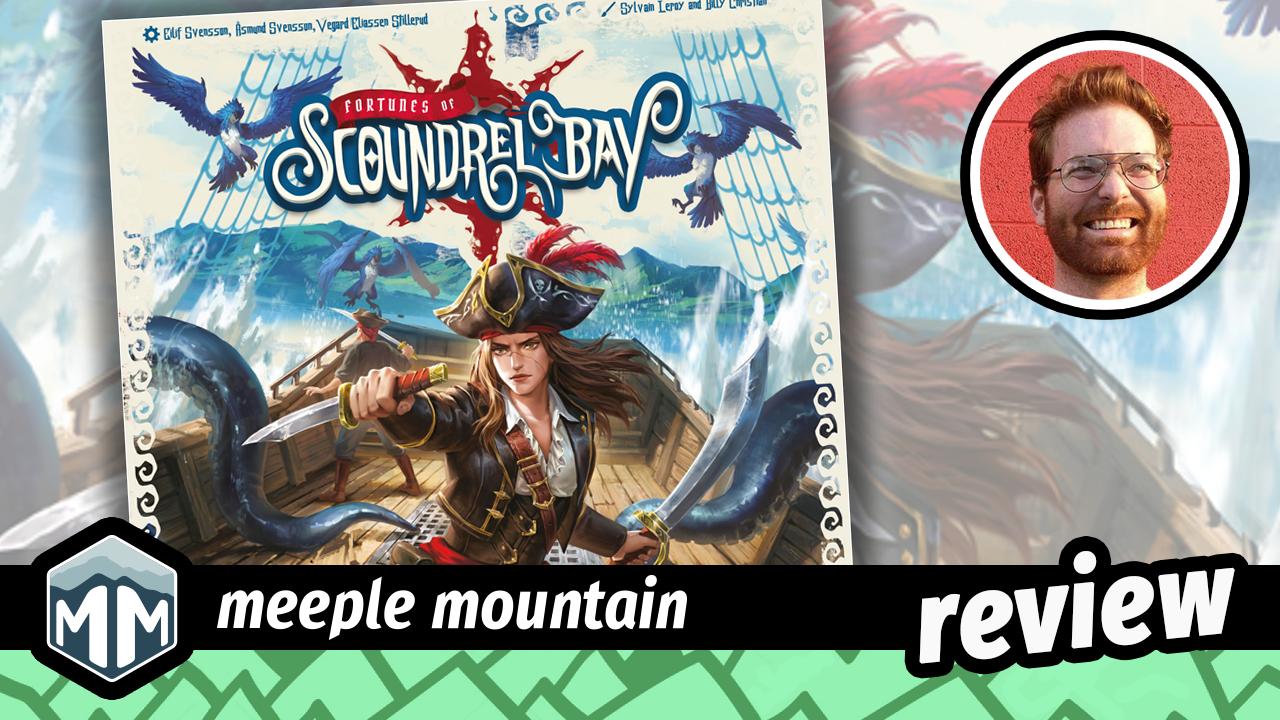
Fortunes of Scoundrel Bay has, on the surface, everything that makes me typically dismiss the latest eurogame from the assembly line: It’s clearly inspired by Alexander Pfister’s Maracaibo and Boonlake, it has questionably silly cover art, and maybe one of the most generic and forgettable “this is a pirate game” names of all time (honestly, we accidentally called it “Scoundrels of Fortune Bay, Bay of Scoundrels, Founders of Fortune Bay, etc.)
I was surprised to just have a great time with Fortunes of Scoundrel Bay (FoSB). It’s always a treat to be delighted by the mechanical flourishes in a design, and this one has plenty of thoughtful choices that come together in a surprisingly mid-weight package.
We’re pirates, yar, but we’re also homebodies
Fortunes of Scoundrel Bay has an interesting rhythm compared to many games that feature seafaring as a central theme. Instead of sail, sail, sail, you are often sailing 1 or 2 spaces, then you’re doing a bunch of different activities for several rounds, then you might sail another space. The arrangement of the board is the shape of a bay, rather than a large expanse of ocean, and this is reflected in how the game plays. You’re more of a pirate party barge than a terrifying group of cutthroats. These pirates love to hang.
Manchmal braucht es für einen guten Plan nur zwei Dinge: einen cleveren Kopf – und einen Komplizen. Genau darum geht es in „The Glasgow Train Robbery“ von Salt & Pepper Games. Das kooperative Brettspiel für zwei Personen lief kürzlich auf Gamefound – und der Coup ist gelungen: Die Kampagne konnte über 40.000 Euro einsammeln und mehr als 400 Unterstützer überzeugen.
Für mich persönlich war das übrigens ein eher ungewöhnlicher Klick auf den „Back“-Button. Crowdfunding funktioniert für mich inzwischen nur noch in sehr engen Grenzen. Zu viele Projekte, zu lange Wartezeiten, zu viele Deluxe-Varianten. „The Glasgow Train Robbery“ gehörte aber zu den wenigen Kampagnen der letzten Zeit, die ich tatsächlich unterstützt habe. Aber das Thema, das Artwork und der Fakt, dass es ein kooperatives Spiel für zwei ist, hat mich einfach überzeugt mal wieder ein Projekt zu unterstützen. Davon abgesehen mag ich die Spiel von Salt and Pepper Games sehr. Auch deren letztes Spiel Onoda hatte ich bereits unterstützt und der Verlag ist u.a. auch für diese besonders ausgefallenen Solo-Spiele (u.a. Conservas) bekannt. Aber auch Spiele für zwei sind eine Spezialität des Verlages.
Warum genau ich auf Crowdfunding nicht mehr so gut zu sprechen bin, darüber habe ich übrigens auch ausführlich mit Uli Blennemann von Spielworxx gesprochen – im „Beyond the Table“-Podcast. In der Episode geht es unter anderem darum, warum Crowdfunding für viele Spieler inzwischen schwieriger geworden ist und welche Projekte trotzdem noch überzeugen können.
Der historische Hintergrund
Die Vorlage für das Spiel ist übrigens einer der berühmtesten Kriminalfälle Großbritanniens. In den frühen Morgenstunden des 8. August 1963 stoppte eine Bande einen Postzug auf der Strecke von Glasgow nach London. Mithilfe manipulierten Signals wurde der Zug an einer abgelegenen Stelle zum Halten gebracht, die Crew überwältigt und gezielt der Geldtransport-Waggon geplündert.
Die Beute betrug rund 2,6 Millionen Pfund, damals eine astronomische Summe. Das entspricht heutzutage in etwa einem Gegenwert von etwa 80 Millionen Euro. Doch obwohl der Coup zunächst perfekt verlief und ohne einen einzigen Schuss abzugeben, verrieten sich einige der Täter später selbst – unter anderem durch Fingerabdrücke, die sie beim Spielen von Monopoly in ihrem Versteck hinterließen. Klingt wie ein schlechter Witz ist aber wahr. Und einer der bekanntesten Gauner Großbritanniens hatte seine Finger im Spiel (im wahrsten Sinne des Wortes) – Ronald Biggs. Dem gelang nach seiner Inhaftierung die Flucht und er lebte 35 Jahre im Ausland, u.a. lange Zeit in Brasilien. Doch 2001 kehrte er zurück nach Großbritannien, wo er 2013 auch starb. Natürlich gibt es zig Dokumentationen zu dem Überfall und einige Verfilmungen, die vom Raub inspiriert wurden oder diesen zum Vorbild hatten. Hervorzuheben ist aus deutsche Sicht der Film Die Gentlemen bitten zur Kasse mit Horst Tappert und Kurt Conradi, der unter dem Namen Arthur Finegan Ronald Biggs verkörperte.
Ein Zugüberfall für genau zwei Personen
Diese Geschichte bildet die Grundlage für „The Glasgow Train Robbery“, ein kooperatives Spiel speziell für zwei Personen. Dabei übernehmen beide Spielende unterschiedliche Rollen innerhalb der Bande:
Coordinator – das strategische Gehirn im Safehouse, das den Plan organisiert und Ressourcen verteilt
Operator – der Mensch draußen an den Gleisen, der den Plan tatsächlich umsetzt
Besonders spannend: Kommunikation ist stark eingeschränkt. Spieler dürfen nur über bestimmte Aktionen ein paar Worte austauschen – ansonsten müssen Bewegungen, Karten und Entscheidungen als Hinweise interpretiert werden. Ein bisschen Gedankenlesen gehört also zum perfekten Coup.
Der Plan in fünf Schritten
Der Überfall selbst läuft über mehrere Plan-Karten, die die echten Schritte des historischen Coups widerspiegeln:
Signale manipulieren
den Zug stoppen und die Crew überwältigen
die Lok bewegen
das Geld umladen
mit dem Fluchtfahrzeug verschwinden
Währenddessen tickt ständig die Uhr: Jede Aktion kostet Zeit und der Zug bewegt sich unaufhaltsam Richtung London. Gleichzeitig sorgen unerwartete Ereignisse und mögliche Spuren – etwa Fingerabdrücke – dafür, dass der perfekt geplante Coup schneller eskalieren kann als gedacht.
Stretch Goals und Extras
Die Gamefound-Kampagne brachte auch einige zusätzliche Inhalte. Freigeschaltete Stretch Goals erweitern das Spiel unter anderem um zusätzliche Karten und Varianten, die neue Herausforderungen in den Ablauf des Überfalls bringen und für mehr Wiederspielwert sorgen.
Zugüberfall zum Mitnehmen
Neben dem klaren Fokus auf zwei Spieler punktet das Spiel auch mit seiner kompakten Box. Damit eignet sich „The Glasgow Train Robbery“ perfekt für unterwegs – egal ob im Urlaub, im Café oder (stilgerecht) im Zug.
Das Spiel befindet sich bereits in Produktion (Crowdfunding mal wieder „nur“ Marketing) und sollte dann auch pünktlich eintreffen, sofern es keine Komplikationen bei der Verschiffung gibt. Aus Sicherheitsgründen hat man von einem Versand per Zug abgesehen… 🙂 Einen Late Pledge wird es somit wohl nicht geben, aber ich bin mir sicher, dass man das Spiel zeitnah erwerben kann.
Asmodee arm Fantasy Flight Games is discontinuing the latest iteration of its veteran dungeon crawler Descent, citing rising manufacturing costs, “global economic shifts” and the expense of developing the game’s companion app.
All three games featured large amounts of plastic miniatures, cardboard terrain pieces and map tiles, while Legends of the Dark also leaned into an integrated companion app to help manage campaigns and individual scenarios.
A statement from FFG announcing the end of the game said, “Simply put, the game is too expensive to make. Between ever-increasing manufacturing costs, lengthy and pricey app development timelines, and global economic shifts making everything more expensive to produce, it became abundantly clear that continuing to make this game is just not feasible.
“This is far from the outcome we wanted – again, we all love this game and hoped to see it grow for years to come – but even if we were to sell every last copy, we would still ultimately be doing so at a loss.
“In a fiercely-competitive board game industry, that simply isn’t sustainable, and because of circumstances outside of FFG’s control, there are no adjustments we could make that could lower costs enough to continue printing the game.”
Standees from Frosthaven || Photo credit: Cephalofair Games
Other competitors in the space have included CMON’s Massive Darkness series – based on its huge-selling Zombicide system – which has raised more than $10m acrossa trio ofcrowdfunds since 2017.
Using crowdfunding for those large-scale, component-heavy games has helped publishers Cephalofair and CMON reduce the risk of developing expensive titles by being able to accurately gauge demand, as well as receiving financial backing for the projects up front.
Even with that data, however, both publishers have run into problems amid the heavy global economic uncertainty over the last couple of years – especially around volatile US tariff policy aimed at countries such as China, where the vast majority of board games are manufactured.
Asmodee has almost entirely avoided crowdfunding for its own games to date, with its only launched campaign believed to be Lookout Games’ Kickstarter for the Grand Austria Hotel: Let’s Waltz! Expansion & Deluxe Upgrade, which raised about €383,000 during the coronavirus pandemic in 2020.
Its only other prior exposure to crowdfunding is thought to be via the company Exploding Kittens, in which it made a strategic investment short of a buyout in 2021. That business has since raised more than $977,000 in a Kickstarter campaign for Hand to Hand Wombat the following year.
Its statement about the end of Descent: Legends of the Dark said, “While we don’t have anything to share at this time, there is always a possibility that we will revisit Descent in the future.
“It would take a different form and would not be Legends of the Dark, but this game universe is near and dear to FFG’s heart.
“The future is always uncertain, and even though we have to close the book on Descent today, we hope that, someday, we’ll be able to dream big with it again.”
FFG’s other major titles currently include collectible card game Star Wars Unlimited, ‘living card games’ Marvel Champions and Arkham Horror: The Card Game, heavyweight space opera board game Twilight Imperium and veteran bluffing and negotiation game Cosmic Encounter.
The company said that although Act III of Descent: Legends of the Dark is no longer in development, the company would continue to support the game’s companion app for the first two acts of the game, albeit without any new content being added.
In February Artefacts Studio unveiled Terrinoth: Heroes of Descent, a video game set in the Descent universe which FFG said “captures the classic dungeon-crawl feeling of the Descent board games in a whole new medium”.
Asmodee co-founder Philippe Mouret and Catan Studio head Pete Fenlon have both stepped back from their high-level roles at the board game giant, with Julia Marcelin and Mike Bisogno stepping up to oversee some of its biggest-selling titles as part of the leadership transition.
Mouret, who co-founded Asmodee more than 30 years ago, was also behind the creation of Splendor publisher Space Cowboys in 2014, and has overseen multiple publishing studios at the business over the years.
Julia Marcelin, who has been with Asmodee for almost seven years, becomes head of five studios as part of the shake-up, taking on responsibility for Days of Wonder, Space Cowboys, Repos Production, Libellud and Next Move.
Marcelin has spent the last year working with Mouret as deputy head of studio in preparation for the transition, Asmodee said, following previous responsibilities in operational strategy and international transformation at the business.
A statement from Asmodee said Mouret had “played a defining role in shaping the company’s creative direction”, as well as “contributed to the development and creation of some of the industry’s most celebrated titles”.
The company said Mouret would “remain closely involved” with its publishing team, working alongside chief product officer Jean-Sébastien De Barros and senior vice president for tabletop Benoit Clerc.
Asmodee also revealed that Pete Fenlon has stepped down as head of Catan Studio after ten years, with his LinkedIn page now updated to place him as “storyteller” and “mentor at large” at the company.
Former Catan Studio head Pete Fenlon
Mike Bisogno, who joined Asmodee three months ago after more than 17 years at Spin Master, takes on the role. He was most recently senior director of design and inventor relations at Spin Master, and also previously worked as a licensing lead at the company.
The game has sold more than 45 million copies and been translated into over 40 languages to date. Asmodee announced a 6th edition of the game last year to coincide with the title’s 30th anniversary.
A statement from Asmodee said, “Mike combines creative leadership with a strong track record of building successful partnerships. His arrival reflects Asmodee’s commitment to sustaining Catan’s legacy while exploring new opportunities for growth.”
It added, “Pete has left an enduring mark on the industry, with a career spanning several decades, including 20 years as CEO and chairman of Mayfair Games, and being a force behind the growth and global success of Catan.
New Catan Studio head Mike Bisognio
“Since joining Asmodee in 2016 to lead Catan Studio, he led the brand through significant expansion and innovation.”
Jean-Sébastien De Barros, chief product officer and executive vice president for publishing at Asmodee, said, “Asmodee has always been built on the strength of its people. I see both Philippe and Pete as mentors for our new generation of Asmodee publishing team members.
“They have each played a pivotal role in shaping not only our portfolio but also the culture of Asmodee, one which resonates with so many players today.
“I’m glad to have shared part of my journey with them and we are confident in the next generation of leaders we’re bringing to these positions as they bring the right energy to continue building on this legacy.”
The board game giant said buying ATM, the publisher of titles including Speed Bac/Quickstop, Mouton Mouton and Pili Pili, was predicated on social games being “the fastest growing category of the board games market”.
The ATM deal followed five other acquisitions from the past 12 months – including the buyout of Japon Brand from CMON, anchoring the board game giant’s push into a “currently untapped market” for the company.
So zuverlässig wie ein Uhrwerk veröffentlicht Stefan Feld jedes Jahr zwei neue Spiele in seiner City Collection bei Queen Games. Mit Valencia erscheint nun die Nummer 9 der Reihe –…

 Anmelden