Wie in den letzten Jahren führen wir von Beeple auch in 2026 wieder eine Osterauktion durch. Wir versteigern wieder Spiele, die wir grösstenteils aus unserem privaten Bestand zur Verfügung stellen. Ergänzt wird das Angebot durch Spenden von Autoren und Verlagen, die ebenfalls tolle Pakete geschnürt haben. Ihr habt so die Möglichkeit, an einige besondere Schmankerl zu kommen […]
In unserem Format „Tipp um Tipp“ laden wir euch ein, mit uns zu quizzen. Wir beschreiben Euch einmal pro Woche in 15 bis 20 Hinweisen ein Brettspiel. Wie schnell bekommt Ihr es heraus? Am Ende gibt es direkt die Auflösung.
Schreibt uns gerne, wie Euch das Quiz gefällt oder sagt einfach hallo.… [Weiterlesen]
Our dear cat Penelope has died. Thus, the history today is personal.
Penelope’s early life is shrouded in mystery. She lived on the streets, but we do not know for how long and if she had been in a human household before. In 2016, she was found and taken to an animal shelter. For the next three years, nobody wanted to adopt her… until we came there and found her to be a somewhat reserved, but very sweet middle-aged lady.
She integrated into the family immediately: One day after her adoption, she already strategized how to blunt the Prussian invasion of Bohemia.
From then on, she was our constant companion. She read with us…
…celebrated Halloween…
and Christmas with us…
…rid our place of provocative ribbons…
…tested all boxes for their sitting qualities…
…and had secret admirers who sent her bouquets.
She even found the time to adopt a secret second identity as quirky nanny Purry Poppins.
Her love for board games remained undiminished. Sometimes we suspected that she considered herself to be a board game.
The only thing she could not abide was me going for business trips. Big-eyed protests were staged on my suitcase.
Yet when I came back and played a game with her, everything was forgiven.
While she certainly enjoyed the games…
…the most important part to her was spending quality time with her family – for example, sitting on my lap while I sorted counters into trays.
Penelope was with us during tumultuous years. No matter if Covid forced us to stay at home or Putin threatened to cut off our energy supply, it was always a comfort to have a furry, affectionate companion with us.
As Penelope aged, her health deteriorated. She succumbed to a lung edema on March 11. She will be greatly missed.
In unserem Format „Tipp um Tipp“ laden wir euch ein, mit uns zu quizzen. Wir beschreiben Euch einmal pro Woche in 15 bis 20 Hinweisen ein Brettspiel. Wie schnell bekommt Ihr es heraus? Am Ende gibt es direkt die Auflösung.
Schreibt uns gerne, wie Euch das Quiz gefällt oder sagt einfach hallo.… [Weiterlesen]
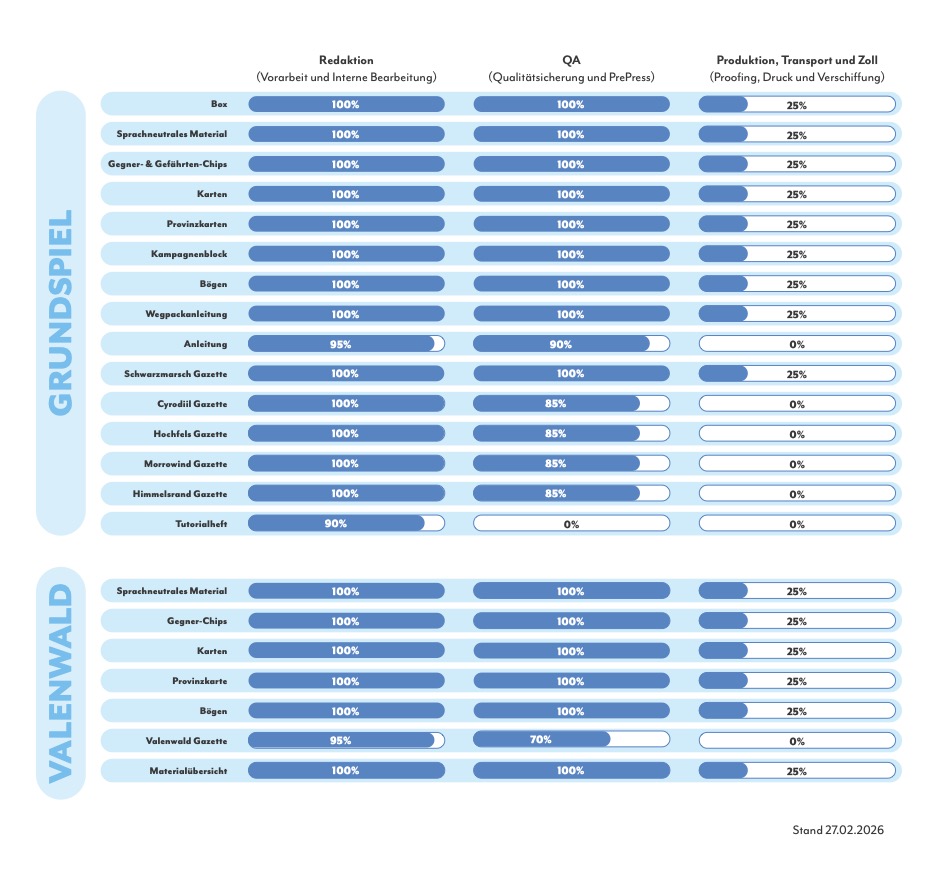
Jens war leider diese Woche krank und konnte nicht so viel einarbeiten wie geplant. Aber es gab wieder viel Feedback vom Korrekturlesen, das nächste Woche umgesetzt wird.
Wir geben euch weiterhin wöchentlich ein Update zum Fortschritt.
In der Schweiz wurde der Brettspielpreis Swiss Gamers Award 2025 vergeben. Dieser wird seit 2010 für das vergangene Jahr vergeben. Seit dem vorletzten Jahr wird neben dem Swiss Gamers Award auch der Swiss Gamers Family Award vergeben, mit dem auch einfache Brettspiele ausgezeichnet werden sollen. Und jetzt NEU: der Swiss Gamers Expert Award. Der Swiss […]
In unserem Format „Tipp um Tipp“ laden wir euch ein, mit uns zu quizzen. Wir beschreiben Euch einmal pro Woche in 15 bis 20 Hinweisen ein Brettspiel. Wie schnell bekommt Ihr es heraus? Am Ende gibt es direkt die Auflösung.
Schreibt uns gerne, wie Euch das Quiz gefällt oder sagt einfach hallo.… [Weiterlesen]
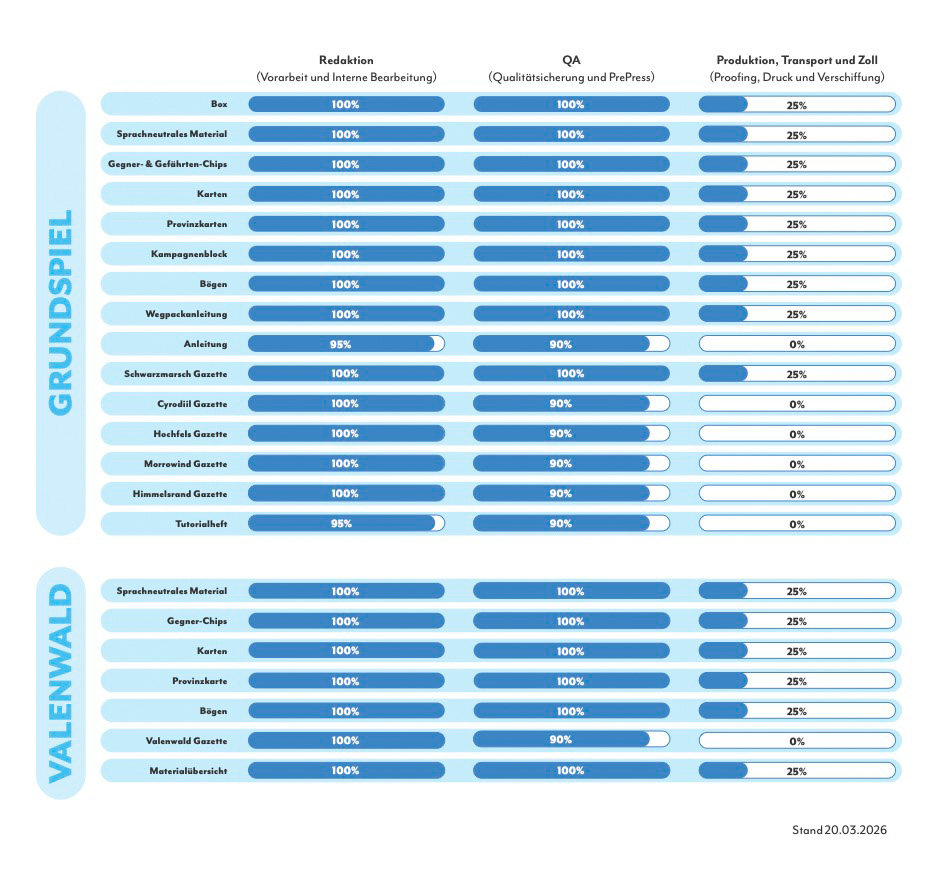
Die Korrekturen aus dem Proofreading werden grad eingearbeitet. Das Tutorialheft ist auch im Proofreading und steht schon für alle im Discord im Channel für Schreibtisch-Spoiler zur Verfügung. Schaut da gerne schon mal rein!
Wir geben euch weiterhin wöchentlich ein Update zum Fortschritt.
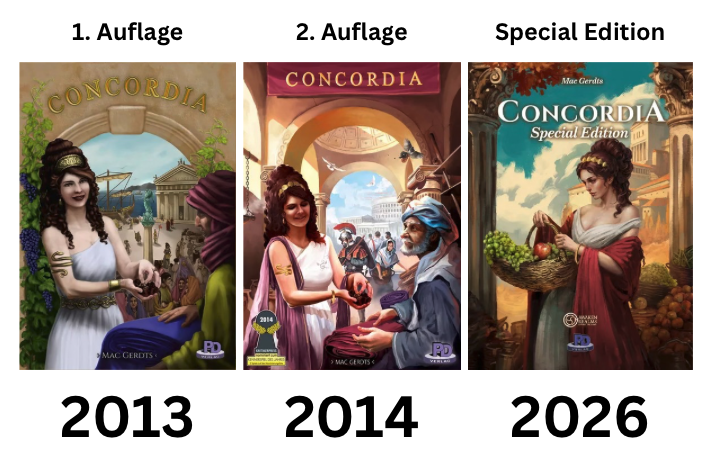
Eigentlich sollte es eine Freude sein. Das Brettspiel Concordia, der elegante Wirtschafts-Klassiker von Mac Gerdts aus dem Jahr 2013 (inzwischen mit unzähligen Erweiterungen ausgestattet), bekommt eine Deluxe-Special-Edition von Awaken Realms. Mehr als 21.000 Menschen folgen bereits der Preview-Seite auf Gamefound. Die Vorfreude war groß – bis das neue Artwork auftauchte. Seitdem diskutiert die internationale Brettspiel-Community […]
Achtung, Achtung! Markiert euch das Wochenende vom 27. bis 29. März in eurem Kalender!
Es ist wieder so weit: Die Frosted Days gehen in die nächste Runde! Auch dieses Jahr laden wir euch wieder zu unserem großen Streaming-Event ein. Freut euch auf mehrere Tage voller Brettspiele, spannender Einblicke hinter die Kulissen, Gespräche mit Gästen – und natürlich auf die eine oder andere Überraschung!
Neben unserem Livestream erwarten euch während der Frosted Days auch wieder besondere Angebote in unserem Webshop, Rabatte auf ausgewählte Titel und vielleicht sogar die Gelegenheit, bei der einen oder anderen Neuheit direkt bei der Vorbestellaktion dabei zu sein.
Genauere Details veröffentlichen wir bald. Ein paar kleine Hinweise darauf, was euch erwartet, wollen wir euch aber schon jetzt geben.
Die große Frosted Days Neuheitenshow
Zum Auftakt der Frosted Days erwartet euch ein besonderes Highlight: unsere große Frosted Games Neuheitenshow.
Dort stellen wir euch unsere kommenden Spiele vor und geben euch einen Ausblick darauf, was euch in nächster Zeit bei Frosted Games erwartet. Natürlich haben wir auch wieder ein paar Überraschungen vorbereitet – darunter Spiele, über die wir bisher noch gar nicht gesprochen haben.
Und wer weiß: Vielleicht startet für die eine oder andere Neuheit sogar direkt im Anschluss eine Vorbestellaktion in unserem Shop.
Angebote, Rabatte und Aktionen
Auch abseits des Streams lohnt es sich, während der Frosted Days regelmäßig bei uns vorbeizuschauen.
In unserem Webshop erwarten euch wieder besondere Angebote und Rabatte auf ausgewählte Spiele. Vielleicht findet ihr also genau den Titel, der euch noch in der Sammlung fehlt – oder entdeckt etwas ganz Neues für euren Spieltisch.
Unser Live-Programm
Natürlich steht aber weiterhin unser Livestream im Mittelpunkt der Frosted Days. Euch erwarten unter anderem:
Let’s Plays unserer aktuellen und kommenden Spiele
Interviews und Gespräche mit Gästen
Einblicke in die Arbeit der Redaktion
und natürlich wieder einige Überraschungen
Während des Streams könnt ihr im Chat Fragen stellen, mitdiskutieren und euch mit uns über Spiele austauschen.
Mehr Infos folgen bald
Das vollständige Programm und alle Details zu den Frosted Days veröffentlichen wir demnächst. Schaut also bald wieder hier vorbei.
Wir freuen uns schon riesig darauf, ein paar tolle Tage mit euch zu verbringen!
It’s Women’s Day! A great opportunity to look pair a book and a game on the American women’s suffrage struggle: The Woman’s Hour (Elaine Weiss) and Votes for Women (Tory Brown, Fort Circle).
The Woman’s Hour was published in 2018 by Viking Press. It focuses on the campaigns for and against Tennessee to ratify the 19th Amendment which enshrined women’s suffrage in the US constitution – as the 36th, and decisive, state to do so.
Votes for Women was published in 2022. It is Tory Brown’s first published board game. The card-driven game can be played in a solo or cooperative mode with the player(s) representing the American suffrage movement from 1848 to 1920 against an automated opposition, or with two to four players facing off against each other (half of them for, the other against women’s suffrage). In either case, the suffrage players must win 36 states (either by shoring them up decisively during the game, or in the final vote on ratification of the federal amendment) to win.
Connections & Conclusions
At first look, book and game seem to have very different scopes. After all, Votes for Women sets in with the Seneca Falls Convention (at which women’s suffrage was first voiced as a political demand in the United States) in 1848 and covers the following 72 years, whereas The Woman’s Hour begins with the arrival of activists Carrie Chapman Catt, Sue White, and Josephine Pearson at the Nashville station in the sweltering summer of 1920. Yet as the narrative progresses, background stories are woven into the tapestry – on the context of the 1920 presidential election, suffragists’ previous efforts to gain voting rights for women in the states and to lobby for a federal amendment, the women’s suffrage movement’s relationship with abolitionism, and all the way back to Seneca Falls (and a little bit of Abigail Adams’s “Remember the Ladies”). If you have played Votes for Women, you will recognize many of the people and events on the cards from the early and middle periods of the game when reading The Woman’s Hour.
The Seneca Falls Convention is the Start card for the suffragist player with which any game of Votes for Women kicks off, following the tradition laid out by protagonist Elizabeth Cady Stanton that this was the starting point of the American women’s suffrage movement.
What unites book and game is their focus on procedural politics. Historical change does not simply happen, nor is momentarily decided upon. Instead, it is brought into effect by the “strong, slow drilling into hardwood boards with passion as well as sound judgment” (Max Weber). The drills used come in both cases from the toolbox of political activism:
The Woman’s Hour details how suffragists (suffs) and anti-suffragists (antis) lobbied the Tennessee lawmakers, how they organized in associations and clubs to channel their activists’ time, funds, and energy, and, of course, how they campaigned for public opinion to win the hearts and minds of the American people with newspaper articles, public speeches, great processions, and all kinds of civil disobedience.
Votes for Women makes these the three actions from which the players choose on a given turn: Lobbying (for and against the 19th Amendment in Congress), organizing (to gain the crucial buttons which are the currency for some powerful in-game effects and die re-rolls), and campaigning (which spreads influence cubes and thus eventually decides if enough states come out in favor of ratification of the 19th Amendment or not).
Early in the game: There are still a lot of orange Opposition cubes, but the women’s suffrage movement has made some inroads (yellow and purple cubes). The large round buttons represent the movement’s organizational strength, the white columns (one already placed on the track under the picture of the Capitol) the willingness of Congress to pass the women’s suffrage amendment.
As we’ve mentioned civil disobedience already: The women’s suffrage movement was no monolithic bloc. One of the great dividing lines was that of styles: The more conventional part of the movement, organized in the late 19th and early 20th century in the National American Women’s Suffrage Association (NAWSA) led by Carrie Chapman Catt, paid close attention to appear as respectable as possible (knowing full well that their demand for equal suffrage was enough of a provocation to the male public opinion of the time). Others adopted a more radical style, inspired by the British suffragettes: The Women’s Party, led by Alice Paul (and represented in Tennessee by Sue White) referred to the president as “Kaiser Wilson” in reference to the German war enemy, burned him in effigy, and (successfully) provoked the police into arresting activists over minor infractions. The dainty young women and respectable matrons who served some prison time then embodied the injustice of depriving women of their vote.
The Woman’s Hour details these fractions within the movement, as NAWSA and the Women’s Party led entirely separate campaigns for Tennessee’s ratification of the 19th Amendment. While infighting was avoided, the reader is left to wonder if the movement could have been more effective if not for these parallel structures – or if the split between a more moderate and a more radical wing was able to compel a broader spectrum of audiences by working in parallel.
Votes for Women depicts the multifaceted character of the women’s suffrage movement by splitting the suffragist player into campaigner figures and influence of cubes of two colors (yellow/gold, the traditional color of the American women’s suffrage movement, and purple, a color which Alice Paul had coopted from the British suffrage movement). As several Opposition event cards target the highest concentration of one or the other color, the Suffragist player is well-advised to aim for an even spread of colors in the individual states.
The pluralism of the women’s suffrage movement is exemplified by the two colors… and a plethora of Opposition events which target only one or the other.
Votes for Women also tackles another split in the women’s suffrage movement which is outside the scope of The Woman’s Hour – that on strategy. After the initial push for women’s suffrage as a part of a great campaign for equal suffrage regardless of sex and race had failed in the aftermath of the Civil War, the suffragists disagreed on how to proceed: Some pushed for a federal amendment to the Constitution (like the 15th Amendment had codified the voting rights of black men), others wanted to win voting rights in the individual states first. While the struggle for women’s voting rights was eventually won with the ratification of the 19th Amendment in Tennessee, the voting rights advances in the individual states had laid the groundwork: Wyoming had established women’s suffrage as early as 1869, Montana sent Jeannette Rankin as the first woman to Capitol Hill, and by 1917, women in 19 states – mostly in the West and Midwest – had won the right to vote (sometimes only in a limited fashion, like voting in local elections).
Votes for Women’s stance is that it needs both – after all, the game is lost for the suffragist player if their lobbying fails to get the federal amendment through Congress, but to win, they need the strength amassed in dozens of local campaigns to have the amendment ratified in enough states. The game, however, makes a statement about timing: While it is possible for the suffragist to have Congress pass the 19th Amendment in the mid-game already, that is a decidedly risky strategy which gives the Opposition a lot of opportunity to snatch individual states and rack up the necessary 13 rejections which mean the failure of the amendment. The ideal move for the suffragist is to build up the strength in the states as much as possible before pushing Congress into action as late as possible. While that is not without its risks (Opposition can still try to throw wrenches in the wheels of congressional action), it spreads them more evenly between federal and local action.
As mentioned above, equal suffrage spread from the American West and Midwest. It had a much harder time in the Northeast and in southern states – like Tennessee. The southern states were not only more conservative in general, suffragists also faced specific obstacles there: Many southern whites remained committed to the cause of white supremacy after the defeat of the Confederacy in the Civil War. Enfranchising women would give the right to vote to black as well as white women, and in the mind of the white supremacists, white women would be much less likely to actually exercise it (be it because they, as “proper” women, would rely on their men to represent them, or because they would not go to a polling station where they might meet with Black Americans). Others, while generally in favor of women’s suffrage, resented the method: After the Civil War, the 13th, 14th, and 15th Amendments had enshrined certain rights (including male voting) for Black Americans in the Constitution. Federal amendments were thus unpopular with many southern whites.
As The Woman’s Hour details, this provided for a lot of traction for the anti movement in Tennessee. Activists like Nina Pinckard and Josephine Pearson railed against carpet-bagging outsiders swooping down from the North to meddle with Tennessee’s affairs, warned of impending “negro domination”, and appealed to the chivalry of southern men to rescue their women from being thrown into the dirty cesspit of politics. That they themselves were knee-deep in that cesspit – after all, they were political activists! – bothered them as much as modern-day “tradwives” are bothered by the fact that their plea for women to be submissive to and dependent on their men is at odds with their often successful social media enterprises.
Somewhat counter-intuitively, many women opposed women’s suffrage on moral or political grounds. Votes for Women does a great job in showing the multi-facetedness of the anti movement beyond the male political and business establishment.
Inherent contradictions aside, the antis’ arguments needed to be countered by the suffs. Many of the white suffragists were willing to make rhetorical or substantial compromises: One of NAWSA’s most-cited statistics in the Tennessee campaign was that the number of white women in the south exceeded that of black men and women combined. Enfranchising women, so the more-or-less subtle subtext, would thus not threaten white supremacy – it might even strengthen it. In the end, the tacit agreement was like that found after the Reconstruction amendments designed to protect Black Americans’ rights in the South: The women’s suffrage amendment made its way into the constitution. Yet voting rights were overseen by the individual states, and federal institutions looked the other way about the blatant disenfranchisement of black voters in the South until the Voting Rights Act almost half a century later.
Neither The Woman’s Hour nor Votes for Women shies away from this uncomfortable part of the women’s suffrage movement: The protagonists of the movement are not portrayed as infallible saints in the book. While they held wildly progressive views for their time on women’s suffrage, their stances on issues of race and class were often more in keeping with those of their contemporaries. They also made tactical mistakes, like Carrie Chapman Catt railing against outsiders trying to influence Tennessee – a charge that was immediately turned against her, a Northerner herself, and restricted her visibility for the remainder of the campaign. And most of them were willing to make compromises for the cause of women’s suffrage – sometimes with themselves (Carrie Chapman Catt supported the US effort in World War I against her pacifist convictions lest the women’s suffrage movement be branded unpatriotic), and sometimes at the expense of others. In short, they were human.
Would the 19th Amendment have passed in Tennessee if the suffragists had been less willing to assuage the fears of southern whites about “black domination”? – Probably not – maybe another state could have become the decisive 36th then, but all likely options had been exhausted before. Did the Black Americans in the South, men and women, suffer from the continued disenfranchisement after 1920? – Undoubtedly.
The South is notoriously tough for the suffragists. Placing a ton of cubes there (plus some additional perks) is a tempting proposition.
Suffragist players in Votes for Women face the same strategic and ethical question (of course, with infinitely lower stakes): One of the most powerful cards in the game is The Southern Strategy which places an immense amount of suffragist influence in the South (representing the union between suffragists and white supremacists). It does open the suffragist for some counter-plays from the opposition, though. Savvy suffragist players might hold the card from turn to turn to play it as late as possible, as an uncounterable stratagem in the final struggle for women’s suffrage. Victories won that way have an odd aftertaste, I assure you.
Since Votes for Women has been released, it’s been in the top 5 of games I have played most often. And while I rarely re-read books, especially non-fiction (because there are always intriguing new books to read), I have come back to The Woman’s Hour and have now both read the physical book and listened to the (excellent) audiobook production. Besides all their worthy exploration and analysis of history, that speaks to both the game and the book being excellently crafted, incredibly engaging pinnacles of their respective medium.
In unserem Format „Tipp um Tipp“ laden wir euch ein, mit uns zu quizzen. Wir beschreiben Euch einmal pro Woche in 15 bis 20 Hinweisen ein Brettspiel. Wie schnell bekommt Ihr es heraus? Am Ende gibt es direkt die Auflösung.
Schreibt uns gerne, wie Euch das Quiz gefällt oder sagt einfach hallo.… [Weiterlesen]
Und damit sind wir komplett. Tim rundet das Team der Brettspielbox ab. Bisher schon vorgestellt: Tim Rolle / Funktion: Vorschau, Rezension, Video Seit wann im Team? 2021 Wohnort: Izmir (bis 09/26) Wer bin ich? Tim liebt das verbindende Element von Brettspielen. Für ihn gibt es kaum einen besseren Ort, um mit völlig unterschiedlichen Menschen ins […]
Gazettere befinden sich mittlerweile alle im Proofreading. Die Korrekturen und ersten Änderungen wurden daraufhin auch schon eingearbeitet. Das Tutorialheft hat noch mal eine Überarbeitung bekommen und geht am Montag in das finale Proofreading.
Wir geben euch weiterhin wöchentlich ein Update zum Fortschritt.
Die fünfte im Bunde und unser neuster Zuwachs im Team ist Tanja. Bisher schon vorgestellt: Tanja Rolle / Funktion: Rezensentin, Video (Schwerpunkt Kinderspiele) Seit wann im Team? 2024 Wohnort: Köln Wer bin ich? Tanja spielt fast täglich, organisiert einen Spieletreff in Köln Junkersdorf und ist mindestens einmal im Monat unterwegs um Spiele auf Messen oder […]
Morgen um 12:00 Uhr schalten wir LIVE aus dem Büro!
Unser erstes „Wann kommt was?“-Update steht an – inklusive Q&A.
Ben gibt euch einen Überblick über den aktuellen Stand unserer Spiele, kommende Updates und woran wir gerade arbeiten.
Außerdem habt ihr die Chance, eure Fragen direkt zu stellen – und Ben reagiert live darauf.
Merkt euch den Link vor, schaltet morgen um 12:00 Uhr ein und seid dabei!
Zum Ende des Jahres 2025 wollten wir es ganz genau wissen: Was lief gut? Was lief weniger gut? Wo können wir besser werden?
Also haben wir euch gefragt.
Und ihr habt geliefert.
847 von euch haben sich die Zeit genommen, uns ehrliches, ausführliches und konstruktives Feedback zu geben. Dafür möchten wir einfach nur Danke sagen. ❤️
Lob, Kritik – und alles dazwischen
Eure Rückmeldungen waren so vielfältig wie unsere Community selbst. Es gab:
Wertschätzung für Dinge, die gut funktionieren
konkrete Kritikpunkte, wo wir nachbessern sollten
neue Ideen und Impulse
Perspektiven, auf die wir selbst noch gar nicht gekommen waren
Genau das macht Feedback so wertvoll. Es zeigt uns nicht nur, wo wir stehen, sondern auch, wohin wir uns gemeinsam entwickeln können.
Warum uns das wichtig ist
Community bedeutet für uns nicht nur Reichweite oder Zahlen. Es bedeutet Austausch. Zuhören. Weiterdenken.
Dass sich 847 Menschen aktiv beteiligt haben, zeigt uns vor allem eines: Ihr wollt mitgestalten. Und das nehmen wir ernst.
Ben reagiert auf euer Feedback
Natürlich wollten wir eure Rückmeldungen nicht einfach nur intern auswerten. Deshalb gibt es jetzt ein Video, in dem Ben direkt auf euer Feedback reagiert.
Offen. Ehrlich. Ungefiltert.
Schaut unbedingt rein und begleitet uns dabei, wie wir gemeinsam auf das Jahr 2025 zurückblicken – und nach vorne schauen.
Die vierte im Bunde ist Nina. Bisher schon vorgestellt: Nina Rolle / Funktion: Korrektorat, (Video – Kinderspiele) Seit wann im Team? 2023 Wohnort: Waltrop Wer bin ich? Nina spielt seit ihrer Kindheit Brettspiele und gibt diese Leidenschaft nun auch an ihre Kinder weiter. Bei der Brettspielbox ist sie die „Gute Seele“ im Hintergrund, jagt kleine […]
Nach Björn und Carina kommt hier nun Nr. 3 in der alphabetischen Reihenfolge. Christoph ist das Urgestein der Brettspielbox. Christoph Rolle / Funktion: Redaktion, Rezensent, Video Seit wann im Team? Gründer, 2014 Wohnort: Bonn Wer bin ich? Christoph Post ist Autor (Handbuch Brettspiele und 101 Dinge, die du über Gesellschaftsspiele wissen musst) und Betreiber der […]
In unserem Format „Tipp um Tipp“ laden wir euch ein, mit uns zu quizzen. Wir beschreiben Euch einmal pro Woche in 15 bis 20 Hinweisen ein Brettspiel. Wie schnell bekommt Ihr es heraus? Am Ende gibt es direkt die Auflösung.
Schreibt uns gerne, wie Euch das Quiz gefällt oder sagt einfach hallo.… [Weiterlesen]

 Anmelden