With this My Favorite Wargame Cards Series, I hope to take a look at a specific card from the various wargames that I have played and share how it is used in the game. I am not a strategist and frankly I am not that good at games but I do understand how things should work and be used in games. With that being said, here is the next entry in this series.
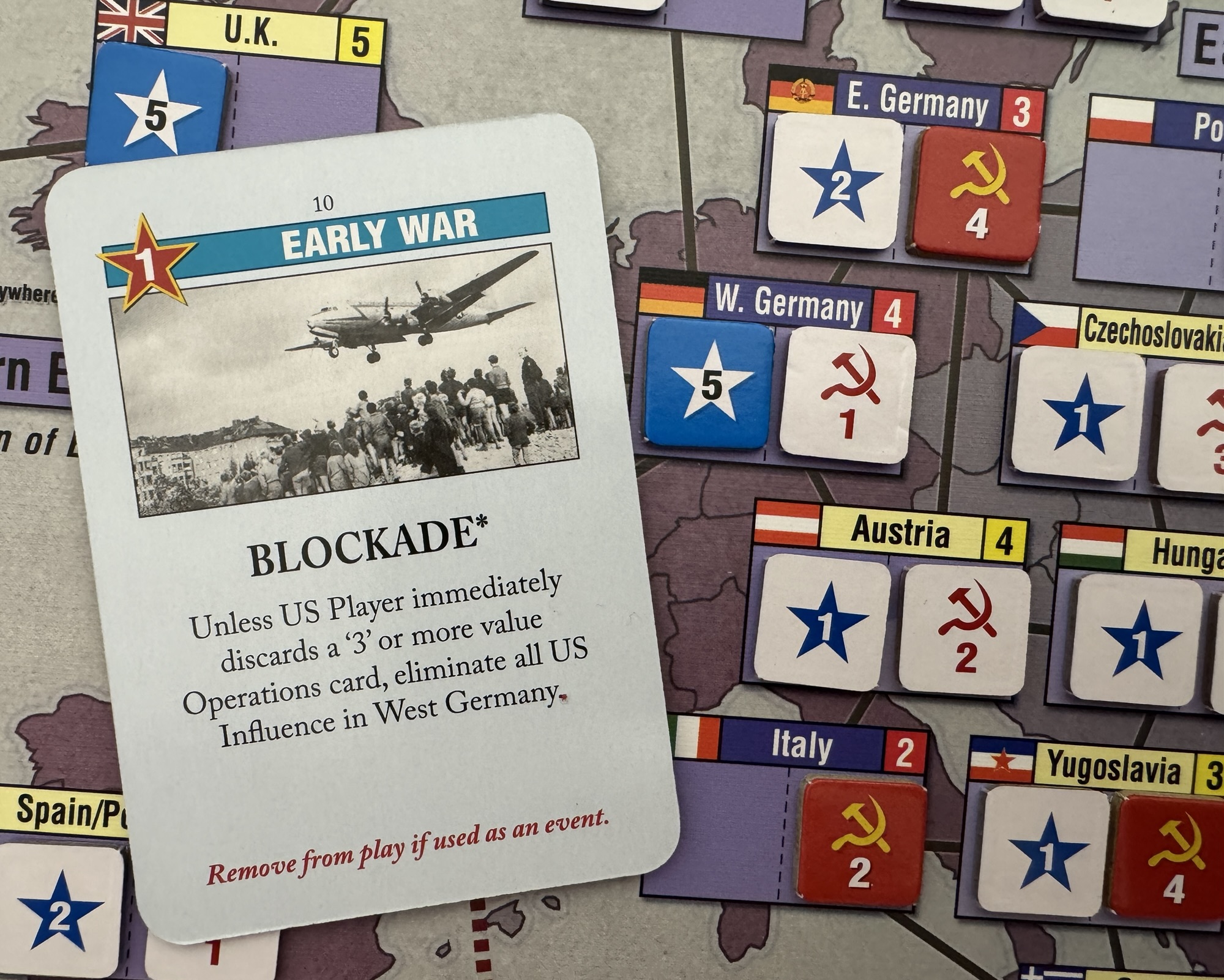
#69: Blockade from Twilight Struggle: The Cold War, 1945-1989 from GMT Games
Twilight Struggle is a 2-player game simulating the forty-five year ideological struggle known as the Cold War between the Soviet Union and the United States which can be played in 2-3 hours. The entire world is the stage on which these two countries “fight” to make the world safe for their own ideologies and way of life. The game starts right after the end of World War II in the midst of the ruins of Europe as the two new “superpowers” of the world squabble over what is left and ends in 1989, when only the United States remained standing.
The map is a world map of the period, where players move units and exert influence in attempts to gain allies and control for their superpower. The beauty of the CDG system used here is that each decision of whether to use a card for the event or the operations value is a struggle as if it is the other side’s event, it might go off hurting you very badly. There are mechanics to allow for the ignoring or cancelling of some of the best cards for your opponent in a side game within the game called The Space Race as well as nuclear tensions, with the possibility of game-ending global thermonuclear war (Shall we play a game, anyone?). I have played TS about 30 times and love it more and more with each sitting. The game makes me sweat, cringe, jump with joy and bite my fingernails. To me, a game that can do all of that in one sitting is worth the price.
One of my favorite type of cards from the game are those that force an action upon your opponent, such as discarding a card, reducing the Ops from card plays or causing them to have to make other plans than what they were working toward. These type of cards are more reactionary but definitely cause issues and mimic the various non-military focused strategies and tactics used during the Cold War. One of the most famous events from the early history of the Cold War is that of the Berlin Blockade. And there is a specific card that pays homage to the event in the game called Blockade. Blockade is an Early War Soviet Card that has an Ops Value of 1, which makes the card more valuable to be used for the printed event versus for the Ops.
When played, the card requires the US Player to immediately discard a 3 Ops or more value card from their hand or the consequence of not doing so will see all US Influence being removed from West Germany. This is a tough choice. Being early in the game, it is possible for the US to rebuild in West Germany and replace the lost influence over time if they do not wish to discard such as high value card. But, herein lies the real key to the Blockade cards use. The Soviet Player, who should be paying attention to not only their hand but also the card plays of the US Player, should try to use this card later in a turn once the US Player has played a majority of their cards in order to ensure that the event text can be realistically be achieved. If played quickly during a turn, the chances of the US Player being able to discard the required 3 Ops or great value card is higher and the card play will not generate any meaningful difference on the board state. I also would recommend a 2 card strategy here as the Soviet Player should be holding in their hand a high Ops card to be able to follow up this action with the placement of Influence into West Germany on their very next play. But, the real value to a card such as Blockade is that it forces the US Player to consider what cards are out there and to play around their negative effects as much as possible. Due to the nature of the game, and the randomness of card draws, having an expendable high Ops card ready and able to be discarded just in case of the play of Blockade is not really feasible. Also, remember that in Twilight Struggle that opponent events on cards that you play will go off and Blockade being drawn by the US Player can be bad as it will require them to play the event as you cannot discard a 1 Ops card to get rid of its negative effect in the Space Race Track due to the minimum requirement being a 2 Ops card. So the moral of the story here is that both players need to consider and plan for the play of or the mitigation of damage from Blockade.
The Berlin Blockade, which lasted from June 1948–May 1949, was a major Cold War crisis where the Soviet Union blocked all land and water access to West Berlin to attempt to force Western Allies out. The Soviet Union was taking this action as a means of retaliation against the introduction of the new Deutschmark currency. The US and Britain responded with the massive Berlin Airlift, flying over 2.3 million tons of food, fuel and supplies to the city. At the peak of the Airlift, a plane landed in West Berlin every 30 seconds. The blockade failed and the Soviets lifted it on May 12, 1949, after realizing the Allied Airlift could sustain the city for an extended period of time, marking a significant victory for the West in the ideological struggle. This event led to the acceleration of the division of Germany into East and West and the deepening of Cold War tensions.
Two weeks ago, we’ve looked at the first period of Soviet liberalization under Nikita Khrushchev from the 1950s on. While these reforms ended the era of Stalinist totalitarianism, they petered out when Khrushchev lost interest in them and was eventually overthrown and replaced by the more conservative Leonid Brezhnev. It would take another generation until a new Soviet leader, Mikhail Gorbachev, would undertake another broad reform program. These reforms – like last time, in the realms of domestic, foreign, and economic policy – are the subject of this article. Of course, you’ll also find a few board games in it!
Freer Press, Freer Elections
The Soviet Union’s political landscape had ossified under Brezhnev. This stagnation (or, if you want to phrase it more positively, hyperstability) also ruled out any experiments after Brezhnev’s death in 1982, and so the Politburo selected his loyal lieutenant Yuri Andropov. Unfortunately, Andropov was already 68 and severely ill then. He died in 1984, to be succeeded by another Brezhnevite stalwart, Konstantin Chernenko, who was similarly afflicted and even older (72 at his accession). Chernenko died in 1985. The rapid succession of aging Soviet leaders is poignantly captured in the contemporary joke: Margaret Thatcher calls Ronald Reagan: “It’s a pity you didn’t come to the funeral of the Soviet general secretary. Marvelous. A great spectacle. I’m totally going again next year.”
Cover of the English-language edition of Kremlin. Unfortunately, fake Cyrillic was once more irresistible, and so the R in Kremlin has been replaced with a Я (which would make the word Kyaemlin).
Another quasi-contemporary (1986) satirical take on the Soviet gerontocracy is Kremlin (Urs Hostettler, Fata Morgana): Players support the various Politburo members in the hopes of advancing those they have influence with to the top jobs, but many a hopeful candidate will die of stress and old age before realizing their ambitions.
After Chernenko’s death, even the most conservative Politburo members saw the need for a different tack: They elected Mikhail Gorbachev as their new leader in 1985, a real baby at age 54. Gorbachev’s reformist leanings were well-known, but he proceeded cautiously in his first year. As with Khrushchev, the big programmatic changes were first announced at a Party Conference of the Communist Party of the Soviet Union.
Gorbachev’s first slogan for his reforms was glasnost (openness). That included sweeping changes to Soviet citizens’ freedom of expression: Gorbachev encouraged the Soviet press to scrutinize politics instead of simply parroting the party line. Dissidents were released from prison. Even non-state-sponsored demonstrations were allowed – a powerful tool to express malcontent with the government. Of course, these reforms undermined the power base of the Communist Party – but Gorbachev hoped that he could steer the ship of state in the new environment and might even benefit from a freer populace.
Even more radical were Gorbachev’s institutional reforms, usually referred to as perestroika (restructuring): The Communist Party’s monopoly on power was cut off by establishing the Congress of People’s Deputies as an independent parliament, and while the first elections in 1989 were not fully free, it was the first time that Soviet citizens could select from several candidates in a contested election. Gorbachev himself chose to base his power no longer on his role as General Secretary of the Communist Party, and instead was elected President of the Soviet Union by the Congress of People’s Deputies in 1990.
This nascent democratization drive – eventually rather envisioned than enacted – makes for the most powerful card in the last phase (1985—1991) of the Cold-War-in-a-nutshell which is Twilight Squabble (David J. Mortimer, AEG): It’s a bit of speculation on the internal and external legitimacy and attractiveness a more democratic Soviet Union could have enjoyed.
Speaking of external legitimacy and attractiveness: Gorbachev’s policies (and he himself) would prove immensely popular in the West… after he had weathered the initial suspicion. Gorbachev began to advocate for a return to détente soon after he assumed office, but US president Ronald Reagan assumed this to be a Soviet ploy. Only after Gorbachev had met Reagan at the 1986 Reykjavík summit did the president believe Gorbachev’s intentions to be genuine.
In the following years, the two of them agreed on far-reaching mutual disarmament, most notably the Intermediate-Range Nuclear Forces (INF) Treaty. Gorbachev’s immutable advocacy for arms reduction is reflected in Wir sind das Volk! – 2+2 (Richard Sivel/Peer Sylvester, Histogame) as his event card cannot be used for the arms race.
Besides the lofty realms of nuclear arms reduction, Gorbachev also had more grounded problems to deal with: The Soviet Union had invaded Afghanistan in 1979 to prop up the failing pro-Soviet government there and had been embroiled since then in a costly and futile counter-insurgency. As the Soviet military could not present Gorbachev with a convincing roadmap on how to win the war, he decided to pull the Soviet forces out in 1988. By that time, the unsuccessful war had undermined the Soviet government’s legitimacy which had rested on its status as a military superpower, exacerbated by the new avenues of political expression open to disaffected citizens – the mothers of Soviet soldiers who fought (or had died) in Afghanistan were among the first to form associations, to pressure the government, and to protest.
In that sense, it is surprising that the withdrawal from Afghanistan can still net the Communist player points in 1989 (Jason Matthews/Ted Torgerson, GMT Games) – but the general principle holds true: The later the Soviets withdraw, the more their failure in Afghanistan becomes an asset to the opponents of Communist power.
Finally, Soviet power was the rock on which the Communist governments in Eastern Europe rested. Whenever they had been challenged – most importantly in Hungary in 1956 and Czechoslovakia in 1968 – Soviet tanks had quashed the dissent. This limited sovereignty within the Eastern bloc had been the central tenet of Soviet foreign policy, after 1968 named the Brezhnev Doctrine. Gorbachev adopted a new approach: He would not militarily intervene in Eastern Europe anymore. Instead, the countries of the Warsaw Pact were free to “do it their way” – thus humorously called the Sinatra Doctrine.
Finally, Gorbachev’s reform agenda of perestroika also aimed to transform the Soviet economy. All Soviet leaders had engaged in some kind of economic reforms, so Gorbachev’s activity did not seem very surprising… until observers inside and outside of the Soviet Union realized how radically it would change the tenets of the Soviet economy, traditionally based on central planning, large state-owned companies, and very limited contacts with the outside world.
First, Gorbachev gave the state-owned companies much more leeway over what to produce and how to set prices. These market incentives were supposed to improve efficiency, but clashed with the existing structures.
Undeterred, Gorbachev went a step further and loosened the restriction on private enterprises. More Soviet citizens could start their own store or workshop and offer goods and services at their own responsibility.
Then, Gorbachev allowed for joint ventures with Western companies (provided the Soviet part owned a majority share), and even let them set up dependencies in the Soviet Union – the famous first McDonald’s restaurant in the Soviet Union opened in January 1990.
The End of the Cold War and the Collapse of the Soviet Union
Gorbachev’s daring move to end hostilities with the West was an unqualified success. In late 1989, he and US president George H.W. Bush could merrily declare together that the Cold War was over.
The consequences of Gorbachev’s foreign policy reverberated through the Eastern Bloc: The allied Communist regimes of Central and Eastern Europe were swept away in 1989.
Early in a game of 1989: The Democrat (blue) has already taken power in Poland and Hungary. It will be difficult for the Communist (red) to stop the ever-growing blue tide. From the Rally the Troops! implementation.
The Perestroika and Glasnost event in Wir sind das Volk! – 2+2 neatly shows the way in which Gorbachev’s reforms put stress on the system: On the one hand, it increases Soviet dominance and makes socialism more attractive (lower two icons). However, it also increases unrest in East Germany (fist icons).
Within the Soviet Union, the political freedoms granted allowed citizens to demand more freedoms. These centrifugal effects became particularly visible as most of the non-Russian republics soon had nationalist independence movements which began to eat away the Soviet Union from its ethnic fringes. Gorbachev responded by proposing a looser federation between the Soviet Republics.
The political reforms also had negative interaction with the economic reforms: On the one hand, the flurry of changes created new inefficiencies; on the other, the increased freedom of the press highlighted economic problems no matter if they were new or had existed for centuries. As Soviet economic performance thus both objectively worsened and also became more obvious to the average citizen, Gorbachev’s legitimacy eroded.
Hardliners within the Communist Party couped against Gorbachev in August 1991 to prevent the loose federation between the Soviet Republics. A coup might also spell the end for the player in the solo game Gorbachev: The Fall of Communism (R. Ben Madison, White Dog Games). It’s a States of Siege game with a twist: Whenever the marker on any of the five paths (four of which refer to various ethno-national groups in the Soviet Union, the fifth represents the Communist Party) reaches the center, the game is not lost immediately, but a coup is staged: If Gorbachev has enough elite support to weather it, he goes on to fight another day.
In history, that was not the case: While the coup failed, it made Gorbachev a lame duck. The supporters of reforms turned away from him and toward his erstwhile ally Boris Yeltsin (who had cut a much more dashing figure during the coup), and away from the Soviet Union and toward their respective ethno-national identities. Gorbachev resigned as president and the Soviet Union was dissolved in December 1991.
The most influential work on Gorbachev’s time in office and his policies remains Brown, Archie: The Gorbachev Factor, Oxford University Press, Oxford 1996.
A magisterial mosaic of Soviet social, economic, and cultural life is Schlögel, Karl: The Soviet Century. Archaeology of a Lost World, Princeton University Press, Princeton, NJ 2023.
For the age of hyperstability before Gorbachev (and the discussion if it was an age of stability or stagnation), see the essays (in German, but with English abstracts) in: Belge, Boris/Deuerlein, Martin (eds.): Goldenes Zeitalter der Stagnation? Perspektiven auf die sowjetische Ordnung der Brežnev-Ära, Mohr Siebeck, Tübingen 2014.
On the transformative last third of the 20th century in Russian history, see Kotkin, Stephen: Armageddon Averted. The Soviet Collapse, 1970-2000, Oxford University Press, Oxford 2001.
On the end of the Cold War, see Dockrill, Saki Ruth: The End of the Cold War Era. The Transformation of the Global Security Order, Hodder, London 2005.
For the Soviet intervention in Afghanistan, see Braithwaite, Rodric: Afgantsy. The Russians in Afghanistan, 1979—1989, Oxford University Press, Oxford 2011.
With this My Favorite Wargame Cards Series, I hope to take a look at a specific card from the various wargames that I have played and share how it is used in the game. I am not a strategist and frankly I am not that good at games but I do understand how things should work and be used in games. With that being said, here is the next entry in this series.
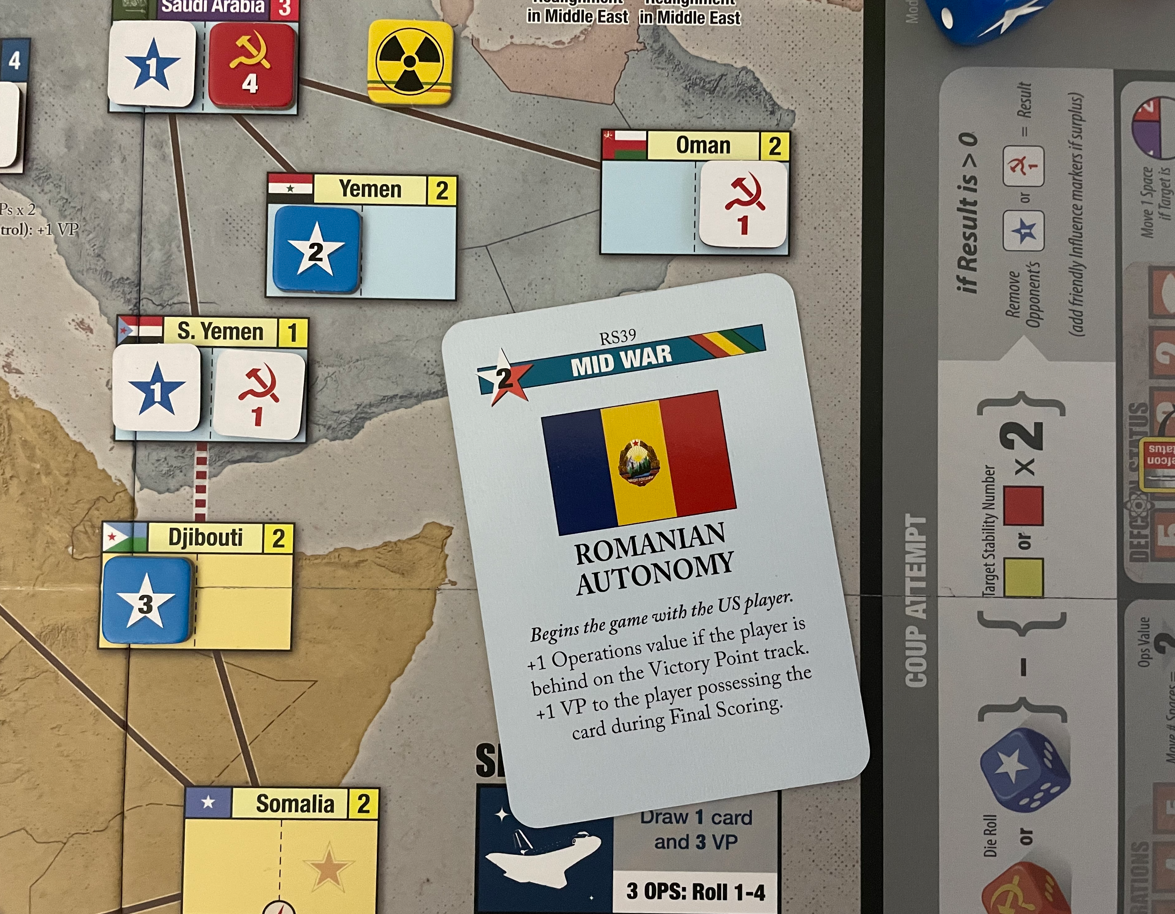
#62: Romanian Autonomy from Twilight Struggle: Red Sea – Conflict in the Horn of Africa from GMT Games from GMT Games
We all love Twilight Struggle….and if you say you don’t, you really do but just want to be different or are a contrarian! The game is phenomenal and has done very well for GMT Games with 8 Printings as well as the Turn Zero Expansion and now a series of smaller geographically focused spin off games starting with Twilight Struggle: Red Sea – Conflict in the Horn of Africa. Twilight Struggle: Red Sea deals with just two regions located in the Horn of Africa including Africa and the Middle East. The game uses the familiar Twilight Struggle formula of Cards with both Events and Operations Points that can be used by players to perform Coups, do Realignment Rolls or place Influence in an effort to gain control of the most Countries in the Regions to score Victory Points and win the game. The game is fast, furious and only lasts 2 hands of cards (unless you choose to play the special 3 Turn variant) so there isn’t a lot of time to mess around and players must be focused on what they are trying to accomplish. The best thing about the game is that it plays in 45 minutes as compared to 3-4 hours for Twilight Struggle.
The next card we will take a look at in this series is the special Romanian Autonomy, which is a unique card that doesn’t play from the deck but starts with the US player and resembles one of the classic cards from the original Twilight Struggle called The China Card. And if you have played Twilight Struggle, you know about the China Card. The China Card is a 4 Ops Value Card that can be held by the player in addition to their hand limit thereby giving them an extra card to use. But the card also has a special ability where if the player uses the card for 4 Ops to place Influence only in Asia, it will grant the player +1 Ops Value to use in placing one additional Influence. The China Card also grant’s the player who holds the card at the end of Turn 10 a +1 VP bonus.
In Twilight Struggle: Red Sea, the China Card has been replaced by the Romanian Autonomy Card. This card is not as powerful as the China Card but definitely creates some new opportunities and challenges for the player playing the card. The Romanian Autonomy Card can effect their Ops Value from cards by +1 during the Turn that they play it if they are behind on the Victory Point Track and also grants +1 VP to the player holding the card during Final Scoring. I think this is a really interesting concept and I think was included as a sort of catchup mechanic due to the short nature of the game. I look forward through more plays to seeing how its addition changes things and whether it is overpowered or just right. Once again, a small and subtle change to the game to create a new and interesting experience for the avid fan of Twilight Struggle or players who are new to the system.
Nicolae Ceaușescu visiting Africa during the Cold War.
During the Cold War, particularly under Nicolae Ceaușescu (1965–1989), Romania maintained a distinct, active presence in Africa, including the Horn of Africa, as part of a strategy to distance itself from Soviet influence, gain international prestige, and foster economic exchanges. While major powers like the Soviet Union and Cuba directly intervened in regional conflicts (such as the Ogaden War), Romania focused on building “fraternal” socialist relations through diplomatic, economic, and technical assistance, often operating with a degree of autonomy from the Warsaw Pact. Romania’s actual African strategy in the Horn of Africa, outlined in its 2023 Africa Strategy, emphasizes partnership, peace, development, education, and security cooperation, not territorial autonomy. Romania aimed to be a bridge between Europe and Africa, strengthening ties through cultural exchange, economic projects, and increased diplomatic presence in strategic capitals like Addis Ababa and Nairobi. Under its former communist regime, Socialist Republic Romania pursued economic independence and influenced African nations, but this was distinct from seeking autonomy within Africa. The phrase “Romanian autonomy in the Horn of Africa” is a game term with strategic implications within the game, while Romania’s real-world engagement with Africa is about broader diplomatic and economic partnerships

 Anmelden