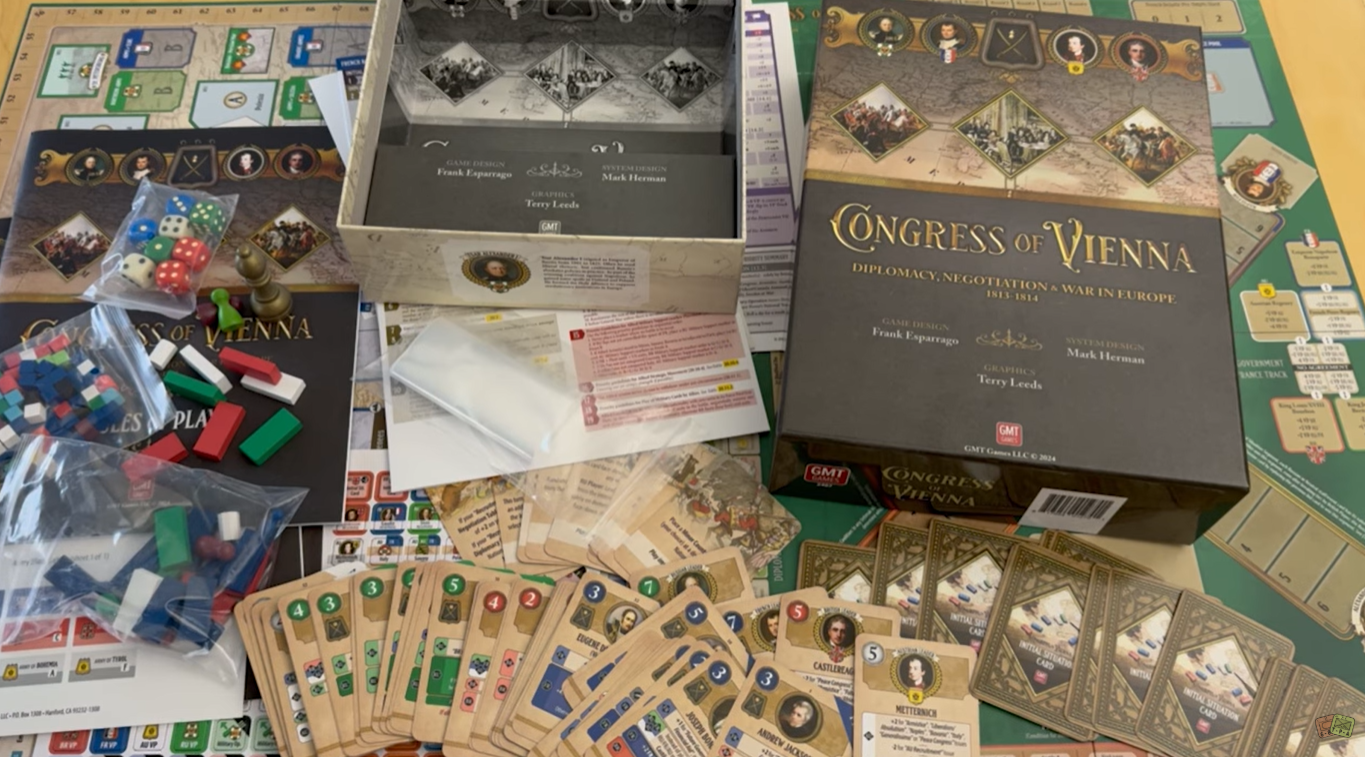
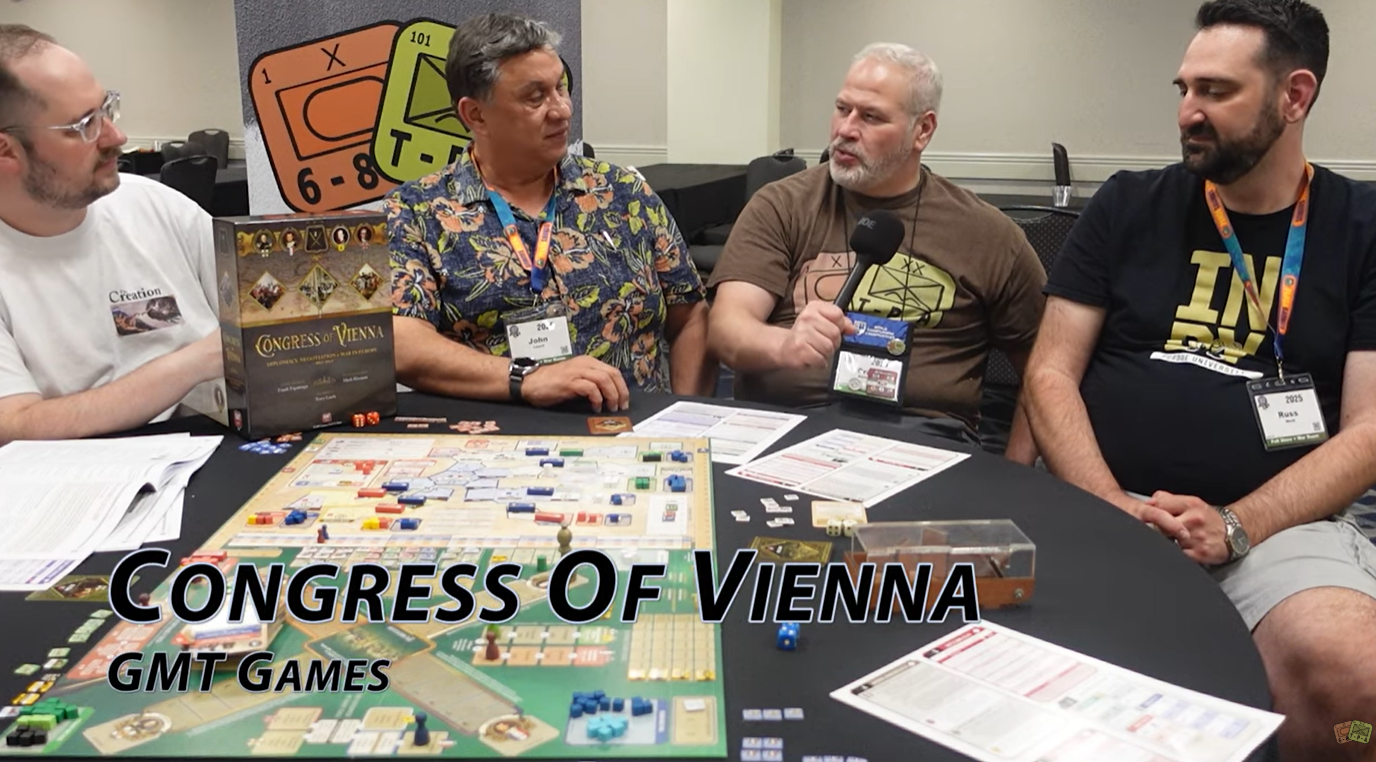
A few years ago, after playing all of the games in the Great Statesmen Series, we heard of a new game in the series from a designer not named Mark Herman and I was immediately interested and intrigued as we have had so much fun with Churchill, Pericles and Versailles 1919. Congress of Vienna from GMT Games is a diplomatic card driven wargame based on Churchill and is the 4th game in the Great Statesmen Series. The game is set during the years of 1813-1814 and sees players take on the role of the main characters of the struggle between the Napoleonic Empire and the coalition of Russia, Austria, and Great Britain with their Prussian, Spanish, Portuguese, and Swedish allies. We played the game recently while attending Buckeye Game Fest and then played a full campaign again while attending the World Boardgaming Championships and absolutely were amazed at the changes and innovations to the system introduced by the designer Frank Esparrago.
A new company on the scene recently is Ingenioso Hidalgo which was created by Paolo Mori. Yes, that Paolo Mori who has designed such interesting little wargames as Blitzkrieg! World War II in 20 Minutes, Caesar!: Seize Rome in 20 Minutes amongst others. He has partnered with Alessandro Zucchini on a new design, which is Ingenioso Hidalgo’s first game, called Battlefields of the Napoleonic Wars. We reached out to these two to get some insight into the design and they were more than glad to share.
Grant: Paolo and Alessandro, welcome to our blog. First off please tell us a little about yourself. What are your hobbies? What’s your day job?
Alessandro: I live in Modena, in Northern Italy, where I work as an Energy Manager in a steel factory. My hobbies are strictly related to games. I love studying Military History and Philosophy and playing wargames. I also like board games (in the past I have designed quite a few) and RPG’s. I’ve been playing Dungeons & Dragons with my friends for 40 years now.
Paolo: I live not far away (about an hour drive) from Alessandro, in the wooded hills near Parma, with my wife and two children. My job is to take care of digital communications for the local university, but in reality I have been on leave for three years to focus solely on game design (and, since last year, on the Ingenioso Hidalgo publishing venture ). In addition to board games, I have a passion for history.
Grant: What motivated you to break into game design? What have you enjoyed most about the experience thus far?
Paolo: Those who know us know that we have worked on very different types of games, and that is what we like to do most: explore different genres and themes. Lately, we have developed a passion for historical games, and we have found that designing a game is an excellent way to study and to spark curiosity and interest in players.
Grant: What is your upcoming game Battlefields of the Napoleonic Wars about?
Paolo: To tell the truth, the game is no longer ‘upcoming’. It was published in April 2025, and we are working on a first reprint (the first print run sold out) which should be available between April and May. Battlefields of the Napoleonic Wars is a game system that allows you to recreate the battles of the era, from small skirmishes with a few thousand men on each side to decisive pitched battles. The aim of the game is to be accessible, both in terms of the complexity of the rules and the length of the game, but also faithful to the specific elements of Napoleonic warfare. Ultimately, it aims to be a fun game to play!
Grant: What is the scale of the game? Force structure of units?
Paolo: The scale of the counters depends on the battle chosen, and can vary from one counter for every 1,000 men to one for every 4,000 for infantry, while for cavalry and artillery the scale is naturally different. The maps can be of three different sizes, and the scale also varies from one hexagon (they are large hexagons of almost two inches) for every 400 yards to one for every 800 yards.
Grant: How are the units represented? What is the layout of the counters?
Paolo: This is one of the first original features of the game. Each unit on the battlefield is represented by two rectangular counters, which, depending on their mutual arrangement within the hexagon, indicate at a glance the type of formation that the unit takes: column, line, or square (or disordered).
The counters have no numbers or values, only two icons (one on the back) that generically represent the type of unit: infantry, cavalry, or artillery. The color of the icons indicates the ‘quality’ of the unit: gold for heavy cavalry or elite infantry, silver for medium cavalry or light infantry, white for light cavalry or line infantry. Each of these units has some simple special rules that govern how they move or fight. Finally, the background of the counters can only be one of two colors. Blue for the French army or its allies. Red for the opposing coalition army.
Grant: Why was this a subject you wanted to create a game on?
Alessandro: I have always been passionate about wargames, especially Napoleonic wargames, and I had already enjoyed creating alternative rules or other regulations for playing certain battles in the past, often trying to simplify or make the rules of some particularly complex games more interesting. That’s why I challenged Paolo to create a wargame together.
Paolo: On the contrary, I have never been a wargame player, even though I have always been fascinated by them. But the commitment required in studying the rules and the playing time has always been overwhelming for me. That’s why I accepted Alessandro’s challenge. The aim was to make a wargame that I could finally play. For me, it was also a very stimulating way to study a historical period that I had never explored in depth.
Grant: What are the unique features with the system used for the game?
Paolo: There are essentially three distinctive features of the game. The first, which we have already mentioned, is the formation system, which is not only very visually appealing but also has an impact on how these units behave on the battlefield. The second feature is the unit activation system, which we will discuss in more detail later. The third is a combat system that uses special dice, which does not use tables but retains all the necessary depth.
Finally, as an extra, the format of the game is also unique. The ‘generic’ counters are associated with many different battlefields, each of which is represented by its own map and a folder containing this map, which is used during the game as a ‘board’ containing all the special rules and information necessary to manage the battle.
Grant: What is your design goal with the game?
Paolo: The idea was to create a game that both groups would enjoy! In other words, a game that would appeal to experienced wargamers looking for a ‘refreshing’ experience that could be enjoyed in an evening, as well as board game players who had always wanted to try historical wargaming but had never da
Grant: What unique elements of the Napoleonic Wars Era did you want highlight in the game?
Paolo: We wanted to emphasize the different formations, which move and attack in very different ways. The lines are not very mobile but are useful for firing and mowing down opponents. The columns move more quickly and are useful for breaking through enemy positions and throwing the enemy into disarray. Finally, the squares…are squares. Immobile, but very useful for defending against cavalry assaults.
For the rest, we have tried to convey all – or almost all – the subtleties of the battles of the time within a very straightforward set of rules.
Grant: What various unit types are included in the game? What is unique about these units?
Paolo: The units represent the three main ‘arms’ of Napoleonic warfare: infantry, cavalry, and artillery, but each unit is further characterized by a color that indicates its type. So we have light, medium, and heavy cavalry (each with specific movement or combat bonuses, with cuirassiers, for example, resembling early tanks); regular, veteran, and elite infantry (the famous guard that never breaks ranks). At present, there are no ‘national’ peculiarities for the various armies (apart from the special rules included in some battles).
Grant: How does activation work? What are the Order Tokens used for?
Paolo: The activation uses a somewhat unusual system, which betrays our background as board game designers. Players take turns placing their Order tokens on the Order spaces on a board positioned next to the battlefield. By placing the Order token, the player decides what type of unit and formation to move (e.g., infantry in column or artillery) or what special action to perform (e.g., maneuver or activate units near a leader). The same space cannot be used more than once by a player. When the Order tokens are exhausted – or when the player believes it is necessary to do so – a Rally order must be executed, which allows the player to reorder their units and recover the Order tokens so that they can be used again.
Grant: What different actions can be chosen?
Paolo: Some actions allow you to move specific units and formations, such as “Infantry in Column,” “Infantry in Line,” “Cavalry,” and “Artillery.” Others allow you to perform specific actions, choosing which units to activate. For example, “Maneuver” allows you to move units twice their capacity, but without attacking. “Leader Action” allows you to choose units adjacent to one of your Leaders. “Elite Units” allows you to give an ‘extra activation’ to cuirassiers or guards. Finally, Rally is the ‘recovery’ action, which allows you to re-form disordered or broken units, move leaders on the battlefield, and bring in any reinforcements, but at the cost of earning victory points for your opponent, in a sort of ‘inertia’ of battle.
Grant: How does combat work in the game?
Paolo: As we said, there are no tables in the game. Combat is resolved using special dice, which have a sort of built-in CRT. Instead of thinking about the modifiers to apply before rolling, in combat you will always roll two dice (one if the opposing unit is in a space that provides cover), and only after rolling will you check the outcome of the attack. Each side of the dice shows a requirement that you must meet for that side to be considered a ‘success’. Some examples of requirements are having a Leader near the attacking unit; attacking with a higher quality unit; firing on a unit in column; assaulting with cavalry, etc. If that condition is met in the attack, that face is valid, and its effect is verified, which can be a casualty or a retreat, which also makes the attacked unit disordered. It is a streamlined but refined system that saves a lot of time in calculations and in finding the perfect strength ratio.
Grant: How do you differentiate fire versus assault combat? What was this important?
Paolo: We have taken this concept to the extreme. Units in line (infantry or artillery) can only fire, while units in column (infantry or cavalry) can only charge. The two types of attack use different colored dice, which have different requirements and effects. For example, an assault will be more effective against a line unit, or if carried out by cavalry, and its main effect will be to push the opponent away and throw them into disarray. Fire, on the other hand, will be more effective against a column or if carried out by artillery, and its main effect is to reduce the strength of the target.
Grant: How do units respond to attacks? What results are possible and how can units evade or respond to certain attacks?
Paolo: Of course, there are the classic reactions of Napoleonic battles! Infantry can react to a cavalry charge by forming a square, just as cavalry can react by evading the infantry charge. Furthermore, if the unit being charged is in line, it can always fire back in the hope of throwing the attackers into disorder and nullifying the attack.
Grant: What is the makeup of the special dice?
Paolo: The dice for assault and fire have already been described…But one is missing! When attacking, a player can always decide to add the Black Hazard Die to their dice. This is a special die because its sides never have a requirement, and its results tend to be positive, but…with some risk involved. It is possible that the attacking unit will be thrown into disarray or suffer a loss. It is a die that can change the outcome of the battle, useful when you really need to push forward, perhaps to recapture a village or a valuable hill.
Grant: How do Leaders affect the actions of units?
Paolo: Leaders are represented by wooden pawns on the battlefield. Their presence is extremely important because they make the attacks of adjacent friendly units more effective, and above all because they allow these units to be activated through a type of additional order, thus making them extremely versatile and efficient.
Grant: What different scenarios are included?
Paolo: The box contains four battlefields: one small (Hagelberg 1813), two medium (La Coruna 1809 and Rivoli 1797) and one large (Austerlitz 1805). An additional Battlefields Pack has already been released, with three more battlefields: Saalfeld 1806 (Small), Quatre Bras 1815 (Medium), and Aspern Essling 1809 (Large). We are working on the second pack, which we hope to release in late spring!
Grant: Who is the artist for the game? How has there efforts improved the experience of players?
Paolo: The actual artists are two illustrators who left us long ago (and whose works are now in the public domain): Frenchman Jacques Onfroy de Bréville (who created the cover image, for example) and German Richard Knotel (who created the cover images for the various Battlefield folders). The counters and dice icons are the work of Fabio Maiorana, who did an excellent job of making the system of requirements and effects understandable. Finally, the maps are by Paolo…they differ slightly from the more popular style of Napoleonic maps, but we like them.
Grant: What optional rules are included? How complex is the game and how do these optional rules change the game?
Paolo: The game is fairly simple (the rules are just over 12 pages long, with lots of illustrations), but in the end we added a small section of optional rules, which we left out of the basic rules to keep it more ‘straightforward’. Just a few things: ways to manage units that have strayed too far from their command, to make leaders more efficient, or to feint cavalry charges against enemy squares. But knowing the grognard audience, we’re sure they’ll contribute other small house rules to add detail or flavor!
Grant: What do you feel the game models well?
Paolo: Every historical game is always the result of a compromise between recounting and simulating an event and making it playable and unpredictable. We believe we have achieved a good result in this direction, one that can satisfy different tastes. In addition to conveying the importance of formations on the battlefield, the game is able to explain how battles of that period were often more chaotic than we imagine today, with certain focal points on the battlefield around which the action was concentrated.
Grant: What has been the experience of your playtesters?
Paolo: The reception was unexpectedly good, especially from those ‘grognards’ who might have turned up their noses at something a little out of the ordinary. Instead, everyone found the game very exciting and also very ‘historical’. This gave us courage, and indeed the reception was confirmed among those who now have the published game in their hands.
Grant: What are you most pleased about with the design?
Paolo: Everything! We’re joking… but since it’s a truly ‘homemade’ creation (Ingenioso Hidalgo, the publishing house that released the game, was created by Paolo specifically to publish this wargame), we are incredibly satisfied with how it turned out. There are certainly things we will adjust with a second reprint, or that some people would have liked to be different, but overall, it turned out just as we hoped.
Grant: What other designs are you contemplating or already working on?
Paolo: There are always lots of projects! Regarding Battlefields of the Napoleonic Wars, we are working on new map packs, and we are starting to work on a project to bring the Battlefields System to other historical periods. We hope to have some more updates in the coming months!
We posted the following unboxing video on our YouTube Channel and you can check that out at the following link:
We picked up Churchill back in 2014 when it first was printed. From what I could tell at the time was that it wasn’t getting a lot of buzz amongst board gamers on BGG and there were only 2 YouTube videos about the game where we could learn a little more (one from Mark Herman and his wife, the other from Stuka Joe). I realize now that I was wrong to a large extent about the presumptive popularity of the game. First, we had bought it while it was brand new so the buzz was just getting started in a major way. Secondly, Churchill is viewed by many as a wargame and as such many euro gamers are hesitant to give it the try it so rightly deserves. But the game system and what it is trying to do is just fantastic with its debating over issues, seeing those issues translate to action on the board in the further prosecution of the war and then the way that people work to coordinate their actions. Just a really solid system.
A few years ago, after playing all of the games in the Great Statesmen Series, we heard of a new game in the series from a designer not named Mark Herman and I was immediately interested and intrigued as we have had so much fun with Churchill, Pericles and Versailles 1919. Congress of Vienna from GMT Games is a diplomatic card driven wargame based on Churchill and is the 4th game in the Great Statesmen Series. The game is set during the years of 1813-1814 and sees players take on the role of the main characters of the struggle between the Napoleonic Empire and the coalition of Russia, Austria, and Great Britain with their Prussian, Spanish, Portuguese, and Swedish allies. We played the game recently while attending Buckeye Game Fest and then played a full campaign again while attending the World Boardgaming Championships and absolutely were amazed at the changes and innovations to the system introduced by the designer Frank Esparrago.
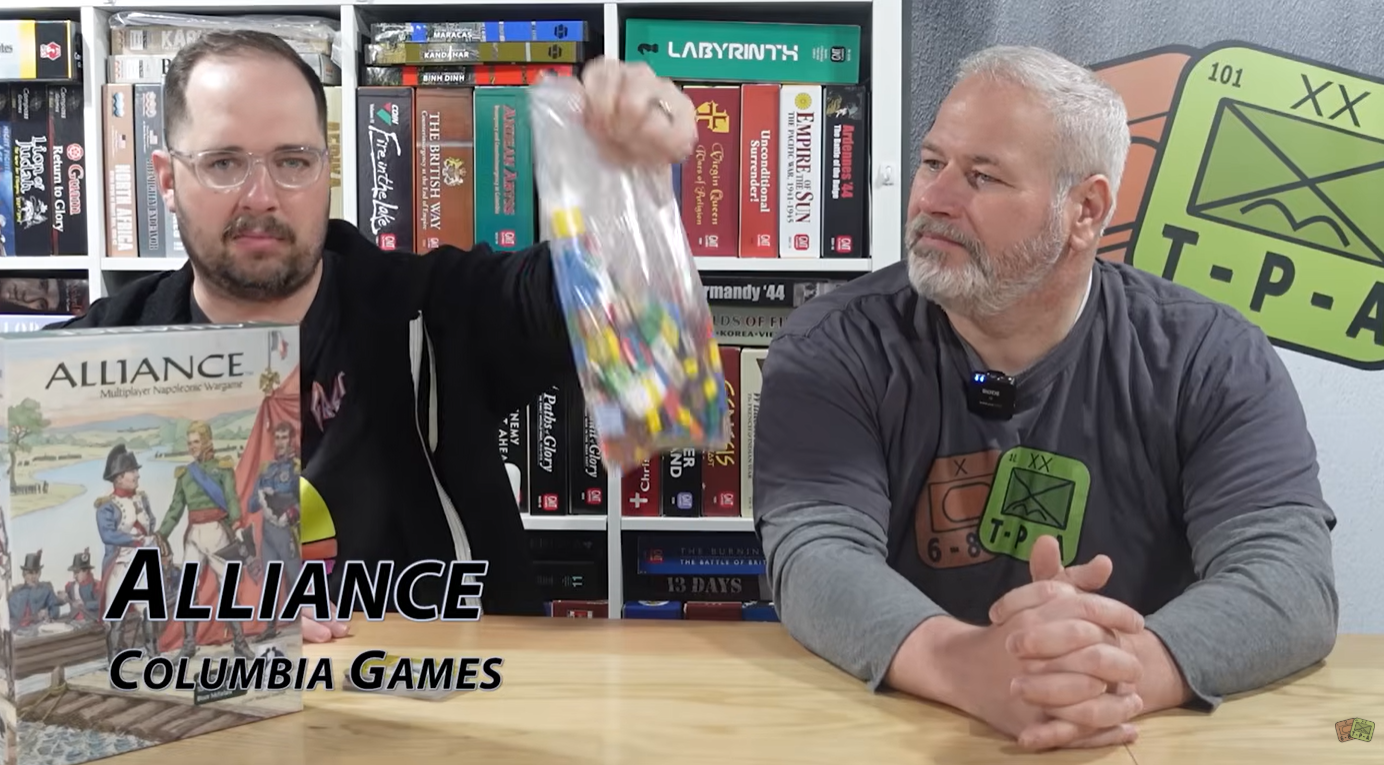
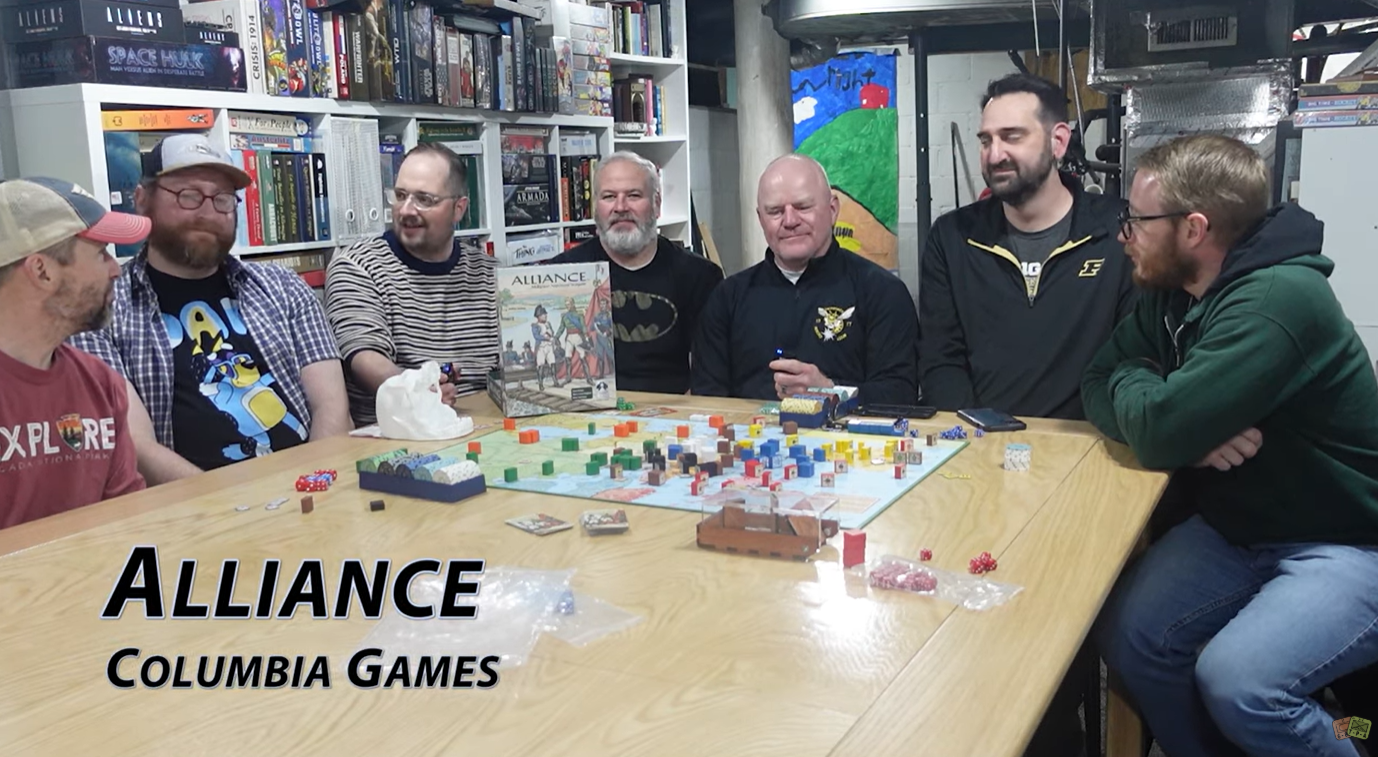
As you know, we very much enjoy multi-player wargames and anytime there is a new multi-player game coming out we very much sit up and take notice. In early 2024, Columbia Games launched a Kickstarter for a game on the Napoleonic Wars called Alliance: Multiplayer Napoleonic Wargame. Alliance is billed as a 1-7 player strategic level game of diplomacy and warfare in the Napoleonic Era with a Columbia Block System twist. The game is huge and plays best with more players. The players take on the roles of different nations during the time and you can play as Austria, England, France, Prussia, Russia, Spain, or the Ottomans. We recently played a full 7-player game and had a grand old time. While the game is not perfect, and there are some quirks that you must get past, the game is really pretty fun and interesting and could be one of those main staples at gaming conventions where you need a lot of players.
With this My Favorite Wargame Cards Series, I hope to take a look at a specific card from the various wargames that I have played and share how it is used in the game. I am not a strategist and frankly I am not that good at games but I do understand how things should work and be used in games. With that being said, here is the next entry in this series.
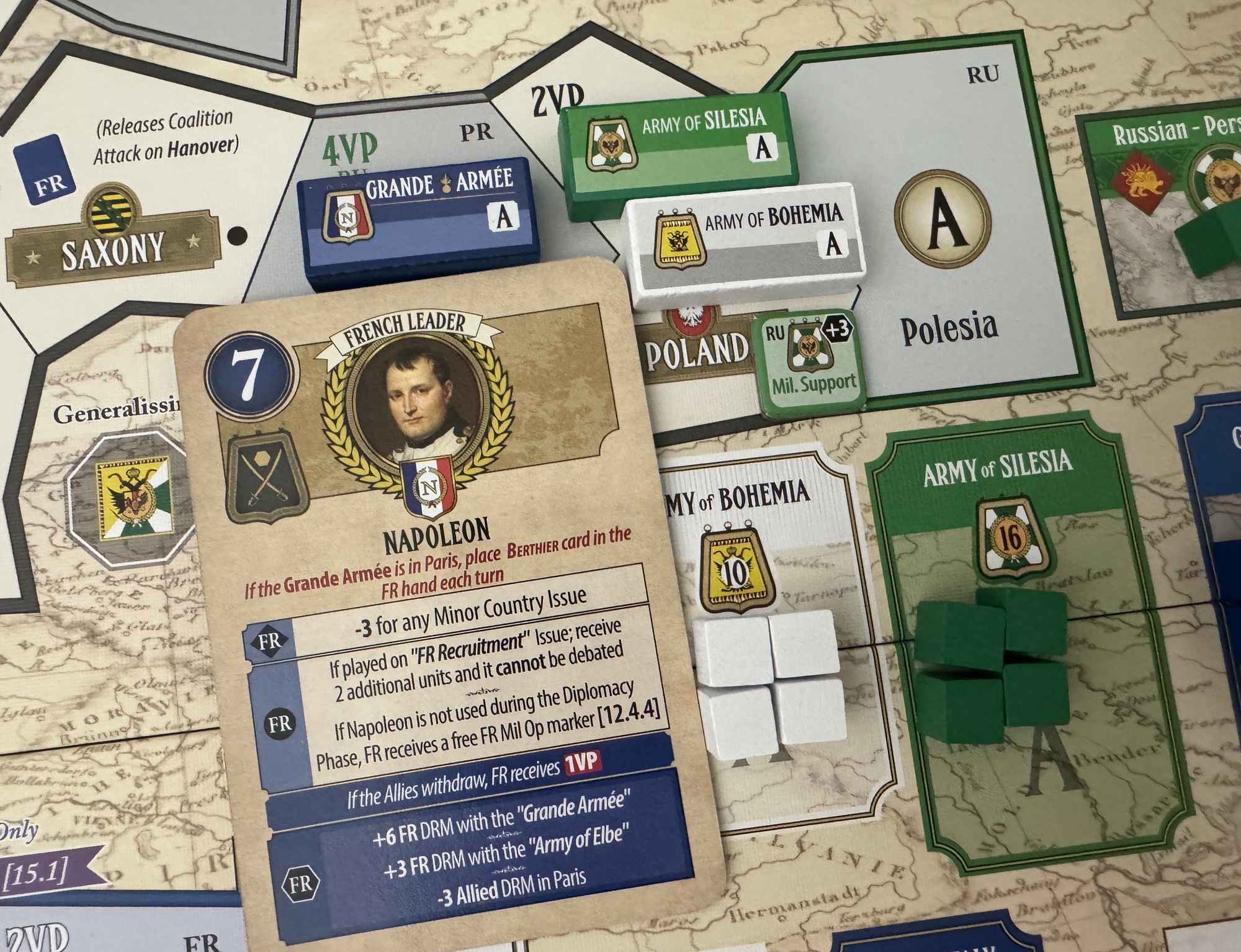
Card #60: French Leader Napoleon from Congress of Vienna from GMT Games
Congress of Vienna from GMT Games is a diplomatic card driven wargame based on Churchill and is the 4th game in the Great Statesmen Series. The game is set during the years of 1813-1814 and sees players take on the role of the main characters of the struggle between the Napoleonic Empire and the coalition of Russia, Austria, and Great Britain with their Prussian, Spanish, Portuguese, and Swedish allies. Congress of Vienna has two different but related phases including the conference table where players first debate over the control of issues germane to the factions and the period of the war and second these issues are then used on the battlefield to recruit units, attack and take overall command of battles. The players will be playing cards from their hands to “debate” over the various issues that were placed on the table, which include all types of things such as Military Operations, Recruitment, who will lead the combined Coalition forces (Generalissimo), Future of French Government, British Financial Aid, Liberalism vs. Absolutism, Austrian Neutrality and several other issues, and then later the players will use their accumulated Resources gained from the issues to enact action on the Military Map and do things like mobilize troops, place Military Support Markers and the ultimately to conduct warfare.
The game relies on cards and cards can be used to negotiate, i.e. move an issue to your National Track. Cards can provide a particular issue with positive and negative DRM’s depending on which nation plays them and can also be traded with another player during the Diplomacy Phase. Certain cards are better than others for debating an issue moved by another player; and finally, if they are saved for the War Phase, staff cards can be used to modify dice rolling in battles. These are very versatile cards and the players will have to learn them and their benefits in order to be effective at the game.
In this entry, we are going to take a look at the French Leader Napoleon card, which is one of the more powerful cards in the game. There is actually quite a bit of information found on the card but it all has a purpose and clearly explains when it provides bonuses when used on the various issues such as Minor Country Issues, French Recruitment as well as its various Dice Roll Modifiers during combat. This card is very powerful and must be used at the appropriate times for what the player is trying to do. Early in the game, the card can be used for its French Recruitment ability to gain new troops, the French will then gain 2 additional Units to use. When used during the Diplomacy Phase to effect the location of issues at the conference table, if used to move any issue it will provide a free French Military Operations Marker to be used on the battlefield to cause units to attack. The uses of Napoleon are many and players will need time to best understand when and where to use his abilities. But, his most impactful use is on the battlefield where he will grant various DRM’s depending on what French army he is commanding. If used with the Grande Armée, he will grant a massive +6 DRM while when being used for the Army of the Elbe he will only grant a +3 DRM. As the games wears on, and the Allies are at the gates of Paris, if used in defense he will grant a -3 DRM to the Allies attacking. These choices are very important and the correct choices will need to be made at the right time to be successful.
After playing now a few times, I am here to say that Congress of Vienna is probably my favorite game in the Great Statesmen Series. I believe that this game has matured the system and made it something that is more than where it started. Congress of Vienna is very much more like a true wargame and was extremely interesting. We are still learning and need to keep playing this one but I did enjoy what it was that we were doing.
Jacques-Louis David – The Emperor Napoleon in His Study at the Tuileries
Napoleon Bonaparte (1769-1821) was a French military and political leader who rose to power during the French Revolution (1789-1799), became Emperor of the French (1804-1814/1815), and conquered much of Europe through brilliant, though costly, military campaigns, leaving a lasting legacy as one of history’s most famous and controversial figures, known for his strategic genius and ambition. He implemented significant legal reforms like the Napoleonic Code but ultimately faced defeat and exile, cementing his image as a complex figure of power and downfall.
Born on the island of Corsica to a family of Italian origin, Napoleon moved to mainland France in 1779 and was commissioned as an officer in the French Royal Army in 1785. He supported the French Revolution in 1789 and promoted its cause in Corsica. He rose rapidly through the ranks after winning the siege of Toulon in 1793 and defeating royalist insurgents in Paris on 13 Vendémiaire in 1795. In 1796, he commanded a military campaign against the Austrians and their Italian allies in the War of the First Coalition, scoring decisive victories and becoming a national hero. He led an invasion of Egypt and Syria in 1798, which served as a springboard to political power. In November 1799, Napoleon engineered the Coup of 18 Brumaire against the French Directory and became First Consul of the Republic. He won the Battle of Marengo in 1800, which secured France’s victory in the War of the Second Coalition, and in 1803, he sold the territory of Louisiana to the United States. In December 1804, Napoleon crowned himself Emperor of the French, further expanding his power.
We have done 2 videos on this game including the following RAW Video after out 1st play at Buckeye Game Fest in May 2025:
We then did the following full Review Video after our 2nd play at WBC last July:
As you know, we very much enjoy multi-player wargames and anytime there is a new multi-player game coming out we very much sit up and take notice. In early 2024, Columbia Games launched a Kickstarter for a game on the Napoleonic Wars called Alliance: Multiplayer Napoleonic Wargame. Alliance is billed as a 1-7 player strategic level game of diplomacy and warfare in the Napoleonic Era with a Columbia Block System twist. The game is huge and plays best with more players. The players take on the roles of different nations during the time and you can play as Austria, England, France, Prussia, Russia, Spain, or the Ottomans. We recently played a full 7-player game and had a grand old time. While the game is not perfect, and there are some quirks that you must get past, the game is really pretty fun and interesting and could be one of those main staples at gaming conventions where you need a lot of players.

 Anmelden