On the final full day of our recent Ireland trip, we walked across Dublin to the Guinness Storehouse self-guided tour experience. You start at the base of a massive circular interior (it’s shaped like a pint of Guinness) and work your way up level by level, learning about Guinness–the beer, the company, and the brand–as you go. Here are a few standout business insights I learned along the way:
Quality Control (and the Veneer Thereof)
Before we even entered the building, we saw a van parked outside that read, “Guinness Quality Team: Dedicated to delivering beautiful Guinness everytime everywhere”. Right from the start, Guinness was communicating that they have a continual focus on providing the best version of their product. This is later reinforced during the tour when they talk about the “smellers” who ensure the barrels are working optimally.
This really got me thinking about more ways we can improve quality control at Stonemaier Games and how we can share the variety of systems we have already have in place, as I always want the first printing of any product to be perfect.
Branding Is Constantly Evolving
I associate Guinness with a specific can, so I was struck by the sheer variety of bottles displayed at the beginning of the tour. While the label has stayed mostly the same over the years, the size and shape of a Guinness bottle has vastly varied.
This made me think of game boxes. There really is no standard game box–modern manufacturers can make any size. While I understand the visual appeal of having games that align cleanly on a shelf, the box is ultimately a delivery vehicle for the contents within. I never want to limit what a game can be (or make a box that is much too big) based on box size consistency.
Longevity Is a Selling Point
The current Guinness label has “EST. 1759” on the iconic harp. It was interesting to see that most of the previous harps didn’t have that date, as it seems like a huge selling point to convey that the product is so good that it has lasted nearly 300 years.
Recently I’ve thought a lot about how longevity is such a great selling point for Magic the Gathering. It isn’t just about Magic lasting over 30 years; it’s also about how they tie old cards to new sets, adding depth and nostalgia to the world they’ve fostered for so long. I think there’s huge value in having a singular, long-lasting product that reminds people of its history.
It’s Okay to Revisit a Tried-and-True Formula
When I think of the Guinness beer, I think of a dark brew topped by thick foam. I assumed that was always the case, but that’s apparently not true: The “creamy white head” wasn’t introduced until 1959.
There’s constant innovation in nearly every industry and we’re always learning, so I don’t think there’s anything wrong with revisiting older games to apply those innovations and lessons learned over the years. That’s what I tried to do in the upcoming Euphoria Essential Edition.
The World Isn’t Stagnant, and Neither Are We
Prominently featured at the Guinness Storehouse is Guinness 0.0, an alcohol-free version of their beer that tastes remarkably similar. I asked a Guinness employee about this version of the beer, which was released around 3 years ago, and they said that it is already a success in reducing drunk driving in Ireland and beyond. It also has a positive impact on public health, as alcohol can lead directly to liver disease.
I think there’s something about human nature that can make us a bit stubborn about changing our worldview, but the world is always changing. I know so much more about accessibility and environmental sustainability than I did a few years ago, and while meaningful sustainable change takes time to implement, I believe it’s worth constantly pursuing.
Those are just a few takeaways from my experience at the Guinness Storehouse. I’d love to hear your thoughts about Guinness or similar behind-the-scenes tours. How do they apply to the tabletop game industry and community?
After sixteen years in the industry, Julie Ahern has worn all the hats. From writing to project management to podcasting to marketing, she’s been part of every step of the game-making process and has helped create some new ones along the way. She’s worked for Greenbriar, Van Ryder Games, and starts her tenure as COO […]
Welcome to this week’s batch of crowdfunding campaigns. We have a variety of offerings here, so we hope you will find something that catches your eye. Also, if you want to chat with the BGQ team, join our Discord Server where we talk about games, movies, sports, and other fun stuff. Check it out and […]
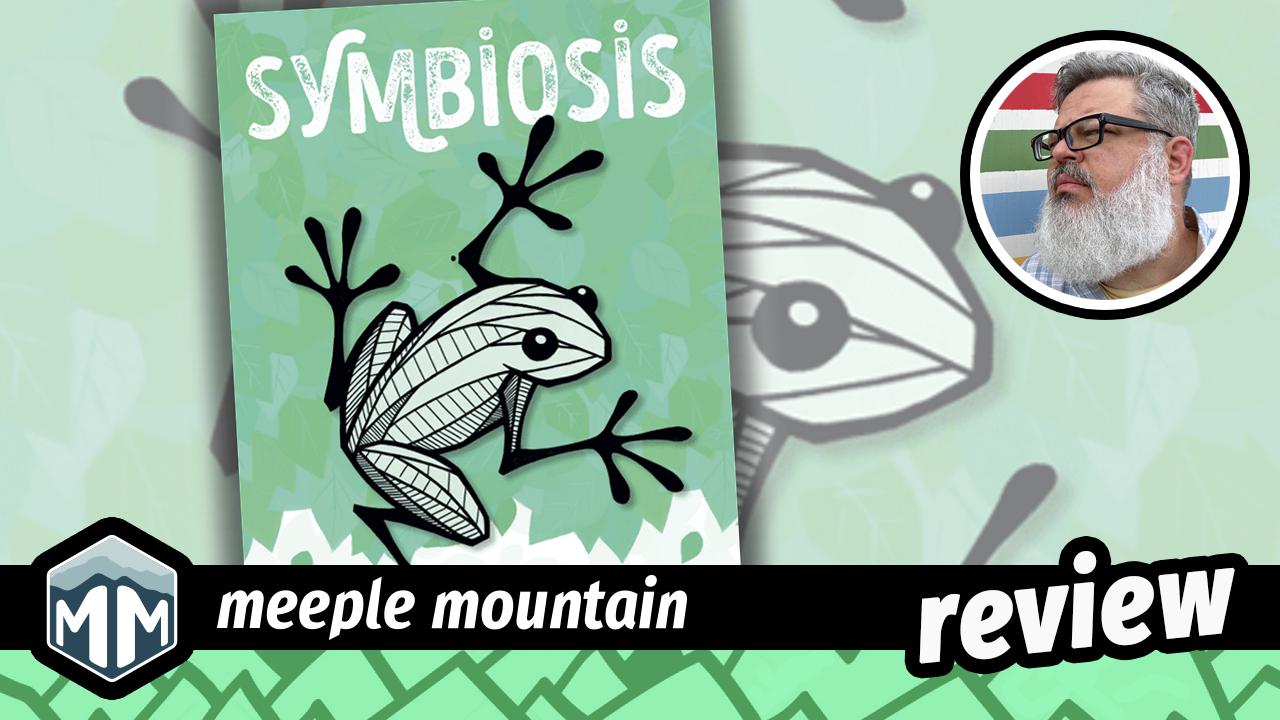
At this year's GAMA Expo I had the opportunity to play Symbiosis with some industry folks. I was charmed by it's artwork and card size, and delighted by the simple decision space and speedy game play. I brought home a copy and reviewed it for you. Check it out!
What is Symbiosis?
In Symbiosis players are growing and improving their pond in an attempt to earn the most points. They start with a 4 x 2 grid of face down cards, 1 of which is turned over at the beginning of the game. An additional 4 cards are turned face up in the center of the table, and serve as the market.
On your turn you select a card from the market and do one of two things:
Replace one of your face down pond cards with the card you selected from the market. Your pond card is placed face up into the market and becomes available for other players to select.
Alternatively you can take one of your face up cards and swap it with a face up market card. If you do this, you must flip one of your remaining face down cards face up.
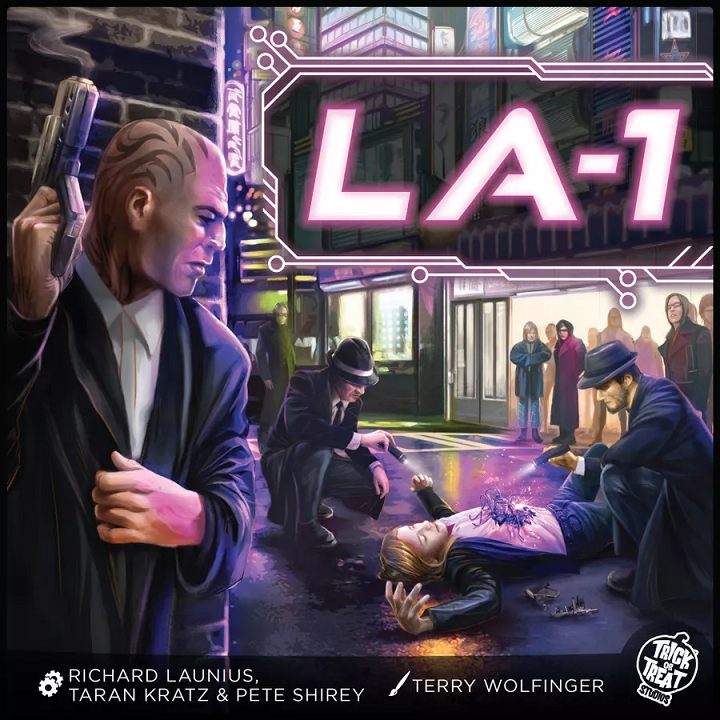
You’re stumbling through the labyrinthine streets of Old Angeles; your clothes soaked in rain and neon. The city is a mix of perpetual darkness and the unending belch of industrialization. But at least you’re not alone. Your private investigation firm is staffed by the other stiffs sitting around the table. All of you are working…
While attending SPIEL Essen last fall, we became aware of a new narrative driven book wargame coming from PHALANX and designer José Luis Barca. We were supposed to get together with José to discuss the game but due to changes in our schedule and another meeting we just couldn’t break away to get over there. I felt bad about that, and want to apologize to their Marketing and Crowdfunding Director Adrian Turzański, but we did get copies and Alexander has since played it several times. In place of the sit down discussion, I reached out to José to see if he wanted to answer some questions in a designer interview. He was willing and that has led us her to this post.
Grant: José welcome to our blog. First off please tell us a little about yourself. What are your hobbies? What’s your day job?
José: Thank you, it’s a pleasure to be here. Okay. So, I’m a big fan of wargames, role-playing games, and board games who, three years ago, left my regular job to work as a freelancer in translation, layout, and writing for board games, role-playing games, and wargames—making a dream come true: working in a field I’m passionate about.
Grant: What motivated you to break into game design? What have you enjoyed most about the experience thus far?
José: Well, in addition to what I mentioned earlier, I’m a novelist. Right now I have three novels and two short story collections written. As part of my work, I translated gamebooks, so I wanted to try writing a different kind of “novel” that’s tied to the game. Also, on my Instagram, I interact with readers through “choose your own adventure”-style story games. All of this led me to the decision to write a gamebook in which the narrative aspect was the most important thing. From the very beginning, I really enjoyed the experience. Being able to give the main character choices was something that wasn’t possible in a normal novel, and I really enjoyed all the options, including killing him off in many different ways. It was something fresh for my writing.
Grant: What is your new game A Bridge Too Far about?
José: A Bridge Too Far depicts the war as seen through the eyes of a private. The protagonist is a Polish soldier from the 1st Polish Independent Brigade who will try to survive in Driel and Oosterbeek. His decisions will shape his future in the Battle of Arnhem, which was a military failure for the Allies. Thus, the gamebook explores the harshness and cruelty of combat in one of the bloodiest battles of World War II.
Grant: It is described as a paragraph-based game. What does this mean?
José: It’s another name for a gamebook, or, in this case, a wargamebook. The narrative unfolds through paragraphs that, depending on your choices regarding the options presented, lead you to other paragraphs. In this way, you aren’t reading a book in a linear fashion, as you would with a novel, but rather you have to follow the storyline through the paragraphs indicated by the game.
Grant: What is your design goal with the game?
José: The goal was to immerse the reader in the combat, allowing them to witness a battle and its various stages firsthand. It was also to explore the character’s psychology—how their morale and willpower gradually break down. In short, the aim is to paint a realistic picture of combat, or as realistic as possible using nothing but the pages of a book—something no one would ever want to experience.
Grant: What research did you do to get the historical details correct? What one must-read source would you recommend?
José: This was undoubtedly the hardest part. Most books today about the Battle of Arnhem cover the battle in general terms, without providing the level of detail needed for a novel or gamebook. Those of us who write historical fiction always face this problem. When we go into such detail in describing places, people, or objects, we run into a problem that no general overview can solve. For this book, I consulted the two most famous books: A Bridge Too Far by Cornelius Ryan and Arnhem, the Battle for the Bridges, 1944 by Antony Beevor. From the first, I drew some anecdotes about the fighting, and from the second, the general overview of the battle, but I needed something more to fully immerse myself in the epic story of the Poles. So I discovered The Pegasus Archive: The British Airborne Forces, 1940-1945, which contains the transcript of all the orders given by officers during the battle, hour by hour. This source was the definitive one for understanding what really happened to the Poles at Arnhem.
Grant: What role does the player take on in the game?
José: The player is a rank-and-file soldier in an elite unit of the British Army, which is where the Polish Brigade was integrated. As I mentioned earlier, your goal is to survive, and how you do that is up to you: whether you make it to Nijmegen safe, desert and go into hiding, or end up as a prisoner. If you don’t survive, there are plenty more options, hahaha.
Grant: What role does the player play in the creation of the soldier?
José: The character must be created at the beginning. You simply need to assign three numbers to its main attributes. The rest is set by default.
Grant: What are the three attributes focused on? What does each represent?
José: The soldier has the following attributes: Body, which indicates stamina, strength, and hand-to-hand combat ability; Mind, which reflects intelligence, reasoning, and the ability to use weapons; and Will, which reflects morale, willpower, courage, and sanity.
Grant: What does the phrase “choice-driven, demanding gameplay” mean?
José: Well, exactly what it says: every decision matters and could mean the difference between life and death. The player is presented with various choices from time to time and the story will branch off from those choices into a new direction.
Grant: How did you go about creating a tense and decision filled experience?
José: Well, that was my intention, but I’m not sure I pulled it off. It’s up to the readers to decide. But my writing style certainly helped. Many of my readers say I write as if I had a camera slung over my shoulder, and that my scenes are action-packed and very visual. You can easily picture the scene without needing lengthy descriptions. What some experts call “dynamic description.” My descriptions of the situation are woven into the dialogue or the character’s actions, as if the reader were watching a movie. These days, I think that’s the best way to write, since there are almost more viewers of movies and TV shows than readers of books.
Grant: How many different branching options are possible?
José: The book has about 20 alternate endings
Grant: How long did it take to make sure these were all consistent and that there weren’t loops?
José: That’s not enough. Let me explain. These days, there are tools available to help you with the process of checking for loops and errors when writing a gamebook. I used a program called “Librogame Creator,” where you type directly, just like in Word. The real benefit is that you can create the paragraphs within the program and link the choices to their respective paragraphs. In the end, you’re left with a paragraph map that makes it much easier to review and see if any are incomplete, if there are loops, and if any lead to a dead end. In any case, it’s not foolproof, and in a work of this type, errors are inevitable. I apologize in advance.
Grant: How are dice rolls handled for the game?
José: The game tells you when to roll the dice. Basically, you roll a number of dice equal to the designated attribute, and you need to roll (in at least one dice, unless otherwise specified) a total greater than the difficulty level specified in the text. It’s very easy and requires almost no rules.
Grant: Where did you get this idea from? How do you think it works?
José: The idea comes from another Spanish gamebook called Ulrica. I borrowed the core of the system with the authors’ permission and then had to adapt it from a fantasy setting to World War II.I think it’s a system simple enough to let the story take center stage. And that’s what convinced me to use it.
Grant: How does the player manage things like ammunition, morale and life points?
José: You have a character sheet where you can track your remaining ammunition, morale, and health points. You won’t go through much ammunition unless you start missing your rolls, of course. In any case, you’ll find more ammunition during the game to add to your inventory. You might have a harder time finding it in the second part, in Oosterbeek, because that’s exactly what happened there. Health is something that’s bound to go down. There are first-aid kits in the game that let you boost that value, but the risk of dying is real and very easy to reach. Morale is something the game really puts pressure on. That was my intention from the start. The player will be tempted to use those points at every turn, but I suggest using them only in matters of life and death. Because morale points rarely go up during the game
Grant: What is the layout of the character sheet at the back of the book?
José: On one side, you’ll find the stats you’ll use during the game: attributes, morale, health, diary, etc., and on the other side, you’ll find your inventory, which will also change as you acquire new items and/or weapons or lose them. I suggest printing it out for a better experience.
Grant: How is victory determined?
José: Victory points are determined by your diary entries. Depending on your actions in battle, you will be remembered and decorated—or you will end up as an anonymous soldier. Your final score depends on your decisions, not on how many fights you win or lose.
Grant: What do you feel the game models well?
José: I think what the game captures best is the intensity and morale in combat. You’ll see soldiers breaking down mentally, civilians suffering the consequences, and your character experiencing combat stress. I think that’s well reflected in the book
Grant: What are you most pleased about with the design?
José: The ammunition consumption system and large-scale combat are my favorite parts of what I’ve designed.
Grant: What other topics or engagements are you considering for use of this system?
José: Any setting from World War I or World War II, as well as all modern wars, is suitable for this system.With a few adjustments, this system can be used for any military conflict in history.
Grant: What other designs are you contemplating or already working on?
José: Right now I’m working on a different system. I call it a “bookgame,” the opposite of the current one. There are already games where the book itself serves as the game board, like Mike Lambo’s games, for example. Well, my next project will be in this format. I’ve created my own system with some familiar mechanics, which are integrated into the rules to add more gameplay to the narrative. Unlike Mike Lambo’s games, my new game will be much more narrative-driven, and its protagonist will be a historical warlord, I can’t say anything more, sorry. I want the historical aspect to be as accurate as it is in A Bridge Too Far. I hope to achieve that.
Thank you for your time in answering our questions José and we look forward to seeing more from you in the future.
Entertainment website The AV Club has shuttered its board game and video games segment, bringing to an end almost 13 years of tabletop coverage for veteran writer Keith Law across the site and its predecessors, Paste Games and Endless Mode.
Law wrote more than 300 pieces across those sites following his debut article in 2013, helping bring modern board gaming to a wider audience through his reviews, opinion pieces and highly regarded ‘games of the year’ lists.
Speaking to BoardGameWire, Law said the shuttering had come as a shock, adding that he would continue to write about board games on his personal blog.
He said, “It’s been an honor and a privilege to write about board games and the tabletop space for the last 12 years for Paste, Endless Mode, and AV Club.
“I worked with some great people, notably my longtime editor Garrett Martin, and feel incredibly lucky to have had the opportunity to write so much about one of my passions.”
The loss of Law’s writing from such a well-read entertainment site was bemoaned by Votes for Women designer Tory Brown, who cited his rave review of that title as “a high water mark in the effort to bring my game to the masses.”
She told BoardGameWire, “Keith Law is a treasure, the kind of smart and thoughtful writer whose approach to criticism makes us all smarter and more thoughtful.
“That a media outlet failed to recognize the value of his contribution says more about the lack of vision in American journalism than the board game audience or industry.”
Keith Law’s glowing review of Tory Brown’s design Votes for Women
The shuttering of the AV Club tabletop section marks the latest in a string of high-profile gaming and entertainment sites closing or shrinking their tabletop coverage in recent years.
They include major video games site Kotaku, which has not published an article to its tabletop section since veteran writer and editor Luke Plunkett left in 2023, and Polygon, which lost renowned, long-serving tabletop editor Charlie Hall as part of a downsizing 12 months ago.
While Polygon’s tabletop section still exists, the segment’s focus has shifted heavily towards coverage of trading card games such as Magic: The Gathering and Pokemon.
Of the 61 articles in tabletop section last month, just three were about board games – one a story highlighting that Star Wars: Outer Rim was being discounted at Amazon, and two about the Game Changer Kickstarter from comedy team Dropout.
Kevin Bertram, the founder of Votes for Women publisher Fort Circle Games, told BoardGameWire, “While I appreciate the contributions of many YouTube reviewers, video cannot fully replace the depth and clarity of written criticism.
“The loss of voices like Charlie Hall (of Polygon) and now Keith Law marks a deeply troubling turn for our industry.
“Board game journalism faces a structural challenge: establishing a sustainable business model that supports rigorous, long-form analysis. Perhaps that future lies with independent critics like Dan Thurot or collaborative models such as Rascal.
“Whatever forms emerge, their success will depend on active support from a community that values thoughtful, written criticism.”
AV Club editor-in-chief Danette Chavez provided a statement to BoardGameWire which said, “The AV Club made the difficult decision to eliminate three roles, which included two full-time staff who ran our video games coverage after joining us from Endless Mode in November 2025.
“This also includes changing the direction of our television coverage. Our hope is this will allow The AV Club to focus on our core strengths: incisive coverage of film and TV through reviews, features, and news.
“We will continue to have some games coverage, but we cannot sustain a full-time staff covering it with our smaller team. All previously published games stories will remain available to read.”
My brother’s third text of the day chased back-to-back missed phone calls. When I’m not writing tabletop content, I work as a program manager for a consulting company. Thanks to a meeting with our company’s COO and Global People Officer, it had been a busy, stressful morning. My phone was on “do not disturb”, so when I flipped the phone over, my brother's communication thread made it clear that there was a real emergency.
Sadly, my fears were confirmed. After a series of alarming health changes over the past few months, our father had collapsed at his home in upstate New York. Even though CPR had been administered relatively quickly, my father’s pre-existing health issues and the morning collapse led to a visit to the emergency room, which quickly became a visit to the intensive care unit.
The situation quickly became tragic. Dad never regained consciousness, and he was placed on a ventilator. Suddenly, machines were the only thing keeping him alive. I booked a flight to Rochester and arrived about four hours before Dad was set to be taken off of life support.
You always think you will have more time.
“Immediate family only,” the signs outside the ICU said. That meant just five of us—stepmom, half-sisters, my brother, me—spent Dad’s final hours in a small hospital room, holding Dad’s hands and shedding plenty of tears. We also did what we loved to do any time the group was together: laugh about the memories that have lasted a lifetime.
A few of those memories were about games.
***
My father was never the person who suggested playing games; in fact, he never seemed to even enjoy playing them.
As a kid, we played a lot of the traditional “roll and move” games with Dad, like Monopoly and Parcheesi. From time to time, we tricked Dad into joining something like The Game of Life. UNO? Obviously. The Rummy family was always lurking nearby: Rummy, Rummy 500, Rummikub, Rummoli (the Poker/Rummy variant of Michigan Rummy that I grew up with).
It felt like Dad was always working late, so games were usually limited to weekends, and my time with him was further limited thanks to a divorce that changed our family dynamic when I was just a child. For my father, games clearly felt like work, so he was less inclined to playing games and more inclined to other leisure pursuits—long meals, action movies, road trips, televised golf tournaments (which mostly doubled as “dad naps”, a tradition we carry on in my home today).
Later in life, Dad could occasionally be tricked into playing games, but there was a limit to how many rules he would bother to learn before throwing up his hands. Like the relatives of many players in my network, Dad seemed to hate just about anything that was “too complicated.” (This is only funnier because my dad loved to play golf—itself a very complicated sport—and he worked in complex management roles throughout his career. I get it: everyone’s brain needs a break. But often, the “too complicated” label felt like lip service.)
Occasionally, the sibs and I pushed Dad to try something new. Seven or eight years ago, I brought a bunch of hobby games to a Thanksgiving family weekend, and forced my dad to play Luxor, the Rüdiger Dornhand management game. (Although I love other Dorn designs, such as Istanbul and Goa, Luxor is still the Dorn title that hits the table the most.)
Luxor is a relatively rules-light experience that plays in about an hour. The main hook: players manage a hand of five movement cards and a small pool of adventurer tokens, tokens that must be moved forward on a track that ends with a treasure tomb in the middle of the board.
On a turn, players can only play either their left-most, or right-most, card from hand to move one of their tokens toward the tomb. (Cards in a player’s hand are never shuffled or moved, only played when they reach one side of their hand.) At the end of each turn, a player must add a new card to their hand from a draw pile, which must be inserted into the middle of their now-four-card hand to give them a new five-card hand for their next turn.
“This is ___ ridiculous!” Dad said, after hearing the hand management rule two minutes into the teach. (I’m leaving the profanity out, for the purposes of a family-friendly website.) “This game has too many rules.”
Still, Dad decided to play Luxor with my wife and stepmother…and almost won, coming in just a few points behind the eventual winner. At the end of the game, he begrudgingly admitted that he had fun thinking through the best ways to move his adventurer tokens around the map to pick up treasure tokens and sets of cards from the movement track. The best part? Dad didn’t really listen during the teach, so he only ever played his left-most card all game long, and only ever added new cards to the right side of his hand.
My father also hated the idea of cooperative games. “I want to have a chance to win,” he would say, because to Dad, winning meant “beating everyone else at the table.” So, whenever we floated co-op games by Dad (The Crew, anyone?), it was a hard pass.
Now, Dad WOULD play games with a team…as long as the goal was to beat the other team. The day we got Dad to play Codenames—a family favorite for everyone else in the household—is still one of the most shocking moments in Bell Family Vacay history. Codenames is always a riot with my family; when a team’s Spymaster goes on a one-word clue run that scores three or four cards on a single turn, that story becomes legend. (Naturally, when someone blows it and gives a clue that reveals the Assassin, that kind of story becomes legend, too!)
Most years, Dad would politely pass when given the chance to play Codenames. But when he finally did decide to join the family for a play, it was a moment. He didn’t want to play as a Spymaster that first time—let’s give the man a “try bite” first, right?—but simply being willing to join the whole family for once was such a thrill.
***
Ultimately, Dad’s favorite thing about games wasn’t playing games at all. It was grabbing a newspaper—or later, his iPad, since even my father had to come to grips with reading the news in the present—and being at the dining room table while others played games.
My dad loved being near the action. He was constantly looking up from his newspaper, smiling at his family, watching them enjoy themselves, laughing along with the group when something funny happened during a player’s turn.
I recently went to a friend’s game night…not to play, but to simply sit around. I’ve done that a few times over the years, and lately, my work schedule has been rough and I don’t always have the capacity to do much more than sit in the same space as my friends. (I am very good, however, at eating your snacks, drinking your bourbon…or, both.)
A friend was running a game of Blood on the Clocktower, and ten adults laughed their way through hours of fun as they ran two sessions back-to-back. The friends asked if I wanted to jump in, to take on a character role in-between rounds.
“Nah, I’m good,” I said. “I just love being here.” Watching innocent friends get eliminated by their peers was glorious. Standing in a corner of the room with two others as they plotted their way into the next night’s accusation was a blast, too. I didn’t think much of it at the time, but just being around others as they had fun on a game night made me think about how much Dad must have loved just being in the room with his kids.
***
The five of us at the hospital were rolling, laughing as we reminisced about so many great times with Dad. As a group, we laugh with and at each other all the time, and we laughed at some of the funny things Dad used to say, some of the bad fashion choices of the last 40 or 50 years we could remember, that time Dad claimed to be on a diet while pounding eight pieces of fried chicken at a local theme park, Dad’s everlasting appreciation for the musician Prince, and took a moment to appreciate the biggest laugh of anyone I have ever met.
And, the times when Dad would settle into his spot at the end of a large table, a glass of Cutty Sark and a plate of cheese and crackers nearby, watching everyone else having fun playing games.
Eventually, the harsh reality of the hospital situation returned. A nurse walked in; a doctor joined her. We had a few more minutes with Dad before…well, before.
I got in one more squeeze of Dad’s hand. Everyone gave him one more kiss on the forehead, then the doctors did what they could to offer him a peaceful passing.

 Anmelden




/pic9571879.jpg)
