Typically this is a joyful post, a celebration of the past year and hope for the future. But tragedy struck over the weekend: Gosia, aka wingspangirl on Instagram, passed away suddenly, leaving the community awash with grief. My heart especially goes out to her sister, Magda.
As you can tell by her screenname, Gosia loved Wingspan, and she often posted about the game. Her enthusiasm for it was contagious, even for me. She also talked about a bunch of other games–that was the level on which I knew her, and I always appreciated the endless bounds of her positivity.
However, as I’ve learned by reading many of the memorial posts about Gosia, her sense of community went so much deeper. Countless people have expressed how Gosia always took the time to talk to them privately about any topic ranging from games to family/friendships to personal struggles. To Gosia, the social media community wasn’t about views or likes–it was about meaningful connections with people around the world.
With that in mind, the focal point of this year’s post about actions for 2026 is on meaningful connections. In a way that is true to you, how would you like to connect with people in 2026? This could be in the tabletop gaming community or beyond.
For me, I’m looking forward to connecting deeper with my coworkers when we’re all together in the same place for a few days this winter. I also invited my mom to join me, Megan, and a few friends on an Iceland trip later in 2026, and I look forward to the connections that emerge from that trip.
Also, I’m trying to give myself the grace and permission to focus more on the people I connect strongly with, especially at gaming events. For years I’ve felt this inner obligation to try to connect with as many people as possible (at Geekway to the West, Design Day, the gaming cruise, etc), but sometimes I just really enjoy certain people and wish I could spend more time with them. I’m hoping to do better at that in 2026.
Here are the questions I asked last year, with the addition of the new question inspired by Gosia:
What will you create in 2026 that is meaningful to you? This can be something completely new or something you’re continuing to create from the past year. What’s the first step you’ll take?
What will you play in 2026 that is meaningful to you? This could focus on the game/sport itself, the location, the people, etc.
Who or what will you elevate in 2026 that is meaningful to you? This could be anything you love or value that you want more people to know about.
How will you connect with people and the community in 2026 in a way that is meaningful to you?
I’ve added a special mention of Gosia in a Wingspan product coming later next year. To everyone whom Gosia touched, I’m so sorry for your loss–for our loss–and I appreciate you sharing how she impacted you.
As the year comes to a close, I’ll do my usual end-of-year posts: My personal top three in a range of categories. As tradition commands, we’ll begin with the games that I played for the first time this year. Here are the best three.
I’m not much of a Formula 1 fan – from my point of view, nothing much happens during the races (after the start, that is), and in many years, even the championship as such is a bore because one driver/car combo is just too dominant. (This year has been excitingly different in that regard.)
In the box: Another close finish!
Heat, however, takes just the exciting parts of racing and puts them together in an enthralling package of evocative mechanisms – downshifting before corners (and upshifting afterward), and the delicate balance of how to deal with the psychological stress on the driver and the physical stress on the car (the eponymous heat). And as the main planning phase is done simultaneously, there’s minimal downtime even with the full six players.
I’m excited to learn new things from and with games. One topic I knew next to nothing about is the 14th century in India. That, however, has changed a bit now due to Vijayanagara, a COIN-lite treatment of the collapse of the Delhi Sultanate’s hegemony under the challenge of invasion from the north (Timur’s Mongols) and centrifugal forces in the south (the nascent Bahmani Kingdom and Vijayanagara Empire). Every game of Vijayanagara tells a variation of that story.
The Delhi Sultanate (black) is under heavy pressure from the Vijayanagara Empire (yellow) and the Bahmani Kingdom (turquoise). From the implementation on Rally the Troops!
Chaos – some games hate it, others, like Time of Crisis, embrace it. Whoever wants to be Roman emperor in the tumultuous third century must be prepared to deal with a whole whirlwind of challenges: Angry mobs want to drag your governors into the gutter, Barbarian tribes stand ready to cross the border into your provinces, and, worst of all, the rest of the Roman elite wants to be emperor, too, and will gleefully take whatever you possess.
Red has declared himself emperor! Yet Yellow runs a compact dominion in the east, ready to move into Italy or break away from the empire. From the implementation on Rally the Troops!
I have been thwarted in my imperial aspirations by my fellow bloggers Alexander and Grant from The Players’ Aid as well as Dave and Michal, and have been loving every minute of it. Time of Crisis has been my most-played game overall this year (with 14 individual plays of it), and rightly takes the crown in this category.
What were your favorite new-to-me games this year? Let me know in the comments!
As the year comes to a close, I’ll do my usual end-of-year posts: My personal top three in a range of categories. As tradition commands, we’ll begin with the games that I played for the first time this year. Here are the best three.
I’m not much of a Formula 1 fan – from my point of view, nothing much happens during the races (after the start, that is), and in many years, even the championship as such is a bore because one driver/car combo is just too dominant. (This year has been excitingly different in that regard.)
In the box: Another close finish!
Heat, however, takes just the exciting parts of racing and puts them together in an enthralling package of evocative mechanisms – downshifting before corners (and upshifting afterward), and the delicate balance of how to deal with the psychological stress on the driver and the physical stress on the car (the eponymous heat). And as the main planning phase is done simultaneously, there’s minimal downtime even with the full six players.
I’m excited to learn new things from and with games. One topic I knew next to nothing about is the 14th century in India. That, however, has changed a bit now due to Vijayanagara, a COIN-lite treatment of the collapse of the Delhi Sultanate’s hegemony under the challenge of invasion from the north (Timur’s Mongols) and centrifugal forces in the south (the nascent Bahmani Kingdom and Vijayanagara Empire). Every game of Vijayanagara tells a variation of that story.
The Delhi Sultanate (black) is under heavy pressure from the Vijayanagara Empire (yellow) and the Bahmani Kingdom (turquoise). From the implementation on Rally the Troops!
Chaos – some games hate it, others, like Time of Crisis, embrace it. Whoever wants to be Roman emperor in the tumultuous third century must be prepared to deal with a whole whirlwind of challenges: Angry mobs want to drag your governors into the gutter, Barbarian tribes stand ready to cross the border into your provinces, and, worst of all, the rest of the Roman elite wants to be emperor, too, and will gleefully take whatever you possess.
Red has declared himself emperor! Yet Yellow runs a compact dominion in the east, ready to move into Italy or break away from the empire. From the implementation on Rally the Troops!
I have been thwarted in my imperial aspirations by my fellow bloggers Alexander and Grant from The Players’ Aid as well as Dave and Michal, and have been loving every minute of it. Time of Crisis has been my most-played game overall this year (with 14 individual plays of it), and rightly takes the crown in this category.
What were your favorite new-to-me games this year? Let me know in the comments!
Via Marginal Revolution: We are repaganizing (in a Christian Magazine …. discusses Christianity, Abortion, Infanticide, Peter Singer, Medically Assisted Suicide and Paganism)
The Zvi’s thoughts on AI during the Winter Solstice — We will win.
Was there a second starting point of life that formed 1 cm long beings and died out on Earth 2B years ago? As always, Betteridge’s law looms large, but …. Possibly.
“Imagine that you’re much smarter than me, and I also party all the time and abuse drugs while you live a completely sober lifestyle. If I end up more economically successful than you are, you need to look inward and ask what you’re doing wrong. That is the situation of East Asia relative to the US and Europe.” Human Capital, Not Industrial Policy.
A 4th Chinese Poem constructed in a 29×29 grid of characters (similar to a magic square) palindromic poem that produces 4,000 sub poems (that rhyme and are coherent) depending on how the subsections are combined & read. Written (Embroidered, actually) by a 21 year old to woo back her husband, who had left her for a concubine. (“At the center a single character she left implied but unwritten: 心 (xin) – “heart.” Later copyists would add it explicitly, but in Su Hui’s original the meaning was even more beautiful: 4,000 poems, all orbiting the space where her heart used to be.”) A nice introduction (Twitter) . Wikipedia Page.
Feral Historian discusses The Doomed City, a soviet SF novel (published after Perestroika) and uses footage from Dark City1 because they share themes. In fact, after seeing the video, Dark City seems to clearly rip off The Doomed City’s “Experiment” and motifs, but Wikipedia does not show a link.
Video Game Trailer that I watched on a whim, and was delighted to find it giving off “Iron Giant” vibes. Coven of the Chicken Foot.
Via Marginal Revolution: We are repaganizing (in a Christian Magazine …. discusses Christianity, Abortion, Infanticide, Peter Singer, Medically Assisted Suicide and Paganism)
The Zvi’s thoughts on AI during the Winter Solstice — We will win.
Was there a second starting point of life that formed 1 cm long beings and died out on Earth 2B years ago? As always, Betteridge’s law looms large, but …. Possibly.
“Imagine that you’re much smarter than me, and I also party all the time and abuse drugs while you live a completely sober lifestyle. If I end up more economically successful than you are, you need to look inward and ask what you’re doing wrong. That is the situation of East Asia relative to the US and Europe.” Human Capital, Not Industrial Policy.
A 4th Chinese Poem constructed in a 29×29 grid of characters (similar to a magic square) palindromic poem that produces 4,000 sub poems (that rhyme and are coherent) depending on how the subsections are combined & read. Written (Embroidered, actually) by a 21 year old to woo back her husband, who had left her for a concubine. (“At the center a single character she left implied but unwritten: 心 (xin) – “heart.” Later copyists would add it explicitly, but in Su Hui’s original the meaning was even more beautiful: 4,000 poems, all orbiting the space where her heart used to be.”) A nice introduction (Twitter) . Wikipedia Page.
Feral Historian discusses The Doomed City, a soviet SF novel (published after Perestroika) and uses footage from Dark City1 because they share themes. In fact, after seeing the video, Dark City seems to clearly rip off The Doomed City’s “Experiment” and motifs, but Wikipedia does not show a link.
Video Game Trailer that I watched on a whim, and was delighted to find it giving off “Iron Giant” vibes. Coven of the Chicken Foot.
Lantern lifted, I stepped into the Crimson Cavern where a Tawny Steppe Wyvern crouched over a cache of meat and a single gleaming amethyst. It watched me calmly, dust motes swirling around its tawny wings. In the Golden Grotto, a Bellicose Firevern crackled with heat, sparks skittering across piles of scorched stone as it let out a low rumble. Finally, in the Amethyst Abyss, a Subterranean Basilisk hatchling blinked up at me, tiny and glittering, nestled among crystal shards. Once they got accustomed to me, the three dragons allowed me to go about my dracologist business and measure their Wyrmspan by Connie Vogelmann from Stonemaier Games with art by Clémentine Campardou.
“In the past two weeks last copies of Imperial Settlers and Alien Artifacts sold out from our website. Games are gone. There is no reprint planned. Gone forever. It makes me sad on so many levels…. I am brutally honest – this is no longer an industry with possible reprints. Games come and die fast, you put a title on the market and a few months later it is considered old.” —Ignacy Trzewiczek, Portal Games
I’ve read this message (click the link for the full version) several times on different forums. Before I dig into it from a publishing perspective, I just want to say that I feel for Ignacy. I can relate to putting love, time, effort, and resources into something that doesn’t last as long as I hoped. While Imperial Settlers has been around for over a decade, Ignacy also says that much newer Portal games like Thorgal and Eleven also won’t be reprinted.
So is this really the end of reprints for all game publishers? From my perspective, definitely not. Spanning from Charterstone all the way through Origin Story, 17 out of 19 Stonemaier games have been reprinted at least once, and most of them more than once.
That said, I think it is harder than ever to create an evergreen game–a game that sells consistently year after year–though there are a few things publishers can do to increase the odds of a game becoming evergreen:
Reconsider which games you publish: Some types of games are much more likely to become evergreen than others based on price, theme, innovation, art, mechanisms, etc. While there isn’t a magic formula for these elements, there are some commonalities among evergreen games. If your game isn’t the type of game that’s likely to garner multiple reprints, that’s okay–it simply shift to a frontloaded marketing strategy.
Reconsider crowdfunding (and how it impacts retailer relationships): Crowdfunding is great for single-run games (particularly fancy versions). However, I don’t think crowdfunding lays the best groundwork for working with retailers, the backbone of evergreen games. I truly am not suggesting that creators ignore crowdfunding as a launchpad for new games, but be aware of how a crowdfunding cycle impacts your relationship with retailers and customers. Are you just crowdfunding the first printing, or are you returning to crowdfunding for expansions, reprints, etc?
Reconsider digital game strategies: It’s wonderful to have the option to play digital versions of tabletop games on Steam, BoardGame Arena, Tabletopia, etc. In some ways, I think these digital options have replaced reprints for some publishers and gamers, with very few analog sales resulting from digital plays. Perhaps this is just the future of most games’ longevity, but publishers have a choice as to how much of their games they offer digitally and when they’re available.
Reconsider new editions and sequels: I think the industry has trained customers to expect that there will always be a new edition, special edition, or sequel to any game that sells well the first time around. I still hear from people saying that they’re waiting for an all-in version of Scythe even though it will never exist (just like all our products, you can always pick and choose which expansions, accessories, and promos you want). It’s neat that publishers can breathe life into older games or that designers can revisit older games with a more experienced vision, but doing this too often may hurt the longevity of the original game.
Reconsider back catalog marketing: Customers get caught up in the cult of the new, but so do publishers. Imagine if you didn’t release or launch any new games in 2026. How would you market your existing games? If it’s different than how you currently market those older games, why? I regularly offer games to reviewers dating all the way back to Viticulture, I talk about older games on social media and YouTube, I foster online communities built around the game, and we’ve released a variety of expansions over the years.
Reconsider how you gauge demand: The minimum order quantity for many manufacturers is 1500 units, so to reprint a product, you need a clear indication from at least 500 people (ideally more) that they’ll buy the product if you make more. What ongoing opportunities are you giving customers to share their interest in a reprint? Stonemaier uses back-in-stock requests on our webstore (we’re gearing up for a Rolling Realms promo reprint based on this data), along with occasional surveys, polls, and reminders on our monthly newsletter; GMT uses their P500 program; other publishers use Kickstarter.
With thousands of games released each year, most of them will not become evergreen games. Also, games that earned multiple reprints in the past may not have the same marketability today. It’s the bittersweet nature of this industry, and I think it’s okay to sunset a game, a brand, or even a company on your own terms.
Do you view this new era of gaming as the end of reprints? What’s the last game you bought that was released prior to 2025?
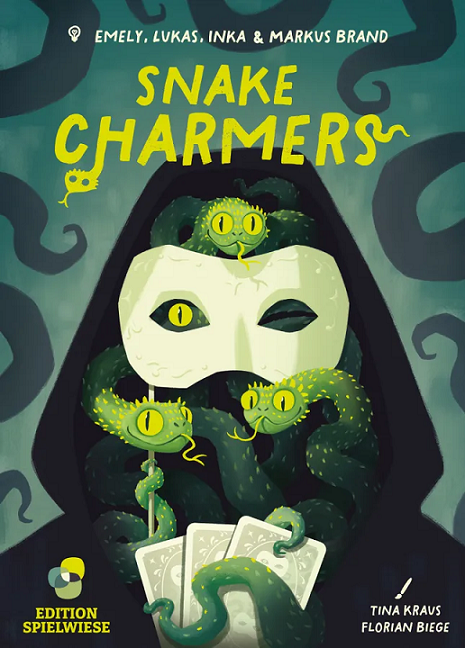
A crafty salesperson would push Snake Charmers as a cross between Cockroach Poker and The Resistance. This allusion is a strong sell, as it ties this new release to two of the best bluffing and deduction games ever designed. Fortunately, it is a reasonably accurate comparison, even if Snake Charmers can’t quite deliver the impact…
As an independent games designer and producer, a lot of my time involves visiting conventions to meet gamers and, ideally, sell my games to them. When I do so, it’s always a surprise how little crossover there is between people who play board games, roleplaying games and miniatures games, which is a pity since I think all of them have something special to offer. So I’d like to take this chance to explain exactly what I think is so special about miniatures games for anyone who doesn’t necessarily play, or even consider them.
This past weekend I enjoyed a brief reprieve from the cold St. Louis weather, venturing to sunny Orlando to visit Universal Studios for the first time. We also saw some friends from the Stonemaier Games Design Day and spent a day on the beach in Tampa Bay.
We spent half a day at two of the older Universal parks, but the focal point of the trip was Universal Epic Universe, the newest park. It features 5 different worlds, including Super Nintendo World, Dark Universe (gothic monsters), and Isle of Berk (How to Train Your Dragon).
I found the whole experience fascinating from a customer service perspective, as these types of parks bet big on immersing you in an otherworldly experience. Here are the top 5 things I learned and observed during my 12 hours at Universal Epic Universe and how they might apply to the world of tabletop games.
1. Dramatic Entrances
One of the smartest decisions at Epic, in my opinion, is the installation of massive “portals” through which you enter each world. When I left the hub world and walked into the giant green tunnel for Super Nintendo World, I felt like I was transported to a new place. Even the music changes.
As big as they are, the portals are small compared to the worlds they transport you into, so there’s a dramatic moment when you take that first step out of the tunnel. You’re hit with a wave of sights and sounds that are completely absent on the other side of the portal.
The closest comparison to this I can think of in tabletop game is opening a game for the first time. Some games do a particularly great job of making a thematic, intuitive, and organizationally satisfying unboxing experience (see my video on this topic). Perhaps this is also why some people love unboxing videos.
2. Interactive Fake Storefronts
In each of the worlds there’s a mix of thematic displays and fake storefronts (like a movie set) mixed in with real stores, experiences, rides, and restaurants. This makes perfect sense: You don’t need to stock a dozen stores or have every type of craftsman actively working in Berk; instead, invest up front in a rock-solid display, and it’ll last years with minimal maintenance.
However, some of these parks take the set dressing to a new level by giving you a specific way to interact with them. For a few, they’re triggered by motion sensors or your voice, and there’s some combination of programming, animatronics, and live acting behind them. For others, they’re activated by a specific device, like the armbands you can buy in Super Nintendo World that you can bop against the oversized shell blocks.
This is exactly what I was aiming for in Vantage’s first-person perspective art. I wanted it to be more than just a pretty picture; instead, each illustration has information about difficulty and your surroundings, and most of what you see is interactive. If there’s house on a hill, you can probably enter that house and see how it looks inside. When you’re inside, there are a variety of objects you can pick up that result in you (the player) gaining a specific card.
My only wish in these theme parks is for more reasons to look closely and less reliance on phones. A few years ago I went to Star Wars Galaxy’s Edge, and I liked the scavenger hunt, but eventually I started ignoring it because I wanted to immerse myself in the world instead of being on my phone.
3. Immersive Line Management
A major feature at Epic are the rides and shows, with wait times ranging from 15 minutes to several hours. The Universal app helps to mitigate this to a certain extent, as it tells you the current wait times. I was also impressed by the facial scanning technology for the express lanes (which we didn’t use) and the lockers (which we did use for some of the more intense rides).
I was mostly impressed by the queue design. It looks like a maze with several big visual barriers–short lanes that cut back and forth–so you constantly feel like you’re moving forward and so you can’t tell how much longer you’ll wait. Along the way are water fountains and some thematic displays, along with plenty of shade from the Florida sun.
My one criticism is that there really isn’t much to do while in line. I’m not entirely sure what I want to do while I’m waiting, but it could be a crowd game, some form of entertainment, or something small to do along the way that adds up to something meaningful. For example, what if in a How to Train Your Dragon line you can make a few quick personality quiz choices along the way (using facial scanning) that results in your dragon selection at the lockers or when you sit down on the ride?
I often talk about wait times and anticipation gaps, and one example of this in the tabletop space are update emails and newsletters. When done well, I find that they increase my curiosity and excitement while making the wait feel like part of the experience instead of something to endure.
4. In-Character Interactions
My most memorable experience at Epic wasn’t the result of expensive sets, thrilling rides, or fancy technology. Rather, it was 10-minute chat I had with an actor (the “owner” of a shop, pictured here) who stayed completely in character the entire time. She wandered over while I was waiting for Megan, and she talked about her background and answered some questions.
It was a busy shop, and I was surprised at several times in the conversation that she didn’t move on to other customers, but she conveyed that she was in no rush. There was no sense of “move along, next person please”–everything about the interaction was welcoming, authentic, and playful. I hope Epic values what this incredible person gives them every day.
This is an area that I’ve found difficult to balance in scaling Stonemaier Games. I want to give genuine time and attention to everyone who contacts me, but in every private interaction is information that others might want to know too (if the question were instead asked publicly). Though, as I type this, it occurs to me that while the conversation at Epic felt custom for me, it wasn’t private at all. Megan’s mom was there, and Megan eventually joined us, and we were in the middle of the shop–anyone could have joined at any time.
5. The Nostalgia Factor
Sometimes I forget about the sheer power of nostalgia until it hits me full force in the form of the Super Mario theme or the voice of Hiccup. One of my favorite and most unexpected experiences from the weekend was a 20-minute water, light, drone, and instrumental evening show at Universal Studios. Even just 20 seconds of music and a brief projected image from ET, Jurassic Park, or Back to the Future made me want to revisit those movies.
I think games do a great job of using art and themes to evoke nostalgia. Nemesis takes us to the Alien movies, Boss Monster has pixel art for those of us who grew up in the 80s and 90s, and long-running games like Pokemon create their own nostalgia cycles. Nostalgia by itself isn’t enough to sell a game, but just like the movies I mentioned above, if the content itself is great, nostalgia can elevate it.
While I didn’t delve into the food because games aren’t edible, the food (and the thematic places at Epic where we ate, like the mead hall shown here) was also a big part of the immersion for me.
I’d love to hear your thoughts about effective immersive customer experiences at theme parks, and perhaps how you relate them to tabletop games. Let me know your thoughts in the comments!
The opening sequence of Martin Scorsese’s Taxi Driver depicts a New York with enough grit that you can feel it on your teeth. It’s a feral hour of the night. DeNiro’s sedan is cruising down a street awash in the radiant soul of the city. There’s a shot of the vehicle’s quarter panel. Beads of…
This is another great expansion from Stonemaier Games, with lot of extra bits to change the game, but not too drastically. To start with and importantly for me is the fact that it all fits in the main box and you get a new card holder that is more like the one that you get with Wingspan, to replace the old smaller holder.
8 You gain 5 new guilds and their cards. You also gain a whole load of Dragons that have some cool new powers which can make putting them in Caves easier if you reach the requirments. one of the new dragon types is called a fledgling, these will make your games that much more interesting. As with most expansions or games for that matter it is best to explore the game and see how you can make the most of them. If you do not like the game, then I am afraid but this wont fix that, but it will make the game more complex and fun.
Before we dive into the content of the playlist, some general observations:
All of the songs in the playlist were popular during the Weimar Republic (1918—1933). Yet as music recording was still in its infancy at that time, many of the songs in the playlist are later recordings (and some rare ones were recorded even before 1918!).
As the playlist is only 2:21 hours long, your Weimar game will probably last longer (if you don’t crash the republic on the first or second round), but there’s no reason not to listen to these songs two or three times – they’re fascinating historical documents.
The playlist is thematically sorted. That helps you find similar songs, but makes for somewhat monotonous listening (until you come to the next group of songs). I therefore recommend you turn shuffle on.
Now, what awaits you in the playlist?
#1: The National Anthem
It seems like a no-brainer to include the German national anthem of the time, yet it’s not so simple: The Lied der Deutschen (Song of the Germans) had been written in 1841, but had since then only been a patriotic song among many – until the first president of the republic, Friedrich Ebert, declared it the national anthem in 1922. The song’s three stanzas were variedly popular: Ebert favored the third stanza with its liberal ideals of unity, justice, and freedom, his right-wing opponents preferred the “Deutschland über alles” (Germany Above Everything) first stanza. I have included an instrumental version. If you feel patriotic, you can sing along.
The Weimar Republic did not come into existence in a vacuum. It inherited German cultural traditions like folk songs (“Wem Gott will rechte Gunst erweisen” (Whom God Wants to Favor), song #2).
And, of course, the Weimar Republic succeeded the German Empire with its national feeling (“Die Wacht am Rhein” (The Guard on the Rhine), song #2), dominant Protestantism (Martin Luther’s classic “Ein feste Burg ist unser Gott” (A Mighty Fortress Is Our God), song #5), and monarchy (“Heil dir im Siegerkranz” (Hail to Thee In the Victor’s Crown), song #7 – the quasi-anthem of the German Empire).
The republic’s midwife was the First World War – whose experience shaped its veterans and provided the cultural context even for those who had not been adults during the war yet (“Wildgänse rauschen durch die Nacht” (Wild Geese Rush Through the Night), song #8, written in 1916, was immensely popular among the Weimar Republic youth movement). The war also cast its shadow over Weimar Germany as many had lost their husbands, sons, fathers, brothers, and friends in the war (“Ich hatt’ einen Kameraden” (I Had a Comrade), song #9, the traditional German soldiers’ lament).
The liberal republic proved fertile ground for satirical treatments of the new developments: Otto Reutter made fun of the big and small war profiteers with “Seh’n Sie, darum ist es schade, dass der Krieg zu Ende ist” (See, that’s why it’s a pity that the war is over, song #10), and Claire Waldoff called for replacing the men in power with women in “Raus mit den Männern aus dem Reichstag” (Kick the Men Out of Parliament, song #11), playing on masculine anxieties after the introduction of women’s suffrage.
Even in a time and place as politically charged as the Weimar Republic, not everything was politics. The average Hans and Gretel may have cared less about their preferred ideology and more about how to have good time on a Saturday night… and the new cultural scene, especially in the big cities like Berlin, provided ample opportunities.
The more sophisticated artists like the Comedian Harmonists succeeded with witty wordplay and erudite vocal harmonies. Others played on the classics – alcohol (“Wir versaufen unser Oma ihr klein’ Häuschen“ (We Blow Grandma’s Little House on Booze, song #19) and sexual innuendo („Fräulein, Woll’n Sie nicht ein Kind von mir“ (Miss, Don’t You Want a Child By Me, song #22). There was even the equivalent of a (generalized) diss track: “Du bist als Kind zu heiß gebadet worden” (You Have Been Bathed Too Hot As a Child, song #23) indicates that this neglect of bath safety led to lasting brain damage in the interlocutor.
#26-33: Film, Theater, and Opera Music
The Weimar Republic’s vibrant cultural scene led to cross-pollination between diverse forms of artistic expression. The new medium of film was pioneered in Germany, and once it had left its silent infancy behind, movie songs became hits. Marlene Dietrich, starring in The Blue Angel, enticed with “Ich bin von Kopf bis Fuß auf Liebe eingestellt (I’m Set to Love From Head to Heel, song #26), but warned “Nimm dich in Acht vor blonden Frau’n“ (Beware of Blonde Women, song #27).
More traditional art forms like the theater also adapted. Die Dreigroschenoper (The Threepenny Opera)’s acerbic critique of capitalism would not have been as successful without its catchy songs, the most famous of which is the “Moritat of Mackie Messer” (Ballad of Mack the Knife, song #31).
Even the most classic and highbrow form of entertainment modernized: “Jonny spielt auf” (Jonny Plays It Big, song #33) introduced jazz into the world of the opera… which brings us to our next category.
#34-41: Jazz and Blues
Traditionally, the United States had received and emulated European fashions, not the other way around. Yet by the early 20th century, America had become the largest economy in the world, its war entry in 1917 tipped the scales of the war further in favor of the Allies, and the increased presence of Americans in Europe meant that the United States turned from an importer to an exporter of culture. Jazz took Europe by storm – both in the form of American (and nascent European) bands and by the new medium of the music record. The Weimar Republic was no exception. Jazz fueled the parties in any larger city of 1920s Germany.
Of course, not everyone loved jazz, and the controversy over its unorthodox dissonances, the more expressive, individualistic, and eroticized dancing style accompanying the music, and, of course, the race of its performers entered the contemporary culture wars – exemplified by Weimar’s double use of Louis Armstrong, illustrating both the SPD’s “The New Rhythm” and the DNVP’s “Nicht Deutsch” (“Not German”) event cards.
The “Tiger Rag” (song #41) is also used in The Tin Drum, German writer Günter Grass’s epic about the rise, fall, and persistence of Nazism: The youthful protagonist Oskar Matzerath who always carries his eponymous tin drum plays the Tiger Rag at a NSDAP rally in his hometown Danzig. The mesmerizing rhythm has the audience sway and dance, exposing the Nazis to ridicule.
#42-47: Workers’ Songs
The aggressive ethno-nationalism of Nazism was one of the two most dynamic political movements of the Weimar Republic (at least once the 1929 crash had plunged vast parts of the German population into a crisis of material and identity). The other was the workers’ movement, both in its reformist Social Democratic and its revolutionary Communist form. As the workers had been traditionally excluded from the public in imperial Germany, dominated by aristocracy and bourgeoisie, they created their own political parties (SPD, later USPD and KPD), economic associations (the trade unions), and social and cultural associations – from workers’ sport clubs to workers’ singing societies. Their milieu was bound together not only by their shared economic experience, but also by this cultural connection, of which the workers’ songs formed an important part.
Classics from imperial times like “Die Internationale” (The Internationale, song #42) remained important, but the movement also adopted new songs written by the numerous socialist poets and composers like Bertolt Brecht, Hanns Eisler, or Ernst Busch. Whereas some of these became new classics (like the “Solidaritätslied” (Solidarity Song, song #46), others aged badly: “Der Marsch ins Dritte Reich” (The March to the Third Reich, song #47) poked fun at the alleged inability of the Nazis to take power after their electoral setback at the Reichstag election of November 1932. First recorded in December 1932, the song was horribly overtaken by events just a month later when Hitler was elected chancellor in January 1933.
Thus, we conclude our playlist. It contains the traditional and the modern, entertainment and politics, left and right – except for the very right, but I don’t want to listen to Nazi songs while playing board games, and I’m sure that neither do you.
Do you like to play music in the background while playing board games? What’s your favorite song from this playlist? Let me know in the comments!
Before we dive into the content of the playlist, some general observations:
All of the songs in the playlist were popular during the Weimar Republic (1918—1933). Yet as music recording was still in its infancy at that time, many of the songs in the playlist are later recordings (and some rare ones were recorded even before 1918!).
As the playlist is only 2:21 hours long, your Weimar game will probably last longer (if you don’t crash the republic on the first or second round), but there’s no reason not to listen to these songs two or three times – they’re fascinating historical documents.
The playlist is thematically sorted. That helps you find similar songs, but makes for somewhat monotonous listening (until you come to the next group of songs). I therefore recommend you turn shuffle on.
Now, what awaits you in the playlist?
#1: The National Anthem
It seems like a no-brainer to include the German national anthem of the time, yet it’s not so simple: The Lied der Deutschen (Song of the Germans) had been written in 1841, but had since then only been a patriotic song among many – until the first president of the republic, Friedrich Ebert, declared it the national anthem in 1922. The song’s three stanzas were variedly popular: Ebert favored the third stanza with its liberal ideals of unity, justice, and freedom, his right-wing opponents preferred the “Deutschland über alles” (Germany Above Everything) first stanza. I have included an instrumental version. If you feel patriotic, you can sing along.
The Weimar Republic did not come into existence in a vacuum. It inherited German cultural traditions like folk songs (“Wem Gott will rechte Gunst erweisen” (Whom God Wants to Favor), song #2).
And, of course, the Weimar Republic succeeded the German Empire with its national feeling (“Die Wacht am Rhein” (The Guard on the Rhine), song #2), dominant Protestantism (Martin Luther’s classic “Ein feste Burg ist unser Gott” (A Mighty Fortress Is Our God), song #5), and monarchy (“Heil dir im Siegerkranz” (Hail to Thee In the Victor’s Crown), song #7 – the quasi-anthem of the German Empire).
The republic’s midwife was the First World War – whose experience shaped its veterans and provided the cultural context even for those who had not been adults during the war yet (“Wildgänse rauschen durch die Nacht” (Wild Geese Rush Through the Night), song #8, written in 1916, was immensely popular among the Weimar Republic youth movement). The war also cast its shadow over Weimar Germany as many had lost their husbands, sons, fathers, brothers, and friends in the war (“Ich hatt’ einen Kameraden” (I Had a Comrade), song #9, the traditional German soldiers’ lament).
The liberal republic proved fertile ground for satirical treatments of the new developments: Otto Reutter made fun of the big and small war profiteers with “Seh’n Sie, darum ist es schade, dass der Krieg zu Ende ist” (See, that’s why it’s a pity that the war is over, song #10), and Claire Waldoff called for replacing the men in power with women in “Raus mit den Männern aus dem Reichstag” (Kick the Men Out of Parliament, song #11), playing on masculine anxieties after the introduction of women’s suffrage.
Even in a time and place as politically charged as the Weimar Republic, not everything was politics. The average Hans and Gretel may have cared less about their preferred ideology and more about how to have good time on a Saturday night… and the new cultural scene, especially in the big cities like Berlin, provided ample opportunities.
The more sophisticated artists like the Comedian Harmonists succeeded with witty wordplay and erudite vocal harmonies. Others played on the classics – alcohol (“Wir versaufen unser Oma ihr klein’ Häuschen“ (We Blow Grandma’s Little House on Booze, song #19) and sexual innuendo („Fräulein, Woll’n Sie nicht ein Kind von mir“ (Miss, Don’t You Want a Child By Me, song #22). There was even the equivalent of a (generalized) diss track: “Du bist als Kind zu heiß gebadet worden” (You Have Been Bathed Too Hot As a Child, song #23) indicates that this neglect of bath safety led to lasting brain damage in the interlocutor.
#26-33: Film, Theater, and Opera Music
The Weimar Republic’s vibrant cultural scene led to cross-pollination between diverse forms of artistic expression. The new medium of film was pioneered in Germany, and once it had left its silent infancy behind, movie songs became hits. Marlene Dietrich, starring in The Blue Angel, enticed with “Ich bin von Kopf bis Fuß auf Liebe eingestellt (I’m Set to Love From Head to Heel, song #26), but warned “Nimm dich in Acht vor blonden Frau’n“ (Beware of Blonde Women, song #27).
More traditional art forms like the theater also adapted. Die Dreigroschenoper (The Threepenny Opera)’s acerbic critique of capitalism would not have been as successful without its catchy songs, the most famous of which is the “Moritat of Mackie Messer” (Ballad of Mack the Knife, song #31).
Even the most classic and highbrow form of entertainment modernized: “Jonny spielt auf” (Jonny Plays It Big, song #33) introduced jazz into the world of the opera… which brings us to our next category.
#34-41: Jazz and Blues
Traditionally, the United States had received and emulated European fashions, not the other way around. Yet by the early 20th century, America had become the largest economy in the world, its war entry in 1917 tipped the scales of the war further in favor of the Allies, and the increased presence of Americans in Europe meant that the United States turned from an importer to an exporter of culture. Jazz took Europe by storm – both in the form of American (and nascent European) bands and by the new medium of the music record. The Weimar Republic was no exception. Jazz fueled the parties in any larger city of 1920s Germany.
Of course, not everyone loved jazz, and the controversy over its unorthodox dissonances, the more expressive, individualistic, and eroticized dancing style accompanying the music, and, of course, the race of its performers entered the contemporary culture wars – exemplified by Weimar’s double use of Louis Armstrong, illustrating both the SPD’s “The New Rhythm” and the DNVP’s “Nicht Deutsch” (“Not German”) event cards.
The “Tiger Rag” (song #41) is also used in The Tin Drum, German writer Günter Grass’s epic about the rise, fall, and persistence of Nazism: The youthful protagonist Oskar Matzerath who always carries his eponymous tin drum plays the Tiger Rag at a NSDAP rally in his hometown Danzig. The mesmerizing rhythm has the audience sway and dance, exposing the Nazis to ridicule.
#42-47: Workers’ Songs
The aggressive ethno-nationalism of Nazism was one of the two most dynamic political movements of the Weimar Republic (at least once the 1929 crash had plunged vast parts of the German population into a crisis of material and identity). The other was the workers’ movement, both in its reformist Social Democratic and its revolutionary Communist form. As the workers had been traditionally excluded from the public in imperial Germany, dominated by aristocracy and bourgeoisie, they created their own political parties (SPD, later USPD and KPD), economic associations (the trade unions), and social and cultural associations – from workers’ sport clubs to workers’ singing societies. Their milieu was bound together not only by their shared economic experience, but also by this cultural connection, of which the workers’ songs formed an important part.
Classics from imperial times like “Die Internationale” (The Internationale, song #42) remained important, but the movement also adopted new songs written by the numerous socialist poets and composers like Bertolt Brecht, Hanns Eisler, or Ernst Busch. Whereas some of these became new classics (like the “Solidaritätslied” (Solidarity Song, song #46), others aged badly: “Der Marsch ins Dritte Reich” (The March to the Third Reich, song #47) poked fun at the alleged inability of the Nazis to take power after their electoral setback at the Reichstag election of November 1932. First recorded in December 1932, the song was horribly overtaken by events just a month later when Hitler was elected chancellor in January 1933.
Thus, we conclude our playlist. It contains the traditional and the modern, entertainment and politics, left and right – except for the very right, but I don’t want to listen to Nazi songs while playing board games, and I’m sure that neither do you.
Do you like to play music in the background while playing board games? What’s your favorite song from this playlist? Let me know in the comments!
Long ago, spirits and demons stirred in the land of the rising sun, wreaking havoc upon crops, rivers, and villages, unseen and unstoppable. As an Onmyoji, a practitioner of ancient cosmology, you learned to capture these restless entities, restoring balance where others faltered. Yet word came that your own village suffered, and another Onmyoji had been called to intervene, an affront to your duty and skill. With careful calculation and swift action, you must outwit your rival, claiming mastery over chaos. You must ensnare the seven spirits, the Yokai Septet by Muneyuki Yokouchi from Ninja Star Games with art by U.
Recently broke 50 (FTF) games of 1846 … I counted all of 18xx for one entry for my 50 by 50 project, which was kind of a cheat (I suspect I have 50 plays of 1830, but most of them before I started logging), but not I definitely have two titles with 50+ plays, as 1862 was already past.
So if I ever do a sixty by sixty a) I’d only need to add 10+ plays to 51 odd games and b) someone shoot me.
Played another game of Moon Colony Bloodbath. Still indifferent, but fine in a once in a while kind of way. Unlike my first game (where everyone survived until the “end game” event) this one ended with two players losing on the same turn, with the winner having one surviving colonist, presumably with a harmonica.
Played Knarr. It was fine. Actually, I was pleased with game, which packs a reasonable number of decisions into a quick time. But the obvious strategy I tried won easily my first time playing, so I’m not sure there’s much depth. So — Indifferent but might play again. It keeps showing up to game night ….
As per my “No prototypes at conventions rule1” I haven’t played Dark Pact, but its Tom Lehmann and appears to be an autobuy when I see it. Not sure any other games coming recently/soon are.
So, open thread …. what are you getting for Christmas (or slightly later).
Although these days its really more of a guideline. ︎

 Anmelden


 Typically this is a joyful post, a celebration of the past year and hope for the future. But tragedy struck over the weekend: Gosia, aka wingspangirl on Instagram, passed away suddenly, leaving the community awash with grief. My heart especially goes out to her sister, Magda.