❌

Normale Ansicht

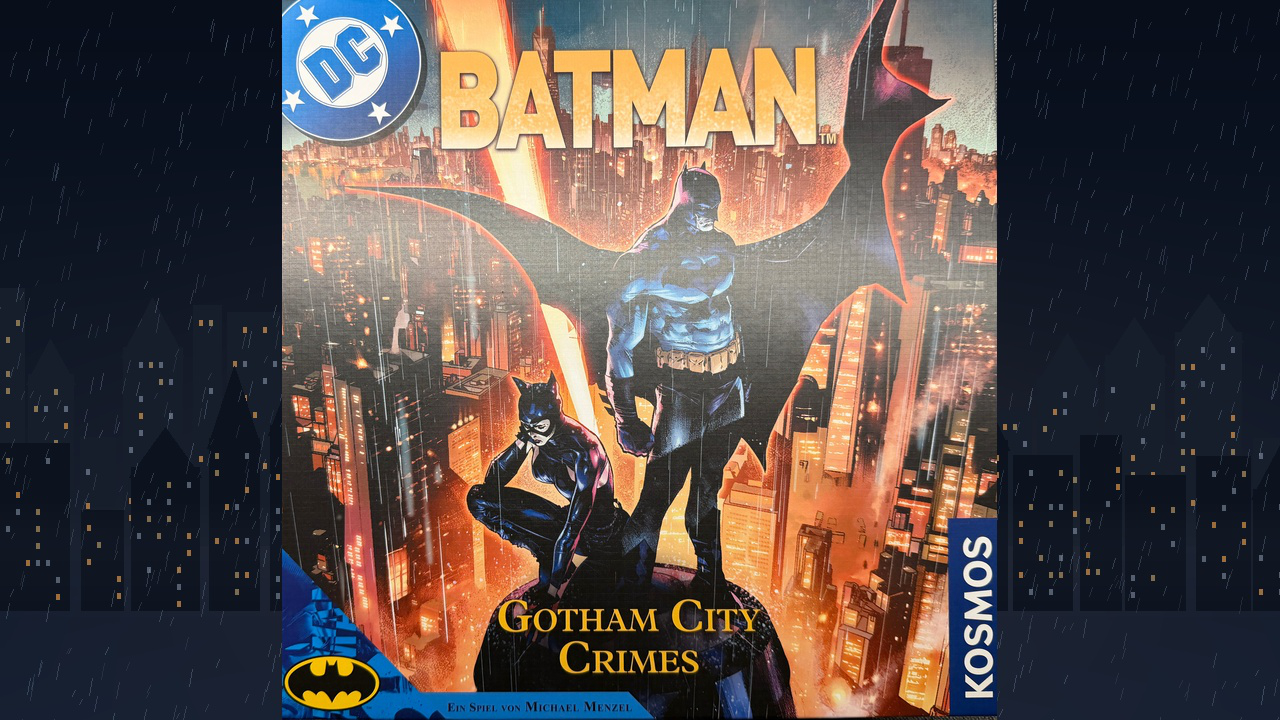
Batman: Gotham City Crimes

Von: ferengi
13. November 2026 um 06:51

Das perfekte Batman-Spiel?

Ich liebe Batman. Die Comics, die Filme, die Spiele.
Das neue Abenteuer für bis zu vier Figuren aus dem Batman-Universum gegen die bekannten Bösewichter war somit ein Pflichtkauf auf der Essen 2026. 5 Fälle können wir spielen.
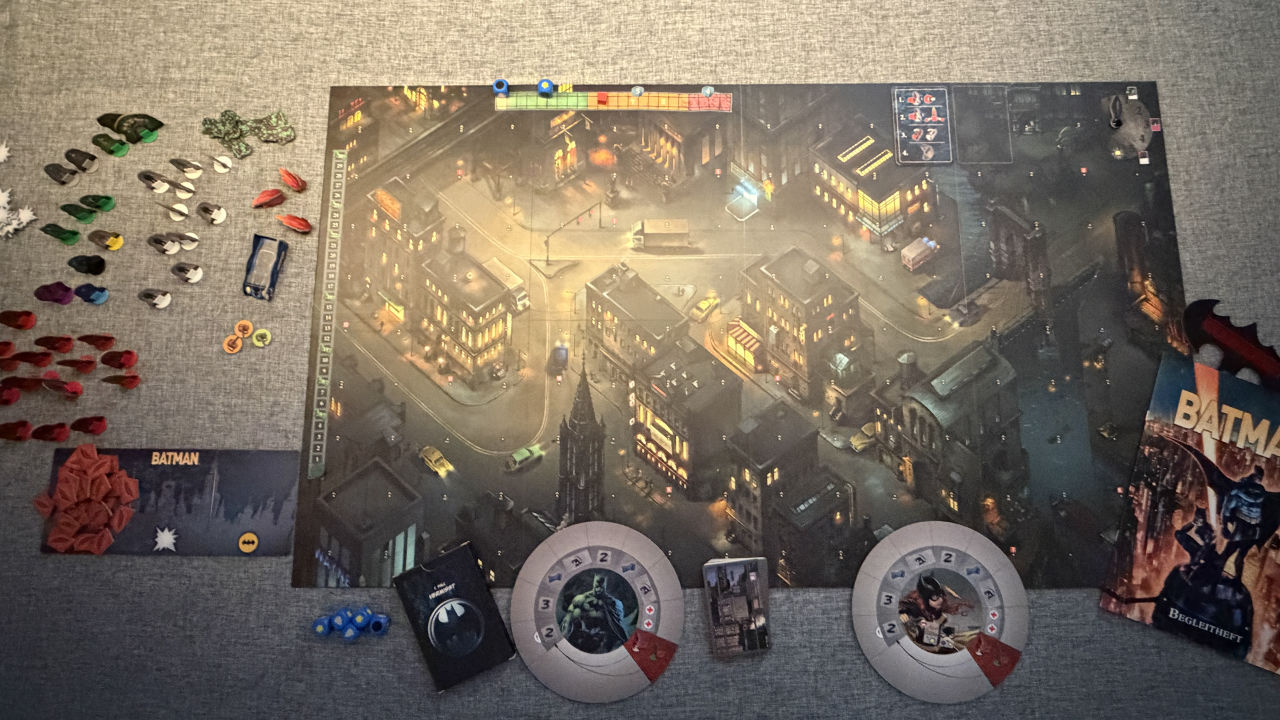
Das Spielmaterial

Wie spielen kooperativ gegen das Spiel. Nachdem wir das Spielfeld aufgebaut haben nehmen wir uns den Kartenstapel für diesen Fall. Hier gibt es dann eine Einleitung in den Fall und es wird die Startaufstellung der Helden und gegnerischen Banden auf dem Spielfeld platziert. Zu welchem Ort wir als ersten hin sollten, wird manchmal deutlich geschrieben, manchmal muss man dies selber rausbekommen. Auch wird in dieser Pahse die Zusammensetzung des Kartenstapels für die Zugreihenfolge mit den Helden vorgegeben. Weitere Karten lesen wir dann, wenn wir dazu aufgefordert werden.

Und nun wollen wir mit unseren Helden starten. Wir ziehen die erste Karte von unserem Kartenstapel mit den Helden. Neben Helden sind in dem Stapel auch Karten der Bosse und der Banden. Die Anzahl der Bandenmitglieder wächst hierdurch an und ab einer bestimmten Konstellation wird es immer schwieriger. Diese müssen wir also nebenbei immer bekämpfen, aber auch die Hauptquest mit Erkunden von Tatorten nicht aus dem Auge verlieren. Dieses Abwägen ist eine wichtige Mechanik im dem Spiel.
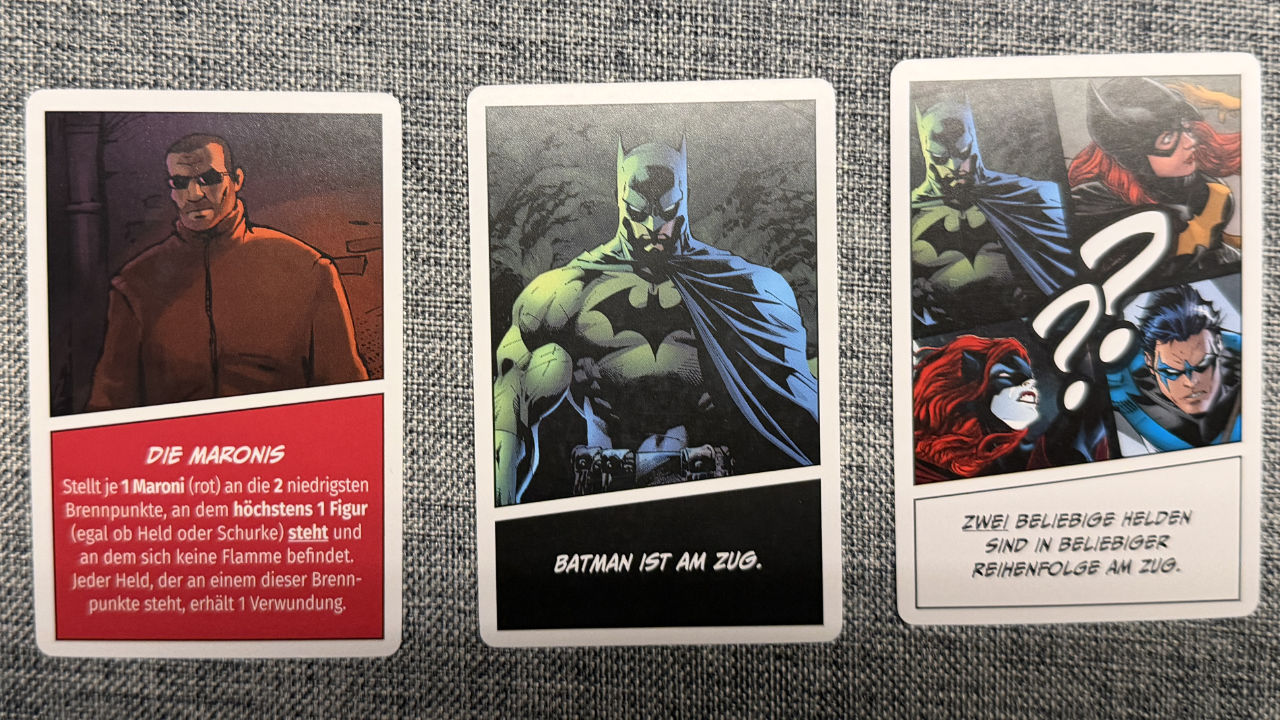
Im Kartenstapel sind neben den Helden auch Karten, die es uns schwerer machen

Auf dem Spielfeld von Gotham City sind die Orte in Dots gegliedert. Unsere Aktionen, die wir mit unseren Aktionspunkten (Anzahl Würfel) durchführen können, werden auf dem Spielerboard geplant. Einige Aktionen kosten 2 Würfel, die meisten einen. Und nach der Planung bewegen wir uns oder erkunden einen Bereich, kämpfen natürlich oder müssen uns auch mal heilen. Die Mechanik mit dem Spielerboard und der Interaktion auf dem Spielbrett ist gut abgestimmt. Oft können wir gerade nicht so weit laufen, wie wir wollen. Oder es fehlt uns dann immer ein Aktionspunkt. Zu leicht macht es uns der Spieledesigner Michael Menzel nicht.
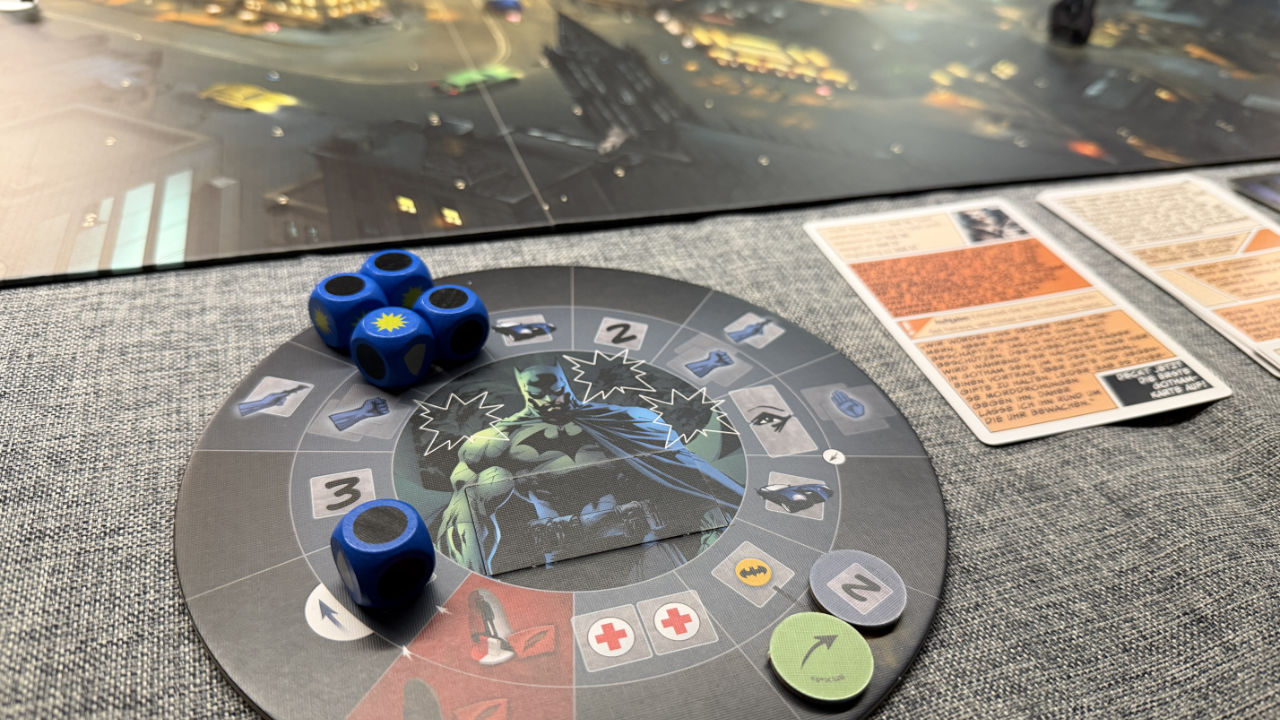
Mit den Würfeln planen wir unsere Aktionen. Die Helden haben unterschiedliche Fähigkeiten, so dass man deren Einsatz/Aufgabe aufeinander abstimmen kann.

Wenn wir mit dem Kartenstapel der Helden durch sind, wird die Uhr um eine Stunde vorgestellt und es wird geprüft, ob es zu einem Brennpunkt kommt (nicht gut), betäubte Gegner wachen wieder auf und der Boss wird stärker. Die Zeit spielt also einen entscheidenden Faktor, da die Gegnerbanden immer stärker wereden. Oft ist das Spielende aber auch durch den Sonnenaufgang um 6 Uhr vorgegeben.
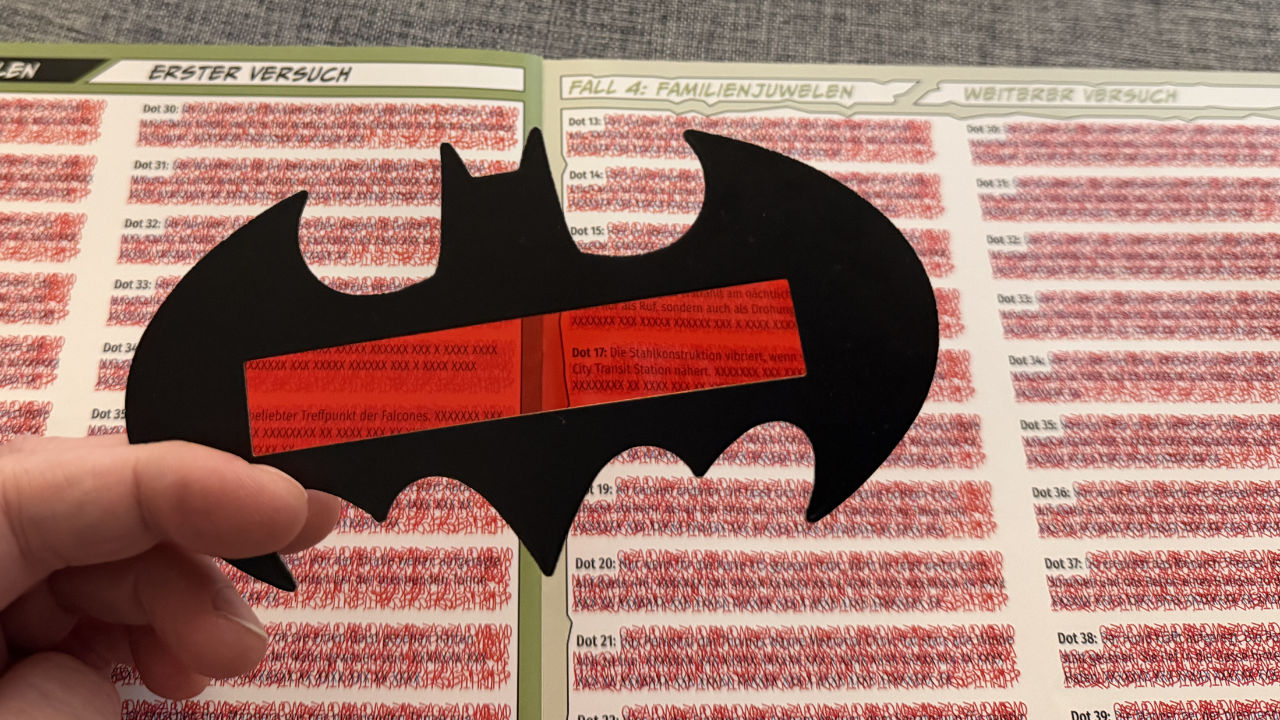
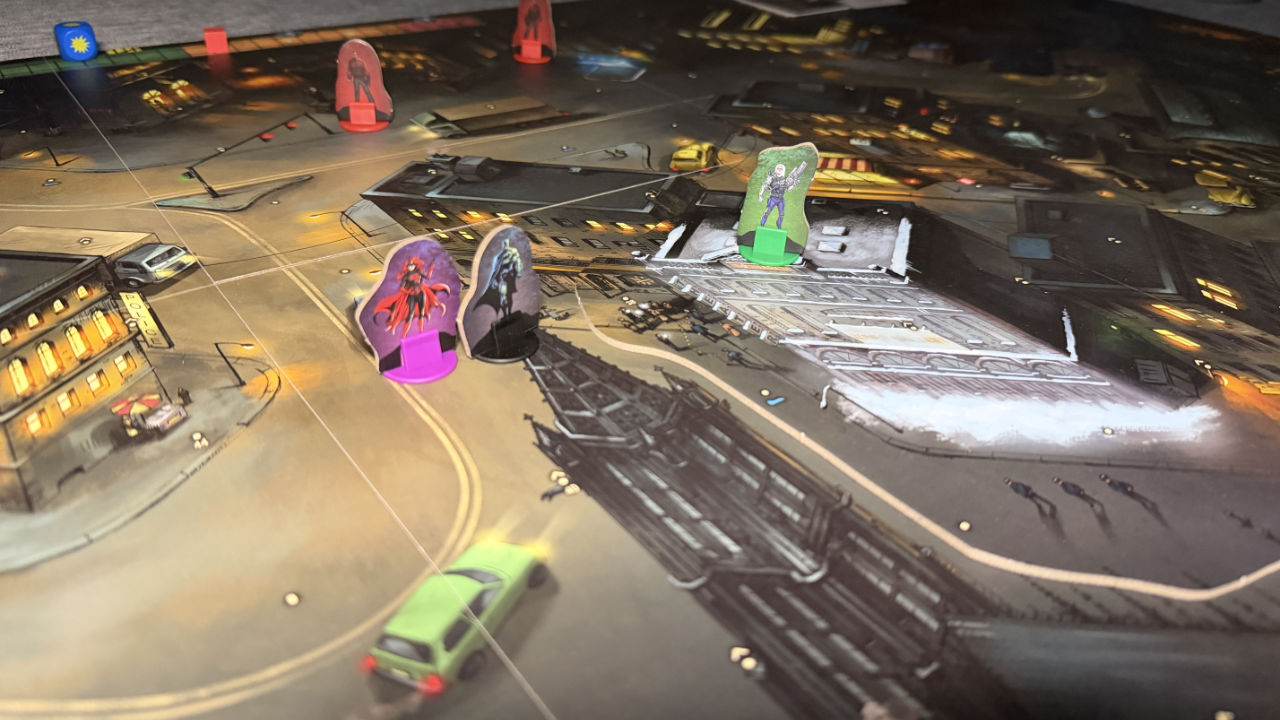
Wenn wir an einem Ort sind und diesen erkunden, lesen wir im Spielheft, was wir dort vorfinden.
Bewegen und kämpfen. An den Dots mit Zahlen können wir im Spielheft erkunden.

Aber wie haben uns die einzelnen Fälle gefallen, waren sie lösbar? Hier spoilerfrei ein Überblick und unsere Erfahrungen zu den Fällen:

  • Fall 1 als Einstieg war kurz und machte Spaß. Leicht zu schaffen.
  • Fall 2 warf Regelfragen auf. Während im ersten Fall erläutert wurde, dass bei Sonnenaufgang um 6 Uhr das Spiel beendet ist, war dies im zweiten Fall nicht eindeutig vorgegeben. Aber es gibt auf der Uhr keine 7. Stunde. Wir haben es mal trotzdem so interpretiert, dass man bis 7 Uhr spielen kann, sonst hätten wir es zeitlich nicht geschafft.
  • Leider ist im Fall 3 Eiskalt ein Logikfehler mit Freeze. Soll man ihn bekämpfen? Er verstopft unsere Würfelleiste mit Eis-Plättchen, wenn er am Zug ist. Und schließlich steht auf seiner Karte, dass man die Eis-Plättchen erst wegnehmen kann, wenn er besiegt ist. Aber wie man ihn besiegen kann, erfährt man nicht. Und zum Ende des Falls interpretiere ich es so, dass man ihn nicht besiegen soll. Auch nervt es, dass wir in einen Ort suchen müssen, um in der Geschichte weiter zu kommen. Und dieser ist keinesfalls so einfach zu finden, wie beschrieben. Und mit nur zwei Helden ist es unglaublich schwierig, viele Orte zu erkunden, da die Zeit wegläuft. Das war richtig frustrierend. Im Anschluss haben wir die Level dann mit vier Helden gespielt, also jeder von uns zwei, und das ist in der Tat deutlich einfacher. Empfehlung: Immer mit vier Helden spielen!
  • Der 4. Fall, nun mit vier Helden, war gut durchdacht und machte uns Spaß. Auch hier war der Ausgang sehr knapp, vermutlich auch weil wir beim Finden der richtigen Schauplätze auch etwas Glück hatten.
  • Der letzte Fall war, vielleicht auch durch Würfelglück, sehr einfach. Als Höhepunkt der Reihe passte die Geschichte gut, ein schöner Abschluss für das Spiel.

Fazit:

Während uns das Grundkonzept sehr gefallen hat und die Atmosphäre bei gedimmten Licht uns voll nach Gotham City versetzte, waren die Fälle sehr unterschiedlich. Dies betrifft die Regeln und und Schwierigkeit, die leider nicht für zwei Helden optimiert wurde. Der Wiederspielwert ist leider nicht vorhanden. Jeden Fall kann allerdings zweimal gespielt werden. Da man beim Spielen die Story und auch wichtigen Orte im ersten Anlauf herausbekommen hat, ist der Ablauf beim zweiten Durchgang anders. Und teilweise sogar besser. Insgesamt hat mir dieses Batman-Spiel gut gefallen, aber es war dann doch nicht das erhoffte perfekte Batman-Spiel.

Stubenscore: 7,7 / 10


BATMAN: GOTHAM CITY CRIMES
BoardGameGeek

Spieledatenbank Luding

Brettspiel (getestet)

Joker’s on You

21. Juli 2026 um 20:44

The jester hat in the corner of the logo looks like a three-legged lady doing the can-can.

Say one thing for Carl Chudyk, he’s always swinging for the fences. His latest, Chess Joker, is full of wonderful ideas. At its most basic: what if we took the game-altering jokers from Balatro, say half a thousand of them, and transformed Chess, that ancient game of strategy and discipline, into a cast-iron bathtub filled with jelly beans and marmalade and one or two razor blades just for fun.

At its best, Chess Joker lives up to that promise. The problem is that it isn’t often at its best.

I like the colors!

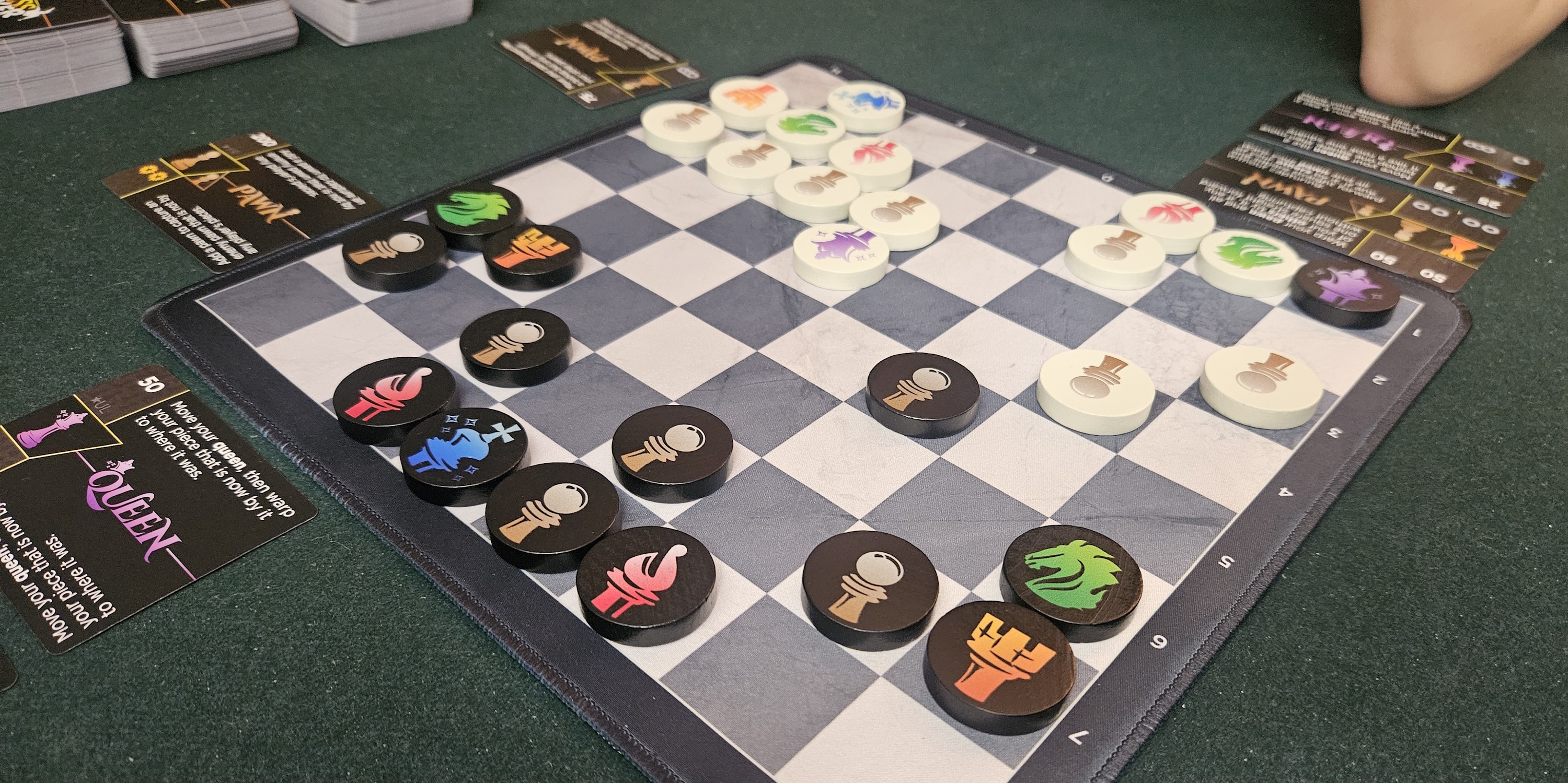
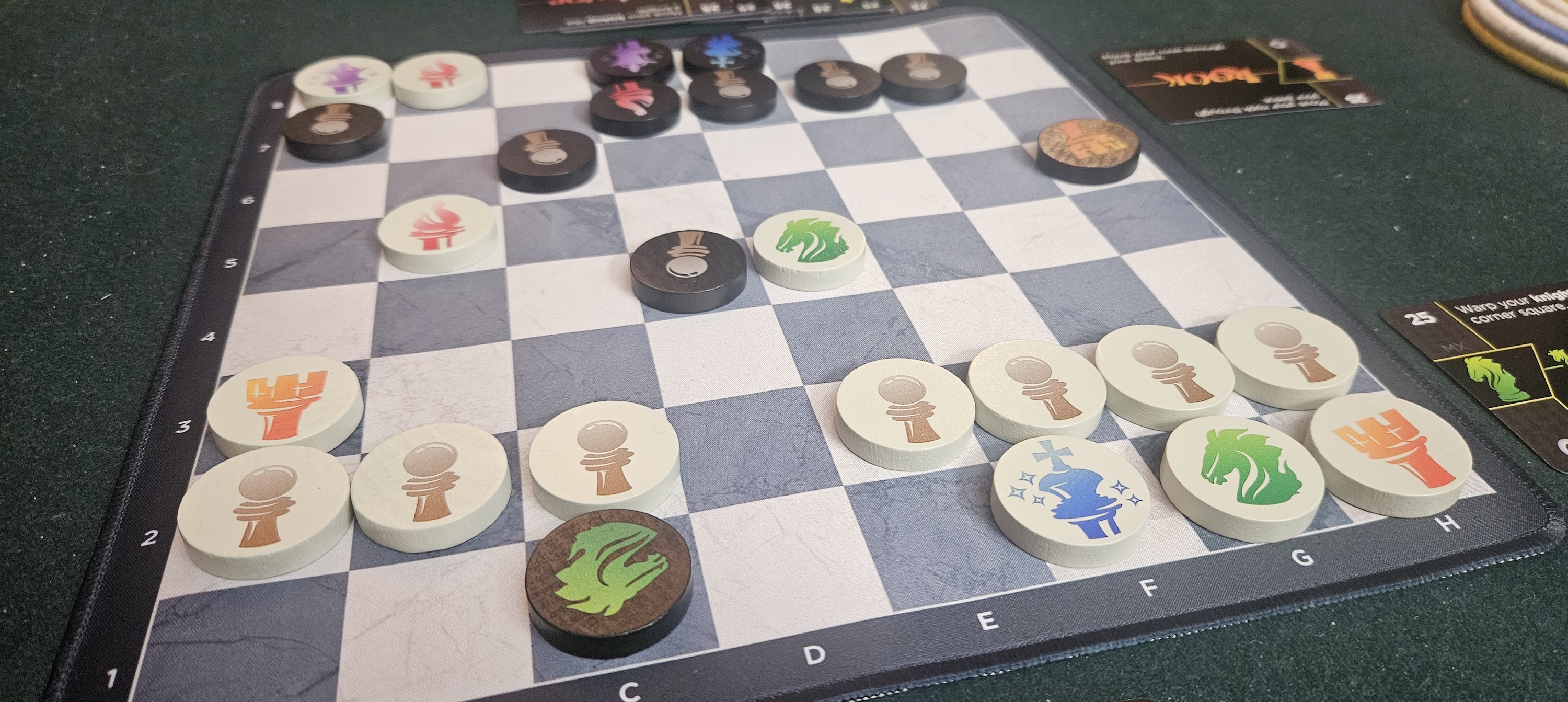
This is chess.

Picture Chess. I don’t have to explain Chess to you people, do I? Knights, bishops, queens. Castling and checkmates. Years ago, some dork with taped eyeglasses and a collared shirt buttoned all the way up to the top pulled an untimely en passant and you haven’t played the game since.

Chess Joker is Chess.

But it’s also Joker.

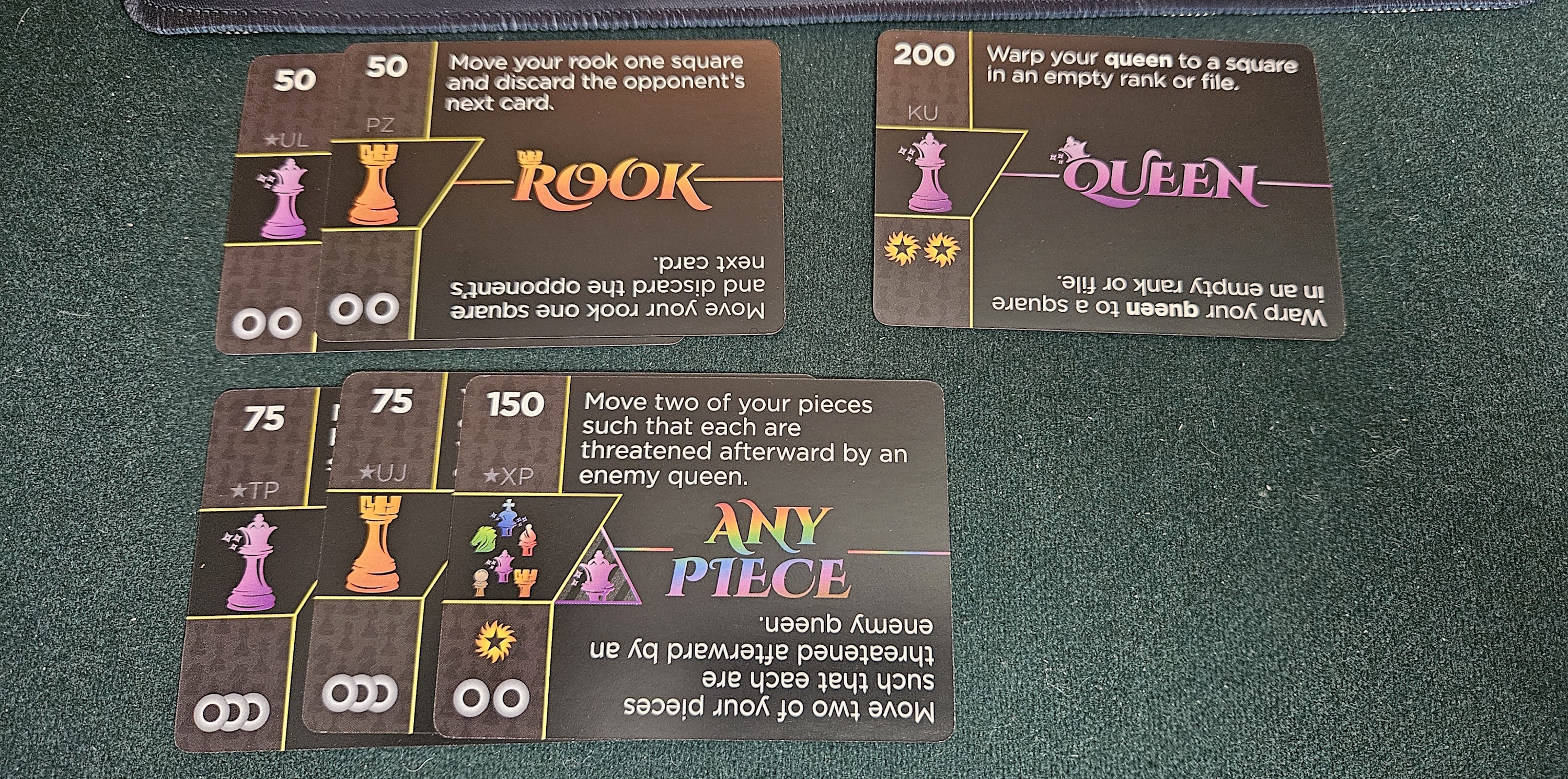
The Joker portion of Chess Joker works like this. At the end of your turn, you draw a card. On your next turn, this offers a new possibility. Like, say, letting you warp one of your pawns sideways two squares. Or moving a bishop like a knight. Or swapping one of your bishops with an opposing piece on the same-color of square. Or placing your queen on h5, no matter what’s in that space right now.

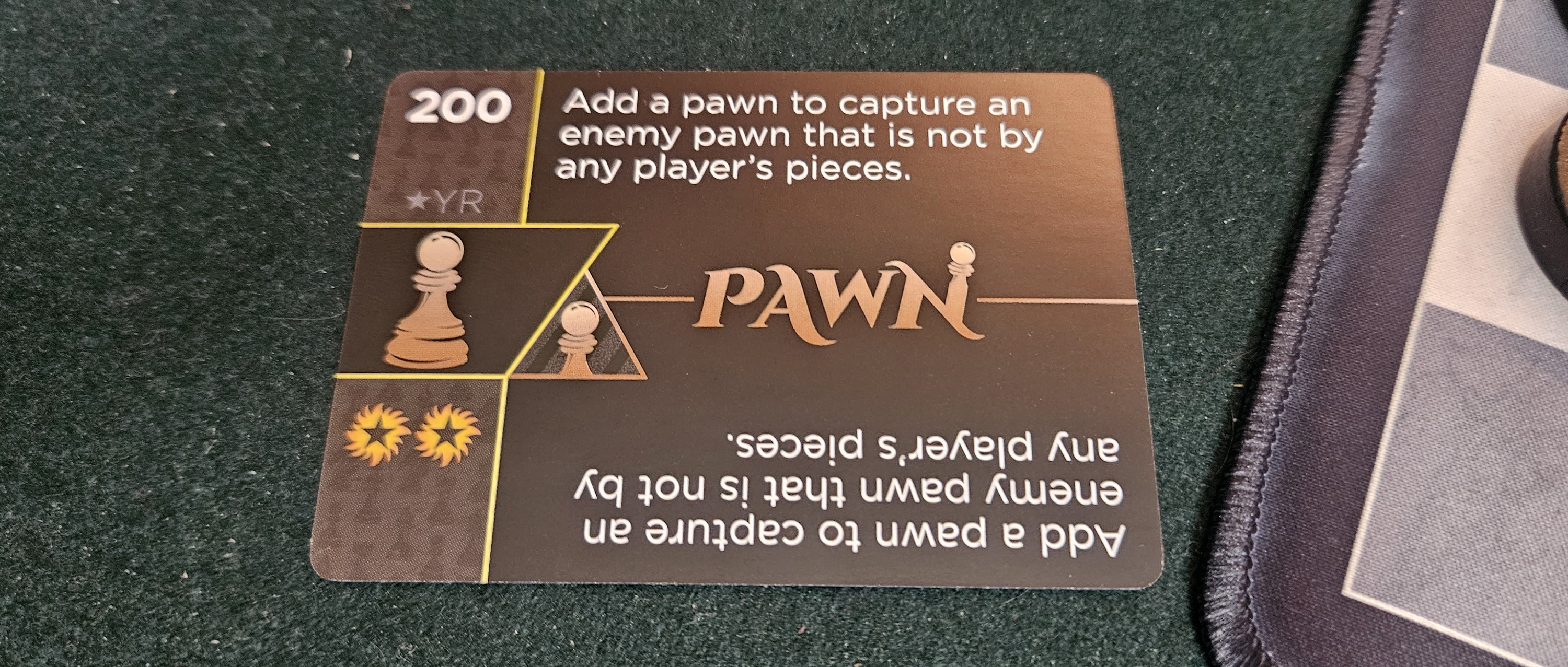
Now, the thing about these cards — these jokers — is that they award points for their shenanigans. The tougher their effect is to pull off, the more points they award. The examples above were low-scoring opportunities. 25 to 50 points. Others are more potent. For 100 points, you might be asked to move your queen to capture an enemy piece (easy) and then capture both an enemy piece and your own piece next to wherever the queen ended her turn (uh oh). For 150: warp whatever piece is currently seated on g5 to any open square. For 200: take any piece that was captured last turn and return it to an empty square by one of your bishops.

I like the little icons that make tallying the score easier. That's a nice touch.

This is a chess joker.

Cutely, these points are called Elo, just like the system invented by Arpad Elo to improve on the previous Harkness system for ranking chess players. While it’s possible to win by checkmating your opponent, it’s also possible — and far more likely, for reasons I’ll discuss momentarily — to win by amassing 800 Elo points.

As you can probably already tell, higher points are significantly tougher to earn than lower denominations. Most of the time, they require preparation in advance. That your queen is already poised to capture; that anybody is seated on g5; that your opponent doesn’t preempt your card. That last point is major. Because jokers are visible to both contestants at the table. And they cycle every turn whether you accomplish them or not. This gives Chess Joker a loose, improvisational air. One that is, naturally, rather the opposite of ordinary Chess.

There’s more to Elo. Reducing your opponent to three or fewer pieces means earning 25 points per turn. On the flipside, putting your opponent in check means awarding them 25 points, discouraging snitty little sequences of checks lest you trickle them closer to victory. And most cards can be “masqueraded,” substituting the stated piece for something else, but at a penalty that reduces the card’s scoring to 25, the lowest possible quantity.

These rules make sense, given the chaotic nature of Chess Joker’s gameplay. Each rule comes across as a patch on a system that would otherwise break down under its own permissiveness. Jokers make putting the rival king in check a trivial matter, thus checks become counterproductive. With pieces dying left and right — again the result of jokers that often eradicate troops outright — the masquerade becomes necessary to prevent the bulk of cards from not having any effect in any given session’s back half.

QUEEN SPARKLES

This is a chess joker scoring pile.

Which is to say, when I called the gameplay “chaotic,” a better word might have been “sloppy.” Indeed, Chess Joker isn’t only a variant of Chess; it’s a repudiation of its deliberate nature. Nearly everybody knows how to play Chess, but most people do not, in fact, play Chess. Because it can be slow and boring and cerebral. Chess Joker is the version that’s fast and reactive and goofy.

As such, it actually shines brighter the more one departs from the headspace that classic Chess demands. Who cares if you lose that knight to only take a pawn? The next flip from the deck might eliminate the poor guy anyway. As long as you earn 75 Elo there’s no good reason not to make the exchange.

To be clear, this can be wild and exciting. I’d even go so far as to call it transgressive, like some ancient taboo has been violated under your fingertips. Because it has been. Over and over again, Chess Joker smears mud on the face of sacred statuary. Don’t want to get into a tit-for-tat exchange of checks and counter-checks? Just don’t. Teleport your queen to the enemy back row. March an entire block of seven pieces forward a single step to menace five enemies with the same move. Warp so many pawns forward that you’re suddenly fielding four queens. Anything is possible at Zombocom… pardon me, in Chess Joker.

Look at me, talking myself into liking Chess Joker more than I actually do. The thing is, I’ve played some wonderful sessions of Chess Joker, full of laugh-worthy reversals and absurd escalations and plenty of board states that would never in a trillion simulations occur in an ordinary match. But I’ve also had some real stinkers. Strings of draws that do very little. Rival jokers that chew through my lines. Moments where the game’s brilliance decides to hide behind its nonsense, like a wise old trickster god giving life-altering advice only to spin around and flatulate in your face.

At this point, I've played maybe... thirty? fifty? chess variants. Deck-building chess! Gravity chess! So many RPG chesses! And so far, my impression of all of them is that they're amusing for a bit, but lack much staying power.

This is an outro image.

The twist, which you surely saw coming, is that most of those sessions are one and the same. There’s no separating them. The good and the bad mashes together. There are hundreds of jokers in the box, and only a fraction appear per game. But with one peeling from the deck every turn, there’s no end to the disruption. Every turn might reveal something amazing or something… not. Not amazing. Not interesting. Not even amusing. And there’s nothing quite like the disappointment of concluding an anarchic volley with something ordinary.

In the end, Chess Joker is a fine experiment. It’s silly and amusing. At times, it even approaches brilliance. In crafting his own variant, Chudyk has joined one of tabletop’s oldest conversations, and for the most part his hooting is as worthy a thesis as any of the others that have been proffered over the centuries. “What if Chess was stupid as hell?” he seems to ask. Sure, yeah. What if it was. I dig it. For a while. And then the question grows obnoxious, and Chess Joker spins out of control yet again, and I’m left wondering if there’s a curated selection of these jokers that makes for a more controlled experience, and somehow we’ve circled back to preferring Chess. The trickster god leans forward from where he’s been dancing on the table, tweaks my nose, and disappears in a puff of confetti.


(If what I’m doing at Space-Biff! is valuable to you in some way, please consider dropping by my Patreon campaign or Ko-fi. Right now, supporters can read the next installment in my series Talking About Games, this time tackling the topic of what makes a good list! Naturally, the piece includes a list.)

❌