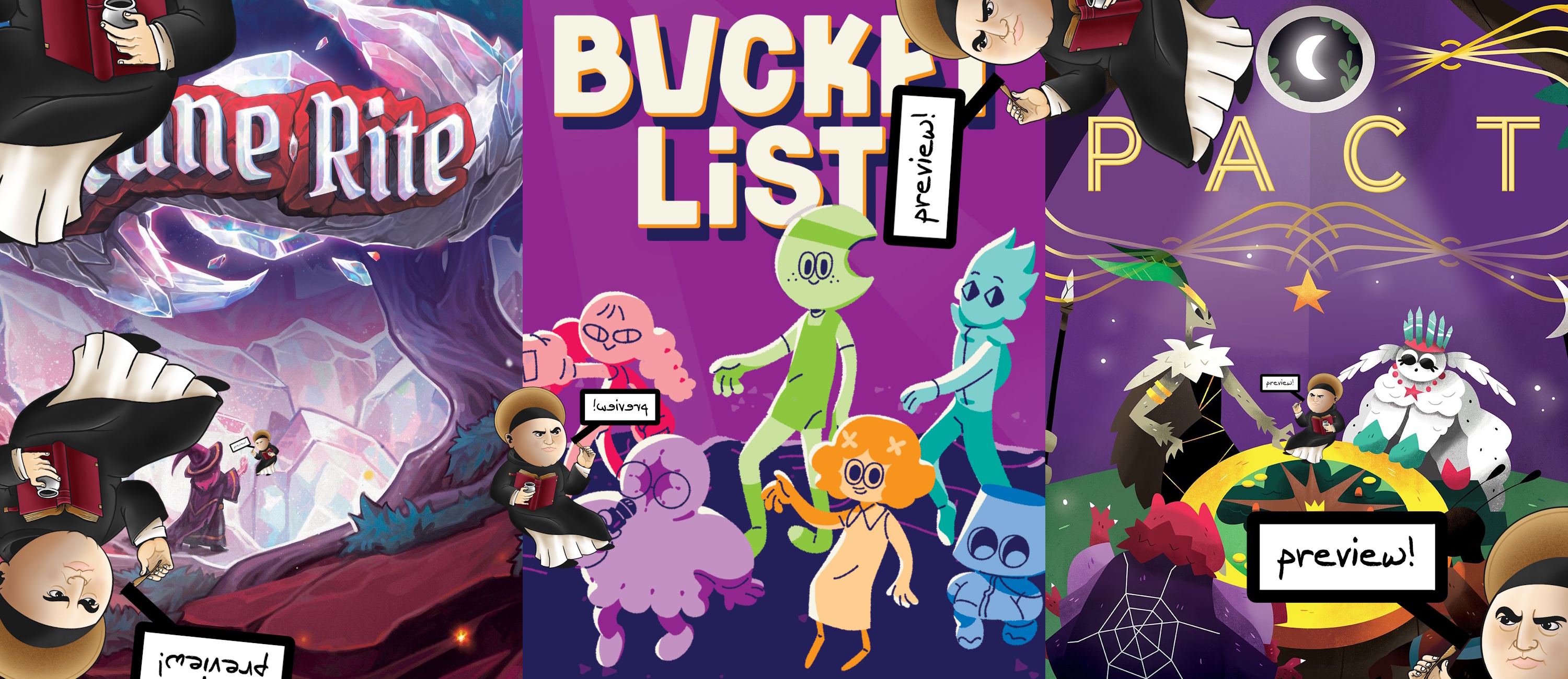
❌

Lese-Ansicht

Bewitchments, Buckets, Bugs

can you spot every Wee Aquinas?

Imagine me in a real pickle sandwich. The middle of preview season (ho ho ho), and suddenly I come down with not one illness, but two. Something chronic, something acute. And me with a whole stack of board games to write about. Some of them time-sensitive, counting down the minutes on crowdfunding platforms as we speak.

What’s an old man to do? Write about all three in a single splash, naturally.

In other words, here are three very different tabletop titles, each worth a wink of your time. Come on in. Let me tell you about them. Briskly, before I’m back to bed.
I've been reading too much China Miéville this month.

Runes, crafted, so thus they may be written.

Rune Rite

At a glance, Rune Rite doesn’t look all that dissimilar from any number of other flip-and-writes. Fortunately, designer Jason Katzwinkel makes one alteration that has major implications not only for this game, but for the entire format.

Short version: you craft the card in advance.

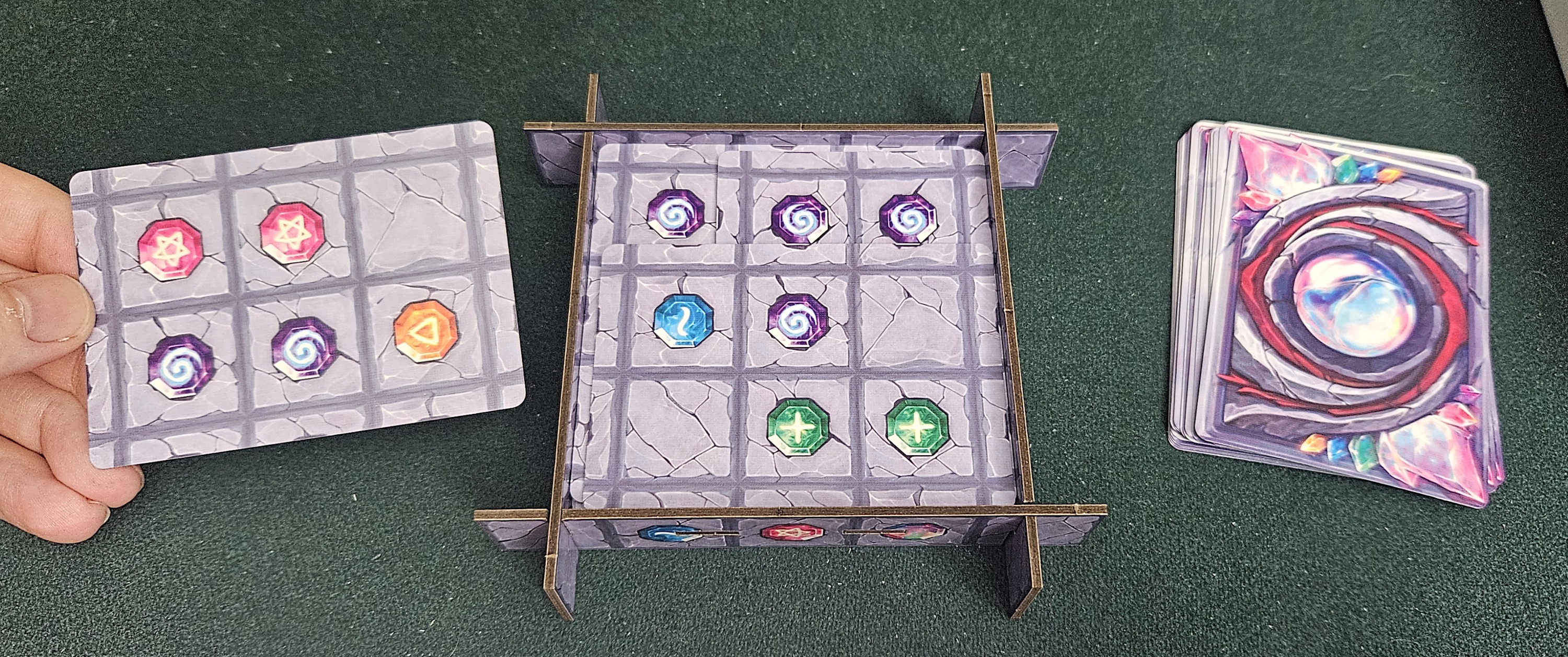
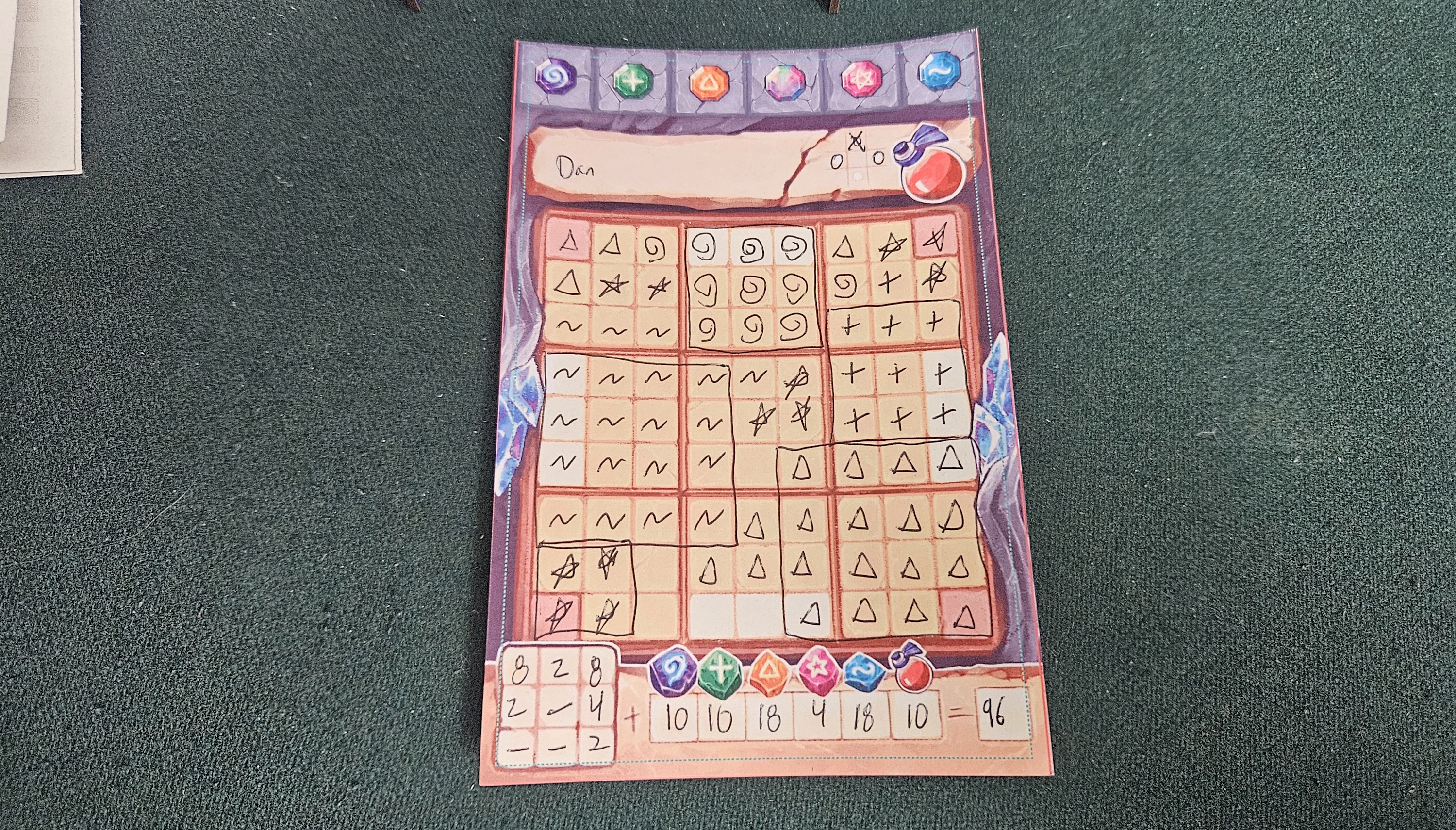
Longer version. Like every other instance of the genre, you begin your turn by flipping over a card. This shows some combination of runes — spirals, stars, tildes, triangles, and plusses, with the occasional wild that counts as anything and everything. Then everybody at the table gets to mark a cluster of those symbols onto a personal paper grid. The larger the cluster — say, a polyomino L of stars — the more you mark, all the way down to a single symbol.

The wrinkle is that drawing a card isn’t as simple as drawing a card. You draw the card, yes, right, you’re following I’m sure, but then you choose how to lay that card over the top of any previous cards, all framed within a cardboard holder to establish the selection’s outer boundaries. In more mathematical terms, every card offers a 2×3 selection, but you’re really drawing from a 3×3 grid. So the current card matters, but so do any previous cards that might still be peeking out from previous turns.

The implications are far-reaching. At the first and most obvious level, you’re given some control over which symbols — and furthermore, which shapes of symbols — you’re allowed to draw on your pad. By rotating your card, it’s possible to arrive at unusual shapes indeed.
HMMM

Looks suspiciously like a flip-and-write to me.

But more than that, with some attention you can also sabotage everybody else at the table. Whatever shape the card-puller draws, nobody else is allowed to use. Sometimes this only provides access to smaller leftovers, but there’s room for devious plays. Such as noting that a rival wants a size-two combination of spirals, so instead you hand them a huge cluster of spirals instead. Go for it, bud. Overcommit.

In some ways, Rune Rite feels like a proof of concept. It’s a small game, I mean, with very little variance between sessions apart from the actual shape-crafting that occurs on each and every turn. Unlike something like Cartographers, which changes its victory conditions between sessions, the goal is always the same.

But for a proof of concept, there’s a lot to like here. There’s real tension between specialization and diversification. Points principally come from drawing boxes of similar symbols and filling other boxes with as many different symbols as possible, encouraging you to build across the pad’s boundaries. Which is to say, there’s a definite “best approach” here, but it isn’t one easily or flippantly pursued.

I’d like to see more of this. Crafting the “flip” of the flip-and-write is a stroke of brilliance, and here it’s given perhaps its purest possible expression. The result is little more than a snack, but it’s a snack that might prove transformative if everybody catches the vision. Like a Triscuit.

Rune Rite is on Kickstarter for nine more days.
the problem with throwing the biggest BBQ in Texas is that within three minutes someone else will claim to have thrown the biggest BBQ in Texas

Some of the things I wish I’d done.

Bucket List

According to internet lore, the term “bucket list” was coined by the 2007 comedy film The Bucket List. This is a myth. My proof is a journal entry dated 14 March 2006 which reads: “Bucket List. Item #1. Prove that I, Dan Thurot, came up with the term ‘bucket list,’ not that stupid movie coming out next year.”

Many of the action items in Micah Heiselt’s Bucket List represent similar uphill battles. Spend a night in Dracula’s Castle? Sure, but bring the gauze. Buy a farm for orphaned alpacas? Nothing was ever stopping you but the fear of success. Fill the Louvre with only your art? Kid. Come on. You can’t even finish one board game preview on a site without the slightest quality control.

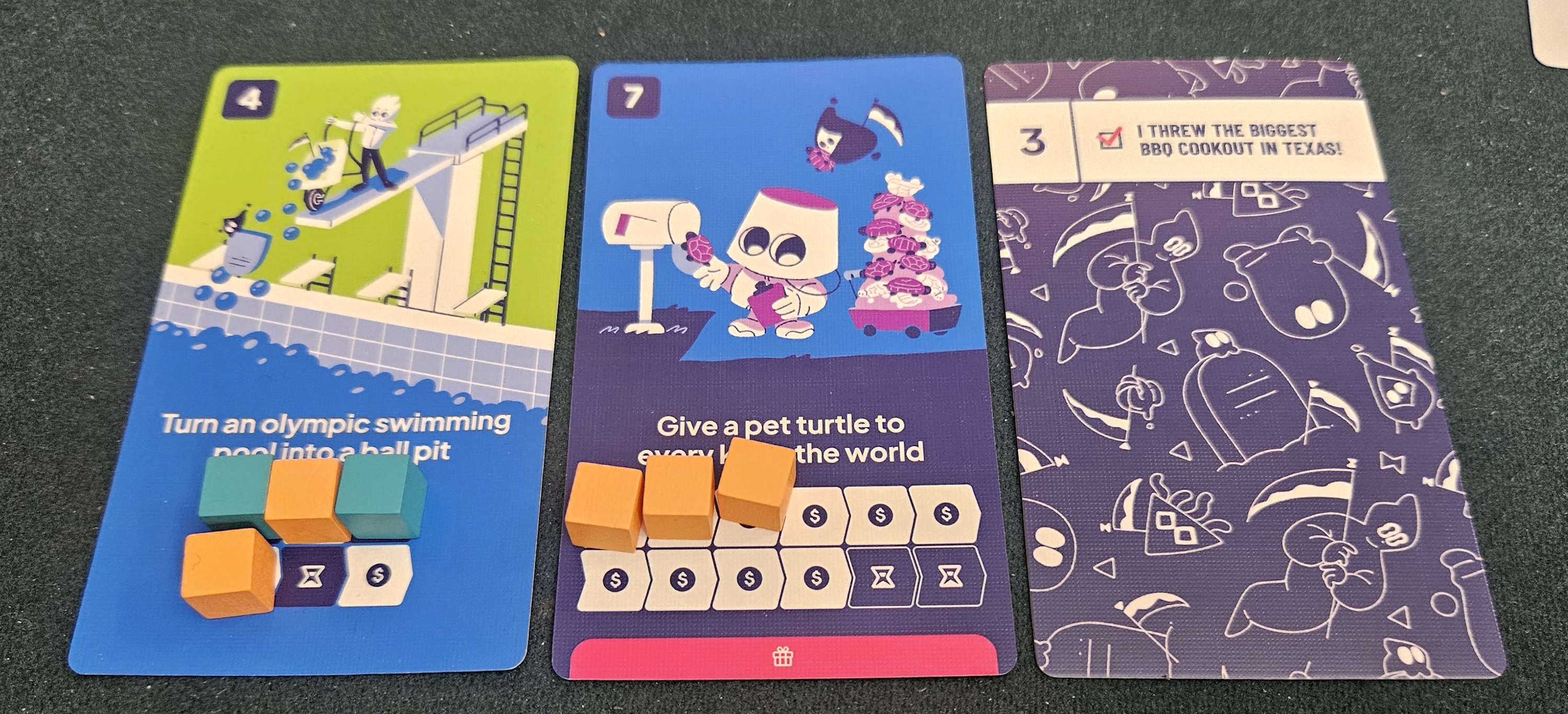
Then again, that’s much of the charm of this one. You and your friends wrote a bucket list in high school. (Presumably you graduated after 2007.) Now, with death swiftly approaching, you must tick off as many boxes as possible.

What would otherwise be a cutesy gimmick game is elevated by two factors. The first is that the gameplay is a combination of long-term planning, thinking on your toes, and careful risk management. There are only two main resources, time and money, which must be invested into a goal before it can be accomplished. That’s simple enough, but resources come from multiple sources, some more reliable than others, such as action cards versus a turn-initiating roll of the dice. You’ll get something, but whether you can put it to good use is another question. Oh, and any leftovers will anger the Grim Reaper.
could you come for me a little faster please

Death comes for us all.

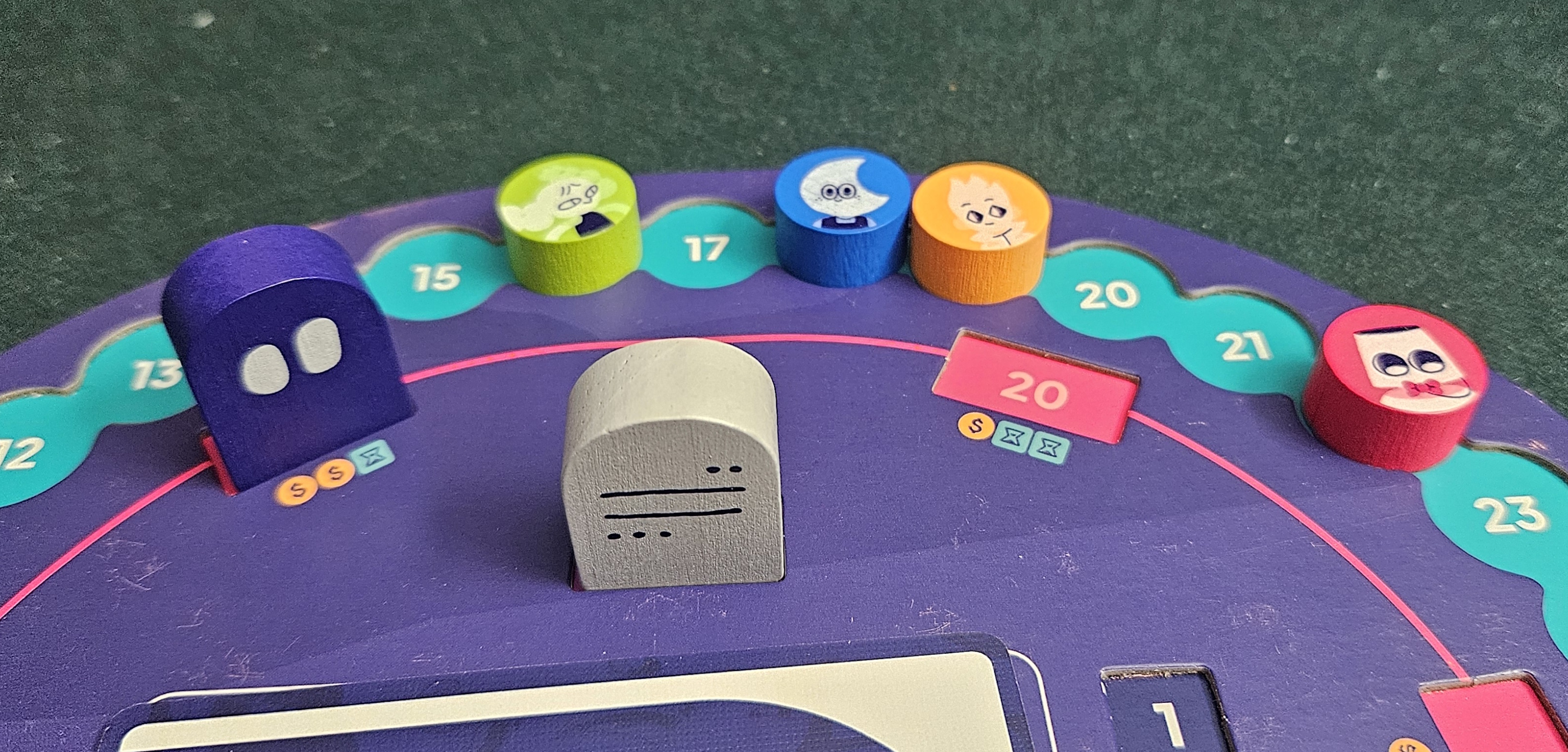
The Grim Reaper is the other shakeup to the formula. Various triggers will see old boney chasing everyone around the score track. If he catches up to the trailing player, a headstone will be placed to end the game upon the completion of the round. There are ways to cheat death, nudging the Grim Reaper back on the track and returning the headstone to its resting place… except you might not want to delay the end of the game if you’re sitting pretty at the top of the score track, leading to little tussles to delay or hasten your mortality.

It’s a bit grim. But then, so is anything associated with bucket lists. The good news is that it’s also an amusing little plaything, with more to consider than first meets the eye, and lots of goofball moments where death seems around the corner only to be delayed yet again. It’s ultimately a game about picking your battles. There isn’t time or money enough to do everything, so you’re encouraged to pad out your days with goals that can absorb whatever resources happen to come your way.

In that sense, there’s something comforting about it, almost nihilistic in its dedication to self-determination. Maybe it will even inspire me to fulfill the other entries in my bucket list. “Item #2. Change it back to Berenstein Bears before anyone notices.”

Bucket List is on Kickstarter for fifteen more days.
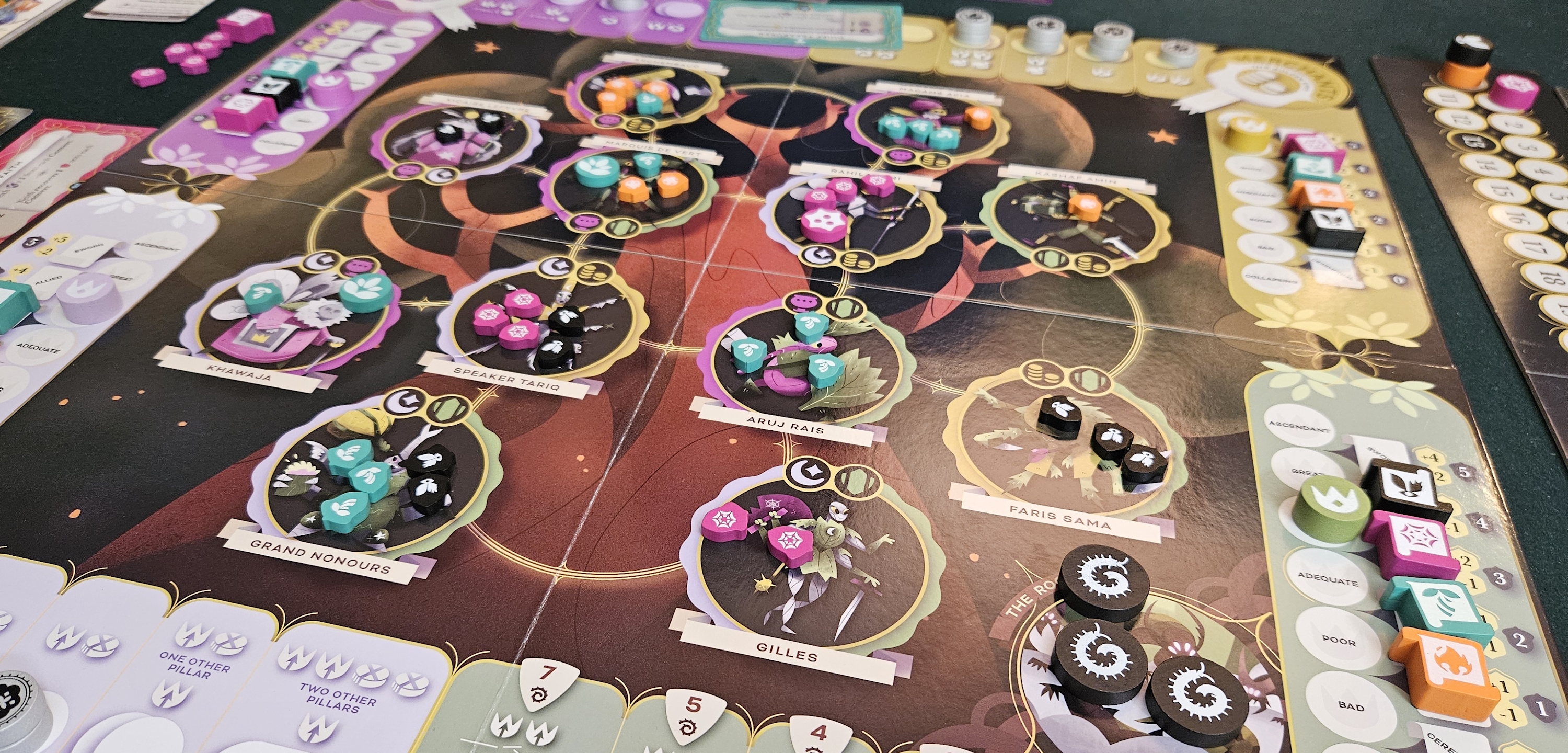
I didn't even notice it was a tree.

This tree is especially bug-infested.

Pact

Pact is what you get when you blend the asymmetry of Root with the hard tradeoffs of a classic card-driven wargame like Twilight Struggle.

First, the Root. Four bug factions occupy the tree kingdom of Branchbourne, each with its own advantages. There’s Jenna Ermine VI, her authority thoroughly entrenched across the branches and boughs of the kingdom, but spread so thin that the slightest tension might crack her carapace. Her closest rival is the Duchesse Orich, incredibly well resourced but also over-leveraged. Somewhat farther underfoot is the revolutionary Matuk Inkclaw, capable of unleashing labor strikes that cripple the kingdom, and the heretic Weaver Neith. Mostly I remember Weaver Neith mind-controlling everybody.

All right, asymmetry is hot right now. But the second half of the game, the card-driven wargame half, controls how things get done. Everything relies on event cards. At any given time, a handful of these are on offer in the market. Taking a turn isn’t as simple as moving pieces. Instead, you select an event. If it’s your own, you either use the card for its action points — adding tokens, moving stuff between locales, that sort of thing — or take its historical outcome, which is always weirder and often more potent, but less directed. On the other hand, if it belongs to someone else, you take the actions while they trigger the event. Pretty normal, as card-driven wargames go, but rather novel when it comes to bug-based fantasy games.
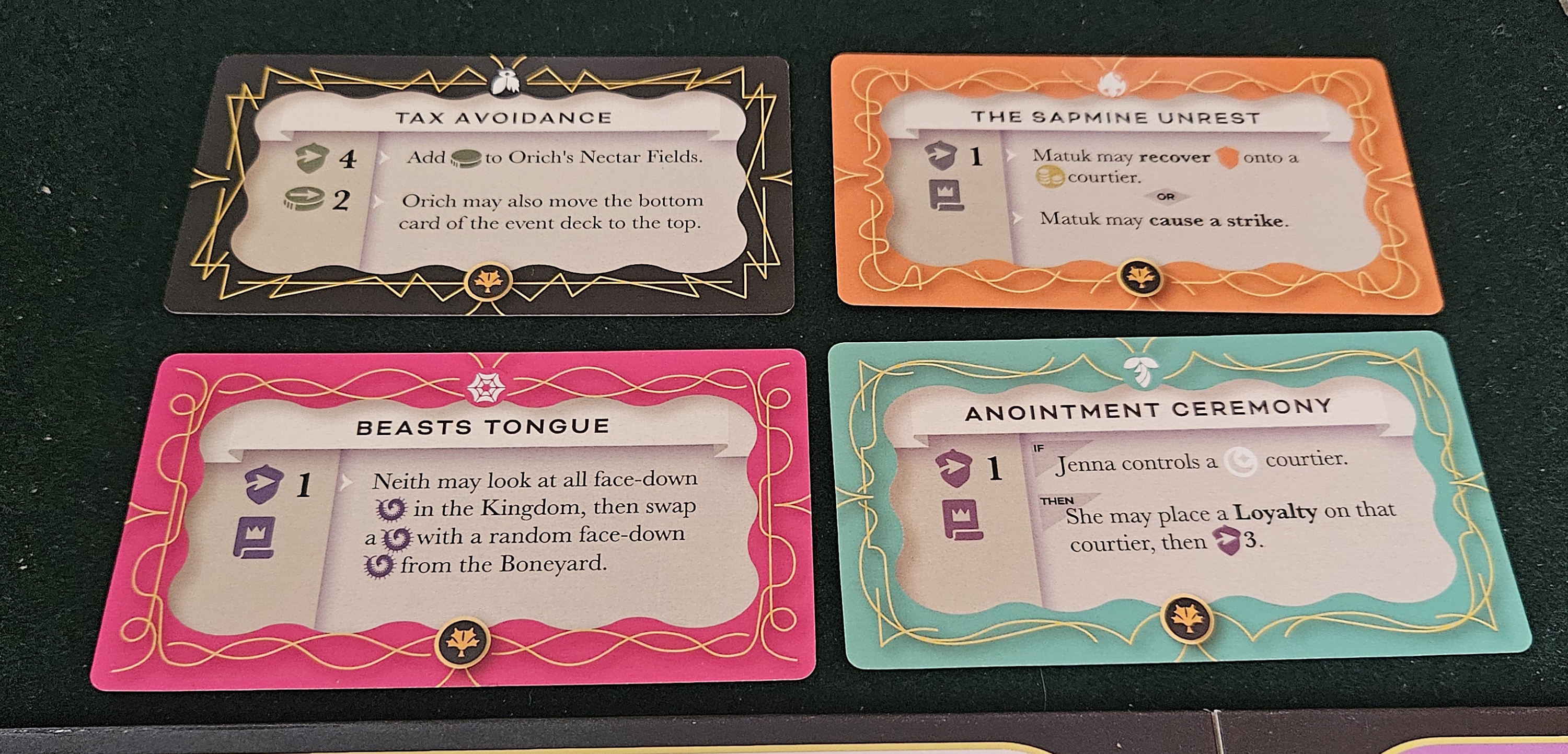
the heartwood? eh? eh?

Events are the heart of Pact.

Making matters more complicated, society in Branchbourne is dominated by four “pillars,” each of which demands some measure of attention lest the kingdom fall into disrepair. These are handled by moving treasures, a nearly zero-sum economy, between their four domains. The Merchants, for instance, are how cash gets infused into the economy. By investing treasures into their domain, additional treasures wink into existence ex nihilo. Invest too much, however, and the Merchants will crash the whole dang thing, reducing the number of treasures in circulation.

Okay, so you want the Merchants to have a lot of treasures, but not so many that they wreck the economy. Except the other pillars also have their own requirements. The Nobility mostly function as parasites, destroying treasures outright, but if not placated they’ll steal treasures from the other pillars. The Church is similar; they like to gather treasures as tithes, but they can manipulate the standings of the other pillars outright. The Military, meanwhile, needs treasure. Lots of treasure. Only their threat is no paper tiger-beetle; if they don’t have enough loot in their vault when the round ends, the centipedes chewing at Branchbourne’s roots will overrun the kingdom and eat everybody.

This prompts a delicate balancing act. Your faction doesn’t only want to survive; they also make pacts (the title! oh ho!) with those pillars to see them succeed in exchange for influence at court. So, depending on how you’ve positioned your faction, you might want the bank to fail this round, since its collapse will humiliate your rival who’s aligned with them, while feeding heaps of glittery to the Church in exchange for their imprimatur on your ascending the throne.
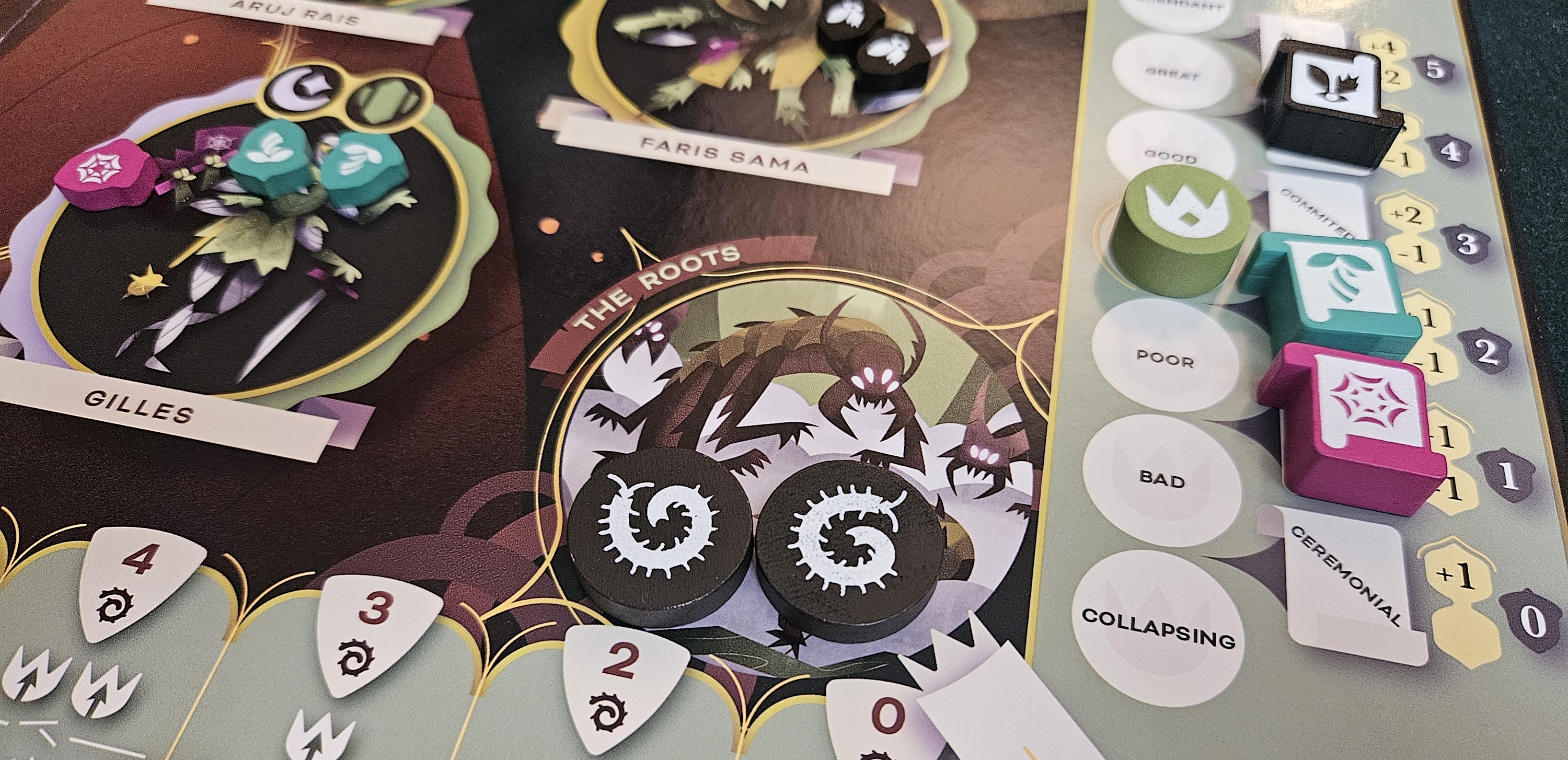
I have a really yucky story about centipedes, but it's basically that one day I was turning over a rock and a centipede walked on my hand, so it's the same as everybody else's childhood-scarring story about centipedes.

Keep forty eye-facets on those centipedes.

Which brings us full circle to that event system, because this is where you can manipulate every little corner of Branchbourne to your advantage. The Duchesse Orich, for example, can use her hives to bestow additional treasures on various pillars of society. But when an event raises the opportunity to do so, will it align with her current goals? The same goes for the firebrand and his labor strikes, the Empress and her loyalty counters, and everything else. Pact is a game of hard tradeoffs. Direct action or powerful but perhaps misaligned events? That’s the question, baby.

All told, the result is a fable about the ever-shifting halls of power that I find mighty intriguing. Like a lot of the best games, designer Zach Hoekstra has keyed into the fact that smart design is often about limitation as much as it is about player agency. Often, turns force a choice between which goals you’ll fail at the least. It’s a lot like tacking into the wind; moving at increments that seem to go nowhere, only that bit by bit move you closer to your objective.

The result is one heady political game indeed. Of the titles on this list, Pact is the heftiest, but it’s also the one I’m most eager to see reach completion. It’s ambitious, it’s weird, it’s full of bugs.

Pact is on Gamefound for nineteen more days.


Prototype copies of Rune Rite, Bucket List, and Pact: The Future of Branchbourne were temporarily provided by their designers and publishers.

(If what I’m doing at Space-Biff! is valuable to you in some way, please consider dropping by my Patreon campaign or Ko-fi. Right now, my third-quarter newsletter is open to all.)

  •  

Tabletop pioneer Steve Jackson returns focus to game design as Sabrina Gonzalez takes over as Steve Jackson Games CEO

Tabletop game design pioneer Steve Jackson has ended a 17-month return running his namesake games company, with new CEO Sabrina Gonzalez taking charge of a business with years of falling revenue as well as a run of promising crowdfunding successes.

Jackson will remain president of the company he founded in 1980, but will refocus his attention on game design and development, with managing editor Allison Page promoted to COO.

He had previously stepped back from the day-to-day running of Steve Jackson Games in 2014, when long-time COO Phil Reed became CEO, allowing Jackson to devote more of his attention to game development.

Reed was succeeded by TurboDork CEO and current GAMA president Meredith Placko in 2023, but Jackson returned to direct control of the business in April last year following her unexpected resignation.

Jackson’s return as CEO in 2024 was not presented as a permanent appointment, with him saying in the wake of her departure that her direct reports would report to him while he “figured out a plan”.

Gonzalez has been with SJ Games since 2013 as a production artist and production manager, apart from a brief period away from the company working for toy and game manufacturer Grand Prix International – and has been a member of the board of directors since 2021.

She said of her vision for the business, “As a general goal, I’d like us to continue to grow. We weathered the pandemic and pivoted project plans to address continually changing tariffs.

“The goal is always to make great games that people love. I want to continue developing new titles for future generations of gamers and also support (and sometimes update) the classics that our fans continue to request.”

New Steve Jackson Games COO Allison Page

New COO Page joined SJ Games as managing editor in 2023, having previously worked as executive artistic director of San Francisco comedy organisation Killing My Lobster. She also spent a year working as a narrative designer in the video game industry.

Page said, “I’m most excited to support Sabrina in her new role as CEO! We’ve always worked really well together and want the same things for SJ Games.

“I’m a problem solver, and I’m passionate about setting clear expectations. I’m excited to untangle whatever comes my way and ensure the team knows how to move forward and has what they need.”

The leadership change comes after what Jackson described in May as an “unusual and very awful” 2025 for the business, which has caused an ongoing delay in the company’s annual stakeholder report that Jackson has publicly posted since 2003.

He said on the company’s blog in May, “We made it through! But it’s not a story that fits well into the standard Stakeholder format. It took me a while to get up the nerve to start, and it has taken me longer to get it right. But I shall.”

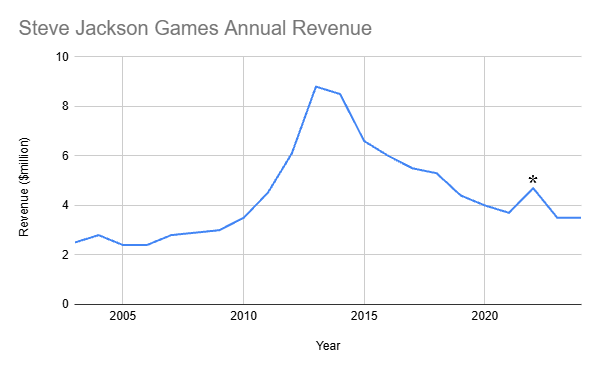
SJ Games posted seven years of rising annual revenues from the mid-2000s to reach a record $8.8m in 2013, a year boosted by heavy demand for its Munchkin line of games – which accounted for more than 75% of its sales – and almost $1m from the Ogre Designer’s Edition Kickstarter.

Revenues have decline substantially since, however, falling about 2.5x from that peak to settle at around $3.5m across both 2023 and 2024 – the last years for which Steve Jackson has published the total – and bringing the annual total down to levels last seen back in 2010.

Annual revenue at Steve Jackson Games between 2003 and 2024. The asterisk(*) at 2022 indicates that the company overstated its revenue at $4.7m that year “due to confusion about BackerKit proceeds”, but it has not publicly provided an updated figure.

Jackson said in the executive summary in the 2023 report, “Cash flow was acceptable. It was not a profitable year, though. We have identified and dealt with some of the money-losing issues; others will be harder. We are working on it. (No fear; we have plenty of runway left. I just hate to use it.)”

He continued in the 2024 overview, “Cash flow was acceptable, but I don’t feel ‘prosperous’. This is not just us; individual game sales, industry-wide, were down at both the distribution and retail end, largely due to the glut of titles.”

Jackson added that year, “We are still working the problem, but we have less runway than we did last year! Cause for optimism: it was a rebuilding year and not expected to be good for cash, but thanks to your support for Munchkin Big Box it was better than we anticipated.”

Those challenges were exacerbated in 2025 by the impact of volatile US tariff policy, which included an unexpected “high five-figure” bill on its Munchkin Big Box after new tariffs were levied while the already-produced game was at sea.

The company subsequently raised some of its prices in response to tariffs, while uncertainty over overseas manufacturing led it to scrap the box and dice for RPG collection Dahlia’s Diversions for Peculiar Parties in favour of a rigid envelope, and shifting printing to the US before fully assembling the games on Jackson’s dining room table.

Jackson said in July that the company had received a partial rebate on its Munchkin Big Box tariff payment earlier this year, which it passed on to customers through a temporary discount on its web store Warehouse 23.

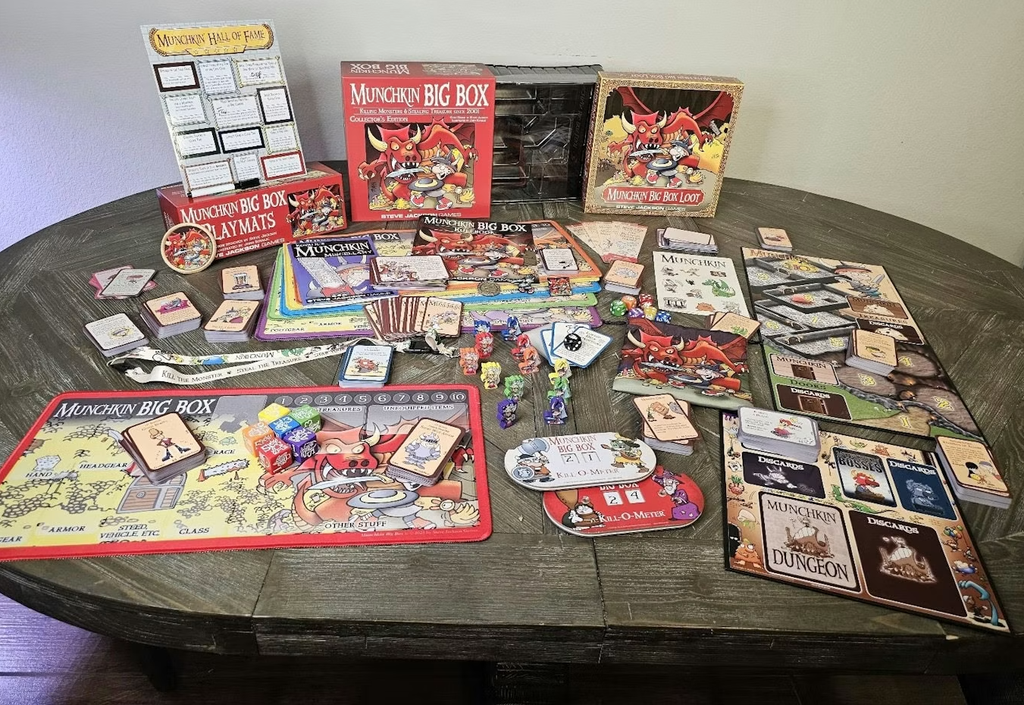
The Munchkin Big Box || Photo Credit: Steve Jackson Games

The BackerKit campaign for the Munchkin Big Box had been one of the company’s bright spots over the past couple of years, bringing in more than $1.3m from over 9,000 backers – a situation Jackson credited with making 2024 financially better than expected.

SJ Games followed that with a $370,000 BackerKit campaign for Munchkin Second Edition this year to coincide with the game’s 25th anniversary, and in recent years has extended out the game with Munchkin Shadowrun, Munchkin Vox Machina and multiple Warhammer-based releases, as well as several other expansions.

The company made a notable expansion itself in February last year, when it brought acclaimed indie RPG publisher Possum Creek Games into the business as an imprint.

It said at the time that the deal would allow Possum Creek, the publisher of Wanderhome and Yazeba’s Bed & Breakfast, to retain full creative and editorial control over its titles, while “lending their talents to the SJ Games design and visual branding”.

Possum Creek editorial director Jay Dragon joined the SJ Games board of directors as part of the tie-up, and became its lead game designer, while Ruby Lavin became the company’s art director.

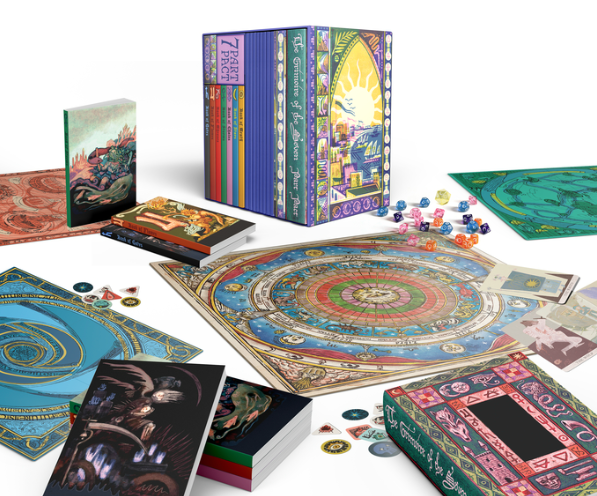
Seven-Part Pact, designed by Jay Dragon

Since then Dragon’s TTRPG design Seven-Part Pact has raised more than $1m through a Kickstarter campaign, while SJ Games has also raised almost $600,000 across a pair of Kickstarters for the venerable Fighting Fantasy line of adventure gamebooks, having agreed a deal in 2024 to bring the UK-created titles back to the US for the first time in more than two decades.

Steve Jackson’s game design career dates back to the late 1970s, with his 1977 debut Ogre helping popularise the emerging microgame format of small, inexpensive wargames.

Within five years he had designed Car Wars and Illuminati, founded his own games company and been inducted into the Academy of Adventure Gaming Arts & Design Hall of Fame in 1982 – all while still in his 20s.

He followed that with the Generic Universal RolePlaying System (GURPS) in 1986, which was his attempt to create a single roleplaying system capable of working across different settings and genres.

While not the first RPG to experiment with universal rules, GURPS helped popularise the concept and grew into a huge publishing line for Steve Jackson Games. By 2004 the company had released about 200 GURPS titles, with more than one million copies in print in English alone.

Jackson’s most visible modern design is Munchkin, which became the company’s biggest commercial success following its release in 2001. The game was inducted into the Academy of Adventure Gaming Arts & Design Hall of Fame in 2013.

The post Tabletop pioneer Steve Jackson returns focus to game design as Sabrina Gonzalez takes over as Steve Jackson Games CEO first appeared on .

  •  

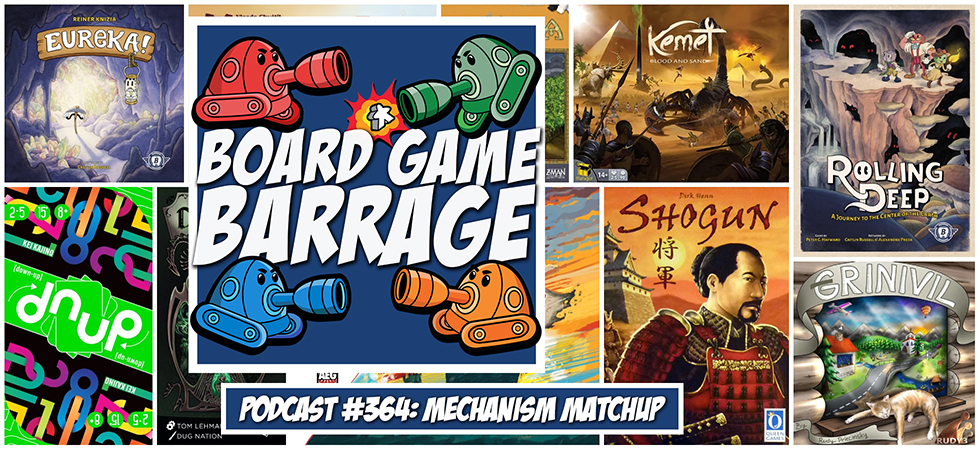
BGB Podcast #364 – Mechanism Matchup


There are two board game mechanisms you just can’t escape, they’re on everyone’s mind, flooding the discourse. That’s combat, and card draw mitigation. Everyone won’t stop talking about them. So we had to weigh in too, not just with what we feel are the best examples of games that have done them best, but some other quirky takes on them too. Before we mitigate our card draws, we talk about Rolling Deep, Eureka!, dnup, and Grinivil.

If you don’t want to miss an episode, please subscribe on Apple Podcasts/Google Podcasts/Stitcher/Spotify, or add our RSS feed to your favourite app. Reviews and subscriptions really help us and would be greatly appreciated! To download the episode directly, click here.

If you’d like to discuss anything in the episode, please do so in the comments below, visit our BoardGameGeek guild, join our Discord, or Facebook Group! Any feedback is also always helpful. If you’d like to show your support for the show, we also have a Patreon with some fun rewards, and a merch store!

Timecodes:

03:59 – Rolling Deep
15:12 – Eureka!
16:48 – dnup
24:48 – Grinivil
40:10 – Combat mechanisms
41:07 – Kemet
45:00 – Dune
48:40 – Shogun
52:42 – Forbidden Stars
53:51 – Dead Reckoning
54:48 – Gloomhaven
55:12 – Card draw mitigation
56:09 – Dark Pact
57:19 – La Granja
58:26 – Glory to Rome
59:58 – Through the Ages: A New Story of Civilization
1:02:07 – Race for the Galaxy
1:02:57 – 7 Wonders Duel
1:06:28 – The Vale of Eternity

Thank you to Heart Society for generously letting us use What’s On Your Mind, Kid? from their album Wake the Queens.

The post BGB Podcast #364 – Mechanism Matchup appeared first on Board Game Barrage.
  •  

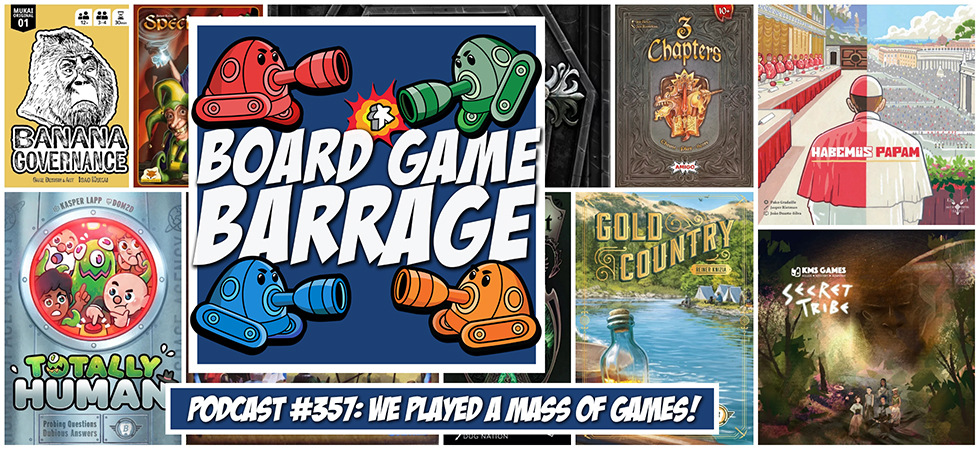
BGB Podcast #357 – We Played a Mass of Games!


We made it back in one piece, and all told I think we did pretty well! We got through a heck of a lot of what we wanted to play, and we’re here to tell you all about it – including Dark Pact, Totally Human, and Banana Governance, and more!

Please submit your favourite games for our Listener Top 20!

If you don’t want to miss an episode, please subscribe on Apple Podcasts/Google Podcasts/Stitcher/Spotify, or add our RSS feed to your favourite app. Reviews and subscriptions really help us and would be greatly appreciated! To download the episode directly, click here.

If you’d like to discuss anything in the episode, please do so in the comments below, visit our BoardGameGeek guild, join our Discord, or Facebook Group! Any feedback is also always helpful. If you’d like to show your support for the show, we also have a Patreon with some fun rewards, and a merch store!

Timecodes:

02:36 – Totally Human
14:04 – Dark Pact
20:56 – Gold Country
28:21 – Staked!
32:58 – Secret Tribe
41:34 – Habemus Papam
50:11 – 3 Chapters
55:22 – Banana Governance
1:02:29 – Hellapagos

Thank you to Heart Society for generously letting us use What’s On Your Mind, Kid? from their album Wake the Queens.

The post BGB Podcast #357 – We Played a Mass of Games! appeared first on Board Game Barrage.
  •  

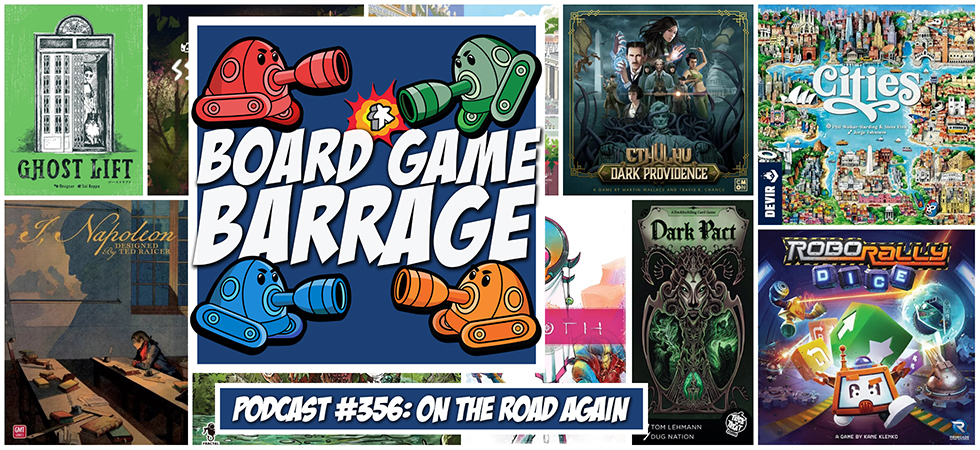
BGB Podcast #356 – On the Road Again


By the time you’re listening to this, we’re probably already in Vegas for Dice Tower West! We’re going to hang about all day playing games – which naturally leads to the question of what we’re going to play? These are the games we came up with! Before we bite off more than we can chew, we talk about Ghost Lift, Cities, and I, Napoleon.

Please submit your favourite games for our Listener Top 20!

If you don’t want to miss an episode, please subscribe on Apple Podcasts/Google Podcasts/Stitcher/Spotify, or add our RSS feed to your favourite app. Reviews and subscriptions really help us and would be greatly appreciated! To download the episode directly, click here.

If you’d like to discuss anything in the episode, please do so in the comments below, visit our BoardGameGeek guild, join our Discord, or Facebook Group! Any feedback is also always helpful. If you’d like to show your support for the show, we also have a Patreon with some fun rewards, and a merch store!

Timecodes:

02:31 – Ghost Lift
08:13 – Cities
14:06 – I, Napoleon
24:40 – Dice Tower West anticipated games
26:05 – Biblios
27:04 – Feya’s Swamp / Kaivai
28:26 – Cheese Thief
29:03 – Habemus Papam
31:15 – Wroth
33:33 – Greed Incorporated
35:39 – Dark Pact
38:45 – Secret Tribe
39:52 – Eternal Decks
41:03 – All In: Predictions
42:04 – Cthulhu: Dark Providence
44:14 – Robo Rally Dice

Thank you to Heart Society for generously letting us use What’s On Your Mind, Kid? from their album Wake the Queens.

The post BGB Podcast #356 – On the Road Again appeared first on Board Game Barrage.
  •  

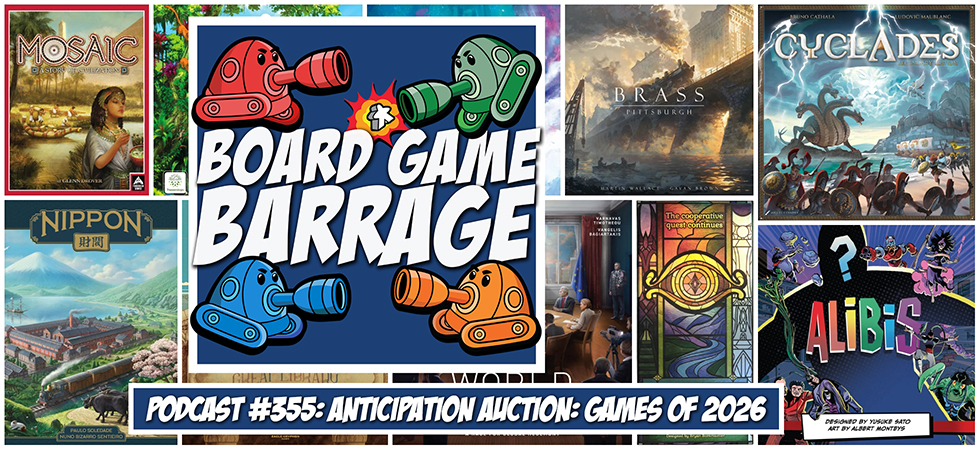
BGB Podcast #355 – Anticipation Auction: Games of 2026


I think it’s fair to say that we crushed this last year (although some of us better than others), so it’s only correct and right that we should return to do it again. What are the best games of 2026 going to be? Well, only we know, but we’re willing to part with that information. Get your fat stacks ready. Before we set ourselves up for failure, we talk about Alibis, Mosaic: A Story of Civilization, and Cyclades: Legendary Edition.

Please submit your favourite games for our Listener Top 20!

If you don’t want to miss an episode, please subscribe on Apple Podcasts/Google Podcasts/Stitcher/Spotify, or add our RSS feed to your favourite app. Reviews and subscriptions really help us and would be greatly appreciated! To download the episode directly, click here.

If you’d like to discuss anything in the episode, please do so in the comments below, visit our BoardGameGeek guild, join our Discord, or Facebook Group! Any feedback is also always helpful. If you’d like to show your support for the show, we also have a Patreon with some fun rewards, and a merch store!

Timecodes:

03:02 – Alibis
09:18 – Mosaic: A Story of Civilization
23:25 – Cyclades: Legendary Edition
36:27 – Anticipation Auction 2026
41:18 – The Game Makers
44:25 – Cozy Stickerville
46:39 – Brass: Pittsburgh
50:35 – The Lord of the Rings: The Two Towers – Trick-taking Game
54:04 – Revenant
56:21 – World Order
59:31 – Dark Pact
1:02:28 – The Great Library
1:03:56 – Spirited
1:05:25 – Realm of Reckoning
1:08:55 – Avalon: The Riven Veil
1:12:57 – La Pâtisserie Rococo
1:14:24 – Nippon: Zaibatsu
1:17:24 – Rewild: South America
1:18:44 – Movers & Shakers

Thank you to Heart Society for generously letting us use What’s On Your Mind, Kid? from their album Wake the Queens.

The post BGB Podcast #355 – Anticipation Auction: Games of 2026 appeared first on Board Game Barrage.
  •  
❌