Anmelden
Riot in Cell Block Arkham

Considering how often the supervillains incarcerated at Arkham Asylum mount successful escapes, we’d do better to confine them inside a Chuck E. Cheese. At least that way they’d have to contend with food poisoning and sticky benches.
Still, the idea behind DC Breakout: Arkham Asylum is a strong one. Designed by Geoff, Sydney, and Brian Engelstein, this is another entry in the “wacky race” genre, marking it as the fourth such title in the past year. How does its coterie stack up against bun bangers, slippery bananas, and underdog brontos? I’ll put it this way: in any other race, it might have won a medal.
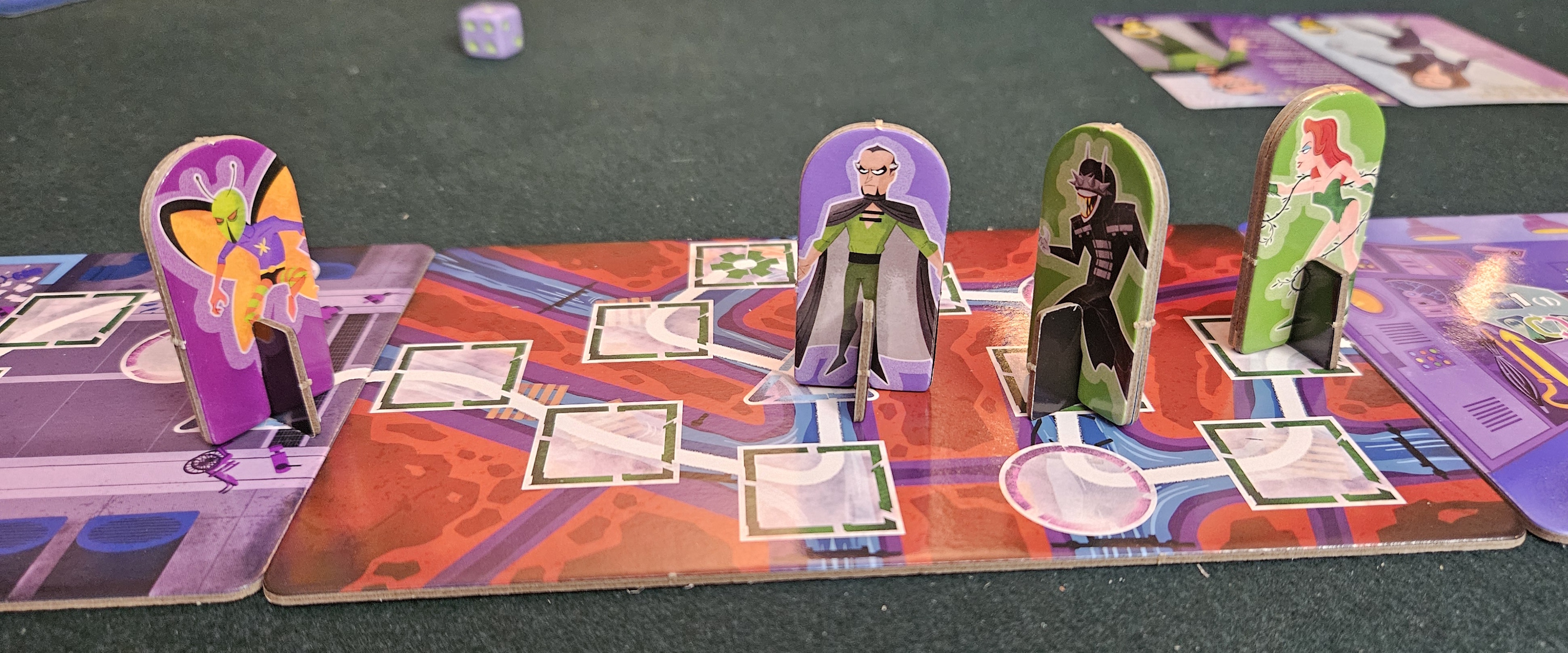
Me, a comics agnostic: oh hey, I can name two of these people.
DC Breakout opens with one heck of a great idea. Rather than having everybody out for themselves, what if our supervillains decided to work together? Not all together, obviously. These are the bad guys. If cooperation was their strong suit, they’d have stomped the Bat decades ago. But two at a time? A three-legged race? Evil duos temporarily setting aside their differences to escape the slammer? Sure. They can do that.
I wouldn’t be surprised if the game’s pitch was that you’re playing Magical Athlete with two characters at a time, because that’s pretty much how events proceed. During setup, everybody receives a hand of supervillains. There will be two races, with the winner of the first receiving some advantage in the second race. Now you pick your duos and head for the starting line.
As openers go, this is as good as they come. There are heaps of villains to choose from. Forty. That’s the number. Forty villains, each with their own ability. It helps, too, that Batman’s rogue’s gallery is probably the most recognizable in comics history. This gives the Engelsteins room to play, but even more importantly ensures that the abilities are able to map to what we expect of any given character.
More or less, anyway. Some are more familiar than others. The Riddler, for instance, turns his movement roll into a bluffing game. Sure. That’s Riddler shit. Talia al Ghul can flip her die to its opposite side. Sure. She’s tricky. Hugo Strange lets other players reroll their dice, but earns extra movements whenever they take him up on the offer. Sure. He’s always manipulating people to get ahead. Scarecrow rotates the tile he’s on, flipping the leader to the reverse and anyone in the rear forward. Sure. That’s his fear toxin causing hallucinations.
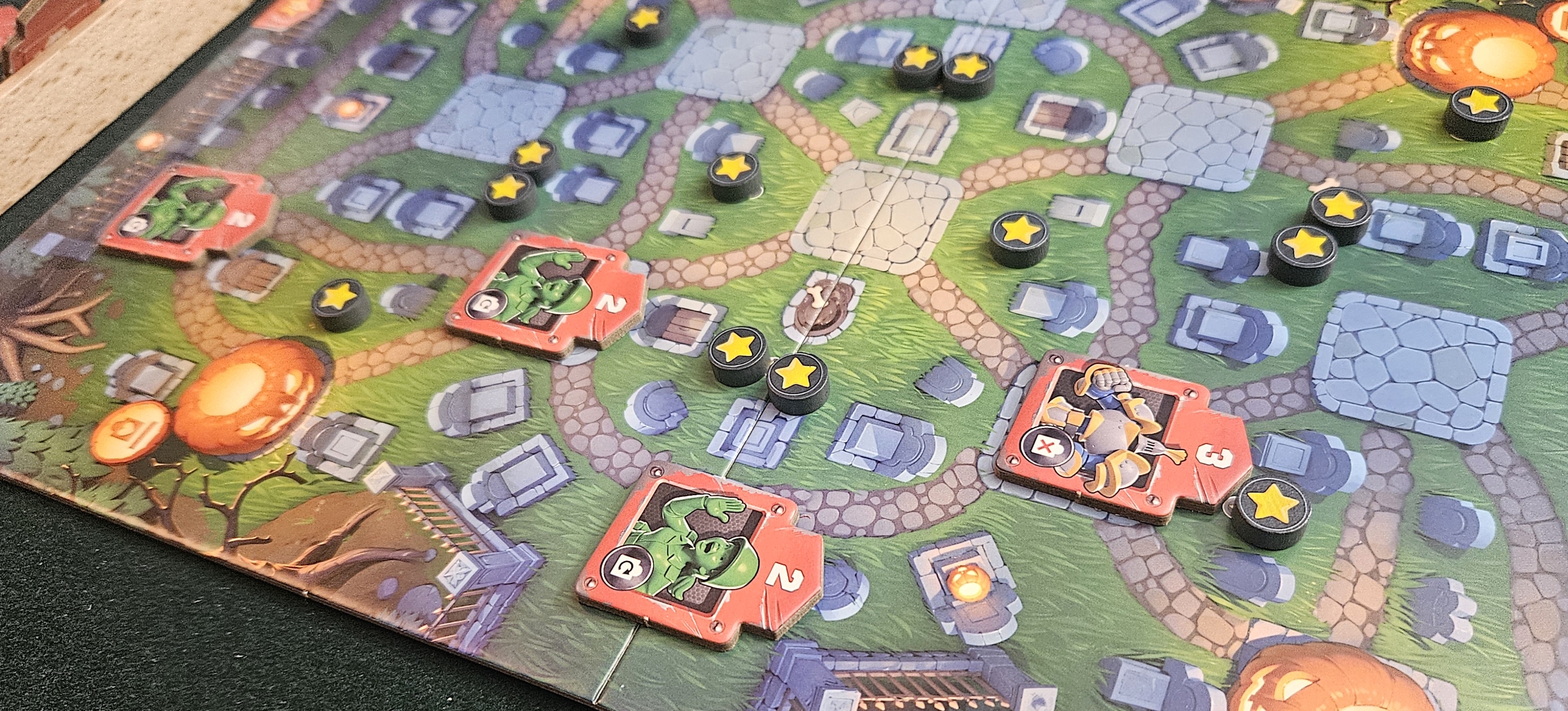
Others are less direct. Catwoman takes an extra turn when she ends on a triangle space. That one requires some explanation. Basically, Arkham Asylum is a series of shaped rooms. Most are squares, fewer are circles, and fewer still are triangles. So Catwoman is there to play the odds, hoping to land on the rarest of spaces in order to leap forward again. Which, yeah, that’s kinda Catwoman-ish, I suppose. Close enough.
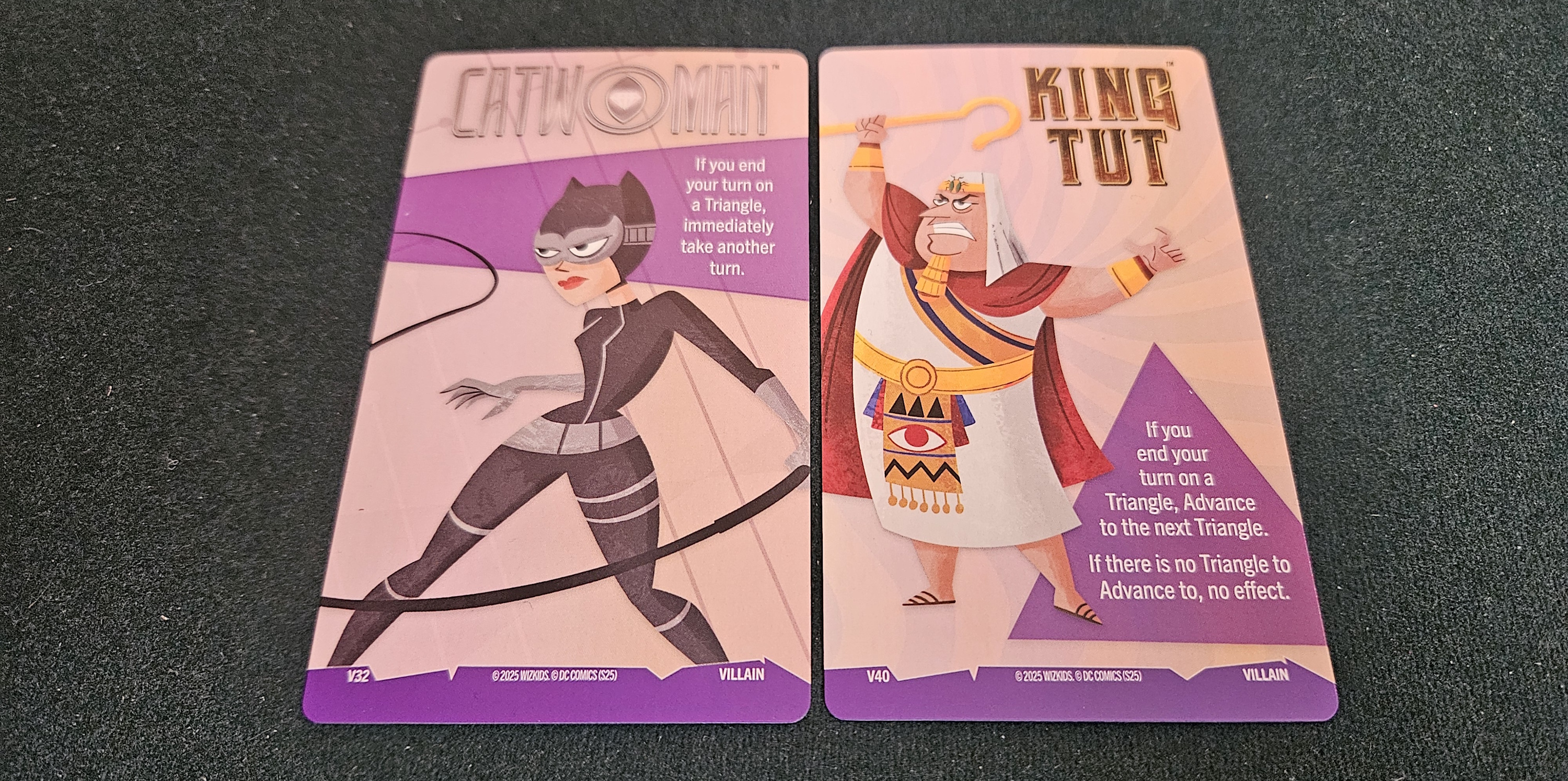
Watch your back, cat! He intends to stick you into a canopic jar!
But what does it mean when Cluemaster moves another team forward to add one to his roll? Or when the Penguin massages his die roll up or down by one pip? Or when Killer Moth… look, I’m not going to pretend to know who Killer Moth is. But what about Condiment King? Why does he get extra movement when he’s trailing? Is this a condiment thing? Is pickle relish associated with losing? Don’t answer that.
Of course, what these abilities mean is that there’s only so much creativity that can be crammed into the system presented here. Fair enough. Not every supervillain can be transformative. For every Joker, there’s gonna be an Egghead. Except the joke’s on us, because the Joker is sort of a bummer in this one. He forces other teams to reroll. I guess the Joker is about chaos. Still, that’s not exactly what I was hoping for from the Clown Prince of Crime.
To be fair, there’s a huge range of abilities on display. Some villains use henchmen. Calendar Man, for example. He starts with one henchman, and can set his die to however many henchman he has at the current moment. If he does, he adds another henchman. Aha! He’s progressing through the days of the month! Good thing we locked him up. Poison Ivy, meanwhile, spends her tokens to force rival duos to move toward her instead of toward the finish line. Cleavage! The strongest of the fundamental forces.
Simultaneously, there are gadgets to consider. Gadgets are single-use powers that can be earned whenever you stop on an armory space or by earning a solid placement in the first race. There are quite a few of these. Fewer than the number of villains, but still, for a deck without any duplicates, there’s a solid range to potentially draw.
Which brings us back around to that core idea. Two villains. A handful of gadgets. A simple roll-and-move race to the exit. What could possibly go wrong?
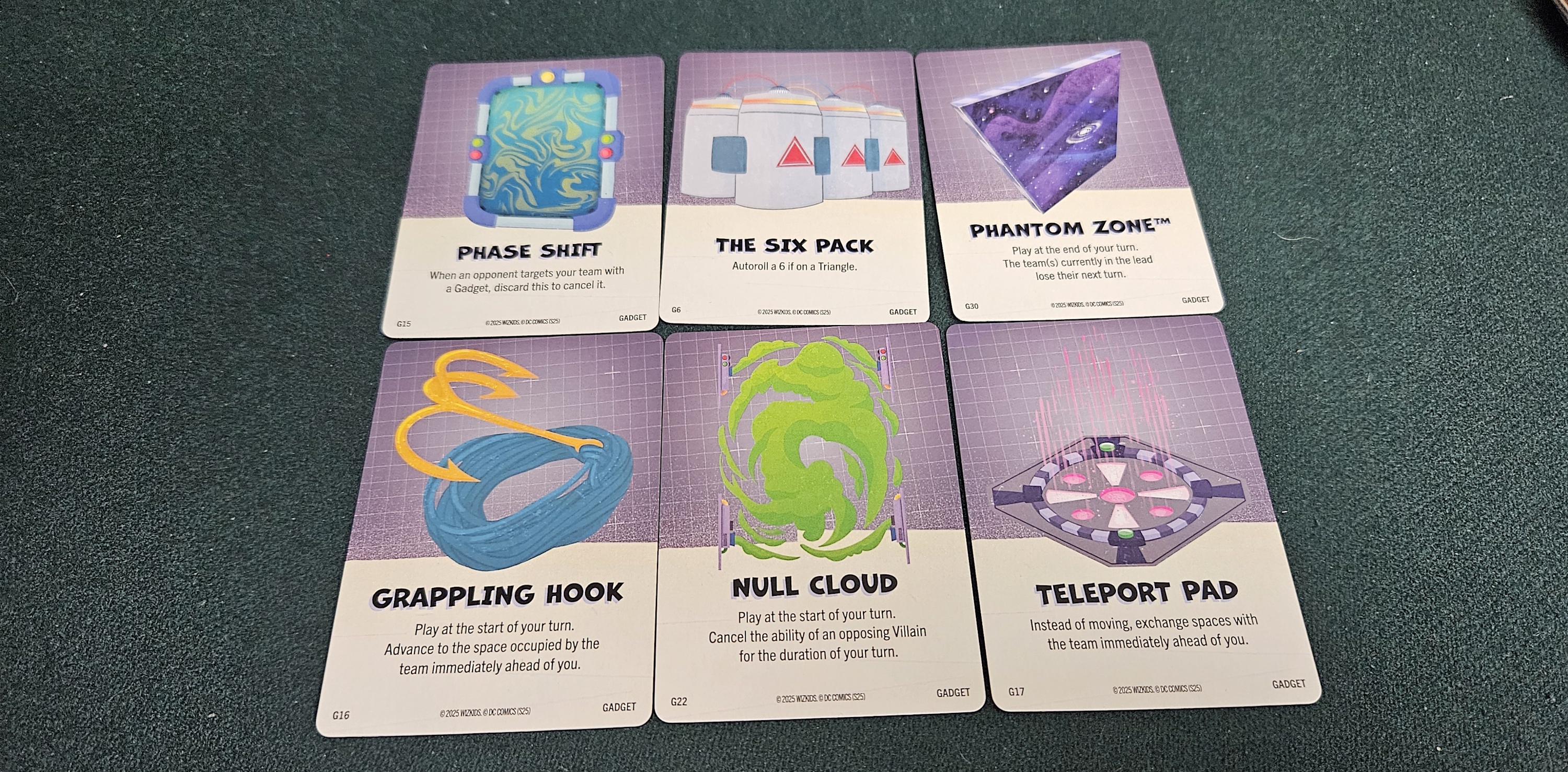
Gadgets allow you to break the game even further.
It’s tempting to say “plenty,” but the more honest answer is that DC Breakout: Arkham Asylum is surprisingly solid. It’s just that it isn’t as solid as its competitors in this unexpectedly crowded field.
At heart, DC Breakout is about breaking the game. With the right combination of villains and tools, it’s possible to… well. I’ve watched as one duo created a near-unbroken loop of extra turns. Another duo was able to reuse items and draw a bunch from the gadget deck, permitting a series of teleports and adjusted rolls that was so unfair that its rivals were still way back at the starting line when it was peeling out toward Gotham City. These races were “unfair.” Hilariously so. Infuriatingly so. But they were also the result of previous prep work. Sacrifices in the first race to acquire extra gadgets. Or the opposite, a hard-fought initial race in order to acquire better tools and a boosted villain draft.
Or, right, dumb luck. DC Breakout is full of that. Again, fair enough. That’s the genre.
But what’s interesting to me is the way this game’s chance feels more chancy than the chance in something like Magical Athlete. Not only more chancy, but more irritating. Perhaps it’s the veneer of skill overlaid atop the dice rolls. Or maybe it’s the way gadgets intrude into the regular process of play. A bad roll is a bad roll. But when you get a good roll and another player deploys an item that overturns it? Or worse yet, flips the entire map around so that they’re in the lead? I’m not going to get mad about it. But a scrunchy face? Sure, I’ll make a scrunchy face. Wacky races, as a genre, are full of bullshit moves. But there’s bullshit and then there’s bullshit. DC Breakout is full of the latter.
Which is fine, as these things go. Part of the game’s fun lies in not only getting lucky, not only in building the right supervillain pairs, not only, even, in managing the micro-decisions that occur during the race. But also in bullshit-proofing your team from rival shenanigans. Some of those unsexy abilities start to look mighty tempting when you realize they boast a stronger immune system to outright cancellation. Most of my best combos, for instance, have arisen from characters I was only dimly aware existed. Cameos from video games, footnotes or curiosities, late-night fan-wiki deep-dives, those were often the characters I needed to leap forward to victory.
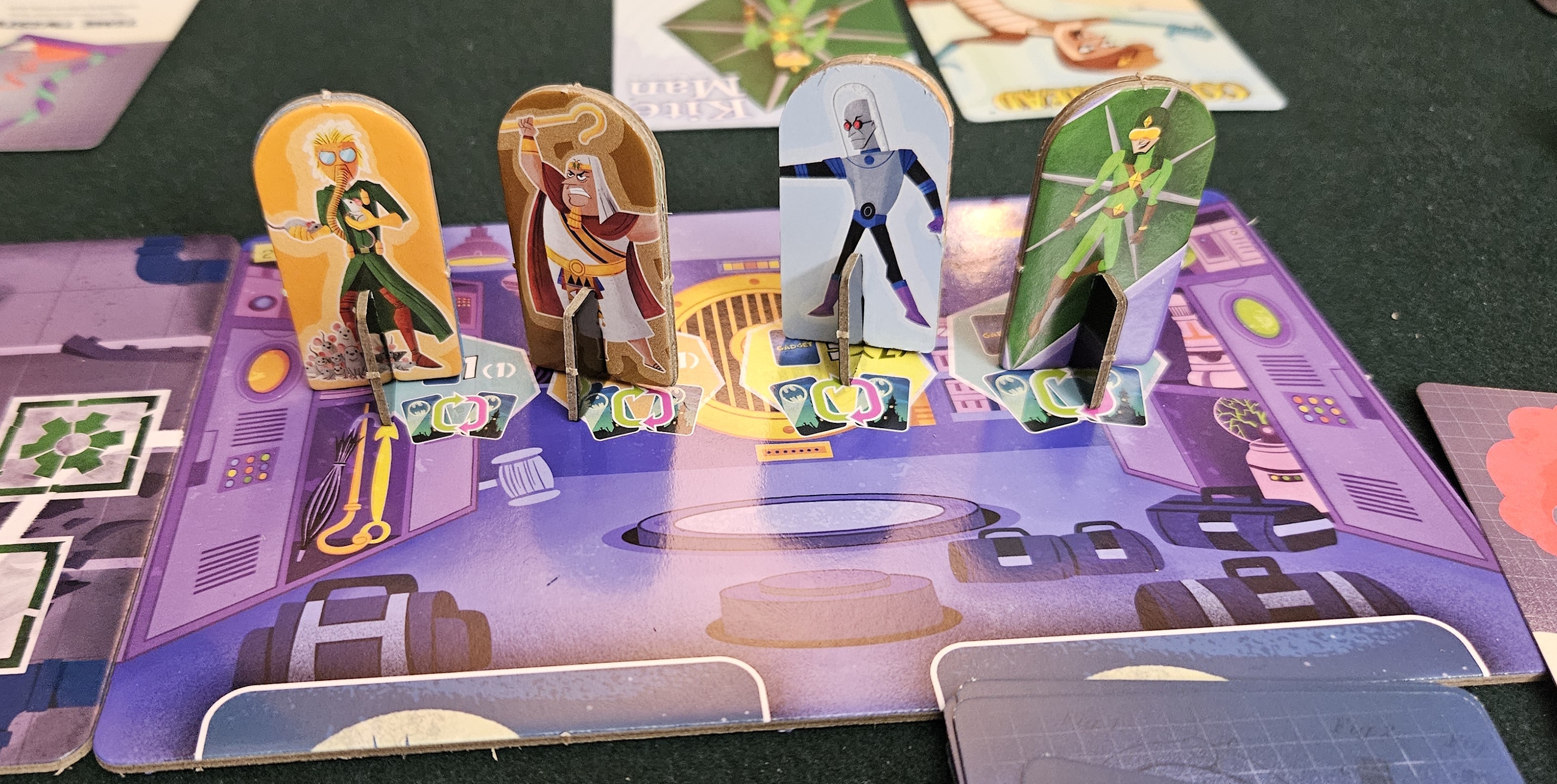
The winner of the first escape leads the second.
The result is a game that’s sometimes very good and sometimes so lopsided that it stops being interesting at all. When multiple players are breaking the game in sync, busted powers firing all over the place, it’s a hoot. But when one duo skip-teleports to the finish line while everybody else huddles around the office water cooler, the problem isn’t that the game is unfair. It’s that it’s boring. It’s like watching a race between a prize stallion and a certain unnamed sciatic board game reviewer. Also, the prize stallion just played a gadget that made the sciatic board game reviewer run backwards for ten seconds. Whee.
Which is to say, there are moments of real brilliance here. The range of abilities in the game’s generous cast. The delight of watching a guy with a ketchup nozzle defeat a mobster who was so uninventive that he named himself after his matte facewear. Even just the idea of pairing racers to become even more idiosyncratic and game-breaking. There’s a ton of good stuff in DC Breakout.
But it’s a game whose peaks don’t always justify its troughs. Not only in relation to Magical Athlete, Hot Streak, and Dino Racer — in relation to itself.
A complimentary copy of DC Breakout: Arkham Asylum was provided by the publisher.
(If what I’m doing at Space-Biff! is valuable to you in some way, please consider dropping by my Patreon campaign or Ko-fi. Right now, supporters can read my first-quarter update of 2026: the best board games, movies, books, and more!)


 While I’ve had my share of visits to art galleries and spent a reasonable amount of time reading the tiny placards or wall explainers of exhibits, I can’t say that I’ve ever looked into some of the well-known rivalries. I may be a heathen in admitting this but when I looked at the premise for […]

 ︎
︎

/pic7268927.png)
/pic9341318.jpg)
/pic9519854.png)
/pic9553171.png)
/pic3646116.jpg)
/pic8644688.jpg)
/pic8644667.jpg)
/pic8723428.jpg)







 Innovation debuted in 2010, accomplishing the impressive feat of packing an entire interactive civilization game into a mere 105 cards. Its popularity has led to subsequent printings of three other editions, each with slight tweaks to card balance and artwork. Additionally, there have been four expansions that add to and alter the existing gameplay in […]

/pic9027686.png)
/pic9520349.jpg)
/pic9520358.jpg)
/pic9520361.jpg)