Normale Ansicht

Marketable vs Aspirational Funding Goals

17. September 2026 um 17:59

In regards to several recent crowdfunded games that either relaunched after an initial cancellation or are struggling to move far past their funding goal, I’ve heard some concerns about trust from potential backers.

For example, if a project has a $10,000 funding goal but after the first few days they only have a few hundred backers and $13,000 in funding, is it a mark of dishonesty if they cancel the project, reconfigure, and relaunch?

Personally, I do not begrudge anyone from learning from a mistake, oversight, or shortcoming and trying to do better. Nor do I consider it dishonest to showcase a marketable funding goal…as long as the creator is transparent about their aspirational goal.

Here’s an example from a related article:

If you want to make a hypothetical game with a landed cost of $20 (manufacturing plus freight shipping) with a trusted long-time producer like Panda, you’ll have a minimum order quantity of 1,500 units (or 2,000 if plastics are involved). Ideally you’ll make more, but that’s the bare minimum you need to cover that MOQ. So that’s $30,000.

Of course, you’ll need to pay artists, graphic designers, playtesters, and proofreaders–those costs can vary greatly based on the complexity of the game and the quantity of the art. At Stonemaier Games, I would say that those costs add up to around $75,000 on average. Added to the landed costs for the 1,500-unit MOQ, that’s $105,000.

I might list the funding goal at $30,000, but somewhere else on the project page I might discuss that I’ve already invested $75,000 in the game and that the funding goal is based on the MOQ of 1,500. So there I might note that we’ll make the game if we reach the funding goal, but my hope is to eclipse $105,000, perhaps marked by a stretch goal.

A creator could also just outright say, “We chose $10,000 as a marketable funding goal, but our aspirational goal is to make at least $50,000. Reaching that aspirational goal will help us cover our sunk costs and will enable us to pay for the first printing without dipping into our savings. If the project has not reached $30,000 a few days after launch, this is a strong indicator the game and/or the campaign are missing something important, and we may consider relaunching to best serve the audience for this game.”

This is essentially what Siclen Studio announced on a recent video about their current Kickstarter, though they took it a step further: They said that as long as they stay above their $10,000 funding goal (as of this writing, the project is at $13,535), they will make the game even though they had much higher hopes for it. I admire that, though I also worry that backer accusations of dishonesty backed Siclen into this corner instead of offering them the grace to relaunch.

I understand that this is a contentious subject, and I also understand that a creator risks losing backer trust if they relaunch. However, we are talking about crowdfunding here: Nothing is etched in stone. Crowdfunding gives creators the opportunity to learn from the crowd while the product and the project are still pliable.

Also, is it not an inherently human trait to set a lower goal with the hopes of surpassing it? I can certainly relate to that.

What are your constructive thoughts about marketable vs aspirational funding goals?


Also read:

If you gain value from the 100 articles Jamey publishes on this blog each year, please consider championing this content! You can also listen to posts like this in the audio version of the blog.

New Exploding Kittens studio boss sets sights on expanding namesake IP into “long-lasting evergreen brand”

17. September 2026 um 11:33
A kitten on an exploding earth illustrating the Exploding Kittens card game

Exploding Kittens has named chief commercial officer Joeri Hoste as its new head of studio, with the long-time game industry exec eyeing further expansion of the company’s namesake hit into a “long-lasting evergreen brand” beyond its big-selling card game.

Hoste joined Exploding Kittens to lead its international business in 2020, following multi-year stints at companies including Hong Kong based board game publisher and manufacturer Ooba Games, toy company BOTI and trading card and collectibles specialist Upper Deck.

He takes the head of studio role at the Asmodee-owned business as former Exploding Kittens CEO Carly McGinnis was named head of the parent company’s global publishing operation last month.

New Exploding Kittens studio head Joeri Hoste

Hoste said in a LinkedIn post that the past six years at Exploding Kittens had been the most rewarding of his career, adding that he was “ecstatic and humbled” to take responsibility for leading the company into the next stage of its development.

He said, “We’ll continue our mission of making great games and creating experiences that bring people together. Exploding Kittens is the game that built its namesake company, and our next challenge will be to develop the IP into a long-lasting evergreen brand that outgrows its original format.

“Exploding Kittens is unique within Asmodee as we combine deep commercial mass market expertise with publishing quirky and irreverent games that disrupt the games category.

“We did not get here by blending in. We succeed because of the talented team that’s willing to be different.”

Exploding Kittens has been a huge commercial success in the wake of its debut title raising almost $8.8m on Kickstarter in 2015.

Last year Exploding Kittens revealed it had sold more than 60 million games as it marked a decade in business – with the company’s growth having already extended well beyond the tabletop.

That has included a partnership with Netflix which expanded the property into mobile gaming and an animated series.

Asmodee bought a 55% majority stake in Exploding Kittens at the end of 2021, and exercised its option to purchase the remaining 45% minority stake last year.

Exploding Kittens has continued to stand out within Asmodee’s portfolio during a difficult period for parts of the US board game market.

Asmodee CEO Thomas Koegler singled the company out last November as a particularly strong performer amid economic uncertainty caused by rising prices and US tariffs, adding that US consumers were favouring lower-priced games. Asmodee again highlighted strong Exploding Kittens growth while discussing a 23% year-on-year fall in its US quarterly sales earlier this year.

The promotion comes as Asmodee is making a wider push into social and party games – a category where Exploding Kittens has been one of its strongest brands.

In March the company agreed to pay up to €250m for French social and party game publisher ATM Gaming, with Koegler saying the acquisition would combine ATM’s strength in Europe with Exploding Kittens’ strong position in the US. Asmodee has said it expects the social games category to grow at between 4% and 8% annually between 2025 and 2030, compared with about 4% for the broader board games market.

It also launched US party game studio Moodbox Games last year, a move de Barros described at the time as strengthening Asmodee’s presence in a category where Exploding Kittens and Zygomatic were already seeing strong success.

The post New Exploding Kittens studio boss sets sights on expanding namesake IP into “long-lasting evergreen brand” first appeared on .

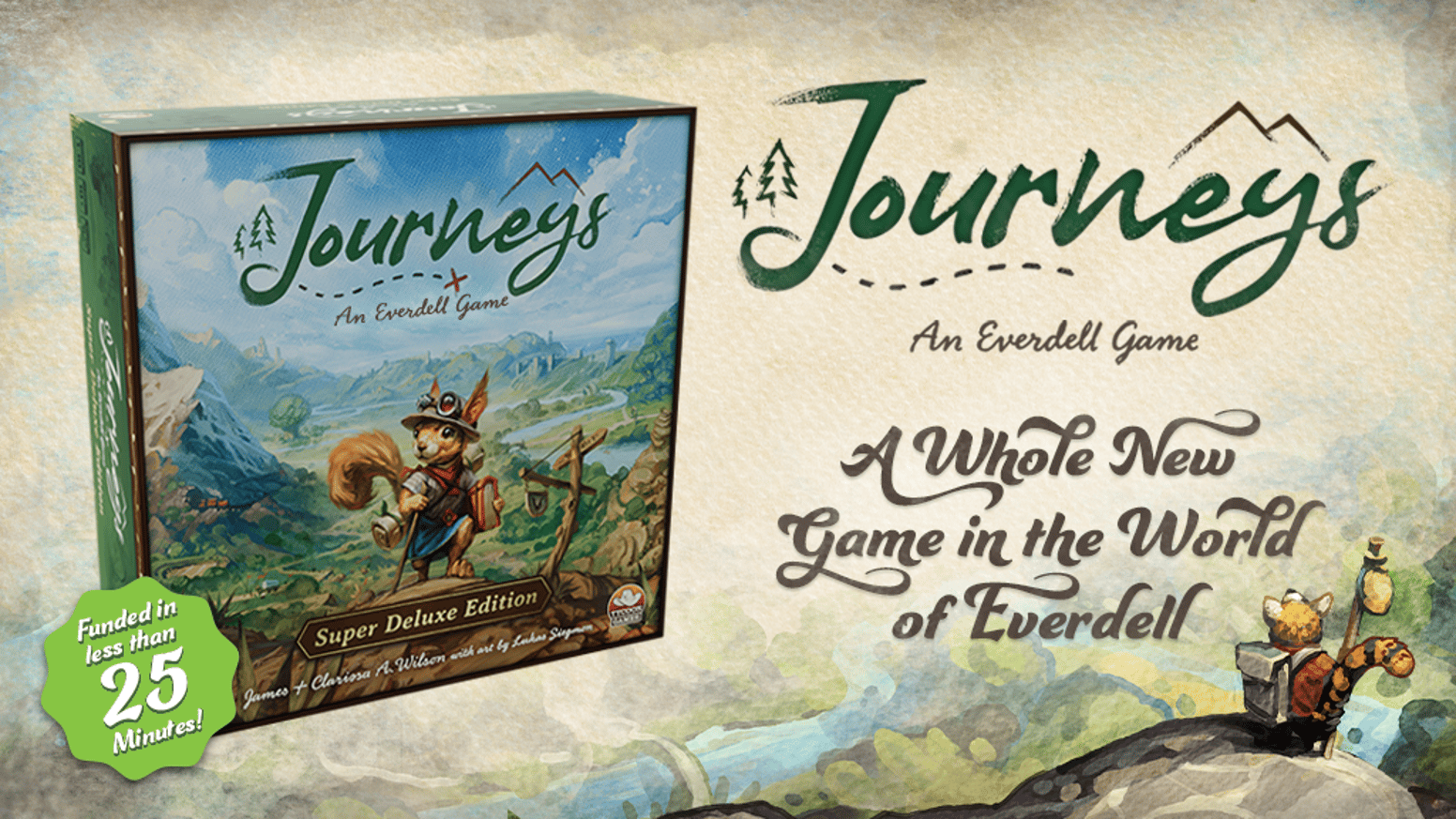
Everdell Journeys: Kickstarter-Kampagne überfinanziert

17. September 2026 um 07:51
Everdell Journeys: Kickstarter-Kampagne überfinanziert

Everdell zählt seit dem Erscheinen 2018 bei Starling Games zu den bekanntesten und mehrfach ausgezeichneten Tableau-Bauspielen der Branche. Tycoon Games hat mit „Journeys: An Everdell Game“ nun einen Ableger mit eigener Mechanik am 8. September 2026 auf Kickstarter gestartet. Die Kampagne steht bei 609.738 US-Dollar von 35.000 US-Dollar Ziel, umgerechnet rund 1.742 Prozent, bei 4.924 Unterstützenden, Stand des Abrufs. Kickstarter führt das Projekt als „Staff Pick“.

Die Kampagne läuft noch bis zum 25. September 2026, 23 Uhr MESZ. Würfelreich hatte sie bereits kurz nach dem Start in der Crowdfunding-Wochenschau erwähnt. Die inzwischen erreichte Größenordnung rechtfertigt jetzt einen eigenen, ausführlicheren Artikel.

Was Journeys von Everdell unterscheidet

Statt Städte per Worker Placement aufzubauen, ziehen 2 bis 5 Spielende als reisende Tiere durch die Welt von Everdell und legen dabei einen eigenen Pfad aus Karten, und Card Drafting steht also im Zentrum. Aktivierte Karten liefern Ressourcen und Punkte für spätere Kombinationen, und ein persönliches Reisetagebuch hält besondere Ereignisse der Reise fest. Die Deluxe-Edition erweitert das Spiel auf 1 bis 10 Spielende und ergänzt Solo- sowie Kooperativ-Modi, die dem Grundspiel fehlen. Laut BGG dauert eine Partie 30 bis 60 Minuten, empfohlen ab 10 Jahren.

Ob sich der Kartenpool zwischen Partien unterscheidet und wie das Automa-System der Solo-Variante genau funktioniert, verrät das verfügbare Kampagnenmaterial nicht. Die meisten Pledge-Stufen enthalten zusätzlich „Gather: An Everdell Card Game“, ein eigenständiges Kartenlegespiel von 15 bis 20 Minuten im selben Universum.

Beim Design ist mit James A. Wilson der Schöpfer des Hauptspiels wieder dabei. Clarissa A. Wilson ist als Co-Designerin neu im Team. Die Illustration liegt komplett in neuen Händen bei Lukas Siegmon. Keiner der drei Illustratoren des Hauptspiels ist beteiligt.

Tycoon Games hat in der Vergangenheit bereits Lizenzen etablierter Titel wie Colt Express, Living Forest und Lewis & Clark übernommen und tritt damit erkennbar als Verlag für bestehende Marken auf, nicht nur als Erstverlag eigener Spiele. Im selben Everdell-Universum hat der Verlag zudem bereits eine eigene Kickstarter-Kampagne erfolgreich abgeschlossen: „Everdell Emerland“ erreichte im Dezember 2025 rund 3.421 Prozent des Ziels bei 7.980 Unterstützenden. Ob die Auslieferung pünktlich erfolgte oder inzwischen erfolgt ist, lässt sich daraus nicht ableiten. Dazu liegen keine belastbaren Angaben vor.

Pledge-Stufen und Auslieferung

Das Grundspiel „Journeys“ kostet 49 US-Dollar (umgerechnet rund 42 Euro, Kurs vom 17. September 2026), die Deluxe-Edition 75 US-Dollar (rund 65 Euro). Für 99 US-Dollar (rund 86 Euro) gibt es die Super-Deluxe-Stufe mit zwei exklusiven Miniaturen, für 159 US-Dollar die Stufe „Travel Guide“ mit zehn Neopren-Spielmatten für die ganze Tischrunde. Am oberen Ende steht „Globetrotter“ für 699 US-Dollar mit der kompletten Everdell-Sammlung inklusive der Erweiterungen Farshore, Silverfrost und Emerland. Die Auslieferung ist laut Kickstarter für August 2027 vorgesehen.

Das Hauptspiel Everdell erscheint in Deutschland regulär bei Pegasus Spiele. Für Everdell Journeys selbst nennt die Kampagnenseite bislang keine deutsche Version. Laut Kickstarter liefert Tycoon Games die Kampagne weltweit aus. Konkrete Versandkosten oder Zollhinweise für Deutschland nennt die Kampagnenseite aber nicht.

❌