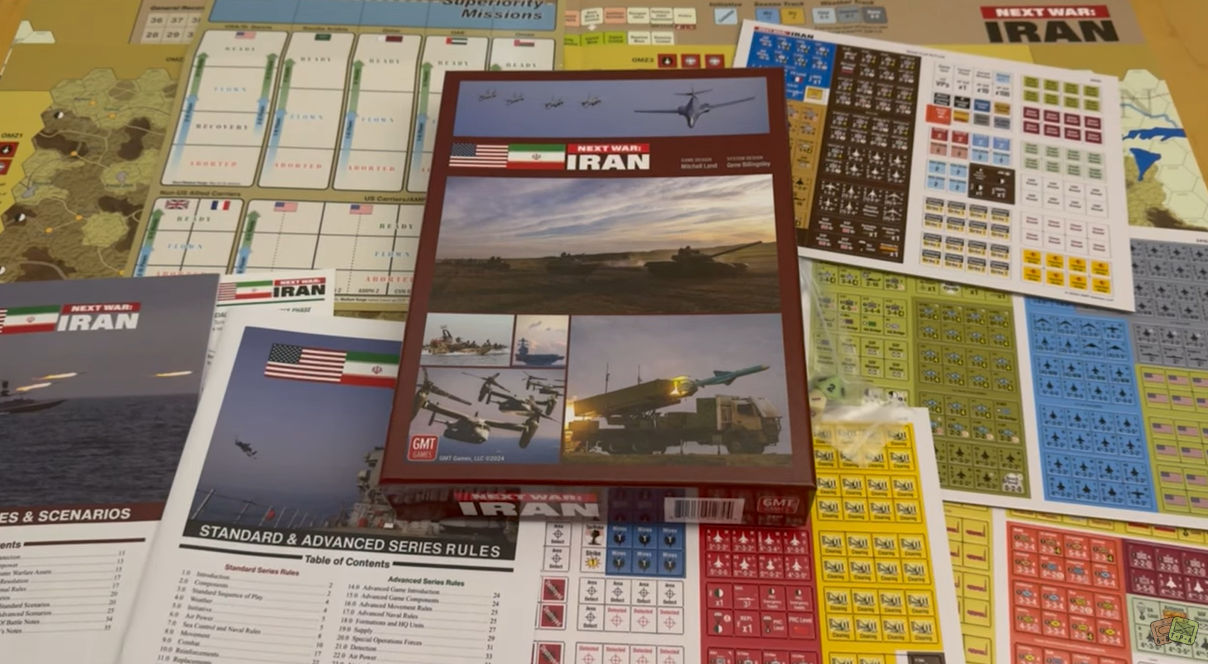
Next War: Iran is the sixth game in the Next War Series from GMT Games. It is unique in the series in that the Allied player has to do the attacking while the non-Allied player attempts to defend its territory against neo-imperial oppression. With a long logistical tail, few true allies in the region, and the menace of Iran’s A2AD capabilities, re-opening the Straits is a tall order.
Grant: Javier welcome back to the blog. What is your new game Battle of Pensacola 1781?
Javier: Thanks for having me again. Pensacola 1781 is a simulation of the American Revolution in the southeast region, stretching from the Mississippi River basin to the Floridas, from the Spanish entry in the war in 1779 to 1782. I must say that the title is a bit deceptive in its scope and included battles.
Grant: What was your inspiration for this game? Why did you feel drawn to the subject?
Javier: The Spanish participation in the American Revolution has recently attracted much interest in Spain. It was, so to speak, the swansong of the empire in the Americas. There aren’t any games that cover the entire campaign. There is only a wargame on the siege of Pensacola from GMT Games which is a part of their Battles of the American Revolution Series, which is a detailed and interesting situation. But I wanted an operational level game showing the big picture, from New Orleans to Mobile, Pensacola and St. Augustine. The game highlights the operations of Bernardo de Gálvez, who led one of the most brilliant campaigns in that theatre, clearing the Mississippi basin of English outposts as well as taking Mobile and Pensacola fighting against all odds. Against the advice of his subordinates, who deemed impossible defending Louisiana without reinforcements from Cuba, Gálvez declared that he preferred “having to answer charges of recklessness, than other type of charges” and took the offensive against the British in the lower Mississippi.
Grant: What was your design goal with the game?
Javier: My goal was to show a “multi domain” 18th century campaign, including amphibious operations, sieges, Indian warfare and diplomacy. The design puts the focus on leadership quality, Indian warfare and chaos. The campaign in Louisiana, modern day Alabama and the Floridas was a bit of a sideshow in a worldwide conflict fought from Canada to the Mediterranean, the 13 colonies, the British channel, Gibraltar or India. The design reflects this in several ways. In this game, reinforcements arrive at the beginning of each year and their arrival depend upon a number of factors, such as victories in earlier turns (thus gaining the favor of their respective courts in London and Madrid) as well as events elsewhere. Fleet squadrons come and go because this is an oceanic war being fought out across the seven seas, and the Caribbean was just only one more front.
Grant: What type of research did you do to get the details correct? What one must-read source wouldyou recommend?
Javier: There are plenty of Spanish sources on the campaigns of Bernardo de Gálvez in the Americas, many of them published in recent times. There are recent English language sources that recognize the major role of Spain in arming and supporting the American Revolution. For instance, the book by Larrie D. Ferreiro Brothers at Arms: American Independence and the Men of France and Spain Who Saved It. Another interesting source in English is the work by Joshua Provan Every Hazard and Fatigue: the Siege of Pensacola, 1781 published by Helion Books. This book provides solid evidence of “the true military consequences of the siege [of Pensacola] on the War of American Independence.”
Grant: What from the American Revolution in the Southeast was most important to model?
Javier: It was important to model that the Mississippi-Floridas campaign was one more theatre in a global war spanning from the Americas to Europe and India. Keeping open the Mississippi River basin to the arms and supplies shipments coming from Spain, France and other nations was a decisive factor in keeping alive the American Revolution. Being just one more theatre, the arrival of reinforcements depends on a number of a factors and events elsewhere. After the first successes of Gálvez, the Spanish decided to reinforce success and provide him with more ships, troops and resources.
Grant: What is the scale of the game? Force structure of units?
Javier: Units are basically regiments and Indian warbands, rated for Indian and Linear warfare. Using one or the other depends on a number of factors, namely leadership quality.
Grant: What area of the Southeast does the map cover?
Javier: The map covers a large area, from the lower Mississippi to Eastern Florida, with off map boxes for outposts in the upper Mississippi and Georgia.
Grant: What off map areas are represented and why are they important?
Javier: There are three: St. Joseph and St. Louis, which are important to keep the Mississippi supply route open, and Georgia, from where the Spanish/Patriot player can launch attacks against East Florida. The 1778 Patriot invasion of East Florida was defeated, but there was the possibility of new offensives in the following years. After the conquest of Pensacola the Allied forces (Spanish, French and Patriots) planned a joint operation against British forces in the Carolinas, but the end of the war cancelled it.
Grant: What key strategic points are contested in the area and what is the geographic goal of the combatants?
Javier: For the Spanish, the first objective is to defend the Mississippi Basin, although Havana is also included in the map so that the Spanish has to keep a sizeable defense there. Historically, the Spanish commander in chief in Havana was extremely reluctant to spare ships and troops for the Floridas. In the words of the chief of the Spanish navy in the island, “This [Cuba] is worth 50 Mobiles or Pensacolas…if the King was here, he would do the same”. The British capture of Havana in 1762 still loomed large.
For the British, the objective is to reach the Mississippi Basin, and, if not possible, to defend West and East Florida. With the arrival of Rodney’s fleet, he can also chance a surprise attack on New Orleans, or even Havana if the Spanish player doesn’t keep there a sizeable force.
Grant: What different unit types does each side have access to?
Javier: There are line infantry, militias, artillery, siege trains, supply trains, Indian warbands, fleets, transport ships, and leaders.
Grant: What is the anatomy of the counters?
Javier: Land units are rated for linear warfare (representing “proper” 18th century warfare) and Indian warfare (irregular tactics, hit and run, pillage, ambushes). Linear infantry and field artillery are better for the first, while militias and Indian warbands are better for the latter. Militias and Indian warbands are also very useful for finding out the makeup and location of the enemy or avoiding interception/ambushes by the enemy force. Leaders are rated for their tactical and diplomatic skills that add modifiers to initiative, combat, diplomacy and other actions. Supply trains are spent to avoid attrition, which can be heavy in the hostile wilderness.
Grant: What is the general Sequence of Play?
Javier: The sequence of play begins with the stratagem markers phase (both players pick at random stratagem markers), followed by reinforcements die rolls at the beginning of the campaign season. Then comes the Indian diplomacy phase, where both players use diplomacy stratagem markers to break or establish alliances with the various Indian tribes. After that both sides can try to recruit Indian warbands among neutral or allied Indian nations. Then comes the recruiting phase, where both sides use accumulated Treasury Points to rebuild destroyed units. Finally, the Spanish operates his naval and land forces in any order he sees fit, followed by the British operations phase. At the end of the turn, both sides roll for attrition, and for the possible withdrawal of Indian bands.
Grant: What type of experience did you want the Sequence of Play to invoke?
Javier: Players can activate their forces in any order they want, so that they can use any combination of land, amphibious and naval operations. The experience I wanted to invoke is that of uncertainty- this is the 18th century warfare in a remote colony. As in many other wars, both sides make plans, but there are many factors that can disrupt them, from hurricanes to unexpected arrival of enemy forces to events elsewhere. There are no communications other than messengers and courier ships, so the possibility of an enemy expedition arriving out of nowhere should make players to be cautious.
Grant: How do the different nations troops coordinate their maneuvers and attacks? What difficulty of command will players experience trying to coordinate French, Spanish and Patriot forces as well as British, Hessian and Loyalist forces?
Javier: In general the troops of different nations can operate together without problem. The Indian forces are a double edged weapon-very useful for reconnaissance and ambush (or to avoid enemy ambushes) but they can leave a force if they decided that they have to return or that they have captured enough loot and captives. Forces can operate any number of units of different nations.
Grant: What role do the Indians of the region play in the game?
Javier: In this game I wanted to emphasize the role of the various Indian nations. Indian warbands are useful for raiding and reconnaissance although they tended to return to their villages after a successful campaign. Historically, the British had a well developed network of Indian agents which gave them advantage in their Indian diplomacy. This is reflected in the “Indian agent” markers, that provide die roll modifiers to the British diplomacy attempts. Historian Josh Provan pointed out in his book on the Pensacola campaign that the Spanish victory was achieved with the assistance of Native American nations, “whom have routinely been dismissed outright for over two hundred years”.
Grant: What are Stratagem markers?
Javier: The Stratagem Marker is a mechanism that I use in many of my designs. These are very useful to simulate things that are beyond the control of players. Represent anything from tropical diseases, campaigns elsewhere in the Americas and in the World, to tactical events such as lucky hit, ambushes or military advantage. The marker “Surprise move” is particularly useful to simulate the uncertainties of 18th century in a remote wilderness such as the old Southeast. Given the right conditions, a surprise move may make a fleet appear out of nowhere and destroy an enemy force. This is the 18th century…there are no communications other than messengers and courier ships. Historically, upon learning about the presence in the Caribbean basin of the squadron of Admiral Rodney, the Spaniards feared that they could catch by surprise the forces besieging Pensacola. Stratagem Markers also simulate the spy networks of both sides. Before the war, Gálvez setup an extensive spy network that was very useful. For instance, his spies got hold of a copy of the secret orders sent to General Campbell at Pensacola, ordering him to organize, if possible, an attack on New Orleans with armed vessels from Jamaica and “as many faithful Indians and the Superintendent could supply”. Gálvez took the initiative and took the British outposts along the lower Mississippi before Campbell could arrange his own offensive.
Grant: What are Treasury Points? How are they gained and lost?
Javier: TP’s represent resources received from their respective metropolis, as well as local contributions used to recruit units. Treasury Points are received from their respective countries during reinforcement turns. Unlike other games, there are no treasury generating regions or cities-everything comes from Havana, Madrid or Britain. Treasury Points are used to rebuild destroyed units.
Grant: What role do Leaders play? What historic personalities are represented?
Javier: Leaders play a key role in diplomacy and combat. The better the leadership, the better chances of gaining initiative in combat, recruiting Indian allies, and so on. Among the historic personalities, the most notable is perhaps Bernardo de Gálvez, the most noted commander in that theatre. After fighting in Europe, North Africa and the Americas (against the Apaches), he was named governor of Louisiana in 1777. In May 1779, a month before Spain declared war on Britain, and three years after the Declaration of Independence, Gálvez assembled a small army with which he attacked the defensive posts the British held along the Mississippi. With a contingent that included free African Americans, Choctaw Indians, Canadians, and American volunteers, Gálvez captured forts such as Manchac, Baton Rouge, and Mobile, and expelled the British from the region. His greatest victory was the conquest of the port city of Pensacola, in northwest Florida in 1781. Galvez’ adversary at Pensacola, Major General John Campbell, a veteran of Culloden in 1746 and the siege of Havana in 1762, is an interesting figure as well.
Grant: How does combat work?
Javier: There are two odds-based Combat Tables-Indian and Linear. Indian represents Indian Warfare-emphasizing mobility, with night attacks, ambushes. Local militias and, of course, Indian warbands are better at them. The other CRT is linear warfare, representing “proper” 18th century linear warfare. In this, Line infantry are artillery are most useful. The choice of CRT is determined by an initiative die roll, modified by the leadership rating of any leaders in the forces, plus the play of Stratagem Markers such as military advantage or ambush.
Grant: What are Military Advantage and Ambush Markers used for?
Javier: They represent tactical opportunities and junior leadership and can be used to modify initiative, interception or operations points die rolls.
Grant: What is the makeup of the CRT?
Javier: As mentioned above, it is odds based. Units add their linear or Indian warfare factors-Linear units add 2 combat factors on the linear CRT, 1 on the Indian CRT. Artillery adds 2 combat factors on the linear CRT, 0 on the Indian CRT. So, a force containing mostly militias and Indian warriors against a force containing line infantry and artillery will chose the Indian CRT. Of course, the system rewards combined arms-it is advisable to combine all types of units in a single force. The Linear CRT is bloodier (more chances of completely destroying an enemy force) the Indian Warfare CRT is more indecisive.
Grant: How do Sieges work?
Javier: In the game there are Fortresses and forts. The first represent stone fortresses such as the ones in Mobile, St. Augustine and Pensacola, while forts represent minor positions made mostly of wood. Players can build siege works to approach the enemy defenses (representing parallel trenches, mining and so on). The force under siege may choose to launch a sortie to destroy the siege works. If the sortie fails, the siege works add a positive modifier to the assault operation against the fortress hex. The player then rolls on the siege table and apply results, which may include Bloody Repulse (Eliminate besieging units equivalent to the number of defending units), Honors of War (with Age of Enlightment chivalry), the defender is given the option to withdraw from the fort or fortress. The defenders are withdrawn and can enter as reinforcements during the next game turn) or Surrender: the fortress is conquered and all defenders are eliminated, including any naval units if it is a coastal fort or fortress.
Grant: How is victory achieved?
Javier: Victory is achieved by taking geographical objectives (Mobile, Pensacola, St. Augustine, New Orleans…) or by preventing the enemy from taking them. The British may win a sudden death victory if they manage to take Havana as in 1762.
Grant: What role do Naval Operations play? Why were they important to include?
Javier: Naval operations were very important because it was the only means to move sizeable forces in this theatre. Overland movement and supply was extremely slow, so the best way to move reinforcements, supplies and to take the fight to the enemy strongholds was by sea.
Grant: What optional rules are included?
Javier: There are four optional rules. In general, these add to the game narrative although it might make game turns somewhat longer. Optional rules are naval infantry. In this one, players can “land” marine infantry from naval ships, which can fight overland in a siege, for instance-if the naval ship is involved in naval combat, it has a negative modifier in combat, representing the missing crew and marines. The other optional rules are Indian supplies (players can purchase supplies to local Indian tribes, like Gálvez did, for instance, during the siege of Pensacola), destroyed forts (players have the option to burn forts, but not fortresses) and valley movement, where players follow river valleys to move faster across the wilderness territory.
Grant: What type of an experience does the game create?
Javier: It creates an experience of uncertainty, in particular with the unexpected arrival of enemy forces from out of nowhere. If this could happen at the tactical level, more so in a strategic game covering all of North America from the Mississippi river basin to Florida. Also, gamers must keep in mind the importance of the human geography-the Indian nations played key roles in the operations of the war, by supplying, providing information and combat troops to the empires at war. Elements such as the “Surprise move” markers, and the arrival of Rodney’s Fleet, provide the game with wild changes of initiative. The British, in particular in the early turns, can try to grab the initiative and attack towards the lower Mississippi or St. Louis.
Grant: What are you most pleased about with the design?
Javier: I think it makes a good work at simulating “multi domain” 18th warfare, covering many aspects, from conventional operations to irregular warfare to diplomacy with a relatively simple set of rules.
Grant: What other designs are you working on?
Javier: I am currently working on several games for SNAFU Design Team, Decision Games, VUCA, Bonsai Games and Compass Games/Paper Wars. S&T will publish in May-June 2026 another of my operational WW2 designs, Forgotten Front: Italy 1944-45. I just turned in to Decision Games the prototype for Ukraine Battles 2. This one covers the early, mobile campaign in Kharkiv in Eastern Ukraine in the spring and summer of 2022. It is an evolution of the system first used in Ukraine Battles 2014-15. Artillery plays a very important role in the system. It is precise and deadly, and can do a number of missions, from interdiction to destroying command posts to supply depots. Plus drones and long range fires, of course.
1942: Battle for the Mediterranean for VUCA Simulations, is, I hope, approaching completion. It is an old project that I first agreed to publish with the company of the late Jack Greene, Quarterdeck International, but later he suggested me to contact VUCA for publication since they did a great job with the new edition of his Bismarck design. 1942: Battle for the Mediterranean is what I would call an operational naval game, with turns representing one month of naval operations. Apart from supplying the war fronts and fighting the enemy at sea, players have to manage their assets and think in the long term. The campaign game covers 10 game turns, from January to October 1942. There are also shorter one turn scenarios simulating the major convoy battles of the 1942 campaign: Second Sirte, Harpoon/Vigorous (Battaglia di Mezzo Giugno, “Battle of Mid June” for the Italians), or Pedestal (Battaglia di Mezzo Agosto, “Battle of Mid August”).
Aragón 38 for SNAFU Team is also in development. Nils Johansson is working on the graphics aspect (map, counters, play aids and cover). It uses an evolution of the Santander ’37 System. While in the Santander campaign we have Brigade-sized units attacking across a mountain range, using speed, firepower and infiltration to overcome the Republican defenses, in Aragon we have a “push” of several Army Corps operating together, with front collapse followed by exploitation, consolidation and conquest of several bridgeheads as bases for future offensive operations. So we had to adapt the system to better simulate that campaign. Bonsai Games from Japan will publish my game Assault on Europe 1943, covering land operations in the Mediterranean Theatre in 1943, from Tunisia to Sicily and Southern Italy. The Allied player can decide whether to land in Corsica and Sardinia before Southern Italy. Rules simulate the painful US Army learning curve (from being called in Tunisia “our Italians” by the British, to a much better performance in Sicily and Southern Italy) and the surrender/collapse of the Italian army (operation Achse). After publishing Red Partisans for Paper Wars, I am working on a small unit game of the fight around Kyiv in February 2022. It is still in a very early design stage.
Thanks for your time Javier in answering our questions as I know you are a busy man and obviously have lots of interesting gaming subjects on your design table. I am very interested in this one, as the American Revolution is one of my favorite gaming topics.
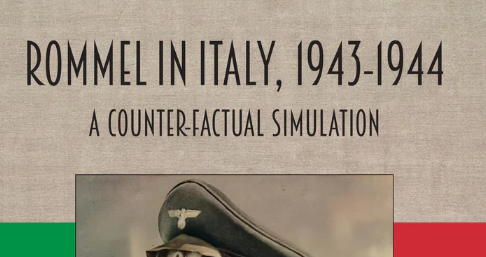
We have interviewed the venerable designer Ty Bomba on numerous occasions over the 10-year life of the blog. In fact, I counted up the interviews and to date we have done 18 total! Wow but the last one we did was in January 2023 and we have just not had him on since. No reason for that other than I have been busy with other games. But recently I saw from War Diary Publications that they were printing one of his What If? style alternative history games called Rommel in Italy, 1943-1944: A Counter-Factual Simulation, which supposes Field Marshal Erwin Rommel had taken command of German forces in Northern Italy rather than being sent to help with the defense of France against the expected Allied invasion. I reached out to Ty and he was more than glad to give me some more information.
Grant: What is your upcoming game Rommel in Italy about?
Ty:Rommel in Italy, 1943-1944: A Counter-Factual Simulation allows 2 players (or one playing 2-hand solitaire) to investigate the strategic and operational potentials that would have been in place across northern Italy from September 1943 through May 1944 if Hitler had left Field Marshal Erwin Rommel in charge there rather than Kesselring. Rommel advocated for immediately pulling back to a shorter, easier to defend, position at the south edge of the Po Valley rather than trying to fight it out farther south, with both the German’s flanks exposed to possible encirclement via Allied amphibious end runs. In effect, it put the Allies into a strategic position that historically they did not achieve until a year later. The question then becomes can they keep up that kind of advance into and across the Alps.
Grant: Why was this a subject that you wanted to design a game around? What assumptions about history did you take into account?
Ty: Historically, we had 2 of Germany’s best field commanders, Rommel and Kesselring at complete odds with each other over theater-level strategy. Kesselring felt confident the Allies would not achieve a level of operational efficiency that would allow them to effectively exploit the supremacy in the seas along both of Italy’s coasts. History showed that he was correct in that assessment, but Rommel’s transfer to France was not a sure thing. Hitler actually tried to send him back to Italy, to take full charge there, shortly after Rommel had gotten on a plane to fly to France. Radio communications temporarily failed, and by the time Hitler’s communications people got that all sorted out, the dictator had again changed his mind and kept Kesselring in place.
Further, the fact Kesselring was shown to have been correct does not mean Rommel was necessarily wrong – and there’s a fun-to-play wargame inherent in that iron.
Grant: What is important from the overall period and setting to model in the game?
Ty: The opening of the campaign, in September 1943, is filled with opportunity – but also fraught with peril – for both sides. At the start of play, there are only a few German garrison units in the far north of Italy, while the 10 (mostly elite) divisions of their Tenth Army start off-map to the south, where they just received Rommel’s order to run north. There are no Allied units setup on the map at all. They enter on the south edge during the first turn, and both players operate using the sequence below.
5.3 Allied Reinforcement & Replacement Phases
During these phases, the Allied player may bring onto the map newly arriving units and reclaim into play units that had been previously eliminated in combat. This phase is skipped on Turn 1.
5.4 German Reinforcement Phases
During these phases, the German player may bring onto the map newly arriving units and reclaim into play units that had been previously eliminated in combat. This phase is skipped on Turn 1.
5.5 Movement & Combat Sequence Determination Phases
In each of these phases, excluding that of Turn 1, the Allied player openly declares whether that turn’s movement phase or combat phase will be taken first. On Turn 1 the sequence is always the movement phase followed by the combat phase.
5.6 Alternating Actions Movement or Combat Phases
Always starting with the Allied player, the two players alternate either launching one attack or moving one unit, depending on whether the present phase is movement or combat. Individual attacks may have more than one attacking unit in them, but moves are always made one unit at a time. The unit(s) committed to those “actions” are, upon their completion, flipped over to show their disrupted sides. If a player does not actually want to make an attack or a move when it is his time to do so, he must flip one unit to its disrupted side, just as if it had moved or launched an attack: no “passing” is allowed.
5.7 Movement or Combat Recovery Phases
A movement or combat phase continues as described above until both players are out of undisrupted units or both agree they want to end the phase. If one player runs out of undisrupted units before the other, the player with remaining undisrupted units may go ahead and complete whatever actions he wants to perform with them within normal strictures, but now uninterrupted by having to pause to allow the opposing player to take an action. When a combat or movement phase is ended, both players should cooperatively turn over all disrupted units on the map so their undisrupted sides are and showing.
5.8 German Supply Check Phases
In each of these phases, both players should cooperatively look over the map to find if there are any German units out of supply. Each such unit is immediately removed to the dead pile.
5.9 Allied Supply Check Phases
In each of these phases, both players should cooperatively look over the map to find if there are any Allied units out of supply. Each such unit is immediately removed to the dead pile.
5.10 Ending & Starting Turns
Each time a Allied Supply Check Phase has been completed, advance the Turn marker one box on the Turn Track printed on the mapsheet and start a new turn with Phase I.
On the first turn, the Allied player has a relatively open front before him. If he can exploit that to get into the Po Valley quickly, he will move the strategic timetable significantly forward of the historic one. However, as he’s moving onto the map, so too it German Tenth Army. Depending on how bold both players are, it is not unusual to see pockets form inside other pockets.
Grant: How has this design changed since its original publication in 2021 in Banzai Magazine under the title Rommel’s Last Stand: Italy 1943-44, What If?
Ty: The new publisher has fixed the (scant) errata from the first (bilingual) Japanese edition from Banzai Magazine. They have also taken all the Japanese off the map and out of the rules, presenting everything fully in English. Other than the removal of those irritants, it is the same game.
Grant: What is the scale and force structure of units used for this design?
Ty: Each hex on the map equals 5 miles (8 km) from side to opposite side. Each full turn represents 2 weeks to 2 months, depending on the time of year. Every ground unit represents a regiment, brigade or division of about 2,500 to 12,000 men and/or 50 to 350 armored fighting vehicles.
Grant: How many maps are used in the game?
Ty: There is 1 large-hex based 34×22” map showing Italy north of the line of the Arno River to Ancona.
Grant: What is the anatomy of the counters?
Ty: The units are standard-classical in their data presentations, except their movement factors are not printed on them. All Allied units have (supplied) MF’s of 16 throughout the game, while the German MF’s are as follows.
German Mechanized Units Turns 1-6 – 16 MF’s
German Non-Mechanized Units Turns 1-6 – 8 MF’s
German Mechanized Units On Turns 7-10 – 12 MF’s
German Non-Mechanized Units On Turns 7-10 – 6 MF’s
Grant: What sources did you consult for the Order of Battle?
Ty: The Armies of Rommel by George Forty was an excellent source for the subtleties in the initial German Order of Battle. Beyond that, I pulled the roughly half-dozen historical Italian campaign games off my shelves and pulled information out of them. This is one of the most thoroughly simulated campaigns in the hobby, going all the way back to Avalon Hill’s Anzio, so I was not looking to find any heretofore undiscovered anomalies in either sides’ OB. The uniqueness in this game’s treatment of it comes from the changed strategic context combined with the tension inherent in the turn sequence, which requires both players to remain alert for sudden danger or fortuitous opportunities all throughout its play
Grant: How does combat work?
Ty: Combat is always voluntary and, when viewed on a battle-by-battle basis, is standard/classical odds ratio using a six-sided die.
Grant: What are the victory conditions?
Ty: Operating in conjunction with the alternating-actions turn sequence, the victory conditions are a further element I used to keep both players on the edges of their seats at all times. See below.
4.1 In General. The Allied player is on the offensive, trying to win by advancing fast enough to cause a major disruption to the historic timeline.
4.2 Allied Victory During 1943 Turns. If Phase 9 of Turn 1 or 2 or 3 or 4 ends with Venice or Milan or Trieste, or any one or more of the four German supply source hexes, occupied by an Allied unit or stack, that game ends at that time in an Allied victory.
4.3 Allied Victory During 1944 Turns. If Phase 9 of Turn 5 or 6 or 7 or 8 or 9 or 10 ends with any one or more of the four German supply source hexes occupied by an Allied unit or stack, that game ends at that time in an Allied victory.
4.4 German 1943 Sudden Death Victory. If any movement or combat phase of a 1943 turn ends with the German player having gained control of the containing the Allied Amphibious Invasion Beachhead marker, the games ends in a German victory at that time.
4.5 German 1944 Sudden Death Victory. If any movement or combat phase of a 1944 turn ends with one or more German units in any hex(es) on the south map edge, that game ends in a German victory at that time.
4.6 German End-Game Victory. If Phase 9 of Turn 10 ends without the Allied player having achieved a victory, the game ends at that time in a German victory.
The “White Dragon Game Designer” dressed as a samurai.
Grant: What are you most pleased with about the design?
Ty: As I mentioned above, the Italian campaign has been one of our hobby’s most thoroughly plowed fields for decades. Despite that, I believe I have offered a new experience with it here. Players will get a new slant on it, one that operates within the broad parameters of the war’s historic decision-making, but that is also tense and entertaining for both commanders.
I also hope its appearance in an easily available all-English edition may lead this and other publishers to look into acquiring the rights to other of my designs that have so far appeared only in East Asia (where I am affectionately known as the “White Dragon Game Designer”). I have done several games that have been well-received there, but are barely known here in the West.
Grant: I know you are a busy man with game design projects as well as editing for various wargame magazines but what other games are you currently working on?
Ty: I am presently working on this alternative history design, which is scheduled to appear in World at War No. 130, called Stalin’s Missed Opportunity: What If He Invaded Romania in May 1940?.
Following the successful deployment of missiles on Cuba in 1962, the Communists gained much ground in Latin America. Western Europe became less convinced of American commitment to defend the continent. This led to the NATO alliance being dissolved and replaced by a neutral bloc.
America was now alone!
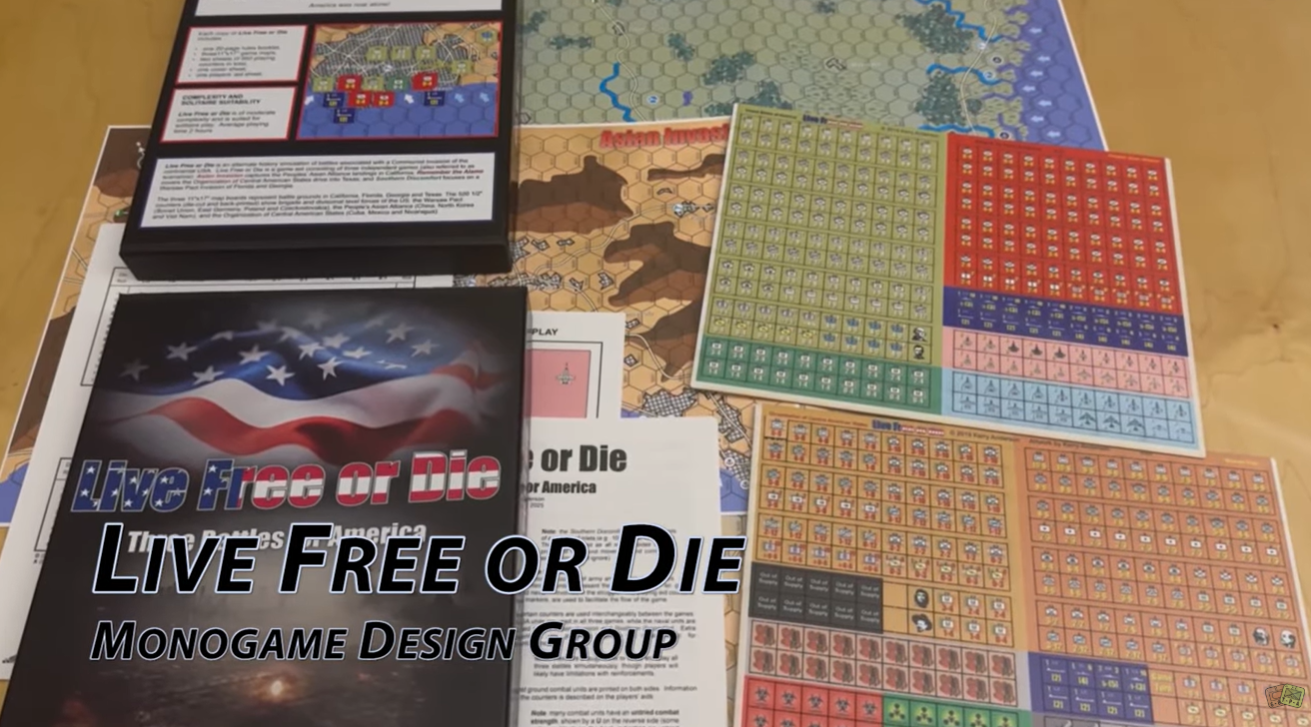
Live Free or Die is an alternate history simulation of battles associated with a Communist invasion of continental USA. Live Free or Die is a game set consisting of three independent games:
Asian Invasion captures the Peoples’ Asian Alliance landings in California;
Remember the Alamo covers the Organization of Central American States drive into Texas; and
Southern Discomfort focuses on a Warsaw Pact invasion of Florida, Georgia.
The Basic Game focuses on ground combat, providing a quick, entertaining game. The Advanced Game introduces air and naval units as well as additional specialized units like cruise missiles, laser defenses and political troops. And beware, there are rules for nuclear, biological and chemical warfare!

 Anmelden