Besucht uns and unserem Stand (C0.9) auf der Spiel Doch! in Dortmund. Von Freitag 24.4. bis zum Sonntag 26.4. erwarten euch viele Angebote, exklusive Einblicke in kommende Neuheiten und die Möglichkeit, unsere Spiele zu testen.
Zum ersten Mal könnt ihr am Stand Entropy, Wuselige Wiesen, Stibitzt, Das Voynich Mysterium, Space Lab, Tir Na Nog, Paper Tales und Horologium sehen, zum Teil sogar schon in finaler Produktionsversion. Ein paar dieser Titel werden sogar auf unseren Spieltischen zum direkten Ausprobieren liegen.
In der Spieleausleihe der Meeplebox findet ihr noch weitere Spiele aus unserem Programm. Eine ausreichende Menge an Rebirth, Endeavor: DieTiefsee, One Hit Heroes und Astro Knights sollte da für euch zur Verfügung stehen.
Im Verkauf haben wir die aktuellen Titel aus unserem Verlagsprogramm.
Die Highlights sind die neuen Artikel zu Too Many Bones.
Wir haben Aus der Tiefe, 40 Wellen von Daelore, Dart, Laborratten und Gearloc Kind dabei. Dazu gesellt sich noch das Grundspiel von Too Many Bones, das zum ersten mal seit 2024 wieder auf einer Messe verfügbar ist.
Wir haben auch noch die letzten Exemplare von Star Trek Captain´s Chair inkl. Promo dabei. Wenn die weg sind, ist das Spiel verlagsseitig komplett ausverkauft. In letzter Minute hat uns auch noch eine winzig kleine Menge unserer Neuheit Paper Tales Ultimate erreicht.
Wie immer haben wir auch wieder das komplette Sortiment an Promos dabei.
Bei den Angeboten erwarten euch unter anderem: Townsfolk Tussle 80€ TT Neue Nachbarn 70€ TT Toller Trödel 35€ Frostpunk 80€ Aeon´s End Legacy 50€ Chu Han 10€ Beide Fateflip Titel im Bundle für 20€
Zusätzlich haben wir noch ein paar Reste und B-Ware aus unserem Keller dabei. Darunter finden sich auch ein paar Dinge, die schon lange nicht mehr verfügbar sind, wie zB die letzten Exemplare von Cooper Island.
Wie ihr seht, haben wir eine Menge vor! Kommt vorbei und sagt hallo.
Vom Verlag sind Fabian, Vincent und Hesy vor Ort und freuen sich immer darüber, Menschen aus unserer Community mal in Person kennenzulernen.
Manche Wortspiele brauchen lange Erklärungen oder leben stark von Sprachwitz. Dito! geht einen anderen Weg. Das Spiel ist schnell verstanden, sofort auf dem Tisch und lebt vor allem davon, dass die Runde in ähnliche Richtungen denkt. Genau daraus entsteht ein lockeres, kommunikatives Spielerlebnis, das immer wieder für überraschende Treffer und viel Gelächter sorgt. Christoph Bei […]
We have done quite a few board game assisted biographies on this blog. Today, we are going farther back in time than ever to cover the life & games of the Roman statesman whose life is half shrouded in myth: Quintus Fabius Maximus Verrucosus. You might know him as Fabius Cunctator – Fabius the Delayer. Without further delay, we’ll get right into the first part of his life – his origins, early career, and, when he was already one of the pre-eminent Roman statesmen of his time, the defining event of his life: The war against Hannibal in which he took on an extraordinary office. Let’s go!
If you want to read more posts of this kind, I strongly recommend you subscribe to the blog – all new posts in your inbox right when they go live!
You may have wondered about Fabius’s long name above. This is a good opportunity to look at Roman naming customs, which tell us a little about Fabius, and a lot about the Romans. Quintus was his given name (the Romans used only around 20 given names for boys, and the five most common names (Quintus being one of them) already made up more than three quarters). Fabius was his family name, marking him as a member of the gens Fabia. The three remaining names were various kinds of nicknames – Maximus (“the greatest”) was a name he had inherited from an ancestor, Verrucosus (“the warty one”) he had received himself for a wart on his upper lip, and Cunctator (“the Delayer”) he earned for… well, we’ll get to that.
The Romans were big on family, and so the second name would have been the most important one to them. We’ll thus stick to calling our protagonist Fabius. He might have been even prouder of his family than the average Roman, as his was the patrician gens Fabia, one of Rome’s great aristocratic families. From his birth around 280-275 BCE on, Fabius was thus destined for a political and military career.
We do not know much about his early life. Fabius’s ancient biographers assert that he was deliberate to the point of slowness, but this seems like projecting his later fame of “delaying” back to his youth to maintain unity of character. In any case, Fabius was anything but slow in his career.
Young Roman nobles were expected to gain some military experience. Fabius could do so in the First Punic War, a protracted struggle (264-241 BCE) with Carthage over the control of Sicily and Sardinia. Rome won, mostly due to the almost bottomless manpower from which it could recruit – in addition to the city itself, Rome had founded many colonies all over Italy, and was allied to almost every other city on the Italian mainland. Fabius’s insights into generalship and Rome’s system of alliances would come in handy later.
Well-born Roman men with ambitions could not but go into politics. The Republic offered several elected offices for which they competed. Usually, these were taken one after another in a fixed sequence (the cursus honorum (“course of honors”)), but the rules were not as fixed in Fabius’s 3rd century BCE as they would become later. Thus, Fabius was elected to the lowest office (the quaestorship, responsible for financial administration) twice (first in 237), but, after climbing the second rung on the ladder (the aedilate), he skipped the third (the praetorship) altogether. Instead, he ran the highest office (the consulate) only four years after his quaestorship. The people of Rome elected him consul for the year 233. Fabius had fulfilled all ambitions which a regular Roman noble could have.
Yet Fabius was not content to be just any Roman noble. While his domestic pursuits were unremarkable – he unsuccessfully opposed a law introduced by the tribune of the plebs Gaius Flaminius which distributed lands in northern Italy to military colonists – he defeated the Ligurians during his consulate and was awarded a triumph for it. That was an extraordinary honor, rarely bestowed. Given that his victory was won against a rather minor enemy, that spoke of Fabius’s political clout.
The triumph was the greatest honor that could be bestowed on a victorious Roman general – and it affirmed the Roman belief in the righteousness and victoriousness of their cause.
Fabius left his consulate as one of the first men in Rome. He consolidated his political power even further, attaining the censorship (an office elected only every five years and correspondingly rare, even amongst former consuls) in 230 BCE, and, in contradiction to traditions prohibiting the repetition of high offices, became consul again in 228. Then, he used his good contacts to the Greek world to ensure that Romans could, for the first time, participate in the Isthmian Games. Two consulates and a censorship would ensure Fabius’s political primacy for the rest of his life.
Ten years after the end of his second consulate, Hannibal invaded Italy.
Invasion: Hannibal in Italy
Carthaginian-Roman relations had remained difficult after the end of the First Punic War. With Rome in control of the islands, the Carthaginians had diverted their energy to Spain. Their leading family, the Barcids, had carved out a large and prosperous colonial empire there. To avoid conflict with Rome, the two empires agreed on a division of spheres of influence. When the Carthaginians clashed with the city of Saguntum, it applied to Rome for help. The Romans resolved to aid Saguntum, even though the city lay in Carthage’s sphere of influence. Some of the ancient authors report that Fabius led a senate faction which favored negotiations over war with Carthage, others – like the generally reliable Polybius – oppose this interpretation. In any case, the hawks prevailed and war was declared on Carthage. The Romans sent an army to Spain, but the Barcid commander Hannibal seized the initiative by skirting the Roman force and crossing the Alps into Italy. Hannibal defeated a Roman army under Publius Cornelius Scipio (the father of Scipio Africanus) at the Trebia river and allied himself with the Gallic tribes in upper Italy. Fabius counseled that Rome avoid engagement with Hannibal and instead rest on its superior strength to wear him out.
In the second year of the war, the two Roman consuls (one of them Gaius Flaminius, Fabius’s opponent from his first consulate) each awaited the Carthaginian army in defensive positions on either side of the Apennine mountains, ready to support each other. Yet Hannibal snuck through the mountains, got into Flaminius’s back, and annihilated his army in a surprise attack on the shores of Lake Trasimene.
Setup for the Lake Trasimene scenario from Commands & Colors: Ancients (Richard Borg, GMT Games): You can see the Romans pinned against the shores of the Lake when the Carthaginians began to emerge from their covered positions in the hills and forests north of the lake. Image from CommandsAndColors.net.
One of Rome’s consuls was dead, the other cut off from the city by Hannibal’s army. The Romans resorted to this leadership crisis with an emergency measure: There was one office whose holder did not have to consult with a colleague – the dictator. Now was the time for such a man.
Dictator: Fabius vs. Hannibal
Traditionally, a dictator would be appointed by the two consuls. Yet one of them was dead and the other cut off from Rome. The remaining senators took matters into their own hands and had the popular assembly elect Fabius dictator. Having an additional experienced general in a crisis offers some advantages, as the Roman player in Hannibal & Hamilcar (Jaro Andruszkiewicz/Mark Simonitch, Phalanx) can attest: The Dictator event places an additional general (whose requirement of a strategy/battle rating of 3-3 makes it likely that it will be Fabius, as there is only one other general of this kind in the game) in Rome, and, as the advantages of unified command are lost in a game which has unified command (the player) anyway, also gives three combat units as a boon.
Another perspective on the office is found in The Republic of Rome (Richard Berthold/Don Greenwood/Robert Haines, Avalon Hill): As all players represent individual Roman factions, putting a dictator in charge can save the Republic from all too many military challenges – but it also runs the risk of making the dictator too powerful to be contained in the political competition of the republic.
Fabius, for one, was all taken up by the current crisis when he was named dictator. He identified the crisis as not only military, but also psychological: The catastrophe at Lake Trasimene had shaken the Romans’ confidence that they would eventually win through their own courage, the help of their allies, and the benevolence of the gods. Fabius began at the latter end. As the highest public official, he was also responsible for attending to religious rites, and he made sure to give them immaculate attention. His ostentatious piety included vowing large public sacrifices to the gods in the coming season, and personally, he promised to build a temple to Venus Erycina, a goddess associated with the gens Fabia.
The religious aspect of Roman life is rarely well understood by modern, secularized, audiences. Board games also don’t get it right very often. The Republic of Rome includes priesthoods which can be conferred on characters (the historical Fabius was a member of the priesthood colleges of both the augurs and the pontifices), but the in-game effect is abstract – it just increases their voting power. Only the pontifex maximus (Rome’s highest priest, literally the “greatest bridge-builder”) has an additional function, as he can veto political proposals (on the grounds that the omens are not favorable). Omens are also the only way in which religion features in Hannibal & Hamilcar: The Good Omen event allows the player to manipulate a die roll.
Religion, the foundation of ancient culture, as a one-time effect.
The two games thus present two differing interpretations: Republic of Rome’s priests are – much like any other Roman aristocrat, from whose ranks they are recruited – concerned with the political advancement of their faction and will use their religious powers as an other tool in this political competition. Hannibal & Hamilcar’s recipient of “good omens” seems to be in fact blessed by the gods (as the omens can manipulate the impact of crossing a difficult mountain pass or the likelihood that a Carthaginian fleet carries reinforcements over the Mediterranean Sea). Neither the former opportunism nor the latter true belief captures the social and cultural importance of ancient religion (without subscribing to the particular Roman form of polytheism) fully, pointing to a certain blind spot in board games.
Fabius’s religious restoration has found less attention among modern readers than his military response to the crisis at hand. In short, after the defeats at the Trebia and Lake Trasimene, Fabius refused to meet Hannibal in a pitched battle. Instead, his army shadowed Hannibal’s, hoping to chip away at his supplies. Such a gradualist, but tenacious approach continues to be referred to as a “Fabian strategy” until today.
Despite Rome’s bad experiences with field battles against Hannibal, the strategy was unpopular. Romans were used to fighting – and winning – battles. Refusing them smacked of defeatism, if not straight-up cowardice. Fabius’s nickname Cunctator (“the Delayer”) stems from the early days of his dictatorship, and it wasn’t meant as a compliment.
The strategy was also initially not successful. Closely observing Hannibal’s army from unattackable positions did nothing to the counter the desolation the Carthaginians visited on the lands of Rome’s allies whose loyalty to Rome now faded. And the one time when Fabius had Hannibal cornered at the plains of Ager Falernus (in September 217 BCE), the Romans were duped: Hannibal feigned a nocturnal attack on the pass by tying wooden torches to the horns of 2,000 oxen, lightly guarded by some of his troops. which resembled an advancing army at night. The Romans, led by Fabius’s second-in-command Marcus Minucius Rufus, engaged in a confused melee in the dark (against Fabius’s explicit command) while Hannibal slipped away by another route with his main force.
Fabius’s reputation reached its nadir after the battle of Ager Falernus. Minucius Rufus was among the Dictator’s many critics. Fabius’s tenuous political position is evidenced by the senate practically appointing Minucius Rufus his co-dictator with an independent command of part of the army – but both parts were to operate in conjunction. Minucius Rufus eschewed Fabius’s careful positioning of the army on the hills to avoid battle and moved into the plains at Geronium to engage Hannibal. He got his wish… but not the way he wanted: Hannibal’s small force at Geronium turned out to be bait, and the reinforcements which Hannibal had hidden nearby started mauling Minucius Rufus’s army. Fabius swept down from the hills with his army. Now Hannibal was under attack from both sides and retreated. While Minucius Rufus’s army had suffered outsized casualties, the battle had not turned into a third disaster.
With Minucius Rufus taken down a few notches – he had to come to Fabius’s camp after the battle and hail him as his second father for the gift of his life – the challenge to Fabius’s authority was met. Yet Fabius was still not popular, and after his six-month term as dictator expired, he returned to private life.
Plutarch’s biography of Fabius (which prizes unity of character over historical accuracy) can be found in an English translation here.
Polybius’s Histories which deal with the rise of Rome in the Mediterranean including the Second Punic War are online in an English translation here.
Fabius has found remarkably little attention by modern biographers. If you read German, I recommend this short, but insightful piece on him: Beck, Hans: Quintus Fabius Maximus. Musterkarriere ohne Zögern [Quintus Fabius Maximus. Model Career without Delaying], in: Hölkeskamp, Karl-Joachim/Stein-Hölkeskamp, Elke: Von Romulus zu Augustus. Große Gestalten der römischen Republik [From Romulus to Augustus. Great Characters of the Roman Republic], Beck, Munich 2000.
Alle Daten sind abgegeben. Chip Theory Games hat die Gazetten, Rulebook und Tutorialheft bereits gesichtet und wir haben die Updates dazu eingearbeitet. Viele Dinge sind im Eproof schon abgesegnet (in der Tabelle 50%), bei anderen warten wir noch auf die Eproofs (in der Tabelle 25%).
Jetzt kommen wir in die Zeit geringfügigerer Updates, da wir nach dem Eproof erstmal auf das MPC warten.
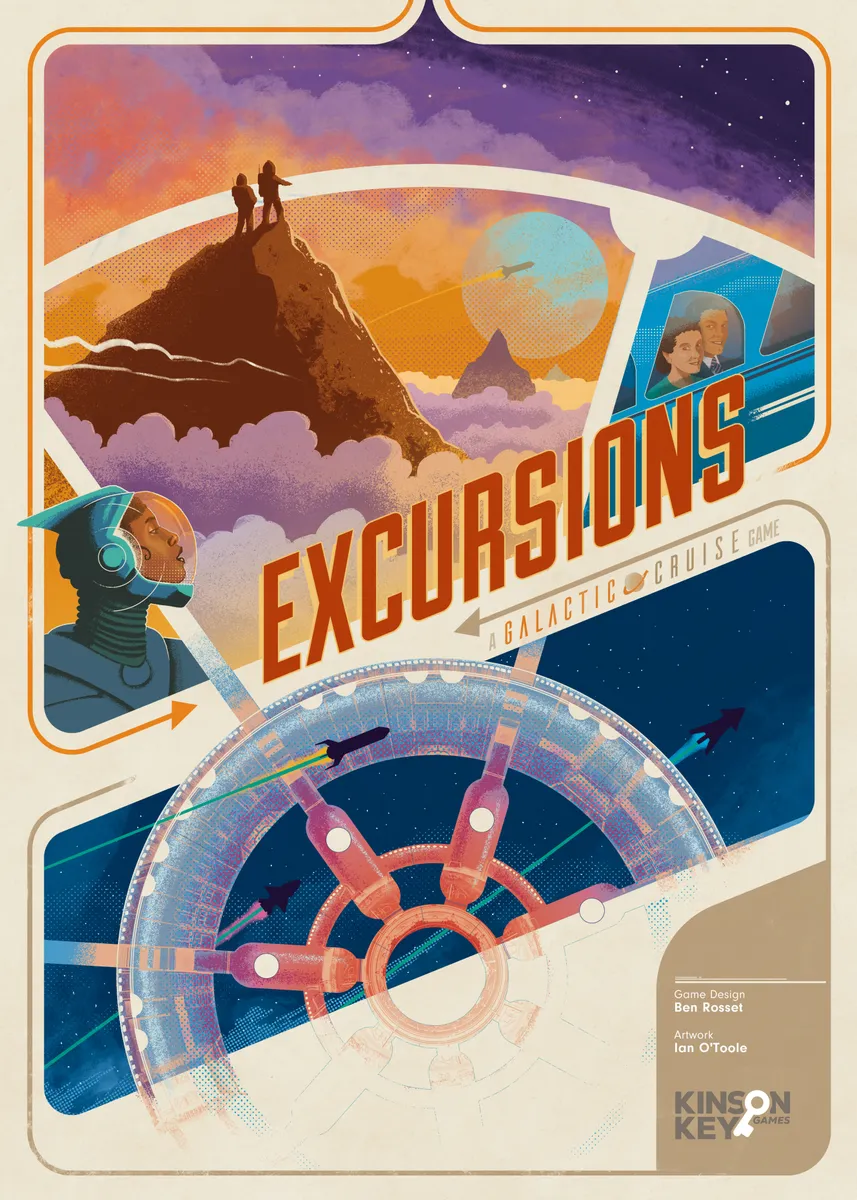
Die Nachricht ist schon ein paar Wochen alt, aber ich bin erst jetzt darüber gestolpert – und sie ist definitiv einen Beitrag wert. Mit Excursions erscheint eine Reimplementierung von Galactic Cruise, die von Kinston Key Games entwickelt wird. Und zwar nicht einfach eine abgespeckte Version, sondern – wenn die ersten Stimmen stimmen – ein eigenständiges Spiel, das die […]
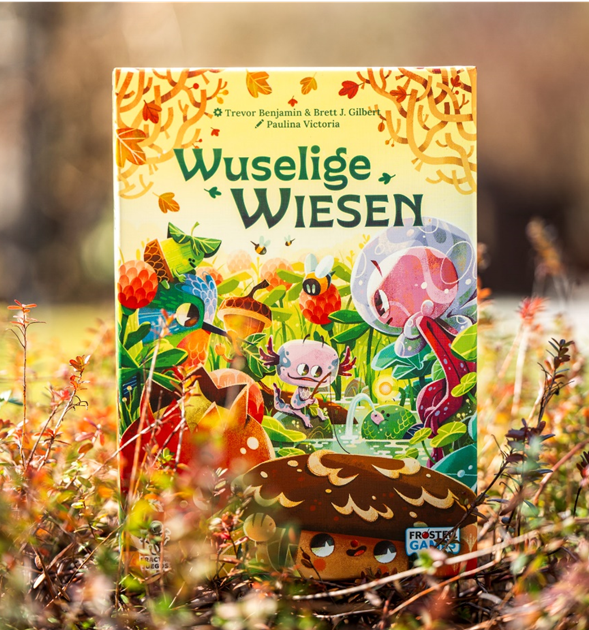
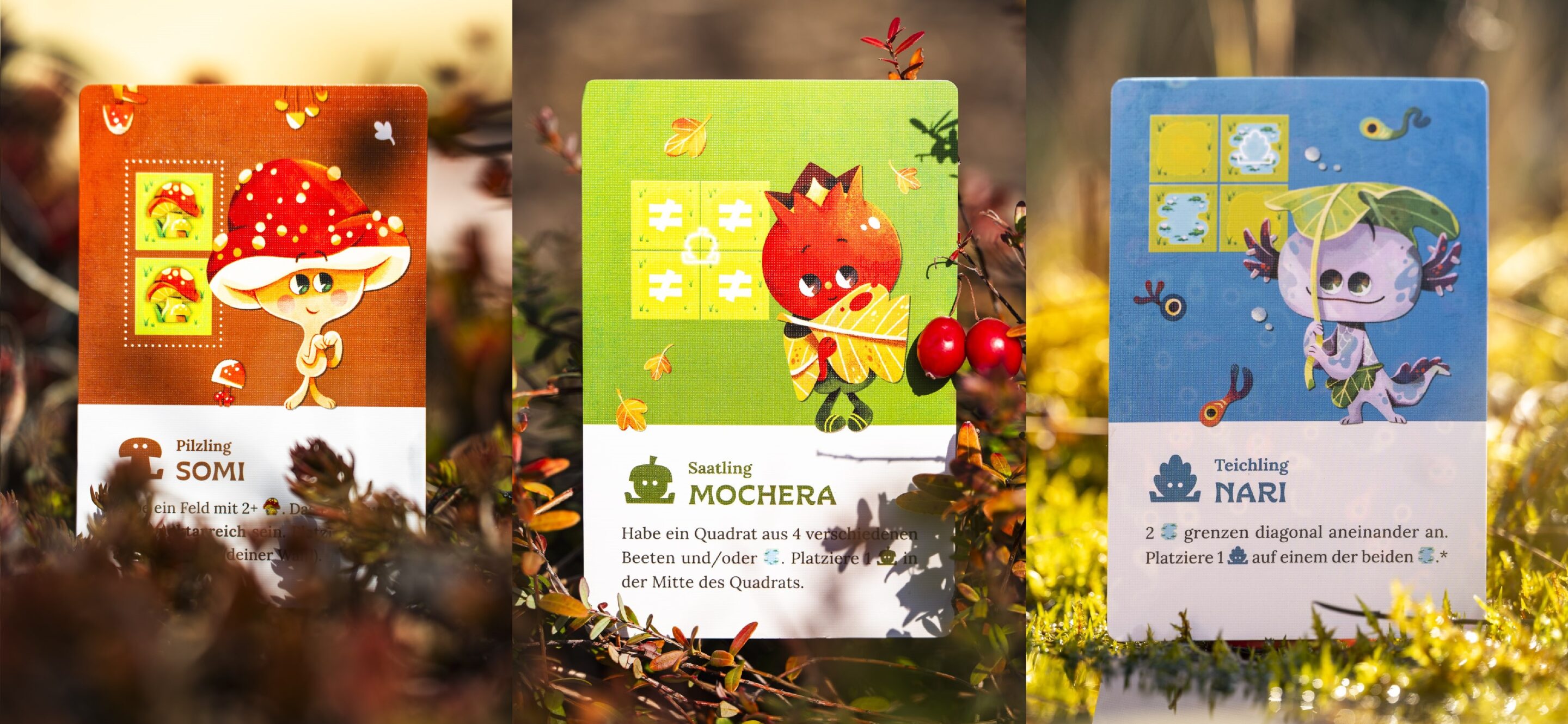
Wuselige Wiesen ist ein entspanntes Plättchenlegespiel für die ganze Familie. Stück für Stück lässt du die blühende Landschaft deines Gartens wachsen und kannst so Wesen anlocken. Mit etwas Geschick lockst du Bienen, Kolibris und sogar geheimnisvolle Wiesengeister an.
Spielvorbereitung
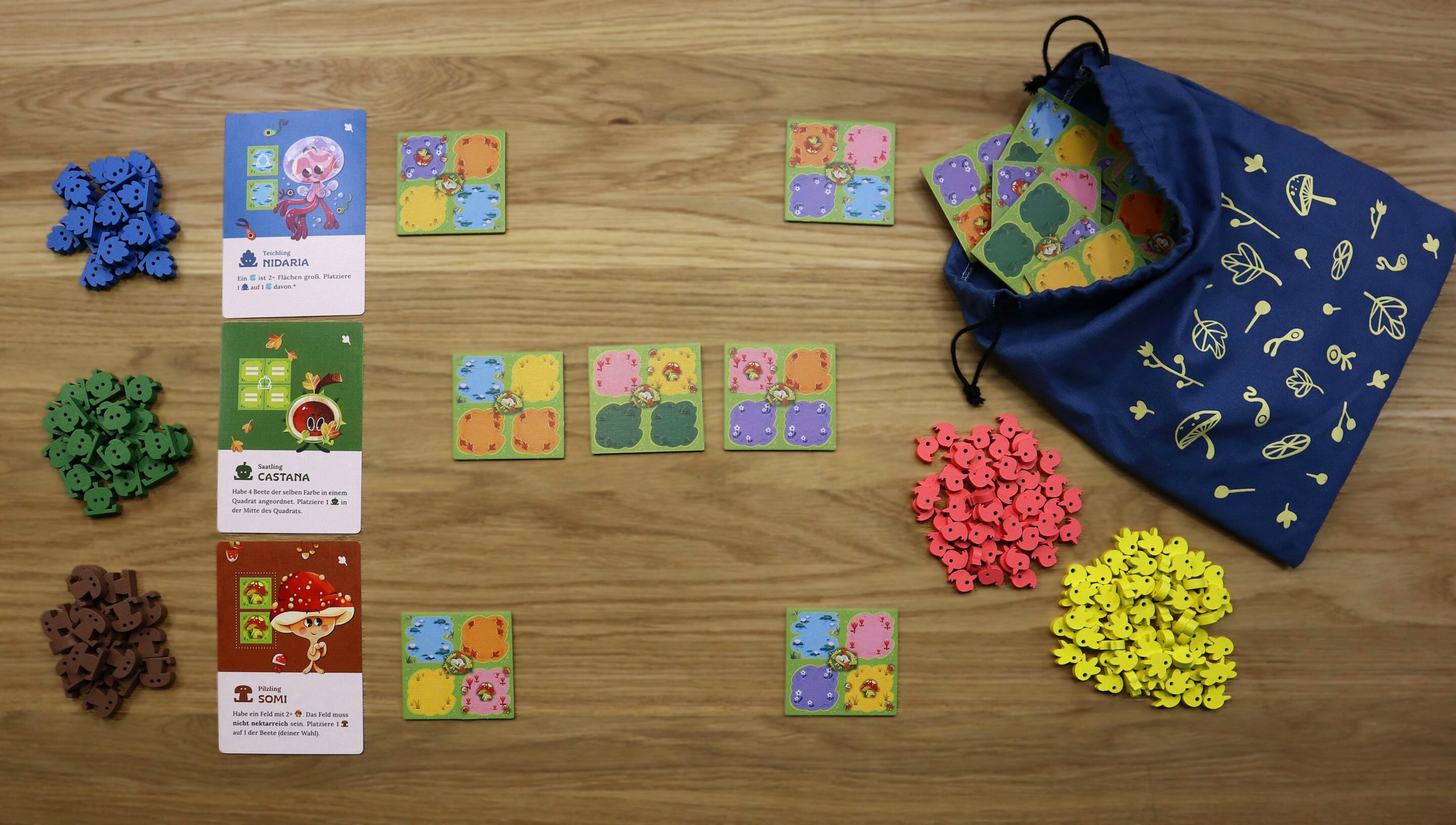
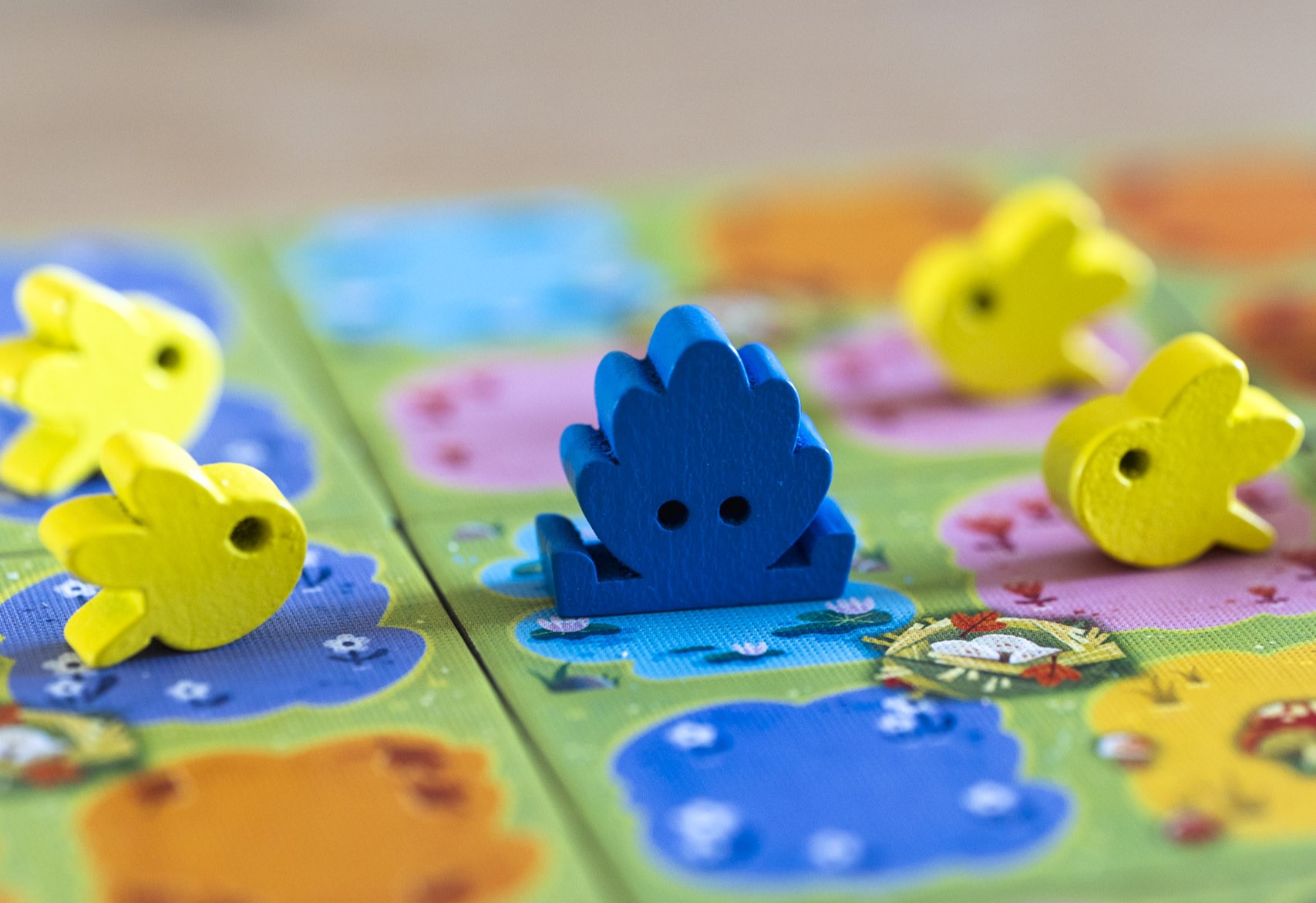
Bevor das Wuseln beginnen kann, bekommt jeder Spieler seine erste kleine Wiese, ein Start-Plättchen, das du vor dir platzierst. Die übrigen Gartenplättchen landen gut gemischt im Beutel. Zieht 3 davon und legt sie offen in die Tischmitte. Dazu kommen die Bienen-, Kolibri-, und Wiesengeisterholzfiguren und je eine Wiesengeister-Karte pro Farbe.
Rundenablauf
Das Spiel verläuft in reihum gespielten Zügen. Jeder Zug besteht aus drei Aktionen: Pflanzen, Anlocken und Auslageauffüllen.
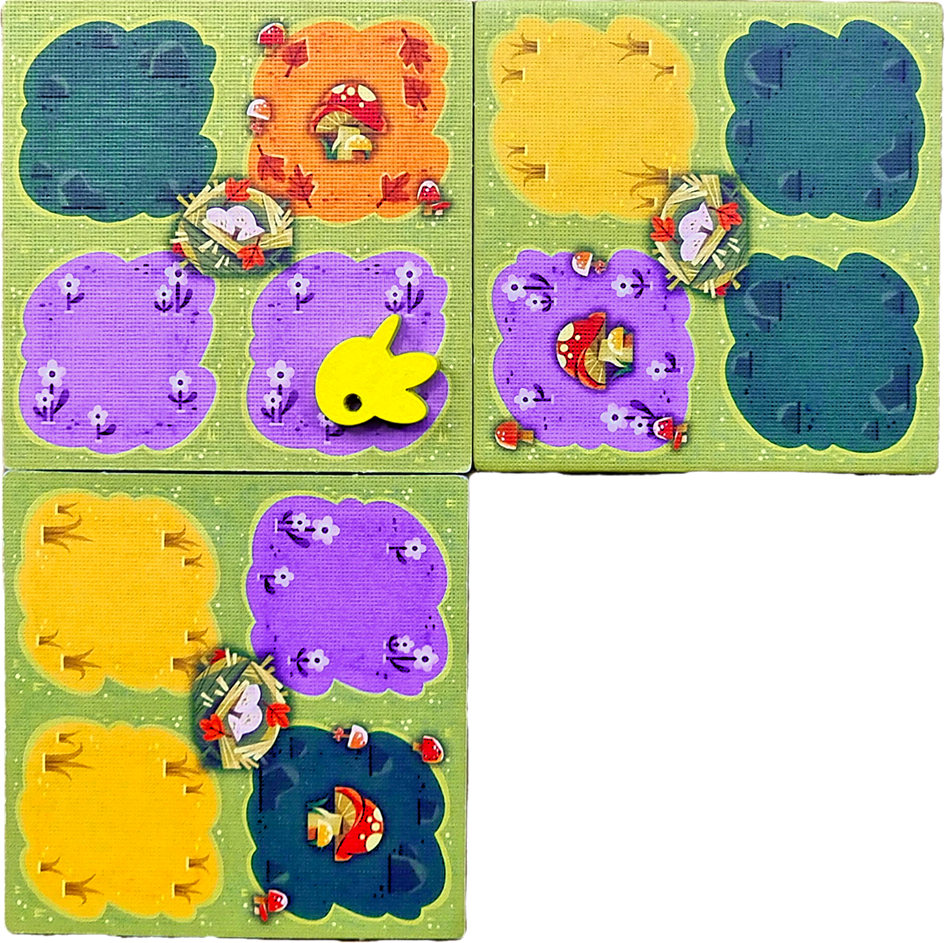
Beim Pflanzen wählst du ein Plättchen aus der offenen Auslage und legst dieses an deine Wiese an. Hierbei sind jedoch die Pflanzregeln zu beachten: Mindestens eine Seite des Plättchens muss vollständig an ein bereits ausgelegtes Plättchen angrenzen, sodass kein Gartenplättchen einzeln liegt. Hierbei darf eine Seite nicht an zwei unterschiedliche Plättchen angrenzen. Gartenplättchen dürfen dabei beliebig gedreht und gewendet werden. Am besten versuchst du, gleiche Beete zu verbinden- so entstehen größere Felder.
Nachdem du neuen Lebensraum geschaffen hast, kannst du dort Wesen anlocken. Wenn eine zusammenhängende Fläche aus mindestens drei gleichfarbigen Beeten besteht, bildet sich ein nektarreichesFeld, auf welchem sich zahlreiche Bienen niederlassen.
Gehört jedes Beet auf einem Gartenplättchen zu einem nektarreichenFeld, nistet sich ein Kolibri in dem Nest in der Mitte des Plättchens ein.
Abgesehen von Bienen und Kolibris lassen sich in den Wiesen bei passenden Bedingungen auch wundersame Märchenwesen auffinden, die Wiesengeister. Jedes dieser Fabelgeschöpfe hat eigene Anforderungen, mit denen du es ködern kannst.
Nachdem du deinen Garten mit Gewusel gefüllt hast, wird die Auslage in der Mitte des Tisches aufgefüllt, indem du ein neues Gartenplättchen aus dem Beutel ziehst, damit wieder 3 zur Auswahl stehen. Danach ist der nächste Spieler am Zug, seinen Garten aufblühen zu lassen.
Das Spiel ist zu Ende, sobald keine Plättchen mehr im Gartenbeutel sind.
Auswertung
Bevor die letztendliche Punktzahl ermittelt wird, gibt es aber noch Boni zu gewinnen! Für jede der drei Wiesengeisterarten wird überprüft, wer die jeweilige Mehrheit hat. Der Spieler mit der Mehrheit darf sich von der zugehörigen Wiesengeisterart zwei weitere Figuren nehmen.
Bei Gleichstand kriegen alle Gewinner den Bonus. Am Ende gilt ganz einfach: Jedes Wesen bringt einen Punkt. Wer die meisten hat, gewinnt.
Kurz gesagt
Plättchen legen, Flächen clever verbinden und die richtige Mischung aus Planung und Gelegenheit nutzen – so wächst deine Wiese zu einem wuselig-lebendigen Paradies heran.
Am 11. April 2026 ist Reinhold Wittig in Göttingen gestorben – in der Stadt, in der er geboren wurde, gelebt und gewirkt hat. Der Spieleautor, Künstler und Geologe wurde 89 Jahre alt. Mit ihm verliert die Brettspielwelt eine ihrer prägendsten Persönlichkeiten: einen Mann, der nicht nur über 130 Spiele veröffentlichte, sondern die Branche strukturell und […]
In unserem Format „Tipp um Tipp“ laden wir euch ein, mit uns zu quizzen. Wir beschreiben Euch einmal pro Woche in 15 bis 20 Hinweisen ein Brettspiel. Wie schnell bekommt Ihr es heraus? Am Ende gibt es direkt die Auflösung.
Schreibt uns gerne, wie Euch das Quiz gefällt oder sagt einfach hallo.… [Weiterlesen]
Du hast Erfahrung im Vertrieb und eine echte Leidenschaft für Brettspiele? Dann könnte das hier genau dein nächster Schritt sein!
Bei uns dreht sich alles um Spiele, Strategie und Begeisterung – und genau dafür suchen wir Menschen, die nicht nur verkaufen, sondern andere mitreißen können. Wenn du gerne mit Kunden arbeitest, ein Gespür für gute Produkte hast und Teil eines engagierten Teams werden möchtest, bist du bei uns genau richtig.
Vertriebserfahrung
Begeisterung für Brettspiele
Kommunikationsstärke & Teamgeist
Klingt nach dir? Dann melde dich bei uns und werde Teil unserer Reise!
This is a board game blog. Board games are a medium which can help us understand – for example, they can provide a uniquely active perspective on history. Yet which other medium can provide a fresh perspective on board games? – This is where novels come in handy. Today, we’re going to look at The Third Reich (Roberto Bolaño), a study in obsession as well as gaming and history.
Spain in the 1980s. Udo Berger, a young German, has just arrived in a small seaside town for a vacation with his girlfriend Ingeborg. Yet Udo’s mind is not on the beach. He has just won the national championship at the wargame The Third Reich (clearly based on Rise and Decline of the Third Reich (Don Greenwood/John Prados, Avalon Hill)) and plans to use his vacation to write an article on his new strategy for the Axis. Ingeborg, however, has more traditional vacation activities in mind, and so they spend some of their swimming, tanning, and partying, through which they befriend another German couple, some locals, and the enigmatic paddleboat renter who is only known as El Quemado (The Burned One) for the burn marks which cover his body. When the vacation comes to an end, Udo remains in Spain, supposedly to help in the case of an acquaintance lost at sea windsurfing… yet the real reason is the game of Third Reich which he plays against El Quemado.
Chilean novelist Roberto Bolaño wrote the novel in 1989. Since he turned his hand-written first draft into a typoscript (and later typed the first 20% into his first computer), it is assumed that he wanted to eventually publish it, but he didn’t do so before his death in 2003. When the novel was found among his papers, it was posthumously published in 2010. In addition to the original Spanish (El Tercer Reich), the book has been widely translated. I read the German translation.
Warning: Spoilers for the plot of The Third Reich ahead – but frankly, this is not a book you read for plot, you read it for the vibes.
Obsession: Conquest, Validation, Control
Udo Berger is wargame-obsessed, but the book is not a study of how an outsider has outsider fixations. On the one hand, Berger’s obsession with conquest and domination sets him by no means apart from his peers – just that they usually direct their respective urges to amorous exploits. On the other, our protagonist does not only want to conquer in the game either. In addition to his girlfriend, he also pursues the hotel manager Frau Else (who has been his crush when he was vacationing in Spain as a teen), and the underage chambermaid Clarita. And maybe most of all, Berger is fixated on being respected by his wargame peers, which he can only imagine obtaining by finding strategies (and publishing articles about them) which will obliterate all conventional wisdoms about the game.
As Berger is acutely aware of his lack of linguistic sophistication, he decides to practice by writing a diary during his vacation (which is what we read in the novel). The development of this diary reflects the changes in the writer: Originally, his daily entries are very structured (one per day, headlined by the date), and mostly concerned with banal reports on what he did, what he ate, and what he has in mind for the game/article). As Berger is drawn more and more into his duel with El Quemado, the diary gets more confused: He jumps from one level of narration to another within the same paragraph, extensive passages are solely dedicated to what’s happening in the game (down to which counters are placed on which individual hex numbers on the board), and the chapters are not only named after the dates, but also entitled “With El Lobo and El Cordero [his Spanish acquaintances]”, “Spring 1942” or “My Favorite Generals”.
Berger’s inability to focus also dooms his conquests (ludic and erotic): He sets out to prove that opening a second front early is not a liability, but an asset, and enthusiastically reports early in the game to a friend at home that it’s “Blitzkrieg on all fronts”. Yet as he conducts an amphibious assault of Britain at the same time as he invades the Soviet Union, his forces are overstretched and his Axis collapses before the historical date. And broadcasting his erotic attention over Ingeborg, Frau Else, and Clarita, does not further his relationship with either of them.
As things slide out of his grip, his attitude to control changes: Initially, Berger is fixated on the superior strategy. He notes down the exact moves – which corps need to occupy which hex in which turn to win. This chess-like approach collapses after the turning point of the game: Once El Quemado begins his counter-attack, Berger mentions for the first times that there are die rolls in the game (and how they favor his opponent) – not unlike many board gamers I have seen.
Gaming and History
Besides the main theme of obsession, the novel also offers many glimpses on gaming, history, and the relation between the two.
Berger arrives in Spain with his life compartmentalized between the gaming and the “normal” part – his girlfriend and the office job. This compartmentalization is already eroding with his plan to write the strategy article (which immediately chafes against the confines of a conventional vacation – the hotel employees are bewildered by his request for a large table to be set up in his room, and Ingeborg demands he come to the beach) and fully collapses over the course of the book, when he even unilaterally extends his vacation to play the game (and gets fired for it).
The shadow of history hangs over Berger. Our protagonist does not only play games about World War II, he also reads “patriotic” literature of the era, knows about the lives and deeds of the German generals (especially those of the SS), and the only of his wargamer friends for whom he has a certain reverence is a veteran of World War II. Despite this clear fascination for the history of Nazi Germany, Berger twice disavows being a Nazi himself (having been asked by El Quemado and Clarita). Once he even calls himself an “opponent of the Nazis”, but does not expound on it. His personal politics do not factor into the novel – Berger, having been born around 1960 in democratic, liberal, prosperous post-war Germany enjoys the luxury of only engaging with history at his leisure. He thus remains at the surface of it…
…unlike his gaming opponent. El Quemado comes from South America, and it is rumored among his Spanish acquaintances that the scars he bears are the result of torture (by one of the many right-wing regimes which took power in the 1970s). History has thus seeped into his body and gives him the strength to withstand the ludic assault of the experienced player Berger.
Bolaño himself was arrested after the 1973 coup in Chile and, to his own wonder, was released after eight days without having been tortured (he ascribed it to two of the detectives having attended school with him). He then emigrated to Spain where he worked odd jobs in the tourism industry like El Quemado.
Another allusion to Chile is made in a much-misunderstood scene: On September 11, everyone is out at the beach to celebrate the Catalan national holiday. Yet when a plane flies overhead, an eerie sense of dread overcomes the spectators. Many reviewers see this as a revision which Bolaño must have made after the September 11, 2001 terrorist attacks (or, as an odd coincidence) – but I think the likeliest reason for the scene is that the coup in Chile began on September 11, 1973 with the rebelling air force bombarding the presidential palace in Santiago.
Verdict
Roberto Bolaño’s The Third Reich starts with the innocent concept of a beach vacation. As it grows darker, the novel develops a hypnotic pull. The author’s own deep knowledge of wargames allows him to paint a vivid picture of the game itself – and of the hold it can have over its players.
In unserem Format „Tipp um Tipp“ laden wir euch ein, mit uns zu quizzen. Wir beschreiben Euch einmal pro Woche in 15 bis 20 Hinweisen ein Brettspiel. Wie schnell bekommt Ihr es heraus? Am Ende gibt es direkt die Auflösung.
Schreibt uns gerne, wie Euch das Quiz gefällt oder sagt einfach hallo.… [Weiterlesen]
Seit dieser Woche befinden sich alle Files im Approval! Das heißt: Wir warten jetzt auf die Freigabe durch unseren Partner und bessern gegebenenfalls nach, wo es nötig ist. Gleichzeitig haben wir für erste Files bereits E-Proofs erhalten und gesichtet – ein notwendiger letzter Freigabeschritt unsererseits, damit diese Komponenten in die Produktion gehen können.
110 – 99 – Diese Zahlenkombination macht Ninety Nine aus dem Hause Kendi Games aus. Wir wollen mit 110 Spielkarten als erste Person 99 Punkte erreichen und wir schauen einmal, ob es Kendi Games gelingt, das einfach und spaßig zu Tisch zu bringen Björn Bei Ninety Nine baut jede Person eine eigene Kartenreihe auf. Das […]
Wie in den letzten Jahren führen wir von Beeple auch in 2026 wieder eine Osterauktion durch. Wir versteigern wieder Spiele, die wir grösstenteils aus unserem privaten Bestand zur Verfügung stellen. Ergänzt wird das Angebot durch Spenden von Autoren und Verlagen, die ebenfalls tolle Pakete geschnürt haben. Ihr habt so die Möglichkeit, an einige besondere Schmankerl zu kommen […]
In unserem Format „Tipp um Tipp“ laden wir euch ein, mit uns zu quizzen. Wir beschreiben Euch einmal pro Woche in 15 bis 20 Hinweisen ein Brettspiel. Wie schnell bekommt Ihr es heraus? Am Ende gibt es direkt die Auflösung.
Schreibt uns gerne, wie Euch das Quiz gefällt oder sagt einfach hallo.… [Weiterlesen]
Our dear cat Penelope has died. Thus, the history today is personal.
Penelope’s early life is shrouded in mystery. She lived on the streets, but we do not know for how long and if she had been in a human household before. In 2016, she was found and taken to an animal shelter. For the next three years, nobody wanted to adopt her… until we came there and found her to be a somewhat reserved, but very sweet middle-aged lady.
She integrated into the family immediately: One day after her adoption, she already strategized how to blunt the Prussian invasion of Bohemia.
From then on, she was our constant companion. She read with us…
…celebrated Halloween…
and Christmas with us…
…rid our place of provocative ribbons…
…tested all boxes for their sitting qualities…
…and had secret admirers who sent her bouquets.
She even found the time to adopt a secret second identity as quirky nanny Purry Poppins.
Her love for board games remained undiminished. Sometimes we suspected that she considered herself to be a board game.
The only thing she could not abide was me going for business trips. Big-eyed protests were staged on my suitcase.
Yet when I came back and played a game with her, everything was forgiven.
While she certainly enjoyed the games…
…the most important part to her was spending quality time with her family – for example, sitting on my lap while I sorted counters into trays.
Penelope was with us during tumultuous years. No matter if Covid forced us to stay at home or Putin threatened to cut off our energy supply, it was always a comfort to have a furry, affectionate companion with us.
As Penelope aged, her health deteriorated. She succumbed to a lung edema on March 11. She will be greatly missed.
In unserem Format „Tipp um Tipp“ laden wir euch ein, mit uns zu quizzen. Wir beschreiben Euch einmal pro Woche in 15 bis 20 Hinweisen ein Brettspiel. Wie schnell bekommt Ihr es heraus? Am Ende gibt es direkt die Auflösung.
Schreibt uns gerne, wie Euch das Quiz gefällt oder sagt einfach hallo.… [Weiterlesen]
Jens war leider diese Woche krank und konnte nicht so viel einarbeiten wie geplant. Aber es gab wieder viel Feedback vom Korrekturlesen, das nächste Woche umgesetzt wird.
Wir geben euch weiterhin wöchentlich ein Update zum Fortschritt.
In der Schweiz wurde der Brettspielpreis Swiss Gamers Award 2025 vergeben. Dieser wird seit 2010 für das vergangene Jahr vergeben. Seit dem vorletzten Jahr wird neben dem Swiss Gamers Award auch der Swiss Gamers Family Award vergeben, mit dem auch einfache Brettspiele ausgezeichnet werden sollen. Und jetzt NEU: der Swiss Gamers Expert Award. Der Swiss […]

 Anmelden