

Normale Ansicht

Alley Cat Games’ pivot to producing more high-complexity designs rewarded with Diamant d’Or win for Ada’s Dream

09. Februar 2026 um 15:26

British board game publisher Alley Cat Games has triumphed in this year’s Diamant d’Or – a prize focused on championing heavier eurogames – after pivoting its strategy several years ago to experiment with crowdfunding more complex designs.

The Toni López-designed dice manipulation game fought off big name titles including Galactic Cruise and Luthier to win the 2026 Diamant d’Or, which was created more than a decade ago to celebrate complex euros the organisers felt were being overlooked by more mainstream board game awards.

Richard Breese’s latest design in his Key series, Keyside, took second place in this year award, while Ants, an ant colony expansion title from frequent Diamant d’Or finalist Cranio Creations, came third.

Speaking to BoardGameWire, Alley Cat Games director Caezar Al-Jassar said the team was “ecstatic” with the win, adding, “we have worked hard for three years to bring Ada’s Dream to gamers and have been blown away by the positive response from our backers and supporters”.

He said, “Ada’s Dream is the most complex game we’ve ever produced. A few years ago we noticed that the trend for Kickstarter games was leaning to heavier and more complex games than we were producing, and so we pivoted to explore creating more games like this.

“This meant a lot of extra work to produce the final game and we are incredibly pleased to see that work has paid off, and that Ada is being celebrated by the Diamant d’Or committee.”

Ada’s Dream || Kickstarter image

Ada’s Dream was Alley Cat’s most successful crowdfunding campaign in terms of the total raised, having picked up almost £200,000 from more than 3,300 backers.

Its heavier titles in recent years have included Autobahn, Arborea and Baghdad: The City of Peace, while the company continues to put out lighter weight designs such as Timber Town and small-box offerings like Barbecubes, Tic Tac Trek and 2026 release Bookshelf, which Al-Jassar designed.

The Diamant d’Or win comes just under a year after Alley Cat announced during its Kickstarter campaign for Baghdad that it would cease producing retail editions of its crowdfunded titles “for the foreseeable future”, amid rising competition on shop shelves and uncertainty around US tariffs.

A statement from the company at the time said,” It is getting harder for Kickstarter games to succeed, both on Kickstarter and in particular at retail stores after the campaign.

“This, coupled with rising costs and the uncertainty surrounding US tariffs, has led us to look at ways of streamlining the business to ensure that we don’t have so much money tied up in stock. We’d much rather invest this money in making more great games!”

Al-Jassar told BoardGameWire, “Considering that these titles are more expensive to produce, ship, and store than smaller more retail friendly games, we kept the decision to move away from retail distribution of our Kickstarter games.”

A small number of copies of Ada’s Dream were briefly available through the Alley Cat website from February 5, but those available to US and European customers have already sold out.

Al-Jassar said, “The initial webstore sales were some stock not needed for fulfilment. However, as there are still backers that did not complete their Pledge Managers, we will be keeping a supply in storage until a set number of months after the end of fulfilment to ensure all backers have the opportunity to receive their copy.

“Regarding future plans for Ada’s Dream, we won’t be producing a print run for retail distribution but may have some more copies available once enough time has passed after fulfilment, and are exploring a future Kickstarter campaign with an expansion and reprint that we hope to launch in early 2027.”

The 2026 Diamant d’Or

WINNER: Ada’s Dream, designed by Toni López (Published by Alley Cat Games)

Second place: Keyside, by Richard Breese and David Turczi (HUCH!, R&D Games)

Third place: Ants, by Renato Ciervo and Andrea Robbiani (Cranio Creations)

Other finalists:

Galactic Cruise, by TK King, Dennis Northcott and Koltin Thompson (Kinson Key Games)

Luthier, by Dave Beck and Abe Burson (Paverson Games)

Philarmonix, by Faris Suhaimi (Archona Games)

Recall, by Helge Meissner, Kristian Amundsen Østby, Kjetil Svendsen and Anna Wermlund (Alion – by Dr Ø)

Sweet Lands, by Totsuca Chuo (Uchibacoya)

The post Alley Cat Games’ pivot to producing more high-complexity designs rewarded with Diamant d’Or win for Ada’s Dream first appeared on .

Luthier – The Art of the Instrument

Von: Bill
07. Februar 2026 um 11:43

„Musik ist die Sprache der Leidenschaft“ – Richard Wagner

Luthier bietet endlich das Thema Musik als solche in unserem Blog! Und zwar geht es um klassische Musik. Wir sind uns wohl bestimmt einig, wenn ich behaupte, dass dies die edelste Möglichkeit ist, einen Konzertsaal mit Klängen zu füllen.

Dave Beck hat mit seinem Verlag Paverson Games durch dieses Spiel ein pompöses Gesamterlebnis komponiert. Wie schön, dass Funtails dieses edle Stück für den deutschen Markt lokalisiert hat. Es wäre doch schade gewesen, wenn manchen so ein klangvolles Stück aufgrund der sprachlichen Barriere verwehrt geblieben wäre! Insgesamt handelt es sich um ein Werk positiver, gemeinsamer Klänge. Doch ab und zu, und dann ganz unerwartet, kommen infernalisch die spielerischen Gegensätze zum Tragen und man bekommt die volle Breitseite der interaktiven Möglichkeiten untereinander zu spüren

Ob mir dieses Konzert so gefallen konnte, dass ich es ab jetzt öfter hören möchte, werde ich Euch in diesem kurzen Eindruck im Folgenden gerne erläutern.


Eindruck von der Bühne

„Wenn ich an meinem alten, von Würmern zerfressenen Klavier saß, beneidete ich keinen König um sein Glück“. – Joseph Haydn

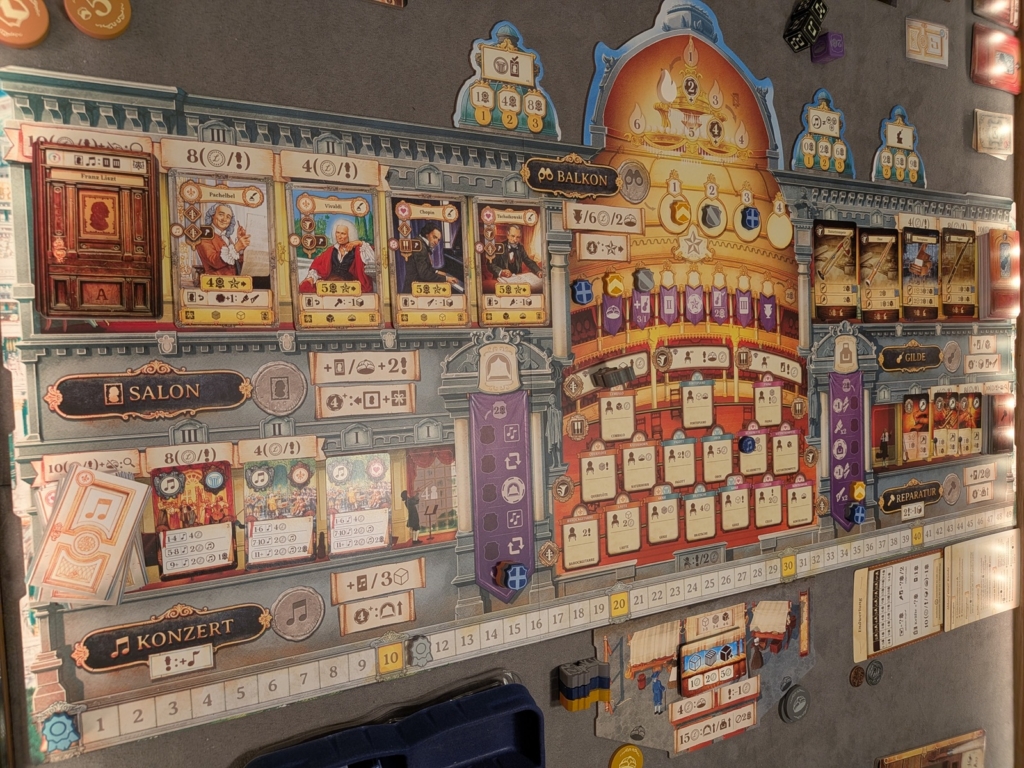
Spielübersicht zu Dritt zu Beginn der zweiten Runde

In Luthier verkörpert jeder Spieler eine ehrenvolle Familie von Instrumentenbauern zur Zeit des 17./18. Jahrhunderts. Angeordnet ist der Schauplatz im damaligen Europa. Jeder Spieler möchte die Familie der zu dieser Zeit erfolgreichsten Luthiere verkörpern (Luthier ist aus dem französisch abgeleitet für „Laute“ und bedeutet soviel wie Saiteninstrumentenbauer). Das Spiel wird 6 Runden gespielt, in denen wir versuchen die Bedürfnisse berühmter Mäzen zu erfüllen. Dabei bauen und reparieren wir Instrumente und geben kleine Privatkonzerte. Mit all diesen Aktionen machen wir nicht nur die Mäzen fröhlich, sondern sichern unseren Instrumenten den Vorsitz (also wichtigen ersten Platz der jeweiligen Instrumentenart) im Konzertsaal. Dies ist ein großer Punktebringer und sollte auf jeden Fall Beachtung finden!

Am Anfang noch sehr leer, füllt sich der Saal langsam mit unseren Markern.

Im Balkon über dem Saal können wir die Spielerreihenfolge bestimmen und ggf. eines der variablen Spielziele (die kleineren Kuppeln darüber) erfüllen und uns so weitere für das Spiel wichtige Boni freischalten. Die drei lilafarbenen Banner um den Saal herum zeigen unsere Fähigkeiten in der Werkstatt (rechts), auf der Bühne (links) oder den Fortschritt beim Erfüllen der Wünsche unserer Mäzen (oben). Unten sieht man den Markt, die Preise ändern sich zufällig von Runde zu Runde. Über den Marktkarten erkennt man die Preisfenster. Somit kosten Tierprodukte immer zwischen 1-3, Holz 2-4 und Metalle 4-6 Münzen. Auf der großen Kuppel oben befindet sich die Rundenanzeige. Zwischen den Runden 2-3 und 4-5 erhalten wir Zuwachs unserer Arbeiter. Zwischen den Runden 3-4 werden die Mäzen „A“ gegen „B“ getauscht. Letztere bieten uns Siegpunktbewertungen am Spielende.

Das Spielertableau stellt hauptsächlich unsere Werkstatt dar, zeigt aber auch die Geduld unserer Mäzen, welche auf unsere Fürsorge warten.

Auf dem Spielertableau befindet sich hauptsächlich unsere Werkstatt. Links ist die Grobbearbeitung, die alle Instrumente am Anfang durchlaufen müssen. Rechts finden wir die Feinwerkstatt, hier werden alle Instrumente fertiggestellt und danach ausgewertet. Beide Werkstätten haben eigene Plätze für unserer Arbeiter.

Beispiel einer Aktion

Zu Rundenbeginn legen wir unsere vorhandenen Arbeiter an die verschiedenen Einsatzorte verdeckt ab. Dieser mechanische Kniff zeigt somit zwar unseren Kontrahenten an, wo wir diese Runde überall tätig werden möchten, aber nicht mit welcher Arbeiterstärke genau. Diese (1-5) bestimmt dabei nicht nur, wer zuerst handeln darf (bei Gleichstand entscheidet, wer hier zuerst eingesetzt hat), sondern auch die Stärke unserer Handlung. Eine höhere Zahl bietet immer Vorteile an der Stelle. Wenn über der entnommenen Karte Kosten stehen (hier 4 Münzen oder Inspiration) muss ich diese normalerweise in beliebiger Mischung bezahlen.


Groupie auf Tour

„Der Zweck der Musik, wie er immer war, ist es, Freude an dem Leben zu erwecken, das wir leben“ – Johann Sebastian Bach

Ich habe oben bereits sehr viel beschrieben und bestimmt doch nur 80% aller Mechaniken dabei erwähnt. Dieses Werk ist umfangreich, das muss an dieser Stelle als kleine Warnung erwähnt sein. Aber es ist einfach thematisch so gut überlegt und fühlt sich dabei so einzigartig und meisterhaft komponiert an, dass es einen wahrlich in diese Epoche zu genau diesem Vorhaben versetzt! Es ist ein kleiner, wahrgewordener Spielertraum! Das Material ist einfach wunderschön, selbst in der Basisversion ist das kaum anders! Die Illustrationen von Vincent Dutrait sind dabei wundervoll anzuschauen und wirken wie eine Komposition für sich.

Dieser Zeichenstil Vincent Dutrait’s erfüllt das gesamte Spiel

An manchen Stellen hat man das Gefühl Teile aus dem Spiel Das Unbewusste von Frosted Games zu erkennen. Das wird durch einen der beiden Zeichner aus dem Spiel um Siegmund Freud emotional noch unterstrichen. Und es stimmt wohl: Hier und da ähneln sind manche Details schon, wenn z.B. die Mäze nach erfüllen einen dauerhaften Bonus bietet und bei dem Unbewussten die Klienten nach heilenden Worten zum Trauma dies ebenfalls tun. Und doch sind die Spiele an so vielen Stellen auch wieder komplett unterschiedlich. Doch ich verstehe den Vergleich.

Nach nur einem Spiel gestern Abend sind die angenehmen Klänge noch immer in meinen Gedanken zu vernehmen. Sollte ich mich bereits jetzt festlegen müssen, würde ich wohl den goldenen Meeple vergeben (mehr zu unserer Bewertung oben rechts in den Reitern). Es ist aber ein erster Blick auf das Spiel und damit keine endgültige Bewertung. Kann es den Platz halten oder muss es nach einigen Spielen vielleicht herabgestuft werden? Oder, was ich beinahe zum jetzigen Zeitpunkt glaube, kann es für mich sogar den ultimativen türkiesen Rocker bedeuten?

Mindestens bereits Gold wert – kann es diesen Ersteindruck halten?

Von dem Spiel gibt es auf unserem Youtube-Kanal ein Unboxing:


Konzertmitschnitte

(Galerie mit Fotos)

Titelbild von Webandi auf Pixabay

Verlage: Paverson Games / Funtails

Hinweis: Das Spiel ist ist mein selbst gekauftes Eigentum. Diese Rezension ist unentgeltlich durchgeführt worden und spiegelt alleine meine persönliche Meinung wider.

“We feel that the industry wants it”: German Mensa switches long-running board game award away from lighter titles to focus on expert games

27. Januar 2026 um 15:59

The German branch of high IQ society Mensa has changed up its long-running board game award to focus entirely on complex, expert-level titles, scrapping its prizes for shorter family games and two-player designs.

Mensa in Deutschland has awarded the MinD Spielepreis since 2009, and has operated a ‘shorter games’ category for more than a decade and lighter two-player games prize since 2019.

But this year’s award will return to just a single category, pitting six expert-level games against each other in order to fill what the organisers see as a gap in the industry.

Jochen Tierbach, who has been organising the MinD Game Award for 16 years, said, “There are already various awards and prizes for family and connoisseur games.

“But for expert games, the really tough ones, there is no such thing in Germany yet. And we feel that the industry wants it.”

A long list of more than 20 titles has been whittled down to six challengers for this year: Galactic Cruise, Luthier, Shackleton Base, Speakeasy, Thebai and Thesauros, all of which have been released in Germany since Spiel Essen last October.

The organisers will now take the next ten months to persuade as many Mensans as possible to play the titles and rate them out of 10 for ‘challenge factor’ and ‘replayability’. The winner is set to be announced on November 10.

Last year’s MinD award for complex games saw Tomáš Holek’s space exploration eurogame SETI add to its array of prizes, while Simone Luciani and Dávid Turczi’s Nucleum triumphed in 2024.

The last holder of the MinD shorter game award is 2025 Spiel des Jahres winner Bomb Busters, while 2024 SdJ champion Sky Team was the final winner of the best two-player game prize.

Other board game awards focusing specifically on heavier titles include France’s Diamant d’Or, which was launched more than a decade ago to champion complex eurogames the organisers felt were being overlooked by more mainstream board game awards.

The US branch of Mensa also runs an annual board game award, Mensa Select, which is voted on by members following a now traditional four-day gaming marathon.

MinD Spielepreis finalists 2026

Galactic Cruise, by TK King, Dennis Northcott and Koltin Thompson (published in Germany by PD Verlag)
MinD committee notes: “In Galactic Cruise, players build a luxurious cruise company for space travel and organise ships, staff and wealthy customers.

“The game impresses with its strong thematic interconnection, a hidden deployment mechanism to determine the order of actions, and challenging resource planning.”

Luthier, by Dave Back and Abe Burson (Funtails)
“Luthier puts players in the role of instrument makers who, thanks to generous patrons, equip famous musicians throughout the Baroque, Classical and Romantic periods and compete for the chair of various instrument groups in the orchestra.

Shackleton Base, by Fabio Lopiano and Nestore Mangone (Giant Roc)
“In Shackleton Base, players build a permanent base at the south pole of the moon, using executives who bring a slight asymmetry to the game.

“Three of seven selectable corporations with special abilities and several interlocking scoring options provide strategic depth and high variety.”

Speakeasy, by Vital Lacerda (Skellig Games)
“Speakeasy is set during Prohibition in Manhattan, where players open illegal bars, nightclubs and casinos in different districts and supply them with stolen or moonshine alcohol.

“The appeal of the game lies in the indirect interaction through territory control, competition for lucrative locations and the constant risk of attracting too much attention.”

Thebai, by Dávid Turczi (Pegasus Spiele)
“Thebai is a tightly interwoven optimisation game in which population or hoplite cubes are placed on your own estate or on the shared game board to rebuild the Kadmeia of Thebai.

“Resources must be gathered for assignments while trying to promote population to the council or promote hoplites to army commanders in order to successfully repel attacks on the city.”

Thesauros, by Cedric Millet (Elznir Games)
“In Thesauros, players first search for and then recover sunken treasures in order to ultimately sell them to a museum at a profit.

“Budget planning several rounds in advance requires strategic foresight and a carefully balanced mix of long-term exploration plans, short-term financing requirements, and disruptive manoeuvres against or by the competition.”

The post “We feel that the industry wants it”: German Mensa switches long-running board game award away from lighter titles to focus on expert games first appeared on .

❌