Someone introduced me to Magic. Someone taught me how to play the wrong way. I sucked. Someone taught me the right rules and how to build a deck. I got good. I went broke. I got out. Then, Commander arrived. I got inspired by a Commander deck my wife bought me for Christmas and decided to build a deck of my own. I identified a potential commander amongst my plethora of cards. I made a few suppositions about what types of cards I might need in my deck. I realized the state of my card collection was in total disarray. So, I decided to get organized.
To that end, the first thing I did was to hop onto Amazon to pick up a few trading card storage boxes. Examining the myriad plastic baggies full of cards that were in my bin of cards, I gauged that I had around 2,000 loose cards that needed a home. After looking over multiple options, I finally settled upon these storage boxes.
I liked these because they looked rugged and durable. Plus, they’re reasonably priced. 800 cards per box seemed like it should be sufficient. I…
Veteran toy and game maker Hasbro‘s increasing reliance on Magic: The Gathering’s runaway success continued last year, with the trading card game’s revenue soaring 59% to mark its strongest annual performance yet.
Hasbro saw its overall revenue rise almost 14% last year to $4.7bn, driven by record 45% growth in its Magic, D&D and digital gaming division Wizards of the Coast.
“Wizards was a standout, anchored by record Magic revenue”, said Hasbro CFO and COO Gina Goetter, who added in an earnings call following the company’s 2025 financial results reveal that Wizards “remains our primary growth engine”.
Magic’s record-breaking year was capped off by a storming fourth quarter, which saw revenues from the game up 141% compared to Q4 2024 on the strength of the Avatar: The Last Airbender and Final Fantasy releases.
Wizards’ revenue increased 45% to almost $2.2bn across all of 2025, with operating profit of just over $1bn – while Magic’s revenue grew nearly 60% across 2025 powered by Universes Beyond sets, as well as “ongoing strength in backlist and Secret Lair”, Hasbro said.
The stellar performance of Wizards, and Magic in particular, is in stark contrast to Hasbro’s consumer products segment – which includes Nerf guns, Transformers and Peppa Pig toys.
That segment saw revenues drop 4% last year “amongst macro and retailer volatility brought on by tariff announcements in Q2”.
Goetter said Hasbro expects Wizards to deliver mid-single-digit revenue growth in 2026, “supported by a healthy release cadence and continued engagement across the Magic ecosystem”, while Hasbro as a wider business is expecting revenue growth of 3% to 5% this year.
Speaking about expectations for Magic’s continued success in 2026 Hasbro CEO and director Chris Cocks told the earnings call, “I think it really comes down to several growth vectors. The first one is distribution growth.
Hasbro CEO Chris Cocks
“We’re seeing meaningful growth in our Wizards Play Network. That was up 20% last year. We think it’s going to be up double digits this year again. We’re seeing incremental distribution as the brand expands and the player base expands. So I think mass market and non-WPN-based distribution growth exceeded last year WPN growth and will exceed it again this year.
“Player growth has been robust. I think the organized play metrics we’re giving you are just kind of hardcore or core player growth, the people who play in stores. Our metrics for non… kind of ‘hardcore’ players are a little more loose, but we think that those are growing well in excess of that 20%. And importantly, as we’re bringing on new kind of casual fans or new to MAGIC fans and collectors, they are sticking around. And you’re seeing that evidenced in robust backlist and higher organized play participation.
“So what we’re seeing going on with Magic is a virtuous cycle of there’s more places to buy, there’s more people playing. They’re engaging longer and sticking around. And that just leads to increased set over set performance like we’re seeing with Lorwyn. And we see that continuing into 2026.
“Not to mention, we’ve got a stacked lineup of partners. You’ve got Teenage Mutant Ninja Turtles, The Hobbit, Marvel Super Heroes and Star Trek plus some real fan-favorite sets like Lorwyn and Strixhaven on tap for this year.”
Hasbro’s annual results reveal came the same day it announced it had signed a multi-year licensing partnership to make it “the global primary toy licensee for the world of Harry Potter” and the upcoming HBO series.
That partnership with Warner Bros. Discovery Global Consumer Product begins in 2027, covering “dolls, role play, action figures & collectibles, interactive plush, board games and more”, Hasbro said.
But the Harry Potter franchise won’t yet be making its way to Magic, according to the Wizards of the Coast community team, who posted to Reddit to say, “The Magic Multiverse has its own school of Magic at Strixhaven with plenty of secrets still to explore. Our Universes Beyond roadmap currently doesn’t have us visiting any others.”
Harry Potter-related deals have come under fire from parts of the board game hobby in the last year due to ongoing anti-trans campaigning from the character’s creator, JK Rowling.
CGE has since apologised “unreservedly” for failing to take into account how “the harmful views of the story’s creator have escalated into harmful actions”, and committed to donating 100% of the game’s profits to appropriate charities.
Last month Upper Deck, the publisher of the Legendary series of deck-building board games, was urged by the Tabletop Game Designers Association not to create a Harry Potter-based tabletop title, after the company announced a deal for the “coveted” Harry Potter licence.
Upper Deck said on January 7 that it would begin creating collectibles for the Harry Potter franchise, starting with two sets of trading cards due for release later this year, adding that it was “excited to bring its iconic brands and flagship products to the world of Harry Potter”.
Following the TTGDA plea and rising numbers of comments across Upper Deck’s social media calling out the decision, the publisher made a single-sentence response on BlueSky and a BGG thread saying “Upper Deck has no plans to produce Harry Potter games at this time”.
These days, there are so many ways to play Magic the Gathering (known simply as Magic for this article), it’s easy to lose track. The three pillars of modern Magic—Limited, Constructed, and Multiplayer—have numerous tributary formats and rulesets, but no format has straddled the lines of each of these categories more perilously than Brawl.
A Look Back At Brawl: Magic's Most Misunderstood Format
Introduced officially during the release of Throne of Eldraine as a smaller scale variant on Commander, Brawl is a 60-card singleton format where players build around a legendary creature (or planeswalker) in a similar fashion to Commander’s 99-card-plus-general deckbuilding concept. The main way that Brawl set itself apart from Commander when it was introduced, aside from deck size, was that all Standard-legal planeswalkers were available to lead your deck, alongside the format's legendary creatures. Additionally, Brawl decks could be constructed only from Standard-legal cards. (Later takes on Brawl, such as Magic: The Gathering Arena's Historic Brawl format, would expand the card pool while maintaining player access to planeswalker generals.)
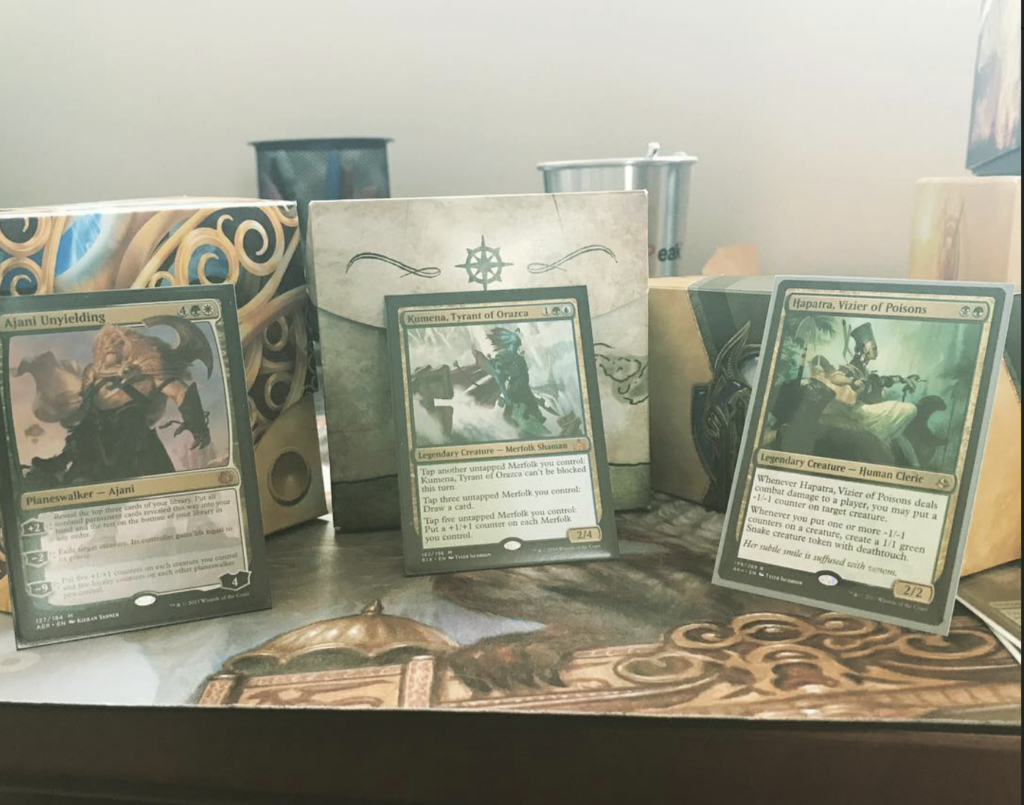
[caption id="attachment_327919" align="alignnone" width="1024"] A trio of Brawl decks built circa 2018, featuring Ajani Unyielding, Kumena, Tyrant of Orazca, and…
Someone introduced me to Magic. Someone taught me how to play the wrong way. I sucked. Someone taught me the right rules and how to build a deck. I got good. I went broke. I got out. Then Commander arrived.
I suppose now is a good time to talk about Commander: what it is and what it means for me.
Part Two: What A Mess
Where I Extoll the Virtues of the Commander Format
As mentioned in the previous entry in this series, a standard Magic deck is composed of 60 cards—consisting of cards from very specific blocks—with no more than four copies of a single card in the deck. Each player begins a game with 20 hit points, and the players win by reducing their opponents’ health to 0. There’s nothing wrong with this mode of play. It’s the way I played Magic for decades. But, it’s costly since entire sets of cards are constantly being rotated out, and new sets are being rotated in. This means you have to constantly buy more cards if you want to compete.
The Commander format changes a lot of things. Firstly, in Commander, your deck is composed of 100 unique cards (minus basic lands, which you can…
This past Christmas, my wife bought me a pre-constructed Magic: the Gathering Commander deck, which is set in the Doctor Who universe. Doctor Who appears within Magic: the Gathering as a part of an initiative called ‘Universes Beyond’. This series, based on various IPs, features other settings such as Lord of the Rings, Avatar: the Last Airbender, and Fallout (to name a few).
It was an unexpected, but welcome, gift to say the least. I haven’t played Magic: the Gathering in years (I’ve never played the Commander format), but I do love me some Doctor Who. So, I wasted no time tearing into it to check out the cards, and I have to say: I’m in love. From the artwork to the card mechanics to the flair text, the theme oozes from every card. It’s exactly what you’d want from a Doctor Who themed Magic: the Gathering set.
As I sat there reading the cards and trying to understand how the deck worked, I felt something long dormant began reawakening in me: the desire to play. And, as I sat there reading over the cards, it became apparent to me that I’ve been out of the game for far too long. Unfamiliar keywords, command zones, color identities… my eyes crossed trying to parse everything. Magic is an ever-evolving game and…

 Anmelden