
Normale Ansicht

My Favorite Wargame Cards – A Look at Individual Cards from My Favorite Games – Card #64: Guns of August from Paths of Glory: The First World War, 1914-1918 from GMT Games

Von: Grant
03. Februar 2026 um 14:00

With this My Favorite Wargame Cards Series, I hope to take a look at a specific card from the various wargames that I have played and share how it is used in the game. I am not a strategist and frankly I am not that good at games but I do understand how things should work and be used in games. With that being said, here is the next entry in this series.

#64: Guns of August from Paths of Glory: The First World War, 1914-1918 from GMT Games

Paths of Glory is widely thought to be a masterpiece on WWI and after just a few plays of the game, both in person and online on the fabulous Rally the Troops!, I can definitely see why people feel that way. Even though we are novices, the game is just that good and really tells the story of the fruitless efforts of both the Entente and Central Powers as they bashed their heads against each other over control of Europe. The game is long and you generally are going to have to play this one over a long weekend to get it all in and enjoy it properly but it is just such as great tool to understand the complexities of the struggles of trench warfare, supply and the balance of attacking versus taking a breath and regrouping. I really enjoyed the mix of historical events and the choices that I had to wage the war in a way that I felt was appropriate. But, my message to everyone who plays this game is beware of supply. Even in our few plays, supply has been an issue and we have had to make sure we didn’t make a few fatal mistakes that would get us in trouble. I want it to be clear here. I am not good at this game…at all and the nuances of supply and how to play have just eluded me as I continue to make the same errors game after game. But it is really good and I look forward to each new play with enthusiasm and am excited about the chance to get to learn more about this fascinating war that was so very fruitless.

I am going to use snips of the board from Rally the Troops! in this post so it might look a bit different from my normal posts.

With that being said, generally in every single game the Central Powers will start out by playing their Guns of August card. Guns of August is a crucial, high-stakes opening event for the Central Powers on Turn 1, enabling an immediate, powerful, and historical offensive against France and Belgium.

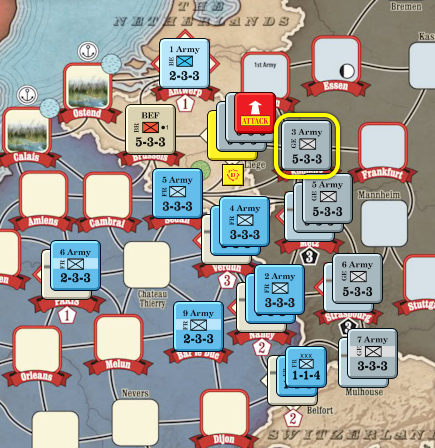
The Guns of August is a 3/4 OPs card that is placed into the CP player’s hand at the outset and gives them the initiative immediately. First off, the card destroys the fortress at Liège and then gives a massive mobilization effort booster by moving 2 German Army counters from their starting spaces including the German 1st and 2nd Armies and then activating them both to attack along with the German 3rd Army who is located at the start of the game setup in Koblenz.

This gives the CP player 2 choices about how to start the war with this attack. They can focus on the British Expeditionary Force located in Brussels or the French 5th Army located in Sedan. The allows the CP to destroy the Liège fortress, advance armies, and immediately attack or pressure the British Expeditionary Force (BEF) and French forces. In my humble opinion, the BEF is the real target here as this unit cannot be replaced or rebuilt and its removal opens up the path for the Germans to take on the fortress at Antwerp.

While the Guns of August card play is an aggressive move, it does somewhat ensure Austria-Hungary can survive potential Russian pressure as the Allied player will have to quickly use their precious resources to fill the gaps created by this opening attack rather than using them to bolster the Russians in the east or to build up the Serbians a bit in the south to prolong the fall of Belgrade. Paths of Glory is a large part about resource management and the constant pressure to continue offensive momentum and rebuild troops through the use of Replacement Points and events to bring on additional troops is a major problem for both sides. You can only attack for so long before you will burn yourself out and will have to spend time to recover and get ready for the next turn’s offensives. Using the Guns of August cards efficiency will free up resources to use elsewhere.

There are alternative openings with the card that can be considered. If not using Guns of August for the event, the CP player can use 1 OP to destroy the Liège fort, allowing them to conserve the card for later or pivot to a more defensive strategy, such as defending the Rhine.

In the end, I would recommend the hammer approach versus any other use of the card as it will really put the pressure squarely on the Allies to do something about what you have just accomplished. In the picture to the right is the normal outcome of these attacks as you can see the BEF is reduced and the French 5th Army has broken and is now replaced by a smaller Corps counter that cannot really do anything offensively and is just there to protect the back side of the Maginot Line from being caught out of supply.

The Guns of August (published in the UK as August 1914) is a 1962 book centered on the first month of World War I written by Barbara W. Tuchman. After introductory chapters, Tuchman describes in great detail the opening events of the conflict. The book’s focus then becomes a military history of the contestants, chiefly the great powers.

The Guns of August provides a narrative of the earliest stages of World War I, from the decisions to go to war up until the start of the Franco-British offensive that stopped the German advance into France. This led to four years of trench warfare. The book discusses military plans, strategies, world events, and international sentiments before and during the war.

The book was awarded the Pulitzer Prize for General Nonfiction for publication year 1963, and proved very popular. Tuchman later returned to the subject of the social attitudes and issues that existed before World War I in a collection of eight essays published in 1966 as The Proud Tower: A Portrait of the World Before the War, 1890–1914.

In the next entry in this series, we will take a look at Georgi Zhukov from Churchill: Big 3 Struggle for Peace from GMT Games.

-Grant

Best 3 Games with…Designer R. Ben Madison!

Von: Grant
14. Januar 2026 um 14:00

I have really enjoyed my plays of several games designed by R. Ben Madison. He has a knack for including elements of the history into the gameplay while placing the historical events into the framework of his chosen system, which is usually the States of Siege Series…but not always. He has designed 24 games to date, with most of those being solitaire games, dealing with all types of history including the American Revolutionary War, World War I, World War II, the American Civil War, Ancient Egypt, the pre-Columbian Indian “mound builder” cultures that dominated eastern North America, the Falklands, Napoleonic Wars and many, many more and I frankly have never played one of his that I didn’t like.

A few years ago, I did a video showcasing many of Ben’s games on our YouTube Channel and you can check that out at the following link:

In this entry in the Best 3 Games with…Series, we will take a look at some of favorites games by Ben.

3. Jeff Davis: The Confederacy at War from White Dog Games

I love a really hard and involved solitaire wargame and I found a really good one in Jeff Davis: The Confederacy at War. The player takes on the role of President of the Confederacy Jefferson Davis, and you have to manage the Confederate government and the Southern war effort during the American Civil War. The choices help determine the fate of armies and the struggle between Robert E. Lee and Ulysses S. Grant. The game uses the States of Siege Series model with a central point being defended from advancing forces on 5 different tracks.

One of the more interesting design choices in this one was the inclusion of slaves held by the South. Their focus in the game is as a resource to advance and assist the war effort through their labor. These human resources are used to take extra actions for the Confederate States of America, as the noose of the Union closes around them, they will be starved for Action Points as their factories and railroads are taken over by the advancing Federal Troops. I truly appreciate this focus in the game to give a glimpse into the political and social issues that contributed to the start of the American Civil War. I think that all too often our wargames sanitize and whitewash history of all of the darker and less desirable aspects but I think that including this element into the game was a wise choice by the designer.

The game also uses a very interesting method of determining your per turn funds as you have to run blockades against the Union to get funds to supply armies, move your troops and invest in actions to build defenses. You can also use the Slave tokens as a sort of currency to take actions but then those tokens are used up and cannot be reused. I have really enjoyed this one although it is a full 3 hour game as you have to get through 40+ chits to survive to the end. Lots of tough choices, lots of interesting side issues, such as dealing with slaves in the southern economy and keeping politicians happy. This is a great solo game!

You can check out our unboxing video to get a good look at the components:

2. Mound Builders from Victory Point Games

Mound Builders from Victory Point Games is a solitaire States of Siege game that to me has a very intriguing theme that hasn’t been gamed very often and really caught my eye. In Mound Builders, you represent the two largest pre-Columbian Indian “mound builder” cultures that dominated eastern North America from before the time of Christ until the coming of the European colonists in the 17th century. Your empire represents the earlier Hopewell culture and the later Mississippian culture that derived from it.

The game plays in two distinct sections or modules. The first module deals with the Hopewell culture, which is the earlier of the two cultures in the game. During this phase of the game, your goal is to simply expand the influence of your empire across the land, trading with various chiefdoms and trying to incorporate their dominions into your own in order to increase your economic power through the accumulation of various types of resources. As time passes, your empire will grow and regress due to various factors including warfare, disease and drought, but more often than not, the real threat to your culture is simply that of the existence of other ways of life and beliefs that will ultimately mix with your own culture.

During the second phase of the game, you will be beset on all sides by competing tribes as well as the nasty Spaniards and will watch as the empire that you worked so hard to build during the Hopewell Era simply disappears from history. Each turn, a card will be drawn that tells you which of the 5 opposing cultures will move into your lands along a siege track. Sometimes only 1 will move but up to 3 can all move at once, and some can be moved more than once each turn. If you do not attack those cultures when they occupy one of your chiefdoms by the end of your turn and chase them off, your resource will be taken from you and you will no longer be able to produce or trade for that type of good, thereby weakening your economy. This States of Siege system is so very cool and has been replicated in may other additions to the series (such as Ottoman SunsetDawn of the Zeds and Hapsburg Eclipse but also has spawned, or at least inspired several other designers to create equally cool and interesting simulations (Pavlov’s House and Castle Itter). I have definitely reaped the benefits of this States of Siege Series and love me a good solo game with this cool mechanic.

This is a link to a video unboxing of the game showing off the great components but unfortunately we have never done any other videos on this game:

1. Kaiserkrieg! The Great War 1914-1918 from White Dog Games

Kaiserkrieg! is simply fantastic! A solitaire treatment of The Great War using the States of Siege Series model but with a change to a horizontal rather than vertical layout of spaces where enemy forces can build up and perform an “Over the Top” move if you don’t destroy their troops before then. The player takes the side of the Central Powers and must deal with events that replicate the history of the period and the tumult of various revolutions, threats and opportunities. Well done game by Ben Madison that uses chit pull to activate the enemies and cause events. Lots of chaos. Lots of tough choices. Lots of history. And it always seems to come down to the very end. The only draw back to the game though is that it is long, taking 2-3 hours to play through an entire game. Each chit drawn has lots of information and there are always lots of things to do each turn with your very limited actions.

One of my favorite parts is the use of Blockade Runners to gain your funds for the turn. During the Naval/Air Warfare Phase, the player will place out their available Blockade Runners on various seas zones numbered 1a, 1b, 2a, 2b, 2c, 3 and 4 in order to attempt to break Allied blockades and deliver goods and funds to Germany to fuel the war effort. Each of these numbered sea zones will provide a haul of Reichsmarks based on the number of the sea zone if they are able to evade the British Cruisers. This is determined by rolling 2d6 and consulting the British Cruisers Table to find out in what sea zones the available British Cruisers will be placed. If there is a Blockade Runner in the determined sea zone, it will be destroyed and placed in the Neutral Ports box where it will wait to be built later at a cost of 2 RM. If the rolled sea zone contains a Blockade Runner and the High Seas Fleet marker, the British Cruiser will be unable to destroy the Blockade Runner and a naval combat will ensue.

In the above picture, the Central Powers defeat the British Cruiser with the High Seas Fleet and the 3 Blockade Runners placed in seas zones 2b, 3 and 4 bring home a cash haul of 9 Reichsmarks that will be used to take actions and push back the amassing Entente forces in the various staging areas to avoid an Over the Top chit from being placed and prevent the built up forces there attacking into Germany. This process of gaining income is very interesting and unique and it really feels correct as you are trying to do your best to avoid and destroy the British Cruisers so that you have your choice of the best producing sea zones without the fear of Entente intervention.

You can check out our unboxing video to get a good look at the components:

Here is a link to my video review:

Well there you have my 3 favorite games from R. Ben Madison. There are so many good titles to choose from making this exercise very difficult but the 3 that I chose were very enjoyable to play. What are your favorite Ben Madison designs?

-Grant

❌