As the year comes to a close, I’ll do my usual end-of-year posts: My personal top three in a range of categories. As tradition commands, we’ll begin with the games that I played for the first time this year. Here are the best three.
I’m not much of a Formula 1 fan – from my point of view, nothing much happens during the races (after the start, that is), and in many years, even the championship as such is a bore because one driver/car combo is just too dominant. (This year has been excitingly different in that regard.)
In the box: Another close finish!
Heat, however, takes just the exciting parts of racing and puts them together in an enthralling package of evocative mechanisms – downshifting before corners (and upshifting afterward), and the delicate balance of how to deal with the psychological stress on the driver and the physical stress on the car (the eponymous heat). And as the main planning phase is done simultaneously, there’s minimal downtime even with the full six players.
I’m excited to learn new things from and with games. One topic I knew next to nothing about is the 14th century in India. That, however, has changed a bit now due to Vijayanagara, a COIN-lite treatment of the collapse of the Delhi Sultanate’s hegemony under the challenge of invasion from the north (Timur’s Mongols) and centrifugal forces in the south (the nascent Bahmani Kingdom and Vijayanagara Empire). Every game of Vijayanagara tells a variation of that story.
The Delhi Sultanate (black) is under heavy pressure from the Vijayanagara Empire (yellow) and the Bahmani Kingdom (turquoise). From the implementation on Rally the Troops!
Chaos – some games hate it, others, like Time of Crisis, embrace it. Whoever wants to be Roman emperor in the tumultuous third century must be prepared to deal with a whole whirlwind of challenges: Angry mobs want to drag your governors into the gutter, Barbarian tribes stand ready to cross the border into your provinces, and, worst of all, the rest of the Roman elite wants to be emperor, too, and will gleefully take whatever you possess.
Red has declared himself emperor! Yet Yellow runs a compact dominion in the east, ready to move into Italy or break away from the empire. From the implementation on Rally the Troops!
I have been thwarted in my imperial aspirations by my fellow bloggers Alexander and Grant from The Players’ Aid as well as Dave and Michal, and have been loving every minute of it. Time of Crisis has been my most-played game overall this year (with 14 individual plays of it), and rightly takes the crown in this category.
What were your favorite new-to-me games this year? Let me know in the comments!
As the year comes to a close, I’ll do my usual end-of-year posts: My personal top three in a range of categories. As tradition commands, we’ll begin with the games that I played for the first time this year. Here are the best three.
I’m not much of a Formula 1 fan – from my point of view, nothing much happens during the races (after the start, that is), and in many years, even the championship as such is a bore because one driver/car combo is just too dominant. (This year has been excitingly different in that regard.)
In the box: Another close finish!
Heat, however, takes just the exciting parts of racing and puts them together in an enthralling package of evocative mechanisms – downshifting before corners (and upshifting afterward), and the delicate balance of how to deal with the psychological stress on the driver and the physical stress on the car (the eponymous heat). And as the main planning phase is done simultaneously, there’s minimal downtime even with the full six players.
I’m excited to learn new things from and with games. One topic I knew next to nothing about is the 14th century in India. That, however, has changed a bit now due to Vijayanagara, a COIN-lite treatment of the collapse of the Delhi Sultanate’s hegemony under the challenge of invasion from the north (Timur’s Mongols) and centrifugal forces in the south (the nascent Bahmani Kingdom and Vijayanagara Empire). Every game of Vijayanagara tells a variation of that story.
The Delhi Sultanate (black) is under heavy pressure from the Vijayanagara Empire (yellow) and the Bahmani Kingdom (turquoise). From the implementation on Rally the Troops!
Chaos – some games hate it, others, like Time of Crisis, embrace it. Whoever wants to be Roman emperor in the tumultuous third century must be prepared to deal with a whole whirlwind of challenges: Angry mobs want to drag your governors into the gutter, Barbarian tribes stand ready to cross the border into your provinces, and, worst of all, the rest of the Roman elite wants to be emperor, too, and will gleefully take whatever you possess.
Red has declared himself emperor! Yet Yellow runs a compact dominion in the east, ready to move into Italy or break away from the empire. From the implementation on Rally the Troops!
I have been thwarted in my imperial aspirations by my fellow bloggers Alexander and Grant from The Players’ Aid as well as Dave and Michal, and have been loving every minute of it. Time of Crisis has been my most-played game overall this year (with 14 individual plays of it), and rightly takes the crown in this category.
What were your favorite new-to-me games this year? Let me know in the comments!
Before we dive into the content of the playlist, some general observations:
All of the songs in the playlist were popular during the Weimar Republic (1918—1933). Yet as music recording was still in its infancy at that time, many of the songs in the playlist are later recordings (and some rare ones were recorded even before 1918!).
As the playlist is only 2:21 hours long, your Weimar game will probably last longer (if you don’t crash the republic on the first or second round), but there’s no reason not to listen to these songs two or three times – they’re fascinating historical documents.
The playlist is thematically sorted. That helps you find similar songs, but makes for somewhat monotonous listening (until you come to the next group of songs). I therefore recommend you turn shuffle on.
Now, what awaits you in the playlist?
#1: The National Anthem
It seems like a no-brainer to include the German national anthem of the time, yet it’s not so simple: The Lied der Deutschen (Song of the Germans) had been written in 1841, but had since then only been a patriotic song among many – until the first president of the republic, Friedrich Ebert, declared it the national anthem in 1922. The song’s three stanzas were variedly popular: Ebert favored the third stanza with its liberal ideals of unity, justice, and freedom, his right-wing opponents preferred the “Deutschland über alles” (Germany Above Everything) first stanza. I have included an instrumental version. If you feel patriotic, you can sing along.
The Weimar Republic did not come into existence in a vacuum. It inherited German cultural traditions like folk songs (“Wem Gott will rechte Gunst erweisen” (Whom God Wants to Favor), song #2).
And, of course, the Weimar Republic succeeded the German Empire with its national feeling (“Die Wacht am Rhein” (The Guard on the Rhine), song #2), dominant Protestantism (Martin Luther’s classic “Ein feste Burg ist unser Gott” (A Mighty Fortress Is Our God), song #5), and monarchy (“Heil dir im Siegerkranz” (Hail to Thee In the Victor’s Crown), song #7 – the quasi-anthem of the German Empire).
The republic’s midwife was the First World War – whose experience shaped its veterans and provided the cultural context even for those who had not been adults during the war yet (“Wildgänse rauschen durch die Nacht” (Wild Geese Rush Through the Night), song #8, written in 1916, was immensely popular among the Weimar Republic youth movement). The war also cast its shadow over Weimar Germany as many had lost their husbands, sons, fathers, brothers, and friends in the war (“Ich hatt’ einen Kameraden” (I Had a Comrade), song #9, the traditional German soldiers’ lament).
The liberal republic proved fertile ground for satirical treatments of the new developments: Otto Reutter made fun of the big and small war profiteers with “Seh’n Sie, darum ist es schade, dass der Krieg zu Ende ist” (See, that’s why it’s a pity that the war is over, song #10), and Claire Waldoff called for replacing the men in power with women in “Raus mit den Männern aus dem Reichstag” (Kick the Men Out of Parliament, song #11), playing on masculine anxieties after the introduction of women’s suffrage.
Even in a time and place as politically charged as the Weimar Republic, not everything was politics. The average Hans and Gretel may have cared less about their preferred ideology and more about how to have good time on a Saturday night… and the new cultural scene, especially in the big cities like Berlin, provided ample opportunities.
The more sophisticated artists like the Comedian Harmonists succeeded with witty wordplay and erudite vocal harmonies. Others played on the classics – alcohol (“Wir versaufen unser Oma ihr klein’ Häuschen“ (We Blow Grandma’s Little House on Booze, song #19) and sexual innuendo („Fräulein, Woll’n Sie nicht ein Kind von mir“ (Miss, Don’t You Want a Child By Me, song #22). There was even the equivalent of a (generalized) diss track: “Du bist als Kind zu heiß gebadet worden” (You Have Been Bathed Too Hot As a Child, song #23) indicates that this neglect of bath safety led to lasting brain damage in the interlocutor.
#26-33: Film, Theater, and Opera Music
The Weimar Republic’s vibrant cultural scene led to cross-pollination between diverse forms of artistic expression. The new medium of film was pioneered in Germany, and once it had left its silent infancy behind, movie songs became hits. Marlene Dietrich, starring in The Blue Angel, enticed with “Ich bin von Kopf bis Fuß auf Liebe eingestellt (I’m Set to Love From Head to Heel, song #26), but warned “Nimm dich in Acht vor blonden Frau’n“ (Beware of Blonde Women, song #27).
More traditional art forms like the theater also adapted. Die Dreigroschenoper (The Threepenny Opera)’s acerbic critique of capitalism would not have been as successful without its catchy songs, the most famous of which is the “Moritat of Mackie Messer” (Ballad of Mack the Knife, song #31).
Even the most classic and highbrow form of entertainment modernized: “Jonny spielt auf” (Jonny Plays It Big, song #33) introduced jazz into the world of the opera… which brings us to our next category.
#34-41: Jazz and Blues
Traditionally, the United States had received and emulated European fashions, not the other way around. Yet by the early 20th century, America had become the largest economy in the world, its war entry in 1917 tipped the scales of the war further in favor of the Allies, and the increased presence of Americans in Europe meant that the United States turned from an importer to an exporter of culture. Jazz took Europe by storm – both in the form of American (and nascent European) bands and by the new medium of the music record. The Weimar Republic was no exception. Jazz fueled the parties in any larger city of 1920s Germany.
Of course, not everyone loved jazz, and the controversy over its unorthodox dissonances, the more expressive, individualistic, and eroticized dancing style accompanying the music, and, of course, the race of its performers entered the contemporary culture wars – exemplified by Weimar’s double use of Louis Armstrong, illustrating both the SPD’s “The New Rhythm” and the DNVP’s “Nicht Deutsch” (“Not German”) event cards.
The “Tiger Rag” (song #41) is also used in The Tin Drum, German writer Günter Grass’s epic about the rise, fall, and persistence of Nazism: The youthful protagonist Oskar Matzerath who always carries his eponymous tin drum plays the Tiger Rag at a NSDAP rally in his hometown Danzig. The mesmerizing rhythm has the audience sway and dance, exposing the Nazis to ridicule.
#42-47: Workers’ Songs
The aggressive ethno-nationalism of Nazism was one of the two most dynamic political movements of the Weimar Republic (at least once the 1929 crash had plunged vast parts of the German population into a crisis of material and identity). The other was the workers’ movement, both in its reformist Social Democratic and its revolutionary Communist form. As the workers had been traditionally excluded from the public in imperial Germany, dominated by aristocracy and bourgeoisie, they created their own political parties (SPD, later USPD and KPD), economic associations (the trade unions), and social and cultural associations – from workers’ sport clubs to workers’ singing societies. Their milieu was bound together not only by their shared economic experience, but also by this cultural connection, of which the workers’ songs formed an important part.
Classics from imperial times like “Die Internationale” (The Internationale, song #42) remained important, but the movement also adopted new songs written by the numerous socialist poets and composers like Bertolt Brecht, Hanns Eisler, or Ernst Busch. Whereas some of these became new classics (like the “Solidaritätslied” (Solidarity Song, song #46), others aged badly: “Der Marsch ins Dritte Reich” (The March to the Third Reich, song #47) poked fun at the alleged inability of the Nazis to take power after their electoral setback at the Reichstag election of November 1932. First recorded in December 1932, the song was horribly overtaken by events just a month later when Hitler was elected chancellor in January 1933.
Thus, we conclude our playlist. It contains the traditional and the modern, entertainment and politics, left and right – except for the very right, but I don’t want to listen to Nazi songs while playing board games, and I’m sure that neither do you.
Do you like to play music in the background while playing board games? What’s your favorite song from this playlist? Let me know in the comments!
Before we dive into the content of the playlist, some general observations:
All of the songs in the playlist were popular during the Weimar Republic (1918—1933). Yet as music recording was still in its infancy at that time, many of the songs in the playlist are later recordings (and some rare ones were recorded even before 1918!).
As the playlist is only 2:21 hours long, your Weimar game will probably last longer (if you don’t crash the republic on the first or second round), but there’s no reason not to listen to these songs two or three times – they’re fascinating historical documents.
The playlist is thematically sorted. That helps you find similar songs, but makes for somewhat monotonous listening (until you come to the next group of songs). I therefore recommend you turn shuffle on.
Now, what awaits you in the playlist?
#1: The National Anthem
It seems like a no-brainer to include the German national anthem of the time, yet it’s not so simple: The Lied der Deutschen (Song of the Germans) had been written in 1841, but had since then only been a patriotic song among many – until the first president of the republic, Friedrich Ebert, declared it the national anthem in 1922. The song’s three stanzas were variedly popular: Ebert favored the third stanza with its liberal ideals of unity, justice, and freedom, his right-wing opponents preferred the “Deutschland über alles” (Germany Above Everything) first stanza. I have included an instrumental version. If you feel patriotic, you can sing along.
The Weimar Republic did not come into existence in a vacuum. It inherited German cultural traditions like folk songs (“Wem Gott will rechte Gunst erweisen” (Whom God Wants to Favor), song #2).
And, of course, the Weimar Republic succeeded the German Empire with its national feeling (“Die Wacht am Rhein” (The Guard on the Rhine), song #2), dominant Protestantism (Martin Luther’s classic “Ein feste Burg ist unser Gott” (A Mighty Fortress Is Our God), song #5), and monarchy (“Heil dir im Siegerkranz” (Hail to Thee In the Victor’s Crown), song #7 – the quasi-anthem of the German Empire).
The republic’s midwife was the First World War – whose experience shaped its veterans and provided the cultural context even for those who had not been adults during the war yet (“Wildgänse rauschen durch die Nacht” (Wild Geese Rush Through the Night), song #8, written in 1916, was immensely popular among the Weimar Republic youth movement). The war also cast its shadow over Weimar Germany as many had lost their husbands, sons, fathers, brothers, and friends in the war (“Ich hatt’ einen Kameraden” (I Had a Comrade), song #9, the traditional German soldiers’ lament).
The liberal republic proved fertile ground for satirical treatments of the new developments: Otto Reutter made fun of the big and small war profiteers with “Seh’n Sie, darum ist es schade, dass der Krieg zu Ende ist” (See, that’s why it’s a pity that the war is over, song #10), and Claire Waldoff called for replacing the men in power with women in “Raus mit den Männern aus dem Reichstag” (Kick the Men Out of Parliament, song #11), playing on masculine anxieties after the introduction of women’s suffrage.
Even in a time and place as politically charged as the Weimar Republic, not everything was politics. The average Hans and Gretel may have cared less about their preferred ideology and more about how to have good time on a Saturday night… and the new cultural scene, especially in the big cities like Berlin, provided ample opportunities.
The more sophisticated artists like the Comedian Harmonists succeeded with witty wordplay and erudite vocal harmonies. Others played on the classics – alcohol (“Wir versaufen unser Oma ihr klein’ Häuschen“ (We Blow Grandma’s Little House on Booze, song #19) and sexual innuendo („Fräulein, Woll’n Sie nicht ein Kind von mir“ (Miss, Don’t You Want a Child By Me, song #22). There was even the equivalent of a (generalized) diss track: “Du bist als Kind zu heiß gebadet worden” (You Have Been Bathed Too Hot As a Child, song #23) indicates that this neglect of bath safety led to lasting brain damage in the interlocutor.
#26-33: Film, Theater, and Opera Music
The Weimar Republic’s vibrant cultural scene led to cross-pollination between diverse forms of artistic expression. The new medium of film was pioneered in Germany, and once it had left its silent infancy behind, movie songs became hits. Marlene Dietrich, starring in The Blue Angel, enticed with “Ich bin von Kopf bis Fuß auf Liebe eingestellt (I’m Set to Love From Head to Heel, song #26), but warned “Nimm dich in Acht vor blonden Frau’n“ (Beware of Blonde Women, song #27).
More traditional art forms like the theater also adapted. Die Dreigroschenoper (The Threepenny Opera)’s acerbic critique of capitalism would not have been as successful without its catchy songs, the most famous of which is the “Moritat of Mackie Messer” (Ballad of Mack the Knife, song #31).
Even the most classic and highbrow form of entertainment modernized: “Jonny spielt auf” (Jonny Plays It Big, song #33) introduced jazz into the world of the opera… which brings us to our next category.
#34-41: Jazz and Blues
Traditionally, the United States had received and emulated European fashions, not the other way around. Yet by the early 20th century, America had become the largest economy in the world, its war entry in 1917 tipped the scales of the war further in favor of the Allies, and the increased presence of Americans in Europe meant that the United States turned from an importer to an exporter of culture. Jazz took Europe by storm – both in the form of American (and nascent European) bands and by the new medium of the music record. The Weimar Republic was no exception. Jazz fueled the parties in any larger city of 1920s Germany.
Of course, not everyone loved jazz, and the controversy over its unorthodox dissonances, the more expressive, individualistic, and eroticized dancing style accompanying the music, and, of course, the race of its performers entered the contemporary culture wars – exemplified by Weimar’s double use of Louis Armstrong, illustrating both the SPD’s “The New Rhythm” and the DNVP’s “Nicht Deutsch” (“Not German”) event cards.
The “Tiger Rag” (song #41) is also used in The Tin Drum, German writer Günter Grass’s epic about the rise, fall, and persistence of Nazism: The youthful protagonist Oskar Matzerath who always carries his eponymous tin drum plays the Tiger Rag at a NSDAP rally in his hometown Danzig. The mesmerizing rhythm has the audience sway and dance, exposing the Nazis to ridicule.
#42-47: Workers’ Songs
The aggressive ethno-nationalism of Nazism was one of the two most dynamic political movements of the Weimar Republic (at least once the 1929 crash had plunged vast parts of the German population into a crisis of material and identity). The other was the workers’ movement, both in its reformist Social Democratic and its revolutionary Communist form. As the workers had been traditionally excluded from the public in imperial Germany, dominated by aristocracy and bourgeoisie, they created their own political parties (SPD, later USPD and KPD), economic associations (the trade unions), and social and cultural associations – from workers’ sport clubs to workers’ singing societies. Their milieu was bound together not only by their shared economic experience, but also by this cultural connection, of which the workers’ songs formed an important part.
Classics from imperial times like “Die Internationale” (The Internationale, song #42) remained important, but the movement also adopted new songs written by the numerous socialist poets and composers like Bertolt Brecht, Hanns Eisler, or Ernst Busch. Whereas some of these became new classics (like the “Solidaritätslied” (Solidarity Song, song #46), others aged badly: “Der Marsch ins Dritte Reich” (The March to the Third Reich, song #47) poked fun at the alleged inability of the Nazis to take power after their electoral setback at the Reichstag election of November 1932. First recorded in December 1932, the song was horribly overtaken by events just a month later when Hitler was elected chancellor in January 1933.
Thus, we conclude our playlist. It contains the traditional and the modern, entertainment and politics, left and right – except for the very right, but I don’t want to listen to Nazi songs while playing board games, and I’m sure that neither do you.
Do you like to play music in the background while playing board games? What’s your favorite song from this playlist? Let me know in the comments!
Before the fall fair and convention circuit is coming to an end, I had the opportunity to attend Süddeutsche Spielemesse (Southern German Game Fair) in Stuttgart. As when I went last time, it was a pleasant, laid-back experience.
The game fair is part of a conglomerate of hobby and leisure related fairs which are all held over the same long weekend in neighboring fair halls. As the ticket covers all fairs, you are free to explore everything. That’s great if you go as a group or family with differing interests: Your creative-minded daughter can get all inspired at the arts & crafts fair, your animal-loving son will try to make friends with the cats, rabbits, and camels at the animal fair, your gourmet spouse samples their way through the food fair, and then everybody meets at the game fair because you all love board games. Right?
These folks will go to the board game fair later and play Camel Up.
With that setup, Süddeutsche Spielemesse’s target audience is broad, from the hobbyist to the very casual gamer. Consequently, you’ll find a lot of games outside of the hobby board game niche – from classics like chess and go over sports games to role-playing games. The exhibitors are usually either vendors (game test opportunities are rare), clubs looking for new members (like many of the role-playing clubs), or, my favorite, the big gaming island run in the middle where you can just borrow a game and play it free of charge which gives Süddeutsche Spielemesse a certain convention feel.
At this point, it is tradition that the gaming island remains open until 10pm on Friday, allowing for a beautiful evening of gaming. I met with a friend there and we played three different two-player games:
Northern German cities Hamburg and Altona try to outdo each other – yet while the usual victory point collecting occurs, these only matter if the game runs its full seven rounds. And it is much more likely that one of the cities will decisively outdo the other in one of the four areas of competition (alliances, ships, lawsuits, and prestige) and score an instant victory. With such a plethora of instant victory conditions, you will always feel the thrill of chasing one yourself and being threatened with another by your opponent.
Yes, that’s a concrete floor… all tables were taken already. I report that I am still young and springy enough for this kind of gaming (at least for 45 minutes).
In our game, we both started conservatively, getting a little bit of everything. Then my friend made a play for the alliances and was only one of them short of victory… but I could stave off defeat and counter-punch with ship dominance. I guess more experienced players would be at each other’s throat from the get-go which should make for exciting gaming and high replayability (at a very moderate complexity).
Two players chart their path up a mountain built from a shared supply of tiles, each of which has a unique combination of a color (indicating its row) and number (indicating its file). Thus, you always know that a tile you took cannot be accessed by your opponent – and vice versa. This kind of very abstract game with almost-perfect information is usually not up my alley, and Solstis proved no different. We were both unenthused by its mix of logical planning and high randomness in the rare case of placing a nature spirit. However, each play only took 10 minutes, so we didn’t spend much time to gain the valuable knowledge of what’s not our jam.
Table time! That’s a pretty solid path up the mountain, and you can see a lot of nature spirits in the middle – but one of them (the red one) is the evil spirit of vengeance.
Maybe our highlight of the fair: Agent Avenue pits its two players against each other as retired secret agents trying to catch each other. To unveil the other’s identity, they enlist their suburban neighbors, all of which are anthropomorphic animals, from daredevil wolves over codebreaker owls to double agent vixens. The recruitment comes by “I cut, you choose” – but as one of the two cards the active player offers to their opponent is face-up, the other face-down, there is a spy-appropriate amount of bluffing and deduction. Pair this with a varied, but not overwhelming amount of instant victory/defeat conditions and card effects, and you have a light, but tense contest which resolves in no time at all (we played three times in 40 minutes).
My green figurine is being pursued by the blue one. So far, my crew of agents is decidedly sub-par – the double agent on the left is only effective when you have two of them (numbers on the left), the sentinel on the right also kicks in at two and three, whereas the daredevil in the middle will lose you the game once you collect three of them.
Any games of these that sound like your cup of tea? Have you attended any cool local conventions or fairs recently? Let me know in the comments!
Tobias H. aus Heusenstamm ist neuer Deutscher Cacao-Meister. Wir gratulieren ihm ganz herzlich. In einem spannenden Finale konnte sich Tobias H. am 22. November in Darmstadt gegen die Konkurrenz durchsetzen und Titel und Preise mit nach Hause nehmen.
Nur wer sich bei den deutschlandweiten Qualifikationsturnieren qualifiziert hatte, durfte an diesem Tag an dem Cacao DM Finale 2025 antreten. 32 Qualifikanten von Jung bis Alt waren aus allen Teilen Deutschlands nach Darmstadt ins Darmstadium angereist, um den Titel des Deutschen Cacao-Meisters 2025 zu erringen.
Now this may sound a bit basic. Of course you want advantages! Yet when you’re planning what to do with your investment tile, you might often be tempted by other things – shiny prestige spaces, or simply spaces with a lower cost which help you gain the majority in the region. Advantages, however, are often the better choice: A well-chosen advantage can gain you another space (or deny it to your opponent) not only once, but several times over the course of a game. If your opponent is smart, they will often try to counteract your gaining of an advantage by unflagging the space which gave you the advantage, or at least gaining a similar advantage, which means you are acting and they are reacting.
France and Britain are fighting hard for the two spaces adjacent to the Baltic Trade advantage. You can see on the French player mat in the background that France has gained the Algonquin Raids and Mediterranean Intrigue advantages.
Some of my favorite advantages: The Indian alliances with Mysore, Nizam, or the Marathas which allow you to drown your opponent in a sea of conflict markers, the Asiento advantage whose discount on fleets gains you a cheap military edge – and spaces – which can be flexibly moved around, and, best of all, Baltic Trade whose debt reduction amounts to two free wild points every turn. Get it or at least deny it to your opponent!
Board Position First, VPs Second
Advantages are long-term benefits. In the same spirit, I advise you to prioritize the long-term benefits of a sound board position over the short-term gains of winning this regional or that global demand scoring. If your board position is good – if you have the right alliances, military outposts, and advantages – you will put pressure on your opponent, win wars, gain spoils, and the VPs will come rolling in anyway.
Both players have done their homework and placed a flag on a fort (hexagonal spaces) in North America – Britain in Halifax, France in Louisbourg.
A key investment in that sense is a turn 1 fort in North America. That’s the only theater which is active in all four wars, so the fort will give you a military benefit four times (a strength point and the conquest line) in addition to controlling its surroundings (which makes unflagging harder and removing enemy conflict markers easier), and, of course, it’s a space which counts for regional scoring.
Use Initiative Wisely
If your opponent scores a few more VPs than you early on, that is not only bearable, but might even be to your advantage, as the player behind in VPs has the initiative and decides who goes first in a turn. That’s a weighty decision, as going first gives you a better choice of the investment tiles, but going last allows you to mess with your opponent’s plans and they have no chance to repair the damage before scoring.
If this were the first turn – would you choose to go first or second as the player with initiative?
My rule of thumb is: I go last, unless there’s an odd number of investment tiles with a major action in the dimension that will be crucial (early on, that’s often diplomatic), or an odd-and-low number of investment tiles that allow you to play an event.
Which strategies and tricks do you use to win at Imperial Struggle? Let me know in the comments!
Heute startet in Augsburg die Spielwiesn. Ihr findet uns am Stand 5-A06. Mit im Gepäck haben wir unter anderem unsere neuen Kartenspiele HIER und WHAT’S Next sowie die Erweiterung für DIE WANDELNDEN TÜRME. Wir freuen uns auf euch.
Once more, the SPIEL fair at Essen has come to an end. It’s been a few intense days of looking, meeting, and, of course, playing – for me and 200,000+ other attendees. Even though the fair has expanded to another hall now, tickets for the busiest days (Friday and Saturday) were sold out a week before the event, and I also had the impression that more of the games sold out (at least that was my experience at several booths). Thus, I went home with zero purchases – which is fine! I travelled with a light suitcase on my way back, and I’ll be able to catch up on purchases via the usual local and online vendors.
Something you cannot catch up on, however, is meeting the people who mean something to you. I’ve always enjoyed going to the fair with a friend or two, and over the years, my SPIEL schedule has been enriched by more and more meetings with my fellow friends of board games and history whom I’ve met over the internet. In that regard, this year’s SPIEL has been exceptional: Not only have I gotten to dinner with my Boardgame Historian colleagues (a great way to start off the fair experience with some sparkling conversations on history in board games from a research and museum perspective) and to play a few games with Michal from The Boardgames Chronicle (more on that below) – both are almost traditions by this time – but I (and Michal) also got to meet Grant and Alexander from The Players’ Aid on their very first trip to SPIEL! I think that we all had a blast, and many plans to meet again are already in the making… and maybe play more games together!
Speaking of games: I’ve gotten around to play a grand total of 13 during the two days of the fair (ranging from very short demos to full games). Here are my highlights:
Bohemians had attracted my attention with its beautiful artwork and its intriguing fin de siècle Paris art scene setting. After giving it a test drive at SPIEL (with Michal, my friend A., and another fairgoer), I can also attest that it has sound mechanics (a mix of long-term deckbuilding and short-term pattern building from the cards in your hand):
You arrange your day as an aspiring artist with activities like “Wander the streets aimlessly” or “Practice a new technique.” The activity cards have symbols on the left and right, which, if matching, give you inspiration. You can imagine that there are some power combos – for example “Get in the mood for composing” and “Compose without stopping” have four matching symbols!
It gets even better if you acquire more inspirational activities (by spending inspiration) or if you don’t do activities alone, but have a muse with you (also to be gotten into your hand by spending inspiration).
In the end, your goal is to make artistic achievements which range from “A mildly positive review in the local newspaper” over “Your family’s quiet acceptance of your new life” to “Establishment dismayed by your work” which – you guessed it – are also acquired by spending inspiration.
A good day as an artist: I got six inspiration from matching symbols on the card edges, two because the color of the card for morning and night matches that on the player board (orange and blue), and another three from the bonus of the “Go from café to café” activity. That’s 11 inspiration, enough for an artistic achievement (above the player board). Unfortunately, not working also meant I gained another hardship – like the previously-acquired drinking habit above the player board whose negative effect (drawing another hardship!) I staved off by playing enough expression icons.
As you need quite a lot of inspiration for the achievements (and they get ever more “expensive” as the game progresses), you’ll probably have to arrange for artistic activities in all four slots of the day… which means you cannot work, another (much less exciting) way to spend your time. Every player has a disreputable profession (street musician, beggar, journalist…) which they can use instead of an activity – and, if they do not, they will gain a hardship card into their deck. You know, all the bad things in life that only orderly labor keeps at bay. Abject poverty. Shame. Syphilis.
Ideally, activities, muses, achievements, and hardships come together narratively. For example, I had a great day in which my activities linked up and I could meet with not one, but two muses right after another! That gave so much inspiration that I gained an achievement… but as I hadn’t worked, I gained a hardship – hypersexuality! Apparently, I had frolicked a bit too much with the muses.
Bohemians is a nice light deck-builder which should work especially nicely for casual audiences. I had a very good start at the fair with it and have acquired it since.
And now for something completely different! Neither King Nor God takes players to the European power struggle in the Age of Reformation. Four of them will fill the shoes of England, France, the Holy Roman Empire, and the Papacy in their quest to spread their trade, conquer new territories, and convert cities to their religion. For this task, they send out courtiers to the great cities of Europe. As the courtiers are placed face down, you know where your rivals sent one to, but not what kind of courtier it is – a merchant to plop down trade barrels, a general to move armies, an assassin to murder or a traitor to take over another courtier?
As the courtier stacks in cities will be resolved only when all courtiers have been placed (top to bottom – so the courtier placed last goes first), there’s a lot of tactical finesse in placement: Do you go where everyone seems to go to partake in the bonanza or do you try to carve out your own little domain in less popular cities? Will you place your merchant first so that he’s on the bottom of a stack and will resolve after any general who could raid his trade barrel placement or do you place him last so he can go before anyone tries to murder him?
Strasbourg, the place to be: No fewer than eight courtiers have assembled there. Nearby Colonia is only visited by a single Papal courtier.
That makes for very little downtime and great mirth both in assembling and resolving those courtier stacks. Given that everyone’s victory conditions are secret (to be drawn randomly at the start of the game), there is a lot of guessing and bluffing. However, if no one has fulfilled their victory condition by the time the plague hits Europe, different victory conditions will apply.
The game at setup: Soon, the empty regions of Europe will be filled by the all-important trade barrels on which the income of the great powers depends.
Despite its length (three to four hours for a full game), the game plays briskly from the first turn on. And while it is involved, it’s not a complicated game – in fact, as the friendly Sound of Drums guy who had explained the game to the group before us had to demo a game at another table, we successfully self-taught the game from the rulebook!
Neither King Nor God is a pilot for a bigger five-player version that is to be published next year.
I’d been eyeing Verdun for some time now, but never got around to play it. Good thing I could remedy that at SPIEL! As Michal and I randomly bumped into each other at the DDP booth, we could try the game together (each accompanied by a team mate).
Verdun is one of the many “trick-takers with a twist” that are released these days – and definitely one of the better ones! Two or four players (in teams of two) fight the World War I battle of Verdun. Whoever has the initiative selects an objective to attack. If their side – Germany or France – wins the trick by at least the (hidden) strength of the objective, they’ll gain the objective and its victory points. As all players draw from a shared deck of cards, that means that anyone will have both German and French cards in their hand.
That leads to all sides of interesting decisions: If you’re defending as France, are you going to play a French card to try and win the trick? Or are you playing a German one to get rid of it, either hoping that you’ll win anyway, or that the Germans win by so much that another German card doesn’t do them any good?
It gets even trickier when you consider that all cards have skull icons on them, indicating how many negative points they’ll confer on their respective side if they end up in the casualty pile. After every trick, one card per side (sometimes more) ends up as a casualty. If you can sneak in a skull-heavy card of the opponent side, that might undo all the points they’ll gain from winning the objective.
I, as one of the German players, have just played a strong French card in the hopes of poisoning their victory with high casualties (skulls on the left of the card).
Consequently, scores will likely be negative in the end. Maybe you’ll win a few objectives, maybe not. But certainly, you will have suffered appalling losses. The question is not if you’ll win big, but if your enemy is losing even more painfully than you. The grim logic of the war of attrition on the Western Front.
Our short test game also showed the importance of keeping initiative, so you can attack and at least have the chance to win objectives and offset some of the losses: In the end, France had gained two objectives (Germany none), which, as losses were pretty evenly spread, was enough for victory (-7 to -13).
Verdun is testament to what relatively simple games can do, and how games which stray far from wargame standards (hexes, counters, combat resolution tables…) can capture the essence of a conflict just as well.
Self-balancing dragonflies (in Vietnamese: Chuồn Chuồn), often made out of bamboo, are popular toys in Vietnam. They have now made their way to the board gaming world in this charming, gorgeous game.
Players will attempt to attract dragonflies of varying sizes and colors to their bamboo trees to match the patterns on their objective cards – for example, to have a small yellow dragonfly on the highest bamboo, a large purple one on the middle, and a small blue one on the lowest. As everyone takes dragonflies from the same pool and there’s only one in each size/color combination, you will soon run out of dragonflies and will have to use the magic cards at your disposal to re-arrange the flies, shake them off someone’s tree, etc.
Look at those dragonflies!
I found the game enjoyable and its production values outstanding. The finely crafted dragonflies are guaranteed to catch the eyes of observers, which makes the game also great for introducing new players to board gaming (everyone likes pretty things, and everyone likes to place self-balancing dragonflies!).
As I started the fair with a game about aspiring artists, it was most fitting to end it with another about this subject. The single-minded pursuit of artistic achievements which was abuzz in fin de siècle Paris has by 1977 given way to the much wider notion of… victory points! These you may get for a variety of pursuits and objectives, from perfecting your musical skills over becoming addicted to drugs candy to going to bed early.
Rock Hard: 1977 is a worker placement game, just that you only have one worker – yourself, the aspiring rockstar. You’ll divide your activities between day (say, practicing your craft or giving a radio interview), evening (playing gigs), and night (hanging out with the cool kids at the club). Every once in a while, you’ll also have to work your square job as a veterinary assistant, truck driver or what have you. Unlike in Bohemians, that is not a moral corrective on your life, but fulfils the simple economic need of making some money with which you rent those rehearsal studios, pay for your demo tape recording, or buy drugs candy.
Benji “Bam Bam” Bernstein dreams of being a rockstar. So far, he knows two songs.
Ideally, your skills will improve, you’ll play at ever greater venues, and your royalties will cover the cost of your rockstar needs. We didn’t get quite that far at the fair – I had to catch a train and another of my fellow players a pre-scheduled game. Until then, we had only dipped our feet in the waters of musical glory, but it was a very thematic affair!
Rock Hard: 1977 has been released in English last year already (by Devir), but the fair showed off the new German edition.
What do you think of these games? Anything up your alley? And if you’ve been to SPIEL or would have liked to go – what are your highlights?
Heute startet wieder in Essen die große Spielemesse SPIEL. Auch in diesem Jahr präsentieren wir dort unsere Spiele und haben uns viele Aktionen ausgedacht. Ihr findet uns am Stand C511 in Halle 7.
You say „board game fair“, I say “SPIEL” at Essen. It’s the Mecca for the tabletop gaming faithful. Four days of playing, trying, and buying. 200,000+ visitors. I’ve been therea few timesover the last yearsfor two days each and found it an intensive board game experience. I’m looking forward to going again this year!
As always, this is not meant as a „must buy“ list or whatever other consumptionist term some people use. It is likely that I will buy only one or two of these games. Why? Because I have quite some good games already, and I like to make them count before I plunge into new adventures. Generally, there are no musts in buying. And there are no musts in attending board game fairs or conventions – obviously those can come as pretty big expenses for travel and accommodation. Bottom line: No musts. You do you.
One note beforehand: Board gaming is getting ever more international, and this list shows it: The six designers come from six different countries, and, for the first time in the nine years I’ve been making this list, none of them is from Germany or the United States.
Without further ado, on to the games! They are sorted by location on the fairgrounds.
1-6 players, 60-150 minutes, for sale, MSRP: 50.00 €
Many games have great nations compete on the global stage. Yet Limit is different. Few games of this kind have a robust section of domestic affairs beyond the usual political-economic-military competition. Fewer dare to zoom out so much that the game spans not years, but generations over two centuries. And barely any are based on a model that neither promises eternal improvement for everyone nor zero-sum competition between the powers, but rather the limits of industrial development. If you think you have heard of the latter before: Yes, this game is based on the World3 model of the Club of Rome’s The Limits to Growth. All of these uncommon features combine into a game which I expect to feel unique.
Designer Alexandre Poyé will be at the booth to teach the game (not all around the clock, but you have a reasonable chance to meet him there).
Archaeology is a popular setting for board games, and I’m here for it. While I love the civilizations of the ancient Mediterranean as much as the next person, I’m happy to see games shedding light on less-known cultures – like the Marajoara from the Amazonian island of Marajó (in modern-day Brazil), famous for their distinctive style of pottery. You will excavate, restore, and display vases while maintaining the finances of your museum. Mechanically, the game combines inspiration from (peg) solitaire with dice movement. I would have loved the game to lean a bit harder on the unique visual style of the Marajoara pottery (mostly limited to the cover art and the large vases), but I’ll take what I can get!
3-6 players, 45-60 minutes, for sale, MSRP: 35.00 €
If your main takeaway from watching Conclave was how exciting it would be to elect a pope, Pako Gradaille has you covered. Habemus Papam puts you in the Roman curia at the time of a papal election which you aim to influence according to your public (an old pope! An innovator! Someone from the New World!) and private (finish the election early! Have a pope who is exactly like yourself!) goals. You will expend your curial influence to advance the cause of candidates whom you like (or hamper those you don’t), but conserving influence is also valuable in its own right. Whoever balances their competing interests best takes the victory. Sacramental wine and vapes are not included in the box.
1-4 players, 45-60 minutes, for sale, MSRP: 35.00 €
We turn from the wealth and austerity of the Catholic Church to the poverty and indulgence of fin de siècle Parisian artists! You chase the inspiration for artistic achievements by living life to the fullest, crafting exquisite days by skillfully combining activities as varied as wandering aimlessly through the city, discussing philosophy, meeting a muse, or losing yourself in your work. Speaking of work: You’ll have to do some of that, too – mean labor to support yourself lest you avoid the hardships which come with the life of a free spirit (which range from poor hygiene over abject poverty to syphilis). Bohemians is a mechanically light, but thematically rich deck-builder, and, as befits a game about artists, is strictly gorgeous.
2 players, 90-150 minutes, for sale, MSRP: 69.00 €
In 1920, the old world of European empires had been shattered. What the new world would look like was still up for contention, as in this struggle of two nascent states: On the one hand, new nation-states came into being – like the (Second) Polish Republic, the first independent and united Polish state in over a century. On the other hand, ideology transcended nations, and the Soviet Republics (of which the Soviet Union would spring soon after) were emboldened by their success in the Russian Civil War against the old monarchist forces. As Poland reached for the east, the World Revolution got ready to spring to the industrial centers of western Europe. The two sides were to clash in one of the most mobile conflicts in history.
1920: Nest of Eagles is a re-implementation of Rok 1920 (published in 1995 by Encore) which has received the typical Phalanx treatment of pairing wargame mechanics with euro production quality.
I’m a sucker for a Faustian bargain… literarily speaking, I mean. My soul is still mine. Why would you even ask me that? – Anyway, Faust vs Mephisto takes the man and his devil and puts them on even ground (maybe like in the Study II scene of Goethe’s Faust): Mephisto tries to dominate by winning all tricks in a given round – or tempt Faust by winning none of them. Anything in between is a success for Faust. If Mephisto manages to pull it off twice in four rounds, he wins, otherwise Faust has proven that “A good man, through obscurest aspirations // Has still an instinct of the one true way.” Faust vs Mephisto seems like a snappy little card game to play before or after a more involved game – or whenever you have a little bit of spare time with a fellow gamer.
What are the games you are anticipating most eagerly? Let me know in the comments!
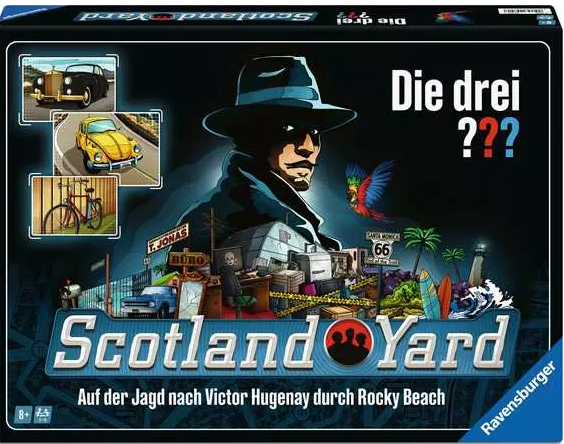
Es gibt eine Variante von dem Klassiker unter dem Brettspielen „Scotland Yard“ zu den Drei Fragezeichen. Leider ist es mehr oder minder das Originalspiel mit optischen Änderungen zu Rocky Beach statt London.
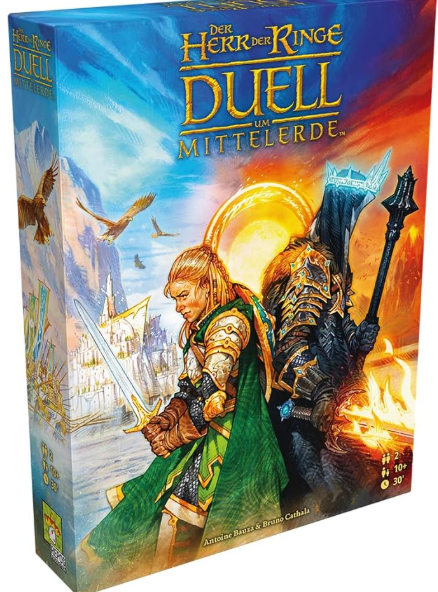
Viel mehr, als eine angepasste Variante von 7 Wonders Duell. Ein gutes Spiel für zwei Personen, die notfalls der Herr-der-Ringe-Thema ausblenden können.

 Anmelden