Es gibt eine Variante von dem Klassiker unter dem Brettspielen „Scotland Yard“ zu den Drei Fragezeichen. Leider ist es mehr oder minder das Originalspiel mit optischen Änderungen zu Rocky Beach statt London.
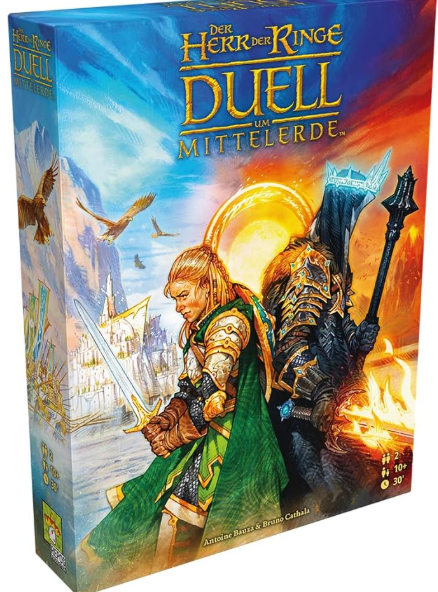
Viel mehr, als eine angepasste Variante von 7 Wonders Duell. Ein gutes Spiel für zwei Personen, die notfalls der Herr-der-Ringe-Thema ausblenden können.
Amsterdam is an amphibious city. Water flows around it (the Ijsselmeer, over which most people used to come into the city), water flows through it (the Amstel river, after which it is named, and the canals dug later), and even the land on which the buildings stand was won from the watery marshes in a feat of human ingenuity. The need to work together in this communal enterprise did not only strengthen the peasants and craftspeople who had won this land themselves (instead of receiving it from a noble), but also their willingness to put up with each other regardless of differences – the first instance of the famous Amsterdam tolerance.
Amsterdam’s rise was also closely connected to the water: On the one hand, Dutch herring fishers found out about how to cure fish on the ship, enabling them to sail further and catch more instead of having to head home after the first big catch. And in the 14th century, the count of Holland decreed that all Dutch beer imports from Hamburg, then northern Europe’s brewery, must go through Amsterdam. The city thus became a trade hub, first for these staples of fish and beer, but the local merchants soon branched out to luxury goods, too, especially as the great voyages of discovery brought Europe in direct touch with south and southeast Asia as well as the newly-discovered Americas.
When the Reformation swept Europe in the 16th century, Amsterdam, unlike many other Dutch cities, did not adopt the new Protestant faith. Yet the city kept its unusual approach to differences of faith and tolerated the local Protestants. Neither Protestantism nor tolerance were acceptable to the ruling Habsburg monarch, Philip II of Spain, who had inherited the suzerainty over the Low Countries from his father, emperor Charles V. Yet while both Philip and Charles were ardent Catholics, they had a very different relationship with the Low Countries. Charles had been born and brought up there, living his happiest years not far from Amsterdam. Philip was a Spaniard in everything, regarding the Dutch with suspicion. And as they started rebelling against him – for the Protestant faith, for municipal independence from the monarch, and for the exemption of taxes funding Habsburg wars in faraway lands – he was resolved to bring them back into the fold by force.
The various factions of the Dutch struggle for independence are the player roles in Revolution: The Dutch Revolt, 1568—1648 (Francis Tresham, Phalanx Games) – Catholics, Habsburgs, Nobility, Burghers and Reformers. Amsterdam remained initially Catholic (and thus loyal to Philip), yet other concerns would be more pressing to the city than religion: When the Dutch rebels blockaded the city from the sea, thus causing the collapse of any trade profits and the food supply to the city, Amsterdam’s anti-Habsburg faction was ascendant. The city threw its lot in with the rebels in 1578. Its Catholic minority, however, would be treated as the Protestants had been before. Tolerance went both ways in Amsterdam.
Amsterdam had escaped its ruin from the naval blockade. Further south, Antwerp, the most important Dutch port, was not so fortunate. While the blockade strangled Antwerp’s trade, tens of thousands of Antwerp merchants and artisans left the city to find greener pastures elsewhere – most of them in Amsterdam. Thus, while the Dutch provinces were engulfed in warfare with the Habsburgs (which would only end with Dutch independence in 1648), the convergence of capital and know-how in Amsterdam turned the city into the commercial capital of the world.
The Center of the World
Amsterdam in the early 17th century was buzzing with commercial activity. The merchants did not only find new trade routes, they also invented new ways of doing business altogether: The Vereenigde Oostindische Compagnie (United East India Company), or VOC for short, founded in 1602, was the first chartered company in the world. Anyone could buy a share in the company and thus partake in its profits – or sell the shares to others in what would become the Amsterdam Stock Exchange (also the first of its kind in the world). Amsterdam ships carried goods all over the worlds, Amsterdam shipwrights built them, Amsterdam craftspeople produced many of the finest objects for sale, and Amsterdam painters and writers catered to the pursuits of the minds. In the mid-17th century, a staggering 30% of all the new books in the world were published in Amsterdam, taking advantage of the liberal approach to the exchange of ideas in the metropolis.
Construction boomed in Golden Age Amsterdam – the city had much outgrown its medieval limits. In an ambitious scheme to not only expand, but also re-order the city’s flow of people and goods, Amsterdam took on its characteristic form, the city center surrounded by three belts of interconnected canals (grachten).
Amsterdam’s canals and the narrow houses built along them (for taxes were paid according to the width of the building’s front) have their own board game dedicated to them: Grachtenpand (Zach Hoekstra, Wulfhorn Games).
To my knowledge, no board game portrays the construction of the grachten. That’s a shame, because the scheme that led to their creation is worthy of the most cunning table strategist: Mayor Frans Oetgens knew of the plan to expand Amsterdam and dig the canals before it was public, so he and his associates bought up vast stretches of land at bargain prices and sold them back to the city at astronomical profits.
This act of self-interested entrepreneurship embodies Amsterdam’s preoccupation towards individual gain. It speaks to Amsterdam’s character as an individualist, bourgeois city that its most recognizable sights are not palaces and cathedrals, but these canals and the private houses along them.
Another very Amsterdam trait which has stood the test of time is the love of flowers, especially tulips. Yet never was this passion greater than in the 17th century, when it intermingled with the other great passion of Amsterdammers – commerce. Unlike the controlled trade of goods and shares in Amsterdam’s port and stock exchange, the Amsterdam Tulip Bubble developed unregulatedly in taverns where buyers and sellers met over a glass of wine. The price of tulips skyrocketed in one of the first documented speculation crazes – until the bubble burst, as is the inevitable outcome of Tulip Bubble (Kouyou, Moaideas Game Design): Players want to partake in the profitable trade, yet must try to sell before the end of the mania, for all their tulips in hand will be worth nothing at game end.
The allure of 17th century Amsterdam, this great laboratory of capitalism, is so great that it has become a widespread board game setting – just behind Vikings, zombies, and trading in the Mediterranean. Even the behemoth board game franchise Ticket to Ride has an instalment set in Amsterdam. Ticket to Ride: Amsterdam (Alan R. Moon, Days of Wonder) deviates from the tried-and-true setting of trains in favor of route-building in Golden Age Amsterdam 200 years before the first rail was laid. I especially appreciate that the game sticks with the original names for places in Amsterdam, so that players who don’t speak Dutch can attempt to pronounce Korenmetershuisje (Little House of the Grain Measuring Officials) and Oost-Indisch Huis (East India House).
Finally, the great master of eurogames has also designed a Golden Age Amsterdam game: Merchants of Amsterdam (Reiner Knizia, Rio Grande Games). And despite Knizia’s reputation of producing mathematically sound, but often themeless games, it might be the one which captures Amsterdam in 17th century best: Not only is the central mechanism that of a Dutch auction (that is, an auction which starts at a very high price which continues falling until someone buys the asset in question at the price asked), but its map depicts the Amsterdam surrounded by four world regions with which the players can trade – Amsterdam, the commercial center of the world.
Amsterdam’s preeminence could not last forever. Despite its naval and commercial advantages, the Dutch Republic was a small country compared to England or France, and eventually fell to these rivals. The rampjaar (catastrophe year) of 1672, in which England challenged the Republic on the seas and France invaded the Netherlands, ended the Dutch Golden Age. Amsterdam was only saved from French occupation when the Dutch pierced the dikes and flooded a large area of their own country to prevent the French onslaught.
As the Dutch Republic shrunk in importance, so did Amsterdam. London, Paris, Vienna, and Berlin eclipsed it as centers of modernity in Europe. Even within the Netherlands, the city fell behind: Its disadvantageous geography meant that Rotterdam, situated directly on the North Sea instead of the Ijsselmeer, became the country’s premier port. Amsterdam, however, remained a center of the arts, and an iconic city of individualism and tolerance.
In the 20th century, these values brought Amsterdammers to adopt a liberal attitude toward prostitution (openly practiced around the Old Church) and drugs (marijuana is not legal, but its consumption in specialized establishments (coffeeshops) is tolerated). That openness has made Amsterdam a dream destination for those wishing to uproot traditional lifestyles (at least for a moment) – from Yoko Ono and John Lennon staging their “Bed-In” for world peace in Amsterdam to the ubiquitous bachelor party trips there. Surprisingly, not a single board game seems to be dedicated to this side of Amsterdam.
When board games are set in modern Amsterdam, they often allude to traditional Dutch themes: Gift of Tulips (Sara Perry, Weird Giraffe Games) has its players once more compete for the finest flower bouquets at the city’s annual tulip festival. Amsterdam’s rich artistic history also often features: In Masters of Crime: Shadows (Lukas Setzke/Martin Student/Verena Wiechens, KOSMOS), the players aim to conduct a painting heist, whereas in EXIT: The Game – The Hunt Through Amsterdam (Inka Brand/Markus Brand, KOSMOS), they want to recover a lost Vincent van Gogh painting. My detective instincts say that these are the same painting! Finally, Amsterdam’s slide to modern metropolis sans its erstwhile very specific features is exemplified by the game set in Amsterdam with the single highest number of ratings on BoardGameGeek: Mechanically, the crime/mystery game Shadows: Amsterdam (Mathieu Aubert, Libellud) could be set in any big city. There’s nothing Amsterdam-specific about private detectives looking for evidence and avoiding the police’s official investigation. Yet the artwork on the tiles sometimes gives a little glimpse – for example, houses along the gracht.
A good introduction on Amsterdam’s history is Shorto, Russell: Amsterdam. A History of the World’s Most Liberal City, Doubleday, New York City, NY 2013.
Frederick the Great. A Military Life was published in 1985 by Routledge. It is a biography of Prussian king Frederick II (the Great, 1712—1786) dedicated to the military dimension of his life – not only his wars (on a tactical, operational, and strategic level), but also his activities as a military administrator and organizer.
Friedrich was published in 2004. Richard Sivél’s first published board game is a highly abstracted operational treatment of the Seven Years’ War in central Europe, focusing on Prussia’s desperate struggle for survival against the overwhelming odds of the Austrian-Russian-French alliance, personified by the eponymous king (Friedrich is the German form of Frederick). Five years later, a prequel on the War of the Austrian succession was published which uses the same basic system: Maria (Richard Sivél, Histogame).
Connections & Conclusions
My first contact with Duffy’s book was via Friedrich – it is one of the books referenced in the bibliography contained in the rulebook. A good choice, as it is the first treatment of the military dimension of Frederick’s life since imperial German times (and remains the definitive work on the subject until today).
Obviously, the book is more encompassing – after all, it treats not only the Seven Years’ War, but the entire 74-year life of Frederick. Yet the chapter on the Seven Years’ War makes up almost half of the book – testament to the importance of the war for Frederick (whom it turned from an energetic man in his prime into a hollowed out, aged king who had lost most of his pleasures along with many personal friends). The toll the war took on Frederick is showcased in many anecdotes both in the book and in the “small events” in the game.
Glum times for Frederick! Other event cards show him as energetic and decisive, but this one embodies his worst impulses.
Frederick represents a watershed in history. On the one hand, he expanded and modernized the Prussian bureaucracy which is so symbolic for the modern, often impersonal state. On the other, he was a roi-connétable, a king-warlord, one of the last monarchs to personally lead his troops into battle – those after him who did so had usually used their military success to also take political power which was then based on their continued martial prowess (like Napoleon). Yet in an age when the kings of Britain, France, or Russia remained at court and sent their generals to fight whichever war needed fighting, Frederick rode at the head of his main army, entrusting detachments to his generals only because he could not be everywhere at once.
And Frederick did his best to be everywhere. One of the most striking characteristics of Frederick’s campaigns is his masterful use of the interior lines, on which he performed sweeping forced marches from one theater of the war to another. The most impressive example is found late in the campaign of 1757: After Frederick’s offensive in Bohemia had failed, and France’s victory over the Hanoverian army in northwestern Germany opened the way for a French invasion of Prussia. Frederick marched his army to western Saxony, where he beat a combined French/Imperial army at Roßbach on November 5. The Austrians had used the opportunity to invade Silesia which had only been held by secondary Prussian detachments and were in the possession of almost the entire province… until Frederick’s army showed up, having marched 400 kilometers in a month, and expelled the Austrians from Silesia at Leuthen, the site of his greatest tactical victory.
Frederick’s forced march from Roßbach (battle on November 5, 1757) to Leuthen (December 5, 1757) on the Friedrich map.
These sweeping operational and tactical maneuvers are detailed by around 50 maps in Duffy’s book. Whoever is interested in the wars of Frederick will pore over them for a long time during the read and probably flick back and forth between the map section and the text to follow a battle description. While Friedrich prizes maneuver, it has to scale down the distances covered – the march from Roßbach to Leuthen would take five turns on the map (an entire game typically takes around 20 turns).
Operational map of the forced march from Roßbach to Leuthen (top) and tactical map of the battle of Roßbach (bottom right) in Frederick the Great. A Military Life. I’d love to say the book is in this slightly banged up condition because I read it so often, but the unromantic fact is that I bought it used at a library sale (at the bargain price of four bucks).
Thus, there is a certain disconnect between general Friedrich [the pieces are all named in the German fashion] moving on the map and the player role of Frederick: The general Friedrich is much less important than the historical Frederick-the-general. His piece starts in Saxony, which makes it likely that he will only ever do battle with Austria and their minor ally, the Imperial Army, but never venture far enough to fight against France or even Russia and its ally Sweden. If he remains in Saxony and Prussia elects to focus its defense against Austria in Silesia, Frederick might command only a small detachment, avoiding battle while pinning down Austrian forces and taking unglamorous retreats if he is engaged.
Friedrich (Frederick) is keeping Karl von Lothringen (Charles Alexander of Lorraine) busy in Saxony while the main forces of Prussia and Austria, stacked to impressive height, face off in Silesia.
The player role of Frederick, however, oversees the entirety of the Prussian war effort (as well as that of Prussia’s minor ally Hanover, ruled in personal union by the king of Britain). The player has control over the maneuver of their generals of which Frederick could only have dreamt: News of a victory or defeat in East Prussia would have reached his army camp in Bohemia only weeks after the event, whereas in Friedrich the player can position the general in charge of defending East Prussia exactly where they want and have him surrender, retreat, or fight for his life according to the overall strategic plan.
Maximilian Ulysses von Browne has moved boldly in the first turn… and might face Friedrich/Frederick’s wrath (and superior power) in the second.
Nonetheless, the game is very effective at conveying Friedrich’s psychological state: In the early game, the player might be elated by their power and success. As Frederick moves and draws cards first in the round, an aggressive player can attack their foes with overwhelming force – for example, a second-round attack on Austria means that Prussia has drawn its seven cards per round twice already (so, fourteen in total), whereas Austria has only drawn its five cards per turn once. This corresponds with the quality advantage of the Prussian troops early in the war which Duffy notes frequently. Yet Duffy also argues that this advantage was lost by the heavy casualties the Prussian army endured in 1757 and would never be regained. (Duffy contends that Frederick inherited the finest military force in Europe upon his accession to the throne, but left his own successor a mediocre army – this long-term criticism of Frederick is, of course, beyond the scope of the game.)
Correspondingly, the Frederick player will soon find that the time to play defense has come (if it hasn’t been from the beginning of the game). And as their once-impressive card hand dwindles under the repeated attacks from all foes, elation will give way to gloom. Whenever an anecdote is read as the end-of-round event, showing the historical Frederick at turns defiant, melancholy, or self-pitying, the Frederick player will be able to relate – as they will as Austria’s allies, one after another, falter and peace is made. Frederick might have won the game, but it will surely have taken a toll.
Prussia barely holds on to the last Austrian and Russian objectives… let’s hope for Frederick that the Tsarina dies soon!
In that sense, Frederick the Great. A Military Life and Friedrich are a perfect match – the analytic and the immersive, the intellectual and the emotional. Give both a try!
Frederick the Great. A Military Life was published in 1985 by Routledge. It is a biography of Prussian king Frederick II (the Great, 1712—1786) dedicated to the military dimension of his life – not only his wars (on a tactical, operational, and strategic level), but also his activities as a military administrator and organizer.
Friedrich was published in 2004. Richard Sivél’s first published board game is a highly abstracted operational treatment of the Seven Years’ War in central Europe, focusing on Prussia’s desperate struggle for survival against the overwhelming odds of the Austrian-Russian-French alliance, personified by the eponymous king (Friedrich is the German form of Frederick). Five years later, a prequel on the War of the Austrian succession was published which uses the same basic system: Maria (Richard Sivél, Histogame).
Connections & Conclusions
My first contact with Duffy’s book was via Friedrich – it is one of the books referenced in the bibliography contained in the rulebook. A good choice, as it is the first treatment of the military dimension of Frederick’s life since imperial German times (and remains the definitive work on the subject until today).
Obviously, the book is more encompassing – after all, it treats not only the Seven Years’ War, but the entire 74-year life of Frederick. Yet the chapter on the Seven Years’ War makes up almost half of the book – testament to the importance of the war for Frederick (whom it turned from an energetic man in his prime into a hollowed out, aged king who had lost most of his pleasures along with many personal friends). The toll the war took on Frederick is showcased in many anecdotes both in the book and in the “small events” in the game.
Glum times for Frederick! Other event cards show him as energetic and decisive, but this one embodies his worst impulses.
Frederick represents a watershed in history. On the one hand, he expanded and modernized the Prussian bureaucracy which is so symbolic for the modern, often impersonal state. On the other, he was a roi-connétable, a king-warlord, one of the last monarchs to personally lead his troops into battle – those after him who did so had usually used their military success to also take political power which was then based on their continued martial prowess (like Napoleon). Yet in an age when the kings of Britain, France, or Russia remained at court and sent their generals to fight whichever war needed fighting, Frederick rode at the head of his main army, entrusting detachments to his generals only because he could not be everywhere at once.
And Frederick did his best to be everywhere. One of the most striking characteristics of Frederick’s campaigns is his masterful use of the interior lines, on which he performed sweeping forced marches from one theater of the war to another. The most impressive example is found late in the campaign of 1757: After Frederick’s offensive in Bohemia had failed, and France’s victory over the Hanoverian army in northwestern Germany opened the way for a French invasion of Prussia. Frederick marched his army to western Saxony, where he beat a combined French/Imperial army at Roßbach on November 5. The Austrians had used the opportunity to invade Silesia which had only been held by secondary Prussian detachments and were in the possession of almost the entire province… until Frederick’s army showed up, having marched 400 kilometers in a month, and expelled the Austrians from Silesia at Leuthen, the site of his greatest tactical victory.
Frederick’s forced march from Roßbach (battle on November 5, 1757) to Leuthen (December 5, 1757) on the Friedrich map.
These sweeping operational and tactical maneuvers are detailed by around 50 maps in Duffy’s book. Whoever is interested in the wars of Frederick will pore over them for a long time during the read and probably flick back and forth between the map section and the text to follow a battle description. While Friedrich prizes maneuver, it has to scale down the distances covered – the march from Roßbach to Leuthen would take five turns on the map (an entire game typically takes around 20 turns).
Operational map of the forced march from Roßbach to Leuthen (top) and tactical map of the battle of Roßbach (bottom right) in Frederick the Great. A Military Life. I’d love to say the book is in this slightly banged up condition because I read it so often, but the unromantic fact is that I bought it used at a library sale (at the bargain price of four bucks).
Thus, there is a certain disconnect between general Friedrich [the pieces are all named in the German fashion] moving on the map and the player role of Frederick: The general Friedrich is much less important than the historical Frederick-the-general. His piece starts in Saxony, which makes it likely that he will only ever do battle with Austria and their minor ally, the Imperial Army, but never venture far enough to fight against France or even Russia and its ally Sweden. If he remains in Saxony and Prussia elects to focus its defense against Austria in Silesia, Frederick might command only a small detachment, avoiding battle while pinning down Austrian forces and taking unglamorous retreats if he is engaged.
Friedrich (Frederick) is keeping Karl von Lothringen (Charles Alexander of Lorraine) busy in Saxony while the main forces of Prussia and Austria, stacked to impressive height, face off in Silesia.
The player role of Frederick, however, oversees the entirety of the Prussian war effort (as well as that of Prussia’s minor ally Hanover, ruled in personal union by the king of Britain). The player has control over the maneuver of their generals of which Frederick could only have dreamt: News of a victory or defeat in East Prussia would have reached his army camp in Bohemia only weeks after the event, whereas in Friedrich the player can position the general in charge of defending East Prussia exactly where they want and have him surrender, retreat, or fight for his life according to the overall strategic plan.
Maximilian Ulysses von Browne has moved boldly in the first turn… and might face Friedrich/Frederick’s wrath (and superior power) in the second.
Nonetheless, the game is very effective at conveying Friedrich’s psychological state: In the early game, the player might be elated by their power and success. As Frederick moves and draws cards first in the round, an aggressive player can attack their foes with overwhelming force – for example, a second-round attack on Austria means that Prussia has drawn its seven cards per round twice already (so, fourteen in total), whereas Austria has only drawn its five cards per turn once. This corresponds with the quality advantage of the Prussian troops early in the war which Duffy notes frequently. Yet Duffy also argues that this advantage was lost by the heavy casualties the Prussian army endured in 1757 and would never be regained. (Duffy contends that Frederick inherited the finest military force in Europe upon his accession to the throne, but left his own successor a mediocre army – this long-term criticism of Frederick is, of course, beyond the scope of the game.)
Correspondingly, the Frederick player will soon find that the time to play defense has come (if it hasn’t been from the beginning of the game). And as their once-impressive card hand dwindles under the repeated attacks from all foes, elation will give way to gloom. Whenever an anecdote is read as the end-of-round event, showing the historical Frederick at turns defiant, melancholy, or self-pitying, the Frederick player will be able to relate – as they will as Austria’s allies, one after another, falter and peace is made. Frederick might have won the game, but it will surely have taken a toll.
Prussia barely holds on to the last Austrian and Russian objectives… let’s hope for Frederick that the Tsarina dies soon!
In that sense, Frederick the Great. A Military Life and Friedrich are a perfect match – the analytic and the immersive, the intellectual and the emotional. Give both a try!
Before the Treaty of Alliance and the French declaration of war on Britain, France had supported the American Patriots materially. Now that France was a full belligerent, fighting forces would follow – first, the French fleet.
Admiral d’Estaing’s event card in Liberty or Death (Harold Buchanan, GMT Games) emphasizes the difficulties and opportunities of coordinating far-reaching naval operations. From the Vassal module.
A naval force under Admiral Charles Henri Hector d’Estaing, carrying a few thousand French land forces, was dispatched to North America in summer 1778. They embarked on an ambitious combined-force scheme together with the Continental Army to take Newport from the British. American-French cooperation (as well as army-navy cooperation) proved difficult, and the operation had to be aborted. In one of the more dubious decisions of the war, the British abandoned Newport, one of the finest natural harbors in New England, voluntarily soon after.
As joint operations had not yielded success, the American and British forces would usually operate separately for the next two years. That meant that the Americans continued to bear the brunt of the struggle for North America. The French navy and army, however, were crucial in tying down British forces in the by now global struggle: British and French forces fought over the economically crucial “sugar islands” of the Caribbean. A French armada, strengthened by Spain which had recently entered the war, threatened to invade Britain itself in 1779. Even in far away India, British forces were challenged by the French and their local allies. Players of Imperial Struggle (Ananda Gupta/Jason Matthews, GMT Games) will recognize these as the four regions in which Britain and France fight for supremacy – with victory going to the player who can balance their interests in the four regions best, taking losses where they must while making bigger gains elsewhere.
The board of Imperial Struggle depicts a world full of opportunities for conquest, alliance, and trade in North America, Europe, the Caribbean, and India. In this particular game, the British have been expelled from North America, but done well in India.
The American Patriots had none of this strategic depth. If they were defeated North America, their cause would be lost. And even with French support, it did not seem like they could do more than brace themselves against the military and financial superiority of Britain… if so much. The harsh winter of 1779-80 decimated the Continental Army. Difficulties in paying the troops resulted in the mutiny of the Pennsylvania and New Jersey Line regiments. The situation seemed so dire that Benedict Arnold, one of the most distinguished American commanders, betrayed the American cause (but failed to deliver the fort of West Point to Britain), serving in the British army for the remainder of the war.
The Benedict Arnold event in Washington’s War (Mark Herman, GMT Games) does not only give a die roll modifier in a battle to Britain, but also removes the (American) leader Arnold from the board. Experienced American players know this, of course, and will not entrust Arnold with important missions… thus, his invasion of Canada is unlikely to happen in the game. An interesting meditation on how much historical hindsight influences gameplay.
The Southern Strategy
Part of the American woes was the new British focus. As New England was lost to Britain, and too full of rebels to be retaken, the British turned their attention to the southern colonies which the believed to be populated by many British loyalists.
First, they advanced from Florida (supported by sea) into Georgia and took Savannah on December 29, 1778. A combined American-French land-sea operation failed to retake the city in June 1779. After this second joint operations failure, the French fleet relocated to the Caribbean. British forces under Charles Cornwallis laid siege to Charleston, South Carolina, the following March.
Lincoln never stood a chance. From the Rally the Troops! implementation of Washington’s War.
Benjamin Lincoln, who had commanded the American troops in the unsuccessful counter-offensive at Savannah, was put under enormous political pressure not to let Charleston, one of the most important cities in the south, fall into British hands. Retreat was thus impossible. Yet the defense of the city against superior British forces was doomed. Lincoln surrendered in May 1780.
Cornwallis’s next victim. From the Rally the Troops! implementation of Washington’s War.
Cornwallis also beat the new American commander in the south, Horatio Gates, at Camden (and thus cut Gates, the hero of Saratoga, back to size again). As the British general was poised to invade North Carolina, Washington dispatched Nathanael Greene to take command in the south.
Greene’s approach aimed to elude a decisive engagement. Contrary to British assumptions, the south was not rife with British loyalists. The crown was only supported where Britain could enforce loyalty – on the coasts, and wherever Cornwallis’s army was at the moment. And Cornwallis could not be everywhere. Small American forces under guerilla leaders (like “The Gamecock” Thomas Sumter and Francis Marion, on whom the movie The Patriot is based) chipped away at British forces and support. While Cornwallis beat Greene at Guilford Court House and Eutaw Springs in early 1781, he could not reverse the south’s affiliation to the Patriot cause.
Yorktown
Cornwallis lost patience with the indecisive campaign against Greene’s Fabian strategy. In 1781, he boldly struck into Virginia. His supply was to come from sea via the port of Yorktown on Chesapeake Bay. If Virginia, the largest and most populous southern colony was taken and thus the south cut off from the north, Greene would have to surrender – or so Cornwallis thought. Cornwallis’s good strategy rating in Washington’s War makes it likely that the British player will let him pursue similarly active campaigns… and hopes not to get caught by superior force.
Cornwallis’s plan was risky. Virginia was much closer to the American and French main forces than the Carolinas. The French commander Jean-Baptiste Donatien de Vimeur, comte de Rochambeau, urged George Washington to confront Cornwallis. And thus a third joint operation began: Gilbert du Motier, Marquis de Lafayette, a French volunteer in the Continental army, marched American and French forces to Virginia.
Cornwallis responded in the typical British manner: He fortified Yorktown and confidently relied on British naval superiority to keep his options open. That confidence was shaken when the French instead of the British navy showed up in Chesapeake Bay. The British sent a fleet of their own, but the resulting naval battle of Chesapeake Bay failed to expel the French fleet (September 5, 1781).
Between a rock and a hard place: Cornwallis was trapped by the American-French army and the French navy. From the Rally the Troops! implementation of Washington’s War.
Washington and Rochambeau took command of the combined army and invested Yorktown. As Cornwallis had failed to tenaciously defend the outer defenses, assuming he would be evacuated by the Royal Navy, the sieging forces advanced quickly. Cut off from supplies and under bombardment from the allied artillery, Cornwallis surrendered on October 17, 1781. His entire force of almost 8,000 was captured (with another 156 dead). French and American total casualties (dead and wounded) were barely over 200.
Peace
The war in the colonies had been unpopular in Britain for some years. Parliament was unwilling to expend more money on it, and thus the British forces deployed had never again reached their peak strength from 1776. With one of the two main British forces in the colonies lost, so was the parliamentary base for the government. When the Whig opposition’s motion to end the war in North America carried a majority, Prime Minister Frederick North resigned in March 1782. “North’s Government Falls” is the end of a game of Washington’s War, and can happen anytime between 1779 and 1783 (provided the event is face-up in the respective year).
North’s successors had to make peace with four separate enemies – the United States, France, Spain, and the Netherlands. The American negotiators Benjamin Franklin and John Jay proved most skillful in this complicated multi-sided diplomacy. They secured diplomatic recognition for the United States as well as the western domain all the way to the Mississippi and important fishing rights in the Atlantic. The Peace of Paris was signed on September 3, 1783.
The king of France had little time to enjoy his triumph. The war expenses incurred in the American Revolutionary War contributed to the financial crisis which resulted in the French Revolution (whose protagonists were in turn inspired by the American ideas of liberalism and republicanism) just six years after the Peace of Paris.
Britain, on the other hand, bounced back from the setback in North America. The country’s naval, commercial, and financial strength was still intact. Britain would orchestrate the coalitions against revolutionary and Napoleonic France until the final victory at Waterloo in 1815, ushering in a century of British global dominance.
And the United States? They remained within their own hemisphere for the time being. Only occasionally drawn into conflict with their erstwhile French allies or old British enemies, the United States dealt with their westward expansion and economic development. Despite its unresolved conflict internal conflict about slavery, the American republic remained an inspiration to European liberals and democrats who strove to follow the example begun 250 years ago.
Allison, Robert J.: The American Revolution. A Very Short Introduction, Oxford University Press, New York City, NY 2015 is exactly what it says on the tin.
Higginbotham, Don: The War of American Independence. Military Policies, Attitudes, and Practice, 1763-1789, Indiana University Press, Bloomington, IN 1977 covers not only the campaigns, but also the political, social, and economic dimensions behind them.
As we have seen in the last post, Wallenstein had contrived to make many enemies. His only supporter, Emperor Ferdinand, feared to be upstaged by the seemingly all-powerful general. The news in late 1633 – Wallenstein treating with the Swedes, Wallenstein letting Thurn go free, Wallenstein not defending Regensburg and Bavaria, Wallenstein refusing to support the Spanish mission to the Netherlands – mixed with their tendentious interpretations by the Bavarian and Spanish parties at court convinced the emperor that Wallenstein planned betrayal. To forestall this, the Imperial War Council secretly decided to relieve Wallenstein of his command on December 31, 1633.
Wallenstein and his intimates did not know about the dismissal, but they sensed the shifting wind. His brother-in-law Adam Erdmann, Count Trčka, and his marshal Christian von Ilow had Wallenstein’s officers sign a statement of loyalty to their commander in his winter quarters at Plzeň on January 12. They hoped that this show of unity in the army would remind the emperor that he needed his general. The opposite was the case: Ferdinand took it as another sign of treason.
When Wallenstein had been dismissed in 1630, it had caused both the emperor and the electors immense anxiety about his possible reaction. He had taken it meekly then, but what would he do now? As the emperor and his advisors had resolved that Wallenstein was a traitor, they expected the worst – insubordination, rebellion, joining his army with the Swedes. That needed to be forestalled. A secret court found Wallenstein guilty of treason on January 24, 1634. The court reached out to three of Wallenstein’s officers which they deemed reliable – Wallenstein’s second-in-command, Matthias Gallas, the commander of the embattled left wing at Lützen, Ottavio Piccolomini, and the tenacious defender of Dessau Bridge, Johann von Aldringen. To them, they gave the delicate task of delivering Wallenstein to Vienna – dead or alive.
The three executors of the imperial sentence faced a daunting task. Wallenstein was popular with the common soldiers whose pay was guaranteed by their general, not by the emperor whose coffers were notoriously empty and whose will to pay the army notoriously limited. The officers seemed more promising, as they were honor-bound to the emperor, but they had also sworn loyalty to their commander. Gallas got in touch with those they deemed reliable and instructed them not to follow any orders from Wallenstein, Trčka, or Ilow.
By that time, Wallenstein’s health had deteriorated even more. He was barely able to leave his bed and sometimes could not even sign documents. All the while, he waited for a reply from Hans Georg von Arnim on the potential peace with the electors of Saxony and Brandenburg.
Trčka acted on Wallenstein’s behalf in the day-to-day affairs, confident in his command over the soldiers. Only deep into February did it dawn on him and Wallenstein’s other intimates that imperial agents were prising the army away from them – officer by officer, regiment by regiment.
Wallenstein in his winter quarters at Pilsen (the German spelling of Plzeň) with the three executors of the imperial will dancing around him. Cheb, to the northwest of Plzeň/Pilsen would have given Wallenstein an easy exit west in direction of the Swedish-German forces under Bernard of Weimar or north to the Elector of Saxony. From the Vassal module of Thirty Years War: Europe in Agony, 1618-1648 (David A. Fox/Michael Welker, GMT Games).
Nothing was left to Wallenstein but flight. On February 23, he and those faithful to him made away to Cheb, accompanied by a few regiments of loyal troops. They had been joined by the regiment of Colonel Walter Butler on the way and counted on the garrison of Cheb under the command of John Gordon. Both Butler and Gordon had been contacted by the three conspirators who urged them not to obey Wallenstein. For the time being, Butler and Gordon prevaricated.
As Cheb is in the northwestern corner of Bohemia, Wallenstein could easily leave Bohemia for Saxony or be joined by Swedish forces. That put time pressure on Butler and Gordon. If Wallenstein fled, they would be held responsible. If they arrested him, he would be freed again if the Swedish arrived. Thus, they resolved to murder him and his associates.
Gordon invited Trčka, Ilow, and a few more Wallenstein intimates for dinner up in Cheb’s castle on February 25th – together with Wallenstein, who declined on grounds of his constant bad health. Gordon and Butler, both present at dinner, had a group of soldiers commanded by captain Walter Devereux come in, declare for the emperor, and murder Wallenstein’s associates. With all of them dead, Devereux took his small group down to Wallenstein’s residence in the town. They found Wallenstein in bed already. As he got up, Devereux stabbed him to death.
Wallenstein’s leader counter in Cuius Regio.
Wallenstein’s death is handled in a rather detached manner in Cuius Regio (Francisco Gradaille, GMT Games, forthcoming): Like every other leader, Wallenstein has an initial and a last year of service (1625 and 1634, in his case). In the leader deployment phase before the campaigns of 1635, the player will have to remove Wallenstein. Death – be that from plague, battle, or murder – is inevitable and pre-ordained.
The Catholic player in Thirty Years War: Europe in Agony, 1618—1648 has more freedom. As we have discussed in the last two instalments of the series, Wallenstein can be dismissed and recalled in the game. And if he proves to be too influential (and comes close to the threshold at which his influence would give the Protestants a Major Victory), he can also be assassinated (and thus be removed from the game permanently). There is, however, no inevitability of Wallenstein’s death: As his influence is only raised from recruiting troops, taking cities, and successfully attacking with him, the Catholic player can just forgo those, not use Wallenstein anymore and let him live out his old age in peace. Somehow, this never occurred to the historical Ferdinand II. Implicitly, the game’s treatment of Wallenstein’s assassination posits that the active threat which Wallenstein posed in Ferdinand’s view was nothing but a fabrication of the emperor’s paranoia, and that the emperor remained firmly in command at all times.
Twilight of the Thirty Years’ War
Wallenstein had grown rich on land which had been taken from those the emperor had declared rebels. He ended up on the other side of this bargain. His estates in Bohemia and Silesia were seized (Mecklenburg was lost to the Swedes anyway). A good deal went as spoils to all the officers involved in the conspiracy against him. Gallas, Piccolomini, and Aldringen became great magnates, and those on the lower rungs of the plot did not go unrewarded either, down to an additional month’s pay for all the soldiers in the garrison of Cheb whose only contribution had been to stand by idly while Wallenstein was murdered. The rest of Wallenstein’s estates were sold by the emperor to fix some of his short-term financial problems. Wallenstein’s widow Isabelle kept nothing. Only when she pleaded mercy (instead of justice) from the emperor did she receive a small estate to live on.
Wallenstein had died when the war had already been raging for sixteen years. It would last another fourteen before peace was finally made in 1648. Any time Emperor Ferdinand II had been in a position of strength, he had not made concessions to form a lasting peace, but instead increased his demands, prompting the interventions of first Denmark, then Sweden, and finally France (shortly after Wallenstein’s death).
Ferdinand II died in 1637. At the time of peace, the new emperor Ferdinand III was mostly ruined. Protestantism survived, protected by German princes and foreign powers. Sweden controlled the Baltic Sea. Any hopes of imperial hegemony in the empire or of Habsburg hegemony in Europe were dashed. After Spain had conceded Dutch independence, it fought on against France, and lost that war, too, along with its European primacy.
Afterlife
Wallenstein remained fascinating to his contemporaries after his death, and would continue for centuries. Assessments close to his own time hewed closely to the religious beliefs of the writer: Catholics tended to see Wallenstein as a traitor (following the official account of the emperor), Protestants made him into a Machiavellian mercenary leader, often contrasted with the heroic “Lion from the North” Gustavus Adolphus.
Later treatments focused on individual aspects such as Wallenstein’s purported dependence on astrology. You will have noticed that this is the first time since our first post that astrology is mentioned – because there is no evidence that Wallenstein was more interested in it than his contemporaries, let alone that he made decisions based on horoscopes. The speculations on this issue are based in the accounts of those who bore witness against Wallenstein shortly before and after his death, taking pains to stress anything which might indicate that Wallenstein was anything but a devout Catholic. The idea of Wallenstein, the Star-Seeker, is particularly prevalent in the German mind, as playwright Friedrich Schiller dedicated a trilogy of plays to Wallenstein’s last weeks – and presents the general as an indecisive fatalist, done in by his own passivity as well as the cabals of those around him. That’s (masterful) fiction – but it hews close enough to history (Schiller had taught history at the University of Jena and even written a major book on the Thirty Years’ War) to influence anyone whose first contact with Wallenstein was through Schiller’s plays.
By the time document-based historiography had been firmly established in the 19th century, pre-established views on Wallenstein had become so solidified that historians still argued within their confines – mostly on the matter if Wallenstein had, in fact, betrayed the emperor. Slowly, the view that he had not gained ground.
Interpretations of Wallenstein in the 19th and 20th century often were inspired by current politics: Catholic German nationalists hailed Wallenstein as a proto-Greater German unifier. Czech historians like Josef Pekař adopted their compatriot as a proto-nationalist transcending the multi-national Habsburg Empire. Hellmut Diwald saw in Wallenstein the necessary authoritarian answer to overcome foreign domination of Germany (and subsequently plunged himself into New Right revisionism).
When stories of “Great Men” had decidedly fallen out of favor in academic history, Golo Mann revived the genre with his biography of Wallenstein, testing the limits of academic writing with his literary ambitions. His book dispelled some of the myths around Wallenstein and retained others.
Currently, Wallenstein’s heritage as a Bohemian, a nobleman, a (converted) Catholic, and a magnate have received more attention. History is never completed, but only enriched with more perspectives. Wallenstein’s life and its subsequent interpretations are thus also lessons in historiography.
A recent biography which succeeds at dispelling the Wallenstein myth is Mortimer, Geoff: Wallenstein. The Enigma of the Thirty Years’ War, Palgrave Macmillan, London 2010.
For an older, more encompassing biography with literary aspirations, see Mann, Golo: Wallenstein. His Life Narrated, Holt, Rinehart, and Winston, New York City, NY 1976.
On the reception of Wallenstein and his changing image from his contemporaries all the way through the 20th century, see Bahlcke, Joachim/Kampmann, Christoph: Wallensteinbilder im Widerstreit: Eine historische Symbolfigur in Geschichtsschreibung und Literatur vom 17. bis zum 20. Jahrhundert [Conflicting Conceptions of Wallenstein: A Symbolic Figure from History in Historiography and Literature from the 17th to the 20th Century], Böhlau, Cologne/Weimar/Vienna 2011 [in German].
For a short introduction to the Thirty Years’ War, see Schmidt, Georg: Der Dreißigjährige Krieg [The Thirty Years’ War], C.H. Beck, Munich 2010 [in German].
A magisterial monography on the entire war is Wilson, Peter H.: Europe’s Tragedy. A New History of the Thirty Years’ War, Penguin, London 2009.
Gustavus Adolphus, King of Sweden, had taken Germany by storm in 1631. He was allied with the heretofore neutral Protestant electors of Saxony and Brandenburg, had shattered the imperial army under Count Tilly at Breitenfeld, and was taking his winter quarters in Mainz, deep in the southwest of Germany. For 1632, he looked ready to advance along the Danube, first into Bavaria, the home of elector Maximilian, the most powerful Catholic prince in the empire (and Wallenstein’s chief rival), and then into the Habsburg core lands.
I recommend you blow up this image by clicking on it – not only to see the strategic situation in early 1632 with the main Swedish army in the electorate of Mainz in the northwest and an advance column in Franconia (northeast) and the Catholic League forces on both sides on the Danube which will flow further east into the Habsburg core lands, but also to enjoy the sheer beauty of this map! Taken from the Vassal module of Won by the Sword (Ben Hull, GMT Games).
Wallenstein had been the emperor’s man to solve his military problems for five years. It was thus an obvious choice to recall him as commander. Even Maximilian was in favor (hoping for Wallenstein to defend his electorate, which had heretofore been blissfully ignorant of war as a first-hand experience). Emperor Ferdinand II was practically begging. Wallenstein agreed – but only to reorganize the army, only for three months. The emperor went along, having no other choice. And, of course, when the three months were over, Wallenstein stayed on, having his supreme authority confirmed and expanded.
We have discussed the Wallenstein rule in Thirty Years War: Europe in Agony, 1618—1648 (David A. Fox/Michael Welker, GMT Games) as far as his dismissal was concerned – when Wallenstein’s influence becomes too high, the Catholic player can avoid losing by dismissing Wallenstein which will halve his influence. Having dismissed Wallenstein, the Catholic player can recall him again for a second bout in command – this time probably shorter, as Wallenstein will have some leftover influence and will thus be closer to the influence threshold that would mean Protestant victory!
Gustavus Adolphus had not been idle while Wallenstein re-organized the army. He had split his army in several parts, taking a good deal of Catholic Germany (and distributing ecclesiastical lands to his supporters), while his main force advanced towards Bavaria. The army of the Catholic League under Maximilian and Tilly attempted to make up for their numerical inferiority with a strong defensive position behind the river Lech. Gustavus Adolphus forced the Lech in April 1632 with the double measure of a crossing south of the Catholic army and the massed use of artillery. The League army was routed. Tilly died of the wounds he had suffered in the battle. One month later, Gustavus Adolphus lodged in the Bavarian capital Munich.
The Duel with Gustavus
Maximilian beseeched Wallenstein to march for Bavaria and meet the Swedes in open battle. Yet Wallenstein’s mission concerned the entire empire, not just a single electorate. And his caution – half natural, half learned in the campaign of 1626 – led him to pursue a different course. He marched for Franconia. From there, he threatened Gustavus’s supply lines which stretched all the way to the Baltic coast, and he could quickly march to Bavaria, strike at the Swedish king’s new Saxon allies, or retreat to Bohemia, as the situation required it. When he took camp near the city of Nuremberg, one of the greatest cities of the empire, he also evoked the Protestants’ fear of another Magdeburg – more atrocities visited on a large Protestant city. Gustavus Adolphus had to turn and face Wallenstein.
The Swedish king had a battle-hardened army with him, but the difficult supply situation and the vast area which he had conquered had forced him to detach large parts of his army. Even though reinforcements arrived for him in Nuremberg, his combined force was not bigger than Wallenstein’s (strengthened by some of the Bavarian troops) who had built a fortified camp at the Alte Veste outside of Nuremberg. Gustavus, eager to fight a decisive battle and resume his attack on the Habsburg core lands, attempted to breach the defenses for several days, but was bloodily repelled by Wallenstein’s forces. The king had to withdraw. He left a garrison behind to hold Nuremberg against Wallenstein’s siege. The Swedes were not defeated, but the myth of Gustavus’s invincibility was broken.
As the Protestant army had withdrawn southwest, Maximilian feared a new invasion of Bavaria. Once more, he demanded that Wallenstein follow Gustavus to protect Bavaria. And once more, Wallenstein refused. Protect Bavaria he would, though… not by marching south, but north.
Wallenstein’s march for Saxony followed his tried-and-tested strategy of combining pressure on the supply lines with political pressure: When Wallenstein’s army showed up in Saxony, the Saxons would understand how foolish they had been to declare against the emperor. Maybe their elector John George, an imperial loyalist by inclination, could be brought back into the imperial fold. Until then, Wallenstein’s army would winter in Saxony, consuming the food and fodder which Saxon peasants had grown and harvested.
As Wallenstein had foreseen, Gustavus Adolphus followed him to protect his supply lines and his Saxon allies, arriving in November 1632 in Saxony. In Wallenstein’s mind, the campaigning season was over, and he split his army into several winter quarters – a common necessity in Cuius Regio (Francisco Gradaille, GMT Games, forthcoming) as well, as smaller towns are often unable to supply large armies in winter. Yet Gustavus was not done campaigning, kept his force concentrated, and marched on the force under Wallenstein’s command stationed around the village of Lützen.
Wallenstein & Piccolomini! Best friends forever! From the Vassal module of Cuius Regio.
Wallenstein, caught unprepared, scrambled to get reinforcements for the battle that was now upon him. He hoped that at least the cavalry of his lieutenant Gottfried Heinrich, Count of Pappenheim would arrive in time, maybe even the infantry. Until then, he took defensive positions at Lützen, obscured by the morning mist and the smoke from having set the village on fire.
The ensuing Battle of Lützen, fought on November 16, 1632, was Wallenstein’s fiercest tactical challenge. The Protestant army had a slight numerical superiority, its core formed by veterans of many battles (usually on the winning side), and it was commanded by the greatest tactical commander of the time. The initial Swedish assault shattered Wallenstein’s left. The Swedes also gained Wallenstein’s artillery battery on the left wing. Yet when the battle seemed already lost, Pappenheim arrived with his cavalry regiments and turned the tide. Pappenheim, however, was severely wounded, and most of his cavalrymen fled. Colonel Ottavio Piccolomini took some regiments from the center, and, helped by the onset of more fog, could stabilize the front.
In the meantime, Wallenstein’s right had repelled the Protestant assault on their side and were now battering the Swedish-German troops under Prince Bernard of Saxony-Weimar. Bernard called for support, and the king himself answered with a group of select cavalrymen. Gustavus Adolphus was wounded, lost touch with his forces in the fog, and thus fell into the hands of imperial soldiers who killed him and plundered his corpse. News of the death of the king spread among the Protestant ranks. They responded quite differently to Pappenheim’s forces when faced with the loss of their commander: Gustavus Adolphus had been beloved, a hero, the savior of Protestantism. The Swedish-German troops battered Wallenstein’s right wing and took his second battery. Their strength, however, was insufficient to expel the imperial forces from their defensive positions. The fighting ended when night fell. Wallenstein withdrew his army in good order.
Lützen had been no victory for Wallenstein. He had given up the battlefield and his losses were heavier than those of the Protestants. Yet Wallenstein could retake the positions lost, and he could recruit new soldiers to take the places of the fallen. Gustavus Adolphus, on the other hand, could barely be replaced. The imperial side could be content with the campaigns of 1632.
The Search for Peace
After Wallenstein’s last great operational success, the campaign against Denmark in 1627 and 1628, he had made peace with his enemy from a position of strength. His inclination now was to do the same – only peace would confirm his large acquisitions in Bohemia, Silesia, and Mecklenburg, and as he grew older and sicker, frequently bed-ridden, he meant to enjoy them. As the Swedes were nowhere near as thoroughly beaten as Denmark had been, Wallenstein started smaller with attempts to prise their Saxon allies away from them with a mix of persuasion and force: While he treated with his former marshal Hans Georg von Arnim, who, as a devout Protestant, had left imperial service for reasons of conscience after the Edict of Restitution, and now served the Elector of Saxony, Wallenstein’s new lieutenant Heinrich von Holk (another Protestant, and the former commander of the forces resisting Wallenstein at the siege of Stralsund) marauded in Saxony.
Wallenstein’s goal: To return Saxony to the imperial camp. Alas, it was not so easy… as you can see, the conditions for the “Saxony Switches Sides” event are not met, and Saxony will continue to fight alongside the Swedes in this game of Thirty Years War: Europe in Agony, 1618-1648.
The emperor had good hopes that his Saxon vassal would return into the imperial fold and commended Wallenstein for his diplomatic efforts. In the meantime, Wallenstein (and his new second-in-command Matthias Gallas, promoted after Holk had died of the plague in September 1633) also treated with the Swedes (in the person of Gustavus Adolphus’s chancellor Axel of Oxenstierna who now directed Swedish politics), yet nothing would come of that: Both sides seem to have tried to stall the other’s war efforts with diplomacy and undermine the confidence of the allies of the other. For example, the Swedes offered Wallenstein to become King of Bohemia if he allied with them and fought against the emperor – an absurd notion, as Wallenstein’s confirmation by the Protestant estates of Bohemia would have been at odds with their expropriation in 1621 from which he had acquired his Bohemian holdings.
The Swedish advances were not acknowledged by Wallenstein himself. As his health deteriorated, however, others started speaking with his voice, chiefly his brother-in-law Adam Erdmann, Count Trčka, his marshal Christian von Ilow, and the Bohemian diplomat Vilém Kinský. They hoped to bring about an alliance between Wallenstein, the Bohemian emigrants, and the foreign powers supporting them against the Habsburgs – Sweden, and possibly even France.
Both sides used their tentative diplomatic efforts and the resulting operational lull in 1633 to consolidate their forces after the exertions of the previous year. By fall, though, they were ready to strike again. Wallenstein marched to Silesia to retake the last Habsburg dominion held by the Protestants. Their commander, the Bohemian Heinrich Matthias von Thurn, surrendered in exchange for his release after the capture. Emperor Ferdinand resented that this arch-rebel who had been in the Bohemian uprising from its beginning in 1618 went unpunished.
The Swedish main army, commanded by Bernard of Weimar, struck at Regensburg and invaded Bavaria again in November. Wallenstein sent some regiments under Johann von Aldringen to support the Catholic League army, but his own army remained in Bohemia on the principle that any threat to the Habsburg core lands could be blocked as long as imperial forces held the city of Passau on the Danube. Maximilian complained bitterly to the emperor about Wallenstein’s passivity.
Emperor Ferdinand II had always been the source of Wallenstein’s power, often against the advice of his allies. Maximilian had always been suspicious of Wallenstein. The Spanish Habsburgs had had a more ambivalent stance. They had respected Wallenstein as an effective commander who spread Habsburg influence in Germany, but had resented his refusal to support their wars in the Netherlands, and, in the late 1620s, against the French in Upper Italy. In December 1633, they found themselves in a pickle: The Habsburg governess of the Netherlands, Isabella Clara Eugenia, aunt to the King of Spain, had died. With Dutch naval supremacy, they could only bring a new governor in by land, along the Spanish Road linking Upper Italy and the Netherlands – whose middle part in Germany was now in the hands of the Swedes. The Spanish representatives in Vienna lobbied for Wallenstein to give the new governor, Cardinal-Infante Ferdinand, an armed escort of several regiments. Wallenstein refused. An army of a few thousand men with the Cardinal-Infante could not possibly withstand any Swedish attack on its way, he argued, while he could not spare thousands of men when the Habsburg core lands were under direct threat. Spain was snubbed. If the Spanish had ever supported Wallenstein, henceforth, they wouldn’t.
It doesn’t look so good anymore for our hero! In the next post, we will wrap up the story of Wallenstein. Watch this space!
A recent biography which succeeds at dispelling the Wallenstein myth is Mortimer, Geoff: Wallenstein. The Enigma of the Thirty Years’ War, Palgrave Macmillan, London 2010.
For an older, more encompassing biography with literary aspirations, see Mann, Golo: Wallenstein. His Life Narrated, Holt, Rinehart, and Winston, New York City, NY 1976.
On the reception of Wallenstein and his changing image from his contemporaries all the way through the 20th century, see Bahlcke, Joachim/Kampmann, Christoph: Wallensteinbilder im Widerstreit: Eine historische Symbolfigur in Geschichtsschreibung und Literatur vom 17. bis zum 20. Jahrhundert [Conflicting Conceptions of Wallenstein: A Symbolic Figure from History in Historiography and Literature from the 17th to the 20th Century], Böhlau, Cologne/Weimar/Vienna 2011 [in German].
For a short introduction to the Thirty Years’ War, see Schmidt, Georg: Der Dreißigjährige Krieg [The Thirty Years’ War], C.H. Beck, Munich 2010 [in German].
A magisterial monography on the entire war is Wilson, Peter H.: Europe’s Tragedy. A New History of the Thirty Years’ War, Penguin, London 2009.
Am Freitag startet die Berlin Brettspiel Con im Estrel Convention Center und wir freuen uns, dabei zu sein. Ihr findet uns am Stand 3-02. Mit im Gepäck haben wir unser brandneues Kartenspiel HIER, sowie Up or Down? und unser Legespiel Camargue.
Das neue Deckscape Dungeon ist da und ab sofort bei uns im Onlineshop verfügbar! Erkundet mit euren Helden die Tiefen des Dungeons, löst Rätsel und findet die legendären Augen des Drachen Kronaris.
Nach Skull King ist nun die Skull Queen auf den Meeren unterwegs und lässt die Planke sprechen. Ein Kartenspiel! Aber auch ein gutes? Wir haben es getestet.
Hier meine Vorhersage für das Spiel des Jahres und das Kennerspiel des Jahres 2025 (inkl. einiger Nominierungen). Am Dienstag-Nachmittag (20.05.2025) sehen wir, ob ich zumindest für die Nominierungen recht hatte.
Warum den Stress einer echten Reise auf sich nehmen, wenn man auch bequem zu Hause die Sehenswürdigkeiten abarbeiten kann? Aber macht die spielerische Planung auch Spaß? Wir haben es getestet.

 Anmelden