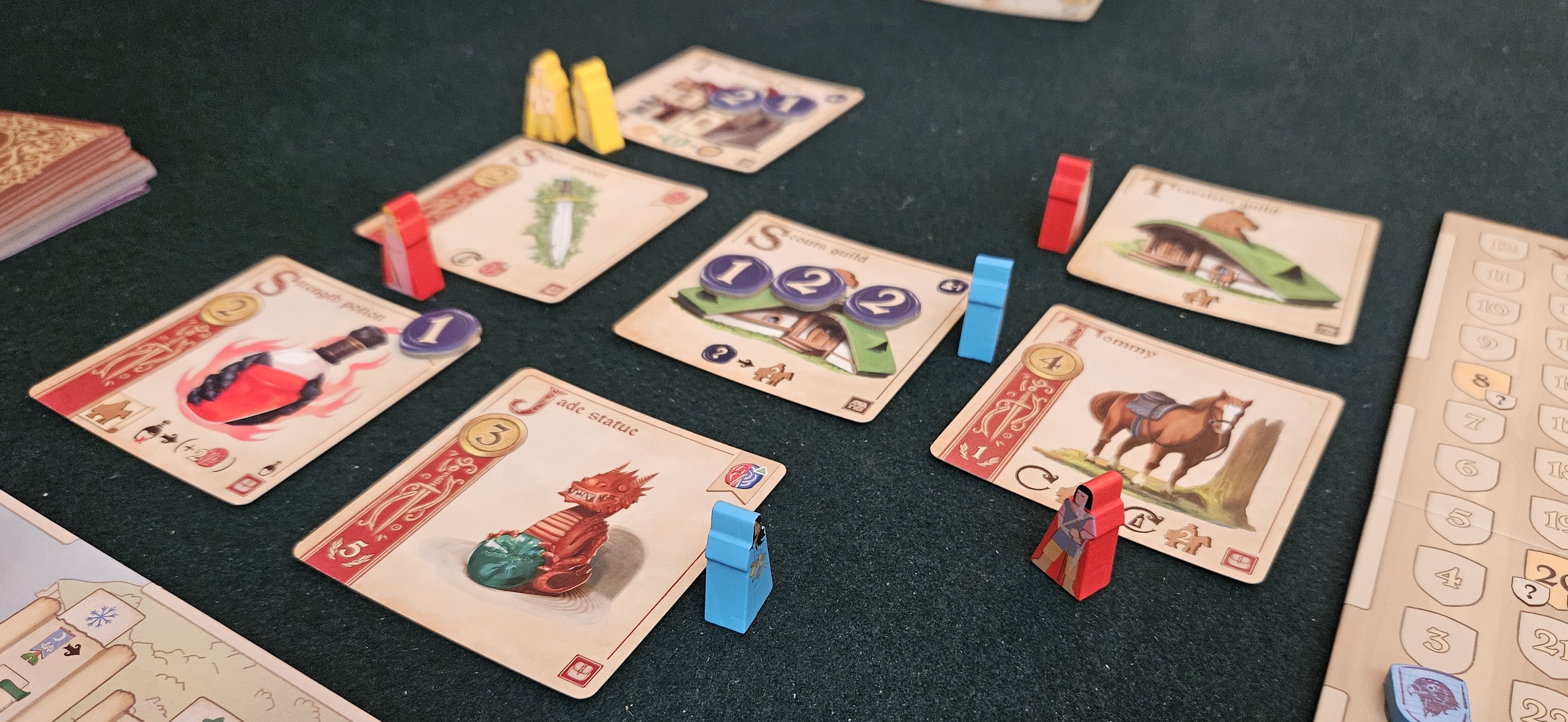
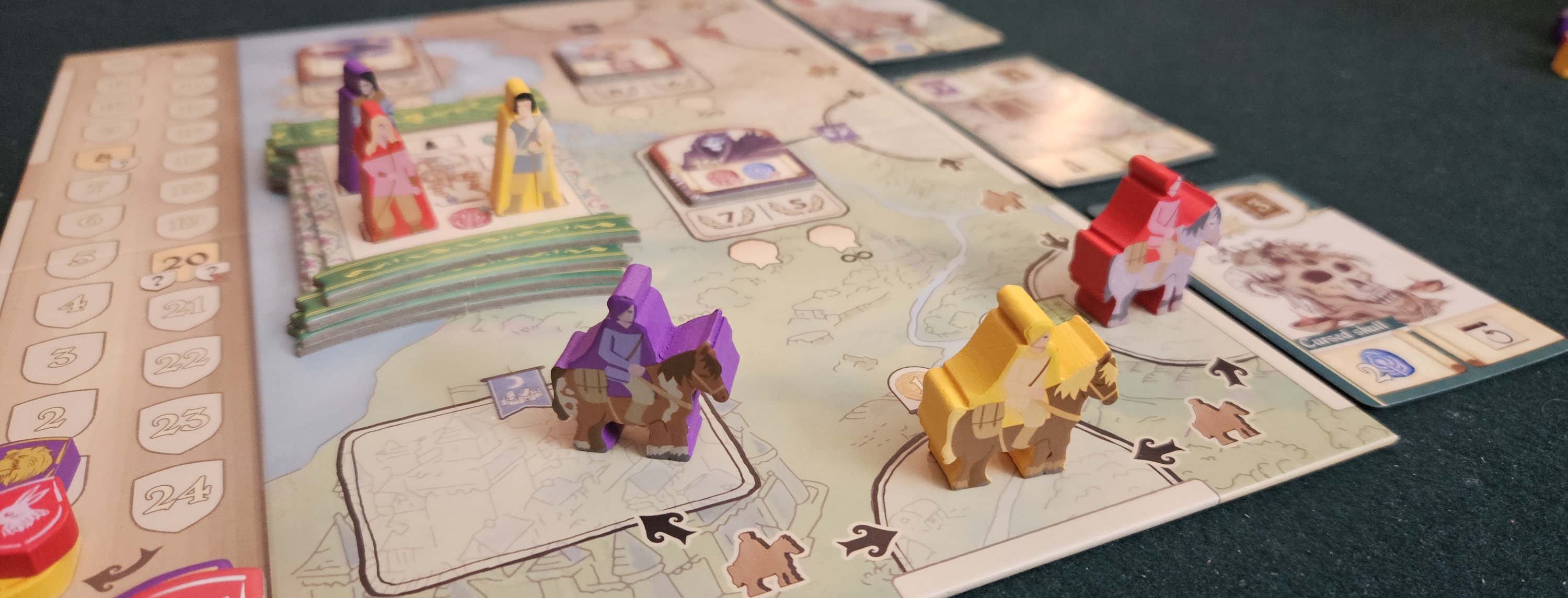
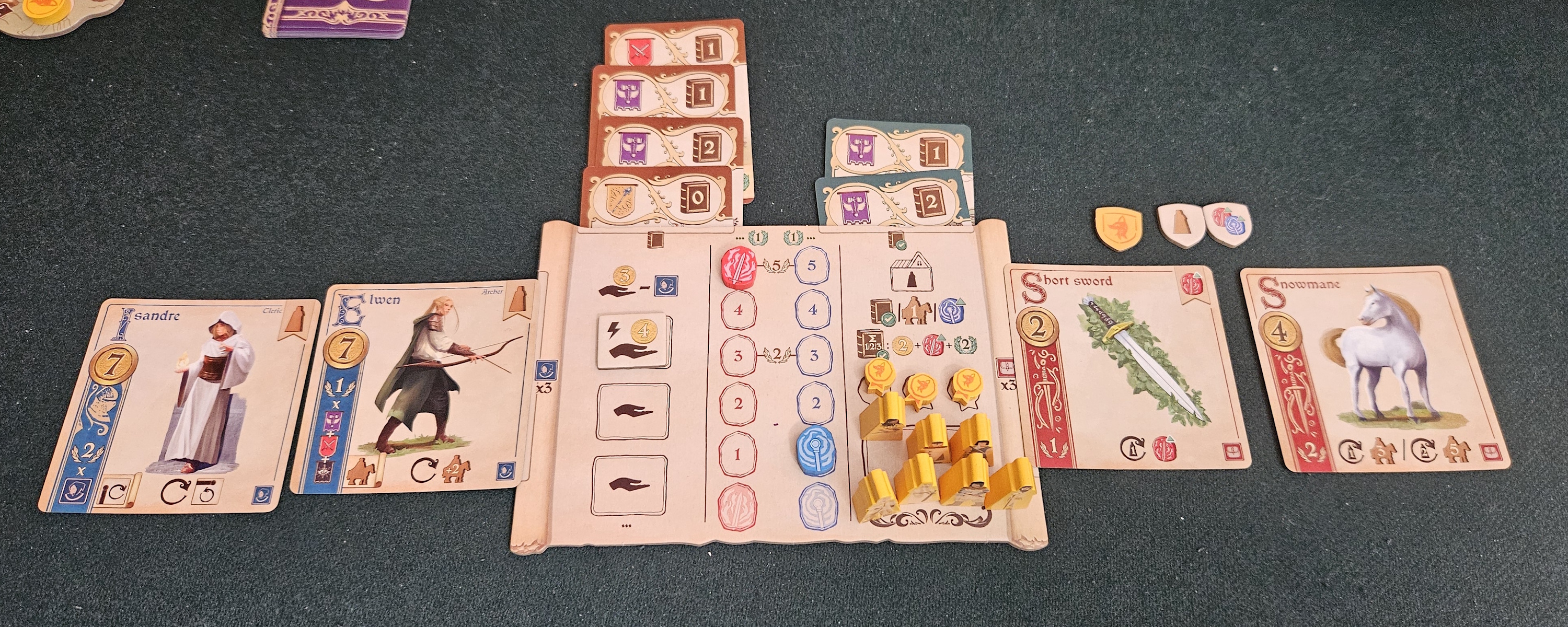
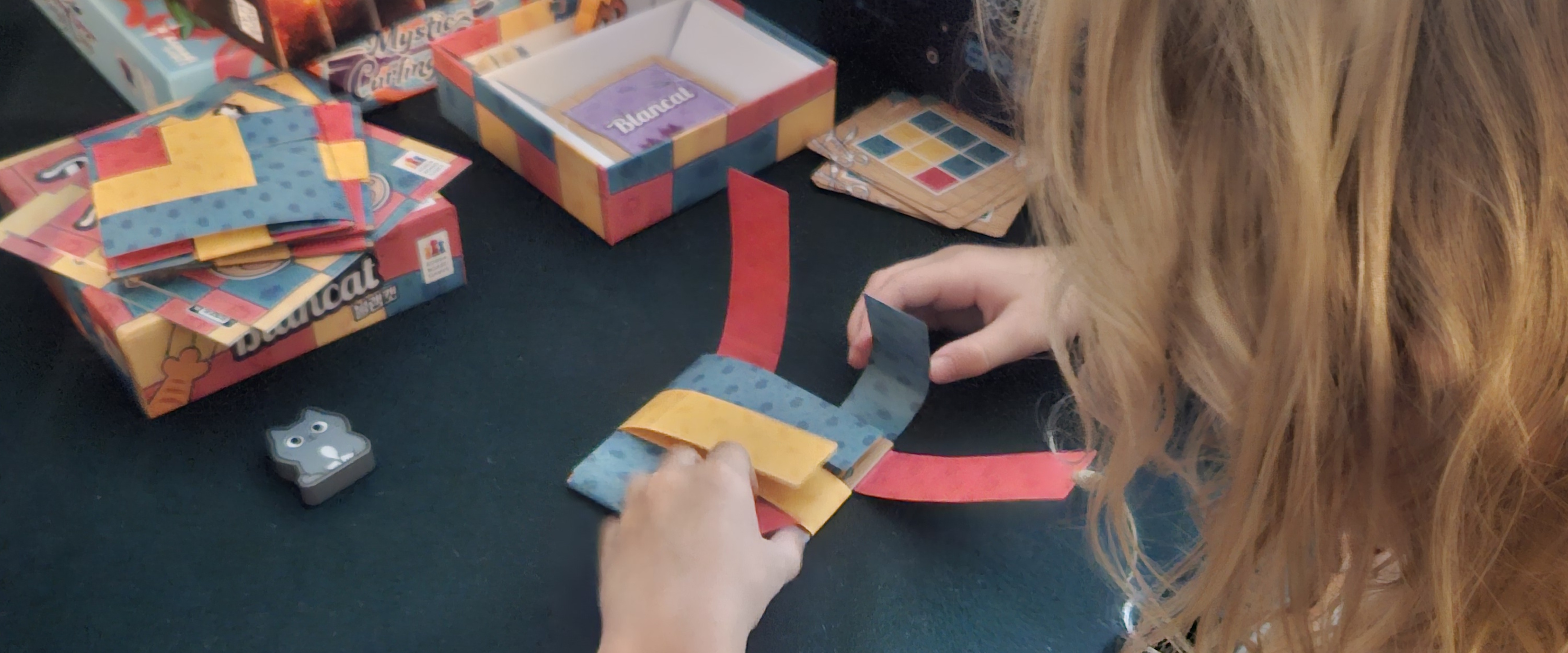
I don’t know what to make of Pond. Not as a board game — it isn’t that hard to get a handle on — but rather as an artifact of hyperreality, a signifier that has sprung into Pinocchio-like boyhood, a cardboard link to another game entirely.
Which, yeah, is to say that it calls to mind Root. It isn’t even that close, gameplay-wise. But when you put something on the table and three people blurt out “Is this that new Root expansion?” / “Wait, those aren’t the Root frogs” / “Huh, it even has four letters in the title,” just one part shy of a Barbershop quartet, reality begins to feel negotiable.
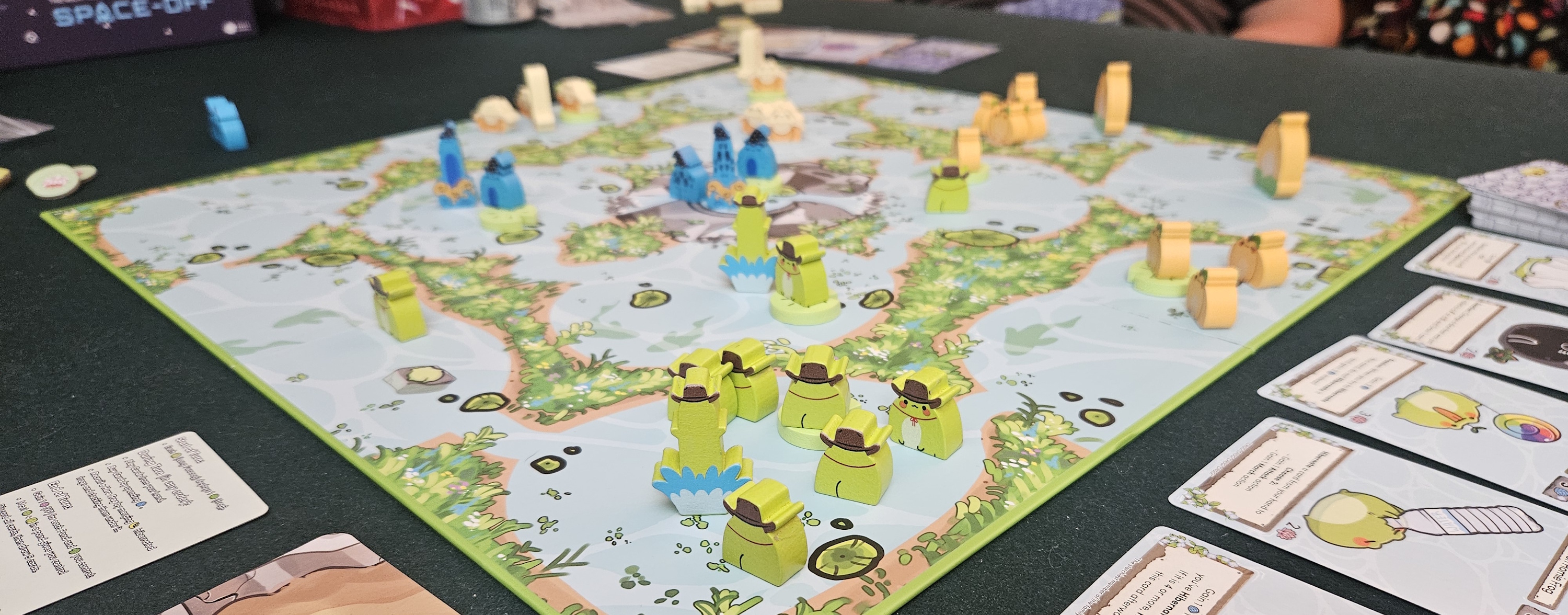
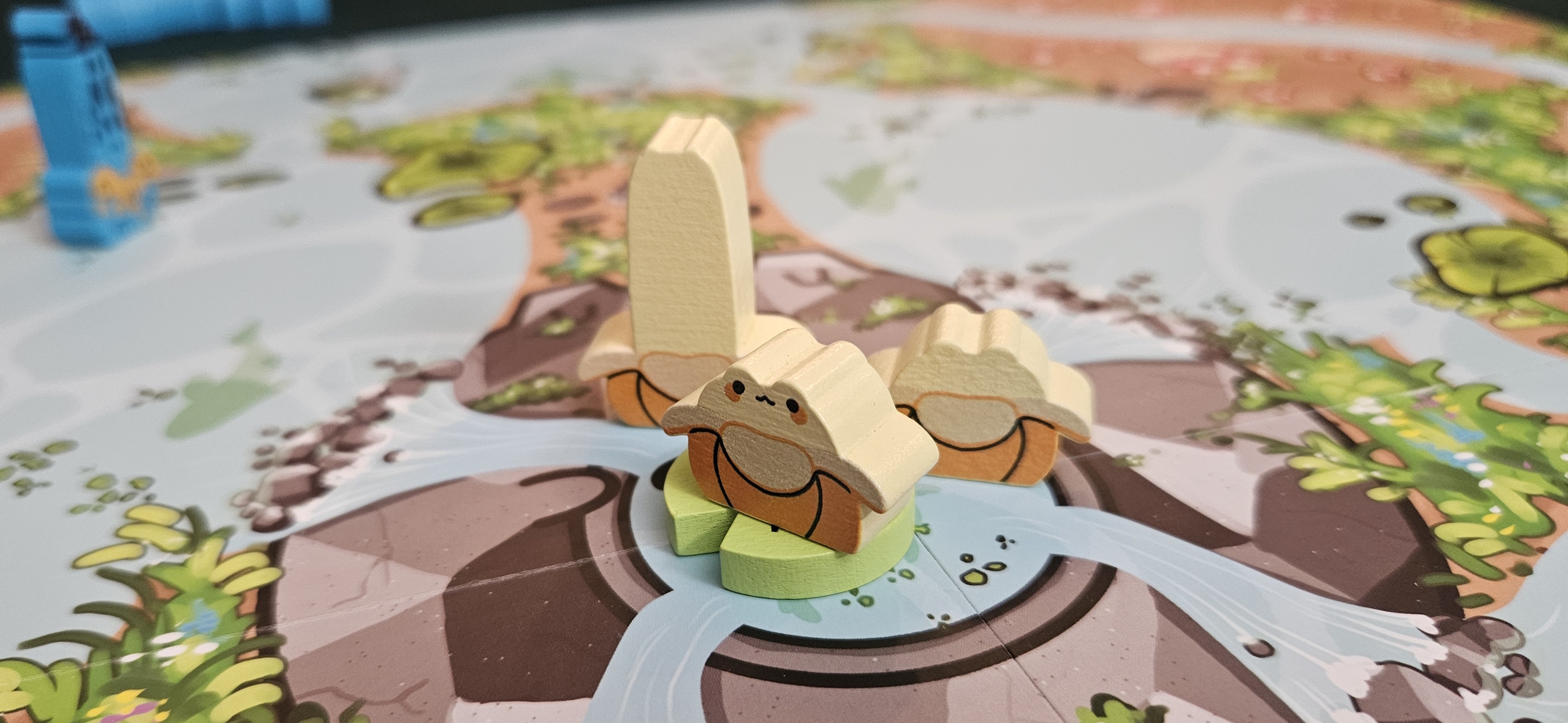
Frogs in their natural habitat.
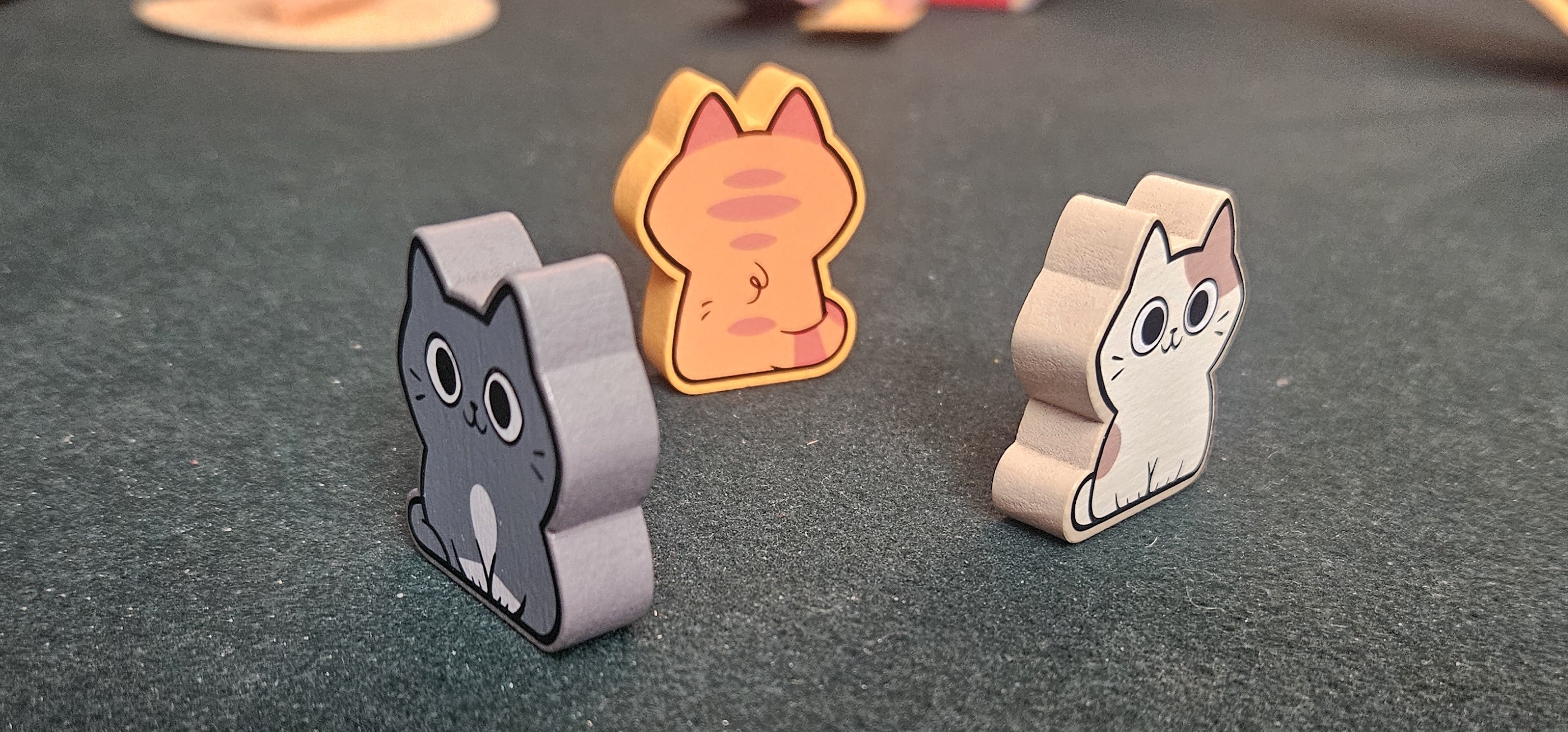
Picture this. Up to four factions of adorable wetland creatures have decided to duke it out for control of their local pond network. Each faction is asymmetric, with its own adorable superpower to attend to its adorable visual motif. For the most part, they are staffed with frogs. Just frogs: the infantry for this final war, the grist for this cuisses de grenouille.
There are also long frogs. Pardon me. Long fwooogs. That should tell you something about Pond’s sense of humor. If “long fwooog” strikes you as substantially cuter than “long frog,” this might be the game for you. At any rate, long fwooogs are the battlefield commanders who send their fellow frog-kind hopping into battle. They can be injured, in the sense that sustaining damage will result in points for your rivals, but never killed the way a lesser frog might be removed from the board. One imagines them the gentlemen officers of this particular campaign. Stiff upper lips when asked to call upon others to make the final sacrifice, quavering backs and sickbed sweats when it’s time to charge over the top. Which is perhaps why long fwooogs do not take part in battle directly.
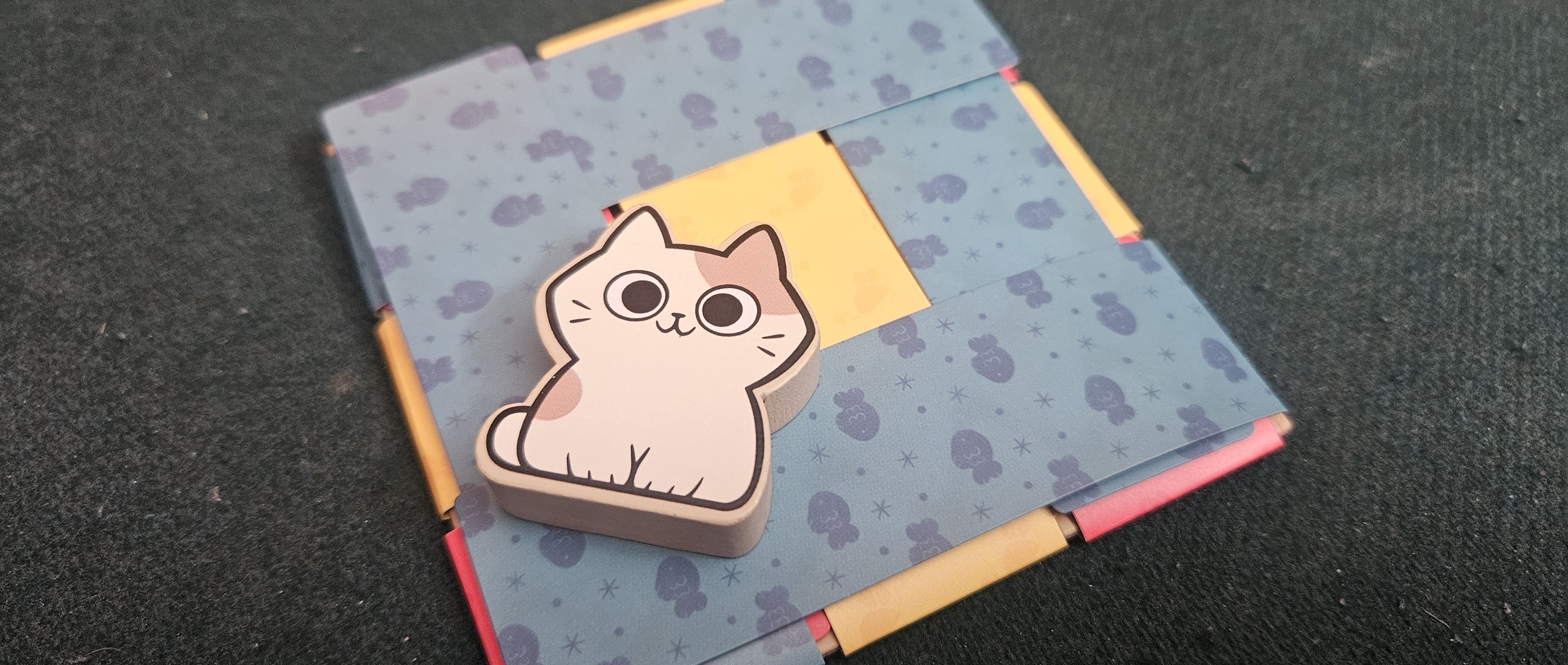
As for the map, it’s arranged as concentric ponds that radiate from the center. Each pond is identical, but lily pads may be built to increase one’s scoring value. Movement tends to be rapid. In part because the map is rather compact, but also because factions can accomplish quite a bit on a turn. The art, as you might expect, is downright adorable. I don’t mean that in a belittling sense; some of the cards made me laugh out loud, in particular the “Biblically Accurate Frog,” with its seraph’s spokes of eyes and wings.
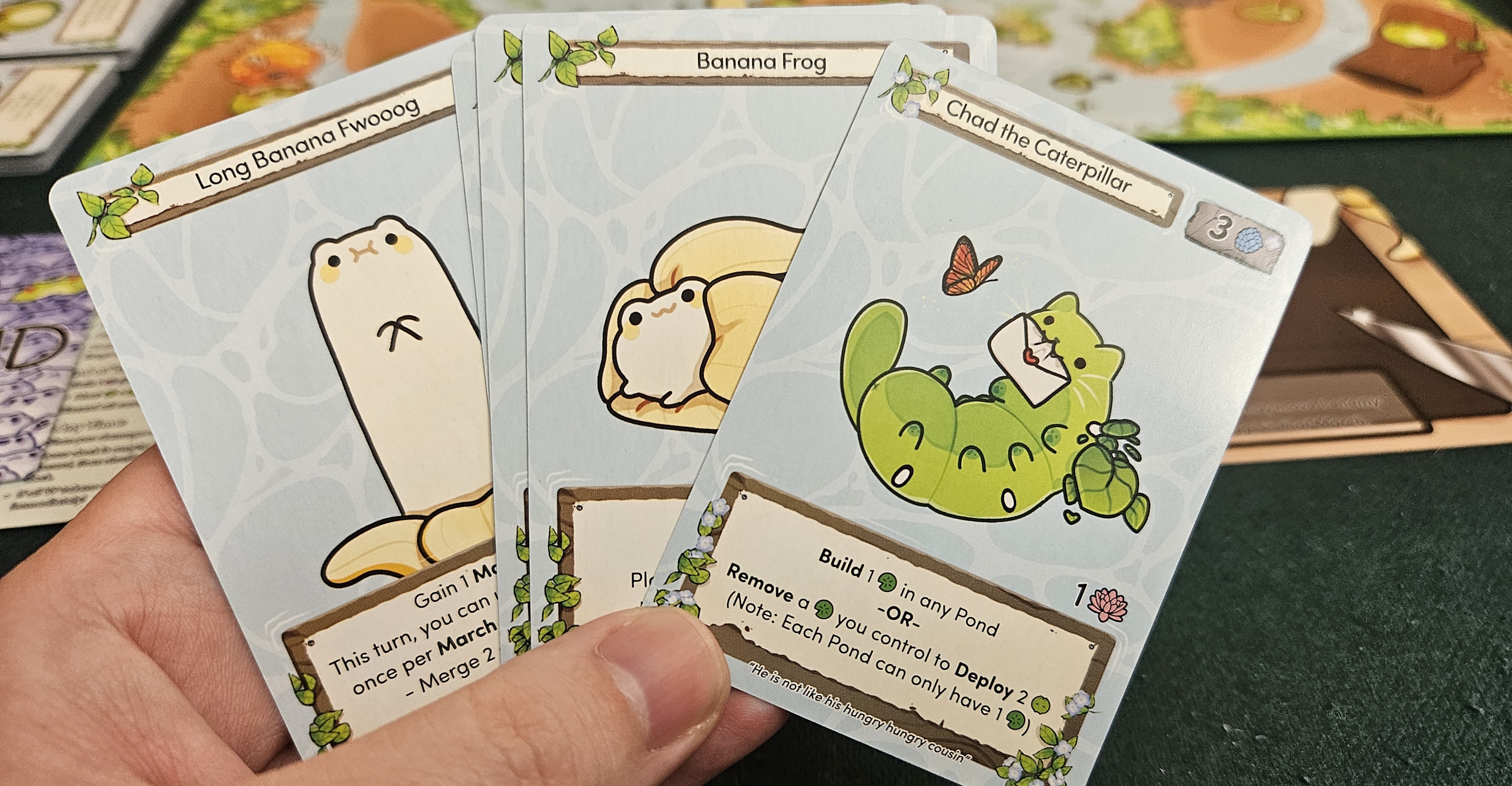
A pocketful of frogs.
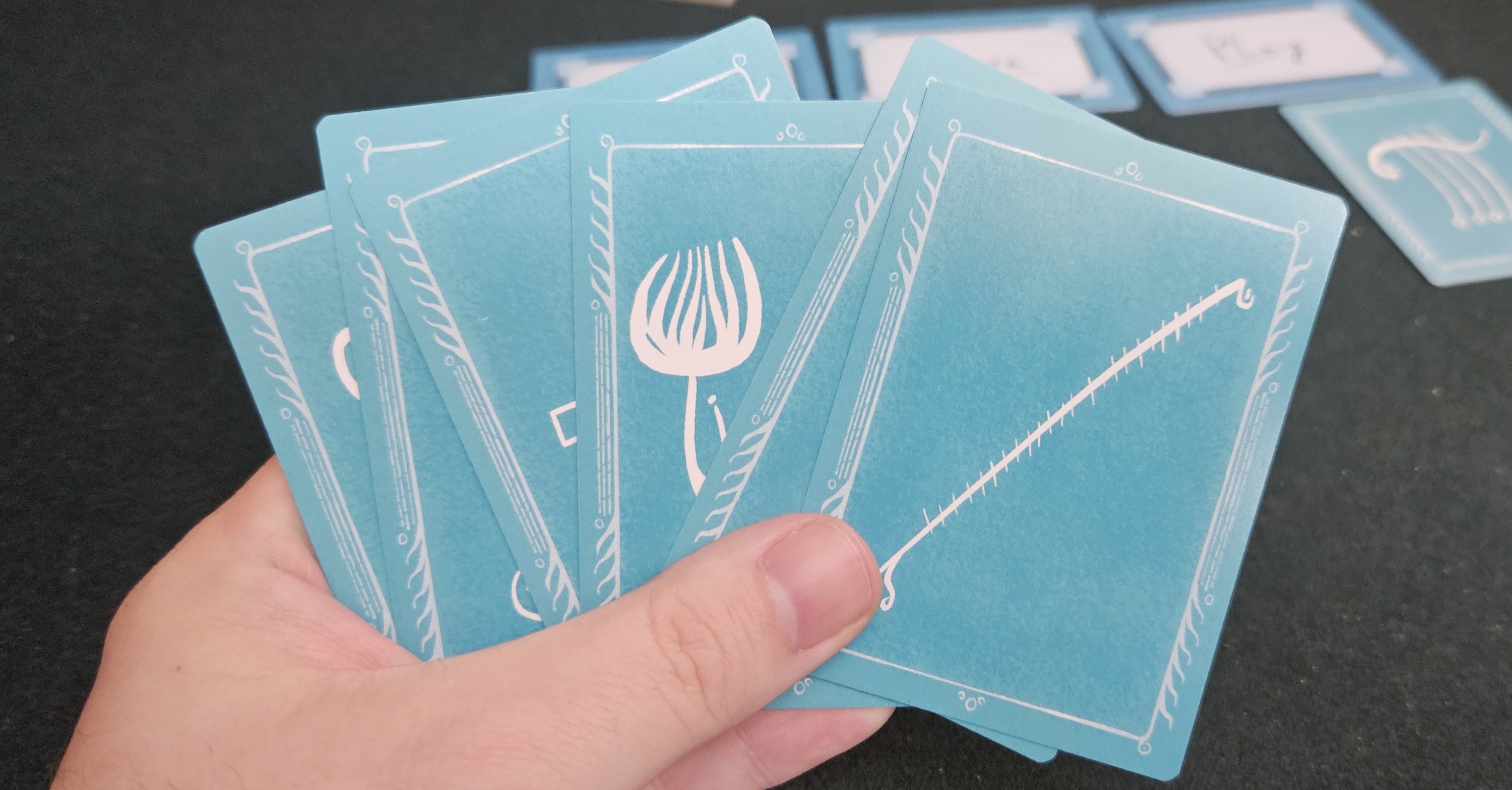
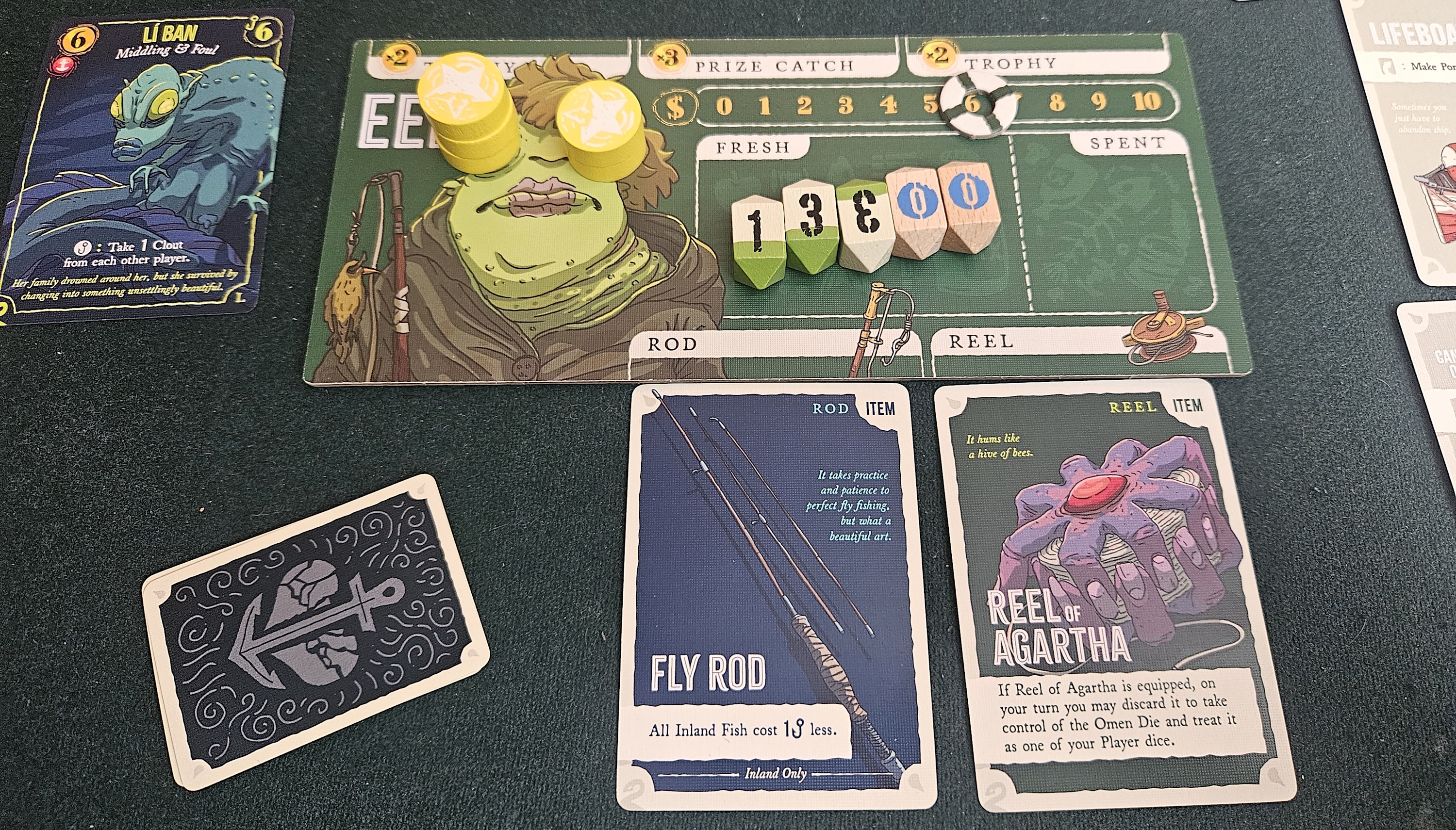
As for cards, there are heaps of the things. In a thankful departure from Root, Pond presents itself as a deck-building game. Everyone begins with a deck of ten cards, built from a combination of generic offerings (“Frog with a Knife” and “Frog with a Net”) and faction-specific troops that give each player their own dose of asymmetry without front-loading too many rules. Banana Frogs are slippery — they generate movement but also return to the top of your deck — while Wizard Frogs teleport around, Pumpkin Frogs produce lots of food, and Cowboy Frogs like to wrassle.
This is probably where Pond shines the brightest, not least because its card effects are all over the place. You might draft Jimmy the Bee into your deck to draw a card for every single lily pad under your control — potentially doubling the total action economy of your turn but also planting a target on all those lily pads. Or the Anarchy Frog, perfect for dumping all your stagnant frogs into a single pond and then lighting them on fire for a bunch of points. Swole Frog turns self-damaging battle results into offense-only attacks; Sneaky Frog deploys into any pond, even those you can’t normally reach; Cactus Frog pops a couple of attackers at the instant of their aggression. The whole thing feels wild and untamed. One might even say it doesn’t feel properly developed. All the better.
Of course, there aren’t infinite effects to tinker with. Indeed, one of the main limitations of the underlying system is that everything seems to revolve around four or five verbs — deploy, move, attack, build, hibernate — but within that rubric, there’s an impressive range of expression here. Some cards feel like outright showstoppers. As far as I’m concerned, that’s a great way to get the table to actually pay attention to the card market.
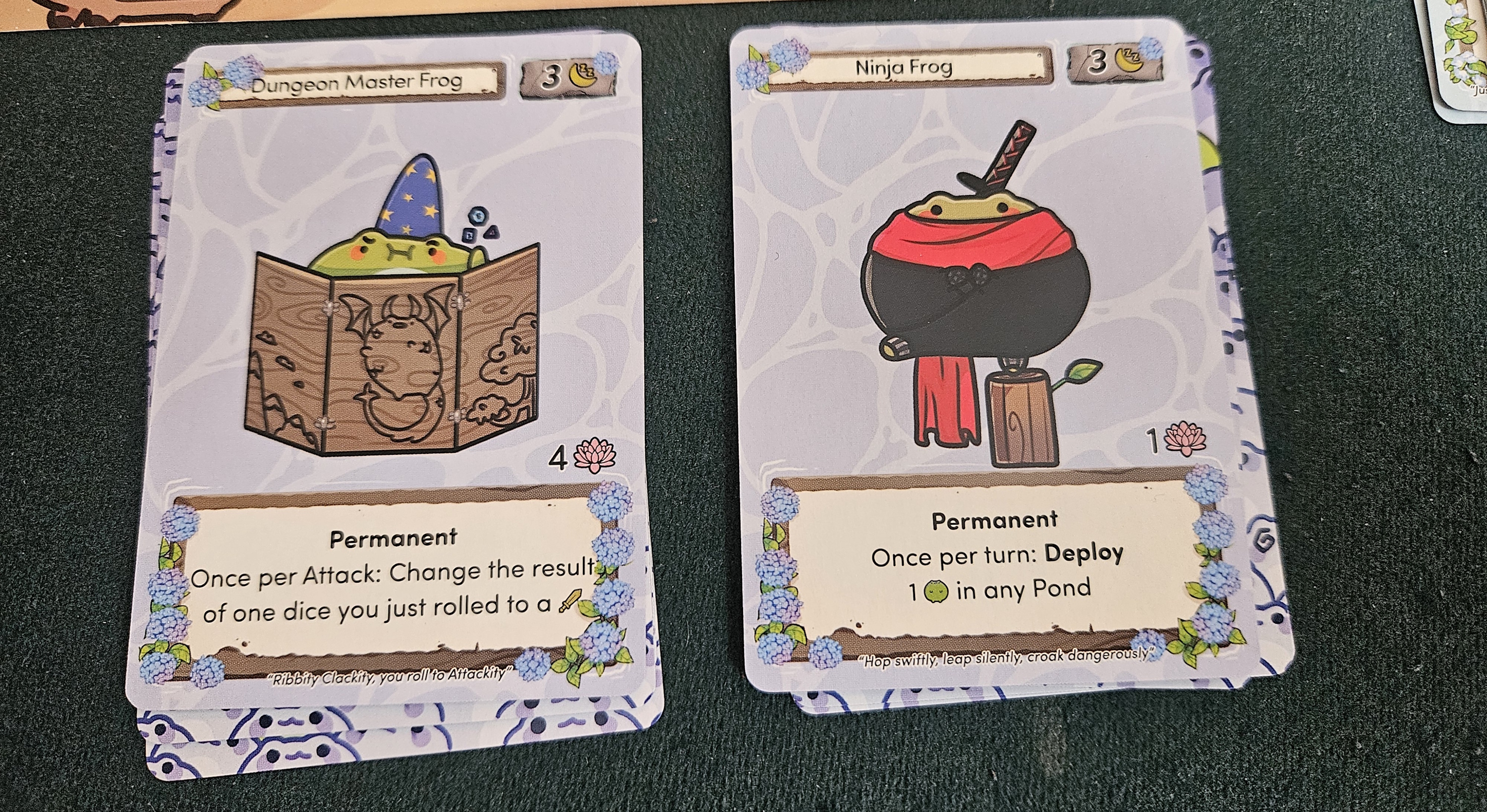
Hibernation leads to metamorphosis.
It helps, too, that card-winnowing is built right into the foundation. Whenever you shuffle your deck, you’re required to “hibernate” a frog, removing it from circulation while still preserving its point value. There are other ways to hibernate cards, too. They’re almost always desirable thanks to hero frogs.
What are hero frogs? Glad you asked. These are permanent upgrades that sit atop one, two, or three hibernated cards. That’s where the Biblically Accurate Frog comes in. Also the Unicorn Frog, the Leprechaun Frog, the Investor Frog, and so many more. To a one, these guys are valuable. First of all, you don’t need to shuffle them into your deck. Their ability is always there, ready to teleport a dead frog into your opponent’s swamp cooler.
At a more fundamental level, hibernation and heroes are a wonderful method for further defining all that factional asymmetry. Once again, almost no overhead required. This is probably where Pond deposits itself furthest from Root’s woodland. Where that game put all its chips on front-end asymmetry, requiring a tremendous initial investment before anybody could play — or at least play well — here the asymmetry is gentle at first, then slightly less gentle. It never becomes not gentle. Just more differentiated, with little perks that spring from the cards you’ve chosen to hibernate, draft, and deputize to hero status.
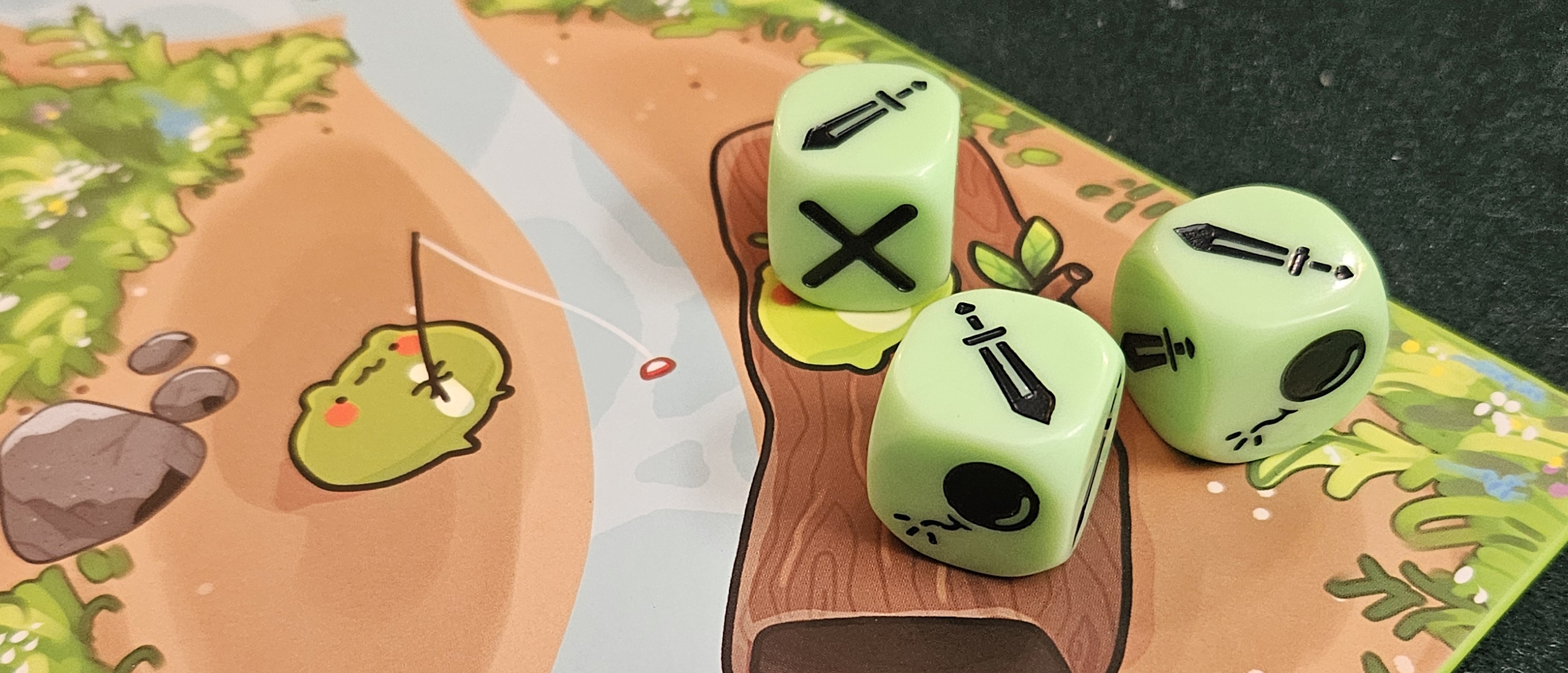
Frog battles are dangerous affairs.
Which brings us, inadvertently, back to Root.
I’ve seen some people call Pond a starter Root. My Little Root. Root for Babies. (Okay, not that one.) That isn’t too far off in the sense that its adorable artwork belies a confrontational race to score a certain number of points. But the games are surprisingly distinct in their underlying approach. They’re both volume-measuring tools with froggy eyes sharpied onto the side. But one is a funnel that runs from wide to narrow while the other is a bit more of a graduated cylinder. Despite some superficial resemblance, they move their liquids toward different purposes. A gulp versus a sip.
Those purposes, meanwhile, reach different conclusions. Root has been around for eight years. That’s a long time in this hyper-speed hobby of ours. Long enough to spawn imitators, some more flattering than others. Pond, in some senses, feels like a game that can only exist because Root existed first. But it carves out an identity that feels… still similar to Root, but not overly so. Not so close that it starts to feel like a ripoff. Just another perspective on similar themes. Root but easier to learn. Root with a first teach that doesn’t feel like reading a syllabus. Root that ends with a bang rather than a last little trickle of crafting points. Root without the near-infinite imaginary space.
(Root without Foucault? Yes. But Root as Baudrillard, as the signifier and signified getting mixed together until we can’t tell the difference. Root as the meme that has escaped containment. If it could ever be contained to begin with.)
Sometimes a frog is only a frog.
This leaves Pond in an interesting place. There’s a spot for a lighter adorable woodland creature kingmaking asymmetrical game. Maybe not the biggest spot or the most lasting one. But it would be false to pretend that Pond hasn’t exerted some charm. I’ve enjoyed spending a few sessions with its Biblically Accurate Frogs and Frogs with Two Knives and, sure, even the Long Fwooogs, cloying as they seem. I don’t imagine I’ll keep coming back, but my romps through these wetlands have been enjoyable all the same.
A complimentary copy of Pond was provided by the designer/publisher.
(If what I’m doing at Space-Biff! is valuable to you in some way, please consider dropping by my Patreon campaign or Ko-fi. Right now, supporters can read the next installment in my series Talking About Games, this time tackling the topic of what makes a good list! Naturally, the piece includes a list.)
Circle of Conflict is a really bad title. Just terrible. You know what would have been better? Anything. Ring of Conflict, maybe, seeing as how this is a Lord of the Rings shindig. Crud, just call it Circlet. That has an elegant chime, doesn’t it? Circlet.
I imagine the thinking behind the title, which was designed by Geoff Engelstein and Stephen Buonocore, was that it’s descriptive. Because the game actually plops you right into the middle of a circle, you see, and that circle happens to be not a circle of harmony, but a circle of conflict. You’re reenacting the War of the Third Age from both perspectives, commanding the Free Peoples against the player to your left and Sauron & Friends against the player to your right. Thus the Circle. The Circle of Conflict.
The other rancid thing about the title is that… oh, what’s that? You want to hear about the game? Very well. It’s quite good. Not perfect, but good.
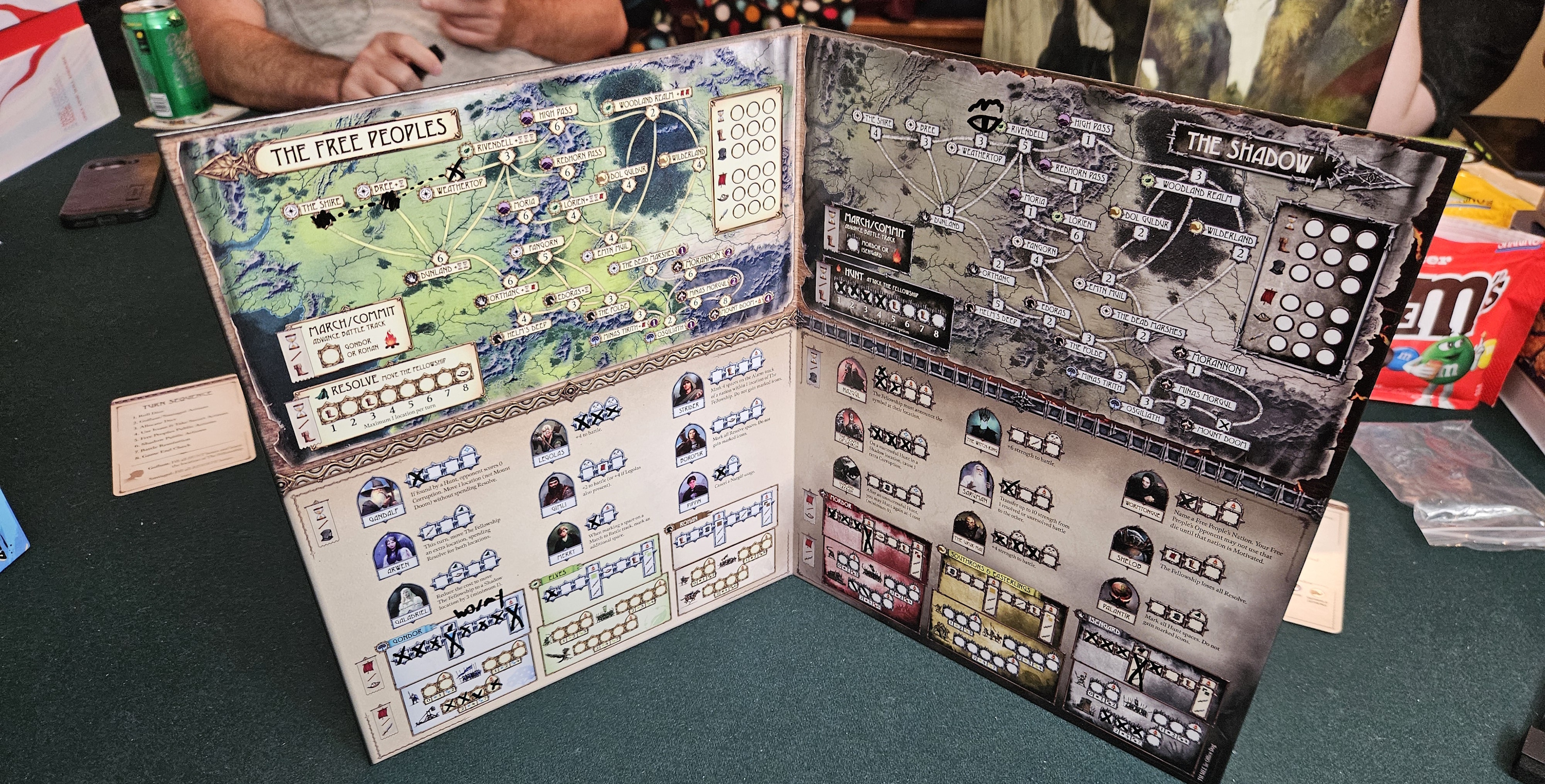
More board games should be in folders. For the lazy.
As gimmicks go, one could do a lot worse than Circle of Conflict. It’s like the inverse of its title: just a great idea from top to bottom. As the Free Peoples, you’re trying to safeguard the One Ring on its trip to Mount Doom, muster armies to defend Rohan and Gondor, and generally vouchsafe the hearts of men so they don’t falter. As the Shadow, you’re doing all that but exactly the opposite. Find the Ring, burn Rohan, burn Gondor, indulge every impulse.
And it works. Works well, in fact. Works too well, perhaps, in the sense that the system very quickly scurries out of the way and opens up the holistic design to any number of nitpicks.
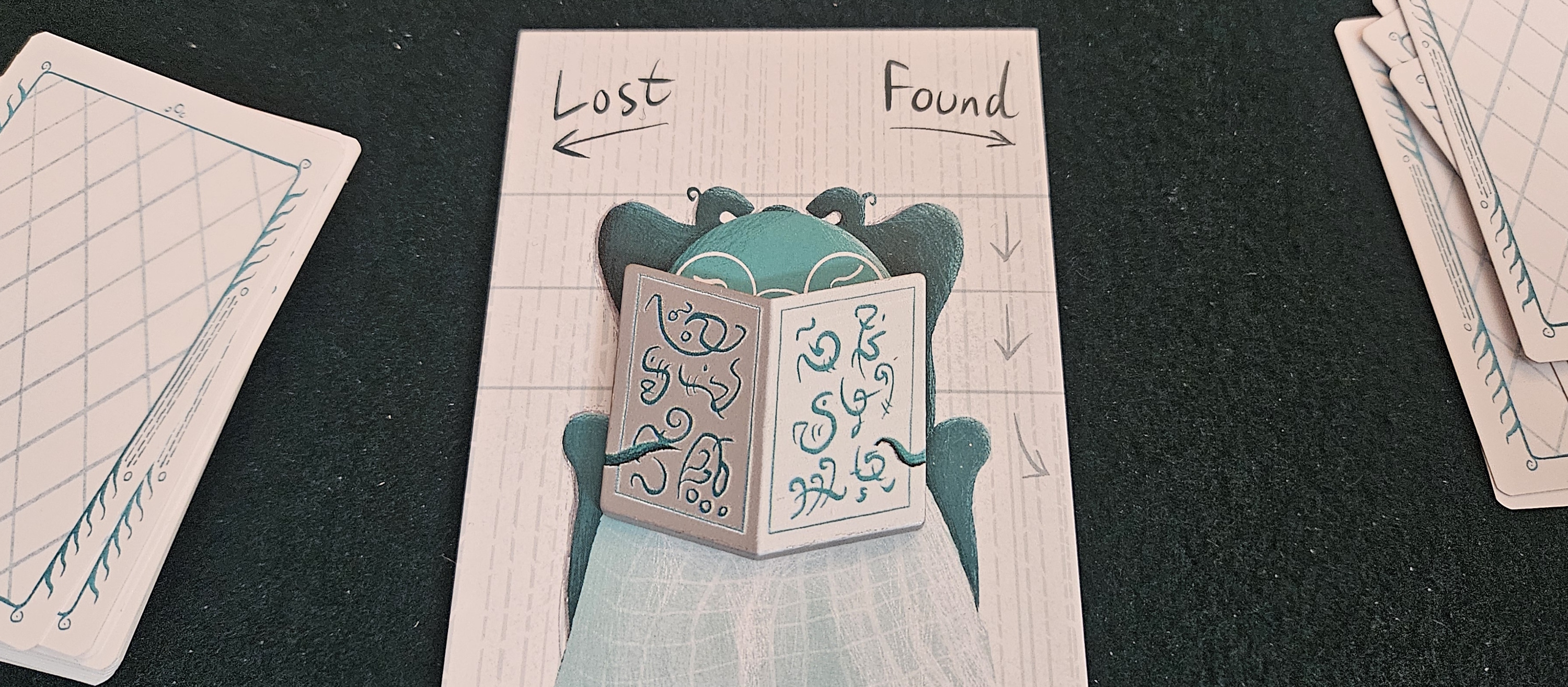
The baseline mechanism is roll-and-write, landing this in the long and not-often-successful lineage of titles that have tried to fashion a roll-and-write-but-bigger game. Every round — which is a mess of phases, just be warned — opens with a big handful of chunky dice getting rolled onto the table. When the game begins, only two of these dice are actually usable, and you’re required to divide them between the halves of your demesne. One for the Free Peoples, one for the Shadow.
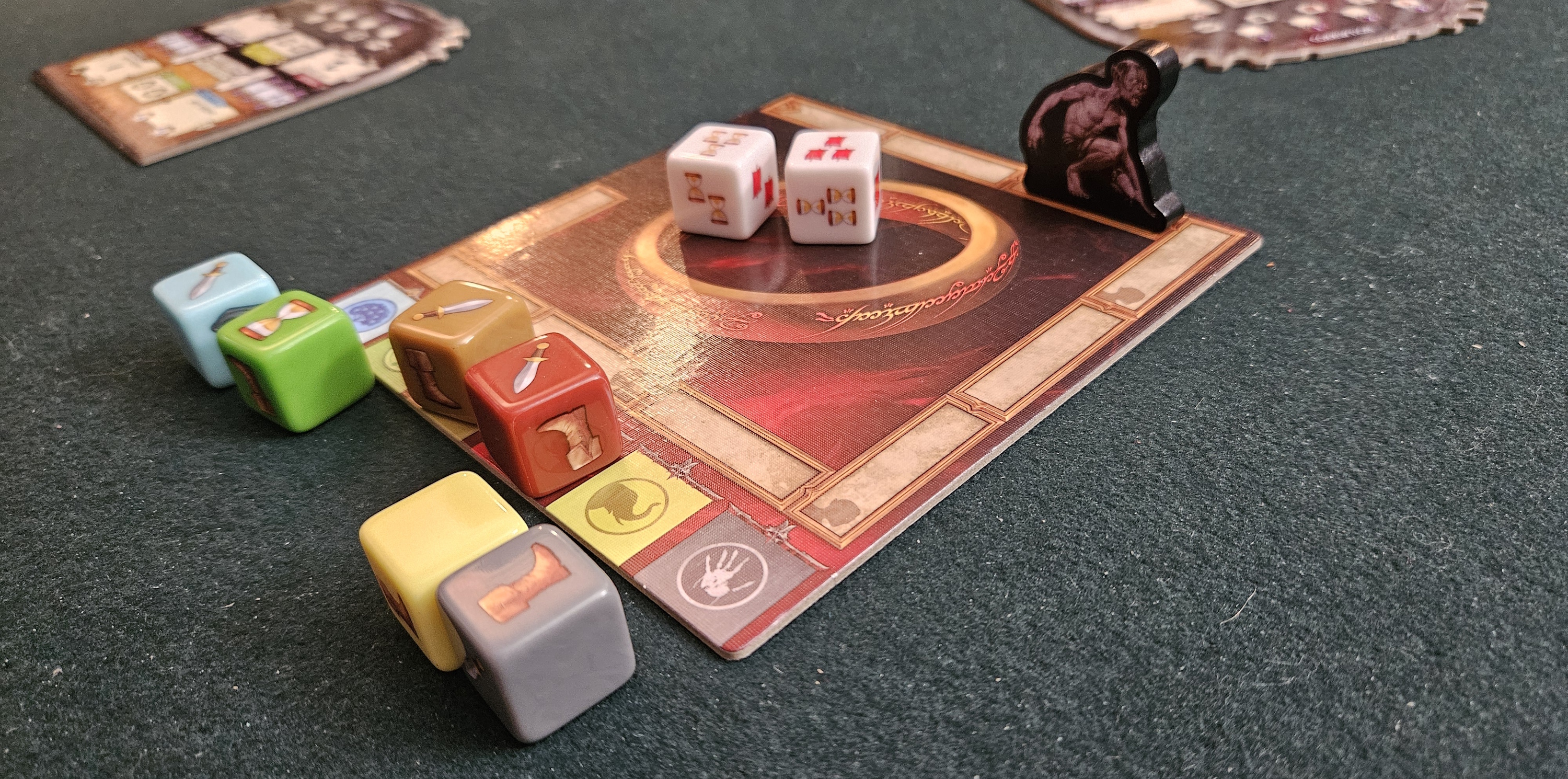
I do love some nice dice. And a nice Sméagol, too.
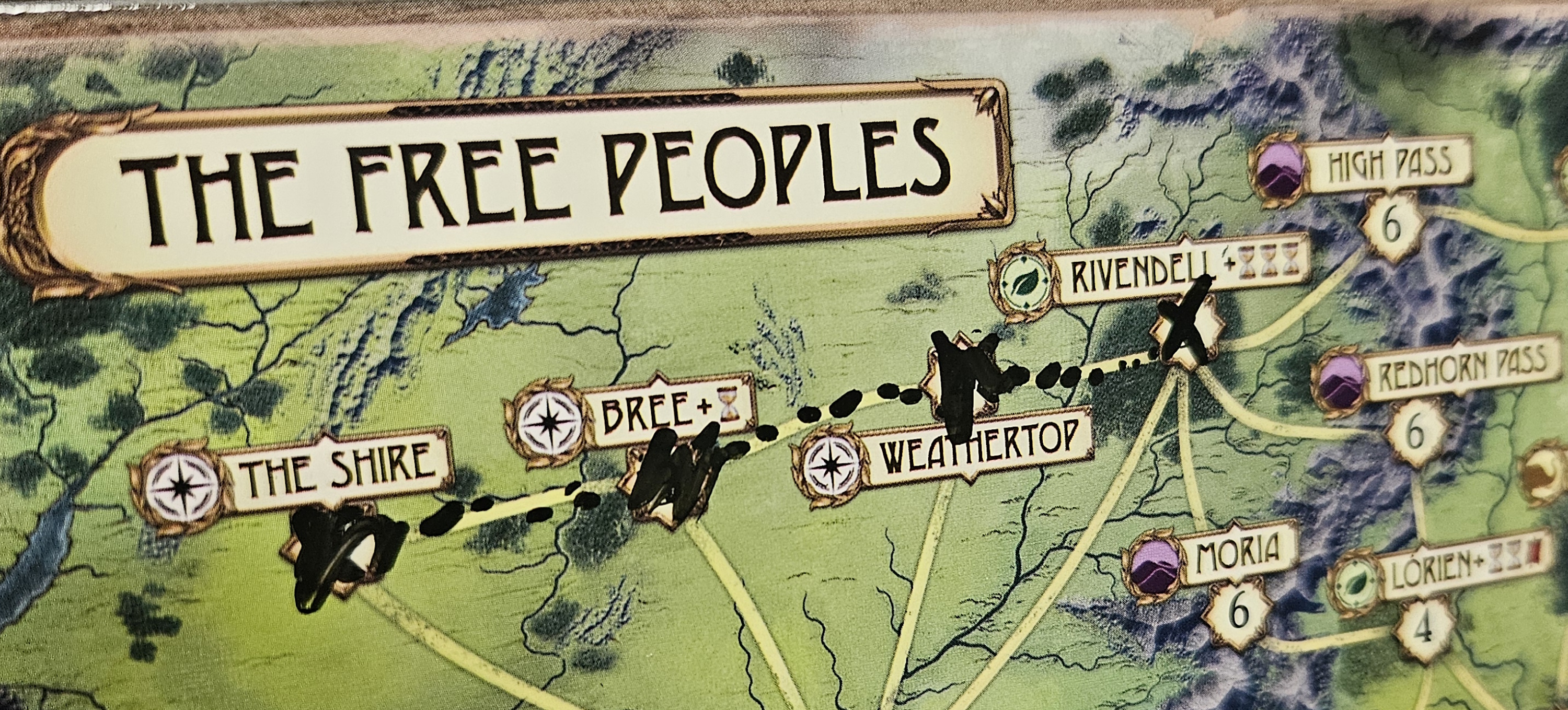
It’s a simple enough decision, although of course there’s more to it than first meets the eye. It isn’t long before players begin to hear rumors from their neighbors. Perhaps the player to your left announces that they’ve rallied Isengard. This means they also gain the icons from the gray die, and may soon begin deploying troops to assault your version of Rohan. Meanwhile your Nazgul are hunting for the Ring somewhere around Weathertop; this initiates a call-and-response phase where you check your investigation against the player to your right, who reveals whether you’ve managed to corrupt their Ringbearer.
Point is, while you aren’t given total control over whether to go all-in on one side or the other, you’re afforded just enough authority to lather up some nice apprehension. At times, it can feel like both sides are pressing in on you while ignoring their neighbors on the opposite side. It’s a smart way of divvying up the action on Engelstein and Buonocore’s part. Some activities are concealed, others reveal essential breadcrumbs of military intelligence. Along the way, you hope you aren’t playing with cheaters. Or people who don’t really understand the rules and might interpret them in their favor.
At all times, this puts you in twin headspaces: hunter and hunted, army on the march and defenders under siege, Gollum and Sméagol. Actually, you’re only ever Gollum or Sméagol. There’s a special phase for that. Everyone chooses whether they’re the li’l guy’s good side or bad side, then reveals their decision and handles the fallout. If anything, Gollum’s madness seems like the one thing to collapse the game’s cosmological superposition. But that’s neither here nor there.
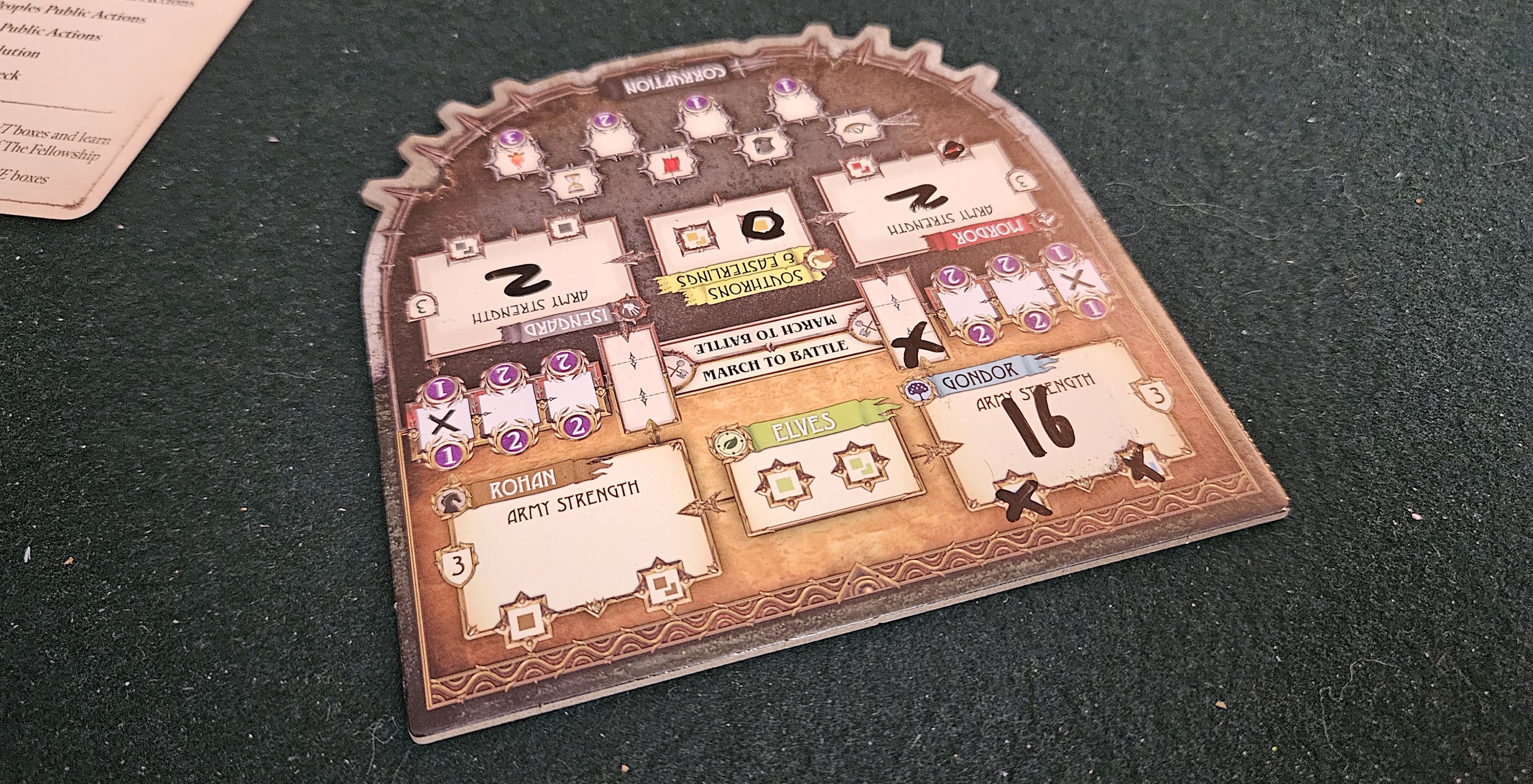
The battle board is, ahem, functional.
If anything, there are a few points where Circle of Conflict (ugh) seems to throw up its hands, as though Engelstein and Buonocore knew they were onto something great and realized they had to bring it back down lest they invent something too mind-expanding. There are a lot of the customary roll-and-write combos, for example, where you’ll be filling in one bubble that then awards another icon that lets you mark another bubble, and then that bubble lets you mark something else, and on and on until an ordinary turn has transformed into two or three turns’ worth of dry-erase daubs. In a game this distinct, these moments always feel like a throwback to the format’s puzzle-going past, more of a conundrum to solve than a dynamic contest between players.
And, yes, at times Circle of Conflict (hurk) feels like too much of a puzzle. After one or two sessions, you get a good sense for which combos will really let you whip along its tracks. Some early Boromir and Galadriel to secure the loyalty of Rohan toot suite, Wormtongue to tank the loyalty of whichever nation your right-ward neighbor embraces first, just enough Legolas Gimli to max out your battle value but no more. I don’t want to say it can be “solved”… but one of my opponents in our most recent session sure believed so.
Which isn’t to say this ruins the game. Not by a long shot. It’s just that Circle of Conflict (uruk-hai) is at its best when it leans into the suspense between neighboring players, but not every portion of the design is pitched toward maximizing that. The slow buildup of armies, with both sides growing stronger, closer, and more likely to win a bunch of points from the coming battle: incredible. The gradual chase and evasion of the Ring on both sides: wonderful. The occasional game-disturbing abilities from the heroes: appropriately enraging. Waiting around while somebody completes their tenth mark on a turn when you earned two or three: a bit of a downer.
Conducting the grand tour.
On the whole, I dig it. It calls to mind other experimental titles like Captain Sonar and The Anarchy in its willingness to tinker with the usual formula, even as it doesn’t quite reach their heights. Even so, there are little touches that make it especially considerable, like how the hobbits are tiny until suddenly they matter quite a lot, the occasional ability to move or hunt with greater efficacy, or, my favorite detail, the fact that the whole thing is presented as a single folder so you can lean back in your chair while you jot down your moves. One could do a lot worse.
A complimentary copy of The Lord of the Rings: Circle of Conflict was provided by the publisher.
(If what I’m doing at Space-Biff! is valuable to you in some way, please consider dropping by my Patreon campaign or Ko-fi. Right now, supporters can read the next installment in my series Talking About Games, this time tackling the topic of what makes a good list! Naturally, the piece includes a list.)
What recourse is there for the public when their leaders will not listen, their employers have broken the compacts that bind society, and their bellies gnaw with hunger?
If two examples are sufficient to draw a motif, that seems to be the recurring question at the center of Yoni Goldstein’s work. Last year’s Chicago ’68 was a refreshing look at civil disobedience in the streets; now Goldstein and the Dietz Foundation are publishing The Nights of King Ludd, which raises similar questions about resistance and state repression despite being translocated across an ocean and 150 years.
Gettim, lads!
I’ve been twice called a Luddite. The second time was not that long ago, after publishing an article explaining why I wouldn’t be reviewing any board game that used non-human artwork. A few years before that, it was because I mentioned to a friend that I thought it was wrong for corporations to use programmed obsolescence to spur consumers to purchase replacement cell phones.
In both cases, the response felt similar. “Get with the times. You can’t fight progress. This technology is inevitable. Go with the tide or get washed away by it.”
At the turn of the 18th to 19th century, English stockingers and woolworkers were hearing similar sentiments. Their trade, which had been conducted by domestic labor for over a century, was facing upheaval. The stocking frame was not a new technology — it had been invented in Nottingham way back in 1589 — but gradual improvements, such as rotary-, water-, and steam-powered frames and Jebediah Strutt’s derby rib, made it possible to turn out greater quantities than ever before.
Now, I know what you’re thinking. Isn’t easier work better than harder work? In theory, absolutely. I’m as lazy as they come, so you won’t hear a peep out of me on that count.
But the people who made their living knitting stockings weren’t the ones who benefited from these improvements. Over the course of a few short decades, mill owners used one dirty trick after another to dispossess an entire class of laborer. They violated price-collaboration laws. They used enclosure acts to drive commoners from the lands they had occupied for centuries, producing hordes of desperate workers who would work for almost nothing. They used their superior access to parliament to lobby for frame-breaking protections and outlaw collective bargaining. They churned out cheaper but less durable products. They employed children with no care for the blood their amputated limbs left in the machines. They used war as a pretext to declare their industries essential and therefore in need of military protection.
With every peaceful recourse blocked off, some textile workers took matters in a different direction. They took up their hammers not to work the machine, but to break it. And they did so under the fictional name of Ned Ludd.
Roles are dynamic, with self-interested goals and unique abilities.
This is where The Nights of King Ludd deposits us. The mills are roaring. Thousands have already been displaced. It’s going to get a lot worse before it gets better.
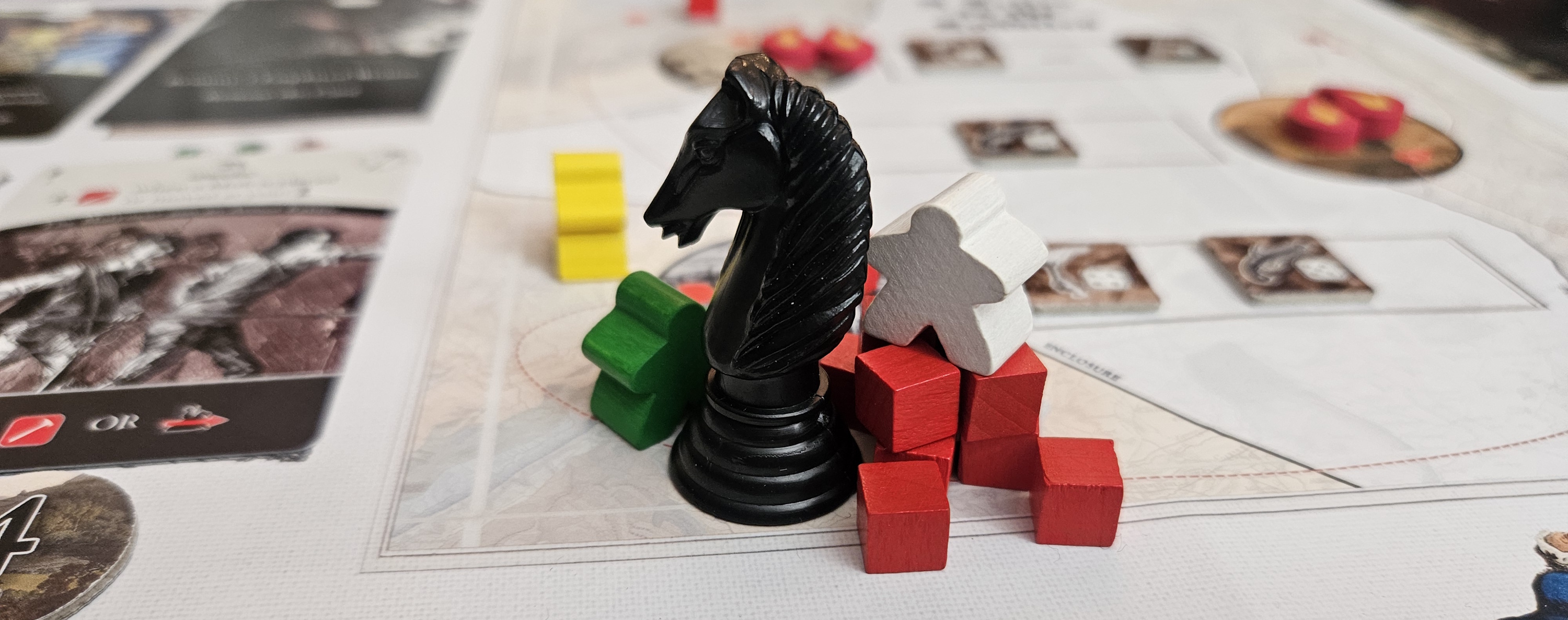
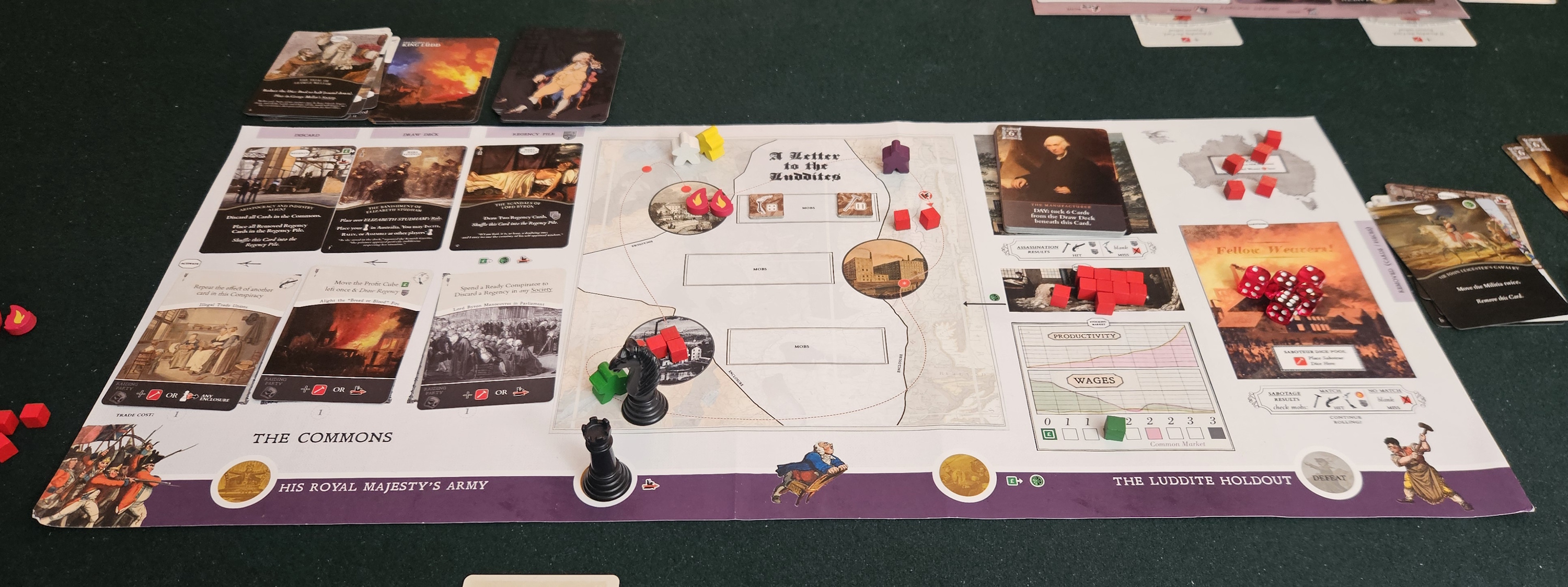
Goldstein presents the Luddite movement from two vantages. There’s the sky-high perspective, showing the three epicenters of Luddite activity in Nottinghamshire, Yorkshire, and Lancashire. This portion has the look of a traditional historical simulation game: there are enclosures for unemployed laborers, mills where workers or mobs can congregate, and a chess knight making the rounds to crack down on anyone threatening the supply of cheap stockings and lace.
But there’s another, more intimate perspective, and it’s here that Goldstein’s approach to the Luddite movement becomes clearer. Rather than embodying the Luddites as a faceless mass, as they’ve customarily been represented by the intervening two centuries of Oxford tut-tutting, here they’re given names and faces — and, above even those signifiers, personal aspirations and fears.
It works like this. When the game opens, everybody adopts an identity. You might become George Mellor, King Ludd’s “right-hand man” who infamously assassinated the wealthiest mill owner of Yorkshire and hanged for it. Everybody at the table loses the game together if they don’t burn the map’s three mills, but Mellor must also assassinate the manufacturer, a nasty piece of work who sits at the side of the board and hoovers up cards from the deck with each passing round. This is a dangerous proposition, liable to bring the military down on the movement’s head sooner than later, ensuring that Mellor’s appearance lends the session a riotous edge.
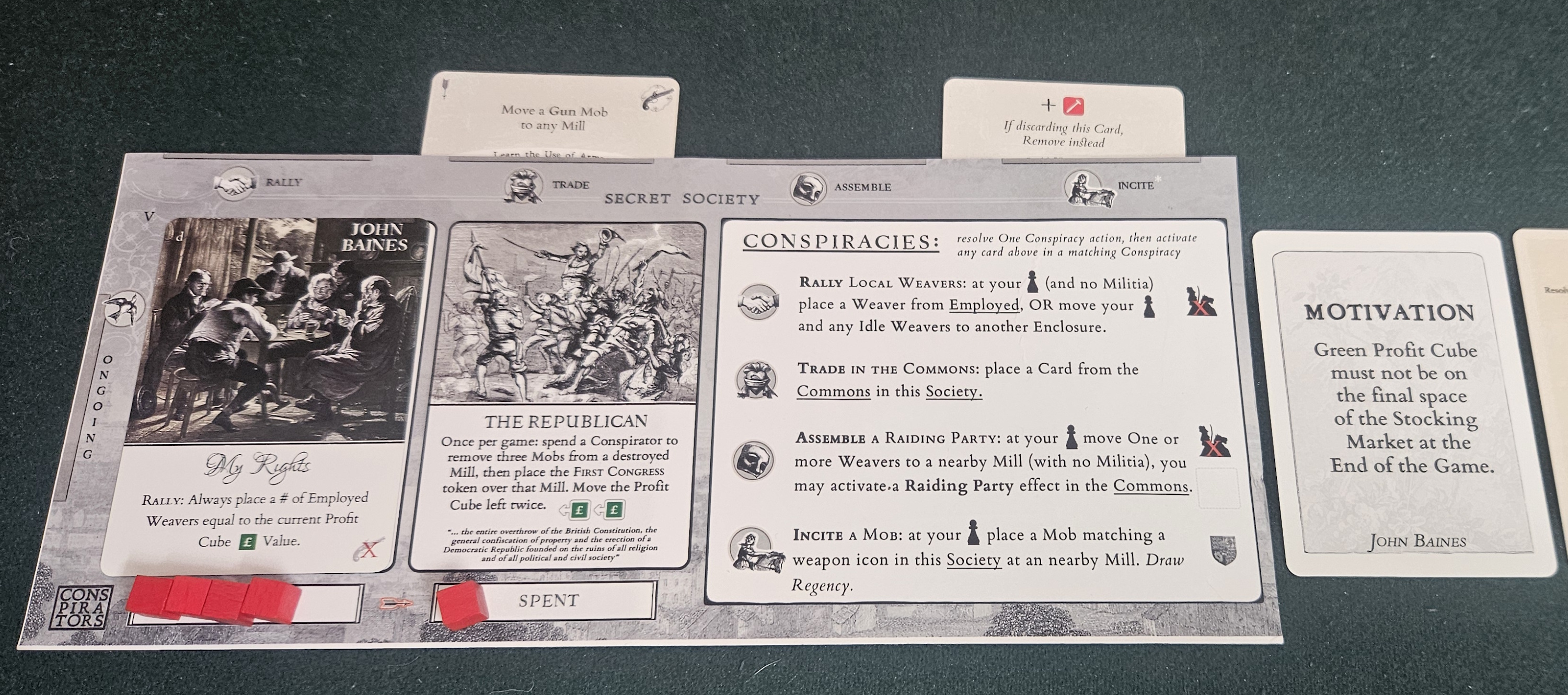
That’s the extreme end of things. The remaining identities provide other objectives, like sisters Mary and Lydia Molyneux’s desire to hold onto their family’s position in society and John Baines’ fear that the price of goods will collapse. These characters necessitate a more cautious approach, one that strives to keep as many weavers employed as possible rather than whipping everyone into a frenzy. These figures have been brought together by a manufactured crisis, but they have stark differences of opinion on the movement’s operation.
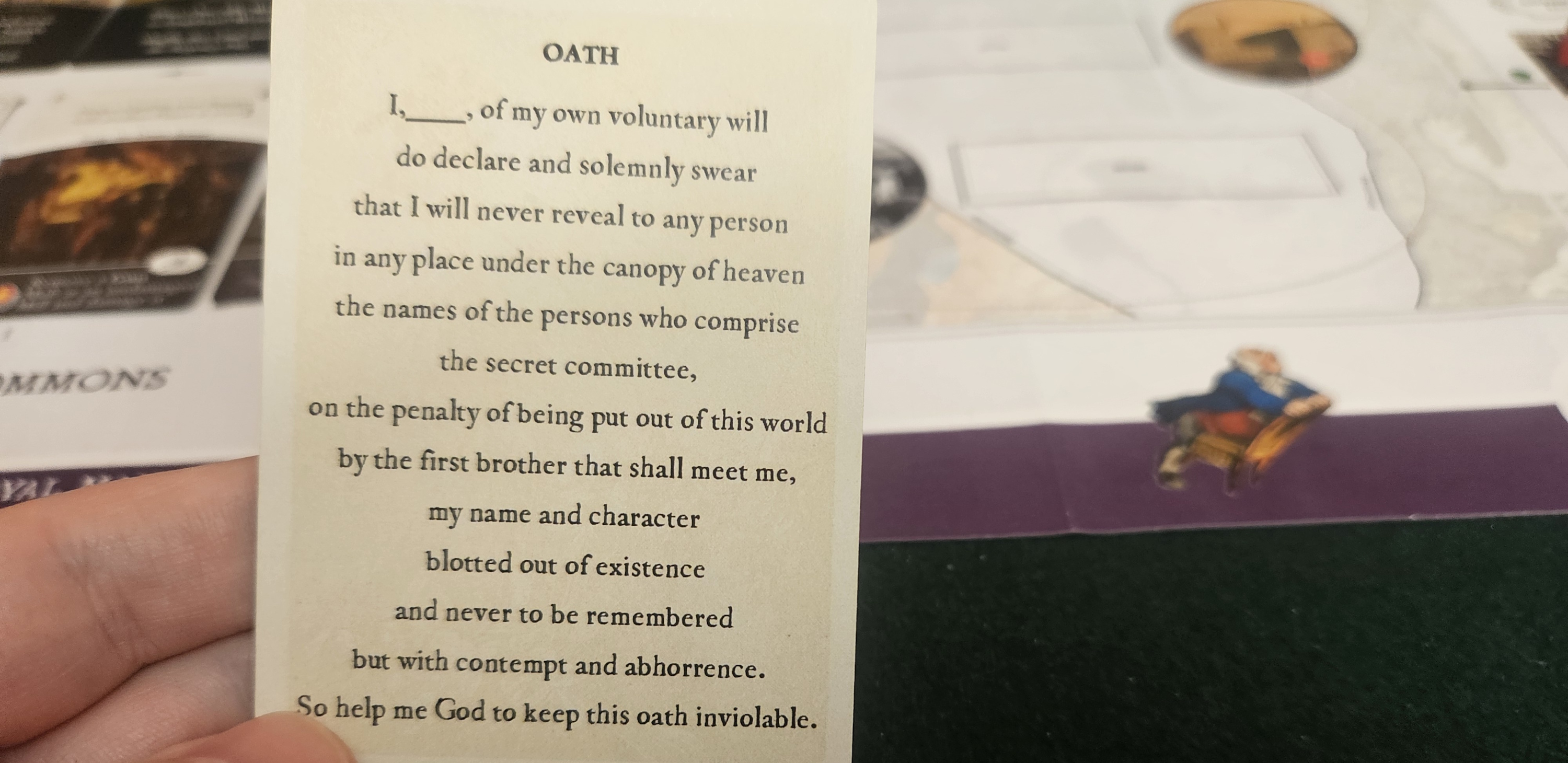
Crucially, these identities are more than clusters of special abilities and personal objectives. Each character seeds a woe into the deck, representing a personal problem that might rear its head at any moment. They also have personal lines they refuse to cross. Elizabeth Studham has joined the Luddites to save her home and community. Will she eventually become so impassioned — some would say radicalized — by the cause that she risks exile to the colonies? The celebrity parliamentarian Lord Byron is another option, his distance from the movement reflected by a weaker pool of conspirators. Will he throw away his standing in polite society to champion laborers who hold so little in common with him? These are the questions The Nights of King Ludd asks early and often, presenting the movement as a tangle of competing interests and concerns.
The Regency gets up to no good in response to the Luddites’ no good.
The Luddite movement has always eluded easy classification. Given the revolutionary fervor on the Continent, some historians portray it as a similar moment of English class consciousness. Others interpret it as the earliest stirrings of what would become later labor reform and even Marxism.
Perhaps it’s appropriate, then, that Goldstein presents the movement in such contradictory terms. Just as the game tells its story via two vastly different scopes, and just as its characters squabble over the appropriate course of action, the game itself is suspended between identities.
On the one hand, there are familiar elements of both card-driven wargames and paxgames. There’s the river-style market, which recalls Pax Porfiriana and its many successors, while the cards themselves are multitools that hew closer to the system found in Mark Herman’s We the People and popularized by Twilight Struggle. Much of the game revolves around figuring out which cards to purchase and when to deploy them, familiar fare for anyone who’s been involved in the historical gaming scene at any point over the past three decades.
But the cards play second fiddle to the game’s real core: its dice. At heart, The Nights of King Ludd is about building a pool of dice and then rolling them to determine whether your frame-breakers have successfully broken enough frames to put a mill out of commission. This is a multi-step process. First your conspirators must organize unemployed weavers, bringing them into the movement and assembling them at the sites where their agitation will do the most good. Then they must be persuaded to take up arms and occupy the mills — both of which are testy affairs, drawing ire from the Regency and the patrolling militia. All the while, you must assemble a pool of dice that can be spent for those workers, now suitably organized and positioned, to assault the mill.
If everything goes right, a mob of weavers will enter a mill, burn it down, and disappear back into the moonlight. No need for anybody to get hurt. No trials, no hangings, no masses of deportations to Australia. Some property will be ruined, but like the historical Luddite movement these attacks will shock authorities with their targeted precision.
The hitch, as you can probably discern for yourself, it that it is exceedingly rare for everything to go right.
Hm. I knew those Aussies were up to something.
In practice, The Nights of King Ludd plays out like a jigsaw puzzle whose pieces keep getting hidden beneath the tablecloth, squirreled away by cranky uncles, and sometimes fed to the family dog.
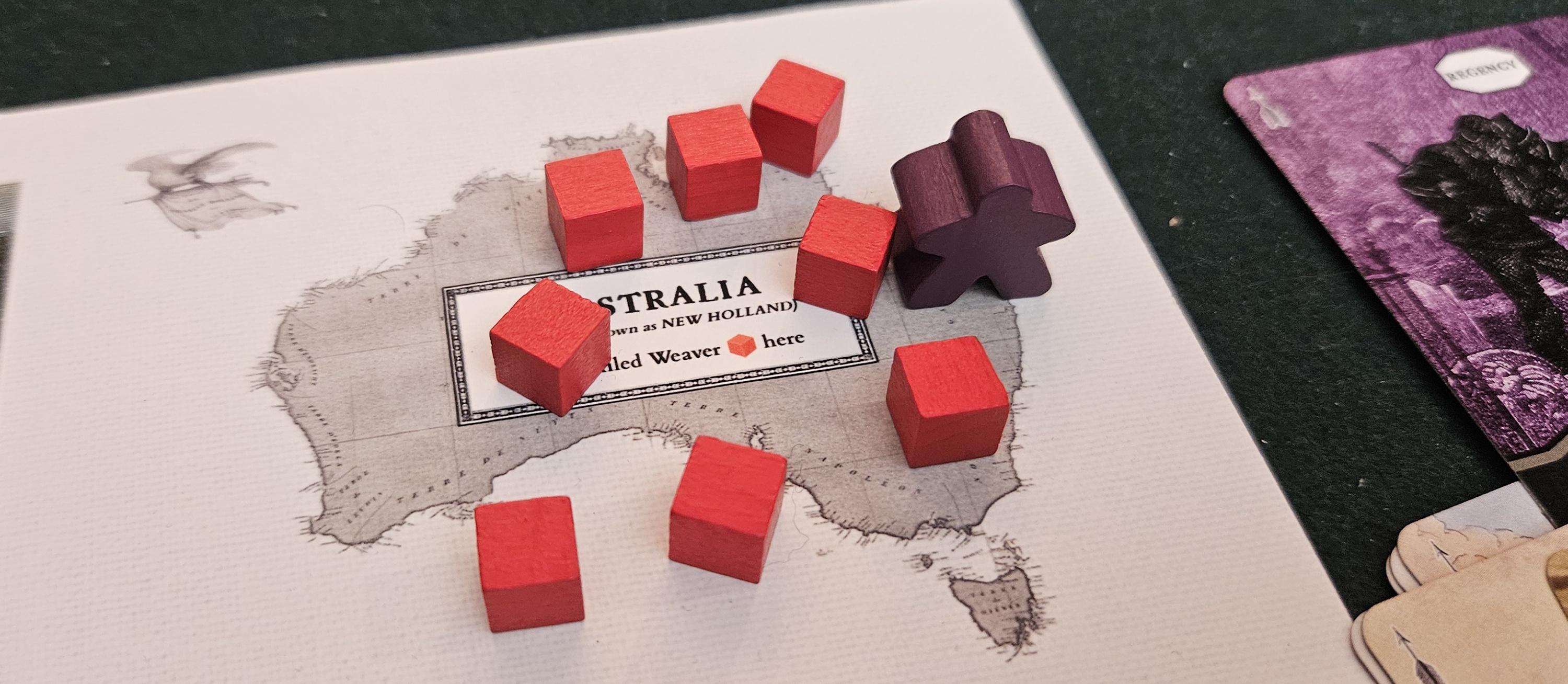
Consider this. To wreck a mill, you must organize those unemployed weavers. But the passing militia will lock down entire counties at a time, sometimes for extended durations. This makes it near-impossible to organize with any precision, especially if your character is currently in hiding in the affected portion of the board. It may become necessary to wait out the occupation. Or even to bait the militia into removing itself to another region. Just be careful you don’t draw them toward a mill where your workers are on the verge of an uprising; that will exile the entire lot to Australia, severely limiting the movement’s access to manpower.
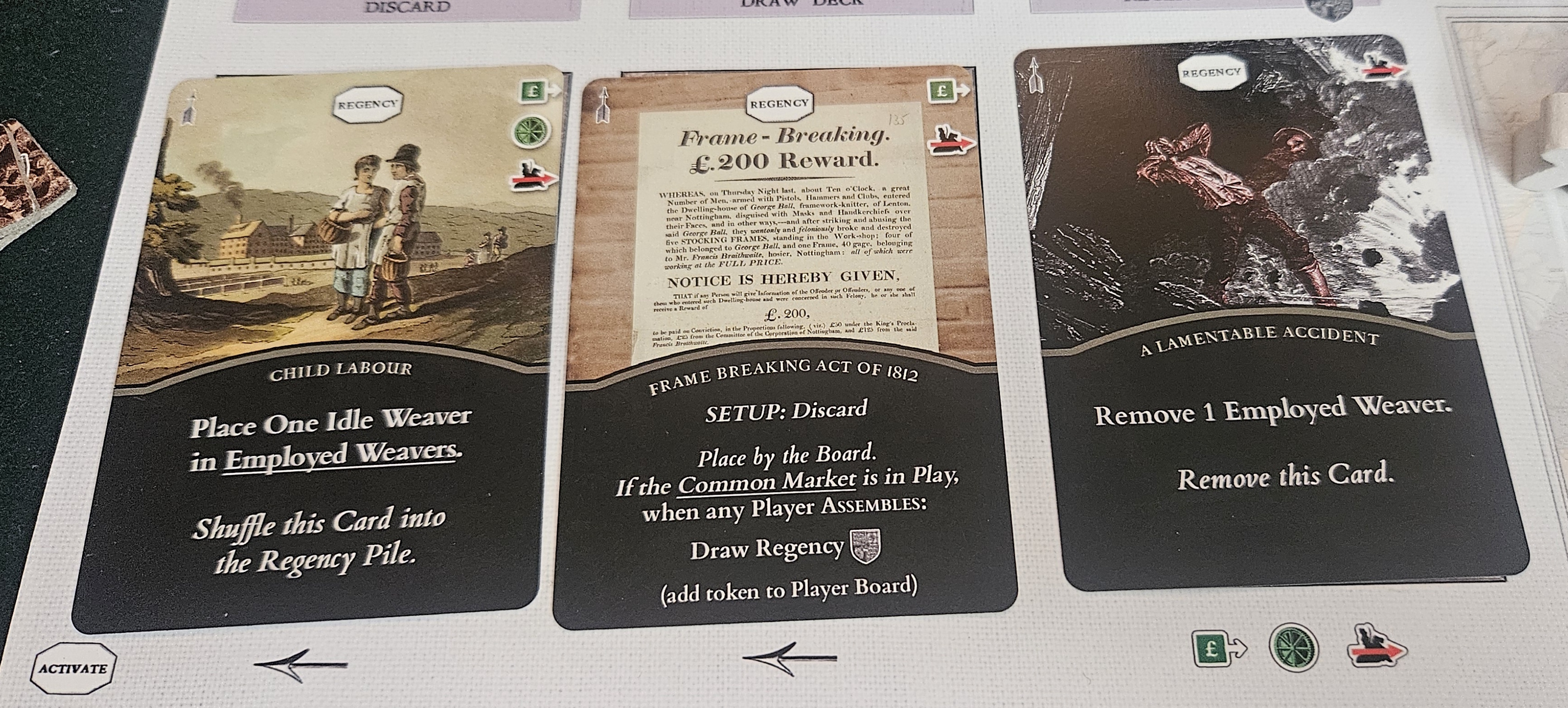
Okay, so you’re keeping an eye on the local garrison. But what about the Regency in London? Certain actions force you to draw a card from the Regency deck, and these cards are, to use the terminology of the day, a right burr in the arse. Their effects are far-ranging. Government spies tip off the authorities before a mob can act. Preemptive hangings permanently lower the ceiling on your dice pool. The cavalry show up to move the militia token two spaces instead of the usual one. Child labor and sixteen-hour workdays and workplace accidents ensure that laborers are too exhausted to resist their plight.
There are other, more transformative consequences as well. Somewhere in the game’s midsection, the card row shifts from a common pool to a laissez-faire market that’s open to those with capital — hint hint: Lord Byron still does okay — but not so much to those who actually produce its goods. This alters how players access cards. No longer is every card the same price. Now their values are tiered, requiring greater expenditures to purchase until they slide leftward in the market. It’s a remarkable flourish, illustrating the radical changes this industrializing generation underwent as food prices soared, their livelihoods were stripped, and their legal representatives were bought out by moneyed interests.
Swear me an oath!
Put together, these elements give the game the sensation of trying to keep a sinking ship afloat even as you commit mutiny. There are occasional refreshing breezes: an ambush that delays the militia’s approach, such a mass of unemployed workers that their grievances become impossible to ignore, even early attempts at establishing labor cooperatives. But make no mistake, what initially seems like a straightforward task will soon be stymied from all directions. Even when the movement’s success is secured, it often comes at the expense of a conspirator’s personal goal.
At times, it’s also an uneven task, and not only because the Regency is scrambling to protect the people with the most from having slightly less. Thanks to Goldstein’s hybrid system, The Nights of King Ludd can be tricky to operate. At any given moment, you’re operating along multiple vectors. There’s the strategic layer, with its emphasis on timing and positioning. The personal level, with its diverse objectives and abilities. The card market, always in flux, plus the gradual attentions of the Regency. Keeping in mind that I’ve only played a prototype, it’s a lot to unpick.
And then, of course, there are the dice. Goldstein provides opportunities to mitigate a flubbed roll, not to mention a few alternate tricks for damaging mills, but these options are few and far between. Most of the time, the only path forward is a healthy dice pool, a well-armed mob, and a prayer in one’s heart. There’s nothing as uniquely irksome as showing up to a mill-burning with torches and hammers, only to somehow roll all misses. Those who balked at John Company’s retirement rolls will likely find themselves similarly disappointed here.
It takes a village to burn a mill.
For my part, The Nights of King Ludd is a strange, evocative thing, as much a machine as those it seeks to break. It’s a more radical experiment than Chicago ’68, but Goldstein leverages it to similar ends, asking hard questions about who societies prioritize. Put somebody in a sack and don’t be surprised when they choose to fight their way out.
Were the Luddites doomed? Maybe. The textiles industry was transforming with or without powered mills and innovative knitting frames. Trousers were soon to supplant hosiery in popularity. Cotton and silk were growing more affordable. The United States was starting to throw their economic weight around. And, pardon my French, Napoleon was being a real butthole.
But some men chose to oil their machinery with blood. The response was fire and fury. And, yes, sometimes blood for blood. A few droplets pattered into an ocean. Once again, Goldstein has crafted a challenging, thought-provoking rumination on an oft-misplaced history, collective anger, and the depths power and capital will plumb to protect their interests. Stark, sobering, and sometimes hopeful, The Nights of King Ludd is an essential work for students of labor history and new-wave historical simulation.
A prototype of The Nights of King Ludd was temporarily provided by the designer. It is on Kickstarter right now.
(If what I’m doing at Space-Biff! is valuable to you in some way, please consider dropping by my Patreon campaign or Ko-fi. Right now, supporters can read the next installment in my series Talking About Games, this time tackling the topic of what makes a good list! Naturally, the piece includes a list.)
The smallest but most persistent indignity of our current digital age is the way we have all, every one of us, been press-ganged into service as human CAPTCHAs. You know, the Completely Automated Public Turing test to tell Computers and Humans Apart, as tortured an acronym as ever there was. How many bicycles are there in this image? Is that a stop sign or merely a reflection of a stop sign? Is this story real or fake? The computer can’t tell the difference. Which means you can’t ping your lost iPhone without decoding the golem’s underlying logic.
Kasper Lapp, it seems, fashions games with my discomfort as their first design principle. First it was That’s Not a Hat. Now it’s Totally Human.
I dislike Totally Human. But at least I dislike it for reasons that mark it as a very interesting game indeed.
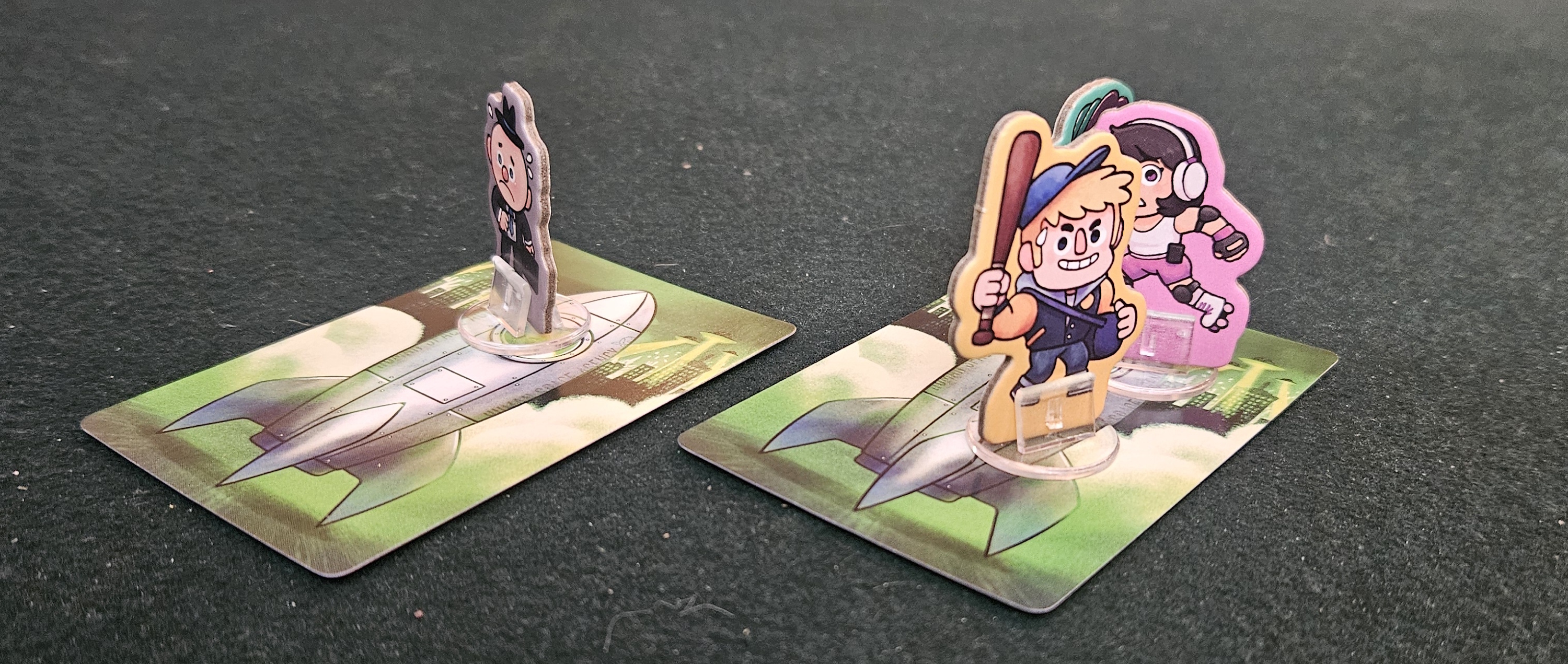
Uh oh. I’m an alien. No worries. I’ll just have you for dinner.
Imagine this. Your society, previously flawed but functional enough in principle, has been overrun by aliens. Aliens who eat humans. These aliens look like us, talk like us, even make art like us. But these things made by aliens are not human in nature. Oh no. They are the regurgitated mass of all that is human. Always backward, never forward. Remixed, never created. Always the tiniest scooch off.
That’s because the aliens are ChatGPT, hahahaaaaaaaaa
Calm down, Dan. Sometimes an alien is an alien.
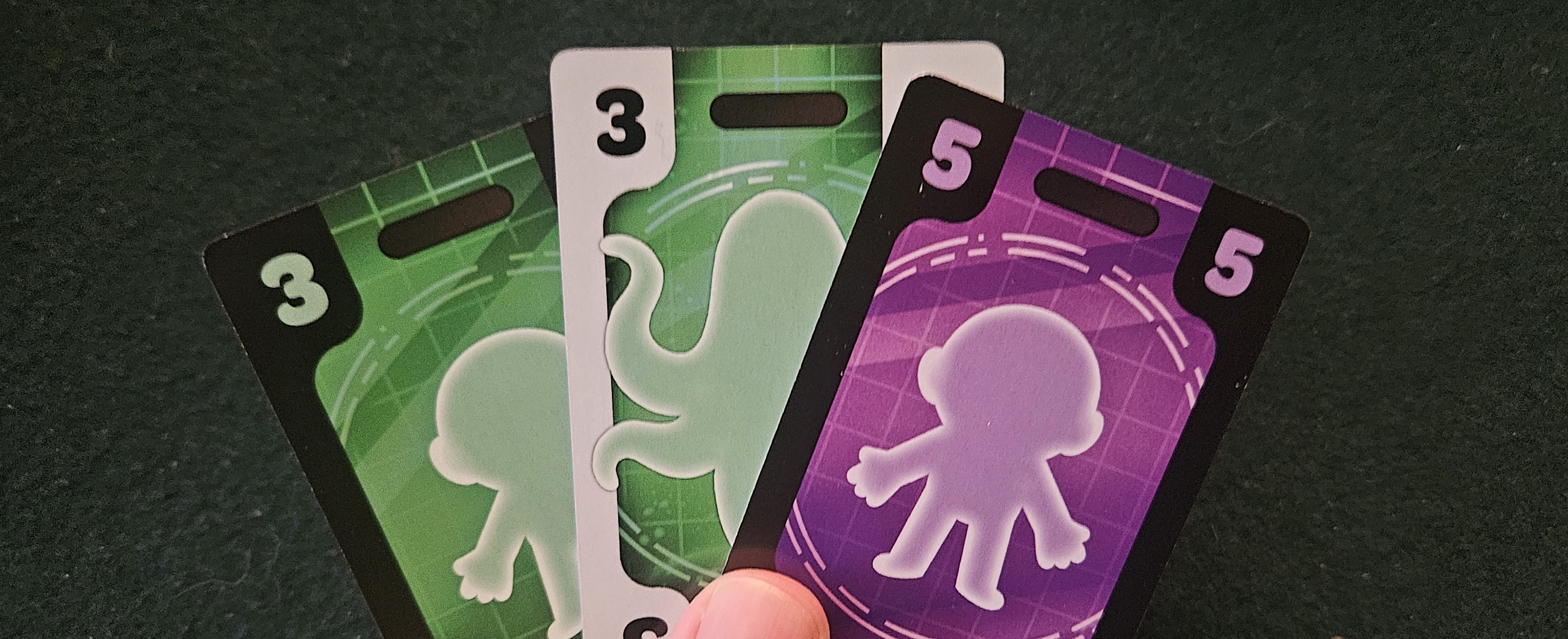
You draw three numbered cards. If the whole trio shows the outline of an ordinary human, congratulations, you are an ensouled being fashioned through millions of years of evolution and perhaps the consciousness of the universe itself. If, on the other hand, even a single one of these cards shows an alien, sorry, you’re an alien. Your sole purpose in life is to snack on humans.
Because of the alien invasion, the humans are boarding shuttles to start new colonies somewhere far from Earth. But first, they need to sort through who’s who, lest the colonists get eaten en route like the crew in that one movie (spoiler). How will they accomplish this — DNA scans? Deep behavioral analyses? Having the applicants draw a picture of a person that doesn’t look like a bizarre homunculus?
No. By answering three abstract questions that set the hairs on the back of our neck prickling. The world’s ending, and we’re gonna Voight-Kampff our way through to the other side.
So. What’s the answer? Punk.
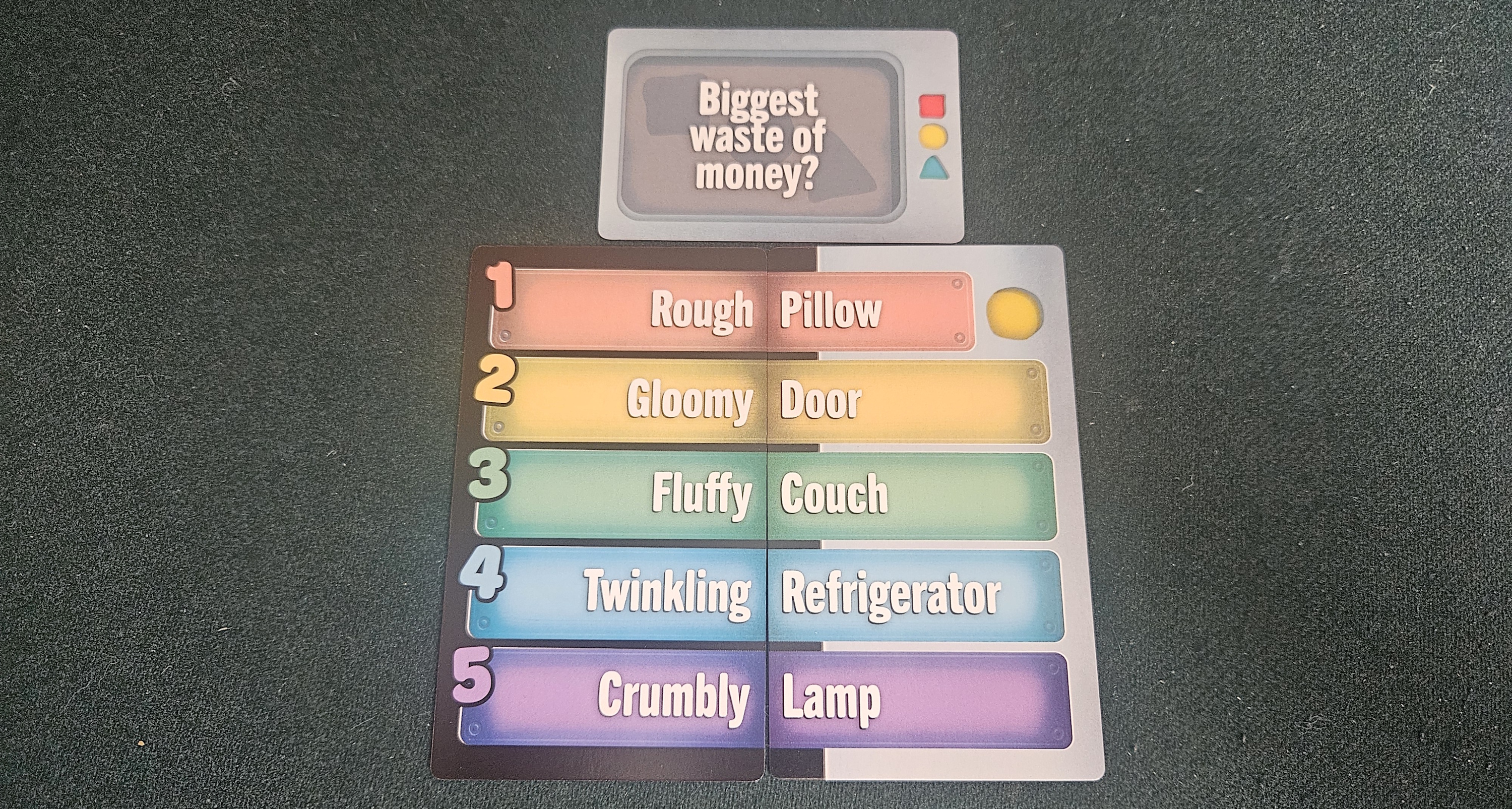
These questions are procedurally generated — not unlike a CAPTCHA. There are three components. First, the question. Second, a bunch of adjectives. Third, some nouns. This produces a five-fold multiple-choice test.
For example, you might be asked about the best name for a punk band. Is it (1) Slimy Cloud (2) Slow River (3) Unreliable Volcano (4) Well-Oiled Tree (5) Noisy Flower. Everybody simultaneously plays a card that reveals their chosen answer.
Here’s the catch that might force an alien to tip its tentacle. Humans can answer the questions however they like. But the aliens among us, they’re more limited. When they drew those three cards at the beginning, they received three numbers. Those are the digits they must use to answer the three questions posed by the game. They can choose the order they use the numbers, spending them like, I dunno, digital tokens or whatever, but they’re required to use those exact numbers.
In the case of the above question, the table’s answers will hopefully prove revealing. You’ll discover which of your friends listen to punk, those whose entire conception of punk is Green Day, and perhaps, if you aren’t so snobby that you airlock anyone who can sing all nine minutes of “Jesus of Suburbia,” which of your buddies is actually a stochastic nightmare that repeatedly consumes, vomits, and re-consumes humanity’s efforts at culture.
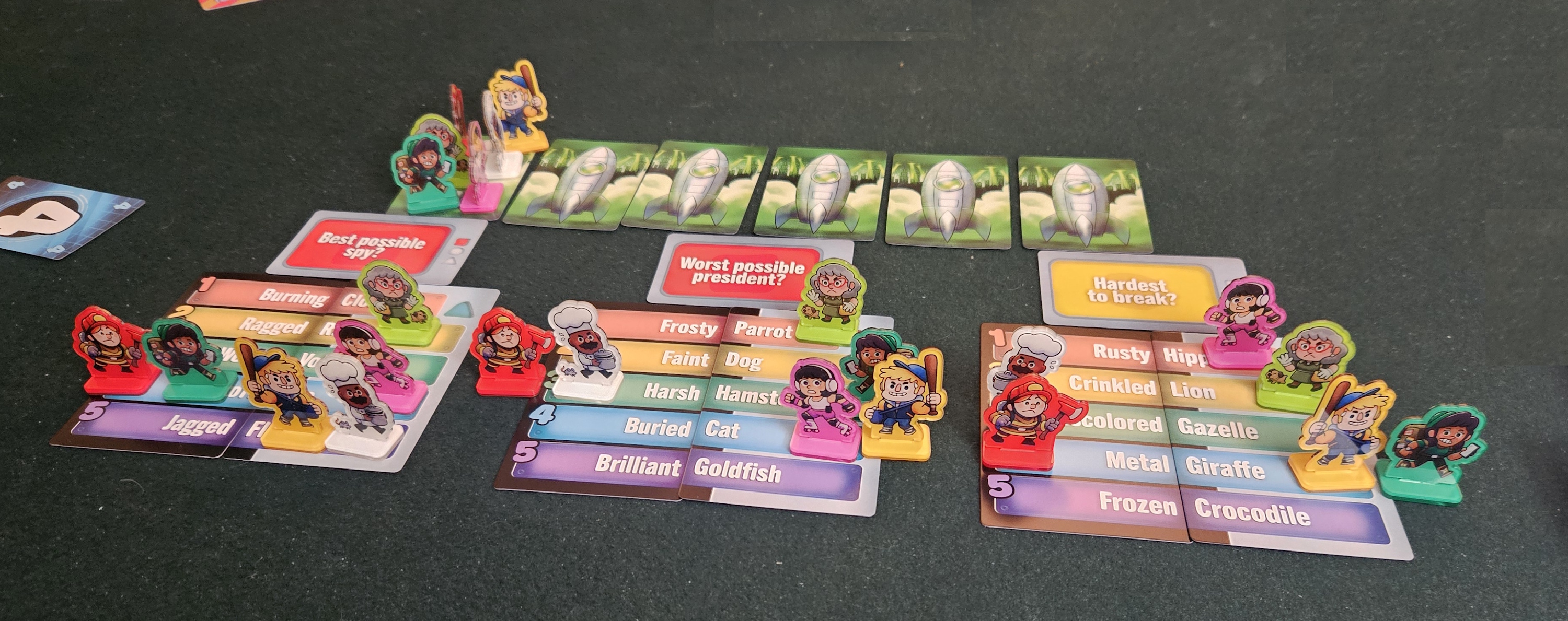
Once all three questions have been asked and answered, it’s time to climb aboard the rocket ships. Humans win by securing a spot on the most-populous colony ship. For genetic diversity in reproduction, obviously. Also, they would prefer to not be torn limb from limb. Aliens, meanwhile, win by eating a human. Usually this results in a spectrum of success, with a few humans blasting off into the cosmos while one or two aliens secure the necessary calories to survive for one more day.
Three questions. That’s all you get.
Conceptually, Totally Human is intriguing. It taps into that wonky space of our brains that’s more intuitive than logical, especially when it comes to in- and out-grouping. While some questions are more obvious than others, plenty are full of gray spaces for players to squabble over and, sometimes, to get lost in. Is it harder to break a rusty hippopotamus (because hippopotamuses are the sturdiest animal on land) or a metal giraffe (because it’s metal)? Is there really a “best” thing to put into a hundred-year time capsule? Is Green Day punk?
And then, when it comes time to load the rockets, the ensuing debates are also vibe-based, reaching into a rucksack of mammalian instincts. On Bluesky, there was recently some discussion about the value of small talk beyond allaying boredom at a social event, such as establishing to fellow apes that you’re a friend rather than an aggressor — and, as an extension of that, the way neurodivergent folks might feel alienated by such a state of affairs. Totally Human could function as a ludic expression of that entire conversation. When there are aliens in our ranks, it’s often better to move with the crowd than to have a good reason for why you stand slightly apart from baseline. When one is perhaps a little alien, the consequences can be severe no matter how benign the distinction.
This makes Totally Human interesting to talk about, but not always enjoyable to experience. And I don’t mean in the usual way for social deduction games, where deception sometimes rankles those who prefer forthrightness. Totally Human wrings the concealment angle of the genre into a sort of social deduction distillate. It’s about hiding in plain sight and little else. You’re given the option to discuss and defend the team’s Q&A sessions, but either the questions are so binary that folks either fit the metric or they don’t, or else they’re so vague that very little can be gleaned from them. In either case, either you hide with at least one of your fellows or you wind up on the outside looking in, human or no.
Blastoff! Hope you aren’t hobnobbing with a flesh-eating alien.
As a get-to-know-you game, there’s some value to be had here. Not only because you get to ask and answer silly questions, which provides an avenue for further insight into the socially anxious apes seated at your kitchen table, but also because those questions often lead down more interesting avenues. Provided you don’t shy away from all forms of small talk. In which case, you really should avoid this particular campfire.
For everyone else, Totally Human is totally fine. Personally, I wish its gameplay lived up to its premise. Beyond illustrating our tendency to cluster more closely with those who say the right words in the right sequences, there’s very little to see here. Maybe it’s a question of fatigue. In a world where every feed has become an extended CAPTCHA, it turns out I would rather not role-play as one, even for a mere quarter hour. My verdict: interesting but unsatisfying.
A complimentary copy of Totally Human was provided by the publisher.
(If what I’m doing at Space-Biff! is valuable to you in some way, please consider dropping by my Patreon campaign or Ko-fi. Right now, supporters can read the next installment in my series Talking About Games, this time tackling the topic of what makes a good list! Naturally, the piece includes a list.)
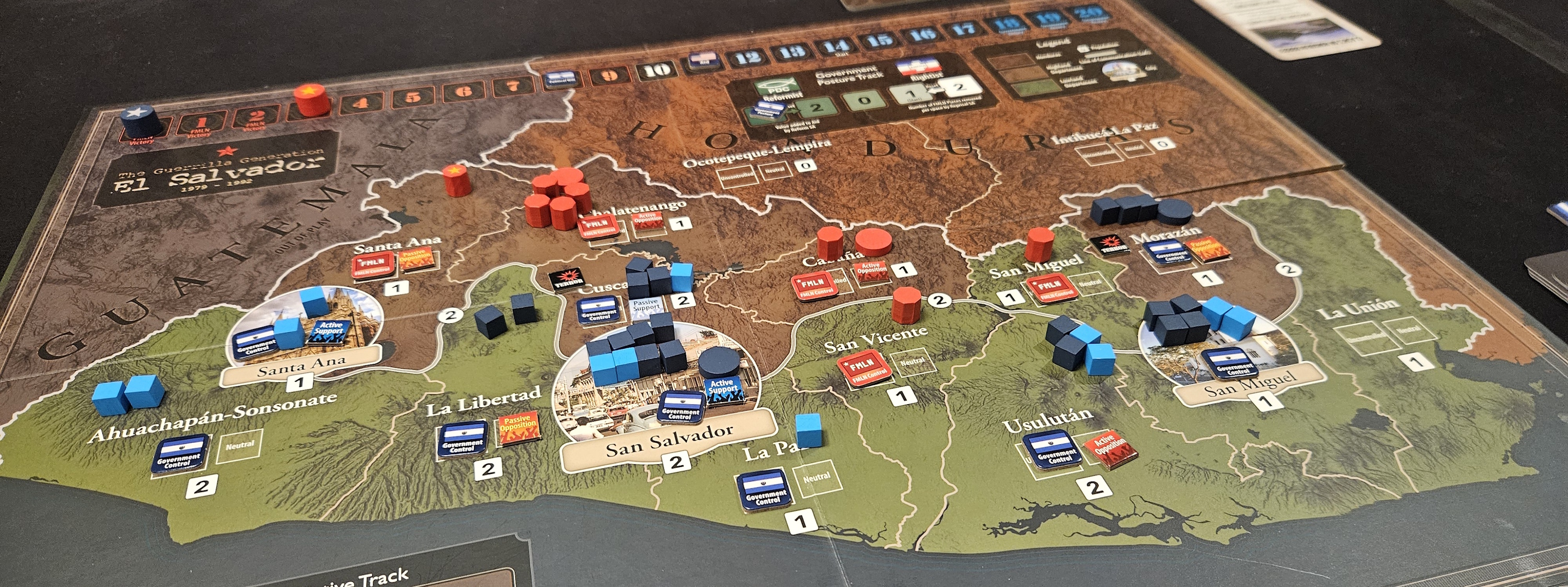
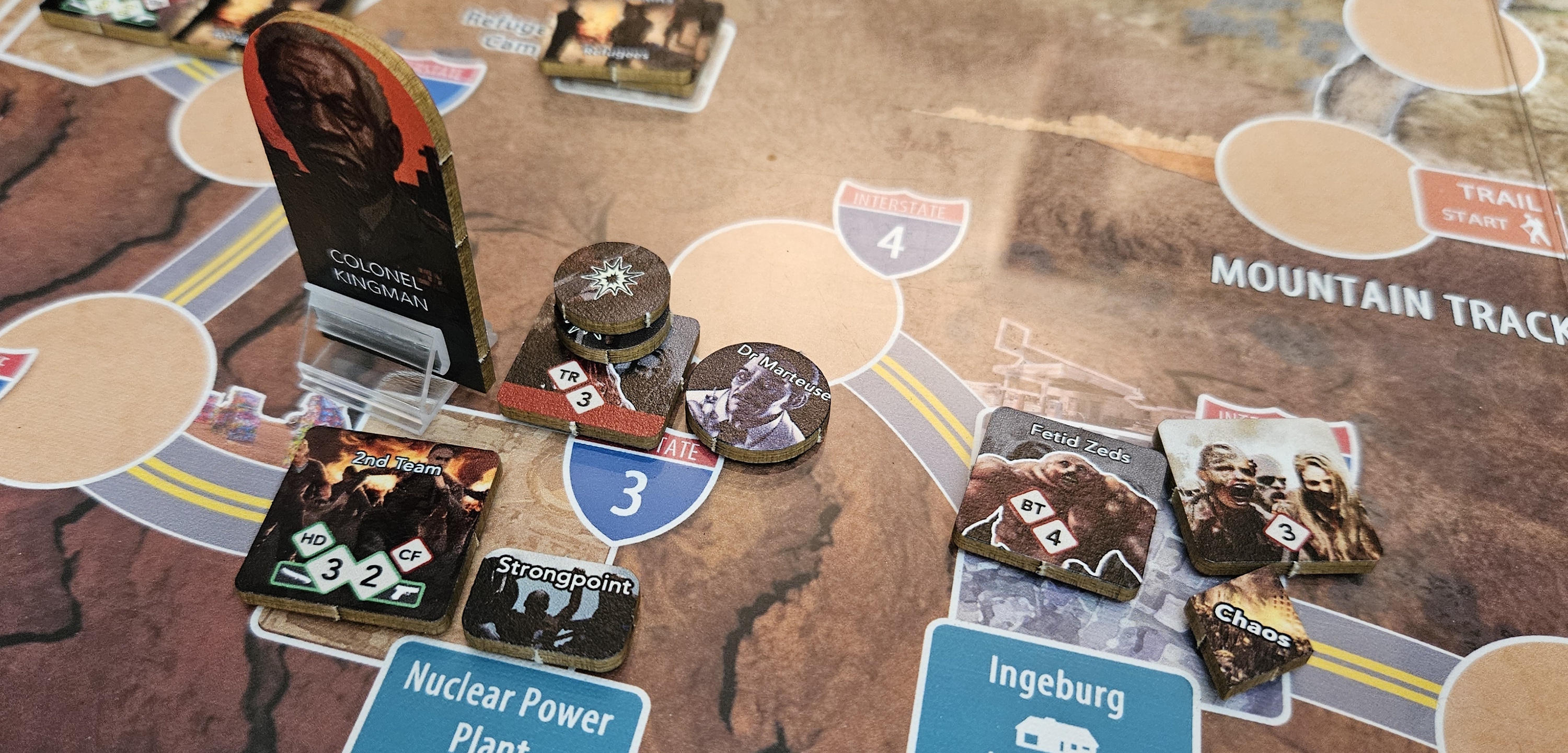
At long last, we’re nearing the end. After Uruguay, Peru, and Nicaragua, El Salvador is the fourth and final scenario in Stephen Rangazas’s The Guerrilla Generation. We’ve seen urban resistance movements that neglected to reach the people they were bent on liberating, a cult-of-personality communist party who went to any lengths to maintain their doctrines, and far-right death squads whose activities were so vicious that they became invaders of their own country. Now, in El Salvador, we’re going to see a little bit of everything as the FMLN launches its first offensive against the government in January 1981.
But the story doesn’t begin there. It never does. History is a story, and stories need beginnings. But reality is not a story. There are any number of root causes to this particular insurrection. We might begin with Farabundo Martí, from whom the FMLN drew its name. He was executed by firing squad in 1938 after his uprising of peasants was massacred by the government. Or we could start with that regime’s formation in 1931 through coup d’état and its repressive rule for more than four decades.
This time, however, the most suitable starting point is a priest: Óscar Romero.
One of the many murals of Óscar Romero.
Óscar Romero was appointed the fourth archbishop of San Salvador in 1977. A native Salvadoran, Romero was a social conservative, and indeed this was one of the reasons his appointment had been considered. The priesthood of El Salvador had long been divided along social lines, with some priests supporting stability while others favored “liberation theology.” This was a relatively new strain of Catholic thought, born out of the Latin American revolutions and foreign interventions of the ’60s. As with any issue of dogma, there were contrasting definitions of liberation theology, but the gist was that the poor and downtrodden were being deliberately kept in place by both individuals and systems, and that good Christians were therefore called upon to reflect the living ministry of Jesus Christ by rectifying their suffering. Priests who supported liberation theology, then, tended to be sympathetic toward Marxist thought and communist guerrillas, while those critical of it fell into the opposite camp. Romero’s appointment was accepted with relief by the regime. Unsurprisingly, the liberationists were bitterly disappointed.
(Sidenote: North American and European readers might note a similarity between liberation theology and the concept of “woke” as it originated among African-Americans in the Jim Crow-era United States. These strands of thought arose from different sources, but as a quick and dirty analog one could do a lot worse. Short version: you are being kept poor on purpose, the jackboots have it in for you, and it behooves young people to get woke to reality so they can survive this hostile state of affairs.)
Only a month after Romero’s appointment to San Salvador, one of his personal friends, the Jesuit priest Rutilio Grande, was assassinated. This came as a shock to Romero. After all, Grande had been one of the good ones. Despite speaking out against the government on certain issues, he had also argued for a pastoral ministry that was disconnected from Marxism. After every effort to walk a middle path, he had still been gunned down by state security forces only a few miles from where he had been born. Romero requested an investigation. He was met with silence.
Another mural.
In his own words, Romero became devoted to following Grande’s path. He spoke to the people via weekly radio broadcasts, his diocese newspaper, and his sermons, repeatedly listing the government’s killings, tortures, and disappearances. When the joint military-civilian Revolutionary Government Junta proved as brutal as the military dictatorship it had replaced, he appealed to President Jimmy Carter to halt the flow of U.S. military aid and Pope John Paul II to condemn the regime. Again, silence. Even as his popularity among the people grew, it seemed everybody with access to real power was content to ignore his pleas.
Despite his inability to effect change, somebody was listening. Because that’s always how it goes with those who live by the gun. One must not only be victimized. One must be grateful for their place in life. One must submit.
In March 1980, Archbishop Romero called upon Salvadoran soldiers to reject the government’s crimes against humanity. The next day, he was shot through the heart by a gunman as he delivered a sermon at a small chapel attached to Hospital de la Divina Providencia. His funeral was attended by a massacre in the streets. The shooters fired from rooftops with rifles and threw smoke bombs into the crowds of mourners. At least thirty were killed. In response, José Napoleón Duarte, four years in advance of his presidency, blamed both sides of the political spectrum for the violence, and used it as pretext to decline an official inquiry into Romero’s murder. The meddlesome Archbishop, whom the regime had welcomed only three years earlier, had been silenced for good.
The FMLN launches one of their offensives.
Nine months later, the FMLN launched its first offensive against the government.
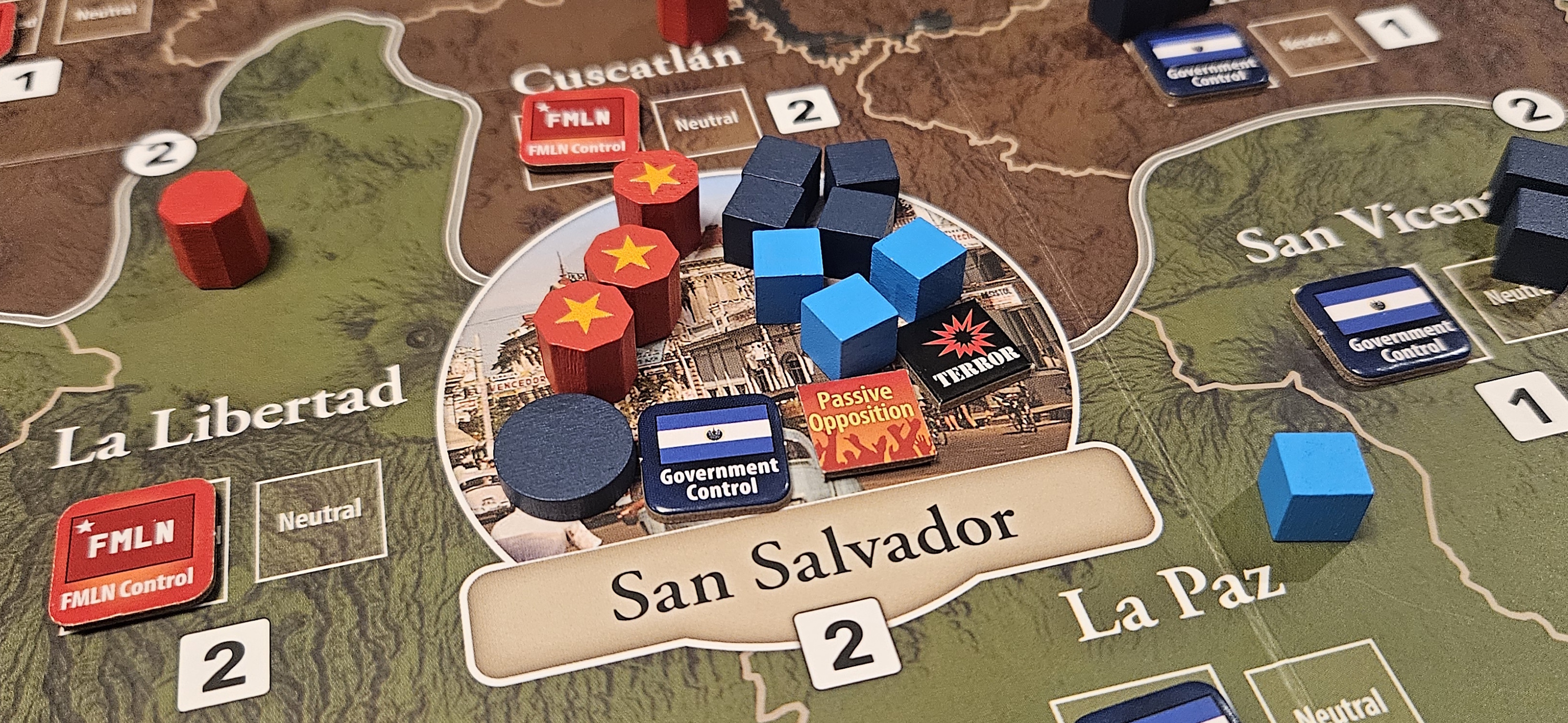
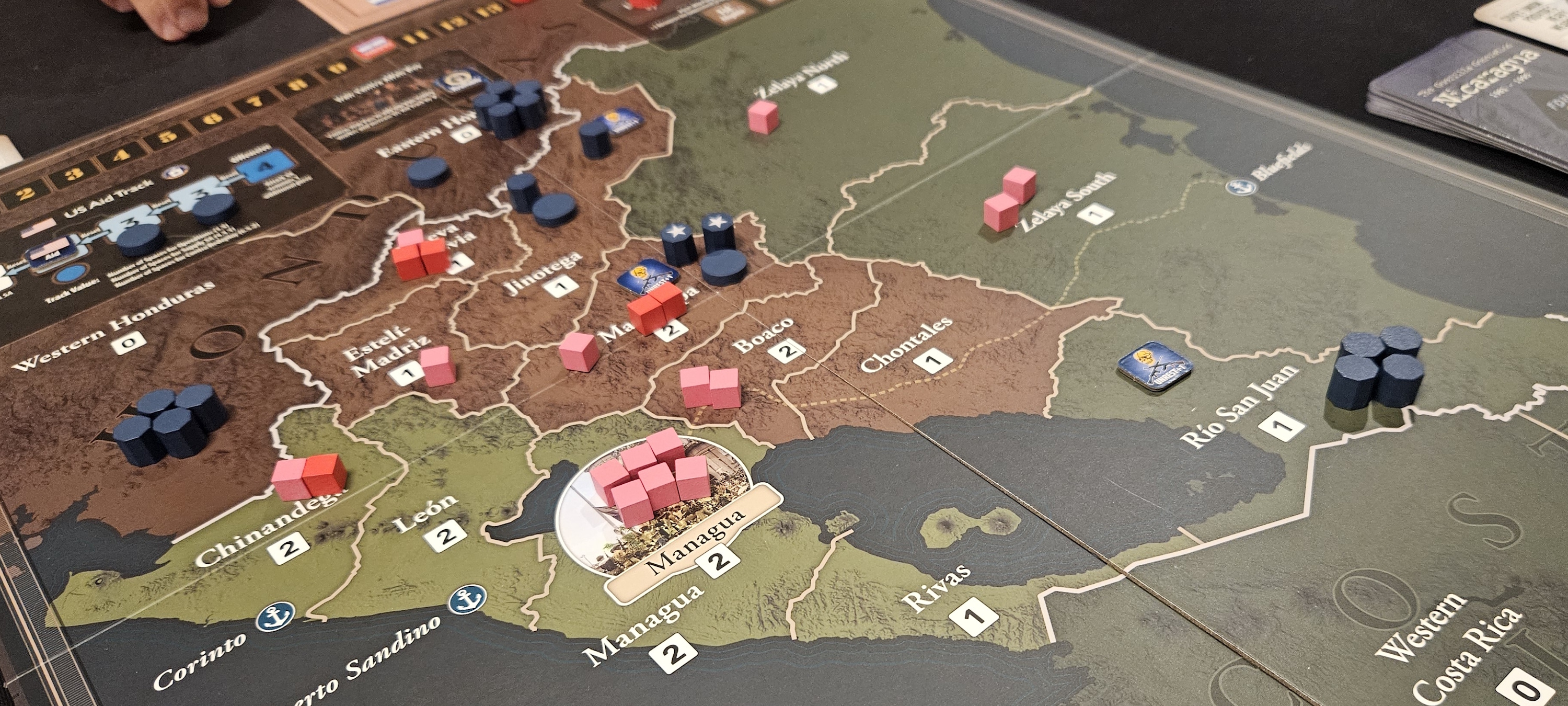
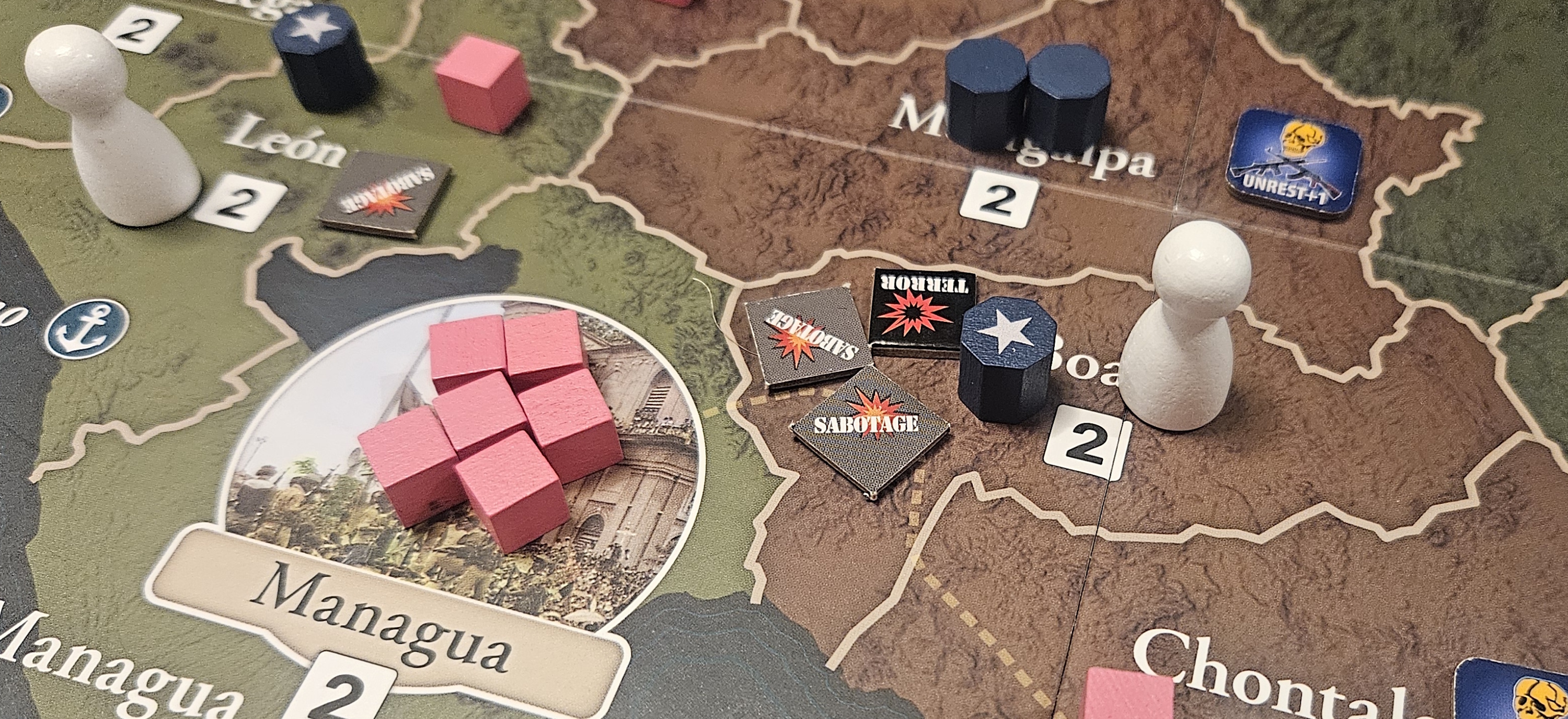
This is where the fourth scenario of The Guerrilla Generation begins. The FMLN, fed up with the government’s constant human rights abuses, rolls from the highlands into the coastal and urban portions of the country. Potentially, large numbers of blue government cubes will be removed in an instant and the guerrillas will possess large swaths of territory. For a system that usually portrays insurgent forces as incapable of such a concerted assault, it’s a shocking opening gambit.
To accomplish this, Rangazas takes cues from a handful of earlier titles, most notably the “pivotal event” cards that made their first appearance in Mark Herman’s Fire in the Lake. At the time, these were a profound departure for the series. For those who don’t know the COIN System very well, events are normally seeded at random throughout the deck. Thanks to their chaotic appearance, they represent occurrences that fall beyond the factions’ ability to set into motion, but which one of them might leverage to their advantage. When Volko Ruhnke designed Andean Abyss, the first volume in the series, it represented a change in the way card-driven wargames presented player agency. Rather than putting every event into players’ hands — both literally and figuratively — factions were now presented as reactive. Something would happen: a massacre, the death of a politician, an influx of war materiel from an interested third-party nation. And then you, the player, would decide whether that event was worth acting upon.
Fire in the Lake presented another option. Some events, Herman’s system argued, represented moments of clear player agency. It wouldn’t make any sense for the Tet Offensive to blindside the Viet Cong, for example. So each player was given a single pivotal event. One card in their hand, which could be used at the player’s discretion to cancel an ordinary event and launch a special action.
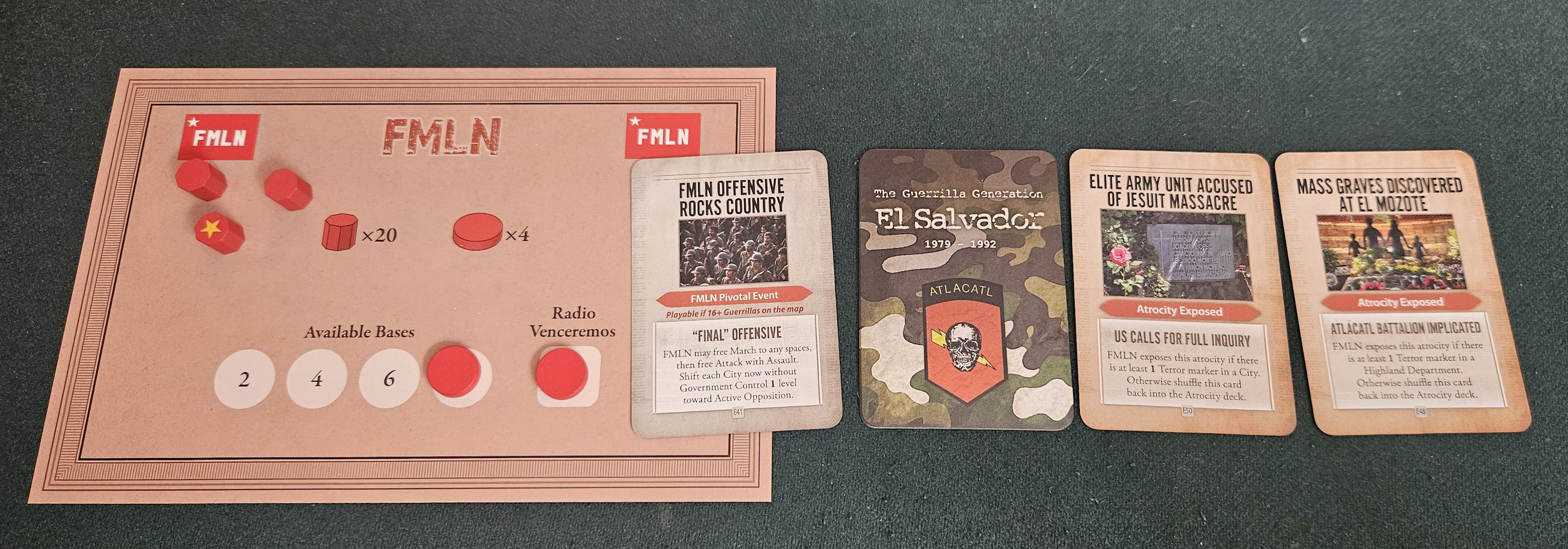
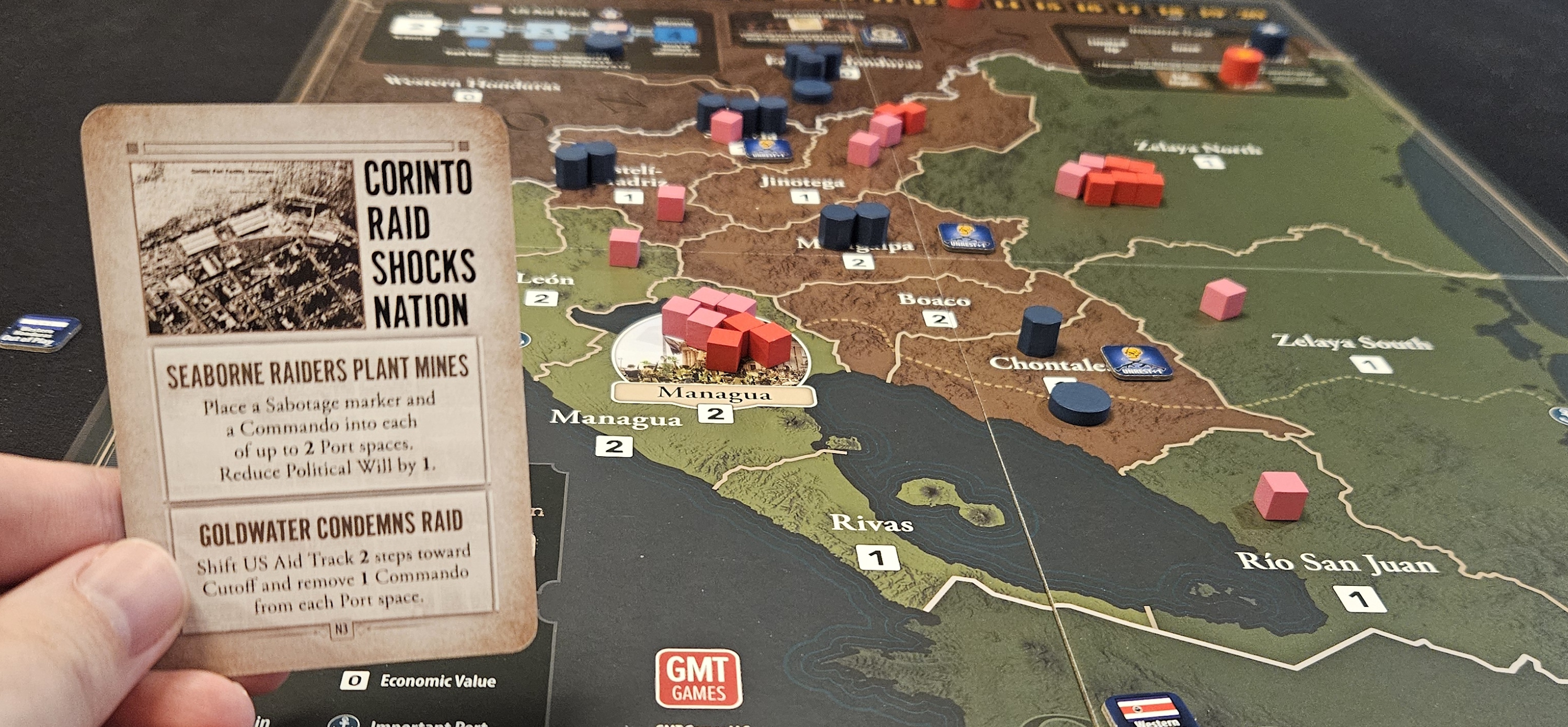
The El Salvador scenario begins with one such event. Only in this case, the event has already been played. “FMLN Offensive Rocks Country” starts on the table. All at once, the FMLN, which the game presumes is largely in its historical situation as of January 1981, undertakes a country-spanning sweep. It won’t be enough to topple the regime, as FMLN leaders had hoped historically. But it sets the tone for what’s to come. This is a knock-down drag-out fight. The FMLN is significantly tougher than most of the series’ insurgencies; the Government, significantly weaker. But the Government has a prize trainer in its corner. The United States. Duh. And the U.S. is currently packing the Government’s gloves with enough silver eagles for a knockout punch.
Uncovering the regime’s war crimes.
From there, the scenario settles back into the system’s usual rhythm of events and faction activities. It isn’t long before both sides begin to have money trouble. The FMLN isn’t as willing to extort the local populace as some of its peers in other volumes. Managing its finances is a slow process, requiring careful spending and hard tradeoffs between building local support or using local resources to maintain their momentum.
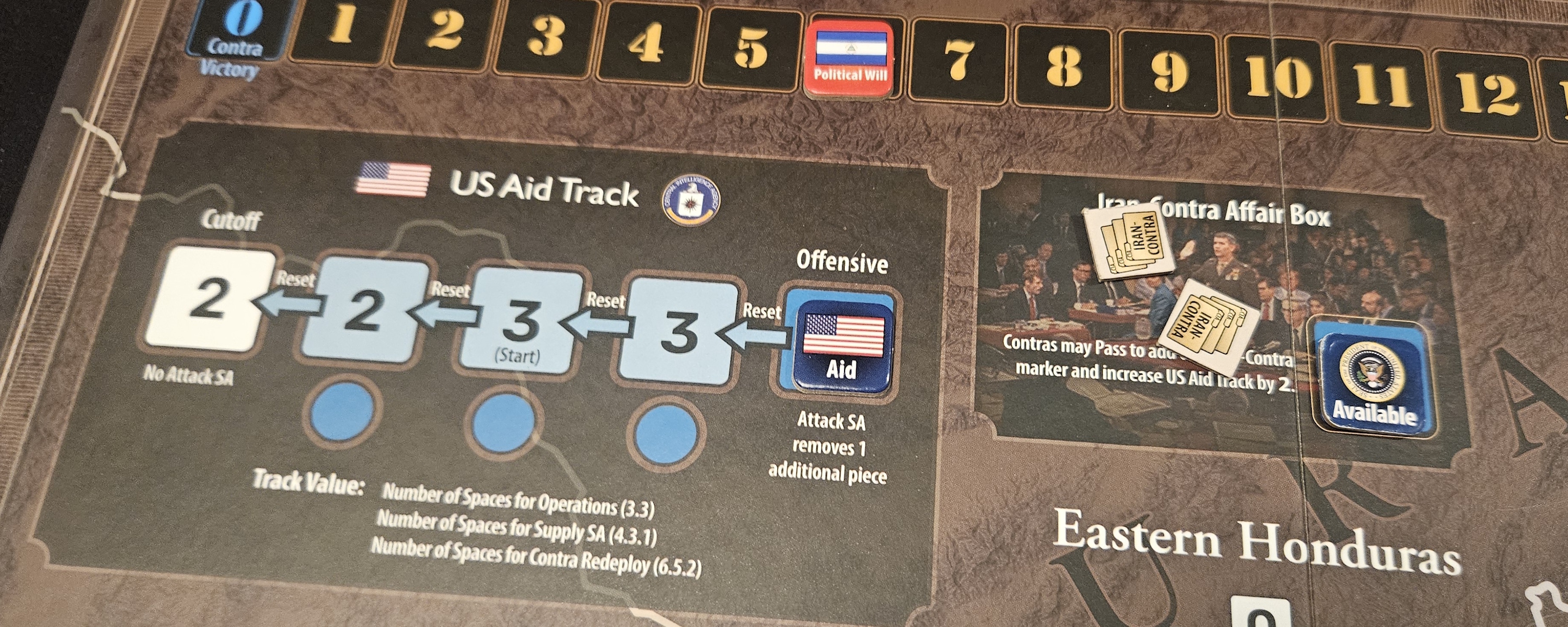
The Government, meanwhile, is similarly pressed. There simply isn’t enough in the coffers to resist the FMLN’s offensive. This is where the United States rears its head. As in many previous volumes, the Government’s resources are bolstered by an Aid marker. Rather than releasing a trickle of resources at pre-appointed intervals, however, here Aid functions as a secondary cash reserve, with the niggling problem that the Government can only avail themselves of this pool for certain operations. Basically, while the U.S. is happy to send endless bundles of cash to resupply Government forces in urban centers, Congress balks when a massacre shows up on the evening news. It’s a testy relationship, one that encourages the appearance of stability even as the FMLN claims additional territory outside the cities.
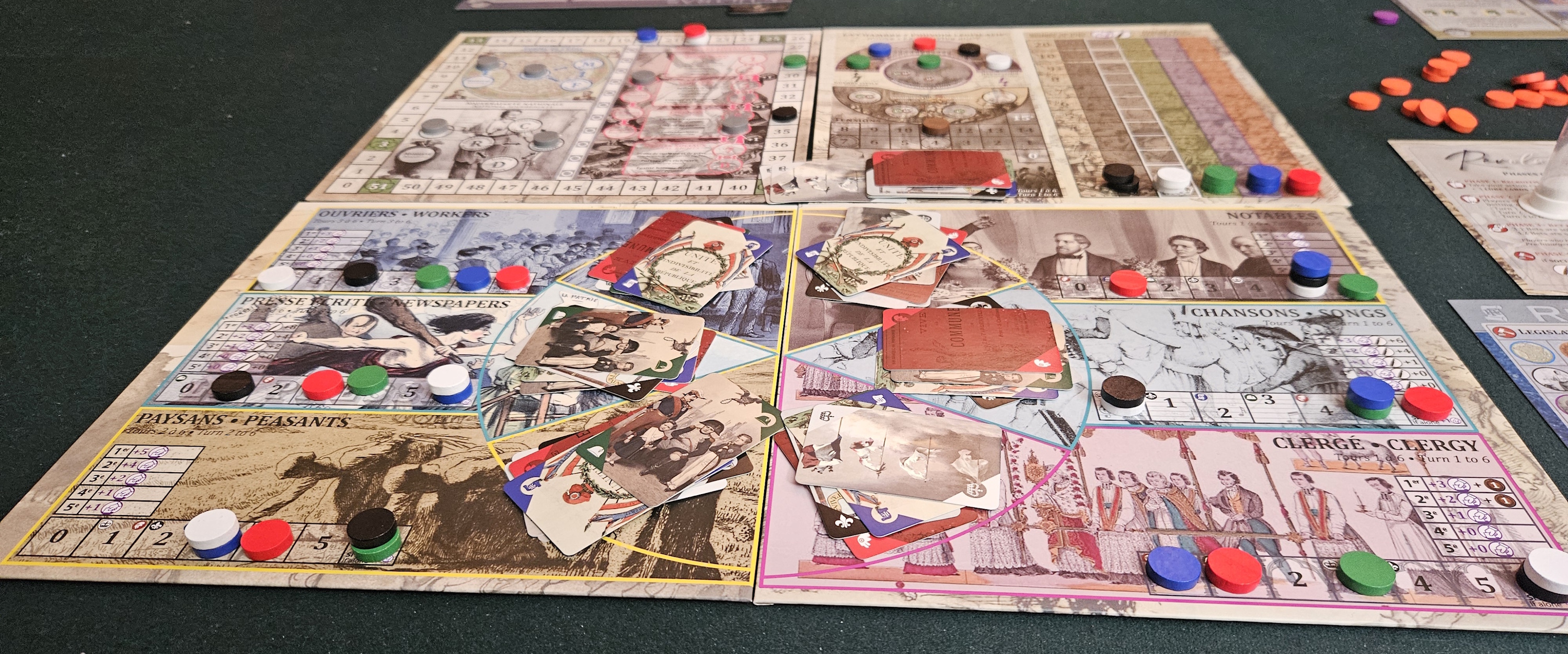
It’s also the COIN System at its most ideological. In the past, I’ve critiqued the series as being frustratingly “blind” when it comes to ideology — and by extension, of defaulting to a conservative position that elides the nuances that underpin these conflicts. Basically, COIN’s emphasis on procedure excels at “what” and “how,” but usually flubs the “why.” We see the outcomes of ideology — the tanks and planes, the massacres and coverups, the boots on the ground — but not so much the reason those tanks were delivered to faraway places, the regime’s need to conceal those massacres, or the half-truths that were sold to the public to convince them to sacrifice their young men and women to fight a war that has nothing to do with them. It’s not especially far-fetched to see in titles like Land and Freedom, Versailles 1919, and Revolutions an ideological intervention into a system that was, itself, a procedural intervention on the card-driven wargames that came before it.
“Reform” can be misleading.
I don’t know if Stephen Rangazas is the strongest designer to handle the COIN System to date, but he makes a good case for being the most clear-eyed. Both of El Salvador’s factions are uniquely hemmed in by ideological concerns. In addition to their desire to govern the populace, the FMLN must uncover and promulgate the reason for their offensive. The why to the what. They do this by revealing cards from a personal deck to demonstrate the Government’s crimes against its citizens. Crimes that would continue over the twelve-year course of the Civil War, with the post-war commission stating that security forces were responsible for eighty-five percent of civilian casualties. By revealing these crimes, the FMLN doesn’t bolster their position immediately, and even risks the occasional backfire when the wrong card is revealed. They are, in effect, building a case during wartime for how the peace will be conducted.
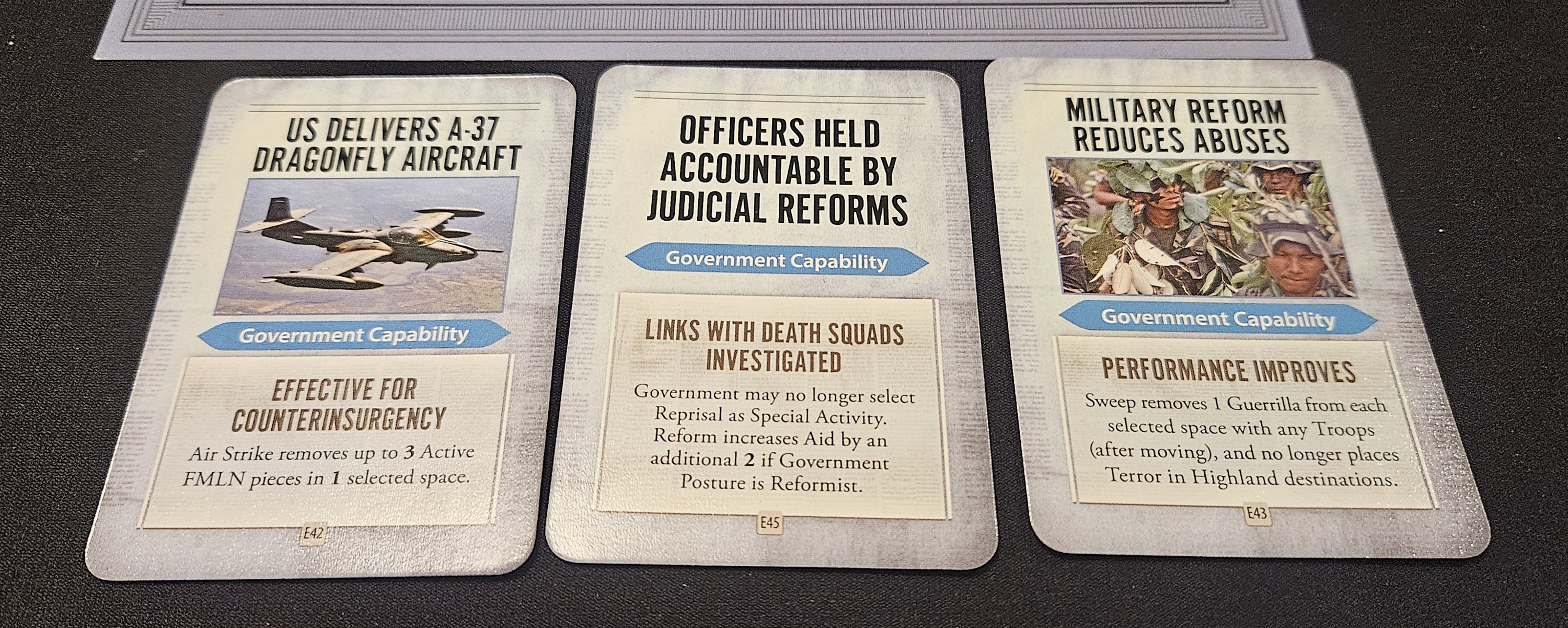
For the Government’s part, they’re asked to walk a tightrope between taking a hard rightist stance toward the insurgency or introducing reforms to rein in their troops. (And secure greater U.S. Aid, but surely that isn’t the prime motivator. Right?) As these reforms are embraced, it becomes harder to conduct reprisals. And the Government is positively horny to conduct reprisals. It’s the easiest way to batter the population into… well, not supporting the Government, but at least they won’t be supporting the FMLN either.
It isn’t long before El Salvador becomes a zombie state, completely bankrupted and in thrall to foreign funding. It’s a stark ludic representation of a regime that has bought its continued right to abuse its citizenry by indebting itself to a hemispheric hegemony whose interests shift with the wind. Or, in game terms, with a whole bunch of event cards.
In some ways, the scenario pulls up short. There is no card for Óscar Romero. Perhaps his assassination came too early for the game to model. Robert D’Aubuisson, the death squad commander who ordered Romero’s death, he has a card. It isn’t flattering, reflecting his antagonistic nature and inability to avoid controversy. That’s as close to the Archbishop as the game gets. His absence is a reminder that no simulation reaches every corner, no matter how long the broom’s handle.
I’m in there somewhere. Don’t look, though. Please don’t.
The one time I visited El Salvador, as a member of an ophthalmic surgical mission in early 2019, Óscar Romero was everywhere. We were hosted in Juayúa by a Catholic retreat, so the imagery of St. Romero was unsurprising, especially given his canonization only a few months earlier. But his visage appeared everywhere beyond the compound walls as well. On the streets of San Salvador, beside the walls of coffee plantations, inside coffee shops. A plaque marked where bullets had penetrated the wall during his funeral massacre.
Growing up, my Father was deeply conservative, but with a compassionate streak that suited his status as a medical doctor. When he began visiting Latin America to perform cataract surgeries — one eye per patient so the surgical team could double how many people they treated — he underwent a transformation. His nature grew more thoughtful; his veneration of Ronald Reagan and Teddy Roosevelt melted away. He began reading books about saints. Little by little, he started talking with more frustration and less condemnation about the state of the poor.
We also started getting along a bit better. But that’s neither here nor there.
I went with him in 2019 because he sensed this might be one of the last trips he had in him. The pandemic hadn’t been declared in our hemisphere yet, but the medical community could see the writing on the wall, and political changes were threatening to make El Salvador even harder to visit. So I accepted his invitation, renewed my expired passport in a panic, and off we went.
There’s no need to bore you with the details. The indigence was extreme, but all poverty has the same leanness. The defining moment came a few months after the trip, when I related how one of our fellow volunteers had called the people “lazy.” Dad, who all my life had complained about panhandlers and freeloaders and takers, suddenly roared, with such force that I think it surprised him as much as me, “They’re not lazy. They’re poor.”
I’ve always been proud of my Father. For his work ethic. For how much he reads. For putting up with a son who’s totally unlike him. But in that moment, I became proud of his ability to change.
It’s possible for the government to find their footing. But at what cost?
When it comes to the COIN Series, El Salvador and The Guerrilla Generation more broadly also represent a change. As a system, COIN has sometimes been insightful and sometimes been blinkered. Often it has been both things in the same volume. With Rangazas’s work in this multipack and The British Way, it becomes something else. It tells a slightly different story, one less about counterinsurgent procedures and more about the systems that brought about these insurgencies in the first place.
Or, as Óscar Romero put it in his second pastoral letter, delivered at the Feast of the Transfiguration shortly after his appointment to San Salvador and the murder of his friend Rutilio Grande: “The Church has, quite rightly, denounced sin. Certainly she has denounced personal sins, and she has also denounced the sin that perverts relationships between persons, especially at the family level. But she has begun to recall now something that, at the Church’s beginning, was fundamental: social sin — the crystallization of individual sins into permanent structures that keep sin in being, and make its force to be felt by the majority of the people.”
Next time, we’ll examine those systems from afar via The Guerrilla Generation’s meta-campaign, which combines Nicaragua and El Salvador in Resisting Reagan.
A complimentary copy of The Guerrilla Generation was provided by the publisher.
(If what I’m doing at Space-Biff! is valuable to you in some way, please consider dropping by my Patreon campaign or Ko-fi. Right now, supporters can read the next installment in my series Talking About Games, this time tackling the topic of what makes a good list! Naturally, the piece includes a list.)
Ask my twelve-year-old about her favorite games and she’ll list a bunch of titles she consistently beats me at. Case in point: Six-Sided Seas. Inspired by the laminated game boards Chris Solis witnessed in Thailand board game cafes, this is a design by Kroze Kresky that limits itself to a single roll-up mat and a bunch of dice.
Forget inspirations. I keep losing to a child. A literal child. Twelve years of age, and already acquainted with an eyepatch and peg leg. She yearns for the galleon.
(sound: the distant thunder of a broadside)
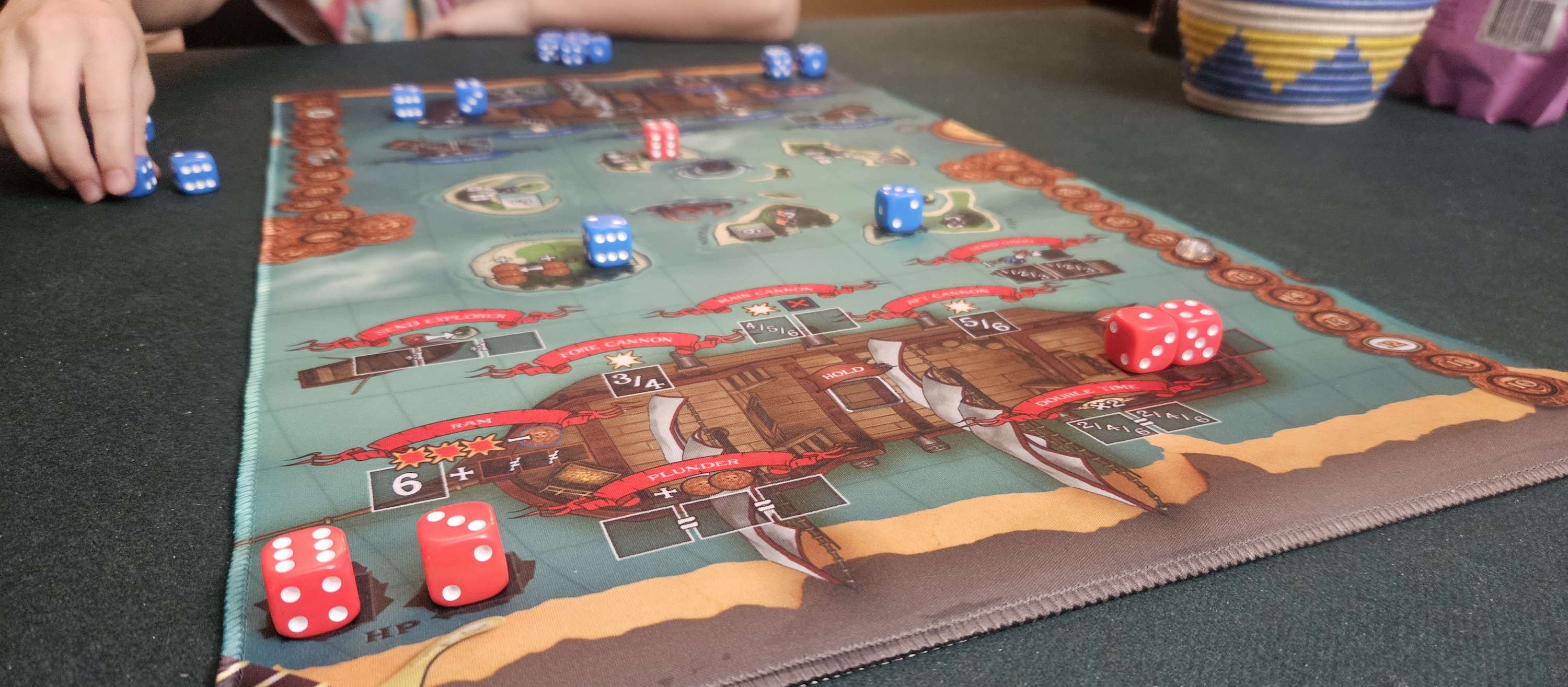
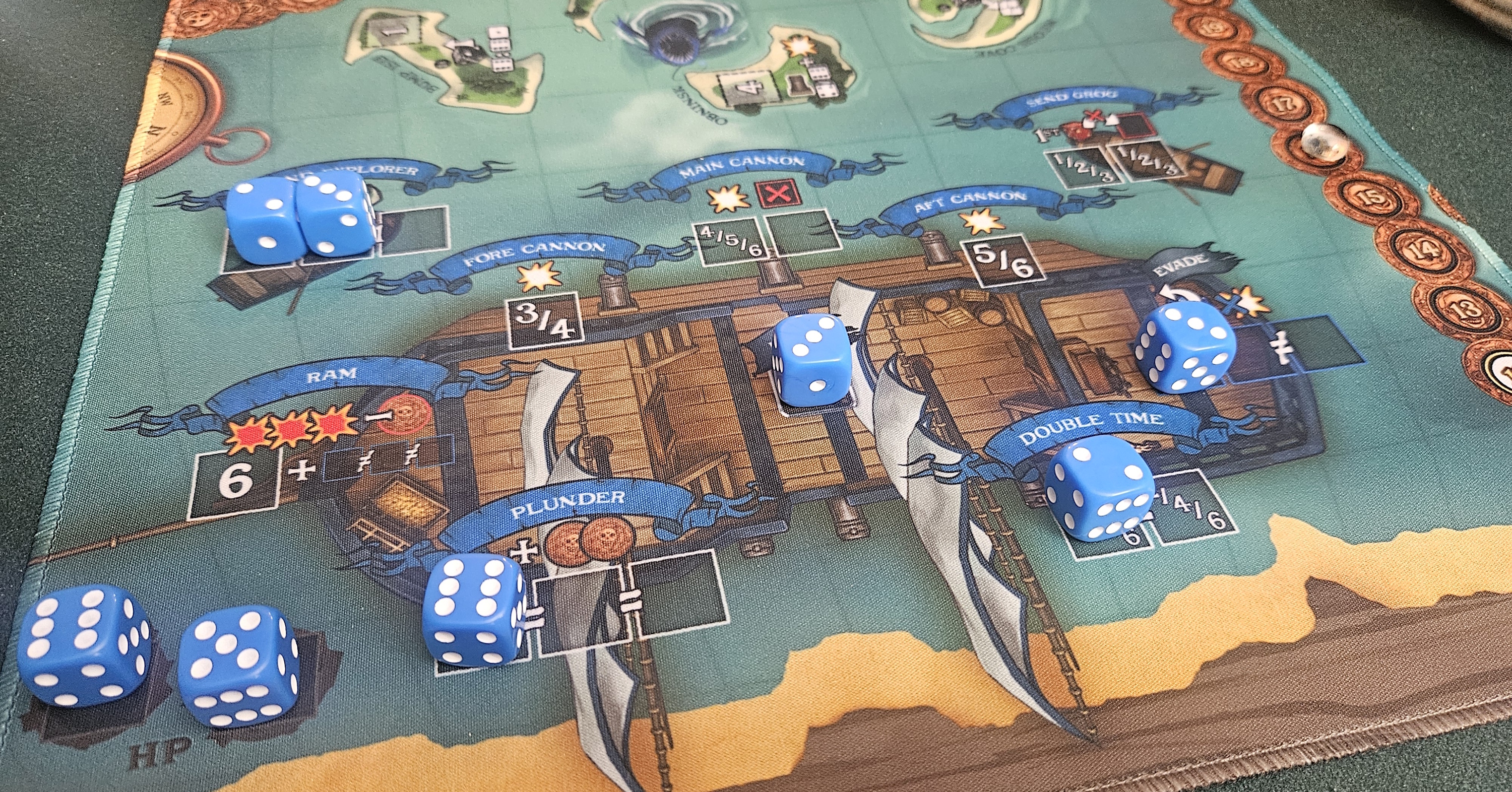
As befits Six-Sided Seas’ simple format, the gameplay is a rapid-fire exchange of cannon fire, island-hopping conquest, and desperate carpentry. The whole thing takes between ten and twenty minutes, depending on how poorly one fares. If my experience is anything to go by, it’s one of those games that demands two or even three sessions in sequence. If I wanted to be reductive, I’d call it Pirate Yahtzee. You roll dice and assign them to your ship’s various stations. Once a station is full, you can remove all the dice banked there to activate its ability. The whole thing is dead simple.
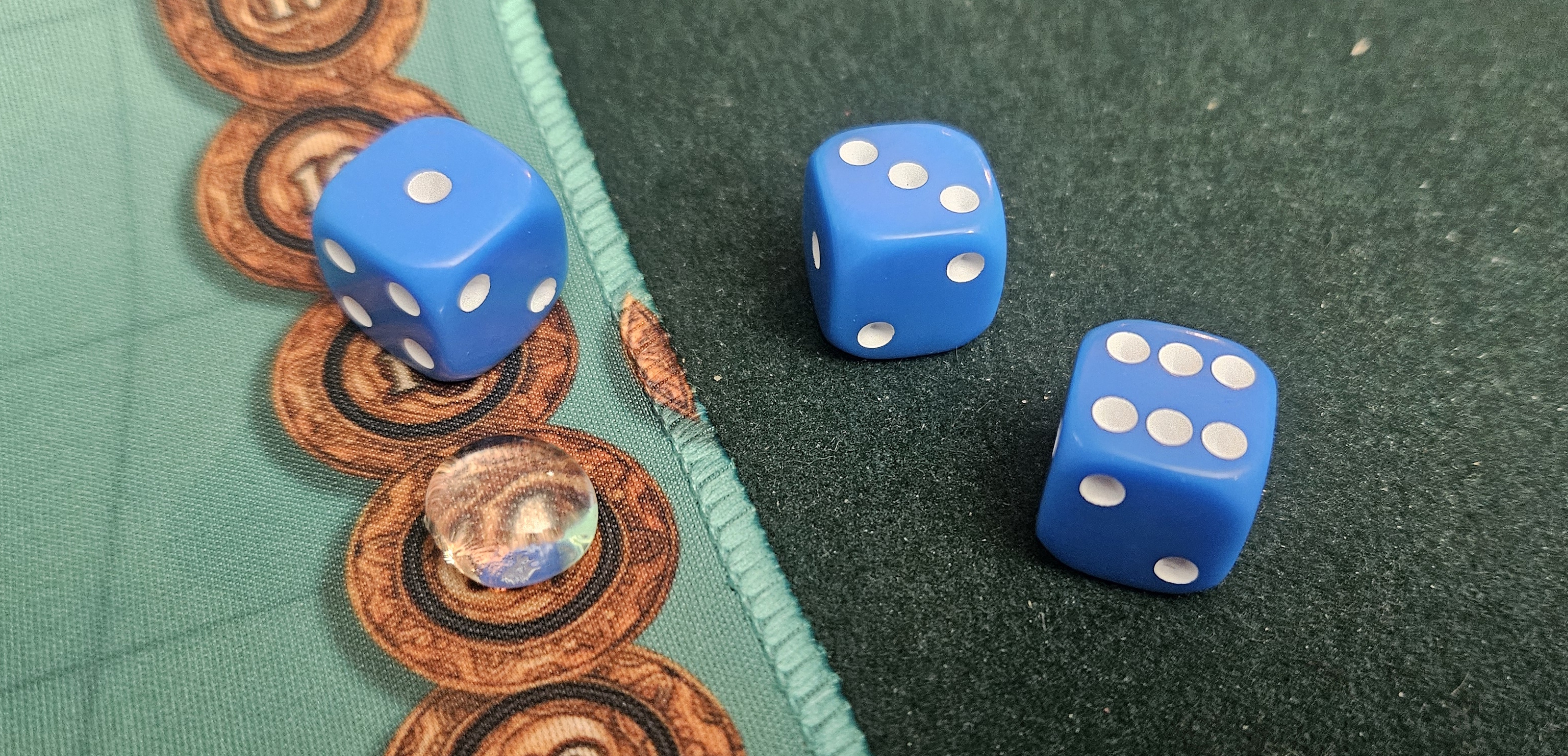
But there are unexpected complexities beneath the surface. The first has to do with the way dice operate. Your crew has a certain amount of plunder, which sets the ceiling for your rolls. You can throw as many dice as you like, but busting that number means assigning a few of them to your evasion pool and tossing the rest, a paltry pity prize indeed. Hitting your plunder number, on the other hand, lets you either bump it up a space or earn an extra roll for free, effectively stretching how much you can accomplish either this turn or in the future. So you’re always playing the odds, pushing your crew a little further, and then enjoying or suffering the consequences when they rise to the occasion — or snap under the pressure.
To roll or not to roll? ‘Tis the question.
Meanwhile, the actions themselves are nicely varied. There’s the usual cannon fire, of course, and a few disruptive abilities like one that sends a barrel of grog to the enemy ship to disable the first rolled die on their next turn or another that wipes out your defensive pool of evasion dice to ram the enemy ship for beaucoup damage. Three contrasting win conditions give these pursuits some edge. Sinking the enemy is the honest option, but even a limping vessel might earn enough plunder or secure four of the contested (and bonus-bestowing) islands in the middle to win without splintering an enemy timber.
It’s minor, but it was also designed to be minor, and its minorness is one of its greatest strengths. For example, I’m compelled to lament the ram action, which I believe is horribly overpowered, especially when doubled, but it’s a maneuver that requires multiple turns to set up, strips away your protection, and may be a reflection of my daughter’s favorite strategy more than an actual imbalance. Anyway, what’s an imbalance in a game that I’ve set a world record for by losing in four minutes? As soon as I’ve been scuttled, we’re halfway positioned for the next duel. This time I’ll ram her ship. (Spoiler: She rammed my ship twice and sent it to the bottom of the ocean.)
It takes fifteen, twenty minutes to sink one of these ships.
I don’t want to damn Six-Sided Seas with faint praise; its brevity belies a real understanding of what makes dice so joyous to handle. The decisions are micro-sized, but they matter. Should I seize the island that gives me an all-important reroll — one that might prevent an untimely bust — or double the impact of my cannons? If I’m falling behind, should I play it safe with my dice or push my crew as hard as possible? There are no easy answers.
So, yes, the format matters. Six-Sided Seas is small, brief, and in some respects limited, especially with its two-player count. But I’m impressed with what Kresky and Solis have done with said format. This one would feel right at home in a game cafe, on a picnic table, or beneath the dim light of a cramped starboard cabin.
A complimentary copy of Six-Sided Seas was provided by the publisher.
(If what I’m doing at Space-Biff! is valuable to you in some way, please consider dropping by my Patreon campaign or Ko-fi. Right now, supporters can read the next installment in my series Talking About Games, this time tackling the topic of what makes a good list! Naturally, the piece includes a list.)
For today’s Space-Cast!, we’re revisiting some jerk’s nasty review from five years ago, investigating some excellent indie games, and discussing the ups and downs (but mostly ups) of self-publishing. Our guide for this journey is none other than Connor Wake, creator of Umbra Via, Out of Sorts, That’s the Spirit!, and many others.
Listen here or download here. Timestamps can be found after the jump.
TIMESTAMPS
1:05 — a reckoning with Umbra Via
28:49 — persisting through Hedged In and Hedge Mage
37:09 — Out of Sorts
58:16 — That’s the Spirit!
1:10:20 — self-publishing
(If what I’m doing at Space-Biff! is valuable to you in some way, please consider dropping by my Patreon campaign or Ko-fi. Right now, supporters can read the next installment in my series Talking About Games, this time tackling the topic of what makes a good list! Naturally, the piece includes a list.)
Every so often — although not as often as I’d like — a publisher will release a more affordable version of a beloved game, and it’s always interesting to see where they’re able to shave a buck off the original production. Cardboard becomes cardstock. Plastic miniatures lose detail or transform into standees. In the absolute worst cases, the game is streamlined. “Streamlined.” The doubt-quotes are important. Pared down, more like. Cut short. Decapitated.
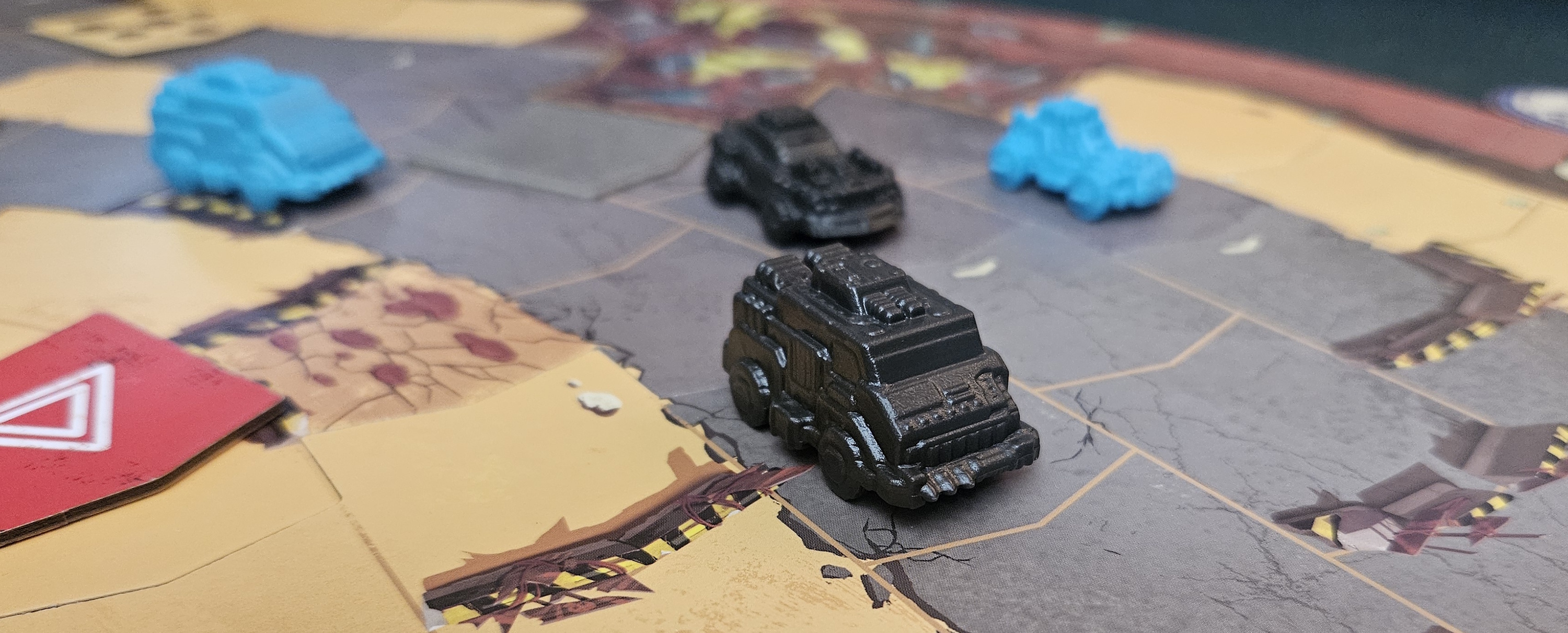
Thunder Road: Ignition trails the lavish Thunder Road: Vendetta. In some ways, this is what you would expect from a product that’s more of the same but costs a third as much as the original box. Cardstock and single-injection molds. The usual.
What’s surprising about Ignition, though, is where it departs from the save-a-buck formula. It isn’t that I expected the folks at Restoration Games to churn out garbage. Far from it. But Ignition isn’t just Thunder Road Done Cheap. After only a handful of plays, my daughters, who had previously declared Vendetta one of their all-time faves, insisted Ignition was superior. To my own surprise, in many ways I agree with them.
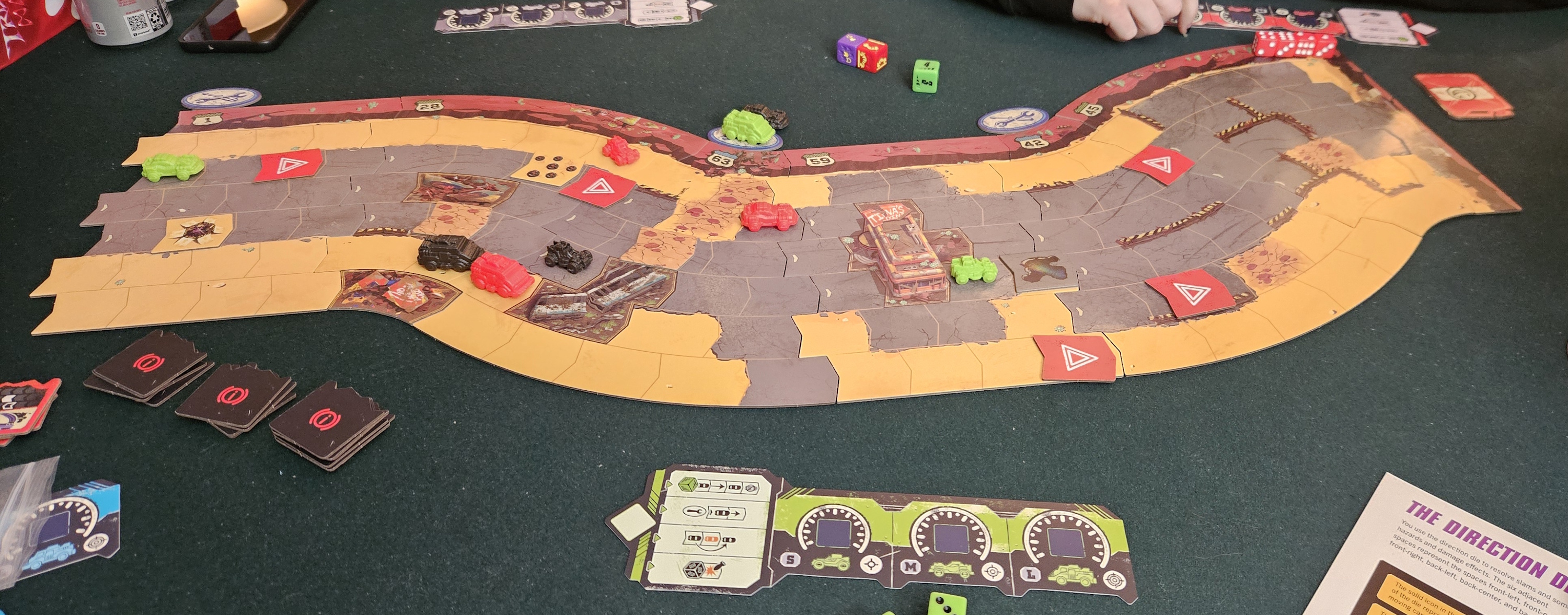
Another day on the road.
Not that you’d know it right away. Thunder Road was a maximalist design. You could see it in every detail, even if you didn’t have access to the multi-tiered Maximum Chrome edition. The cars were assembled from multiple pieces. The helicopters had a spinning rotor. The boards and dice were chunky. And that’s before the expansions added trucks and motorcycles and super-weapons and a deathmatch arena.
By contrast, Ignition is smaller. Suitably so, but still smaller. As before, players command three vehicles as they race across the wasteland, dodging potholes and taking potshots at one another. The accoutrements are gone, none more fundamental than the original game’s whirlybirds, the toy helicopters that served to pursue anyone who broke away from the pack.
Honestly… I don’t miss all that stuff. At least not as much as I thought I would. Ignition is a return to basics. Which might present a problem if those basics weren’t superheated and accelerated to 2400 feet per second.
These are paper mats rather than heavy cardboard. There isn’t much difference.
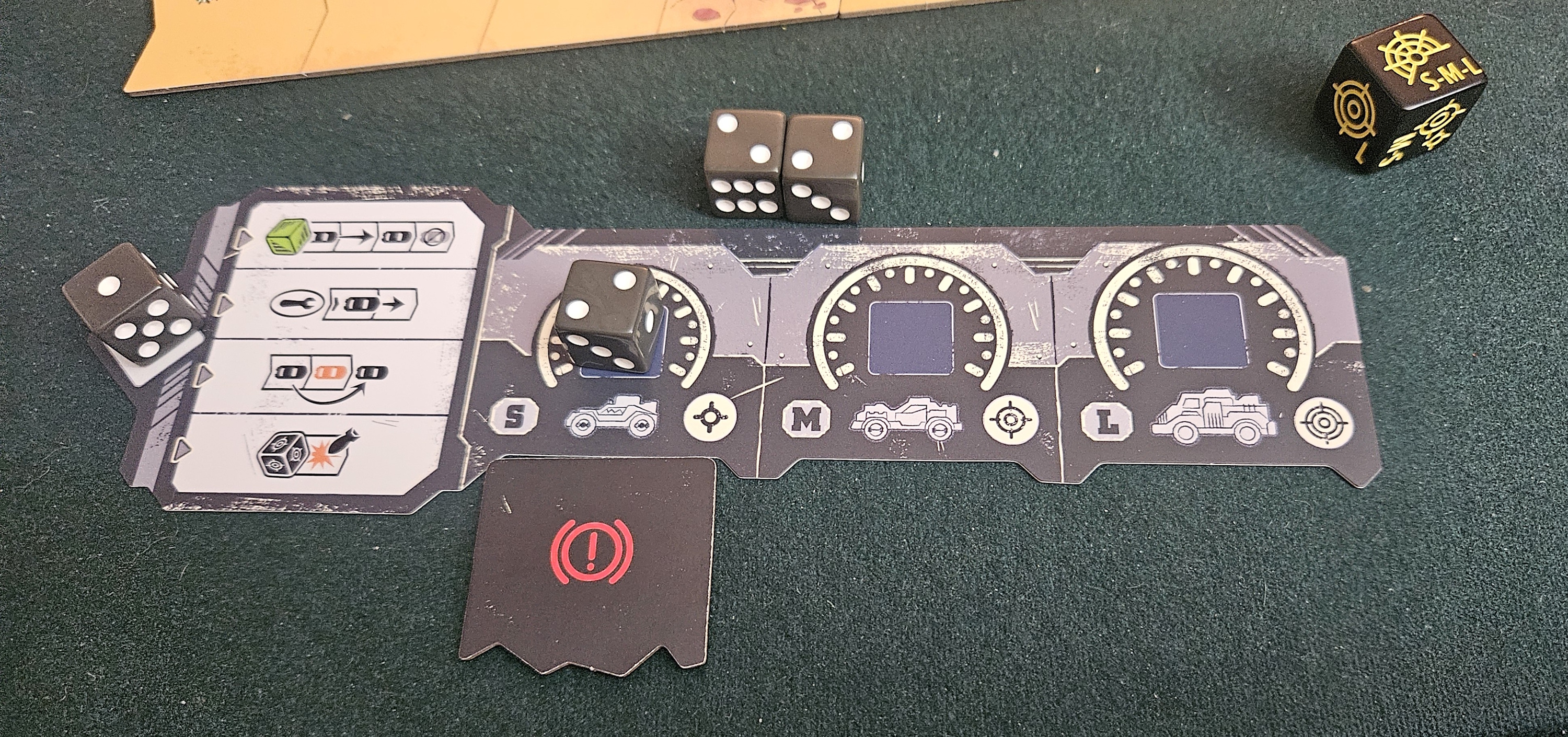
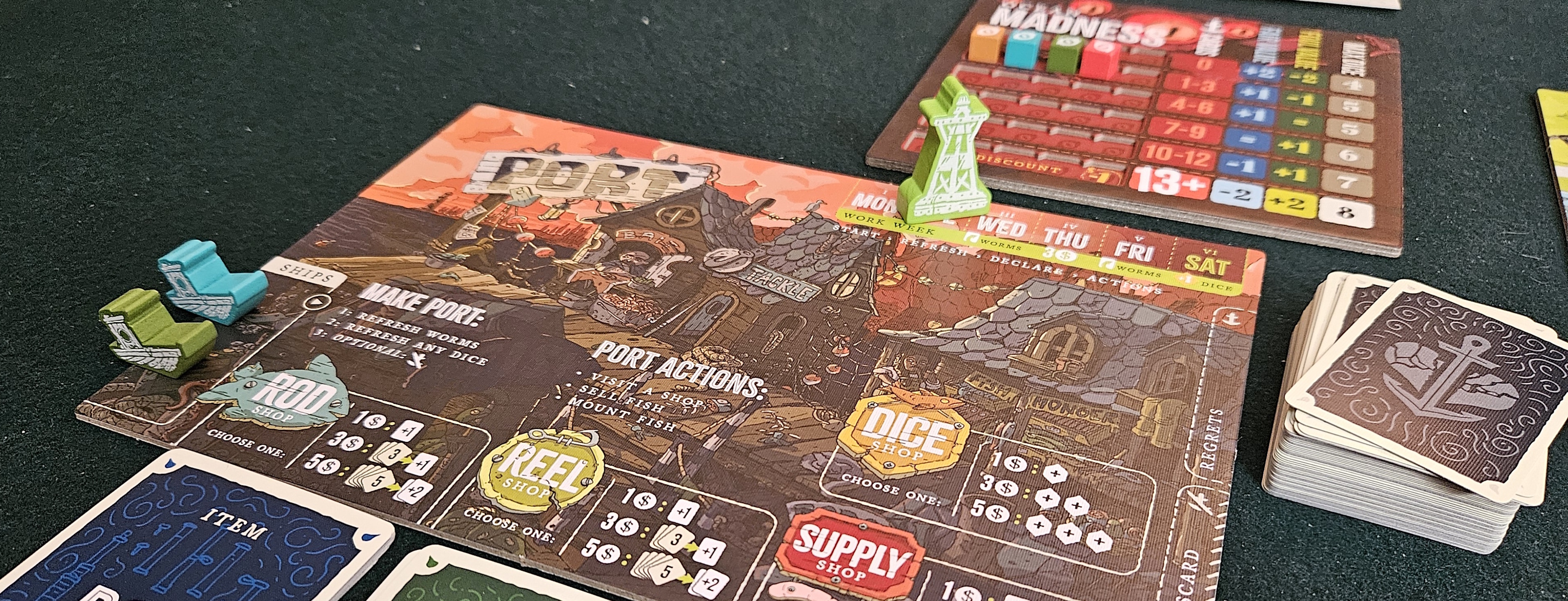
First, the dice. The foundations are the same as before. Each round, everyone rolls four dice, then takes turns placing them one at a time on those various rigs to hurtle them down the highway. That last die could be used once per round to activate a special bonus, like weaving through traffic or sending your helicopter to bomb someone.
Very little has changed. For the most part, the dice-play is identical. Roll four. Spend three on movement. The last one goes toward a bonus action. It’s every bit as smooth and chancy as ever.
The first little differences only rear their heads once you look closer at those bonus actions. The helicopters are gone, replaced by an action that serves more or less the same purpose. This time it’s a missile, presumably launched from one of your cars, and capable of targeting anyone on the road. The only difference is that the missile doesn’t take up space on the road the way Vendetta’s helicopters did.
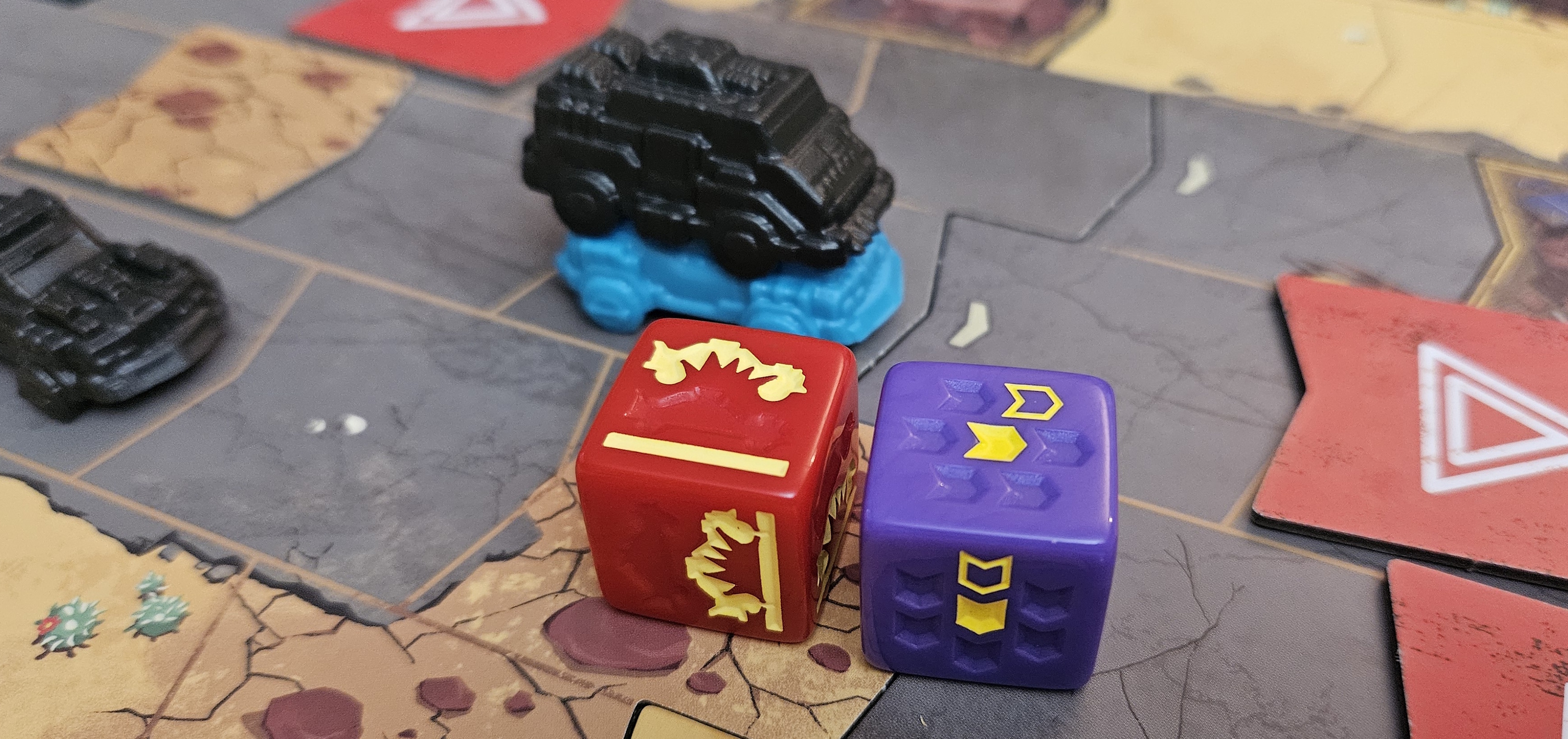
Or there’s the way nitro no longer moves a car by the value of the die placed on it. Instead, you get to roll the trick die and move that far. It’s a subtle but smart alteration, reducing the effect of a strong opening roll and making breakaway vehicles less likely to speed across a dozen spaces in a turn.
Or there’s the absence of the repair action. Now, if you know Thunder Road, that might sound as cracked as a wasteland warrior’s sense of self after their warlord has imparted some considerable brainwashing. No repairs? How will you keep your cars from being wrecked?
About that…
Checkpoints allow demolished vehicles to return to the race.
In Ignition, cars don’t get wrecked.
Oh, they can still crash. Or get machine-gunned to bits. Or have a missile turn them into a crater. Or speed across too much gravel after their transmission has been shredded by a landmine. Two hits and a car is out of commission.
But only for a while. Only until the next time you activate it with a die.
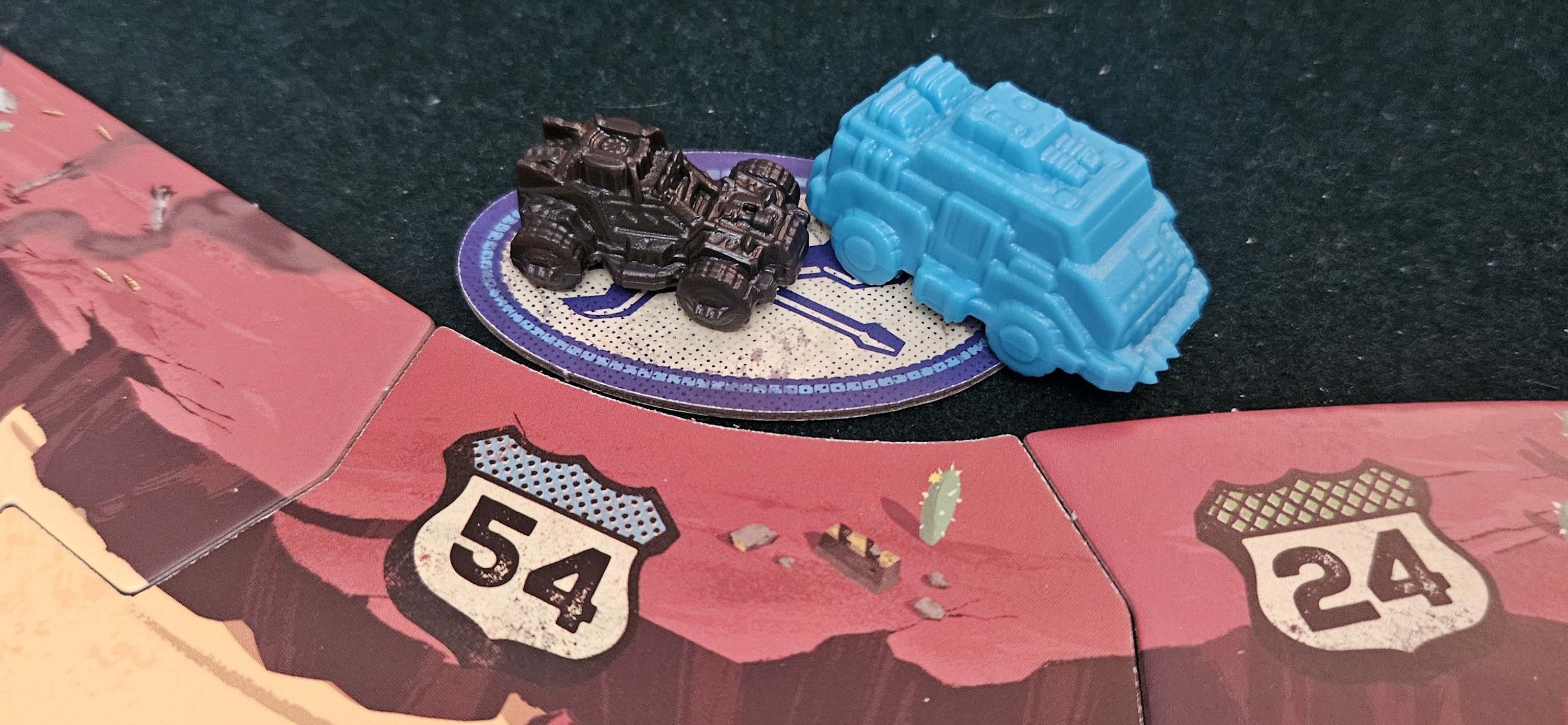
The answer is checkpoints. When a car is destroyed, it goes to the most recent checkpoint. From there, it reenters the race, albeit probably a little farther back then before. Also, it will be slower. It takes the car’s entire turn just to reappear on the road.
That is, unless you spend your bonus action on the option that stands in for the old repair action. Now, when you roll your car back onto the road, the jump-start action will allow it to make its full move. In most cases, this is enough to get back into the thick of things. And if not… well, maybe in those cases it’s smarter to save your bonus dice on heat-seeking missiles.
The curved roads look great and add a few new considerations.
The ramifications of this change from permanent destruction to temporary setback are far-reaching. First, I won’t pretend there aren’t any negatives. There are no more car wrecks. These were one of the original game’s coolest sights, the burnt-out husks of defeated racers turned into serious obstacles for the drivers behind them.
That said, this completely removes one of the system’s larger problems: that the back half of Vendetta’s races were considerably less interesting than their opening moments. As players lost their vehicles, turns grew shorter and more perfunctory. Fewer decisions were present. Usually the last third of the track felt like a foregone conclusion.
Now the victory condition has changed. This is a race, pure and simple, and whomever crosses the finish line with two cars is declared the winner. There’s no longer a situation — and a common situation at that — where you’ve lost so any cars that you no longer have anything to do with those remaining dice. Now you just wheel them back onto the track and keep going.
This eases some of the game’s chancier elements. Thunder Road has never been a serious game, but dulling the consequences helps to emphasize its better portions. Namely, that this is also a rather funny game. Smashing a tank into a dune buggy, only for the tank to get thrown into a wall of trash, is now wholly amusing rather than frustrating. By the same token, getting slapped with a missile right before you reach the next checkpoint offers a shadow of the finish-line blues, but its easier recovery means you haven’t lost the race. If anything, this adds some strategy to the game. Rather than investing every one of your best rolls into your fastest car, it’s often worthwhile to spread them around to ensure a damaged vehicle reaches the next checkpoint rather than getting booted back to the start of the track.
Which is all very clever. Because Ignition is definitely the smaller of these siblings, but it doesn’t feel short so much as lean and muscular. Its matches are focused and mean and hilarious. An improbable emotional blend, but one that works thanks to some ruthless development work.
Smoosh!
Everything else survives intact, at least if we’re starting from the baseline rather than the expansion stuff. The special dice, which oversee ramming and damage and shooting, are still a joy to contemplate and handle. The cars still feel distinct without needing any additional rules. The race… well, it’s still Thunder Road. Just better, in most ways.
As my seven-year-old put it, “It was so crazy when my car hit your car into the garbage!” Like the best of the recent resplendence of comedy racing games — Hot Streak, Magical Athlete, and Dino Racer — Thunder Road: Ignition feels like it was custom-built to appeal to everyone in my family, adult and child alike. Vroom vroom, sucka.
A complimentary copy of Thunder Road: Ignition was provided by the publisher.
(If what I’m doing at Space-Biff! is valuable to you in some way, please consider dropping by my Patreon campaign or Ko-fi. Right now, supporters can read the next installment in my series Talking About Games, this time tackling the topic of what makes a good list! Naturally, the piece includes a list.)
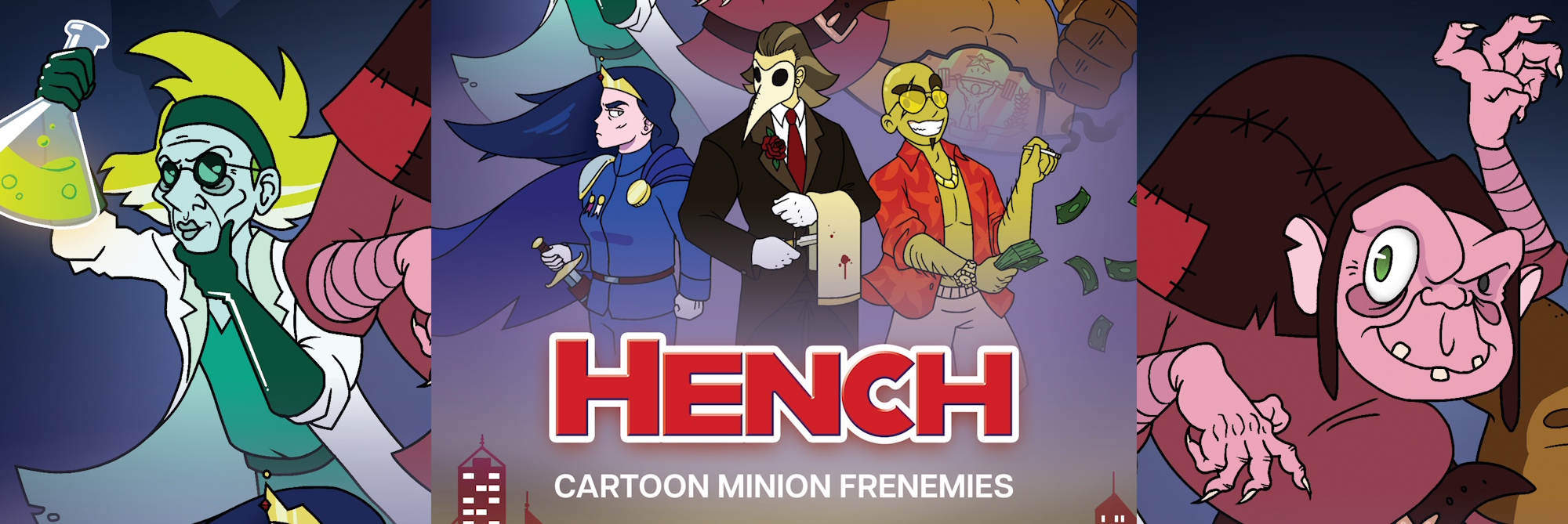
Hench is a strange, lovely beast. It’s as far as it gets from Edward Damon’s previous title, Rex Regnat, and not only because its Saturday morning cartoon vibe is a sharp contrast with that game’s public domain portraiture. They operate in distinct modes. Where Rex Regnat functioned best when everybody was attentive, Hench is a little sloppier. It’s raucous. It doesn’t mind getting grease on its shirt. It wants to throw stuff against the wall.
Players are, rather obviously, a supervillain’s henchmen. Henchpeople, according to union guidelines. It’s a role that rewards those who steal recognition for the most basic of tasks.
Observe my nefarious deeds.
When you get down to it, Hench is about a single question. Really, it’s the same question that undergirds much of modern society. On the one side, there are tangled and mutually beneficial incentives that allow us to have raspberries in winter and mass transit and airplanes that don’t fall immediately out of the sky. On the other, there’s the need to “get that bag,” as the kids say. To benefit yourself. To stay afloat at everybody else’s expense.
Perhaps Lord Nefarious, your supervillain overboss, is the stand-in for capitalism in this particular arrangement. Because in Hench, it’s necessary to work as a team to succeed. But in order to succeed succeed, you also need to stab that team in the back as often as possible.
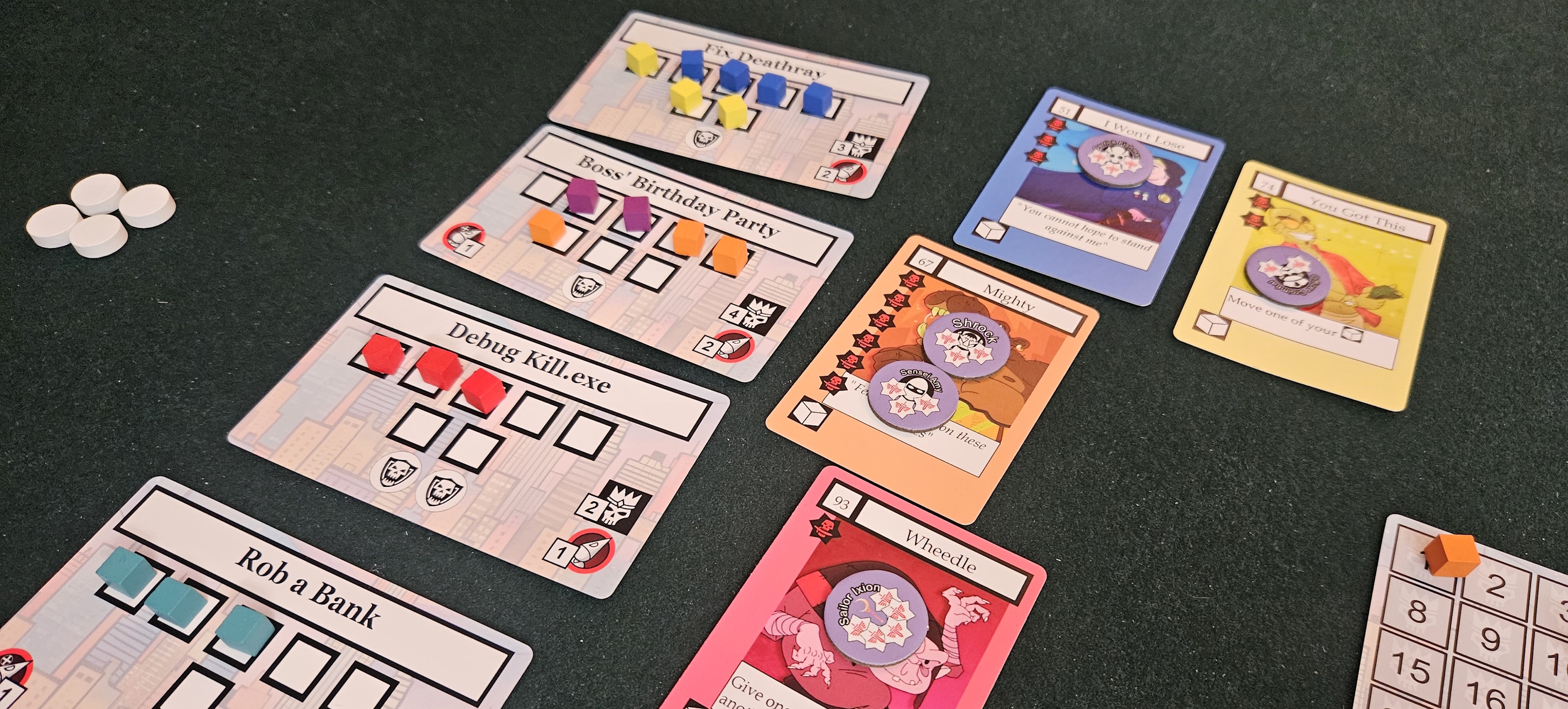
Picture this: multiple missions, ranging from the banal (dry-clean the boss’s outfit, bully a child) to the labyrinthine (build a volcano lair, file the evil org’s taxes). Even the most trivial of these tasks requires investment from multiple henchpeople. Especially because those do-gooder heroes are always out foiling your plans, requiring regular confrontations that may well end with your face purpled and swollen, but at least you’ve kept Dr. Hero away from Evilcon East for the week.
But then, the problem. The real problem, because heroes are but the first hurdle on this particular marathon. (Marathons have hurdles now??) Everyone who contributes to a mission will earn Lord Nefarious’s esteem. But whomever contributes last to the task, the mook who’s putting the finishing touches on the job when the overboss slouches around — well, they get more credit than everybody else.
This social conundrum informs everything. Whether you bother to help a fellow henchperson fix the deathray. Whether you intercept a hero on the verge of tanking an objective. How obnoxious — how loud — you become at the table.
Everything, from the henchpeople to the heroes to the missions, are done in good humor.
For the most part, Damon leaves the answer to this question — really the answers, plural, because there’s no singular way to respond — up to the players. Hench is a restrained design in that regard. Turns, which are simultaneous, consist of picking cards and then, according to their initiative number, playing them to those various jobs. Within that rubric, there’s room to collaborate or to be as snide as possible. Even to sabotage a rival’s mission on the brink of its success. Hench isn’t proscriptive about it.
I will say, the center of this cake is a little doughy, and not only because we baked a saw into its midsection. Whether we’re talking about the missions, the heroes, or the limited henchperson powers, the tuning never feels entirely right. Hench feels like a game that would have benefited from wackier occurrences, the occasional landmine or salt-water taffy, to keep events lively.
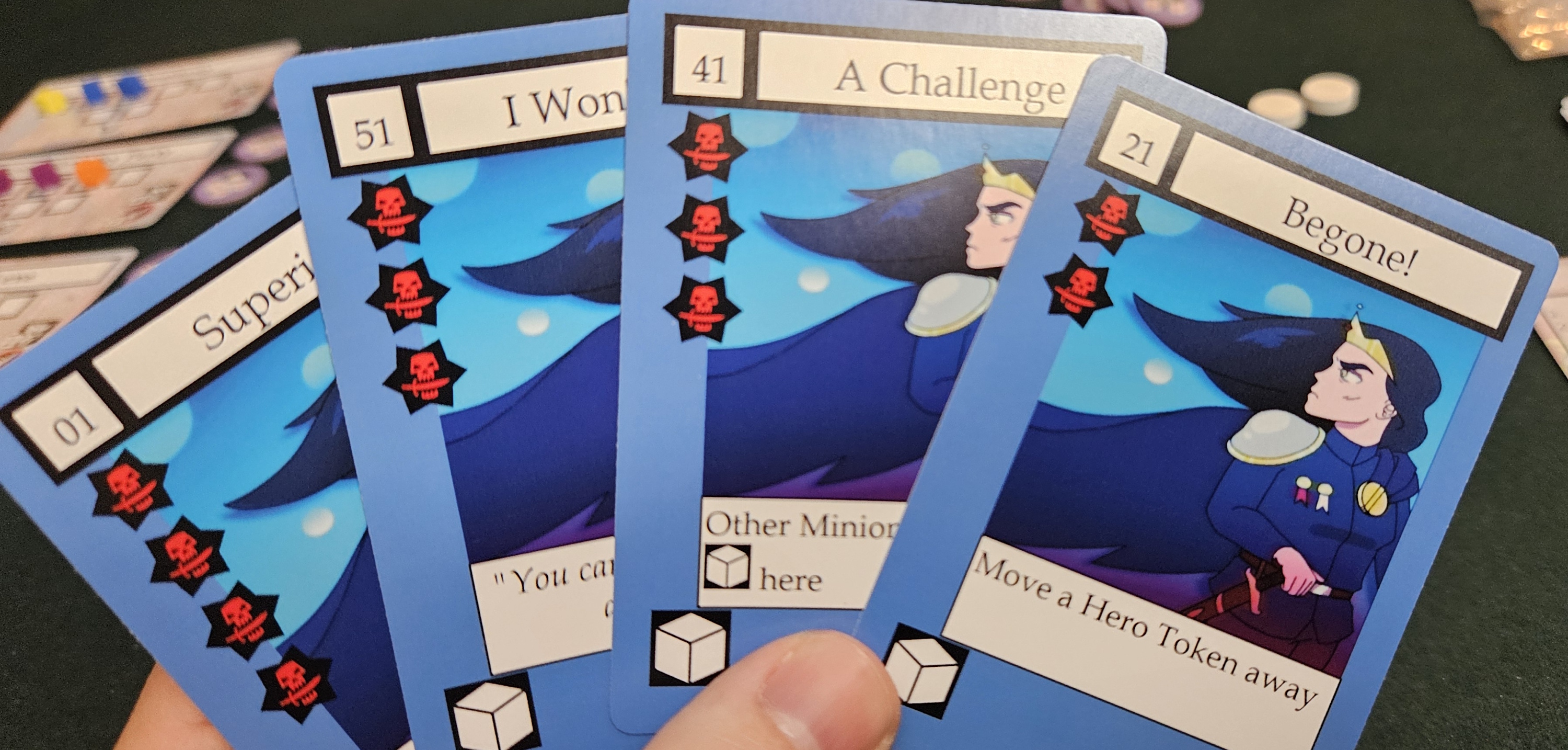
The biggest example is the minions. Each character receives a passive ability and a couple of cards with special abilities. For a game with so much potential, it’s a limited approach. Not even the game’s cooldown system, which prevents any henchperson from playing the same one or two cards over and over again, can break its hold. Instead, players tend to play their best three cards over and over again. Some additional tinkering wouldn’t have gone amiss.
Still, I appreciate a design that keeps the focus where it’s due. Hench might not be the best imaginable version of itself, but there’s no denying that its attention never strays. The whole thing takes maybe half an hour, just long enough to let a few interoffice rivalries develop, but not so long that they grow stale. It’s a thought experiment written… not large, but big enough to illustrate its point. There’s no such thing as ethical collaboration under a dark lord. That’s my takeaway.
Nefarious deeds on cooldown.
Or maybe I just like hanging out with these weirdos. To be sure, the cast is colorful, and while their abilities are limited, they each gesture toward a more robust personality. There’s the Worm, who thrives on punishment and thus seeks out minor failures. The Brain, always out-thinking everybody around him. (Or at least imagining he is.) The Brute is a gigantic hippo. I don’t remember its abilities. But being a giant hippo’s got to count for something.
All in all, Hench is a minor but still appealing second act from an exciting up-and-comer. It isn’t as dense or piercing as Damon’s previous title, but still offers a tight half-hour experience that understands the virtue of getting out of its own way. Very much unlike a dark lord, come to think of it.
A complimentary copy of Hench was provided by the designer. It will be available at Pax West next week.
(If what I’m doing at Space-Biff! is valuable to you in some way, please consider dropping by my Patreon campaign or Ko-fi. Right now, supporters can read the next installment in my series Talking About Games, this time tackling the topic of what makes a good list! Naturally, the piece includes a list.)
2023 feels like a zillion years ago. That’s what I get for having the brain of an old-growth redwood. According to tradition, New Year, Old Year is how I revisit the titles that I declared to be the “best” in any given year. Best Week 2023 featured thirty titles over five days. Let’s see how they stack up today.
Day One! Family Stuff!
Aw. The first day of Best Week 2023 is a snapshot of a slightly younger family. These are all games I played with my kids, then aged four and nine, and it’s interesting to see which have survived the intervening two years and change.
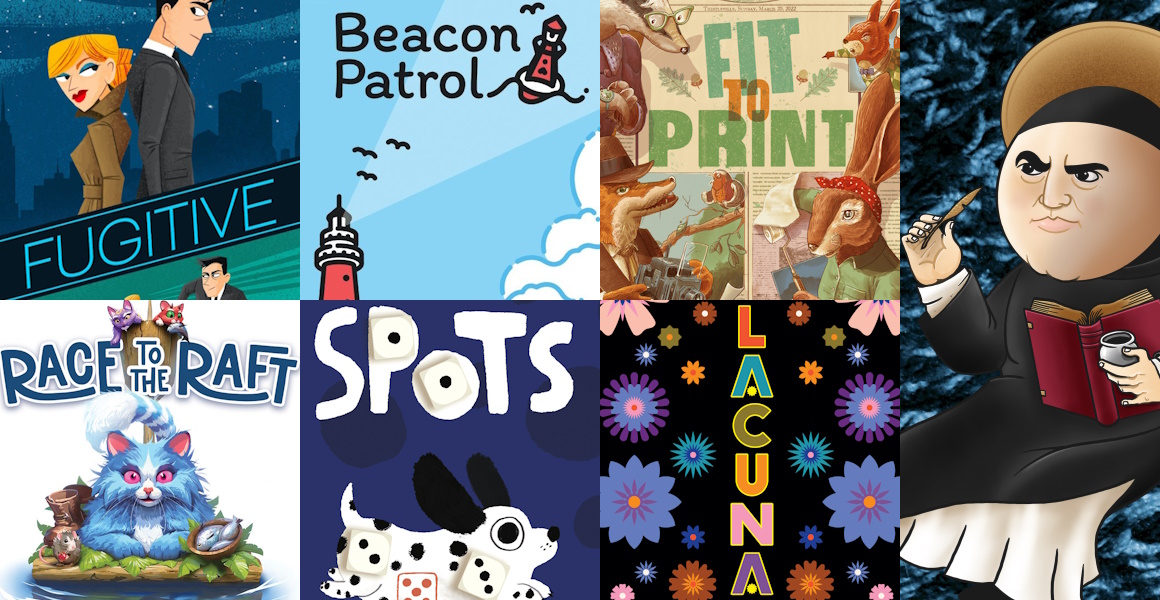
In terms of family play, the big losers of the bunch are Fugitive and Race to the Raft, although not so much because the games aren’t good as because they’re too heady. I’d still be happy to play either of them, but their absence from my daily life is rather pronounced.
Somewhere in the middle, I would put Beacon Patrol and Lacuna. I’m actually pretty regretful that I passed along the former. Given how smitten with Blorp! my children are, despite being grossed out by its overabundance of orifices, I think they would appreciate Beacon Patrol’s gentler setting and more interesting placement puzzle. Lacuna, on the other hand, is still sitting on Cate’s shelf. She always gives it a place of priority when she rearranges her games, and insists she isn’t too old for it. I think it might be time to pull it down to see how it fares between her and her little sister. For whatever reason, though, it’s been cemented in her head as a game that’s worthwhile, something to be treasured, even if we haven’t played it in a good long while.
That leaves two titles. Fit to Print is such a banger. I wouldn’t say it’s appeared much at family time, but I tabled it again earlier this year to show some friends what could be accomplished with that Galaxy Trucker formula, and it was a hit all over again. This is another good candidate for reintroduction. (How’s that for a phrase that makes me sound like a mad scientist?) I think even the younger kiddo could now grasp the basics.
The undisputed leader of the pack is none other than Spots. Honestly, I’m not sure why I didn’t give it the number one position. Contrarianism, most likely. Cate recently introduced it to a group of friends at one of the game days she’s been hosting, and it warmed my heart to see yet another pack of children giggling over the cow that thinks it’s a dog. What a perfect game.
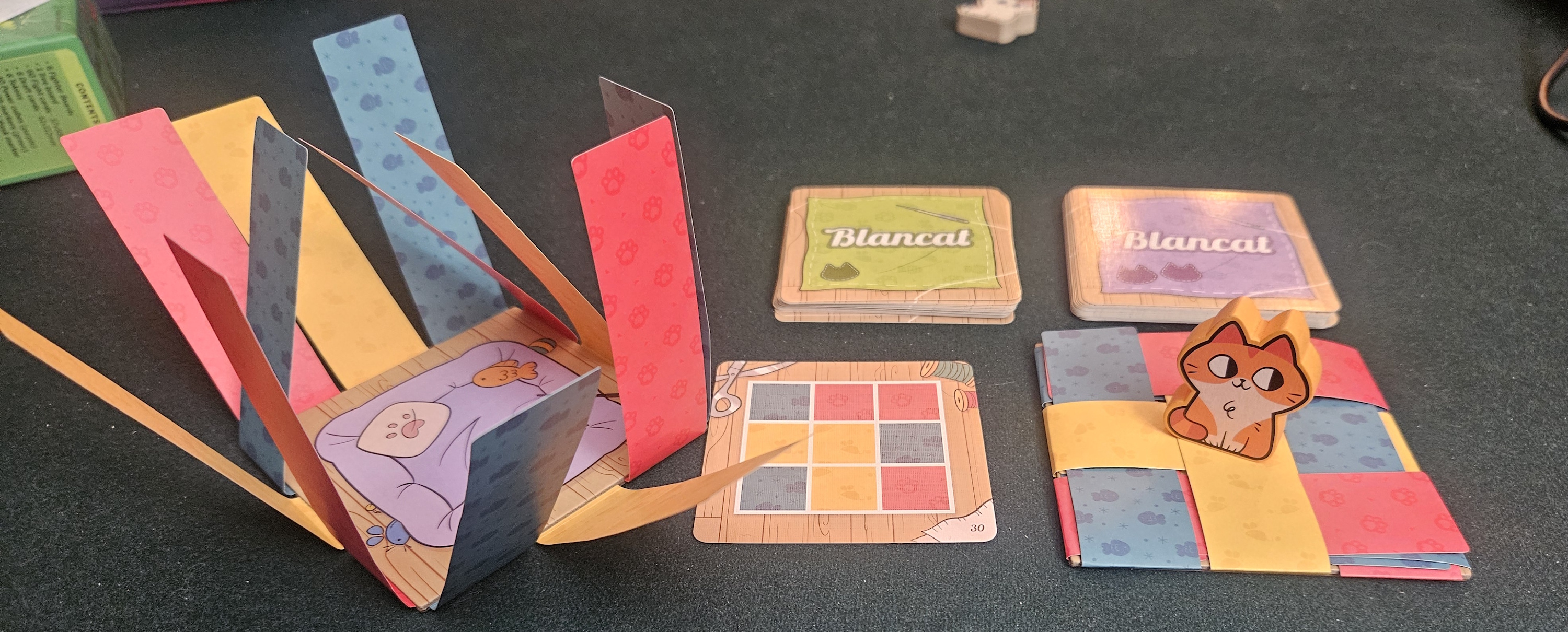
Two years might not seem like enough of an interval to warrant a second edition, but Connor Wake’s Out of Sorts is not your average board game. Actually, it’s become something of a counterpoint for me. While Wilmot’s Warehouse has become the proof of concept for what a modern memory game can accomplish, to such a degree that I have played it something like fifty times, Out of Sorts is that but bizarre, that but frightening, that but even more unwilling to guide its players by the hand. Because it is weird, my appreciation is even more boundless.
How weird is it? Here’s the premise: You’ve been abducted by an alien and put to work categorizing their spacefaring library. Presumably the delay of lightspeed means they’ve only recently learned of Melvil Dewey’s book classification system. “There are less racist alternatives!” one might protest. Yes. We have more pressing problems at the moment, but too true. Unfortunately, the alien doesn’t know about those Dewey-free alternatives. All it knows is that humans are good at sorting books. And it owns a lot of books.
What’s this nonsense?
So you sort. And sort. And sort.
I’ve always found it beautiful, our human tendency to see shapes in foliage and gods in static. We are thing-ordering machines, if you want to go that way, with such a talent for hearing music and witnessing divine geometries that we sometimes drive ourselves mad. When we look at the cards Wake has illustrated, we don’t see nonsensical scribbles. We see — so many things. Little projections of our selves. Examinations of our private pareidolia. Here is a hand-tied fly, ready to be cast into the river. There is a tadpole bopping along to a song. Which song? “Barbara Ann” by the Beach Boys. It could be none other.
When the game begins, we receive three categories. These, like everything else in Out of Sorts, have been retouched from the original edition. Perhaps we have been tasked by our alien overlord to organize their xenic scrawl into Death, Math, and Art History. Or perhaps Royalty, Life, and Rituals. Some combinations are easier than others. Some seem impossible. What’s the crucial visual distinction between Reptiles and Monsters? How about Thermodynamics versus Cosmos? Best of luck. We’re gonna need it.
There are two roles. One player is the Sorter, responsible for shelving these cards. In game terms, assembling them into a hand. Everyone else is a Finder. They find the cards, both at the beginning of each round and then when the alien decides to check our homework.
This latter portion is the game’s version of a pop quiz. One by one, the Finders reveal cards from the deck and put them into an order that matches the hand built by the Sorter. It’s analogous to diving into a card catalog for some random book, then immediately identifying where in your personal ordering system you’ve decided to place it. Structural Dynamics of Flow, easy, that’s in the middle. Noblesse Oblige & Other Obsoletions, that goes after the first one. Wheels: The Denunciation. Uh oh, that’s in the same category as the previous title. Fortunately, we created a sub-category that lands it squarely before that one.
Except here we’re faced with alien squiggles rather than readily-identifiable classics of the Western Canon. Sometimes the symbols collapse into a mental mishmash. Other times we spark the magic that is our capacity to organize even the most nebulous of concepts. Within a century, pedants will grouse at one another over which category is truer than the other. Mostly, we’re spinning these categories on the fly, terrified of being fed out the airlock.
These surveillance measures are getting out of hand.
Where this latter edition departs from the original is in its open-ended nature and overall fluidity. The original, if you haven’t played it, was a march to a finish line that probably never arrived. Victory required passing through every one of the game’s checks. Nine in total. I’ve never managed it. Frankly, I’m not actually sure it was possible for normies to accomplish.
This time around, Wake has grown more playful. As before, the game begins with a twenty-minute timer, followed by escalating requests from the alien. Only this time, rather than hoping you’ll make it through all nine rounds, the game assumes you’ll falter. Maybe we’ll deplete our limited supply of minutes. Or maybe the alien will notice the errors in our categorization system. (Adorably, it peeks suspiciously from behind its alien magazine. What we cannot know is that its reading material is smut.)
Either way, we’re given one last chance to sort the deck we’ve created, ordering the entire thing in a panic. The more checks we passed previously, the more we have to sort, but also the longer the alien gives us to accomplish our task. Our performance awards us a final score, tallied for every card we put into its correct place. As conclusions go, it’s far smoother than what Out of Sorts provided before, more of a crescendo than an abrupt termination.
But that’s not all. While our score matters, Wake also rips a page from Jon Perry’s Hot Streak by assigning our rank a post-script to this whole debacle, a one-sentence note right out of a ’90s sports flick. “Bobby went on to play in the Majors. Tom married Queenie. Jerry died of lung cancer at 34 from smoking eight packs a day.” That sort of thing. Only more likely to involve airlocks.
These changes make the new edition gentler in some ways, more approachable, but this isn’t to say it’s been defanged. If anything, the game has been given a rounder shape, one that suits its gameplay so perfectly that it’s hard to imagine it ever occupied a different vessel. In fact, I’d half-convinced myself that it was always this way. I had to go back to the original rulebook to make sure I wasn’t imagining a slightly worse version of the same game.
There are other little additions. The biggest is a variant that sees the alien librarian occasionally interjecting its own recommendations. Sometimes these are helpful, like having the Sorter flip a card around so everybody can see it. More often, they’re petty annoyances, like tossing a book onto the front of the stack or having the Finders assign a title in the Sorter’s place. It’s a small alteration, but worthwhile in how it forces your squad of unwilling astro-librarians to adapt to further impositions.
There’s now an ultra-mean variant where the alien proposes ideas.
All told, Out of Sorts is every bit as good as I remember. Partly that’s because it’s such an improvement that it retroactively persuaded me that this is how the game was always played, a suitable trick for a game about both the fuzziness and indefatigability of creative memory.
But the real reason is because it’s still that same weird memory game, only improved in nearly every way from Wake’s earlier effort. For a game about alien libraries, Out of Sorts is defiantly human. Its illustrations are hand-drawn, its design is iterative, and its central spark is the same promethean fire that is our human capability to organize and imagine. I love its squiggles and crotchety alien kidnapper. I love even more what it reveals about our human capacity to index a shelf of shame.
A complimentary copy of the new version of Out of Sorts was provided by the designer/publisher.
(If what I’m doing at Space-Biff! is valuable to you in some way, please consider dropping by my Patreon campaign or Ko-fi. Right now, supporters can read the next installment in my series Talking About Games, this time tackling the topic of what makes a good list! Naturally, the piece includes a list.)
One of my favorite games ever designed is getting a new edition. Apart from some component upgrades and better availability, nothing has changed. Which is precisely what this title needed.
So come on in. The tea’s hot and the fire is crackling. HA HA. You just scalded your tongue. That means I’m the winner. It also means today’s game is Schadenfreude, the most joyously nasty trick-taker out there.
If you know Schadenfreude, you know this is one wacky hand.
I’m convinced that Schadenfreude is the best “pure” trick-taker ever crafted. Designed by the mysterious ctr, historically this one has been hard to nab. Not so any longer, because the new edition is coming via Office Dog, the same studio that brought us the Lord of the Rings trick-takers, Fellowship and Two Towers, both of which are lovely.
As I noted in my original review, Schadenfreude unfurls like a joke that keeps on giving. It’s comparatively bare of ornamentation, nothing like some of my personal favorites of the genre. The tricks are must-follow. The triumphs are nonexistent. There are two special cards, a zero and a ten that can match with any suit, but I suspect they’re mostly there to round out the card count.
The gimmick, such as it is, is that the player in second place wins the trick. At the level of sheer utility, this does a lot for the usual reliability of high-value cards. You’re holding a nine? Too bad. You’ll never get it into your scoring pile. At best, it’s a way to push an eight into somebody else’s score pile. Unless somebody is holding that wild ten, anyway. Then the nine might be your undoing. But now I’m getting ahead of myself.
The score tracker is more than just cards and meeples!
Schadenfreude’s shenanigans extend to the entire scoring rubric. Whenever you win a trick, you claim the winning card plus anything played off-suit. These cards then sit in your score pile, where they’re worth points at the end of the hand. Unless you later win a duplicate. Then any duplicated cards obliterate one another like those two guys in Time Cop.
Avoid duplicates, check. Easy, right?
Except you don’t necessarily want to score, at least not too much or too often. The game only ends once somebody breaks past forty points. But this isn’t a threshold for victory. Oh no. It’s a threshold for losing like a chump. Anybody over forty is ineligible to win. Whoever’s sitting at the highest score after that game-concluding bust becomes the winner in their place. Provided not everybody busted on the same round. Which, yes, can absolutely happen. It’s never not hilarious.
Between this rubric and the game’s restraint — only four suits, no special powers or rules exceptions — Schadenfreude provides tremendous range to strategize. It’s the sort of game where every play might force-feed a poison pill to a rival. Maybe even three poison pills at once. Early on, it’s common for somebody to gobble up as many cards as possible, only to realize their comfortable lead puts them in very real danger of busting. Suddenly their play grows conservative. Only now everybody else wants them to choke on as many cards as possible.
It’s now easier to tell the suits apart.
Above all else, it’s funny. Lots of trick-takers are funny, but I don’t think any one of them has made me laugh as hard as this one. Some have called the game “themeless,” except it’s a perfect expression of an emotive theme rather than a physical setting. Schadenfreude is about schadenfreude, about the joy that comes from watching somebody topple from their high horse. Which is probably why the cover art is now a knight taking a head-dive from his noble steed. I hope he dents his helmet and spends the whole evening scrubbing grass stains from his coat. Git.
Ahem. Anyway, this is more of an announcement than a proper review, and for that I’m sorry. But Schadenfreude is a wonderful little artifact, the rare sort of game that’s not only a joy to play but also to explain. I’ve yet to see it flub at the table.
A complimentary copy of the new version of Schadenfreude was provided by the publisher. Which was very kind of them, considering I’d bought the damn thing three times previously, twice at great expense because it was impossible to actually find anywhere reasonable.
(If what I’m doing at Space-Biff! is valuable to you in some way, please consider dropping by my Patreon campaign or Ko-fi. Right now, supporters can read the next installment in my series Talking About Games, this time tackling the topic of what makes a good list! Naturally, the piece includes a list.)
All I play anymore is trick-taking games. Fortunately, it’s an uncommonly smart genre. Today I’m covering three titles that highlight both the format’s breadth and what makes trick-taking one of tabletop’s most enduring pastimes — and one of its meanest.
In other words, these are trick-takers for jerkwads. Compliment intended.
I am not gonna review eating 18 pancakes.
Shortstack
Marceline Leiman has been busy. After the success of High Tide, it seems like her designs are popping up everywhere. (Pro tip: Dino Racer has the juice.) Most recently, Shortstack has been making the rounds.
To begin, your hand is massive. Nine cards, then a “napkin” (also a card), then nine more cards. The reason for this division becomes clear right away. Rather than playing a single card, every trick is built from two separate components, one from the left side of the napkin and the other from the right. The first card’s number becomes the “suit” while the second becomes the “rank.”
Simple enough, and a wrinkle that constitutes the entire sub-genre of domino trick-takers. But two things set Shortstack apart from the pack. The first is that “perfect pancakes” — those where the rank and suit are identical — are outright winners. You’re still required to follow suit if possible, but your dichotomous hand makes it easier than usual to claim tricks at unexpected moments. This produces quite a bit of flexibility, important for claiming high-value tricks that will likely award a point at the end of the round.
Now that’s more acceptable.
The other thing that’s different about Shortstack is even more impactful: if you eat too many pancakes, you’re gonna hurl. Leiman is too polite to actually state this outright, but we’re professional translators of subtext round these parts. If you take too many tricks, all your pancakes are “thrown out” (read: barfed), you score nothing, and everyone else at the table earns a point. Presumably because they’re laughing at your misfortune.
This alters Shortstack from straightforward into a nasty affair indeed. Your flexible hand makes it easier to claim tricks, but also offers little opportunities to nudge an opponent into chowing down on too many pancakes. It always seems like there are two or three rounds too many. While it’s technically possible, in the three-player game at least, to get through a hand without ejecting all that batter across the table, it isn’t likely.
The result isn’t my favorite short-form trick-taker; personally, I would rate this one alongside Nebular Colors, which I appreciated without wanting to come back to. But it’s still a simultaneously charming and vicious little thing. Like Marceline Leiman herself, perhaps? I couldn’t tell you. I’ve never met her. But when she keeps producing such digestible razor blades, one starts to wonder.
More games should use CDs as soundtracks and play surfaces.
The Magic Shop
More games should come in DVD cases with soundtracks on compact disc. Even better, those discs should double as game boards. Even bettah, those games should be adaptations of short stories from the turn of the century. And not this century. The one before that.
The Magic Shop, designed by Reader on Jupiter, calls to mind their previous title The Man Who Was Thursday not only for its packaging and soundtrack, but also its fascinating approach to adaptation. In this case, the work being reimagined is H.G. Wells’ 1903 short story “The Magic Shop,” and much like the story’s father and son, we’ve stumbled into a shop, found ourselves trapped, and must now accomplish increasingly bizarre feats of endurance and navigation in order to leave. Basically, it’s a 19th-century IKEA.
While it’s tempting to spend this entire time discussing the game as an adaptation, which is utterly delightful in its impressionism, capturing the whimsy and some measure of the story’s menace without recreating even a single narrative beat, we’re here to talk shop. For the most part, The Magic Shop’s trick-taking is relatively straightforward. You want to win tricks, but only as many as you’ve contracted. Your bid matches the rank of whatever card you devote at the start of the hand, but in a gesture of goodwill every card also allows a bid of either three or zero on its reverse side. In practice, this usually means shooting for either three tricks or none at all.
As with Thursday, everything about this game is gorgeous.
Here’s where it gets wacky. Whenever a trick is taken, the winner also gets to perform a magic trick. These are tied to the suits, which limits what the winner is permitted to cast. Furthermore, while the winner is always free to use the suit of their own card, they also have the option of using any of the cards played into the trick — but only if they take a “thirst token” that awards additional points to any rival who meets their bid for the round.
As for the actual magic tricks, these give The Magic Shop much of its flair. One of them changes the trump suit; another flips an eye token so that low ranks now outclass high ranks. Perhaps the meanest is the one that forces everybody at the table to pass a card clockwise, perfect for ruining bids. This can be ameliorated by the suit that lets you swap out your bid for another card from your hand (phew!), although this can be summarily wrecked by the one that forces the current trick to “accumulate.” This means that rather than awarding the trick, it instead sits off to the side to be claimed by whomever takes the next one. And yes, multiple accumulations can be strung together. Ever wanted to win four tricks at once? Probably not when your bid is set at three and you’ve already taken two.
You can probably already tell that The Magic Shop is a highly tactical trick-taker; its merger of exacting contracts and ongoing flux makes for quite the ride. I’m convinced it’s possible to play well, but I’ll be damned if I know how. Once again, I love what Reader on Jupiter is doing, but there’s really no separating my affection from the game’s aesthetic, approach to adaptation, and general mischief. Those who fear chaos really should avoid this one at all costs. Personally, I dig it.
It feels like we’ve been here before…
Torchlit
Speaking of chaos, David Spalinski’s Torchlit is one of those games that first appears entirely uncontrolled. Don’t be deceived. This is a highly strategic trick-taker. It’s just that there’s room for some truly cruel plays, usually as a result of some jerk deciding you need to be taken down a peg.
Here, those jerks are adventurers. Dungeon delvers. Ruin ransackers. Your goal is to march into the current dungeon, earn some gold, and march out again. Gold mostly comes from looted corpses; at the end of the hand, every monster on your space is worth a coin. Two coins, if we’re talking about dragon cards.
Wait, there’s more. At the start of the hand, you flip one of your cards face-down. This is your torch. Yes, it’s a — say it with me — contract bid! If you wind up on your chosen room, you earn some extra money. If not, your torch is added to its designated room, where it awards any other adventurers the gold instead.
Making matters significantly harder is the way you move through the dungeon. The winner of each trick moves forward… and so does anybody whose card rank matches theirs. So while it’s possible to piggyback on a hero’s success, it’s also possible to get piggybacked. As in, hauled up on a rival adventurer’s and dragged kicking and screaming past the room you bid on. Like you’re some kinda hobbit being taken to Isengard.
These monsters sure are sticky.
Meanwhile, the rooms are populated by monsters according to the cards that were played into the current trick, but they’re doled out by whomever deployed the lowest rank. This means there are two games going on: the death march through the dungeon as decided by the winner, but also the local cash piñatas as seeded by the loser. Unless those two happen to be the same player. Then that punk gets to decide everything. Which is entirely possible, especially if somebody sweeps a trick by winning with a low dragon card.
All told, these contrasting imperatives give Torchlit its venom-tipped fangs. When I wrote about its self-published version a while back, I argued that it was very nearly a hybrid trick-taker, as much about your position on the board as about the tricks themselves. The intervening years have only deepened that impression. Torchlit is something like a push-your-luck game, except it’s less about luck and more about dodging and/or taking advantage of your fellow dungeon divers. The new edition by Allplay is incredibly handsome, making it more widely available to those who aren’t able to gobble up the latest indie darling.
Of today’s titles, this is the strongest. Honestly, it might be one of my favorite trick-takers of the past few years. But make no mistake, it’s every bit as nasty as the others. It may not include regurgitated flapjacks or unexpected magic tricks, but there are plenty of little barbs to dig into your rivals’ plans. Between this and the similarly jerkwaddy Chasing Shadows, Spalinski is on a roll.
Complimentary copies of Shortstack, The Magic Shop, and Torchlit were provided by their designers/publishers.
(If what I’m doing at Space-Biff! is valuable to you in some way, please consider dropping by my Patreon campaign or Ko-fi. Right now, supporters can read the next installment in my series Talking About Games, this time tackling the topic of what makes a good list! Naturally, the piece includes a list.)
According to one of my uncles, the terms “right” and “left” derive from the fact that conservatism is correct while liberalism is wrong. You know, because we say “that’s right” to mean “that’s correct” and “that’s left” when we’ve suffered a serious brain hemorrhage and don’t remember how words work.
In actuality, the right/left divide comes to us from the French Revolution of 1789, when the members of the National Assembly who supported the Ancien Régime would sit to the king’s right, while those in favor of the revolution sat to the left. Presto blammo: a rubric that would confuse dumb uncles for the next 240 years.
Still, it’s a helpful formulation for the rest of us, if often an overly simplistic one. When I introduce the five factions from Laurent Rix’s exceptional Revolutions: France 1820-1880, I lay them out from right to left. All the easier to explain their objectives. Often, players appreciate this gesture, especially for the factions in the middle, whose aims might seem alien to our modern minds. And some people say you can’t learn history from a board game.
I play on a big board with my wife.
The second thing I usually explain when teaching Revolutions is the timing of the whole thing. There are certain dates that stand out in the memory — the existence of the 1812 Overture is a good reminder that the game begins after Napoleon’s removal from power, but not everybody has internalized that particular mnemonic. And it makes sense that not everybody in my very American group would recognize this particular string of dates. 1820 to 1880? What even happened in there?
Why, these are the middle decades of the Long Nineteenth Century! Which is to say a whole lot happened, but it isn’t the sort of stuff that’s often taught in history classes in the United States, where Manifest Destiny and the Civil War loom large over everything else.
In our case, Revolutions casts us as five major factions, all of whom seized and held some measure of power over those six decades. Even if, for one of them, the furthest expression of that power was limited to two months in Paris.
Each faction has their own objectives and perks.
Thus, our dramatis personae, from right to left:
First we have the Ultras, who are, as their name suggests, rather extreme in their dedication to a reconstituted monarchy and suppression of everything the previous revolution and eventual empire stood for.
A few centimeters to their left stand the Orleanists, willing to fly the Tricolor and speak the revolutionary tongue, but still invested in tradition and moral order.
The cult-of-personality Bonapartists make up the middle children of this family squabble; they appreciate a good monarch, but only when it’s their own guy on the throne, and will allow a few concessions to modern liberalism while also brutally suppressing it.
The Republicans are next, with their lofty ideals about freedoms and voting, not to mention a willingness to engage with urban populations and newspapers.
But even they pale next to the more extreme Socialists, who are about as far away from our starting point as it’s possible to get without earning a thinkpiece from the Atlantic about how they and the Ultras are really the same at heart.
Now that the cast has been listed, it’s time to… well, to debate, mostly.
Sometimes you tally votes… and sometimes you count bullets.
What makes Revolutions special is the way Rix covers six decades of history, both legislative and revolutionary, without missing a beat. As board games go, this is a longue durée history that teases out the unlikely alliances, concessions, and sometimes bloodbaths that marked those years.
Most of the time, your faction wants to secure votes. Let’s say you’re a brash young Republican in the middle of a reconstituted monarchy enforced by a foreign Coalition. What exactly is your recourse? Early on, your goal will probably be to secure some measure of legislative power. So you curry favor, both on the table by bidding influence cards to various sectors of French society, and above it by trying to persuade your natural allies — the Socialists for now, but also the Bonapartists and maybe Orleanists, especially if the Ultras have spent too long on the throne — that it would be prudent to make a few adjustments to how votes are cast, who receives representation, or which privileges will be granted to citizens. Together you create a voting bloc, earn some political influence, and then squabble over whether to flex your limited power to enforce a plebiscitary or representative government.
But then, disaster. After all that effort, perhaps the Ultras will veto your motion. They’re quite happy with the vote going to the richest landholders, thank you very much. But this veto sets the streets of Paris into a flurry. Now, with social tensions on the rise, you begin to agitate.
The six sectors that can eventually be manipulated for political advantage.
Over time, the political landscape undergoes seismic transformation. Rural populations become reachable. Newspapers begin to carry the public voice even more resoundingly than song. The working class begins to wake up to the fact that it’s a whole deal. Did I mention that Rix has folded the century’s gradual urbanization into his game? It’s quite the thing to behold. When Revolutions opens, the only people who can really be influenced are the notables and the clergy, and you can bet they aren’t taking calls from anyone grumbling about freedom of religion. But over the course of ensuing decades, new sectors open up, throwing the old order into a disarray from which it will never recover.
To be clear, Revolutions is never whiggish. Progress isn’t the straight line some would have us believe. When the peasantry enters the game, they’re hot for more Bonapartism, for the glory of the old days, not for equal representation. Newspapers, like tavern songs, can be written by gray-haired reactionaries as well as by sexy young revolutionaries.
Still, it becomes increasingly difficult for monarchism to keep its cold fingers wrapped around the national throat. There’s an arc here, even if it doesn’t have a foreordained slant.
So you agitate. Eventually, the frustration of the population boils over into a full-blown conflict. Now factions are forced to pick sides, either sidling up to the established order in hopes of earning a concession or two, or joining the revolutionary bandwagon in an attempt to reshape society more dramatically. Like everything else in Revolutions, these are handled slickly. Tallying votes is as easy as checking everybody’s position on the game’s six tracks; counting manpower is much the same, with a few extra steps for those who are willing to erode their popular support to throw additional bodies at the problem. Revolutions are tense, but they’re never complicated.
Event cards are optional, but add a lot to the experience.
Playing Revolutions is an illuminating experience. It calls to mind a few other titles, exemplars like Geoff Engelstein and Mark Herman’s Versailles 1919, with its uncomfortable alliances and shifting priorities, and Alex Knight’s Land & Freedom, about partners whose petty squabbles are so urgent that they argue themselves to death rather than combining to face a superior threat.
Like those games, Revolutions takes place in subtle theaters. One might even call them abstract. There are no battlefields here. Your successes and failures are measured on tracks, both those that measure your appeals to France’s social spheres and those that gauge the current status of national sovereignty and which rights are held by the people. Wars are a question of numerical superiority. Whichever side has the bigger number wins. Simple. Functional.
For all that, it’s gripping from start to finish. Rix imbues his social model with little eurekas. In our last session, we saw uncomfortable coalitions form, especially when factions who wouldn’t normally deign to spit on their rival’s flaming culottes were suddenly brought together to oppose a runaway tyrant. We also saw the peasantry undergo a shift in attitude after dear leader sacrificed them so casually to quell the next uprising. We watched as newspapers shifted from suspicious new media, the tool of republican rabble-rousers, to another appendage of the moneyed class. We observed how the erosion of rights could be accomplished in steps so that the populace only grumbled a little at a time.
Meanwhile, these occurrences required very little overhead. Like many new-wave historical titles, Revolutions prides itself not only on its model of culture in transition, but also on ease of play. For the most part, gameplay consists of bidding cards, tallying votes, and then spending influence to enact changes. Or, when that doesn’t work, mustering your forces for a bash in the streets of Paris. There are subtleties to these processes, but they never tip the scales into unnecessary chrome. Instead, the rules get out of the way, letting you focus on which side of the latest political headwind you want to tack into.
Keep pushing! Never stop pushing!
All told, Revolutions: France 1820-1880 is one of the finest examinations I’ve ever seen of a new society struggling to be born. In many ways it’s a game about not only history, but the way history is formed, the way people begin to see themselves as agents of history and authors of history, the way ideas are transmitted or obscured, the way change is enacted or smothered. It’s about the many birth pangs and postpartum twinges that accompany any transformation. Hopefully, it’s a reminder that the world can be recast into a new shape yet again.
A complimentary copy of Revolutions: France 1820-1880 was provided by the publisher.
(If what I’m doing at Space-Biff! is valuable to you in some way, please consider dropping by my Patreon campaign or Ko-fi. Right now, supporters can read the next installment in my series Talking About Games, this time tackling the topic of what makes a good list! Naturally, the piece includes a list.)
I never played Spyrium, William Attia’s 2013 game of steampunk factories, but I heard good things about its worker placement/removal system. Greylune, as near as I can tell, recaptures that title’s core appeal, while swapping the geared top hats for a more generic — but maybe more blandly appealing? — fantasy universe.
Your followers go into the market to buy goods… and steal gold? I think?
As expected, the best part has everything to do with the workers. The core system here is genuinely brilliant, a series of placements and eventual withdrawals that feel like direct assaults on one’s fellows at the table without ever laying a cross finger upon anyone’s shoulder.
The idea is that workers are placed into a marketplace to secure various goods. There are a few types of said goods: items and companions, both of which require purchasing, and amenities, which can be visited more than once. Their main commonality is that buying something from the market has two big restrictions. First, you can only purchase something by removing a worker — thus shifting yourself into the game’s second phase, which prevents you from placing any more workers until the next year — and second, the more workers there are surrounding something, the higher its cost.
The inverse is also true. Rather than pulling off a worker (teehee) to buy a card, their withdrawal can earn a pocketful of gold instead. This works by the same formula: you remove a worker, count how many other workers are next to the card in question, and then earn that many coins. They’re probably engaging in commerce or something. I preferred to pretend they were pickpockets.
As systems go, there’s no doubting its cleverness. Everything is wholly player-driven. It’s pretty rare that I’ll pay attention to how many coins a rival is holding, but here it’s common to tally someone’s holdings. Often, the placement of a single worker can drive up a price just beyond their reach, prompting them to first place another worker to earn the necessary cash, and thus providing a window to swoop in and nab whatever sword, horse, or buddy they were eyeing.
It’s a rather snitty game like that. Also a razor-taut one, every coin and card counted to its precise change.
Ah, an adventure!
The reason for all those fairly-gotten gains is to outfit your knight for adventure. Everything has its place: companions provide reactive abilities that make it easier to travel and survive encounters, while items generally serve to improve your skills or move your knight deeper into the wild. There are also two flavors of strength, cherry and blueberry, to represent swords and sorcery.
So you head out into the unknown to beat up a troll, help a hermit, or take part in a joust. You know. Hero stuff. But in my favorite twist, it isn’t enough to accomplish an objective. These encounters are tucked under your player board, where they then sit, doing nothing, until you get around to sending one of your followers to boast of your achievements in one of the local taverns. This requires more worker placement and removal, whether the following spring or because you’ve planned ahead.
It’s rather impressive to see in motion. Despite the removal of anything resembling steampunk, the game moves according to clockwork logic, everything feeding back into itself: workers outfit knights who bring back deeds for workers to boast about or resources for them to spend at the market, around and around, until you’ve exhausted everyone and it’s time to tuck in for the winter.
At the same time, it’s a game laden with regrets. It isn’t uncommon to move onto the next phase only to immediately see the gap in your plans. Or, more often, for another player to come along and do something that forces you to think more reactively. Encounters exist to be stolen; quests to be one-upped; jeweled idols to be purchased out from under another prospective client.
It feels good, though. Really good. Which makes me wish the game didn’t feel like it was left at eighty percent completion. There’s a big difference between replayability and variety, with lots of modern games leaning toward the latter. I would guess that Attia was designing for tightness of experience.
But also… Greylune needs some variety. Every session reveals nearly every card, both in the marketplace and the wild. There’s such a lovely sense of discovery to those first sessions that I found myself wishing I could go back and experience it again. Here, knowing what’s coming is much of the battle. On my second play, I knew I would buy the horse if it showed up. Then I knew I would try for a potion strategy. In the last round, which features no variance from play to play, it’s inevitable that a powerful tavern will appear, one that awards rather large quantities of points. So I planned from the very beginning to save most of my quests for the last moment and forego adventuring altogether. There were little hiccups, but the strategy worked well enough to lap most of my opponents. It felt good, to be sure. But it also felt sterile and mechanical.
Everyone likes buying stuff, right?
Ultimately, Greylune both impressed me and left me chilly. Its core system is downright smart, and the set dressing around it feels good to handle. But it’s like handling a machine; a fidget toy, perhaps, or an orrery, spinning along its foreordained orbit. Pleasant but cold; beautiful but delicate. These days, I like my games to apply some force when they’re ramming their shield into my teeth, and Greylune’s touch is simply too dainty to cause so much as a wiggle.
A complimentary copy of Greylune was provided by the publisher.
(If what I’m doing at Space-Biff! is valuable to you in some way, please consider dropping by my Patreon campaign or Ko-fi. Right now, supporters can read the next installment in my series Talking About Games, this time tackling the topic of what makes a good list! Naturally, the piece includes a list.)
There was a run there, between the aughts and the teens of the current century, when Victory Point Games published multiple of the best solitaire board games ever. Banger after banger. Then it was sold and chopped up for parts.
Perhaps the best title to emerge from that golden age was Hermann Luttmann’s Dawn of the Zeds. This baby merged the strategic considerations of the States of Siege line with some cinematic flair. So much cinematic flair that its overstuffed third edition aped not only the dramatic beats of cinema but also the notion that it was a movie being directed by the player. A tonal mismatch if ever there was one.
Here’s the good news: Hermann Luttmann is back with a new version of Dawn of the Zeds. Dubbed the Designer Edition, and divorced from the vultures who gobbled up Victory Point, it’s a revamp of the system from top to bottom. It isn’t as good as I remember. It’s better.
The heroes we need. And deserve. And got. Cool.
Unlike any number of internet specialists, I have no idea what a “real” zombie apocalypse would look like. But the scenario presented by Dawn of the Zeds feels real enough, at least in the moment. It begins on the periphery, slowly, Farmingdale’s outlying communities stubbornly refusing to listen to reason. Then the levy breaks and the tidal wave comes all at once. Defenders panicking over the radio. Refugees crowded on the interstate. Infections concealed among the survivors, ready to bloom into a fresh horde of killers. It isn’t long before the bodies are piling against the barricades.
Drawing on its lineage from the States of Siege system, Dawn of the Zeds offers a bird’s eye perspective that lends it a certain credence. At a tangible level, you play as a specific group of survivors. There’s some wiggle room there, including a multiplayer mode, but the classic setup is four heroes selected at random from a generous pool. These heroes, to put it bluntly, are not created equal. One session might provide Professor Agee, already on the cusp of inventing an antidote, and Captain Piazza, the sniper whose ranged attacks and booby traps make her a force of nature at any range. Then the next will give you Pickles the dog. Poor dumb Pickles. He’s the best boy. Just not, you know, the best at zombie invasions.
But these inequalities — some might call them “imbalances” — are not only to be expected from Dawn of the Zeds; they’re the whole reason it works. Better get used to it, in any case. Every round begins with an event card that dictates not one but four phases. One of them, the RRRR phase, is really four phases folded into one, letting you usher refugees to safety, shove raiders across the countryside, and invite any passing Army Rangers to help your community. There’s a fourth R in there, but I’ll be damned if I can remember what it stands for. Compared to that, the actual action phase, which usually sees your characters taking a measly one action each, is often brisk. Certainly you’ll wish you had more time. What do you mean Emily Orozco, golf pro, can drive balls into an oncoming horde or shuttle defenders around in her golf cart, but not both?
The sense that you’re drowning in a rickety submarine, four new leaks springing each turn while you only have enough hands to patch three, has been the default state of solitaire and cooperative gameplay ever since Matt Leacock standardized it in Pandemic. But where Dawn of the Zeds excels is at making that formula feel more natural than elsewhere. Flipping an event card doesn’t merely present a problem; it hits you with a full-spectrum crisis. Whether refugees can retreat. The threshold for yet another outbreak that will bring new zombies onto the board. How far you can stretch your tins of beans. Whether your heroes can muster some extra oomph today, that little bit of extra effort to earn a more generous action allotment.
There’s nothing quite like an event deck.
Not least of all, which lanes will come under assault today. This being a glorified States of Siege game, the entire map is divided into four lanes that spiral around and eventually terminate at Farmingdale. If any zeds reach the town, it’s game over.
So you play football. Or tug of war. Some calorie-burning metaphor is appropriate. Each lane has its own tendencies, not to mention spaces that are crucial to your survival but which will very quickly succumb to the horde. The suburbs are defensible but populated with noncombatants who must be protected lest they turn into zombie chow. The interstate is mostly open but for the town’s nuclear plant. The mountains and farmlands both feature zones where food and ammunition can be harvested more readily, if only you can hold them. It doesn’t help that zombie territory must be painstakingly reclaimed lest any future zeds spawn that much closer to your town center.
For the most part, this turns Dawn of the Zeds into a game of fire response. One of your outlying settlements’ defenders falls too soon, so you send loony old Mister Johnson and his shotgun to help bushwhack the zeds back a few steps. Supplies are dwindling, so it’s time for Big Wheels Carter to plow through the crowd with his big rig to bring a few crates back home. Injuries are piling up, so Agent Carter retreats from the front lines to help out in the hospital. Too many zombies are at the gates, so Pickles runs out and ignores the zombies, but also doesn’t really help behind the lines either. Good job, Pickles. Who’s the best boy?
Fortunately, there are plenty of tools to aid in these efforts. Barricades can be erected. Refugees can be rearmed and turned into zed-killing professionals. Antidotes and super-weapons can be manufactured. Indeed, it’s now pretty rare to not leave at least one hero back in town, at least for the first half of the session, just to keep a handle on the hospital and laboratory.
The Designer Edition’s biggest change… dice.
In the meantime, the underlying logic has changed somewhat from the game’s previous incarnations. Since its earliest days, Dawn of the Zeds betrayed its wargaming roots by employing old-school combat results tables. The dreaded CRTs. Anytime zeds entered a space with humans, you would compare their relative values, then check those values against a table that would tell you the outcome. It was a question of sums. My defenders have two strength, plus one for defending a named location, plus another for that supporting unit, plus two for Colonel Kingman’s enhanced barricade… against the combined zed strength of three plus four… now check the table… and that means we inflict two hits and the zeds retreat one space, but we take two hits in return. Wait, since Deputy Schmidt is on the scene, we get a positive shift on the table. Even better. Except, wait, we were looking at the ranged table when we were in hand-to-hand combat.
In other words, the combat system was functional, but not always very exciting.
It seems Luttmann has learned a few tricks in the years since the third edition, perhaps courtesy of experiments like The Plum Island Horror. The CRTs are out. And I mean all the way out. Nowhere to be seen. Instead, zeds now deal a static attack value — usually two to five — that can be blocked with shields, while human forces roll dice to inflict injuries or trigger special abilities.
The consequences are far-reaching. First of all, hero abilities are more manageable. In the third edition, heroes had half a dozen abilities each, all written in long-form text, all necessary for using them to their fullest capacity. Now heroes have two passive abilities plus perks that trigger when they get the right results on their dice. It’s tidy by comparison, preventing those obnoxious “oh shoot, I forgot to do this one thing” moments that were so common in previous editions, but also ensuring everybody feels like their own member of the team.
More importantly, combat is no longer something that can be summed out in advance. No longer can you park the right cluster of heroes and town defenders on a space and trust the CRT to provide. Sometimes you’ll roll five dice and flub the whole set. Other times Pickles will pounce on a pair of chits and somehow obliterate the entire stack with his lone yellow die. This can be frustrating, and there’s a whole optional reroll system in there for those who are, like me, little brats about bad tumbles. But this also pushes the game in a direction that’s more organic, more freewheeling, with unexpected twists and turns. It feels more like a series of triumphs and catastrophes and less like we’re pausing every thirty seconds to look at another dang chart.
It helps, too, that combat now includes little moments of player agency, especially where retreats are concerned. Previously, the CRT was everything. Injuries, retreats, the CRT might as well be God handing down tablets from Mount Sinai. Now it’s up to you whether to retreat from a space to ignore an injury or suck it up and hold your ground. This still won’t save a squad from a total overrun, but it’s a nice decision to leave in the player’s hands. Will you absorb a few extra losses to hold onto that important district, or cut your losses and hopefully outrun the zeds? It’s a toughie.
Want to ambush a zombie horde?
To be clear, Dawn of the Zeds is still a cluttered design in some ways. There are still tables, just not combat results tables. You check separate rubrics to see if your hero succeeded at foraging, healing, or researching the zombie virus. Chits still show little letter codes that designate their special abilities. Above all, there are still absolute heaps of special modifiers that might be applied to units. What’s the difference between flaming zeds, smelly zeds, and beta zeds? That isn’t the start of a joke. Those are actual traits that might be added to a chit to modify the threat it poses to Farmingdale’s defenders.
For the most part, though, the beauty of the Designer Edition is that it hits the sweet spot between complexity and ease of entry. It’s a little easier than before, both complexity- and difficulty-wise. But for all its streamlining, there’s still texture here. Flaming zeds are incredibly dangerous, but they’re also self-damaging. Smelly zeds repel your defenders if they share a space after combat. Beta zeds move faster and hit harder. Now that you know those ones, what about infected vermin, dirty zeds, smart zeds? Most of these traits won’t appear in a single session. But the beauty of this system is that they might. This is still a kitchen sink design, but it’s a kitchen sink design by a kitchen sink designer who’s come to really know his kitchen sinks.
And what a kitchen sink it is. After all these years, I had some trepidation going back into Dawn of the Zeds. Like its comrades in the old Victory Point Games catalog, it was a product of its time. That second edition, arguably the high-water mark for the old versions, shipped in a folio-sized ziplock. Its cutouts smelled of wood smoke from the workshop laser cutter. The rules were scattered and frenetic, a little homebrew. Opening the box for this edition, I wasn’t exactly thrilled to discover that that’s apparently how Luttmann’s brain functions.
But even after all this time, Dawn of the Zeds feels fresh. Fresher, actually, now that the States of Siege titles are a thing of the past rather than regular attendees of the alternative wargaming scene. The closest comparison from the past few years is The Plum Island Horror, but while that game has left a few visible fingerprints on this one, the two are more like cousins than siblings. All in all, this has the hallmarks of the same game Luttmann designed fifteen years ago. It’s still weathered and wild-eyed, the buttons of its overcoat still loose, but it’s every bit as indomitable as ever.
“You’re under arrest, Dr. Mabuse!”
At least I hope it is. Some part of me wonders if Dawn of the Zeds has grown too far out of step with the modern hobby scene. It’s challenging and woolly and random. Even more random thanks to the dice combat.
But it’s also one of the most exciting and interesting solitaire games of its age. Once a week over the past month or so, I’ve sat with it in the evening, watching my defenders fail or rally, my heroes dart from one peril to the next. And it was perhaps the most relaxed I’d been in as much time. It felt like coming home. Not to the janky and over-stuffed version that I’d grappled with when I reopened the third edition last year. Instead, a version that was still expansive in what could happen, but more manageable and vivid in the moment. The past as I remember it rather than the past as it was.
Even when Pickles showed up only to promptly hurl himself into an unwinnable fight. Especially then. Good boy, Pickles. Good game, Dawn of the Zeds.
A complimentary copy of Dawn of the Zeds: Designer Edition was provided by the publisher.
(If what I’m doing at Space-Biff! is valuable to you in some way, please consider dropping by my Patreon campaign or Ko-fi. Right now, supporters can read the next installment in my series Talking About Games, this time tackling the topic of what makes a good list! Naturally, the piece includes a list.)
As a natural melancholic, the idea of being drawn to the sea — to drown one’s regrets, whether figuratively or bodily — makes me glad there isn’t a significant body of water within six hundred miles. It isn’t that suicide holds appeal for its own sake. Rather, it’s a fire door in the back, rigged with an alarm but duly located in case of an emergency. Sometimes, when an elderly person goes missing in the mountains, I wonder if they disappeared because of forgetfulness, as the silver alerts would have us believe, or because they could no longer stop remembering.
Deep Regrets, like Judson Cowan’s forthcoming Personal Demons, wears its metaphor on its sleeve only to collar it in gameplay. Perhaps we went to the sea to forget, to scrape our hull free of the barnacles that have accreted there, only to find ourselves fouled with a fresh catch. To mount an escape is to be caught.
Okay, now I’m being melancholic. At least it’s a good fit for Cowan’s intended topic.
Hanging out in port.
“On the surface” is a loaded term for Deep Regrets. That’s because Deep Regrets is about surfaces and what lies beneath them. In terms of character, the surface reading is that you’re a fisherman. Not the catch-and-release kind, but rather the my-livelihood-is-disappearing-with-the-depleting-abyss kind.
Which is what drives your bayman to trawl ever deeper. As the shoals close to the surface grow thin, you seek more benthic prey. It’s a solitary practice, both thematically and at the table. Turns don’t exist in complete isolation from those of your peers; this isn’t a total multiplayer solitaire experience. But as we will see, there’s a lidless membrane between you and your peers that’s never quite breached.
For the most part — on the surface — Cowan plays it straight. The entire game could be described in that hobbyist shorthand that sounds alien to outsiders. Fishing is a press-your-luck minigame that expends dice and other resources to land the best fish. Every turn is framed around either a day at sea or one in harbor, trading your catch for equipment. There are subsystems aplenty: permanent and temporary dice, rods and reels with variable benefits, fish both great and small.
Check out my cool shades. They conceal my squamous nature.
What’s interesting about these systems, though, is what they communicate about both the gameplay and your character.
Starting with gameplay, Deep Regrets is — on the surface — an incredibly chancy plaything. Early on, there are clues one can follow: the shadow beneath the water reveals whether a catch is small, middling, or large, and various depths translate to creatures that are increasingly dangerous to land-based mammals. Your bayman also has access to a few starting tools, such as a can of worms for peeking at a shoal’s face-down card and a lifeboat for beating a hasty retreat to port if your odds at sea turn south.
It isn’t long before it becomes apparent that Deep Regrets isn’t as aleatory as all that. Oh, there’s always a sense of risk. It isn’t uncommon for a cocksure hand to take one risk too many and invite the wrath of something truly monstrous. There are cards in the deck, whether the base deck or one of its multiple expansions, that can very much ruin your day.
Still, there’s so much mitigation at play that it’s hard to regard Deep Regrets as quite as chancy as some have made it out to be. Failing to catch a fish results in grabbing a “dink” — fishing slang, not lifestyle slang — which offers some benefit of its own, whether better fishing or some cash value, to offset the sting of failure. Even a cursory glance at the equipment shop reveals tools that will offset any number of flubs or miscasts. It isn’t enough to strip the game of its uncertainty altogether, but these are hardly uninformed decisions.
This is all good stuff, and would provide plenty to mull over. But, once again, this only brushes the surface.
Not all catches are created equal.
It’s appropriate that where Deep Regrets expands its horizons is via the regret deck, a thick stack piled with all sorts of misgivings and heartbreaks. At regular intervals, your hapless fishers will land something special. A mermaid, perhaps, so shimmering with glory that it breaks your heart to haul her ashore. A leviathan, its mind linking to yours in its lashing final moments. Or maybe you’ll just sell something nasty at the fish market and feel bad about it. Regardless of the cause, these junctures see you drawing a regret.
Regrets matter in two senses. First, the number you hold in your hand determines your character’s current madness. The madder you become, the greater the risks you’ll take at sea and the weirder the creatures you’re willing to sell at market. Second, the sum of those cards determines which player is bitterest upon the game’s completion. This means tossing out your highest-scoring trophy.
What’s curious about regrets, though, is that they aren’t wholly undesirable. True enough, you would rather not have such terrible regrets that you fling your prize charybdis angrily into the sea. But a handful of regrets is… good, in fact. After a few days at sea, it won’t escape your notice that the deadlier deep shoals are packed with strange creatures. It also won’t escape your notice that these can be sold at higher prices and earn greater scores. But only if you’ve gone a little mad. Maybe even very mad. Not so mad that you ruin yourself. But mad enough to take the right risks and mount the right trophies.
Which is to say, Deep Regrets isn’t really about said regrets being bad, at least not always. In much the same way that Personal Demons doesn’t present fears as bad so much as things that need to be confronted, here one is invited to court regret, to dance with it, to dispel its worst excesses through clean living or self-medication or simple caution. Whatever works. But either way, a life without regrets hoists a lower ceiling, victory-wise.
Just some of the game’s many regrets.
Laid out like this, Deep Regrets’ messaging might come across as trite. Adolescent. As a species, we’ve told countless stories about how our regrets and failures are crucial stepping stones on the path to adulthood, from Picard being transformed into a timid science officer because he didn’t get shanked as a cocky ensign to the memory-erasing shenanigans of Eternal Sunshine of the Spotless Mind.
But Deep Regrets doesn’t come across as an adolescent musing. Its passage to success isn’t as straight as “regrets good.” Plenty of its regrets are well worth casting off. There’s a certain temporal wiggliness to the process; if you regret losing your arm or sacrificing your sister, I’m not wholly sure what it means when those regrets are discarded. Did we… forget? Get over it? Prevent its having happened through some demersal bargain? No idea. But the effect is one of curated regret, cautious regret, not wholesale acceptance or dismissal.
This makes Deep Regrets interesting rather than perfect. I wish the game had been pacier, but in some spots Cowan’s eagerness seems to have gotten the better of him. After the first few rounds, turns begin to bloat with extra dice, fish, equipment, and dinks. In the end, it isn’t the chanciness that’s the problem; it’s the replete tools for extending a turn and making outcomes more certain. As the game grows longer, its charms wear thin. Eventually, they rupture like aquatic flesh that’s gone too long without refrigeration.
Mounting my trophies, buoyed by regret.
Still, Deep Regrets is smarter than it looks. It’s a game that rewards peering beneath the surface, both in terms of gameplay and as a ludic examination of a life lived without too many guardrails. I can say this with complete certainty: I don’t regret the time I’ve spent with it. Not in the slightest.
Complimentary copies of Deep Regrets and its expansions were provided by the designer/publisher.
(If what I’m doing at Space-Biff! is valuable to you in some way, please consider dropping by my Patreon campaign or Ko-fi. Right now, supporters can read the next installment in my series Talking About Games, this time tackling the topic of what makes a good list! Naturally, the piece includes a list.)
The first thing one notices about the third scenario in Stephen Rangazas’s The Guerrilla Generation is that the script has been flipped. Unlike both the Uruguay and Peru scenarios, which presented the COIN Series’s customary red insurgents facing off against government blues, here the entire color scheme has been inverted. Now the insurgent cylinders are the blue ones, while the government’s troops and police are red and pink. The effect is jarring. More than once, I found myself staring at the wrong side of the faction aid, trying in vain to make sense of the information before me. What do you mean the red side needs to deploy sweep-and-clear operations? Wait, the pinkos have air superiority? When has that ever been the case?
This is Nicaragua, baby. One short year after the socialist Sandinistas ended the Somoza family’s four-decade reign, inheriting an indebted and war-wracked country, the U.S.-backed Contras are pouring over the border from Honduras and Costa Rica. What follows is the most harrowing of the multipack’s scenarios thus far.
Nicaragua under siege.
As always, the first few turns in a new COIN scenario are testy. Both sides take longer turns than usual, acquainting themselves with the operations that will be their guiding star over the next few hours. (Or, in the case of Rangazas’s scenarios, the next hour to ninety minutes.) Everything is new. The contours of the geography, with its many tropical hiding places and mountainous hard points. The location of any urban centers and their lifelines through the countryside. Any neighboring countries to act as hiding places for roving insurgent forces.
And, in this case, the sudden realization that the Sandinistas are going to have to find a way to afford all this stuff, while the Contras are perpetually flush.
This isn’t the first time in the COIN Series a faction has wielded unlimited spending potential. That distinction traces all the way back to the bottomless pockets of the Coalition in Brian Train’s A Distant Plain. Even this multipack has already showcased a scenario that dispensed with funding altogether.
But what makes Nicaragua so dizzying is that here it’s the insurgents who can act with impunity, not the government. In the background, the Sandinistas are hurrying to repair the damage from the last bad decade of Somozan rule, including the earthquake that leveled much of Managua only for relief funds to quietly route into el presidente’s personal bank account. Now they’re making good on their promises: literacy campaigns, schools, hospitals. Also no small measure of native repression, in case you’re thinking everything is rosy. So when it comes to the CIA shenanigans in Honduras, the Contras with their limitless materiel, the commandos laying nautical mines in the harbors, the U.S. embargo squeezing the entire economy, there simply isn’t enough cash to go around.
It wouldn’t matter so much if everything weren’t so damned expensive. When the scenario opens, the Sandinistas are desperately undermanned. This makes sense in context. All those bright-red troops and hot-pink police have been hastily retrained from the previous conflict’s insurgent cylinders. This leaves much of the country unprotected, especially around the fringes. The only solution, especially early on, is to spend, spend, spend. Spend to train more police. Spend to garrison them in the countryside. Spend to sweep into insurgent hotbeds. Spend to send in the soldiers with the big guns. Even with the multipack’s briefer campaigns, hovering around only eight cards per propaganda round, it isn’t uncommon for a government player to find themselves skint with a good few turns before the next infusion of income.
That’s a little too close to home for comfort.
The only reprieve comes from the Contras themselves. Once again, Rangazas uses the limited tools of Volko Ruhnke’s COIN System to carve out some impressive evocations of insurgent warfare. Unlike the other insurgents we’ve seen thus far, the Contras are not locals. Or, well, they’re locals, former members of Somoza’s national guard or disillusioned revolutionaries, but they aren’t locals the way the Tupamaros were locals to Montevideo or the Shining Path were locals to Ayacucho. The Contras are roving death squads. Their targets aren’t only military, but also the schools and hospitals and agricultural collectives currently being set up by the Sandinistas. Their targets are economic. And therefore civilian.
Which means the Contras don’t have roots in local communities. They can establish bases in Nicaragua, but these are closer to waystations than actual recruitment centers. All their actual recruitment occurs in neighboring countries, in the safe harbors of Honduras and Costa Rica. They aren’t wholly untouchable across these borders; the Sandinistas can lob artillery strikes into foreign territory, risking erosions to their legitimacy, and depending on the whims of the event deck might mount small incursions. But their foreign-backed status informs everything about how the Contras behave. They deploy in foreign territory, then infiltrate into Nicaragua via mountain passages and jungle paths. Once there, they mount attacks and sabotage infrastructure — the customary insurgent tactics — only to melt back across the border at regular intervals.
This produces a starkly different type of gameplay from the usual COIN fare. The Contras work according to their own circadian rhythm, there and back again, in offensives and dispersions, rather than claiming territory long-term. When a campaign ends, they can maintain a certain number of toeholds in-country, but not so many that they won’t have to yield something hard-fought.
More importantly, this gives the Sandinistas some breathing room. Border security is a priority, and not an impossible one. Urban centers have always been tough nuts to crack, but Managua’s central position makes it uniquely secure among COIN capitals. It isn’t unthinkable, for example, that the Sandinista player might opt to empty it of protection altogether. A risky proposition, but one that might put its manpower to better use in more vulnerable sectors.
Meanwhile, the geography takes on real significance. Given its operational focus, the COIN Series has always taken a satellite perspective of territory, more about regional tendencies than individual strongpoints. Here, one immediately grasps the various inroads the Contras might take toward destabilizing the socialist regime. Harbors on the coast are vulnerable, but are more readily policed. The mountains are good hiding spots for entrenched death squads, but access can be blocked with some well-placed army divisions. Perhaps the tenderest pressure point is the harbor on the country’s Atlantic coast, far from Managua and surrounded by jungle. But the Contras also struggle to project that far. It’s a pickle all around.
Come get your yankee dollars!
Of all its pickles, however, none are more vinegary than the looming gaze of the continental hegemon. The United States is never absent from either side’s thoughts. While the Contras don’t have to worry about actual resources, they are subject to American pocketbooks. Depending on the current status of U.S. aid, their operations can target between two to four regions at a time. This encourages the Contras to spend at least a portion of their attention attending to their paymasters, whether through the event deck or by occasionally passing to beg for more attention.
The Sandinistas, for their part, must also keep an eye on the Yankees. There’s no avenue for directly tanking funding to the Contras; the inner workings of a corrupt American presidency are far above the Sandinistas’ ability to influence. But there are ample cards in the deck for applying international pressure. This makes the Sandinista player somewhat reliant on the sequencing of the event deck, but it also prevents their operations from becoming rote. More than most of Rangazas’s scenarios across both The Guerrilla Generation and The British Way, and indeed more than most of the main COIN volumes, Government players must consider every possible avenue for undermining their opponent. Where these titles usually present their government factions as clear frontrunners in terms of wealth and manpower, here they feel fragile and outmanned. They’re the region’s big dog, but their hookworms are funded by the most powerful empire in human history.
Which makes the Iran–Contra Affair such a big deal. Whenever the Contras require extra help, they can pass to bump up the aid track. The price is an extra evidence token in the Iran–Contra box. This isn’t guaranteed to trigger; in fact, it’s even less likely than the People’s Prison being uncovered in Uruguay or Abimael Guzmán being captured in Peru. But if Reagan does happen to get caught funding a violent insurgency that wantonly targets civilians, the ramifications are considerable. With no further ability to increase their funding, there’s a very real chance the Contras will wither on the vine.
Where the previous two scenarios existed in isolation, this draws greater attention to the specter of American involvement in Latin American politics. There’s the wider situation to consider. For The British Way, Rangazas connected all four scenarios via a meta-campaign that traced the larger anti-colonial movement against the British Empire. The Guerrilla Generation includes a similar option, one that’s both more focused and more ambitious. This campaign, called Resisting Reagan, allows players to tackle both this scenario and the next one side by side. It’s a massive undertaking, requiring familiarity with both scenarios and an additional set of campaign rules.
Which is why it will have to wait for its own chapter in this series. Hey, I can only do so much at a time. Look at the bright side: bonus fifth part! Yay!
(Right? Yay?)
You’ve gotta be doing something wrong if Barry Goldwater denounces it.
All told, Nicaragua is not only the strongest of the three scenarios we’ve played in this multipack, and not only one of Rangazas’s best uses of this long-running system about counterinsurgencies, but one of the best expressions of the wider COIN Series, period. It draws clear delineations between its besieged (and increasingly problematic) revolutionary government and the foreign-backed commandos raising hell in the countryside, presents a novel gameplay scheme in the constant ebb and flow of its insurgents, and, perhaps most importantly, draws the player’s attention outward to the wider problems of American imperialism besetting the titular guerrilla generation on all sides. As my play partner put it, this might be the first COIN scenario that he would request we play again.
But another session in Nicaragua will have to wait for Resisting Reagan. First, we need to examine the multipack’s fourth and final scenario, and the one most personal to me: El Salvador.
A complimentary copy of The Guerrilla Generation was provided by the publisher.
(If what I’m doing at Space-Biff! is valuable to you in some way, please consider dropping by my Patreon campaign or Ko-fi. Right now, supporters can read the next installment in my series Talking About Games, this time tackling the topic of what makes a good list! Naturally, the piece includes a list.)
Nutgoo.Lee’s Blancat made my seven-year-old cry. I know. That’s a movable bar. She was tired from a long day of playing in the sun, but she wanted to try the “kittie quilting game” anyway. It ended in tears. That’s on me, not Blancat, and certainly it isn’t on Nutgoo.Lee.
But here’s the thing: she practices at Blancat. She sits on her own at the table and studies the little templates and does her best to craft the quilts. She’s played plenty of other board games. She even has her favorites. Right now, that means Barbecubes and A Gentle Rain. Tactile stuff, not all that far removed from Blancat, but simpler, with lighter stakes. This is the first game I’ve seen that’s made her studious. The first game that’s meant to be challenging. Her intensity makes me wonder if there’s something here that I didn’t see right away. They say children let you see the world through new eyes. It seems the same goes for board games.
Everything you need to make a blanket.
Blancat is about making blankets for cats. It’s a simple concept. You draw a card that shows a pattern. Everybody races to make the pattern, folding strips of stiff paper over and under one another. Upon completing your blanket, you grab a kitten. Last one out is a rotten egg. Then you play again. Nominally, there’s a scoring system. Honestly, we’ve never bothered. It’s the sort of game you play until the little ones want to do something else.
I’m not opposed to simplicity. Indeed, simplicity is often a synonym for elegance. But there’s a tendency in this hobby to hoist a ceiling over certain games. Too simple and the game is for kids. Too small and we’ll cap its rating at 7/10 on BGG. It doesn’t matter whether this is our most-played game of all time. It’s still not a serious game. Because it’s small. Because it’s simple.
Blancat is both small and simple. But watching my seven-year-old play it, I can tell you it’s the most serious exercise ever devised.
Blancat works for kids, but the advanced templates are surprisingly hard to craft.
There are two types of patterns, separate decks that offer vastly different degrees of challenge. The easy deck fits the description. As long as you have the gross motor skills of a toddler, you’ll get there.
But the hard deck is nasty. It isn’t enough to just fold down those strands willy-nilly. A successful pattern takes forethought. Blue over yellow. Red tucked between two strands, then folded upward. Blue back through the yellow and the red… wait. How exactly is this supposed to work? For twelve cardboard flaps, there’s surprising tactility at play. A strand that seemed like it went here might suddenly need to go there. A ribbon that was previously buried might become crucial, necessitating a last-second excavation. I’ve had easier times sewing actual quilts, and that’s no boast.
There’s an element of muscle memory to these challenges. It’s like playing with a Rubik’s Cube. At first, you’re just fiddling. Only later do you develop the sense for how to move things around. Eventually, it becomes second nature. To such a degree, in fact, that the whole thing stops being impressive and becomes an exercise in rote execution. When’s the last time you were impressed with somebody solving a Rubik’s Cube? I had a friend who could solve one while bouncing on a trampoline. Ten or fewer bounces, I think.
Three little kitties.
Of course, it’s all relative. Put that Rubik’s Cube in the hands of a child. Now we’re cooking. Because Blancat isn’t rote for my seven-year-old. Not yet.
For adults, Blancat is about speed. Such speed that I worry those little paper flaps will tear. Such speed that it’s like watching my high school friend take the highest, laziest bounces on the trampoline, so high and lazy he could spin that Rubik’s Cube a dozen times before his feet returned to the mesh. It was fun trick to watch, the once.
But with her? With my youngest kiddo? For her, it isn’t about speed. It’s about deliberation. It’s about thinking through this new logic. It’s also about kittens, because she loves kittens. But when she’s in that zone, the strands worked in her little fingers, even the kittens become secondary. She stops grabbing them for a hug. Instead, she’s all focus, weaving one flap over the other, pausing in confusion when something doesn’t line up, reversing her decisions, reassessing.
Watching her play Blancat is like watching her grow up in time-lapse. Her brain making new connections in real-time. Her fingers growing more limber. Her sense of self forming a new confidence. It makes my sternum watery. To see her. To feel such awe at her. To wonder at the span of us, our human family, striking flint into tinder, the spark igniting liftoff for a rocket ship. We grow up so fast.
Snug as a bug in a rug.
Blancat. That’s what we’re talking about.
Is it a good game? I have no idea. I think it is. For what it is. For a game that’s simple and small, but also surprisingly large. For a game that’s one thing to adults and another thing entirely to children. For a game about folding strips of paper ribbon over and under one another. For a game with wide-eyed kittens on its cover.
Honestly, I don’t really care about all that. What I care about is the way my child studies its ribbons, folding and folding, and then, when the pattern is done, reaches out and plucks a wooden cat from the table, and places it atop the quilt, and then, in a voice so quiet I can tell it’s reserved for herself alone, whispers in triumph, “Meow.”
A complimentary copy of Blancat was provided by the publisher.
(If what I’m doing at Space-Biff! is valuable to you in some way, please consider dropping by my Patreon campaign or Ko-fi. Right now, supporters can read the next installment in my series Talking About Games, this time tackling the topic of what makes a good list! Naturally, the piece includes a list.)
I won’t pretend to know what’s happening in Duel of Meloch. When we first got a glimpse of this world via Scythe, it was an alt-history Great War mechs-n’-boiled-barley affair. Then Expeditions rolled around and the whole thing took on a determinedly Strugatsky Brothers flair, all strange zones and alien meteors and zombified hussars. Now there’s a foreign entity named Meloch who’s thrown the previous games’ heroes into a time warp, resulting in one last excursion that just so happens to be a grudge match between two of Jamey Stegmaier’s most iconic gameplay systems.
Do these disparate threads make a lick of sense? Not to this philistine. But even as the gameplay mostly gets me shrugging, I can’t help but find the result compelling. It’s a pickle.
Scythe. Expeditions. This mat ain’t big enough for the both of us.
At a sky-high level, Duel of Meloch does precisely as its subtitle proposes. This is Scythe vs. Expeditions, and so snugly fitted that while a few minor alterations are necessary to make its hand-me-down trousers and blouses cohere into a single uniform, for the most part these changes dissolve into the aether after all of two minutes. This isn’t a different, third game that just so happens to use the components from Scythe and Expeditions. It’s Scythe and Expeditions, side by side, and sometimes right in each other’s faces, both humming along as Stegmaier intended.
How does it work? Well, again, it’s Scythe and Expeditions, so they work like Scythe and Expeditions. The former, called the Scythian, is playing an economic game. They escort workers across the landscape, have them harvest wheat and oil and so forth, and then spend those resources to build mills and armories and additional mechs. The latter, the Explorer, is more solitary. Occupying a single mech, they trawl across the map in search of cool artifacts and various helpers, then use those assets to manage a hand of cards and attack corruption tokens. Visually, the Scythian puts themself out there. You see their workers and factories and mechs spread across the land. The Explorer, on the other hand, tends to keep their resources closer to the vest. More tangibly, this means glancing at their board to see how many quests and upgrades they’ve completed.
What’s most impressive is how smoothly these systems merge. Some fun has been poked at Stegmaier for his games’ shared iconography. Even as recently as two months ago, the new edition of Euphoria once again used those objective stars as their centerpiece, giving the game the appearance of a spreadsheet, one at odds with its more vivid original incarnation. But those duplicated icons have never seemed more forward-thinking than here. In fact, the one discernible place where the icons differ — combat strength — is so jarring that it comes across as an intrusion into the game’s visual language.
It’s funny, in other words, to pine for even more generic visual language, but there we have it. Take that, doubters. Myself included. Without those duplicates, Duel of Meloch would have been a true ocular nightmare. Instead, it’s as crisp as can be expected from such an experiment. Especially if it’s true, as Stegmaier asserts, that these systems were never planned to be combined.
Scythe’s double-action system is as interesting as ever.
The gameplay itself is conducted at two levels: the micro, consisting of your own turn — which, for the last time, is either Scythe or Expeditions, depending on which side of the equation you’re commanding today — and the larger macro perspective that sees those sides coming into collision.
This being Duel of Meloch, it’s that latter collision that’s the real draw. And it’s… fine. The Explorer moves faster in terms of kilometers per turn, while the Scythian draws borders and eventually outnumbers their rival in terms of sheer mechpower. This mostly matters for combat. The Explorer punches harder máquina a máquina thank to its dual brands of combat strength; the Scythian brings numerical superiority to bear. To help these tussles along, combat is imported more or less intact from Scythe. Both sides bid via private dials, then modify their strength with combat cards. These cards have received some adjustment in the form of a new deck, but not so much that returning players will require explanation.
The inherent limitation of these bouts is similar to those of Scythe: namely, there really isn’t much reason for the Explorer and the Scythian to jostle. Duel of Meloch isn’t a duel so much as a race. There’s a shared objective board, and both sides are hustling to tick off its various boxes. This also acts as a showcase for the games’ shared iconography, even when those icons translate to slightly different things. For example, the Scythian might be asked to raise their popularity to ten, while the Explorer tries to accomplish three quests. Both of these goals use the heart icon, and both represent an outward-facing perspective, making them a natural leg of this particular relay. The same goes for other criteria: loot some number of coins, defeat corruption tokens or expand across a certain number of hexes, strap upgrades to your mech or roll out all your reinforcements.
Or win in combat.
Depending on which side of the objective bar you’re using, you’re encouraged to win either one or two battles. Like every other objective, however, this locks off access to that objective for your rival. The result is usually at least one big battle. Beyond that, it’s usually a better use of your time to sprint toward the next objective. Sure, there’s some possibility of disruption, since defeating a rival sends them back to their home base. But the Explorer moves so quickly, and the Scythian eventually fields so many units, that these setbacks are fairly minor in the scheme of things. Depending on the current state of the board, they might even delay the victor more than the vanquished.
The shared iconography makes evaluating objectives a snap.
In other words, these aren’t exactly the fine-tuned interactions of Root or Vast. Or, crud, even the more Euro-tinted interactions of something like Crescent Moon. Players are mostly left to noodle in their respective corners, gathering the workers, resources, and cards they need to succeed. Then, either once or twice per session, they’re invited to poke their rival, only to retreat back to their personal workshop for the remainder of the duration.
This isn’t bad so much as uninteresting. In a vacuum, there’s nothing wrong with multiplayer solitaire. The problem, rather, is that everything about Duel of Meloch, from its setting to that promissory tagline, scream out for greater friction. The game itself is a collision. Of systems. Of outlooks. Of occupants trapped in an alien entity’s playpen. But for a collision, there’s very little in the way of combustion or shattered glass. It feels like something is missing, an undelivered invitation to actually look up from your private tableau to see what your opponent is up to. Flashpoints on the map. King of the hill. A reason to drive the Scythian away from the upgrade-bestowing city or prevent the Explorer’s access to those corruption tokens. Anything.
Instead, what Duel of Meloch offers is a buttery smooth merger that doesn’t seem to know what to do with itself. It’s bad practice for a reviewer to theorize about what could have been, but some part of me yearns to see Duel of Meloch as a more ambitious experience. Why limit ourselves to two players? Why not two per side, one Scythian and one Explorer, the first for building and defending our base, while the other roves into contested territory and sabotages rival efforts? Such a game would be different than this one… but not as different as it would have sounded before I actually played Duel of Meloch. Such is the expert craftsmanship behind these systems and their combination.
The explorer is… exploring, one supposes.
As it stands, Duel of Meloch is a fine piece of engineering. But it’s like a windup car without a racetrack to hurtle itself along. The parts are there. The motor winds with such a satisfying tick and whines so beautifully when the knob is released. It hurtles forward with such enthusiasm. But this is one mech that could have been soaring loops instead of walking in circles.
So, for now, it remains a curiosity. Perhaps there’s some value to the game as an expansion, especially for the Scythe/Expeditions devout. For the rest of us, Duel of Meloch stands more as a monument to its designer’s cleverness than as a plaything worth exploring on its own merits.
A complimentary copy of Duel of Meloch was provided by the designer/publisher.
(If what I’m doing at Space-Biff! is valuable to you in some way, please consider dropping by my Patreon campaign or Ko-fi. Right now, supporters can read the next installment in my series Talking About Games, this time tackling the topic of what makes a good list! Naturally, the piece includes a list.)

 Anmelden