For over five years (but fewer than seven), Postmark Games has published high-quality, low-cost print-and-play games. Oh, you need examples? How about roll-and-move titles like Voyages, Aquamarine, and Waypoints? Or ditties like Battle Card, Scribbly Gum and Koala Rescue Club? Or even 52 Realms: Adventures? Now the company is working on their first coin-flip title, Master of Coin. For today’s Space-Cast!, we’re joined by Rory Muldoon, half of the Postmark team, to discuss the beginnings, current status, and future of the company. How does one build a business on games that players print for themselves? Maybe we’ll find out!
Listen here or download here. Timestamps can be found after the jump.
TIMESTAMPS
2:06 — the origins of Postmark Games: when Rory met Matthew
11:33 — the first game
15:20 — roll-and-moves: Voyages, Aquamarine, and Waypoints
24:52 — licensed games: Battle Card, Scribbly Gum, and Koala Rescue Club
31:55 — Postmark’s compact form factor
40:19 — playing card games: 52 Realms: Adventures and 52 Duels
51:48 — from the customer’s perspective
58:28 — the current title: Master of Coin
(If what I’m doing at Space-Biff! is valuable to you in some way, please consider dropping by my Patreon campaign or Ko-fi. Right now, supporters can read the next installment in my series Talking About Games, this time tackling the topic of what makes a good list! Naturally, the piece includes a list.)
I recently read an interesting announcement on Board Game Wire that Scott Brady (co-designer of one of my favorite party games, Caution Signs, along with some others I really enjoy like Boop and Hues & Cues), is trying a new “proof-of-play” model of publishing through his company, A Game Studio. Their goal and methodology is to make a single, small print run of selected games “to generate real-world sales, player feedback, and retail validation before presentation to larger publishing partners.”
In the interview, Scott mentions a few problems he is trying to solve through this model:
Publishers are passing on great games because they already have a full schedule for the next few years.
Publishers are wary of taking on risk for a big print run without knowing how people will respond to the game.
Mass-market games aren’t a good fit for crowdfunding.
I agree that those are all legitimate problems facing publishers (and designers). This certainly isn’t the only solution or approach, but I appreciate Scott for trying something different. He’s aiming for a single print run of these games at smaller quantities (1500-3000 units), then try to license the game to a studio that wants to invest in a bigger print run.
Of course, like any publisher, A Game Studio has limits as to how many games they can publish, so they may quickly run into the same issue that any publisher faces when they are inundated by submissions. Scott is starting with two games, and he says in the interview, “I am personally staking my reputation on the games I choose to help.”
I have some questions about the model, and I’m genuinely curious to see how it plays out.
If a game does extremely well in the proof-of-play model, wouldn’t A Game Studio prefer to keep it in house?
Are publishers actually looking for more games than they already have in their crowded release schedules?
Is this actually similar to a publisher signing the worldwide rights to a game that’s currently only found in one language or that had a single successful crowdfunding campaign?
Given the slim margins on selling games into distribution and retail, will publishers be willing to decrease their margins on these licenses? In this model, a publisher would pay both the designer and A Game Studio based on the sales they generate.
I 100% applaud Scott for trying to create a win-win-win situation for designers, publishers, and his studio, and I genuinely hope it works. I’m sorry I don’t have a link to his website or where publishers can submit to this process–I can’t find it on any of the articles, and web searches for “A Game Studio” aren’t providing accurate results.
“What’s next?” This was the question on everyone’s minds after we had just wrapped up a 10-month campaign of Betrayal Legacy, and it was time for my monthly legacy gaming group to pick our next campaign. We had already done … Continue reading →
There are times, engaging with this hobby of games, when one is confronted with the very real possibility, regardless of one’s self-esteem, that one is in fact stumbling through this harrowing and at times magnificent experience we call life with a dearth of cognitive capacity.
Put another way, there are games that make you wonder, “Am I a dumdum?”
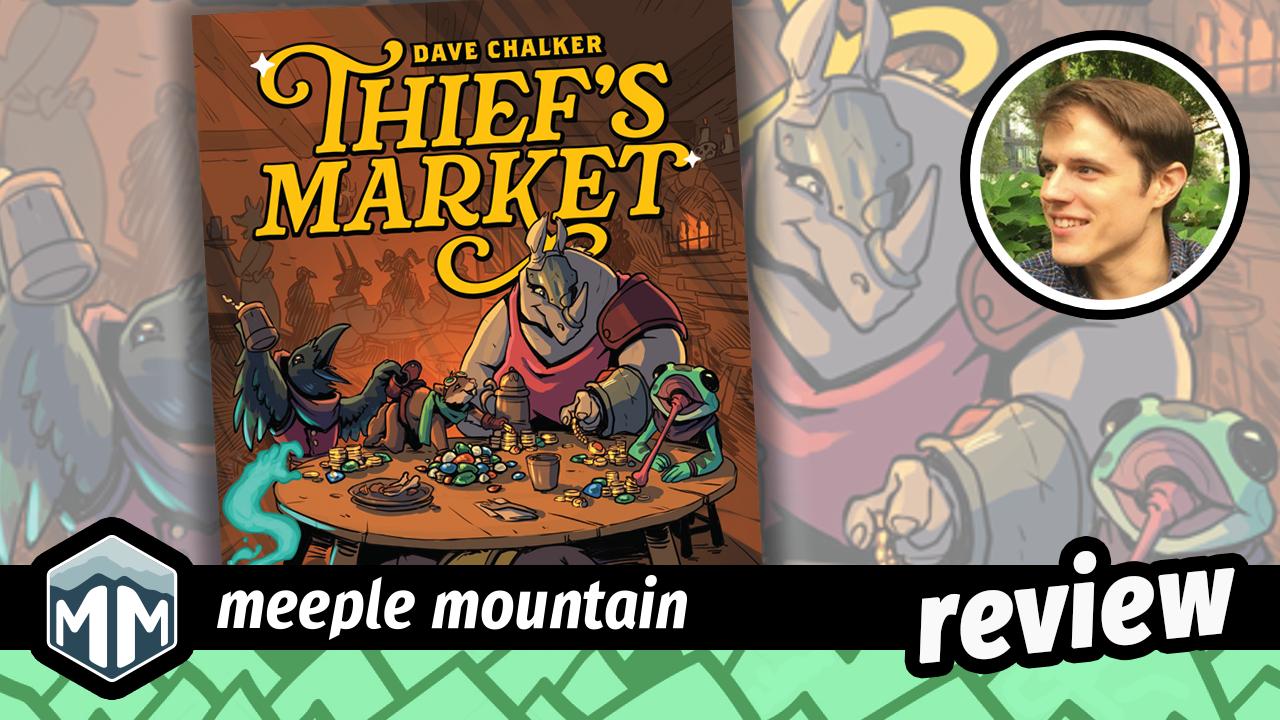
Thief’s Market, from publisher PickPocket Games and designer Dave Chalker, is just such a game. This is surprising for a few reasons, not least of which is because Thief’s Market is, mechanically, a breeze. It’s a challenge to think of something simpler without tipping over into party games. Each round is divided into two phases: grab some loot, then spend said loot on resource conversion powers and points until someone wins. This is not, in theory, the stuff analytical types tend to lose much sleep over.
The starting player rolls all the dice, which are then placed in the middle of the table along with the first player token. Players take turns drafting dice by either staking a claim from that middle or picking the pocket of a fellow player. If…
Haratama is a trick-taking game from Japan with a horror theme and great art. Every round, three card values are randomly drawn to become the penalty values for the round. That means if you win these cards you will be penalised. This is a game about scoring as few points as possible. Points are bad.
Most standard trick-taking rules apply. You must follow suit if you can. There is a
Rinse and repeat with the after gaming sleeping and eating of breakfast. I was very tired this morning when the alarm went off at 7:30am. I knew I had a big day and hoped that I’d have the energy to do all that I had planned.
First up was a learning game of the brand new The Weimar Republic from GMT Games. The Weimar Republic is a Card Driven Game of political struggle in interwar Germanywhere 4 unique factions compete for dominance including the democratic Coalition, the Soviet-backed Communist Party, Hitler’s National Socialists and the far-right Radical Conservatives. The game covers the Interwar Years between 1919-1933 and represents all of the different fighting factions trying to gain control in Germany’s regions and major cities, to maneuver the political landscape of the Republic, and to dominate through a combination of propaganda, parliamentary elections, street violence, economic influence and ideological zeal. This situation sets itself up perfectly for a game to explore the various parties involved. I was able to get into a game with the Hoosier Herd gaming group from Bloomington, Indiana.
The game appears to be a COIN Series like game as each faction has their own unique abilities and powers but also win in their own way. The game also visually looks like a COIN game as it uses multi-colored wooden cubes to represent influence in the various districts of pre-WWII Germany.
A major focus of the game is the concept of Elections. Each Era has a number of Election Cards (based on the historical number of Elections) that are shuffled into the Event Card decks. When an Election Card is played, both a Regional and a General Election is held at the end of that round. Election scoring is based on players’ Dominance over spaces and Regions, with modifiers such as Middle Class Sympathies, Cadres, military Supremacy, etc. Regional Elections gives Parliamentary Control over the game’s Regions while a General Election can potentially end the game – if anyone but the Coalition wins a General Election, that player also immediately wins the game.
Players draw a hand of cards for each Era and use their AP to conduct Actions. You don’t chose between AP and Event as when you play an Event Card the Event always takes place, unless there are some requirements that aren’t met. You don’t need to play a card every turn – in fact you can’t, as there are fewer cards in a hand than turns in an Era and you may only play one Event Card per turn. However, you always have a basic 1 AP that may be used by itself or in combination with any Event Card played, so during some turns you will be using only that basic point. You can also pass which allows you to discard a card and draw a new one.
I very much like what I was doing but need to grok the rules so I know what I should be doing. We had a good time and I look forward to another play in the near future.
Next up I sat down with Greg Smith to play the upcoming Korean Tide from Compass Games. I took Greg to the woodshed with the Chinese and had a great time with the game. This one is a very good addition to the Tide Series and adds in some new tricks.
One of the things that I liked was the addition of new Divisional Displays which hold the strength points and assets of each division. The player will track the strength points as they are lost and gained but also will keep track of their reserves which is a new concept. Reserves can be used to force a reroll of your opponents dice during combat or to reroll your dice. The reserves are created by reducing the division’s strength points by 1. There are also tank counters that are attached to units, particularly the North Korean units at the start of the game which add a single strength point but also cause the defender to retreat after being attacked regardless of outcome. Both of these additions are very nice changes.
Greg and I played for the first 2 years of the war including 1950 and 1951 and I was able to break his units and destroy several American divisions. But the real thorn in Greg’s side was my 6th KPA unit who was dug in and just wouldn’t die. I was able to continually feed them reinforcements and their combat rolls were amazing inflicting 2-3 losses on the UN forces while taking no more than 1 loss. Such an interesting system and I very glad that I was able to play it.
Next up was a game of Baltic Empires from GMT Games. Baltic Empires covers the tumultuous period in the Baltic region from the collapse of the Teutonic Order in 1558 to the end of the Great Northern War in 1721. The game really focuses on representing both the mercantilist economic thinking of the time, the very limited resources at hand on the state/ruler level and the destructive nature of warfare and its effects on the local economy. When war occurs in spaces infrastructure can be destroyed and it is very expensive to keep replacing units that just die on the battlefield.
The game has 5 factions including Denmark-Norway, Sweden, Poland-Lithuania, Prussia-Brandenburg and Russia. Each power has 2 common victory conditions and 1 or 2 that are specific to that power. The shared victory conditions are either control of 2 custom houses or being the hegemon on all 3 tracks at the same time.
One of my favorite parts was that each turn, 5 Dramatis Personae Cards are randomly drawn from the deck and become available for purchase by the players in the Production phase. These cards have a wide variety of effects, but can be broadly divided into 4 types: those that have permanent effects, those that have one-time effects, those that affect victory conditions and those that provide a special leader unit.
These cards are excellent fun and really create somewhat of a race to purchase the best cards before others can acquire them.
I loved the game and was doing quite well with Sweden as I had captured Riga and Kurland in the Baltics and had built up quite the nice economic engine.
The economic system is simple, but manages to capture a lot of key elements of this period. Each province has between 0 and 3 resource icons and between 0 and 2 city icons. If a workshop marker is present on a resource icon the province produces 1 of that type of resource and if a city marker is present on a city icon the province produces 1 thaler (the currency of the game). There is one twist though, as provinces under noble control will contribute a maximum of 1 of the resources and 1 of the thalers produced in it to the central administration while the rest is discarded as it goes into the coffers of the local nobility. Only provinces where royal control has been imposed will contribute their full income to the player. In addition to this there are 3 trade center provinces on the map, and these generate extra income for their controlling player as they are able to tax the trade there. Just a great little game that I hope to explore further later.
My final game of the evening was a look at The Emperor’s Voice and The Emperor’s Choice coming to Kickstarter soon from Worthington Publishing. I was able to sit down with Wes Crawford to play his game The Emperor’s Voice which covers midnight until noon on August 15, 1945 when an attempted Army coup occurred against the Emperor of Japan in order to stop the surrender. The Emperor’s Choice is about the week leading up to the attempted coup, where the Imperial Cabinet debated over the issues concerning the ultimate decision by the Emperor to surrender. The two games may be joined together to create one longer legacy game that may be played in about two hours, although each may be played separately as a complete game, too.
I played The Emperor’s Voice as the Honor player who is trying to convince the Emperor to call off the surrender. The game is played with each player having a set type of action cards with things like move, plot, force commit, attack and persuade. Each of these actions is used to move into position to influence key figures and generals to sway them to your side with the draw of random chits and event cards to overcome your opponents total influence of the figures.
It’s all very tense and planning is key as you only have a few turns of 4-5 card plays to sway the generals, find the recording to destroy it, pressure the emperor and take out resistance against you. It all works well to create a very interesting and thematic game. I was able to win the game by convincing several of the key generals to my side and then successfully moved the emperor. I ended with 11 total cubes or VP’s to 5 for Wes.
I also played 1 round of The Emperors Choice where players are moving 1 of 6 issues up a track to their side to score VP’s and to gain special abilities from the won issues to assist in their next turn.
Both are great fun and will be coming to Kickstarter in the 4th quarter.
I had a great time today and got in a total of 5 games. I’m a bit beat and my mind is mush but I’m really looking forward to tomorrow as we have a full 6-player game of Imperial Elegy from VUCA Simulations planned and a look at an upcoming WWI aerial dogfight game called Above the Trenches from Flying Pig Games.
I really haven’t been playing enough Conquest for a while now – not because it isn’t good, but it’s a bit of a big ‘lifestyle’ game that demands a lot of time investment (like Age of Sigmar or Warhammer 40,000) and so many other games clamour for my attention. But I was very pleased to see Para Bellum release a completely revamped 2nd edition ruleset for the skirmish version of their game, which is called First Blood. It’s a much easier proposition to get a couple of warbands on the table for a battle than the big rank and flank armies of Conquest: Last Argument of Kings. And whereas before First Blood was really just a cut-down version of its big brother, this new edition feels more like a game in its own right.
I redid my rules and reference from scratch for this new edition. If you get a chance to play, let me know what you think of the game!

 Anmelden