For years I’ve written a cautionary tale about the pros and cons of being the face of a brand or company. Yet it wasn’t really until this year that we started to act on the potential perils–more on that in a minute.
This topic came to mind because I recently received an email from Emily in marketing at Alkem Gear (which I mentioned in this article). A lot of what Emily shared was centered around Tim, the founder and creator of Alkem, yet I saw very little of Tim on Alkem’s website or the Kickstarter project. So I asked this:
“How does Tim remain closely connected to the campaign despite partnering with others–like you–for public-facing roles?“
Tim himself wrote back with a detailed answer; here are the two key quotes:
“One thing I believe is really important as a founder is understanding my own limitations. My background is in engineering and product development, not marketing, so I’ve always believed the best way to build something meaningful is to surround yourself with people who are genuinely better than you in certain areas. My role is to help set the vision, establish the values behind the brand, and make sure every decision stays aligned with the kind of community we want to build.
At the same time, I’m intentional about not making the brand revolve around me personally. I’m happy to do interviews, demos, podcasts, or community discussions, but my goal isn’t to become the face of the brand. I want Alkem to have its own identity, one built around service, humility, quality, and community. I want something that can outgrow any one individual.”
This is a really solid answer. I’ve talked in past articles about the power and appeal of a creator sharing themselves with backers during a crowdfunding campaign (opposed to outsourcing to other people or marketing services); see links at the end of this article. However, as someone with 7 coworkers, I also understand the value of delegating to people who are far better at their jobs than I am (or was, as I once wore nearly every hat here). I admire Tim for wanting Alkem to have its own identity.
Despite that, it’s still me (Jamey) writing these articles, replying to questions on social media and email, posting on Instagram, writing newsletters, recording the podcast, running the livecast, and recording YouTube videos. There’s plenty of upside to this personal touch, but the downside is that if you don’t like Jamey, if Jamey is hit by a bus, or if Jamey is no longer part of Stonemaier Games, it would be an abrupt transition to suddenly see someone else appear in my place on social media.
So a few months ago I talked to my coworker, Erica, to see if she would be interested in joining me on some YouTube videos. Not only does it put another face to Stonemaier Games, but you also get to hear from someone else who cares passionately about the tabletop hobby. Our latest video just posted yesterday, and it delves into a subject that was dear to Erica when she worked at a local game store.
Also, I would be remiss to point out that I’m far from the only face or name you’ll see if you have different experiences with Stonemaier Games. If you attend a convention, you’ll probably see Dave or Alex. If you’re a retailer, you’ve probably talked to Susannah. If you’ve had a customer service request, you’ve likely corresponded with Joe. And if you’ve submitted a game to us, you may have heard back from Alan. There’s also Christine (graphic design), but that’s truly a behind-the scenes role.
There’s still room for more versatility, but I really appreciate Erica for joining me as another friendly face on the YouTube channel. She’s also very active in the comments of our shared videos. She and Susannah have also stepped up for the livecast when I’ve traveled (I think Alex may have been on one of those too).
What are your thoughts about the delicate balance between making a company approachable, personable, and relatable without putting all your eggs in the same face?
Hello readers! Mike Didymus-True here, the editor of BoardGameWire.
I wanted to post a quick message to apologise for an upcoming week or two quiet patch for the site – I’m being unexpectedly admitted for surgery tomorrow, and will likely be out of action for at least 7 to 14 days while I recover. And as BoardGameWire remains a one-person operation, which I squeeze into my spare time around my day job and my two kids, unfortunately that means a very brief hiatus for the site!
Please do continue to email me with your news and such in the mean time, and I’ll do my best to get reporting again as soon as possible! I’m on mike@boardgamewire.com
If this hiatus makes you think “Hmm, I wonder where I’ll get my board game industry news from now”, might I recommend the excellent W Eric Martin over at Board Game Beat, who sometimes has crossover with the kind of things I tend to cover here.
And if this hiatus has also made you think “Hmm, I really do find BoardGameWire and its reporting useful, that Mike really does do a pretty good job covering things that don’t get written about elsewhere – I would very much like to support that kind of thing financially” – that would be lovely! You can pledge a variety of amounts through the BoardGameWire Patreon, or by choosing a paid subscription to our regular newsletter.
The land of Fruit Island, as the name implies, is ripe with delicious fruit: bananas, pomegranates, and mangoes. On this island lives a tribe of monkeys. Over the years, they have built a thriving fruit industry, gathering fruit from the surrounding jungle and delivering it to the trading post for maximum profit. However, all is not well. Living on the island as well is a giant gorilla and, wouldn’t you know it, he also has a penchant for fruit. But, this gorilla prefers to let others do the hard work, using his size to bully, and steal from, the hard-working monkeys.
In Fruit Island, the players take on the role of the monkeys, working to gather fruit and deliver it to the trading post before they’re caught out by the gorilla and have their fruit stolen from them. Fruit Island is a press-your-luck, mess-with-your-opponents game. Equal parts prayer and risk assessment, it’ll have you asking yourself just how long you think you can hold out before making a beeline for safety.
Which monkey will be the most successful? Only time will tell.
How It’s Played
At the start of a game of Fruit Island, each player chooses a monkey and places it onto the trading post in the middle of the game board. The gorilla is placed on the…
Whenever people liberally throw around words like “innovative” or “unique” with recently published games, I can’t help but clench my jaw. It’s a difficult pothole to avoid, as the promises spat by titles in the crowdfunding era are necessarily braggadocios. We’re all guilty of this from time to time. It’s natural to pile on superlatives…
While attending Buckeye Game Fest this spring, we were gifted a copy of a newly published game called And the War Came: American Civil War 1861-1865 from Pinkerton Games, which is published by Blue Panther LLC and Steve Jones. The designer and owner of Pinkerton Games Larry Pinkerton had been their earlier but had to leave due to some other pressing business and we were unable to meet but were very grateful for the game. Upon returning home, I reached out to Larry to see if he would give us a bit of an inside look at the design and he was more than willing to discuss the game.
Grant: Larry welcome to our blog. First off please tell us a little about yourself. What are your hobbies? What’s your day job?
Larry: Grant and Alex, first, thanks for the opportunity to tell you about myself, and my game, And The War Came. I’m a lifelong resident of southwest Ohio, from the Dayton area. I’ve got three great adult kids, each working on their families and/or careers. I’m now retired from both my civilian job, and my almost 34 years as a traditional Ohio National Guard member-last duty assignment as an Air Defense Brigade Commander-so now more time for hobbies.
Now that And The War Came is finally done, I enjoy hanging with my kids, playing music, and traveling. I still do part time contract work in support of US Army training events, which I enjoy as well. And I hope to find more time for playing other wargames too!
Grant: What motivated you to break into game design? What have you enjoyed most about the experience thus far?
Larry: I’ve always been interested in the American Civil War, and many years ago it came to me that a block style game and a strategic level treatment of that war would make a great game-one that didn’t really seem to be available, at least for what I was looking for. I’ve really enjoyed developing the game, adopting, changing or dropping processes, seeking to get at the right balance of playability, workable mechanics and good history. It took a while, but I’m happy with the results.
Grant: What is your upcoming game And the War Came about?
Larry:And the War Came is a strategic level American Civil War game, focused on the southeastern United States. It started life as a block game, but when I decided to self-publish, I switched to rotatable counters due to cost. But play is similar-it’s area movement and card driven, so those familiar with Columbia style block games will recognize some of the mechanics.
Grant: What does the title mean in relation to the history of the American Civil War?
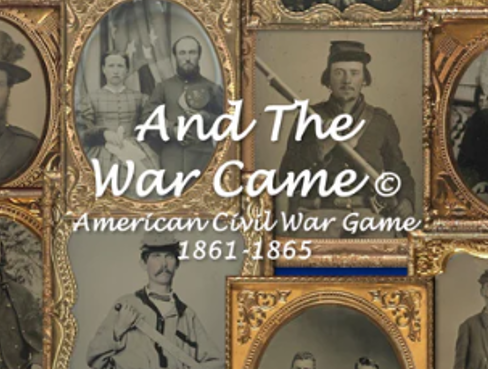
Larry: I bounced so many title ideas and finally settled on And The War Came, which is a sentence in Lincoln’s 2nd inaugural address (March 4, 1865). I felt that line summarized how the United States stumbled and staggered into civil war. And the wonderful Carte de Visite Collection images from the US Library of Congress I chose for the game box spotlight who the actual participants really were.
Grant: What games gave you inspiration for your design?
Larry: Columbia Game’s Hammer of the Scots and Victory Game’s The Civil War 1861-1865 were by far the strongest influences.
Grant: What is important to model or include in a game about the American Civil War?
Larry: Above all, I think it is leaders and leadership at the corps and army level. Any discussion of ACW campaigns seems to hit on the “what ifs” of senior leaders. There were simply so many generals I could have chosen to model in the game, but I finally settled on 22 Union and 19 Confederate leaders that did or could have risen to army or independent command. The formations on both sides were so similar, in my opinion it was the leadership that was truly decisive.
Grant: What challenges did you encounter in the design? How have you overcome them?
Larry: Wow, there were a lot; game flow, simple but historically accurate mechanics, relative strength and play balance, rail and naval capacity, re-playability, map scale-all had to be refined through trial and error, playtesting and compromise. And countless rulebook edits! Rules concepts I thought made perfect sense in my head and on the page drew several questions when reviewed by others. But I think it’s a pretty good final product.
Grant: What is the scale of the game? Force structure of units?
Larry: Regional area movement, and seasonal turns, representing three months. The map is bounded by eastern Kansas to eastern Texas on the western edge, New Jersey to northern Florida along the Atlantic Coast, lower Midwest on the northern edge, and Gulf of Mexico on the southern. Most states contain 4 to 10 areas-states with better road networks tend to have less areas. But there is more territory than units to control it. Fortress cities (i.e. Washington, D.C.), major railroads, navigable rivers, and mountains and swamp areas are also portrayed on the map. Rail and naval support capacity change each year.
Units represent infantry or cavalry corps, with a strength of from 1 to 4 divisions, or forts representing 1 to 4 installations. Unit count is: Union-33 Infantry counters, 10 Cavalry counters, 5 Fort counters, Confederate-26 Infantry counters, 8 Cavalry counters, 8 Fort counters.
Grant: What is the counter anatomy?
Larry: Very straightforward if familiar with Columbia style block wargames-a mechanic I have always admired for simple and clean fog of war, step reduction, and ranged or initiative combat. \Counters are square with strength point symbols (divisions) arrayed along each edge, plus movement and combat ratings. Infantry has a combat value of C2 with a move allowance of 1. Cavalry has a combat value of B1 with a move allowance of 3. Forts have a combat value of A1 with a move allowance of 0-they are stationary. There are also corps insignia (Union) or battle flags (Confederate) just to add historical flavor, and the branch insignia of the period for infantry, cavalry or forts. Ultimately, I chose to give similar units of both sides the same combat or movement ratings (since both Union and Confederate formations grew from the same organizational foundations and traditions), but those ratings can be modified by the leaders who command them, both at corps and army levels, and/or the battlefield terrain.
Grant: What does it mean the “game is We Go turn based”?
Larry: Most functions are conducted by both players at the same time. For example, in the Administration Step, both players recruit (buy) their new units/strength points, enter new or recovered from wounds generals, or administratively move/transfer generals already on the map to new assignments/commands. When both players are done, they go to the next step, (Operations), with Action Phases where each plays a card to determine who moves first, they complete their moves and then resolve any battles that result from movement. The Logistics Step and Victory check complete a turn.
Grant: What type of experience does this approach create?
Larry: It minimizes down time for one. Actions in the Administration Step, Operations Step, Logistics Step happen simultaneously. Only in the Operations Steps’ Action Phase (or depending on the season, phases) does movement happen sequentially. This limits the action/reaction dynamic to operations, where maneuver happens in small chunks due to the seasonal card play. Neither side is able to make big sweeping moves, while the other side can only watch-the mechanic enables campaigns like Gettysburg or Vicksburg, although they may not necessarily occur during the course of play.
Grant: How does the game use cards?
Larry: Cards list the number of “orders” you can issue to units in order to conduct movement or other actions. There are also cards with both events and orders where players must choose which to use. And most cards have a bonus action (improved combat, movement, or leader promotion) to spice things up. The season determines the number of cards each player receives that turn. The Winter season/turn, each player receives only one card-in the single Action Phase, each player compares their card to the other player’s to determine who moves first (initiative), then second, then resolve any combats. This makes for a short turn. In both Spring and Fall seasonal turns, players receive two cards each, then play their cards against each other in each of the two Actions Phases, conducting moves and combat. In the Summer seasonal turn, three cards are dealt to each player-thus there are three Action Phases that turn.
Grant: What type of cards are included? Can you share a few examples?
Larry: There are 30 cards in the common game deck (there are not separate unique decks for Union or Confederate players). The deck includes 22 orders cards, each card with a value of 1, 2, 3, 4 or 5 orders. The orders determine how many units (corps) or commands (see Leaders below) can be moved with that card-a card with only one order allows the movement of only one unit, etc. Orders can also be used to promote generals or repair rail roads, etc. Again, most, but not all of these 22 cards also have a bonus that improves movement, or combat for a unit, or gives a free general promotion.
There are also 8 cards that include a combination of orders and events such as blockade impacts, partisan activities, native uprisings, surprise attacks, diplomatic incidents, immigrant or native recruits, or spy activity-each event with favorable impacts for themselves, or negative impacts for the opposing player. I chose for the event cards to be generic in nature and usable for both sides, verses specific events (i.e. Trent Affair) scripted events. For these 8 cards, players have the option to play the event and still have two orders to move other units, or not play the event at all, and have all three orders for movement.
The entire deck is reshuffled at the start of a new year. Since each player only receives 8 cards in a four season/turn year, only 16 of the 30 cards are played each year-some cards may not get played during the entire war, while others may reappear several times.
Grant: How does combat work?
Larry: Again, similar to other Columbia style block games.
Paraphrased from the rulebook:
Units Fire or Retreat in a combat round. The sequence of combat is A class units fire/retreat first, before B class units, followed by C class units which fire/retreat last. If both sides units are the same class, the defender has the advantage, and fire/retreat before attacking units of the same class. A general’s initiative rating may change who has the first shot advantage. To Fire, roll as many dice as the unit’s current strength points (SP). A hit occurs for each die roll equal to, or less than the unit’s combat number rating. Hits on the enemy take effect as they happen, each hit immediately reducing the enemy unit strength point count by one. Say a 3 division (SP) infantry corps has a combat rating of C2-that corps rolls 3D6 dice and every “1” or “2” rolled is a hit, reducing enemy strength and effectiveness when returning fire. In a battle between a B1 cavalry unit and a C2 infantry unit, the B1 rolls first, but only scores a hit for each 1 rolled. The C2 rolls second and scores a hit for each 1 or 2 rolled. One round of combat is complete when each unit fires or retreats.
Some unit strength may be recovered at the end of combat if the unit is not destroyed-with this recovery rule I’m trying to account for after the battle return to duty wounded, stragglers, local prisoner exchanges, etc. I was aiming for about 20% casualty rates in combat.
Grant: How do Leaders work? How are they killed or wounded?
Larry: Leaders are used to command corps or armies (units under the command of a general are actually called “commands”, i.e. Sherman’s command). A leader imparts his initiative (A, B, or C class) and tactical ratings to the unit or units he commands. In Sherman’s case, he changes a C2 infantry corps under his command to a B2. A leader’s initiative and tactical ratings may change at different ranks. And I’ve added optional rules to randomize when leaders enter the game, and their ratings.
Leader counters also rotate-they all enter the game as a one star general. They may be promoted to two or three star rank. Grant and Sherman can even be promoted to four star (GEN) rank as they historically became army group commanders. A one star general (BG) controls one corps counter; a two star (MG) may command one or two corps.
The only way a leader can be promoted to three stars (LTG) rank is to take command of one of the 5 named armies: Potomac, Cumberland, and Tennessee for the Union; Northern Virginia and Tennessee for the Confederacy. Named armies may contain four or more corps, depending on the army. And only named armies may have subordinates of one or two star rank. If a three star army commander is relieved of command, there is a political cost, and the leader reverts to one or two star rank.
Leaders also represent staffs and logistics trains, so commanded units may engage in two rounds of combat, whereas corps without a commander may only initiate one round of combat-so even lower quality leaders can be beneficial since they allow you to fight an additional round. Most leaders also increase the movement allowance for infantry to 2 instead of the base 1.
And yes, leaders may be wounded, killed or captured. At the end of each combat which involved leaders, a leader casualty assessment is rolled-lower ranked leaders are more likely to be casualties. If assessed as a casualty, another D6 is rolled for severity of wound. Rolls of 1 through 5 indicate the leader is out for that many turns. A roll of 6 means the leader is killed. And if a commanded unit is destroyed but the leader is not killed or wounded, the leader is captured. Captured leaders may be exchanged as prisoners.
Grant: How does the design create fog of war and uncertainty?
Larry: The counter covers hide counter information until opposing units engage in combat. Of course, leader losses will occur, which adds to uncertainty. The cards also provide for a lot of variability in maneuver. And the strength replacement recruiting is a combination of fixed values for the year, plus a die roll for variable recruits each season. Recruitment strengths diminish for both sides over the course of the game. There’re several optional rules that address the Emancipation Proclamation, Drafts, Leader randomization, etc. to add historical flavor or variability to the game.
Grant: Who is the artist for the game?
Larry: I did the artwork…in MS PowerPoint. Whew, not the easiest thing to do! But I’m happy with the results. I used public domain art and was able to generate nice graphic quality with the tools available. And I found you can only go so far in development before you have to start addressing production concerns. And the War Came is definitely a game on a budget!
Grant: How is victory achieved?
Larry: Quite simply, players must accomplish more than their historical counterparts in the same period, for example the 1862 scenario, when the Border States, most of Tennessee and New Orleans were in Union hands by year’s end. So, victory usually means holding more territory, but there are also war weariness and political factors that contribute to, or detract from, victory. Examples are the midterm elections of 1862, Presidential elections of 1864, and weariness of the northern population.
Grant: What do you feel the game models well?
Larry: The overall ebb and flow of the conflict-using corps formations on a large area map just works well. And although there are abstracted naval and logistics rules that function well, I chose to focus on the senior commanders and Lincoln’s and Davis’s struggles to find effective military leadership for their troops at corps and army levels. And I think I’ve got the right level of political factors that contributed to the War’s outcome factored in. It’s hard for the CSA to win, but if the USA sits on it’s hands to build strength and perfect its leadership, the USA will lose. The USA must take the fight south early and often-and that’s a lot of territory to cover.
Grant: What are you most pleased about with the design?
Larry: There’s so many classic ACW titles out there that cover the entire scope of the war in great detail, and yet I think And the War Came fills a niche. For those familiar with board wargames, it’s not overly complex and it plays fairly quickly. I like the unknowns and fog of war, and think the re-playability is there. The historical framework is solid. I tried to not model for effect, so historical campaigns and outcomes are certainly possible, but not preordained. I wanted an interesting beer and pretzels game, one that both those familiar and unfamiliar with the ACW could enjoy. Again, I’m satisfied with the results.
Grant: What other designs are you contemplating or already working on?
Larry: I think if there’s another one in me, it’ll be a strategic treatment of the American Revolution-but to model that conflict will take some work, initially just to get the scope right, and factor in the interrelationship with the wider Anglo-French conflict.
Oh, and I must add a hearty thanks to Blue Panther Games, for their great production and distribution support! I just couldn’t nail down a publisher-but after consulting with Steve Jones (BPG) I realized I could partner with Blue Panther and do it myself! I would recommend them to any aspiring designer who’s interested in self-publishing.
If you are interested in And the War Came: American Civil War1861-1865 from Pinkerton Games, you can order a copy for $65.00 from the Blue Panther LLC website at the following link: https://www.bluepantherllc.com/products/and-the-war-came
Welcome to this week’s batch of crowdfunding campaigns. We have a variety of offerings here, so we hope you will find something that catches your eye. Also, if you want to chat with the BGQ team, join our Discord Server where we talk about games, movies, sports, and other fun stuff. Check it out and […]
I have spent the last several months revisiting the game Rats of Wistar, a design from Simone Luciani and Danilo Sabia released all the way back in…2023. (Yes! A game three years old!!!) When I first reviewed the game over at Meeple Mountain, I talked about the many details that worked for me in a four-stars-out-of-five article.
Since then, I like where Rats of Wistar has landed in the overall scheme of the tabletop strategy gaming landscape. It’s holding onto a spot in the top 1,000 games on BGG (as of this posting, spot 930, a spot that might have changed even while you were reading this article), and that feels about right. The general consensus: Rats of Wistar is a solid way to spend a strategy gaming afternoon, with a strong action selection system. There are plenty of reasons why the game hasn’t landed higher; Rats of Wistar is a game most people in my network have heard of, but many have never pushed to try, at least not yet.
I suspect that, for a few players, Rats of Wistar is probably one of their favorite games. For others, even a single play made those players hope that they never see Rats of Wistar in a dark alley again (a dark alley with proper game tables and just enough lighting, of course).
I love going to the Ratings & Comments area on BGG to see what people think about a game, to see the trend line of a game’s comments after it first hits and then again later (months, and often years, later), to see how public opinion has possibly shifted. Our BGG community is a colorful bunch, so I often go in just to read what people think of a title after I have played it for the first time or after finishing a full review.
The commentary on Rats of Wistar is emblematic of how I feel about game opinions, too. Some people have games they love…and it’s wild to see how differently others feel about those exact same games. Certainly, no single game is for everyone. But I am continuously amazed by how widely opinions can vary on the same title.
Rats of Wistar is a lot of things—a worker placement game, a hand management game, a game about racing for public milestones, a tableau builder.
It’s also a game with two decks of Invention cards: 100 “basic” Invention cards, and another 80 “advanced” Invention cards, and all 180 cards are different. Some of the cards have one of five Skill icons: Intelligence, Agility, Stamina, Perception, or Strength. Some cards have no tags at all. Most cards are worth positive points at the end of the game, while a few are worth negative points. All the cards in Rats of Wistar have a cost to play, which includes a mix of resource costs (wood or metal) as well as conditional requirements, such as other tags from played cards.
The best Rats players typically play the most cards. I spent about six months lurking in the top 25 on the Rats of Wistar implementation on Board Game Arena, and I learned a lot from the world’s best players (mostly by getting smoked) on my way up the leaderboards. Now, I mostly play Rats for fun, because of the things many of you have called out in the Ratings & Comments area on BGG. That also means my stress level is lower—Friendly Mode has been a blessing—and this has not diminished my love for the game.
So, again: Rats of Wistar is a card game. It is a swingy card game, for all the reasons most card-driven tableau building games are swingy thanks to the random flop of new cards into the market and the opportunity to top-deck new cards. It’s also a little swingy right from the jump, thanks to a pre-game card draft.
During setup, each player selects a pair of Invention cards, one basic Invention and one advanced Invention card, with the player last in turn order drafting cards first. Rats of Wistar is a very tight action selection game, and going last even in the first round can be a detriment, one reason players might find themselves using one of their three first-round actions to flip turn order by visiting a space known as the Alchemist’s Hut location on the main board.
But the reward for going last is not a bad one, in a game where the right combination of cards to start the game could lead to some juicy bonuses.
In part, this is because there are three public milestones available at the start of each game. Sometimes, the milestones are driven by those card tags I mentioned above; these Skill icons might mean a game where you need to have two Strength icons to get a few points and an instant bonus. Or, you might be in a game where the first player to dig three rooms in their Rat compound (these are not your mama’s rats, friends) earns four points and a card draw of an additional Invention card.
But selecting cards first, in a card game where cards are a big driver, ends up being a big deal. I love it…and so many of you do not. A quick sample of the negative comments on only the most recent page on the game’s BGG Comments area:
“Starts strong…but devolves into a random luckfest unworthy of its playtime.”
“Not my cup of tea.”
“Very snowbally.”
“Was this playtested more than a handful of times?...too much hidden information on the board, too much imbalance among cards.”
I love these comments and respect these opinions. But, you know what’s funny? These are exactly some of the reasons why I love Rats of Wistar! Nothing makes me angrier, especially in games where there are dozens, if not hundreds of cards, where the cards in a game ARE completely balanced. I want cards that are intentionally unbalanced—some Invention cards cost more than others, but provide a whale of a bounty. Other cards in Rats of Wistar have crap powers…but those cards have the Skill icons needed to complete missions and objectives later in the game.
I’ve played games of Rats of Wistar where I was the one snowballing other players. I built up a hand of cards that played well into each other, then got on a run where I played a card which allowed me the chance to play another card for free, or a card that gave me a once-per-round power that tied beautifully into 3-4 other cards in my hand. In other games, I got completely trashed by a player whose hand management destroyed my game or built up combos that I could never compete with.
I LOVE Rats of Wistar for those reasons!
Nothing brings joy quite like spending 15-20 minutes over a lunch break scanning the feed on a game from my recent list of plays.
Whenever I pick up a new game and have a few plays under my belt, I like to dive in to see what everyone else thinks. The beauty of the BGG platform is that people love sharing their opinions here…the good, the bad, the ridiculous.
Sometimes, I come to validate those feelings with my own confirmation bias. I recently completed three plays of a new strategy title, and came in to confirm that some of the things I saw were also things that other players experienced. I also drop in to the Comments area when I play something I love but worry that no one else likes it…it might sound great that I liked it, but if no one else likes it, would anyone else bother to play it with me later?
But my favorite forums always end up being the ones for games like Rats of Wistar. Generally, people liked it, and most Luciani titles have gotten love over the years. Even with the negatives I sprinkled above, the reality is that most people have nice things to say about their experience with the game.
But when people don’t like a game, they flame it, and they flame it hard. I love reading the passion that some players bring to the table with their emotions in these things, and as someone who has also dropped a rant on the boards from time to time, I totally get it.
I really believe that I like a game more when there are some strong opinions, in all directions. I want to fight for the games I enjoy playing, and warding off some of the haters makes me feel a little better about my own thoughts, even in cases where I find myself in the minority. Everyone has a point of view, and now I just need to find other fans so that I can consistently get that game to the table.
BGG is a wonderful platform for everything: meeting people, sharing opinions, reading the news, learning about your next favorite new toy. And when it comes to opinions, so many people have so many interesting things to say!
New-to-me games played recently include … CAPER: EUROPE (2022): Rank 514, Rating 7.6 A nice little 2 player with multiple ways to score points, the tug-of-war at each of three locations being just one means. Each turn you … Continue reading →
This game is set in World War II and depicts the battle between Germany and the USSR. This is a two player game and the story starts with Germany initiating the invasion of the Soviet Union. Every few rounds both players will score points based on controlling key locations. If you outscore your opponent by 10 points, you win immediately. Otherwise, you win by having more points at the end of

 Anmelden



/pic9625777.jpg)

