“But you cannot trust us to let you face trouble alone, and go off without a word.” -Meriadoc Brandybuck, The Fellowship of the Ring, J.R.R. Tolkien
Disclosure: played more than 20 times, completed all the chapters and beat the game in endless mode
We’re both fans of The Lord of the Rings. Kaysee has seen the movies twice, has read the trilogy, and tried to learn the Elven language and their writing system. Max has seen the extended edition countless of times and has read the books even more, so it’s not surprising that we got very excited when we found out that there’s a cooperative trick-taking game based on The Fellowship of the Ring.
The box is really eye-catching. We really like its stained-glass look. It’s just so pretty that you wouldn’t hesitate to display it in your living room. And, like many other trick-taking games, it is compact (4 cm x 10.4 cm x 21.9 cm). It has three compartments inside, each has a ribbon to keep track of the chapters that you’ve finished. The components are as beautiful as the box. It only has cards, including the chapter cards, the main deck cards, the character cards, and the reference cards, and five wooden tokens.
The Components
The first setup was easy. Players only need the first chapter card, four character cards, two star tokens, the main deck, and the One Ring token. The chapter cards contain flavor texts related to the story and the chapter-specific rules players need to follow. The character cards contain character specific objectives that players need to fulfill, some chapters can modify or add objectives. There are short chapters and long chapters. Short chapters last one round, while long chapters take multiple rounds to complete. The star tokens are initially used to help players identify which characters are necessary in order to finish the chapter. For two players, three characters are selected. The deck should then be distributed as if there were three players. The hand of the “ghost player” should then be arranged in a pyramid form.
The Pyramid for two players
The player who gets the one ring card gets Frodo, the ring token and gets to choose and control the character for the pyramid. The second player chooses another card, but all starred characters must be chosen. It is not allowed for the second player to mention which character they would want to choose before the first player has chosen their second character(s). Talking about what suits you have is not allowed, but the advantage of having a pyramid character is that both players can partially see its hand. We like this mechanism, but we can imagine a scenario being impossible to complete if a specific character is the pyramid.
Frodo is the one who leads the first trick. To lead a trick means to choose any card to play, but the ring cards cannot be chosen to lead in the beginning. The next character, the one on Frodo’s left should match the suit played. If they don’t have any matching suit, they can play any card, even a ring card. After a ring card is played in this manner, the One Ring token gets flipped to its other side, indicating that ring cards may now lead tricks. Whoever plays the highest matching suit takes the trick unless the one ring card is played. The One Ring is the most powerful card in the game, as whoever plays it gets to choose whether to take the trick or not. Taking into consideration who takes the trick is crucial most of the time to complete the objectives and the chapter. We would suggest having three 6-sided dice to keep track of the number of tricks won. If neither of the players have D6s, a paper and pen would do. Take note that not all characters need to win a trick (as in the case of Pippin).
Every chapter and character has a different set of rules and objectives. Some chapters may take longer to finish than others. This is really good, as the different varieties make the game more exciting. That said, Kaysee finds the later chapters to be less exciting than the earlier and middle ones since there was tension that builds up in the middle chapters due to how the difficulty increases, but as one reaches the later chapters, there seems to be a drop in difficulty that can affect the excitement formed by the anticipation for something much more difficult.
Another thing that we both like is how the mechanics are connected to the theme. But there were a few times where some characters that could reasonably be expected to be available based on the story are in fact not. We assume it has something to do with the balancing of the game, so it’s not a huge deal for us. We also like the endless mode where the objectives may vary for each game.
The game is optimized for more than two players. To allow for a two-player game, the pyramid character was added. It works really well, but one player controlling two characters is something that we’ve both found mentally taxing at times as the decision making for the pyramid character is not shared.
Our Final Thoughts:
The Fellowship of the Ring is a beautiful co-op trick-taking game. The narrative and the theme were well integrated in the mechanics, and that’s really fun for those who like trick-taking games and The Lord of the Rings. People who aren’t fans of LotR may still like it due to the interesting changes of the mechanics in every chapter, but maybe not as much.
Although the decision making process is not equally shared for two players, we would still recommend it to two players who just want to play something less heavy and have some more relaxed evenings, especially if they are LotR fans and want to complain about how blond Legolas is in the movies and in this game.
What we like:
art style
campaign progression
connection between theme and mechanics
production quality
What we do not like:
extra cognitive load for one player
more optimized for more than two players
What Kaysee also doesn’t like:
less exciting in later chapters
What Max also doesn’t like:
the pyramid can sometimes make victory impossible
Kaysee’s rating: 4/5
Max’s rating: 4/5
Combined rating: 4/5
Reference:
Tolkien, J. R. R.(1991). The Fellowship of the Ring. HarperCollins. The Lord of the Rings: The Fellowship of the Ring – Trick Taking Game[Rulebook]. (2025). Office Dog.
Title: The Lord of the Rings: The Fellowship of the Ring – Trick-Taking Game
Game Design: Bryan Bornmueller
Illustration: Elain Ryan, Samuel Shimota
Publisher: Office Dog
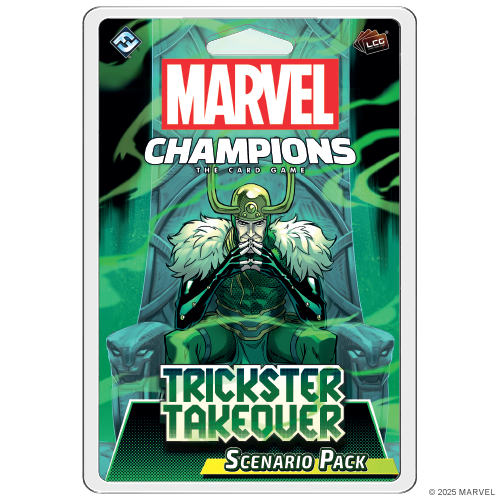
The Trickster or Loki as he is also known heads up an evil team with The Enchantress and they mess with the minds of the Heroes. This gives a fight that the Heroes are fighting inside their minds as well as other with other heroes while not knowing who or what they can trust. from the graphic novels he was known as Loki Laufeyson and he was the Trickster God of Mischief, Evil, and Lies, a member of the monstrous Frost Giants of Jotunheim that was adopted and raised among the Asgardians, a group of humanoid beings from the pocket dimension of Asgard, the Realm Eternal. Born smaller than the rest of his race and rejected by his father Laufey, he was adopted by the All-Father; Odin following the war. He was taken back to Asgard to be raised alongside his adopted brother Thor. He was worshiped by the humans known as Vikings and became part of Norse Mythology. Loki grew jealous of his brother after learning his true origin and schemed against him and Asgard. His later cosmic meddling led to the formation of the Avengers, “Earth’s Mightiest Heroes”. He has the ability to call his wolf Fenris to him amongst many other of his baddies. The Enchantress is a being from Thors realm and in fact she has the hots for Thor and is usually wound up by Loki into attacking Thor.
So how do these work in the game. First of all you have to take on the Enchantress, wh will hit you with a hypnotic gaze. There are five different hypnotic gaze cards each with a different enchantment on the opposite side, get too many charm counters and the card gets flipped to its unique “trance” side and gives you the Enthralled trait which has an immediate effect and also causes you to take a forced action. For example you might be confused or take damage and also forced to draw a card and play it. Also being enthralled will make side schemes nastier to deal with.
Then you have to deal with Loki, but things are never simple with Loki and you have to first deal with his Avator’s who are spread out. This is where you get to play the new “Epic Mupltiplayer Mode” as each player group has to deal with their own batch of the four avators facing off against a randomly-chosen avator that gets swapped out for another each time one is defeated. Each time you defeat one, you Shatter the Illusion that allows you to actually damage the real Loki. But of course Loki is going to just sit there and take damage, once he gets down to half heath, his focus intensifys and his avators get powered up making it even more difficult.
However, there are also some Enthralled Minions, who if you manage to knock back to their senses then they will actually team up with you to help take down the villains, which could well swing the battle back in your favour.
Peter unboxes and talks about the new Reichbusters: Reloaded – and showcases his fully painted set!
Let’s have a good look at the new Reichbusters: Reloaded upgrade set, my painted miniatures from the original set, and explore the million-dollar question – is it better than the original game now?
Making high quality tabletop gaming content at the EOG takes time and money. Please consider becoming a Patreon supporter or making a donation so I can continue this work! Thankyou!
Yesterday I announced the Euphoria Essential Edition, which combines the core game with the expansion and includes some revised rules/components, particularly the board layout. It will be on the Stonemaier Games webstore, ready to ship, starting on May 13.
While discussing the game on yesterday’s livecast, I started to reflect on the factors that result in us considering an “essential” version of an existing game (e.g., Viticulture, Between Two Cities, Between Two Castles, and now Euphoria). I mentioned a few then, and I’ve added a few more to this list:
The game only has 1 expansion, and we can combine the expansion with the game without significantly increasing the price of the essential version compared the original game’s price. This is critical, as we are always focused on price accessibility. If a $60 game and a $30 expansion combined together would still be close to $90 due to the manufacturing cost, we might as well keep them separate. But if the combination leads to some production optimization for a new price of $65, that’s great.
The combined game plus expansion is still accessible to newcomers. Any first expansion of a Stonemaier game is at least partially the result of learning from what people say about the game. Many–but not all–first expansions offer seamless additions rather than new elements that make the game more complex, making them prime for essential editions.
The game and the expansion have successfully been on the market for years. I like to give our games the time to find their audience and thrive in the wild for a long time before revisiting them before considering an essential edition (opposed to releasing the game and then creating a new edition right away).
The game is out of stock but still in demand. For us and the amazing retailers who support our games, we wouldn’t want to create a new edition of a game while there’s still ample inventory of the previous version. We also only consider games with continual sales month-to-month.
We are excited to revisit the game to offer the best version. Even if we’re literally just combining the core game and the expansion, there’s a lot of work involved, especially for the rulebook (but also potentially the box, reference cards, punchboards, etc). And sometimes–like with Euphoria–it’s even more work, as it’s an opportunity to improve the original. I spent a lot of time redesigning the board to make the order of operations and interconnected elements much easier to understand, learn, and teach, and artist Jacqui Davis completely remade the art to match the revised design. We’re passionate about all of our products, but there needs to be a special spark to revisit something that was deemed final for so long.
If there are changes, they do not negate the investment of anyone who already owns the game and the expansion. This is really important to me, and it’s why we created an update pack for Euphoria that includes the new board, updated rulebooks, and the smaller artifact cards. It’s for this reason that I try to be very intentional while weighing the importance of making gameplay changes opposed to just seamlessly combining the game and expansion.
What do you think about these reasons? Is there anything else you would like me to consider for future essential editions (none of which are in the works)?
If you’re curious to learn more about the inception of Euphoria Essential, I’ve included the latest design diary post below.
***
April 23: The Inception of Euphoria Essential Edition
In March 2025, almost exactly 13 years after finishing the design for Euphoria, it was time to reprint the game. We’ve reprinted Euphoria a number of times over the years–a reprint is simply printing more of the same exact game–but this time I reached out to Morten (who had designed the Ignorance Is Bliss expansion) with the idea of updating Euphoria with everything I’ve learned about the game over the last decade.
Here’s what I proposed to Morten:
Player mats and big tokens: Remember the tiles in Euphoria that let you quickly adjust token quantities (1x, 2x, 3x, etc)? I’m thinking we could update the player mats to have those tracks, allowing us to remove the big wooden tokens.
Board and bazaar: The inclusion of the player mats allows us to use the area of the game board currently occupied by tracks for the bazaar. It might be just a little tight, though–maybe decrease the size of artifact cards? Also, I would like to offer a double-sided board (bringing back the grayscale look of the original version on one side).
Recruits: I would love to offer a single set of recruits instead of telling players to use only the new or original recruits. To accomplish this goal, I’m open to removing some of the original recruits that aren’t balanced well for the expansion changes. I would also prefer to remove the factionless recruits. They’re clever, but by nature they are exceptions to standard recruit rules.
Markets: I feel similarly about the markets–I just want to shuffle them all together. If we need to remove some markets to accomplish this, that’s fine.
Gameplay: There are 4 elements of Euphoria that I don’t fully love: It’s difficult to teach despite its weight, I’m not sure the ethical dilemmas are necessary, it feels really bad to lose a worker due to a knowledge check (or even to see someone else lose a worker), and it feels impossible to catch up once someone has 9 stars and you’re behind. I’m not necessarily saying that anything needs to change to address these issues, but this is an opportunity to do so if we choose.
[end of message to Morten]
I’ll cut to the chase on a few of these elements: The final result was that we consolidated information onto player mats, we combined all recruits (102 total: asymmetric abilities that each player has), and we combined all market tiles (34 total: worker-placement actions to construct on the board). This essentially results in Euphoria plus the Ignorance Is Bliss expansion, offering a ton of variability with everything seamlessly integrated into a single box.
What do you think about this inception story? Join us tomorrow to dive into the core elements of the Essential Edition’s board, including a few minor-but-impactful rule changes! You can also click here to get a May 13 launch notification (followed by shipping later in May).
I spent a lot of time and money on the original Reichbusters: Projeck Vril. Painting all those miniatures was a huge job, which is why I was very relieved when Monolith bought the property from the crashing-and-burning Mythic Games and promised a new version with better rules. The original version suffered from a fiddly, clunky ruleset that bogged the game down in the second half and frustrated more than entertained. Could Monolith provide a game worthy of all those characterful miniatures?
Well, it cost me a lot more more money to get it of course, but thankfully they did. I’m very happy to say that Reichbusters: Reloaded is finally a fun game that I look forward to playing. It’s not perfect by any means – after the alarm goes off there’s still a lot of enemy wrangling to do – but it no longer feels like a game of two separate parts, one fun, the other not. Instead of constantly fiddling about with noise rolls, you have a pretty good idea how long you can get away with your team killing bad guys before the alarm goes off and all hell breaks loose; and once it does, controlling them isn’t quite so onerous and you still have a very good chance to fulfil your objectives and get out. I also love the way the objectives have been broken into three levels of difficulty – not only can you decide to go for a more difficult objective on the fly if things are going well, but extra objectives increase replayability by incentivising a return to a scenario armed with the knowledge gained on earlier playthroughs.
Thankfully, all the fiddly little tokens have completely gone, replaced by item cards and clearly laid out character reference sheets. In fact, this version is so well done I find myself looking at the original and wondering “what were they thinking?”. Probably something like “that’ll do, we’ll fix it later with an upgrade pack at huge expense”, which is no doubt one of the reasons Mythic went bust.
But enough of the past, Reichbusters: Reloaded is now the fun, frantic, silly, Nazi-bashin’ and alien-shootin’ game I always wanted it to be, and all those many hours of miniature painting were not in vain. Thanks Monolith!
Gatekeeping has long been a concern within the board game hobby. For decades, our hobby was shaped by small communities, often dominated by white men of a certain age. They decided who was allowed to call themselves a board gamer and who couldn't. However, as the hobby grew, it also became more diverse. Nowadays, welcoming newcomers and making the hobby accessible to a wider audience has become a highly important goal, a goal which I strongly support and feel very passionate about. Unfortunately, some people have started to use the term gatekeeping in such a way as to become gatekeepers themselves. In this article, I want to look at this paradox more closely.
I made a huge intentional shift in my life in 2011. I’m now 45 years old, and looking back I realize how distinctly different my life was before and after my 30th year (mostly for the better).
If I had the chance to speak to my 30-year-old self, here are a few things I might say:
1. Creativity thrives in the small windows of free time, not the big ones. For most of my 20s I hoped for big gaps in time that were completely clear of other responsibilities–weeks and months–when I could write a novel. But the two times I had a big gap of time (the summer after college and when I was between jobs), I mostly just played and procrastinated. When I turned 30, I decided to spend 2 hours every night writing the novel, and I was done in 2 months while still maintaining my day job, friendships, and other hobbies. Realizing I could do that motivated me to also spend those small windows of time to design a game, Viticulture. This is one of the biggest changes I’ve ever made in my life, and my career with Stonemaier Games wouldn’t exist without this shift.
2. A change in location won’t make me a different person. I’m an introvert with a rather crippling social anxiety regarding approaching people. I romanticized the idea of going somewhere completely new by myself to see if a different, fearless version of Jamey would emerge, so I booked a solo trip to Ireland for a few days in 2011. Not only did I learn that I much prefer to travel with at least one other person, but also found that I’m still myself–for better or worse–even in a different country where everyone is a stranger. Another way to put this is: For the things about myself that I most want to work on, there’s no magic bullet.
3. There is so much to learn after formal education. I’m incredibly grateful for the all the teachers and professors who guided me from kindergarten through college. But there’s a whole world of knowledge outside of the classroom. I’ve learned so much about game design, for example, by listening to podcasts, reading articles, and watching videos (along with actually playing and designing games).
4. Healthy living starts to take effort after a certain age. I’ve been physically active my entire life, and I was blessed with a great metabolism, so for many years I didn’t feel the need to eat with intention. That was all fine and dandy until I started running Stonemaier Games in my early 30s, a job that often involves sitting at a desk for 12 hours a day. I was no longer playing sports as regularly, yet my diet was the same as ever (and it wasn’t even terrible–I ate fruits and vegetables every day). My body changed incrementally, and before I knew it, I was 20 lbs heavier than I’d ever been. Fortunately I realized it’s never too late to change, but I wish I could tell myself what I was doing to my body and how even 20 minutes of exercise every day can make a huge difference.
5. I don’t want kids, and I’m not alone. For most of my life, I thought I wanted to have kids–I never questioned doing the same thing my parents did (I have a brother and sister). It wasn’t until my early 30s that started to realize that the creative, nurturing, and compassionate sides of myself were fulfilled and challenged better in other ways (game design, friends, cats, etc). But when my siblings and college friends started to have kids, I struggled sometimes to feel like an “adult.” But then I started to make some wonderful friends who were just as happy not having kids as I was–and I found a partner in Megan who also doesn’t want kids–and I’m so grateful for those relationships (they even helped the relationships I had with friends and family who do have kids).
me at 45
6. Money well spent makes a big difference. For the longest time, if I wanted a chocolate bar, I’d spend $0.50 at checkout at the grocery store. But one day I was shopping with a friend, and they said, “You love chocolate, right? If you love something, it’s worth paying for the best.” So I shelled out for a $5 chocolate bar, and it was amazing. This isn’t to say that I don’t still enjoy a Snickers, Kit-Kat, or Hersheys Almond from time to time. But I give myself permission to spend money on the things I love. Similarly, I’ve learned to pay for things that last–I have shoes and jeans that have lasted over a decade.
7. Every job before my career was a good use of time. I think there was a time when I didn’t believe this; I wished I could have found my path earlier in life. But whether it was waiting tables, project managing medical textbooks, or managing a nonprofit staff and fundraiser, I was learning indispensable skills and habits that have had a direct impact on Stonemaier Games’ success.
8. Loving a pet requires compassionate discipline. I adopted my beloved cat Biddy in 2007 when he was a tiny kitten, and raising him from beginning to end is one of the greatest joys of my life. Biddy loved to eat, and I gave him open access to cat food (and sometimes human food). At one point he tipped the scales at 20 lbs. He developed diabetes and required twice-daily insulin shots for the rest of his life. He died of intestinal cancer when he was 16 years old. While I don’t know if I could prevented any of Biddy’s ailments, I wish I had known earlier that I could have made Biddy’s life better overall by denying him a portion of the thing he wanted the most (kibble). Not enabling someone’s worst habit is a core part of loving them. I would truly do anything to have another month or year with Biddy–I miss him every day.
9. There is no rule that says everything must remain the way it’s always been. This applies to relationships, habits, routines, beliefs, hobbies, diet, behaviors, even our bodies. For example, for as long as I can remember, I had large protruding mole at the base of my back. I didn’t like it, but I figured it was too close to my spine to be removed. But then I asked a dermatologist about it, and she said, “Oh, sure, we can remove that right now.” Five minutes later, something that had bothered me for years was gone forever. I wish I could have known earlier that if there is any persistent element in my life that I could cut or add that would make me happier (and those around me), it’s never too late to choose to make that change.
10. Try a lot of different things to continually discover new passions. At 30, I thought I only enjoyed specific types of games and that I didn’t like party games…until I tried Telestrations, Just One, So Clover, Blob Party, and Caution Signs. At 30, I thought I enjoyed blogging as my only form of content creation…until I filmed a “my favorite mechanism” video for YouTube, tried a Facebook livecast, posted an Instagram photo, or recorded a podcast. At 30, I thought ultimate frisbee was the only disc-related sport I enjoyed…until I started playing disc golf during the pandemic and now play every week. The world is full of potential passions I have yet to try, and I won’t know if they’re for me until I actually try them!
I wasn’t sure where this list would take me, but I appreciate the opportunity to share. I’d love to hear if any of these resonate with you or if there’s something you wish you knew before you turned 30.
Rubén Hernández’s Dodos Riding Dinos was one of those games people talked about. The kind of nutty activity that combines a longstanding tabletop genre with silly dexterity elements. I mentally associated it with killer titles like SEAL Team Flix, PitchCar, and Space Cadets. These games marry the frivolous kinetic energy of flicking with a more…
We have done quite a few board game assisted biographies on this blog. Today, we are going farther back in time than ever to cover the life & games of the Roman statesman whose life is half shrouded in myth: Quintus Fabius Maximus Verrucosus. You might know him as Fabius Cunctator – Fabius the Delayer. Without further delay, we’ll get right into the first part of his life – his origins, early career, and, when he was already one of the pre-eminent Roman statesmen of his time, the defining event of his life: The war against Hannibal in which he took on an extraordinary office. Let’s go!
If you want to read more posts of this kind, I strongly recommend you subscribe to the blog – all new posts in your inbox right when they go live!
You may have wondered about Fabius’s long name above. This is a good opportunity to look at Roman naming customs, which tell us a little about Fabius, and a lot about the Romans. Quintus was his given name (the Romans used only around 20 given names for boys, and the five most common names (Quintus being one of them) already made up more than three quarters). Fabius was his family name, marking him as a member of the gens Fabia. The three remaining names were various kinds of nicknames – Maximus (“the greatest”) was a name he had inherited from an ancestor, Verrucosus (“the warty one”) he had received himself for a wart on his upper lip, and Cunctator (“the Delayer”) he earned for… well, we’ll get to that.
The Romans were big on family, and so the second name would have been the most important one to them. We’ll thus stick to calling our protagonist Fabius. He might have been even prouder of his family than the average Roman, as his was the patrician gens Fabia, one of Rome’s great aristocratic families. From his birth around 280-275 BCE on, Fabius was thus destined for a political and military career.
We do not know much about his early life. Fabius’s ancient biographers assert that he was deliberate to the point of slowness, but this seems like projecting his later fame of “delaying” back to his youth to maintain unity of character. In any case, Fabius was anything but slow in his career.
Young Roman nobles were expected to gain some military experience. Fabius could do so in the First Punic War, a protracted struggle (264-241 BCE) with Carthage over the control of Sicily and Sardinia. Rome won, mostly due to the almost bottomless manpower from which it could recruit – in addition to the city itself, Rome had founded many colonies all over Italy, and was allied to almost every other city on the Italian mainland. Fabius’s insights into generalship and Rome’s system of alliances would come in handy later.
Well-born Roman men with ambitions could not but go into politics. The Republic offered several elected offices for which they competed. Usually, these were taken one after another in a fixed sequence (the cursus honorum (“course of honors”)), but the rules were not as fixed in Fabius’s 3rd century BCE as they would become later. Thus, Fabius was elected to the lowest office (the quaestorship, responsible for financial administration) twice (first in 237), but, after climbing the second rung on the ladder (the aedilate), he skipped the third (the praetorship) altogether. Instead, he ran the highest office (the consulate) only four years after his quaestorship. The people of Rome elected him consul for the year 233. Fabius had fulfilled all ambitions which a regular Roman noble could have.
Yet Fabius was not content to be just any Roman noble. While his domestic pursuits were unremarkable – he unsuccessfully opposed a law introduced by the tribune of the plebs Gaius Flaminius which distributed lands in northern Italy to military colonists – he defeated the Ligurians during his consulate and was awarded a triumph for it. That was an extraordinary honor, rarely bestowed. Given that his victory was won against a rather minor enemy, that spoke of Fabius’s political clout.
The triumph was the greatest honor that could be bestowed on a victorious Roman general – and it affirmed the Roman belief in the righteousness and victoriousness of their cause.
Fabius left his consulate as one of the first men in Rome. He consolidated his political power even further, attaining the censorship (an office elected only every five years and correspondingly rare, even amongst former consuls) in 230 BCE, and, in contradiction to traditions prohibiting the repetition of high offices, became consul again in 228. Then, he used his good contacts to the Greek world to ensure that Romans could, for the first time, participate in the Isthmian Games. Two consulates and a censorship would ensure Fabius’s political primacy for the rest of his life.
Ten years after the end of his second consulate, Hannibal invaded Italy.
Invasion: Hannibal in Italy
Carthaginian-Roman relations had remained difficult after the end of the First Punic War. With Rome in control of the islands, the Carthaginians had diverted their energy to Spain. Their leading family, the Barcids, had carved out a large and prosperous colonial empire there. To avoid conflict with Rome, the two empires agreed on a division of spheres of influence. When the Carthaginians clashed with the city of Saguntum, it applied to Rome for help. The Romans resolved to aid Saguntum, even though the city lay in Carthage’s sphere of influence. Some of the ancient authors report that Fabius led a senate faction which favored negotiations over war with Carthage, others – like the generally reliable Polybius – oppose this interpretation. In any case, the hawks prevailed and war was declared on Carthage. The Romans sent an army to Spain, but the Barcid commander Hannibal seized the initiative by skirting the Roman force and crossing the Alps into Italy. Hannibal defeated a Roman army under Publius Cornelius Scipio (the father of Scipio Africanus) at the Trebia river and allied himself with the Gallic tribes in upper Italy. Fabius counseled that Rome avoid engagement with Hannibal and instead rest on its superior strength to wear him out.
In the second year of the war, the two Roman consuls (one of them Gaius Flaminius, Fabius’s opponent from his first consulate) each awaited the Carthaginian army in defensive positions on either side of the Apennine mountains, ready to support each other. Yet Hannibal snuck through the mountains, got into Flaminius’s back, and annihilated his army in a surprise attack on the shores of Lake Trasimene.
Setup for the Lake Trasimene scenario from Commands & Colors: Ancients (Richard Borg, GMT Games): You can see the Romans pinned against the shores of the Lake when the Carthaginians began to emerge from their covered positions in the hills and forests north of the lake. Image from CommandsAndColors.net.
One of Rome’s consuls was dead, the other cut off from the city by Hannibal’s army. The Romans resorted to this leadership crisis with an emergency measure: There was one office whose holder did not have to consult with a colleague – the dictator. Now was the time for such a man.
Dictator: Fabius vs. Hannibal
Traditionally, a dictator would be appointed by the two consuls. Yet one of them was dead and the other cut off from Rome. The remaining senators took matters into their own hands and had the popular assembly elect Fabius dictator. Having an additional experienced general in a crisis offers some advantages, as the Roman player in Hannibal & Hamilcar (Jaro Andruszkiewicz/Mark Simonitch, Phalanx) can attest: The Dictator event places an additional general (whose requirement of a strategy/battle rating of 3-3 makes it likely that it will be Fabius, as there is only one other general of this kind in the game) in Rome, and, as the advantages of unified command are lost in a game which has unified command (the player) anyway, also gives three combat units as a boon.
Another perspective on the office is found in The Republic of Rome (Richard Berthold/Don Greenwood/Robert Haines, Avalon Hill): As all players represent individual Roman factions, putting a dictator in charge can save the Republic from all too many military challenges – but it also runs the risk of making the dictator too powerful to be contained in the political competition of the republic.
Fabius, for one, was all taken up by the current crisis when he was named dictator. He identified the crisis as not only military, but also psychological: The catastrophe at Lake Trasimene had shaken the Romans’ confidence that they would eventually win through their own courage, the help of their allies, and the benevolence of the gods. Fabius began at the latter end. As the highest public official, he was also responsible for attending to religious rites, and he made sure to give them immaculate attention. His ostentatious piety included vowing large public sacrifices to the gods in the coming season, and personally, he promised to build a temple to Venus Erycina, a goddess associated with the gens Fabia.
The religious aspect of Roman life is rarely well understood by modern, secularized, audiences. Board games also don’t get it right very often. The Republic of Rome includes priesthoods which can be conferred on characters (the historical Fabius was a member of the priesthood colleges of both the augurs and the pontifices), but the in-game effect is abstract – it just increases their voting power. Only the pontifex maximus (Rome’s highest priest, literally the “greatest bridge-builder”) has an additional function, as he can veto political proposals (on the grounds that the omens are not favorable). Omens are also the only way in which religion features in Hannibal & Hamilcar: The Good Omen event allows the player to manipulate a die roll.
Religion, the foundation of ancient culture, as a one-time effect.
The two games thus present two differing interpretations: Republic of Rome’s priests are – much like any other Roman aristocrat, from whose ranks they are recruited – concerned with the political advancement of their faction and will use their religious powers as an other tool in this political competition. Hannibal & Hamilcar’s recipient of “good omens” seems to be in fact blessed by the gods (as the omens can manipulate the impact of crossing a difficult mountain pass or the likelihood that a Carthaginian fleet carries reinforcements over the Mediterranean Sea). Neither the former opportunism nor the latter true belief captures the social and cultural importance of ancient religion (without subscribing to the particular Roman form of polytheism) fully, pointing to a certain blind spot in board games.
Fabius’s religious restoration has found less attention among modern readers than his military response to the crisis at hand. In short, after the defeats at the Trebia and Lake Trasimene, Fabius refused to meet Hannibal in a pitched battle. Instead, his army shadowed Hannibal’s, hoping to chip away at his supplies. Such a gradualist, but tenacious approach continues to be referred to as a “Fabian strategy” until today.
Despite Rome’s bad experiences with field battles against Hannibal, the strategy was unpopular. Romans were used to fighting – and winning – battles. Refusing them smacked of defeatism, if not straight-up cowardice. Fabius’s nickname Cunctator (“the Delayer”) stems from the early days of his dictatorship, and it wasn’t meant as a compliment.
The strategy was also initially not successful. Closely observing Hannibal’s army from unattackable positions did nothing to the counter the desolation the Carthaginians visited on the lands of Rome’s allies whose loyalty to Rome now faded. And the one time when Fabius had Hannibal cornered at the plains of Ager Falernus (in September 217 BCE), the Romans were duped: Hannibal feigned a nocturnal attack on the pass by tying wooden torches to the horns of 2,000 oxen, lightly guarded by some of his troops. which resembled an advancing army at night. The Romans, led by Fabius’s second-in-command Marcus Minucius Rufus, engaged in a confused melee in the dark (against Fabius’s explicit command) while Hannibal slipped away by another route with his main force.
Fabius’s reputation reached its nadir after the battle of Ager Falernus. Minucius Rufus was among the Dictator’s many critics. Fabius’s tenuous political position is evidenced by the senate practically appointing Minucius Rufus his co-dictator with an independent command of part of the army – but both parts were to operate in conjunction. Minucius Rufus eschewed Fabius’s careful positioning of the army on the hills to avoid battle and moved into the plains at Geronium to engage Hannibal. He got his wish… but not the way he wanted: Hannibal’s small force at Geronium turned out to be bait, and the reinforcements which Hannibal had hidden nearby started mauling Minucius Rufus’s army. Fabius swept down from the hills with his army. Now Hannibal was under attack from both sides and retreated. While Minucius Rufus’s army had suffered outsized casualties, the battle had not turned into a third disaster.
With Minucius Rufus taken down a few notches – he had to come to Fabius’s camp after the battle and hail him as his second father for the gift of his life – the challenge to Fabius’s authority was met. Yet Fabius was still not popular, and after his six-month term as dictator expired, he returned to private life.
Plutarch’s biography of Fabius (which prizes unity of character over historical accuracy) can be found in an English translation here.
Polybius’s Histories which deal with the rise of Rome in the Mediterranean including the Second Punic War are online in an English translation here.
Fabius has found remarkably little attention by modern biographers. If you read German, I recommend this short, but insightful piece on him: Beck, Hans: Quintus Fabius Maximus. Musterkarriere ohne Zögern [Quintus Fabius Maximus. Model Career without Delaying], in: Hölkeskamp, Karl-Joachim/Stein-Hölkeskamp, Elke: Von Romulus zu Augustus. Große Gestalten der römischen Republik [From Romulus to Augustus. Great Characters of the Roman Republic], Beck, Munich 2000.
A pair of mirrored birds lean towards one another, their colours bright, but soft. If you look closely, you can see that their bodies are forming a heart. Nearby, Kueh, delicate sweets, sit arranged with care. Judging by their colours and shapes, they promise wonderful flavours. Each one tells a story of ancient traditions and of the practised hands that shaped them. It is a quiet celebration of heritage and harmony, of the culture of Peranakan: Tiles and Tactics by Eugene Lim from Genie Games with art by Eugene Lim.

 Anmelden