Normale Ansicht

“It’s crazy how it has grown globally”: unpublished designs award Cardboard Edison unveils new finalists as entries more than double since 2020

25. Februar 2026 um 16:22

The long-running Cardboard Edison Award, which aims to celebrate the best in unpublished board game designs, has revealed its latest finalists after whittling them down from a record-breaking 396 entries.

This year’s 20 finalists include a magnet-based vertical castle-building game, a medium-weight strategy title centred around wedding planning, and a Persian folklore-themed action selection design which sees players use astrolabes to read stars and hunt demons.

Cardboard Edison’s annual entry numbers have soared since the first competition attracted 109 designs in 2016 – almost doubling to 192 within the next two years, and more than doubling between the pandemic year of 2020 and this year’s contest.

Part of that growth has been down to the competition’s growing pedigree of winners that have gone on to be published by well-known studios.

They include Winter, published by Devir, Castell from Renegade Game Studios and Umbra Via from Pandasaurus Games, as well as 2023 champion Diatoms, which followed a successful Kickstarter campaign with retail publication by 25th Century Games in partnership with Ludoliminal.

Still from the pitch video for StrongHolds by Nelson de Castro, one of this year’s Cardboard Edison Award finalists

The rising numbers of entries has also been boosted by the international growth of the award, which attracted submissions from designers in 34 different countries this year.

Just over half of the submissions were from the US, about 8% from Australia, 6% from Canada and 4% from the UK, with “a decent number” from Germany, Spain, New Zealand and The Netherlands.

Cardboard Edison was launched in 2012 as a board game design studio and hub, which has since expanded from a well-read industry blog into a vast repository of information for board game designers.

Suzanne Zinsli, who created the award a decade ago with the help of fellow Cardboard Edison founder Chris Zinsli, told BoardGameWire it was “crazy” how it had grown globally, adding that she was “humbled that people from so many different countries trust us with their games and want our feedback”.

She said one of the major challenges around the award’s rapid growth was bringing in enough judges to properly assess the rising numbers of entries.

More than 80 judges took part in this year’s award process, including The Search for Planet X and Fromage designer Ben Rosset, Elysium and Next Station: London creator Matthew Dunstan and High Tide designer and Diana Jones Emerging Designer award winner Marceline Leiman.

Zinsli said, “Honestly, finding enough people to judge all the entries has probably been the toughest part of running the Cardboard Edison Award every year.

Cardboard Edison co-founder Suzanne Zinsli

“It’s a big ask, and we’re very particular about who we invite. We want judges we can trust to be objective, provide great feedback, and who have the experience to back it up.

“That was our biggest hurdle this year, but it actually worked out great. We had enough judges, they were almost all able to hit their targets, and it ended up being one of our smoother years overall.”

When asked if any particular trends or themes were noticeable among this year’s cohort of entries, Zinsli told BoardGameWire, “I definitely noticed a few! For mechanisms, I saw several trick-taking legacy games, which is so cool. I love trick-taking and I like legacy games, so seeing them paired together felt brilliant.

“I was excited when I saw the first one, then I saw a second, and then a third! It’s something I haven’t really seen in the past, and now suddenly there were at least three entries, and there might have been more, since I only personally judged about 60 games. I love it – I’m totally here for it.

“As for themes, I wouldn’t say there was one ‘big’ topic, but I saw a lot of games that felt very personal, things based on the designers’ own lives or lifestyles.

“It felt like more games than ever had a message to send or a story to tell. It was really nice to get a glimpse into the designers’ lives and see what’s important to them through their work.”

The 2026 Cardboard Edison Award is its second since the organiser revealed it was changing its judging process, after a backlash over a colonisation-themed winner from 2024.

Suzanne and Chris Zinsli said it “became clear there was a blind spot in our judging process” after the response to the prize being given to Crowded Frontier, which was themed around the rush to colonise the American West.

Speaking to BoardGameWire this week about the impact of those changes, Suzanne Zinsli said, “I’m going to cautiously say I think the changes have helped, since we didn’t see any similar issues last year.

“As for the future, I’m sure things will continue to evolve. There’s nothing on the books right now, but as the industry and society change, we want to keep up.

“I’m also realistic, and I’m sure we’ll mess something up again at some point. But when we do, we’ll course-correct. We’re ready to change as needed.”

Still from the pitch video for Braggin’ Wranglers by Luke Wolyncewicz, one of this year’s Cardboard Edison Award finalists

In terms of advice for potential future applicants, Zinsli told BoardGameWire, “If I had to pick one thing to focus on: have your game blind (or unguided) playtested.

“Every year, I read rulebooks where I simply can’t figure out how to play. That really hurts your chances! You might have a fantastic game, but if I can’t play it without you there to teach me, I’ll never know how good it is.

“On the flip side, the biggest thing to avoid is ignoring the three-minute video limit. We ask for three minutes, but we often get videos that are seven, 10, or even 20 minutes long. Also, don’t send us a video from five years ago.

“If the video hasn’t changed in five years, it makes me think the game hasn’t made any progress either. We want to see the current version of your work!”

This year’s finalists will now enter a second round of judging in order to crown the winner, with a champion usually announced in May of each year.

Last year’s award was won by Dot Com, an economic strategy game which uses an app to run players’ money supplies down in real time.

The game, designed by former Ravensburger game development intern Sammy Salkind, puts players in the shoes of startup founders battling to build their internet startups during the dot-com bubble of the late 1990s.

Cardboard Edison finalists 2026:

Astrolabe by Yasaman Farazan
2-5 players
45-90 minutes
Players are exorcists in a Persian folklore world, using astrolabes to read the stars, hunt
demons, and bind them into artifacts. Each round, players secretly rotate their astrolabe to
choose an action, a number, and a time of day, then reveal and resolve actions in ascending
order.
Pitch video

Black Ruth of Dogtown by Keith DeViere Donaldson
1-4 players
30 minutes
Black Ruth of Dogtown is a procedural oracle system driven by a circular mancala drafting
mechanism, where players construct a three-by-three grid to optimize set collection and
speculative scoring in service of a final narrative divination resolution.
Pitch video

Braggin’ Wranglers by Luke Wolyncewicz
2-8 players
15 minutes
Braggin’ Wranglers sees players catching animals to score points using a unique adjustable
lasso—but there’s a twist! Turn order is decided by your lasso size, which you secretly set at the
start of each round!
Pitch video

Catacombes de Paris by Nicholas Henning
2-5 players
70-110 minutes
In Catacombes de Paris, players take on the solemn duty of transporting the remains of millions
through the bustling streets of 18th-century Paris to build their personal ossuary in the famed
Catacombs. This highly thematic experience combines a strategic pick-up-and-deliver system
with an engaging polyomino mini-game for building out your ossuary board.
Pitch video

Deductive Seasoning by Eric Ledger
2-5 players
20-40 minutes
Deductive Seasoning is a family-friendly deduction card game where you are a food scientist
who has concocted a dish using a secret ingredient from the Periodic Table of Flavor. You must
figure out other players’ secret ingredient through careful play and observation.
Pitch video

Goa Kranti by Andy Desa
2-4 players
60-90 minutes
A cooperative game about an overlooked chapter in history: Goa’s struggle for independence
from Portugal (1932-1961). Players embody historical freedom fighters choosing between
violent resistance and peaceful satyagraha. Core mechanisms include push-your-luck resource
gathering, deck improvement, and bag-building for a pivotal mid-game check when India gains
independence.
Pitch video

Hatchlings by Alan Leduc
2-5 players
30 minutes
You’re a Nature Spirit with one job. Get your baby sea turtles out of their comfortable nest,
across the beach, and into the water where they belong, thus earning praise from Mother
Nature. It would be easy if it weren’t for the relentless bully Steven Seagull and the other Spirits
competing for glory.
Pitch video

Hybrid Hijinks by Jena Keesee
3-5 players
60 minutes
A competitive game, creating hybrid creatures and utilizing variable, configurable player powers
to impress visitors and earn the most approval for shifting prowess.
Pitch video

Ladybugs by Michael Posada
1-4 players
30 minutes
Push your luck by rolling dice that represent a colony of ladybugs flying over a field of flowers.
Your rolls determine which flowers you add to your garden, which scoring conditions you unlock,
and how many points you earn.
Pitch video

Limelight by Cameron Fleming
3-6 players
45 minutes
Limelight is a push-your-luck deckbuilder about staging a Broadway show. Over three Acts,
you’ll audition talent, hire crew, and rehearse your show, trying to achieve the perfect mix of
cards on Opening Night.
Pitch video

Match Patch by Jack Rosen
3-5 players
20 minutes
Match Patch is a game about the benefits of farming using companion planting methods.
Mechanically, it is a card-matching race game where players try to diversify their harvested
crops.
Pitch video

Midnight Spawn by Jayson Farrell
1-4 players
60 minutes
Midnight Spawn is a game about the mysterious and incredible deep sea. In this game you’re a
researcher in your deep-submergence vehicle, or DSV. You’ll discover strange creatures and
observe them eat or move other creatures, manipulating the shared board. You can also
upgrade your DSV with tech cards or boost your score with research cards.
Pitch video

Moonforge by Pawel Owsianka
1-4 players
90 minutes
In Moonforge, players command large space facilities capable of capturing asteroids, extracting
valuable resources (energy, metal and minerals), and upgrading their operations with new
modules and functions. Resources can be sold for currency points, while depleted asteroids
contribute material toward the creation of a new moon.
Pitch video

PiramiDuel by Guillermo Viciano
2 players
20-30 minutes
A game for two players where you will explore Ancient Egypt, fighting to claim the most
influential pyramids.
Pitch video

Possessions by Dan Nichols
2-4 players
60-90 minutes
Possessions is a competitive strategy game where you play as ghosts with one hour to finish
your unfinished business and fulfill your final wishes. As the clock ticks down, strive to get the
most value from your secret ambitions by possessing your family’s last living heirs.
Pitch video

StrongHolds by Nelson de Castro
2 players
40-60 minutes
StrongHolds is a competitive castle-building game featuring magnetic tiles that allow players to
build vertically unlike any other game. Harness your creativity and vision as a Medieval
Architect, while sabotaging your opponent by tossing and sliding siege tiles to topple their
progress.
Pitch video

The Leftovers by Larry Ted McBride
2-4 players
25 minutes
The Leftovers is a cooperative trick-taking game of community deck-building, resource
management, strategy, and story. With your party of magical foodfolk, you will work together to
complete objectives and avoid vicious food fiends as you explore the abandoned halls of the
Enchanted Ladle.
Pitch video

The Roots of All Evil by Dean Burry
2-4 players
15-20 minutes
Be the first animal cultist to summon the tree demon Blackthorn by creating ever-expanding
rings of root cards in which to place your sacred offerings.
Pitch video

The Wedding Planner by Jose Lema
2-4 players
60-90 minutes
You just got engaged! Now you have 12 months to plan the wedding of your dreams. The
Wedding Planner is a medium-weight strategy game that captures the authentic pressure of the
process: an overwhelming workload, finite resources, and the constant tension between vision
and reality.
Pitch video

Wunderkammer by Rosco Schock
2-4 players
45 minutes
Wunderkammer is a set collection style game with a unique simultaneous silent auction
acquisition mechanism. Each curiosity that you collect also has two attributes so the scoring of
your collection is scored in each dimension.
Pitch video

The post “It’s crazy how it has grown globally”: unpublished designs award Cardboard Edison unveils new finalists as entries more than double since 2020 first appeared on .

MicroMacro: The Home Game Jigsaw Puzzle Review

25. Februar 2026 um 15:11
MicroMacro: The Home GameI am not a huge fan of puzzles. If I have time to myself, I prefer to play video games or a solo board game. Sarah (my wife) LOVES puzzles and would rather work on a puzzle during her downtime. When not watching movies or Netflix, we play about one board game a week together, […]

Source

Focused on Feld: The Sandcastles of Burgundy Game Review

Hello and welcome to ‘Focused on Feld’. In this series of reviews, I am working my way through Stefan Feld’s entire catalogue. Over the years, I have hunted down and collected every title he has ever put out. Needless to say, I’m a fan of his work. I’m such a fan, in fact, that when I noticed there were no active Stefan Feld fan groups on Facebook, I created one of my own.

Today we’re going to talk about 2025’s The Sandcastles of Burgundy, his 44th game. The Sandcastles of Burgundy (Sandcastles) stands out from all of Stefan Feld’s other designs in two notable ways. Firstly, this is Feld’s first foray into designing a children’s game. Secondly, this is Feld’s first co-design with his wife Susanne who, as an elementary school teacher, brings her professional experience with children to bear, working with Feld to simplify the game down into the experience it is today.

In Sandcastles, a foreign dignitary, Queen Crab, has announced her intention to come visit your kingdom. As a way to show her gratitude for you being such a gracious host, she has sent ahead some beach-themed decorations from her kingdom and has asked that you decorate your village in preparation for a beach party that she plans to throw when she arrives. Sandcastles

The post Focused on Feld: The Sandcastles of Burgundy Game Review appeared first on Meeple Mountain.

Etherstone Game Review

I’m a big fan of weird dueling games—Ortus Regni is one of my all timers—and if they allow for multiplayer silliness, all the better. Etherstone manages to be a complete product, thoughtful, novel, and at times, surprisingly clever. If nothing else, it gets props for not just being a blatant money-grab, instead offering a self-contained and compelling game that has a lot of depth.

The conceit

The lore of Etherstone is not that compelling, mainly because the art is so expressive that I don’t really end up caring much about whatever the story is. It’s evoking druids and biopunk—wild and crazy characters collecting various blobs of mana and using them to bring in more characters so you can battle shared threats, etc., etc.

Mechanically, at the beginning of the game you’ll select a leader card from two that you’re dealt randomly. This will give you a starting distribution of resources. From there, you’ll draft seven cards from a large deck. Once you’ve done both of these things, it’s time to duel.

Etherstone captures one of my favorite underutilized mechanisms in gaming—the point buy. Though it’s a standard card draft that you see in many games, the fact that you’re only getting seven cards to play the entire session with…

The post Etherstone Game Review appeared first on Meeple Mountain.

Walletbiters

25. Februar 2026 um 00:21

Gotta say, the art is excellent across the board.

It’s in my nature to appreciate wallets. I own a couple dozen of the things. One for carrying money and eleven-year-old gift cards to defunct smoothie chains, the rest for microgames from Button Shy.

This latest batch includes something experimental, something from a designer whose previous work I’ve loved, and something that’s really just a bigger board game compressed to fit into a wallet. That’s gotta be a home run, right?

Right?

now I want a banana

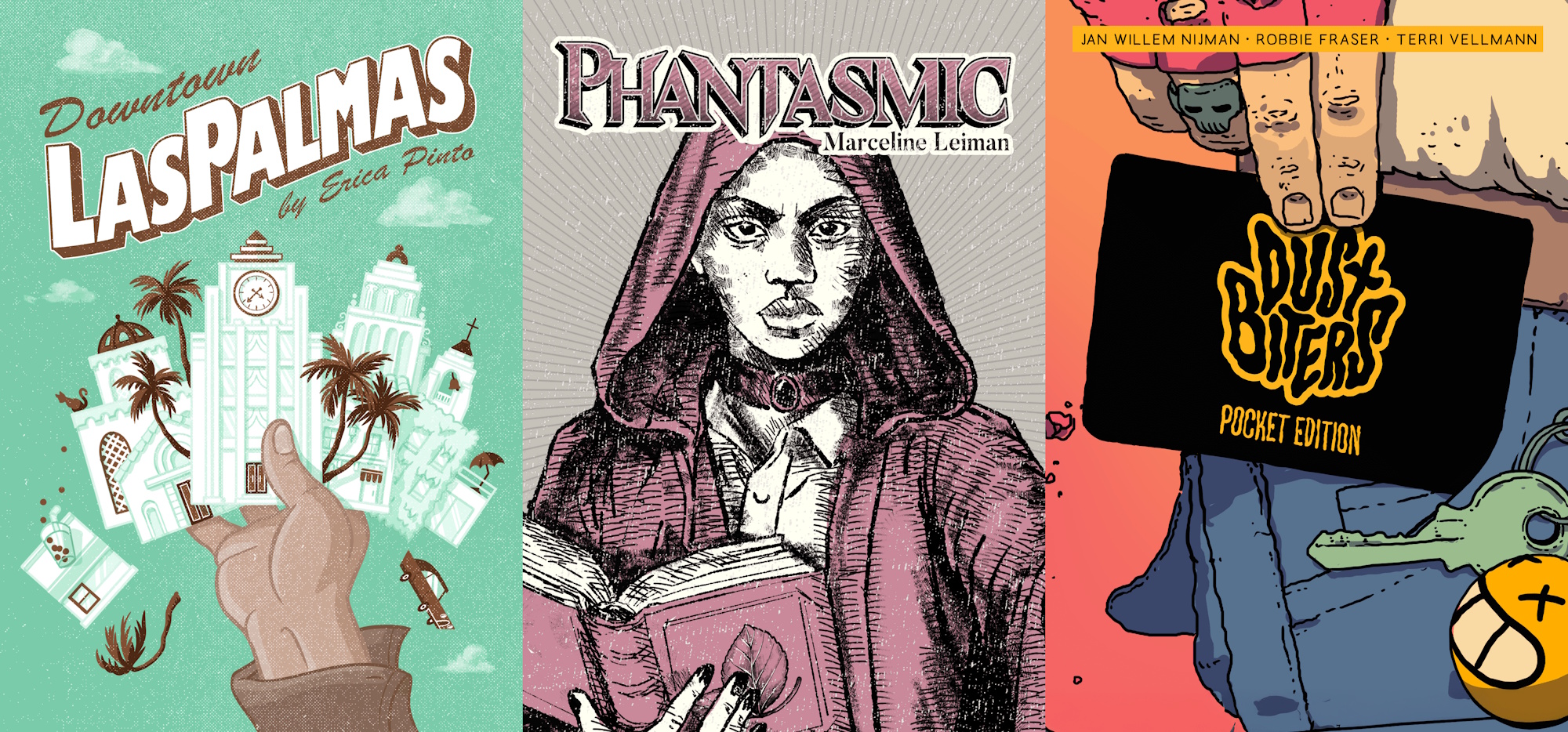
Downtown Las Palmas is the domain of “banana mitts.”

Downtown Las Palmas

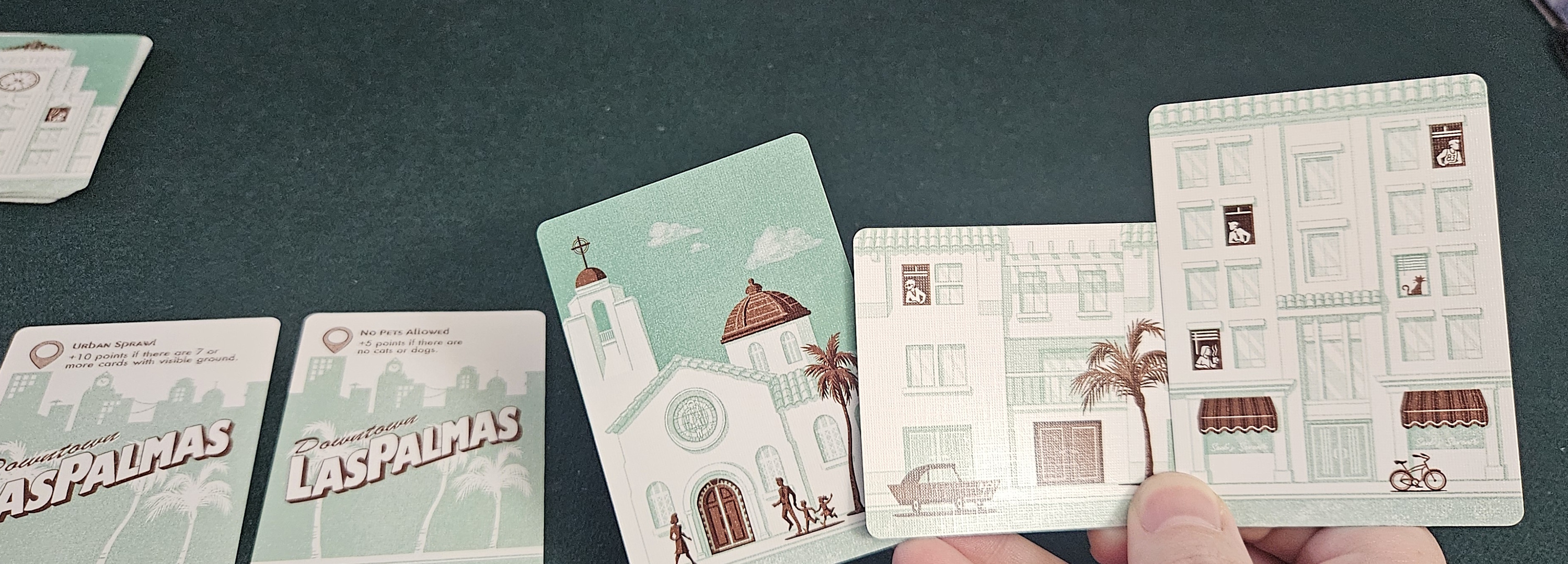
I appreciate a surfaceless game now and then, especially on long flights or while sitting in hotel rooms with tables that barely fit their obligatory lamp. In theory, Erica Pinto’s Downtown Las Palmas is one such game. You’re building a city in the palm of your hand, stretching those finger-webs to maximize real estate. The more cards you stuff into your mitts, the better, earning points not only for volume of cards, but also for every highlighted feature. Along the way, there’s some variability thanks to objectives printed on the back of every card. Stuff like “Traffic Jam: +2 points per vehicle” and “Urban Sprawl: +10 points if there are 7 or more cards with visible ground.”

Sadly, it doesn’t work.

I have wide hands. Not as wide as my friend Chris’s — everybody in our high school group called him “gorilla hands,” they were that massive — but big enough to comfortably reach an octave plus three on the piano. And I can barely hold these things. Maybe it’s the linen finish. Maybe it’s the game’s directives, which require ground-level streets to align and the sky to not intrude like some dimensional rift in front of another structure. These are necessary rules; to function as a society board game, you’ve gotta have rules. Or maybe it’s just my slippery fingers. But whatever it is, the entire thing slides to pieces the instant I’m holding more than four or five of the things.

Dang sky, always ruining my skyline.

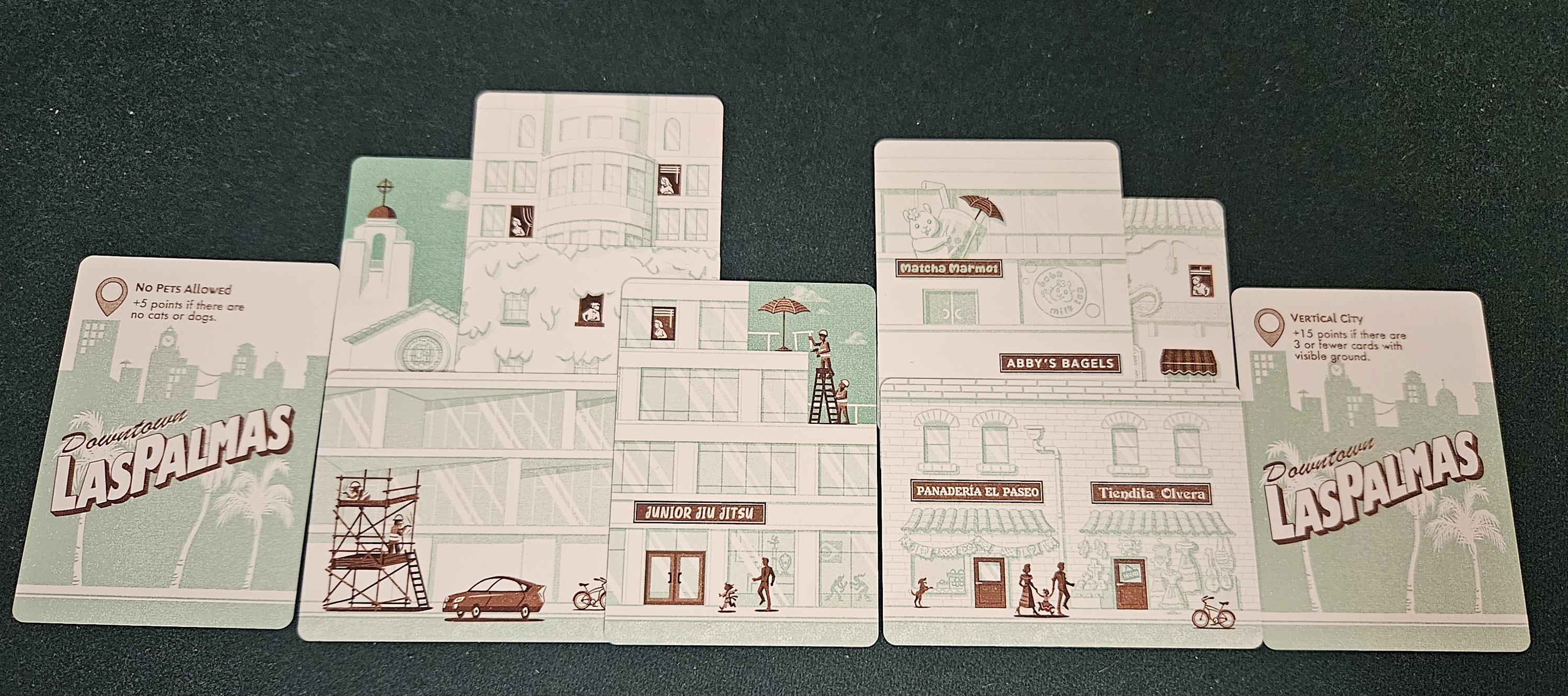
The table version is functional, at least.

There’s an alternate way to play. Cards can be arranged on the table, spaced between your session’s chosen objectives. This allows some glimpse of how Downtown Las Palmas is meant to function. The buildings that sprout from the concrete jungle, punctuated by slants of blue sky. The signs over the signs, the awnings and cats perched in impossible places. It’s a lovely thing to see come together.

Playing this way, though, I can’t escape the notion that this isn’t how Downtown Las Palmas should work. Probably because it isn’t. Sure, this is an official variant. But there are other small games about overlapping cards, many of them also published by Button Shy.

In the end, the game remains a lovely concept. Maybe I’ll get to try something else from Pinto before too long.

I'm stronger than these cards. I will always win an arm wrestle, if only barely.

Stronger? Weaker? Who can say?

Phantasmic

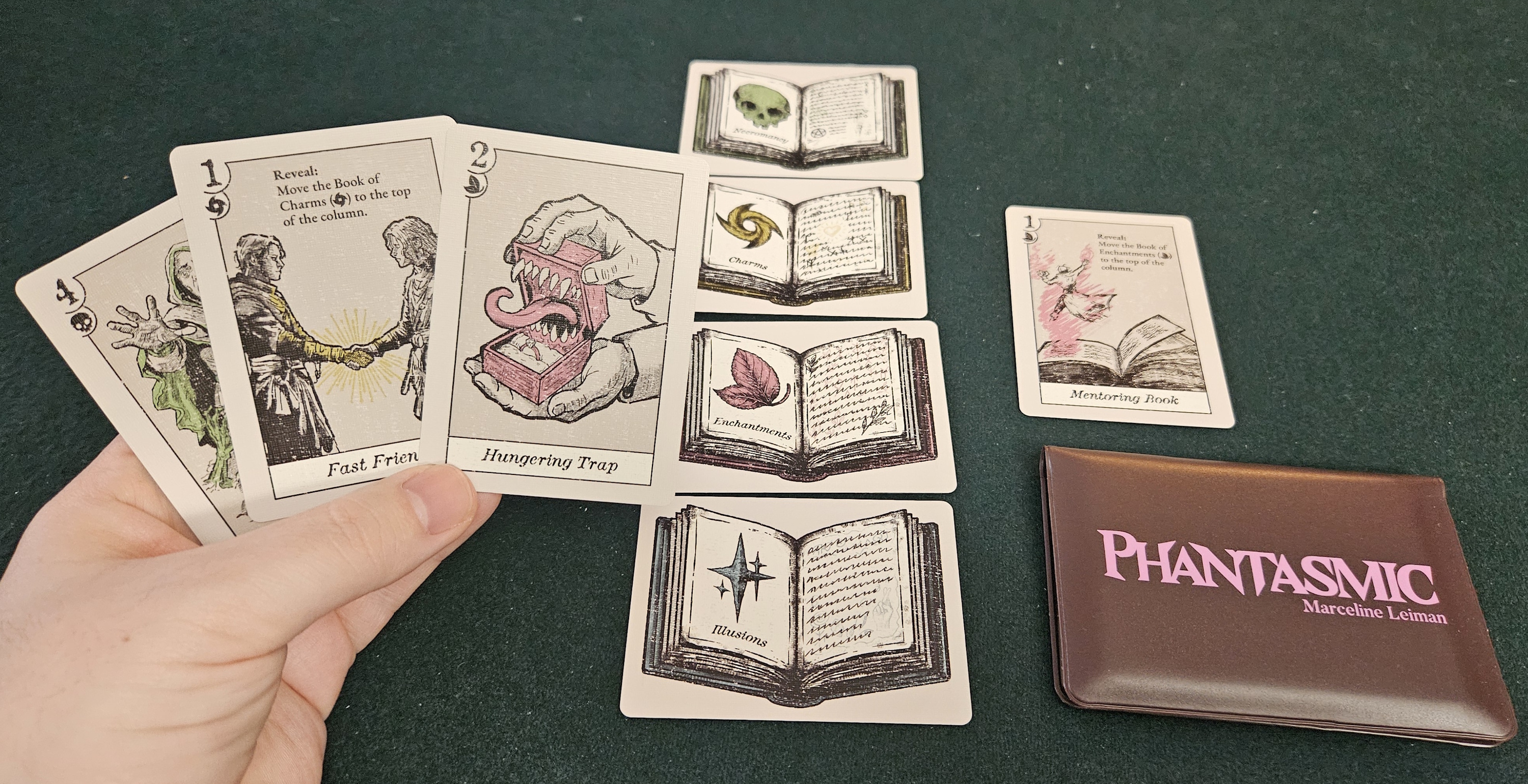
Phantasmic is the smallest of Marceline Leiman’s games, which is saying something when the others are High Tide and Heavenly Bodies. It’s the smallest in terms of rules footprint as well. The game is dead simple.

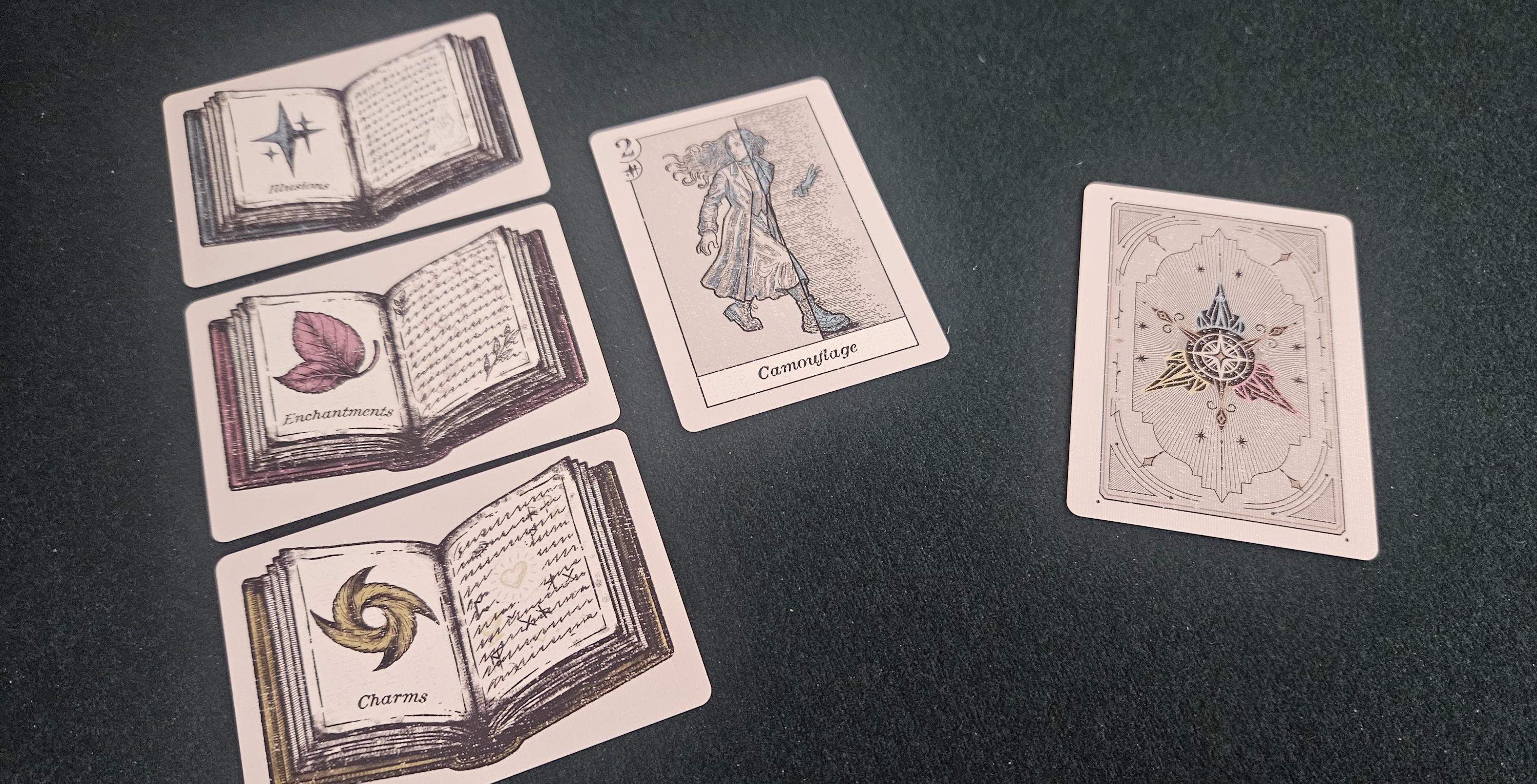
Picture a magical duel. That can’t be hard; heaven knows we’ve witnessed a bazillion of the things. One player is the Leader, a face-up spell before them on the table. The other is the Rival; their card goes face-down. At this point, the Rival announces whether their concealed spell is stronger or weaker than the Leader’s. A spell’s strength is a changeable quality, dependent on its rank and its spellbook’s position in relation to two others. The Leader declares whether they believe the Rival is lying or telling the truth. The hidden card is flipped. Everyone oohs and aahs.

Like I said, Phantasmic is simple. Perhaps too simple. At first brush, it feels almost like a coin flip. I say something, you determine whether I’m lying.

Then I could propose to Summer and have it bite her finger, haha! She would love that! (No, really, she would probably dig it.)

I want a ring box mimic.

But if Phantasmic is a coin flip, it’s a heavily loaded one. The placement of those spellbooks, the various rankings, even any previously played cards, all add to the game’s texture. A coin flip comes down to 50/50 odds; here, the likelihood that my spell is stronger than yours might be rather slender indeed. It helps that certain cards alter the outcome by swapping those spellbooks before the duel is decided.

So it’s a game of probabilities and bluffing in equal proportion. Given the game’s 18-card format, it helps that the card pool is knowable. Button Shy always offers little expansions, in this case a fourth set of spells; it isn’t enough to throw the calculations into disarray, but it does loosen up the probability a little bit.

Okay, so it isn’t quite as vacuous as a coin flip. But is it any good? Perhaps the best way to describe Phantasmic would be to say that I don’t mind it. I might almost use it as a five-minute tiebreaker, rather than a game’s default “whomever has the most leftover resources” or whatnot. But it’s so slight that I struggle to foresee any reason to nab it off the shelf rather than any number of other titles. Wallet games included.

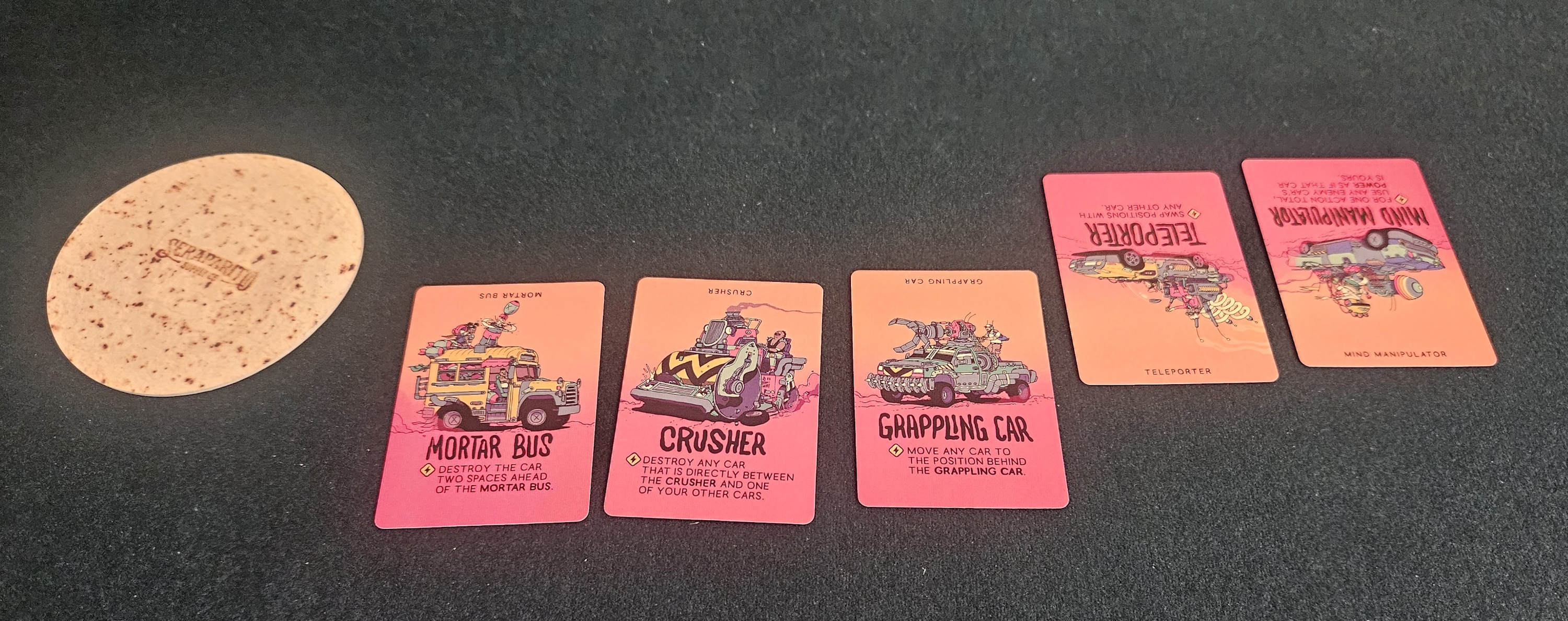
After taking this picture, I chucked it disc-like toward the stack of coasters on the counter, only for it to knock over a pencil holder. So surely it could shred a repurposed school bus.

Pretend the tortilla coaster is a whirlwind.

Dustbiters: Pocket Edition

I remember being curious about Dustbiters a few years back, that collaborative design by Robbie Fraser, Jan Willem Nijman, and Terri Vellman, in no small part thanks to Vellman’s lovely pink-hued trashheap illustrations. It’s basically the sandstorm scene from Fury Road, all those cars gunning their engines and puffing propane-jelly, while being ripped apart by a duster wider than Texas.

To my delight, Button Shy’s Pocket Edition is Dustbiters, albeit in a smaller package and minus only a few cards that are immediately replaced by the expansion. When the original game hit the scene, I had no idea it was functionally a microgame itself, tallying a slender twenty-one cards. I might have even been irritated at seeing its contents floating inside a too-large box.

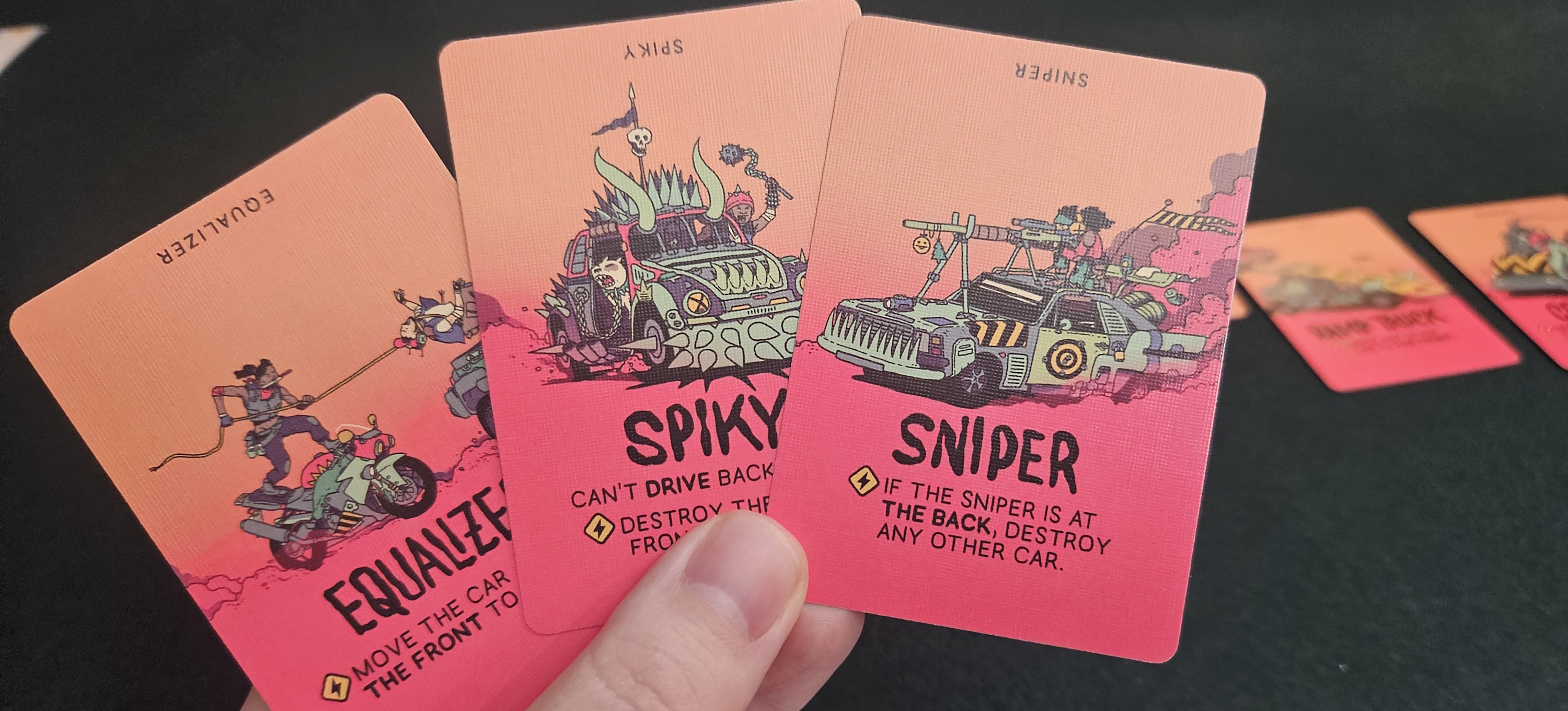
Right away, Dustbiters excels on multiple fronts. The artwork is perfect, of course, those little road-freaks guffawing as they tear across the wasteland. The gameplay is also no slouch. Six cards begin on the table, three oriented toward me and the rest facing you. Every turn offers three actions, whether spent moving vehicles up or down the line, triggering abilities, or deploying reinforcements to the melee.

From there, it’s a bloodbath. The goal is to be the last player with any cards on the table. Every turn will result in multiple casualties, and that’s if you’re shirking your homicidal duty. Thanks to the storm bearing down on your position, at least one car will be demolished at the conclusion of each turn. The only path to survival is sheer forward propulsion.

just good friends having a good time

A day out with the crew.

What a great little game. There’s some wonderful overlap between the vehicles’ appearance and their function, breeding a certain irradiated logic. There’s a Jammer with an old satellite dish wedged atop its minivan frame; it cancels the abilities of both adjacent cars. A repurposed steamroller can crush its neighbor, but only if its victim is sandwiched by another of your vehicles. A Ramp Truck lets you fling your car haphazardly to the front of the line. The blood-bag Max tethered to the front of the Martyr car may absorb any other hit.

Here’s something that tickles my fancy: quite often, designers stretch the microgame’s 18-card limit by pressing their cards into multiple duty. Each card has two sides and many orientations, after all. Dustbiters doesn’t need the help. All it takes is a conga line of murderous gas-guzzlers, some nasty time pressure, and a few simple rules. Five minutes is all it takes to play, but there’s more drama compressed into those five minutes than… well, than in certain nu-euros about flinging tourists into outer space.

Of the trio, Dustbiters is the clear frontrunner, which means it is the sole title to not be shredded by the wasteland storm of my judgement. Dustbiters, I verily witness thee.


Complimentary copies of Downtown Las Palmas, Phantasmic, and Dustbiters: Pocket Edition were provided by the designer.

(If what I’m doing at Space-Biff! is valuable to you in some way, please consider dropping by my Patreon campaign or Ko-fi. Right now, supporters can read about which films I watched in 2025, including some brief thoughts on each. That’s 44 movies! That’s a lot, unless you see, like, 45 or more movies in a year!)

Incredible EPIC Terrain!

24. Februar 2026 um 21:10

Sextus, you ask how to fight an idea. Well I’ll tell you how… with another idea!

Peter showcases the amazing range of epic scale Gothic Sector pre-painted terrain from Gale Force Nine!

I do love a bit of tabletop terrain, and if it’s pre-painted so I don’t have to do any extra work, so much the better! Gale Force Nine just sent me this incredible range of epic-scale terrain from their Gothic Sector range, and I’m blown away. At last, great trees and roads for games like Armoured Clash, Adeptus Titanicus, Epic 40,000, and Legions Imperials, and Epic Warpath. Check it out!

Making high quality tabletop gaming content at the EOG takes time and money. Please consider becoming a Patreon supporter or making a donation so I can continue this work! Thankyou!

Ra and Write Review

24. Februar 2026 um 15:07
Ra and WriteWhen your spouse is an Egyptologist, it’s hard to pass up an opportunity to play and review the newest Ra iteration—Ra and Write. Even harder when you’re planning a visit to see an art show about Ancient Egypt’s gods. Designed by Reiner Knizia with art by Ian O’Toole, the game pulls forward themes which will […]

Source

Pinched! Game Review

For the most part, the team at Mighty Boards has never done me wrong.

After a middling experience with their recent release Red North, I didn’t rush their other SPIEL Essen 2025 release, Pinched!, to the table until recently. But after doing plays at three, four, and five-player counts, I’m excited to share that Pinched! was a blast. Save for my thoughts on how the game’s random card draw can affect scoring and notes on a specific player count, I highly recommend giving Pinched! a look.

“I’ll Take That”

Pinched! is a hand management and set collection game of bluffing and thievery for 2-5 players. Over a series of turns, each player (taking on the role of a thief in a gang of them) will serve as the Mastermind for a given turn. Using a hand of location cards, the Mastermind will select a heist location from amongst the 3-5 locations available in that game.

The Mastermind plays this card face-down into the center of the table, then each other thief will play a card from their own hand of location cards in the hopes of matching the location selected by the Mastermind. During the reveal, two things could happen. If the Mastermind picks a location that…

The post Pinched! Game Review appeared first on Meeple Mountain.

Masters of Crime: Incognito Game Review

I’ll admit it: my wife and I got a little too comfy.

After some of the best experiences in the one-shot, mystery gaming arena with the KOSMOS series Masters of Crime, I expected my fourth run to be another blowout. Masters of Crime: Vendetta, Masters of Crime: Rapture and Masters of Crime: Shadows are the height of the category; one of those titles was on my top 10 games of 2025, but all of them could have been, if I had just sprinkled the titles across the entire list.

What those games got right is why I recommend them to everyone I know. The scenarios are fantastic, you’re always placed in the shoes of the villains, not the cops, the puzzles are tough but fair, and the endings always made logistical sense after working through all the bread crumbs dropped during the investigation.

Masters of Crime: Incognito was the next game on my list. I created a draft for this review and had a 5.0/5.0 placeholder ready to go before I played the game. I was sure Incognito would be another banger; why wouldn’t I? My wife and I set up a date night for a Friday evening play. I made the cocktails; she grabbed our note-taking components, laid out the game, and read the…

The post Masters of Crime: Incognito Game Review appeared first on Meeple Mountain.

What Up, BGG!

by Justin Bell

Hey hey folks! I’m excited to be a part of the team here at BoardGameGeek as a contributor on the BoardGameGeek News blog. You’ll see me here every week and I’ll pop up with extra content from time to time, between articles and via some of our other internal productions, such as episode 88 of The BoardGameGeek Podcast which posted a couple weeks ago.

A little bit about me: like everyone else who works here, I love games. It’s probably fair to say that I love what games mean to my life a little more than the games themselves—getting friends and family together to chuck dice, talk a little smack, and laugh a whole bunch. Certainly, those nights are more interesting when the games themselves are good, but any chance to sit at a table to experience something together is really hard to beat.

I have been—and will continue to be—a contributor at Meeple Mountain, a gang of gaming fanatics who contribute written content (and a smidge of video content) to the tune of more than 500 articles, reviews, interviews, convention roundups, and more every year. I’ve had the distinct pleasure of delivering material on Meeple Mountain for the last five years, and I’ve been playing hobby games of all shades for the last 40. In addition to appearances on The BoardGameGeek Podcast, I have also appeared on 30+ episodes of The Five By and individual episodes of Five Games for Doomsday, Tabletop Submarine, The Tabletop Merchant Podcast, and Board Game Times.

When I’m not thinking about games, I’m usually doing one of the following three things. I might be working my full-time gig, as a global program manager in the training, learning & development space where I travel a whole heck of a lot. I am possibly eating...and, while I love to cook, the job and the travel mean I get lots of chances to fulfill my personal life motto: “when in doubt, eat out.” I am hopefully spending time at home with my wife and two kids, ages 12 and 9, who seem surprised when I’m not hosting yet another game night.

Speaking of home, I’m based in the Chicagoland area, where I’ve been for most of the last 15 years. Before that, I’ve gotten around a bit: Rochester, NY; San Francisco, CA; Charlottesville, VA; plus, all the parts of the “DMV” (DC, Maryland, Virginia), from Mount Vernon Square to Rockville to Falls Church to Gaithersburg to Crystal City, even a little old place known as Buzzard Point, the area just west of the baseball stadium that the Washington Nationals call home.

And then, there are the games. Mertwig’s Maze holds a special place in my gaming heart, being one of those formative experiences from a billion years ago thanks to friends who were all about games in the Advanced Dungeons & Dragons series. I played a lot of the titles in the “Gamemaster” series from Milton Bradley: Shogun, Axis & Allies, and my favorite from that batch of titles, Fortress America. But I was also playing a lot of the games my parents bought for me, from Monopoly, UNO, and Yahtzee to more specialized titles like Go For It!, Hotels (a Milton Bradley title previously known as "Hotel"), and Fireball Island.

Any chance I could get to play games—board games, card games, video games, baseball, basketball, football—I did it. In college, it feels like I was playing either Spades or Hearts every night before heading out for the evening. As I got older, I got caught up in the magic of Catan thanks to a friend in Chicago who showed me Settlers of Catan: Cities & Knights, which led me down a path of so many modern classics, such as Race for the Galaxy, Puerto Rico, San Juan, 7 Wonders, and a number of other titles that I was thrilled to discover.

That love affair continues today. I put in the work to build up a few different gaming groups—I do games every Monday with a “review crew” at my house, Tuesdays once a month with BGG’s very own [user=LindyBurger]Lindyburger[/user], most Wednesdays with a group of folks I’ve known since I first moved to Chicago, every Friday at home with my wife and kids, some Saturdays with a mix of the deep strategy gamers who I met during COVID, and Sundays once a month with my buddy [user=imaginaryforce]ImaginaryForce[/user] and some of his friends in the Chicago suburbs.

Thanks to this wide range of gaming networks and my industry relationships, I get the chance to play a lot of different types of games. While I would categorize myself as an “omnigamer”, I usually gravitate towards the kinds of games I know I can get to the table consistently. That might range from family-weight games, trick takers, light dexterity games, and straightforward “roll and move” games to your run-of-the-mill medium-weight Euro game (tracks, baby!) to heavier fare, such as strategy titles, 18xx games, and “rules for rules’ sake” games that land in that 4.0+ weight class here on the Geek.

My all-time top five? Man…that’s a moving target. Let’s go with these for now:
1. Chicago 1875: City of the Big Shoulders
2. The White Castle
3. Kingsburg
4. UNO
5. Tiletum

My top five of the last five years? Much easier:
2021: Beyond the Sun (the Geek says it was a 2020 release, but I didn’t play it until 2021)
2022: Tiletum
2023: Hegemony: Lead Your Class to Victory
2024: Dead Cells: The Rogue-Lite Board Game
2025: Vantage

Here’s my goal for the BGG community: write engaging articles and share interesting industry discussions, aimed at both our core audience as well as folks just dropping by to say hello. I’ve got a bunch of ideas, but I’d still ask for your input: what kinds of discussions really get you excited? What parts of the tabletop business intrigue you? Which personalities in this space are you most interested in meeting? What mechanics are you most excited to explore?

I’ve got thoughts, but I have a feeling you do, too…let’s keep the dialogue open. I’m excited to engage with the members of this community!


(it's always brunch time...right?)

Designer Diary: Treat, Please!

24. Februar 2026 um 08:00

by Courtney Shernan


One day in the summer of 2019, I was sitting on the couch with my little loaf Trixie, watching her lick my hand over and over, so I would keep petting her. It made me think about all of the ways that she would get me to do things for her, like standing by the front door so I would take her for a walk or groaning at her food bowl, so I would feel guilty and feed her an early dinner. And then I thought, “There’s a board game here!”

I thought about different game mechanics and decided to create a deck building game with an inviting and accessible theme of being a silly, spoiled dog. I really enjoyed playing deck-building games, but I knew how intimidating they were for me at first and that a lot of my friends and family felt similarly. My goal was to make a game that introduced deck building as a mechanic and captured the strategy under the guise of a cute, light-hearted dog game where you “learn” new dog behaviors to build your deck. The behavior cards would be things like “Wag Tail” and “Sit on the Human’s Lap” that you could play to gain “cuteness”. With enough cuteness, you could complete objectives like “Get a Treat” or “Get Belly Rubs” as a dog trying to get their human to give them what they want.

I spent the whole weekend brainstorming, typing up cards in Word, and printing them out. There were going to be so many fun elements, like polka dot accessories and little rain booties you could add to your deck to make your dog extra cute. I got everything together for the prototype I envisioned, and then I just couldn’t play it. Not that it was unplayable (although it very well could have been) - I just couldn’t bring myself to play it. I thought to myself that there was no way I could design a board game, and I didn’t feel like I had anything even remotely new to offer. I shelved it, and I felt ridiculous for even trying.


A year later in the summer of 2020, my husband and I were quarantining at home and started playing Gloomhaven regularly. I love how the game makes you determine the optimal time to play specific cards from your hand while having the option to get your cards back by resting. I remembered the work I put into Treat, Please! a year earlier, and I thought it would be fun to implement a similar rest mechanic, where dogs could choose to “Take a Nap” to get their behavior cards back from their discard pile, rather than having to wait until they’ve fully cycled through their deck. At that point, I decided to eliminate the deck element of the game entirely, leaving players with just their growing hand of behavior cards and their discard pile.

At this point in my life, I was looking for any kind of creative outlet to focus my attention, and I figured there was no harm in trying to see this through. The idea of having my own board game on my shelf had been a dream for a long time. I went back to my old prototype and completely reworked all of the cards. I also added a board with a house layout to the game, where you could only play certain behaviors if you were in the corresponding room of the house (e.g., you had to be in the kitchen to “Lick the Dirty Dishes”), and the human was also roaming around doing different things, which impacted your ability to get their attention.

After many iterations of playtesting by myself, my husband happily agreed to playtest. His first piece of feedback: get rid of the board! He was totally right; it was completely unnecessary and overcomplicated the game. Instead, I created an event deck, so I could maintain the feeling of the human doing different activities with implications for you as dog. One of my favorites is "The human is putting away laundry", which gives you the option to "Run away with a sock" for attention.

From there, I had a very rough prototype that resembles Treat, Please! in the form it’s in today:


Playtesting
I knew I needed to start playtesting early and often, but without being able to see my friends and family in person, my options felt limited. My friends and I had been using a digital platform for virtual D&D sessions, and I realized that if I could make my game digitally, my D&D friends would be able to playtest too!


I started off playtesting with my DND friends in August 2020, and it really helped build my confidence with explaining the rules and listening to constructive feedback. I quickly realized that I would need to expand my playtesting circle if I wanted to continue improving the game. My friends suggested that I join the PlaytestNW Discord, the server for a local playtesting group that shifted to virtual playtesting during the pandemic. I was so nervous to join my first Sunday playtesting session and told myself that I would just go to playtest and observe the first time. I reassured myself that if I had a terrible time and felt unwelcome that I could find other opportunities elsewhere. But I couldn’t have been more wrong; I was immediately greeted by the most welcoming community of game designers and playtesters, and it was amazing to see games at all different stages of development. I started regularly attending and eventually got the nerve to sign up Treat, Please! for playtesting in October 2020.

After joining PlaytestNW, my design journey started accelerating, and I was eager for more opportunities to playtest. That is when I learned about the Break My Game (BMG) Discord server, with playtesting events almost every day of the week! After attending my first BMG playtest, I knew it was the perfect place for me. One of the things that stood out to me the most was how well-moderated their playtesting events are and how supportive the community is, which made me feel comfortable sharing my game and receiving feedback from complete strangers. After being a member of the community for awhile, I became a moderator and eventually a playtest event host. Hosting playtests was an absolute blast, and I loved seeing how other designers’ games would progress over time. These online groups also helped me find other opportunities to playtest and network, such as Protospiel Online, Nonepub, and the Tabletop Mentorship Program.

There are countless improvements that I made to the game thanks to input from playtesters, but here are a few of the highlights:
• Removing negative interactions and focusing on positive, communal effects to lean into the idea that this is a household full of dogs that are competitive but love each other.
• Shortening the game from 10 to 7 rounds and structuring it as a week in the life of a dog, providing the opportunity to ramp up gameplay during the last 2 rounds of the game (i.e., “the weekend”).
• Reducing the burden of taking a nap by allowing you to play one of your behaviors if you take a short nap instead of losing your whole turn.

Once it became safe to meet up with others, I was so excited to start playtesting in person. Local conventions like Dragonflight and OrcaCon were amazing experiences to connect with my desired audience: dog lovers!


Pitching
Initially, I planned to self-publish Treat, Please!. However, my plans changed when I was invited to participate in the “Feedback Frenzy” pitching event at the online Nonepub convention in January 2021. I never considered the possibility that a publisher might be interested in my game, so the idea of pitching hadn’t crossed my mind until then.

For the event, I pitched to a panel of publishers and game designers and got immediate feedback on my pitch - all of which was livestreamed during the convention. It was a terrifying but exhilarating experience, and honestly, it felt like I was in my element. It made me wonder why I hadn’t considered pitching previously, and I started to believe I had a chance to successfully pitch to an interested publisher if I could find more opportunities like this.


I sought out other opportunities to pitch directly to publishers, including a speed pitching event on Discord through the Tabletop Mentorship Program and other virtual pitch practice events. During a pitch practice event on the Weird Giraffe Games Discord server in March 2021, I pitched to Chris Solis of Solis Game Studio, who reached out afterward requesting to play. We quickly set up a time to play digitally, and then he requested that I send him a physical prototype. It was immediately clear that he understood what I was trying to accomplish with the game, and I was thrilled that someone believed in me and my vision. After some back and forth, I signed Treat, Please! with Solis Game Studio in May 2021.

Design Development
Once the game was signed, Solis Game Studio took the reins and formed an incredible team to take Treat, Please! from a prototype (with a severe lack of cute dog art) to a polished game. I was responsible for playtesting as we worked on some gameplay changes together. At this point, I was focused on playtesting in person, so I could get detailed feedback from playtesters about all aspects of the game, particularly pacing and how the physical components felt.

I was so fortunate that Solis Game Studio encouraged me to be actively involved in the final development of the game and that I was able to provide input on the art and graphic design as it was being worked on. It brings me so much joy to see many of the dogs in my life shine in the adorable artwork of Kiem Hollis.


A love letter to Trixie, and hello to a new friend…
Trixie crossed the rainbow bridge in February 2024 after a battle with cancer. The day we found out there was nothing else we could do to make her comfortable and that it was time to say goodbye was one of the worst days of my life. I don’t know how else to describe my love for her other than saying she was my doggie soulmate. I am so grateful for all of the memories we made together that will continue to fill my life with joy, and I’m grateful for this game that will always bring me right back to those times with her.


We welcomed a new friend, Louie, to our family last year, and we’ve enjoyed learning his quirks and the unique things he does for attention. Like how he growls quietly and stares at you until you lift up a blanket for him to go under or how he loves to jump onto the window sill and sleep in the sun. He is a silly, sneaky boy with a loving personality that has been so special to see as he has settled into our home.


Trixie and Louie have brought an immeasurable amount of joy and love into my life. One of my favorite parts of playtesting was hearing players talk about their dogs and seeing connections form between complete strangers over their shared love of dogs. My hope is that Treat, Please! will encourage players to reminisce about all of the fun and silly memories they have with the dogs in their lives.

I’m so excited to share that Treat, Please! is now available on Solis Game Studio's website here. And please feel free to share your favorite doggo quirks and stories below - I would love to hear all about your wonderful pets!

And lastly, I just want to say that if you’re toying with the idea of designing your own game, do it. I wish I could go back and tell myself in 2019 to stick with it. Even if Treat, Please! didn’t end up being published, I am so proud of the skills I’ve gained during this journey and grateful for the communities that welcomed me along the way. If there is anything I can do to help you on your journey, please don’t hesitate to reach out.

The Fox in the Forest: Duet

This spin-off of The Fox in the Forest changes things up a bit, turning a competitive game into a cooperative one. This is a trick-taking game for two players. You have a pawn moving along a track. There are markers placed next to the track. As you move that pawn back and forth along the track, it removes a marker whenever it stops, if there is one next to it. Your goal is to remove all

FIJ and GAMA Expo Preview is Live

24. Februar 2026 um 01:32

by Beth Heile

We've recently made some big changes with our Preview lists, and things kick off with this list for Festival International des Jeux (FIJ) and GAMA Expo.


Previously, publishers filled out a form and BGG staff and volunteers entered that information into Preview lists. Now, our Preview lists will be self-service and publishers will enter that information themselves. This will allow publishers to simply the Preview process by inputting information themselves directly into the Preview system. Each Preview list will then be moderated to ensure that entries are allowable under our Preview submission rules.

PLEASE NOTE - inaccurate entries on a Preview list will be removed! Please view the posting guidelines in the tutorial or below for submission rules.

If you would like to submit an entry for the FIJ / GAMA Expo Preview list, you can find written instructions HERE.

If you have any question, you can post a comment in this thread or email at news@boardgamegeek.com.

SUBMISSION GUIDELINES

Triple-Triple Omelette Burger w/o Cheese

24. Februar 2026 um 00:11

I'd eat there.

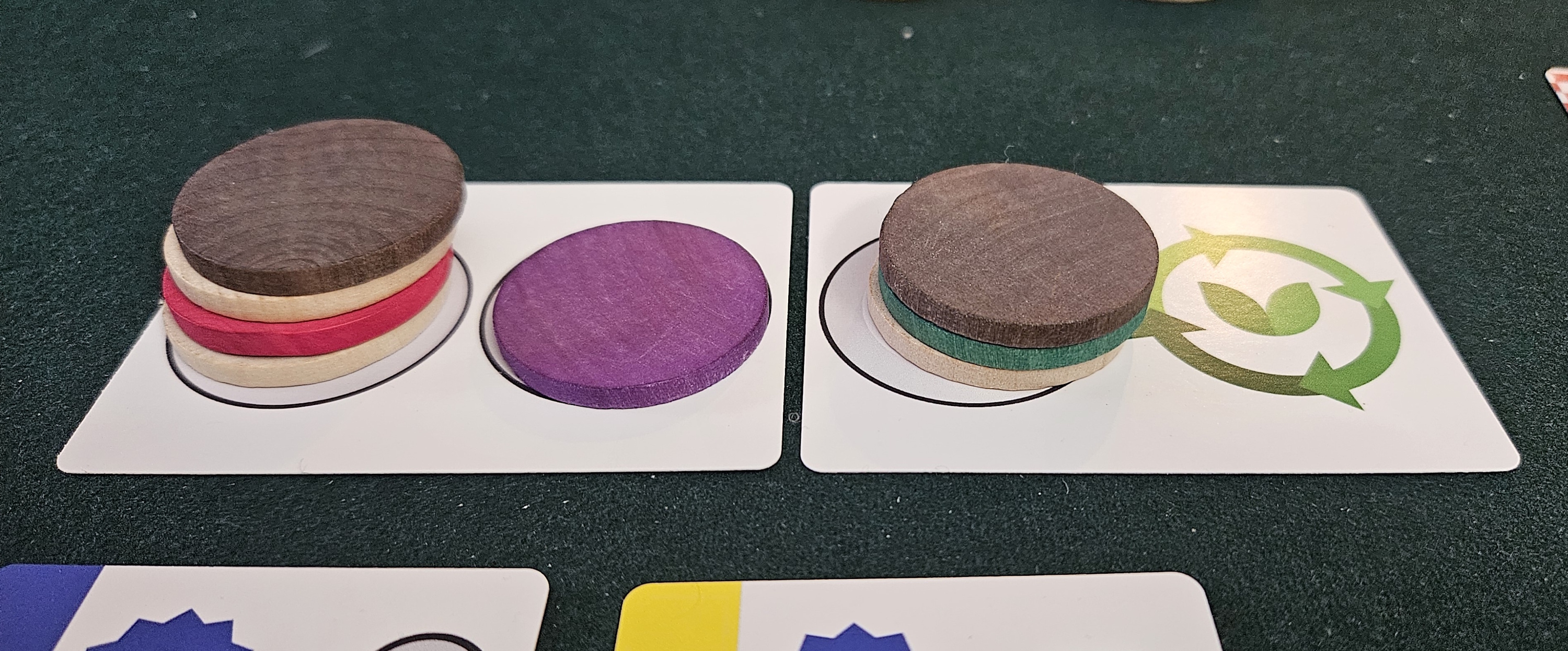
Sold initially at the Indie Games Night Market, Joseph Z. Chen’s Flip Stack Burger Shack has all the markings of an indie darling: its not-quite-smooth discs look great on the table, the gameplay is tactile and amusing, and it even comes in a bag. (All the best indies come in a bag.) But what I least expected from it was a cerebral puzzle that reduced my brain to onion jam.

Can you make my favorite burger? Nope. There aren't ingredients in the right colors.

Sandwich artistry.

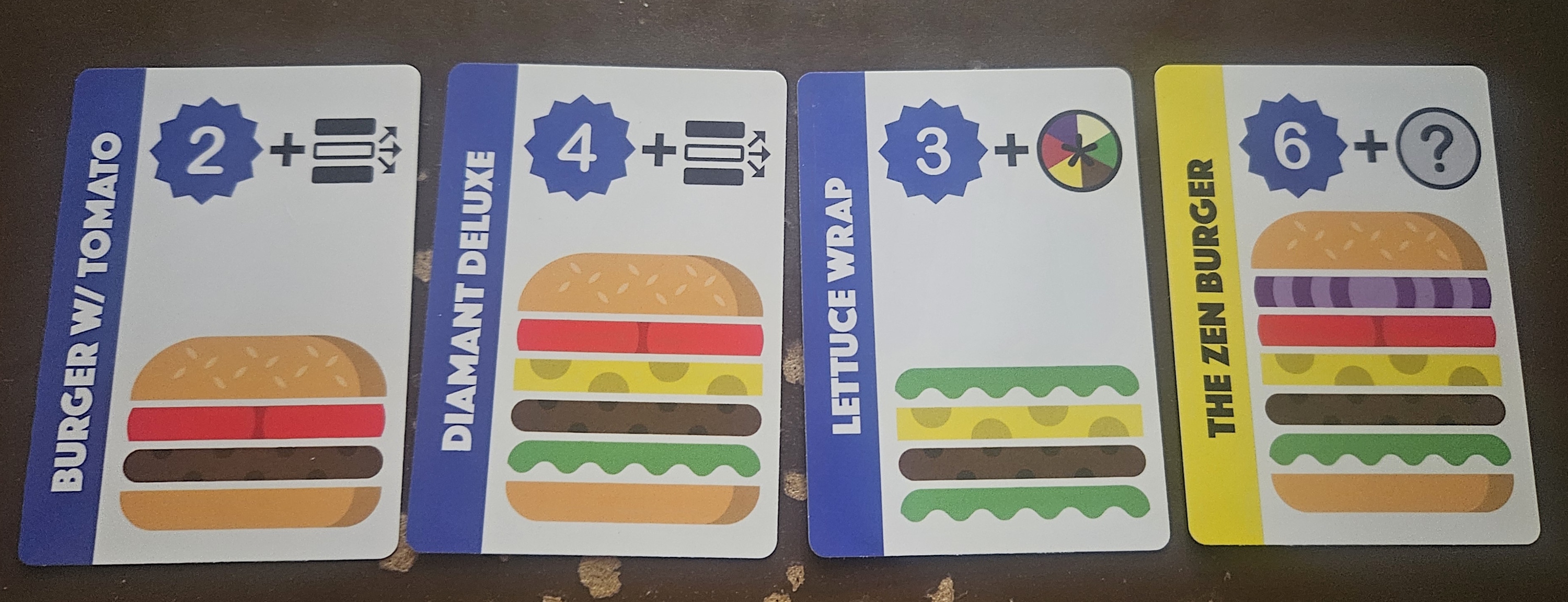
Picture this. It’s your first day on the job. The burger shack down at the beach is your haunt, and there are already people lining up at the window. The orders are coming fast and hot. Classic burger! Tomato grilled cheese! Diamant deluxe! Lavender burger! Your assistant begins flinging ingredients your way. It’s all you can do to flip the piles onto the proper buns.

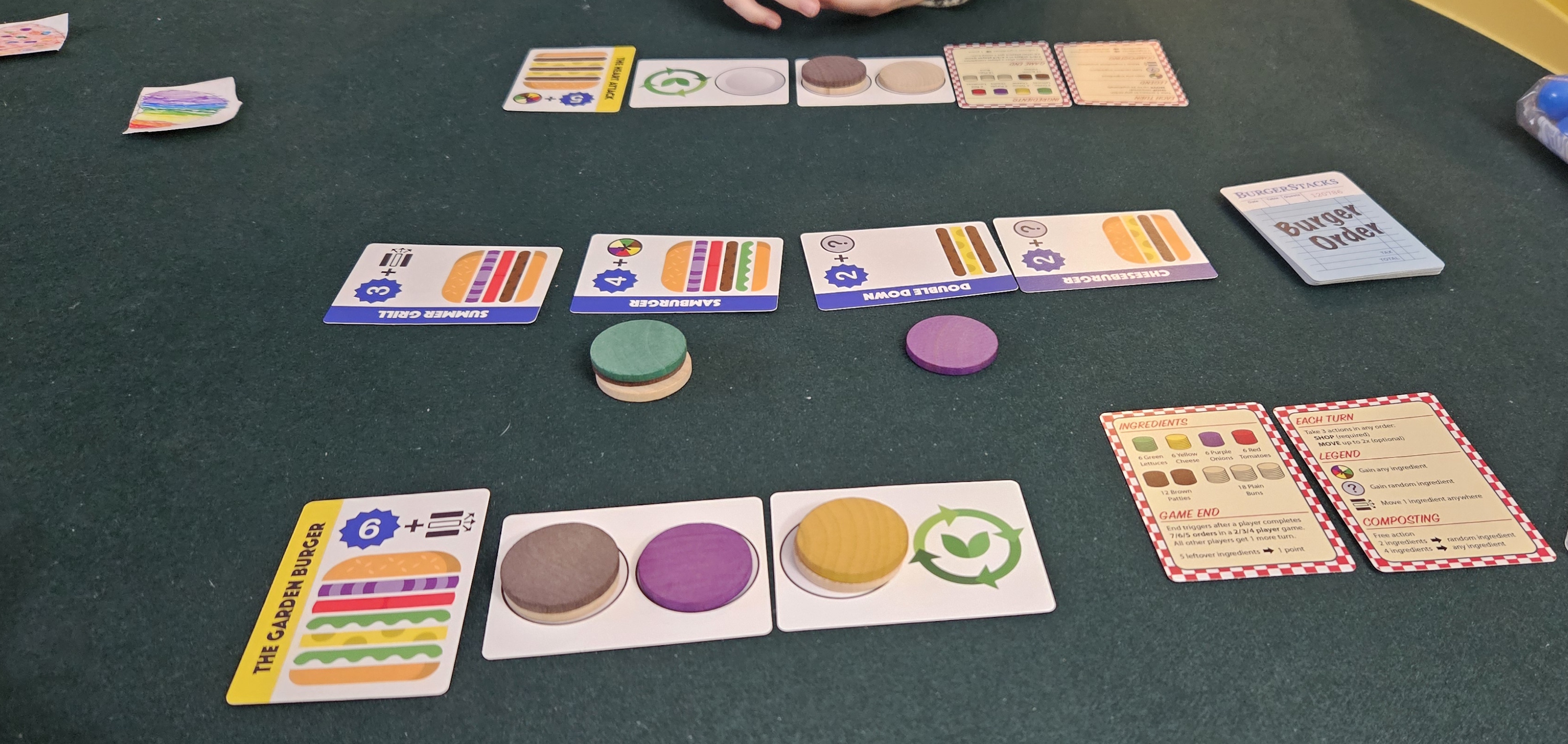
This isn’t quite how Flip Stack Burger Shack plays — nor does this particular shack deserve the highest food safety rating — but it’s close enough. Drafting from shared stacks, players take handfuls of ingredients, flip them this way and that, and slop them into something resembling an edible hamburger. Ideally before their coworkers can snipe the order out from under them.

Let’s get the quibbles out of the way. For a game about flipping burgers, Flip Stack Burger Shack is a strangely deliberate event. When you’re trying to assemble a particular sandwich — let’s say an Oklahoma — you’ll be staring at a diagram. In this case, a bun, patty, cheese, and onion, topped off with another bun. But building that burger is tougher than it looks, especially when the stacks begin to accumulate some elevation. At any given time, you might be staring at a single ingredient, some lettuce, the stack that was replenished right before your turn, but then ever-increasing stacks that might reach a half-dozen or more ingredients at the same time. Those slop piles can be useful, but they also tend to be tougher to use. This requires the titular flipping and stacking, often to separate out the necessary ingredients before they arrive atop the correct sandwich.

Or maybe you could chuck the whole thing into the composter and, via culinary magic, produce a more desirable ingredient from the bag. Sayonara, entire heads of wilted lettuce; say hello to a single sliced tomato.

Either way, this process is anything but rapid. More often, Flip Stack Burger Shack is thinky. Ponderous, even. With four players, the downtime between turns threatens to become bloated. Like unrinsed lettuce or a burger patty left too long in a surfer’s hatchback.

If you saw these hanging on the back wall of a Wendy's, would you find it endearing or distressing?

Handy burger diagrams.

But with the right crowd of players or the right player count, whichever lets you move at a steady clip, that same thinky edge makes Flip Stack Burger Shack an unexpected treat.

I’ll give an example. Most burgers need buns. Easy. Most burgers also need patties. As a result, it’s a relatively safe bet to nab extra buns and patties. But what happens when the easy pickings have been nabbed? Now the game shifts into riskier territory. With some clever acquisitions from the ingredient counter, not to mention a few timely flips, it’s possible to head off rival sandwich artists.

Those flips, by the way, are handled with perfect ease. Any time you pick up a stack, whether from the market or your own plates, you’re free to grab some or all of the tokens, and then you’re also free to flip them as you see fit. This doesn’t solve every problem; indeed, it’s surprising how often you’ll need multiple maneuvers just to lever a tomato out from under an ill-placed slice of cheese. But it provides some truly pleasant tactility. It helps that the tokens are wood. One of the benefits of being a small-batch production is that the whole thing’s aesthetic is perfectly minimalist, from the painted tokens to the receipt-book burger diagrams. Flip Stack Burger Shack isn’t the most innovative title in the world, but it feels lovely to handle.

That handling is the core of the entire experience. Some games are about big ideas. Others are about sequences, or engines, or fancy math. This one is about the joy of moving things, shifting and rotating them, feeling their grain on your fingertips, and doing your darnedest to keep the right stack in your mind’s eye.

mmm cheese

Even from a distance, these burgers are handsome.

And, well, that’s all there really is to it. Flip Stack Burger Shack is another indie market title that, like last week’s Imps, will hopefully draw enough attention that it gets picked up for wider publication. Just don’t report the shack to the food inspector’s office. I’m pretty sure none of these burgers are gluten, meat, or dairy free.


(If what I’m doing at Space-Biff! is valuable to you in some way, please consider dropping by my Patreon campaign or Ko-fi. Right now, supporters can read about which films I watched in 2025, including some brief thoughts on each. That’s 44 movies! That’s a lot, unless you see, like, 45 or more movies in a year!)

The Box: An At-Home Escape Room Review

23. Februar 2026 um 17:58
The BoxYou’re in the mood for an Escape Room. Great! Except it’s a Tuesday night and you haven’t made a reservation. No wait, it’s the dang babysitter who canceled on you. No, wait, you don’t want to go outside. No, wait, your dog ate your ticket. No wait… We get it. For reasons both legitimate and/or […]

Source

Tariff Tax Update: February 2026

23. Februar 2026 um 17:05

Every day for the last 10 months, I’ve lived in fear that the executive branch of my own country would raise our import taxes to an extreme level that would significantly damage Stonemaier Games and the thousands of small businesses seeking to serve their US customers, retailers, and employees.

So when the Supreme Court ruled on Friday that the tariff taxes and the way they were implemented were unconstitutional, I had a huge sense of relief. Relief that small businesses can no longer be used as pawns in a global game. Relief that the whim of one person can no longer effectively change the landed cost of our product from $10 to $25.

Yes, there are still legal ways for the executive branch to impose tariff taxes. They seem really passionate about making small businesses in the US pay more taxes. But these methods have limits: For example, the new tariff tax is 15% (that’s the max it can be), and it needs congressional approval to extend beyond 150 days.

In the immediate future, I don’t think we’ll see much of an impact on prices, as anything in stock in the US already had its tariff tax paid when it entered the country (if it was manufactured elsewhere). My perception is that many businesses avoided raising prices and instead just ate the extra costs (that’s what we did; we did not increase any prices).

There is also the possibility of tariff tax refunds. To date, Stonemaier Games has paid just under $300,000 in tariff taxes to the US government. I’m not counting on getting any of that back–it will be nice if we do, and I hope that other businesses do, but the level of uncertainty isn’t something for which we can plan.

My hope, as always, is that what happens next will help me best serve my coworkers, our independent contractors and partners, and our customers in the US and around the world (consumers, retailers, and distributors). I wish the same for all other small businesses.

How have the tariff taxes affected you, and what is your hope for the future of tariff taxes?

***

If you want to question the feasibility of manufacturing highly customized games in the US, the ethics of manufacturing in other countries, or the politics of opposing tariff taxes, please read this and this.

Previous articles:

Other related resources:

If you gain value from the 100 articles Jamey publishes on this blog each year, please consider championing this content! You can also listen to posts like this in the audio version of the blog.

All Patched Up – A Review of Company of Heroes: 2nd Edition

23. Februar 2026 um 15:00
I find it hard to believe the Company of Heroes board game is five years old. This splendid adaptation of the popular real-time strategy PC game was a story in 2021. My review contained a healthy amount of enthusiasm, and it occupied a key position in my top 10 of the year. A lot has…

Read more →

❌