Lese-Ansicht

Liberation Ludology, Part One: Uruguay

I think we should call them I.M.F. Insurgencies in Latin America, just to be even more opinionated.

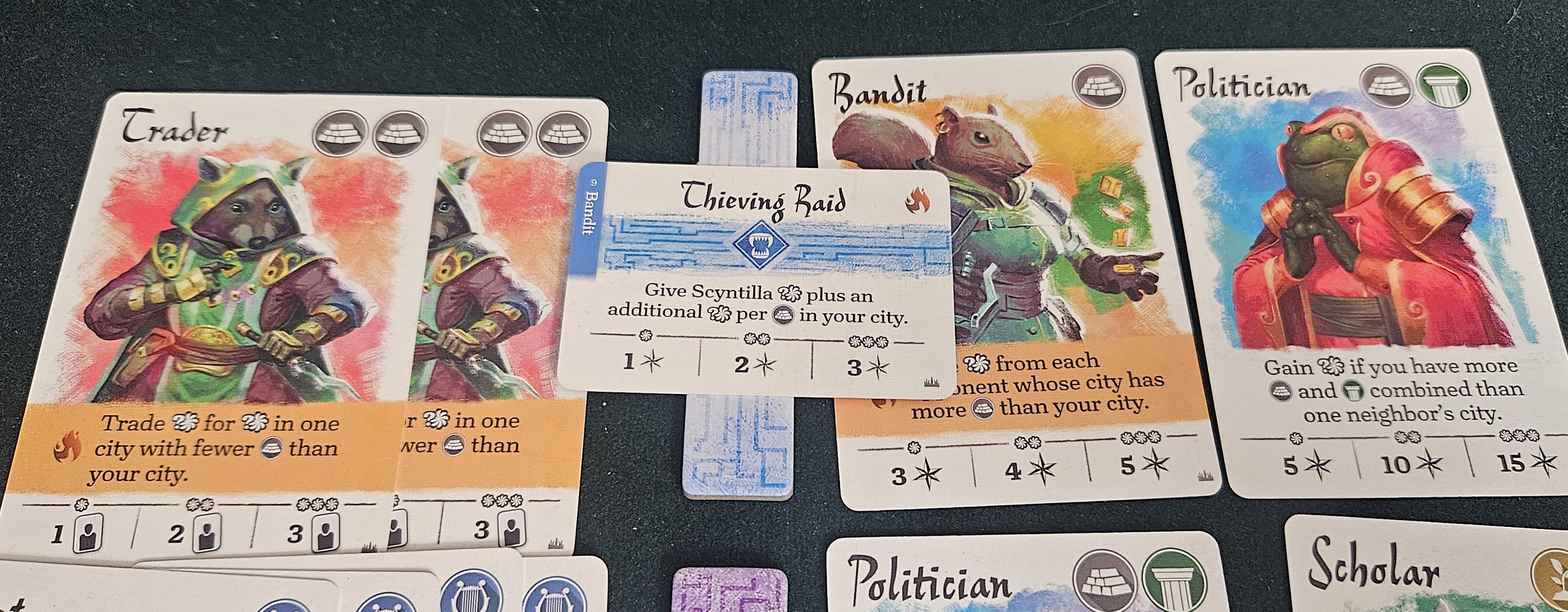
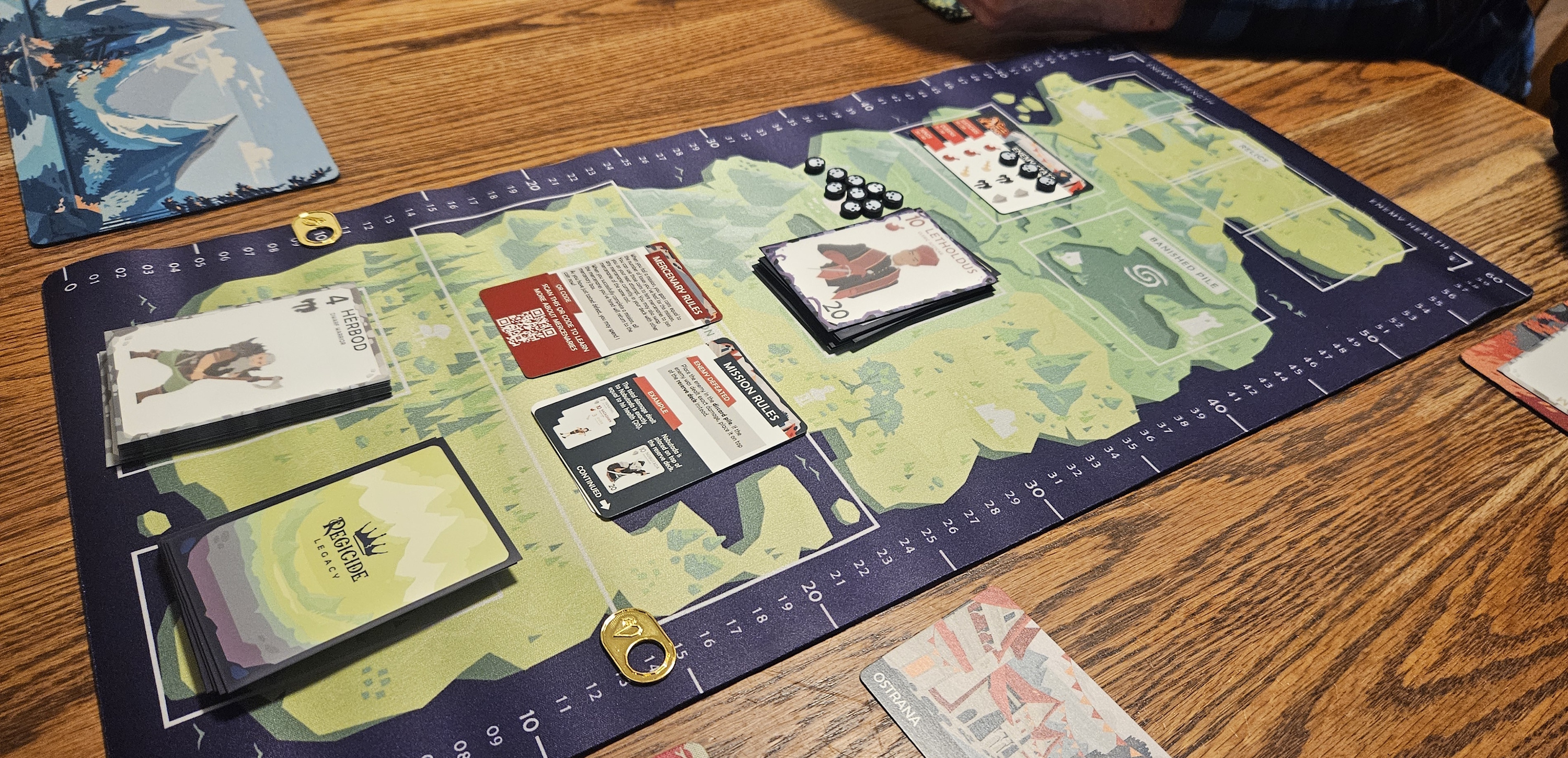
It’s safe to say that The Guerrilla Generation is the wargame I’ve been looking forward to the most since its announcement on the heels of The British Way. Like that title, this is a multipack by Stephen Rangazas, once again using Volko Ruhnke’s COIN System to examine four different conflicts over the course of the 20th century. This time, our destination is Latin America.

And it all begins with a comparatively small urban insurgency in Uruguay.
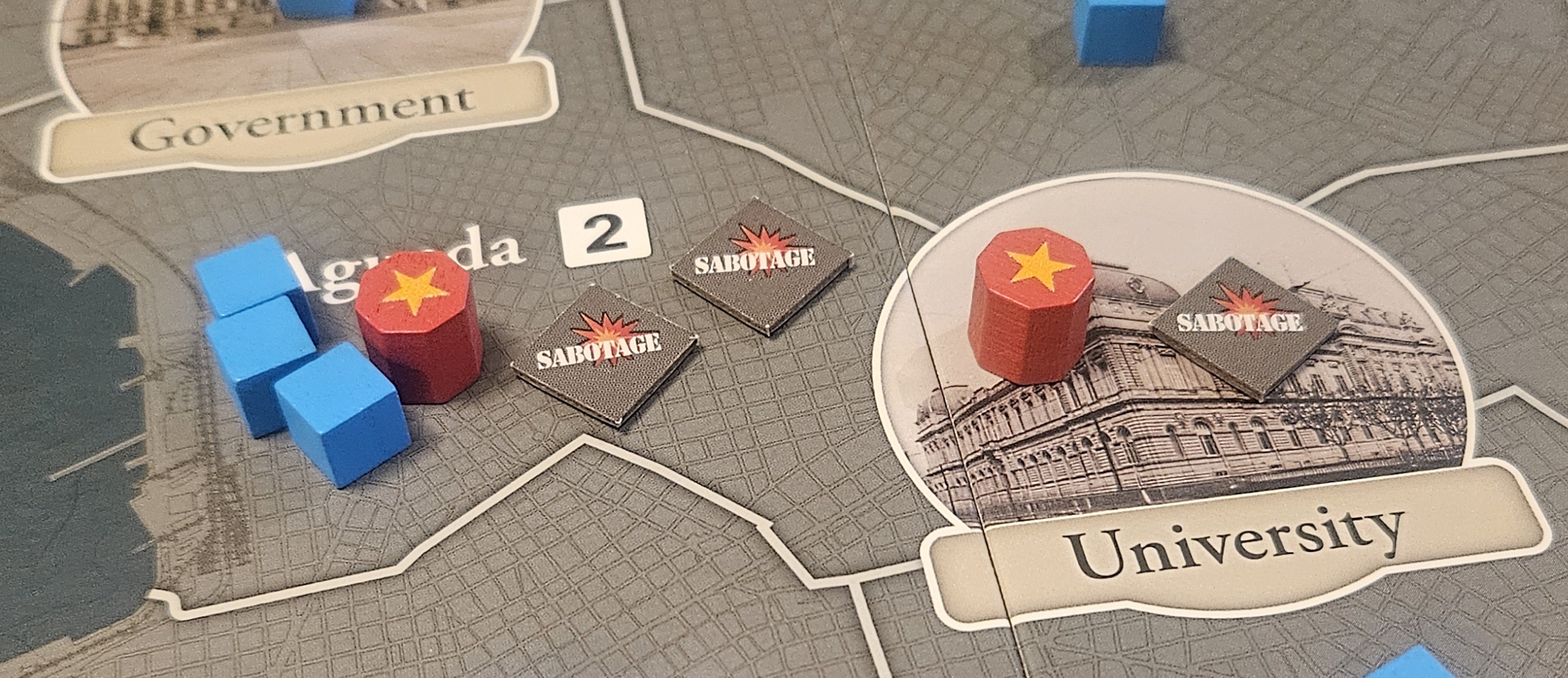
That's me, the red cell, teaching your kids about history and stuff.

Ah, my favorite bastion of Marxist corruption.

If you’ve played even one COIN game before, the basic arrangement of their maps have probably solidified themselves in your mind. There are typically three types of spaces: rural zones, drawn in green or brown depending on the terrain being represented; urban centers, portrayed as gray bubbles where the country’s population is most concentrated; and lines of communication, the highway or rail networks that string everything together.

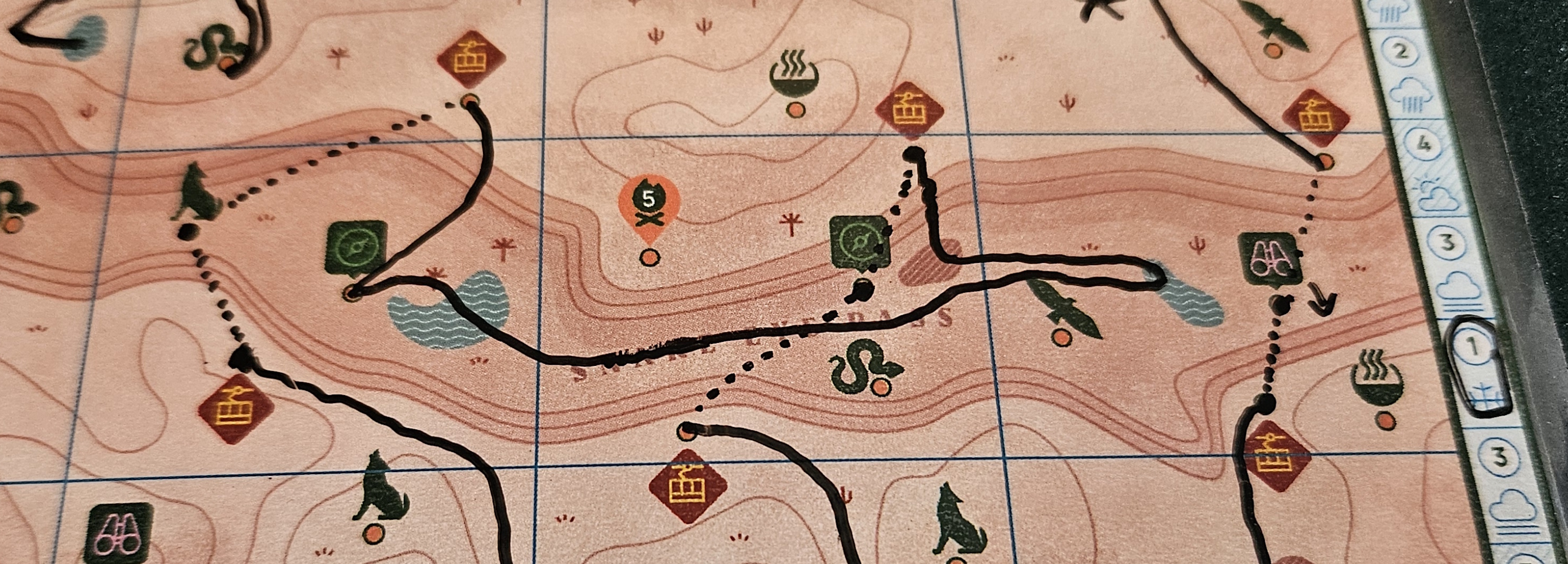
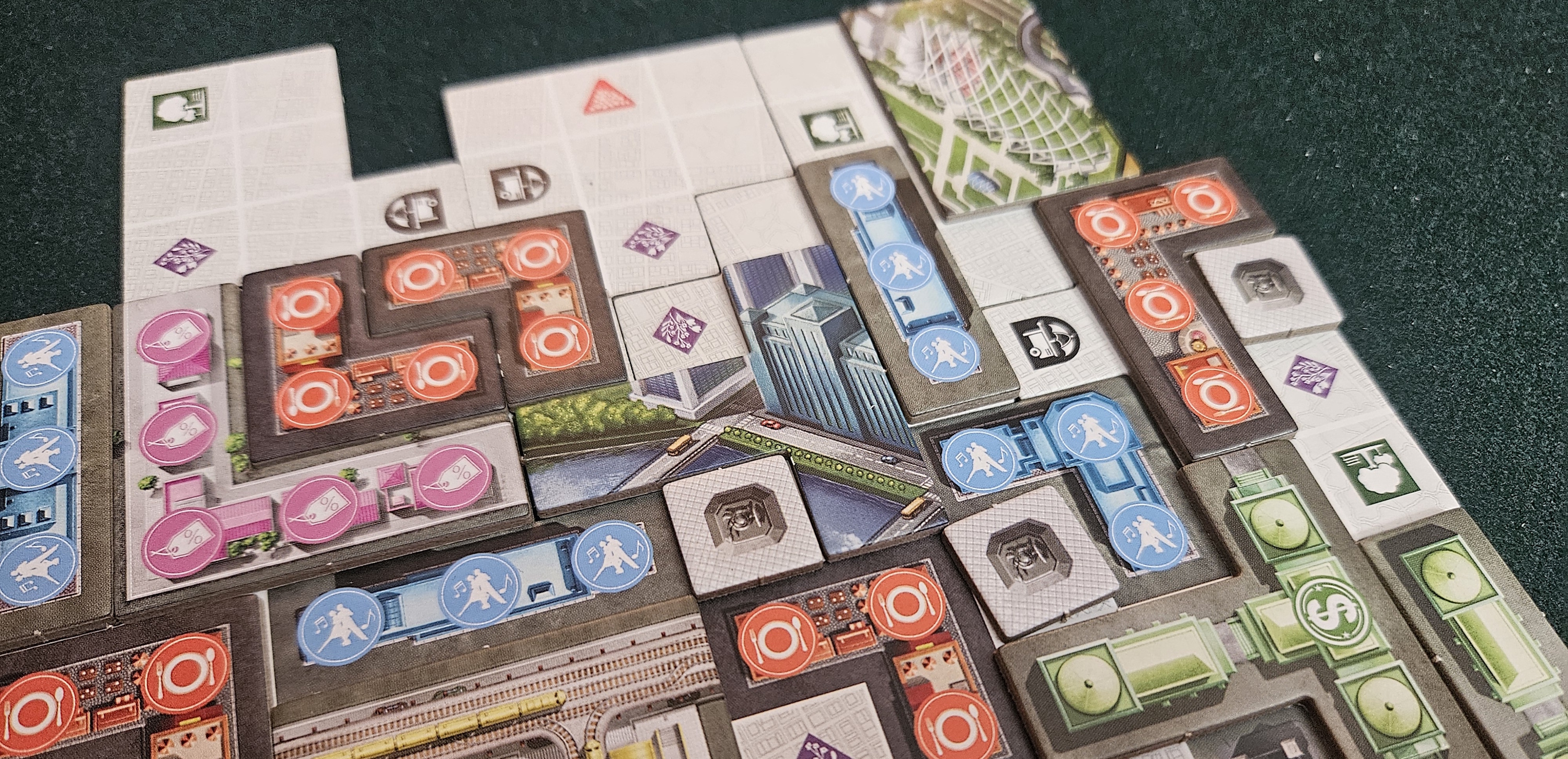
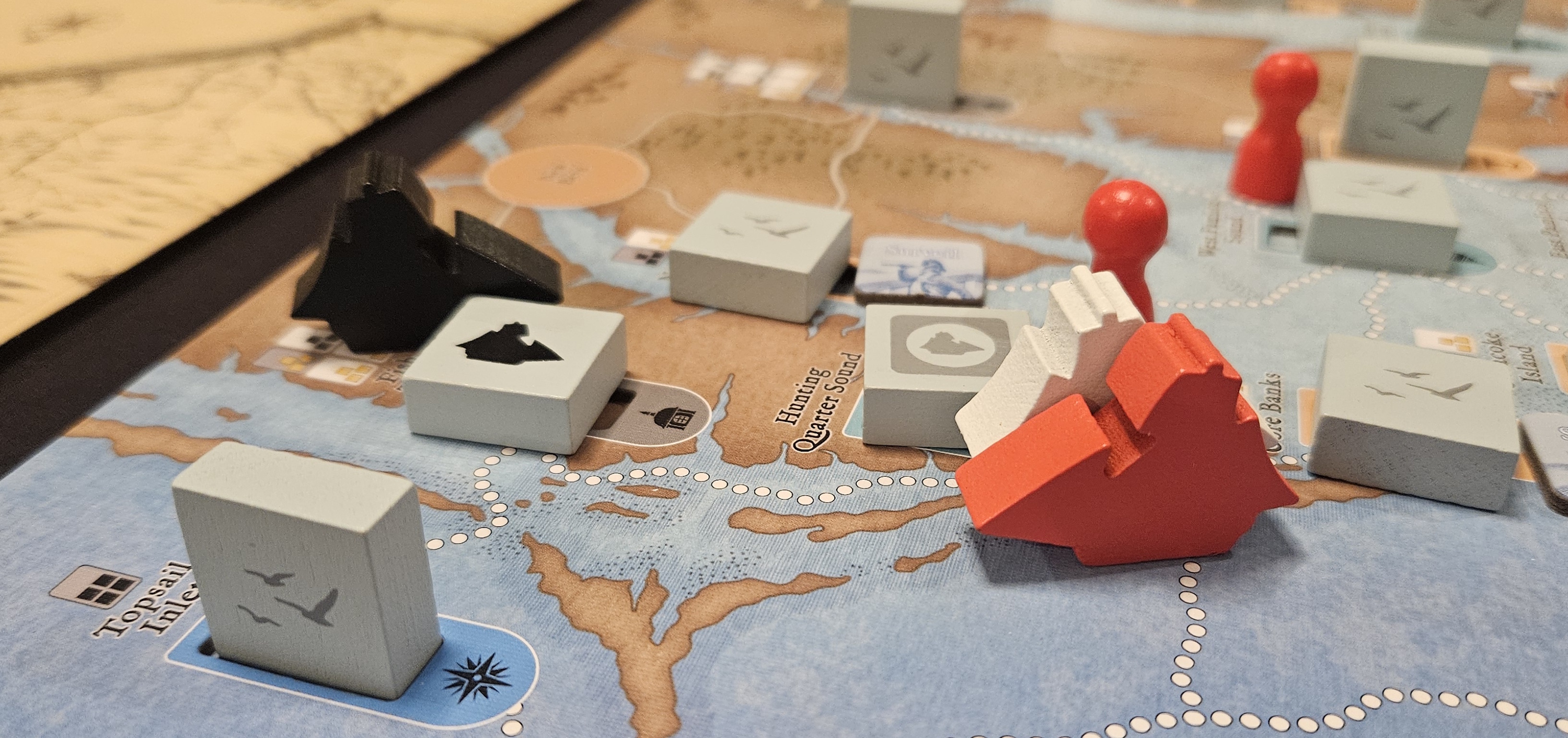
What sets the Uruguay scenario apart from every other map is that it all takes place within one of those concrete-hued bubbles. Unlike most of the insurgencies depicted by the series, this game’s revolutionaries, the Tupamaros, have confined most of their activities to Montevideo. Right away, this presents both advantages and disadvantages. In the former column, there’s no denying that it’s much easier to traverse a single city than an entire country. Acts of sabotage and intimidation take place where their impact will be greatest. The state’s juiciest targets — the armory, the prison, the university — are all right there. It helps, too, that it’s easy to blend in among the million-plus population.

But there are some stark disadvantages as well, and it’s here that Rangazas pulls the system in two contrasting directions. As with The British Way’s anti-colonial movements, The Guerrilla Generation examines how its four insurgencies differed in operation, ideology, and outcome. For their part, the Tupamaros are relatively restrained. This isn’t to say they’re nonviolent, like some Latin American analogue of the Indian National Congress from Gandhi. Installations will still be sabotaged. Key figures will still be kidnapped and held hostage in a roving prison. Soldiers and policemen will still be assassinated. But limiting the insurgency’s activities to Montevideo means there’s less opportunity for the revolutionary fires to fan out of control.

Indeed, that’s one of the core questions asked of the Tupamaros player. Founded in the wake of Fidel Castro’s successful takeover of Cuba — as presented in the second COIN volume, Cuba Libre — the urban nature of the Tupamaros reflected the ideals of their core membership. This was a middle- and upper-class movement, staffed principally with students and tradesmen rather than farmers and day laborers. At the outset, it’s impossible to overlook the lone insurgent cell situated comfortably within the university.

Thus, a tension is presented. Should the Tupamaros confine their activities to their original vision or expand their base? Neither option is perfect. Keeping the message focused restricts the manpower the Tupamaros can bring to bear, a problem that only grows more pressing as increasing numbers of revolutionaries are imprisoned. But the instant the organization expands its recruitment pool, rogue cells might spark violent actions that disgust Montevideo’s populace and sway their sympathies toward the regime. It’s a familiar conundrum for students of revolutionary history, but to my recollection it’s the first time we’ve seen it presented so clearly in the COIN Series.
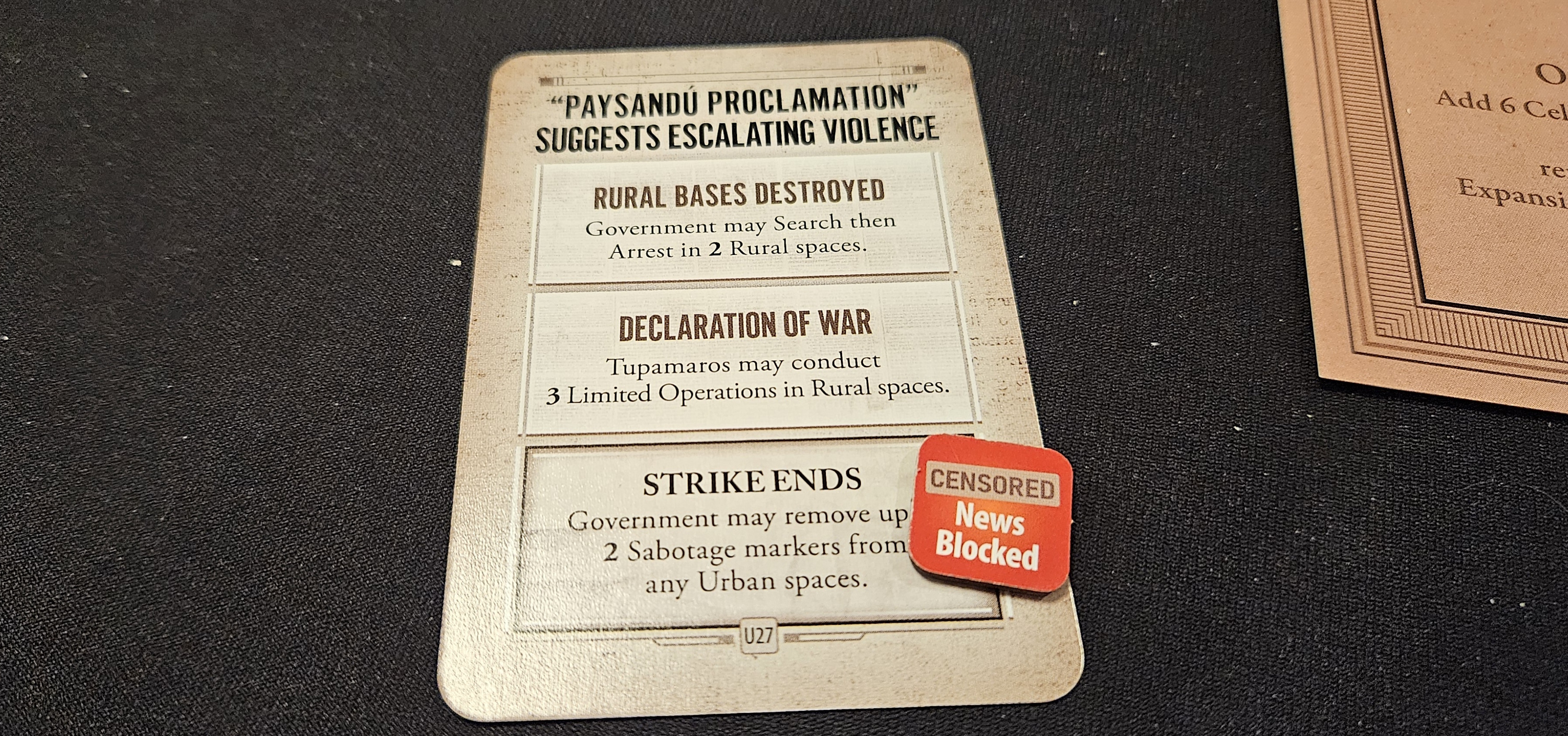
Oppose censorship, kids. (so woke)

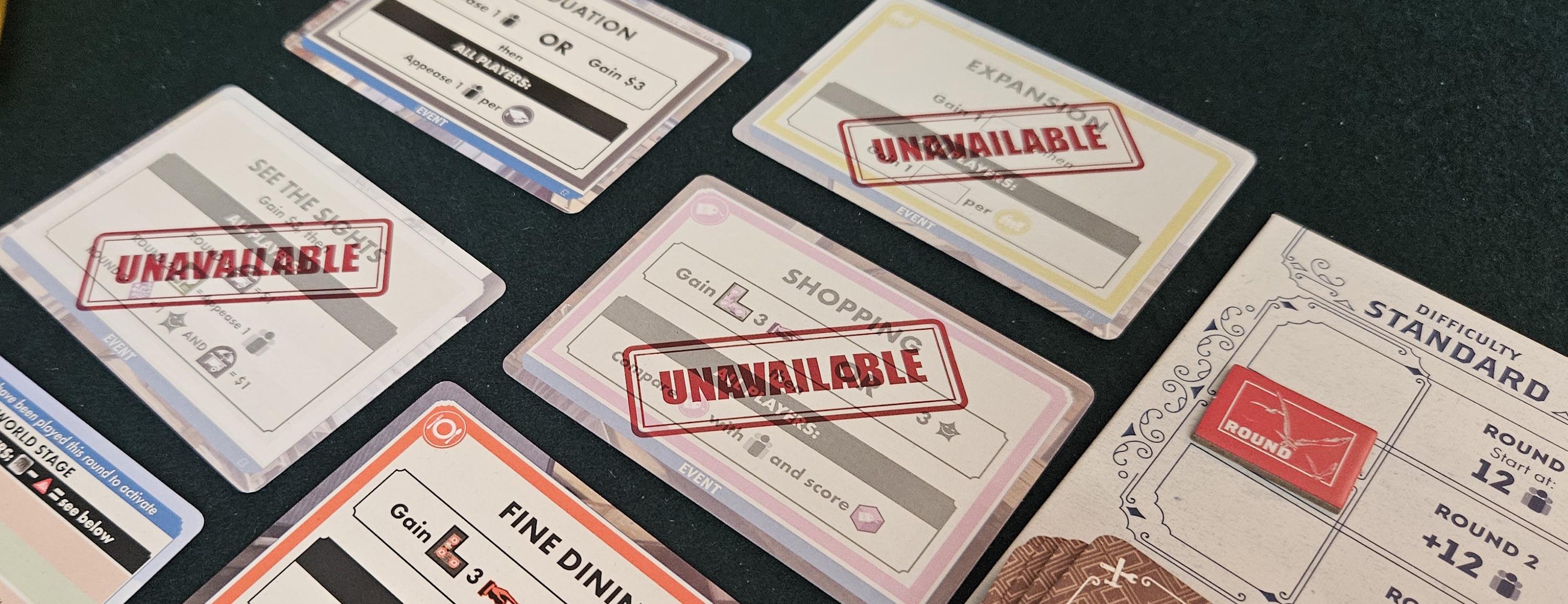
Events pull triple duty this time around.

This is only the first of the small touches that Rangazas deploys to great effect in the Uruguay scenario. The Tupamaros — who, it must be said, receive the module’s most interesting toys — are also the recipients of two other tweaks that speak to their urban nature.

First, supplies. At various points, the Tupamaros draw chits that represent the tools of their trade. Rather than being presented as generic “supplies,” here they’re delineated into distinct types that influence how the Tupamaros operate. Arms, for example, double how many sabotage markers their attacks place on the map, while escape vehicles make it easier to disappear after an operation. These chits are interesting, not to mention a great deal of fun to handle during gameplay, but their real advantage is that they imbue the Tupamaros with a certain materiality that has sometimes gotten lost in the COIN System’s sky-high perspective. Not to go all Marxist on anybody, but the organization’s material conditions inform its practice. (Or “praxis,” if we really want to lean into the forthcoming accusations.) Basically, you’re more likely to jump in guns blazing if you have guns. Or expand your organization if you have a bunch of order chits for bullying around your new recruits. Or lean into hostage-taking if the People’s Prison already has a few high-profile captives under lock and key.

While this gives the Tupamaros an ideological edge that’s missing from many of the more counter-insurgent-focused volumes of the COIN Series, an alteration to the function of the game’s event cards solves a very different issue. At the end of each turn, after both sides have had their chance to act, an event takes place. Not the usual event, the one that might be capitalized upon by either faction, but an unconnected occurrence in the third box at the foot of each card. This represents something happening beyond the reach of either the Tupamaros or the Government. An escape from a women’s prison, perhaps, or a worker’s strike somewhere in the city. (Or, in a subtle piece of humor, the United States Senate might denounce torture in Uruguay after sending advisors to teach proper torture techniques. The outcome of this denunciation: “No effect.”)

This makes the Uruguay scenario the most event-heavy of the COIN titles thus far, but also resolves one of the series’ underlying tensions — namely, the false perception that these particular actors would be all-powerful were it not for their rivals’ meddling. Here, it’s possible for things to occur that are simply beyond your control. Perhaps a new poll will show that the military has high approval ratings. Is that good or bad? Hard to say. It might be rather impactful indeed. Or it might not matter in the slightest. But it’s something that happens without the participation of the game’s factions. They can suppress the news, whether through propaganda or censorship, but either way they are thrust into a world in which they are major actors, but not the only actors.
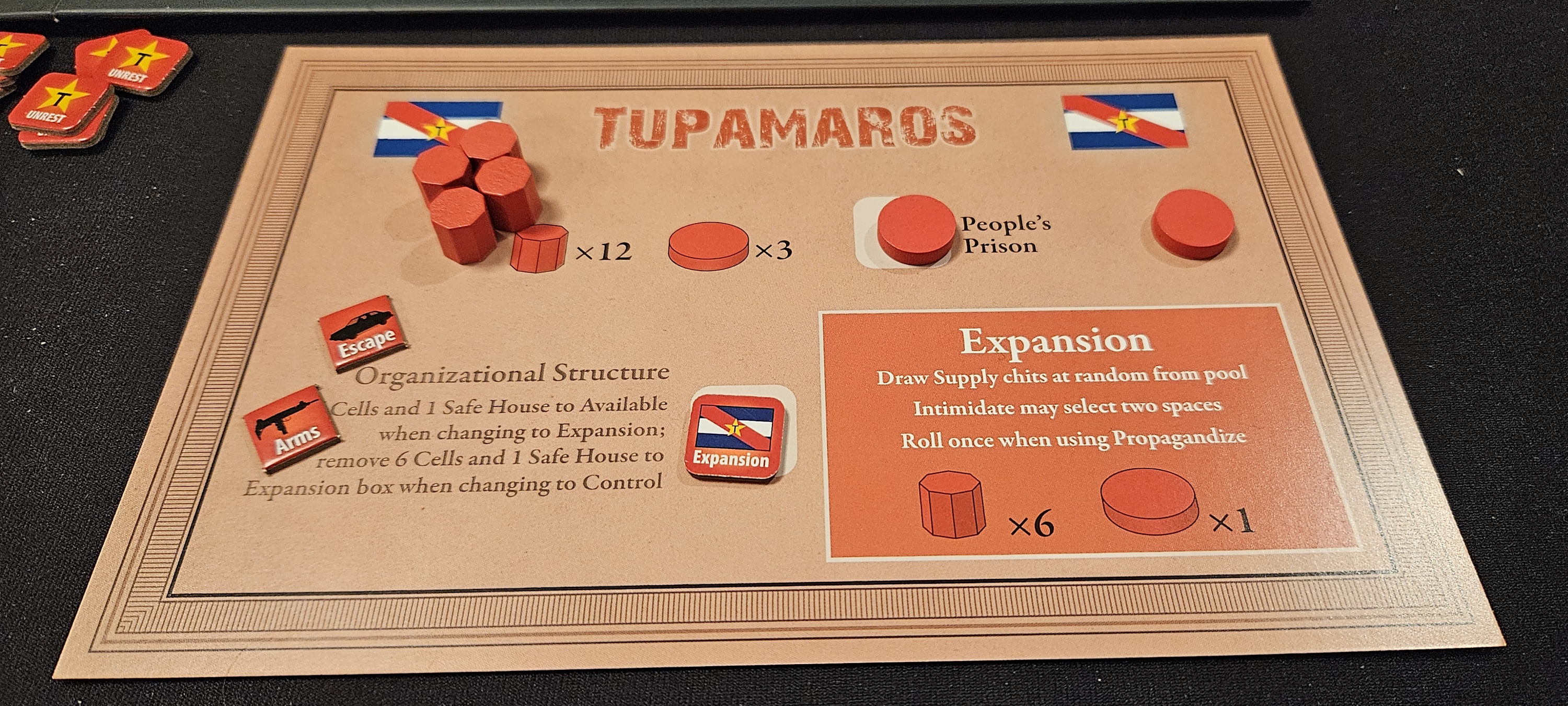
Also, they had a relatively high percentage of female participation in the movement! ... although they weren't great at promoting women, so, uhhh

Guns, cars, hostages… the Tupamaros get all the fun stuff.

For the most part, the Uruguay scenario’s increased resolution suits both the history and the gameplay. The Tupamaros in particular are presented as a lively bunch, if also ill-equipped to effect sweeping change.

But this tighter focus also shows a COIN System straining at its limits. Peculiarities gnaw at the foundations, concessions to balance that are probably necessary to make the game function as intended, but present as artificial constraints on the pieces sitting on the map. Insurgent cells spring across the city at will, while Government police cubes trundle from one district to another. Intel chits pad the Government’s actions, doled out as a result of interrogated prisoners, but the system feels ancillary at worst, and a less enthusiastic version of the Tupamaros’ supply chits at best. I don’t have any strong feelings on the game’s balance, as I’ve seen both factions emerge victorious, but the Government is a drag to play compared to their more freewheeling countrymen.

Fortunately, these quibbles fade alongside the scenario’s grander accomplishments. Historically, the Tupamaros lost the war but won the long-term moral conflict. The Government, pressed to their limit, eventually called in the military to subdue the insurgency. The operation was successful, shattering the organization and holding its ringleaders hostage in squalid conditions for twelve years.

The Guerrilla Generation portrays this turn of events as well. On their own, the Government is unlikely to quell the uprising, especially if the Tupamaros player cleverly manages their supplies and balances their organization’s expansion and control. The Government is therefore presented with the option to call in the military. This bolsters their numbers dramatically, adding darker-hued cubes to the map that are immune to the petty intimidation tactics that have been the insurgents’ stock in trade. Once deployed, it’s almost guaranteed that the military will crush the revolution.

But this sets off a different victory tally. Now the Government is faced with the prospect of a fatal coup d’état. If their legitimacy drops below that of the military, they lose the game outright. In theory, in the moment, this also looks like a Tupamaros failure. Thanks to hindsight, Rangazas presents it as a victory for the underdogs. Yes, the coming years will see civic governance gradually phased out in favor of military rule. Yes, Tupamaros leadership will languish in prison. But eventually military overreach will pave the way for democratic reform and amnesty for the captives. Presumably, such an outcome places the game’s conclusion not in 1973 with the military coup, but in 2010 with the Tupamaro and twelve-year captive José Mujica being sworn in as the country’s 40th constitutional president.
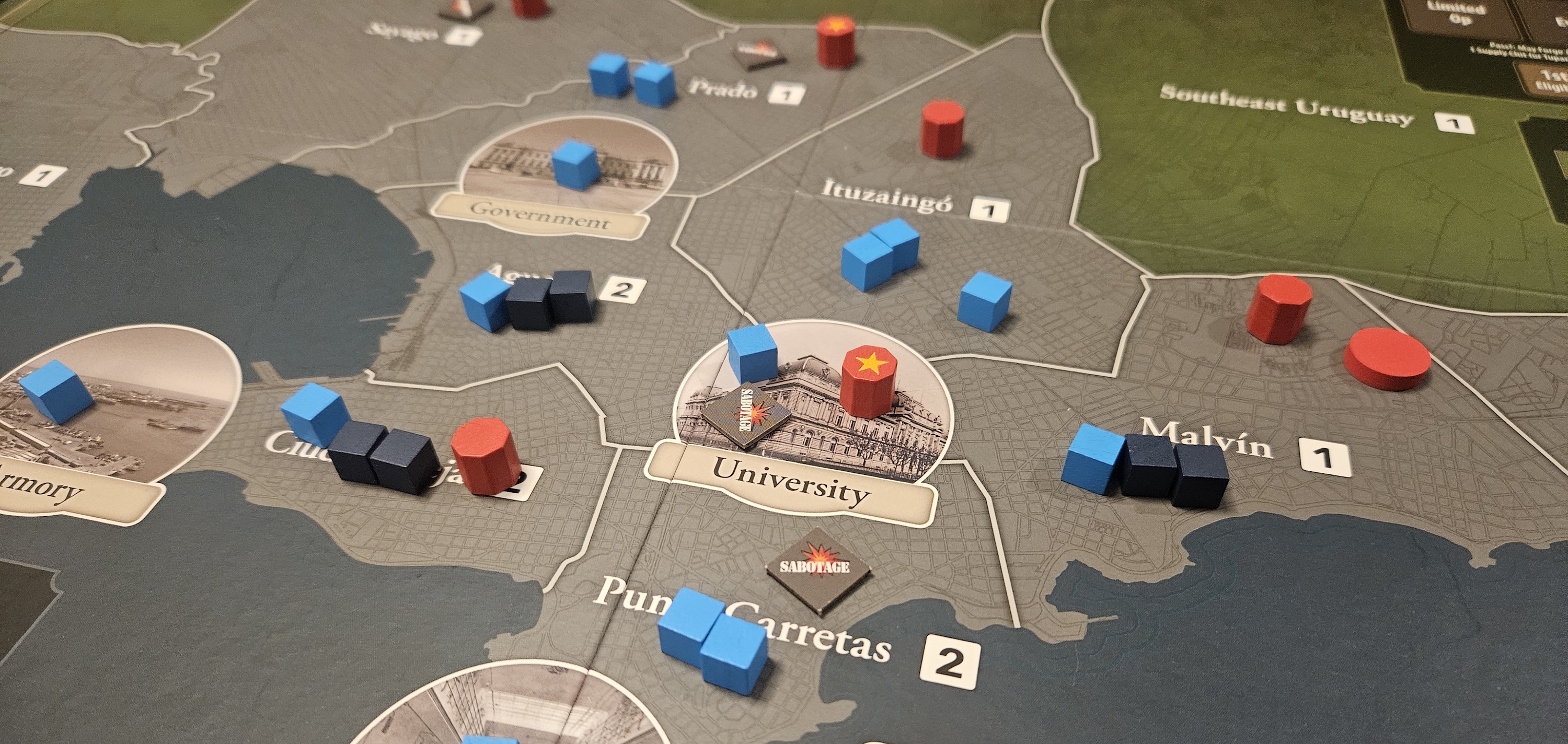
It all depends on when you choose to end the story, I guess.

Deploying the military is likely the death knell of the Uruguayan regime.

There’s a certain reading of this outcome that might regard it as rose-tinted, perhaps even accelerationist in nature. Positioning a victory for the Tupamaros as more or less identical to their abject failure is a stark authorial choice. By no means was the civic-military dictatorship of Uruguay guaranteed to conclude in democratic reform.

Then again, I’d be more sympathetic to such a perspective if events had not, in fact, shaken out that way. All wargames are built on hindsight, through necessity if nothing else, and this is probably as close to true success as the Tupamaros were likely to get.

Either way, Uruguay provides a sterling entry point to The Guerrilla Generation. Its insurgency is a far cry from what we’ve seen from the series thus far, an urban uprising that struggled to obtain broad appeal, but made enough of a nuisance of itself to incite the suicide of the regime it opposed. We’ll see if the next three insurgencies are able to ride the tide of historical chance to similar highs. Spoiler: Don’t get your hopes up.


A complimentary copy of The Guerrilla Generation was provided by the publisher.

(If what I’m doing at Space-Biff! is valuable to you in some way, please consider dropping by my Patreon campaign or Ko-fi. Right now, supporters can read my first-quarter update of 2026: the best board games, movies, books, and more!)


  •  

You Stay in That Television!

As a teenager, I once watched The Ring, then went upstairs to find my little sister with her wet hair draped over her face, seated in front of my computer screen. She just wanted me to comb her hair. I flipped.

All I play anymore is trick-takers.

I don’t play as many trick-takers as I used to.

For the most part, that’s fine by me. Sometimes, too much of a good thing makes for a real tummy ache, and while it’s a rare week that doesn’t see me tackling at least one of the hobby’s elder statesmen, nothing makes a board game quite like a board. I will admit, though, there’s always the siren call of the latest pure tricker. “Come back to the table,” it sings, except in, I dunno, Greek. Calling me. Haunting me.

Dead Channels, for example. This is the latest title by Daniel Newman, whose designs we’ve tussled with once or twice.

I miss old fuzzy televisions. (That's a lie.)

Test signals.

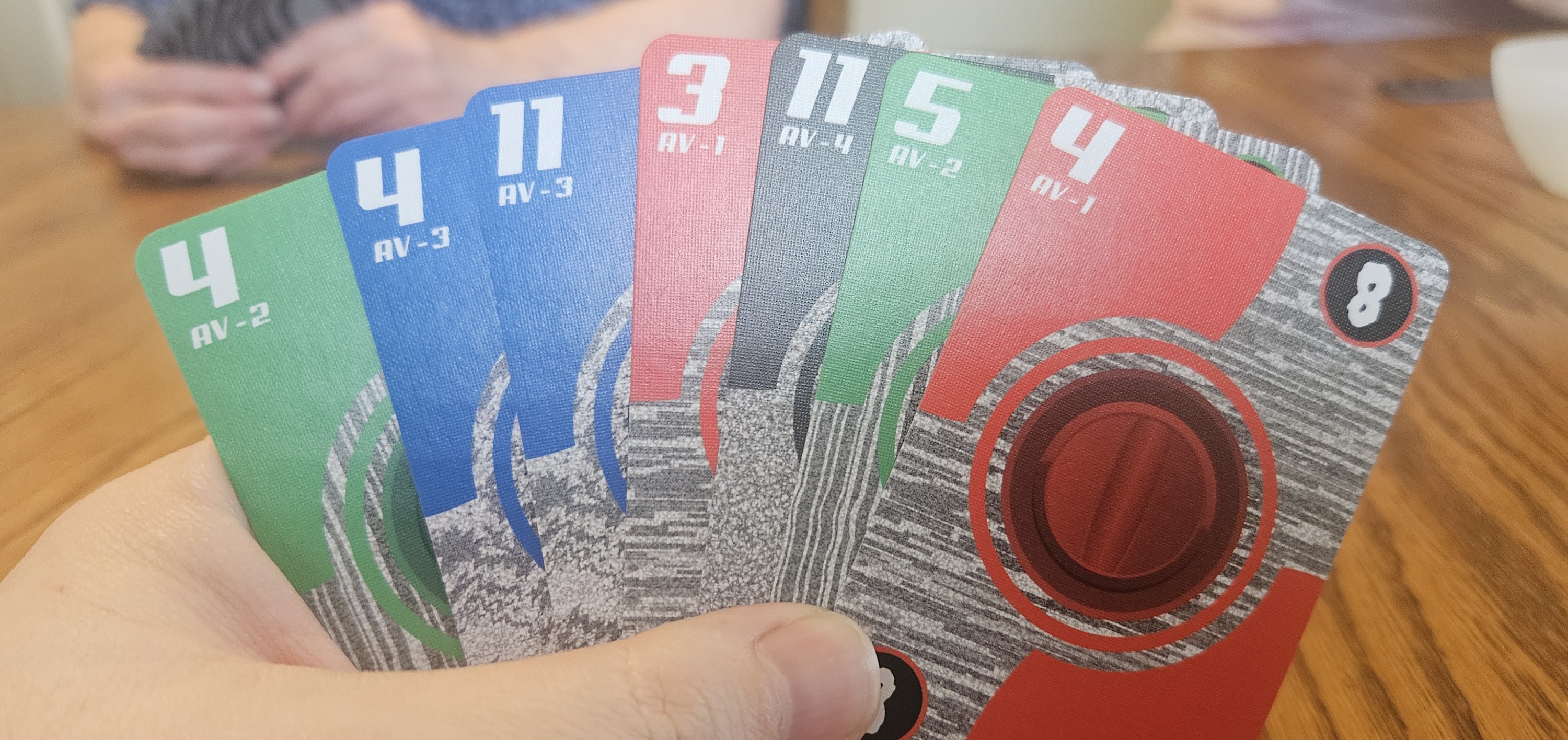
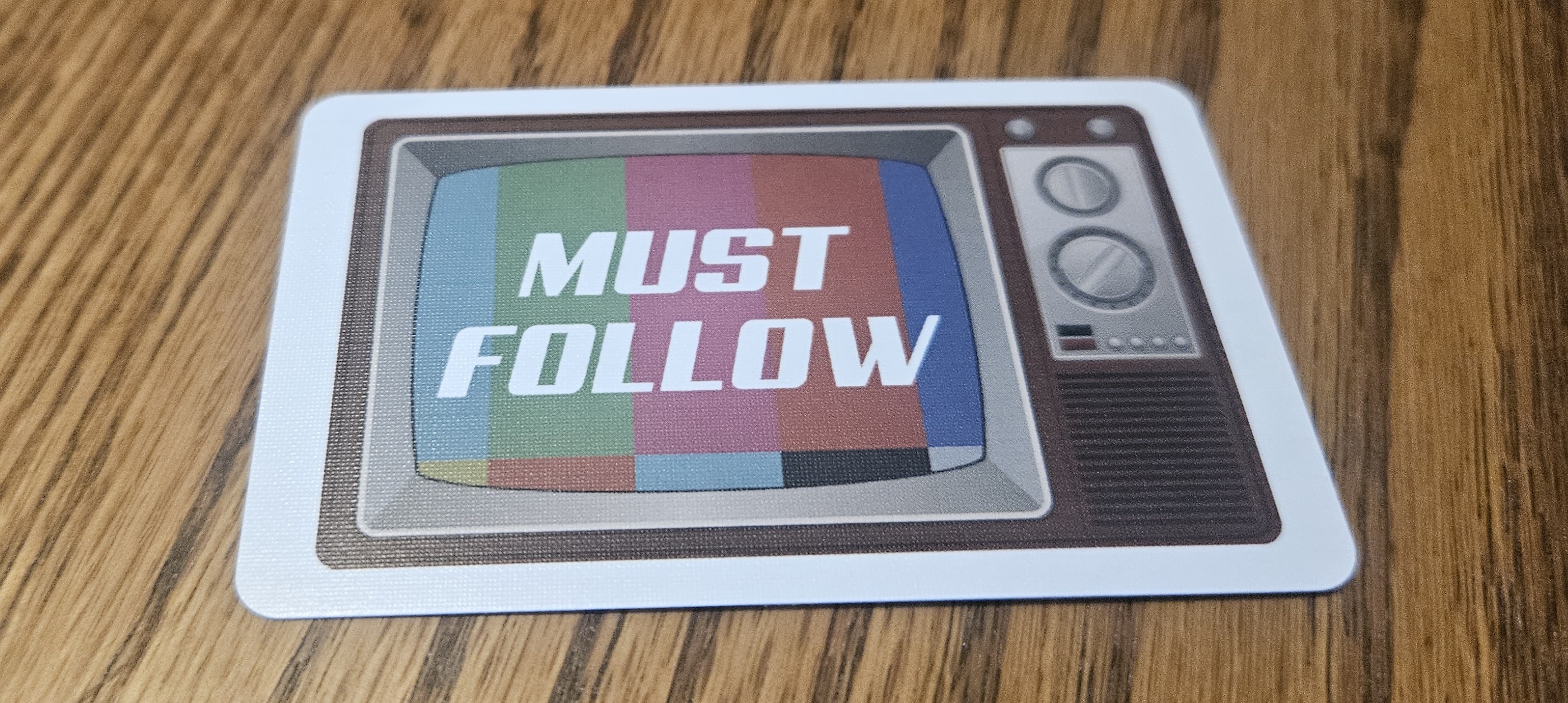
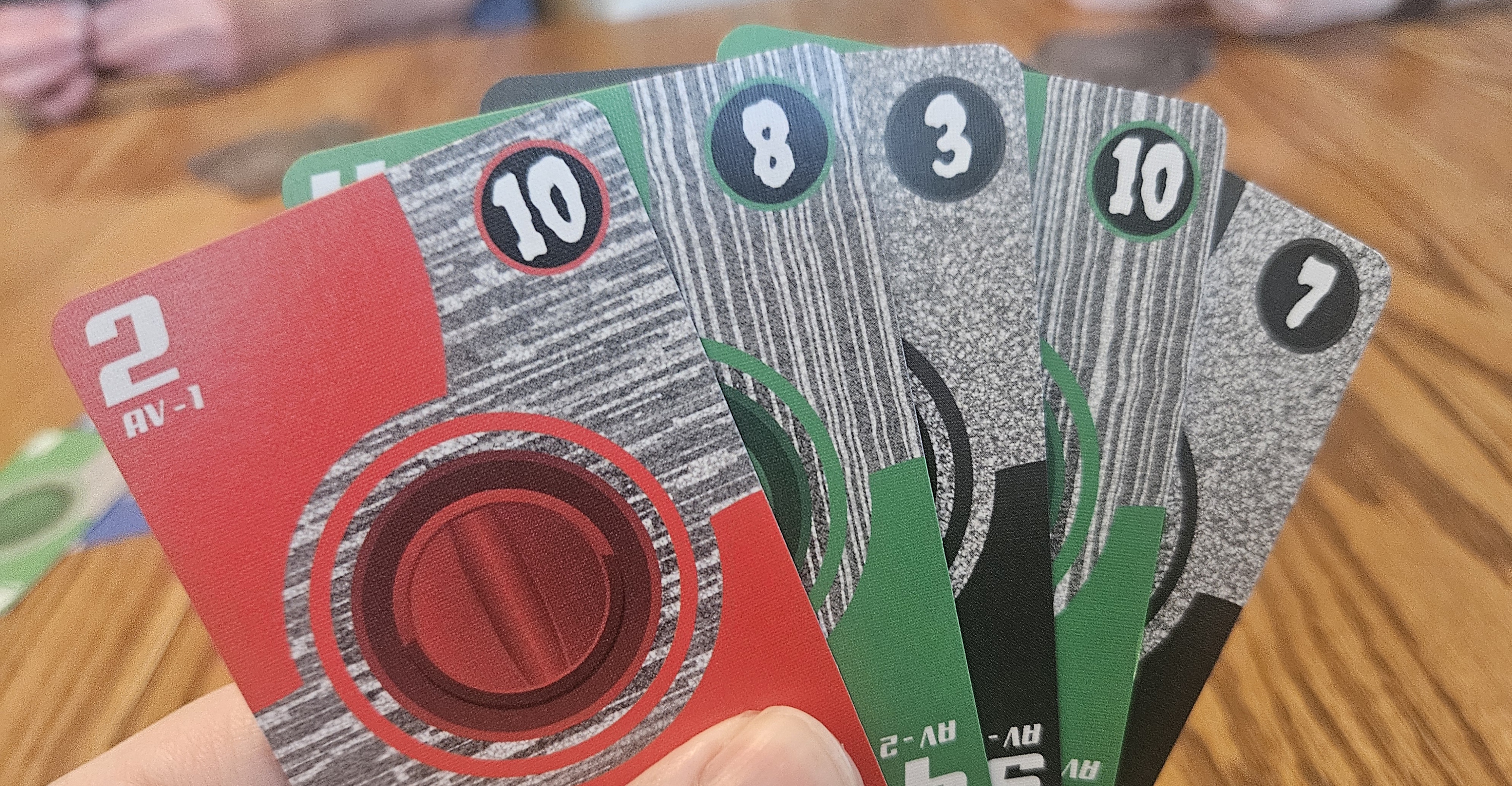
In the fashion of elder trick-takers — modern ones still do this, but older ones too — this is one of those trickers where the designer mines untapped veins from the minutest of changes. The idea is that every card shows two states. One of those states is colorful, like the tuning image you’d get on an old television. The other is fuzzed gray with static. As you play, these states flip back and forth, informing everything about how the hand is played.

This isn’t the first time we’ve seen a trick-taker alternate hand functions. But what sets apart Dead Channels is the way your cards flip from one state to the other. When the channel is tuning, this is an ordinary must-follow trick-taker. If I play red, you have to play red if at all possible. The highest card in the led suit wins. Normal stuff.

But when someone plays off-suit, the game changes. Now everybody splays their cards the other direction and begins playing a must-not-follow game. If I play red, you better not touch the stuff. Only the high card among those that are eligible — as in, non-following — are permitted to win.

Of course, this might also become impossible before too long, forcing us to flip the channel back to tuning, then back to static, and so on until the hand concludes. Flip. Flip. Flip.

Do you think the rising generation will make horror movies about smart TVs? Honestly, my smart TV scares me all the time. At random it will turn on a random mystery channel. I don't know why.

Like some of Newman’s games, Dead Channels feels haunted.

That’s simple enough, but what makes Dead Channels fascinating is that you’re always wrestling against your hand. It would have been easy to overclutter this one, but instead Newman sticks to a simple rubric. You want two tricks. That’s it. Two per player. Naturally, more tricks than that will be awarded, making this a razor-edged proposition. But that’s the idea. If you earn two tricks, you net zero points. For every trick you’re off, whether up or down, you earn a point. Points are bad.

What’s noteworthy about Dead Channels is the way this produces such a well-rounded experience with very little in the way of overhead. I’ll be the first to tell you that trick-takers are a fraught proposition. Between the card counting, goofball terminology (sloughing? really?), and the damoclean threat of contract bidding, this has always been a dense genre, one that’s simple enough on the surface but sharp with gravel once you go more than two inches deep. Dead Channels relies on a little bit of foreknowledge. Like plenty of other trickers, you can explain the rules to veterans with a flurry of jargon. But for the most part it’s as accessible as these things get, devoid of the extra bells and whistles that have been normalized in past years.

Is it the next great thing? The next Schadenfreude? I doubt it has such pretensions. But it’s nice to come back now and then, to see how clever designers are still adjusting the format in small ways that only seem obvious in retrospect. By embracing both must-follow and must-not-follow, Dead Channels effectively becomes two trick-takers in one — although, of course, the challenge lies in how you navigate that liminal space between them, flipping between one mode and the other.

DEMONIC POSSESSION (it's just digital epilepsy)

Static still corresponds to suits. Don’t you see the fuzz lines?

I don’t play nothing but trick-takers these days. But like I say, it’s nice to circle back for a visit. In that sense, Dead Channels feels like coming home for a reunion only to make a new pal instead. Could have gone worse.


A complimentary copy of Dead Channels was provided by the designer/publisher.

(If what I’m doing at Space-Biff! is valuable to you in some way, please consider dropping by my Patreon campaign or Ko-fi. Right now, supporters can read my first-quarter update of 2026: the best board games, movies, books, and more!)
  •  

Colossissippi

The title of this review was provided by Dr. Mike Handsome, M.D., in response to my dissatisfaction with blended Greek/Latin words.

Despite being the creation of John Rudolph Drexler, Colossi reminds me of an early John Clowdus design. At really every point, come to think of it. There’s the shape of the thing: a lane-battler packed with powerful abilities that constantly reform its contests into new shapes. Or its illustrations, here produced by Sean Thurlow, but not all that distant from the brushstrokes that fill Omen: A Reign of War. The form factor is also approximate; the box isn’t tiny, but it isn’t much larger than Omen’s second edition. Even the game’s willingness to surprise feels redolent of one of our hobby’s under-celebrated innovators.

If I wasn’t sufficiently clear, this should be taken as an enormous compliment. Colossi has a few shortcomings — another parallel with certain Clowdus titles — but it’s such a gust of fresh air that I dearly hope Drexler has a few more in the chamber.

It's not the game's fault that three is the perfect number of lanes.

Three lanes.

As mentioned, Colossi is a lane-battler. Through blurred eyes, it might even seem overly familiar. Players are presented with three lanes at any given time, each host to an existential battle. Yawn, am I right?

Except it takes all of five seconds before Colossi drops its own beat. The first riff is that it handles up to four players, and every count is as smooth as the others. The second is that each lane is strikingly different from those to its right or left. This is thanks to the way Drexler builds out each one via a combination of an environment and up to three items.

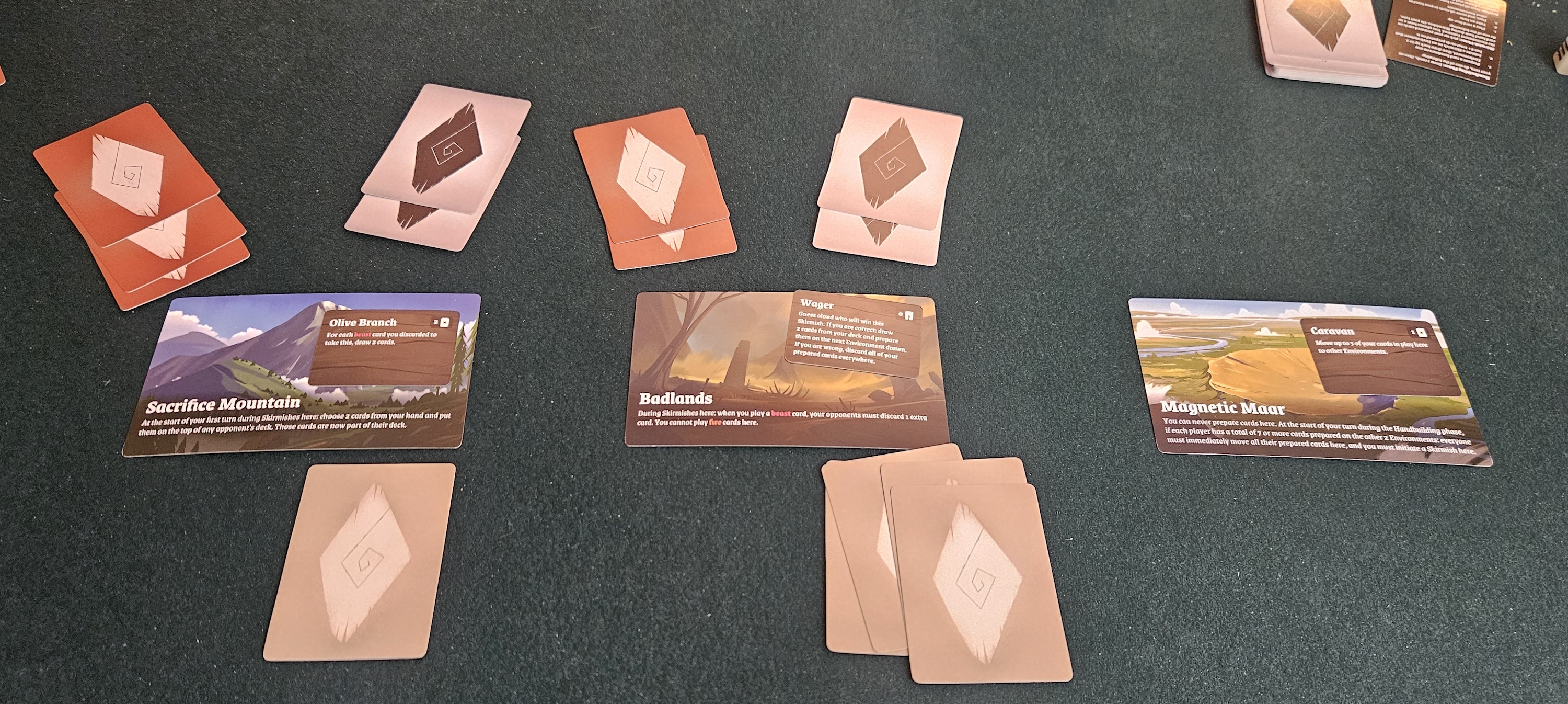
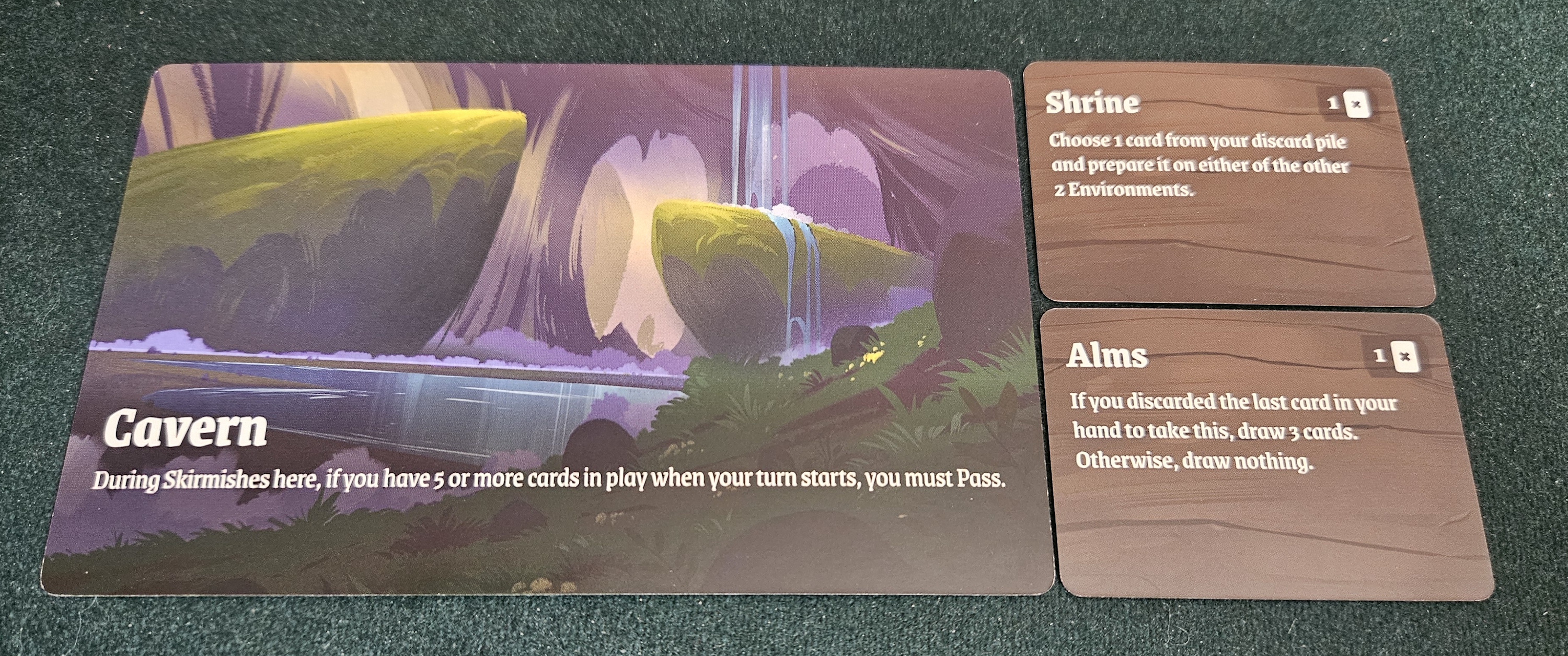
The former, environments, are the game’s main objective. Win three of them and you’re declared the victor. In addition to that, each one is entirely unique. Some are simple enough, like the Desert, which prohibits water cards from being played into its lane. Others are more transformative, like the Impulse Isle, which turns the usual phased play — one card per player at a time, around and around until everybody passes — into massive plays that have each player deploy every card and ability at once before passing to their neighbor. Or the Chaos Fissure, where everybody is required to prepare an equal number of cards, shuffle them together, and then deal them at random to all participants. Or the Magnetic Maar, a zone where preparing cards is strictly forbidden, forcing players to get creative in order to secure it.

Those last two environments won’t make sense without some explanation. Cardplay in Colossi is broken into two separate but interconnected phases. First, players prepare cards by seeding them face-down into those three lanes. Once an environment meets a threshold of cards, somebody is allowed to trigger a battle there. The game then shifts into its second phase. Everybody adds the cards they’ve prepped in that lane to their hand and then duke it out for control of that single environment. Once that battle is dusted, a new environment is added to the gap and the game returns to the preparation phase.

Back and forth it goes. Preparation, preparation, preparation, preparation, HUGE BATTLE, preparation, preparation, HUGE BATTLE, preparation, preparation…

And some nice art! I too would try to conquer this cavern.

Each lane features both an environment and one to three items.

Along the way, Drexler shows off a number of small touches that elevate Colossi from a good idea to an impressive execution. I mentioned items. Each environment hosts one to three of the things, depending on how far the game has progressed. Rather than deploying a card into a battle, you’re allowed to discard something from your hand to claim these babies. Like the larger environments, they’re transformative in their own right, adding perks or adjusting the parameters of the current fight.

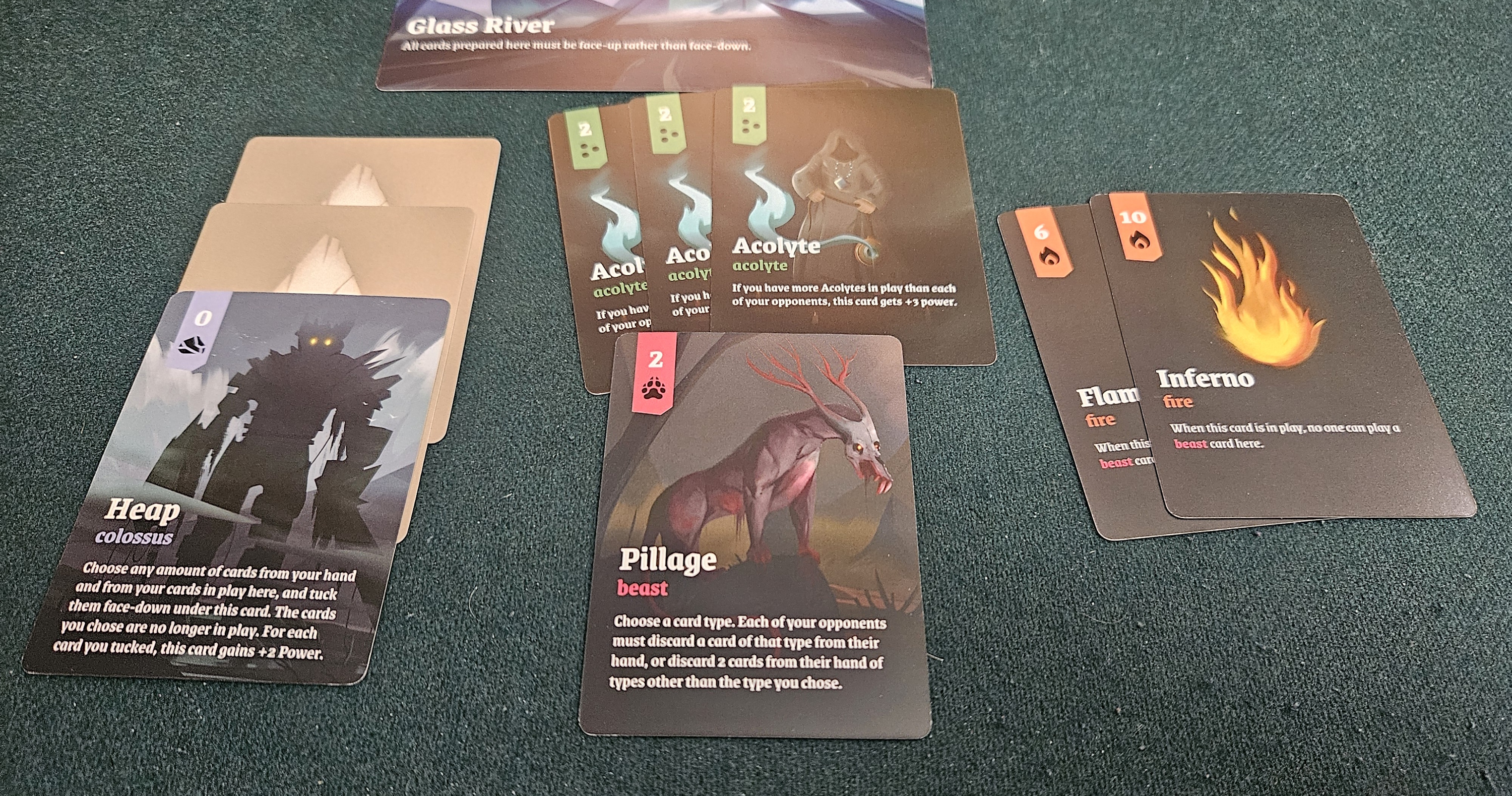
Of course, none of this would spark to life without the right selection of powers. Here Colossi flexes a more familiar muscle to fans of the genre, starting everyone off with an identical deck of twenty-four cards that deforms as the session progresses. First-timers may find the selection intimidating at first, especially since the myriad types cancel or boost one another like a seven-pronged Roshambo. Divine Gifts add more cards to your hand. Electricity makes Divine Gifts more expensive to play and is empowered by Water. Fire is powerful and blocks Beasts, but gets nerfed by Water. Beasts mess with rival hands, while Colossi do… all sorts of things. Acolytes grow stronger in bulk.

Your cards, meanwhile, aren’t necessarily going to stay your cards for very long. One of the Colossi, the Curse, wanders over to the opposing side of battle to decrease their strength. Then, like a kid deciding it prefers its neighbor’s house, it sticks around afterward, filling up their deck with a card they probably don’t want. One of the Beasts abducts a rival card into your deck, potentially stealing their best cards outright.

Over the course of a half-dozen or so battles, this gives each deck its own topography. One player becomes weak with Fire, and therefore vulnerable to Beasts, but finds a way to use their multiple Colossi to swing fights their way. Another gains so many Acolytes that their hand becomes a cultist’s paradise, winning through sheer manpower. A third starts lighting everything on Fire and hoping nobody has the necessary bulk of Water cards to douse the flames.

The result is as subtle as it is brash, especially once the table remembers that the battles are just, well, battles. The bigger picture, the war, is what matters here. It’s easy to lose sight of that, especially in the midst of a drawn-out fight. Often, it’s smarter to bait an opponent into using too many cards, then withdraw to other environments for a jump start on the fight that will soon engulf them as well. But why play it smart when you have a one-in-ten chance to draw exactly the card you need in order to swing this thing?

I think I lost this one.

Battles can turn into real pile-ups.

Sure, I have quibbles. Some battles get too summy for their own good, especially once Water starts fudging the value of Fire and Electricity. Certain environments have obnoxious or burdensome effects. Similarly, some of the powers are touch-and-go, especially those that allow someone to draw extra cards in the middle of a fight. Then again, the little imbalances between suits are also what make the game formidable. When somebody drops their Inferno card, everybody notices.

On the whole, Colossi is a superb debut. It’s hard-hitting, vicious, subtle, and so much cleverer than it seems at first glance. More than that, it produces a heretofore unseen take on the lane-battler, one that goes beyond the usual trappings to prove itself a new creature indeed. No — a new colossus.


A complimentary copy of Colossi was provided by the designer/publisher.

(If what I’m doing at Space-Biff! is valuable to you in some way, please consider dropping by my Patreon campaign or Ko-fi. Right now, supporters can read my first-quarter update of 2026: the best board games, movies, books, and more!)
  •  

Scribbly Koalas

Weird bugs of Australia, the board game. "KOALAS AREN'T BUGS." Nah, pretty sure they are.

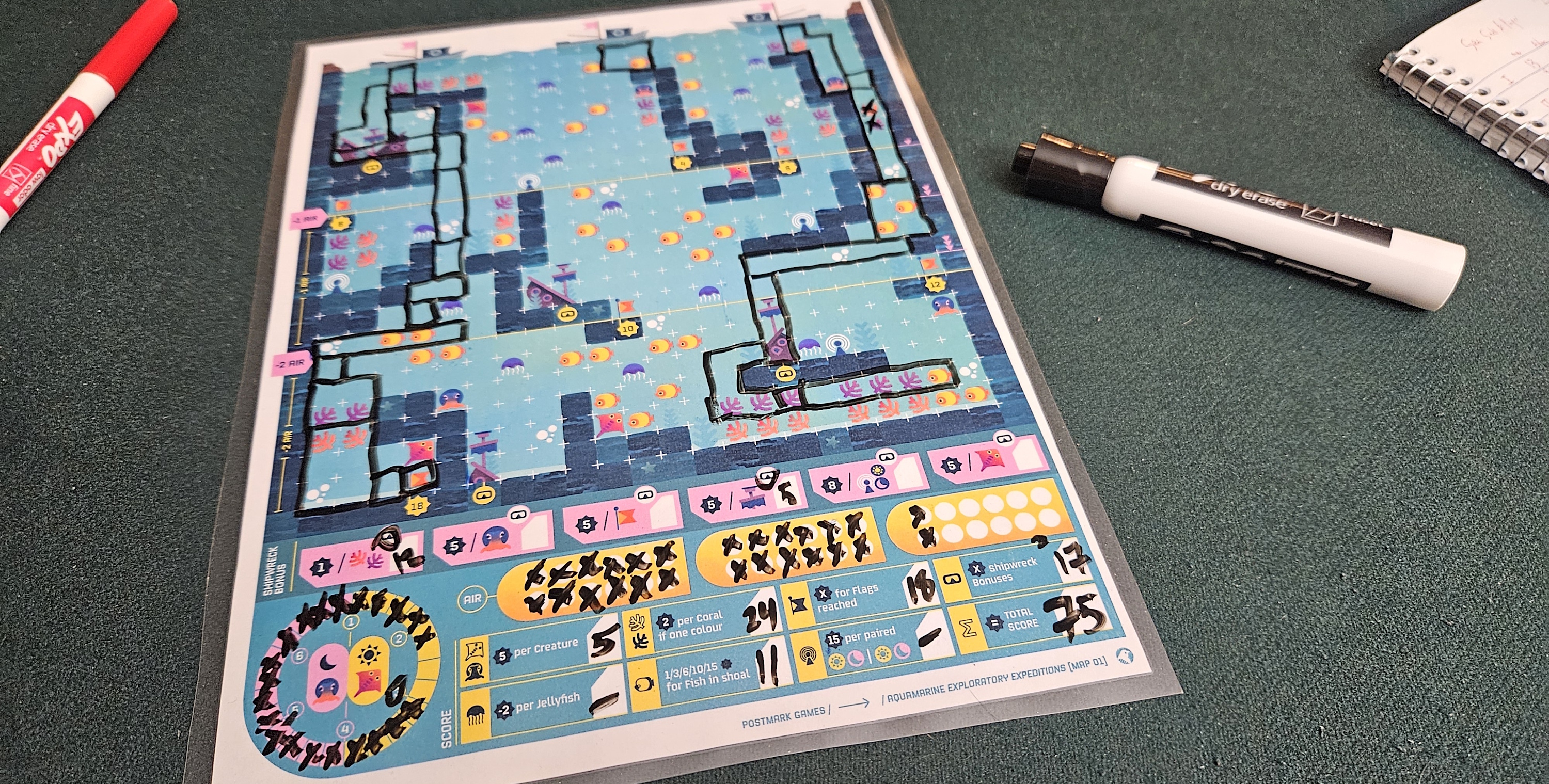
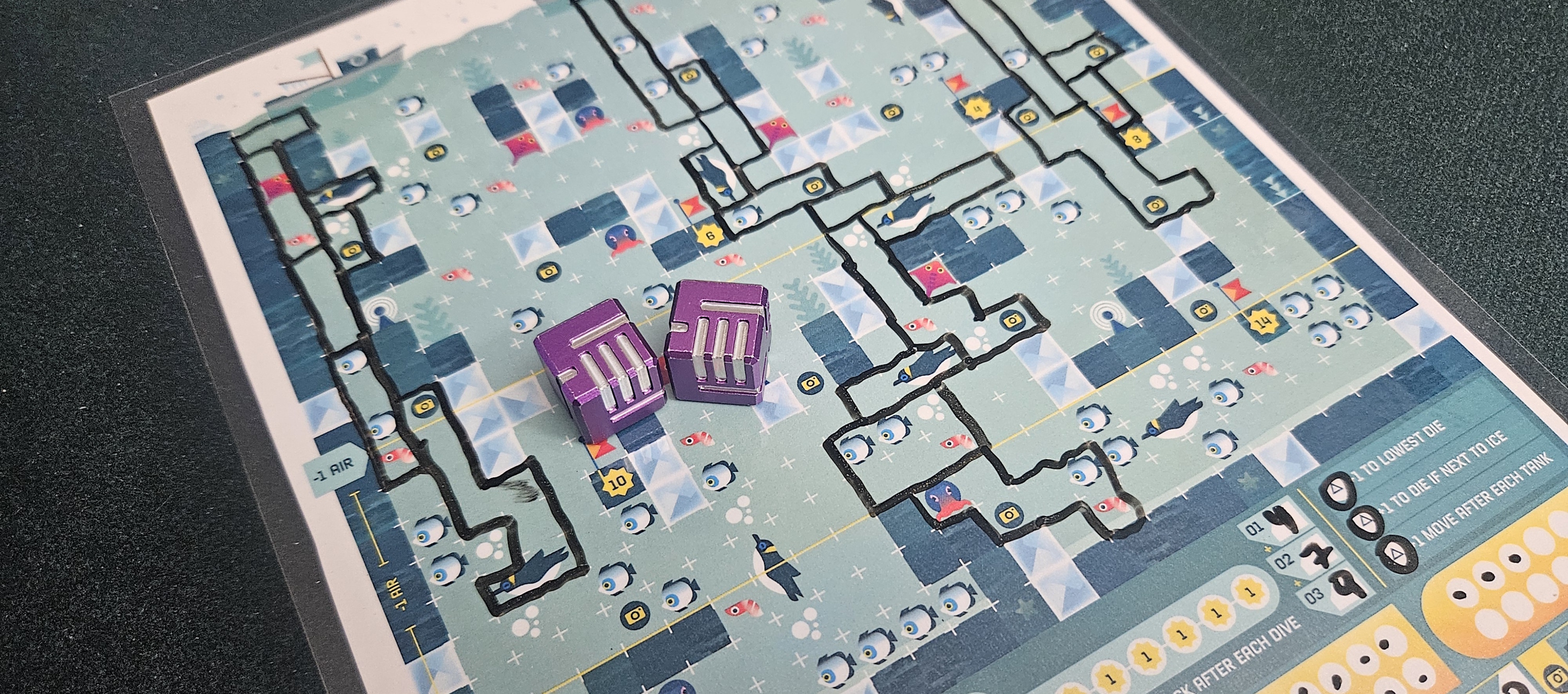
My odyssey through Postmark’s catalog of single-sheet print-and-play games continues. This week’s titles are none other than Scribbly Gum and Koala Rescue Club, both designed and illustrated by Phil and Meredith Walker-Harding.

You can tell we’ve reached the really good games when I’m covering them two at a time. Although this makes for a good twist, because one of them is pretty dang solid. For babies. I mean that in a good way.

As you can see, my twelve-year-old is better at marking a sheet than her old dad.

Scribbles!

Scribbly Gum

For those of us who slept through botany class — huh? this school offers botany? — Scribbly Gum refers to the Eucalyptus haemastoma tree, whose colloquial name is derived from the lovely “scribbles” left behind by the chewing of the Ogmograptis moth in its larval stage. In this one, you’re chewing this way and that through the tree’s soft bark to secure meals that will permit you to grow from non-lepidopterophobia-triggering larvae into the Ogmograptis‘s hideous adult form.

The concept couldn’t be simpler. You roll two dice, then choose one of the results to permit movement. The rubric is straightforward. A roll of one lets you move up, two moves you down. Three and four correspond to left and right. Five, meanwhile, lets you follow a rare dotted line, usually forging a shortcut. Sixes are dead rolls, but don’t worry about rolling two of the things, because any double is a wild move that lets you go anywhere.

Turns, then, consist of rolling dice, choosing a direction to move, and securing the nut, blossom, leaf, or water in the space you just reached. Little by little, you spread across the page, leaving behind cutesy scribbles.

There’s a little more to it than that, but not by much. Certain spaces on the food track permit extra moves, and there are optional scoring bonuses for meeting little thresholds. These vary by map, but they usually conform to “eat a certain number of blossoms” or “chew up every space on the left side of the sheet.” It’s simple stuff. Baby’s first roll-and-write.

Dang it, kiddo.

Even more scribbles!

That might sound like faint praise, but when I used Scribbly Gum in its intended fashion by plopping it in front of my twelve-year-old, she was so charmed that we played all four maps in a single sitting.

Now, she isn’t quite a baby, and this isn’t her first time around the block. She’s played a few games of this ilk before. Paper Dungeons is a favorite, and her official review of Flip Pick Towers was “It’s like Paper Dungeons but not as good.” Reasonable marks coming from her.

But Scribbly Gum caught on because its rules are so darn simple that they get out of the way almost immediately. Which in my daughter’s case, meant she could get down to the serious business of triggering free actions with alarming frequency. Oh, and making her scribbles nice and cute.

This is a minor offering from Postmark, especially compared to its opening trio by Rory Muldoon and Matthew Dunstan. But it’s a pleasant minor offering, a gentle experience that doesn’t burn brains or exclude the little ones. While I’d rather tackle the seas, whether above or below, or a scenic hike, it wasn’t as though I begrudged my time in the presence of these squirmy art-bugs.

Those koalas, on the other hand…

brrr, they're even worse than moths

Saving some horrible koalas.

Koala Rescue Club

Koalas are horrible creatures, their natural cuteness belying some truly awful biological processes that I shan’t elaborate here. Koala Rescue Club dresses you into the high-visibility vest of a volunteer planting eucalyptus trees and rehoming the little guys, which would be a wonderful objective if the game weren’t so dull.

This is, once again, a game that opens each turn with a rolled die, although here that roll signifies which shape you can place on your sheet. It’s polyomino placement, in a sense, with the caveat that you’re really placing each shape twice. Once for the trees, another time for the koalas who will dozily munch their leaves. This results in tidy rows of circles: a big one for the tree itself, a smaller one within the tree for the koala.

As with Scribbly Gum, there are bonuses to be chased. Filling a column or row with koalas awards a perk. Extra trees and koalas are the norm, useful for filling in spaces earlier left blank. Volunteers allow you to adjust the value of the roll. Skybridges travel across the road to neighboring eucalyptus groves. And koala hospitals earn points. Or in the later maps, trigger bonuses of their own. Optional merit badges offer a few extra points for, say, planting all the trees in Grove C or building all the skybridges.

Especially when printed in color. For those of us with crappy printers shackled to the ink cartels, low-ink versions are much appreciated.

Like all of Postmark’s productions, it does look nice.

Koala Rescue Club is suitably cute, but the problem is that it isn’t very interesting. In the opening turns, before you have volunteers for adjusting rolls or extra groves for placing any larger shapes that won’t fit among your starting trees, you’re more or less beholden to the roll of a single die. This makes the early stages listless, like one of those games where everybody takes a matching move in the opening turn or two.

Affairs improve as more options are unlocked, but not so much that it often feels like you’re being confronted with hard tradeoffs. The shapes are so simple that matching them into a space is generally a trivial task. The merit badges are unexciting and nearly always repeat themselves. Even the possibility that this might be used as an educational game is somewhat let down by the two-layered shape placement. Where Scribbly Gum could pass for baby’s first roll-and-write, I harbor doubts about Koala Rescue Club.

The upside, I suppose, is that in solitaire it’s a nice enough way to kill a few minutes. Unlike most of the Postmark catalog, where the solitaire mode comes across as an afterthought, here it seems like the right way to play. Maybe that’s because my twelve-year-old declared it boring after one play and insisted we tackle Scribbly Gum again. Still, my few solitaire sessions were markedly more enjoyable than watching her put her head down on ink-marked plexiglass.

In other words, Koala Rescue Club needed rescuing. But who rescues the koala rescuers? I dunno. I just needed an outro.


Access to the files to print Scribbly Gum and Koala Rescue Club was provided by the publisher.

(If what I’m doing at Space-Biff! is valuable to you in some way, please consider dropping by my Patreon campaign or Ko-fi. Right now, supporters can read my first-quarter update of 2026: the best board games, movies, books, and more!)
  •  

A Crack in the World

They're minding their own business at a nice dinner party. No cause for alarm.

I wouldn’t wish to inflict board game drama on anybody who wasn’t already saturated in the stuff, so I’ll keep the details sparse, but the past couple of weeks saw a minor authority figure on BoardGameGeek sharing his views on demonic possession with a potential customer. I try to stay away from such dust-ups, but I found myself compelled to weigh in. My resultant post discussed the textual development of an adversarial spirit in Judaism and Christianity and made an impassioned plea to anyone basing their decisions on the existence of otherworldly beings.

Over the coming days, I heard from a number of people. Some had been touched by what I’d written. Others were just glad to have encountered something informative on the internet. One or two were offended.

But what stood out to me the most were those who had, like me, encountered “demonic possession” in the wild. Not the real thing. Not actual demons clawing their way through the cracks in the world. I’m talking about the excuses, usually offered by pastors, who couldn’t explain some phenomenon, but who needed to be the authority figure on everything. The undiagnosed illnesses. The non-mainstream gender orientations. The people who wanted nothing to do with the good news.

Playing Martha McGill’s Witch Hunt 1649, it was impossible to not mull over those thoughts all over again. It was impossible not to think back on the time I met a witch.

Poor health, reputation in the crapper, cutting bait and plucking roosters... at least I have some relaxing reading ahead of me. Until the sun goes down. The past *sucked.*

Living my worst life.

Statistically, you’ve already assumed that I’m talking about a woman.

Witch Hunt 1649 isn’t about the witch hunts that dominated my schooling. Those were New World witches, the result of mistrustful Puritans living on the edge of a world that seemed immune to their understanding. McGill’s telling predates Salem by half a century and takes place far across the sea. In the same year that Charles I lost his head and Oliver Cromwell prepared the New Model Army to march northward, villages in Scotland reacted to their uncertainty the same way that countless communities had done before: by blaming the women they didn’t like very much.

There were men witches, too. Not many. Just enough to ensure that nobody was above suspicion. Of the 3,800 Scots accused of witchcraft, eighty-nine percent were women.

In the game, the figure is similarly skewed. At the start, everybody receives a character to embody. These cards offer only a few tidbits. A name. A woodcut illustration. A once-per-game special ability. And a small blurb that explains why these people are subject to suspicion. There’s Elspeth, who once nicked some nice linens. Agnes, who knows which herbs might ease a fever. Bessie, whose primary sin is that she’s a bit lazy. Janet, isolated after cutting the sheep-stealing cousins out of her family. William, who loves a ribald joke. Helen, over-eager to share her conversion experience with her neighbors.

Ordinary people, in other words. To most of us, it would be their neighbors who seemed too buttoned-up. Too prying. Too obsessive about the minutiae of everyone’s lives. Too willing to fling an accusation that might get one of their neighbors strangled with a cord and their stake-bound body charred to ashes.

Of the fifteen character cards, eleven are women. Seventy-three percent. If anything, Witch Hunt 1649 short-sells the divide.

Nowadays I take a reputation hit for not sharing my special orange soda. Worth it.

Fate cards present ethical conundrums between suffering and suffering a different way.

As a game, Witch Hunt 1649 is a simple thing. That’s to be expected. Published by Central Michigan University Press, this is closer to an educational tool than a hobbyist product. Like Greg Loring-Albright’s Keep the Faith from the same imprint, there’s an element of role-play, with most turns consisting of a single card-flip. This card presents some stroke of ill fortune that has befallen your character. Chronic headaches. Extra tithes. A cousin’s hasty marriage. The rumor that you’re a closet Catholic. You’re allowed to choose how to respond to these misfortunes, but there’s no such thing as coming away richer. Every choice is a Sophie’s choice. Waning physical welfare, waning standing in the community, or waning material goods. After a while, you begin to wonder why anybody bothers trying to be good.

The one respite is that you’re still here, still alive, still capable of improving your situation. You take the card fate has dealt you and acquire something from the market. Like everything else in Witch Hunt 1649, these are meager possessions. Your goal, apart from survival, is to accrue enough to place yourself in high society. Higher society. One sickle and pair of shears at a time, one cow-shed and kiln, you construct a life.

As often as not, those possessions become anchors. That Bible improves your standing in town, but you might have to part with it to support the local poor. The local poorer. That basket helps you carry more fish from the stream, but it hurts all the worse to lose it. Other items, like creepy rams, are liable to trick some farmer into thinking they’re striking a pact with the devil. When the trial begins, everything becomes potential evidence.

The witch-trial is the centerpiece of the game. As soon as you have three black marks, you’re dragged before a council of fifteen propertied men and put to the test. Black marks, it must be noted, have nothing to do with your choices; either you gain them or you don’t, entirely irrespective of your decisions. They’re also drawn face-down. When the trial begins, you have no idea of the substance of the accusations against you. At times, they’re as harmless as a rumor. Other times, they’re as damning as a rumor.

To secure an acquittal, you spend your meager health, your meager reputation, your meager possessions. You try to persuade your friends and family to stand by you. You’re well aware that these are hard requests. If you’re found guilty, your relations will also stand trial. It isn’t until the accusations are revealed, flipped one by one, that your fate becomes clear. Even then, survival is only momentary. There’s nothing preventing you from being dragged before the council at a later date, no matter how much of your property you’ve parted with, no matter how many teeth you’ve lost to the stress.

The worst black mark, in my book, is telling me that you think A.I. is now feeling emotions. Get thine arse to the trial.

Accrue three black marks and it’s time for a trial.

For the first few years after I came home, it wasn’t uncommon for someone to ask if I’d seen any demonic possessions out there. Possessions or skinwalkers or witches, anything like that. I’d served a portion of my two years as a Mormon missionary among the Crow Nation, and people were always quick to note how “Those folks are more spiritual than we are.”

In this case, “more spiritual” meant more susceptible to the beings that dwelled on the other side of the crack in the world. Spirits, demons, angels. Beings we never saw as white folk. Beings that only seemed to gather around those with brown skin, on land they’d been planted on by the government, or else in faraway places where people still practiced cannibalism and wife-burning and whatever else.

Whenever anybody asked the question, I thought about the witch.

I first heard about the witch from a guy in Hardin, the half-white, half-native port town on the edge of the reservation. We were set to baptize a man. Crow. Maybe already a member of the church, but records were spotty. On the scheduled day, he didn’t show up. “He was probably called away by that witch,” the guy said. I laughed, but he insisted that, no, he was being serious. “He’s taken up with a witch,” he said. “Those folks are more spiritual than we are. We can’t hear their call because we aren’t as spiritual,” he said. “We,” he said, meaning white folk. I asked if we should go find him. Find him and help him. If he was under thrall to a witch, surely that meant he needed us more than ever. Needed Jesus. Needed baptism. Needed something. “No, there’s nothing for it,” he said.

I stole this from street view, because nearly all of my old mission photos were destroyed. Otherwise I might have shown you not-as-fat-Dan standing around on some windswept prairie.

A mile or so outside Hardin.

I returned to the Crow Nation many months later, after many people had asked me about the spiritual folk out there, about whether I’d seen any possessions or skinwalkers or witches. It took some phone calls, but we found the witch’s address. We hopped in the truck and took off, the missionaries who now lived on the rez seated in front, talking excitedly about how they’d exorcise the witch’s demon or dust off their feet against her house.

When I met the witch, I was surprised. Not because she was a woman. (Eighty-nine percent of witches are women.) It was how ordinary she seemed. Her trailer looked like the other trailers that dotted the rez. Her dogs barked like the other dogs that barked on the rez. Her wind-chimes chimed like every other set that chimed on the rez. I asked if she’d seen our man. The one who’d skipped out on his baptism.

“Sure,” she said. “He comes around when he’s trying to get off the meth. He stays a few days, sweats it off, then he goes home again.”

Oh. Well. It wasn’t true, then, what I’d heard. Someone had told me she was a witch. Ha ha, what a mix-up.

“Sure,” she said, laughing brightly and rubbing at the sunspots on her forearm. “I’m a witch. I’m a witch at helping people get off the meth.” Then she told me about her degree in nursing, how the learning had come naturally. How she’d worked for years in addiction recovery. How she was, indeed, an actual witch, with a power for curing people of their killing habits.

On the drive back, as we talked about our encounter with the witch, two of the other missionaries bubbled first with excitement, then with righteous upset. We hadn’t done anything. No denunciations had been leveled. No demons had been cast out of their hosts. One told a story about how a devil had once held together a person’s broken leg, then the prophet had cast the devil out. This caused the leg to break again, because evil magic sometimes imitates good things. “We should go back,” he said. “No way,” his companion shot back. “What if she uses Satan’s priesthood on us? You know they’re more spiritual than us.”

I didn’t say much. Between this and my previous visit to the reservation, I was starting to harbor some serious doubts about the shape of the world. There was a crack in it, all right. A crack that ran right through it. But the crack wasn’t what I’d been told. It wasn’t us on the one side and evil spirits on the other. It seemed to me there were good people all over, lots of them, some with addictions or problems or sicknesses, and some who wanted to help. And then there was us. The people in the white shirts and ties. Telling stories about everyone else. Trying to square them so they looked the way we wanted. And then, when they wouldn’t be squared, pretending they must have widened the crack to the other side and beckoned something ugly into themselves.

All else being equal, I choose whichever item requires the least work.

I do want a nice box bed.

I no longer believe in witches any more than I believe in teenage boys being sent by Jesus to proclaim the restoration of an everlasting gospel that keeps changing on itself. But I do believe there are demons out there. There’s nothing supernatural about these demons. They look like us and dress like us. They eat our favorite foods and watch our favorite reality shows on television. They do pretty much whatever they want to do, and then they come up with compelling reasons why they were in the right to do it. Those are normal enough behaviors, but the way to tell a regular person from demon, I suspect, is that a regular person might come up with a reason why they were a good fit for nursing school. A demon, on the other hand, explains why they’re the chosen one who’s been endowed to save the world from itself. Whether anybody wants it or not. Whether they have to bind a person to a stake and flick a torch into the straw.

Witch Hunt 1649 pulls a lot of weight for such a small game. It shows how insular communities can curl in on themselves until they sour and curdle. It examines how people on the margins, women especially, become scapegoats for no greater sin than being marginal. It preserves the memory of the crimes against those people rather than letting us forget the cruelties we can unleash on our neighbors.

But for me, mostly, it gets me hoping that the only witch I’ve ever met has helped a bunch of people with their methamphetamine addictions.


A complimentary copy of Witch Hunt 1649 was provided by the publisher.

(If what I’m doing at Space-Biff! is valuable to you in some way, please consider dropping by my Patreon campaign or Ko-fi. Right now, supporters can read my first-quarter update of 2026: the best board games, movies, books, and more!)
  •  

Forget the Flippers

I love the art style, at least.

It wouldn’t be an exaggeration to call Steven Aramini one of our hobby’s finest designers of small-format board games. Whether we’re talking about microgames like Sprawlopolis and Ancient Realm, or Fliptown, still perhaps the finest flip-and-write game ever designed, Aramini has a keen talent for compressing big ideas into small packages.

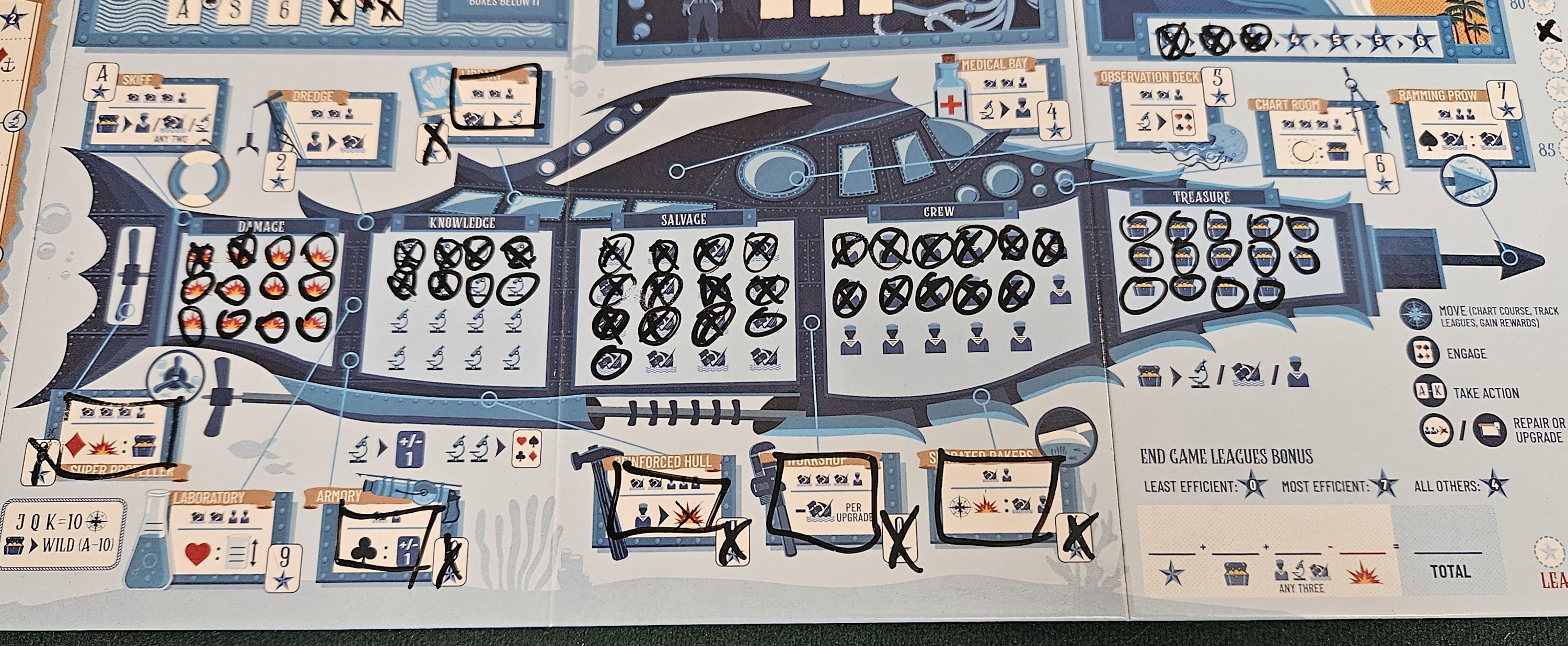
Flip Voyage, then, is his followup to Fliptown by way of Nemo’s War — although in a rare Aramini miss, this one surfaced too quickly and contracted the bends.

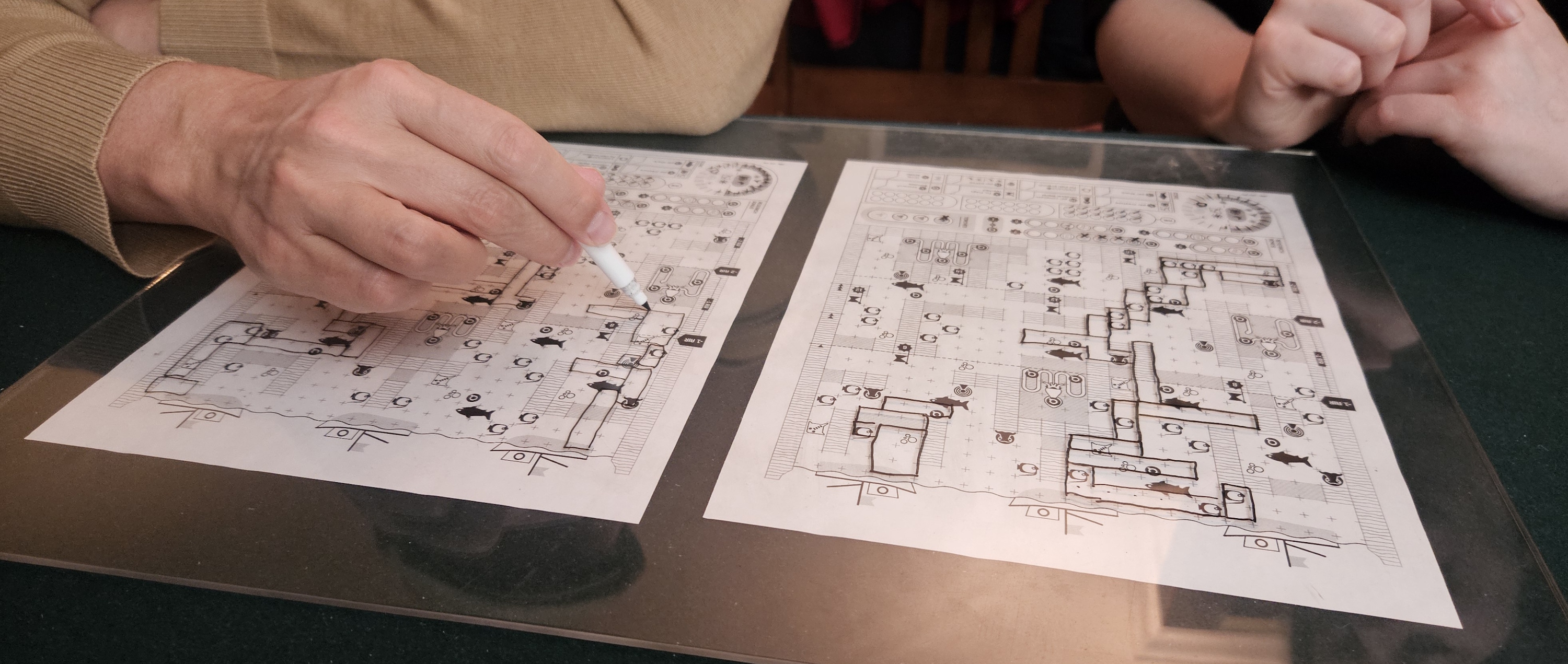
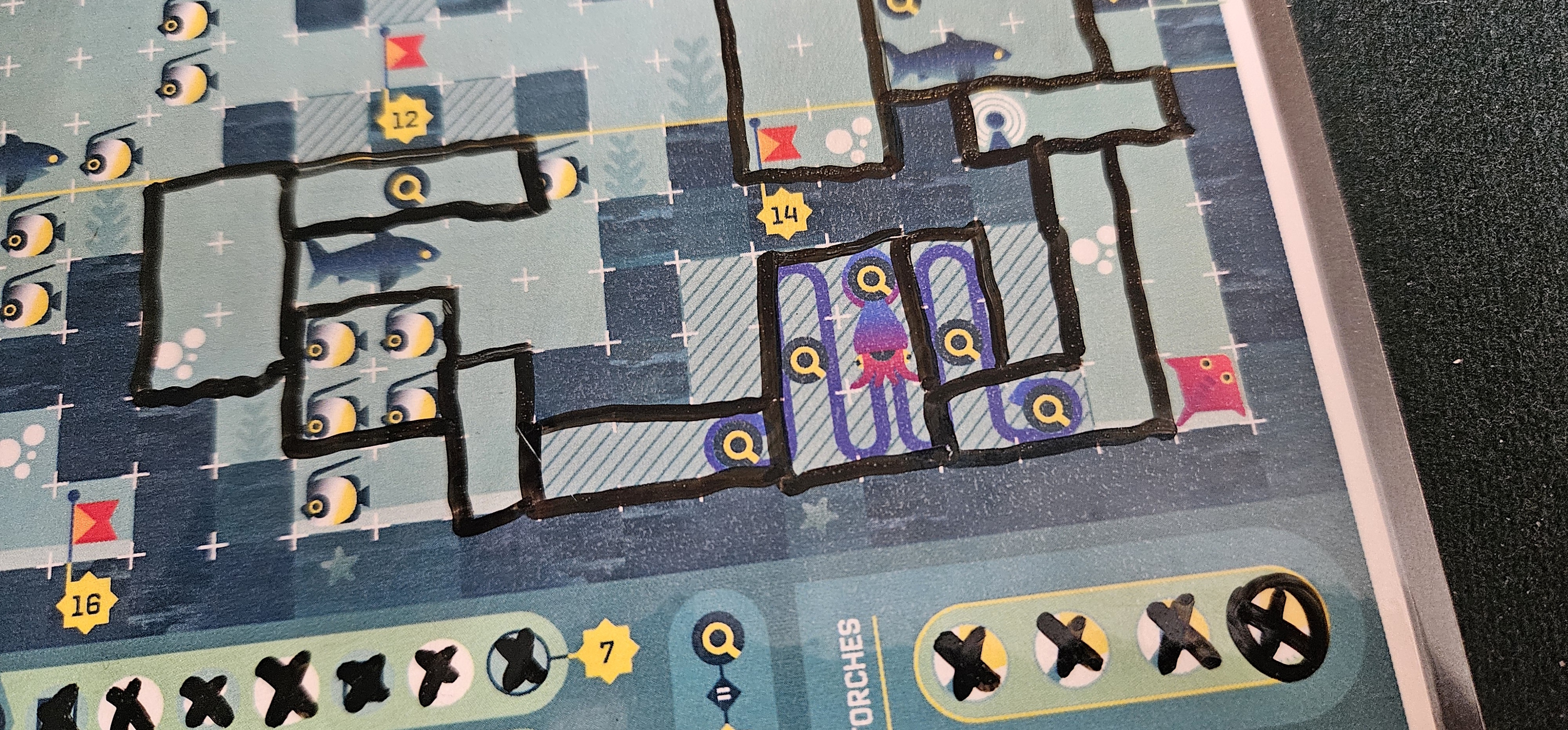
I have been led to understand that living on a submarine is a clammy, cramped experience, devoid of the wide-open viewing ports, expansive libraries, and world-class luxuries that such a fantastical vessel should offer. Sounds like a skill issue. Get on it, submarine designers.

We all live on an ordinary blue submarine.

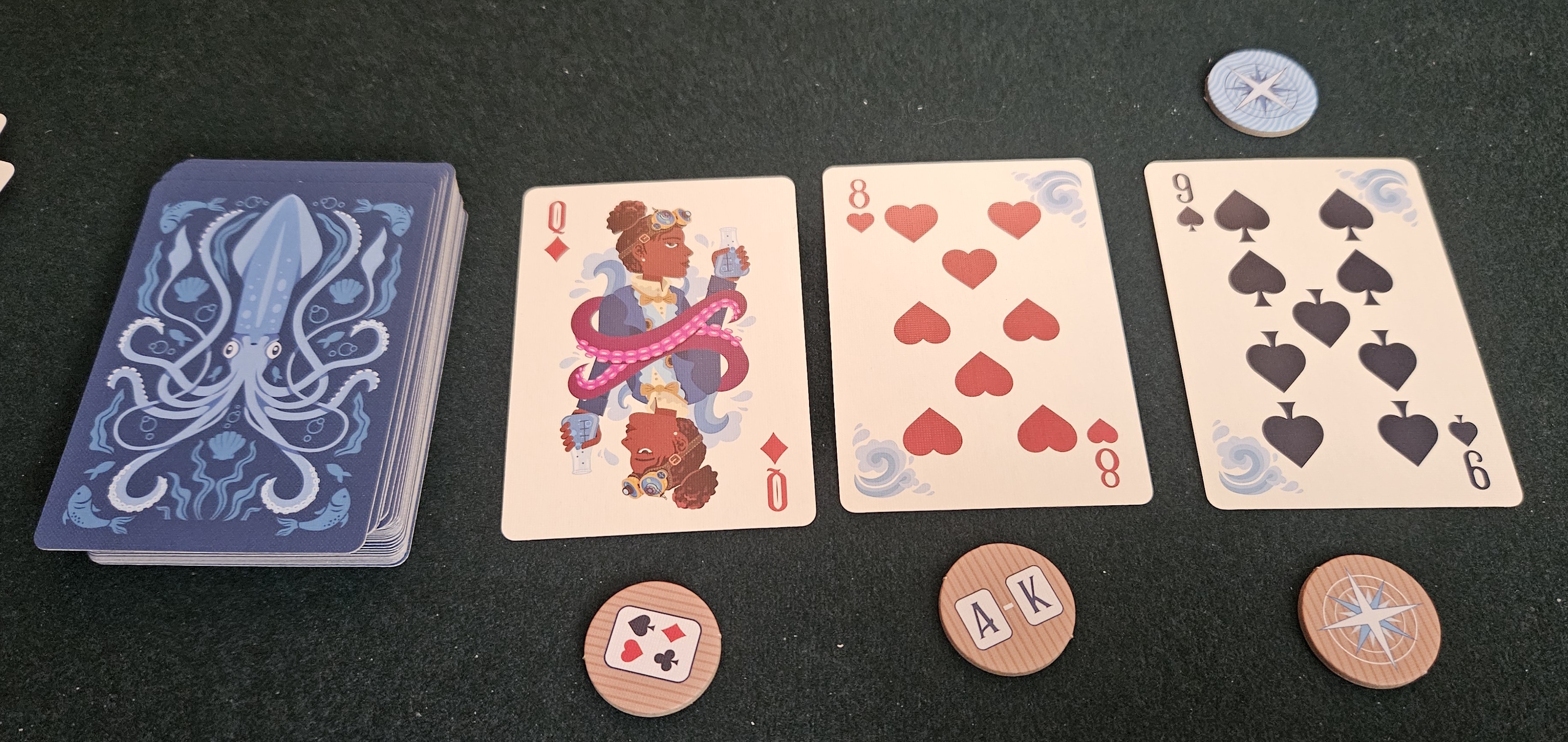
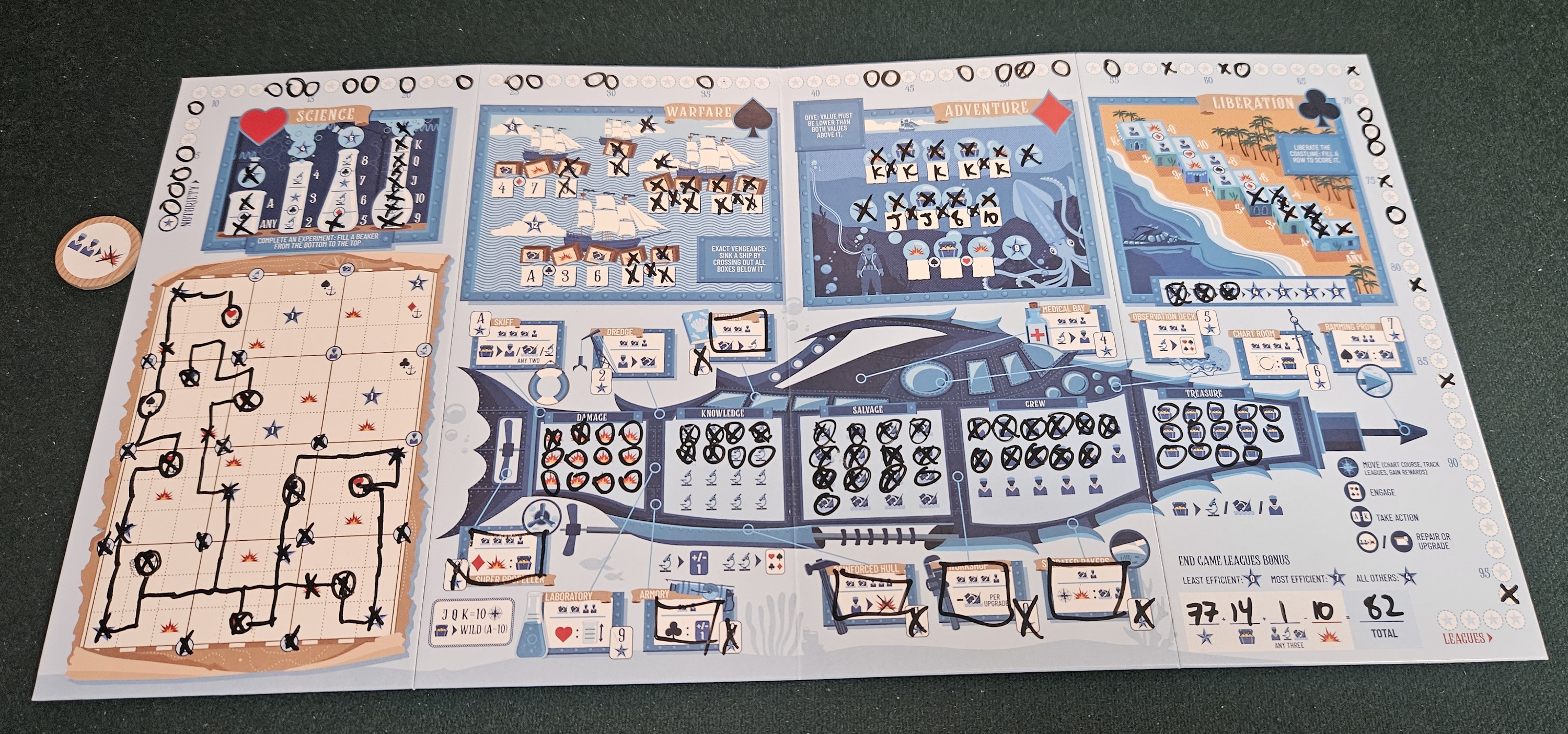
If you’ve played Fliptown, the basic conceit behind Flip Voyage will be familiar, if perhaps also baffling in its pared-down nature. Like that game, Flip Voyage is a combo-heavy flip-and-write that sees everybody at the table — whether one player or fifty, with the box providing enough dry-erase boards for four — turning three cards at a time from an ordinary deck of playing cards. Everyone uses that trio according to their own individual goals and position, and then, after awkwardly signaling to one another that they’re done, moves onto the next set. For our signal, my group has taken to sticking up a thumb. That or asking Geoff whether he’s wrapped up his turn, because eighty percent of the time he’s the last one anyway.

In Fliptown, the template was straightforward enough, while still offering a range of options. You would choose one card for its suit, to indicate which of four activities your cowboy would undertake that turn. Another card offered up its rank, setting the strength and/or destination for that activity. The final card became part of a poker hand, an ongoing bid to earn extra points and cash at the conclusion of five flips. Since everybody knows poker hands, from movies if not from personal experience, the relative value of each splay was given an intuitive value.

There are no giant squids in this game. Pity.

Three cards are revealed at a time. How will you use them?

This time around, the value of any given card is more wishy-washy.

For one thing, there are no poker hands. That’s fine. Fliptown was a cowboy game. Per contractual obligation, every cowboy game must feature poker. Flip Voyage, though, is about journeying under the sea in a submarine based on Captain Nemo’s / Jules Verne’s Nautilus, undertaking such anti-colonial activities as sinking imperial vessels and liberating captives from slaver camps.

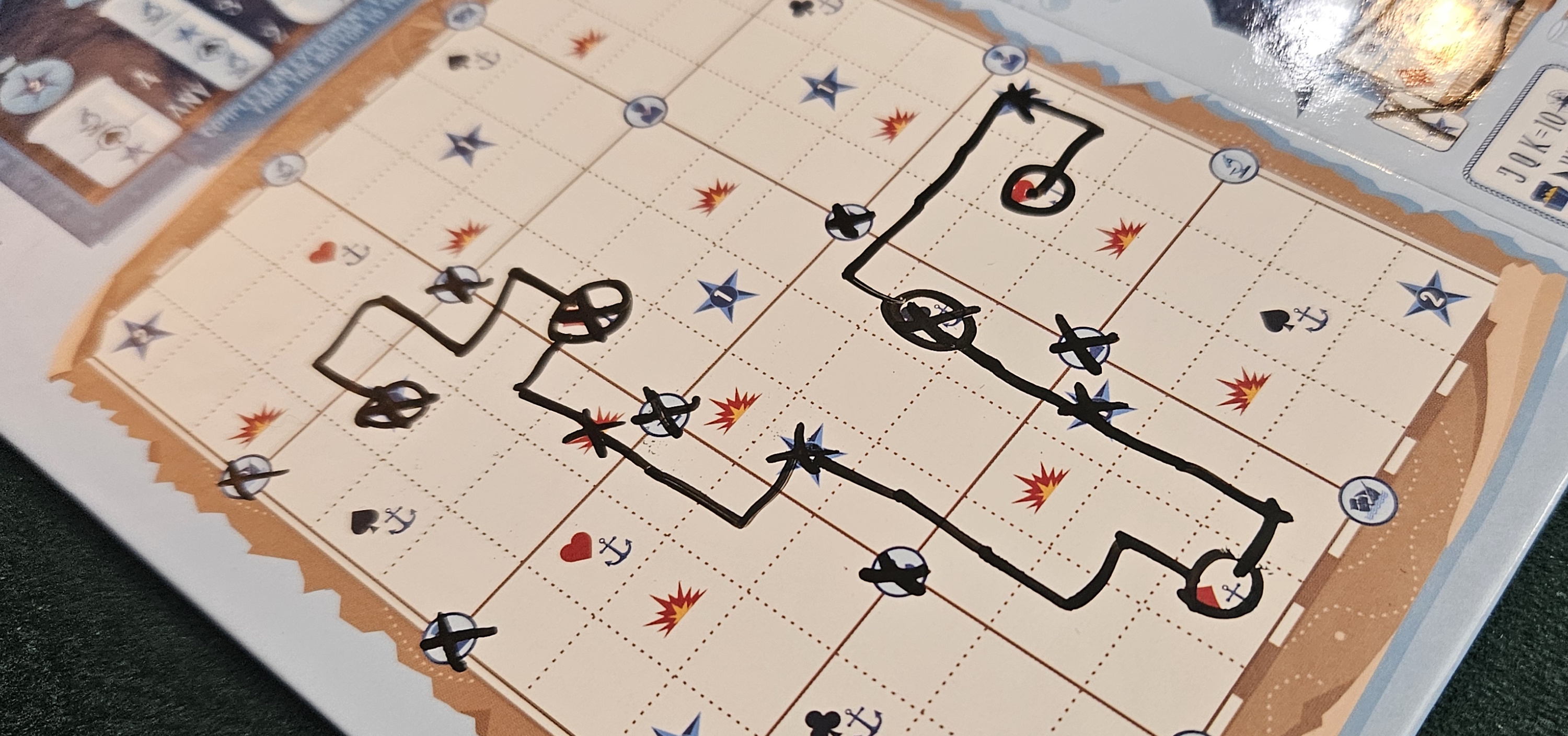
As such, while two of each round’s three cards are spent undertaking those activities, that final card is instead used to travel across a simple grid map. These journeys are both critical, setting the tone for each trio of cards, and somewhat disappointing in their straightforwardness. Certain spaces award stars — points, basically, here called “notoriety” — while others incur damage to your vessel. Various lines can be crossed to earn resources, and there are ports where weighing anchor earns you a free action in one of the game’s four suits.

The gist is that you take your chosen card’s rank and travel that many spaces, generally steering across stars, avoiding damage, and ensuring you halt in a spot that will permit one of those free actions. Meanwhile, criss-crossing the map is a surefire way to earn extra resources, but you’re also lightly incentivized to keep your journey pacey thanks to a “most efficient” award doled out at the end of the session. Coal is expensive, I suppose.

Meanderin' around.

Charting your course.

Perhaps I would have felt more kindly toward Flip Voyage’s voyaging had I not recently played three different titles that handled navigation so much more cleverly, but the map is never as interesting as it could have been. Damage is easily avoided, while the ease of pulling U-turns and adjusting your current range with a spent resource both serve to eliminate any hard decisions. For the most part, the toughest part of navigation is remembering to tally how far you moved on the score track.

The activities, meanwhile, are considerably easier than those found in Fliptown. There’s a tonal quality to the distinction. In Aramini’s former game, each activity was pitched as a wager, requiring players to decide how far they wanted to press themselves in an attempt to secure greater rewards. By contrast, the activities in Flip Voyage are considerably blander.

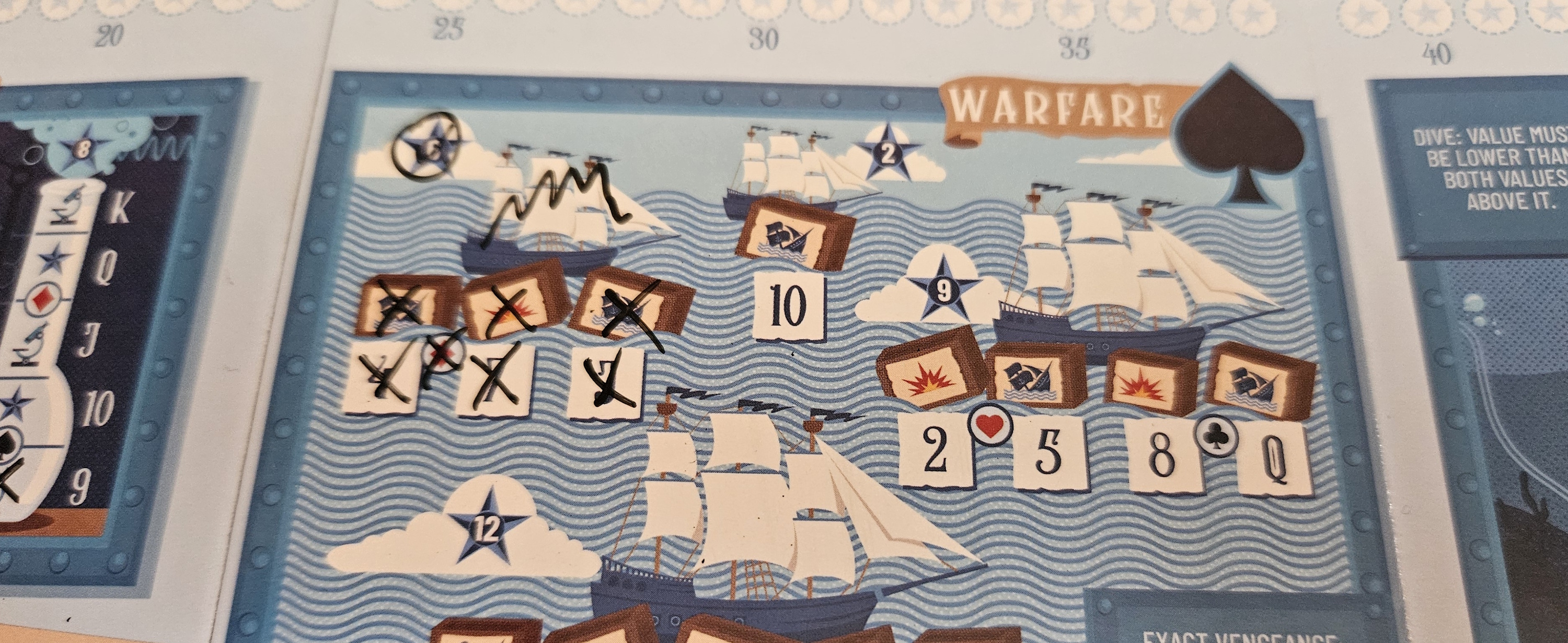
As before, there are four, each corresponding to the deck’s French suits. Using a heart takes you to the science lab, where you must fill beakers in rank order. Next door is the warfare track, where spending cards will punch holes in imperial warships, either earning salvage or damage. Diamonds are for adventure on the ocean floor to retrieve treasure or damage. And clubs are for raiding slaver camps, liberating new crewmates or, again, taking damage.

Against all odds, Flip Voyage makes sinking a wooden warship dull.

Sink to the bottom… without me.

If you couldn’t tell, there’s a lot of taking damage in Flip Voyage. Three of four activities will ding your Nautilus Jr. in some way or another, and there’s no skipping a turn to loot graves like in Fliptown. This has a flattening effect on the game. There are fewer peaks and troughs than before. Instead, you’re usually guaranteed some upside to go with your downside, or vice versa. A resource here, a scratch there, bit by bit, until the game concludes and everyone tallies their score.

There are upgrades to consider, little perks that adjust your activities. Some are formidable, like the serrated rakers that encourage you to steer into damaging spaces on the map or the super propeller and ramming prow that earn extra resources from their related activities. But a number of upgrades are surprisingly dull. Oh, the dredge lets me turn crew into salvage? The library turns salvage into research? Sorry, I nodded off. I hate to keep resorting to contrast, but these are a far cry from the shops and hotels of Fliptown’s tumbleweed town.

It’s possible to consider these alterations in a generous light. Fliptown had moments of profound chance, especially when two players attempted to, say, rob a stagecoach on the same turn, an endeavor that required both highwaymen to draw their own card to determine their success. Flip Voyage is less beholden to Lady Luck. Apart from the trio that opens the turn, there are no flipped cards here. I’m sure there are those who prefer their flip-and-writes to limit their luck to inputs rather than outputs, to borrow Geoff Engelstein’s delineation between flavors of chance.

I’m not one of those people. The beauty of Fliptown was its willingness to allow both modes. You could push your cash into the center of the table by sticking up trains, speculating on land, and chasing bounties. Or you could keep to safer trails by mining gold, riding duster, or robbing corpses. Even without the inclusion of random outcomes, there was so much to do that every session felt like a fresh adventure. After about one and a half plays, Flip Voyage has shown all it has to offer.

I also have the Fliptown expansion ready to go. Hopefully it's better than this one.

Ahh, a marked-up board.

Still, the process of filling in the board is enjoyable enough. That’s some faint praise, I know, but it would be a lie to say that this game is devoid of its pleasures. Figuring out how to put those cards to use is still a strong core for such a game.

But twenty thousand leagues is a great distance to cover under such pressure, and this hull has sprung more than a few leaks. There are plenty of better options, including many designed by Aramini. To quote Captain Nemo, “Oh Almighty God! Enough! Enough!”


A complimentary copy of Flip Voyage was provided by the publisher/designer.

(If what I’m doing at Space-Biff! is valuable to you in some way, please consider dropping by my Patreon campaign or Ko-fi. Right now, supporters can read my first-quarter update of 2026: the best board games, movies, books, and more!)
  •  

Class Reunion: Euphoria

Yes, the title of this review is a reference to Euphoria, a television show I haven't watched a single minute of, but which the internet has led me to understand stars Sydney Sweeney's bosoms.

It’s been thirteen years since the original release of Jamey Stegmaier’s Euphoria: Build a Better Dystopia. I would say it doesn’t feel like thirteen years, but I’d be lying. Between the pandemic and five or six successive generations of board game iteration, it’s been an eternity. Long enough for a retrospective, certainly.

Speak of the devil. Euphoria: Essential Edition is a remake of the original game, plus some of the stuff from the expansions, minus a few love handles and splotchy moles. Let’s see how the old dystopia has held up after all these years.

There's even a drab side. For the drabbers.

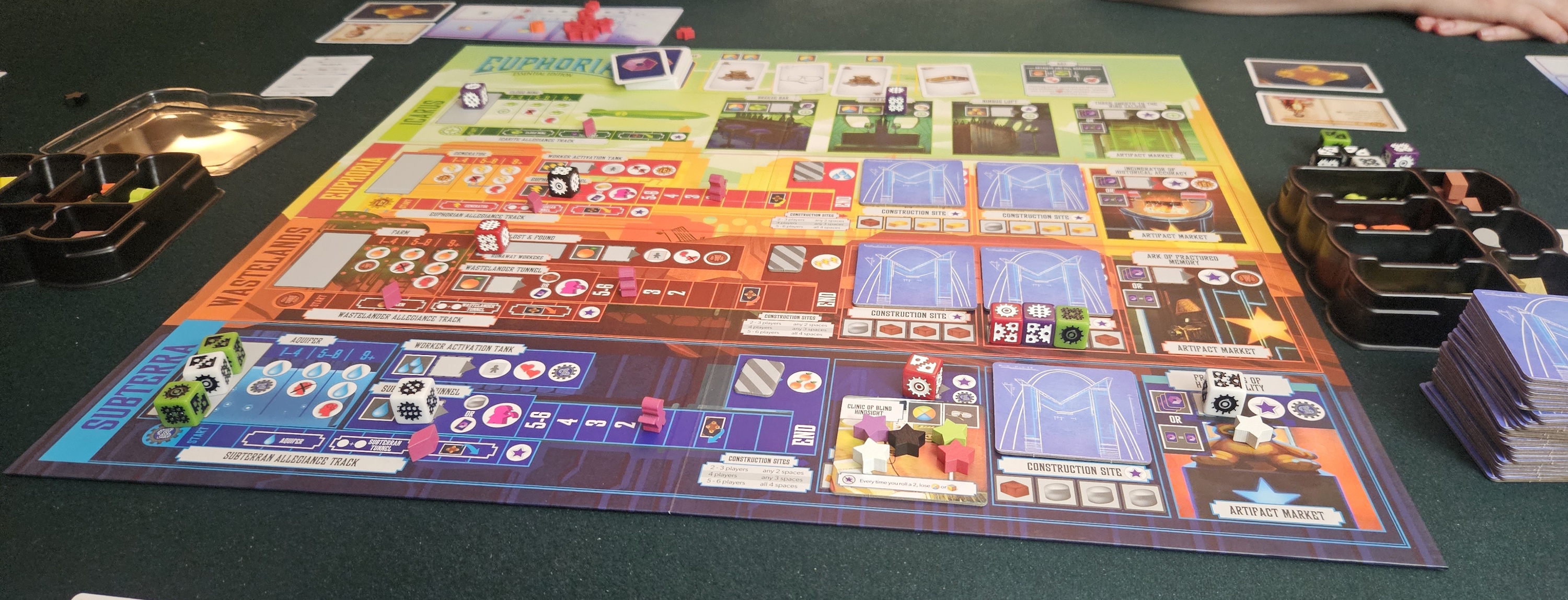
The new board, not quite the same as the old board.

Short version, there’s rebar showing through the concrete.

As before, Euphoria is about your efforts to thrive in a dystopian society. Relatable. Maybe that’s why the intervening decade hasn’t flown by. But I digress. In Euphoria’s case, that dystopian society is divided into four strata, each offering different spaces for your workers to run errands. There are the Euphorians, folks who generate electricity by marching on hamster wheels, Wastlanders who labor in orange groves, Subterrans who pump water through the cracked bedrock, and Icarans… Icarids? Icaruses? Whatever. These guys cook future-meth for keeping everyone’s workers drowsy and compliant.

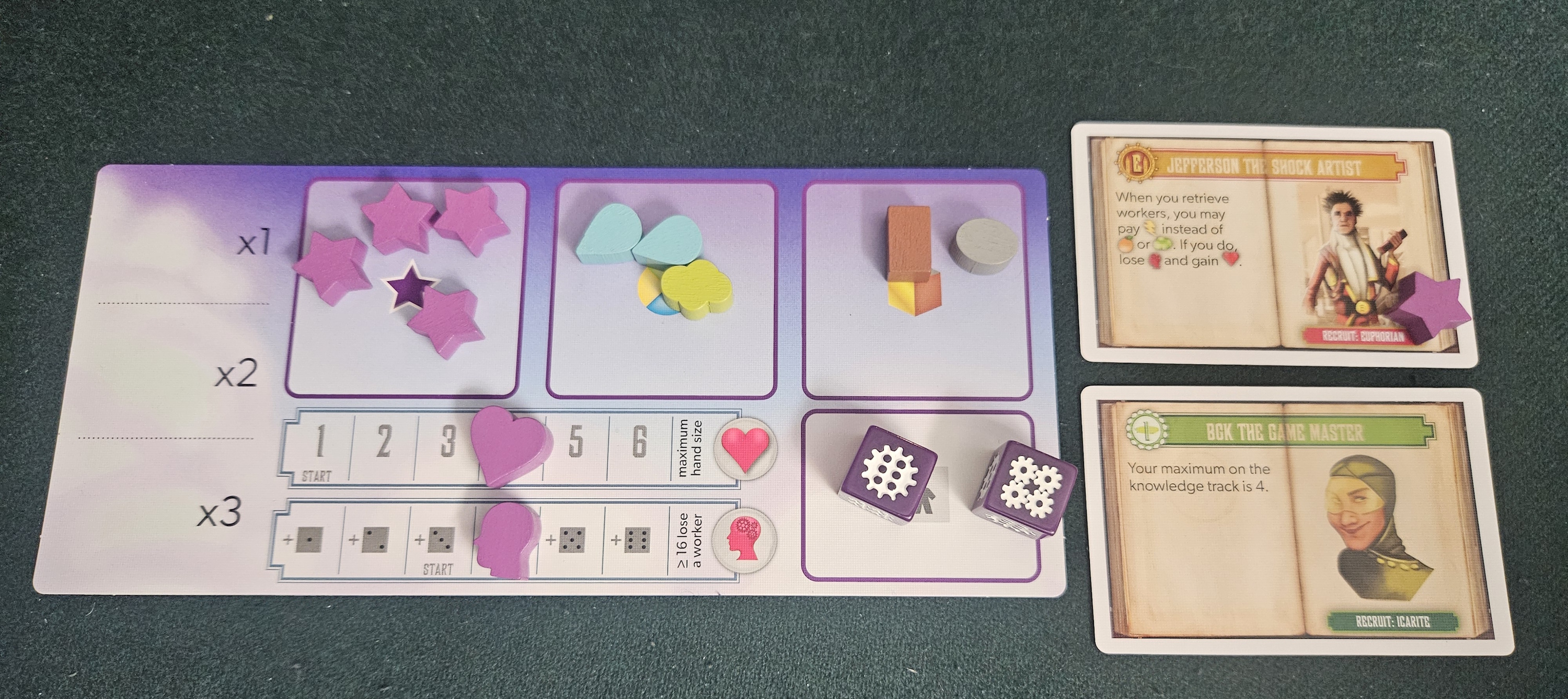
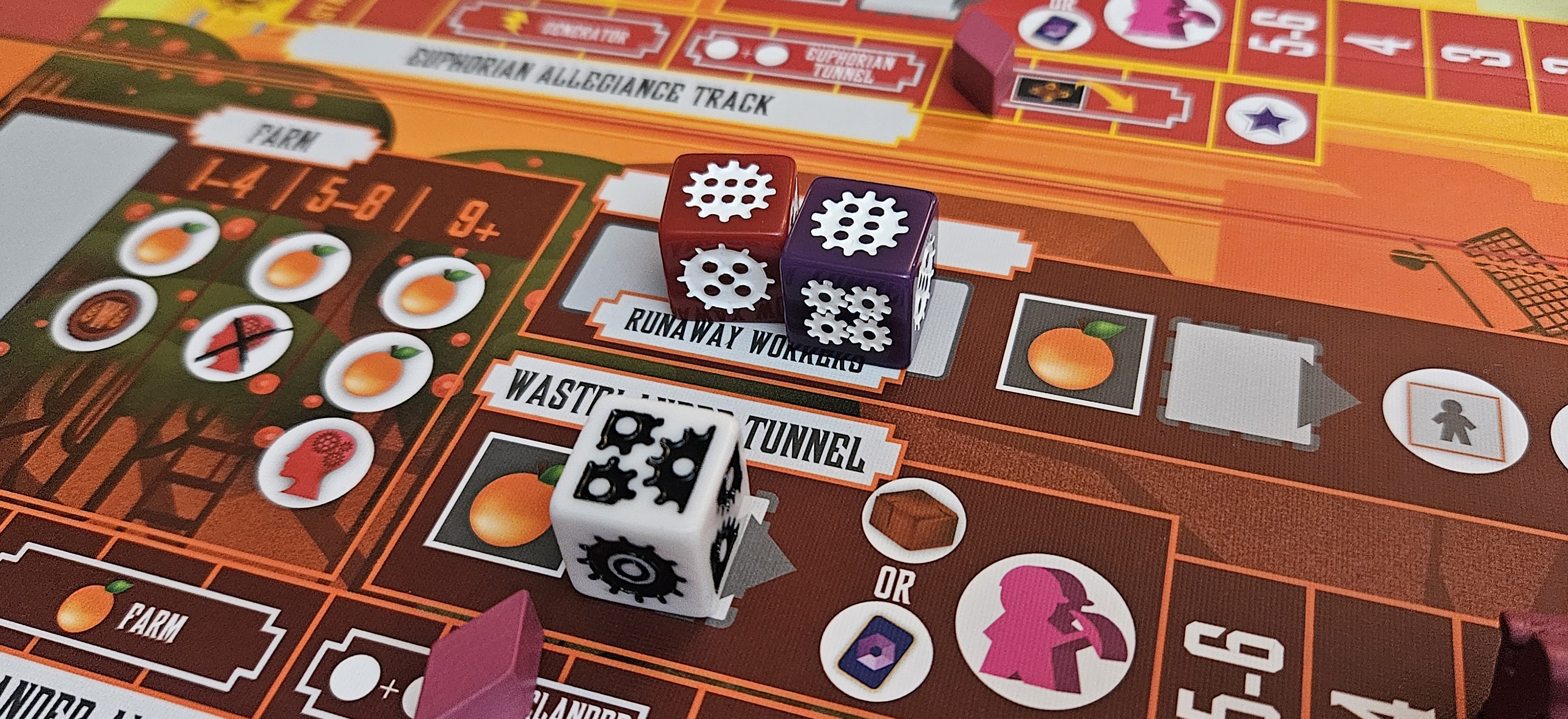
The status of those workers is never far from mind. At the time of the original game’s release, rolling dice to determine the relative knowledge of one’s workers was a clever touch. If nothing else, it functioned as one of the hobby’s earliest meta-commentaries on the blank slate that was the worker-placement worker. Roll too high, and one of your workers gets wise to the situation and flees from your grasp. Roll too low, and…

… and there’s no penalty for rolling too low. What you really want is to roll doubles. That way, you can spend some morale to place an extra worker, earning two turns in a single go.

"Actually, there are no streets in the future world of Euphoria." —that one superfan of Stonemaier Games who writes nasty notes whenever I don't love one of their games

Euphoria: meek in the streets, freak in the spreadsheets.

At the time of the original game’s release — there’s a phrase I’ll probably say more than twice — it was easier to overlook the chanciness of the whole thing. Sure, rolling high means losing a worker, and rolling doubles means earning a twofer. But rolling low, I suppose, means you can send a worker to one of the game’s resource production zones without worrying about them learning the shape of their culture. Except, wait, that’s another benefit for rolling low. Darn it.

Okay, so Euphoria is full of luck. Always was, still is. The problem isn’t so much that luck is the sole determiner of whether you succeed, but rather that it’s just enough to prove frustrating. As a genre, Eurogames included more chance in 2013 than they do today. Personally, I miss a bit of chance. But in general, those earlier forms of chance were about mitigation. Even placing towns in Settlers of Catan was about spreading around the odds so that you’d always earn something. In Euphoria, the system feels out of place, and not only among the determinists of 2020s nu-euros.

But let’s set that aside. How has the rest of the game borne the timelapse?

Again, the short version is that it works perfectly well, but never quite eases its grandfatherly creaks and groans. Most actions are tit-for-tat resource conversions. First you send a worker to a resource generator to earn one or two commodities. Then you send them to a tunnel to spend a commodity for a building block. Maybe you spend a wad of commodities for an extra worker. Then you build special markets, which let you exchange commodities, blocks, and artifacts for stars, the game’s victory condition. Repeat. Repeat. Repeat.

But an appropriate one, I guess. At least you're managing your workers' needs, even if all they happen to need is some vitamin-C or some space-meth.

“Runaway workers” sure is a loaded term.

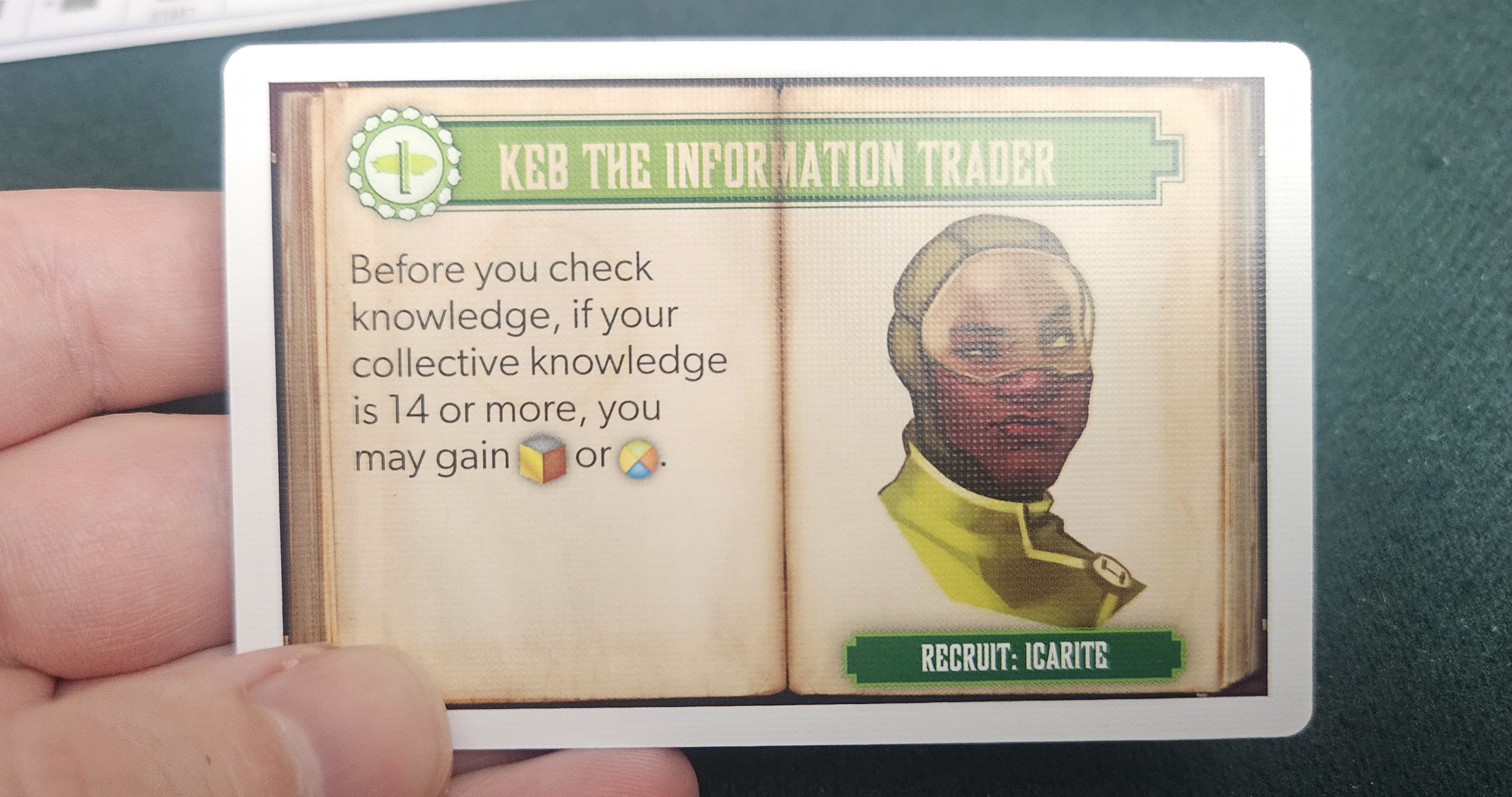
It doesn’t help that the Essential Edition sometimes comes across as more of a Pruned Edition. The board is more legible, but has shed the original map’s sense of place. Just look at that perfect goofball illustration. The new map feels like a spreadsheet setup for a spreadsheet game. Which is fine, as those things go. This is a resource-conversion worker-placement game, after all. You could even make the argument that this new edition has shed the original game’s pretense, including the ethical dilemma cards that, let’s face it, didn’t always add much to the game systems-wise. But, again, they mattered to Euphoria’s sense of place, the notion that players were being forced to compromise their values in order to get ahead. Thanks to the intervening years, a few subtractions, and this updated visual design, it’s easier than ever to see the wires and mirrors behind the illusion.

The remaining good parts are still as good as ever. For example, those markets. As before, building a market means spending a bunch of building blocks, not to mention putting your laborers in a holding pattern until other players join in. This created a certain degree of cooperation, one that could be turned against you at a moment’s notice. Having even a single worker hanging around at a job site is a real sacrifice, fostering opportunities for players to bicker and cajole. That’s great.

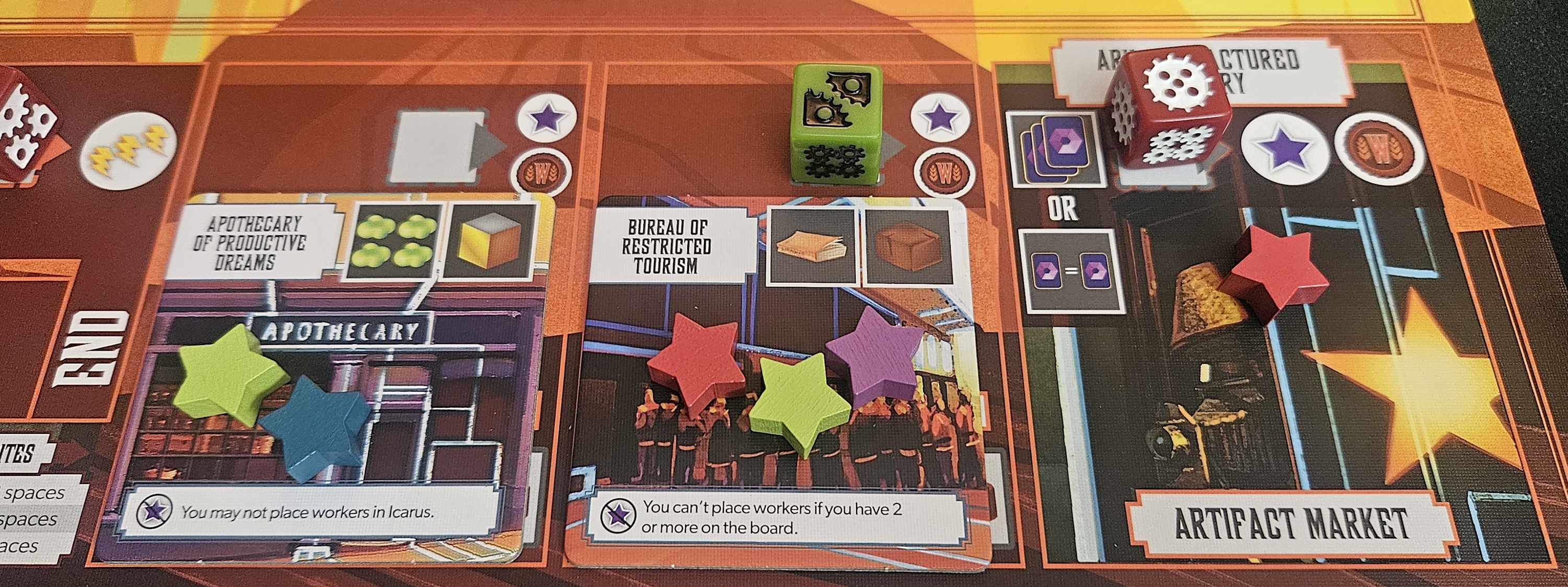
Furthermore, the markets themselves are nasty little things. When built, every player who didn’t contribute to its construction is forced to suffer a penalty until they pay a penalty at the new market. Sometimes these are negligible; other times they pose biting impositions that must be rectified as soon as possible. Or even both at once. The Theatre of Endless Monotony reduces how many commodities you earn, but only to a minimum of one. The Institute of Orwellian Optimism treats all your 1s and 2s as 3s when it comes to checking your dice for thoughtcrime. The Courthouse of Hasty Judgment makes it harder to spend artifacts for stars. That sort of thing.

He likes to live on the edge. The edge of KNOWLEDGE.

This guy is a cool dude.

There are some real whoppers in there, too. In one case, we revealed the Apothecary of Productive Dreams. This market prevents some players from sending workers to Icarus. At all. Which effectively locks them out of a full quarter of the board’s spaces. Worse, buying into an already-built Apothecary requires bliss, the very same drug peddled by the Icaroopsies. Not only were some players locked out of Icarus territory, this locking-out was effectively permanent. Was this a fair turn of events? Hardly. But it was interesting. Textured, we might call it. Abrasively textured, sure, but it was refreshing to play a game that would offer such overt penalties rather than ensuring everything ran smoothly all the time.

Between these and the heaps of recruit cards, there’s always something happening on the board. Some market being constructed (or ruining your day), some recruit tweaking the rules to your benefit, some haggling over at the construction site. That’s all great.

The downside is that it never quite breaks free of its shackles. Board games have largely moved on from worker placement, at least in such a straightforward cube-pushing sense. And Euphoria always feels like cube-pushing. Every segment of its dystopia is more or less identical to its peers. The same resources exchange rates. The same methods for hampering one another. The same costs at the artifact markets. And now those four segments are placed side by side so you can see just how closely they align.

In a sense, the Essential Edition is a worthwhile experiment because it highlights just how far game design has come over the past decade. But it’s only a worthwhile experiment for me, a total sicko for how board games change and develop over time. For somebody looking to spend their hard-earned cash, there are better options out there. If I’m going to place dice-shaped workers and suffer random consequences, I’d much rather play Connie Vogelmann’s Apiary, and that’s limiting our selection to titles from the same publisher.

Now make the crossover worker-placement game that's Space Bees vs. Dystopian Labor, Jamey.

E:EE is full of little textures. Some of them are abrasive.

Because Euphoria has been left behind. By board games as an iterative artform. By our hobby’s collective taste in the role of chance. By an Essential Edition that leaves some of its most interesting ideas in the dustbin. By a culture that’s grown weary of dystopias.

Speaking only for myself, I think it’s time to tunnel through to the other side.


A complimentary copy of Euphoria: Essential Edition was provided by the publisher/designer.

(If what I’m doing at Space-Biff! is valuable to you in some way, please consider dropping by my Patreon campaign or Ko-fi. Right now, supporters can read my first-quarter update of 2026: the best board games, movies, books, and more!)
  •  

Combat Results Postcard

Battle (underline) Card

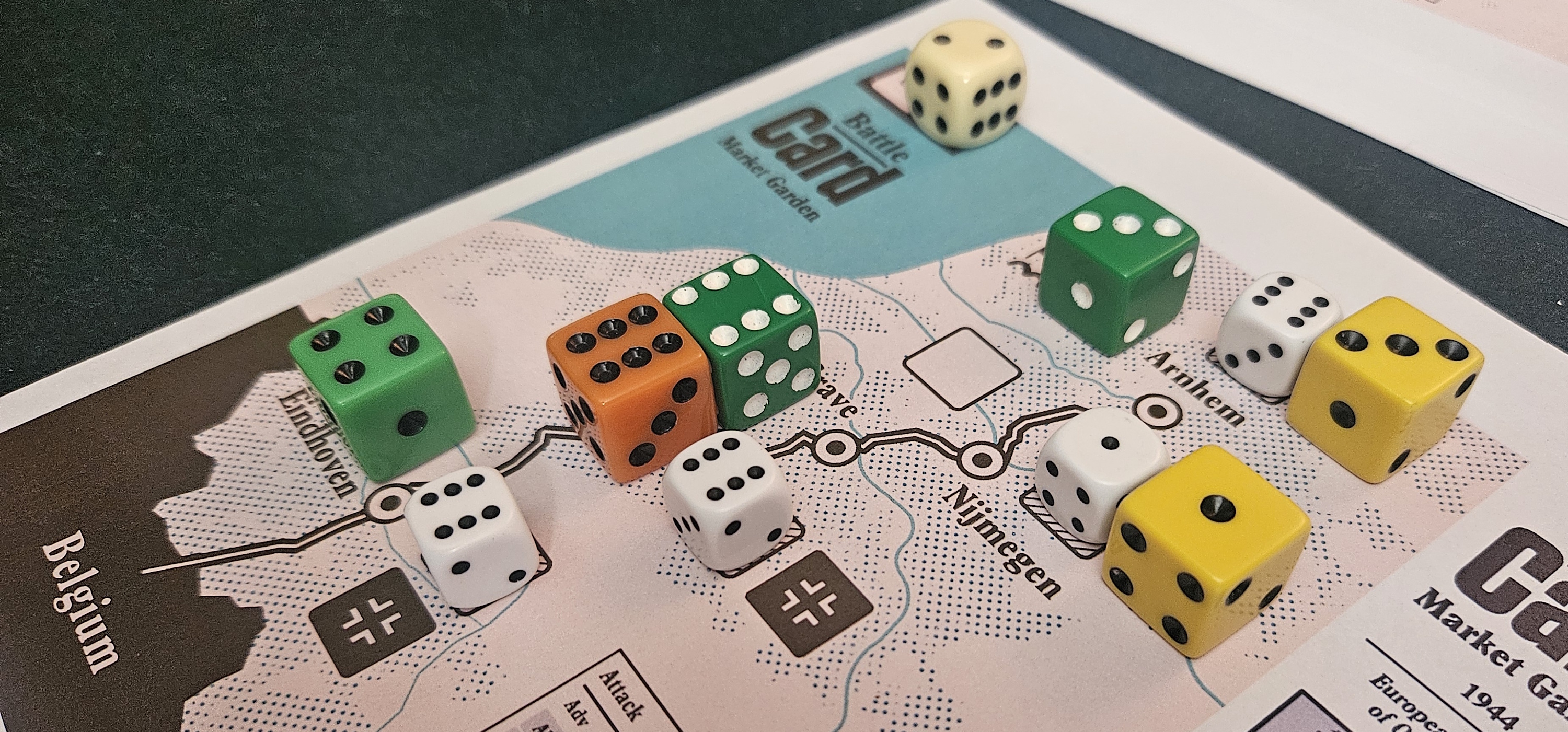
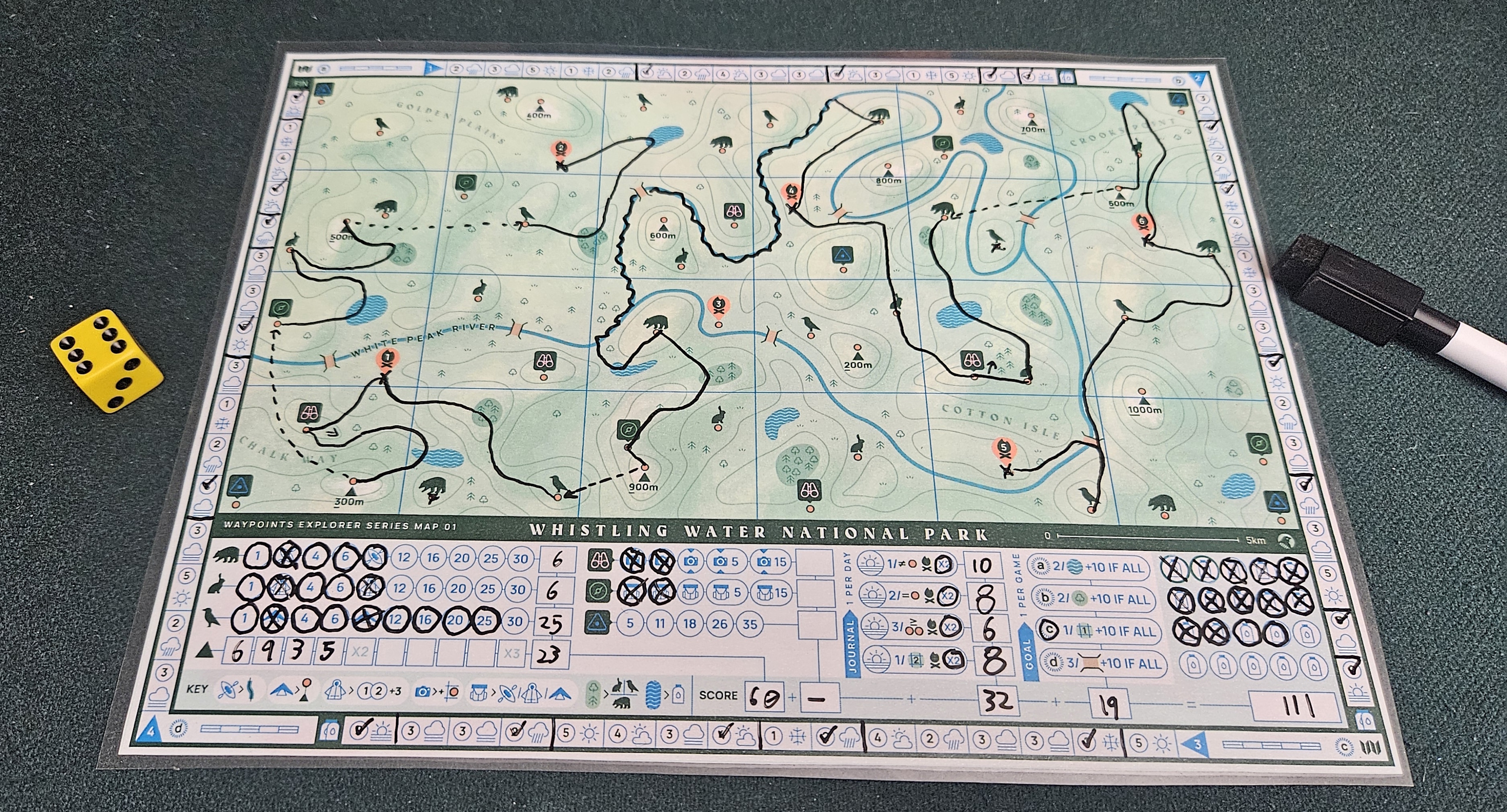
Battle Card is as apt as descriptions get. Designed by David Thompson and Nils Johansson, this is the fourth project in the Postmark Games lineup. Like its earlier peers — Voyages, Aquamarine, and Waypoints — this is a print-and-play title that can be produced with functionally zero budget. Unlike those projects, however, Battle Card is billed as a wargame on a single postcard-sized sheet.

That’s true enough. With a few dice and a smidgen of experience to help interpret the rules, Battle Card covers six engagements from the Second World War. And their format is indeed very small, highlighting some real resourcefulness on their designers’ part in compressing battles and even campaigns into ten-minute experiences.

But unlike those other titles, Battle Card is a mixed bag. I’ll give an example.

Their national anthem, I believe.

Rock on, Canada.

The second of Battle Card’s six scenarios sees Commonwealth forces waging a fighting retreat against Imperial Japanese troops shortly after the attack on Pearl Harbor. Over the course of two months, these forces staggered their positions along the Malay Peninsula, gradually ceding ground in an attempt to withdraw a portion of their forces. Historically, the campaign was catastrophic for the Allies, revealing Japanese air superiority and rapid infantry. (Mounted on bicycles!)

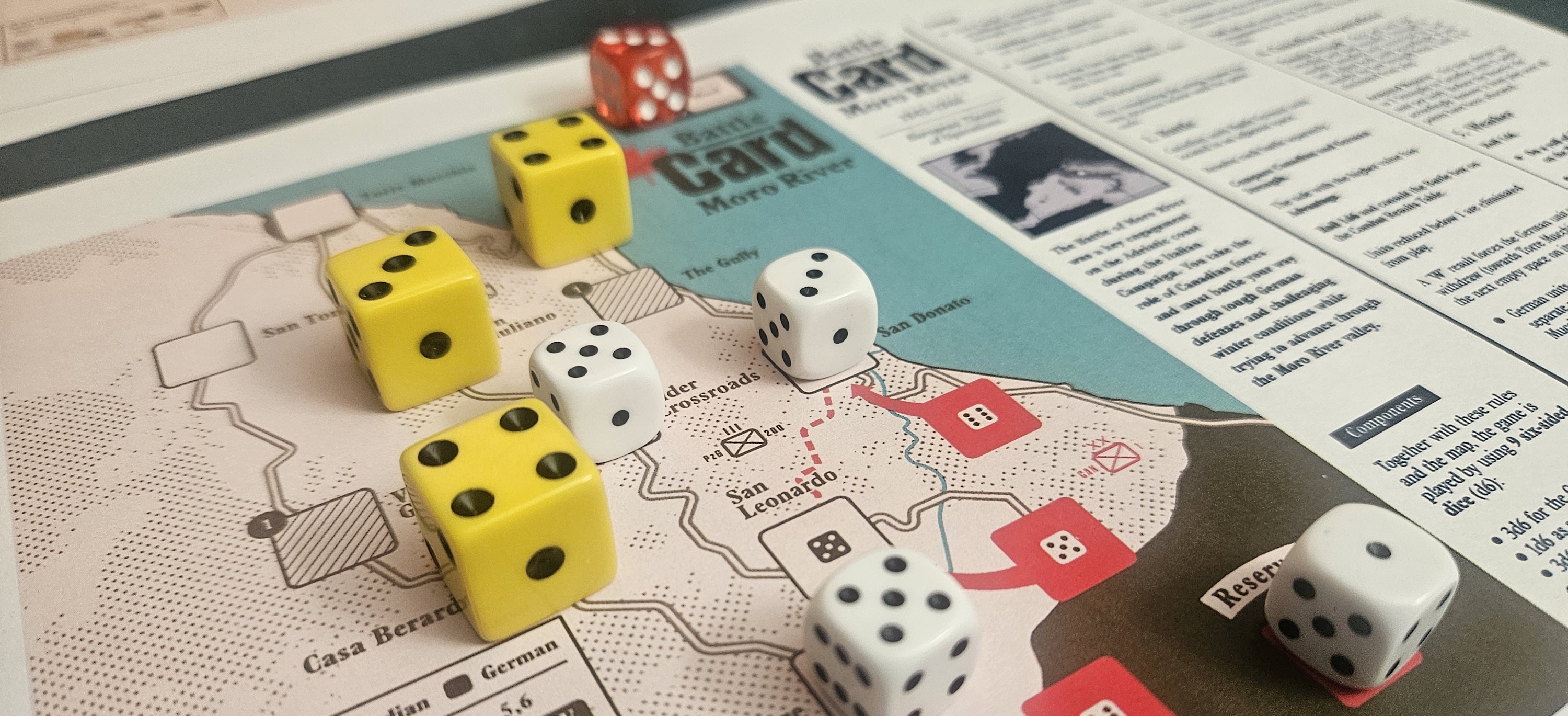
In Battle Card, the situation isn’t much better. Dice represent the armies on both sides, with their pips indicating their current strength. These armies engage in battle — determined by the roll of another die — and shift positions along the twin roads along the peninsula.

Here, the situation is relatively static. As the leader of the Commonwealth forces, your options mostly revolve around when to retreat, whether to defend your position or mount a counterattack, and which units to gradually pull back toward Singapore. No matter the outcome of any individual roll, the game has been fixed, much as it was historically. It isn’t a question of whether the Japanese will overtake your position, but how swiftly.

The smaller dice designate control. None of the other scenarios bother. This was a wise omission.

The Market Garden scenario is ostensibly a demo, but it’s fiddlier than those that come afterward.

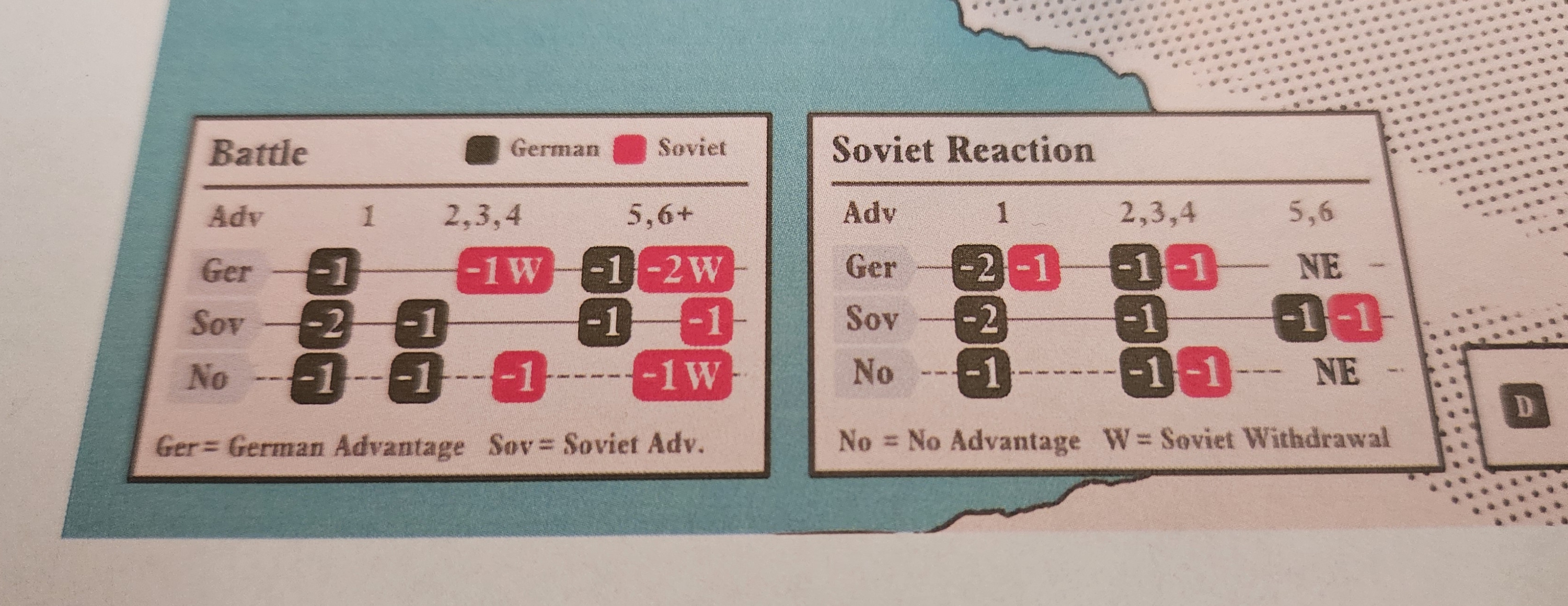
What follows is a strong indication of both the system’s strengths and weaknesses. Your choices, such as they are, are as bite-sized as the game’s footprint. Retreat or hold; defend or attack; withdraw a die along a road. The roll-offs are governed by small combat results tables that factor in whether one side has an advantage — meaning one side’s die has more pips than that of their enemy. As advertised, it’s fast. And, to its credit, the minimalist design does lend some sense of the geography and the central conundrums of the conflict.

In this case, your objective is to withdraw three pips to Singapore, and the way to accomplish this goal is closer to a puzzle than anything offering operational flexibility. Either you stick your troops behind the right line in the sand or you don’t. Either you withdraw in time or you don’t. Either you make high enough rolls or you don’t. No matter the scenario, this is more or less how Battle Card functions. There’s a solution here. That solution still requires the bulk of the rolls to go your way, but that’s the solution, and there’s no deviating from it. Perhaps most damningly, once you’ve uncovered that solution, there’s really nothing else to see.

Yes, yes, I’m the guy who wrote that replayability is overrated. But there are slender games and then there are slender games. Battle Card is the latter. Each play lasts between five and ten minutes. Scenarios are also compact, as befits a game called Battle Card, meaning there aren’t many subtleties to any given fight. If you don’t figure out the trick on your first play, you’re bound to have a strong suspicion heading into your second. After that, it’s really a matter of getting the right rolls.

Magnifying glass not included.

Combat results tables! We got ’em!

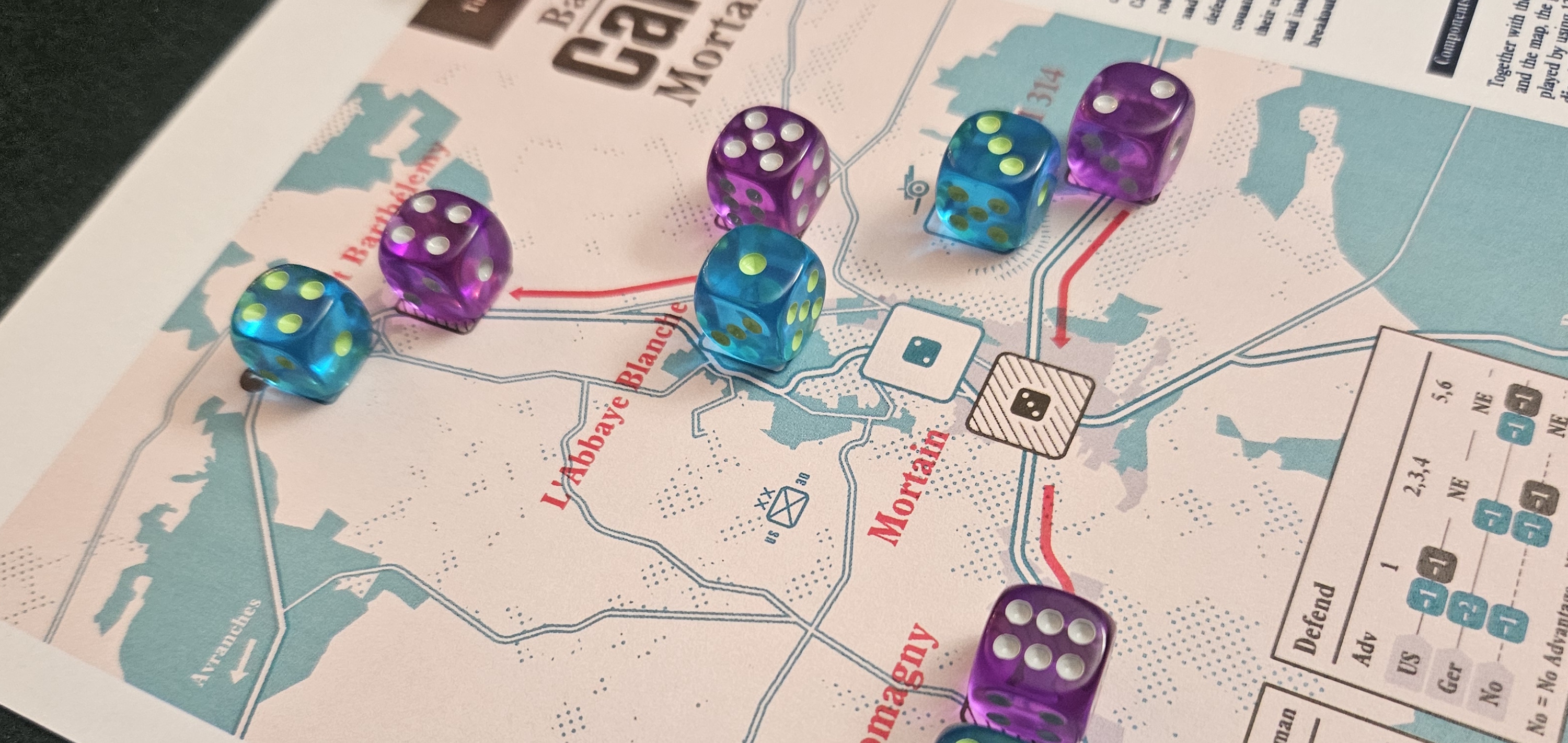
This isn’t to say the whole enterprise is doomed. The best scenarios offer some wiggle room between maneuver and chance. As the Canadians make a three-pronged drive up the Italian boot in the Moro River scenario, they must pause to reinforce any divisions that took a beating. As the Germans plunge toward the Caucasus oil fields, they need to decide when to split their forces into smaller but more vulnerable columns. Choosing where to fire your artillery at Mortain is… well, it isn’t the most complicated decision, but it would also be inaccurate to call it straightforward.

Again, though, that’s about as much mileage as anyone will get out of these print-and-plays. I’ve run through the entire series twice now, and the second time I found myself growing weary. This stands in strong contrast to those other Postmark titles. As score-chasers, there was always a reason to return for another attempt. Here, the entire format feels too compressed, like a States of Siege game without the chrome-laden considerations that made that series so interesting. Mostly, it was a nice way to organize my dice by color and size.

Step one: fire arty at bad guys threatening arty. Step two: fire arty at other bad guys.

Firing the arty.

In a way, Battle Card isn’t that far off from looking at an animated battle map. All those little arrows and company designators. The towns changing hands. The roads, the weather. The relative strength of any given column. Battle Card is that with some marginal interactivity. As a middle-aged white guy, that’s my ken. But the joke’s on Battle Card. I already own a book of WWII battle maps. This is one instance where pushing the pieces across the board — sorry, the card — isn’t enough of an improvement.


Access to the files to print Battle Card was provided by the publisher.

(If what I’m doing at Space-Biff! is valuable to you in some way, please consider dropping by my Patreon campaign or Ko-fi. Right now, supporters can read my first-quarter update of 2026: the best board games, movies, books, and more!)
  •  

Space-Cast! #56. Keep Your Shirt Tucked In

Wee Aquinas has some deep thoughts on this topic, but unfortunately we had to cut him for time.

Ever wanted to play a game that would make you feel strange feelings about your childhood religion? Heyo, Greg Loring-Albright’s Keep the Faith is the title for you! In this conversation, Greg joins us to discuss whether board games or role-playing games are better, our respective religious traumas and hopes, and how a board game might prove illuminating of historical forces. You know, light chit-chat!

Listen here or download here.

TIMESTAMPS

Honestly, there are no timestamps for this one. The conversation was rather stream-of-consciousness on my part, and I’d rather not break it into discrete portions. I’m sorry. =(


(If what I’m doing at Space-Biff! is valuable to you in some way, please consider dropping by my Patreon campaign or Ko-fi. Right now, supporters can read my first-quarter update of 2026: the best board games, movies, books, and more!)
💾

  •  

Bite the Big One

That's me, avowed space terrorist, machinegunning a Bezos penis-rocket before he can escape the Amazon Superflex.

I live in the shadow of the Wasatch Mountains. Have for nearly my whole life. Out-of-towners sometimes voice their apprehension when they first visit our cordillera, when they see the way our cities and suburbs are hemmed in by walls. The mountains, they say, seem precarious, like they could topple onto our heads at any moment, burying us under a thousand tons of limestone and quartz monzonite. Jokingly, I inform them that the real danger of the coming tectonic collapse — not the little shakes we sometimes get, but the Big One, the one we’re a millennium overdue for — is that it will kill us from below. The ground will liquefy and carry us downward, the ancient tidal basin finally sweeping us out to an inland sea that died with the mammoths.

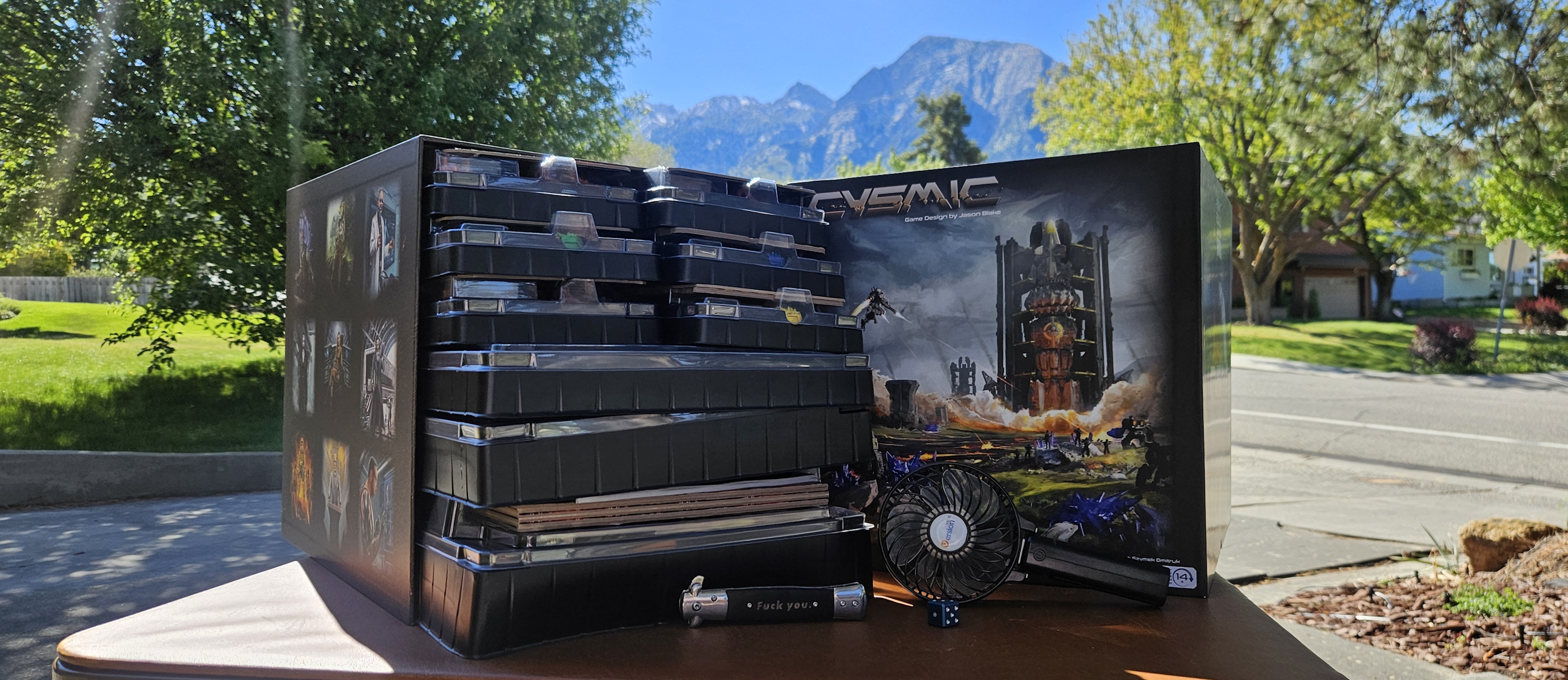
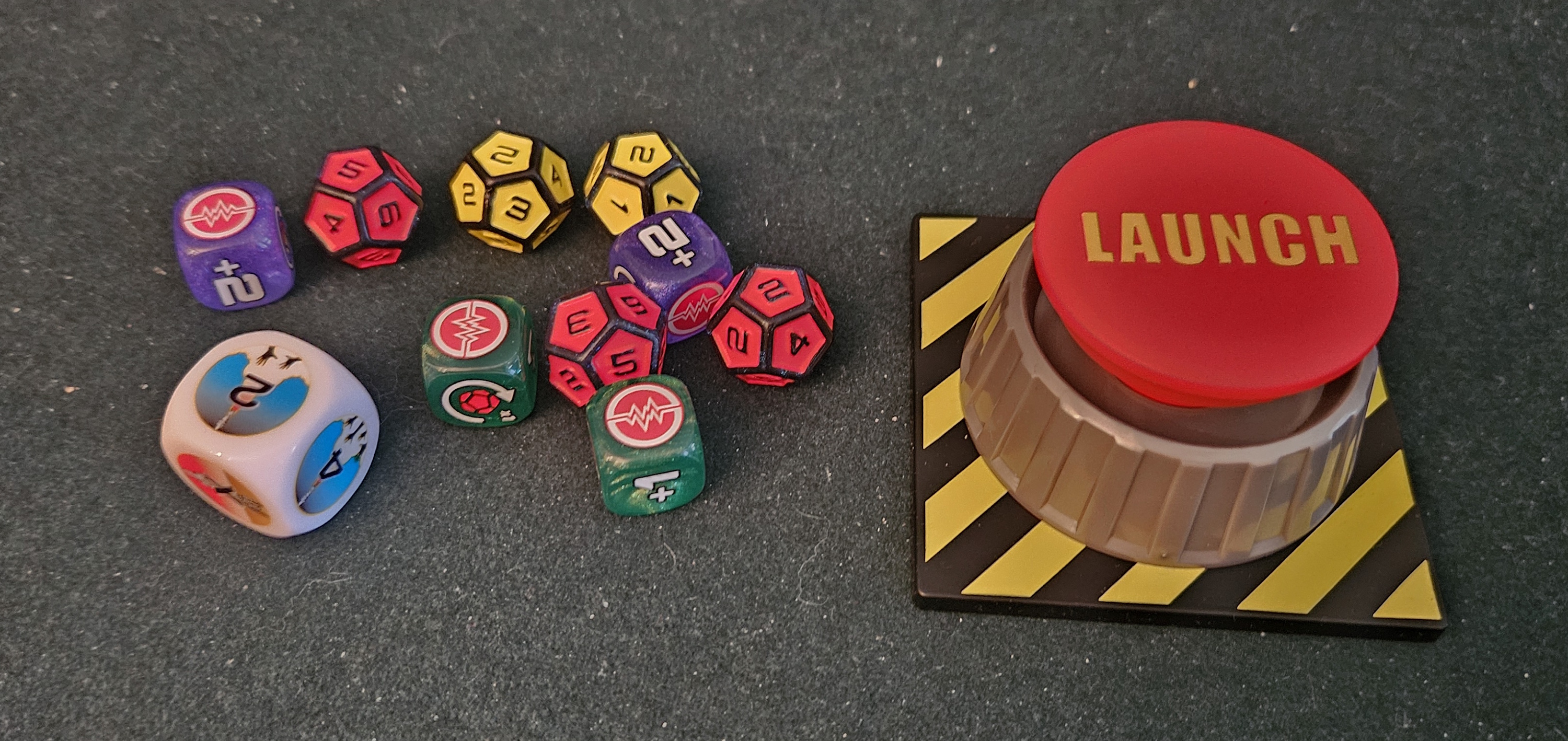
Cysmic, the board game by Jason Blake, gives me that feeling. When I hefted it onto the review stack next to my computer desk, my wife wondered aloud if it would topple and crush me. It isn’t the largest board game I’ve ever owned; that would be the 22-pound Ogre, the one with the team lift warning printed prominently on its side. But it’s the one that feels most like an Ozymandian temple to excess. Its map is sprawling. The frame that holds the hexes comes with hidden magnets to lock everything into place. The plastic constructs are so phallic that they make me uncomfortable. Among its many dice, there’s one for gauging your character’s crisis of conscience. It’s so gargantuan that it’s become a game-night joke. Nothing could justify this sprawl.

I kinda dig it.

This is the first knife hidden in these images. Because lately I have been Getting Into Knives.

Cysmic next to a few everyday items.

I want to set the scene. Both of the scenes.

In the distant future, humanity has settled an exoplanet. Pretty cool. Only it turns out that we repeated our past mistakes, squatting on territory that means us harm. This planet, you see, is tectonically unsound. Seismic. Cysmic. (Ohhhhh.) At some point in the near future, the crust of this world will flake away like the film coating an uncleaned oven. When that happens, the eruption of magma and steam will render anything above unlivable.

Not unlike the Salt Lake Valley, come to think of it. Mostly, I just don’t. Think about it.

Which is precisely the problem. Cysmic is unexpectedly redolent of Sol: Last Days of a Star, Ryan Spangler’s parable about climate collapse hastened by its victims, and Meltwater, Erin Escobedo’s cautionary tale about how nations set themselves aflame for the sake of spiting people whose existence has little bearing on their own. Of course, these titles could not be further apart, production- or intention-wise, but the parallels are there for the taking.

All, for instance, are about a looming crisis that their games’ factions are urgent to hasten. Because that’s the crux of the matter. Our goal on this planet is to escape by reconstructing one of the old colony ships that bore us here. But rather than cooperate to ensure everybody gets a seat on the ark, we now usher in our own destruction. We crack the mantle to get at the minerals that will shape the colony ship’s hull; we shatter the crust with our ordnance; we erect tracked megastructures that unfasten fault lines like zippers. Every action we undertake in service of survival steals a pinch from the hourglass.

Where Sol’s telling of this parable was poetic and Meltwater’s was bitter, Cysmic settles for frickin’ awesome. If those games offer the somber foretellings of the Book of Revelation, Cysmic is the Doof Warrior rendition. Let’s get this party staaaaarted, it hollers, jets of flame washing over the audience.

"You're right, that isn't how biomes work!" —a climatologist misreading my caption.

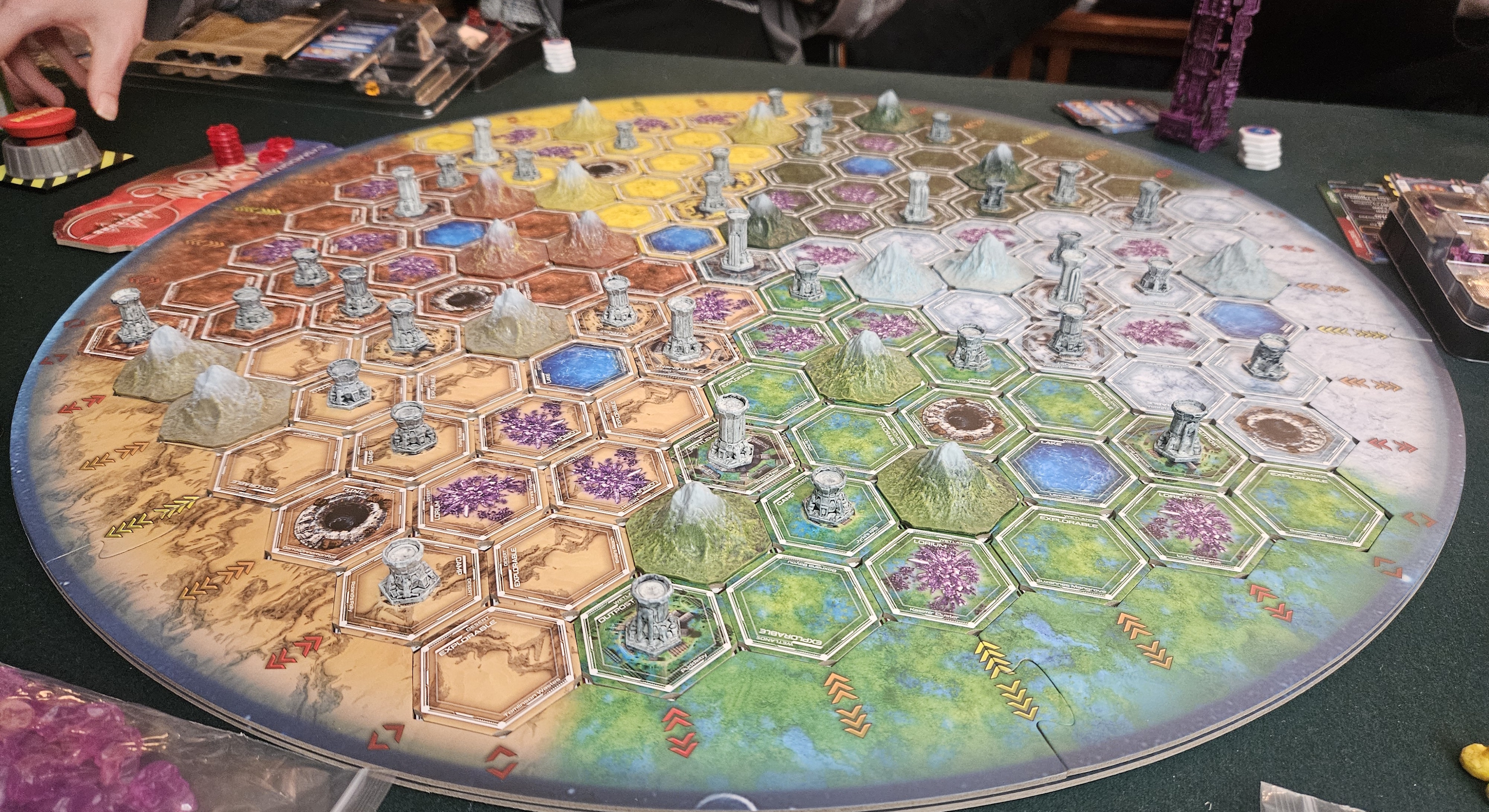
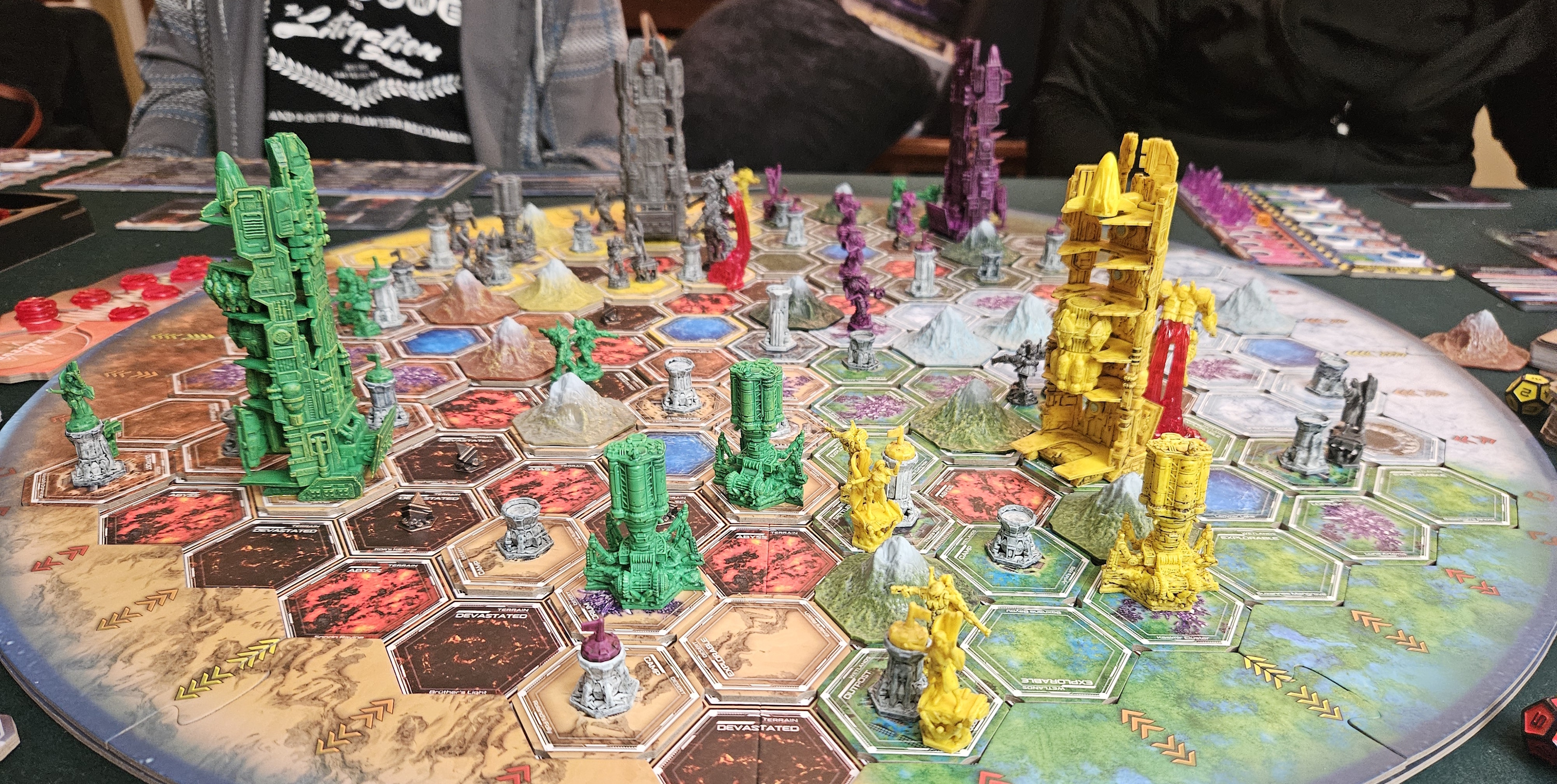
The map is ridiculous.

That’s the narrative scene. The second scene begins on the physical tabletop.

I worry about waste. Not as often as I ought to, probably. Compared to junk mailers and Happy Meal toys and oil wells set alight by incautious tyrants, board games are a drop in an ocean of muck. At least, I tell myself, they’re preservable. I donate some of them, and sell others, and buy secondhand when I can, and try to ensure that they go to homes where they will be appreciated and not wind up in some landfill after only one or two plays.

Cysmic defies that self-soothing rubric. The map is so massive that my group laughed uncontrollably the first time we set it up. Again, it isn’t the largest board game to ever take up real estate on my table, but it’s perhaps the most of everything else. Those frames, with their little magnets underneath the cardboard. The tiles, crafted with fingernail-thick nubs at their corners to make them easier to pry up. The plastic mountains, which called to mind the earliest printings of Runewars, back before Fantasy Flight decided to use cardboard overlays in place of three-dimensional topography.

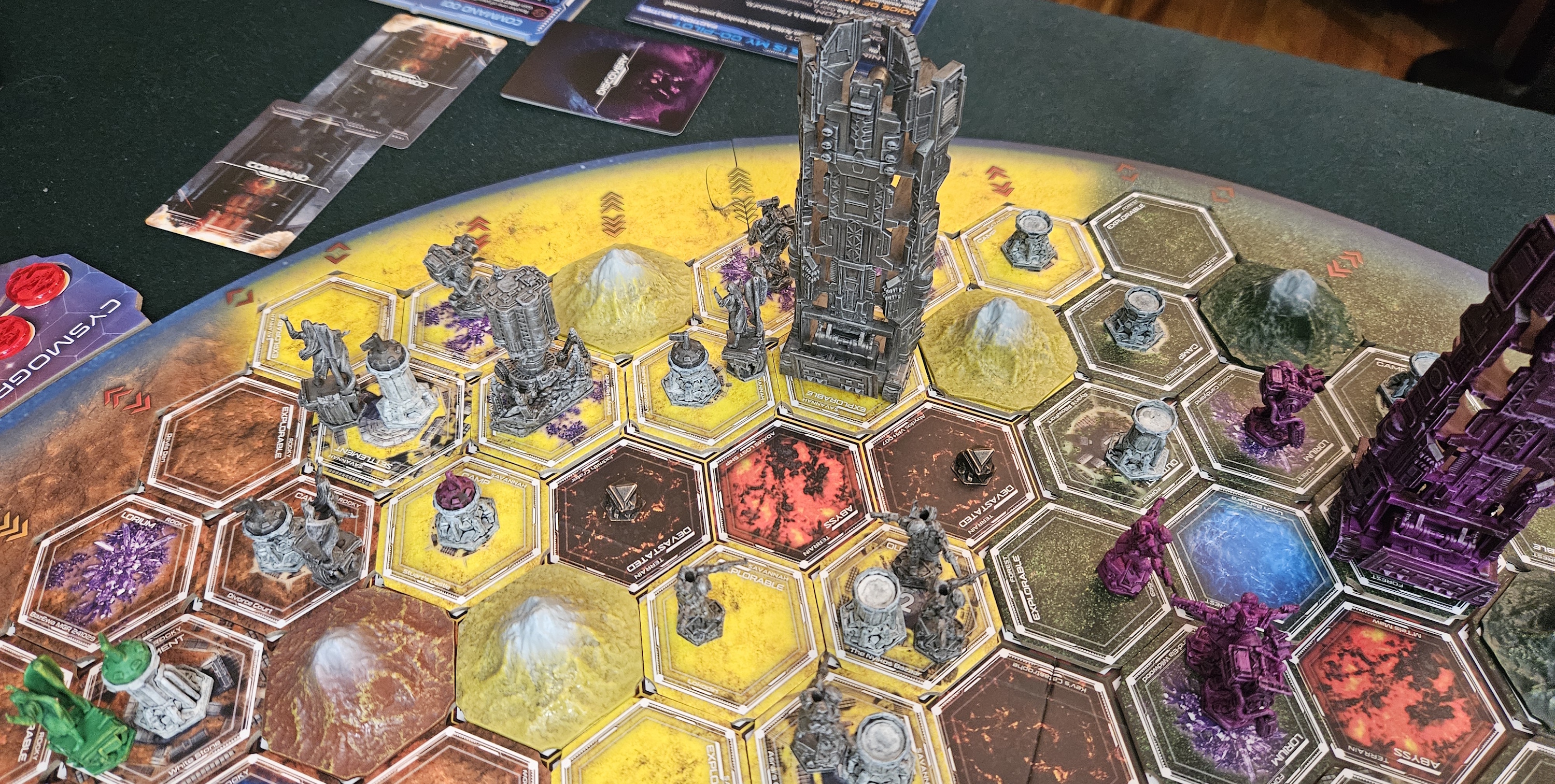
The miniatures. Goodness, the miniatures. Some of them are actually mini. Others, like the spires that hold the components inside your colony ships, an affectation that’s a nice bit of visual design on the one hand but also a physical obstruction of the battlefield on the other, are so large that they veer into self-parody. If you saw this thing on a sketch show, you would swear this wasn’t a real game. Ha ha, we would say, look at the silly nerds, with their jokes about Windows 11 and their board games that defy common sense. Those towers are not merely phallic; they are penises, swollen like Cormac McCarthy’s sunset, like Daniel Plainview’s erupting pumpjack, almost rhapsodic in the baldness of their representation.

To some degree, this clutter is extraneous to the tale Blake wants to tell. It’s so big, for one thing, that many of its rumblings hardly matter. The first time the mantle collapses to reveal the planet’s glowing lifeblood, odds are that the catastrophe won’t come anywhere near you. A settlement falls in, countless lives are lost, but only in theory. There are other settlements to claim, other veins to mine. The scars are mere obstructions, easily bypassed or flown over. Might as well fire up some extra rockets. Charge some lasers. Drill baby drill.

The map also wraps around, so these guys aren't actually hiding up against the edge.

Battle lines begin to form. Soon they’ll fall apart.

Then again, this is also the point. Because Cysmic, in addition to head-banging through the apocalypse, does have something to say about how the proverbial frog gets boiled. One collapse is nothing. Two is nothing. Five is nothing. But a dozen? Now we’re cooking. Like the frog in the pot. Like the settlements that have just fallen into mile-wide sinkholes. Like our troops, those without early warning detection systems, who have gone hurtling into the abyss.

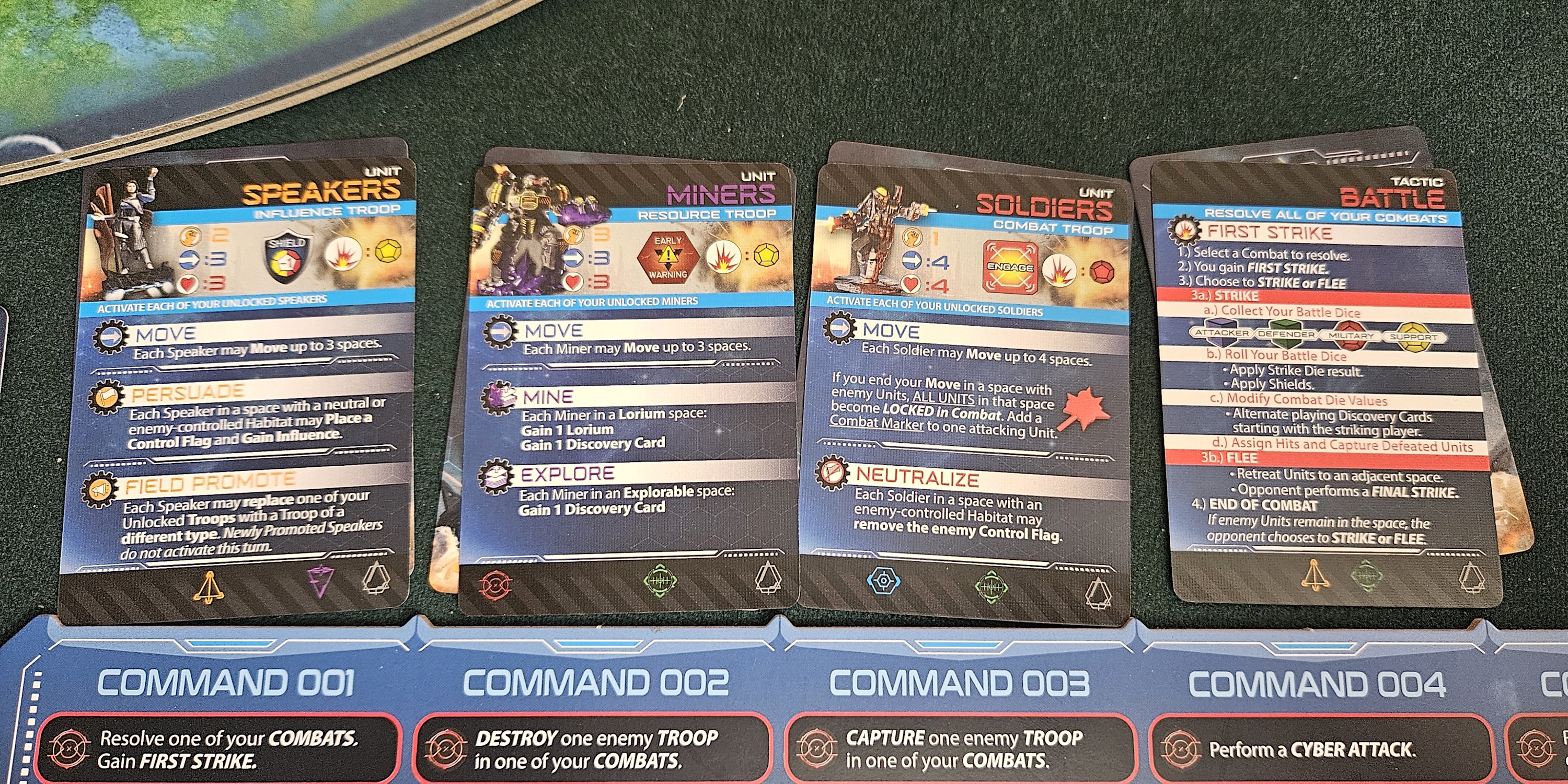
Let’s back up. For a game of such sprawling proportions, Cysmic is surprisingly smooth to play. Each turn sees you selecting a card that activates some segment of your apocalypse-realizing faction. Often, this means triggering a type of unit. There are diplomatic Speakers that are indispensable in the early days and more vestigial once the oven reaches temperature, Soldiers for shooting things, Miners and plus-sized Harvesters for mining minerals, and big jump-jet equipped Powermechs for blasting enemy columns. Other cards resolve all the battles you’ve set up over the previous turns, launch negotiations and cyber warfare, recruit or upgrade troops, the works.

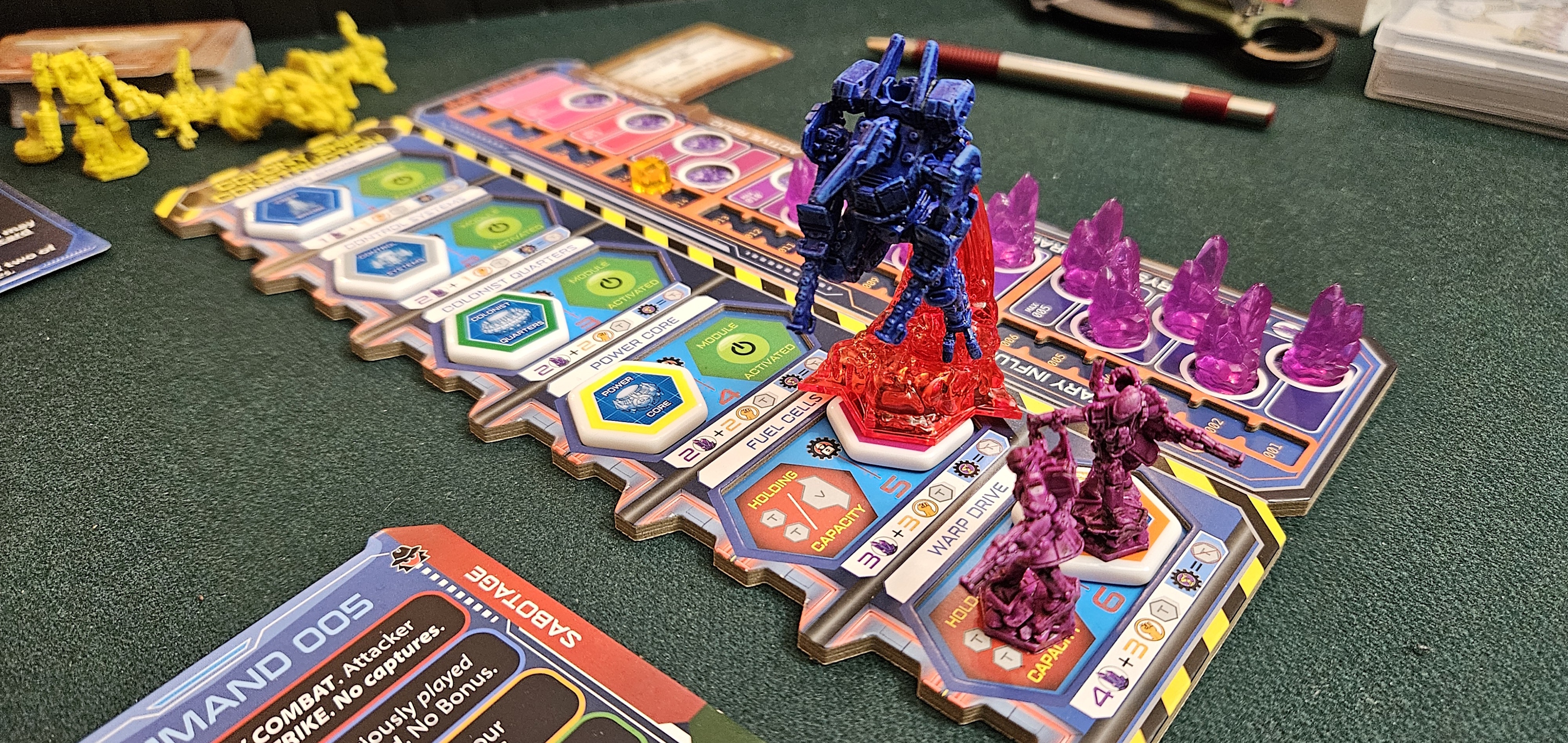
The most transformative card is the one that activates your colony ship. This inevitably collapses at least one hex as your giant launchpad shifts position, squishing troops and cities under its treads and leaving fiery destruction in its wake. This is also an opportunity to attach modules to your ship, provided you have the resources and blueprints to do so.

Despite this clarity, turns aren’t as straightforward as choosing one card among many. In addition to selecting which card to activate, you also choose one that will disappear beneath it. This card is out of the rotation for the time being, depriving you of an entire class of unit or some crucial activity. Sure, there are ways to cycle spent cards back into your hand before the end-of-round refresher, but it speaks well of Cysmic that you’re asked to make tough decisions early and often. These choices aren’t as profound as, say, the hand drafting in Inis or Blood Rage, but they tend to be more significant than the eldritch upgrade paths of Cthulhu Wars.

This positions Cysmic squarely in the middle of the Ameritrash spectrum, somewhere between the poles of “cerebral/political” and “beautifully stupid.” Before long, it touches on both extremes. And while its performance in either arena is accomplished to greater or lesser effect, it always returns to those core tradeoffs between cards. This does wonders for the game. At a glance, you can tell how likely it is that a rival will respond to an incursion with a counter-attack, whether a target can shift a particular unit out of your reach, when the next tectonic collapse will take place. None of this information is foolproof. There are too many special abilities and action cards and faction perks for that. But it’s enough to communicate some sense of possibility, a probability waveform that can be surfed to your advantage.

My priority is rock and roll, did you ever consider that? No? Shame on you.

The command system asks hard questions about your priorities.

So let’s look at those poles.

At heart, Cysmic is a contest of equal-opportunity aggression. Your goal is to complete your colony ship before anybody else, an objective made significantly harder by the absence of blueprints for all six of the necessary modules. Each player has sole ownership of one such module, meaning the only way to complete your ark is by prying the blueprints from their possession.

Fortunately, the blueprints of the far future apaprently come as shareable zip files. There’s no need to be too possessive; your possession of a blueprint does not preclude my ownership. The rub is that nobody is going to hand out their propriety information willingly. There are therefore two ways to gain access to a faction’s data. One, you can steal it via cyber crime, a finicky action that’s one of the game’s many underdeveloped appendages, but a noteworthy one all the same. Or two, engage in battle to kidnap some of their troops for use in a blueprint-for-prisoners exchange.

The implications are far-reaching. The good part is that everybody needs to attack everybody else, at least a little bit, in order to capture enough units to swap for those blueprints. If anything, a few early attacks might render a particular neighbor more or less negligible, which can be a huge relief when you share a border. Once you hold my blueprint, there’s no reason to attack me anymore, barring some late-game stalling for time.

On the other hand, this diminishes some of the game’s other elements. The map, for example, isn’t especially interesting, which is saying a lot when it depicts an entire planet crumbling under the strain of mech battles and mountain-cracking mineral extraction. There’s no reason to hold any territory in particular. One settlement is as good as another, resource veins are interchangeable, troops come and go, and entire flanks might collapse thanks to a random pull from a bag. With no sense of permanence, there’s nothing like a battle line, and the inviolability of your colony ship means there’s nothing to protect.

The closest dudes-on-a-map analogue would probably be Kemet, but one cleared of cities or temples. There’s plenty of territory out there, even a few choke points, but all that landscape provides very little reason to care about one tract over another. As the planet falls apart, it’s possible that some areas will become more valuable, but our sessions tended to conclude before such an eventuality was realized. The result is round-robin aggression, everybody targeting whomever they haven’t yet stolen blueprints from, with very little concern for anyone else.

My faction's powermechs scream "Zip zop zooey!" as they launch into battle. Nobody fears them.

Prisoners can be exchanged for blueprints.

The good news is that these aggressions are enjoyable enough in their own right that it isn’t as though Cysmic is going through the motions. Battles are punchy, if a little too concerned with different dice types and attack modifiers, and it’s always possible that a gunfight will accidentally split the world at the seams. There’s a little bit of everything in there. Dice, of course, with varying shades for combat and noncombat units; cards, for modifying rolls and maybe springing a nasty surprise; unit and faction abilities, just in case you thought you were getting off easy. Despite this abundance, resolution is reasonable, never reaching Forbidden Stars duration, which is great for the game’s play length if not for any prospective bathroom breaks.

Maybe the biggest highlight is the faction system. Like everything else in Cysmic, there are heaps to choose from, and in place of the expected mealy-mouthed plus-one perks, each team offers something transformative and meaty. One of them adds adjacency to every single space next to a mountain or lake, effectively letting you teleport anywhere at will. Another seizes control of any settlement anywhere on the map at the start of each turn. A third takes their turn at any point in the round — and I mean any point, treating the usual turn order to forced obsolescence.

What’s wild is that these are only the first of those factions’ abilities. Each offering has three or four whoppers. And there are more than twenty-five factions in all, each with their own distinct advantages and playstyles. The only real downside is that they all have dork-ass meme names like Path of the Wrighteous, Moving Mao Tons, or Kriss of Death. Receiving a diplomatic missive from uplifted psychic housecats is one thing; that the kittens have named their faction Cat-Aclysm gives off a real cringe vibe.

But, look, restraint is not Cysmic’s watchword, so why would Blake rein in the puns? Everything here is the board game equivalent of an extra order of mozzarella sticks. The handfuls of dice. The units you probably won’t field. The sheer variety on display. There’s even a clacky launch button that serves precisely zero in-game function, but which I very much intend to keep when I pass the game along to somebody else.

And, of course, there’s that most emblematic of all components: the conscience die.

My conscience says it's time for a big scoop of peanut butter.

Roll the dice. Smash the button. Search your conscience.

To my utter tickling, this final hexahedron serves an indispensable purpose. When at last the planet has been strip-mined, when the blueprints have been assembled, when the modules have been stuffed into your colony tower, the game is still not complete. Now it’s time to blast off for the stars and leave the rest of these suckers behind.

Except you might not be ready to hit the red button. It all depends on the conscience die. When the time comes, you roll and compare its result against the troops you still have on-planet. All the miners and troops stationed in the dust, all the diplomats persuading those neutral settlements that you have their best interests at heart, all the prisoners still waiting for freedom. The conscience die reveals how many you’re willing to leave behind. If there are fewer out there than the roll, you leave. Kaboom.

But if not, you stick around and attempt to evacuate more bodies, more lives. With the right resources, you can try the roll again next turn. Without them, you’ll have to wait for the end of the round when your cards return to your hand.

Either way, Cysmic has done the unexpected. It has grounded the moral cost of its conflict. In incredibly shaky terms, yes. In a way that rewards losing units to cave-ins and enemy assaults. In a way that makes the anthropogenic horrors visited on its planet and peoples seem all the sillier. But in terms that, imperfect as they are, most historical wargames don’t even attempt, and which — and I say this in all seriousness — we would laud in a game with a more solemn setting. Because even here, as the world collapses toward its molten core, sometimes the cost is too high. Sometimes you can’t bring yourself to make the hard choice. Even if you happen to be a battle-hardened jerk named Minnesota Killjoy.

(Yes. That is one of the game’s factions. Save me.)

I now want to play Clash of Cultures on this map. While the terrain falls into the core.

Ah. Ludicrous.

This, I think, is what sets Cysmic apart. It’s too big. It could have been pruned down. It doesn’t need quite so many alternative modes. The mountains could have been cutouts. The launch towers could have been a little less, ah, engorged. There didn’t need to be magnets all over the place.

But it’s also a huge cry from the crowdfunding trash that gives miniatures-heavy games such a bad name. Unlike some of those titles, maybe even unlike the majority of them, Cysmic is a game one would actually opt to play. And more than that, it’s an earnest experience, one packed with exciting battles, a landscape undergoing disaster, a race to survive at all costs.

It even has shades of meaning in its human-hastened collapse, one that feels all too timely. Here in the desert of Utah, a billionaire has announced a 40,000 acre data center that will triple the state’s power consumption. The stated reason is national security, a digital arms race against China. This despite the professionals at the local universities pointing out that we don’t have the water, don’t have the heat allowance, don’t even have much of a Great Salt Lake anymore. Will our elected officials make a saving throw on the conscience die before they bake us to death? I hope so.

For a board game, that’s the sort of thing that makes us say it’s punching above its weight. When it comes to Cysmic, the aphorism feels wrong. Let’s instead say it’s punching at precisely its weight. Fine: maybe a little under.


A complimentary copy of Cysmic was provided by the publisher/designer.

(If what I’m doing at Space-Biff! is valuable to you in some way, please consider dropping by my Patreon campaign or Ko-fi. Right now, supporters can read my first-quarter update of 2026: the best board games, movies, books, and more!)
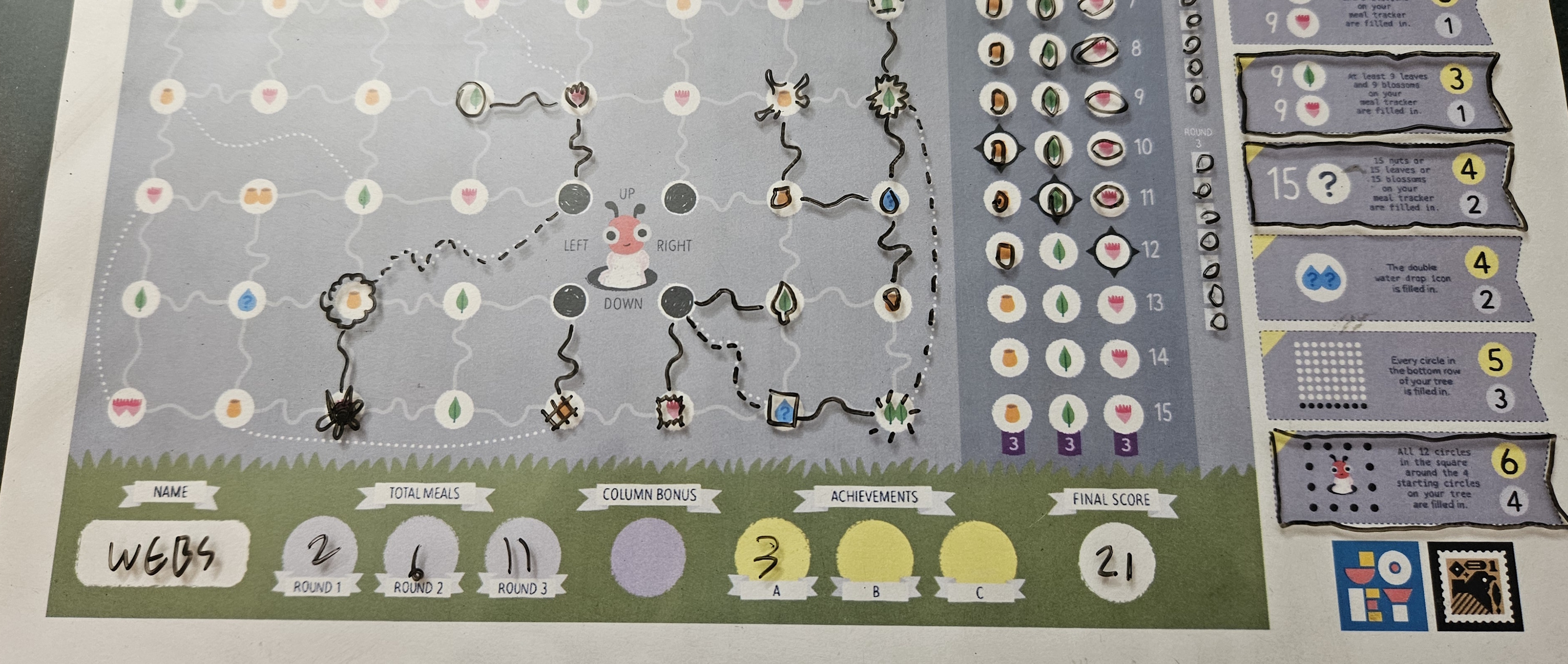
  •  

Touch Grass (Metaphorical)

at last, a use for this darn orienteering merit badge

Voyages, the first of Matthew Dunstan and Rory Muldoon’s single-sheet print-and-play roll-and-write games, used three dice. Aquamarine used two. Waypoints continues the trend by using a single die.

That’s cool in its own right. But that isn’t what makes Waypoints special. What makes Waypoints special is the way it handles the movements generated by its rolls. Where those other titles — and let’s face it, most board games — featured straight movements, point to point, A to B, nearly every move in Waypoints is the sort of move you might actually make while traversing an open space.

Here, I’ll show you.

I attempted to draw my route in the spirit of Fabio Bracht on BoardGameGeek. His penmanship (squigglemanship?) in this game is super impressive.

A glimpse of the first map and the many places it might take you.

You’ve taken the Internet’s advice to touch grass. And with gusto, because rather than go to the park or something, you’re opting for a four-day wilderness expedition. Hopefully you aren’t prone to hay fever.

The gist behind Waypoints is that every turn you’re allotted some number of movement points. The number itself depends on the weather, and isn’t as simple as rolling the die and moving as far as it indicates. Instead, your roll shifts you forward along a track and reveals the current turn’s weather for everybody at the table. Inclement showers or storms might confer only a single pip of movement, while sunny afternoons offer a full five points. You also have a limited supply of water, which can be spent to stretch yourself to greater distances.

Every move begins and ends at a waypoint. When the game opens, that’s a campsite. Turn by turn, that might mean a wildlife site, a peak, a hot spring, a scenic overlook, or any number of other destinations. There are plenty to discover, and across the game’s five scenarios there’s a fair bit of variety. Along the way, you might swing by special features, like water sources or forests, but these aren’t waypoints, just side destinations on your way to the main thing. If you can’t reach another waypoint, that’s fine, but it means you’ll be stuck at your starting point pumping some extra water instead of moving anywhere at all.

As for those movement points, they’re spent by crossing lines. Latitude and longitude? That’s a point. Elevation? Another point. A long-distance trek involving multiple map segments and lots of hiking up and down ravines? That’s possible, but you’ll probably need a decent stretch of good weather. That or guzzle tons of water.

The skill here is avoiding goats.

Each map prioritizes a different skill.

Very quickly, these inbuilt limitations give your movements a certain naturalistic beauty. Rather than dealing in straight lines, as the crow flies, Waypoints challenges you to think like a gravity-bound creature. You’ll scurry along ridges, stick to gullies between rises, find open stretches of flat ground for traveling long distances, march up inclines in short spurts.

Of course, saving energy is only half the game. You’re here to see things. And the things most worth seeing outdoors are liable to be hard to reach. There’s a balance to be struck, then, between conserving your strength and pushing yourself to see the best sights.

But the result is a creativity of space, energy, and distance that’s rarely expressed in a medium as literalistic and rules-bound as board games. Often, the best route will be circuitous, the one that loops the long way around a peak. Or one that swings down a hill to collect some water, across a meadow to investigate a forest, and then around and up an incline where you’ll deploy a hang glider to soar to your next destination.

Because of course there are special abilities. In the first map, you quickly avail yourself of hang gliders and kayaks for covering great stretches of the outdoors. On other maps, your tools might include climbing ropes, cable cars, bicycles, snorkel gear, dinghies, ski lifts, or ferries. This produces fresh conundrums for each scenario. More impressively, these differences are also visible in the lines you draw on the map. In the desert, you tend to travel in spurts, sticking to shade or rationing your movement around the great canyon bisecting the map. On the ski slopes, shuffling upward is more difficult than gliding downhill, resulting in sharp rises followed by sweeping, switchbacked movements that visit feature after feature before arriving at the turn-concluding waypoint. In Waypoints, your mode of transportation is written directly onto the page, visible in the sweep of each route.

butterflies become granola... curious.

Meeting wild animals confers a wide range of benefits.

Like the previous entries in Dunstan and Muldoon’s movement trilogy, Waypoints is heavy with scoring opportunities. Fortunately, also like Voyages and Aquamarine, the scoring is interesting at all points.

The main commonality between maps is wildlife. There are always three types to see, and apart from occasional oddities — on the coastal map, the majority of my dolphin sightings occur in forests — it’s rewarding to watch your appreciation tick upward, earning not only points but also additional tools to make traversal easier. Beyond that, maps grow more playful. In one, reefs earn additional points later in the day, creating a situation where you’re incentivized to visit them late, but not so late that you get stranded when the day unexpectedly comes to its end. In another, you parcel out slugs of whisky between visiting local breweries or slogging through lochs in search of monsters.

Perhaps the one sour note is yet another repeat: the solitaire mode is a letdown. As with Voyages and Aquamarine, this is one roll-and-write that’s far more interesting to experience with other human minds. The problem is that the solo objective is incredibly easy in a vacuum, asking you to ensure that you conclude each day at a campsite. When that’s your primary objective, it’s a thing easily accomplished.

With fellow trekkers, the real goal is to wring every last point out of an imperfect day. Some hikes will be cut short, the caprice of the dice only offering a small handful of turns before the sunset brings your trek to a close. Others might even go long, your hiker hovering around a natural concluding point, only to find themselves distracted by extra sights. Regardless, there’s something satisfying about facing challenge after challenge, feeling like everything is going wrong, only to look at a rival’s sheet to discover that, you know what, your journey was rather remarkable in the end.

And scored forty-something points for it. Boom, baby. I still lost.

That time I scaled the Grand Canyon eight times in a day.

That’s the last great thing about Waypoints. In the minute between scoring and erasure, you get to look back on this thing, this little journey, and behold what you’ve accomplished. The strange loops, the reversals, that time you got stranded at a lighthouse for the night. The stories this game tells are small and gentle, but that’s also what makes them worth tracing one last time. This is no battle. There are no foes to vanquish. Only you, a fellow player or ten, and the routes you penned onto a map.

It’s a rare game that lets its players be so expressive. That Waypoints does so much with a sheet, a pen, and a die is nothing short of wonderful. I liked both Voyages and Aquamarine; against all odds, this one outdoes both of them at their best.


Access to the files to print Waypoints was provided by the publisher/designer.

(If what I’m doing at Space-Biff! is valuable to you in some way, please consider dropping by my Patreon campaign or Ko-fi. Right now, supporters can read my first-quarter update of 2026: the best board games, movies, books, and more!)
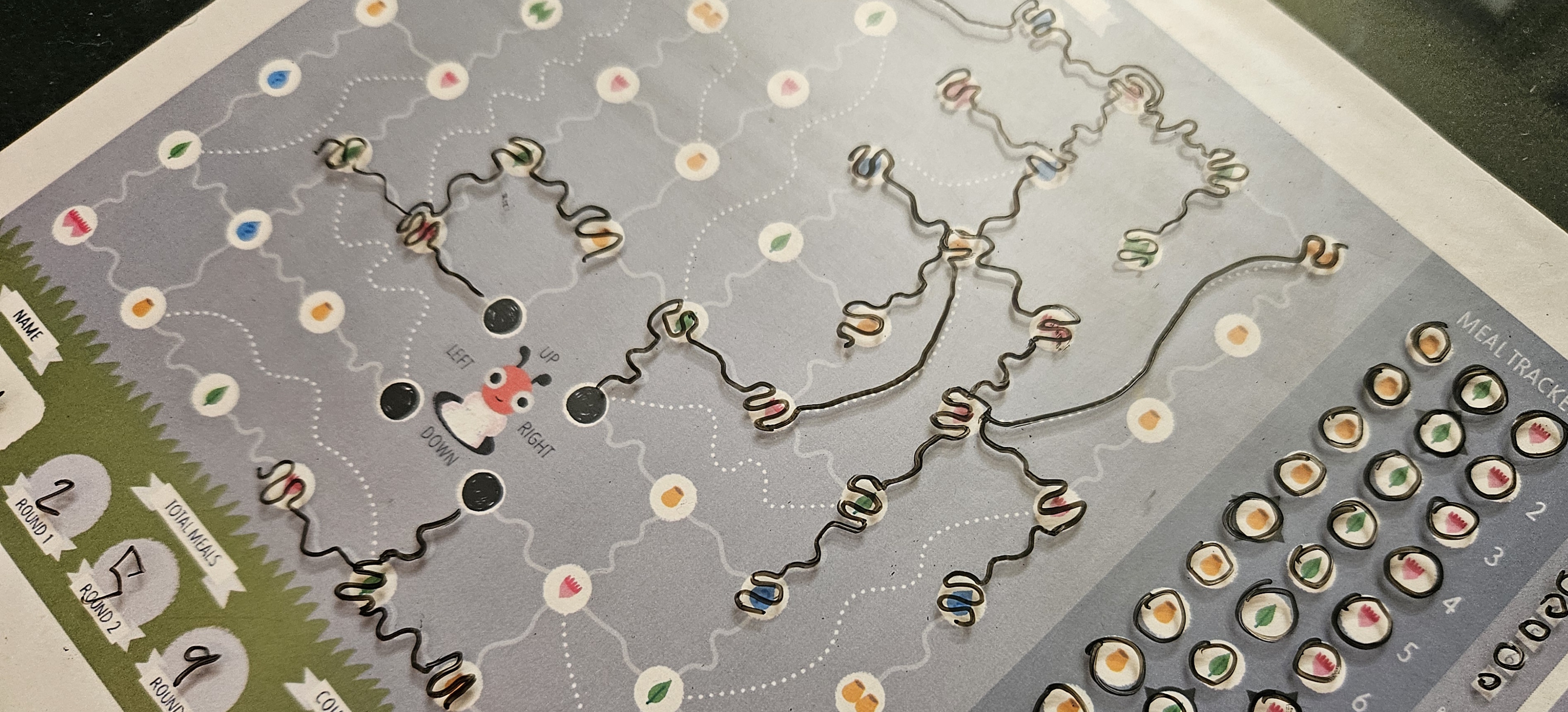
  •  

Blood in the Felt

he ought to be showing his middle finger

The original Fallout — the original original, the video game, the one from so long ago that they refused to sell it to me at the media section of my local grocery store because it was rated M for mature and as a twelve-year-old they suspected I didn’t qualify — it had a time limit. After a certain number of in-game weeks, the quest failed. Sayonara, Vault 13. Sorry about the terminal dehydration.

You know what else has a time limit? My life. Your life. All of our lives. I was once advertised a wall calendar that would count down the weeks in the average lifespan. It was perhaps the grimmest thing I’ve ever seen, one’s life scratched off week by week. Fallout: Power Play is that ghoulish product in board game form. It is a waste, the subtraction of every minute in its presence keenly felt. If the function of art, as Tarkovsky noted, is to harrow the soul and prepare it for death, then Fallout: Power Play is anti-art. It is a game that makes me unready for the beyond, incurious to receive the answer to the great mystery that awaits us all. It makes me resentful and crabby. It makes me want to claw those minutes back from the felt and stuff them red-nailed into the craw of whichever anonymous designer retched forth this slouching antichrist.

I do not recommend it. Not ironically, not for a sake of a lookie, not to release its carbon back into the atmosphere through combustion. Stay away. The radioactive skeleton has been thus mounted atop the dump, its meaning undeniable. If you enter here, you will leave poorer.

Do not be tempted. Do not be deceived. This is a board game mimic, a creature known to consume nerds.

The distant appearance of a lane-battler.

Ostensibly, Fallout: Power Play has the outward appearance of a lane-battler. The wasteland is presented as a series of locales, theme-park destinations like the Brotherhood Airship, the War Camp, the Trading Post. Generic and safe, like every Fallout after the first two and New Vegas, strip-mined for maximum return on investment.

Into these locales you will deploy — you will maybe deploy, but we’ll circle back to that — the populace of your faction. There are four in all. Most familiar even to outsiders is the Brotherhood of Steel, those much-fetishized techno-cultists, in their iron suits that smell of piss and incense. They are matched by the Enclave, the baddies of the series, although only in the sense that they are slightly less nostalgically laden; the Super Mutants, greenskin crazies shorn of the cognitive internality that marked their earliest incarnations in the video games; and the Raiders, who one suspects were included because the designer was running out of ideas but had been tasked with shoehorning in loony-bin scavengers for the sake of marketability.

Ostensibly — there’s that word again — these factions go about the business of deploying their scientists and tin-can warriors and yellow-toothed scavvers and greenskin mooks into these locales, with the aim of securing influence and therefore victory points one pip at a time.

Only, as you might have guessed, this is not what happens. No sir. No ma’am. Not even close. Balance isn’t something I usually fret over. It’s a coward’s concern, the birthright of those mewled into comfort from infancy. Balance? I might as well bellyache about fairness!

But in Fallout: Power Play, we are reminded of just how good board games have gotten over the past decade. I speak not of the balance between decks, between factions, because it’s impossible to get that far. Rather, the issue is wholly internal. These decks are so lopsided that there are hardly any troops to deploy. Those boots that must be placed on the ground, which indeed are required in order for the game to function, are the exception rather than the norm. In place of manpower, all four decks are top-heavy with everything else. Missions, which seed little objectives that, surprise surprise, require the troops that you only occasionally have access to. Powers, which, what do you know, also riff on the troops you may or may not have deployed to the wasteland’s many sunny destinations.

To produce art, to share it widely. To not have it stripped into a meme, all meaning lost in the familiarity.

Signs and signifiers, devoid of the soul.

As a result of this crooked state of affairs, most turns are spent waiting around. Passing. As in, literally telling the table “I pass,” like a kid who forgot their homework, only in this case the teacher neglected to hand it out yesterday, but has, in their cruelty, still insisted that their pupils collectively pass their papers to the front. “I pass,” you say. “Pass,” says the next player. Someone else dumps three troops into a location. Luck of the draw. “I think I will pass,” says the next player, and then, in an attempt to interject some levity into this torment, they add, “But I am choosing to pass. I am not passing because I don’t have any cards to play.”

They are lying. Lying to themselves that this experience could be buoyed. Lying to themselves that they might reclaim these misspent minutes.

Is this a commentary on the unfairness of war? Of how war never changes, parroting the catchphrase that has become self-parody? If only. I might stomach a game that wanted to teach me something, even if it were as badly done as this.

But Fallout: Power Play cannot keep its own story straight. The cards urge their players to trigger activities that are impossible. Bold keywords that go unexplained, their meanings only guessed at, peer back from the cardstock like the unblinking eyes of the abyss. Other cards sport instructions that the game declines to enable or explain, the equivalent of an apocalyptic warlord who amuses himself by playing games with his prey. When the player is told to “choose a quest,” how are we intended to denote such a thing? Memory? A nonexistent token? A tapped card? Do we announce the choosing, or leave it secret? Can we cheat? Can we change our minds? What if the quest is removed? What if upon its removal it reappears? Is there bluffing in this game? Is there a soul, some form-space version only accessible within the sulci of the designer’s mind? If so, how might we access it? Would a surgical drill suffice?

I adore games. Bad games, too. Like bad art — bad films, bad books, bad paintings — there is an earnestness that makes all of human endeavor worthy of investigation, even if only as a means to understand its impulse and methodology. I can play a bad game. I often do such, and have a wonderful time examining what makes the bad game bad, what makes it fall short of what-could-have-been. Even bad games are worth my time.

What I cannot play is a tossed-up wad of cardboard that has been struck before me with the intent to waste my time. I say “intent” because at least then Fallout: Power Play would have been produced with something like intention, something like deliberation, rather than this generated slopmess, this uneager unthinking unplay. I have been pranked by a trickster; that would be better than to have suffered so unwittingly. To unwit, then, the only object of curiosity in the entire package is the absence of the designer’s name. It is there. It can be found. But it is hidden, neither on the box nor attested on BGG. At least that speaks to some measure of dignity. A dignity denied to me, by the way, in the moments Fallout: Power Play has stolen, irrevocable and irretrievable, from the precious span of my life.

Someone is going to shout at me for this review. Guaranteed.

1 1000 51 6 500.

I want those minutes back. I am resentful, like the firefighters sent into Chernobyl, the authorities insistent that we are safe, this was a mere accident, the graphite on the ground has only charred our flesh because our lying senses are mistaken, now will we please whittle the oaken heartwood of our limited days on this bounteous Earth down to a flinty toothpick for the sake of somebody else’s error, somebody else’s neglect, and while the shavings pile up at our feet, minutes that will not be reclaimed, but will be stricken from those that might be shared with our children, their faces upturned to adore the parents whose lovemaking gave them life and who bounced them in their exhaustion until they could at last close their eyes and sleep, while those shavings mound to our knees, will this game forget that these objects are meant to be joyous reflections of our birthright as creatures who learn from our frolicking, who test gravity with leaps and who learn songs through atonal screeches that set our hearts afloat despite their assault on our eardrums, and this is life and what it could be, what it was meant to be, and this ungame, this hideous thing, should not be experienced by man nor beast, but consigned to the mulch of the soil until it enriches something for the first time since it was atomically the lignin of a great tree, now whittled to shavings, its compressed heartwood all in fragments on the floor, and there is no gluing together what was carved apart with sharpened iron and thoughtless conception.

Do not play Fallout: Power Play. I challenge you to never play it. I dare you to stay away. I beseech you, I beg thee. There are better ways to exhaust this one life you have been given by god or the universe. Write a poem. Draw a stick-figure. Design a game. But make it yours. Show me what you have made. It will be better than this, and I will receive it with eyes of joy.


A complimentary copy of Fallout: Power Play was provided by the publisher.

(If what I’m doing at Space-Biff! is valuable to you in some way, please consider dropping by my Patreon campaign or Ko-fi. Right now, supporters can read my first-quarter update of 2026: the best board games, movies, books, and more!)
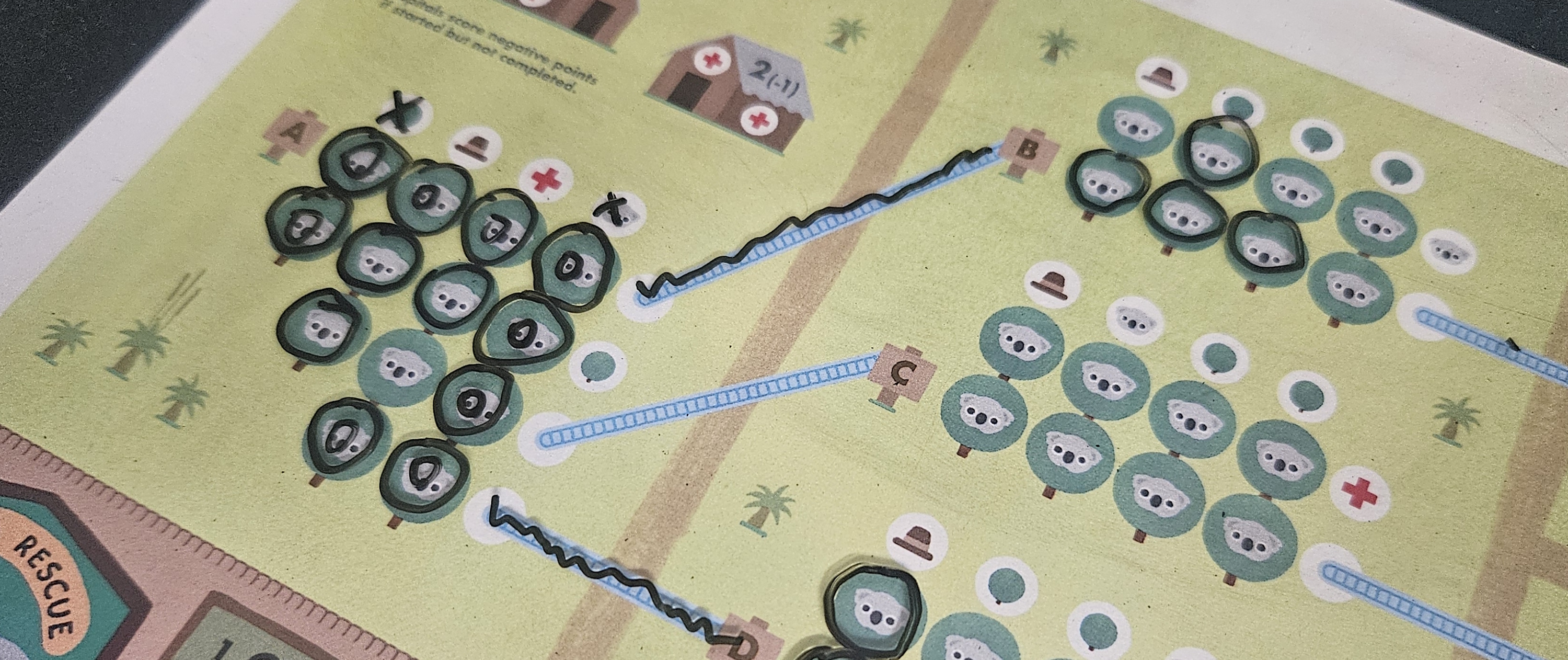
  •  

All Things Go, All Things Go

First Seattle, now Chicago. What's next? I vote Pompeii.

Quinn Brander’s Rebuilding Chicago is one of the best polyomino-placement games I’ve ever played. That’s the lede, and I will not bury it. Even moreso than its predecessor, Rebuilding Seattle — not to be confused with Raising Chicago, which I do pretty much every time I say the game’s title aloud — this is a tight, smart, and addictive approach to city-building and competitive brinkmanship. The more I play it, the more I want to keep coming back.

I dig this approach. Rather than separating the bookkeeping and tableau-making, they're right next to each other. Makes it easy to see what needs to be tracked. Not sure I've seen that before.

The player boards are also where you build your district.

Lest this become a comparison piece with Rebuilding Seattle, let’s nudge the parallels out of the way. Yes, this is more or less the same system. But where Seattle had some baggy Ozempic skin wrapped around its bones, Rebuilding Chicago sees Brander screwing down every edge and flap until all that remains is a taut cable that bears so much more weight than its predecessor.

We begin with the usual tale. Chicago has burned down. Cow in the shed, fire fire fire, a hot time in the old town tonight. Now it’s up to you to transform the rubble into not only into a place people can inhabit, but one they might visit from afar. A World’s Fair city. A city that stands for a thousand years. Or at least a little over a century, barring any further catastrophe.

Right away, there’s a confidence to the whole thing. Your player board, festooned with trackers and laws only you can pass, also shows the first portions of your city district. Cleverly, this district is fragmented. There’s the main area, filled with food carts and gardens and public parks — a lot of rubble, too — where you will place the structures that govern your city’s progress. But there are also two smaller areas, way off to the left and right. You’ll bridge to these areas eventually, but until you do so they’re unavailable, just collections of spun-off decay that must be reached eventually lest they produce an eyesore from afar.

Quinn Brander is an extraterrestrial. With seventeen digits on his primary appendage. And he came here, to Earth, to design board games. Devious.

The card offer and scoring board is printed in base 17 for some reason.

Rebuilding Chicago, then, is a polyomino game in two layers. Underneath it all are suburbs, oddly shaped pieces that don’t always fit together easily, each providing the same icons that dominate your main board. Once adjoined to the rest of your city, these then provide the foundation for everything else.

It’s a little bit like building one jigsaw atop a different, mismatched jigsaw, with certain pieces you’d rather not cover because all those hot dog stands will provide income at regular intervals. But given how tight the game’s geography tends to be, sacrifices will have to be made. It isn’t uncommon, for instance, for your pitiless district councilperson to glean the benefit of those local hotspots, only to then immediately eminent domain them into new shopping centers.

There are seven types of structure in all, but three of them are given outsized attention: shopping, nightlife, and dining. These are your amenities, and unlike the banks and train stations and everything else, they’re given special trackers for both their quantity and quality. This is crucial, because at certain points someone, whether yourself or one of your rival district bosses, will trigger these amenities to score. When that happens, you check their position on your trackers against how many dissatisfied citizens are living in your district, subtract any shortfalls, and then earn victory points and hard-earned cash on the result.

That's where Stephen King novels happen.

Those gaps in your city are entirely legal.

In addition to your ongoing construction projects, Rebuilding Chicago contains a whole series of interlocking systems, but never so many that the game becomes complicated to cluttered.

To start, there’s the drafting. You select buildings, bonuses, amenity perks, and everything else via a market draft. Each card offers both structures and some other bonus, forcing players to make hard decisions almost every turn. Meanwhile, the market doesn’t refresh unless you pay some cash to do it. This can feel restrictive at times, especially when you’re scraping the till for every last nickel, but also prevents the table from churning through the decks — of which there are three, one per era of the city — until they get precisely what they want.

Overlaid atop everything else is an event system that’s purposely frustrating in all the right ways. Claiming an event awards some minor bonus to the triggering player, while also applying a broader effect to everyone at the table. In many cases, though, the best outcome is to let some other rube trigger them so you can benefit without having to spend the turn.

These events run the gamut: new suburbs, cash for hot dog stands, scoring checks, even occasional bids to ensure your city is visible on the world stage. There are subtleties aplenty to consider, especially since events tend to be scattered among the usual card-drafting and city-building, producing little windfalls that punctuate the action. The result is a circadian rhythm that propels the game through both ups and downs. Sometimes players are flush with cash, other times events provide necessary infusions. It’s significantly more organic than the systems found in some tableau-builders, where everyone has resources until they don’t. Here, everybody is involved until the last event has been claimed. Then it’s time for the next round.

Also, my friend Adam will trigger shopping one turn before I need it triggered. Every time.

Events are powerful, and dictate the duration of the round.

Perhaps best of all, Brander’s vision of a city on the rise is pleasantly nuanced. The amenities are the clear show-stealers, with their periodic checks and windfalls. But every project receives its due in some manner. Trains allow access to distant suburbs, making expansion all the easier, although at times the additional responsibility can prove overwhelming, especially in the game’s early stages. Schools reduce the number of grumpy citizens, making it easier to appease your population via amenities. Financial institutions make money, special landmarks trigger sweeping bonuses that can alter your approach to scoring, and even single-square monuments serve to beautify your urban landscape and pave over unsightly messes.

It helps, too, that each player is given control over their own district, complete with its own starting benefits and unique laws, the game’s term for special abilities you can trigger once per round. The Loop, with its easy access to transportation, tends to expand rapidly, while River North feels a little more scrappy and Lincoln Park is thick with cash potential. There are six districts in all, and rather than settling for my usual three plays I couldn’t help but give them all a try, observing how Brander invests his system with distinct puzzles despite making only the barest of tweaks. My personal favorite, Hyde Park, leans into the education strategy to quell its citizen-grousers, but there are other approaches, all valid, with their own advantages and drawbacks.

Which is to say, it’s a stunningly rich system for so few rules. Perhaps that’s to do with how it always returns to its core considerations: the draft and how your rivals can steal precisely what you were looking for, the events that might occur one turn shy of their maximal benefit, and above all those wonderful skylines, all Tetris pieces and larger landmarks and monuments spackled into the cracks. This is one of those rare games that asks to be looked at for a moment, to be beheld, before everything gets sorted back into the box.

where's the bean

Hey, I’ve been to there.

In the end, Rebuilding Chicago realizes the promise of Rebuilding Seattle and then some. Where that game played it loose with every detail, this one cinches up its suspenders. The result is a mighty fine game in every regard. As a drafter, as a race, as a series of accidental or snitty thefts between players, as a positional puzzle to use every last acre of a city in metamorphosis. Here’s to a second round with each of those half-dozen districts.


A complimentary copy of Rebuilding Chicago was provided by the publisher.

(If what I’m doing at Space-Biff! is valuable to you in some way, please consider dropping by my Patreon campaign or Ko-fi. Right now, supporters can read my first-quarter update of 2026: the best board games, movies, books, and more!)
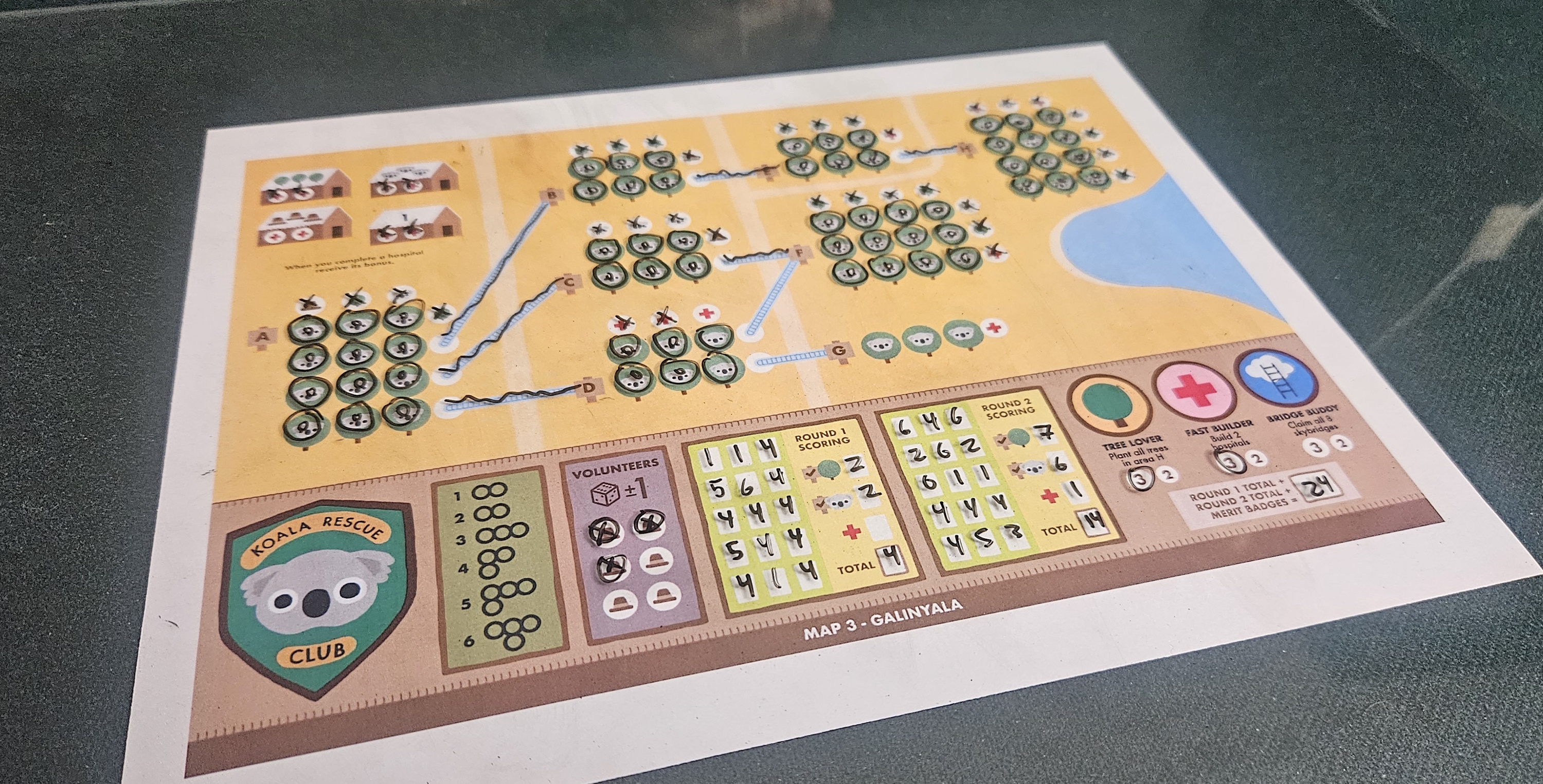
  •  

Better Citizens than Netizens

I've been reading the latest book in Adrian Tchaikovsky's Children series, and there's a very good chance it has colored my impression of this game for the better.

Citizens of the Spark feels like it was custom-made with me in mind. It’s a tableau-builder (yes) designed by Philip duBarry and illustrated by Diego Sá (yes) seeded with a small selection from a huge pool of cards (yeeesss) that happens to be populated with anthropomorphic animals (eh, fine). Those animals, it turns out, are not your usual medieval-ish fare, but scientists, scholars, performers, and everything else, jumbled together to form a polis of intersecting interests and vocations.

Which is to say, it brought me around in the end.

No mantis shrimp? Where is my Cato?

Ah, my pleasant animal polis.

It begins with a shuffle. Such a big shuffle, in fact, that my relatively broad hands ache at the strain of holding so many cards. There are thirty flavors of citizen in the box, a generous spread. Depending on your player count, you’ll take seven to ten of those sets, each set ten cards in size, and riffle them together until your knuckles crack.

And then you try to get them to work together.

Even in its earliest moments, there’s a tinge of something primal to Citizens of the Spark. Not primal in the sense of cavemen striving against the mammoth. Primal in the way the game asks you to create a society from these dissimilar peoples. This is the question that hovers over all of civilization. Can people who don’t see eye to eye live beside one another and strive toward a shared goal? It’s visible in Sá’s artwork. The Judge is a chicken. Not in the sense that she’s a coward hiding behind the bench and his robes. She’s literally a chicken. A hen. A producer of eggs. Tasty in peanut oil. She might share a city with one of her natural predators. An Agitator who happens to be a fanged reptile. A Soldier who is a bear. The tiger Scientist. To thrive, one presumes the city is governed by détente. No eating the judges.

As lovely as those illustrations are, duBarry encodes these dissimilarities into the cards themselves. In any given session, you might be presented with a society of Tyrants and Executioners. Yikes! But those dangerous creatures may soon prove paper tigers in the face of Traders and Politicians. Your task is to take these cards, measure their worth, and try to piece together something functional. There are natural imbalances, of course, but nearly any combination is playable, with the sole exception that you shouldn’t use more than a few underlined citizen sets at once. It’s impressive, both conceptually and as a way to ensure that every session presents a fresh conundrum for players to puzzle over.

This is the way it appears in the solitaire mode, but it's more interesting, just visually speaking, than the ordinary multiplayer setup.

Cards are drafted from rows that gain more sparks as their denizens are neglected.

For all that, the actual gameplay is snappy and rules-light. First you choose a few creatures to add to your incipient polis. These are offered three rows at a time, each containing two or three cards, again depending on player count. As rows go unclaimed, perhaps because they include cards that don’t boast the same natural synergies as their peers, they accumulate sparks, the game’s currency of victory points. After a while, even outcasts accrue enough value to make them tempting.

As your city swells with citizens, you might want to trigger their actions. There are quite a few of these, attacks and defenses and trades and swaps and conversions, but their one commonality is that every action grows more potent with larger numbers of citizens. Here’s a simple example. If you have a Merchant, you can trigger its action to gain sparks for every brick icon in your city. With only one Merchant, that’s one spark per brick. With the maximum of three Merchants, that’s three sparks.

The limitation, though, is twofold. First, that citizen will depart your city forever. So there’s an element of press-your-luck to the whole thing, a barrage of micro-decisions over whether to activate your citizens right now, or wait until you have a bunch of them to trigger their more powerful effects.

Second, everybody else at the table also gets the chance to activate that citizen type. Sure, maybe we’ve tapped out the supply of Merchants, so I’m eager to earn a few points. But if your city is housing three times as many of the guys, or more of the icons they score with, then it’s entirely possible I’ve just handed you a powerful opportunity on your off-turn. Tradeoffs, tradeoffs.

Cluttering this headspace even further is the fact that the Merchant is about as simple as citizens get. The Scientist functions similarly, earning increasing points with more duplicates. But they also force another citizen to abandon your city entirely. Controversial research, perhaps. The Warrior earns points, but only if your city has greater military strength than a neighbor. The Bandit steals points, but you need to have fewer bricks than your victim; as a complicating factor they also provide the very same brick icon they’re trying to have fewer of.

I think I can probably beat it... some day.

The solitaire mode is bastard-hard.

Put together, Citizens of the Spark is the sort of game that’s rife with imbalances, but those imbalances are the very thing that make it so riveting to explore. It’s almost unthinkable that any assemblage of citizens won’t come with at least one or two stinkers. Philosophers who don’t have anyone to philosophize to. Defensive Advisors and Diviners when there are hardly any attacks to defend from. Poets and Outcasts, the gummy citizens that steadfastly refuse to be put to productive use.

But that’s precisely when the game becomes interesting. Maybe everybody will squabble over the most valuable citizens, thus spreading them between too many cities to be valuable. Or maybe a few cards will sit in the offer so long that they become worth quite a bit more than their printed value. I’m already on the record as believing that “balance” is perhaps the most oversung element of board game design. In duBarry’s hands, the imbalances between citizens become the game’s most essential texture.

To be clear, Citizens of the Spark is a subtle game. It isn’t flashy. There are big swings, but they’re swings of points, a card moving from there to here, more points. There are plenty of turns that consist of grabbing cards, glancing at your tableau, and deciding that, y’know what, there aren’t any actions you want to take right now. Similarly, it’s a rather chancy game. Get ready to listen to that guy complain that no good cards are ever available on his turn.

Still, I can’t help but appreciate this one. I like its gentle ebbs and flows. I like how it feels warm despite its cutthroat tendencies. I like how it can wipe out a player’s city in the early stages, then still, more often than not, pave the way for a comeback with some grit and maybe some whining. I even like the solitaire mode, with its card-shifting and ability-triggering meanie of a bot.

Most of all, I like these dang cards. Their imbalances and chanciness, the way they reward focus and diversification at the same time. The fiction of them. They call to mind any number of successful cultures, from Persia to Star Trek to the Panspecificity, that fashioned functional states despite the vast differences between their subjects. Or maybe the most successful city on the table will be a government of predators. That’s how it goes sometimes. I like that, too.

Lots of bricks today. Bricks for miles. Who do we think we are, ancient Sri Lanka?!

It’s a while before repeat combos show up.

Ultimately, Citizens of the Spark is a pleasant little thing, not groundbreaking or liable to show up in every game store, but still a quiet and compelling artifact of play that grows deeper and cleverer with each session. It’s the sort of game that feels like the beginning of something. More citizens? New modes? Another game inspired by this one’s muted success? Who knows. For now, it’s a game I’ll break out when I want to show somebody what can be accomplished with unassuming systems and some imagination.


A complimentary copy of Citizens of the Spark was provided by the publisher.

(If what I’m doing at Space-Biff! is valuable to you in some way, please consider dropping by my Patreon campaign or Ko-fi. Right now, supporters can read my first-quarter update of 2026: the best board games, movies, books, and more!)
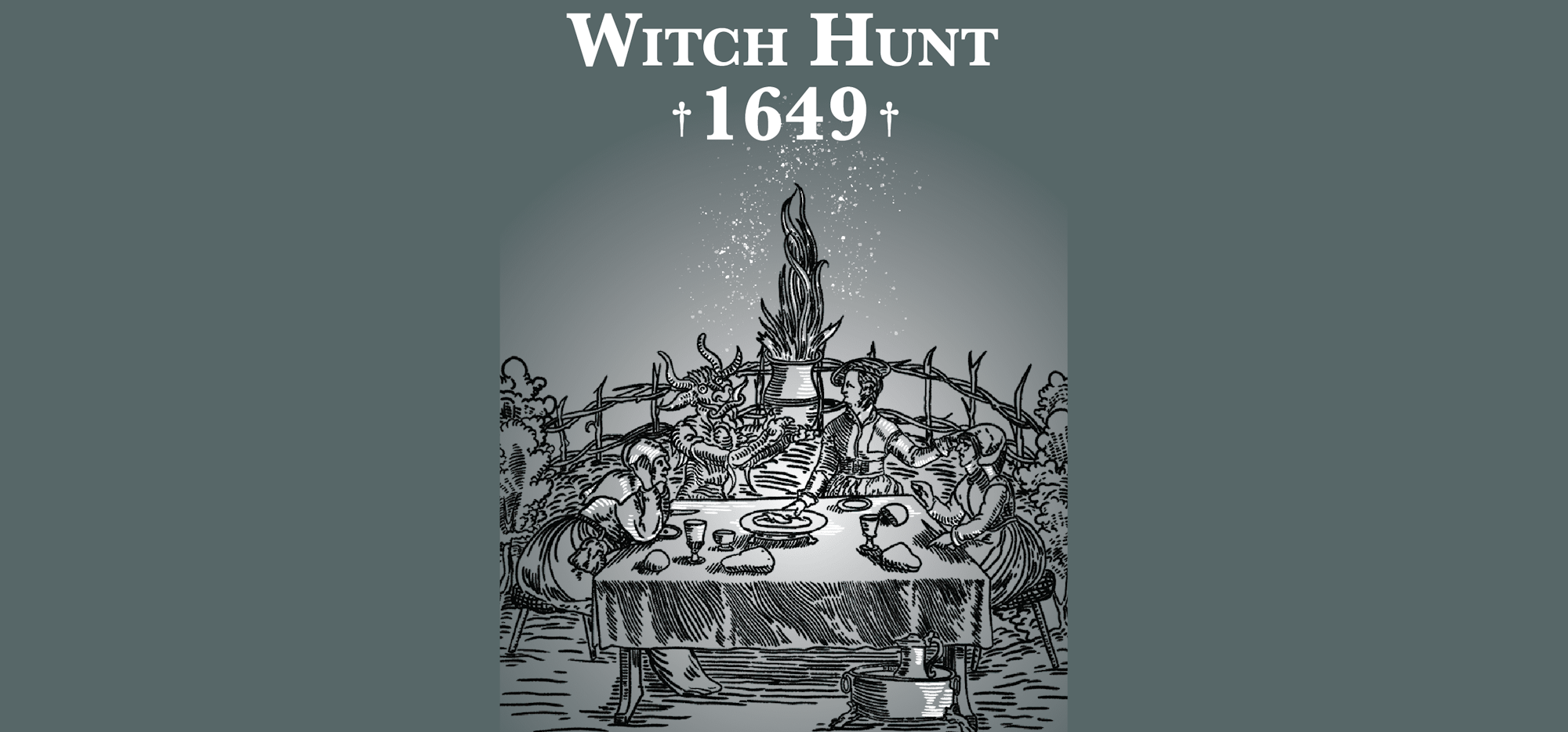
  •  

Dive Tables

The fish is inside the dive suit. It has become the diver. When it returns to the surface, it will have its vengeance.

Here’s something you probably didn’t know about old Dan Thurot: I’m a scuba diver rated for search and recovery. There aren’t many of us here in the desert, which is probably why I receive unexpected calls to dredge the ponds of local golf courses whenever there’s a Silver Alert. Thus far, I have declined these requests. Those waters are, like, four feet deep. That’s a job for snorklers. Or a tall guy with hip waders.

Instead, I mostly use this as qualification to comment on scuba stuff. That cave rescue in Thailand? Legitimate. The roll-and-write shenanigans of Aquamarine? Um. Okay, look, Aquamarine isn’t the most robust scuba simulation. But as another print-and-play title from Postmark Games, it’s a worthy followup to Voyages.

Yes, real scuba divers can use air bubbles from the ocean floor to preserve the contents of their oxygen tank. Anyone who tells you otherwise is trying to keep you in newbspace.

This is exactly what scuba diving is like.

Like Voyages before it, Aquamarine is a dice-heavy game of movement, positioning, and exploration by Matthew Dunstan and Rory Muldoon. Unlike that game, Aquamarine is played with two dice instead of three. What will those loony bastards think of next, a movement game that uses only one die?

(Since I’m late to the party, the answer is “Yes.” But that’ll have to wait till next time.)

As before, the gist of Aquamarine is elegant in its simplicity. You roll the dice, then use one of them to move your diver. Here those movements are represented as enclosed boxes. Enclosing something — some coral, a school of fish, a stinging jelly — means scoring it when the game ends.

Of course, it couldn’t be that breezy. Dunstan and Muldoon are all about encoding necessary and enlivening limitations into their print-and-plays.

In this case, the first of those limitations is that you only have access to one die out of that rolled pair. Bigger rolls mean bigger enclosed areas, but that also means depleting oxygen equal to the difference between the lower and higher die. So while it might be tempting to use that 6 rather than the piddly 2, covering the larger area means hoovering up four units of precious oxygen. Making matters tougher, deeper dives consume more air, adding time pressure right when the sea’s aquatic life is at its most interesting. Similarly, you’re constrained in which shapes you’re allowed to draw. Mostly long rectangles rather than jagged freeform polyominoes, although there are moments of squiggly liberation that emerge whenever doubles are rolled.

I want to use dice that are appropriate to each game. For Voyages, I played entirely with my cool palm-wood dice. For this one, these goofy aluminum ones. But as for Waypoints... I'm not telling. (Because I don't know yet.)

Weird aluminum dice not included.

These triplet pressures are the shared system underpinning everything in Aquamarine. Much like the headings in Voyages, everything arises from those constraints. Travel too fast or linger too long at depth, and your waning oxygen will force you to start a new dive. Paint yourself into a corner with your shapes, and you might find your next move taking you in the wrong direction.

From there, the game’s selection of maps tinkers with the formula. As before, the inaugural outing sets the template. Schools of fish are worth increasing amounts of points as more of them are enclosed in a box; certain creatures only emerge during daylight or nighttime hours, requiring you to parcel out your time accordingly; special beacons and flags reward those who travel to the corresponding depths.

But there’s tremendous variety within that blueprint. My personal favorites are found on the second map and fourth map. In the former case, undersea caverns can be readily explored during daytime, but at night gradually deplete a limited stock of flashlights; meanwhile, researching sharks and giant squids ticks you up along a selection of bonus tracks. And in the latter, arctic ice threatens your air supply, but snapping pictures of frolicking penguins and icon-improving shrimp can net scores of points that keep ramping upward.

This time around, there are troughs to accompany the peaks. In particular, two of the maps — a double-sheet deep-sea excursion and a fossil hunt in ancient waters — are too persnickety for my tastes, asking the player to make minute adjustments that don’t always play well with the need to ration air or count spaces.

This is how all of my actual sheets look. Many thanks to Rob Cramer for letting me borrow his nicer printed options!

As before, low-ink options are included.

Some of that has to do with the inherent limitations of the game’s movement system. Where Voyages — and our next installment — are more freewheeling with their range allotments, maneuverability in Aquamarine is downright torpid. Unless you’re starting a fresh dive, each box must attach to the previous one. This makes total sense, but also keeps the game more snugly straitjacketed. If I were a generous man, I’d call it more bite-sized; but because these are aquatic adventures — and because I’m not a generous man — they instead come across as suffocating, at least sometimes.

But while Aquamarine is the flimsiest of Dunstan and Muldoon’s roll-and-move trio, it’s hardly a poor example of the form. If anything, it’s another testament to how much can be accomplished with a sheet of paper, a pen or pencil, some lamination or a plexiglass, and dead simple rules. When the game slips into its groove, it’s immensely satisfying.

Especially in multiplayer mode, it should be said. That’s another shortcoming imported from Voyages. Here, the solitaire rules are disappointing, asking you to reach certain depths. Child’s play. The real challenge lies in sitting across from one to ninety-nine partners and seeing who can wring the most out of those shared inputs. In that mode, there’s nothing quite like glancing smugly (or despairingly) at a fellow player’s sheet to see where your routes departed. Who veered parallel to the ocean floor to preserve oxygen, who ventured much on the outcome of future rolls, who spent their dive observing shockingly large schools of fish. Or, in my case, who got stung by a bunch of jellyfish because they thought they were pushing themselves to more rewarding depths, only to tap zero on their dive meter. I’ve never gotten the bends in real life, but I’m pretty sure my diver in Aquamarine has made some testy ascents.

Those hickeys are from my Canadian girlfriend. You wouldn't know her.

I’m making new friends down there.

In short, Aquamarine is a mixed experience compared to its peers, but to evaluate it solely as a comparison misses out on what makes it such a rollicking time. I prefer Voyages; I prefer Waypoints. But given the option between Aquamarine and nothing, this is still exactly what I want from a print-and-play game.


Access to the files to print Aquamarine was provided by the publisher/designer.

(If what I’m doing at Space-Biff! is valuable to you in some way, please consider dropping by my Patreon campaign or Ko-fi. Right now, supporters can read my first-quarter update of 2026: the best board games, movies, books, and more!)
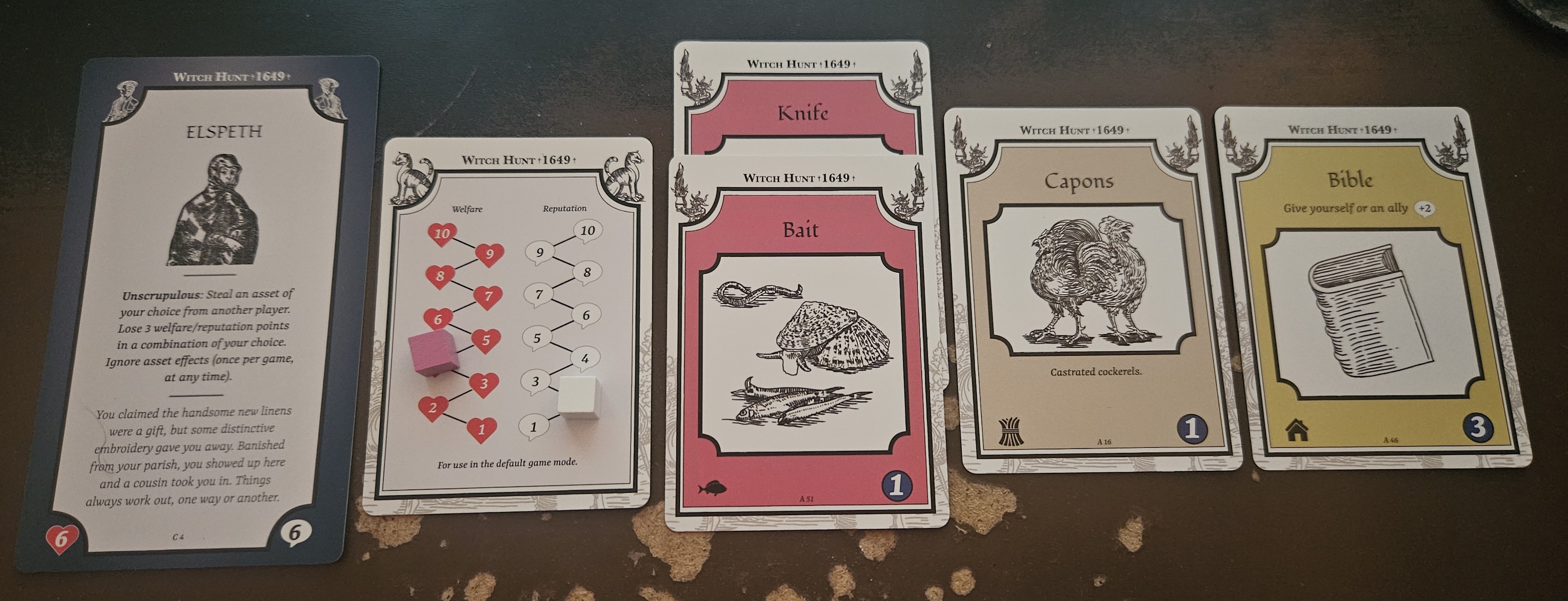
  •  

Coprodexterity

I would love to hide some serious commentary in these alt-texts, so... how about I regale you with the sodden tale of the worst poo of my life?

Wombats are herbivorous solitary nocturnal mammals native to Australia, and — here’s the part you knew was coming; nay, hoped was coming — they poop in cubes. And stack them. Why? I dunno. Darwin was pulling a goof that day.

Now Wombat Poo is a stacking board game by Phil Walker-Harding. Why? We know why. Because poop is funny, that’s why. But is Wombat Poo funnier than its opening joke? I think so. A little bit.

hahahahaha I'm not doing that

This is exactly what wombats do. Exactly.

On a surface level, Wombat Poo is about stacking cubes. There are three sizes included in the box: small, smaller, and smallest. Maybe that sounds like a complaint. To be sure, I’ve dinged certain dexterity/stacking games in the past for featuring such light components that their edifices collapsed at the slightest exhale, never mind a hand tremor. Fortunately, while the cubes in Wombat Poo are quite small, they have enough heft that the tower isn’t doomed past its first inch. Not right away.

But what makes Wombat Poo function isn’t its stacking. I mean, yeah, without the stacking there isn’t a game. But the stacking is really the backdrop for a compelling system of wagers. Basically, when your turn rolls around, you decide whether to poo or wipe. Each player even gets a double-sided card for announcing their position on the matter. If you poo, that means flipping a card from the deck to determine which size of poo you must stack. If you’re unlucky, maybe you’ll even need to stack two poos.

I'm gonna get sued for sure.

I imagine that wombats, since they’re herbivores, produce poop that can be composted without bacteria-killing hot methods, but don’t take my word for it. No, really. Don’t take my word for it.

The other option, wiping, backs you out of the round, while also scoring a point for every cube in the stack.

This is unexpectedly clever for a game that might otherwise seem somewhat single-ply. The thing, you see, is that your fortunes aren’t entirely based on your own prowess at squattie-piley. The decision to stay in the round is also an investment in the other players at the table. If someone in your group suffers from the shakes — as does one of my oldest friends and game-night regulars — they might still remain competitive, building their score by surviving their occasional, um, movements, and letting others do the bulk of the hard work. Conversely, their natural weakness at dexterity games may well translate into everyone else’s natural weakness as well. When the tower topples, the player who did the toppling loses two points. A meager sum. Just enough to prevent somebody from overturning the tower out of spite. But when that happens, those who stayed in the round score nothing at all. It’s only by wiping in time that you’ll accrue a winning score. How’s that for a rule to live by?

This transforms Wombat Poo into a surprisingly forgiving experience. Its central question isn’t “Can you stack this?” so much as, “Can you stack this, plus can the next couple of players also stack their cubes atop your wonky-ass placement, so you can get out while the getting’s good.”

Which is a considerably more interesting question than those posed by most stacking games. For adults, anyway.

Bad review. I don't think anyone would disagree with such a stance. Take a stand on something contentious, kiddo.

My six-year-old’s review: bees are better than Wombat Poo.

At the risk of sounding highfalutin’ — not to mention deeply unserious — Wombat Poo proved too subtle for my twelve- and six-year-old children. An unexpected outcome, given the game’s cartoon wombat and topicality. Those kids were cracking poop jokes literally the evening before we broke out the game for the first time. Then, somehow, overnight, they went from “Poop is the funniest thing in the universe” (juvenile) to “Poop is not funny at all” (adolescent), without quite reaching “Poop is funny unless it’s awful, then it’s even funnier” (mature).

There were other factors. The smallest of the cubes were a bit too light for the six-year-old’s fingers. Maybe it doesn’t help that the notion of playing with one’s fecal matter had been painstakingly ingrained as taboo for years by yours truly, lest this leaking ship we call a home tip over the edge into total disaster. And, yes, the scoring wasn’t quite as immediate as that of, say, Rhino Hero.

Look, I know how I sound. Arguing that Wombat Poo is a mature game for adults isn’t really what I’m trying to say here. I’m sure there are sufficiently advanced children who can also manage it, and some of them will have sufficiently arrested parents to stack poops with. I hope so. In my experience, though, Wombat Poo has become an adult filler, a strong contender for those moments when you just want to heap up some cubes, but with more to the rules than penalizing whichever player makes the tower plunge.

After Night Soil and now Wombat Poo, can I manage a fecal trifecta? Only YOU can make it happen, my dear professional board game designers.

The Leaning Tower of Poopa.

In other words, Wombat Poo is the thinking man’s poop-stacking game. Not David Hume level or anything. Voltaire, though? Yeah, Voltaire might stack some poops.

And that’s all there is to say about that.


A complimentary copy of Wombat Poo was provided by the publisher/designer.

(If what I’m doing at Space-Biff! is valuable to you in some way, please consider dropping by my Patreon campaign or Ko-fi. Right now, supporters can read my first-quarter update of 2026: the best board games, movies, books, and more!)
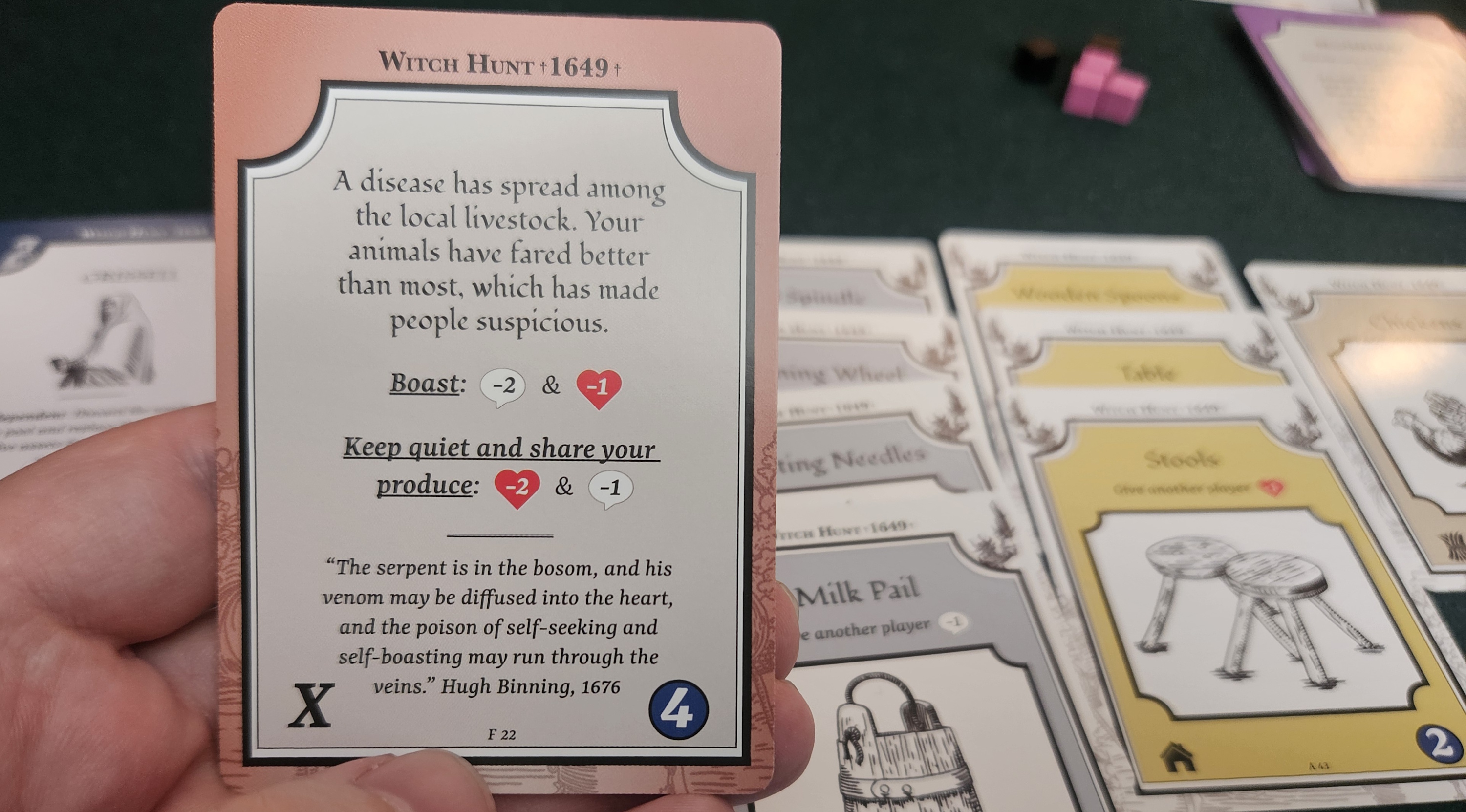
  •  

Not Your Daddy’s Blackbeard

*not a representative image of the actual Blackbeard or Lieutenant Robert Maynard*

I no longer think of Volko Ruhnke as a man, but as a machine purpose-built for stamping out novel conflict simulations. COIN, Levy & Campaign, that older one where the terrorists have the efficacy of ’90s movie baddies, and now Hunt for Blackbeard, an unexpected romp that’s as much about setting the record straight as it is about blasting pirates with grapeshot. I now know more about Blackbeard than at any point in my life. Which is to say, I know a lot less, given the man’s outsized legend.

Ye'll keel the swab-haul lest ye port-rum the banyan, yarr

Afore ye vast, starboard lubbers!

Almost everything we know about Blackbeard is wrong, or at least embellished from later sources seeking to cash in on the pirate’s notoriety. That he learned his trade under the legendary Captain Hornigold — unconfirmed. That he braided his hair with smoking fuses — not exactly the sort of fire hazard a man who worked with gunpowder would accept. That he murdered a swath across three seas — well, there was some murder, that’s true. But not as much as previously reported. Not when a pirate’s work required most crews to throw down their arms.

If anything, the Edward Thatch we come to know in Hunt for Blackbeard is something of a sad sack, at least when placed alongside his outsized legend. His great vessel has been stripped. His plunder has been sold down to its last few barrels and crates. His crew has been reduced to a couple dozen hands. Even his most infamous companions are on the outs; Stede Bonnet’s surviving crewmen are likely informers rather than allies, and Israel Hands, Blackbeard’s long-time second in command, may soon be sent on a doomed mission to allow the captain to claim his portion of their remaining goods.

Some of these details are relegated to the historical notes, and this, being a production from Fort Circle Games, provides excellent timelines and essays. But the diminished status of the infamous captain is on display right there on the board as well. For one thing, there’s the scope of the hunt. Confined to the sounds, towns, and islands of North Carolina, this pursuit is leagues away from the Caribbean waters that usually dominate pirate yarns. And then there’s the scale. Blackbeard’s fleet has become one ship, the Adventure, ill-fitted and undercrewed. His pursuers have only two ships, both of them relatively small, plus a band of hunters who travel by land to check the colony’s towns and inlets. These are, in a sense, an invading force, commissioned and outfitted by the governor of Virginia. But as invading forces go, sending bounty hunters from one colony into another isn’t an excursion into foreign territory.

For his part, Thatch behaves more like a cornered rat than a pirate king. Hunt for Blackbeard opens with the pirate standing at an intersection. Rather than expend the resources to hunt down every last offender, the Crown has offered a pardon to all who will renounce the pirate’s life. Most in the colonies have already accepted. Thatch, too, has taken the offer, only to return to the sea to seize some easy plunder. Now the hunters are coming for him, and while he has relative shelter in North Carolina thanks to his largesse with colony officials, the ensuing game of cat and mouse has the mood of a deepening sunset rather than a crescendo.

"Bums around town or camp with his wife" is the most relatable event.

Blackbeard tends to his retirement… or continues his piratical career.

There are two sides in Hunt for Blackbeard, hunter and hunted, but Ruhnke’s virtuosity at game design clutters and blurs those roles.

Both sides, for instance, are gluttonous for information. In the case of the Hunters, that means Blackbeard’s location — whether that of the famed captain, his lieutenant, or the camp he might periodically visit to resupply or lick his wounds. But for Blackbeard, word of his pursuers’ deeds is every bit as precious. The Hunters are always visible on the map, but how far their reach has extended, where their informants have told them to search, or whether they have a particular stretch of the sea under surveillance, those details may be concealed or laid bare depending on context and choice.

The same goes for the question of which side is hunting whom. Nominally, the Hunters are, well, the hunters. As soon as they’ve outfitted their vessels, they depart from Virginia and begin the chase. But all the while, Blackbeard is laying preparations of his own. Looting vessels, preparing the Adventure, buying off witnesses. When the time comes for the spark to touch powder, it’s entirely possible that Blackbeard will sink the competition.

What Ruhnke produces, then, is a double-blind game of entrapment. First there’s the race. Blackbeard hurries to gain or spend his treasure, whether to reestablish himself as a great pirate captain or to secure another pardon. The Hunters hustle to outfit their vessels before the trail goes cold. But then, over the course of the ensuing rounds, the fierce dance between predators.

Perhaps the most surprising thing about Hunt for Blackbeard is its speed. The game only lasts four rounds. And these aren’t the drawn-out bullet-point-ridden rounds of something like Here I Stand. While there are still bullet points to tick off, the phases pass at a brisk pace, bouncing between sides so rapidly that there’s hardly a moment of downtime. First, the Hunters interview informants, giving them a glimpse at Blackbeard’s potential location — a step that requires Blackbeard to avert his gaze, lest he learn what the Hunters have gleaned. Second, Blackbeard spends his time preparing his ship, sailing, and planning any piratical activities. Again someone must close their eyes, although it’s the Hunter player this time. After that, the Hunters take their turn proper, moving their ships and perhaps picking up their quarry’s trail. Only then does Blackbeard actually accomplish any pirating, a step that may well have been interrupted by the arrival of the Hunters.

They also need to balance how much time they spend "interviewing" (interrogating) "witnesses" (pirates) about "Blackbeard" (some innocent man).

The hunters balance preparation against the need to depart early.

Playing through these steps, a few thoughts spring to mind.

First, there’s an essential tactility to Hunt for Blackbeard. The actions themselves are brief, but the need to physically turn the blocks gives every movement a sense of growing unease. When I played digitally, the entire session took perhaps a third of the duration, but in its haste lost its sense of place. It’s one thing to click an icon; another entirely to hover one’s fingertips over the block, stomach knotted into a fist as you try to deduce whether an earlier clatter had come from here or there, or was perhaps your opponent shifting a few components as a ruse. This process elongates the game, but is necessary: touching the pieces, straining your senses for clues, seeing the shadows cast by those monolithic blocks and wondering whether they conceal a trace of your foe’s passage or a flock of passing gulls, these are as much components in the game’s telling as the rules or the wooden ships.

As much as Ruhnke excels at designing macro-level systems, he still has yet to create a compelling method for resolving combat. Perhaps the game’s biggest disappointment is the moment of battle, when, after all those preparations, both sides roll a couple dice to see who hits the higher number. It’s fitting, I suppose, given the chanciness of naval combat. The historical Blackbeard managed to rake one of his pursuers with grapeshot, effectively removing their ship from the fight, before the trap was sprung and he was overwhelmed during a boarding action. But after all those steps and countersteps — after that dance! — it wouldn’t have gone amiss to put some showmanship into the last struggle. What could have been a wall of thunder instead comes across as a puff of smoke.

Lastly, however, the game leaves me in awe of the way board game excel at representing history. I’ve read about Blackbeard. Not a lot. Just enough to know we don’t know much. But it wasn’t until seeing it rendered this way that I understood some of the words on the page. The intimacy of the space. The smallness of a man whose legend has outgrown him and now nips at his heels. The small invasion of a neighboring colony, one governor determined to rid himself of a pest that his peer next door has decided to indulge. Piracy was always caught up in the history of empires, and nowhere is that clearer than here, with official pardons and corrupt commissioners in the balance, populated by enemies and victims, but also imperial troops crowding into spaces that were once open, with safe havens where an infamous pirate acted as a patron rather than a danger to be cut out with the point of a saber. To play this game is to grasp the history a little more tightly.

You know what's a really good hidden movement game? Burned. In terms of hidden movement mechanisms, that one almost ruined Hunt for Blackbeard for me. Although to be fair, it might have ruined all hidden movement.

The hide-and-seek nature of the game is well done.

Is it disappointing that Hunt for Blackbeard operates better as history than as a plaything? Oh, maybe. A little bit. Especially when the game concludes with a wet fuse rather than a discharged cannon, I can’t help but feel some letdown.

But I’m impressed with the trappings that surround that climactic battle. Once again, Ruhnke has created a system that will hopefully earn emulation; once again, Fort Circle has crafted an enviable representation of American history, one that complicates and deepens its subject matter rather than frocking him in smoking fuses.


A complimentary copy of Hunt for Blackbeard was provided by the publisher.

(If what I’m doing at Space-Biff! is valuable to you in some way, please consider dropping by my Patreon campaign or Ko-fi. Right now, supporters can read my first-quarter update of 2026: the best board games, movies, books, and more!)
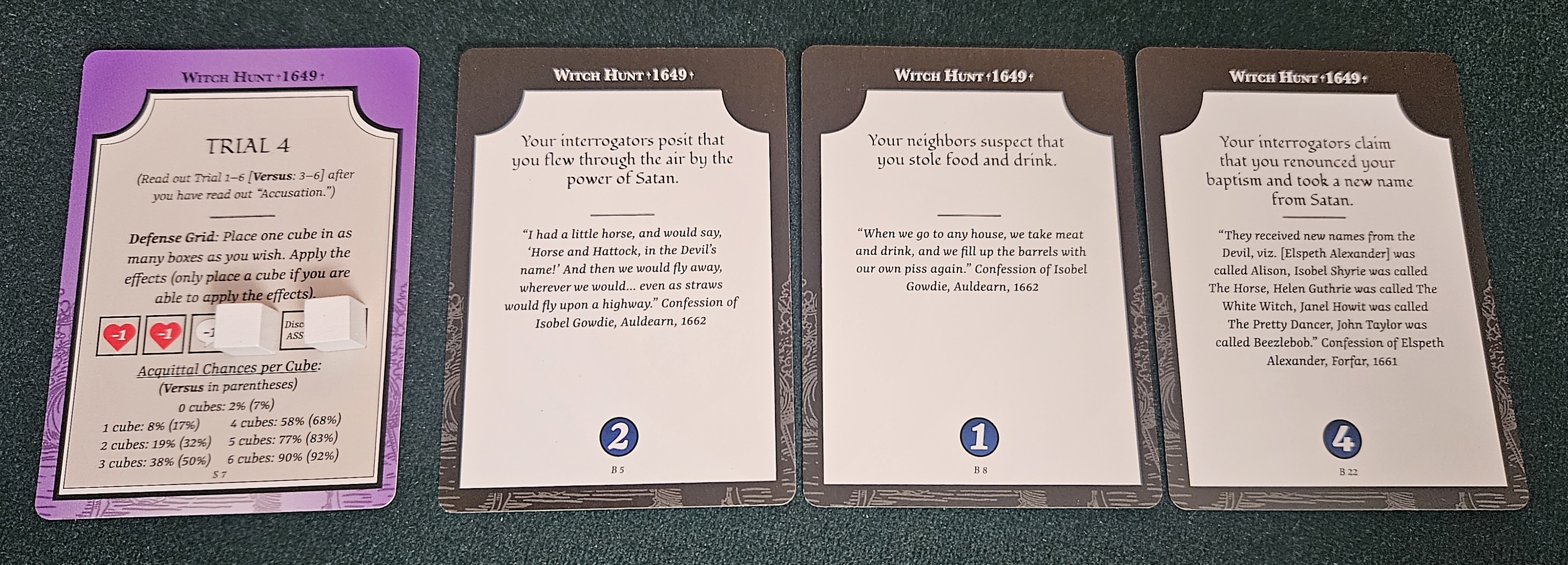
  •  

It’s Always the Ides of March Somewhere

... wait, that isn't how time works.

I would describe my feelings toward Regicide as “appreciation,” despite it finding dedicated fans all around me. For years it was in regular rotation on my wife’s phone; my sister-in-law bought the fancy custom deck rather than just using a generic deck of playing cards. My own interest had more to do with the game as an act of repurposement: the clever casting of face cards as mad royals who needed to be put down, the suits transformed into character classes for blocking attacks or repairing injuries.

Regicide Legacy, designed by the same trio as the original — Paul Abrahams, Luke Badger, and Andy Richdale — is very nearly the exact opposite of the original game, at least in terms of form factor. Where the previous Regicide could be played with any old deck scrounged from a vacation bag, this edition is something of a throwback. It’s a genuine legacy title, for one thing: torn cards, stickers, micro-expansions, all of it. Its cooperative/solitaire campaign is generous. Moreover, it’s hard, significantly harder than is the norm in our current obliging hobby. It isn’t uncommon for a chapter to take two, three, half a dozen tries before your band of mercenaries is permitted to move on to their next target.

Now that I’ve wrapped it up, I can squarely say that the ordeal was thrilling, brilliant, and exhausting.

Pretty sure every single character in this game inhabits a polycule.

Hey there. We spotted you from across the bar and liked your vibes.

If you haven’t played the original Regicide… first, maybe give it a try. The rules are freely available, and as noted earlier you can play with a deck of cards that costs five bucks at the supermarket. That’s if you don’t have one handy already.

Regicide Legacy begins with Regicide. As in, its first chapter is the base game with only the slightest of modifications. Your crew, a band of adventurers, comprises the forty non-face cards of an ordinary playing deck, plus perhaps one or two goblins depending on player count. Their strength ranges from one (for an ace) to ten, across four classes that have been given their own iconography rather than repeating the regular French suits.

The face cards, meanwhile, become a deck of targets. First you’ll face the jacks, then the queens, then the kings, ideally lining them up for the guillotine. This is no easy feat. Each royal has a sturdy pool of health points, and punches back after each attack, requiring you to spend cards from your hand to absorb the blow.

The cardplay is impressive. Depending on your chosen attacker, your crew avails themselves of an ability. Warriors deal double damage to your target. Paladins block return damage. Clerics cycle discards back into your deck, which Bards then use to refill everybody’s hands. There’s a life cycle to this process. Some cards can be paired, such as aces, here styled as animal companions, or duplicate ranks whose strength would sum to ten or less. Success demands a delicate balance, between offense and defense, between healing and aggression, between risk and caution.

It’s pretty much inevitable that you will lose.

And now there are two more Regicides?! I'm behind the times.

In contrast to the original Regicide, Regicide Legacy is all premium.

That inaugural failure, though, demonstrates the ways that Regicide Legacy intends to depart from its predecessor. Rather than shuffling the cards and giving it another try, you’re invited to open the first of the set’s many boxes. Within, you discover mercenaries: multi-rank cards that can be readily paired with more of their peers than usual, heavy hitters, maybe an extra goblin or two. Each merc has a cost in its corner. One loss means you have one gold to spend.

So you buy a card, add it to your deck, and take another stab at toppling the divine right of kings.

Again, failure is largely inevitable. It’s just a little less inevitable than before. Second loss, two gold. You grab a couple new fighters. Shuffle. Again.

Another loss. That’s three more gold. Now your company is becoming noticeably tougher. Maybe you were struggling with damage output; some extra Warriors will make up the difference. Or perhaps you found it difficult to manage your hand; that’s where Clerics and Bards come in. Whatever your particular weakness, there’s a patch for it.

At some point, the odds turn in your favor. Inside the first chapter box there is a sealed booster pack with its own instructions. Your mercenaries depart. New cards are introduced. Another chapter presents a new set of bosses, each tougher than the last.

Seems like this could have been paper, but I won't deny there's a childlike appeal to splitting open a booster.

Opening the post-game expansion pack.

Along the way, a few things become apparent.

First, Regicide Legacy wants you to succeed. Even if only belatedly, after spending heaps of gold on up-powered mercenaries who round out your company’s deficiencies. Where the original game bordered on the misanthropic, booting you back to the beginning at even the slightest trip, the ability to pad your deck with repeat failures is a wonderful tool. Some make it easier to pair cards, or add wild aces, or, eventually, strip even the toughest bosses of their natural immunities to your character abilities.

Next, Regicide Legacy earns that second ligature. This is a legacy game through and through. In its earlier stages, this means variable card sleeves. To offer only the lightest of spoilers, the members of your company can become corrupted, adorning themselves in the thorn-framed sleeves usually reserved for royals, and incurring a penalty when played. Not long after that, you’ll encounter more transformative effects. Stickers that dual-class cards, minigames for randomly determining which character succumbs to a story beat, and, yes, eventually the dreaded moment that was so transgressive back in Risk Legacy, the command to rid yourself a card for good.

Go ahead. Tear it up. Don’t let your squeamishness show. Don’t let your fingers tremble. Don’t check how much the reset box costs. Uh oh. You looked. That’s as much as, like, fifteen decks of playing cards. But who would buy that many playing cards? You’re here for the drama, baby, and there’s no drama quite like drama that inflicts lasting damage.

This one happens to like Tal Bachman.

Each boss presents its own conundrums.

The main highlight is the procession of new character classes that are added to your ever-expanding band. To the original four — the original six if you count animal companions and goblin jesters — there’s enough to more than double the roster. I won’t spoil the surprise, but the way your deck morphs from one thing into something else entirely is quite the sight to behold. There’s wild magic to be uncovered, risky operators who might help or hinder your goals, heroes who always seem to show up in the nick of time, and complicated figures who require constant reminders.

Because Regicide Legacy, already a tangled, difficult game, only grows more tangled and more difficult as additional chapters are unlocked. More complicated, too. Sequencing matters. The subtle distinctions between two defensive classes matter. Whether cards are discarded or banished, which abilities a boss blocks, how cards are shifted across the board in this particular scenario — everything matters.

In our case, we played nearly the entire campaign four-handed. There was me, of course, plus my wife and sister-in-law. I doubt I would have survived by excluding the fanatics. We were also joined by my mother-in-law, a veteran of countless trick-takers. Her inclusion highlighted both the game’s strengths and its weaknesses.

Strengths first. Across the duration of the campaign, Regicide Legacy held our interest. Even my mother-in-law’s interest. Even when we were tired from battering ourselves against a particularly difficult chapter. (The worst offender, we discovered, had been nerfed post-release.) At our weekly dinner, the group was eager to see what came next. Not so much in the story, which is the usual fantasy muddle of proper nouns. But in the interplay of cards and abilities. In the composition of our deck. In which sticker would be appended to which character. In the developing shape of the thing.

But these strengths are attended by problems. Foremost, that Regicide Legacy soon gets too big for its britches. My mother-in-law spent the back half of the campaign showing her hand to whichever daughter was seated beside her, effectively requiring someone to play two hands simultaneously. She recalled the starting classes well enough, and even remembered a few of the later outliers. But as for the distinction between a Mage and a Reaver or between a Druid and a Chanter, no player aid was sufficient to fill every gap.

It's so heavy. You could kill somebody by dropping it off a high rooftop. Post-campaign, the rulebook recommends using it as a tool of actual regicide.

That’s one packed box.

Perhaps this sounds like an issue of age. To some degree, it was, as my mother-in-law would freely admit. But even those of us inured to modern hobby games and RPG classes and this particular brand of cardplay sometimes found our minds snowed in by the game’s avalanche of intersecting triggers. It isn’t only the character classes; there are also the bosses to consider, plus the special rules that govern this chapter, plus, often, the lingering rules from last week’s session, finally cemented in time to be discarded with the previous tuckbox. Most of the time, I had to run the turn-by-turn action, and even then it wasn’t uncommon for someone to stab back that my reminder necessitated a counter-reminder because of such-and-such character or some lingering effect from the scenario instructions.

Is it too much? We finished the campaign. We survived. We succeeded. But we also stumbled along the way. Sometimes we realized two rounds later that we’d flubbed a rule earlier. More than once, we restarted a session altogether, the rules suddenly clear where previously they had been opaque.

Personally, this process was many things. Frustrating at times; exhausting at others.

But it was exciting, too, and exciting in a way that very few games have been before. We developed favorites — dual-classed Elashor, Vegarian the Vegetarian, my crush Lierin — and groaned at the appearance of others — Dinky, may you be damned to the underworld for eternity for how often you have betrayed us. We laughed a lot, especially when a new boss crushed us to powder, or when somebody stared at the problem before them, eyes glazed over, only for someone to recall the exact rule that would save us from a doomed situation.

The remaining question is whether we’ll return. Some of us already have; my sister-in-law has launched her second campaign with another group, spreading the good word to unwitting converts. There’s an entire post-game to tackle, justification for the potential waste of a discarded core box, and I can confirm that it’s a smart system, randomly doling out enemies and modifiers and boons that will test the hardy company that was forged over the previous thirty battles.

My secret goal every game was to get Lierin in my hand and then never spend her. I succeeded maybe thrice.

Lierin is my Canadian girlfriend you’ve never met.

So. Will we? Return, that is?

I don’t know. Maybe someday. I plan to keep the box, despite my doubts that we’ll remember the class abilities if we go more than a month without a session. Even if we don’t, I can’t help but regard Regicide Legacy with fondness. I can’t remember a single story beat from the narrative. But the stories it told above the table — the way our deck transformed along with our aptitude as players, the inside jokes we developed, the characters whose named we pronounced five different ways — those are worth keeping around. That’s the real legacy here. That’s what makes me consider Regicide Legacy such an unlikely success. Torn cards? Stickers? Psh. I’m only interested in the stickers of the soul. The torn cards of our feelings.

And with those strained metaphors, I think that’s enough Regicide Legacy for one sitting.


A complimentary copy of Regicide Legacy was provided by the publisher.

(If what I’m doing at Space-Biff! is valuable to you in some way, please consider dropping by my Patreon campaign or Ko-fi. Right now, supporters can read my first-quarter update of 2026: the best board games, movies, books, and more!)

  •  

High O’er the Billows We Are Wafted Along

let's make this header as ink-hungry as possible, hmm? because I know some of you readers are PRINTING EVERY SINGLE ARTICLE for some reason.

Let it not be said that I don’t take requests. A number of readers have pointed out that it’s been a long time since I’ve covered any print-and-play games. Too true. But there’s a reason for that. Voyages, the six-map design by Rory Muldoon and Matthew Dunstan and the launchpad title from Postmark Games, is both an illustration of my reticence and a roundhouse kick to that same reticence’s noggin.

nice!

How Voyages really ought to look.

This is how Voyages is supposed to look. Soft hues, perfect for covering with pencil marks. (Or, if you’re a consummate professional, a dry-erase marker.) Weathered at the edges, giving it the feel of a brine-worn map. Crisp, with sharply defined edges, all the better for making out the proper boundaries of everything, from the sea’s hexes to the spaces for tracking the depletion of your sailors.

And this is how my version of Voyages looks:

less nice! but in a way I can actually print, so, nice!

In my hands, how it actually looks.

Gray. Somewhat dull. Concealed beneath a much-abused plexiglass. Dice not included.

This is a very good thing. Because my main hangup with print-and-play games is that I only own a black-and-white printer. It works roughly a quarter of the time. The ink is sold at a premium by a cartel with armed enforcers and semi-legal firmware updates that mark my bootleg cartridges as empty until I bend a plastic doohickey, perform a hard reset, and offer three Our Emperors to the Omnissiah.

Discussing business practices isn’t very sexy. There’s a reason I don’t talk much about the publishers or marketing schemes behind the games I feature here. But in the case of Postmark Games, the business practice is the format. Buying a game gives you access to a Dropbox folder. That folder includes assets for both high- and low-ink printers. It’s as indie as it gets. A little fly-by-night. Shabby, if you’re the sort of person who demands a custom link to everything.

But the beauty of this format is that it’s also easy to use. Even with my wonky printer, I was able to get everything working in about two minutes. After another hard reset, I even had the rules sheet and a few warm maps ready to go.

This is probably the messiest map of the group, but it's deeply impressive how Voyages turns into a light survival horror game.

Sometimes your crew’s duties are tough, such as when you keep plowing into icebergs.

The gameplay, as befits a one-sheet roll-and-write game, is elegantly simple. You roll three dice and then assign them to three roles. One is your ship’s heading, which of six compass directions it will travel. The second is your speed, how far you’ll travel. You know, provided you don’t run aground on an island, hit a reef, or smack into the map’s edge. Between these two assigned dice, you’ll steer around the map to… well, it depends on the map.

Which brings us to that third die. This one governs your crew’s duties. But those duties differ from map to map. In the first map, this is a simple number-crossing game. If your third die shows a 3, you scratch off a 3 on your sheet. If this happens to finish a row or column, you earn a bonus. Easy.

But as the maps progress, the rules grow increasingly tricky. Not hard, exactly. Just tricky. Frankly, it’s impressive how much territory Muldoon and Dunstan are able to cover. Where one map sees your vessel racing to ignite beacons on lonely islands, another becomes a hard-bitten game of survival in arctic waters. The first map has some simple pick-up-and-deliver gameplay. Basic stuff. But another is all about catching the wind to drift between coral arches.

More often than not, these extra rules are handled by the die you assign to your ship duties. Repairing your vessel when it rams into icebergs or gets swatted by a whale. Tacking into the wind. Diving for treasure. Scavenging artifacts.

It’s a lovely system, surprisingly open-ended despite the stark limitation of three dice, and while there’s obviously a great deal of luck involved, it’s open to manipulation thanks to sailors who can be exhausted to ensure you don’t drift endlessly back and forth. More than once, I found myself thinking back to The Guild of Merchant Explorers, another flux-and-write game that threaded the needle between limitation and expression. That’s not exactly a coincidence, given that Dunstan co-designed that one with Brett Gilbert, but it’s notable how Voyages manages to produce an entirely different tale under similar constraints. To sail these waters is to be both buffeted by the winds and master of your own fate. It’s a wonderful paradox.

And dodging as many scoring opportunities as possible, apparently.

Charting invisible islands.

At first, my assumption was that Voyages would be a solitaire game. Because that’s what print-and-play games are for, right? And it is. A solitaire game, I mean.

But the solo mode is merely okay, a race to unlock three objectives (out of five) before sixteen turns have expired. Personally, I found that goal not only achievable, but usually laughable, barring a series of becalmed rolls. Anyway, what’s the fun of rushing all the time? The seas are full of things to discover. I’d rather take the time to poke around a corner before darting off to the next objective-indicating star.

Where Voyages shines is in multiplayer. The race element is still present, with those aforementioned objectives triggering the conclusion of the session, but the emphasis on scoring feels more natural to both the format and the setting. In this mode, there’s room to explore some more, everybody keeping one eye on their own heading and another on their opponents’ progress toward those objective stars. There’s also the pleasure of seeing what someone else did with the same rolls that caused you so much trouble. I was delighted by how quickly Summer picked up those first couple of maps, sailing gracefully from one isle to the next, scooping up sailors from their rafts and weaving between hazards. Compared to my bumbling from one island to the next, it was quite the sight. Also, her dry-erase lines are really sharp. Apparently I smush the felt into the plexiglass like some sort of ape.

If Voyages shines with multiple hands, it really glows when strung together in a campaign. This adds a little bit of everything. There are moonshot objectives to pursue, like visiting every single special zone on a single map or ensuring a half-dozen members of your crew upgrade to elite status. Stars can now be exchanged for upgrades, adding new ways to score points or mitigate a bad roll. And these newfound abilities are offset with the presence of a nemesis that adds increasingly difficult restrictions to the rules.

In the case of our campaign, our nemesis was Scar. Early on, he threatened to snipe any sailors we rescued from the water. Not too bad, given his shoddy marksmanship. But in the campaign’s later stages, he sent us sailing straight through islands rather than stopping automatically and eventually turned our three dice into a measly pair plus a duplicate. At the apex of our power, we found ourselves forced to wring every advantage from our abilities just to make a pit stop or sail the proper currents. The result was another careful dance between limitation and permissibility, stretching the system but never so far that it snapped.

palm wood!

These are my “thematic” dice.

On the whole, I came away deeply impressed. With the business model, with the design, with the way the game actually came out okay on my cartel-operated printer. Crud, even with the way Voyages manages to be a roll-and-write that isn’t just sums and filling in test-sheet bubbles. As much as I enjoy some of those titles, free-ranging movement has its own organic appeal. I’ll go where I want, winds be damned.

Or tacked into, anyway. As I’ve noted before, Voyages is a masterclass in the way board games excel when they lean into the limitations of their medium rather than trying to escape them altogether. Voyages is something special. It seems I’ll be getting back into print-and-play games.


Access to the files to print Voyages was provided by the publisher/designer.

(If what I’m doing at Space-Biff! is valuable to you in some way, please consider dropping by my Patreon campaign or Ko-fi. Right now, supporters can read my first-quarter update of 2026: the best board games, movies, books, and more!)
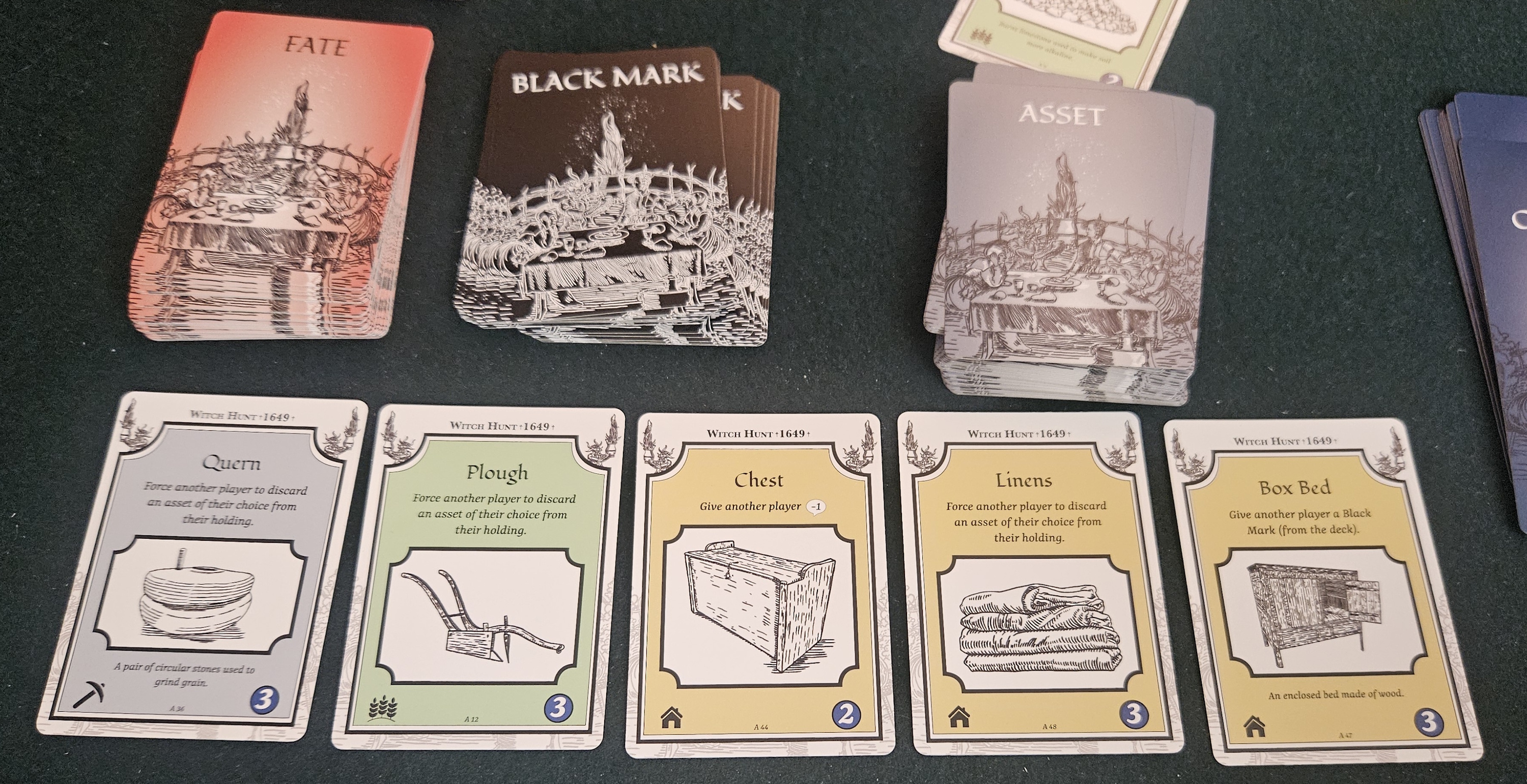
  •  

Riot in Cell Block Arkham

Hm. I've seen the opening scene of The Dark Knight. I think I'll team up with someone other than the clown guy, thanks.

Considering how often the supervillains incarcerated at Arkham Asylum mount successful escapes, we’d do better to confine them inside a Chuck E. Cheese. At least that way they’d have to contend with food poisoning and sticky benches.

Still, the idea behind DC Breakout: Arkham Asylum is a strong one. Designed by Geoff, Sydney, and Brian Engelstein, this is another entry in the “wacky race” genre, marking it as the fourth such title in the past year. How does its coterie stack up against bun bangers, slippery bananas, and underdog brontos? I’ll put it this way: in any other race, it might have won a medal.

It helps that so many of Batman's rogues are descriptive. Oh, you're a moth that kills people? Got it. Oh, you're a Batman but you laugh? Nice.

Me, a comics agnostic: oh hey, I can name two of these people.

DC Breakout opens with one heck of a great idea. Rather than having everybody out for themselves, what if our supervillains decided to work together? Not all together, obviously. These are the bad guys. If cooperation was their strong suit, they’d have stomped the Bat decades ago. But two at a time? A three-legged race? Evil duos temporarily setting aside their differences to escape the slammer? Sure. They can do that.

I wouldn’t be surprised if the game’s pitch was that you’re playing Magical Athlete with two characters at a time, because that’s pretty much how events proceed. During setup, everybody receives a hand of supervillains. There will be two races, with the winner of the first receiving some advantage in the second race. Now you pick your duos and head for the starting line.

As openers go, this is as good as they come. There are heaps of villains to choose from. Forty. That’s the number. Forty villains, each with their own ability. It helps, too, that Batman’s rogue’s gallery is probably the most recognizable in comics history. This gives the Engelsteins room to play, but even more importantly ensures that the abilities are able to map to what we expect of any given character.

More or less, anyway. Some are more familiar than others. The Riddler, for instance, turns his movement roll into a bluffing game. Sure. That’s Riddler shit. Talia al Ghul can flip her die to its opposite side. Sure. She’s tricky. Hugo Strange lets other players reroll their dice, but earns extra movements whenever they take him up on the offer. Sure. He’s always manipulating people to get ahead. Scarecrow rotates the tile he’s on, flipping the leader to the reverse and anyone in the rear forward. Sure. That’s his fear toxin causing hallucinations.

Others are less direct. Catwoman takes an extra turn when she ends on a triangle space. That one requires some explanation. Basically, Arkham Asylum is a series of shaped rooms. Most are squares, fewer are circles, and fewer still are triangles. So Catwoman is there to play the odds, hoping to land on the rarest of spaces in order to leap forward again. Which, yeah, that’s kinda Catwoman-ish, I suppose. Close enough.

YOU WILL RESIDE IN THE AFTERLIFE WITH MY EXCAVATED KIDNEY OOOOHHHH

Watch your back, cat! He intends to stick you into a canopic jar!

But what does it mean when Cluemaster moves another team forward to add one to his roll? Or when the Penguin massages his die roll up or down by one pip? Or when Killer Moth… look, I’m not going to pretend to know who Killer Moth is. But what about Condiment King? Why does he get extra movement when he’s trailing? Is this a condiment thing? Is pickle relish associated with losing? Don’t answer that.

Of course, what these abilities mean is that there’s only so much creativity that can be crammed into the system presented here. Fair enough. Not every supervillain can be transformative. For every Joker, there’s gonna be an Egghead. Except the joke’s on us, because the Joker is sort of a bummer in this one. He forces other teams to reroll. I guess the Joker is about chaos. Still, that’s not exactly what I was hoping for from the Clown Prince of Crime.

To be fair, there’s a huge range of abilities on display. Some villains use henchmen. Calendar Man, for example. He starts with one henchman, and can set his die to however many henchman he has at the current moment. If he does, he adds another henchman. Aha! He’s progressing through the days of the month! Good thing we locked him up. Poison Ivy, meanwhile, spends her tokens to force rival duos to move toward her instead of toward the finish line. Cleavage! The strongest of the fundamental forces.

Simultaneously, there are gadgets to consider. Gadgets are single-use powers that can be earned whenever you stop on an armory space or by earning a solid placement in the first race. There are quite a few of these. Fewer than the number of villains, but still, for a deck without any duplicates, there’s a solid range to potentially draw.

Which brings us back around to that core idea. Two villains. A handful of gadgets. A simple roll-and-move race to the exit. What could possibly go wrong?

I'm pretty sure Phantom Zone is a kink club for nerds.

Gadgets allow you to break the game even further.

It’s tempting to say “plenty,” but the more honest answer is that DC Breakout: Arkham Asylum is surprisingly solid. It’s just that it isn’t as solid as its competitors in this unexpectedly crowded field.

At heart, DC Breakout is about breaking the game. With the right combination of villains and tools, it’s possible to… well. I’ve watched as one duo created a near-unbroken loop of extra turns. Another duo was able to reuse items and draw a bunch from the gadget deck, permitting a series of teleports and adjusted rolls that was so unfair that its rivals were still way back at the starting line when it was peeling out toward Gotham City. These races were “unfair.” Hilariously so. Infuriatingly so. But they were also the result of previous prep work. Sacrifices in the first race to acquire extra gadgets. Or the opposite, a hard-fought initial race in order to acquire better tools and a boosted villain draft.

Or, right, dumb luck. DC Breakout is full of that. Again, fair enough. That’s the genre.

But what’s interesting to me is the way this game’s chance feels more chancy than the chance in something like Magical Athlete. Not only more chancy, but more irritating. Perhaps it’s the veneer of skill overlaid atop the dice rolls. Or maybe it’s the way gadgets intrude into the regular process of play. A bad roll is a bad roll. But when you get a good roll and another player deploys an item that overturns it? Or worse yet, flips the entire map around so that they’re in the lead? I’m not going to get mad about it. But a scrunchy face? Sure, I’ll make a scrunchy face. Wacky races, as a genre, are full of bullshit moves. But there’s bullshit and then there’s bullshit. DC Breakout is full of the latter.

Which is fine, as these things go. Part of the game’s fun lies in not only getting lucky, not only in building the right supervillain pairs, not only, even, in managing the micro-decisions that occur during the race. But also in bullshit-proofing your team from rival shenanigans. Some of those unsexy abilities start to look mighty tempting when you realize they boast a stronger immune system to outright cancellation. Most of my best combos, for instance, have arisen from characters I was only dimly aware existed. Cameos from video games, footnotes or curiosities, late-night fan-wiki deep-dives, those were often the characters I needed to leap forward to victory.

The standees are actually two different villains smooshed together on the same base. It's a neat idea, but I wish you could see them side-by-side instead.

The winner of the first escape leads the second.

The result is a game that’s sometimes very good and sometimes so lopsided that it stops being interesting at all. When multiple players are breaking the game in sync, busted powers firing all over the place, it’s a hoot. But when one duo skip-teleports to the finish line while everybody else huddles around the office water cooler, the problem isn’t that the game is unfair. It’s that it’s boring. It’s like watching a race between a prize stallion and a certain unnamed sciatic board game reviewer. Also, the prize stallion just played a gadget that made the sciatic board game reviewer run backwards for ten seconds. Whee.

Which is to say, there are moments of real brilliance here. The range of abilities in the game’s generous cast. The delight of watching a guy with a ketchup nozzle defeat a mobster who was so uninventive that he named himself after his matte facewear. Even just the idea of pairing racers to become even more idiosyncratic and game-breaking. There’s a ton of good stuff in DC Breakout.

But it’s a game whose peaks don’t always justify its troughs. Not only in relation to Magical Athlete, Hot Streak, and Dino Racer — in relation to itself.


A complimentary copy of DC Breakout: Arkham Asylum was provided by the publisher.

(If what I’m doing at Space-Biff! is valuable to you in some way, please consider dropping by my Patreon campaign or Ko-fi. Right now, supporters can read my first-quarter update of 2026: the best board games, movies, books, and more!)
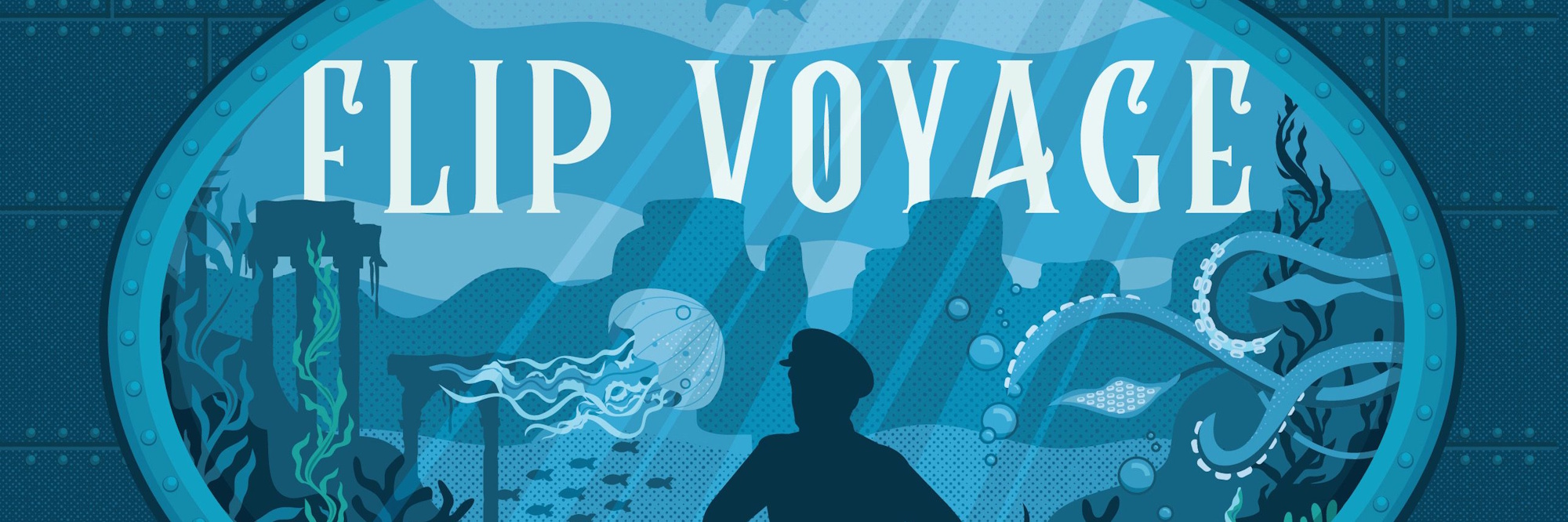
  •  
❌