Normale Ansicht

Cysmic

Von: Björn
23. Mai 2026 um 09:00

Nach uns das Vakuum

Du stehst am Rande eines Waldes, das Licht bricht sich durch die Kronen der Bäume und ein paar arglose Nagetiere klettern die Rinde entlang stets auf der Suche nach der nächsten Nuss und einem lauschigen Plätzchen. Plötzlich ein immer stärkeres Rasseln der Äste. Ein Reh flüchtet in Panik, doch der grünbedeckte Boden reißt auf. Alles bebt, und der Riss entwickelt sich zu einem gewaltigen Spalt, der das Reh samt Umgebung verschluckt.

Willkommen auf Kepler-62e, deinem Heimatplaneten. Schön hier. Also, bis gerade eben.


Steckbrief

SpielCysmic
VerlagStar Reach Games
Veröffentlichung2026
IdeeJason Blake
IllustrationJason BlakeSzymek Dmitruk
Rating (BGG)8,9 (Stand Mai 2026)
Komplexität (BGG)3,19 (Kennerspiel)
SpielweiseKooperativ, Kompetitiv, Solo
MechanikenHand Management, Multi-Use Cards, Events, Variable Player Powers

Spielprinzip

Tja, so oder so ähnlich muss es den armen Tropfen auf diesem Planeten mit dem klangvollen Namen ergehen. Die Welt steht kurz vor dem Kollaps, und die allerletzte Überlebenschance besteht darin, eine Arche in Form eines Raumschiffs zusammenzuzimmern, um als Erster den Abflug machen zu können. Tschüss, Weltuntergang!

Also worum geht es hier eigentlich? Erstmal in Kurzform. Du entsendest Gesandte, um Einfluss in den verschiedenen Habitaten zu sammeln (Stichwort: aggressive PR), schickst Minenarbeiter auf die Loriumfelder, um diese wertvolle Ressource zu schürfen, oder hetzt Soldaten in Kämpfe. Deren Ziel? Gegnerische Truppen gefangen zu nehmen, um diese später als Druckmittel gegen Baupläne einzutauschen. Exquisit! Denn das Wissen um die sechs lebensrettenden Module der Arche ist leider unter all den Fraktionen aufgeteilt. Je nach Spielerzahl hältst du nur ein bis drei dieser begehrten Pläne in Deinen Händen. Den Rest musst du von den anderen abluchsen. Das wars mit der ehemals netten Nachbarschaft. Also alle Teile sammeln, bauen und Abflug! Und jetzt nochmal im Detail.

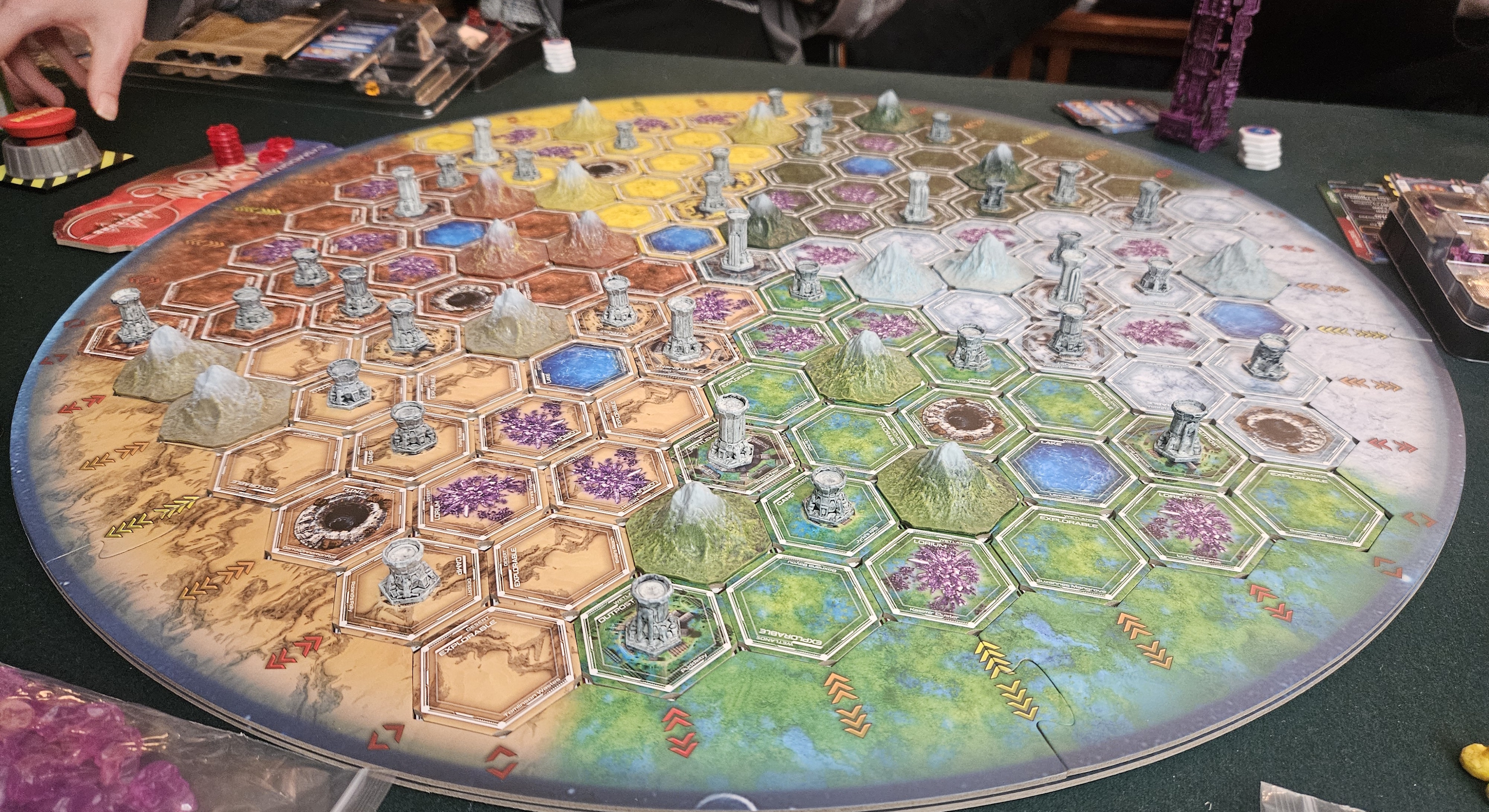
Alle übernehmen die Kontrolle über eine der 27 (!) Fraktionen, jede mit eigenen asymmetrischen Startressourcen und Fähigkeiten. Auf den Fraktionen ist eine Mindestspielerzahl angegeben, und es empfiehlt sich wärmstens, sich auch daran zu halten, denn ansonsten könnten Sie zu stark oder zu schwach sein. Du platzierst Deine Startrampe (in der dein glorreiches Fluchtauto, die Arche, zusammengebaut wird) zusammen mit Deinen Starteinheiten auf einem der 6 Terraintypen. Das Spielfeld ist rund und in der Mitte thront die noch aktuelle Hauptstadt des Planeten: Colony City.

Da das Brett einen runden Planeten darstellt, kannst Du Dich im Pac-Man-Style von den Rändern direkt auf die anderen Seiten bewegen. Das solltest Du Dir gut hinter die Ohren schreiben, denn man vergisst es leicht, obwohl es die planetare Reiseplanung erheblich erleichtert. Dadurch ist plötzlich nämlich alles näher dran als du denkst.

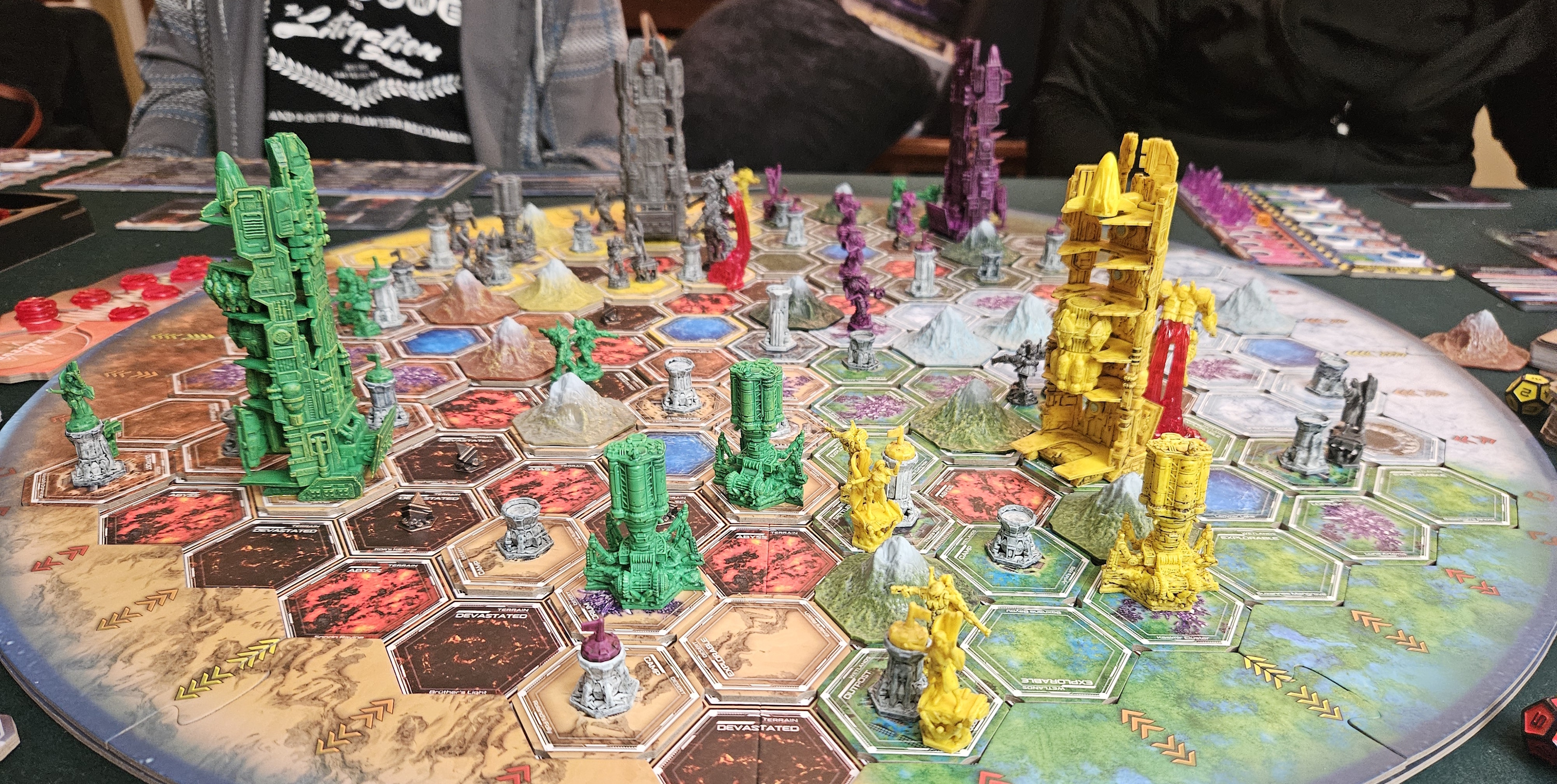
Runder Planet auf einem runden Spielbrett. Die Startrampen stehen bereit für den Bau der Arche.

Und dann geht’s los! Noch ist der Planet am Stück, alle Hexfelder ruhen friedlich an Ort und Stelle, und in den ersten Zügen passiert scheinbar gar nicht so viel. Doch wer die Express-Methoden nutzt, um schneller an sein Ziel zu kommen, fördert nicht nur mehr Ressourcen zutage, sondern beschleunigt auch den Zerfall des Planeten. Am Ende zählt nur das Überleben.

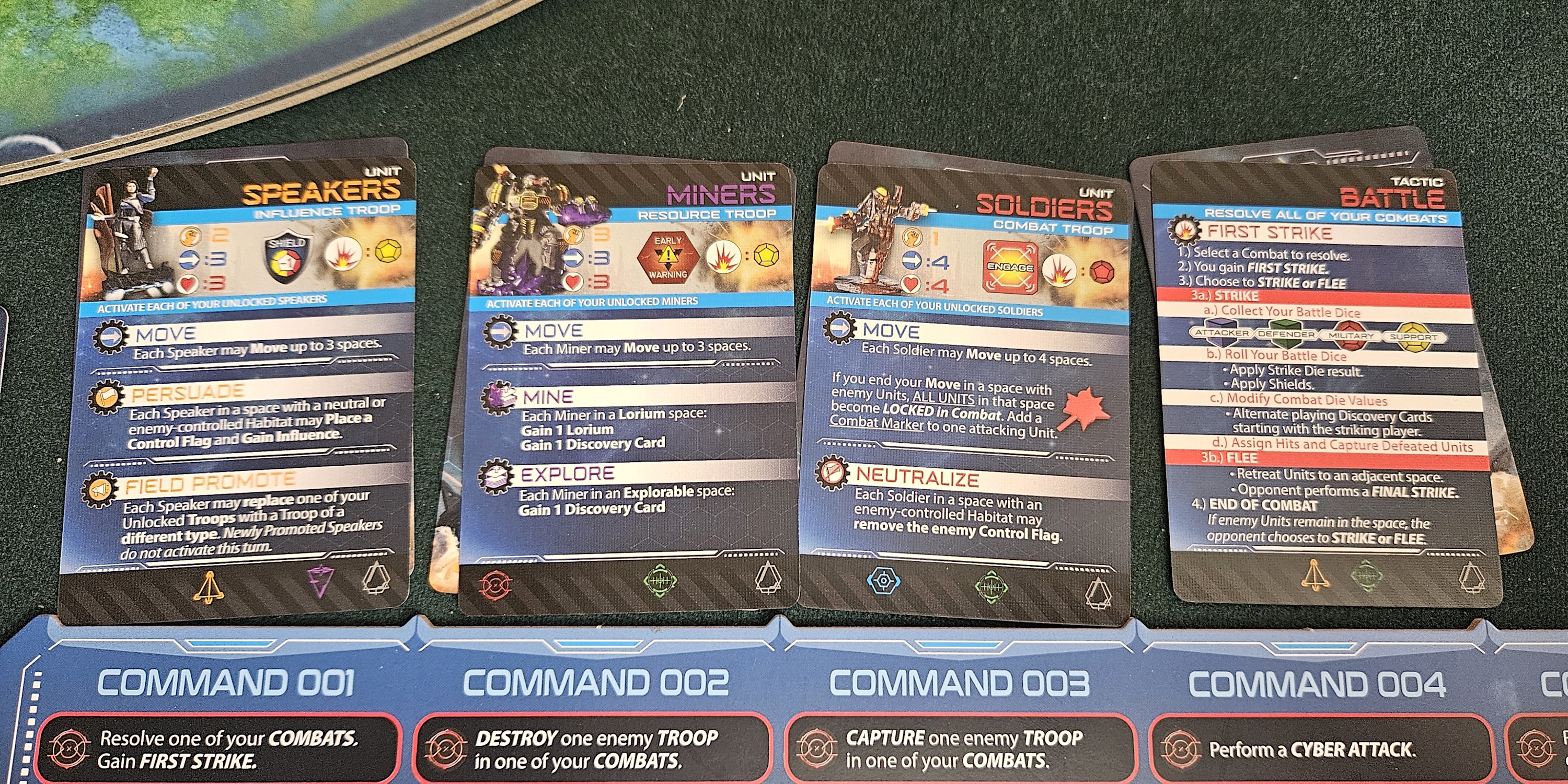
Der Aktionsmechanismus ist extrem clever gelöst. Du hältst 10 Aktionskarten auf der Hand und spielst pro Zyklus (der aus 5 Runden besteht) jeweils eine Karte. Der Clou: Du musst Dich in jeder Runde auch dazu zwingen, eine Karte herzlos zu verbrennen. Sprich, sie für den Rest dieser 5 Runden ins Nirvana zu schicken. Vorausplanung ist also King, denn Deine spontane Reaktionsfähigkeit schrumpft von Runde zu Runde wie ein zu heiß gewaschener Wollpullover. Aktionskarten gibt es für Einheiten und als Taktikkarten. Jede Einheitengattung hat ihre eigene Karte, mit der sie aktiviert wird. Ohne Karte? Keine Bewegung. Faules Pack! Die Taktikkarten sind hingegen Dein Werkzeugkasten, um Kämpfe abzuhandeln, Cyber-Angriffe vom Stapel zu lassen oder Truppen aufzuwerten. Du siehst also die Entscheidung, welche der 5 Karten du feierlich opferst, treibt einem den Schweiß auf die Stirn. Neben der Hauptaktion finden sich auf den Karten auch noch farbige Symbole, die du als sekundäre Aktion nutzen kannst. Dein Playerboard verrät dir, wofür du welches Symbol gebrauchen kannst. Dabei werden die Aktionen von Runde zu Runde netterweise ein bisschen stärker.

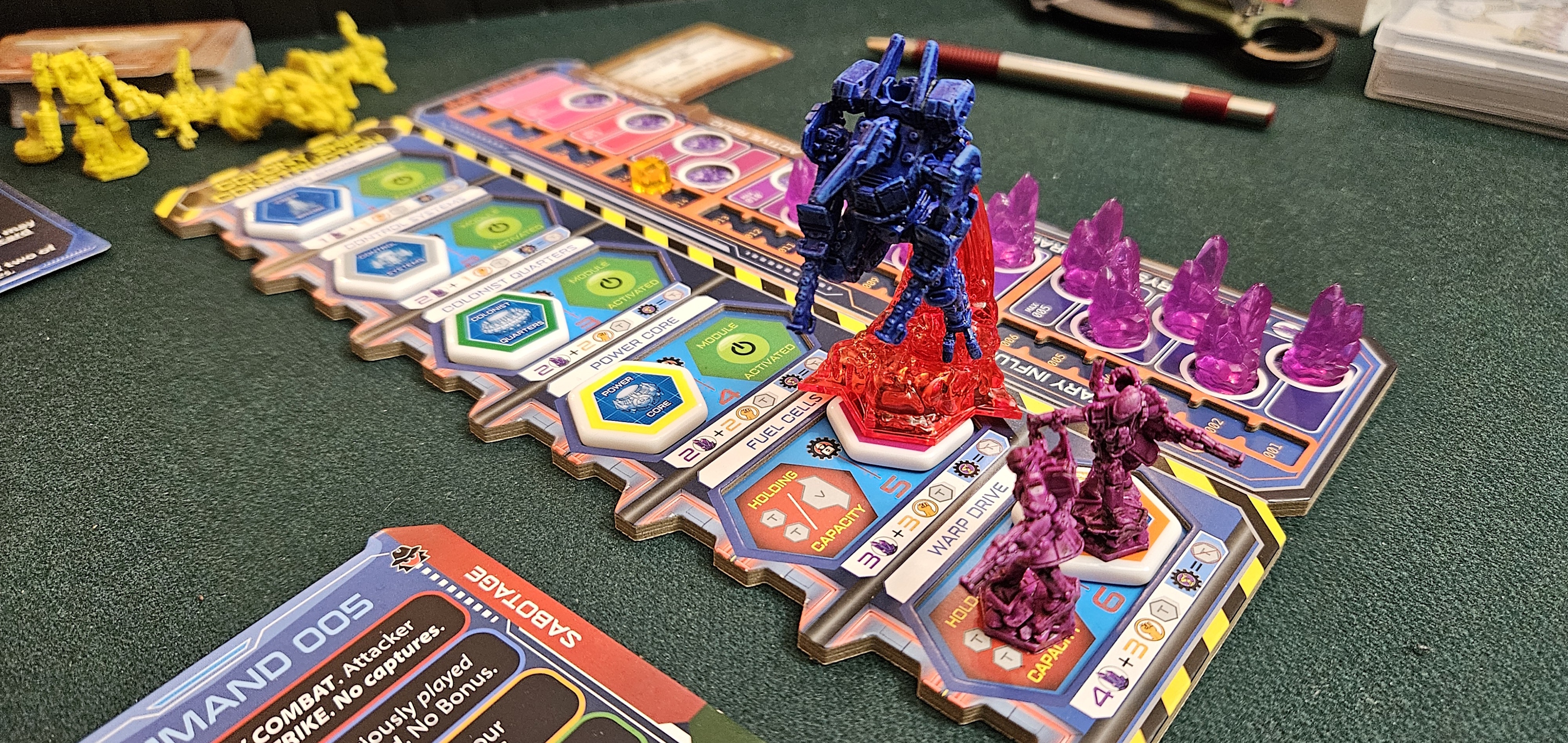
Das Playerboard mit allen möglichen Zusatzaktionen die von Spalte zu Spalte variieren. Oberhalb wird immer eine Aktionskarte gespielt und eine Aktionskarte „verbrannt“ darunter gelegt.

Einfluss und Lorium-Abbau

Zu Beginn versuchst Du erst einmal, Einfluss zu sammeln. Mehr Einfluss bedeutet, dass Du mehr Einheiten gleichzeitig rekrutieren kannst (mehr Kanonenfutter!). Wie sammelt man Einfluss? Du schickst deine Gesandten in die menschlichen Habitate, um dort eine astreine Propagandashow abzuziehen. Die Habitate haben einen Wert von 1 bis 3. Du hisst einfach dein Banner auf dem Dach und erhöhst deine Einflussleiste um den entsprechenden Wert. Die zentrale Hauptstadt in der Mitte lässt sich übrigens auch bequatschen und bringt satte 5 Einflusspunkte. Aber die Gefahr, dass ein Gegner dir diesen lukrativen Posten klaut, ist extrem hoch. Denn niemand, absolut niemand, gönnt dir so viel Macht.

Dann brauchst du natürlich auch noch Lorium. Die absolute Super-Ressource, um deine Einheiten aufzuwerten und die Arche-Module zusammenzuschrauben. Diesen Knochenjob erledigen deine Minenarbeiter. Leider sind die Typen schnarchlangsam, weshalb Du sie schnellstmöglich zu Harvestern aufwerten möchtest. Diese Ungetüme rödeln Dir das Lorium schneller in die Kammer, als ein Eichhörnchen auf Espresso Nüsse verstecken kann. Ja gut, sie verursachen dabei dummerweise zusätzliche Erdbeben, die den Planeten der völligen Zerstörung ein gutes Stück näherbringen… aber hey, es geht schließlich darum, schneller wegzukommen als die Nachbarn! Also pfeif auf den Umweltschutz. Nach uns die Sintflut (oder das Vakuum)!

Wenn der Planet Risse bekommt

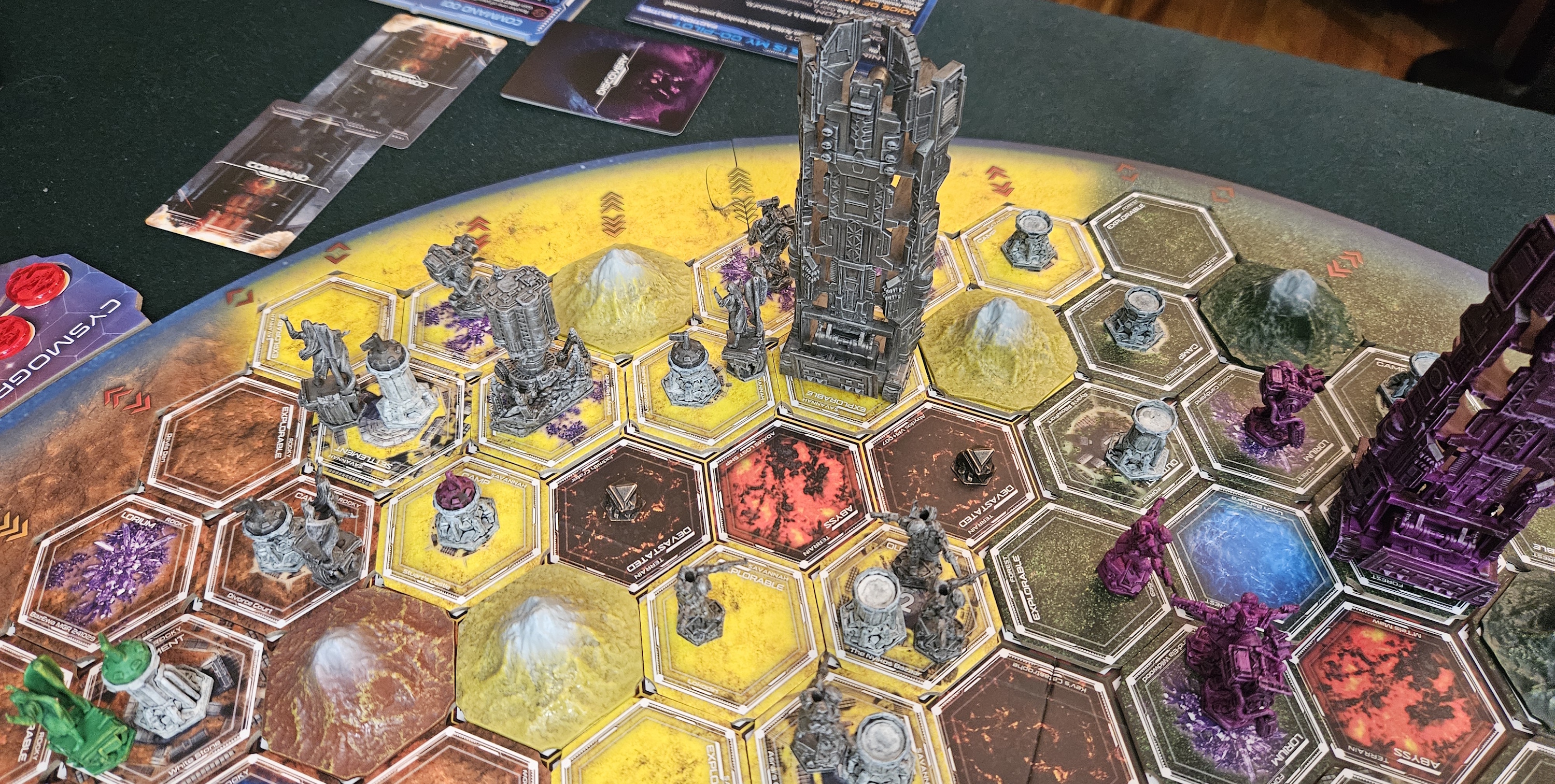
Wie erwähnt, verursachen die aufgewerteten Einheiten (wie die Harvester) bei ihrer Nutzung ein Beben. Das bedeutet, Du schiebst den Marker auf dem sogenannten „Cysmographen“ um 1 nach oben. Erreicht der Marker das Ende der Skala, rumst es und ein Riss entsteht! Dafür wühlst Du blind in einem Säckchen nach einem Riss-Token und schaust, wo der Planet dieses Mal aufplatzt. Das ist herrlich zufällig und sehr glückslastig. Auf der Vorderseite steht, welche der 6 Regionen betroffen ist, und auf der Rückseite, welche Reihe in das ewige Nichts stürzt. Alle Hexfelder in dieser Reihe werden gnadenlos entfernt. Befinden sich Einheiten oder Gebäude darauf? Tja, Pech gehabt, die werden direkt mit in den intergalaktischen Abgrund gerissen! Nur wenige Einheiten, wie die Minenarbeiter und die Arche selbst, verfügen über ein Frühwarnsystem und dürfen noch panisch zur Seite hechten und auch andere Einheiten im gleichen Feld zur Flucht verhelfen. Alle anderen machen den Abflug – leider ohne Raumschiff. Der erste Riss lässt meist noch etwas auf sich warten, aber die Abstände werden immer kürzer, bis schließlich jedes noch so kleine Beben den Planeten weiter zerreißt. Der Druck zu verschwinden, steigt ins Unermessliche, und irgendwann wird es dir völlig egal sein, ob deine Aktion ein Beben auslöst oder nicht. Hauptsache, Dein Taxi ins All wird fertig! In einer meiner Partien hatte fast jedes Riss-Token den guten Bill als Ziel. Wenn das Pech einem so hold ist, kann das verständlicherweise sehr frustrierend sein. Damit muss man schon leben können.

Zerstörte Felder hinterlassen entweder einen völlig unpassierbaren Abgrund oder ein begehbares verwüstetes Feld. Auf verwüsteten Feldern werden Relikte platziert, die mächtige Zusatzfähigkeiten verleihen. Jede Einheit kann diese einfach im Vorbeigehen einsammeln und du kannst maximal 2 davon gleichzeitig nutzen.

Die untere Seite des Planeten ist bereits völlig weggebrochen. Die Zeit rennt.

Der Bau der Arche

Aber was genau musst du eigentlich tun, um dieses Wunderwerk der Technik fertigzustellen, fragst du Dich? Zu Beginn hast du (je nach Spielerzahl) nur 1 bis 3 Baupläne. Diese sind nach Spielerfarben sortiert. Spielt man nicht mit voller Besetzung, sind die Pläne der fehlenden Farben entweder automatisch vorhanden oder (für die Hardcore-Gamer, die länger spielen wollen) auf die aktiven Spieler aufgeteilt. Fakt ist, du kannst ein Modul nur bauen, wenn du auch den verdammten Plan dafür hast! Es gibt primär zwei Wege, an das geistige Eigentum Deiner Mitspieler zu kommen.

Gefangennahme: Du nimmst im Kampf gegnerische Einheiten gefangen und tauschst sie später per Aktion großmütig gegen einen Bauplan aus dem Besitz deines Opfers ein.

Cyber-Angriff: Wenn Deine Truppen um die gegnerische Arche herumlungern und gerade nicht in eine Schlägerei verwickelt sind, können bis zu drei Einheiten hacken, was das Zeug hält. Sowohl Kämpfe als auch Cyber-Angriffe werden elegant mit Würfeln ausgetragen.

Hast Du Dir endlich einen Bauplan ergattert, drehst Du stolz den Marker der entsprechenden Farbe auf Deinem Tableau um und Zack – grünes Licht für den Bau!

Den eigentlichen Bauzauber vollführst Du dann in jeder Runde mit dem grauen Sekundäraktionssymbol. Das kostet Dich Lorium und Einfluss (irgendwer muss den Handwerkern ja sagen, dass sie gut sind). Alternativ kannst du auch die Arche-Aktionskarte zücken, um Module zu bauen. In dem Fall sparst du dir sogar die Einflusskosten. Ist das Modul fertig, steckst du die schicke Miniatur in Deine Startrampe und freust Dich wie ein Schnitzel darüber, dass das Teil magnetisch mit einem befriedigenden Klack einfach hält.

Der rettende Knopf und das liebe Gewissen

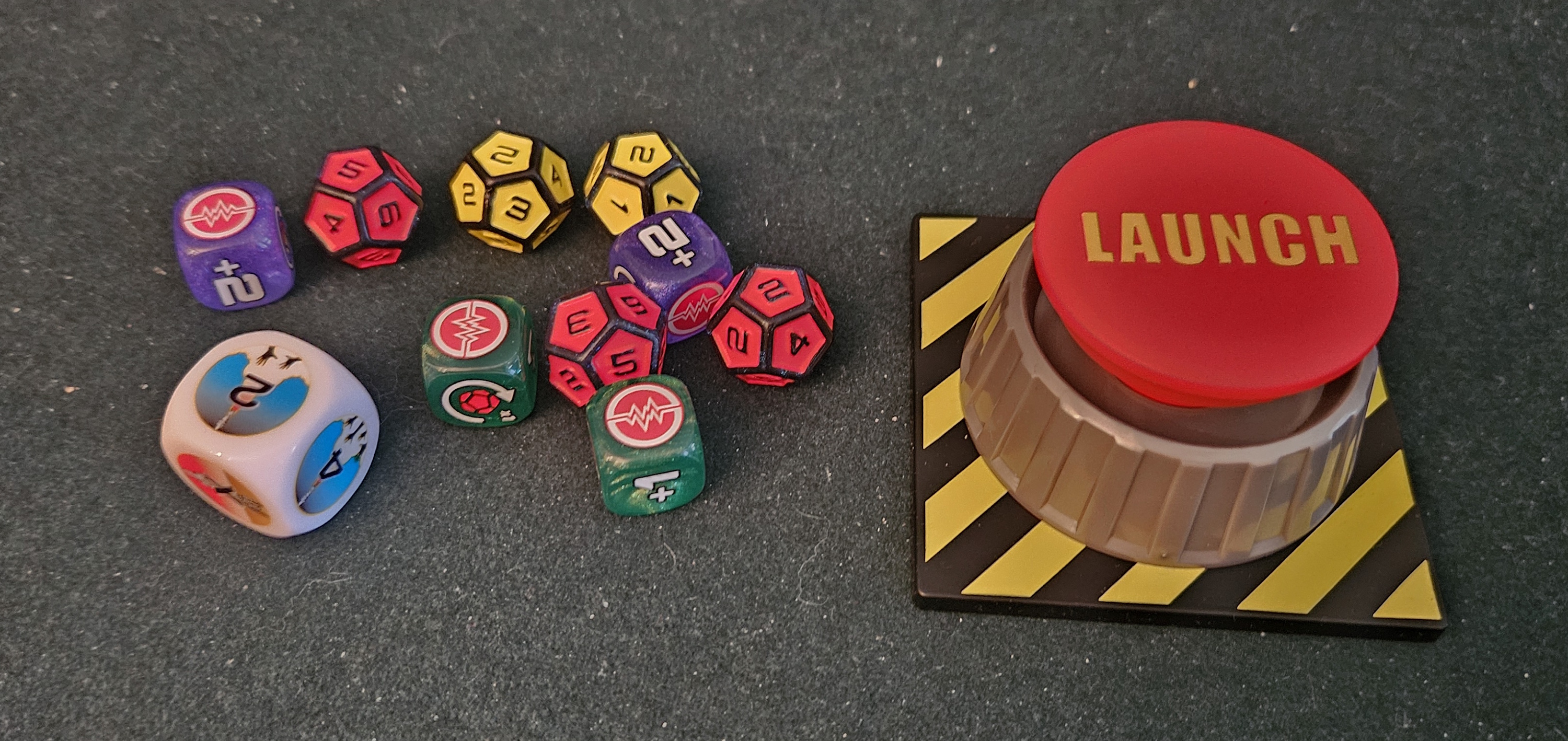
Wenn es dann endlich so weit ist, du den Planeten nach Strich und Faden ausgebeutet, deine Mitspieler ordentlich drangsaliert hast und deine Arche startklar in der Sonne glänzt, drückst du am Ende Deiner Runde den großen, roten Startknopf. Aber halt! Hast du nicht alle deine Einheiten rechtzeitig in die Arche evakuiert, klopft plötzlich dein Gewissen an. Du musst einen Würfel werfen, der bestimmt, wie viele Leute du eiskalt zurücklassen darfst. Liegt das Würfelergebnis unter der Zahl deiner noch auf dem Feld befindlichen Einheiten, meldet sich die Moral. Du bringst es nicht übers Herz, den Knopf zu drücken, und musst es in der nächsten Runde noch mal versuchen (Drama!). Der Gewissens-Würfel ist offiziell eine optionale Regel, aber ich finde er gehört zum sadistischen Spielgefühl einfach dazu! Auch dieser Moment, wo alle anderen Spieler noch weiter auf ihren eigenen Sieg hoffen können.

Eine weitere großartige, optionale Regel ist das „Mini-Legacy“-System. Wenn ein Spieler sich erfolgreich in den Orbit verabschiedet, aber noch eigenes Fußvolk auf dem zerbröselnden Planeten zurückgelassen hat, werden diese armen Seelen notiert und stehen ihm oder ihr in der nächsten Partie nicht mehr zur Verfügung. Eine ziemlich geniale Idee, um dem Sieger beim nächsten Mal ein kleines moralisches und spielerisches Handicap aufzudrücken.

Weitere Spielmodi

Wem das alles noch nicht reicht: Neben dem Standardmodus bietet das Spiel auch einen Euro-Modus, der das fiese Interagieren in spätere Runden verschiebt. Hier erarbeitet man sich die Module brav und gesittet durch das Erfüllen von Missionen und erst später durch Keule auf Kopf.

Für die Pazifisten unter uns gibt es sogar einen kooperativen Modus! Hier erhält jeder Spieler speziell zugeschnittene Aktionskarten, und die Habitate wimmeln nur so vor unschuldigen Zivilisten, die wir gemeinsam in eine zentrale Arche eskortieren müssen.

Und falls das an Varianz immer noch nicht reicht, kannst Du mit dem Material von Cysmic glatt noch eine alternative Version von Schach spielen. Das ist kein Witz. Auf der Rückseite des Boards ist ein echtes Schachbrett aufgedruckt. Gespielt wird dieses Weltraumschach dann stilecht mit Würfeln und Karten.


Unboxing

Mal ganz abgesehen davon, dass diese Box ein komplettes Ikea-Kallax-Fach hermetisch versiegelt, ist das Teil ist auch von innen ein absoluter Brecher! Die Box ist hervorragend konzipiert, und die ganzen Trays sind wundervoll durchdacht. Vermutlich das Beste, was die Tiefziehteil-Industrie jemals hervorgebracht hat. Jeder Spieler bekommt ein eigenes Tray, in dem sein gesamtes Material untergebracht ist, und auch der Rest wird perfekt sortiert. Ich hätte mir höchstens noch ein paar kleine Stege gewünscht, um die Etagen besser voneinander zu trennen und die Trays leichter einzeln herausheben zu können. Aber ich fürchte die paar Millimeter waren einfach nicht mehr übrig. Das Spiel gibt es ausschließlich in dieser einen Standardausführung, aber diese „Standardausführung“ ist Deluxe seine Mudda.

In den Trays schlummern detaillierte Miniaturen, hochwertige Karten (die übrigens auch gesleeved problemlos in die Einsätze passen!), Metall- und Kunststoffmarker sowie Hexfelder mit einer cleveren kleinen Nut, um sie leichter vom Feld hebeln zu können. Dazu kommen 3D-Berge für die epische Optik. Das Spielbrett ist magnetisch, sodass sich der Rahmen für die Hexfelder einfach zusammenklicken lässt, und auch die Arche ist (wie erwähnt) magnetisiert. Autor Jason hat hier absolut sein Herzblut vergossen und wollte sein Baby in der bestmöglichen Version in die Welt entlassen. Mission erfüllt, würde ich sagen. Das alles gab es damals zum Preis von 199 $. Mit Steuern und Versand landete ich am Ende bei rund 242 €. Zugegeben, das ist eine ordentliche Stange Geld, die den Geldbeutel zum Weinen bringt. Aber für das, was man hier an Gegenwert bekommt, ist es im Vergleich zu anderen überkandidelten Crowdfunding-Projekten ein absoluter Schnapper.

Kleiner Fun Fact am Rande: Ursprünglich war das Spiel in vielen kleinen Modulen und Erweiterungen geplant. Diese typische „Boxenschlacht“, die man von anderen Projekten kennt. Doch am Ende merkte man, dass es auch aus Kostensicht sinnvoller war, einfach direkt ein dickes „All-In“-Paket rauszuhauen. Den Backern der kleineren Varianten wurde ein Upgrade oder ein Refund angeboten. Ich persönlich bin ein riesiger Fan dieses Ansatzes! Erstens eliminiert es dieses furchtbar nervige FOMO (Fear of Missing Out). Du hast am Ende einfach das komplette Spiel vor Dir liegen und musst nicht stundenlang vorm Bildschirm schwitzen und abwägen, welches Paket nun das richtige ist. Man sagt einfach: „Ja, bin dabei!“ oder „Nee, ist nix für mich.“ Zweitens ist es für den Vertrieb schlichtweg viel einfacher und billiger, wenn alle exakt denselben Karton bekommen. Wenn man sich anschaut, wie oft es bei anderen Titeln mit zig Erweiterungsmöglichkeiten zu fehlerhaften Lieferungen kommt, ist das hier eine echte Wohltat.


Bewertung

Ich bin vielleicht etwas voreingenommen, da ich mit der Übersetzung auch sehr involviert bin, aber Cysmic ist trotzdem ein fantastisches Spiel und eines, das einem den Glauben an Crowdfunding zurückgibt. Ich glaube die Wertung von aktuell 8.9 auf BGG unterstreicht das nochmal. Hier hat ein Mensch einfach 9 Jahre seines Lebens damit verbracht, im stillen Kämmerlein zu tüfteln, um der Welt sein Meisterwerk zu präsentieren. Und das Beste daran ist das sich die 9 Jahre tatsächlich gelohnt haben. Es ist am Ende in gutes Spiel dabei herausgekommen und das ist ja bei aller Liebe und Herzblut nicht immer selbstverständlich. Manchmal sind Entwickler ja auch viel zu verbohrt in ihrer Vision. Durch die aberwitzige Menge an Spielmodi ist Cysmic so etwas wie die eierlegende Wollmilchsau auf dem Spieltisch: Koop, PvP, Euro und Schach. Klingt wie ein Fiebertraum, funktioniert aber alles. Aktuell ist das Spiel in Europa komplett ausverkauft, doch eine zweite Kampagne inklusive Reprints ist geplant.

Auch nach mehreren Partien fühl ich immer noch diesen Zerfall des Planeten und welch ein spaßiges Spielelement das doch ist. Also wer mit Chaos und Zufall leben kann wird hier definitiv glücklich und alle anderen sollten sich das Spiel trotzdem mal anschauen.

Wie wir bewerten haben wir euch hier aufgeschrieben.

Eine deutsche Version?

Mich hat das Spiel jedenfalls so vom Hocker gehauen, dass ich mich mit vier anderen ambitionierten Fans zusammengeschlossen habe, um eine deutsche Version auf die Beine zu stellen. Was eigentlich nur als kleine Fan-Übersetzung gestartet ist, eskalierte völlig und endete in 5 Monaten hochprofessioneller Arbeit an einer vollständig übersetzten Fassung dieses Mammut-Spiels. Wir reden hier von 60 Seiten prall gefülltem Regelwerk, über 400 Karten, Hexfeldern und Spielhilfen. Wir hatten das große Glück, vom Autor persönlich unterstützt zu werden und Zugriff auf alle Originaldaten zu haben. Das war eine enorme Hilfe.

Ganz nebenbei haben wir dabei auch noch ein paar Fehlerchen der englischen Version ausgebügelt und einige schwammige Regeln weiter verdeutlicht. Das Ergebnis kann sich jedenfalls sehen lassen. Leider liegt es nun am Erfolg der zweiten Kampagne, ob es dieses deutsche Wunderwerk jemals offiziell geben wird. Eine komplette deutsche Retail-Fassung ist aktuell zwar sehr unrealistisch, aber ein deutsches „Upgrade Pack“ (das zumindest alle Karten und die Anleitung enthält) könnte tatsächlich Realität werden. Drücken wir die Daumen! Also wenn du nun Interesse an dem Spiel hast, lass doch hier schonmal ein follow für die neue Kampagne da. An dieser Stelle meinen Dank für diese glorreiche Zusammenarbeit und Erlebnisses an Jason, Günter, Şenel und Thomas.

Konzertmitschnitte

Zwei Spieler und ihere Einheiten sitzen sich im gegenseitig im Nacken.

(c) Copyright StarReachGames

Grafik(en) und Bild(er) von analog rockt

Bannerbild von analog rockt.

Bausteine: Diese Rezension ist unentgeltlich durchgeführt worden und spiegelt meine persönliche Meinung wider.

Bite the Big One

19. Mai 2026 um 23:40

That's me, avowed space terrorist, machinegunning a Bezos penis-rocket before he can escape the Amazon Superflex.

I live in the shadow of the Wasatch Mountains. Have for nearly my whole life. Out-of-towners sometimes voice their apprehension when they first visit our cordillera, when they see the way our cities and suburbs are hemmed in by walls. The mountains, they say, seem precarious, like they could topple onto our heads at any moment, burying us under a thousand tons of limestone and quartz monzonite. Jokingly, I inform them that the real danger of the coming tectonic collapse — not the little shakes we sometimes get, but the Big One, the one we’re a millennium overdue for — is that it will kill us from below. The ground will liquefy and carry us downward, the ancient tidal basin finally sweeping us out to an inland sea that died with the mammoths.

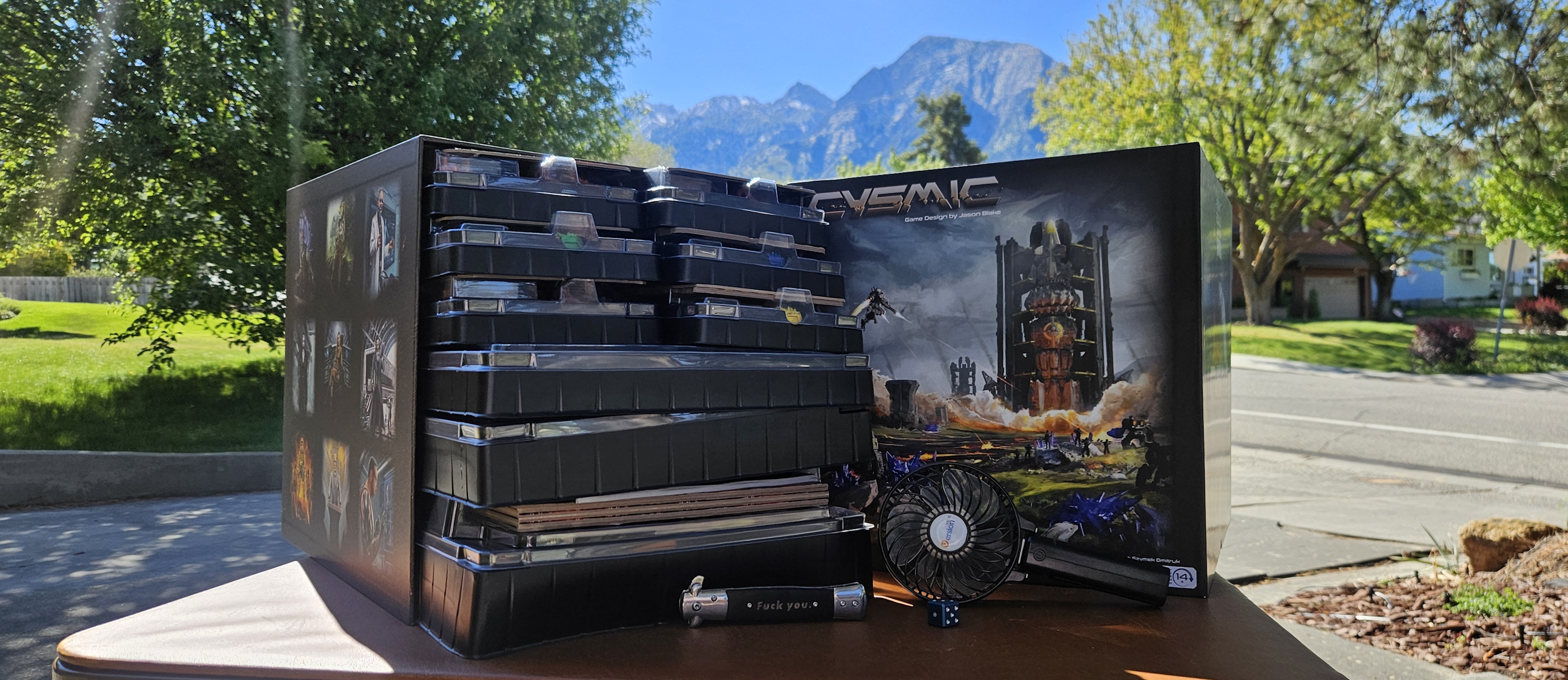
Cysmic, the board game by Jason Blake, gives me that feeling. When I hefted it onto the review stack next to my computer desk, my wife wondered aloud if it would topple and crush me. It isn’t the largest board game I’ve ever owned; that would be the 22-pound Ogre, the one with the team lift warning printed prominently on its side. But it’s the one that feels most like an Ozymandian temple to excess. Its map is sprawling. The frame that holds the hexes comes with hidden magnets to lock everything into place. The plastic constructs are so phallic that they make me uncomfortable. Among its many dice, there’s one for gauging your character’s crisis of conscience. It’s so gargantuan that it’s become a game-night joke. Nothing could justify this sprawl.

I kinda dig it.

This is the first knife hidden in these images. Because lately I have been Getting Into Knives.

Cysmic next to a few everyday items.

I want to set the scene. Both of the scenes.

In the distant future, humanity has settled an exoplanet. Pretty cool. Only it turns out that we repeated our past mistakes, squatting on territory that means us harm. This planet, you see, is tectonically unsound. Seismic. Cysmic. (Ohhhhh.) At some point in the near future, the crust of this world will flake away like the film coating an uncleaned oven. When that happens, the eruption of magma and steam will render anything above unlivable.

Not unlike the Salt Lake Valley, come to think of it. Mostly, I just don’t. Think about it.

Which is precisely the problem. Cysmic is unexpectedly redolent of Sol: Last Days of a Star, Ryan Spangler’s parable about climate collapse hastened by its victims, and Meltwater, Erin Escobedo’s cautionary tale about how nations set themselves aflame for the sake of spiting people whose existence has little bearing on their own. Of course, these titles could not be further apart, production- or intention-wise, but the parallels are there for the taking.

All, for instance, are about a looming crisis that their games’ factions are urgent to hasten. Because that’s the crux of the matter. Our goal on this planet is to escape by reconstructing one of the old colony ships that bore us here. But rather than cooperate to ensure everybody gets a seat on the ark, we now usher in our own destruction. We crack the mantle to get at the minerals that will shape the colony ship’s hull; we shatter the crust with our ordnance; we erect tracked megastructures that unfasten fault lines like zippers. Every action we undertake in service of survival steals a pinch from the hourglass.

Where Sol’s telling of this parable was poetic and Meltwater’s was bitter, Cysmic settles for frickin’ awesome. If those games offer the somber foretellings of the Book of Revelation, Cysmic is the Doof Warrior rendition. Let’s get this party staaaaarted, it hollers, jets of flame washing over the audience.

"You're right, that isn't how biomes work!" —a climatologist misreading my caption.

The map is ridiculous.

That’s the narrative scene. The second scene begins on the physical tabletop.

I worry about waste. Not as often as I ought to, probably. Compared to junk mailers and Happy Meal toys and oil wells set alight by incautious tyrants, board games are a drop in an ocean of muck. At least, I tell myself, they’re preservable. I donate some of them, and sell others, and buy secondhand when I can, and try to ensure that they go to homes where they will be appreciated and not wind up in some landfill after only one or two plays.

Cysmic defies that self-soothing rubric. The map is so massive that my group laughed uncontrollably the first time we set it up. Again, it isn’t the largest board game to ever take up real estate on my table, but it’s perhaps the most of everything else. Those frames, with their little magnets underneath the cardboard. The tiles, crafted with fingernail-thick nubs at their corners to make them easier to pry up. The plastic mountains, which called to mind the earliest printings of Runewars, back before Fantasy Flight decided to use cardboard overlays in place of three-dimensional topography.

The miniatures. Goodness, the miniatures. Some of them are actually mini. Others, like the spires that hold the components inside your colony ships, an affectation that’s a nice bit of visual design on the one hand but also a physical obstruction of the battlefield on the other, are so large that they veer into self-parody. If you saw this thing on a sketch show, you would swear this wasn’t a real game. Ha ha, we would say, look at the silly nerds, with their jokes about Windows 11 and their board games that defy common sense. Those towers are not merely phallic; they are penises, swollen like Cormac McCarthy’s sunset, like Daniel Plainview’s erupting pumpjack, almost rhapsodic in the baldness of their representation.

To some degree, this clutter is extraneous to the tale Blake wants to tell. It’s so big, for one thing, that many of its rumblings hardly matter. The first time the mantle collapses to reveal the planet’s glowing lifeblood, odds are that the catastrophe won’t come anywhere near you. A settlement falls in, countless lives are lost, but only in theory. There are other settlements to claim, other veins to mine. The scars are mere obstructions, easily bypassed or flown over. Might as well fire up some extra rockets. Charge some lasers. Drill baby drill.

The map also wraps around, so these guys aren't actually hiding up against the edge.

Battle lines begin to form. Soon they’ll fall apart.

Then again, this is also the point. Because Cysmic, in addition to head-banging through the apocalypse, does have something to say about how the proverbial frog gets boiled. One collapse is nothing. Two is nothing. Five is nothing. But a dozen? Now we’re cooking. Like the frog in the pot. Like the settlements that have just fallen into mile-wide sinkholes. Like our troops, those without early warning detection systems, who have gone hurtling into the abyss.

Let’s back up. For a game of such sprawling proportions, Cysmic is surprisingly smooth to play. Each turn sees you selecting a card that activates some segment of your apocalypse-realizing faction. Often, this means triggering a type of unit. There are diplomatic Speakers that are indispensable in the early days and more vestigial once the oven reaches temperature, Soldiers for shooting things, Miners and plus-sized Harvesters for mining minerals, and big jump-jet equipped Powermechs for blasting enemy columns. Other cards resolve all the battles you’ve set up over the previous turns, launch negotiations and cyber warfare, recruit or upgrade troops, the works.

The most transformative card is the one that activates your colony ship. This inevitably collapses at least one hex as your giant launchpad shifts position, squishing troops and cities under its treads and leaving fiery destruction in its wake. This is also an opportunity to attach modules to your ship, provided you have the resources and blueprints to do so.

Despite this clarity, turns aren’t as straightforward as choosing one card among many. In addition to selecting which card to activate, you also choose one that will disappear beneath it. This card is out of the rotation for the time being, depriving you of an entire class of unit or some crucial activity. Sure, there are ways to cycle spent cards back into your hand before the end-of-round refresher, but it speaks well of Cysmic that you’re asked to make tough decisions early and often. These choices aren’t as profound as, say, the hand drafting in Inis or Blood Rage, but they tend to be more significant than the eldritch upgrade paths of Cthulhu Wars.

This positions Cysmic squarely in the middle of the Ameritrash spectrum, somewhere between the poles of “cerebral/political” and “beautifully stupid.” Before long, it touches on both extremes. And while its performance in either arena is accomplished to greater or lesser effect, it always returns to those core tradeoffs between cards. This does wonders for the game. At a glance, you can tell how likely it is that a rival will respond to an incursion with a counter-attack, whether a target can shift a particular unit out of your reach, when the next tectonic collapse will take place. None of this information is foolproof. There are too many special abilities and action cards and faction perks for that. But it’s enough to communicate some sense of possibility, a probability waveform that can be surfed to your advantage.

My priority is rock and roll, did you ever consider that? No? Shame on you.

The command system asks hard questions about your priorities.

So let’s look at those poles.

At heart, Cysmic is a contest of equal-opportunity aggression. Your goal is to complete your colony ship before anybody else, an objective made significantly harder by the absence of blueprints for all six of the necessary modules. Each player has sole ownership of one such module, meaning the only way to complete your ark is by prying the blueprints from their possession.

Fortunately, the blueprints of the far future apaprently come as shareable zip files. There’s no need to be too possessive; your possession of a blueprint does not preclude my ownership. The rub is that nobody is going to hand out their propriety information willingly. There are therefore two ways to gain access to a faction’s data. One, you can steal it via cyber crime, a finicky action that’s one of the game’s many underdeveloped appendages, but a noteworthy one all the same. Or two, engage in battle to kidnap some of their troops for use in a blueprint-for-prisoners exchange.

The implications are far-reaching. The good part is that everybody needs to attack everybody else, at least a little bit, in order to capture enough units to swap for those blueprints. If anything, a few early attacks might render a particular neighbor more or less negligible, which can be a huge relief when you share a border. Once you hold my blueprint, there’s no reason to attack me anymore, barring some late-game stalling for time.

On the other hand, this diminishes some of the game’s other elements. The map, for example, isn’t especially interesting, which is saying a lot when it depicts an entire planet crumbling under the strain of mech battles and mountain-cracking mineral extraction. There’s no reason to hold any territory in particular. One settlement is as good as another, resource veins are interchangeable, troops come and go, and entire flanks might collapse thanks to a random pull from a bag. With no sense of permanence, there’s nothing like a battle line, and the inviolability of your colony ship means there’s nothing to protect.

The closest dudes-on-a-map analogue would probably be Kemet, but one cleared of cities or temples. There’s plenty of territory out there, even a few choke points, but all that landscape provides very little reason to care about one tract over another. As the planet falls apart, it’s possible that some areas will become more valuable, but our sessions tended to conclude before such an eventuality was realized. The result is round-robin aggression, everybody targeting whomever they haven’t yet stolen blueprints from, with very little concern for anyone else.

My faction's powermechs scream "Zip zop zooey!" as they launch into battle. Nobody fears them.

Prisoners can be exchanged for blueprints.

The good news is that these aggressions are enjoyable enough in their own right that it isn’t as though Cysmic is going through the motions. Battles are punchy, if a little too concerned with different dice types and attack modifiers, and it’s always possible that a gunfight will accidentally split the world at the seams. There’s a little bit of everything in there. Dice, of course, with varying shades for combat and noncombat units; cards, for modifying rolls and maybe springing a nasty surprise; unit and faction abilities, just in case you thought you were getting off easy. Despite this abundance, resolution is reasonable, never reaching Forbidden Stars duration, which is great for the game’s play length if not for any prospective bathroom breaks.

Maybe the biggest highlight is the faction system. Like everything else in Cysmic, there are heaps to choose from, and in place of the expected mealy-mouthed plus-one perks, each team offers something transformative and meaty. One of them adds adjacency to every single space next to a mountain or lake, effectively letting you teleport anywhere at will. Another seizes control of any settlement anywhere on the map at the start of each turn. A third takes their turn at any point in the round — and I mean any point, treating the usual turn order to forced obsolescence.

What’s wild is that these are only the first of those factions’ abilities. Each offering has three or four whoppers. And there are more than twenty-five factions in all, each with their own distinct advantages and playstyles. The only real downside is that they all have dork-ass meme names like Path of the Wrighteous, Moving Mao Tons, or Kriss of Death. Receiving a diplomatic missive from uplifted psychic housecats is one thing; that the kittens have named their faction Cat-Aclysm gives off a real cringe vibe.

But, look, restraint is not Cysmic’s watchword, so why would Blake rein in the puns? Everything here is the board game equivalent of an extra order of mozzarella sticks. The handfuls of dice. The units you probably won’t field. The sheer variety on display. There’s even a clacky launch button that serves precisely zero in-game function, but which I very much intend to keep when I pass the game along to somebody else.

And, of course, there’s that most emblematic of all components: the conscience die.

My conscience says it's time for a big scoop of peanut butter.

Roll the dice. Smash the button. Search your conscience.

To my utter tickling, this final hexahedron serves an indispensable purpose. When at last the planet has been strip-mined, when the blueprints have been assembled, when the modules have been stuffed into your colony tower, the game is still not complete. Now it’s time to blast off for the stars and leave the rest of these suckers behind.

Except you might not be ready to hit the red button. It all depends on the conscience die. When the time comes, you roll and compare its result against the troops you still have on-planet. All the miners and troops stationed in the dust, all the diplomats persuading those neutral settlements that you have their best interests at heart, all the prisoners still waiting for freedom. The conscience die reveals how many you’re willing to leave behind. If there are fewer out there than the roll, you leave. Kaboom.

But if not, you stick around and attempt to evacuate more bodies, more lives. With the right resources, you can try the roll again next turn. Without them, you’ll have to wait for the end of the round when your cards return to your hand.

Either way, Cysmic has done the unexpected. It has grounded the moral cost of its conflict. In incredibly shaky terms, yes. In a way that rewards losing units to cave-ins and enemy assaults. In a way that makes the anthropogenic horrors visited on its planet and peoples seem all the sillier. But in terms that, imperfect as they are, most historical wargames don’t even attempt, and which — and I say this in all seriousness — we would laud in a game with a more solemn setting. Because even here, as the world collapses toward its molten core, sometimes the cost is too high. Sometimes you can’t bring yourself to make the hard choice. Even if you happen to be a battle-hardened jerk named Minnesota Killjoy.

(Yes. That is one of the game’s factions. Save me.)

I now want to play Clash of Cultures on this map. While the terrain falls into the core.

Ah. Ludicrous.

This, I think, is what sets Cysmic apart. It’s too big. It could have been pruned down. It doesn’t need quite so many alternative modes. The mountains could have been cutouts. The launch towers could have been a little less, ah, engorged. There didn’t need to be magnets all over the place.

But it’s also a huge cry from the crowdfunding trash that gives miniatures-heavy games such a bad name. Unlike some of those titles, maybe even unlike the majority of them, Cysmic is a game one would actually opt to play. And more than that, it’s an earnest experience, one packed with exciting battles, a landscape undergoing disaster, a race to survive at all costs.

It even has shades of meaning in its human-hastened collapse, one that feels all too timely. Here in the desert of Utah, a billionaire has announced a 40,000 acre data center that will triple the state’s power consumption. The stated reason is national security, a digital arms race against China. This despite the professionals at the local universities pointing out that we don’t have the water, don’t have the heat allowance, don’t even have much of a Great Salt Lake anymore. Will our elected officials make a saving throw on the conscience die before they bake us to death? I hope so.

For a board game, that’s the sort of thing that makes us say it’s punching above its weight. When it comes to Cysmic, the aphorism feels wrong. Let’s instead say it’s punching at precisely its weight. Fine: maybe a little under.


A complimentary copy of Cysmic was provided by the publisher/designer.

(If what I’m doing at Space-Biff! is valuable to you in some way, please consider dropping by my Patreon campaign or Ko-fi. Right now, supporters can read my first-quarter update of 2026: the best board games, movies, books, and more!)

❌