With this My Favorite Wargame Cards Series, I hope to take a look at a specific card from the various wargames that I have played and share how it is used in the game. I am not a strategist and frankly I am not that good at games but I do understand how things should work and be used in games. With that being said, here is the next entry in this series.
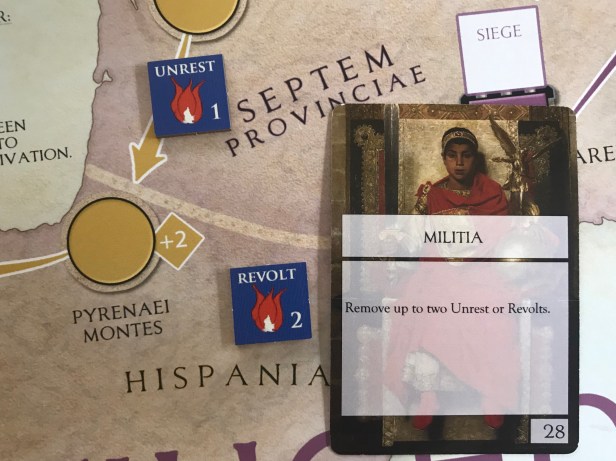
#63: Militia from Stilicho: Last of the Romans from Hollandspiele
Stilicho: Last of the Romans is a very well designed and interesting solo experience that plays in 60-90 minutes. But, due to the unforgiving nature of the random card draws and its reliance on dice luck, that admittedly can be mitigated through cagey card play and proper decisions, the game can be over very quickly. In fact, my very first play a few years ago lasted only 2 rounds and was over in about 15 minutes. Remember that the historical Stilicho only made it to Round 3! The cards are at the heart of the game here and make it a very tense and decision filled experience. Having to analyze each card, measuring its utility against the board state and what pressing matters the player must address while also fretting over having to discard a good Event Card that just isn’t useful at this point in time to take an action can be really agonizing. I think that this design works even better than its predecessor Wars of Marcus Aurelius.
The cards are a form of multi-use cards, as most Card Driven Games are, as they can either be used for the printed events on the cards or simply to be discarded to take one of a number of actions available to the player. It is important to read every aspect of the card thoroughly as some cards have multiple effects, differing effects depending on what the state of the game is or whether one Barbarian has surrendered or may have several prerequisites to that card being allowed to be played.
There are some events that are too important to your efforts to ever discard to take an action as they provide you with such great benefit and are more efficient than taking individual actions. Don’t get me wrong though the playability of a card is always dependent on when in the course of the game the card is drawn. An example of what I am talking about is the Militia Roman Card.
During the game, some cards will cause Unrest Markers to be placed on the various tracks that wind their way through the provinces. These Unrest Markers represent the erosion and weakening of Roman control, the spread of fear throughout the populace due to the threat of usurpers and ultimate civil war as well as the logistical difficulties of defending against barbarian incursions. They act as a critical, accumulating threat that, if left unchecked, can lead to widespread revolts, which are one of the primary ways a player loses the game. Unrest Markers are placed in Dioceses when specific enemy cards (particularly the Vandals) are activated or reach the end of their movement tracks. If a Diocese already contains an Unrest Marker when a new one is triggered, it indicates increasing instability, requiring the player to flip an existing, lower-level Unrest Marker to its “Revolt” side. Unrest/Revolt Markers increase the difficulty of battles in that province. When attacking or defending in a affected Diocese, the marker adds to the enemy’s strength. Also, a major loss condition in the game is having too many Revolt Markers on the board simultaneously. Managing and removing these markers is essential for survival. Unrest Markers are placed in a specific order across the board—starting from Hispania and moving through Gallia to Italia—which dictates the geographic spread of the crisis. Players must spend valuable actions (usually by discarding cards) or use specific Event Cards such as the Militia card to remove these counters from the board.
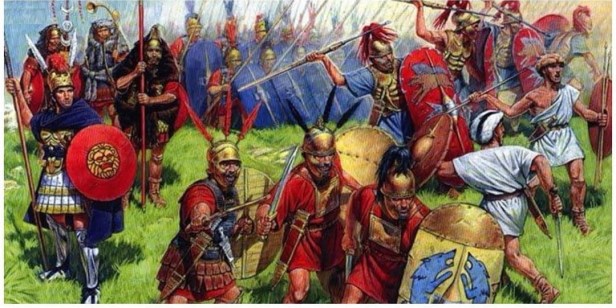
Before the late 2nd century BC, Rome used a citizen militia or levy of property-owning men aged 16–46, serving unpaid during summer campaigns. Organized by wealth, they formed three lines—hastati, principes, triarii—and provided their own equipment. They were crucial for seasonal defense and expansion, as well as for patrolling and safeguarding supply lines, trade routes and newly conquered territories, ultimately transitioning to a professional army after 107 BC. The citizen troops were grouped into maniples based on age and wealth, with the poorest acting as light-armed skirmishers (velites). Service was typically restricted to the annual campaign season, often ending with the Festival of the October Horse on 19 October. The militia employed a three-line, checkerboard formation to allow for tactical flexibility. Due to many reasons, the militia system was phased out after 107 BC in favor of a full-time, professional army, although conscription remained as a, mostly unpopular, option for raising forces.
I wrote a series of Action Points on the various aspects of the game and you can read those at the following links:
Action Point 1 – the Mapsheet focusing on the three Fronts down which your enemies advance, but also covering the different spaces and boxes that effect play such as the Olympius Track, Game Turn Track, Army Box, Leader Box and Recovery Box
Action Point 2 – look at the cards that drive the game and examine the makeup of both the Enemy Deck and the Roman Deck.
Action Point 3 – look into the Roman Phase and examine how cards are discarded to take one of nine different actions.
Action Point 4 – look at a few examples of Battles and how they are resolved.
Action Point 5 – look at a few points of strategy that will help you do better in the game.
I shot a playthrough video for the game and you can watch that at the following link:
I also followed that up with a full video review sharing my thoughts:
Amsterdam is an amphibious city. Water flows around it (the Ijsselmeer, over which most people used to come into the city), water flows through it (the Amstel river, after which it is named, and the canals dug later), and even the land on which the buildings stand was won from the watery marshes in a feat of human ingenuity. The need to work together in this communal enterprise did not only strengthen the peasants and craftspeople who had won this land themselves (instead of receiving it from a noble), but also their willingness to put up with each other regardless of differences – the first instance of the famous Amsterdam tolerance.
Amsterdam’s rise was also closely connected to the water: On the one hand, Dutch herring fishers found out about how to cure fish on the ship, enabling them to sail further and catch more instead of having to head home after the first big catch. And in the 14th century, the count of Holland decreed that all Dutch beer imports from Hamburg, then northern Europe’s brewery, must go through Amsterdam. The city thus became a trade hub, first for these staples of fish and beer, but the local merchants soon branched out to luxury goods, too, especially as the great voyages of discovery brought Europe in direct touch with south and southeast Asia as well as the newly-discovered Americas.
When the Reformation swept Europe in the 16th century, Amsterdam, unlike many other Dutch cities, did not adopt the new Protestant faith. Yet the city kept its unusual approach to differences of faith and tolerated the local Protestants. Neither Protestantism nor tolerance were acceptable to the ruling Habsburg monarch, Philip II of Spain, who had inherited the suzerainty over the Low Countries from his father, emperor Charles V. Yet while both Philip and Charles were ardent Catholics, they had a very different relationship with the Low Countries. Charles had been born and brought up there, living his happiest years not far from Amsterdam. Philip was a Spaniard in everything, regarding the Dutch with suspicion. And as they started rebelling against him – for the Protestant faith, for municipal independence from the monarch, and for the exemption of taxes funding Habsburg wars in faraway lands – he was resolved to bring them back into the fold by force.
The various factions of the Dutch struggle for independence are the player roles in Revolution: The Dutch Revolt, 1568—1648 (Francis Tresham, Phalanx Games) – Catholics, Habsburgs, Nobility, Burghers and Reformers. Amsterdam remained initially Catholic (and thus loyal to Philip), yet other concerns would be more pressing to the city than religion: When the Dutch rebels blockaded the city from the sea, thus causing the collapse of any trade profits and the food supply to the city, Amsterdam’s anti-Habsburg faction was ascendant. The city threw its lot in with the rebels in 1578. Its Catholic minority, however, would be treated as the Protestants had been before. Tolerance went both ways in Amsterdam.
Amsterdam had escaped its ruin from the naval blockade. Further south, Antwerp, the most important Dutch port, was not so fortunate. While the blockade strangled Antwerp’s trade, tens of thousands of Antwerp merchants and artisans left the city to find greener pastures elsewhere – most of them in Amsterdam. Thus, while the Dutch provinces were engulfed in warfare with the Habsburgs (which would only end with Dutch independence in 1648), the convergence of capital and know-how in Amsterdam turned the city into the commercial capital of the world.
The Center of the World
Amsterdam in the early 17th century was buzzing with commercial activity. The merchants did not only find new trade routes, they also invented new ways of doing business altogether: The Vereenigde Oostindische Compagnie (United East India Company), or VOC for short, founded in 1602, was the first chartered company in the world. Anyone could buy a share in the company and thus partake in its profits – or sell the shares to others in what would become the Amsterdam Stock Exchange (also the first of its kind in the world). Amsterdam ships carried goods all over the worlds, Amsterdam shipwrights built them, Amsterdam craftspeople produced many of the finest objects for sale, and Amsterdam painters and writers catered to the pursuits of the minds. In the mid-17th century, a staggering 30% of all the new books in the world were published in Amsterdam, taking advantage of the liberal approach to the exchange of ideas in the metropolis.
Construction boomed in Golden Age Amsterdam – the city had much outgrown its medieval limits. In an ambitious scheme to not only expand, but also re-order the city’s flow of people and goods, Amsterdam took on its characteristic form, the city center surrounded by three belts of interconnected canals (grachten).
Amsterdam’s canals and the narrow houses built along them (for taxes were paid according to the width of the building’s front) have their own board game dedicated to them: Grachtenpand (Zach Hoekstra, Wulfhorn Games).
To my knowledge, no board game portrays the construction of the grachten. That’s a shame, because the scheme that led to their creation is worthy of the most cunning table strategist: Mayor Frans Oetgens knew of the plan to expand Amsterdam and dig the canals before it was public, so he and his associates bought up vast stretches of land at bargain prices and sold them back to the city at astronomical profits.
This act of self-interested entrepreneurship embodies Amsterdam’s preoccupation towards individual gain. It speaks to Amsterdam’s character as an individualist, bourgeois city that its most recognizable sights are not palaces and cathedrals, but these canals and the private houses along them.
Another very Amsterdam trait which has stood the test of time is the love of flowers, especially tulips. Yet never was this passion greater than in the 17th century, when it intermingled with the other great passion of Amsterdammers – commerce. Unlike the controlled trade of goods and shares in Amsterdam’s port and stock exchange, the Amsterdam Tulip Bubble developed unregulatedly in taverns where buyers and sellers met over a glass of wine. The price of tulips skyrocketed in one of the first documented speculation crazes – until the bubble burst, as is the inevitable outcome of Tulip Bubble (Kouyou, Moaideas Game Design): Players want to partake in the profitable trade, yet must try to sell before the end of the mania, for all their tulips in hand will be worth nothing at game end.
The allure of 17th century Amsterdam, this great laboratory of capitalism, is so great that it has become a widespread board game setting – just behind Vikings, zombies, and trading in the Mediterranean. Even the behemoth board game franchise Ticket to Ride has an instalment set in Amsterdam. Ticket to Ride: Amsterdam (Alan R. Moon, Days of Wonder) deviates from the tried-and-true setting of trains in favor of route-building in Golden Age Amsterdam 200 years before the first rail was laid. I especially appreciate that the game sticks with the original names for places in Amsterdam, so that players who don’t speak Dutch can attempt to pronounce Korenmetershuisje (Little House of the Grain Measuring Officials) and Oost-Indisch Huis (East India House).
Finally, the great master of eurogames has also designed a Golden Age Amsterdam game: Merchants of Amsterdam (Reiner Knizia, Rio Grande Games). And despite Knizia’s reputation of producing mathematically sound, but often themeless games, it might be the one which captures Amsterdam in 17th century best: Not only is the central mechanism that of a Dutch auction (that is, an auction which starts at a very high price which continues falling until someone buys the asset in question at the price asked), but its map depicts the Amsterdam surrounded by four world regions with which the players can trade – Amsterdam, the commercial center of the world.
Amsterdam’s preeminence could not last forever. Despite its naval and commercial advantages, the Dutch Republic was a small country compared to England or France, and eventually fell to these rivals. The rampjaar (catastrophe year) of 1672, in which England challenged the Republic on the seas and France invaded the Netherlands, ended the Dutch Golden Age. Amsterdam was only saved from French occupation when the Dutch pierced the dikes and flooded a large area of their own country to prevent the French onslaught.
As the Dutch Republic shrunk in importance, so did Amsterdam. London, Paris, Vienna, and Berlin eclipsed it as centers of modernity in Europe. Even within the Netherlands, the city fell behind: Its disadvantageous geography meant that Rotterdam, situated directly on the North Sea instead of the Ijsselmeer, became the country’s premier port. Amsterdam, however, remained a center of the arts, and an iconic city of individualism and tolerance.
In the 20th century, these values brought Amsterdammers to adopt a liberal attitude toward prostitution (openly practiced around the Old Church) and drugs (marijuana is not legal, but its consumption in specialized establishments (coffeeshops) is tolerated). That openness has made Amsterdam a dream destination for those wishing to uproot traditional lifestyles (at least for a moment) – from Yoko Ono and John Lennon staging their “Bed-In” for world peace in Amsterdam to the ubiquitous bachelor party trips there. Surprisingly, not a single board game seems to be dedicated to this side of Amsterdam.
When board games are set in modern Amsterdam, they often allude to traditional Dutch themes: Gift of Tulips (Sara Perry, Weird Giraffe Games) has its players once more compete for the finest flower bouquets at the city’s annual tulip festival. Amsterdam’s rich artistic history also often features: In Masters of Crime: Shadows (Lukas Setzke/Martin Student/Verena Wiechens, KOSMOS), the players aim to conduct a painting heist, whereas in EXIT: The Game – The Hunt Through Amsterdam (Inka Brand/Markus Brand, KOSMOS), they want to recover a lost Vincent van Gogh painting. My detective instincts say that these are the same painting! Finally, Amsterdam’s slide to modern metropolis sans its erstwhile very specific features is exemplified by the game set in Amsterdam with the single highest number of ratings on BoardGameGeek: Mechanically, the crime/mystery game Shadows: Amsterdam (Mathieu Aubert, Libellud) could be set in any big city. There’s nothing Amsterdam-specific about private detectives looking for evidence and avoiding the police’s official investigation. Yet the artwork on the tiles sometimes gives a little glimpse – for example, houses along the gracht.
A good introduction on Amsterdam’s history is Shorto, Russell: Amsterdam. A History of the World’s Most Liberal City, Doubleday, New York City, NY 2013.

 Anmelden