
Lese-Ansicht

Coffee Rush Game Review

“It seemed like a good idea at the time.”

That old adage, often spoken in jest with a hapless shrug of the shoulders, speaks to a day that begins like any other day where one ill-fated decision causes everything to fall apart, a veritable misplaced pebble cascading into an avalanche. That cold, bleak, wintry Sunday morning at the cafe was just such a day.

I’d arrived early to open the cafe for the day and my three employees had shown up soon thereafter. It was a Sunday, so expectations were very low. We typically didn’t get much traffic and, usually, I’d have to start sending people home early to save on labor costs. But, you never know how things are going to go. So, you’ve always got to be prepared.

About an hour after opening, a young man walked in with a camera in one hand and a trophy in the other. Upon stepping to the counter, he asked to speak with me, and the story he told me was so unusual that I will never forget it. His name was Ty and he was a Youtuber with a following in the millions. His passion was traveling to various, random cities, visiting their local establishments, and providing them with exposure on his channel. On this particular day, his mission…

The post Coffee Rush Game Review appeared first on Meeple Mountain.
  •  

Focused on Feld: Civolution – Acceptance Letter Expansion Game Review

Hello and welcome to ‘Focused on Feld’. In this series of reviews, I am working my way backwards through Stefan Feld’s entire catalogue. Over the years, I have hunted down and collected every title he has ever put out. Needless to say, I’m a fan of his work. I’m such a fan, in fact, that when I noticed that there were no active Stefan Feld fan groups active on Facebook, I created one of my own.

Today we’re going to talk about Civolution: Acceptance Letter, the much anticipated expansion for 2024’s Civolution, his 41st game.

This expansion includes three modules that can be added together or used separately. I’m not going to explain how the base game is played. This review assumes you already know. If not, you can check out my review of the Civolution base game.

Instead, we’re going to explore the new modules and discuss how they work and what I think about them. It is also my fervent hope that I’ll be able to answer the question you’ve asked yourself that, no doubt, led you here: is this an expansion that I need in my collection?

Module 1: Starting Attribute Chips

Civolution: Acceptance Letter includes six Starting Attribute chips. During setup, whether by random assignment or by drafting them, each player will…

The post Focused on Feld: Civolution – Acceptance Letter Expansion Game Review appeared first on Meeple Mountain.
  •  

Focused on Feld: Notre Dame Game Review

Hello and welcome to ‘Focused on Feld’. In this series of reviews, I am working my way through Stefan Feld’s entire catalogue. Over the years, I have hunted down and collected every title he has ever put out. Needless to say, I’m a fan of his work. I’m such a fan, in fact, that when I noticed there were no active Stefan Feld fan groups on Facebook, I created one of my own.

Today we’re going to talk about 2007’s Notre Dame, his third game. Following the release of Rum & Pirates the year before, this was Stefan Feld’s second game to appear in Alea’s big box series. Even though the game was released in the same year as In the Year of the Dragon, I’m calling this his third game because, numerically, Notre Dame comes before In the Year of the Dragon in the series (numbers 11 and 12, respectively).

In Notre Dame, players take on the roles of noble families in the city of Paris at the end of the 14th century as they vie to become the most prestigious family in the city. Each player begins the game with their own borough, a board which is divided into seven different sectors, and is connected to a central tile which represents the Notre Dame…

The post Focused on Feld: Notre Dame Game Review appeared first on Meeple Mountain.
  •  

Wingspan: Americas Expansion Game Review

Here at Meeple Mountain, we’ve written a lot about Wingspan. Since its inception in 2019, Elizabeth Hargrave’s Spiel des Jahres winning masterpiece has inspired and captured the hearts of gamers worldwide. I’m not going to go into detail about how to play the game here. If you’re unfamiliar with Wingspan, then I suggest you familiarize yourself with the base game before reading any further.

It’s been four years since the Wingspan: Asia expansion (2022) was released. Unlike that expansion, the subject of this review, Wingspan: Americas is not a standalone expansion. To play Wingspan: Americas, you must have the base game or the Wingspan: Asia expansion in order to do so.

Something Old

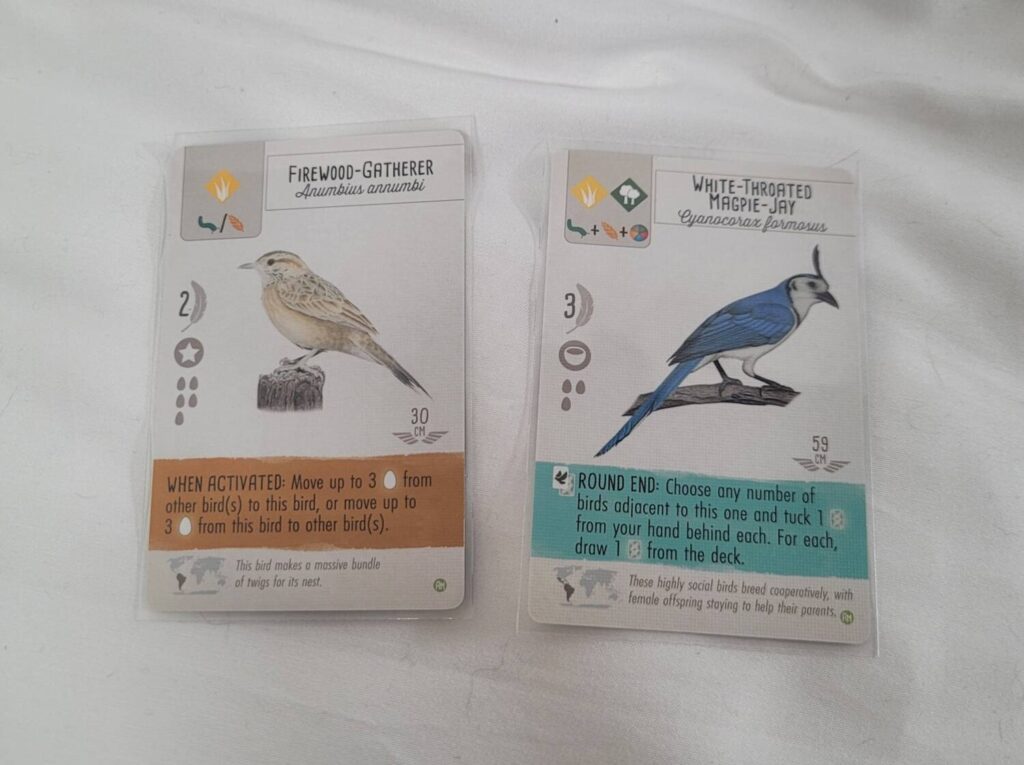
Americas introduces a whole host of new birds, each featuring new and interesting abilities. A couple of standouts for me are the White-Throated Magpie-Jay which lets you tuck cards behind its neighbours, replacing the tucked cards with newly drawn ones, or the Firewood-Gatherer which steals eggs from other birds in your tableau and dispenses eggs of its own to other birds in your tableau.

A user on BoardGameGeek has compiled a list of all the new birds and their abilities that you can go check out if you’re interested. Many of these…

The post Wingspan: Americas Expansion Game Review appeared first on Meeple Mountain.
  •  

Catan: on the Road Game Review

When it comes to modern board gaming, there is no denying the impact that The Settlers of Catan (now just Catan)has had on the hobby, bringing the ideology of modern game design to players around the world in a format that’s approachable, digestible, and easy to learn. While not a perfect game by any means, it’s a game that’s launched an empire. And now, that empire is going portable.

Now, this isn’t Catan’s first foray into portability. 1996 saw the introduction of Catan: the Card Game, a small box, two-player version of the game. In 2002, the Catan: Portable Edition was released, a tiny plastic version of the base game. Then, in 2010, Rivals for Catan was released, another small box, two-player game based in the Catan universe. Each of these has its issues. Aside from the fact that the two-player games are only for two players, once the games are in progress, they turn into sprawling behemoths that take up almost as much (if not more) space than the board game they’re replacing. As for the Portable Edition, when I say it’s tiny, I’m not mincing words. The cards are miniature versions of the already small cards from the regular game. The plastic road pieces are about as long as the average thumbnail is wide.

When I…

The post Catan: on the Road Game Review appeared first on Meeple Mountain.

  •  

Light Seeker Game Review

From the rulesheet: “A curse has cast a shadow over the valley, causing the inhabitants to run from the villages and the animals to flee their nests. From the top of a ridge, a mysterious creature named Buh has noticed the desolation and decided to bring the light back. As they stroll through the valley, Buh uses their magic to seek out and restore the light. As darkness recedes, wildlife and the village’s inhabitants begin to return and revel in the sun’s life-giving warmth once again.”

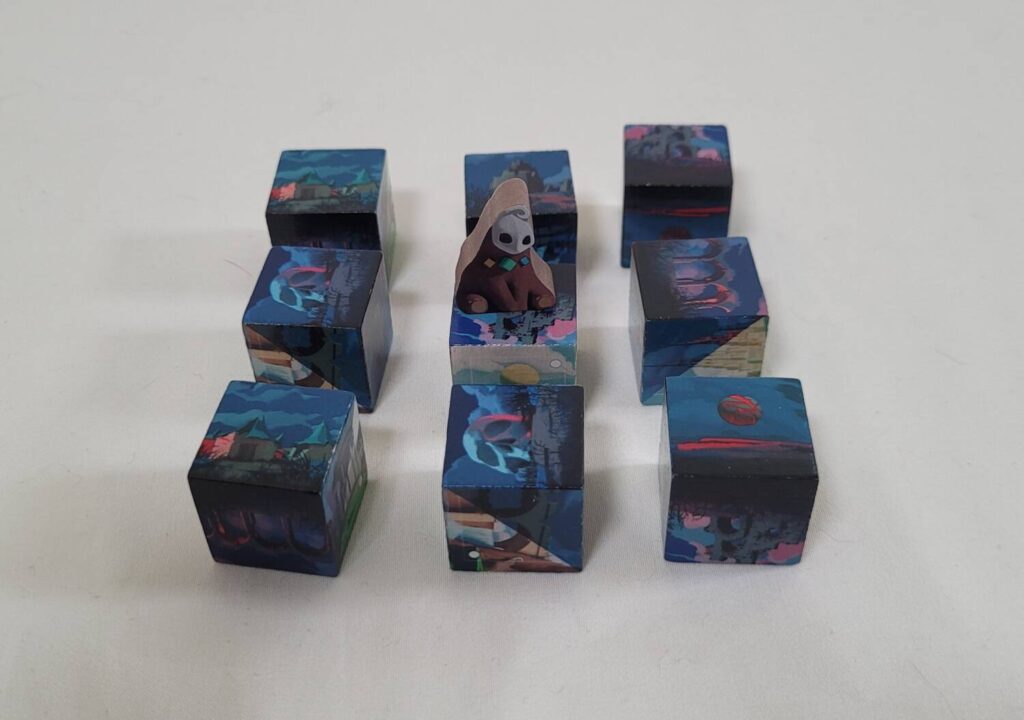
Light Seeker is a two-player strategy game composed of 9 wooden cubes and a single meeple, called the ‘Buh meeple’ (which sort of resembles a cartoon badger). Each wooden cube has a number of dark sides, bright sides, and a couple of half-bright/half-dark sides. At the start of the game, the cubes are arranged into a 3x3 grid, dark sides up. The Buh meeple is placed atop the centermost cube.

On a player’s turn, they will be performing two actions from a list of two possible action types. The same action can be repeated if the player wishes. The two possible actions are ‘slide cube’ or ‘tilt cube’. Sliding involves moving a cube from its current spot to an orthogonally adjacent location without…

The post Light Seeker Game Review appeared first on Meeple Mountain.

  •  

Fruit Island Game Review

The land of Fruit Island, as the name implies, is ripe with delicious fruit: bananas, pomegranates, and mangoes. On this island lives a tribe of monkeys. Over the years, they have built a thriving fruit industry, gathering fruit from the surrounding jungle and delivering it to the trading post for maximum profit. However, all is not well. Living on the island as well is a giant gorilla and, wouldn’t you know it, he also has a penchant for fruit. But, this gorilla prefers to let others do the hard work, using his size to bully, and steal from, the hard-working monkeys.

In Fruit Island, the players take on the role of the monkeys, working to gather fruit and deliver it to the trading post before they’re caught out by the gorilla and have their fruit stolen from them. Fruit Island is a press-your-luck, mess-with-your-opponents game. Equal parts prayer and risk assessment, it’ll have you asking yourself just how long you think you can hold out before making a beeline for safety.

Which monkey will be the most successful? Only time will tell.

How It’s Played

At the start of a game of Fruit Island, each player chooses a monkey and places it onto the trading post in the middle of the game board. The gorilla is placed on the…

The post Fruit Island Game Review appeared first on Meeple Mountain.

  •  

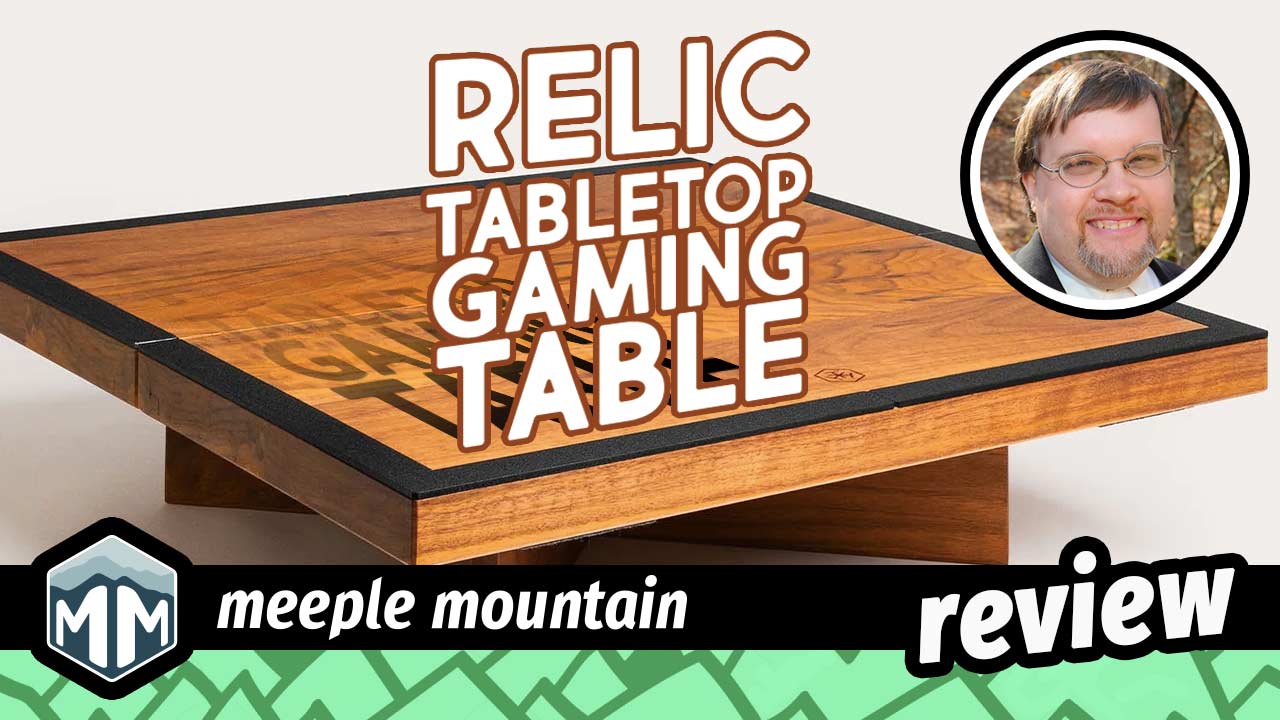
Relic Gaming Tabletop Table Review

The Need

If there's one thing all boardgamers can agree on, it's this: boardgames and their accoutrement take up a lot of room. Space is at a premium. And, if you're like me and you live in tight quarters to begin with, the idea of ever owning a nice boardgame table such as the Bandpass Firefly Board Game Table is nothing more than fantasy. In my home, we have three surfaces on which we can game: the dining room table which measures roughly 40 inches in width and 80 inches in length, a folding 4' x 4' card table, or a folding 6' x 4' picnic table which takes up the entire living room once it's been deployed. None of these are designed with modern boardgaming in mind. The largest of the three, the picnic table, struggles to contain large, sprawling megaliths such as Frosthaven or any Vital Lacerda game.

This is why I got excited when I saw the Relic Gaming Tabletop Table pop up in my social media feeds one day not too long ago. On paper, it seemed to be the answer to all my prayers, utilizing the airspace above the game table to relieve the pressure on the game table. But, how functional is it in…

The post Relic Gaming Tabletop Table Review appeared first on Meeple Mountain.

  •  

Ave Uwe: Yellowstone Park Game Review

From the rulebook:

“Welcome to Yellowstone Park, the home of many wild animals. Impressive geysers spray their hot fountains into the blue sky. The players go on a trip through the park, which is shown on the game board. Each player has a hand of animal cards with different colors and numbers. During the game the players try to put their cards down as skillfully as possible on the game board to avoid penalty points.”

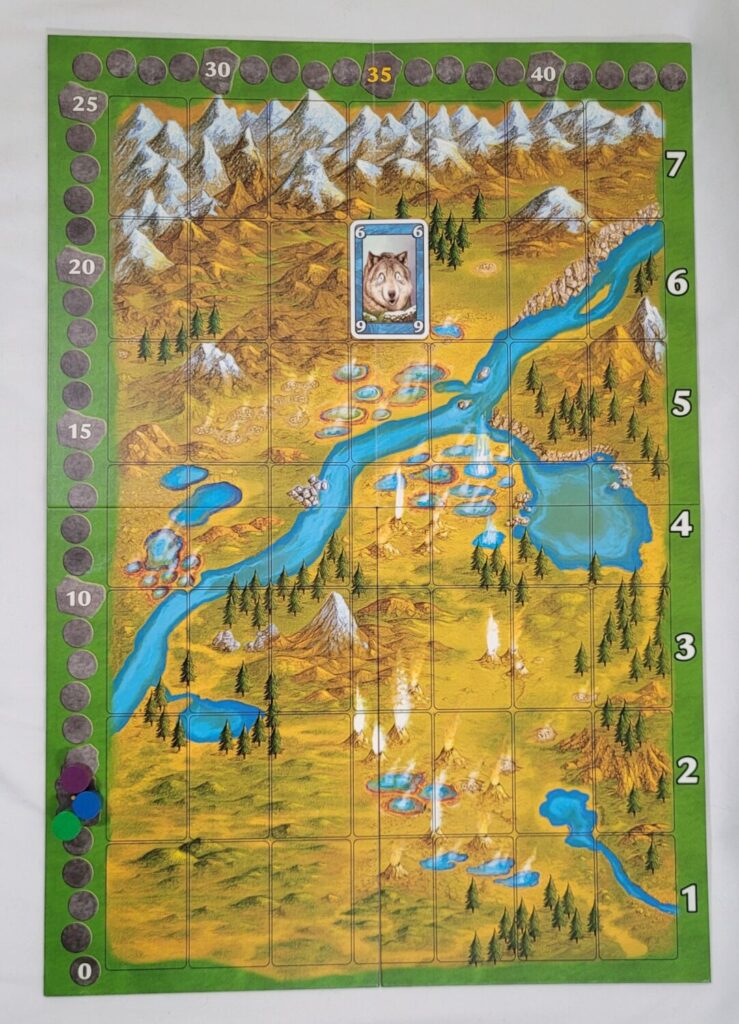
Yellowstone Park is played on a 7x7 grid laid on top of an illustrated overhead view of the titular park. The rows are numbered from 1 to 7 in ascending order, starting from the lowest row and moving upwards. There is a score track running along the left side of the grid. Each player’s score marker begins at the number 5 spot on this track.

There is also a deck of 56 Animal cards. Each card is one of four colors (red, green, yellow, blue) and one of seven numbers (1 through 7). For each number, there are two copies of that number + color pair (two copies of green 1, for instance). Every card features a cartoonish image of an animal, but these illustrations are unimportant for the purposes of the gameplay.

The post Ave Uwe: Yellowstone Park Game Review appeared first on Meeple Mountain.

  •  
❌