Lese-Ansicht

Epic Warpath v1

Never set foot on the wrong side of history.

Conquer worlds with your Epic Warpath rules & reference!

It’s been a bumper time for fans of epic scale wargaming lately, and Mantic Games has got in on the act by Kickstarting an entire range – 8 factions – for their own epic system, Epic Warpath. I received the starter set, a couple of large resin models, and some epic scale building sets for review, and as I write the painting is finally done and I played my first game last week – and had a blast!

The rules are a nice mixture between old and new, using the command dice system from Deadzone and the order tokens pioneered in GW’s original Adeptus Titanicus and still used in their recent epic scale game Legions Imperialis. Order and combat tokens do a very nice job of tracking each unit’s current status during the game, so you can see what’s going on at a glance, and the combat system is straightforward and effective. It wasn’t long before the rules began to recede into the background during our first game and we could concentrate on what was happening on the table. The order of the rules in the book is a bit clunky however, and I’ve tried to improve comprehension with my rules & reference. Stayed tuned for a battle report video as soon as I get an opportunity!

The miniatures look great and there’s a minimum of fiddly construction, which is good to see. For me the big draw here over GW’s offering is the variety and distinctness of the available factions – and the fact they’re all available up front. While GW seems obsessed with their Horus Heresy, Mantic is having fun putting space rats, dwarves, zombies and weird aliens together on the tabletop, and to me that’s far more enjoyable than civil war amongst space marines.

To see what you get in the starter set, check out my unboxing. More to come!

  •  

Results of the Stonemaier Company Retreat

Last year around this time, a coworker shared that they would feel valued by a Stonemaier company retreat. After asking other coworkers about the idea and hearing that they were supportive of it, I started the year-long process of planning the trip, which culminated in roughly 3 days in Phoenix last week.

The main feature of the retreat was that it was the first time all 8 of us have ever been in the same place at the same time, as we all work well from home in Missouri, Oregon, Florida, Nevada, and Minnesota. My happy place is at my desk at work, but I was happy to serve my coworkers by arranging and participating in this trip.

Details about exactly how the trip worked are in the article I wrote in June. Basically, I found a location (Phoenix) that met the environmental preferences of all coworkers and was within a direct flight for almost all of us, and I found a rental property where we could all have our own rooms to meet privacy, introversion, and sleeping needs. The trip was only for Stonemaier employees, and the focus was on each other and Stonemaier Games (opposed to nearly everything else we do, which is focused on our customers). The trip was during the week, as it was a work trip–I wanted everyone to be able to return home for a weekend with their families and friends.

Two things that evolved after I wrote that article in June are as follows:

  • Food: I heard some good advice about food planning–make it easy for everyone–that I took to heart. For breakfast, we picked up a few basic items from the grocery store on the first day. For lunch, I researched nearby restaurants from which we could order delivery or pickup. For dinner, I made reservations at a few local places that met everyone’s dietary preferences.
  • Schedule: I heard some other good advice about having some sort of structure to each day, shared in advance so everyone has a clear vision and can plan accordingly. Here’s how it looked:
    • casual breakfast individually at the house
    • mornings are free time to do anything you want in and out of the house: work, sightsee, meet outside the house with local friends, relax, etc.
    • order in together for lunch
    • stay at the house for the afternoon (not necessarily for anything in particular, but just to create the potential of working together if there are things to playtest, discuss, or just play for fun)
    • go out together for dinner
    • play games together, hang out at night, and/or have quiet time

The only last-minute changes involved (a) those of us in St. Louis getting a huge snowstorm just before the trip, resulting in a longer flight and a much later arrival than planned on Tuesday and (b) we rented an 8-passenger van rather than taking rideshares around the city.

Before the trip, I printed/assembled a bunch of prototypes and packed them along with a submission and some pre-production copies. We spent the majority of the two afternoons (plus one evening) playtesting and discussing these games.

My coworkers shared a wealth of feedback for me to consider and implement, which was as helpful as it was exhausting (if you’ve ever run a playtest of one game for a few hours, you know how much mental and emotional energy it requires–this was six games over a total of at least fifteen hours). This resulted in me returning from the trip with a staggering amount of work. Their feedback was great, though, so I’m navigating how to better include coworkers in the playtesting and product design process in a more spaced-out, remote, and independent way.

I think my favorite couple of hours during the retreat happened on the last night after the final playtest session. We were tired enough to go to bed, but instead we drifted one by one into the living room and talked. Just 8 people hanging out, joking, sharing, opining, etc. It was really nice to have that idle time with such delightful folks.

I’m sharing all this partially to close the loop I opened in June’s article and partially to offer an alternative template to traditional corporate conferences filled with speeches and teambuilding activities and intense meetings. We essentially just got together in a nice place and worked/playtested for a few days.

Would I do it again? I’m not sure. I’m definitely not looking to add another job to my job, and this was no small effort for me to plan, coordinate, and execute; I also returned with far more work than when I arrived. I think we work well remotely (in fact, in many ways this was a reminder of why I prefer to work from home, especially as an introvert), and much of the product design discussions can happen virtually on a rolling basis. Three of my coworkers are here in St. Louis and already participate in playtesting (though I could do a better job of inviting them more often). The idle time was intangibly important, though, so every few years I think it would be nice to get together for that purpose, even if it’s just a quiet evening before Design Day when most people are in St. Louis anyway.

I’m curious to hear your reactions, thoughts, and questions to this style of work retreat–feel free to share in the comments!

***

If you gain value from the 100 articles Jamey publishes on this blog each year, please consider championing this content! You can also listen to posts like this in the audio version of the blog.

  •  

boardgaming in photos: Clans of Caledonia, Hanamikoji, Molly House, Caylus, Regicide

I took a screenshot of my list of games in progress at BoardGameArena.com. Just a snapshot of a moment in time. I spend much time in front of my computer, both for work and leisure, and I always have a browser tab with BGA open. Whenever it is my turn for one of the games I'm playing, a tiny triangle is animated at the tab. When I notice it I happily click to take my turn. I recently

  •  

A chat with Eric Lang

 31 Jan 2026. Eric Lang (Blood Rage, Rising Sun, Ankh, Chaos in the Old World) was in town. He has been staying in Malaysia on and off for many years, and is now planning to spend more time living in Kuala Lumpur. He wants to get to know the local designer community and the local boardgame community. Aaron arranged two meet-up sessions for game designers and other industry players to get to

  •  

Captain Tsubasa

Captain Tsubasa is a 2 player game based on the manga and anime of the same name. This Japanese manga and anime from the 1980’s is hugely popular not only in Japan but also around the world. It is about football (soccer). In the game you play a football match between two key teams in the story, Nankatsu and Toho. This is a card game, and you will see many characters from the series. If

  •  

Jan ’26 Links

Five Ideas You Can’t Unsee — I don’t know, I’ve forgotten most of them several times.

SETI @ Home has now finished its analysis after 27 years. (Video from Anton).

Zoning does more harm than good.

A quick video showing a game (that I’ve never heard of, probably educational) being assembled at the factory.

International Go is struggling for the usual reasons, but also because China, Japan and Korea can’t agree on the rules (and ended up agreeing to use the U.S. rules as a compromise).

Works in Progresses Top 10 Articles of last year — Includes an article on the Hanseatic Shipping League, which I’ve played three or four games revolving around.

52 Things I Learned in 2025 Lists (Kent Hendricks)

Jorbs makes a humorous PSA — Do Not Play Slay The Spire.

Hasbro is being sued for printing too many Magic cards.

The RPG industry is like a water pipe. (I’m linking this to a post that simply quotes a facebook post, because I don’t use facebook).

Feral Historian — Is the Matrix a Right-Wing story?

Veritaserum on The Expert Myth — This contains a lot of stuff I’ve encountered, but is well done.1

  1. In fact I hadn’t seen the Red/Green Button example, although I described something very similar in DMPOR. ↩

  •  

Jan ’26 Links

Five Ideas You Can’t Unsee — I don’t know, I’ve forgotten most of them several times.

SETI @ Home has now finished its analysis after 27 years. (Video from Anton).

Zoning does more harm than good.

A quick video showing a game (that I’ve never heard of, probably educational) being assembled at the factory.

International Go is struggling for the usual reasons, but also because China, Japan and Korea can’t agree on the rules (and ended up agreeing to use the U.S. rules as a compromise).

Works in Progresses Top 10 Articles of last year — Includes an article on the Hanseatic Shipping League, which I’ve played three or four games revolving around.

52 Things I Learned in 2025 Lists (Kent Hendricks)

Jorbs makes a humorous PSA — Do Not Play Slay The Spire.

Hasbro is being sued for printing too many Magic cards.

The RPG industry is like a water pipe. (I’m linking this to a post that simply quotes a facebook post, because I don’t use facebook).

Feral Historian — Is the Matrix a Right-Wing story?

Veritaserum on The Expert Myth — This contains a lot of stuff I’ve encountered, but is well done.1

  1. In fact I hadn’t seen the Red/Green Button example, although I described something very similar in DMPOR. ↩

  •  

We Stand with Our Community

A few months ago, my coworker, Alex, moved from St. Louis to Minneapolis. This week I spent some time with him in person for the first time since the move, and we had a long chat about the horrifying recent/ongoing events in his new city.

If you haven’t followed the news, the quick version is that there are thousands of masked, armed men patrolling the streets, breaking into homes, and committing acts of violence with no accountability from the federal government. In the face of such danger and oppression, the people of Minneapolis/St. Paul have joined together to say in their words and actions that this isn’t right. They are taking care of each other. They are being good neighbors to each other.

Alex described the incredible sense of community that has emerged from the peaceful protests in Minneapolis. He also spoke of the small businesses who have spoke up against ICE without fear of retribution (or maybe some with fear–this is a scary situation) and how their words have power.

We see the tremendous weight of grief, anger, and fear that so many are carrying right now. No one should have to live with constant fear. Everyone deserves to feel safe, valued, and to be treated with dignity.

Stonemaier Games wholeheartedly supports the voices demanding an end to violence, calling for accountability, for true racial justice and equality, and for simple kindness and decency. We truly admire the power and necessity of peaceful protest. The care that Minnesotans (and so many others) are showing for one another by standing together, listening, helping, and protecting their communities, demonstrates incredible strength, compassion, and resilience.

Kindness matters. Especially during times like these.

As a company, and simply as people, we believe deeply in our shared humanity. Healing can only happen when we listen with empathy, acknowledge pain honestly, and hold space for one another.

While the path to change often feels slow, we hold onto hope. Hope that accountability, deeper understanding, and meaningful progress will emerge from moments like this. Your quiet determination should inspire us all. Please, look out for each other. We are not all the same, but we are undeniably stronger together.

Stonemaier Games stands with Inside Up Games in supporting organizations doing vital work on the ground. Groups like Monarca MN and MIRAC (Minnesota Immigrant Rights Action Committee) focus on protecting, supporting, and caring for communities who are often the most vulnerable during difficult times, both in Minnesota and other places where these incursions are happening.

https://monarcamn.org/about

https://www.miracmn.com/

You are not alone. We see you, we support you, and we are sending care and solidarity from Missouri, Nevada, Florida, Oregon, and from within Minneapolis.

–Jamey, Alan, Susannah, Dave, Joe, Christine, Erica, and Alex

  •  

The world of Invincible gets smaller with Tiny Epic Invincible

The post The world of Invincible gets smaller with Tiny Epic Invincible appeared first on Graphic Policy.

In Tiny Epic Invincible, you’ll mask up as one of six unique heroes and travel the globe as you protect hotspots under invasion by deadly foes

  •  

BGI 404 PREDICTIONS 2026!

BGI 404 PREDICTIONS 2026!

Board Games InsiderJoin our Guild on Board Game Geek Guild | Like us on FB

Social media:

Ignacy Trzewiczek / Portal Games: website | FB | Twitter | Youtube

Corey Thompson / Above Board TV:  website | Youtube

Stephen Buonocore / “The Podfather Of Gaming”: website | FB | Twitter | Youtube

Intro Music: Happy Rock – Bensound.com

💾

  •  

Steam Sale on Boardgame implementations

Steam is having a sale on board games, and I’m debating whether to buy any. I’ve mainly not been too happy with board games on steam (see Mr. President and Space Corp), but for the price of a decent lunch having a game I might spend 20-100 hours on seems reasonable, so I’m considering getting one or two.

Also, GMT has announced a digital version of Space Empires 4x (dropping in June) That could be excellent as the real problems with the game were the accounting (and related errors) and digging up a bunch of counters without revealing what you were buying … both of which should be easily fixed by being on a computer.

Update — Still on the fence for videogames, but after watching the Heavy Cardboard playthrough of Stellar Ventures, I decided to back it.

  •  

Steam Sale on Boardgame implementations

Steam is having a sale on board games, and I’m debating whether to buy any. I’ve mainly not been too happy with board games on steam (see Mr. President and Space Corp), but for the price of a decent lunch having a game I might spend 20-100 hours on seems reasonable, so I’m considering getting one or two.

Also, GMT has announced a digital version of Space Empires 4x (dropping in June) That could be excellent as the real problems with the game were the accounting (and related errors) and digging up a bunch of counters without revealing what you were buying … both of which should be easily fixed by being on a computer.

Update — Still on the fence for videogames, but after watching the Heavy Cardboard playthrough of Stellar Ventures, I decided to back it.

  •  

For the Love of the Game

Over the weekend I was printing and cutting some game prototypes, and I put the latest season finale of Welcome to Wrexham on in the background. I didn’t expect the confluence of those two activities to bring me to tears.

In this episode, the Wrexham football team is preparing for a game at the end of the season that will decide whether they are promoted to the second-highest level of English football. The team’s co-owner, Rob McElhenney, gives a speech inspired by a text conversation he had with some unnamed, highly successful athletes.

Here’s most of McElhenney’s speech, almost verbatim (thanks to this transcript). Also, if you have Hulu, I highly recommend watching the speech, as it’s brilliantly edited in a way that splices footage of the final game with the players during their childhood days.

“I want you to picture a time in your life. Maybe you’re eight, maybe you’re nine, maybe you’re ten, maybe you’re six, maybe you’re 12, but you’re out there and you’re playing football. You’re just kicking the ball around. You’re playing with your friends, your dad, your mom, your sisters, your brothers, your buddies. You’re just playing football.

And it’s fun. And you fell in love with that feeling.

Of course you’re grateful for the support that you’ve had along the way, your family, your friends, and everyone, but you’ve already honored that. From this point, the only person you owe something to is that ten-year-old kid who fell in love with football, who could not wait to be in the position that you’re in right now!

The point is, there is a moment or a series of moments in which you were in love with this game, and that is all that matters. I want you to go out there and play like you’re ten years old and have the time of your lives because I promise you that is the only thing you will remember.”

I’m watching this speech unfold while cutting and sorting prototype cards, something I also did as a 10-year-old. I played and created games then purely for the fun of it. Now I’m very fortunate to run a tabletop publishing company as my job, but sometimes I need the reminder that I do this for the love of games.

I also played soccer as my primary sport from a young age up until college, and I still occasionally play pickup games. Even though I never played at a high level, there was definitely a tonal difference between playing for fun with my friends and starting for my high school team. To practice for hours every day can feel like work, even though it’s a game.

So as I listened to McElhenney’s rousing speech, I found myself in tears. I was transported back to those days when there was no marketing and metrics and planning and budgeting and customer service and project management and proofreading. It was just me sitting on the floor in my bedroom, drawing maps, cutting cards, and writing rules. It was just me juggling the soccer ball outside at sunset with my late father.

This isn’t to bemoan any of the business aspects of my job. I genuinely enjoy them, and I appreciate the variety they offer. I like that game design is only a small part of my job.

But with all the complications we make for ourselves and that come with being adults, the speech was a helpful reminder that there is a child in all of us who once did it for the love of the game. It’s worth honoring that child by seeking and spreading joy.

This may not resonate with your career compared to your childhood passions, but perhaps you can still relate to the concept of doing something purely for the love of it you first discovered when you were young. What does this speech make you think about?

***

If you gain value from the 100 articles Jamey publishes on this blog each year, please consider championing this content! You can also listen to posts like this in the audio version of the blog.

  •  

Immersive Imperial Struggle Playlist (Board Game Playlists, #2)

You love board games. You probably also like music. Let’s combine the two into an immersive playlist for Imperial Struggle (Ananda Gupta/Jason Matthews, GMT Games). Have it gently play in the background during your next session of Imperial Struggle for the full period immersion!

First things first: Here’s the playlist!

Before we dive into the content of the playlist, some general observations:

  • Of course, there was no music recording in age of Imperial Struggle, so all the songs in the playlist have been recorded in the 20th or 21st century.
  • The playlist is only 1:45 hours long, so you might need to listen to it several times during your game… unless France stomps over Britain in the first turns.
  • The playlist is thematically sorted. That helps you find similar songs, but makes for somewhat monotonous listening (until you come to the next group of songs). I therefore recommend you turn shuffle on.

Now, what awaits you in the playlist?

#1-3: Religious (classical) music

Imperial Struggle begins after the age of the great confessional wars in Europe, but religion still played an important role in people’s lives, from the lowliest peasants all the way up to kings. Their week culminated in a Sunday service and their year was interspersed with religious events. Composers wrote pieces specifically for a religious holiday (like Bach’s “Christmas Oratorio” from which #2 is taken), or were dedicated to comprehensive religious teaching (like Händel’s “Messiah”, premiering on Easter 1742 in Dublin, from which #3 is taken).

#4-12: Secular (classical) music

The Baroque saw music as universal. Religious and secular followed the same conventions, and thus the same composers wrote pieces for the church and for worldly courts, like Baroque grandmaster Johann Sebastian Bach (Toccata and Fugue in D minor, #4 and Cello Suite No. 1 in G Major, #6) or Georg Friedrich Händel (Sarabande from Suite No. 11, #5). The classical (in the narrower sense) music from the mid-18th century on left this universal view behind. Composers now focused on either one or the other, with most of them following the more fashionable and more lucrative secular path.

Some composed for a court whose lavish entertainments always required music (like the 1773 wedding of the French prince Charles Philippe, the later king Charles X, for which François Francœur arranged the music from which #9 is taken – thus the title Symphonie du Festin Royal (Symphony of the Royal Feast)). Others became freelance musicians (like Mozart, who could (for some years) live of the proceeds of his concerts and operas, #10-12).

#13-16: Folk songs

Not everyone went to a church where the latest compositions were played on Sundays, and of course most people were far removed from attending any court festivities, let alone royal weddings. But people made and listened to music. The easiest, most affordable way to do so was to sing. The 18th century is rich with folk songs, some originally written at the time (like Frère Jacques (“Brother James”), #15 or “Ye Jacobites by Name”, #16), others older, but first put down to paper at the time (Au Claire De La Lune (“By the Light of the Moon”, #13, and Over the Hills, and Far Away (#14)).

#17-23: Patriotic songs

We’ve heard in #16 already how political events seeped into popular songs. Others were written specifically to rouse patriotic feeling, an emotion which came into its own in the 18th century: “Rule, Britannia” (#17) expressed confidence and pride in the Royal Navy to protect British freedoms, “The British Grenadiers” (#18) praised the courage of their counterpart by land.

That these songs could be re-interpreted and turned against their original intent shows “Free America” (#19), written in 1770, which uses the same tune as “The British Grenadiers”, but its lyrics extol America’s freedom (which turned out to be freedom from Britain).

Finally, national anthems also came first into existence in the 18th century: Brits sang “God Save the King/Queen” (#22 – I took the liberty of choosing a not-quite-traditional version). France only got its first anthem (La Marseillaise, #23) with the French Revolution which bookends Imperial Struggle… at least until Ananda Gupta and Jason Matthews get around to do a Revolutionary and Napoleonic Wars expansion!

Thanks to Jason for suggesting songs #5, #14, and #21!

If you like immersive playlists, I’ve done one for Weimar: The Fight for Democracy (Matthias Cramer, Capstone Games/Skellig Games/Spielworxx)!

If you want to dive a bit deeper into the times of Imperial Struggle, here’s a book recommendation.

And if you’re looking for strategic direction in Imperial Struggle, I’ve also got you covered.

What’s your favorite song from this playlist? Let me know in the comments!

  •  

Immersive Imperial Struggle Playlist (Board Game Playlists, #2)

You love board games. You probably also like music. Let’s combine the two into an immersive playlist for Imperial Struggle (Ananda Gupta/Jason Matthews, GMT Games). Have it gently play in the background during your next session of Imperial Struggle for the full period immersion!

First things first: Here’s the playlist!

Before we dive into the content of the playlist, some general observations:

  • Of course, there was no music recording in age of Imperial Struggle, so all the songs in the playlist have been recorded in the 20th or 21st century.
  • The playlist is only 1:45 hours long, so you might need to listen to it several times during your game… unless France stomps over Britain in the first turns.
  • The playlist is thematically sorted. That helps you find similar songs, but makes for somewhat monotonous listening (until you come to the next group of songs). I therefore recommend you turn shuffle on.

Now, what awaits you in the playlist?

#1-3: Religious (classical) music

Imperial Struggle begins after the age of the great confessional wars in Europe, but religion still played an important role in people’s lives, from the lowliest peasants all the way up to kings. Their week culminated in a Sunday service and their year was interspersed with religious events. Composers wrote pieces specifically for a religious holiday (like Bach’s “Christmas Oratorio” from which #2 is taken), or were dedicated to comprehensive religious teaching (like Händel’s “Messiah”, premiering on Easter 1742 in Dublin, from which #3 is taken).

#4-12: Secular (classical) music

The Baroque saw music as universal. Religious and secular followed the same conventions, and thus the same composers wrote pieces for the church and for worldly courts, like Baroque grandmaster Johann Sebastian Bach (Toccata and Fugue in D minor, #4 and Cello Suite No. 1 in G Major, #6) or Georg Friedrich Händel (Sarabande from Suite No. 11, #5). The classical (in the narrower sense) music from the mid-18th century on left this universal view behind. Composers now focused on either one or the other, with most of them following the more fashionable and more lucrative secular path.

Some composed for a court whose lavish entertainments always required music (like the 1773 wedding of the French prince Charles Philippe, the later king Charles X, for which François Francœur arranged the music from which #9 is taken – thus the title Symphonie du Festin Royal (Symphony of the Royal Feast)). Others became freelance musicians (like Mozart, who could (for some years) live of the proceeds of his concerts and operas, #10-12).

#13-16: Folk songs

Not everyone went to a church where the latest compositions were played on Sundays, and of course most people were far removed from attending any court festivities, let alone royal weddings. But people made and listened to music. The easiest, most affordable way to do so was to sing. The 18th century is rich with folk songs, some originally written at the time (like Frère Jacques (“Brother James”), #15 or “Ye Jacobites by Name”, #16), others older, but first put down to paper at the time (Au Claire De La Lune (“By the Light of the Moon”, #13, and Over the Hills, and Far Away (#14)).

#17-23: Patriotic songs

We’ve heard in #16 already how political events seeped into popular songs. Others were written specifically to rouse patriotic feeling, an emotion which came into its own in the 18th century: “Rule, Britannia” (#17) expressed confidence and pride in the Royal Navy to protect British freedoms, “The British Grenadiers” (#18) praised the courage of their counterpart by land.

That these songs could be re-interpreted and turned against their original intent shows “Free America” (#19), written in 1770, which uses the same tune as “The British Grenadiers”, but its lyrics extol America’s freedom (which turned out to be freedom from Britain).

Finally, national anthems also came first into existence in the 18th century: Brits sang “God Save the King/Queen” (#22 – I took the liberty of choosing a not-quite-traditional version). France only got its first anthem (La Marseillaise, #23) with the French Revolution which bookends Imperial Struggle… at least until Ananda Gupta and Jason Matthews get around to do a Revolutionary and Napoleonic Wars expansion!

Thanks to Jason for suggesting songs #5, #14, and #21!

If you like immersive playlists, I’ve done one for Weimar: The Fight for Democracy (Matthias Cramer, Capstone Games/Skellig Games/Spielworxx)!

If you want to dive a bit deeper into the times of Imperial Struggle, here’s a book recommendation.

And if you’re looking for strategic direction in Imperial Struggle, I’ve also got you covered.

What’s your favorite song from this playlist? Let me know in the comments!

  •  

FlingCon Notes

I mean, if a game convention is going to be literally two miles from my house, there is a fifty-fifty chance I will go1.

Games Played

Games of Note

I saw many new games, but I suspect that most (or all) of them are easily skippable. It did warm my heart to see a bunch of “Play this new game, let us know what you think, and you might win a copy” going unplayed, because they didn’t seem any good at a glance.

However, one game that did catch my eye is Giants Moving Tiny Furniture, which has a bunch of small cute furniture and you (and team-mates) have to move around on top of the box. I only watched ten seconds, but it seemed like a delightful idea, sort of like a pop-art Jenga. From glancing at the BGG page, after I left, it sounds like Welcome to the Dungeon (which I haven’t played but picked up a copy at the bazaar) where there are things to do and you bid on less and less time (etc) to finish it.

Oh, and you have to use only your pinky? In teams?

I arguably could have played more games, but 2 days is enough for me.

Update — More Thoughts

There were quite a few new “ginormous overproduced games” being played. (At least) one of which was being promoted by the creator/designer/publisher, but they just all gave off the feel of “You wouldn’t look at this twice if it was cardboard chits, and it you shouldn’t look at it twice just because it doesn’t.” There were a number of boxes that looked to be a cubic foot (roughly). Just hulking square boxes taking up space.

Amusingly, one of those was … Food Chain Magnate Deluxe Edition! But that box at least still has the retro 50s artwork that might make people take a second glance instead of “Pew Pew Space-ships!” or whatever. I keep saying I need to put FCM back into my bag (although the new Indonesia is getting good reps this last month), but I’m happy with the old edition, which takes half the space even if I bring the expansion box.

Speaking of “Cool!” (that is in fact, not). The organizers piped in “Geek Music” to the venue. By which I mean …. Movie Themes. Oh, its the Imperial March! Lord of the Rings! Harry Potter! Superman! I may be in the minority, but I hate that. The music is fine, but two days of that got old quick. If people want music, they’ll bring it themselves.

It would be rude if I took out my air pods and played X music on speakers because I thought it better fit the mood (whatever that was), unless I asked everyone. Normally I would have just moved away to a quiet area, but the open gaming was pretty much right up against the speakers. The local game store also does it, and I get it for a game store, where most people are wandering in and spending a few minutes browsing (or playing games for a few hours)23, but for two days it gets old fast.

  1. I skipped the last one, but went to this one. ↩
  2. I believe that I read somewhere (probably in Why we Buy by Paco Underhill), that piped in music does lead to more sales, and stores often carefully curate their sounds. So that makes sense even if I personally hate it. But a convention is a pre-sale buy a ticket thing. ↩
  3. Although now that I realize that Underhill makes his living on consulting for this kind of stuff (coupled with the replicability study in psychology) I wonder if that is in fact true, but I suspect enough companies have A/B tested the hell out of that to verify it. ↩

  •  

FlingCon Notes

I mean, if a game convention is going to be literally two miles from my house, there is a fifty-fifty chance I will go1.

Games Played

Games of Note

I saw many new games, but I suspect that most (or all) of them are easily skippable. It did warm my heart to see a bunch of “Play this new game, let us know what you think, and you might win a copy” going unplayed, because they didn’t seem any good at a glance.

However, one game that did catch my eye is Giants Moving Tiny Furniture, which has a bunch of small cute furniture and you (and team-mates) have to move around on top of the box. I only watched ten seconds, but it seemed like a delightful idea, sort of like a pop-art Jenga. From glancing at the BGG page, after I left, it sounds like Welcome to the Dungeon (which I haven’t played but picked up a copy at the bazaar) where there are things to do and you bid on less and less time (etc) to finish it.

Oh, and you have to use only your pinky? In teams?

I arguably could have played more games, but 2 days is enough for me.

Update — More Thoughts

There were quite a few new “ginormous overproduced games” being played. (At least) one of which was being promoted by the creator/designer/publisher, but they just all gave off the feel of “You wouldn’t look at this twice if it was cardboard chits, and it you shouldn’t look at it twice just because it doesn’t.” There were a number of boxes that looked to be a cubic foot (roughly). Just hulking square boxes taking up space.

Amusingly, one of those was … Food Chain Magnate Deluxe Edition! But that box at least still has the retro 50s artwork that might make people take a second glance instead of “Pew Pew Space-ships!” or whatever. I keep saying I need to put FCM back into my bag (although the new Indonesia is getting good reps this last month), but I’m happy with the old edition, which takes half the space even if I bring the expansion box.

Speaking of “Cool!” (that is in fact, not). The organizers piped in “Geek Music” to the venue. By which I mean …. Movie Themes. Oh, its the Imperial March! Lord of the Rings! Harry Potter! Superman! I may be in the minority, but I hate that. The music is fine, but two days of that got old quick. If people want music, they’ll bring it themselves.

It would be rude if I took out my air pods and played X music on speakers because I thought it better fit the mood (whatever that was), unless I asked everyone. Normally I would have just moved away to a quiet area, but the open gaming was pretty much right up against the speakers. The local game store also does it, and I get it for a game store, where most people are wandering in and spending a few minutes browsing (or playing games for a few hours)23, but for two days it gets old fast.

  1. I skipped the last one, but went to this one. ↩
  2. I believe that I read somewhere (probably in Why we Buy by Paco Underhill), that piped in music does lead to more sales, and stores often carefully curate their sounds. So that makes sense even if I personally hate it. But a convention is a pre-sale buy a ticket thing. ↩
  3. Although now that I realize that Underhill makes his living on consulting for this kind of stuff (coupled with the replicability study in psychology) I wonder if that is in fact true, but I suspect enough companies have A/B tested the hell out of that to verify it. ↩

  •  

Tokaido Duo

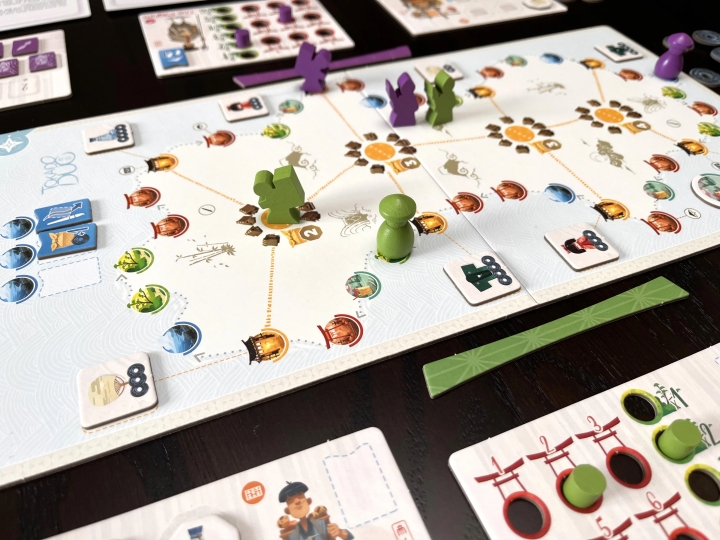
This is an interesting game set on the island of Shikoku, this is a more little bit more complex game than the original Tokaido but it is actually still a fun light game. This has a more in depth map than the original game has and the complexity is in how you use the extra two figures you each have to get the most out of your play. As I have stated unlike the original game each player has three tokens to move and play (a pilgrim an artist4 and a merchant) and a number of zones to do so, they include four mountain towns while the outer zones include temples, gardens, seashores, coastal towns and hot springs.


The aim of the game is points collecting. You collect points in a number of ways and work out at the games end who has won. As in the original you can’t land on an already occupied space so that can be annoying!


This is a great game that you can play against an opponent, or as with most Stonemaier Games you can also play against the solo option. You can order it at: https://www.bgextras.co.uk/other-games/other-board-games/tokaido-duo

If you want to upgrade the coins, then you could use these metal one-unit coins used in Scythe: https://www.bgextras.co.uk/scythe/scythe-promos-and-extras/scythe-promo-16-25-metal-1-coins

The post Tokaido Duo first appeared on Board Game Extras.
  •  
❌