Like any self-respecting person(s), we only do anything if it gets us Credit on the Internet. Or if our boss tells us to. Either way, if the play wasn’t logged, if the run wasn’t recorded, if the calories weren’t counted, then obviously it never happened. Hang on, I think I just found a cookie loophole… […]
Another turn of the Wheel. 2025 was a banner year for board games, which by extension means it was a banner year for Best Week. Down below, you’ll find an index of the year’s picks. Click on any of the images to be whisked to the corresponding article. To the old year! To the new year!
Day One! Picture Perfect!
Day Two! Heart of Darkness!
Day Three! Beatrixmania!
Day Four! The D.T.R.!
Day Five! All My Children!
(If what I’m doing at Space-Biff! is valuable to you in some way, please consider dropping by my Patreon campaign or Ko-fi.)
New Year’s Eve is today, and as we get ready to say goodbye to 2025, it’s time for our annual top 10 list. As is tradition here at BGQ, I’ll be teaming up with fellow reviewer Brandon to list off our Top 10 Board Games of 2025. We always pair up for these lists to […]
In those now-unreachable years before my daughters came along, I remember balking at certain statements. “Some things you simply can’t understand until you have children,” someone would say. Now that I’ve had kids, I’m adult enough to admit they were right… but still juvenile enough to believe they were drafting their offspring into props to prove a point.
And what, exactly, have my daughters taught me? The unnamed emotion of putting an infant to sleep on my stomach. The mind-blanking terror of sitting beside a hospital bed. The way even the simplest of board games can become profound shared experiences. What follows is a list I never thought I would write: the games that transformed my year not because they were innovative or philosophical, but rather because they let me pass a few meaningful minutes with my girls.
#6. Tic Tac Trek
Designed by Trevor Benjamin and Brett J. Gilbert. Published by Alley Cat Games.
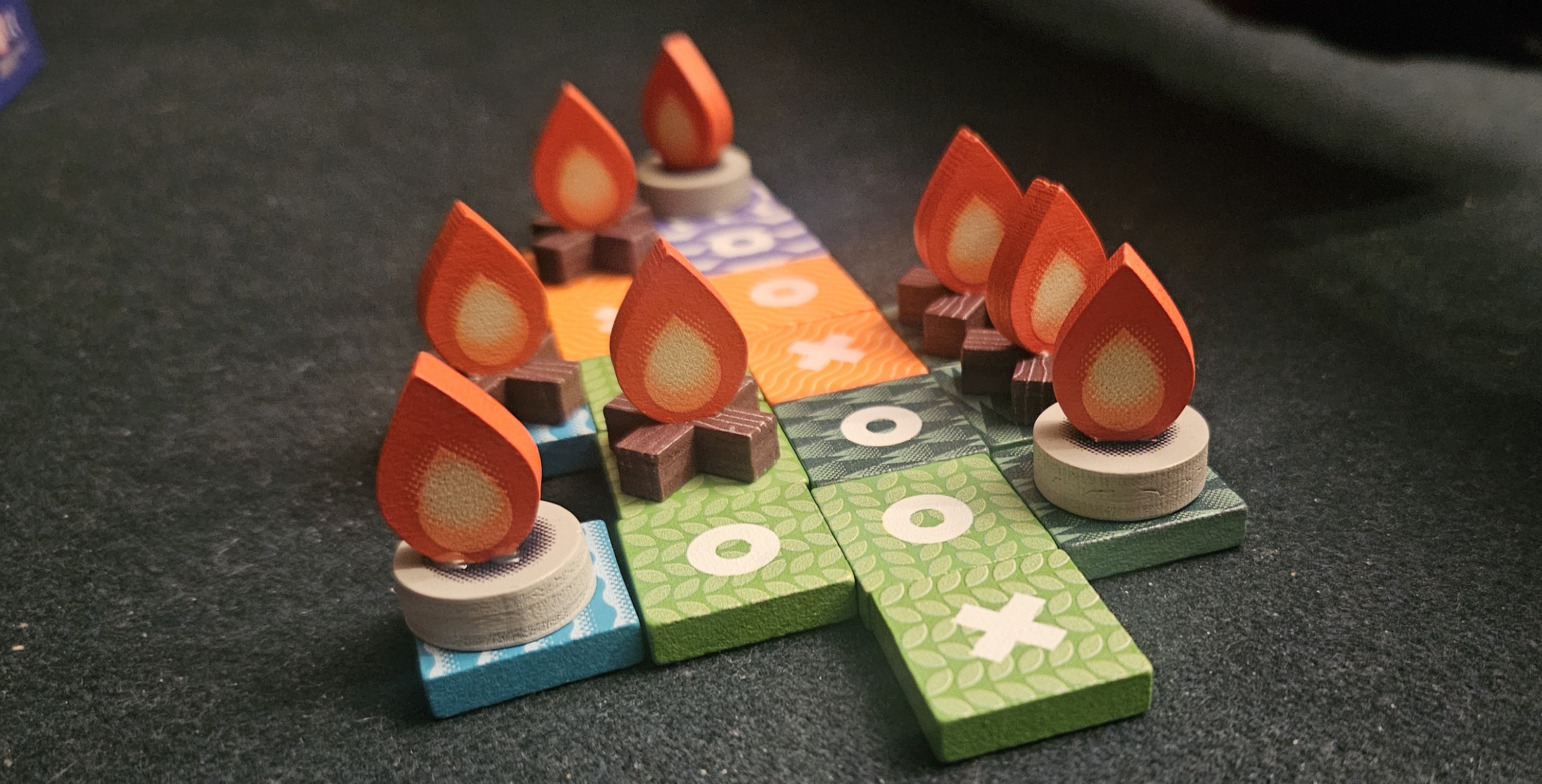
The third in Alley Cat’s line of mint-tin games, Tic Tac Trek initially seemed like the afterthought of the group. For one thing, unlike its predecessors Tinderblox and Barbecubes, it isn’t a stacking game. For another, it’s a riff on Tic Tac Toe, the worst way to pass time in church. (Besides actually listening to the sermon, obviously.)
I should have known better than to doubt Trevor Benjamin and Brett J. Gilbert. Tic Tac Trek is as smart as they come. Your goal is indeed to make three in a row, but here your marks are tiles drawn from a bag, injecting tension and doubt into every move. What’s more, you hope to ignite your campfires on the edges of the play space, earning points for every uncharted territory around them, but risking subtractions as the game progresses. It’s a masterclass in shared incentives and painstaking blocking — but on a more relevant level, you should have seen me beam when my elder daughter absolutely swept my dad with a series of clever placements.
Designed by Reiner Knizia. Published by Bitewing Games.
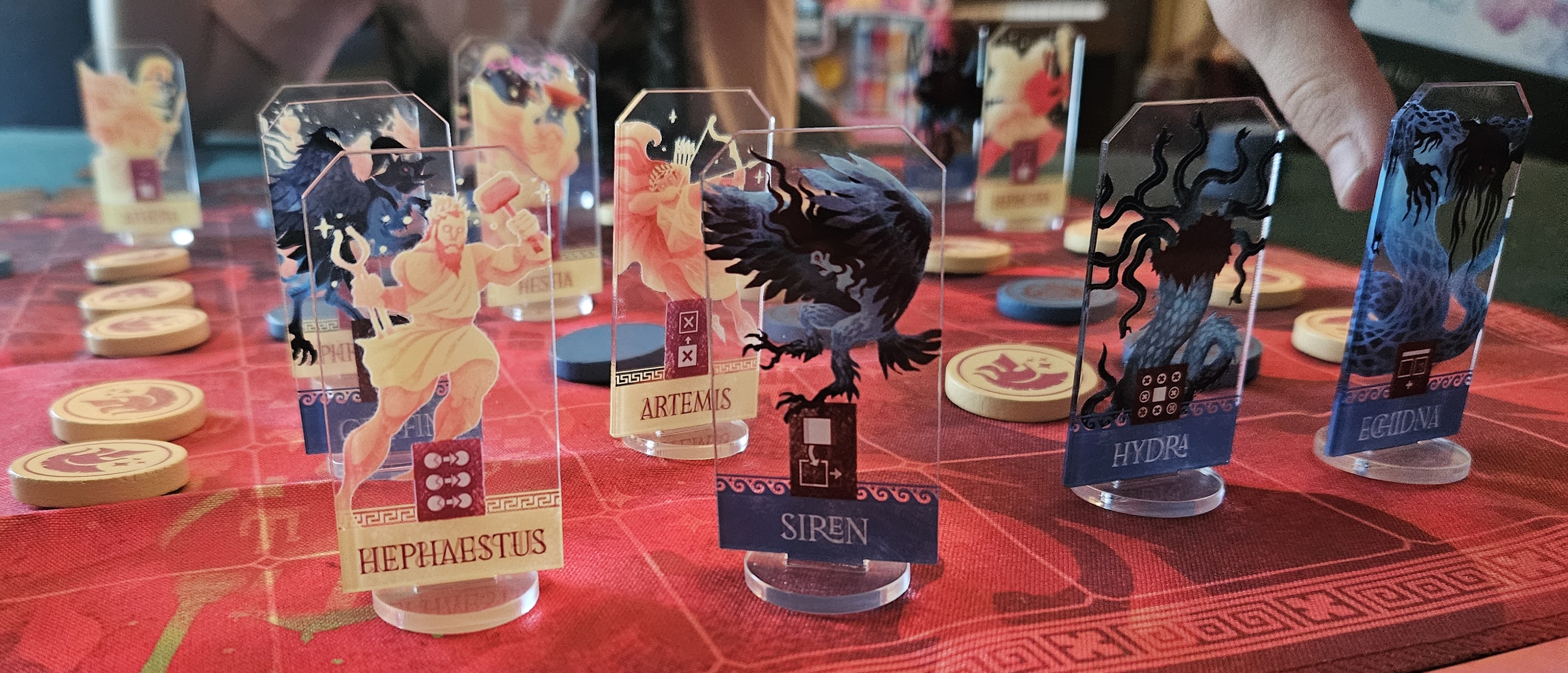
Look, I agree that Iliad, Ichor’s companion title, is the stronger of these Knizias. But Ichor is the one my elder daughter fell in love with, and by extension the one we played time and time again, her monsters sweeping across the foothills of Mount Olympus. As a game, Ichor feels tailor-made to appeal to chess-loving children. It’s basically the answer to the question, “What if every piece could move like a rook?” The answer is silly at times, especially when somebody leaves a lane unattended.
Of course, Reiner Knizia knows better than to let one of his games fall apart just for the sake of some silliness. Ichor stands apart because its objective isn’t to capture opposing pieces. Indeed, most pieces can’t capture at all. Instead, you’re here to scatter all your tokens across the board, a task made all the harder because your opponent also has a stable of their own rooks for replacing your tokens with their own. It’s only through careful play, including cautious use of your team’s special abilities, that you can get ahead. My daughter can beat me over half the time now. I couldn’t be prouder.
Designed by Takashi Ishida and Richard Garfield. Published by CMYK.
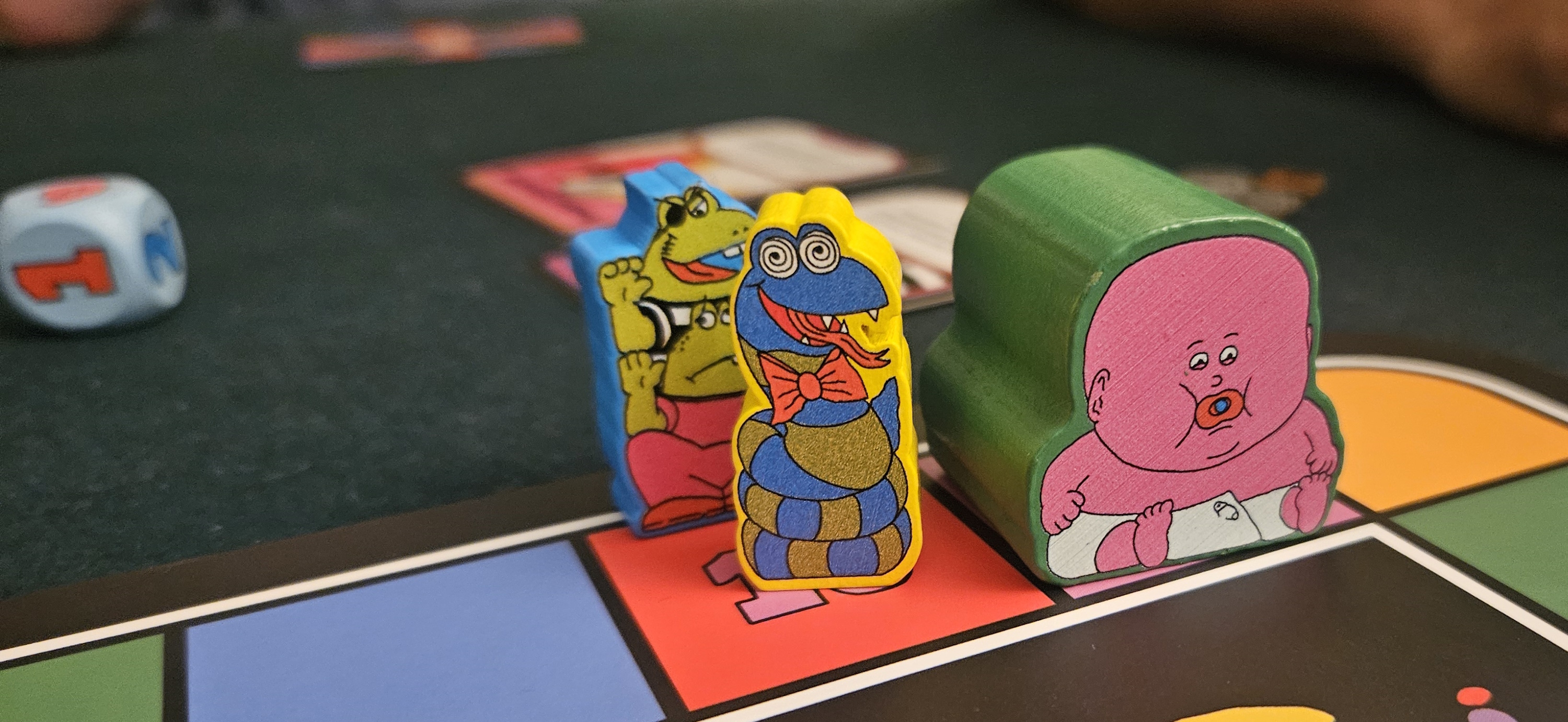
The surest sign of a board game’s success comes when my parents, relative agnostics for the form, ask excitedly if I brought it to Christmas brunch. Magical Athlete is one of the best board games ever designed, and I say that without reservation. Low player agency? Fart noise. Who cares. This is one of those rare games that can be played by four-year-olds and octogenarians with equal delight.
And the recent CMYK edition is more or less the game’s platonic ideal. Everything has been touched up: the character abilities, the extra racing circuit, the way racers are drafted, even the wooden miniatures. Ever seen a giant baby take up an entire space? The game is packed with little jokes, some ludic and others visual. I have yet to encounter a bad play of this thing. Or, crud, even an average play. My kids now insist we pack this thing to any sufficiently large family gathering. It’s that good.
Designed by Kevin Wilson. Published by Incredible Dream Studios.
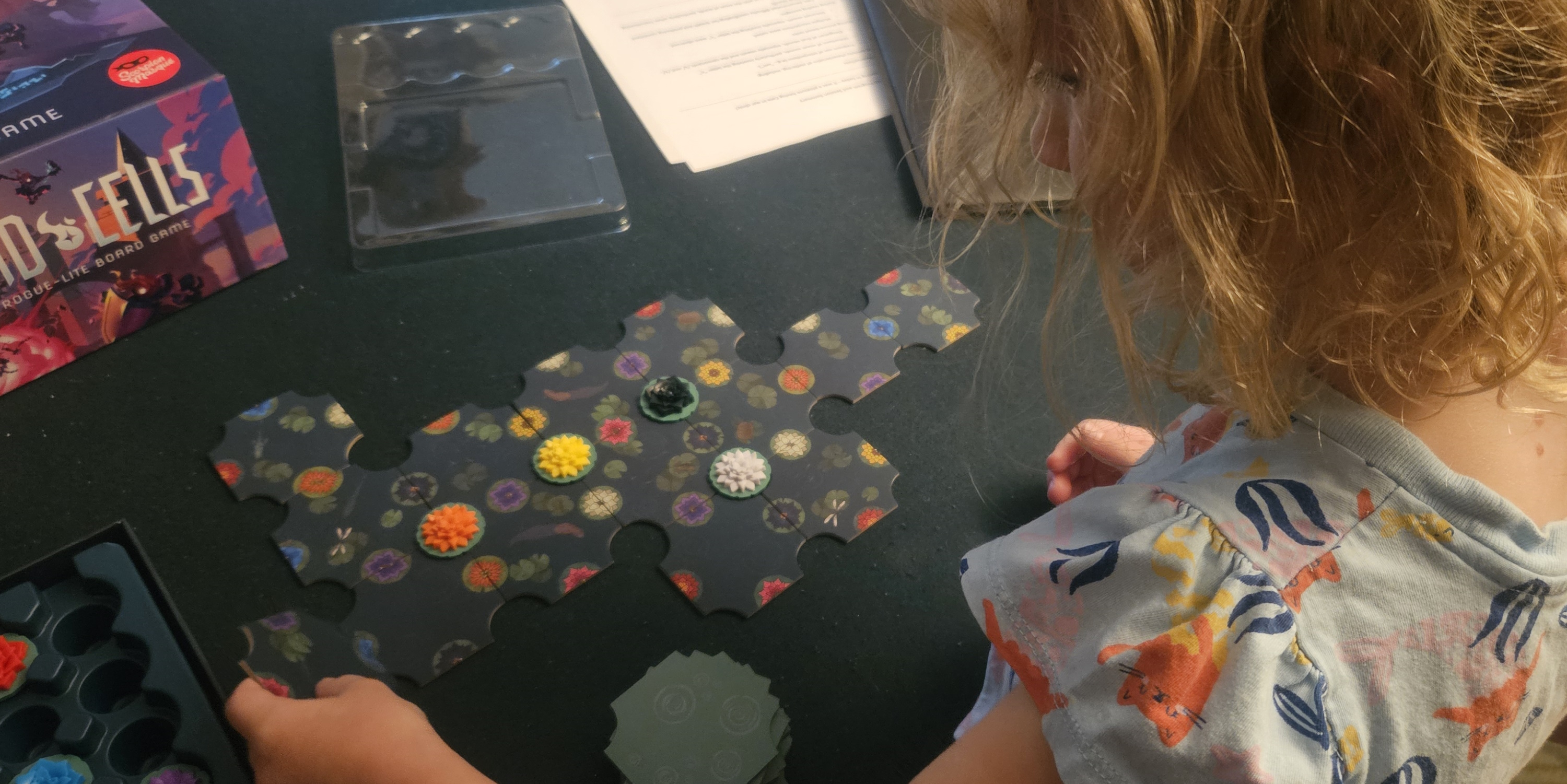
Designed during the doldrums of a global plague, A Gentle Rain technically released in 2021. But in a testament to the format’s timelessness, it emerged as a household regular only this year. As a game, I was initially reluctant. The play consists of matching tile edges to create blossoms. Not much to it. There’s a win condition, but it’s squishy. To be frank, the entire project initially struck me as indulgent and patronizing.
I was wrong. Oh, so wrong. My younger daughter has always struggled with the largeness of her emotions. Being able to sit and undertake simple, soothing, repetitive actions has been a blessing. She cheats at the game; since it’s cooperative, nobody cares, and she also insists I cheat as well. It’s short enough that we can squeeze it in before school. And it’s calming enough that it has been become a reliable staple for helping her gain some space from an overwhelming task. As an exercise in mindfulness, A Gentle Rain exemplifies the strengths of tabletop games.
Designed by Tim and Ben Eisner. Published by Druid City Games.
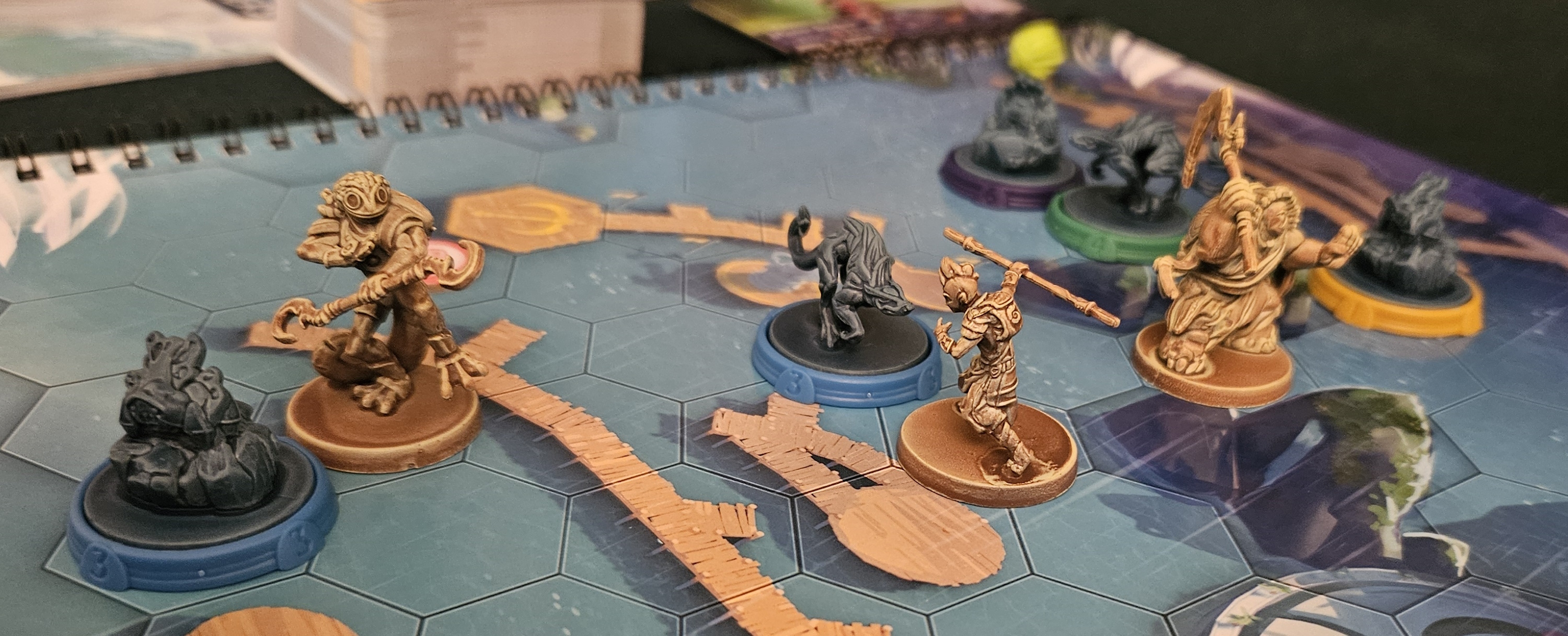
Over the past year, we’ve tackled a number of campaign games. Most of them have quickly proved tiring. I won’t list examples; Best Week isn’t for downers. But the one title that consistently brought us back to the table, charmed us with its bright palette and upbeat characters, and kept us turning pages despite some rather, ah, expressive writing, was Tidal Blades 2: Rise of the Unfolders.
What are Unfolders? I could tell you, but it wouldn’t make any sense. Like most board game adventures, Tidal Blades 2 is a bit of a mush. But it’s a lovely mush. Even the monsters are worth seeing. We spent many nights poring over the game’s scenarios, my older kid tinkering with her character while my younger one perched on my lap for a side battle between her own hero and some spare creatures. This is the first board game that my kids could tell you about the lore. It helps, too, that I was also invested, not only because of the kiddos, but because the game’s world is so vibrant that even this weathered sack of bones found something worth defending.
It’s unthinkable that two goofball racing games came out this year, both with limited player agency, wacky characters, and broad appeal, and that the best of them wasn’t Magical Athlete. In our house, we were already Jon Perry fans. Between Spots for the kids and Scape Goat for the bigguns, there’s no denying his range and talent. Hot Streak bridges the gap with a Golden Gate of remarkable craftsmanship. Also, it’s a useful inroad to the topic of gambling. Look at what DraftKings did to these poor addicts, now reduced to wagering on the outcome of underground mascot races. Is this the future you want for yourselves, kids? Betting your life savings that a hot dog will eat asphalt?
Maaaybe. Above all else, Hot Streak is a scream. It captures the thrill of spectation, breaking down the barrier between play and passive observance. But, look, that’s grown-up talk. The real takeaway is that this is a perfect game because you can bet big on an angler fish running backwards across the finish line. We love it.
Before we dive into the content of the playlist, some general observations:
All of the songs in the playlist were popular during the Weimar Republic (1918—1933). Yet as music recording was still in its infancy at that time, many of the songs in the playlist are later recordings (and some rare ones were recorded even before 1918!).
As the playlist is only 2:21 hours long, your Weimar game will probably last longer (if you don’t crash the republic on the first or second round), but there’s no reason not to listen to these songs two or three times – they’re fascinating historical documents.
The playlist is thematically sorted. That helps you find similar songs, but makes for somewhat monotonous listening (until you come to the next group of songs). I therefore recommend you turn shuffle on.
Now, what awaits you in the playlist?
#1: The National Anthem
It seems like a no-brainer to include the German national anthem of the time, yet it’s not so simple: The Lied der Deutschen (Song of the Germans) had been written in 1841, but had since then only been a patriotic song among many – until the first president of the republic, Friedrich Ebert, declared it the national anthem in 1922. The song’s three stanzas were variedly popular: Ebert favored the third stanza with its liberal ideals of unity, justice, and freedom, his right-wing opponents preferred the “Deutschland über alles” (Germany Above Everything) first stanza. I have included an instrumental version. If you feel patriotic, you can sing along.
The Weimar Republic did not come into existence in a vacuum. It inherited German cultural traditions like folk songs (“Wem Gott will rechte Gunst erweisen” (Whom God Wants to Favor), song #2).
And, of course, the Weimar Republic succeeded the German Empire with its national feeling (“Die Wacht am Rhein” (The Guard on the Rhine), song #2), dominant Protestantism (Martin Luther’s classic “Ein feste Burg ist unser Gott” (A Mighty Fortress Is Our God), song #5), and monarchy (“Heil dir im Siegerkranz” (Hail to Thee In the Victor’s Crown), song #7 – the quasi-anthem of the German Empire).
The republic’s midwife was the First World War – whose experience shaped its veterans and provided the cultural context even for those who had not been adults during the war yet (“Wildgänse rauschen durch die Nacht” (Wild Geese Rush Through the Night), song #8, written in 1916, was immensely popular among the Weimar Republic youth movement). The war also cast its shadow over Weimar Germany as many had lost their husbands, sons, fathers, brothers, and friends in the war (“Ich hatt’ einen Kameraden” (I Had a Comrade), song #9, the traditional German soldiers’ lament).
The liberal republic proved fertile ground for satirical treatments of the new developments: Otto Reutter made fun of the big and small war profiteers with “Seh’n Sie, darum ist es schade, dass der Krieg zu Ende ist” (See, that’s why it’s a pity that the war is over, song #10), and Claire Waldoff called for replacing the men in power with women in “Raus mit den Männern aus dem Reichstag” (Kick the Men Out of Parliament, song #11), playing on masculine anxieties after the introduction of women’s suffrage.
Even in a time and place as politically charged as the Weimar Republic, not everything was politics. The average Hans and Gretel may have cared less about their preferred ideology and more about how to have good time on a Saturday night… and the new cultural scene, especially in the big cities like Berlin, provided ample opportunities.
The more sophisticated artists like the Comedian Harmonists succeeded with witty wordplay and erudite vocal harmonies. Others played on the classics – alcohol (“Wir versaufen unser Oma ihr klein’ Häuschen“ (We Blow Grandma’s Little House on Booze, song #19) and sexual innuendo („Fräulein, Woll’n Sie nicht ein Kind von mir“ (Miss, Don’t You Want a Child By Me, song #22). There was even the equivalent of a (generalized) diss track: “Du bist als Kind zu heiß gebadet worden” (You Have Been Bathed Too Hot As a Child, song #23) indicates that this neglect of bath safety led to lasting brain damage in the interlocutor.
#26-33: Film, Theater, and Opera Music
The Weimar Republic’s vibrant cultural scene led to cross-pollination between diverse forms of artistic expression. The new medium of film was pioneered in Germany, and once it had left its silent infancy behind, movie songs became hits. Marlene Dietrich, starring in The Blue Angel, enticed with “Ich bin von Kopf bis Fuß auf Liebe eingestellt (I’m Set to Love From Head to Heel, song #26), but warned “Nimm dich in Acht vor blonden Frau’n“ (Beware of Blonde Women, song #27).
More traditional art forms like the theater also adapted. Die Dreigroschenoper (The Threepenny Opera)’s acerbic critique of capitalism would not have been as successful without its catchy songs, the most famous of which is the “Moritat of Mackie Messer” (Ballad of Mack the Knife, song #31).
Even the most classic and highbrow form of entertainment modernized: “Jonny spielt auf” (Jonny Plays It Big, song #33) introduced jazz into the world of the opera… which brings us to our next category.
#34-41: Jazz and Blues
Traditionally, the United States had received and emulated European fashions, not the other way around. Yet by the early 20th century, America had become the largest economy in the world, its war entry in 1917 tipped the scales of the war further in favor of the Allies, and the increased presence of Americans in Europe meant that the United States turned from an importer to an exporter of culture. Jazz took Europe by storm – both in the form of American (and nascent European) bands and by the new medium of the music record. The Weimar Republic was no exception. Jazz fueled the parties in any larger city of 1920s Germany.
Of course, not everyone loved jazz, and the controversy over its unorthodox dissonances, the more expressive, individualistic, and eroticized dancing style accompanying the music, and, of course, the race of its performers entered the contemporary culture wars – exemplified by Weimar’s double use of Louis Armstrong, illustrating both the SPD’s “The New Rhythm” and the DNVP’s “Nicht Deutsch” (“Not German”) event cards.
The “Tiger Rag” (song #41) is also used in The Tin Drum, German writer Günter Grass’s epic about the rise, fall, and persistence of Nazism: The youthful protagonist Oskar Matzerath who always carries his eponymous tin drum plays the Tiger Rag at a NSDAP rally in his hometown Danzig. The mesmerizing rhythm has the audience sway and dance, exposing the Nazis to ridicule.
#42-47: Workers’ Songs
The aggressive ethno-nationalism of Nazism was one of the two most dynamic political movements of the Weimar Republic (at least once the 1929 crash had plunged vast parts of the German population into a crisis of material and identity). The other was the workers’ movement, both in its reformist Social Democratic and its revolutionary Communist form. As the workers had been traditionally excluded from the public in imperial Germany, dominated by aristocracy and bourgeoisie, they created their own political parties (SPD, later USPD and KPD), economic associations (the trade unions), and social and cultural associations – from workers’ sport clubs to workers’ singing societies. Their milieu was bound together not only by their shared economic experience, but also by this cultural connection, of which the workers’ songs formed an important part.
Classics from imperial times like “Die Internationale” (The Internationale, song #42) remained important, but the movement also adopted new songs written by the numerous socialist poets and composers like Bertolt Brecht, Hanns Eisler, or Ernst Busch. Whereas some of these became new classics (like the “Solidaritätslied” (Solidarity Song, song #46), others aged badly: “Der Marsch ins Dritte Reich” (The March to the Third Reich, song #47) poked fun at the alleged inability of the Nazis to take power after their electoral setback at the Reichstag election of November 1932. First recorded in December 1932, the song was horribly overtaken by events just a month later when Hitler was elected chancellor in January 1933.
Thus, we conclude our playlist. It contains the traditional and the modern, entertainment and politics, left and right – except for the very right, but I don’t want to listen to Nazi songs while playing board games, and I’m sure that neither do you.
Do you like to play music in the background while playing board games? What’s your favorite song from this playlist? Let me know in the comments!
Before we dive into the content of the playlist, some general observations:
All of the songs in the playlist were popular during the Weimar Republic (1918—1933). Yet as music recording was still in its infancy at that time, many of the songs in the playlist are later recordings (and some rare ones were recorded even before 1918!).
As the playlist is only 2:21 hours long, your Weimar game will probably last longer (if you don’t crash the republic on the first or second round), but there’s no reason not to listen to these songs two or three times – they’re fascinating historical documents.
The playlist is thematically sorted. That helps you find similar songs, but makes for somewhat monotonous listening (until you come to the next group of songs). I therefore recommend you turn shuffle on.
Now, what awaits you in the playlist?
#1: The National Anthem
It seems like a no-brainer to include the German national anthem of the time, yet it’s not so simple: The Lied der Deutschen (Song of the Germans) had been written in 1841, but had since then only been a patriotic song among many – until the first president of the republic, Friedrich Ebert, declared it the national anthem in 1922. The song’s three stanzas were variedly popular: Ebert favored the third stanza with its liberal ideals of unity, justice, and freedom, his right-wing opponents preferred the “Deutschland über alles” (Germany Above Everything) first stanza. I have included an instrumental version. If you feel patriotic, you can sing along.
The Weimar Republic did not come into existence in a vacuum. It inherited German cultural traditions like folk songs (“Wem Gott will rechte Gunst erweisen” (Whom God Wants to Favor), song #2).
And, of course, the Weimar Republic succeeded the German Empire with its national feeling (“Die Wacht am Rhein” (The Guard on the Rhine), song #2), dominant Protestantism (Martin Luther’s classic “Ein feste Burg ist unser Gott” (A Mighty Fortress Is Our God), song #5), and monarchy (“Heil dir im Siegerkranz” (Hail to Thee In the Victor’s Crown), song #7 – the quasi-anthem of the German Empire).
The republic’s midwife was the First World War – whose experience shaped its veterans and provided the cultural context even for those who had not been adults during the war yet (“Wildgänse rauschen durch die Nacht” (Wild Geese Rush Through the Night), song #8, written in 1916, was immensely popular among the Weimar Republic youth movement). The war also cast its shadow over Weimar Germany as many had lost their husbands, sons, fathers, brothers, and friends in the war (“Ich hatt’ einen Kameraden” (I Had a Comrade), song #9, the traditional German soldiers’ lament).
The liberal republic proved fertile ground for satirical treatments of the new developments: Otto Reutter made fun of the big and small war profiteers with “Seh’n Sie, darum ist es schade, dass der Krieg zu Ende ist” (See, that’s why it’s a pity that the war is over, song #10), and Claire Waldoff called for replacing the men in power with women in “Raus mit den Männern aus dem Reichstag” (Kick the Men Out of Parliament, song #11), playing on masculine anxieties after the introduction of women’s suffrage.
Even in a time and place as politically charged as the Weimar Republic, not everything was politics. The average Hans and Gretel may have cared less about their preferred ideology and more about how to have good time on a Saturday night… and the new cultural scene, especially in the big cities like Berlin, provided ample opportunities.
The more sophisticated artists like the Comedian Harmonists succeeded with witty wordplay and erudite vocal harmonies. Others played on the classics – alcohol (“Wir versaufen unser Oma ihr klein’ Häuschen“ (We Blow Grandma’s Little House on Booze, song #19) and sexual innuendo („Fräulein, Woll’n Sie nicht ein Kind von mir“ (Miss, Don’t You Want a Child By Me, song #22). There was even the equivalent of a (generalized) diss track: “Du bist als Kind zu heiß gebadet worden” (You Have Been Bathed Too Hot As a Child, song #23) indicates that this neglect of bath safety led to lasting brain damage in the interlocutor.
#26-33: Film, Theater, and Opera Music
The Weimar Republic’s vibrant cultural scene led to cross-pollination between diverse forms of artistic expression. The new medium of film was pioneered in Germany, and once it had left its silent infancy behind, movie songs became hits. Marlene Dietrich, starring in The Blue Angel, enticed with “Ich bin von Kopf bis Fuß auf Liebe eingestellt (I’m Set to Love From Head to Heel, song #26), but warned “Nimm dich in Acht vor blonden Frau’n“ (Beware of Blonde Women, song #27).
More traditional art forms like the theater also adapted. Die Dreigroschenoper (The Threepenny Opera)’s acerbic critique of capitalism would not have been as successful without its catchy songs, the most famous of which is the “Moritat of Mackie Messer” (Ballad of Mack the Knife, song #31).
Even the most classic and highbrow form of entertainment modernized: “Jonny spielt auf” (Jonny Plays It Big, song #33) introduced jazz into the world of the opera… which brings us to our next category.
#34-41: Jazz and Blues
Traditionally, the United States had received and emulated European fashions, not the other way around. Yet by the early 20th century, America had become the largest economy in the world, its war entry in 1917 tipped the scales of the war further in favor of the Allies, and the increased presence of Americans in Europe meant that the United States turned from an importer to an exporter of culture. Jazz took Europe by storm – both in the form of American (and nascent European) bands and by the new medium of the music record. The Weimar Republic was no exception. Jazz fueled the parties in any larger city of 1920s Germany.
Of course, not everyone loved jazz, and the controversy over its unorthodox dissonances, the more expressive, individualistic, and eroticized dancing style accompanying the music, and, of course, the race of its performers entered the contemporary culture wars – exemplified by Weimar’s double use of Louis Armstrong, illustrating both the SPD’s “The New Rhythm” and the DNVP’s “Nicht Deutsch” (“Not German”) event cards.
The “Tiger Rag” (song #41) is also used in The Tin Drum, German writer Günter Grass’s epic about the rise, fall, and persistence of Nazism: The youthful protagonist Oskar Matzerath who always carries his eponymous tin drum plays the Tiger Rag at a NSDAP rally in his hometown Danzig. The mesmerizing rhythm has the audience sway and dance, exposing the Nazis to ridicule.
#42-47: Workers’ Songs
The aggressive ethno-nationalism of Nazism was one of the two most dynamic political movements of the Weimar Republic (at least once the 1929 crash had plunged vast parts of the German population into a crisis of material and identity). The other was the workers’ movement, both in its reformist Social Democratic and its revolutionary Communist form. As the workers had been traditionally excluded from the public in imperial Germany, dominated by aristocracy and bourgeoisie, they created their own political parties (SPD, later USPD and KPD), economic associations (the trade unions), and social and cultural associations – from workers’ sport clubs to workers’ singing societies. Their milieu was bound together not only by their shared economic experience, but also by this cultural connection, of which the workers’ songs formed an important part.
Classics from imperial times like “Die Internationale” (The Internationale, song #42) remained important, but the movement also adopted new songs written by the numerous socialist poets and composers like Bertolt Brecht, Hanns Eisler, or Ernst Busch. Whereas some of these became new classics (like the “Solidaritätslied” (Solidarity Song, song #46), others aged badly: “Der Marsch ins Dritte Reich” (The March to the Third Reich, song #47) poked fun at the alleged inability of the Nazis to take power after their electoral setback at the Reichstag election of November 1932. First recorded in December 1932, the song was horribly overtaken by events just a month later when Hitler was elected chancellor in January 1933.
Thus, we conclude our playlist. It contains the traditional and the modern, entertainment and politics, left and right – except for the very right, but I don’t want to listen to Nazi songs while playing board games, and I’m sure that neither do you.
Do you like to play music in the background while playing board games? What’s your favorite song from this playlist? Let me know in the comments!
Before the Treaty of Alliance and the French declaration of war on Britain, France had supported the American Patriots materially. Now that France was a full belligerent, fighting forces would follow – first, the French fleet.
Admiral d’Estaing’s event card in Liberty or Death (Harold Buchanan, GMT Games) emphasizes the difficulties and opportunities of coordinating far-reaching naval operations. From the Vassal module.
A naval force under Admiral Charles Henri Hector d’Estaing, carrying a few thousand French land forces, was dispatched to North America in summer 1778. They embarked on an ambitious combined-force scheme together with the Continental Army to take Newport from the British. American-French cooperation (as well as army-navy cooperation) proved difficult, and the operation had to be aborted. In one of the more dubious decisions of the war, the British abandoned Newport, one of the finest natural harbors in New England, voluntarily soon after.
As joint operations had not yielded success, the American and British forces would usually operate separately for the next two years. That meant that the Americans continued to bear the brunt of the struggle for North America. The French navy and army, however, were crucial in tying down British forces in the by now global struggle: British and French forces fought over the economically crucial “sugar islands” of the Caribbean. A French armada, strengthened by Spain which had recently entered the war, threatened to invade Britain itself in 1779. Even in far away India, British forces were challenged by the French and their local allies. Players of Imperial Struggle (Ananda Gupta/Jason Matthews, GMT Games) will recognize these as the four regions in which Britain and France fight for supremacy – with victory going to the player who can balance their interests in the four regions best, taking losses where they must while making bigger gains elsewhere.
The board of Imperial Struggle depicts a world full of opportunities for conquest, alliance, and trade in North America, Europe, the Caribbean, and India. In this particular game, the British have been expelled from North America, but done well in India.
The American Patriots had none of this strategic depth. If they were defeated North America, their cause would be lost. And even with French support, it did not seem like they could do more than brace themselves against the military and financial superiority of Britain… if so much. The harsh winter of 1779-80 decimated the Continental Army. Difficulties in paying the troops resulted in the mutiny of the Pennsylvania and New Jersey Line regiments. The situation seemed so dire that Benedict Arnold, one of the most distinguished American commanders, betrayed the American cause (but failed to deliver the fort of West Point to Britain), serving in the British army for the remainder of the war.
The Benedict Arnold event in Washington’s War (Mark Herman, GMT Games) does not only give a die roll modifier in a battle to Britain, but also removes the (American) leader Arnold from the board. Experienced American players know this, of course, and will not entrust Arnold with important missions… thus, his invasion of Canada is unlikely to happen in the game. An interesting meditation on how much historical hindsight influences gameplay.
The Southern Strategy
Part of the American woes was the new British focus. As New England was lost to Britain, and too full of rebels to be retaken, the British turned their attention to the southern colonies which the believed to be populated by many British loyalists.
First, they advanced from Florida (supported by sea) into Georgia and took Savannah on December 29, 1778. A combined American-French land-sea operation failed to retake the city in June 1779. After this second joint operations failure, the French fleet relocated to the Caribbean. British forces under Charles Cornwallis laid siege to Charleston, South Carolina, the following March.
Lincoln never stood a chance. From the Rally the Troops! implementation of Washington’s War.
Benjamin Lincoln, who had commanded the American troops in the unsuccessful counter-offensive at Savannah, was put under enormous political pressure not to let Charleston, one of the most important cities in the south, fall into British hands. Retreat was thus impossible. Yet the defense of the city against superior British forces was doomed. Lincoln surrendered in May 1780.
Cornwallis’s next victim. From the Rally the Troops! implementation of Washington’s War.
Cornwallis also beat the new American commander in the south, Horatio Gates, at Camden (and thus cut Gates, the hero of Saratoga, back to size again). As the British general was poised to invade North Carolina, Washington dispatched Nathanael Greene to take command in the south.
Greene’s approach aimed to elude a decisive engagement. Contrary to British assumptions, the south was not rife with British loyalists. The crown was only supported where Britain could enforce loyalty – on the coasts, and wherever Cornwallis’s army was at the moment. And Cornwallis could not be everywhere. Small American forces under guerilla leaders (like “The Gamecock” Thomas Sumter and Francis Marion, on whom the movie The Patriot is based) chipped away at British forces and support. While Cornwallis beat Greene at Guilford Court House and Eutaw Springs in early 1781, he could not reverse the south’s affiliation to the Patriot cause.
Yorktown
Cornwallis lost patience with the indecisive campaign against Greene’s Fabian strategy. In 1781, he boldly struck into Virginia. His supply was to come from sea via the port of Yorktown on Chesapeake Bay. If Virginia, the largest and most populous southern colony was taken and thus the south cut off from the north, Greene would have to surrender – or so Cornwallis thought. Cornwallis’s good strategy rating in Washington’s War makes it likely that the British player will let him pursue similarly active campaigns… and hopes not to get caught by superior force.
Cornwallis’s plan was risky. Virginia was much closer to the American and French main forces than the Carolinas. The French commander Jean-Baptiste Donatien de Vimeur, comte de Rochambeau, urged George Washington to confront Cornwallis. And thus a third joint operation began: Gilbert du Motier, Marquis de Lafayette, a French volunteer in the Continental army, marched American and French forces to Virginia.
Cornwallis responded in the typical British manner: He fortified Yorktown and confidently relied on British naval superiority to keep his options open. That confidence was shaken when the French instead of the British navy showed up in Chesapeake Bay. The British sent a fleet of their own, but the resulting naval battle of Chesapeake Bay failed to expel the French fleet (September 5, 1781).
Between a rock and a hard place: Cornwallis was trapped by the American-French army and the French navy. From the Rally the Troops! implementation of Washington’s War.
Washington and Rochambeau took command of the combined army and invested Yorktown. As Cornwallis had failed to tenaciously defend the outer defenses, assuming he would be evacuated by the Royal Navy, the sieging forces advanced quickly. Cut off from supplies and under bombardment from the allied artillery, Cornwallis surrendered on October 17, 1781. His entire force of almost 8,000 was captured (with another 156 dead). French and American total casualties (dead and wounded) were barely over 200.
Peace
The war in the colonies had been unpopular in Britain for some years. Parliament was unwilling to expend more money on it, and thus the British forces deployed had never again reached their peak strength from 1776. With one of the two main British forces in the colonies lost, so was the parliamentary base for the government. When the Whig opposition’s motion to end the war in North America carried a majority, Prime Minister Frederick North resigned in March 1782. “North’s Government Falls” is the end of a game of Washington’s War, and can happen anytime between 1779 and 1783 (provided the event is face-up in the respective year).
North’s successors had to make peace with four separate enemies – the United States, France, Spain, and the Netherlands. The American negotiators Benjamin Franklin and John Jay proved most skillful in this complicated multi-sided diplomacy. They secured diplomatic recognition for the United States as well as the western domain all the way to the Mississippi and important fishing rights in the Atlantic. The Peace of Paris was signed on September 3, 1783.
The king of France had little time to enjoy his triumph. The war expenses incurred in the American Revolutionary War contributed to the financial crisis which resulted in the French Revolution (whose protagonists were in turn inspired by the American ideas of liberalism and republicanism) just six years after the Peace of Paris.
Britain, on the other hand, bounced back from the setback in North America. The country’s naval, commercial, and financial strength was still intact. Britain would orchestrate the coalitions against revolutionary and Napoleonic France until the final victory at Waterloo in 1815, ushering in a century of British global dominance.
And the United States? They remained within their own hemisphere for the time being. Only occasionally drawn into conflict with their erstwhile French allies or old British enemies, the United States dealt with their westward expansion and economic development. Despite its unresolved conflict internal conflict about slavery, the American republic remained an inspiration to European liberals and democrats who strove to follow the example begun 250 years ago.
Allison, Robert J.: The American Revolution. A Very Short Introduction, Oxford University Press, New York City, NY 2015 is exactly what it says on the tin.
Higginbotham, Don: The War of American Independence. Military Policies, Attitudes, and Practice, 1763-1789, Indiana University Press, Bloomington, IN 1977 covers not only the campaigns, but also the political, social, and economic dimensions behind them.

 Anmelden


 Like any self-respecting person(s), we only do anything if it gets us Credit on the Internet. Or if our boss tells us to. Either way, if the play wasn’t logged, if the run wasn’t recorded, if the calories weren’t counted, then obviously it never happened. Hang on, I think I just found a cookie loophole… […]