Anmelden


Clammy Scythe-on-Expeditions Action

I won’t pretend to know what’s happening in Duel of Meloch. When we first got a glimpse of this world via Scythe, it was an alt-history Great War mechs-n’-boiled-barley affair. Then Expeditions rolled around and the whole thing took on a determinedly Strugatsky Brothers flair, all strange zones and alien meteors and zombified hussars. Now there’s a foreign entity named Meloch who’s thrown the previous games’ heroes into a time warp, resulting in one last excursion that just so happens to be a grudge match between two of Jamey Stegmaier’s most iconic gameplay systems.
Do these disparate threads make a lick of sense? Not to this philistine. But even as the gameplay mostly gets me shrugging, I can’t help but find the result compelling. It’s a pickle.

Scythe. Expeditions. This mat ain’t big enough for the both of us.
At a sky-high level, Duel of Meloch does precisely as its subtitle proposes. This is Scythe vs. Expeditions, and so snugly fitted that while a few minor alterations are necessary to make its hand-me-down trousers and blouses cohere into a single uniform, for the most part these changes dissolve into the aether after all of two minutes. This isn’t a different, third game that just so happens to use the components from Scythe and Expeditions. It’s Scythe and Expeditions, side by side, and sometimes right in each other’s faces, both humming along as Stegmaier intended.
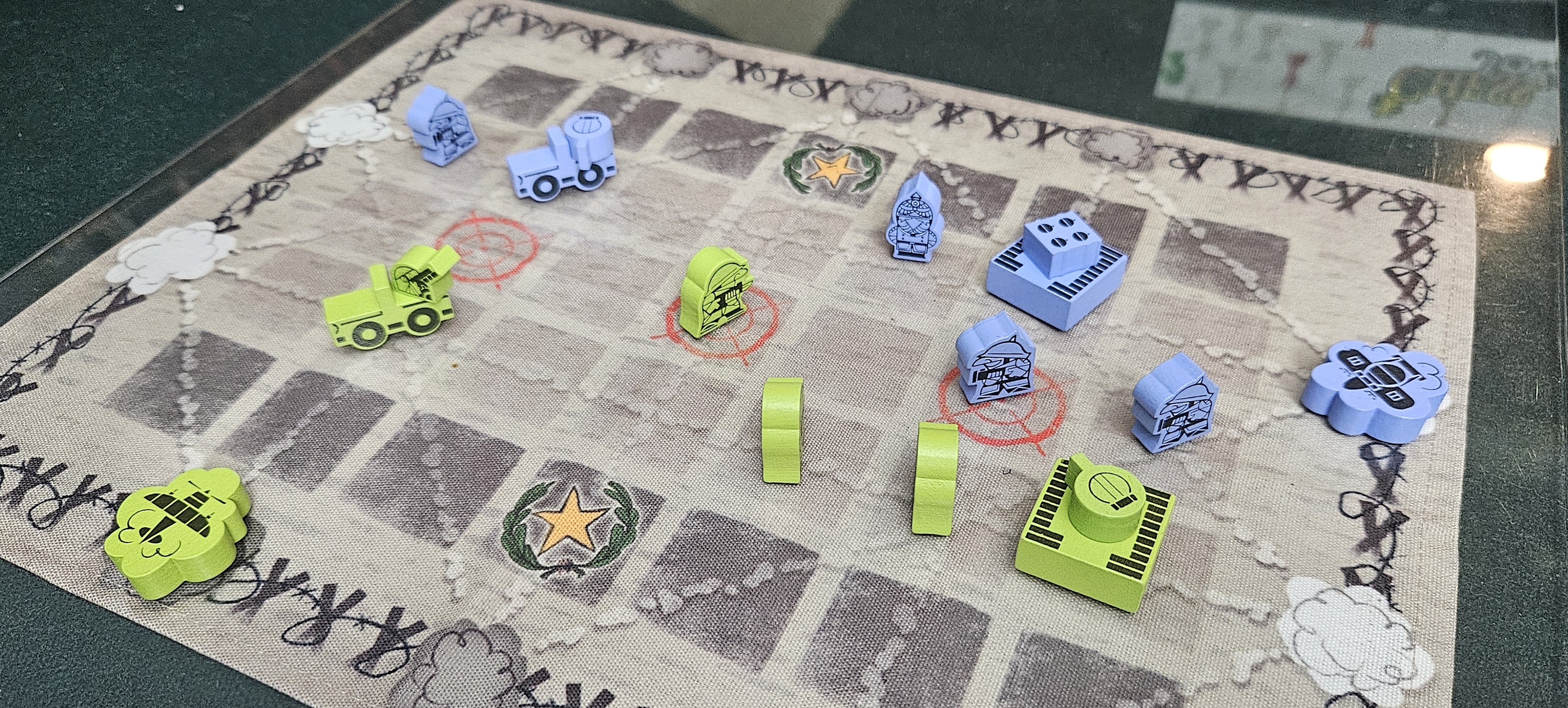
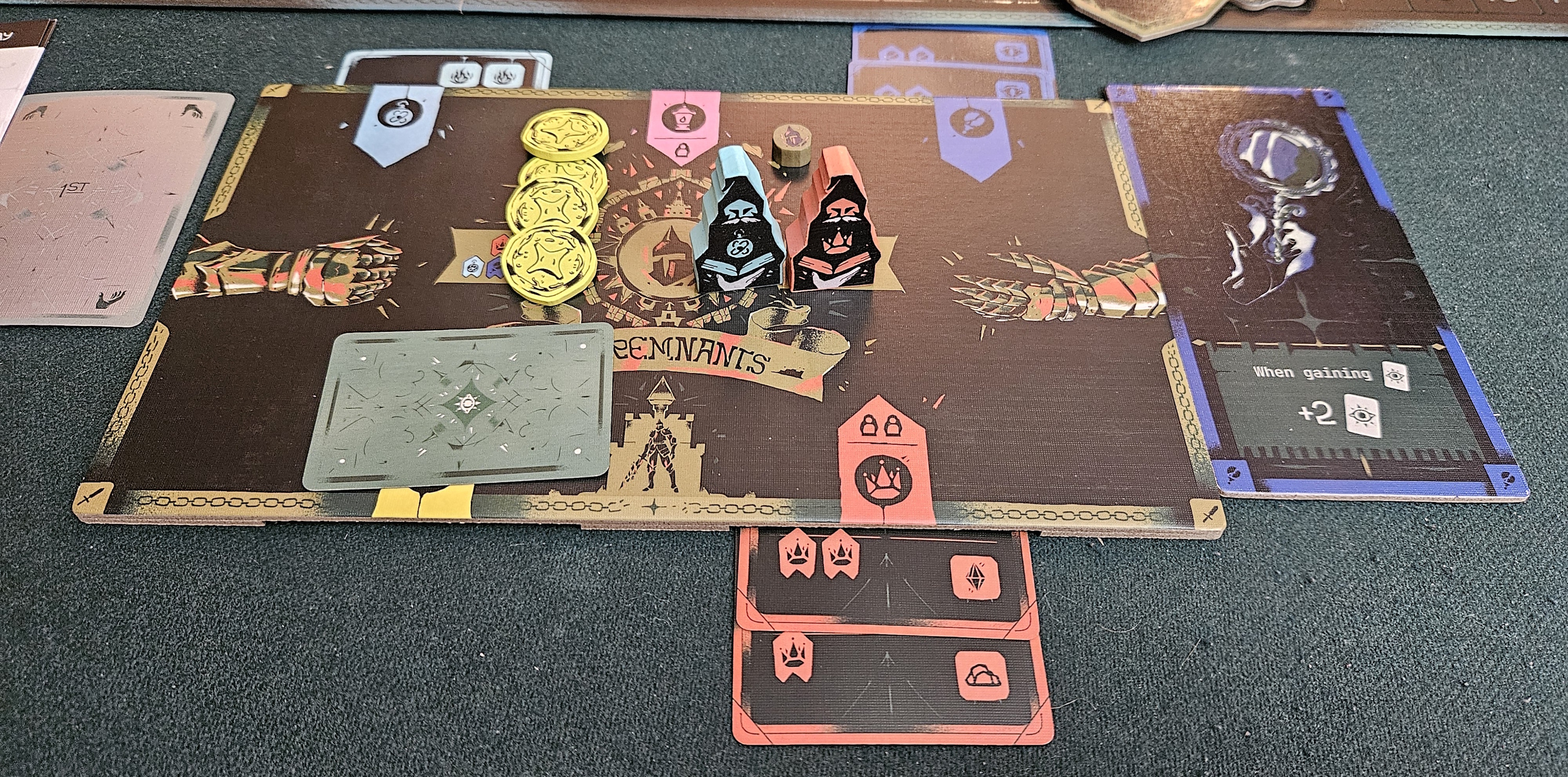
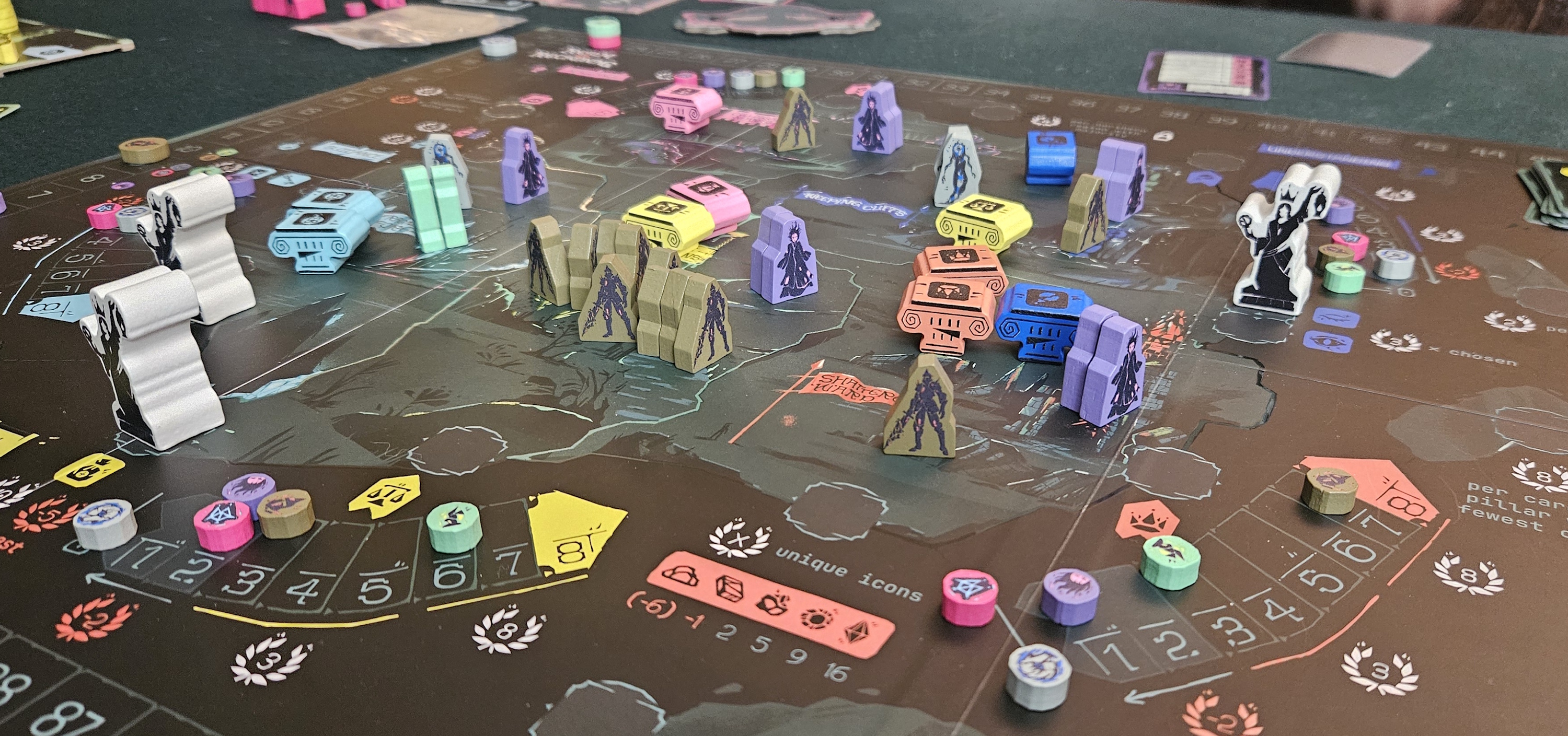
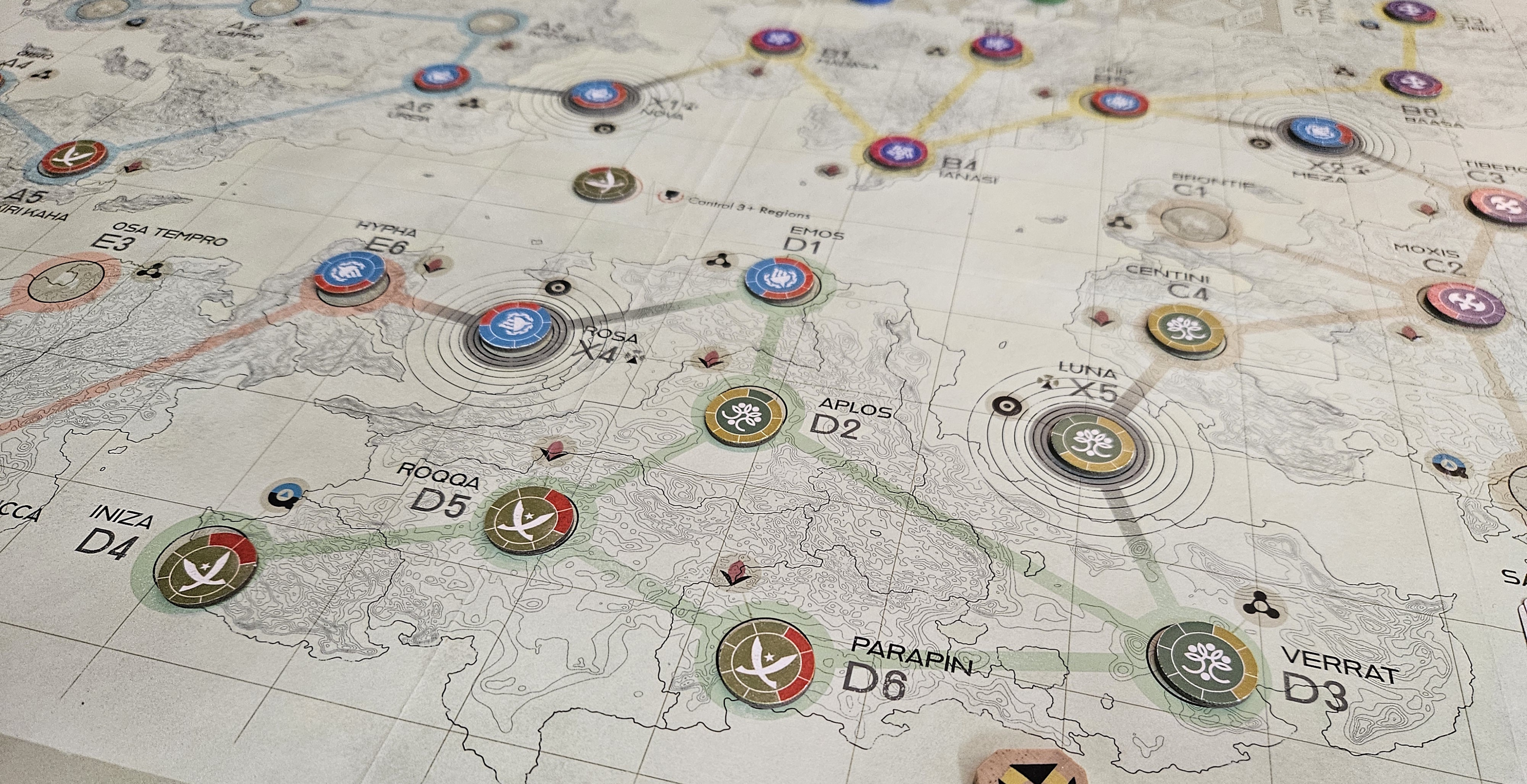
How does it work? Well, again, it’s Scythe and Expeditions, so they work like Scythe and Expeditions. The former, called the Scythian, is playing an economic game. They escort workers across the landscape, have them harvest wheat and oil and so forth, and then spend those resources to build mills and armories and additional mechs. The latter, the Explorer, is more solitary. Occupying a single mech, they trawl across the map in search of cool artifacts and various helpers, then use those assets to manage a hand of cards and attack corruption tokens. Visually, the Scythian puts themself out there. You see their workers and factories and mechs spread across the land. The Explorer, on the other hand, tends to keep their resources closer to the vest. More tangibly, this means glancing at their board to see how many quests and upgrades they’ve completed.
What’s most impressive is how smoothly these systems merge. Some fun has been poked at Stegmaier for his games’ shared iconography. Even as recently as two months ago, the new edition of Euphoria once again used those objective stars as their centerpiece, giving the game the appearance of a spreadsheet, one at odds with its more vivid original incarnation. But those duplicated icons have never seemed more forward-thinking than here. In fact, the one discernible place where the icons differ — combat strength — is so jarring that it comes across as an intrusion into the game’s visual language.
It’s funny, in other words, to pine for even more generic visual language, but there we have it. Take that, doubters. Myself included. Without those duplicates, Duel of Meloch would have been a true ocular nightmare. Instead, it’s as crisp as can be expected from such an experiment. Especially if it’s true, as Stegmaier asserts, that these systems were never planned to be combined.

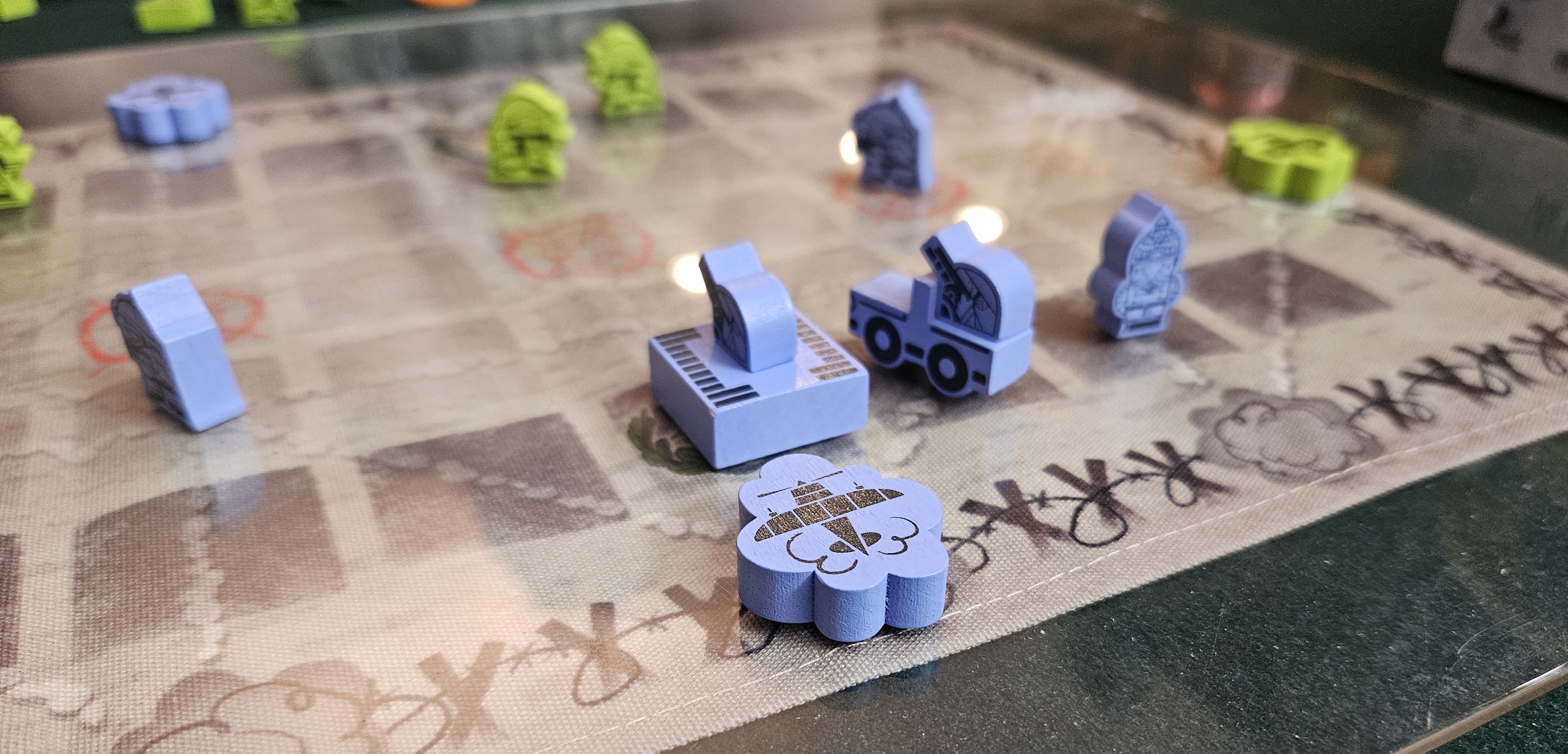
Scythe’s double-action system is as interesting as ever.
The gameplay itself is conducted at two levels: the micro, consisting of your own turn — which, for the last time, is either Scythe or Expeditions, depending on which side of the equation you’re commanding today — and the larger macro perspective that sees those sides coming into collision.
This being Duel of Meloch, it’s that latter collision that’s the real draw. And it’s… fine. The Explorer moves faster in terms of kilometers per turn, while the Scythian draws borders and eventually outnumbers their rival in terms of sheer mechpower. This mostly matters for combat. The Explorer punches harder máquina a máquina thank to its dual brands of combat strength; the Scythian brings numerical superiority to bear. To help these tussles along, combat is imported more or less intact from Scythe. Both sides bid via private dials, then modify their strength with combat cards. These cards have received some adjustment in the form of a new deck, but not so much that returning players will require explanation.
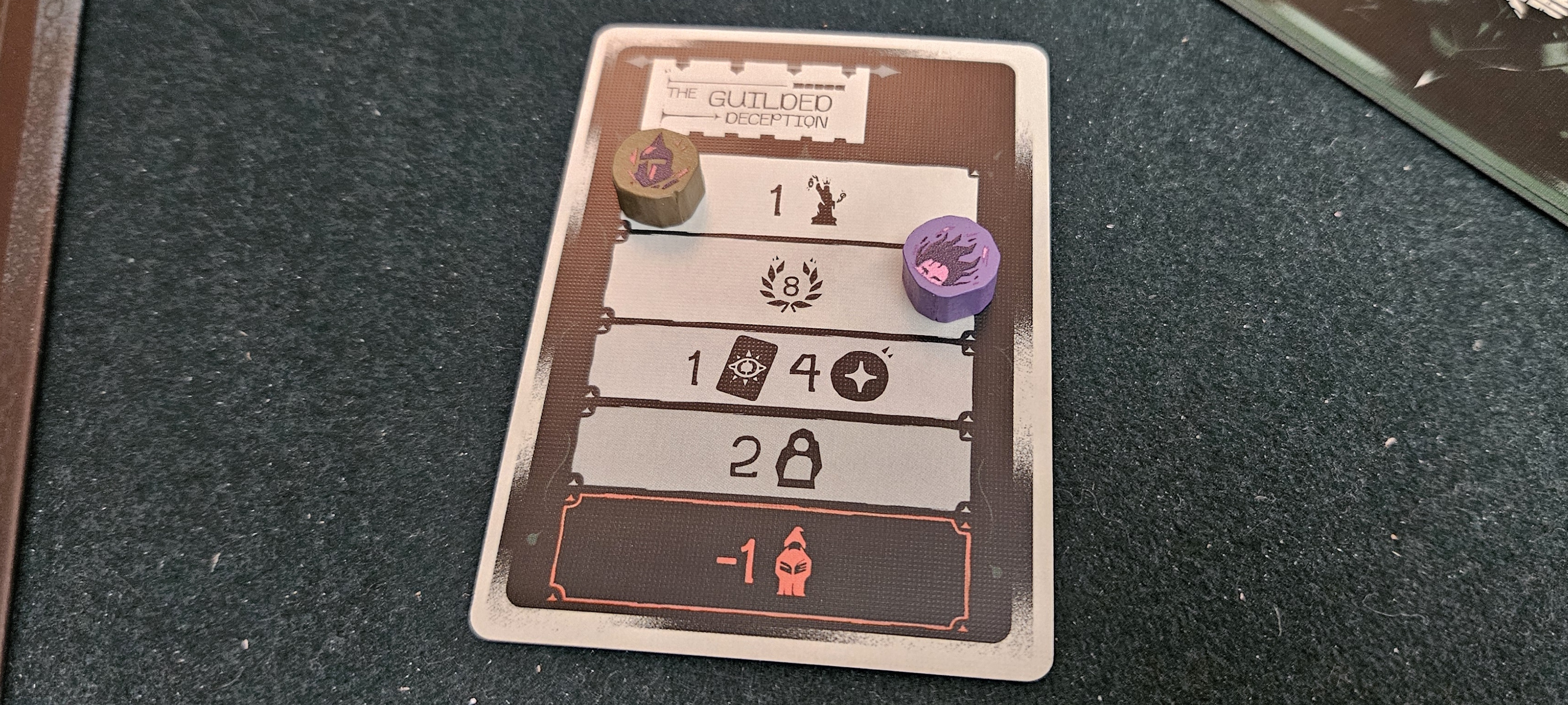
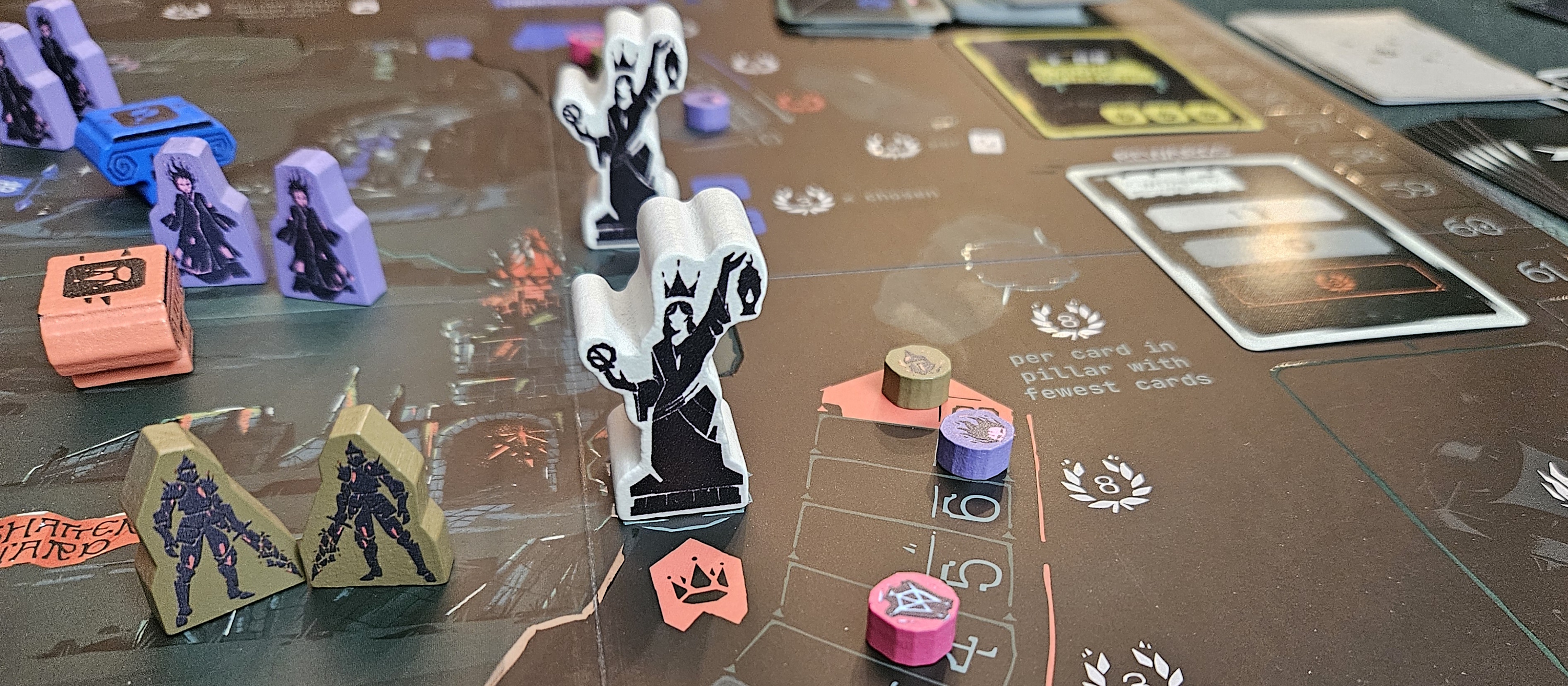
The inherent limitation of these bouts is similar to those of Scythe: namely, there really isn’t much reason for the Explorer and the Scythian to jostle. Duel of Meloch isn’t a duel so much as a race. There’s a shared objective board, and both sides are hustling to tick off its various boxes. This also acts as a showcase for the games’ shared iconography, even when those icons translate to slightly different things. For example, the Scythian might be asked to raise their popularity to ten, while the Explorer tries to accomplish three quests. Both of these goals use the heart icon, and both represent an outward-facing perspective, making them a natural leg of this particular relay. The same goes for other criteria: loot some number of coins, defeat corruption tokens or expand across a certain number of hexes, strap upgrades to your mech or roll out all your reinforcements.
Or win in combat.
Depending on which side of the objective bar you’re using, you’re encouraged to win either one or two battles. Like every other objective, however, this locks off access to that objective for your rival. The result is usually at least one big battle. Beyond that, it’s usually a better use of your time to sprint toward the next objective. Sure, there’s some possibility of disruption, since defeating a rival sends them back to their home base. But the Explorer moves so quickly, and the Scythian eventually fields so many units, that these setbacks are fairly minor in the scheme of things. Depending on the current state of the board, they might even delay the victor more than the vanquished.

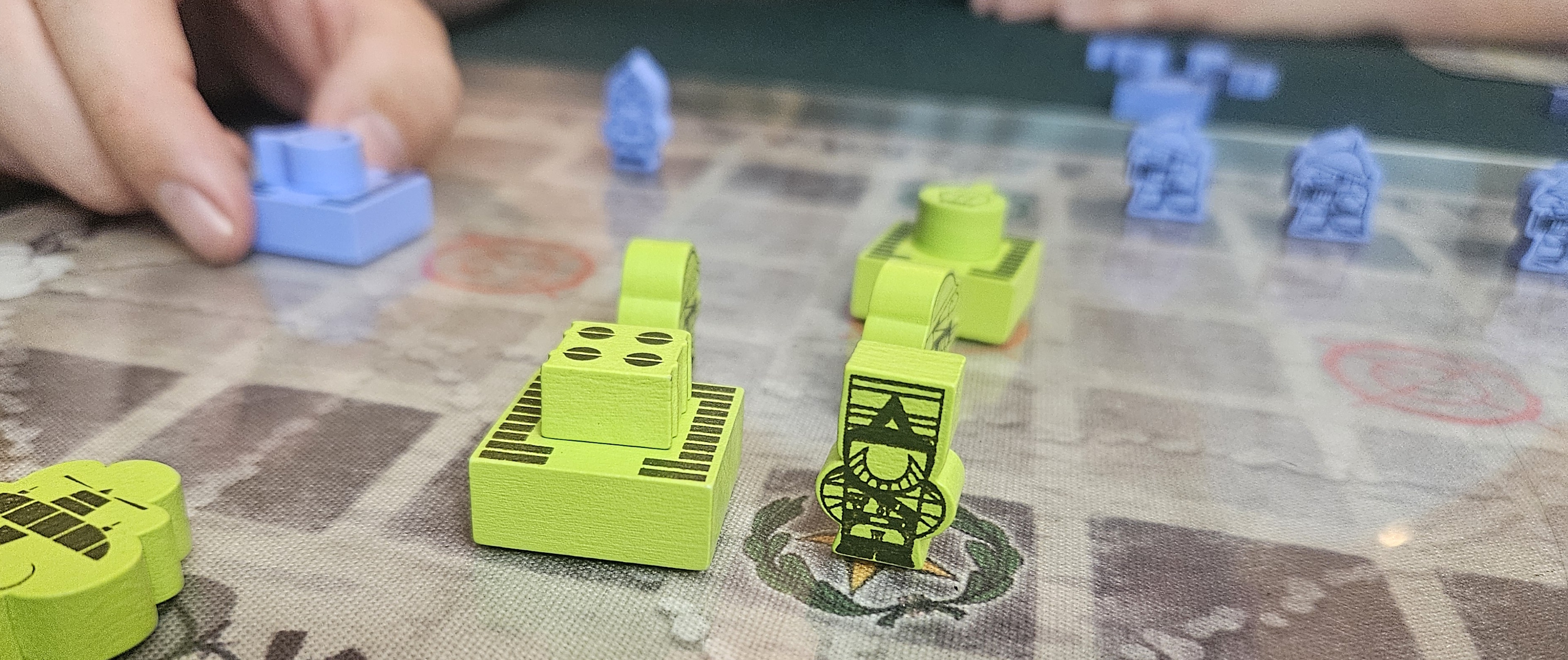
The shared iconography makes evaluating objectives a snap.
In other words, these aren’t exactly the fine-tuned interactions of Root or Vast. Or, crud, even the more Euro-tinted interactions of something like Crescent Moon. Players are mostly left to noodle in their respective corners, gathering the workers, resources, and cards they need to succeed. Then, either once or twice per session, they’re invited to poke their rival, only to retreat back to their personal workshop for the remainder of the duration.
This isn’t bad so much as uninteresting. In a vacuum, there’s nothing wrong with multiplayer solitaire. The problem, rather, is that everything about Duel of Meloch, from its setting to that promissory tagline, scream out for greater friction. The game itself is a collision. Of systems. Of outlooks. Of occupants trapped in an alien entity’s playpen. But for a collision, there’s very little in the way of combustion or shattered glass. It feels like something is missing, an undelivered invitation to actually look up from your private tableau to see what your opponent is up to. Flashpoints on the map. King of the hill. A reason to drive the Scythian away from the upgrade-bestowing city or prevent the Explorer’s access to those corruption tokens. Anything.
Instead, what Duel of Meloch offers is a buttery smooth merger that doesn’t seem to know what to do with itself. It’s bad practice for a reviewer to theorize about what could have been, but some part of me yearns to see Duel of Meloch as a more ambitious experience. Why limit ourselves to two players? Why not two per side, one Scythian and one Explorer, the first for building and defending our base, while the other roves into contested territory and sabotages rival efforts? Such a game would be different than this one… but not as different as it would have sounded before I actually played Duel of Meloch. Such is the expert craftsmanship behind these systems and their combination.

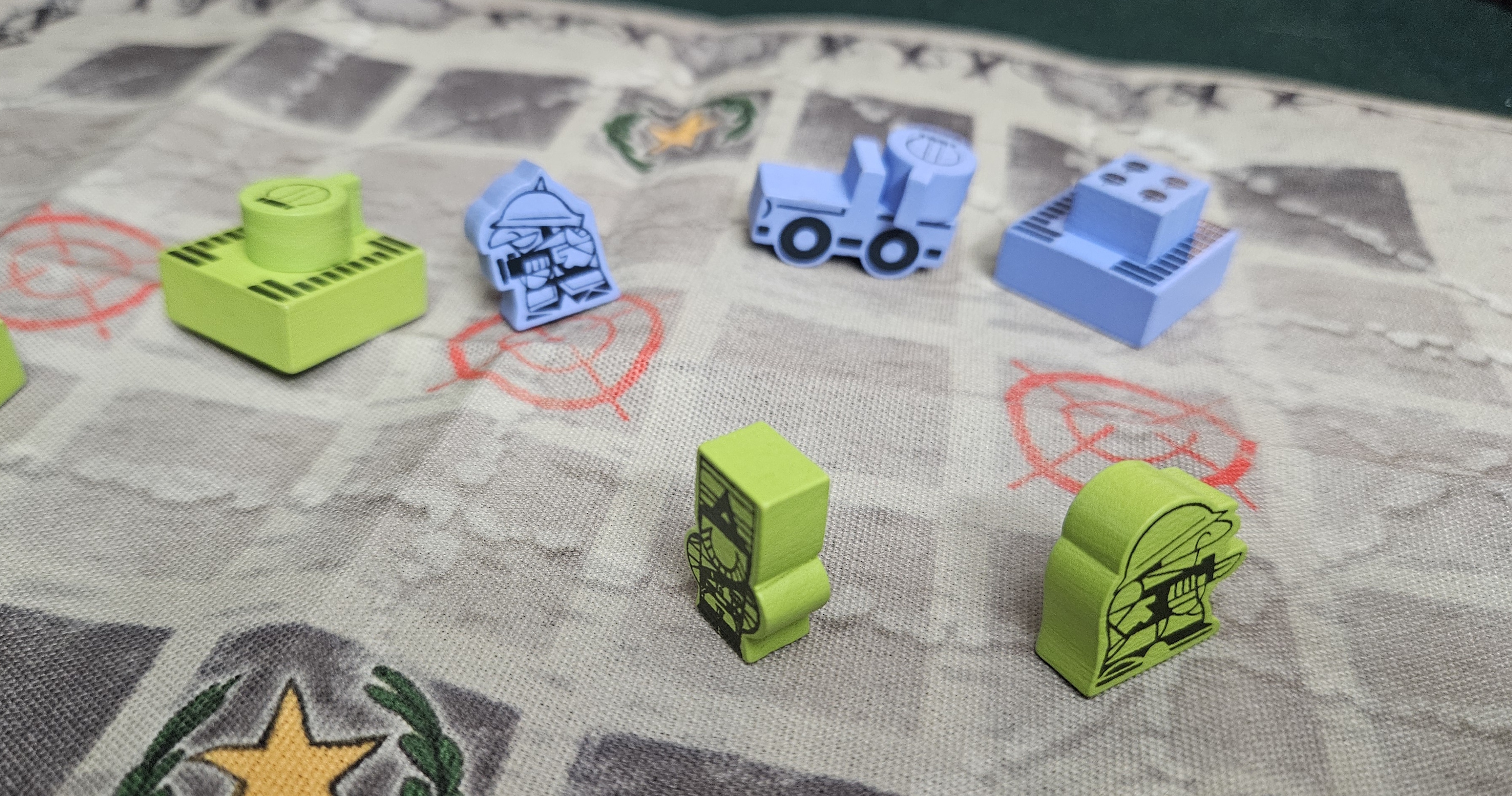
The explorer is… exploring, one supposes.
As it stands, Duel of Meloch is a fine piece of engineering. But it’s like a windup car without a racetrack to hurtle itself along. The parts are there. The motor winds with such a satisfying tick and whines so beautifully when the knob is released. It hurtles forward with such enthusiasm. But this is one mech that could have been soaring loops instead of walking in circles.
So, for now, it remains a curiosity. Perhaps there’s some value to the game as an expansion, especially for the Scythe/Expeditions devout. For the rest of us, Duel of Meloch stands more as a monument to its designer’s cleverness than as a plaything worth exploring on its own merits.
A complimentary copy of Duel of Meloch was provided by the designer/publisher.
(If what I’m doing at Space-Biff! is valuable to you in some way, please consider dropping by my Patreon campaign or Ko-fi. Right now, supporters can read the next installment in my series Talking About Games, this time tackling the topic of what makes a good list! Naturally, the piece includes a list.)