 Anmelden
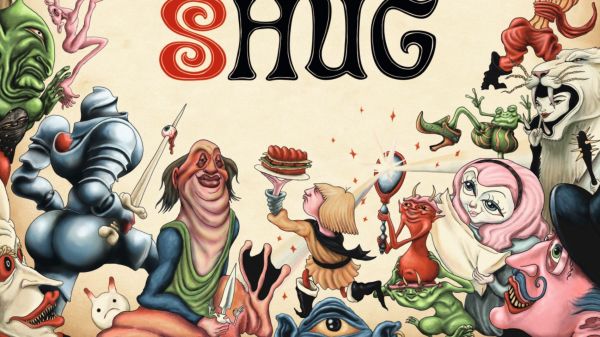


SHUG Preview: A Chaotic Quest with a Unique Style
02. Juni 2026 um 18:31

Embark on a chaotic and unusual quest to befriend monsters and find the elusive Shug! Or maybe just kill a king.

Embark on a chaotic and unusual quest to befriend monsters and find the elusive Shug! Or maybe just kill a king.
My win rate is up slightly, probably due more to a balance patch than any mindfulness on my part.
Remember, the four fundamental questions you should be asking yourself are:
This article deals with the last question. “Scaling, or ‘Why Furnace is a desperation pick.'”
(Many of the examples/explanations below are simplified and not dealing with corner cases.)
I won my low ascension Regent runs grabbing Furnace, a power that gives 4 Forge1 a turn. It seemed comparable to Noxious Fumes, a power that adds 2 poison a turn. But that was shallow thinking, and at higher ascensions it failed hard. It took me a while to unpack why, but there are multiple reasons.
The first is that Noxious Fumes is “Play and Forget.” It does 2 damage, then, 3, 4, 5, 6 etc2. With Forge you also have to play the Sovereign Blade to do any damage. Your sword will be worth 14, 18, 22, etc … but attacking with it costs two mana per attack; then you have to wait and get it back, which also means one less other card in your deck. It costs time and card draw.
Noxious Fumes is active from next turn it’s played … doing damage each turn (but starting smaller). Furnace enbiggens your sword, damage requires further costs. I’ll talk more about Forge below, but the point is that Furnace is passive scaling … If you got a second Noxious Fumes, your numbers and damage would go up, but a second Furnace just makes your potential damage go up.
I don’t love this passive/active terminology, perhaps Poison is “complete” and Forge is Incremental? Or “Potential” vs “Kinetic” is best? Kinetic scaling does actual damage. Potential Scaling might do damage down the line.
But that’s not the only issue
Consider Inflame. +2 Strength, once. All attacks do (at least) two more3. It’s a perfectly find card, and may help through early elites and bosses. In theory its potential scaling, but in practice it activates pretty fast. Ironclad is usually playing attacks, so boom. Three attacks a turn (say), means six extra damage a turn. That’s OK. But it doesn’t grow. Noxious Fumes starts off small but gets bigger over time.
But if you double something, it gets bigger much faster. Voltaic channels a lightning Orb for every Lightning Orb already channeled. Play it 5 times (even without any other lightning) and you channel 1,2,4,8,16. A geometric progression. If you have even another orb or two played each time through the deck (like Zap) the number can get ridiculous fast (depending on card order). Voltaic can cause 500 damage on it’s own. Inflame requires 250 attacks. A linear progression. If you added a second inflame your deck would be more reliable. A second voltaic would be a grotesque win.
(Again, I don’t love the terms; perhaps “Additive vs Multiplicative” scaling might be better).
Any card that doubles (or halves) deserves a close look. Colossus blocks, but also halves the damage vulnerable opponents inflict.
There are some other types of geometric scaling built into the game:
Putting it all together, I was treating Furnace like a scaling card, but it’s the worst kind of scaling — linear (+4 to the swords damage …), and potential ( … when you play the sword). Its much closer to Inflame than Noxious Fumes. It has a place, but that place is providing a bit of extra damage when you are low, against not-particularly fast opponents. It absolutely can make the difference in the Act I boss fight … linear scaling is usually enough.
It just won’t win the game, and the opportunity cost of having it take up a valuable card draw (and mana if you play it) may outweigh that in many fights. And often the damage output it does provide is completely inferior to many other options.
Compare Furnace to Wrought in War4. If you play Furnace, next turn you can play your sword for 14. If you play Wrought in War, you can play your sword this turn for 17, plus the 7 you already did. WiW converts 3 mana into 24 damage, a respectable first damage card. That’s its role, with a smidge of linear scaling each further time through the deck. Now granted, if you play Furnace and wait 5 turns, you’ll do more damage, but that’s an eternity in a hallway fight (unless you can consistently block for huge numbers each turn). If you play The Smith (“Forge 30”) and then your sword, you do 40 damage now (for 3 mana and some stars).
The Big Number is much better than scaling in almost all fights. But … you can make The Smith multiplicative by playing it via Decisions Decisions, which plays a skill three times. Now on the turn you play them, your sword hits for a hundred, which would take Furnace 23 turns! (Or you can play it each time it comes through the deck, and if you play your sword each time, it’s a bit multiplicative).
Yes, those cards require a star economy, and are rare, etc. But the point is that the numbers matter, not just the type of growth.
So I’m not particularly happy to take Furnace. It’s a “I need more damage and haven’t seen great cards” pick. But I’m pleased to grab a Prep Time (“4 Vigor at the start of your turn”) as Regent. Why? Because Vigor can be multiplicative; Regent has lots of targets for multiplication. If you sit and block, you can get 8, 12 or more vigor built up; Build up stars, a card like Stardust (which is an X cost attack, but X is stars, not mana) or Heavenly Drill can quickly grow. Furnace is +4 damage a turn, but even a moderate growth in star economy can turn each point of vigor into 10 or 20 hits, and both numbers can grow each turn …. Geometric, not linear.
You can totally win a Regent run by playing only a single attack. Play two powers Prep Time (+4 Vigor a turn) and Genesis (+2 stars a turn), through out block, and wait for a Stardust to do something like 5 (base damage) + 12 (3 turns vigor) times 20 (stars). As a bonus, you can enchant it to do double damage (or +8 vigor first time played). Prep Time gives you a corner stone you can latch onto; and with a few more pieces (and a lot of block) you have your scaling.
Furnace comes nowhere close.
But Forging can. Summon Forth forges 8 (a reasonable number) …. and puts the sword back in your hand. If your deck was only Summon Forths, you could attack in the following pattern. 18, 26, 34, 42. You gain damage faster and play it more often. Not quite geometric, but much faster linear damage. If you play the Parry power (or two), you now suddenly get damage and block each time you play your sovereign blade. You aren’t multiplying damage exactly, but you are doing two important things (damage and block) each time you play your sword.
Bulwark is a perfectly fine “Block 13 for 2 mana” card … that also forges (10!). I grab it as an early block card, but the damage boost is nice.
The point: Don’t grab a Furnace; get a scaling engine via the following path (or something similar):
Each card answers at least one question other than scaling in the first few steps, attack or block. The initial forge on the cards isnt’t the focus of the card, but a “Yes, and …” The forge provides a path for scaling that comes later. (Similar to how an early silent poison may be meant to handle the first boss, but can also provide the entry way for further scaling).
I’m attacking and blocking; a card or two big enough to handle early hallway fights (or mid-game hallway minions) while incidentally building a linear scaling engine via Forge. Then I’ll only need a card or two (hopefully) to make that a geometric engine … or a big enough linear engine to compensate. Furnace doesn’t do any of that.
Now, I’m not saying Furnace is pointless. If I’ve only seen block cards (or am worried about Lagavulin Matriarch, or know I’ll need to scale while paying for Soul Fysh’s beckons), I might pick a Furnace … as a specific use for a fight. Not for scaling. Sometimes you just don’t get great choices and have to make do … but having taken a Furnace I now now that there might be some synergy with more Forge cards … if they appear.
Writing these as I think I have things interesting to say … so part III whenever.
Update — I realized that the above questions are also missing “How can I make my deck set up faster?” (Sometimes also called ‘Velocity’) and I need to ask that question more often to myself.
︎︎︎︎︎
The post Sprout, a Game about Keeping Houseplants Alive appeared first on Graphic Policy.
Sprout is a cozy, yet thrilling push-your-luck strategy game for 2-5 plant parents
Hi, it’s Joe Slack here. Oliver was kind enough to allow me to write another guest blog. In this article, I thought it would be interesting to discuss board games for two and the gaming experience for two people (especially couples).
The post Tabletop Games for 2 Players (Especially Couples) (Topic Discussion) appeared first on Tabletop Games Blog.
Trust no one – except your Legendary Encounters: The X-Files Deck Building Game rules summary!
My friend Dylan enjoys the Legendary Encounters games, and a while back created this summary for me for The X-Files version (after previously creating the Aliens one). After sitting in my ‘to do’ pile for far too long, I gave it an editing pass and the layout treatment and here it is!
In this incarnation, players play through three seasons of the iconic TV show, working together generate leads and uncover evidence in a bid to defeat enemies and conspiracies. I can’t imagine the amount of work it took to make a coherent game out of a couple of hundred episodes (the game covers the first 9 seasons), but according to reviews, the game is very thematic and replayable, and particularly popular with solo gamers. Enjoy!
By Kaysee
Cooperative card and board games are the kind of card and board games I like to play with my partner. I enjoy working through puzzles together with him and discussing strategies to beat a game. Even when there are communication limits, winning as a team feels satisfying. The immersive feel of some co‑op card and board games (much like a GMless RPG, but with tokens, a more structured storyline, and less dice rolling) keeps us wanting more. Still, after trying many co‑op card and board games, I realized we live in a bubble, in Germany, where there is a huge variety of board games, so co‑op titles are easy to find not only in game stores but also in bookstores and some discount supermarkets. Abroad, however, we often struggle to find them in random bookstores even when other board games are available.
Co‑op board games are games in which two or more players do not compete against each other; instead, they work together to achieve a common objective or reach the same final goal. Co‑op games are less common than competitive ones; only 12.74% of the board games listed on BGG are co‑op[1]. One could wonder why there are so many fewer of them compared with competitive games.
Co-op in board games seems to be a fairly new mechanic. If you ask someone who doesn’t play board games what they know about board games in general, chances are they would imagine and describe a game where two or more players are competing against each other. And if you tell them that there are board games where players don’t compete, they would react as if it was something really new. Even I thought that co-op is a new thing as I associated co-op games with Pandemic[2], which was only released in 2008. Yet there were co-op board games that were released even before that. Reiner Knizia’s The Lord of the Rings, a co-op game released in 2000, is one of the games that influenced Pandemic[3]. And even earlier than that, Wikipedia[4] claims that The Landlord’s Game by Elizabeth Magie, patented in 1903[5], can be played in co-op mode. But after reading the rulebook[6], I don’t think it can be played co-op in the non-monopoly mode. It’s still much more interesting mechanically and thematically than Monopoly though.
In the 70s some co-op games were developed by a company in Canada called Family Pastimes. They only produced co-op games, as the founders claim that children can gain sociological benefits for playing co-op games[7]. Even though they said that they received orders from countries outside Canada and some interests from teachers and the United Nations[8], the company is still small and doesn’t have a scope as wide as Parker Brothers. Family Pastimes to this day is still a relatively small company. Even in Germany the first game that won Spiel des Jahres was a competitive one. The earliest year where a co-op game became popular was in 1981, when Sherlock Holmes Consulting Detective was released, which was also the first co-op game that won the SdJ in 1985[9]. The thing about this game is that it has some similarities to the tabletop RPG Call of Cthulhu. It’s possible that its popularity has something to do with the fascination for TTRPGs such as Dungeons & Dragons at that time, which are typically co-op, and not about wanting to play co-op games in general. Much like how co-op video games such as MMOs, many of which were influenced by D&D[10], are more widespread and popular than co-op board games.
What I view as the scarcity of co-op board games today may be attributed to the long culture of competitive board games worldwide. Unlike video games, war games and other board games such as chess, Go, and shogi have been existing for hundreds of years. They were invented during times where people were more likely to compete for resources to survive or use them to practice for war. They are still very popular to this day, not just because they are fun to play (I find them fun to play I admit), but also because there are pro tournaments[11], which further increase their popularity. Not to mention, wargames have been widely popular for decades (moreso in the US than in Europe after the wars)[12]. On top of that, the mass production of Monopoly and having a version of Monoply of every IP that I could probably think of might have fortified the idea that board games can only be played competitively. The long tradition and nostalgia[13], mass production, and marketing of competitive board games also resulted to having a huge demand for competitive board games[14]. Given how competitive games are more widespread, it wouldn’t surprise me if many people believe that the default mechanic for a board game is competitive and that many of those who play board games are more used to playing competitive board games so much so that changing how they play board games could be a challenge in and of itself.
There’s something about having those shared moments whenever my partner and I play co-op games regardless of the result of the game. But I noticed that playing co-op games can be a bit more intimate than competitive games; it may involve trusting other players in your group, having confidence in them and hope that they could equally trust you with your decisions without adding pressure to them and to yourself, and making sure that it is a safe space to lose and that it’s fine if your group were not able to beat the game.
Playing co-op games involves cooperation- a certain mindset. Not being used to having a specific mindset when playing co-op games may lead to some undesirable outcome in a gaming session. Playing co-op games does not necessarilly eliminate possible social conflicts within a group. This can be seen from the reports of players experiencing quarterbacking (or alpha gaming[15]). The conflict that players might have in co-op games is different from the type of conflict that players have in competitive games; it’s much more personal and undesirable in the former whereas in the latter the conflict is just part of the game and may be desired and agreed upon[16]. Staying inside the gaming space[17], the space where one steps in and agrees with all the rules that are within it, is one thing but behaving in such a way that wasn’t agreed upon by others is another.
Playing co-op board games seems to require so much of players, but one very fascinating thing I noticed is that playing co-op games has lead some groups to have their own systems to prevent alpha gaming which involves learning how to respect others and giving chance for others to express what they think[18]. I don’t know if getting used to doing this will extend outside board gaming, but I still think it’s a good thing to be able to come up with creative ways of preventing conflicts and exercising a form of respect that is different from the form of respect practiced when playing competitive games[19].
But it also doesn’t mean that people who aren’t used to cooperating when playing co-op board games are incapable of cooperating outside of playing co-op board games. There is also a sense of cooperation that is present in some competitive board games, but this is dependent on the mechanism of the board game and is still different from the type of cooperation that is possible or expected in a co-op board game[20].
Playing co-op board games also allows players to have more fun experiences even in sessions where they didn’t win[21]. While there can still be shared experiences when playing competitive games, the feeling of losing and winning is not shared. With co-op games, especially the narrative ones, losing doesn’t feel as bad since the experience is shared. One example is when my partner and I played Fate of the Fellowship; even if the result didn’t feel so rewarding, we still had fun during the game. We also had fun in some games where we lost. Having that shared experiences, which include joint decision-making and imagining some scenarios together, are for me some of the many things why I love co-op games so much.
While co-op games are still not as widespread as competitive games, co-op games are gaining more recognition and it seems that the demand for them is also increasing. Co-op games such as Gloomhaven and Spirit Island are some of the highly rated games on BGG. The most recent Spiel des Jahres and Kennerspiel des Jahres games are co-op[22]. That said, I don’t think that it will replace competitive games in terms of popularity any time soon. And I also don’t think that noone should play competitive games or that they shouldn’t exist anymore[23], but playing co-op games exposes people to a different type of bonding experience where losing and winning are shared, where the metagame and the social interaction, the form of respect, are different from what one experiences and exercises in a competitive game. And maybe some day when the general public think of board games, they wouldn’t just think of competitive games but games that could be enjoyed by a group of people (or a single person) without having to compete against each other.
[1] This is based on the number of board games categorized as cooperative out of all the board games listed on BoardGameGeek on 18.05.2026. It is even less than that as I noticed that some of the games on the list were wrongly categorized as co-op.
[2] Matt Leacock’s Pandemic (2008)
[3] On his blog post, Matt Leacock mentions that Pandemic was influenced by Reiner Knizia’s The Lord of the Rings.
[4] See Wikipedia – Cooperative board game
[5] There’s an article and a book written by Mary Pilon that provide more details.
[6] See Landlords Game Rules
[7] In this interview with Jim Deacove, one of the founders of Family Pastimes, they also claim that they were contacted by the United Nations, psychiatrists and teachers regarding the possible effects of playing co-op games. Whether a cooperative board game can improve children’s social behavior incomparison to competitive games is still debatable based on the article The behavioral effects of cooperative and competitive board games in preschoolers by Malin Eriksson, Ben Keward, Leo Poom, and Stenberg (2021).
[8] See this interview in 1978
[9] Spiel des Jahres winner in 1985
[10] See The Board Game As a Narrative by Pawel Bornstedt (2024).
[11] There’s the Fide World Championship and a long list of chess tournaments worlwide. There’s also a huge shogi tournament in Japan called Osho.
[12] See Pawel Bornstedt (2024)
[13] In Nostalgic bonding: exploring the role of nostalgia in the consumption experience by Holbrook and Shindler (2006) discuss the effect of nostalgia in terms of consumer behavior.
[14] Market.us report says that the demand for board games is increasing, but the industry is still lead by companies that produce Monopoly and other traditional board games.
[15] See Roleplaying as a Solution to the Quarterbacking Problem of Cooperative and Educational Games by Josh Aaron Miller (2021)
[16]This isn’t to say that social conflict doesn’t happen in competitive games. It does happen especially for some players who have difficulties accepting defeat.
[17] I don’t believe that we can all be completely in what is called a Magic Circle, where we have a certain way of thinking and behave in a certain way that is allowed in the game world and is completely untouched by the real or actual world. It is a term coined by Huizinga, Johan (1938) in his book Homo Ludens: a Study of the Play-Element in Culture. I believe that there’s an aspect of us that affects the game world and vice versa.
[18] Reddit may not always be the best source of information, but some Redditors on r/boardgames have shared some interesting solutions to prevent alpha gaming in a respectful way without resorting to conflict.
[19] Respect that players give to their opponents in a competitive game (e.g. accepting defeat) is different from the type of respect that players give to each other in a co-op board game setting.
[20] See Cooperating to Compete: the Mutuality of Cooperation and Competition in Boardgame Play by Melissa J. Rogerson, Martin R. Gibbs, and Wally Smith (2018)
[21] See The Allure of Struggle and Failure in Cooperative Board Games by Douglas Maynard and Joanna Herron (2016)
[22] Spiel des Jahres’ Game Archive
[23] See Melissa J. Rogerson, Martin R. Gibbs, Wally Smith (2018)
Many thanks to Max for proofreading.
Photos by Kaysee
The post What co-op? Why co-op? appeared first on Schmeeples.


