A (incomplete) list of the mistakes me and my (expert) partner made today
Indefensible — Missed that I could be squeezed out of my ace1. Missed a suit count signal, so missed given a ruff . Didn’t fake a jump shift2 and instead only shows an invitational hand, missing a game. Forgot to hold up an ace at a suit contract (for communication reasons).
Defensible — We’d agreed to play “Equal Level Conversion” (ELC)3, but did not discuss if it applied after advancers jump or at the three level which left us both guessing on an auction. We used to play inverted minors, but no longer do, and I couldn’t remember which was which. Accidentally grabbed a low card instead of an honor and gave up a trick. A debatable line in an awkward contract and a few very close bidding decisions that didn’t work.
Bad Luck — Partner twice made the technically correct play when the naive/simple one scores better. (Amusingly, on the second one I was paying attention as dummy and correctly diagnosed why she was doing it at the time).
Anyway, given our relatively small number of mistakes/bad luck, we won (although only by 0.5 Matchpoints).
I did actually consider cashing out, but thought it was squeeze proof, missing a key suit combination. Fortunately, declarer also missed it. ︎
By jumping into a 3 card minor … with a non expert partner, I get raised or dropped too often. But an expert knows sometimes you have to do that and will never pass and rarely raise. ︎
A takeout doubler may convert clubs to diamonds without promising extras, just showing that it was actually a two suited double, not three suited. ︎
For today’s Space-Cast!, we’re revisiting some jerk’s nasty review from five years ago, investigating some excellent indie games, and discussing the ups and downs (but mostly ups) of self-publishing. Our guide for this journey is none other than Connor Wake, creator of Umbra Via, Out of Sorts, That’s the Spirit!, and many others.
Listen here or download here. Timestamps can be found after the jump.
TIMESTAMPS
1:05 — a reckoning with Umbra Via
28:49 — persisting through Hedged In and Hedge Mage
37:09 — Out of Sorts
58:16 — That’s the Spirit!
1:10:20 — self-publishing
(If what I’m doing at Space-Biff! is valuable to you in some way, please consider dropping by my Patreon campaign or Ko-fi. Right now, supporters can read the next installment in my series Talking About Games, this time tackling the topic of what makes a good list! Naturally, the piece includes a list.)
Witch Hunt 1649 is a bit of an unusual subject for Meeple Mountain. It is more of an educational game than anything else, which makes sense coming from Central Michigan University Press. This is not a game most are going to sit down and play with their families, nor is it likely to come up at a hobbyist night. Like Dan Bullock’s The Gods Will Have Blood, Witch Hunt 1649 is more concerned with creating a specific and rich emotion than it is with creating opportunities for decision making or laughs.
Martha McGill’s design is set during an outbreak of witchcraft accusations that plagued Scotland in the mid 17th century. Each player is a member of the community, and on every turn, some variety of misfortune befalls you. Your life is unpleasant, difficult, and neither McGill nor the event deck wants you to forget it. Even when things go well, they don’t. Your livestock have fared unusually well during a recent disease outbreak? Congratulations, people now suspect you of witchcraft. This is a game in which a lucky turn is one where it’s raining out and you decide to stay home.
For those of you who read our Gen Con articles (Most Anticipated Games and Recap), you’ll notice that Camp Grizzly: 2nd Edition was my most anticipated game and it was also my pick of the convention. I picked up a copy of it at the con, and I think I must have played it 4-5 […]
Blancat Designer: Nutgoo Lee Publisher: Korea Board Games Players: 2-4 Age: 8+ Time: 20 minutes Played with review copy provided by publisher You’ve made new blankets for your cats, but they want their old ones back! Remake the original patterns … Continue reading →
Shady Lady is yet another game by Kaya Miyano I have played this year. This is a very Japanese style game - minimalistic but clever. It has a juicy element of trying to read your opponents and sometimes cunningly misleading them. You have a hand of three cards. There are only two types of sets in this game, three cards of the same value, or three cards in sequence. Cards are numbered 1 to 4,
So … after exploring the contracts it is time to try the “full” module 4. Since I want to get into the weeds, this is going to use the 4G4 victory conditions, requiring the launch of a desperation starshot (or a ton of fuel for a regular one). I seriously doubt I’ll get even a marginal victory, but let’s see.
Setup — I (randomly) get green and decide to use one of the promo ground crew. I pick Heloicentricity, which has the power that (if the crew is present) the rocket can use a 2nd movement, but coasting only. Subtle but powerful (an opponent had it in our game last weekend). Particularly if you have to go through a Hohmann intersection you can burn, stop, then coast … for a free ballerina (at the end of a turn).
Fig 1 — Initial Patents (Spaceborn and exodus not shown)
T1.1 — These patents … exist. There’s a De Laval Nozzle and matching reactor that gives a 7-thrust/4-fuel consumption 1-Mass rocket. Great thrust, bad fuel consumption. There’s also the “Holmes” contract with a pretty decent payout …. but getting there would be five burns. That’s …. break-even ish, but then my rocket is out of the way. A robonaut with thruster is always a fine start, but the supports don’t line up. I fundraise (putting the delegate in Authority, so I can lobby to cancel an event) and make Subsidized Research the law (which I called Research Grants in my last game’s post). I don’t take a contract1 (10Aq).
T1.2 — There is an inspiration event …. do I want to allow it? Yes. None of the prior patents are inspiring confidence. This also cycles all three contracts, and I might get a solar sail. Also, I don’t want to lobby right now, in case I have to cancel a budget cut (or something as bad) later on.
Fig 2 — New and Improved!
I get lucky. I take the Monatomic Plug Nozzle (thruster) and Rubbia Thin Film Fission Hohlraum (reactor). Between the two of them I’ve got a 4 Thrust, 1.5 Fuel Consumption 1Mass rocket. Yes, it needs a radiator, but I could just afterburn each turn. I take them (revealing the Photon Kite Sail and Lyman Alpha reactor). And as for the contracts…
T1.3 — I fundraise (11 Aq) and place the delegate and law in Unity to take the Solar Observation contract (26 Aq). The clock marker goes on 1.9 and I have to get to Icarus.
But I already have enough rocket to get there; the advance covers costs nicely.
Figure 3 — To Icarus!
T1.4 — Budget cuts, but I lobby (for free, since the law is Unity) and change it to inspiration. I boost my rocket and contract payload (23 Aqua). I need 11 Fuel Tanks (leaving 12 Aq). Actually that might be a touch short for the return trip, but I can reboost the rocket and leave the crew near LEO if necessary. And well …. I’m not planning on paying for FINAO on the way back … The rocket (which has to afterburn) goes from the cycler to L1 to L45s to the Hohman..
T1.5 — I fundraise Authority (so I can cancel the next bad event) (13 Aqua) but switch Subsidized Research as the active law. The rocket afterburns again and goes four burns2 towards Icarus.
T1.6 — (Glitch, no effect). The Rocket has to wait for the red season (Icarus is synodic) and I take the Phase Locked Diode Laser (3-Raygun Robonaut, “C” Spectral, 1 mass, 3 Rad-Hard, Requires “e” generator) and the AMTEC Thermoelectric generator (Both “e” and “pulse,” 1M, 3 Rad Hard, “C” Spectral, requires wave reactor and a therm).
T1.7 — I afterburn (for the therm), pay FINAO (9 Aq) to deal with the rapid spin, and land on Icarus. Contract fulfilled, Glory Chit claimed, I turned a 3 Aq profit, plus I get the Shielded benefit (-2 on all flare/CME rolls). Mission control says “Backslaps for everyone!” Back home, I take the Rankin MHD (“e”, 0M, 4RH, Wave/Bomb + 2 Therms Required, “M”) mainly because I want the Mo/Li Heat Pump Radiator. For my next mission I’ll want a bit more efficiency, and the 1M/2R-H for two therms is much more acceptable now that I’m shielded.
Fig 4 — Mission Accomplished!
T1.8 — (Glitch, no effect). Failure is now an option when leaving Icarus … and there are no backslaps as the die shows a ‘1’. Mission control pauses for a somber moment before quietly shifting that glory chit back to the mat. My hand is now full, so an unscheduled boost takes the rocket, robonaut and AMTEC generator (4 mass, so 5Aq left) to LEO.
Figure 5 — Ooops
T1.9— Take the Froth Flotation refinery (3M, 5R-H, “D”, requires “e” generator) and the Photon Tether Rectenna generator (“e”, 2M, 2R-H, “V”, modifies thrust).
T1.10 — (Solar flare, but no rocket). Now that I’ve got a robonaut and refinery, it’s time to glance at the contracts … and yup, “Hubris” fits the bill. My next trip is to (say it together) Hertha, which has an unclaimed Glory Chit. So … I fundraise (6Aq) into individuality and make that the law, take the Hubris contract and it’s 8 Aqua advance (14 Aq), set the clock at 2.5.
Boosting is now a free action, so I send up the refinery and Hubris (6 Mass, so 8 Aq left) and add 5 FTs (3Aq) and go to the cycler (using 2FT, leaving 3FT for next turn). With my shielding I’ll be fine … once the season changes. No hurry.
Fig 6 — To Hertha!
T1.11 — With a thrust of 2 and -2 shielding, even a dr of six means my 2 rad-hard stuff is fine, so I can go to the purple pivot and then coast to the next pivot with my crew thruster (using the faction privilege), this finishes my fuel. I sell the Photon Tether but apparently forgot to take the money, so I’m at 3 Aq3!
T1.12 — (Inspiration). Land on Hertha, (fulfilling the contract, getting me Bailouts), Get the Ceres glory and (say it together) Bust Hertha. (I mean, I expect to bust it when I have a buggy. Asking a raygun to find water on the first try is a big ask).
End of Cycle Thoughts — I have 7 VP, two fulfilled contracts with nice abilities, and a rocket that’s heavy but fuel efficient. I think my best bet is Hygiea (as in last game), as both my robonaut and generator are spectral class “C” so if/when I get that I can at least save a bunch of boost cost (since I don’t need the generator to fly). But with a 3 ISRU I won’t be able to luck into Frederika (etc) as well.
T2.1 — Site refuel on Hertha and fly (via Jupiter-Sol L1) to the Hohmann near Hygiea and (just because I can) coast to the Barycenter.
T2.2 — (Pad Explosion, N/A) — Mission control holds their breath as the die spins and lands on ‘5’. Claim it quickly before anyone questions it.
T2.3 — Land on Hygiea and industrialize (and colonize)4.
T2.4 — (Inspiration) Sell the Rankine MHD (6 Aq) …. and notice that a good contract has arrived.
T2.5 — Fundraise (7Aq ), make Unity the law so that I can take the Hexapod Explorer contract (go to a size 2+ unexplored site). I’ll just stop at one on my way to Hygiea. (15 Aqua, timer at 2.10).
T2.6 — (Inspiration) Boost (as an operation) and fuel, leaving 4 Aq and head to Hygiae (with bonus coast get to the pivot just outside).
T2.7 — ET Produce my robonaut (now the Lorentz-Propelled Microprobe, 0M, 3-ISRU Raygun, 3R-H with one re-roll per prospecting op) at Hygiea. The rocket lands at Frederika, which fulfills the contract. That’s another 2VP and I get the insight ability (before researching, I can move one card from the top of a stack to the bottom).
T2.8 — (Inspiration, again). The rocket goes to Hygiea and I ET produce the JTEC H2 Thermoelectric generator (1M, 4RH, counts as both types, solar modifier). Attach the parts to the rocket.
T2.9 — Site refuel and it’s off towards the Jovian Trojans!
Fig 7 — Onward!
T2.10 — The rocket is moving and I fundraise and switch back to Subsidized research. (5 Aq)
T2.11 — The rocket is still moving and I decide to grab a patent or two. Before choosing I insight the top card off the Freighter deck and get the Rotary Dirt Launcher. It’s an Any/C, which is good enough for me. I take it. (I can’t promote it yet, because I don’t have any augmented colonists … but I’ve got some parts, I just haven’t tracked them yet. Need a colonist…)
T2.12 — Anarchy is here and I lose a delegate in Unity. I prospect Achilles and bust. But ha! I get a re-roll. Bust.
T3.1 — I zip over to Hektor and the Skamandrios Moonlet (well, adjacent. You can raygun prospect through Hazards). I decide to prospect both … which costs me a re-roll. I fail both … and the re-roll? Fail again.
T3.2 — More Anarchy (nobody this time) and now it’s Icarion’s turn … bust and bust again. Granted these aren’t huge sites, but I’ve now failed rolls needing 3/2/2/3/3/1/1/1. That’s a lot of failed rolls. My only success was barely finding water on Hygiae, rolling a ‘5’.
Mission Control requests a pause so that they can (plan the next mission / shift the blame).
Figure 7 — A lot of nothin’
A New Day!
It’s a new day at Mission Control. I mean, out in space its the same day, no sunrise or sunset out in the Jovian Belt after another frustrating year. But the clock on the control board says it’s a new day and Mission Control has contemplated the future. We’d still like to find a “D” site, so we can have an ET Robonaut and Refinery (and not have to decomission our rocket), which narrows the prospects. But after contemplating the Jovians Trojans in the Trojan camp our eyes turn to the moons of Saturn.
Fig 8 — Hyperion!
Hyperion is four burns away and the rocket has exactly four burns worth of fuel. With the crew ability, some of the pivots can be passed in a single turn. Yes, there is a hazard, but we’ll look past that. In fact, the plan is practically set in stone when a Jr. Engineer points out that we have exactly four burns of fuel …. if we take them in pairs. That’s because we have six steps and a fuel consumption of 1.5. If we do the burns 2 & 2, that’s six. If we do them 1 and 3 that’s (due to rounding) 2 + 5 … 7 fuel tanks.
Mission Control — “Screw it, we’ll go to Comet Schwassmann-Wachmann 1.”
Everyone — “What ?”
Jr. Engineer — “But that’s smaller and hazardous … We could just pick up a bit more fuel on Icarion …”
Mission Control — “What part of ‘We’ll go to Comet Schwassmann-Wachmann 1‘ did you not understand?” (Glares as the Jr. Engineer scurries away).5
In good news, accounting also found the 3 Aq that “we” lost earlier, so now the mission has 8 Aq.
T3.3 — The rocket coasts towards CSW1 as I grab (via Subsidized research) our old friends the Collimator Bernal and H2-O2 Fuel Cell.
T3.4 — There are budget cuts, but not for us (thanks to our earlier contract). The rocket coasts a bit closer and I ET Produce the Rotary Dirt Launcher freighter at Hygiea … we don’t have the funds to set up the Bernal, so we’ll need to produce and sell … and the rocket is well out of place.
T3.5 — (Remotely) Prospect CSW1. Mission control awaits anxiously but finally there is Joy in Mudsville, as the roll is a ‘1’.
Figure 8 — Finally!
T3.6 — (Inspiration) FINAO the hazard to land (5Aq) and industrialize CSW1. The rocket and crew will be there a while. The new patents have nothing truly useful (like a ‘D’ patent) but I can wait, I’ve got other things to do…. the next few turns happen quickly, as finally there is a plan. Arguably I could have done this earlier, but the thought of decommissioning the generator prior to using for industrialization was sickening.
T3.7/3.8 — ET Produce the Lorentz-Propelled Microprobe and Microbial Fuel Cells on Hygiea and send them towards earth on the freighter. (There’s also a solar flare, but prior to launch).
T3.9/3.10 — I’ve got some spare operations while I wait for the freighter to make it to LEO, so …. ET Produce Femtochemicals and site-refuel at CSW1 as the Freighter keeps going…there is another inspiration, but still nothing that would help.
Fig 9 — The Rocket
T3.11 — Fundraise (6Aq) and switch the law to Freedom (so I can sell two items).
T3.12 — The freighter has passed through the Van Allen belt safely (dr=1) and so I sell both the ET produced items (22Aq).
T4.1 — Boost the Collimator Bernal and H2-02 (which is the white side of the just sold Microbial Fuel Cells) and provide six fuel tanks (2 Aq left!) and they (and the freighter) head to the cycler and rad belt.
T4.2 — (Pad Explosion, N/A) The Bernal (and freighter) go L4s and I anchor the Collimator Bernal as my Home Bernal (decommissioning the H2-O2 Fuel Cells).
Fig 10 — Bernal Time
This feels terribly late to get a Bernal … but in my last game I didn’t get my first home Bernal until T4.7. I’m disappointed because a decent roll in the Jovian Trojans would’ve sped this up a season, possibly two (and saved 4 Aq on hazards … with another 4 to come!). I’m going to need the Bernal income to get out of CSW1 safely …. also, I finally can exomigrate a colonist.
Stop and take pause.
For augmentations, I have a jar, triangle and battery augmentations available. Nothing terribly useful (but it requires two augmentations to promote my freighter, which is a huge jump in load limit). The top colonist is Malcom (who gets a bonus implant action6) … but I also have a BEO Colony; so I could exomigrate from the Spaceborn deck.
That top card is Nano-3D Printers …. so if I took that I’d get a robot I can’t build (since I don’t have an M factory) and a random spaceborn human, plus possibly a better robot (if the 2nd card is a robot). Is that likely to be better than Malcolm? I have no idea … do I need to high-roll so as to catch up? Possibly.
Fig 11 — Decisions, Decisions (That is the Bernal patent deck, not my Bernal)
Mission Control (so used to the feelings of hopelessness from the last decade) decides to pause and take stock ….
I should have cycled the deck that matches the law, just in case the new contract was something I’d want. ︎
A mistake. With weight it had a Net Thrust less than four. But as I paused anyway I could have gone 2 then 2, only spending one more FT for an extra afterburn… ︎
At least it’s nice to see that not all of my mistakes are in my favor. My notes went to a new piece of paper, which is why I didn’t notice until typing this up. ︎
As a relatively new M0 player (as compared to M12), I forgot that I can add a delegate to the crew’s faction when I colonize … so, I didn’t. ︎
As is usually the case, the Jr. Engineer was correct and management was wrong. In their defense, Management was on tilt and possibly drunk. ︎
We always try to make games that are easy to get to the table, but this is absurd: Just one month after customers started receiving copies of Wingspan Pocket, the game already has over 1,000 ratings on BoardGameGeek. People are getting the game and actually playing it right away–this is a publisher’s dream!
What makes Wingspan Pocket so immediately playable? Can these characteristics be replicated in other games? Here’s my take:
Context of Wingspan: I can’t overlook that a person’s knowledge of Wingspan makes it easier to play Wingspan Pocket. Similarly, it was easier for me to play Duel for Middle-earth the first time because I had already played 7 Wonders Duel. I think this asset extends beyond game brands to game mechanisms: If I’m drawn to a new deckbuilding game, I come to it with the experience of having played other deckbuilding games.
Fast initial setup and per-game setup: I don’t mind punching and sorting a new game, but it’s really nice when that process only takes a few minutes. With Wingspan Pocket, you literally just remove the paper bands that secure the decks of cards, and the game is ready to be played. The per-game setup takes another 2 minutes, which not only makes it easier to play the game for the first time, but also every other time.
Streamlined core rules with engine building: No matter how complex a game is, I love when the core action system can be described in a single sentence or infographic. In Wingspan Pocket, you activate bird powers from left to right, starting with the Nest action. That’s it–that’s your turn. A brilliant part of Elizabeth’s design is that you immediately have a sense of progress, because if you play a bird on your first turn, you also get to activate that bird.
Game length: Wingspan Pocket plays in around 30 minutes, making it easy to fit into a busy schedule. Most of our other games are longer–some significantly longer–which is right for those games, but it’s neat to see how quick-to-table a shorter game is.
Solo play: All of our games include Automa solo modes, so you can play them without having to schedule around other players. This removes a huge barrier to entry. Wingspan Pocket is playable from 1-5 players, so when you’re ready to share it with other players, there’s a higher-than-average player count cap.
Shared excitement: When I have the sense that many other people are playing a specific game, I’m excited to play it too. Perhaps it’s just the algorithm, but I’ve noticed a higher density of Instagram posts about Wingspan Pocket than other new games we’ve released in the past. Some of the above factors impact these posts, along with the beautiful bird art by Natalia and Ana–it’s a photogenic game.
Reference cards for each player: I believe that the #1 asset to making a game friendly to those who teach games is the inclusion of reference cards for each player. Wingspan Pocket’s reference card has the core gameplay, setup, and card anatomy on one side and icons on the other.
I’m so happy to see people playing Wingspan Pocket, and I’m looking to learn from this experience for our other games (including Wyrmspan Pocket, which Connie is actively working on).
What inspires you to play a game soon after adding it to your collection?
Much as inSlay the Spire (or Dominion) a strategy can be good or bad depending on the other cards in the pool. Here is where I am at after my 5th Full Counterstrike game.
In general — Production worlds have priority over military windfalls (beyond the first you often drop to trade on T1). Production worlds that earn a card while producing are the highest priority. +Military and +Xeno Military (and +Xeno Defense) can be nice to have, depending on how far you are into the invasion process. But a “repair during production” power is fine, particularly if you have a windfall/grey world that has a power you are OK with being intermittent.
The reason? Apart from the “Produce and ship goods to the war effort” points; in Counterstrike there are many worlds (often frontier) where you consume two goods for three points (or one good for two points) and you want to take advantage of those in the late game. A “consume x2” for 12 is a big deal in base Race. Here 20+ is easily in reach. 1
Because of that, early Frontier Settles are prioritizing purchase, not conquest. Obviously you have to take what you are offered, but still. I’m happy to go with 5 cards in hand, no matter my military rating … half the cards are playable now. (But two military drops the odds of a complete miss). BUT … I’m wary of this if I’ll be out of cards for multiple turns when I drop my hand. (Have goods ready to trade when you Frontier Settle … or that will earn some cards someone else trades. Or have a few spare cards).
As you move into the 2nd half and the automatic development phase in the 2nd half, you’d like to be able to either boost your strategy and/or shore your your military with a card you can play (while calling something else).
Murdering Xeno Homeworlds is nice, but you can earn plenty of points just going your own way and racking up points. 18 Points with Merchant Guild2 or the card that gets you 1/3rd of your consume chits, etc is also possible. Obviously if you have a huge military and enough temp military you can just go conquest, but it’s not mandatory. I’m not going to drop a small +3 Temp Military just so I can murder a Xeno next turn unless I have nothing better to do3 and one big conquest every other turn is only keeping pace with the consume x2 every other turn … and if that guy is produce 4-6 cards (via consume and produce) he’s probably leeching on your settles.
(The seven point award for “most homeworlds” is nice, but so is the seven points for “most consumption.”)
In my tableau last night: Good for 2VP, Alien+Novelty for 3, Genes+Novelty for 3, Rare for 1 + a card. Two goods for 2+2 Cards. ︎
Particularly the 2nd edition copy, which is 2/production and 1/good. ︎
Also, becuase you can only Frontier Settle/Conquest every other turn, it’s OK timing wise. ︎
At Gen Con this year, we met with Ravensburger to hear about what new games they were releasing at the show. To the surprise of none of us, they had a massive amount of new games to show off. While some of them are the larger titles you’d expect from them, a good amount were […]
Renegade Game Studios continues to fire on all cylinders to bring classic (mostly army/fantasy) boardgame titles back into print while pushing forward with some of their IP licensing. The classic worker placement Lords of Waterdeep is out along with its expansion, … Continue reading →
Very few games fall into a gray area for me, but Tales of the Arabian Nights does. It's easily one of the most random games I've played, and it often makes no sense at all. Still, it's given me some of my most memorable gaming moments, especially when my friends and I end up laughing at the absurd stories, like getting rewarded for beating up beggars.
With so many old games coming back after years out of print, it's not surprising that Tales of the Arabian Nights is returning with a 40th Anniversary Edition. It's a clear sign that we're all getting older.
A New Genie in Town
But this isn't just a basic reprint, a phrase that gets slapped on far too many of these revivals. Now there's a solo mode, some status cards have been changed or removed, and getting thrown in prison is no longer a death sentence. Many of the passages have been rewritten, though they still hold on to the harsh themes the original Arabian stories were built.
Even with the updates, the main gameplay is still about earning destiny and story points by exploring, finding encounters, and interacting with them. City cards give you some direction by offering bonuses if you visit them, and…
Bravery in the Sand is a 2-player game that covers the major part of the battle known as Operation Crusader in North Africa during World War II. Covering the period from November 20 to December 3, 1941, players assume the roles of the Axis and Commonwealth generals to determine who will be victorious in this battle. One player controls the Commonwealth force (British, South African, New Zealand, and Indian), and the other player the Axis force (German and Italian). Players activate formations via chit draw, and combat is of the roll-to-hit variety. Includes rules for battlefield recovery, replacements, fortifications, Rommel and more.
The Gang Deluxe Edition Designer: John Cooper and Kory Heath Publisher: Kosmos Players: 3-10 Age: 10+ Time: 20 minutes Played with review copy provided by publisher https://amzn.to/4gCclIb Round up your gang and get ready to pull off a … Continue reading →
I asked my artist Edwin to design a roll-up bunting for Pilgrim Poker.
I plan to bring this to exhibitions. I'm pretty happy with how this turned
out.
I was at Eslite Bookstore (诚品书局) on Sun 16 Aug 2026 to demo
Malaysian Holidays. Eslite ran a small event showcasing Malaysian
themed and locally designed tabletop games. I was one of several designers at
the
Every so often — although not as often as I’d like — a publisher will release a more affordable version of a beloved game, and it’s always interesting to see where they’re able to shave a buck off the original production. Cardboard becomes cardstock. Plastic miniatures lose detail or transform into standees. In the absolute worst cases, the game is streamlined. “Streamlined.” The doubt-quotes are important. Pared down, more like. Cut short. Decapitated.
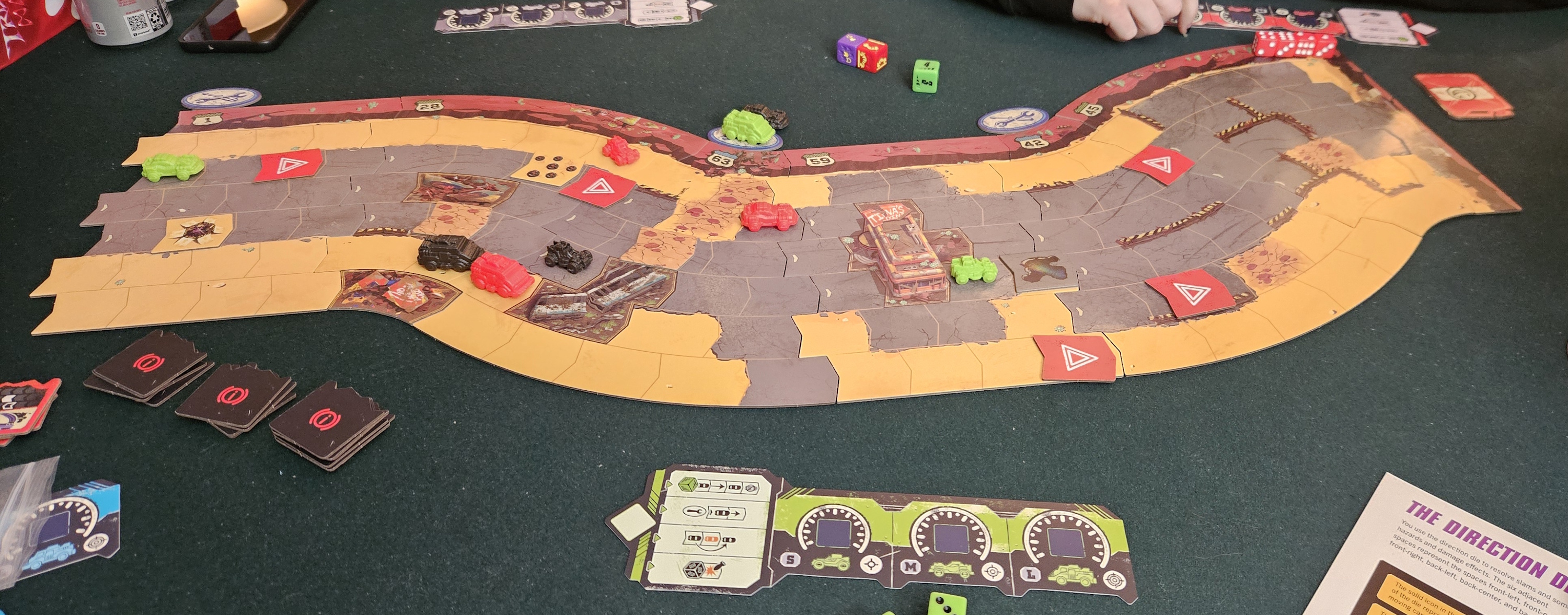
Thunder Road: Ignition trails the lavish Thunder Road: Vendetta. In some ways, this is what you would expect from a product that’s more of the same but costs a third as much as the original box. Cardstock and single-injection molds. The usual.
What’s surprising about Ignition, though, is where it departs from the save-a-buck formula. It isn’t that I expected the folks at Restoration Games to churn out garbage. Far from it. But Ignition isn’t just Thunder Road Done Cheap. After only a handful of plays, my daughters, who had previously declared Vendetta one of their all-time faves, insisted Ignition was superior. To my own surprise, in many ways I agree with them.
Another day on the road.
Not that you’d know it right away. Thunder Road was a maximalist design. You could see it in every detail, even if you didn’t have access to the multi-tiered Maximum Chrome edition. The cars were assembled from multiple pieces. The helicopters had a spinning rotor. The boards and dice were chunky. And that’s before the expansions added trucks and motorcycles and super-weapons and a deathmatch arena.
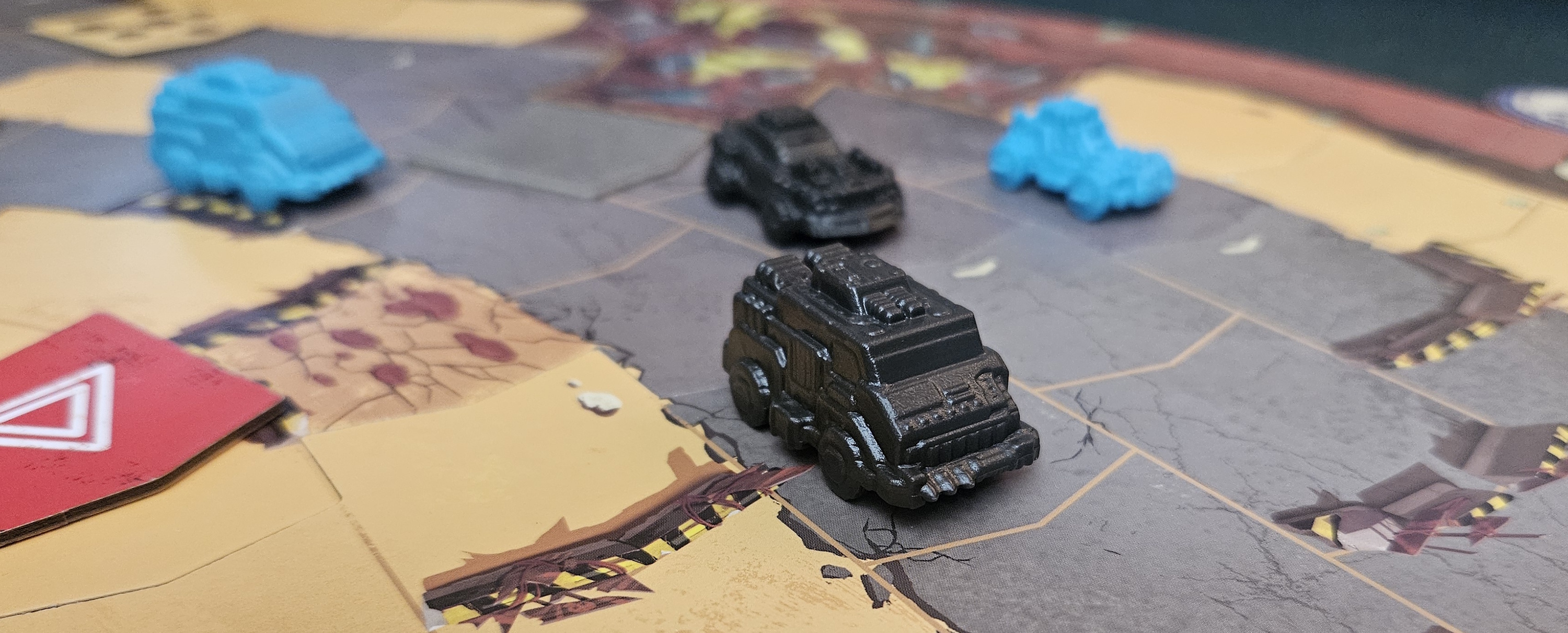
By contrast, Ignition is smaller. Suitably so, but still smaller. As before, players command three vehicles as they race across the wasteland, dodging potholes and taking potshots at one another. The accoutrements are gone, none more fundamental than the original game’s whirlybirds, the toy helicopters that served to pursue anyone who broke away from the pack.
Honestly… I don’t miss all that stuff. At least not as much as I thought I would. Ignition is a return to basics. Which might present a problem if those basics weren’t superheated and accelerated to 2400 feet per second.
These are paper mats rather than heavy cardboard. There isn’t much difference.
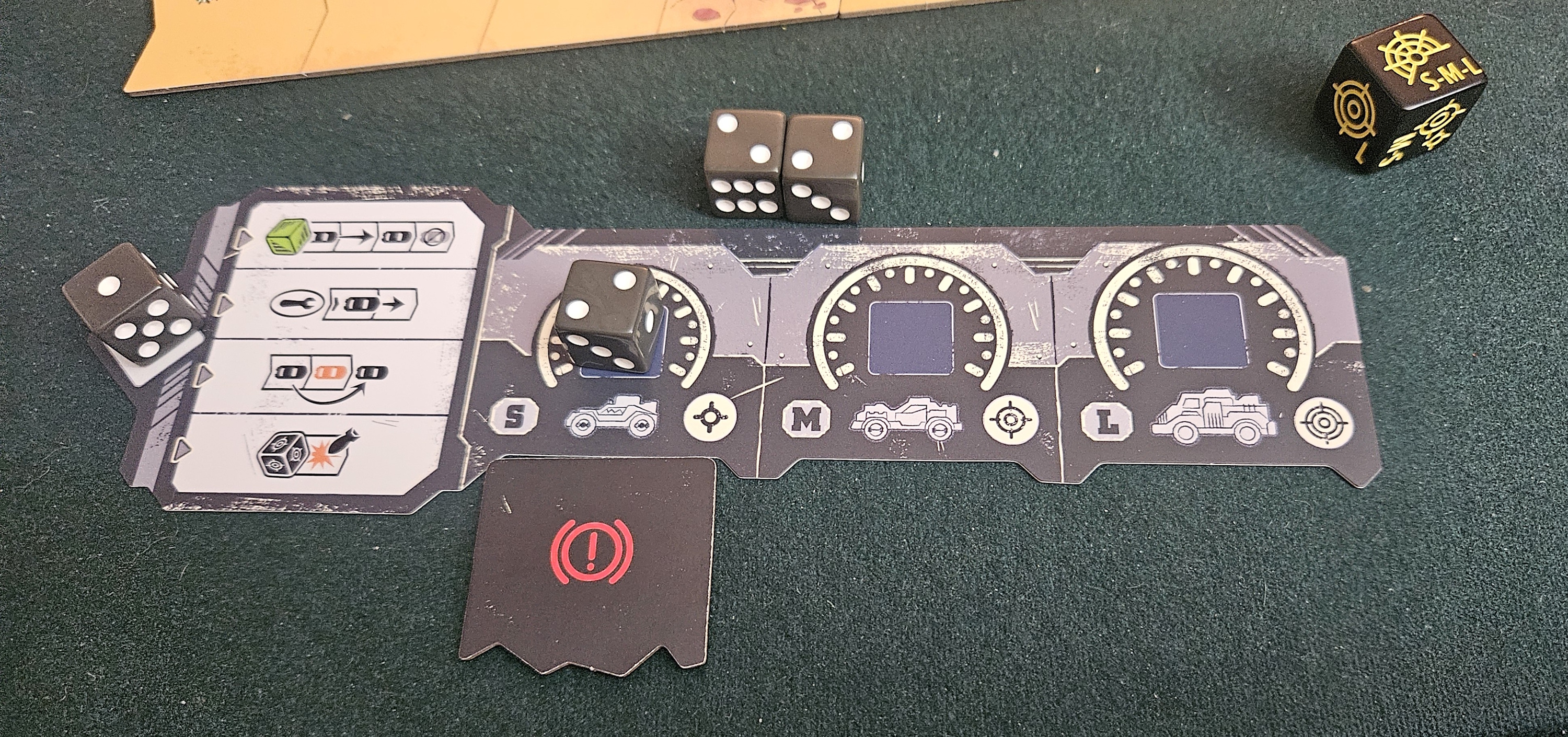
First, the dice. The foundations are the same as before. Each round, everyone rolls four dice, then takes turns placing them one at a time on those various rigs to hurtle them down the highway. That last die could be used once per round to activate a special bonus, like weaving through traffic or sending your helicopter to bomb someone.
Very little has changed. For the most part, the dice-play is identical. Roll four. Spend three on movement. The last one goes toward a bonus action. It’s every bit as smooth and chancy as ever.
The first little differences only rear their heads once you look closer at those bonus actions. The helicopters are gone, replaced by an action that serves more or less the same purpose. This time it’s a missile, presumably launched from one of your cars, and capable of targeting anyone on the road. The only difference is that the missile doesn’t take up space on the road the way Vendetta’s helicopters did.
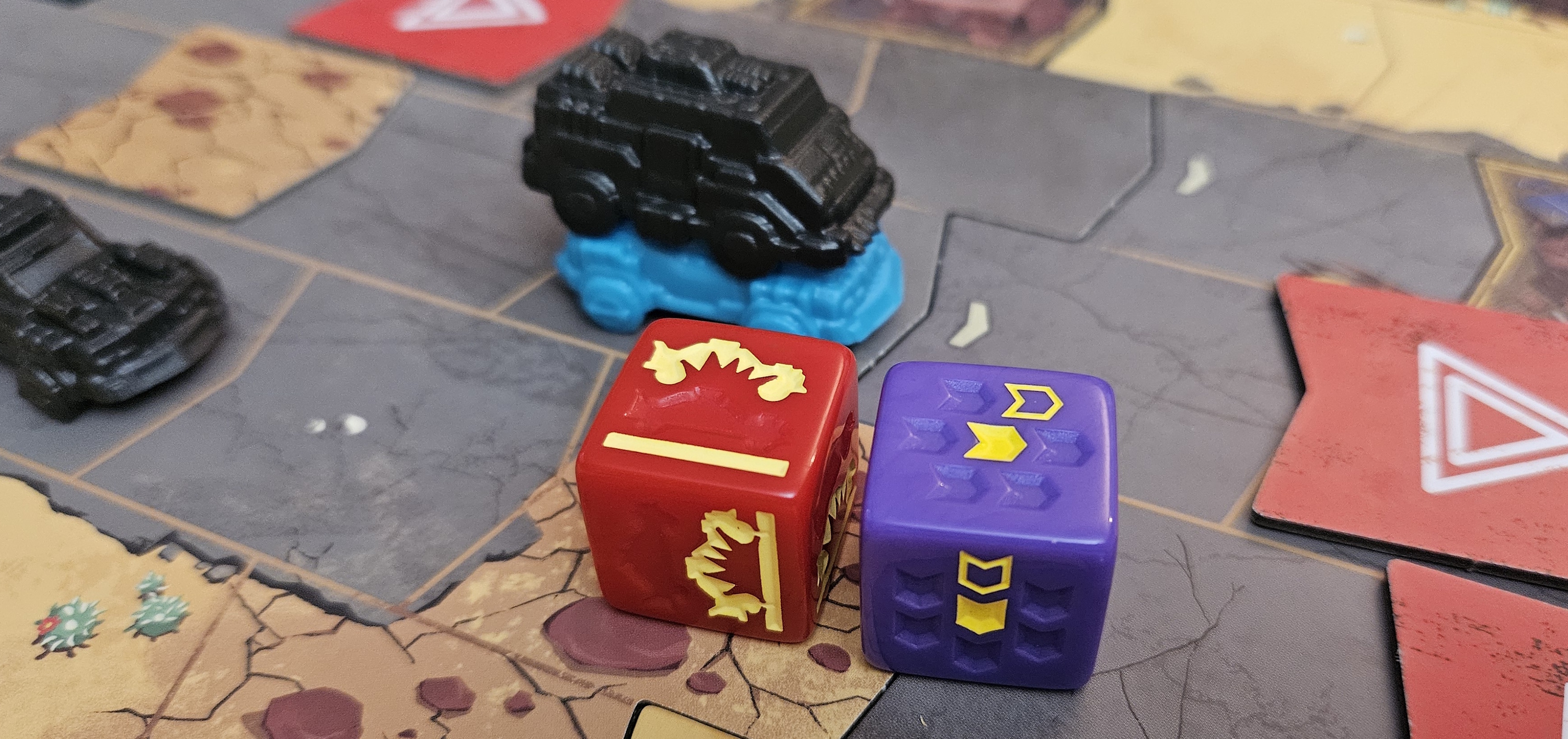
Or there’s the way nitro no longer moves a car by the value of the die placed on it. Instead, you get to roll the trick die and move that far. It’s a subtle but smart alteration, reducing the effect of a strong opening roll and making breakaway vehicles less likely to speed across a dozen spaces in a turn.
Or there’s the absence of the repair action. Now, if you know Thunder Road, that might sound as cracked as a wasteland warrior’s sense of self after their warlord has imparted some considerable brainwashing. No repairs? How will you keep your cars from being wrecked?
About that…
Checkpoints allow demolished vehicles to return to the race.
In Ignition, cars don’t get wrecked.
Oh, they can still crash. Or get machine-gunned to bits. Or have a missile turn them into a crater. Or speed across too much gravel after their transmission has been shredded by a landmine. Two hits and a car is out of commission.
But only for a while. Only until the next time you activate it with a die.
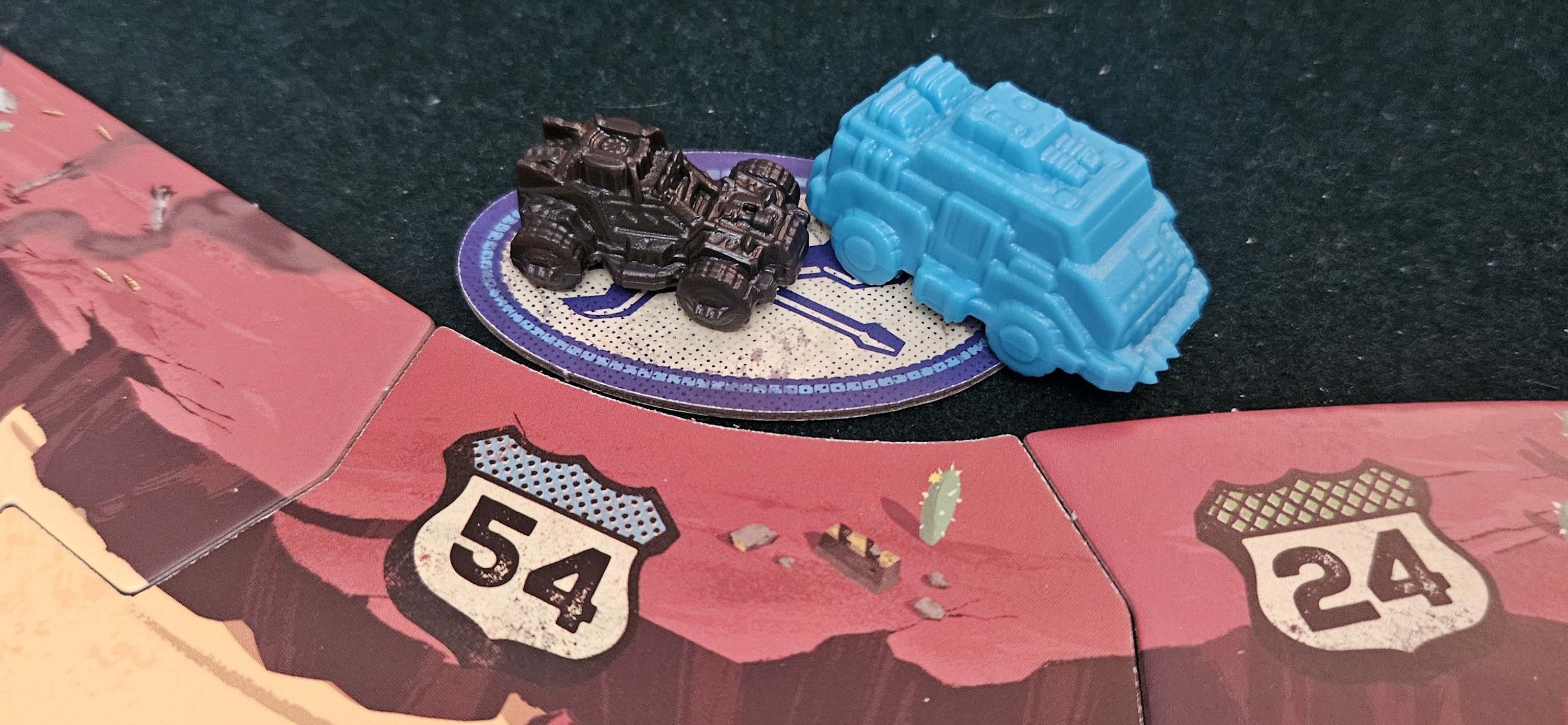
The answer is checkpoints. When a car is destroyed, it goes to the most recent checkpoint. From there, it reenters the race, albeit probably a little farther back then before. Also, it will be slower. It takes the car’s entire turn just to reappear on the road.
That is, unless you spend your bonus action on the option that stands in for the old repair action. Now, when you roll your car back onto the road, the jump-start action will allow it to make its full move. In most cases, this is enough to get back into the thick of things. And if not… well, maybe in those cases it’s smarter to save your bonus dice on heat-seeking missiles.
The curved roads look great and add a few new considerations.
The ramifications of this change from permanent destruction to temporary setback are far-reaching. First, I won’t pretend there aren’t any negatives. There are no more car wrecks. These were one of the original game’s coolest sights, the burnt-out husks of defeated racers turned into serious obstacles for the drivers behind them.
That said, this completely removes one of the system’s larger problems: that the back half of Vendetta’s races were considerably less interesting than their opening moments. As players lost their vehicles, turns grew shorter and more perfunctory. Fewer decisions were present. Usually the last third of the track felt like a foregone conclusion.
Now the victory condition has changed. This is a race, pure and simple, and whomever crosses the finish line with two cars is declared the winner. There’s no longer a situation — and a common situation at that — where you’ve lost so any cars that you no longer have anything to do with those remaining dice. Now you just wheel them back onto the track and keep going.
This eases some of the game’s chancier elements. Thunder Road has never been a serious game, but dulling the consequences helps to emphasize its better portions. Namely, that this is also a rather funny game. Smashing a tank into a dune buggy, only for the tank to get thrown into a wall of trash, is now wholly amusing rather than frustrating. By the same token, getting slapped with a missile right before you reach the next checkpoint offers a shadow of the finish-line blues, but its easier recovery means you haven’t lost the race. If anything, this adds some strategy to the game. Rather than investing every one of your best rolls into your fastest car, it’s often worthwhile to spread them around to ensure a damaged vehicle reaches the next checkpoint rather than getting booted back to the start of the track.
Which is all very clever. Because Ignition is definitely the smaller of these siblings, but it doesn’t feel short so much as lean and muscular. Its matches are focused and mean and hilarious. An improbable emotional blend, but one that works thanks to some ruthless development work.
Smoosh!
Everything else survives intact, at least if we’re starting from the baseline rather than the expansion stuff. The special dice, which oversee ramming and damage and shooting, are still a joy to contemplate and handle. The cars still feel distinct without needing any additional rules. The race… well, it’s still Thunder Road. Just better, in most ways.
As my seven-year-old put it, “It was so crazy when my car hit your car into the garbage!” Like the best of the recent resplendence of comedy racing games — Hot Streak, Magical Athlete, and Dino Racer — Thunder Road: Ignition feels like it was custom-built to appeal to everyone in my family, adult and child alike. Vroom vroom, sucka.
A complimentary copy of Thunder Road: Ignition was provided by the publisher.
(If what I’m doing at Space-Biff! is valuable to you in some way, please consider dropping by my Patreon campaign or Ko-fi. Right now, supporters can read the next installment in my series Talking About Games, this time tackling the topic of what makes a good list! Naturally, the piece includes a list.)

 Anmelden


 ︎
︎