Anmelden


StarDriven: Gateway
Played StarDriven: Gateway last night. First of all, let’s get this out of the way.
The horrific trend in the last two decades of putting a colon (or dash, or em-dash) in a book’s title and then giving it a subtitle is a terrible development and should not be extended into games. It is only allowed if the game is in fact a sequel. We have to be able to tell all the Race for the Galaxy expansions and arcs apart. Adding a “Legacy” to Pandemic (etc) is fine … they are related but different games. Apparently there is a StarDriven: Saga coming out (out?) from the same company, and they want to note they are related … but I’m watching you, Rock Manor Games. Cut it out.
The rough mechanics
(It’s been so long since I reviewed a game that was relatively new, I’m actually going to describe it a bit).
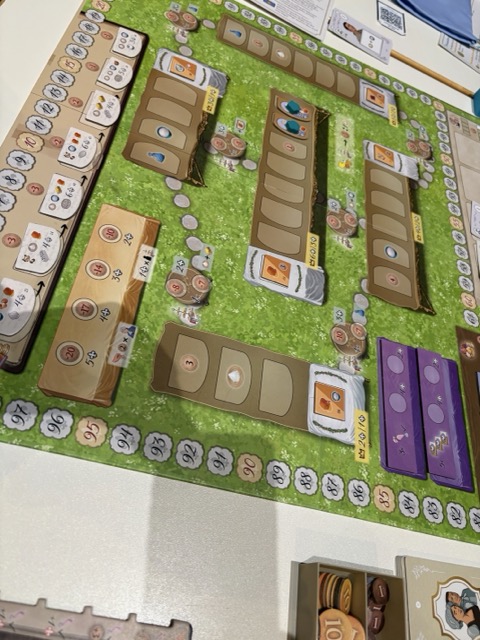
SDG is a knock off Star Trek episode, or perhaps season, and is actually a pretty nice idea. Each player has a ship, and you roll dice (of various colors). You can use red dice for fighting, blue dice to run warp drive1 and sensors. Green dice are impulse and engineering. Some of the stations can also accept any die. Also, each station has an energy cost. (Usually 0-3 energy, but some stations gain you energy equal to the die roll).When you place a die you get one very useful thing (no matter the die value) and then use the die value to get other things.
For example, the “command” station will accept a red die (for one energy), a red die (costing two energy) and any die (three energy). When you place a die there you get an experience marker (which lets you buy/improve your crew) and then the better the die the better the attack.
Crew are a certain species, have specialties (although they can all operate any station) and can be regular or promoted. You can only take an action on a station that has a crew member, but one of your actions is “place a crew member into a station.” Each crew member also has a “Tap to due special thing” as a free action.
At some point you can give up an action to remove and reroll all your dice (and untap some of your crew).
Combat is clever … each die rolled is a hit against a section (you have six sections, after all) but you can roll your shields and if you roll a matching number you block the hit (but your shields are weakened). If you don’t match numbers, you take the hit, the spot is blocked, and your shields are still strong. (You can spend engineering actions bumping up your weapons or shields).
The owner described SDG is “kind of a 2.5X game, not quite a 4x” … at least in the early “episodes” (we played “episode 1”) combat is enough to keep you honest, but minimal. Players are not expected to fight each other, but there are a few nuisance ships out there. Presumably in other episodes there could be harder enemies or PVP. But the board has only the major planets revealed at the beginning and you fly around, encounter “anomalies” and explore the map, and finish missions. When you finish a mission you must tap a promoted crew, or discard a crew from a station back to crew quarters (where you need actions to ready them again) or lose them entirely (from your hand?). Finishing missions gets you reputation (on the nearest major planet).
After a round the last player makes a few decisions for the enemy’s attack (breaking ties only, but usually there are ties). When one player gets 9 reputation the game ends after another round or two (at least for the scenario we played).
Then there is a slightly-too-point-salady scoring for my taste (you get points for reputation, a bonus for having most reputation on each major planet, points for anomalies, negatives for combats, bonus VP that you can acquire during game etc).
The Trouble with (Knock Off) Tribbles
Individually, the ideas work. I like the theme (and can appreciate that the license is too expensive, so I don’t mind it’s had the serial numbers filed off). The game looks nice, (the map tiles are functionally kind of hexes divided into three, but have a different look). Each ship has a slightly different coloration of dice … my ship had only one red (“Command”) die, so fighting and promoting is more difficult. Each ship also has a set of unique abilities (six perhaps) of which you pick two. You manage dice and energy and crew. I mean, the game is overproduced Kick Starter bait with a box too big, but also does give off the “labor of love” with an appreciation of the genre.
BUT ….
- The missions are bland. Tap (or discard) the right crew and that’s it. Sure, this is a “diplomatic mission” and that’s a “earthquake rescue” but they are all the same. The anomalies feel right thematically “Oh, you’ve got an energy alien loose on your ship” vs “A metallic virus is eating your ship” but again the ones I saw were all “Take some damage and if you spend a crew you can keep this card for a bonus <something> later.” I don’t know if you can make the theme shine more with the rules, but it would feel nice if you could. Now that I think about it, the anomalies should stick around and require longer to solve … after all, those are entire episodes in the show … not just one turn distractions.
- Energy felt too abundant, and there wasn’t any real problem if your ship took damage2. Don’t know if that’s because this was “episode 1” (which sets the first few missions and enemies).
- Rolling bad is a poor strategy. I rolled only “1s” on my three blue dice, which meant (effectively) I couldn’t warp to major planets or do anything but the worst sensor sweep. There are ways to re-roll, but they cost time (also a precious resource). Not a major problem in a short game or a game with enough die rolls; more annoying when you only roll the dice 2-3 times in a game.
- There’s clearly a design idea of “You have these characters. Can you make them regulars instead of red-shirts?” going on, which is clever. I wish it was explored more.
But those are just peeves, compared to the fundamental flaw.
The turns are too long. This is a fixed fun game; on your turn you get two actions (plus any free actions, which includes finishing a misson! or using some special abilities). It isn’t a problem that each turn takes 2 minutes (annoying, but not a deal breaker). The turns are too long because each player gets too many actions on a turn. Yes you only get two actions, but there are enough free actions that there’s no point in planning … any mission might be gone by the time it gets back to you. Players can warp around the board, after all, so even though each mission is tied to a planet type, none are too far away.
SDG feels like it would have been more engaging if it used a worker placement (or Eclipse’s) structure of “one action around the table until everyone is forced to pass and reset” … on your turn place a die (tap a crew, let’s make that not a free action, except maybe for promoted crew) and take an action. And don’t replenish a mission until the round is over, so they are definitely being fought over. Once everyone is out of actions then the round is done, the enemies move, and you do the next round. Now each player still only takes 25% of the time, but its a race against time, and isn’t that the real pressure in all the of the schlocky TV shows we love?
Can you get to that mission before the other ship shows up? One action at a time makes it tight (particularly if finishing the mission is an action, maybe not taking dice). Now it would feel more interactive …. instead of just “maximize the board state on your turn, then wander away for five minutes.”
I’ve played six (or even eight!) player games of Eclipse where my turn-to-turn engagement was much higher than my four player game of this.
I’d try this again, but would like to try it with one (or two) less players and perhaps a later scenario. But I’m not chomping at the bit.
Rating — Indifferent.
Update — I got a note from the designer indicating that my concern in footnote 2 was misunderstanding the rules … if all three die slots in a section are damaged they are automatically repaired, but create a hull breach (which is -VP and enough hull breaches will destroy your ship). But that does mean you will always have at least one die slot in each section.
- Since it’s not licensed, SDG doesn’t use terms like “Warp Drive” or “Impulse” that might get them in hot water, but you know what I mean.
 ︎
︎ - In theory your ship can blow up, but we came nowhere close to even “lose some VP if one of your sections is totally blown up.”
Also, from my quick glance at the rules, if your entire engineering section is blown up, you lose the ability to do any repairs ever, which seems like it could be a flaw and is definitely anti-theme for the “daring comeback from impossible odds.” See update after post for clarification︎