❌

Normale Ansicht

The Slasher Review

31. Oktober 2026 um 10:00

By Kaysee and Max

The Slasher
“The killer is well prepared – their knife is sharp and they’ve littered traps around the area. Will you be able to escape with your lives?” – The Slasher Rulebook

Disclosure: tried all difficulty levels

One of the first games we added to our list of must-haves at SPIEL is The Slasher. And not just because it’s a cooperative trick taking for exactly two players, but also because it seemed thematic. Escaping from a killer using trick-taking mechanics sounded exciting and new to us. The artstyle captured us very quickly. And we like that it’s in a small box, even smaller than the other trick-taking games that we own.

It’s also one of the first games we tried after SPIEL because it’s almost Halloween even though Halloween is not really much of a thing in Germany. It also helps that the game is so easy to set up. And because it doesn’t have a ghost third player as in The Crew games and The Lord of the Rings trick taking games, it doesn’t require as much space. Many games in small game boxes appear to be travel friendly, but some of them may require a surprising amount of space, which may not be easy to find in a public area.

The lowest difficulty of The Slasher wasn’t really difficult, but probably because we’ve played quite a few trick taking games before, both cooperatively and competitively. Much like other trick taking games, it’s a must-follow, which means that after the first player plays the lead card, the other player must follow the suit of the lead card. There are four suits: yellow, red, green, and white. Whoever plays the highest card of the lead suit takes the trick (the cards played). But if a player cannot follow the lead, they can play any suit. The lead player would win the trick unless the other player played a trump card. The trump suit is determined randomly at the beginning of each round. Who wins which trick is an important consideration, as the cards that each player wins have various effects in the later part of the round.

The Slasher suits
The Suits

The cards that add suspense to the game are the Area cards and the Item cards. In order to win, we have to survive the location, which is randomly determined by an Area card, while also not being murdered by the Killer and getting the number of Escape Items needed during the game. Each Area card has a condition we need to fulfill in order not to trigger a trap; for instance, a specific number shouldn’t lose a trick. Triggering three traps during the whole game will result in a game over, because both players would be stuck and no one would be able to help them.

Area Cards and Traps
Area Cards and Trap tokens

The Item deck contains the life-saving Escape Items, and some other items that are potentially valuable for survival, but it’s also where The Killer lurks. Each player draws one or more Item cards in the second part of the round. The number of Item cards they draw is dependent on the number of yellow cards they won. If they didn’t win any, they still draw one Item card. The suspenseful part is the possibility of drawing The Killer, who is going to slash whoever drew them. The damage that The Killer inflicts is determined by adding one to the number of slashes on the red cards a player has. Each green card that a player has can be used to mitigate one slash on a red card. White cards always count as one of the other types, depending on the remaining health of the player. At full health they act as green cards, then as yellow, and finally as additional red cards at low health. This really increases the tension aas the game goes on. If one of the players dies, the game ends.

The Killer
Item Cards and the Killer

Our final thoughts

The Slasher does a fantastic job of converting the emotional experience of a classic horror movie into a trick taking game. We really like the suspense that comes from not knowing whether we will gonna draw The Killer or an Item that could help us escape the dreadful place. At the beginning of the game there’s a feeling of unease when you draw Item cards, because The Killer could show up at any time. Over the course of the game this feeling intensifies as you trigger some traps and get hurt by The Killer. At the end the situation is always on a razor’s edge, as you desperately look for the last Escape Item, knowing that any misstep would mean certain death.

The first few games of The Slasher was very thrilling and exciting, but the excitement may not be as much after a few plays. But we still think that it’s a good tiny game that we can just easily bring to the table or any playable surface. Also, the highest difficulty, the Nightmare difficulty, was very challenging and fun.

What we both like:

  • the suspense
  • fun quick game
  • art style
  • the theme

What we both don’t like:

  • could get less exciting over time

What Max also likes:

  • how function of the white cards changes

Kaysee’s rating: 4/5
Max’s rating: 4/5

Combined rating: 4/5
4

Title: The Slasher
Edition: English edition
Game Design: Katsunari Takahashi
Illustration: Katsunari Takahashi
Publisher: Jelly Jelly Games, PLAYWARP

Photos by Kaysee

The post The Slasher Review appeared first on Schmeeples.
Trickarus Game Review

“So, normal trick-taking rules, must follow, there’s a single trump. But THIS time,...”

Trick-taking games are becoming very difficult to review, because an ocean of new trick-takers get released every week. (If you had told me the “best” part of the tariff backlash is that more companies are producing more cheap-to-make card games with a trick-taking element, I might have retired from games right on the spot. I like trick-taking, but I don’t need it to survive.)

The hardest part of the trick-taking deluge is that you have to both learn each game as if it is new, and you have to try to leverage your years of playing other trick-taking games to account for how to win tricks, or avoid them, or win some to set up losing all the rest, etc. The first sentence of this article is uttered at almost every game night I host now, because I picked up about 20 different trick-taking games at Gen Con or through the mail!

Trickarus (originally released in 2024, but now published by Smirk & Dagger Games in the US) is a must-follow trick-taking game. There’s a trump suit. But THIS time, there is a mechanic where players have cards that have a day half, and a night…

The post Trickarus Game Review appeared first on Meeple Mountain.

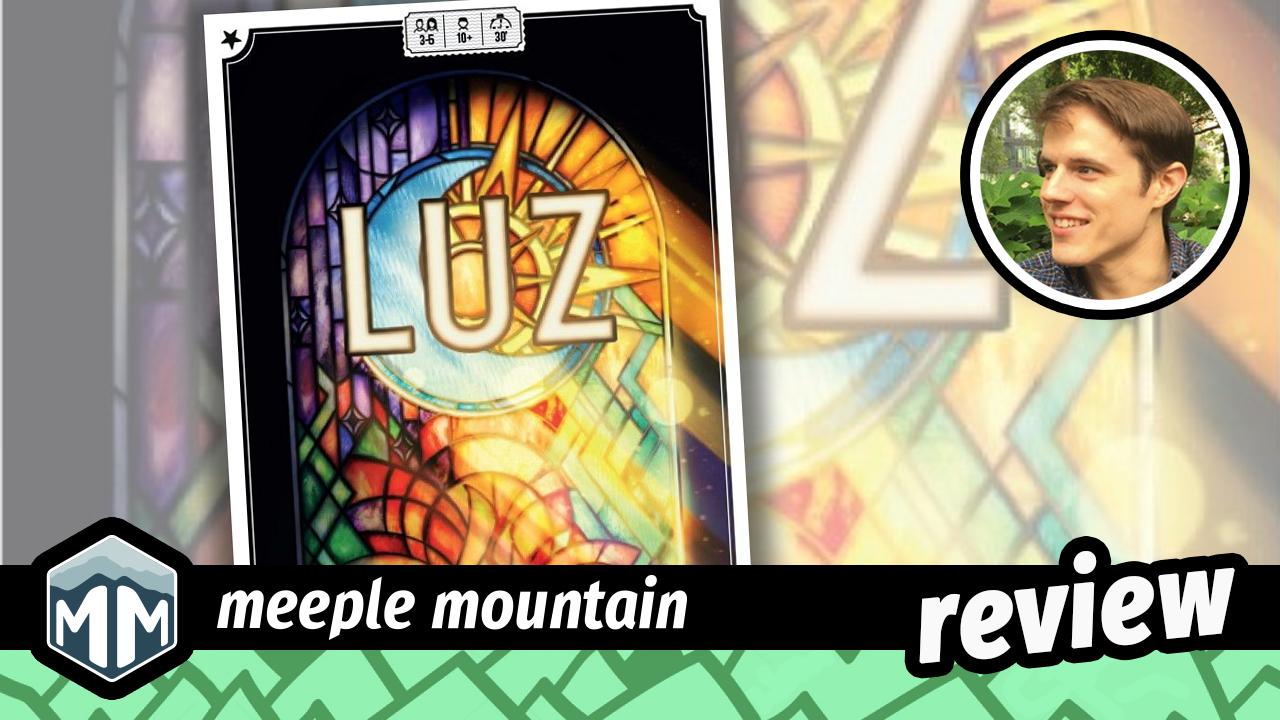
LUZ Game Review

With a title like LUZ, Spanish and Portuguese for “light,” you’d expect this Taiki Shinzawa trick-taking game to have a bit more clarity. Silly you. Silly me! LUZ is a game of shadows and half-knowns, a trick-taker that casts a shadow of uncertainty.

Given that Shinzawa is responsible for the likes of Ghosts of Christmas, a trick-taker in which you play three or four must-follow tricks at the same time while the trump suit shifts with player behavior, I should clarify that LUZ isn’t that opaque. It’s all relative. If Ghosts of Christmas is a few standard deviations outside the mean, LUZ is safely within the bell part of the curve.

This is a must-follow trick-taking game where players bid before the hand begins. You have the choice of making an exact bid, which requires you to hit the nail squarely on the head in order to score, or a more forgiving bid that gives you one trick’s worth of wiggle room in exchange for scoring half the points. Higher risk, higher reward.

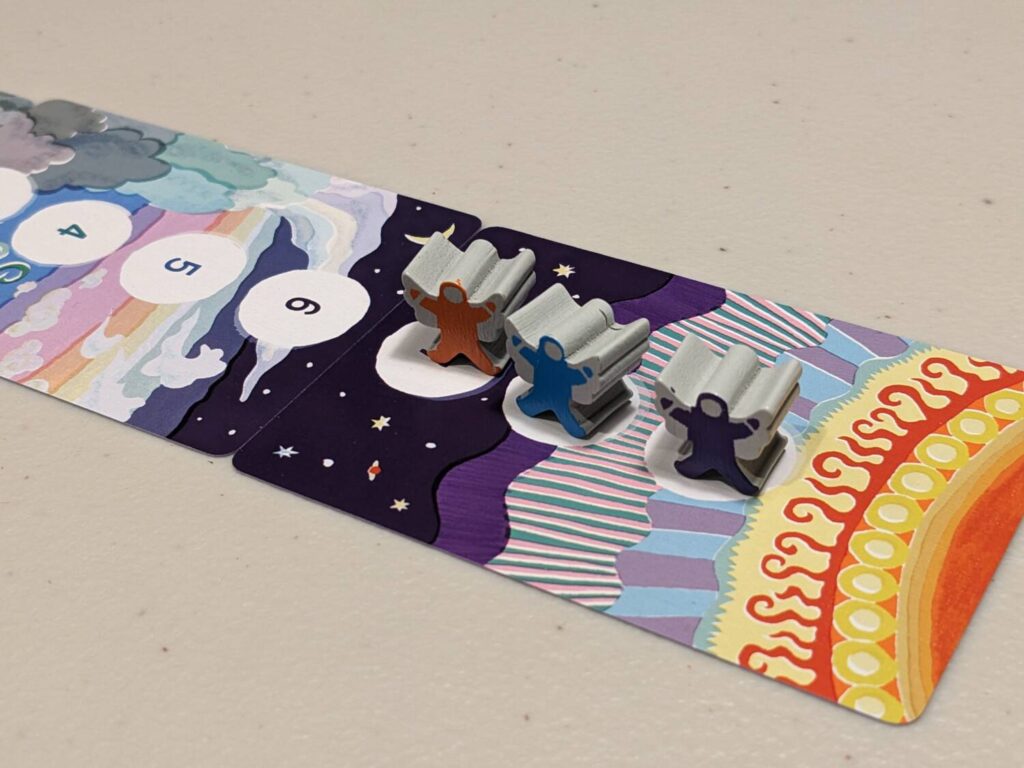
This doesn’t sound so different from whist, other than the room for some wiggle in your wager. The opacity comes from the last two rules: the back of each card indicates what suit that card belongs to, and you never know the values of your…

The post LUZ Game Review appeared first on Meeple Mountain.

The Crew: Mission Deep Sea (2-player review)

29. Juli 2026 um 00:49

By Kaysee and Max

The Crew Mission Deep Sea
“So you see that you have to weigh the opportunities and risks, and assess the feasibility of the mission when assigning the tasks!” -The Crew: Mission Deep Sea Rulebook

Disclosure: completed all the missions

The Crew (in both currently available versions) is one of those games that we kept seeing again and again at bookstores in Germany. Even though they are very reasonably priced and The Crew: The Quest for Planet Nine won Kennerspiel des Jahres in 2020, we weren’t able to bring ourselves to purchase it, because at the back it says (on the German version at least) that it’s for 3-5 players with a variant for two players. The risk of not enjoying the game and wasting 11 € felt too high for us. But after we finished and enjoyed playing both The Lord of the Rings: The Fellowship of the Ring and The Two Towers trick-taking games and learned that they were inspired by both versions of The Crew, we decided to take the plunge and try the second one: The Crew: Mission Deep Sea.

The Components of The Crew
The components

The Crew: Mission Deep Sea, just like its predecessor The Crew: The Quest for Planet Nine, is a cooperative trick-taking game. Except instead of going to space, in MDS players get to be a diving team on a mission to find the mysterious continent of Mu. We have to say right off the bat that we didn’t feel like we are on a deep-sea mission. MDS is not an immersive game. Unlike the LotR trick-taking games, there is barely any connection between the mechanics and the theme.

Just like other trick-taking games, its main rules are simple. MDS has the typical four suits, just referred to by their colors, and four submarine cards that function as trumps. The first player chooses the lead card and the next player must match the suit of the lead card. If they don’t have a matching card, they can play a card of any other suit or a trump card. The player who has the highest matching card or the highest trump card wins the trick. Since MDS is a cooperative game, simply winning a trick doesn’t mean that the players have won the game. All players should work together and fulfill all the tasks and mission objectives, which might include that one player’s task is to not win any tricks.

Submarine cards
The Submarine Cards

The game has a communication limit. Once per round, before or after a trick, each player can reveal one card and place a sonar token on it to convey one of three possible facts. Those are whether that card is the highest, lowest or only card of its suit in their hand. Submarine cards cannot be revealed in this way. Later missions sometimes further restrict communication or forbid it completely.

Most missions in the 32-mission campaign simply have a difficulty number, which determines the total difficulty of the task cards drawn for this mission. While in early missions this means that often only one player will actually have a task, in later missions players regularly have two or more tasks each. In addition to the difficulty number some missions have modifiers, such as the stricter communications limit mentioned before or an optional timer. Some missions don’t have a difficulty number and simply introduce a special rule that has to be followed instead of completing tasks. In theory the difficulty steadily increases throughout the campaign, however the random drawing of the task cards can lead to combinations that are significantly harder or easier than expected. Some combinations are even impossible, which means one or more task cards have to be redrawn.

Whoever gets the four of submarines (the highest trump card) gets to play as the captain, a woman named Meg Diver. In the two player variant, we had to play as if there were three players. The “third player”, an AI called Tonoja, is controlled by the captain. Tonoja gets 14 cards, where seven of them are open and placed on top of the other seven facedown cards. Then the four of submarines is shuffled in and each of us then gets 13 cards. Being Meg Diver wasn’t easy for either of us most of the time. Much like controlling the third player in the LotR trick-taking games, being the captain and controlling Tonoja really inreases the mental load of the player in question, and it can get even more taxing for the captain as the difficulty increases. Depending on the combination of tasks drawn, this mechanic can also impact the difficulty. Still, there’s also a tension sometimes when one of us flips Tonoja’s cards which adds to the enjoyment of the game.

Our Final Thoughts:
The Crew: Mission Deep Sea may seem easy initially. But as we progressed into the missions, it became more and more difficult. Some combinations of tasks can be very difficult for two players, but the game allowed us to try a different set of tasks whenever we couldn’t win the current set of tasks, which we think makes it less frustrating. The gameplay was a lot of fun and some combination of tasks led to really intense and brain tickling moments.

We like playing games with strong themes and The MDS doesn’t have that. But it’s the type of game that we can imagine playing to kill the time or to see the highest difficulty we can beat together. It’s not the best trick-taking game for two players, but it’s also not bad. It definitely has a high replay value and considering that it was only 11 € when we bought it, we can also definitely say that it was worth it.

What we both like:

  • very reasonably priced
  • interesting combinations of tasks
  • challenging missions
  • replay value

What we do not like:

  • unequal mental load for two players
  • almost no connection between theme and mechanics

What Max also doesn’t like:

  • the writing
  • high randomness in difficulty

Kaysee’s rating: 3.5/5
Max’s rating: 3.0/5

Combined rating: 3.5/5
3.5

Title: The Crew: Mission Deep Sea (2021)
Game Design: Thomas Sing
Illustration: Marco Armbruster
Publisher: KOSMOS

Photos by Kaysee

The post The Crew: Mission Deep Sea (2-player review) appeared first on Schmeeples.

Joraku Review – Go West!

Von: Adam
02. Juli 2026 um 13:31

A review copy of Joraku Deluxe was kindly provided by Moaideas. Thoughts & opinions are my own. Joraku takes the threads of a traditional trick-taking system and combines them with area control and action selection to weave a tight, intricate fabric. Joraku didn’t make waves when it first arrived and was desperately difficult to get hold of. It’s well worth tracking down a copy though…

Source

Guide to Trick-Taking Games

Von: Adam
22. Juni 2026 um 18:52

Maybe you’re quite new to board and card games and have heard people talking about trick-taking games. Maybe you’ve been into the hobby for ages and don’t know anything about trick-taking, but you’re too scared to ask at this point. Either way, I’ve got you covered. In the context of card games, a trick is usually a round of play in a card game. Most commonly in trick-taking games…

Source

The Two Towers – Trick-Taking Game (2-player review)

22. Mai 2026 um 23:25

By Kaysee and Max

For the German review please visit Der Herr der Ringe: Die zwei Türme – Das Stichspiel (2-Spieler-Rezension).

Two Towers Trick Taking Game (2-player review)
“Don’t go where I can’t follow.” – Samwise Gamgee, The Two Towers, J.R.R. Tolkien

Disclosure: completed all the chapters

We had fun playing The Lord of the Rings: The Fellowship of the Ring Trick-Taking Game despite it not being optimized for two players, so we were excited to play The Lord of the Rings: The Two Towers Trick-Taking Game to see if there were any interesting mechanical changes (also we‘re LotR fans so there’s that).


The art style is very similar to the first one, but the cards are much more vivid. We also like that they used paper instead of plastic wrapper for the packaging of the tokens and the decks which makes it easier to open and better for the environment (we have a copy from the 1st printing).

packaging
paper, not plastic

The initial setup for two players is still very similar; each of us plays one character, but one of us should play an additional character whose cards are open but in a pyramid form where five of the cards are faceup and the rest are facedown. The One Ring token and the ring cards are not yet part of the setup. Instead, two new tokens and five cards are added: the titular Two Towers, as both tokens and cards and the three Orc cards. All of theses cards don’t belong to any particular suit. As such they can only be played if a player doesn’t have follow the leading suit. The towers are similar to the One Ring, they win any trick that they are played into. Unlike the One Ring the player cannot choose to lose the trick, instead if both towers are played into the same trick, they both lose. The Orc cards are the opposite of the towers and always lose. We like these new cards as they add challenge to the game since they cannot be used to lead a trick. If a player is forced to lead a trick with an Orc (e.g. because it’s their only card left), the group loses the whole chapter. If a trick contains both tower cards and an Orc card, no one wins the trick and it is set aside.


As with the first game, each chapter features a different set of characters with their own goals and rules. These tend to be slightly more complex and interesting this time around. Likewise, many chapters still feature event cards that further change the rules. Unlike the first game, there is a big change after the first ten chapters, which correspond to book three of LotR. Without spoiling too much, the deck changes to become more similar to the deck in the first game, with some significant changes. This of course makes perfect sense thematically, as the later chapters are the ones featuring Frodo, Sam and the One Ring.


We were hoping that Two Towers would be much better for two players. We found the first few chapters to be both fun and mechanically challenging even though the 2-player friendliness is just the same as the previous game, and we were ok with it (we got used to it and we accepted it) but as we stepped in to Chapter 25, that’s when we realized that the game just became worse for two players. We could imagine this chapter being a bit easier for three or four players, but with two, it wasn’t. How the pyramid works in that chapter made us feel very frustrated. We’re still trying to figure out why they made the decision for the set up of the pyramid for this chapter to be the way that it is. With many challenging games, we get that feeling of great satisfaction after beating them, but not with this one. Even though we were able to finish the chapter after a few tries, it didn’t feel satisfying or rewarding. The relief that we felt is more of us not having to be in a very frustrating situation anymore (we could’ve just stopped playing it, but it’s the completionist in us that deterred us from just moving on) than being able to succeed. While it is not as frustrating and has a regular pyramid setup, Chapter 30 also proved difficult for us, due to the specific combination of character goals and the limitations introduced by the event card for that chapter.


We still decided to finish all the chapters. Some of the mechanical changes in part 2 were a noticable improvement and made the game more fun. We also liked how the theme and the mechanisms in part 2 felt very familiar, but were still different and interesting. We also liked the last chapter a lot and how the mechanism matches the theme. It was a good ending.

Our Final Thoughts:
The Lord of the Rings: The Two Towers – Trick-Taking Game was still enjoyable for us in most parts, but there were times where we thought that we could’ve enjoyed it more if there were more of us playing it, something that also crossed our minds while playing FotR, but it did occur more frequently and strongly while playing this game. It’s unfortunate because the interactions between the mechanisms and the theme here are much more interesting than in FotR. We were hoping for it to be at least as good for two players as the previous one if not better, but it wasn’t. Still, we’re looking forward to playing The Return of the King if it comes out in the future and hoping that it will have better mechanics for two players.

What we like:

  • production quality
  • mechanical changes in each chapter
  • art style
  • better packaging
  • interaction between mechanisms and theme

What we do not like:

  • the pyramid can be frustrating
  • less optimized for two players than FotR

Kaysee’s rating: 3.5/5
Max’s rating: 3.5/5

Combined rating: 3.5/5
3.5

Reference:
Tolkien, J. R. R.(1999). The Two Towers. HarperCollins.

Title: The Lord of the Rings: The Two Towers – Trick-Taking Game
Game Design: Bryan Bornmueller
Illustration: Elain Ryan, Samuel R. Shimota
Publisher: Office Dog

The post The Two Towers – Trick-Taking Game (2-player review) appeared first on Schmeeples.

The Road to a Clear Path

07. Mai 2026 um 10:00

By Kaysee and Max

The Fox in the Forest Duet
“They don’t all have to be if enough of them are.” -Mother Fox, The Musician and the Fairies, A. J. Abbott

Disclosure: played using the German version, played 6 times, beat the game in level 3, highest score achieved: 37 pts

There are plenty of trick-taking games for two players, but many of them aren’t cooperative. The Fox in the Forest Duet caught our attention at a book shop as it is both co-op and for exactly two players. Its art style reminds us of some fairytales collected by the brothers Grimm from long before. We decided to purchase it and give it a try.

The box is compact (16.5 x 11.4 x 3.2 cm). It has a rulebook, some small cardboard tokens, a small wooden token that represents the players, two reference cards, a deck of 30 cards, and a small cardboard road map. Unfortunately, two cards have some misprints and the quality of the cards in general isn’t ideal. It would have been nice if they had a linen finish.

components of the Fox in the Forest
The components

The setup is simple, and it doesn’t take much space as you only need space for the small board, the trump card, and somewhere to play the cards. The gem tokens have to be placed on top of the small squares on the board. There are symbols in the squares, which indicate the number of red tokens the player should place. The board also indicates where the players should start.

The board with red gems

One of the players shuffles the deck and hands 11 cards to each player and draws one card that determines which suit is the trump suit. The deck has only three suits. Whoever has the highest number of the suit played by the first player or the highest trump card takes the trick. The wooden token should then be moved toward the winner of the trick. The number of steps is the total number of steps at the top left of the cards, with each card having between zero and three steps. If there’s a red gem at the final step, it should be removed from the board. To win the game, there shouldn’t be any red gems left on the board within three rounds. Kaysee likes this mechanism as there’s something satisfying about removing something from a board and being rewarded for it, similar to a crisis-management mechanism in some crunchy games.

Some cards don’t have any movement numbers, but instead they give the player additional abilities like exchanging a card with the other player or letting the winner choose whether to use both cards to move or just one of them. We like this mechanism because it allows us to indirectly communicate something to each other since the game doesn’t allow us to share our strategies or show each other our cards.

The game has three difficulty levels and a scoring system. The highest possible score is 46, which can only be achieved in level 3 without losing a forest path and being able to remove a gem with each and every single movement. Trying to reach the highest score possible may excite some players, but not us, at least not with this game.

The first game wasn’t very exciting for both of us. We did win the first try, but we didn’t find it engaging. We think it’s probably because of it being too abstract for our taste and how the theme isn’t strong enough in this game. But we do like being able to win the game when we exchange cards and get the cards that we exactly need to beat the game. For level 3, we played for a bit more than half an hour.

Our Final Thoughts:
The Fox in the Forest Duet is a decent compact trick-taking game. Like other games that have a strict communication limit, it didn’t allow us to come up with a strategy together, and that’s ok. Communication limits can be fun sometimes, especially if it feels like we can read each others thoughts, but the lack of strong theme and excitement while we play this game didn’t help in terms of us wanting to play it again. We can, however, imagine playing this to kill the time at a boarding gate at an airport while waiting for the plane to arrive. We would also suggest reading the fairytales by Alana Joli Abbott (even though you’re not at an airport), which are much more suited for the modern times than the fairytales from long before.

What we like:

  • it’s compact
  • the abilities of some cards
  • the mind-reading aspect

What we do not like:

  • production quality
  • not exciting
  • lack of strong theme

What Kaysee also likes:

  • removing tokens

What Max also doesn’t like:

  • too abstract

Kaysee’s rating: 3/5
Max’s rating: 3/5

Combined rating: 3/5
3

Reference:
Abbott, A. J. (2019).The Musician and the Fairies. Foxtrot Games.


Title: The Fox in the Forest Duet
Game Design: Joshua Buergel
Illustration: Adrienne Ezell, Jason D. Kingsley, Roanna Peroz, John Shulters
Publisher: Foxtrot Games, Renegade Game Studios

Photos by Kaysee

The post The Road to a Clear Path appeared first on Schmeeples.

A 2-Player Trick-Taking Journey to Middle-earth

24. April 2026 um 21:10

By Kaysee and Max

The Lord of the Rings The Fellowship of the Ring Trick-Taking Game
“But you cannot trust us to let you face trouble alone, and go off without a word.” -Meriadoc Brandybuck, The Fellowship of the Ring, J.R.R. Tolkien

Disclosure: played more than 20 times, completed all the chapters and beat the game in endless mode

We’re both fans of The Lord of the Rings. Kaysee has seen the movies twice, has read the trilogy, and tried to learn the Elven language and their writing system. Max has seen the extended edition countless of times and has read the books even more, so it’s not surprising that we got very excited when we found out that there’s a cooperative trick-taking game based on The Fellowship of the Ring.


The box is really eye-catching. We really like its stained-glass look. It’s just so pretty that you wouldn’t hesitate to display it in your living room. And, like many other trick-taking games, it is compact (4 cm x 10.4 cm x 21.9 cm). It has three compartments inside, each has a ribbon to keep track of the chapters that you’ve finished. The components are as beautiful as the box. It only has cards, including the chapter cards, the main deck cards, the character cards, and the reference cards, and five wooden tokens.

The components of The Lord of the Rings: The Fellowship of the Ring - Trick-Taking Game
The Components

The first setup was easy. Players only need the first chapter card, four character cards, two star tokens, the main deck, and the One Ring token. The chapter cards contain flavor texts related to the story and the chapter-specific rules players need to follow. The character cards contain character specific objectives that players need to fulfill, some chapters can modify or add objectives. There are short chapters and long chapters. Short chapters last one round, while long chapters take multiple rounds to complete. The star tokens are initially used to help players identify which characters are necessary in order to finish the chapter. For two players, three characters are selected. The deck should then be distributed as if there were three players. The hand of the “ghost player” should then be arranged in a pyramid form.

pyramid character
The Pyramid for two players

The player who gets the one ring card gets Frodo, the ring token and gets to choose and control the character for the pyramid. The second player chooses another card, but all starred characters must be chosen. It is not allowed for the second player to mention which character they would want to choose before the first player has chosen their second character(s). Talking about what suits you have is not allowed, but the advantage of having a pyramid character is that both players can partially see its hand. We like this mechanism, but we can imagine a scenario being impossible to complete if a specific character is the pyramid.


Frodo is the one who leads the first trick. To lead a trick means to choose any card to play, but the ring cards cannot be chosen to lead in the beginning. The next character, the one on Frodo’s left should match the suit played. If they don’t have any matching suit, they can play any card, even a ring card. After a ring card is played in this manner, the One Ring token gets flipped to its other side, indicating that ring cards may now lead tricks. Whoever plays the highest matching suit takes the trick unless the one ring card is played. The One Ring is the most powerful card in the game, as whoever plays it gets to choose whether to take the trick or not. Taking into consideration who takes the trick is crucial most of the time to complete the objectives and the chapter. We would suggest having three 6-sided dice to keep track of the number of tricks won. If neither of the players have D6s, a paper and pen would do. Take note that not all characters need to win a trick (as in the case of Pippin).

Every chapter and character has a different set of rules and objectives. Some chapters may take longer to finish than others. This is really good, as the different varieties make the game more exciting. That said, Kaysee finds the later chapters to be less exciting than the earlier and middle ones since there was tension that builds up in the middle chapters due to how the difficulty increases, but as one reaches the later chapters, there seems to be a drop in difficulty that can affect the excitement formed by the anticipation for something much more difficult.


Another thing that we both like is how the mechanics are connected to the theme. But there were a few times where some characters that could reasonably be expected to be available based on the story are in fact not. We assume it has something to do with the balancing of the game, so it’s not a huge deal for us. We also like the endless mode where the objectives may vary for each game.


The game is optimized for more than two players. To allow for a two-player game, the pyramid character was added. It works really well, but one player controlling two characters is something that we’ve both found mentally taxing at times as the decision making for the pyramid character is not shared.

Schmeeples in Shire

Our Final Thoughts:
The Fellowship of the Ring is a beautiful co-op trick-taking game. The narrative and the theme were well integrated in the mechanics, and that’s really fun for those who like trick-taking games and The Lord of the Rings. People who aren’t fans of LotR may still like it due to the interesting changes of the mechanics in every chapter, but maybe not as much.


Although the decision making process is not equally shared for two players, we would still recommend it to two players who just want to play something less heavy and have some more relaxed evenings, especially if they are LotR fans and want to complain about how blond Legolas is in the movies and in this game.

What we like:

  • art style
  • campaign progression
  • connection between theme and mechanics
  • production quality

What we do not like:

  • extra cognitive load for one player
  • more optimized for more than two players

What Kaysee also doesn’t like:

  • less exciting in later chapters

What Max also doesn’t like:

  • the pyramid can sometimes make victory impossible

Kaysee’s rating: 4/5
Max’s rating: 4/5

Combined rating: 4/5
4

Reference:
Tolkien, J. R. R.(1991). The Fellowship of the Ring. HarperCollins.
The Lord of the Rings: The Fellowship of the Ring – Trick Taking Game[Rulebook]. (2025). Office Dog.

Title: The Lord of the Rings: The Fellowship of the Ring – Trick-Taking Game
Game Design: Bryan Bornmueller
Illustration: Elain Ryan, Samuel Shimota
Publisher: Office Dog

Photos and non-board game illustrations by Kaysee

The post A 2-Player Trick-Taking Journey to Middle-earth appeared first on Schmeeples.

❌