
Normale Ansicht
10 Things I Wish I Knew Before I Turned 30

I made a huge intentional shift in my life in 2011. I’m now 45 years old, and looking back I realize how distinctly different my life was before and after my 30th year (mostly for the better).
If I had the chance to speak to my 30-year-old self, here are a few things I might say:
1. Creativity thrives in the small windows of free time, not the big ones. For most of my 20s I hoped for big gaps in time that were completely clear of other responsibilities–weeks and months–when I could write a novel. But the two times I had a big gap of time (the summer after college and when I was between jobs), I mostly just played and procrastinated. When I turned 30, I decided to spend 2 hours every night writing the novel, and I was done in 2 months while still maintaining my day job, friendships, and other hobbies. Realizing I could do that motivated me to also spend those small windows of time to design a game, Viticulture. This is one of the biggest changes I’ve ever made in my life, and my career with Stonemaier Games wouldn’t exist without this shift.
2. A change in location won’t make me a different person. I’m an introvert with a rather crippling social anxiety regarding approaching people. I romanticized the idea of going somewhere completely new by myself to see if a different, fearless version of Jamey would emerge, so I booked a solo trip to Ireland for a few days in 2011. Not only did I learn that I much prefer to travel with at least one other person, but also found that I’m still myself–for better or worse–even in a different country where everyone is a stranger. Another way to put this is: For the things about myself that I most want to work on, there’s no magic bullet.
3. There is so much to learn after formal education. I’m incredibly grateful for the all the teachers and professors who guided me from kindergarten through college. But there’s a whole world of knowledge outside of the classroom. I’ve learned so much about game design, for example, by listening to podcasts, reading articles, and watching videos (along with actually playing and designing games).
4. Healthy living starts to take effort after a certain age. I’ve been physically active my entire life, and I was blessed with a great metabolism, so for many years I didn’t feel the need to eat with intention. That was all fine and dandy until I started running Stonemaier Games in my early 30s, a job that often involves sitting at a desk for 12 hours a day. I was no longer playing sports as regularly, yet my diet was the same as ever (and it wasn’t even terrible–I ate fruits and vegetables every day). My body changed incrementally, and before I knew it, I was 20 lbs heavier than I’d ever been. Fortunately I realized it’s never too late to change, but I wish I could tell myself what I was doing to my body and how even 20 minutes of exercise every day can make a huge difference.
5. I don’t want kids, and I’m not alone. For most of my life, I thought I wanted to have kids–I never questioned doing the same thing my parents did (I have a brother and sister). It wasn’t until my early 30s that started to realize that the creative, nurturing, and compassionate sides of myself were fulfilled and challenged better in other ways (game design, friends, cats, etc). But when my siblings and college friends started to have kids, I struggled sometimes to feel like an “adult.” But then I started to make some wonderful friends who were just as happy not having kids as I was–and I found a partner in Megan who also doesn’t want kids–and I’m so grateful for those relationships (they even helped the relationships I had with friends and family who do have kids).

6. Money well spent makes a big difference. For the longest time, if I wanted a chocolate bar, I’d spend $0.50 at checkout at the grocery store. But one day I was shopping with a friend, and they said, “You love chocolate, right? If you love something, it’s worth paying for the best.” So I shelled out for a $5 chocolate bar, and it was amazing. This isn’t to say that I don’t still enjoy a Snickers, Kit-Kat, or Hersheys Almond from time to time. But I give myself permission to spend money on the things I love. Similarly, I’ve learned to pay for things that last–I have shoes and jeans that have lasted over a decade.
7. Every job before my career was a good use of time. I think there was a time when I didn’t believe this; I wished I could have found my path earlier in life. But whether it was waiting tables, project managing medical textbooks, or managing a nonprofit staff and fundraiser, I was learning indispensable skills and habits that have had a direct impact on Stonemaier Games’ success.
8. Loving a pet requires compassionate discipline. I adopted my beloved cat Biddy in 2007 when he was a tiny kitten, and raising him from beginning to end is one of the greatest joys of my life. Biddy loved to eat, and I gave him open access to cat food (and sometimes human food). At one point he tipped the scales at 20 lbs. He developed diabetes and required twice-daily insulin shots for the rest of his life. He died of intestinal cancer when he was 16 years old. While I don’t know if I could prevented any of Biddy’s ailments, I wish I had known earlier that I could have made Biddy’s life better overall by denying him a portion of the thing he wanted the most (kibble). Not enabling someone’s worst habit is a core part of loving them. I would truly do anything to have another month or year with Biddy–I miss him every day.
9. There is no rule that says everything must remain the way it’s always been. This applies to relationships, habits, routines, beliefs, hobbies, diet, behaviors, even our bodies. For example, for as long as I can remember, I had large protruding mole at the base of my back. I didn’t like it, but I figured it was too close to my spine to be removed. But then I asked a dermatologist about it, and she said, “Oh, sure, we can remove that right now.” Five minutes later, something that had bothered me for years was gone forever. I wish I could have known earlier that if there is any persistent element in my life that I could cut or add that would make me happier (and those around me), it’s never too late to choose to make that change.
10. Try a lot of different things to continually discover new passions. At 30, I thought I only enjoyed specific types of games and that I didn’t like party games…until I tried Telestrations, Just One, So Clover, Blob Party, and Caution Signs. At 30, I thought I enjoyed blogging as my only form of content creation…until I filmed a “my favorite mechanism” video for YouTube, tried a Facebook livecast, posted an Instagram photo, or recorded a podcast. At 30, I thought ultimate frisbee was the only disc-related sport I enjoyed…until I started playing disc golf during the pandemic and now play every week. The world is full of potential passions I have yet to try, and I won’t know if they’re for me until I actually try them!
I wasn’t sure where this list would take me, but I appreciate the opportunity to share. I’d love to hear if any of these resonate with you or if there’s something you wish you knew before you turned 30.
***
Also read/watch:
- The 10 Best and Worst Decisions I’ve Ever Made
- 10 Harsh YouTube Lessons We Wish We Knew at 20 and 40 Year Olds Share Advice for Younger Self (both inspiration for this article)
If you gain value from the 100 articles Jamey publishes on this blog each year, please consider championing this content! You can also listen to posts like this in the audio version of the blog.
Crowdfunding Campaigns of the Week – 4/20/26
Wunderwaffen Game Review
It’s still early in 2026, but I think I’ve already played the game that will end the year with the widest array of opinions within my review crew.
Wunderwaffen was one of my targets at SPIEL Essen 2025, so I was eager to get it home and put it in front of my team. I was attracted to the game for a few reasons, chief amongst them the game’s publisher. Ares Games has done great work in steadily tight packages, from the Quartermaster General series to family-friendly fare such as TEDOKU and Builders of Sylvan Dale. Ares’ reprint of the Mega Civilization series, Mega Empires, didn’t hurt the cause.
Wunderwaffen is a fragile system, one that worked wonderfully for some players while landing badly for others. But as a very straightforward game that plays in about an hour at its full player count, it is certainly worth a look, especially for wargame lovers looking for a weeknight game they can table with both hobbyists and casual players.
![]()
Nazis, You Say?
Wunderwaffen looks, on the surface, like a one-versus-all wargame for strictly two OR four players. There are four playable factions in the box: Germany, the United Kingdom, the United States, and the Soviet…
The post Wunderwaffen Game Review appeared first on Meeple Mountain.
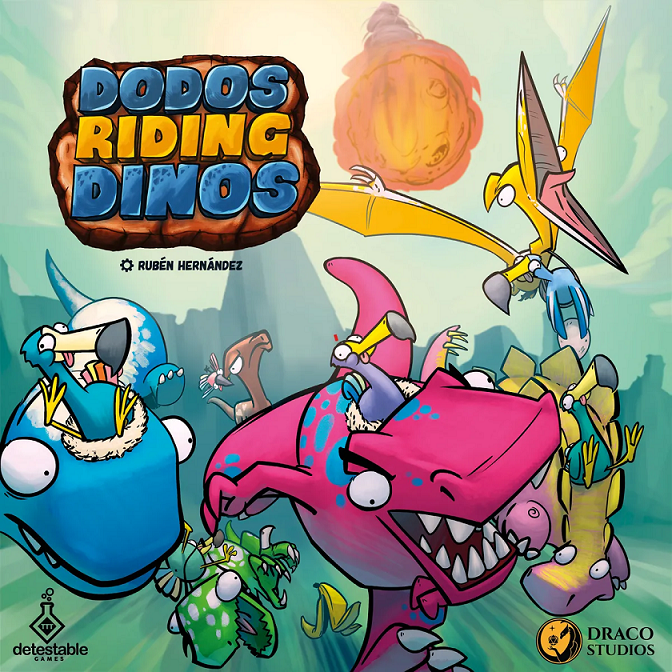
Jurassic Kart – A Dodos Riding Dinos Review


-
The Players' Aid

- Interview with Peregrine Nicholls Designer of Limits of Glory Campaign VI: Jersey from Form Square Games Currently on Gamefound
Interview with Peregrine Nicholls Designer of Limits of Glory Campaign VI: Jersey from Form Square Games Currently on Gamefound
A few years ago, we became acquainted with Andrew Rourke through his Coalitions design from PHALANX that went on to a successful crowdfunding campaign and has recently been delivered. He has since been a busy guy with starting his own publishing company called Form Square Games and also publishing the first 5 designs in a new series called Limits of Glory that will take a look at the campaigns of Napoleon and other contemporary conflicts. In Campaign I, which is called Bonaparte’s Eastern Empire, the game is focused on the campaign of the French in Egypt between 1798 and 1801. Campaigns II, III and IV was Maida 1806 and Santa Maura & Capri. Campaign V was Donning the Sacred Heart, which covers the Vendee Civil War, and just recently fulfilled as I have my copy sitting on my gaming table awaiting an unboxing video.
And now, recently, Form Square Games has announced the next entry in the series which is a two-fer with Campaigns VI and VII called Jersey New Jersey and is set during the American Revolutionary War but also including a 2nd game called A Strong War set during the French & Indian War. I think that these games are well timed with this year being the 250th Anniversary of the signing of the Declaration of Independence and I look forward to playing and exploring both of these games. I reached out to the designer of Jersey who is Peregrine Nicholls about an interview to give us a look inside the design and get more information and he was interested in answering our questions.
If you are interested in Jersey, you can back the project on the Gamefound page at the following link: https://gamefound.com/en/projects/form-square-games/jersey-new-jersey–a-strong-war
Grant: Peregrine welcome to our blog. First off please tell us a little about yourself. What are your hobbies? What’s your day job?

Peregrine: I have been a wargamer ever since my Dad came home with a 1912 1st edition of Little Wars by H G Wells, when I was 8. I have very fond memories of us playing toy soldiers on the floor using these rules and firing matchsticks at each other’s troops from toy artillery pieces. I still have the book and even recently bought a Britains 25pdr gun on eBay to add to my display shelf! Wargaming ballooned from there and today 50 years later I have almost 25,000 miniatures and over 400 board games!
Apart from reading (mainly history books or historically based novels), my main other hobby is following my beloved Leeds United, an English football team, whom I always watch on TV and also manage to get to 4-5 homes fixtures per year – a 500 mile round trip from where I live now in south west England.
My day job is working in the family property business, where with my wife & son we buy, sell, manage and develop property.
Grant: What motivated you to break into game design? What have you enjoyed most about the experience thus far?
Peregrine: Andy, that is Andy Rourke of Form Square Games. I was being shown one of his games at a convention and after he had soundly beaten me, we had a beer and I told him about a game idea that had been sitting in my filing cabinet for almost 40 years! After boring him to death for 20 minutes, he said “I’ll publish that!” – at which point I was speechless! But two years later now here we are, at the Gamefound funding stage!
The most enjoyable part of the process has been rediscovering the history. A lot of reading was needed and now having the internet as a tool, (when previous work on the topic was pre-word processing software!), was a massive advantage and led me down countless rabbit holes of historical threads and narratives.

Grant: What is your upcoming game Limits of Glory Campaign VI: Jersey about?
Peregrine: I am responsible for the Jersey game, not the New Jersey game, which is Andy’s baby.
The Isle of Jersey is the biggest of a small group of islands just off the coast of France in the English Channel. When William the Conqueror (as Duke of Normandy, of which Jersey was a part) invaded England in 1066 the Channel Island become part of the English crown. When Bad King John (he of Robin Hood fame) lost Normandy to the French in the early 1200’s, the Channel Islands decided to remain English and they have been ever since – they are now self-governing British Crown Dependencies.
The French did try to capture them during medieval times, but it was half-hearted as the islands really had no particular value at that time. This changed when England and France became constant enemies in the early 1700’s as by then Jersey had quite a merchant fleet (because of its trade with its colony New Jersey) and like all merchantmen when war came, privateering beckoned.
Jersey then became a real thorn in the French side, massively disrupting French coastal trade; after the first year of the American War of Independence the Jersey fleet had captured and brought back to the island over 200 “prizes”. This is what led the French to the two invasion attempts; the 1779 aborted landing and the 1781 successful landing.
The game covers both these actions, with the 1779 scenario allowing a campaign to develop as if the French had actually landed and the 1781 scenario allowing the player to recreate the actual very brief campaign to see if they get the same or a different outcome.

Grant: Why was this a subject that drew your interest?
Peregrine: That’s easy – I grew up in Jersey! The Battle of Jersey was something we learned about, although since I left the island in the early 1980’s its anniversary has been elevated locally to include uniformed re-enactors in the town square and all the trimmings!
Grant: What is your design goal with the game?
Peregrine: To give the player an enjoyable game on a topic about which 99.9% of them will know nothing! That is one of the things I love about our hobby, discovering history, stories, narratives and personalities from military history about which one would have been ignorant, without our hobby.
Grant: How have you modified the Limits of Glory System to fit the American Revolutionary War?
Peregrine: I have not really had to change anything about the series. Andy and I have added lots of small flavor elements, but fundamentally the game will be very familiar to anyone who has played other games in the system.
Grant: How has designing a game in a tested and established system been? How constrained did you feel?
Peregrine: A little, but not hugely, as Limits of Glory is after all a very clever and innovative system, particularly the Event Clock and the Glory concept – so there was lots to work with.
Grant: What elements do you feel is most important to model in a game set in the American Revolutionary War?
Peregrine: The Jersey game really doesn’t have the feel of the AWI, in the sense that it is set in Europe, without all the quirks (terrain, native Americans, divided loyalties, etc.), that the fighting in America involves. It was coincidental really that the French decided to attack Jersey during the AWI, it could have easily been in a period during say the War of the Austrian Succession or the Seven Years War – or in the French Revolutionary & Napoleonic Wars that followed.
We have included John Paul Jones though – so there is an American link!
Grant: What sources did you consult for the historical details? What one must-read source would you recommend?
Peregrine: Lots of sources. The Societe Jersiaise was most helpful with access to the online resources, some of the contemporary documents were brilliant.

For example, we found a set of standing orders (in Jersey French – a local Normandy dialect) issued by the Colonel of a Jersey Militia regiment, specifying what his men were to bring to the muster point (the parish church) at that time when invasion alert was sounded. Once I had found a connection in Jersey, through an old school friend, who could translate it for us, (although there were a few words in the old copperplate hand writing that alluded us), we had a real flavor for the situation and it even led us to introduce a special rule into the game for 1779 – “harrows” – but you’ll have to buy the game to find out what they are and how they can be used by a player to frustrate his opponent!

One “must read” source? The Battle of Jersey by Richard Mayne, Phillimore Press 1981. There are still second-hand copies floating around on the web bookstores.
Grant: What was it about the French invasion of the Island of Jersey that made you believe the Limits of Glory System would work well modelling the campaign?
Peregrine: The Limits of Glory System is a very open one in campaign terms so fitting Jersey into its strategic mechanics was actually very easy.
Grant: What different units are represented in the game and what advantages do they bring to the battlefield?
Peregrine: In Jersey there are only four types – British Regulars, Jersey Militia, French Nassau Legion infantry and French Royal Regular infantry. There is also some light artillery floating about as well.
The troops were all of a similar standard, although the Legion was an inferior unit, represented by their stats on the Combat table.
We did of course incorporate contemporary doctrine, so you will find that a Jersey Militia officer cannot issue command to British Regular forces – “After all Sir, the cheek of the fellow!”.
Grant: What challenges does this campaign bring to the system? How did you address them?
Peregrine: Great question. There were several:
Tides – how were we to represent that Jersey has one of the most difficult tidal systems in the world (it’s tide range is in the top 5 on the planet), and it frustrated the 1779 attempt to invade and had an affect in 1781 also.

Alarm – in 1781, the island was asleep when the French landed, so we had to bring in rules for how the alarm would be sounded, spread, and how local troops would muster, etc.
Hopefully players will feel we have successfully dealt with these issues, with some simple and innovative mechanics.
Grant: What area does the map cover? Who is the artist and how does their style assist in creating theme and immersion?
Peregrine: It covers the whole island. Jersey is not a big place, approximately 45 square miles, so this was not difficult. We also have a separate “break-out” map showing key locations in the capital, St Helier, which will be the focus of the fighting in 1781.

The artist is from 1795! We were lucky that a contemporary map – The Richmond Map – has been digitized by the Societe Jeriaise and is available through their web portal, so were able to use that. Andy worked his usual graphic magic to clean up the color and tones and we are really pleased with the result. Little details like the fact that we have put the parish crest by the church for each of the 12 Jersey parishes (very important in the cultural & contemporary heritage of the island), is very pleasing and really adds to the period feel.

Also, the picture on the box cover and superimposed behind the map & the player aids is contemporary too – being the painting The Death of Major Pierson by John Singleton Copley which was created in 1782-3 and now hangs in the Tate Britain gallery in London.

Grant: What purpose do the various numbers appearing in each space on the board serve?
Peregrine: These are “difficulty” ratings – the lower the number the more difficult it is going to be to move your forces out of an area. You will notice that the Jersey map has some land and sea spaces that are rated “0” – we built some special rules in for those!
Grant: For those that are not familiar, what is a Glory Rating? What role does it play in the game?
Peregrine: It is a major part of all the Limits of Glory Series games – every Leader has a glory rating. It represents the ability, resources, luck and circumstance of each Leader and is used by them to mitigate failures or to turn success into better success. It becomes intuitive to use after a few game turns.
Grant: What was the process like assigning these ratings to the commanders on both sides?
Peregrine: Fun and difficult! Glory must be set to be playable as well as accurate, so we tinkered and play tested until it felt right.

Grant: What Commanders are included for each side? Are there any real interesting personas here?
Peregrine: Lots – I’m not quite sure where to start, so I’ll give you a few from 1781.
Major Pierson – the British hero, who has a St, Helier street and a pub named after him. At 24, he was young for a Major and because the two Colonels on the island were in England on Christmas leave when the French landed (12th night, 6 January, 1781), he found himself the most senior British officer on the island. He defied a written instruction to surrender his troops from the Governor of the Island (who had been captured by the French), mustered his men and some militia, assaulted St Helier, won, and was killed at the climatic moment of the final assault! Hollywood where are you!
Baron de Rullecourt – the French commander in 1781, who had been the 2IC for the 1779 expedition also. Not a Baron at all, but rather a clever charleton & adventurer who had ingratiated himself in the right circles and persuaded these people to let him command the invasion and had secured a promise he would become the new Governor on the island if successful. A good planner, he pulled off the daring night landing and marched to the capital without detection, capturing the governor in his nightgown! At this point though success went to his head and he assumed all the Jersey & British forces would just surrender as ordered – they didn’t! He was also killed in the climatic battle, at about the same instant as Major Pierson. Some very interesting artifacts were found in his travelling trunk after the battle – I’ll leave the reader hanging here!
Emir Said – a mysterious Indian Muslim “prince”. He accompanied De Rullecourt, dressed in full flowing Arab style dress, turban, the “works”, including a nasty looking large scimitar on his belt. He stood behind De Rullecourt making unintelligent but threatening noises during the surrender negotiations. We have brought him into the game as an NPC – he is fun and unpredictable!
John Paul Jones – a single source identifies the AWI hero as the commander of the naval flotilla for 1781, (following his success at the Battle of Flamborough Head), so of course we had to include the “Father of the American Navy” in the game!

Grant: What is the makeup of the Combat Table?
Peregrine: It is pretty standard for the Limits of Glory System with different troop types (British Regulars, Jersey Militia, Nassau Legion & French Regulars) being given different abilities and success ratings.
Grant: How does combat work in the design?
Peregrine: Again, pretty standard for the Limits of Glory System – although that said there may be some slight changes to reflect the continual nature of the running fights, in what is a truly small campaign in terms of time span.
The big change for Jersey is that there are no sieges. The time span of the campaign is tiny where compared to other games in the system. The actual 1781 campaign lasted less than 1 day; and had 1779 resulted in a landing, 1-2 days would have brought the campaign to a conclusion. That doesn’t mean there are not castles & forts in the game however – we just have a different way of them possibly being captured!

Grant: What is the general Sequence of Play?
Peregrine: If the player has played any Limits of Glory Series game they will be right at home.
Each turn starts with an event, followed by momentum rolls, followed by alternate turns for the players to move or initiate combat, until both players run out of momentum.
Grant: What multiple strategic decisions are presented to the player every turn in this campaign?
Peregrine: Like all Limits of Glory Series games the player must focus in on the objective and get cracking with their plan or they will run out of time.
Who do I move? Where do I move them to? Can I risk it? Have I got the Glory to mitigate a failure? Where do I muster forces? Do I go and attack the French now, or do I wait until I can rouse more militia out of their beds?
Decisions, decisions, decisions!
Grant: How is victory achieved?
Peregrine: In 1781 the key to the whole game is Royal Square in the center of St Helier (this is where the real climatic battle took place) and whoever holds this location when the time clock runs out, wins.
In 1779 taking overall control of the island is the objective for the French and denying this to them is the Jersey players goal.
Grant: What are some basic strategies for the French and the British players?
Peregrine: That is probably too detailed to go into here, but Andy has promised that I can have multiple pages in the rulebook to walk players thorough some basic ideas for strategies for both games.
In essence though the French must successfully negotiate the tides & coastline to get their force ashore in a concentrated way and then either push for St Helier with the Governor & Royal Square as their prizes in 1781; or spread across the island capturing & holding militia mustering points & forts, whilst also beating the resident troops in battle in 1779.
For the Jersey player it is all about getting your troops mustered and then into strong enough groups to deny the French their objectives – in the words of Wellington, “give them a damned good thrashing!”
Both sides have equal chances of winning the game and with the fluid nature of the Limits of Glory System, replayability is high.
Grant: What type of an experience does the game create?
Peregrine: Tense, with an increase in this tension as the game proceeds – and hopefully fun! This has certainly been the experience of the scores of play testers we have played it with.
Grant: What are you most pleased about with the design?
Peregrine: All of it! The idea to bring a game about my childhood home to market has sat in my filing cabinet for almost 40 years, so brushing the dust off and making it a reality has been a dream come true for me. To think that the history of this obscure, globally unimportant, battle will be available to a wider audience is fabulous, as it has a fascinating and vibrant narrative with great characters and heroes that deserves to be better known.
I particularly love the map and the use of the John Copley painting in the game also, as a copy of this painting has hung in my home for as long as I can remember.
Grant: What other designs are you working on?
Peregrine: Wow, give me a chance! Just working on this one has been a major task! Let the dust settle on Jersey New Jersey and I’ll cogitate from there!

If you are interested in Jersey, you can back the project on the Gamefound page at the following link: https://gamefound.com/en/projects/form-square-games/jersey-new-jersey–a-strong-war
-Grant

Dale Yu: Review of Cucumber Catastrophe
Fight Bosses, Compress Numbers, and Make Wine from Tiles
Let's sample another handful of designs debuting at Game Market Spring 2026
Love is a Beatdown
by Justin Bell
“Daddy, can we play Thunder Road: Vendetta?”
One of the rules we have here at Casa de Bell is absolute: if the kids want to play a game from the adult game closet, I always say yes. (There’s only one game off-limits around here: Voidfall. That’s because I’m not teaching it…yet.)
One of the beauties of having kids who are now 12 and 9 is that many of the games in the adult game closet are drifting into the family game closet. As the kids get older, it’s been such a joy introducing new concepts and mechanics that were a bit dense even two or three years ago.
The nine-year-old was the one asking about Thunder Road: Vendetta. He was interested for two main reasons: first, he wanted to play the base game with the Carnival of Chaos expansion, because he loves the arena-style nature of that expansion map.
The second reason is why he really wanted to play: my boy was hoping to have another chance to beat down his dad.
In our first play of Carnival of Chaos, he acquired a “Super-Weapon” called Li’l Sammy, then used said Super-Weapon to shoot down my chopper—normally, choppers are invulnerable—on his way to a dominant victory where he wiped out all my cars.
(Yes, TR:V superfans, you are correct—there is a different scoring system in Carnival of Chaos, tied to “scrap”, the in-game cash that can be earned for damaging opponents. However, my son and I are simple with our approach to this game—the score is all about car kills. He won that first matchup three eliminations to one.)
After his victory, my son spent the next few days gloating about his victory.
At dinner: “Daddy, can you pass me…the Li’l Sammy?”
Before bed: “Hopefully you can beat other players to make up for your loss to me in Thunder Road.”
Walking to school: “I kinda want to play Thunder Road again to see if I can get the Li’l Sammy card. It was so cool shooting down your chopper.”
And on and on. For better or worse, my kids like variety; over the next few weeks, they kept asking to play other games. Weeks turned into months, and while I had the chance to play Thunder Road: Vendetta with other adults during that timeframe, I didn’t break out the expansion again until last week. That’s when my son walked into the game closet, saw the handsome red all-in Maximum Chrome edition copy of Thunder Road, and remembered Li’l Sammy.
“Daddy, can we play Thunder Road: Vendetta? Hopefully, I can get Li’l Sammy again.”
***
After I finished up the work day, I set up the Thunder Road: Vendetta base game with Carnival of Chaos on our kitchen table.
I insist upon using the Choppe Shoppe expansion content. That’s because I—well, now, both my son and I—love using the crew leaders and the car upgrades. The leaders use alternate “command boards”, the dashboard that accommodates each round’s extra die to trigger powers like nitro or the chopper, with asymmetric powers.
My son selected Bumpo the Clown as his crew leader for this play, a spooky-looking character who reminds me of Sweet Tooth from the Twisted Metal car combat games on PlayStation. Bumpo’s power is fine—he can reroll the direction die when his cars move in a slam—but his command board includes the Bump power, which triggers on 6s and allows Bumpo to move the other car on the first slam that turn, even if Bumpo has the smaller car in that slam.
I went with Machine Gun Joe, Esq. to lead my crew. Joe has a somewhat overpowered ability (at least, in the eyes of the nine-year-old, who has a tendency to call everything “OP” if it is not his own powers) to reroll the shoot die once during every attack action.
While I love the crew leaders, the best part about the Choppe Shoppe expansion is the car upgrades. During setup, each of a player’s three cars get outfitted with their own individual powers. For this game, I had a couple of simple upgrades—the Boost Switch, which gave me a +1 on movement, and the Heavy Frame, which grants the assigned car an extra damage slot (three slots instead of the normal two).
But I also had the Onboard Computer, which allowed me to ignore the effects of damage tokens when I assigned it to my large car (The large car is always the one that takes the most damage). So while I would still take damage during the game, it wouldn’t turn ugly, like things tend to do during a Skid or a Blast-Off.
With setup complete, we got rolling. The way the Terrordome (whoops, “Carnival of Chaos”) works, players drive their cars from three different entry-point track pieces outside the arena directly inside, then spend the game navigating pop-up hazards in the form of traps known as “Killer Pillars” that can eliminate cars through various game effects.
Of course, there are other hazards like those pesky opposing cars bent on using all manner of Super-Weapons and their Choppe Shoppe upgrades to take you out. There are a bunch of ways to get wiped out in the ring, and in my experience, games of Carnival of Chaos are a little quicker than the base game, especially at higher player counts.
Thanks to six Super-Weapon tokens scattered around the board, players are always gunning for the best stuff in the game. And while both my son and I were hoping Li’l Sammy would show up so that we could build on its legend, both of us drew cards that represented a bunch of fun toys that we tried to use to take each other out.
Unfortunately for my son, I got my hands on the Super-Weapon goodies first. Sometimes, love is a beatdown.
***
My first Super-Weapon pickup was the BFG…no, not that one. Here, the Big Friendly Gun (complete with a picture of what looks like a big chain gun with a smiley-face balloon on top) deals an extra face-down damage token each time the gun’s owner shoots and hits. I used that to deal two damage to my boy’s small car (the Doom Buggy) on a single turn, making it inoperable.
The Big Friendly Gun made more friends later in the game, when I used it to shut down my son’s medium car, the Avenger. My boy fought back. He grabbed a Super-Weapon token that became the Laser Kebab, which can shoot from the front arc of its assigned car any number of spaces, not just the one-space range of spaces directly in a car’s front arc. He poked holes in two of my cars the next two times he had the chance during his turns from across the arena. Damage, yes, but no inoperable status plays or eliminations.
Slams of inoperable cars into Killer Pillars and a Blast Off that shot one of his cars into the arena walls got me to a place where I was running a 3-on-1 break for the rest of the game. (Thunder Road: Vendetta vets, be honest: isn’t it a blast to watch what happens during a Stunt Die roll of a Blast Off? Goodness gracious, it’s hard to beat those moments in any game!)
Later, I picked up the Auto-Cannon for one of my cars, which lets a player shoot, move, then shoot again. My final Super-Weapon pick-up was the Torsion Dynamo, which removes a car’s guns but guarantees that the opposing car always moves in a slam. (Putting the Dynamo on my small Doom Buggy made that puppy a force!)
None of that mattered though…because as it turned out, I found an opportunity to take out my son’s last car with flair, using maybe my favorite elimination method in the game.
On my final turn, I was able to slam my son’s final car, the Eliminator, forward one space…right into the same space as his chopper, which he had tried and failed to use on his previous turn to take out my medium-sized Avenger.
Any car that ends its turn in the same space as any chopper is automatically eliminated. My son grew up in that final moment, and took his defeat like a man, ending our run of chaos (ahem, Chaos, with a capital C), with daddy taking home a three-to-nothing victory.
Even though Li’l Sammy never reared its ugly head, my son and I had a blast. Chucking those dice and talking a little smack and kitting out our cars and trying, but failing, to use our choppers, nicknamed “Blue Thunder” and “Airwolf” to wipe each opposing set of cars off the grid…it was all kinds of fun, win or lose.
I love playing games with the kids. I’m loving the chances I have now to get in more plays of the games I prefer, creating more memories along the way. And, I don’t mind handing out the occasional beatdown, especially when I can avenge an earlier loss.
That’s because I know what’s coming. The kids love wiping the floor with daddy from time to time, and giving them more chances just means playing more board games.
Pilgrim Poker concept art
Extra Beats: Games Played in 2026
Quick takes on Wabanti, One Mind, dnup, Up or Down?, and Big or Bang


/pic9536215.jpg)
