The humidity clings to your skin as neon reflections shimmer across rain-slick streets. The city is strangely alive with quiet ambition and louder dreams. Towering skylines loom above bustling districts, each corner a promise of profit, each landmark a prize waiting to be claimed. Deals are struck with uneasy confidence, plans unfold behind knowing smiles, and every move carries the weight of opportunity. In this restless urban theatre, only the sharpest minds will rise above the crowd. Welcome to Singapore Showdown by Eugene Lim from Genie Games with art by Marcus Quek.
“Someone else always has to carry on the story.” -Bilbo Baggins, The Fellowship of the Ring, J.R.R. Tolkien
Disclosure: played 6 time, beat the game in legendary
We’re both The Lord of the Rings fans (the extent of which we’ve mentioned in this other LotR game review). When we were looking for games to get at Spiel Essen ‘25 on the Spiel app, we saw that a game called The Lord of the Rings: Fate of the Fellowship was going to be available there. We found out that it’s co-op and by Matt Leacock, so we decided to add it to our list of potential buys. Unfortunately, it was already out of stock when we arrived at the publisher’s area, but the world made us feel better by allowing us to say “Hi” to Matt Leacock and get a signed poster from him.
We finally got ourselves a copy from a friendly local game store earlier this year. We were very excited. The box isn’t too big, but it has plenty of components inside. The first thing we did was to assemble the dice tower. We were thinking about how well-made the cut-outs were. It was beautiful, but when we tested it with three dice, a die got stuck inside. We followed the instructions to a T and made sure that all the parts were in place*. We checked everything, nothing wrong with the assembly, there just happened to be a shelf inside that dice could get stuck on, especially when throwing in more than two dice.
The components
We also liked the other components, especially the wooden troops; they were so cute. We also liked the wooden standees and the other wooden tokens. After checking out the components, we set up the board and assembled the Nazgûl miniatures. It was a bit frustrating because some of them didn’t fit the stands well. We were thinking about adding glue just so they wouldn’t fall off the stands (but we haven’t yet, so we just have to deal with it occasionally when we play). The game board is big and some of the cards are bigger than regular-sized cards. As such, setting it up needs a lot of space (at least 100 x 125 cm for two players).
Wooden troops (shadow troops not included)
During setup, there are two markers that players need to put on the board: the Hope marker and the Threat Rate marker. The Hope marker goes to the Hope track; this
determines how much hope the characters have left. If the marker goes down to zero, the game is lost. It’s really nice that they use the term “hope”. If the characters lose hope, the world falls apart. This is a great mechanical representation of the importance of hope in LotR. The Threat marker, on the othre hand, goes to the Threat track, which tells the player how many Shadow cards from the Shadow deck need to be drawn. The more cards you draw, the higher the likelihood that a troop will spawn, a troop will move to conquer havens, and the Nazgûl will search Frodo. Higher Threat speeds up the loss of Hope. We like how the Shadow deck works. Most Shadow cards have two different sections. The section to resolve is determined by whether the top of the deck has a banner or a flag, which we think give more variety to the game and makes it less predictable than the original Pandemic.
For the intro level, each of us must play two characters. Frodo and Sam (considered to be one character, just like Merry and Pippin) should be played in all games. For the first game, the set of characters is assigned to each player, but for subsequent games, the other three characters are determined by the randomly chosen objectives or are chosen randomly. We’ve never really been fans of not being able to choose a character freely, but we understand that it’s that way to make it more unpredictable for players to know what’s going to happen in a game session, which does increase replayability.
The number of objectives that need to be completed is based on the level of difficulty chosen. Regardless of difficulty, the ‘Destroy the One Ring’ objective is always the final objective. The other objectives, which must be fulfilled before finishing the final one, are chosen randomly. We really liked the objectives, how thematic they are and how tied the characters are to them. The objective cards made each of our games very different. LotR nerds can easily see how much they want to be loyal to the books (Legolas has brown hair in this game!) while also keeping the game’s mechanisms interesting and balanced.
On our turn, each of us can only perform five actions in total. One action must be performed by one character and four actions are performed by the other character. We liked this mechanism since it allows us to think more carefully in terms of the allocation of actions. This game doesn’t have a communication limit, so we were able to talk about strategies and help each other decide how to use our actions. There are six standard actions that almost any character can take, and characters can have additional abilities and actions on their character card. After performing their actions for the turn, the player draws two player cards.
The player card deck contains randomly selected event cards, Skies Darken cards, and region cards. The event cards allow the player to do an event any time in the game, even on another player’s turn. They serve as free actions. The Skies Darken cards increase the Threat level and can, in the wrong circumstances, even decrease the Hope level. The region cards contain symbols, which are required to perform some actions, to re-roll dice, or to remove extra troops after a battle. One interesting symbol is called Resistance, which is represented by a ring symbol. We assume it symbolizes resisting the power of the One Ring.
After finishing a Legendary game
We won the introductory game, but lost the standard game the first time. We won again and won the other difficulty levels as well. The first game was quite difficult, but it got a bit easier as we played more, even when we increased the level of difficulty. But in a way we felt that we were just lucky whenever we won because of the dice-rolling mechanism that happens (which is dependent on how low Hope is and how many Nazgûl there are in Mordor, which means that if the Hope meter is full and there are no Nazgûl in Mordor, then no roll is required) once Frodo and Sam reach Mount Doom and Frodo tries to destroy the Ring using five Resistances.
Our Final Thoughts:
Fate of the Fellowship is a really good game. One can see the amount of effort that was put into it. Despite the slightly underwhelming fulfillment we felt whenever we won, all the games that we had were fun. The different possible sets of objectives and events, and the way the Shadow cards work, made us more engaged and excited. Sometimes we would smile, thinking about how different the paths and choices our characters took were from how it happened in the books. It’s like the characters are in alternate worlds but the only thing that is necessary and can never change is the destruction of The One Ring. Even if the final objective is always the same, the variety from the objectives and the choices we made made for a very fun game each time. As they say, it’s sometimes about the journey, not the goal.
What we like:
assembly and storage of dice tower
randomized sets of objectives
theme-mechanism relationship
mechanism of the Shadow Deck
emergent story-telling
the concepts/keywords
Legolas’ hair
What we do not like:
the final dice roll (if required) sometimes doesn’t matter
some wobbly Nazgûl
What Kaysee also likes:
well-written rulebook
What Kaysee also doesn’t like:
Legendary level doesn’t feel significantly more difficult than the standard level
Winning doesn’t feel rewarding sometimes
What Max also likes:
replayability
Kaysee’s rating: 4/5
Max’s rating: 4/5
Combined rating: 4/5
*It’s not. We flipped one of the pieces, and now it’s fixed. Please see boardgamegeek.com/thread/3542211/anyone-with-problem… for more info in case you experienced something similar for more info in case you experienced something similar.
Reference:
Tolkien, J. R. R.(1991). The Fellowship of the Ring. HarperCollins.
Title: The Lord of the Rings: Fate of the Fellowship
Game Design: Matt Leacock
Illustration: Jared Blando, Cory Godbey
Publisher: Z-Man Games
I recently had an excellent, candid, meandering chat with Peter Vaughan (Cardboard Alchemy), facilitated by Will from the Hungry Gamer YouTube channel. Peter highlighted some really important reasons that publishers–even experienced publishers–consider crowdfunding, including a revelation about changes in distribution and localization.
I believe that crowdfunding remains an incredible tool for all types of publishers, especially newer creators, established publishers who are undergoing an important change, and publishers who want to offer super deluxe version priced beyond the limits of retailers. Here’s a quick checklist of considerations for new creators considering crowdfunding.
There isn’t just one way to serve customers, and I love seeing publishers trying and refining different methods to accomplish that goal, even if their methods are different than ours (we wait until our products are ready to ship before launching them on our webstore, like with the upcoming Finspan: Sharks & Reefs and Euphoria Essential, both on May 13).
Feel free to check out our 35-minute chat if this is a topic that interests you or that you’ve been debating. I’d love to hear your thoughts in the comments!
I’ll rest easier when I know they’ve reached shore
Peter checks out the packed new starter set for Dystopian Wars – Dominion of the Dragon!
Warcradle keeps hitting it out of the park with their releases and they’ve followed up the recent complete revamp of the Dystopian Wars rules with a brand new starter set packed with goodies – everything you need for two players to start playing this exceptional game of steampunk naval combat. Let’s check it out!
Making high quality tabletop gaming content at the EOG takes time and money. Please consider becoming a Patreon supporter or making a donation so I can continue this work! Thankyou!
Legacy games have probably had their golden days. They were something new that hadn't been done before in our hobby. They promised a unique experience of a game that would change as you played it. Not only that, the change would be permanent, requiring you not to only remove components, but actually destroy them, or put stickers into the rulebook, onto the main game board or otherwise apply them to make an irreversible change to the game. However, as exciting as the idea was, it never sat comfortably with me. In this article, I want to talk about this in more detail.
The Banana Ball League, which started in Savannah, is a new type of baseball where the entire focus is on entertaining fans. In fact, Fans First is the title of the book written by founder Jesse Cole, and across several examples it’s clear the extent to which he applies this ideology.
Here are my top 4 takeaways from Cole’s recent chat with Simon Sinek on the A Bit of Optimism podcast:
Every game might be someone’s first game. The Bananas have an incredibly long wait list to watch them play–over 4 million people. So when someone attends a Bananas game, there’s a good chance it is their first game. Knowing this, the Bananas approach every game like their first (and perhaps only) chance for every fan to have a great time. I think that’s a neat approach to tabletop games too: What if my game is someone’s first game? Or it ends up being the only game they play for a long time?
Fans can impact the outcome of the game. One of my favorite rules twists in Banana Ball is that if a fan catches a foul ball, it’s an out. In some ways, this is akin to crowdfunding, where backers can have a direct impact on a game’s final form. In others, it’s more like a game being a living entity that fans shape over time via fan-made content (like Wingspan’s promo birds) or lore-driven decisions (like what Thundergryph is doing with Etherstone).
The fan experience is prioritized over the sanctity of the game. I love sports, but I think sometimes long-standing, classic sports forget that they are ultimately a form of entertainment, and that means evolving with the times. A brilliant example from the Bananas is this rule: After a game reaches the 2-hour mark, no new inning can begin. This effectively puts a time limit on a sport that is notorious for dragging on, instead prioritizing the fan experience.
Look at the game through the eyes of the customer. The Bananas travel around the US to a variety of baseball stadiums, and whenever they arrive at a new place, the first thing they do is walk through the stadium and look at the field from various perspectives, including the most distant seats. They do this to see the game through the eyes of every fan, as they want to make sure they aren’t just serving those in the first few rows. I love this mentality, and it’s a great reminder for me to approach our platforms in a customer’s shoes (the content we create, our website, webstores, how our games appear at local retailers, etc).
Have you been to a Savannah Bananas game? I’m hoping to go someday, and I’d love to hear about your experience.
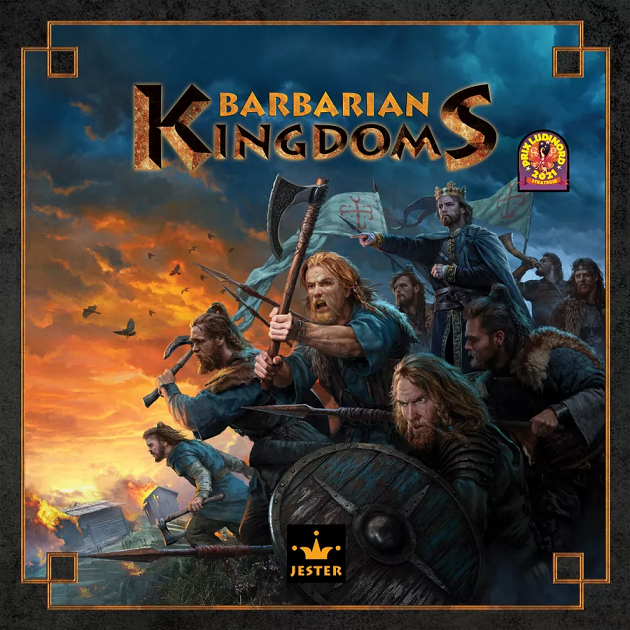
Barbarian Kingdoms is the kind of modest board game that comes in a standard sized box with a small selection of cards, a reasonable number of tokens, and a surprising absence of miniatures. While it is nearly two years old at this point, it actually appears more long in the tooth and weathered. I wouldn’t…
You've been woken from hypersleep. You're still a bit groggy, but it is clear something has happened. Something important. As the captain, you can't waste too much time. You have to get up to speed quickly. As your crewmate gives you a sitrep, it becomes clear that you have to act quickly. It's time to Escape Comics: The Alien Ship by Douglas Beech and Evan Duxbury from Jumping High Five Games with art by Maria Becvar.
“But you cannot trust us to let you face trouble alone, and go off without a word.” -Meriadoc Brandybuck, The Fellowship of the Ring, J.R.R. Tolkien
Disclosure: played more than 20 times, completed all the chapters and beat the game in endless mode
We’re both fans of The Lord of the Rings. Kaysee has seen the movies twice, has read the trilogy, and tried to learn the Elven language and their writing system. Max has seen the extended edition countless of times and has read the books even more, so it’s not surprising that we got very excited when we found out that there’s a cooperative trick-taking game based on The Fellowship of the Ring.
The box is really eye-catching. We really like its stained-glass look. It’s just so pretty that you wouldn’t hesitate to display it in your living room. And, like many other trick-taking games, it is compact (4 cm x 10.4 cm x 21.9 cm). It has three compartments inside, each has a ribbon to keep track of the chapters that you’ve finished. The components are as beautiful as the box. It only has cards, including the chapter cards, the main deck cards, the character cards, and the reference cards, and five wooden tokens.
The Components
The first setup was easy. Players only need the first chapter card, four character cards, two star tokens, the main deck, and the One Ring token. The chapter cards contain flavor texts related to the story and the chapter-specific rules players need to follow. The character cards contain character specific objectives that players need to fulfill, some chapters can modify or add objectives. There are short chapters and long chapters. Short chapters last one round, while long chapters take multiple rounds to complete. The star tokens are initially used to help players identify which characters are necessary in order to finish the chapter. For two players, three characters are selected. The deck should then be distributed as if there were three players. The hand of the “ghost player” should then be arranged in a pyramid form.
The Pyramid for two players
The player who gets the one ring card gets Frodo, the ring token and gets to choose and control the character for the pyramid. The second player chooses another card, but all starred characters must be chosen. It is not allowed for the second player to mention which character they would want to choose before the first player has chosen their second character(s). Talking about what suits you have is not allowed, but the advantage of having a pyramid character is that both players can partially see its hand. We like this mechanism, but we can imagine a scenario being impossible to complete if a specific character is the pyramid.
Frodo is the one who leads the first trick. To lead a trick means to choose any card to play, but the ring cards cannot be chosen to lead in the beginning. The next character, the one on Frodo’s left should match the suit played. If they don’t have any matching suit, they can play any card, even a ring card. After a ring card is played in this manner, the One Ring token gets flipped to its other side, indicating that ring cards may now lead tricks. Whoever plays the highest matching suit takes the trick unless the one ring card is played. The One Ring is the most powerful card in the game, as whoever plays it gets to choose whether to take the trick or not. Taking into consideration who takes the trick is crucial most of the time to complete the objectives and the chapter. We would suggest having three 6-sided dice to keep track of the number of tricks won. If neither of the players have D6s, a paper and pen would do. Take note that not all characters need to win a trick (as in the case of Pippin).
Every chapter and character has a different set of rules and objectives. Some chapters may take longer to finish than others. This is really good, as the different varieties make the game more exciting. That said, Kaysee finds the later chapters to be less exciting than the earlier and middle ones since there was tension that builds up in the middle chapters due to how the difficulty increases, but as one reaches the later chapters, there seems to be a drop in difficulty that can affect the excitement formed by the anticipation for something much more difficult.
Another thing that we both like is how the mechanics are connected to the theme. But there were a few times where some characters that could reasonably be expected to be available based on the story are in fact not. We assume it has something to do with the balancing of the game, so it’s not a huge deal for us. We also like the endless mode where the objectives may vary for each game.
The game is optimized for more than two players. To allow for a two-player game, the pyramid character was added. It works really well, but one player controlling two characters is something that we’ve both found mentally taxing at times as the decision making for the pyramid character is not shared.
Our Final Thoughts:
The Fellowship of the Ring is a beautiful co-op trick-taking game. The narrative and the theme were well integrated in the mechanics, and that’s really fun for those who like trick-taking games and The Lord of the Rings. People who aren’t fans of LotR may still like it due to the interesting changes of the mechanics in every chapter, but maybe not as much.
Although the decision making process is not equally shared for two players, we would still recommend it to two players who just want to play something less heavy and have some more relaxed evenings, especially if they are LotR fans and want to complain about how blond Legolas is in the movies and in this game.
What we like:
art style
campaign progression
connection between theme and mechanics
production quality
What we do not like:
extra cognitive load for one player
more optimized for more than two players
What Kaysee also doesn’t like:
less exciting in later chapters
What Max also doesn’t like:
the pyramid can sometimes make victory impossible
Kaysee’s rating: 4/5
Max’s rating: 4/5
Combined rating: 4/5
Reference:
Tolkien, J. R. R.(1991). The Fellowship of the Ring. HarperCollins. The Lord of the Rings: The Fellowship of the Ring – Trick Taking Game[Rulebook]. (2025). Office Dog.
Title: The Lord of the Rings: The Fellowship of the Ring – Trick-Taking Game
Game Design: Bryan Bornmueller
Illustration: Elain Ryan, Samuel Shimota
Publisher: Office Dog
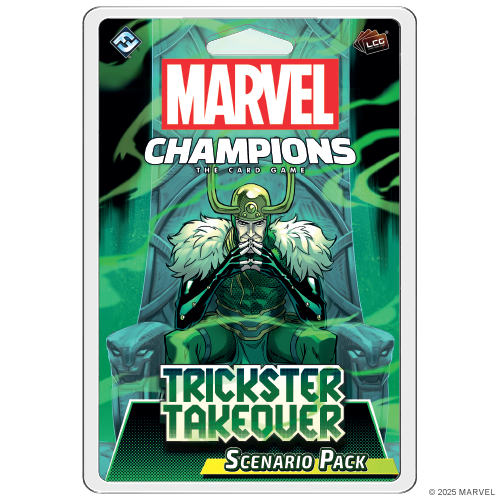
The Trickster or Loki as he is also known heads up an evil team with The Enchantress and they mess with the minds of the Heroes. This gives a fight that the Heroes are fighting inside their minds as well as other with other heroes while not knowing who or what they can trust. from the graphic novels he was known as Loki Laufeyson and he was the Trickster God of Mischief, Evil, and Lies, a member of the monstrous Frost Giants of Jotunheim that was adopted and raised among the Asgardians, a group of humanoid beings from the pocket dimension of Asgard, the Realm Eternal. Born smaller than the rest of his race and rejected by his father Laufey, he was adopted by the All-Father; Odin following the war. He was taken back to Asgard to be raised alongside his adopted brother Thor. He was worshiped by the humans known as Vikings and became part of Norse Mythology. Loki grew jealous of his brother after learning his true origin and schemed against him and Asgard. His later cosmic meddling led to the formation of the Avengers, “Earth’s Mightiest Heroes”. He has the ability to call his wolf Fenris to him amongst many other of his baddies. The Enchantress is a being from Thors realm and in fact she has the hots for Thor and is usually wound up by Loki into attacking Thor.
So how do these work in the game. First of all you have to take on the Enchantress, wh will hit you with a hypnotic gaze. There are five different hypnotic gaze cards each with a different enchantment on the opposite side, get too many charm counters and the card gets flipped to its unique “trance” side and gives you the Enthralled trait which has an immediate effect and also causes you to take a forced action. For example you might be confused or take damage and also forced to draw a card and play it. Also being enthralled will make side schemes nastier to deal with.
Then you have to deal with Loki, but things are never simple with Loki and you have to first deal with his Avator’s who are spread out. This is where you get to play the new “Epic Mupltiplayer Mode” as each player group has to deal with their own batch of the four avators facing off against a randomly-chosen avator that gets swapped out for another each time one is defeated. Each time you defeat one, you Shatter the Illusion that allows you to actually damage the real Loki. But of course Loki is going to just sit there and take damage, once he gets down to half heath, his focus intensifys and his avators get powered up making it even more difficult.
However, there are also some Enthralled Minions, who if you manage to knock back to their senses then they will actually team up with you to help take down the villains, which could well swing the battle back in your favour.
Peter unboxes and talks about the new Reichbusters: Reloaded – and showcases his fully painted set!
Let’s have a good look at the new Reichbusters: Reloaded upgrade set, my painted miniatures from the original set, and explore the million-dollar question – is it better than the original game now?
Making high quality tabletop gaming content at the EOG takes time and money. Please consider becoming a Patreon supporter or making a donation so I can continue this work! Thankyou!
Yesterday I announced the Euphoria Essential Edition, which combines the core game with the expansion and includes some revised rules/components, particularly the board layout. It will be on the Stonemaier Games webstore, ready to ship, starting on May 13.
While discussing the game on yesterday’s livecast, I started to reflect on the factors that result in us considering an “essential” version of an existing game (e.g., Viticulture, Between Two Cities, Between Two Castles, and now Euphoria). I mentioned a few then, and I’ve added a few more to this list:
The game only has 1 expansion, and we can combine the expansion with the game without significantly increasing the price of the essential version compared the original game’s price. This is critical, as we are always focused on price accessibility. If a $60 game and a $30 expansion combined together would still be close to $90 due to the manufacturing cost, we might as well keep them separate. But if the combination leads to some production optimization for a new price of $65, that’s great.
The combined game plus expansion is still accessible to newcomers. Any first expansion of a Stonemaier game is at least partially the result of learning from what people say about the game. Many–but not all–first expansions offer seamless additions rather than new elements that make the game more complex, making them prime for essential editions.
The game and the expansion have successfully been on the market for years. I like to give our games the time to find their audience and thrive in the wild for a long time before revisiting them before considering an essential edition (opposed to releasing the game and then creating a new edition right away).
The game is out of stock but still in demand. For us and the amazing retailers who support our games, we wouldn’t want to create a new edition of a game while there’s still ample inventory of the previous version. We also only consider games with continual sales month-to-month.
We are excited to revisit the game to offer the best version. Even if we’re literally just combining the core game and the expansion, there’s a lot of work involved, especially for the rulebook (but also potentially the box, reference cards, punchboards, etc). And sometimes–like with Euphoria–it’s even more work, as it’s an opportunity to improve the original. I spent a lot of time redesigning the board to make the order of operations and interconnected elements much easier to understand, learn, and teach, and artist Jacqui Davis completely remade the art to match the revised design. We’re passionate about all of our products, but there needs to be a special spark to revisit something that was deemed final for so long.
If there are changes, they do not negate the investment of anyone who already owns the game and the expansion. This is really important to me, and it’s why we created an update pack for Euphoria that includes the new board, updated rulebooks, and the smaller artifact cards. It’s for this reason that I try to be very intentional while weighing the importance of making gameplay changes opposed to just seamlessly combining the game and expansion.
What do you think about these reasons? Is there anything else you would like me to consider for future essential editions (none of which are in the works)?
If you’re curious to learn more about the inception of Euphoria Essential, I’ve included the latest design diary post below.
***
April 23: The Inception of Euphoria Essential Edition
In March 2025, almost exactly 13 years after finishing the design for Euphoria, it was time to reprint the game. We’ve reprinted Euphoria a number of times over the years–a reprint is simply printing more of the same exact game–but this time I reached out to Morten (who had designed the Ignorance Is Bliss expansion) with the idea of updating Euphoria with everything I’ve learned about the game over the last decade.
Here’s what I proposed to Morten:
Player mats and big tokens: Remember the tiles in Euphoria that let you quickly adjust token quantities (1x, 2x, 3x, etc)? I’m thinking we could update the player mats to have those tracks, allowing us to remove the big wooden tokens.
Board and bazaar: The inclusion of the player mats allows us to use the area of the game board currently occupied by tracks for the bazaar. It might be just a little tight, though–maybe decrease the size of artifact cards? Also, I would like to offer a double-sided board (bringing back the grayscale look of the original version on one side).
Recruits: I would love to offer a single set of recruits instead of telling players to use only the new or original recruits. To accomplish this goal, I’m open to removing some of the original recruits that aren’t balanced well for the expansion changes. I would also prefer to remove the factionless recruits. They’re clever, but by nature they are exceptions to standard recruit rules.
Markets: I feel similarly about the markets–I just want to shuffle them all together. If we need to remove some markets to accomplish this, that’s fine.
Gameplay: There are 4 elements of Euphoria that I don’t fully love: It’s difficult to teach despite its weight, I’m not sure the ethical dilemmas are necessary, it feels really bad to lose a worker due to a knowledge check (or even to see someone else lose a worker), and it feels impossible to catch up once someone has 9 stars and you’re behind. I’m not necessarily saying that anything needs to change to address these issues, but this is an opportunity to do so if we choose.
[end of message to Morten]
I’ll cut to the chase on a few of these elements: The final result was that we consolidated information onto player mats, we combined all recruits (102 total: asymmetric abilities that each player has), and we combined all market tiles (34 total: worker-placement actions to construct on the board). This essentially results in Euphoria plus the Ignorance Is Bliss expansion, offering a ton of variability with everything seamlessly integrated into a single box.
What do you think about this inception story? Join us tomorrow to dive into the core elements of the Essential Edition’s board, including a few minor-but-impactful rule changes! You can also click here to get a May 13 launch notification (followed by shipping later in May).

 Anmelden