
Normale Ansicht

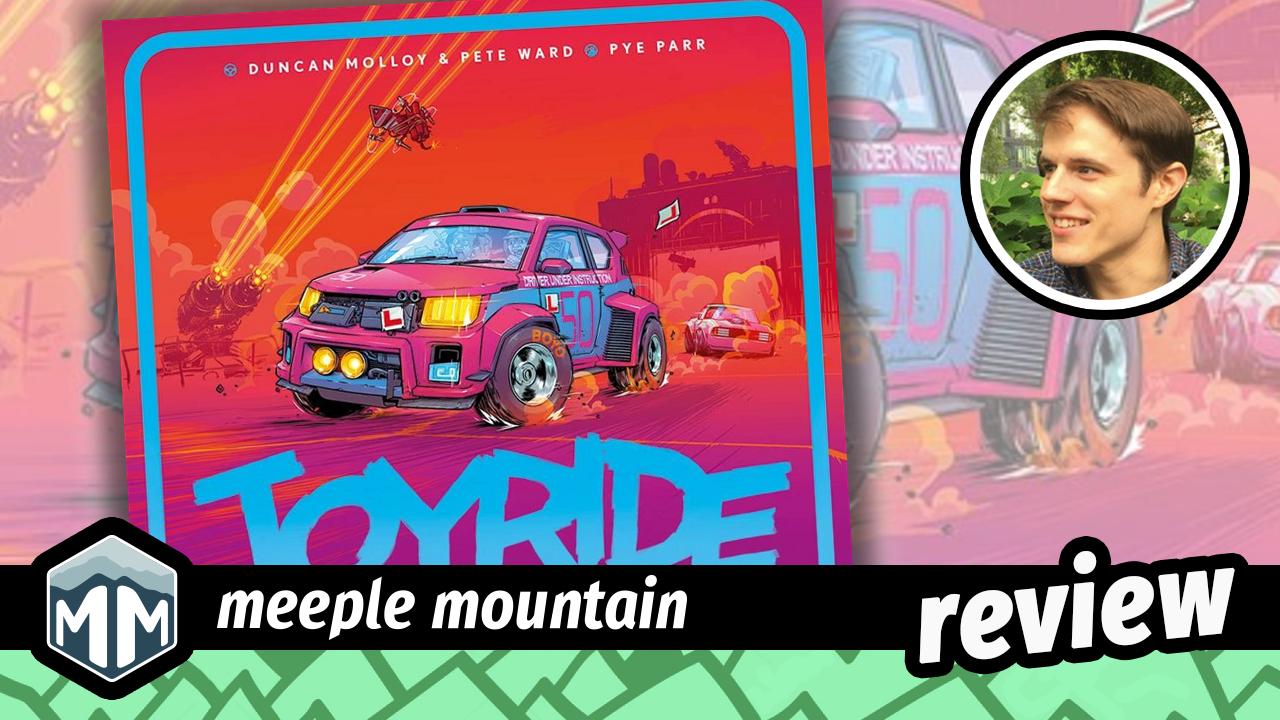
JOYRIDE DUEL: Next Gen Game Review

JOYRIDE DUEL: Next Gen is a bit of an oddity. It is marketed as the Mario Kart of racing games. That promises a certain amount of chaos and, indeed, chaos is what JOYRIDE DUEL has in mind. Rather than a fixed track, with the boundaries and prescribed routes such a thing necessitates, the board is open-world, with numbered gates you have to pass through in a particular order. There are exploding drones and flash grenades, oil slicks and mines that can be picked up on the track or acquired every time you pass through certain gates. The rules contain copious amounts of information concerning the collision of vehicles. Whether it’s a head-on or a side-swipe, you’ll know exactly what to do. The player dashboards have slots for damage, which slowly builds up and incapacitates your vehicle over the course of the race.

With all of these features in place, you too would assume chaos is the special du jour. Yet JOYRIDE DUEL is a surprisingly staid experience. Using a number of dice dictated by the gear you’re in, you zoom around the track, take corners, set up trajectories, and do your best to make it to the end, but it’s all much less dramatic than you’d expect. Across three races, I never added more than one or two pieces…

The post JOYRIDE DUEL: Next Gen Game Review appeared first on Meeple Mountain.
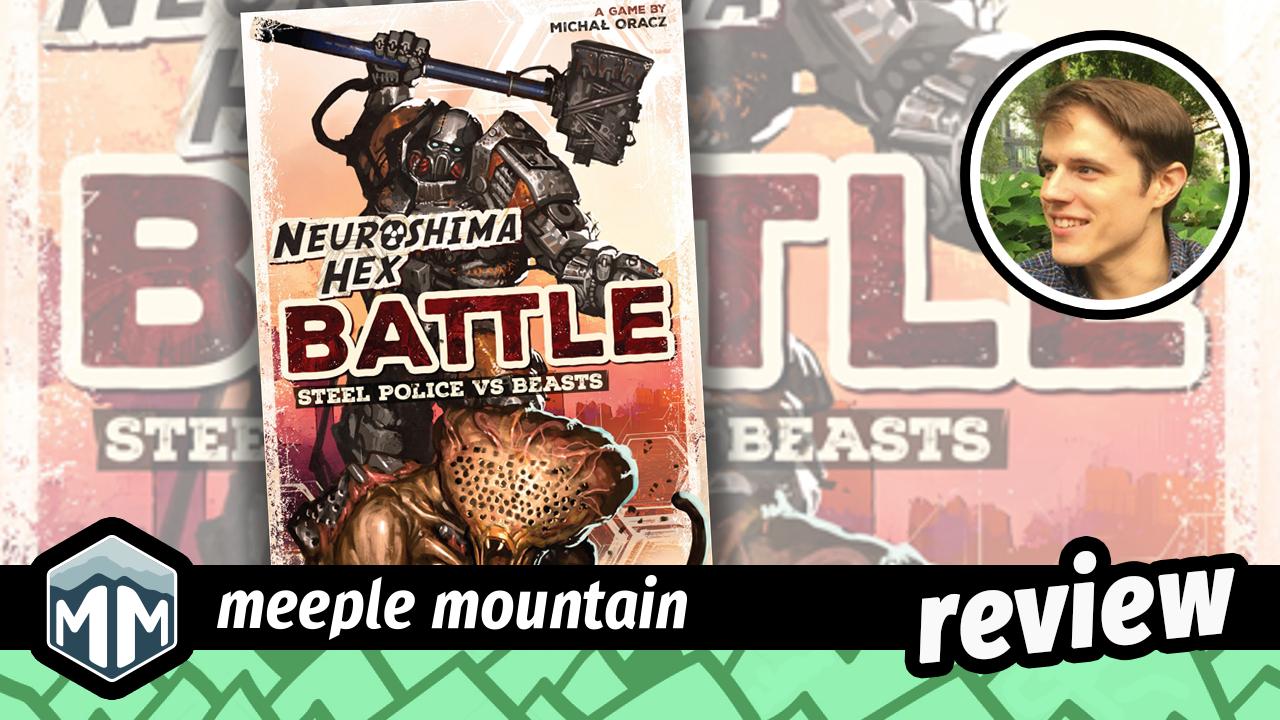
Neuroshima Hex: Battle

I couldn’t tell you when I first heard about Neuroshima Hex, which was originally published in 2006 and predates my time in board games by just about a full decade. At some point, though, Michał Oracz’s tactical tile-layer set up camp on the periphery of my awareness, built a large fire, threw on a stew, and did the only thing it had to do: wait.

My interest in Neuroshima Hex was inevitable. The only trick? I couldn’t find a way in. There are several editions, and oodles of expansions, and it all made the game a bit daunting. Publisher Portal Games seems to recognize that themselves, so for the game’s 20th anniversary, they announced not only a new edition of the base game, but Neuroshima Hex: Battle, a starter box for two that lets the curious among us give the game a try without going all-in. $25 isn’t much in exchange for scratching a perpetual itch, is it? I couldn’t say no.

The sum of Neuroshima Hex takes place in a post-apocalyptic world in which various factions are at war for resources and supremacy. You know, that kind of thing. Each player chooses a faction and its corresponding deck of tiles, then goes about attempting to systematically obliterate their opponent. The decks are made up of varying combinations of…

The post Neuroshima Hex: Battle appeared first on Meeple Mountain.

Corps of Discovery Duo Game Review

I enjoyed my time with Corps of Discovery Duo, Joy Cormier and Sen-Foong Lim’s two-player version of Corps of Discovery. Or, at least, I would have told you I enjoyed it. I certainly had a nice time playing this cooperative deduction game for two. But when it came time to write this review, I found I didn’t have much positive to say at all.

It feels unfair, but it also feels right. Prior to writing about Corps, I had been having an excellent day, so I know I wasn’t moody. I even re-read this draft after taking a nice walk. I gave myself a little treat. I hydrated. I took a nap. When I returned, I found that I couldn’t argue with anything I’d written. Corps of Discovery Duo did not work for me in any meaningful sense.

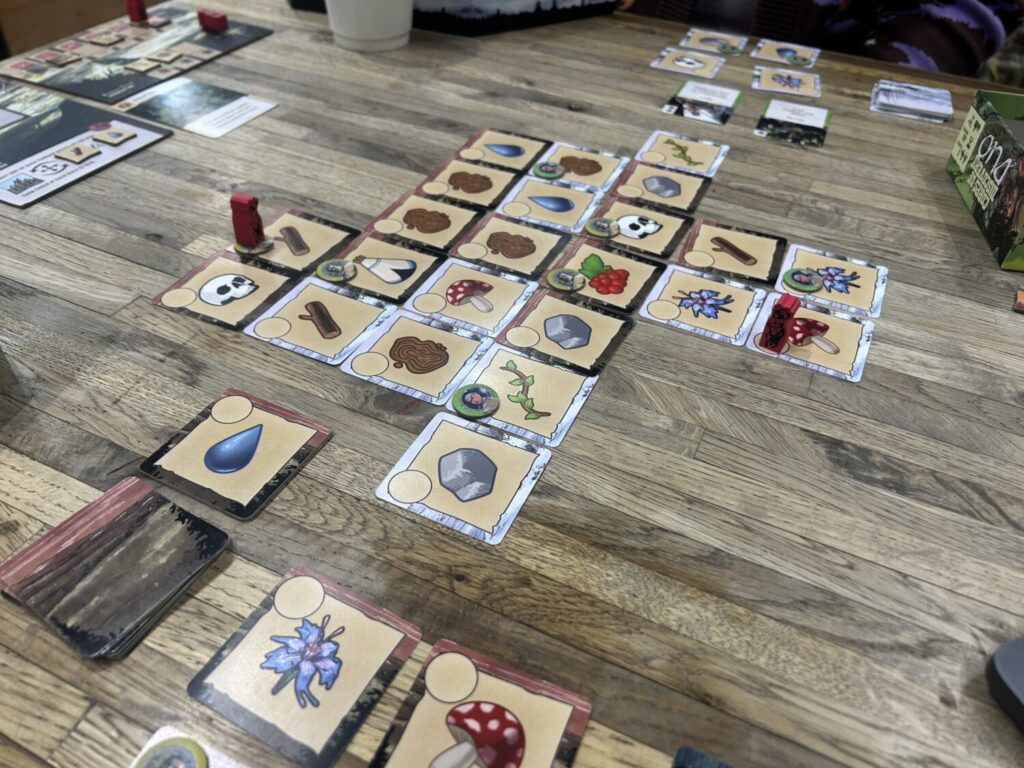
As Lewis, Clark, Sacagawea, or York, two players have to work together to map their way west. In practical terms, this is done by playing cards with one of ten different items on them out onto the table, following both public and hidden rules for each item while doing so.

A large collection of cards in a grid.

Here we hit our first bump. Why are we arranging items? Why aren’t…

The post Corps of Discovery Duo Game Review appeared first on Meeple Mountain.
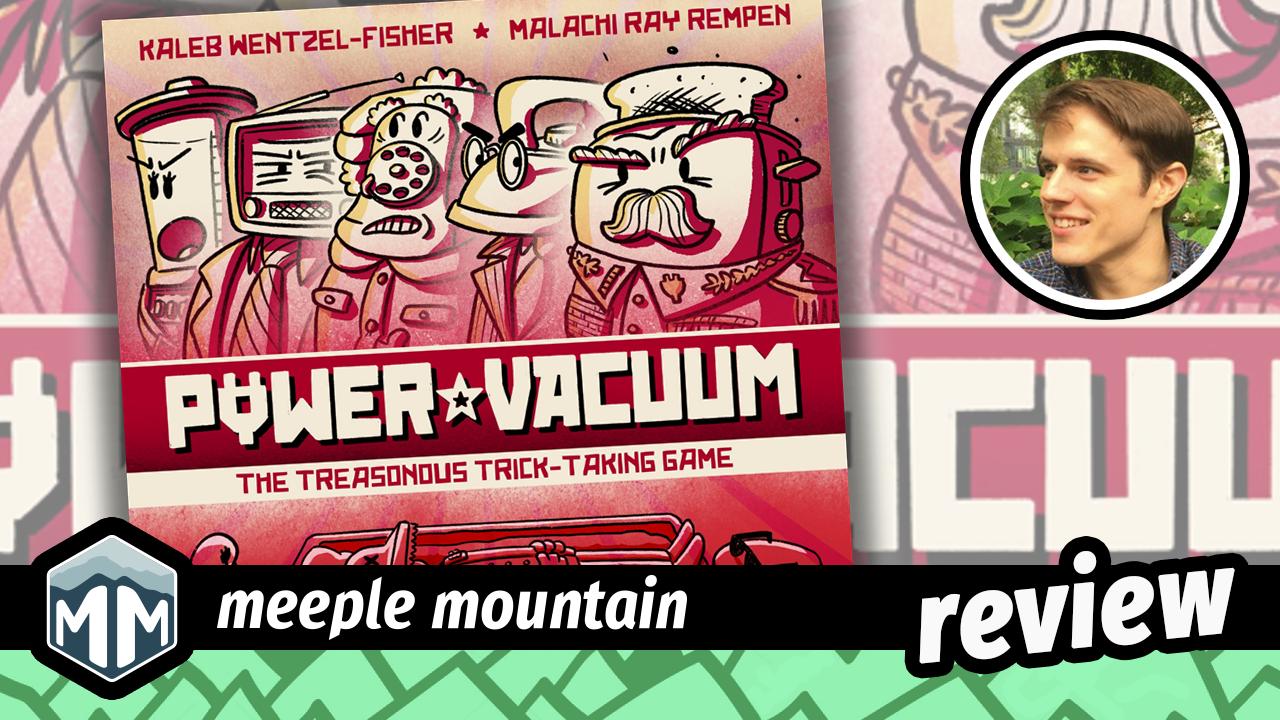
Power Vacuum Game Review

I approached Telephone in a dark, isolated room, far from where prying eyes might see us and ears might hear us.

“Telephone, I’m going to make you deal.”

He didn’t say anything. I knew he wouldn’t. Telephone had survived in proximity to the Supreme Socket by being a good listener. I took a drag from my cigarette, its red light dimly reflecting off the gold accents on the walls.

“Neither of us are replacing the Supreme Appliance. You know it and I know it. We don’t have to like it, but we have to face the facts. You’ve turned too many people off, and I...”

“You’ve burned too many people.”

“In a manner of speaking.”

A long pause. Not even a dial tone. He really knew how to draw you out.

“We both like Toaster,” I ventured.

“In a manner of speaking.”

“We both know how to handle Toaster.”

“Sure. I know how to keep my bread from getting burnt.”

“Blender and Radio are disorganized and at one another’s throats. Let them waste their energy. If we work together to back Toaster…”

“It works out better for both of us.”

“Exactly.”

“I see your point. You have a deal.”

For now, at least. So it goes. A temporary truce is better than a permanent war. I turned to leave.

The post Power Vacuum Game Review appeared first on Meeple Mountain.
Five Families Game Review

Five Families doesn’t quite work. Let’s get that out of the way at the start. Friedemann Friese’s latest big box game had a lot of promise. It mixes together a strange and confrontational auction system with area control scoring, it has wonderfully straightforward rules, and it has cute li’l mobster meeples, but none of these admirable traits can save it. Its joys are undercut by its runaway leader problem, the impact of the capriciousness of the card draw, and, worst of all, monotony.

Still, at least Five Families respects its audience enough to be one of the more interesting letdowns I’ve experienced in a while. I don’t think it’s a good game in the commercial sense, but I wish every game that didn’t work could manage to fail like this. It is something equally or possibly even more valuable than “good”: Five Families is worthwhile.

A lone yellow mobster meeple stands in Linden Hill.

Married to the Mob

The Five Families are the five principal branches of the Mafia as it operates in the United States. If you’ve seen The Godfather, you know who these guys are. While the idea of the Five Families feels irrevocably tied to mid–20th century America—probably, come to think of it, because of The Godfather—the…

The post Five Families Game Review appeared first on Meeple Mountain.

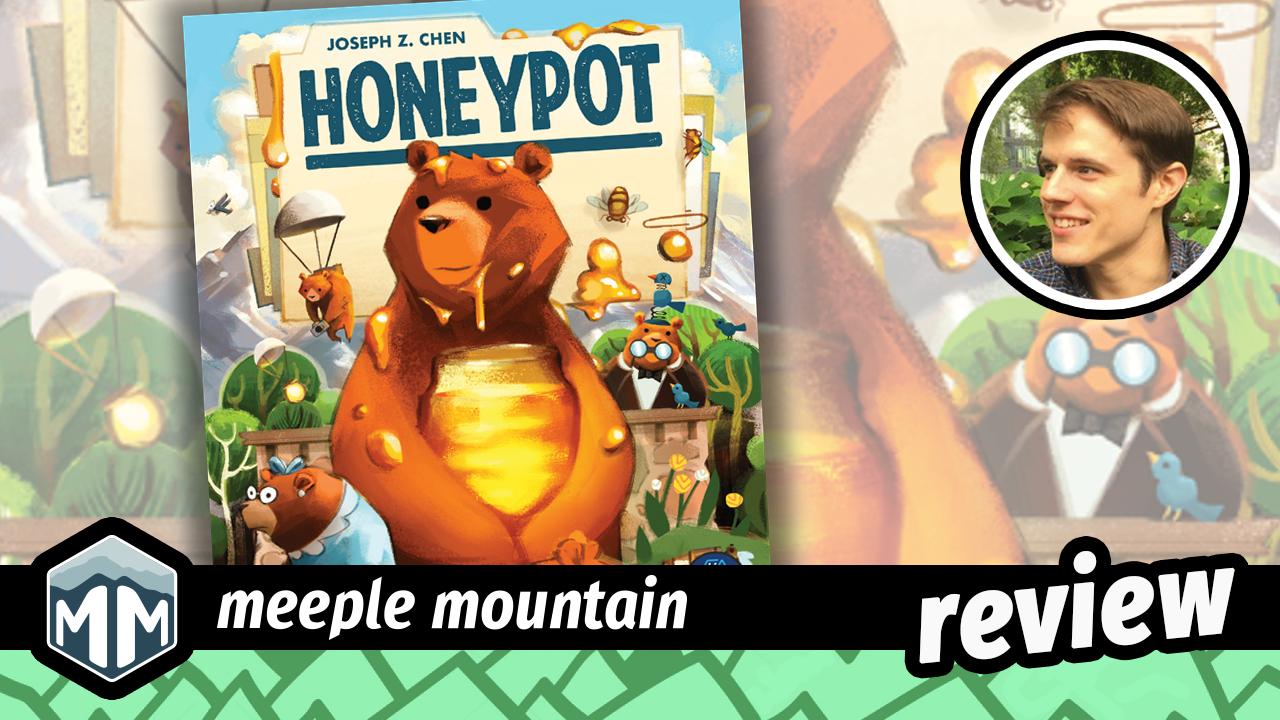
Honeypot Game Review

What a charmer, this Honeypot. It has a great hook. It’s hard to have a bad time when you’re tucking cards into tiny manila folders. Also, there are bear costumes. But I’m getting ahead of myself.

Honeypot isn’t quite I Split, You Choose, but it’s close. I Arrange, You Decide, maybe. I Slice, You Bite? I’ll work on it. As secret agent bears across five brisk ursine rounds, players draw six cards from the massive deck, arrange them however they see fit, place them in the aforementioned manila folders, and hand said folders to the next player in the direction of play. On your turn, you open your little gift and look at the first two cards. Now you have to make decisions.

[caption id="attachment_328210" align="alignnone" width="1024"]A pair of hands hold a small manila folder, into which a stack of cards have been placed facedown. Photo by Ilya Ushakov[/caption]

If you want the two cards you revealed, great. You keep them and that’s your turn. But what are the odds your opponent, this rival secret agent bear with a grin on their face, would put the best cards at the top? The honey only gets sweeter the further down you go, right? If you think there’s something better deeper in the dossier,…

The post Honeypot Game Review appeared first on Meeple Mountain.
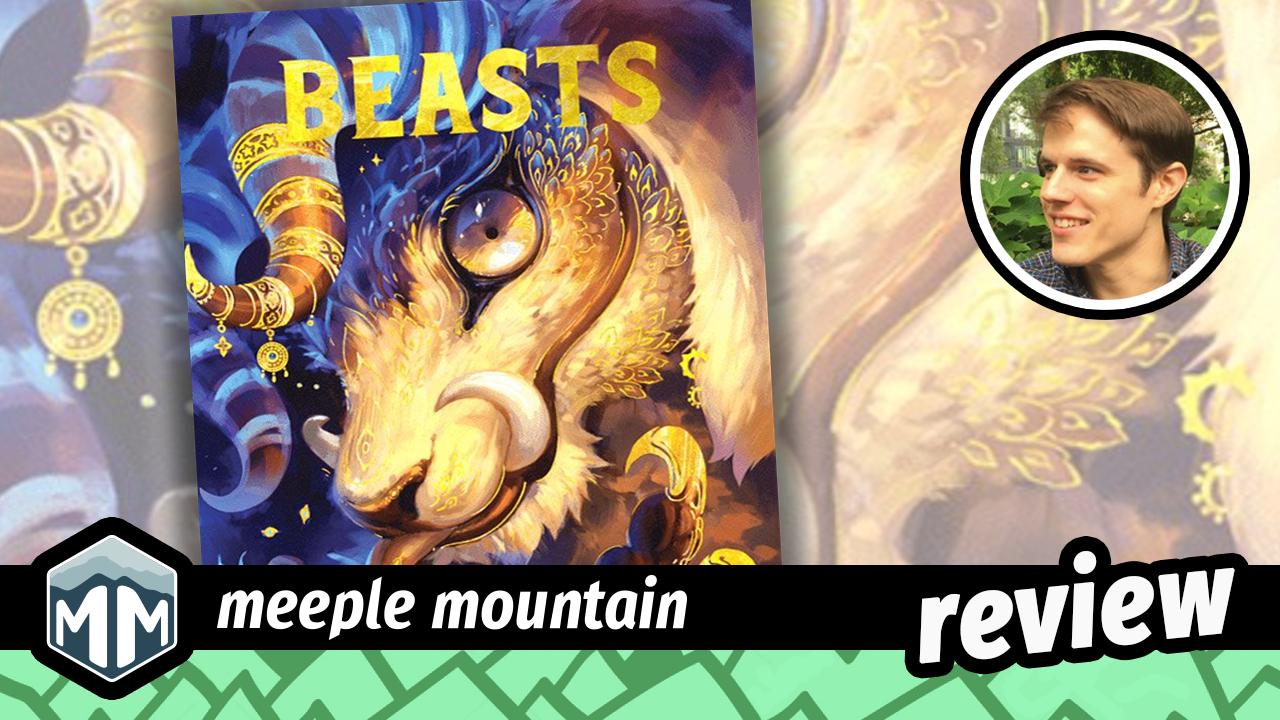
Beasts Game Review

I know how to sell a game. In my day job as an inventory manager for a board game café, I regularly pitch people on games they know nothing about, and I often succeed in making those games sound interesting. The approach is usually straightforward:

Catan is a game about gathering resources, building cities, and trading with other players. It’s also very, very rude.”

MicroMacro is a huge Where’s Waldo, but instead of looking for random people, you’re trying to follow their progress around the map to solve crimes and figure out what happened.”

Hive is just like chess, in that all the pieces have their own moves, but you’re not dealing with 600 years of scholarship and study, so it’s much more approachable.”
Every now and then, you get a game that requires a bit more qualification, like Wilmot’s Warehouse:

“It’s technically a memory game, but it isn’t really. It’s a game about telling stories that happens to be a memory game. You won’t even notice.”
Rare is the game that defies my ability to do a quick pitch. So rare is it, in fact, that until Beasts came along, I’m not sure I could have named one.

It’s not that Clarence Simpson’s card game is difficult to…

The post Beasts Game Review appeared first on Meeple Mountain.
Diver Go! Game Review

I realized long ago that publisher Itten has a library of games that balance precariously on a knife’s edge between Game and Novelty, often tipping towards the latter. They make fun, silly games that hinge on a hooky idea, games that often make a great first impression without offering anything for you to sink your teeth into, or even much of anything to gnaw on. Itten titles are often best as objects of appreciation, kooky displays of what creativity can lead to. My partner referred to them once as “coffee table board games,” a description so exact that I envy its creator.

The mileage you get out of any Itten game is by necessity directly proportional to how much mileage you get out of the hook, and how much you enjoy the presentation. The aesthetic of Crash Octopus, which looks as good on a table as any game ever has, has to be enough to hold your attention, because the game itself isn’t much. A game like Gravity 3 can only interest you if the very concept of a game made out of 15 small weights is enough to get you through the door. I am tempted to compare Itten to publisher Button Shy; they are each in their own way one of the hobby’s most consistently experimental…

The post Diver Go! Game Review appeared first on Meeple Mountain.

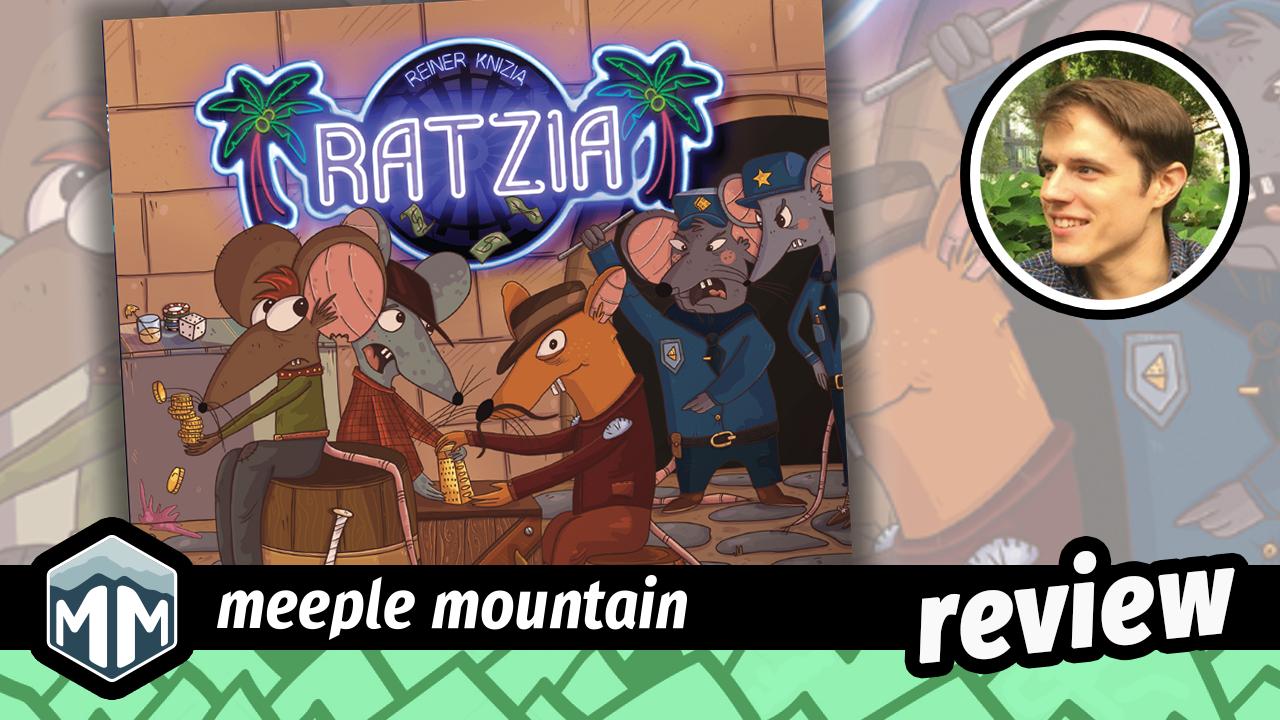
Ratzia Game Review

If you’re reading a review of Reiner Knizia deep cut Ratzia, I figure there’s a good chance you are already at least passingly familiar with the game Ra, the Egyptian-themed auction game with strong push-your-luck elements first published in 1999. Ra is regularly considered one of the greatest board games ever published. It has a hardy rating of 7.7/10 on Board Game Geek, and sits at #117 in their overall rankings. Not too shabby for a game that came out nearly 30 years ago, and that success is certainly deserved. Ra is a terrific game.

Neither Ratzia, nor its previous iteration Razzia!, are so fortunate. Both are held in comparatively slight esteem. Ratzia, a mafia–themed auction game with strong push-your-luck elements, is rated a 6.8 on BGG as of writing, and sits low enough in the rankings that the actual spot doesn’t warrant mentioning.

I find this curious, because Ratzia and Ra are effectively the same game. I do not mean to say that they are similar. No. They are, rule-for-rule, the exact same game. There are a few extra tile types in Ra, but that’s it. These two games are more closely related to one another than Hitchcock’s Psycho is to Gus Van Sandt’s shot-for-shot remake of Psycho, which at least had different actors. So why this discrepancy…

The post Ratzia Game Review appeared first on Meeple Mountain.
Emergency Exit Only Game Review

For some reason I thought fleeing an encroaching office fire would be less stressful than this.

Run for Your Lives!

Emergency Exit Only is a strange beast, a tile layer in which success or failure comes down to how good you are with spatial reasoning and memory. That will sound like a nightmare to some of you, and I get it. I can only assuage your concerns by emphasizing the degree to which this game is funny. Like That’s Not a Hat or the substantially more involved Galaxy Trucker before it, Emergency Exit Only is better when someone fails.

The goal is to get yourself to the end of an eternal, Severance-esque corridor, with a fire hot on your heels the entire time. You take turns adding a tile to the path, but the tiles are placed one atop the other. Only one is ever visible at any given time. Rather than seeing your path unfold before you, you are forced to picture it in your mind’s eye.

[caption id="attachment_327745" align="alignnone" width="1024"] Photo credited to @Olivier_Iello on BoardGameGeek.[/caption]

This means, rather inevitably, that mistakes will be made. If you think the path has hit a dead end, looped back onto itself, or that an otherwise invalid tile was played,…

The post Emergency Exit Only Game Review appeared first on Meeple Mountain.
Heat: Tunnel Vision Expansion Review

I’ve always enjoyed Heat: Pedal to the Metal, Asger Aleksandrov Granerud and Daniel Skjold Pedersen’s smash racing game. It is a smart system. Managing the ebb and flow of your cards to suit the layout of whatever track you’re barreling down comes as close as I imagine a board game can get to feeling like a race. Any time I think about Heat, I imagine tapping the clutch and recklessly shifting up a gear as I head into a monster corner.

If I’ve always enjoyed Heat, it wasn’t until recently, when I finally got to play with car upgrades, that I came to love it. I agree with Mark’s review, the base game is a little too easy, a little too canned. When everybody has the same cards, the figurative course of a race feels predetermined. With the upgrades, that’s no longer true.

Consider my last race in España, where my friend Boris had drafted upgrades for a car that could make massive gains on straightaways, and I had taken a gamble on aggressive turns. I was worried that I had over-leveraged my position, since España has two mid-race stretches that I would need time to get through and Boris could cruise through in a matter of seconds.

A board depicting a race…</p>
<p>The post <a href=Heat: Tunnel Vision Expansion Review appeared first on Meeple Mountain.

Ichor Game Review

I went on a bit of a journey as I considered the place of Ichor in designer Reiner Knizia’s oeuvre. My first thought, the one that came to me instinctively, was “Knizia doing an abstract game? Interesting.” My operating definition of an abstract game is relatively narrow. Rather than considering any game that does not have an explicitly implied—I’m not sure “explicitly implied” is possible, but I’ve said it, so here we are—story or setting “abstract,” I only refer to games in the wide family of things like chess, mancala, or Santorini as “abstract.” For my personal heuristic, there seems to have to be determinism, movement of pieces, and some heavy spatial reasoning.

My second thought was, “What a stupid thought. If anything, it’s surprising he hasn’t done more of them.” Knizia’s games are nearly always abstract, or at least abstracted. We could get lost in the weeds of “All board games are abstracted,” but I’m not interested. Application denied. Some games strive for a relatively representational approach to their setting. Terraforming Mars has you accrue resources to develop technology and build settlements on Mars. Other games don’t. Lost Cities is about playing cards in increasing order. It is also somehow about archaeological expeditions.

A red cloth board, divided into a 6 x…</p>
<p>The post <a href=Ichor Game Review appeared first on Meeple Mountain.
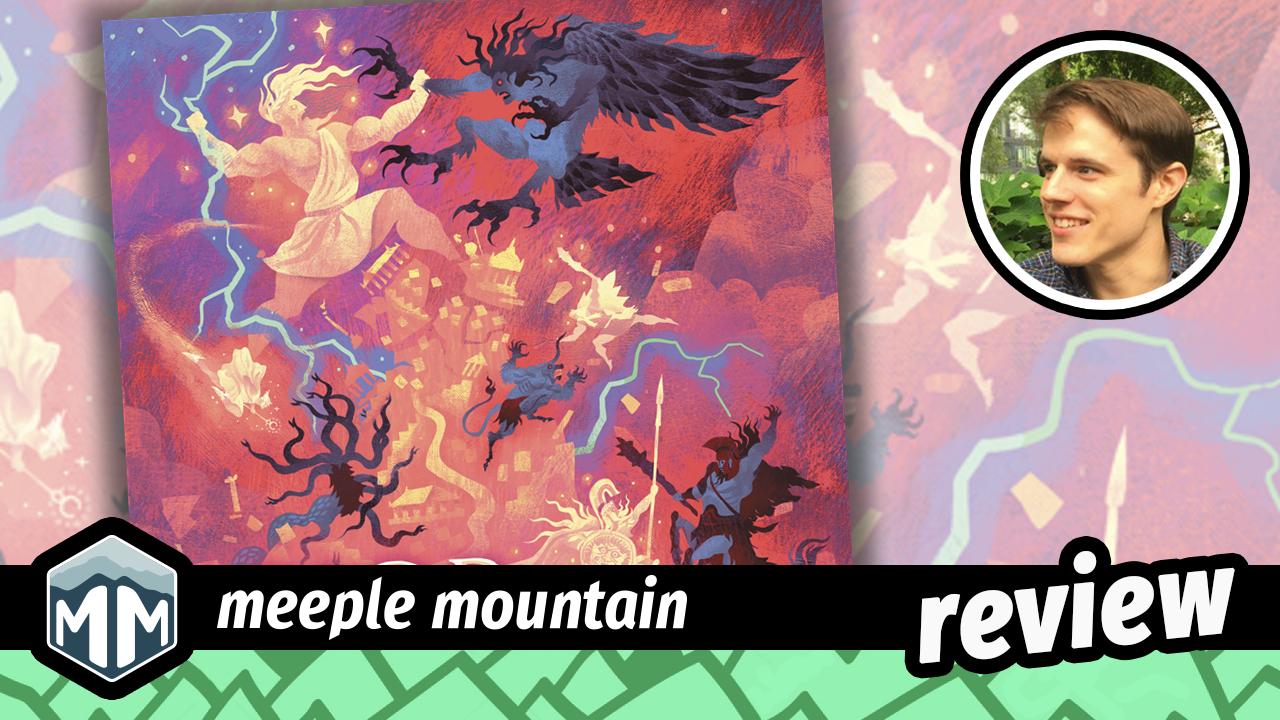
Iliad Game Review

Boy, what a game.

You’d think straightforward tile-layers would be tapped out by now, after thirty or forty years of design, but then you sit down and play something like Iliad, which feels as fresh as the day Carcassonne was born. It manages to be fresh and exciting while comfortable and familiar. That’s a hard combination to pull off.

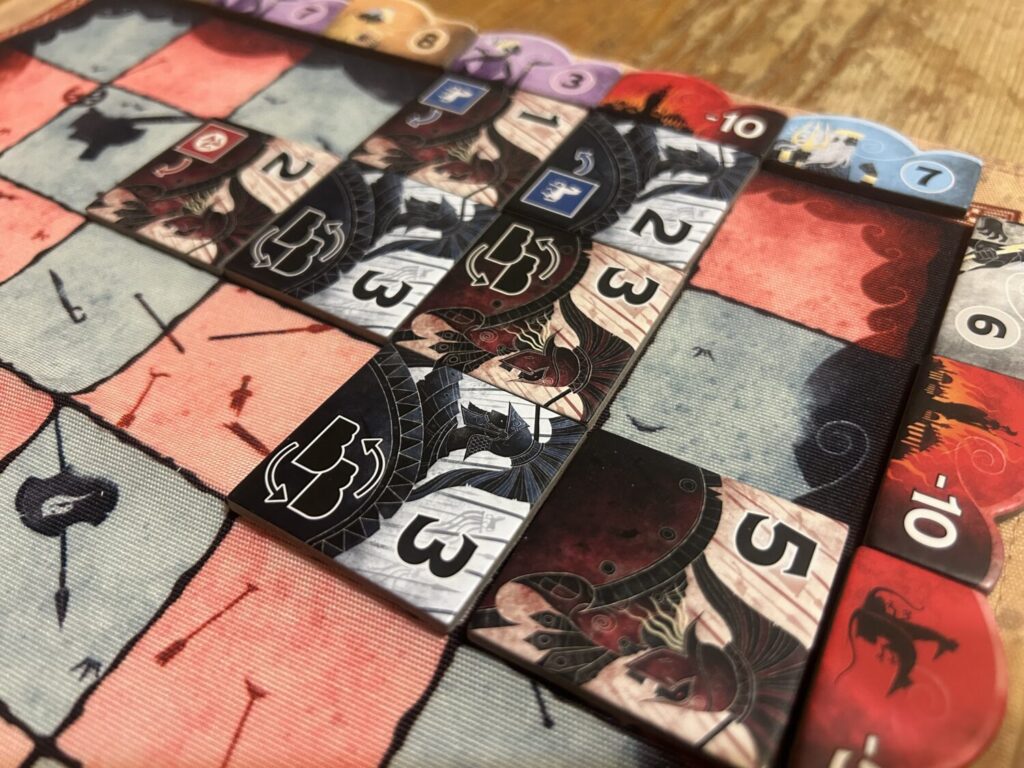
Each player starts with an identical deck of tiles, which vary in value from [input needed] to 5. You take turns choosing a tile from your hand of two and placing it on any contiguous space in your color on the 5 x 5 checkerboard playmat. Whenever a row or column is filled up, the values of each player’s tiles are added together, and the winner chooses from one of the two bonus tiles that sit on either edge of the relevant region. The other player takes whatever is left. The game ends the moment both players have played all of their tiles.

A selection of square titles in red and blue on a cloth mat. Each tile includes an illustration of a Bronze-age soldier and a number.

That, believe it or not, is that, as far as the broad strokes are concerned. With just a little more information, you’re ready…

The post Iliad Game Review appeared first on Meeple Mountain.
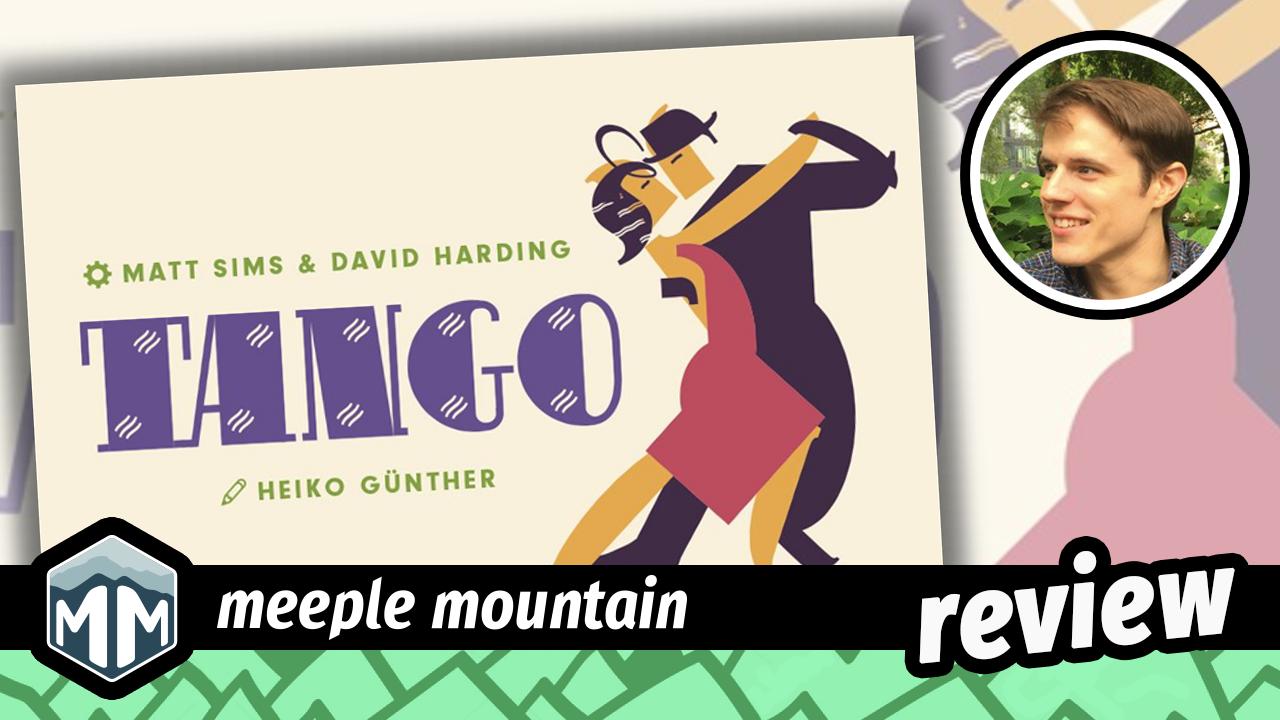
Tango Game Review

Tango.

What a great name for this trick-taking game. It is, of course, a cute name, given that Tango is exclusively for two players. It takes two to tango, and Tango takes two. But it takes more than a cute joke to make a title great. “Tango” is also apt. David Harding and Matt Sims have designed a game that is all about coordination. Also, frankly, there is something a little sexy about this game when you and your opponent are both locked in.

Let’s get into position. Both players are dealt two hands of cards. One hand is subject to the usual standards, by which I mean you hold it in your hand. This is the hand-hand if you will, the pie activo. The other hand, the pie soporto, is set out on the table in front of you in five stacks of two, with the top cards face-up and the bottom cards face-down. This we will call the table-hand.

Now we can begin the footwork. A Basic to the Cross isn’t so complicated, so let’s try that: I play a card from my hand-hand, you play a card from your hand-hand that follows suit if possible, I play a card from my table-hand that follows suit if possible, and finally you play a card from your table-hand…

The post Tango Game Review appeared first on Meeple Mountain.
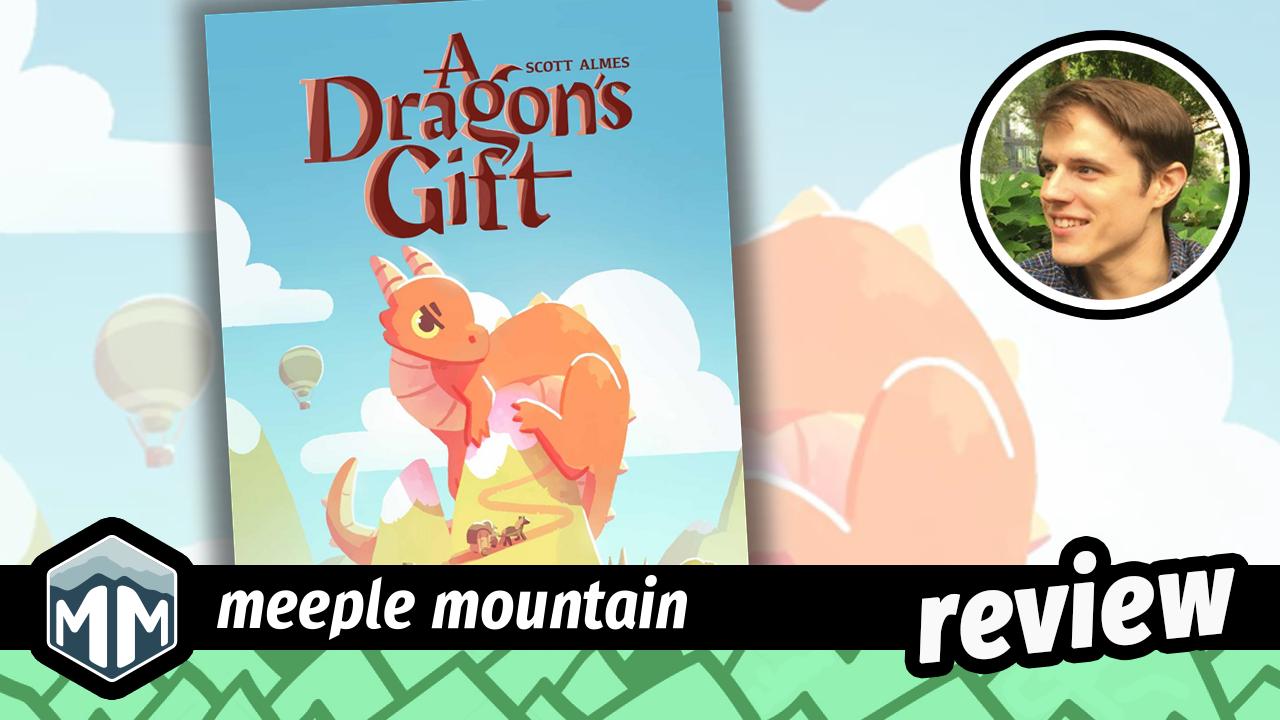
A Dragon’s Gift Game Review

There’s something about A Dragon’s Gift, Button Shy’s latest solo game from designer Scott Almes, that feels particularly pastoral. You can hear the opening strains of “Belle” from Beauty and the Beast as you open the Button Shy wallet and gaze upon these adorable illustrations. Then, just as the song explodes into hustle and bustle, the village's busybodies spring to life.

Every year, the citizens of Adragonsgiftopia (I assume) come together and honor the dragon who guards the town with a gift. Different citizens have different ideas. The baker suggests a treasure chest, which seems a safe bet. The bard wants to write a poem. Typical. The sorceress is in favor of a My First Chemistry set, presumably to encourage the dragon to pursue a career in STEM or to foster a general sense of curiosity and wonder about the world around it. You draw one of the six Gift Cards and set it aside faceup.

A bunch of cards laid out in a grid on a table.Once the gift is chosen, the town gets to work. The remaining 12 cards show the rest of the Village. Each card includes a winding set of roads around the periphery, a natural resource, and a business. The puzzle comes in lining up…

The post A Dragon’s Gift Game Review appeared first on Meeple Mountain.
❌