Normale Ansicht

Designer Diary: Stupor Mundi

13. Februar 2026 um 08:00

by nestore mangone


In December 2017 I was asking myself a couple of times a day whether Newton was ready, and I could not come up with a convincing answer; but since no game is ever truly ready, the very fact that I kept asking the question meant it was ready enough. I had worked on it so much, and with such stubbornness, that I was genuinely tired of board games, of players, and of myself. I therefore decided to take a few months off and focus on my main job, which in the meantime was falling apart.

Then in January 2018, Newton did what it was not supposed to do. Barely three weeks after my noble resolution, a leisure visit to one of the many castles built by Frederick II in southern Italy sparked a renewed curiosity about this figure I had already heard so much about. I read a few things from my father’s library and understood that I could not avoid starting to design a new game about the most astonishing character of that period.

So, on a feverish night, while snowflakes were falling on the heights of the Sila, I locked myself in my studio-laboratory and created the first version of a game that would stay with me for a long time: Stupor Mundi, which at the time was more simply called Frederick II.

The first version of the game was completely different from the current one; in the next image you can see the very first iteration, printed and tested.


At the beginning there was no central board, only a display to draft various types of cards and a personal board to activate them. The interesting part was that each player owned two castles, one on the left and one on the right, and allies determined how to score points in that specific castle against the castle of the adjacent player on the same side.

The idea was genuinely good, but several problems emerged. Deciding the seating order in a four-player game was the least of them. The real issue was tracking power relationships dynamically and giving players the ability to react, turn after turn, to limit losses, mitigating the despair of those who saw points being torn away relentlessly, sinking into the feeling of playing a wargame disguised as a euro.

The game was interesting, but it was not what I wanted to achieve. I had a specific type of player in mind, and that direction did not work.

Some elements, however, were already clearly defined and I would never change them; they were the pillars of the game.

1. The card system - Face down or face up? Pure emotion, hard choices, the feeling of being clever because you give something up for something bigger; pain and pleasure. This is how euros are made. Nothing is given away; every time you lose something to gain something else, perhaps better.
2. The concept of allies - Those little rascals were mini-games on a single tile, worlds within the world. If the game was a large and complex stellar system, those entities were planets, each with its own scoring cycles to be fitted into the larger design.

I kept working, with difficulty. I was short on testers and at the time I lived in Calabria. Finding suitable people for a game like this required hours of travel, which I could only afford every two or three months. In any case, I was determined to finish the job. I made many sacrifices, and by Essen SPIEL 2018 I had a new version to show to a few publishers.


The new version introduced the central castle. If I could not have players confront each other directly, I could do it indirectly. Thus the castle of Frederick II was born, the shadow fief that ties together the plots of every other fief. The castle, in truth, is not a castle. If you think it represents a pile of stone, wood, and lime, you lack imagination, and that is a problem if this is your main hobby. In the Middle Ages, castles were useful defensive structures, but they were also symbols; the symbolic value of the castle points to the concept of dominion over land. Building and dismantling the castle of Frederick II means acting within a network of pacts and agreements, those made with the little rascals: the allies.

In this version the castle had eight sides; it was all about dense construction. More than half of the actions were directed toward building, but the numbers never worked out, the game went on forever, and something was missing. Something I had already wanted to include in Newton but had failed to achieve: passive powers.

If construction dominated everything, there was no room for anything else that was complex and cerebral. For years I had wanted to design a game in which passive powers were central; yes, exactly those powers that we players forget to use, only to complain later and accuse the designer of our own negligence.

I therefore decided to change the numbers. After returning from Essen SPIEL, carrying with me a certain excitement sparked by the interesting comments of various publishers, I got back to work. I was truly enthusiastic and produced two more iterations in quick succession, but something still did not add up. Where could I place passive powers and give them a different meaning? I did not want to give up; I wanted to bring that aspect to light.

At the beginning of 2019 however, a novelty arrived swiftly, like a brigantine pushed by the most favorable winds. I had spoken with Simone Luciani; we were both satisfied with Newton and decided to start working on a new game with a scientific theme. After several conversations it became clear that Darwin would be the next project, and that I would handle the first phase of development. I therefore had to set Frederick II aside.

In September 2019, I returned to work on Frederick II. Some time had passed and I needed a strategy to restart. Destroying everything seemed the most intelligent thing to do. I deliberately deleted all files, spreadsheets, and destroyed the prototypes by burning them in the fireplace while cooking lentils in a clay pot. I bought a bottle of Irish whiskey, got drunk alone, slept for two days, and then started working on the game again.

The next image shows the step taken in January 2020. What was new? The mini-tracks with passive powers. What was different compared to all the other games with this element that I had played? Timing. The passive power was not something you kept for the entire game; it was a temporal opportunity. You had it for a limited time. Which time? You decided. You were the one saying, "This part of my life went this way. I change everything. I put myself back into play. I take a step forward." And once again that real, authentic concept returned: in life you win and you lose. Sometimes you have to let go (at the end, you lose everything and die).


Right around that time I decided to leave my main job and devote myself entirely to game design. Just like the workers in my game, who leave a space, lose a power, but immediately gain a new one - another "skill", as English speakers would say. This gave a new meaning to my existence. I lost something; I gained something else. It was not necessarily an absolute improvement; it was a step to be taken with the right timing. It was only a potential improvement, perhaps even a short-term worsening, but a move toward a major improvement in the near future - a tango danced with time and power relations. The greatest satisfaction comes when something you create speaks not only about the game, but about your life.

Does the game seem devoid of theme to you? Do you not feel the theme? I can assure you that, for me, this is not the case. I am sorry when this happens and I fully understand when players feel lost because they do not grasp the connections between things. I always try to create points of contact between reality and the game, but 1) it is not always easy, and 2) it is not my priority. A creative does not necessarily have to be a servant to other people’s needs for existential representation. In general, being someone’s servant because they have money to give you is not the most edifying goal a creative should aspire to.

At that point the game was very close to what you see today; the final step was creating a system to manage the displays with all the various elements: cards, the goods market, and the allies market. I therefore designed the board with five zones and the movement mechanism. It felt like a natural solution, something that emerged on its own.

By then the game was mature, and I found a publisher, Quined Games, who helped me greatly with their comments and experience.

The game then went through further slowdowns due to a series of problems: COVID and other personal matters. Then one day I was put in contact with the person who would become the illustrator of the game, Maciej Janik, a phenomenal artist. We talked about atmosphere, imagery, castles, and about what interested me from my point of view regarding allies - about a universalistic game in which allies spoke about a very important aspect of political life and of that historical period. The absurdity of the Crusades and the way Frederick II had addressed the problem. If on one side the game spoke about power relations and the ability to face sacrifices in order to obtain greater things, on the other it spoke about concord. A game about the Middle Ages without bloodshed, without hatred between religions or races, but only intrigues, machinations, and growth within the framework of diplomacy.

Some people believe that one medieval king is the same as another, that an emperor is nothing more than a meme, a warrior with a crown who fights like a ninja, killing armored opponents with sword blows. If you strike someone in armor with a sword you will not stop them, even if you are the protagonist of a movie, but Hollywood directors do not seem to know this. Frederick II was not just any character; he is not a boring generic icon printed on the sign of a medieval pub. Frederick II was one of the most fascinating figures in European history, but a game is not required to explain this to you.

In any case, one day this arrived at my home: the first advanced prototype of the game. I almost cried with emotion.


The rest concerns the work of bringing the game to BGA, the balancing process, the sleepless nights, creative insecurity, and the Gamefound campaign... but that is another story.

Life, Liberty, and the Pursuit of Board Games

13. Februar 2026 um 00:40

FIST BUMP

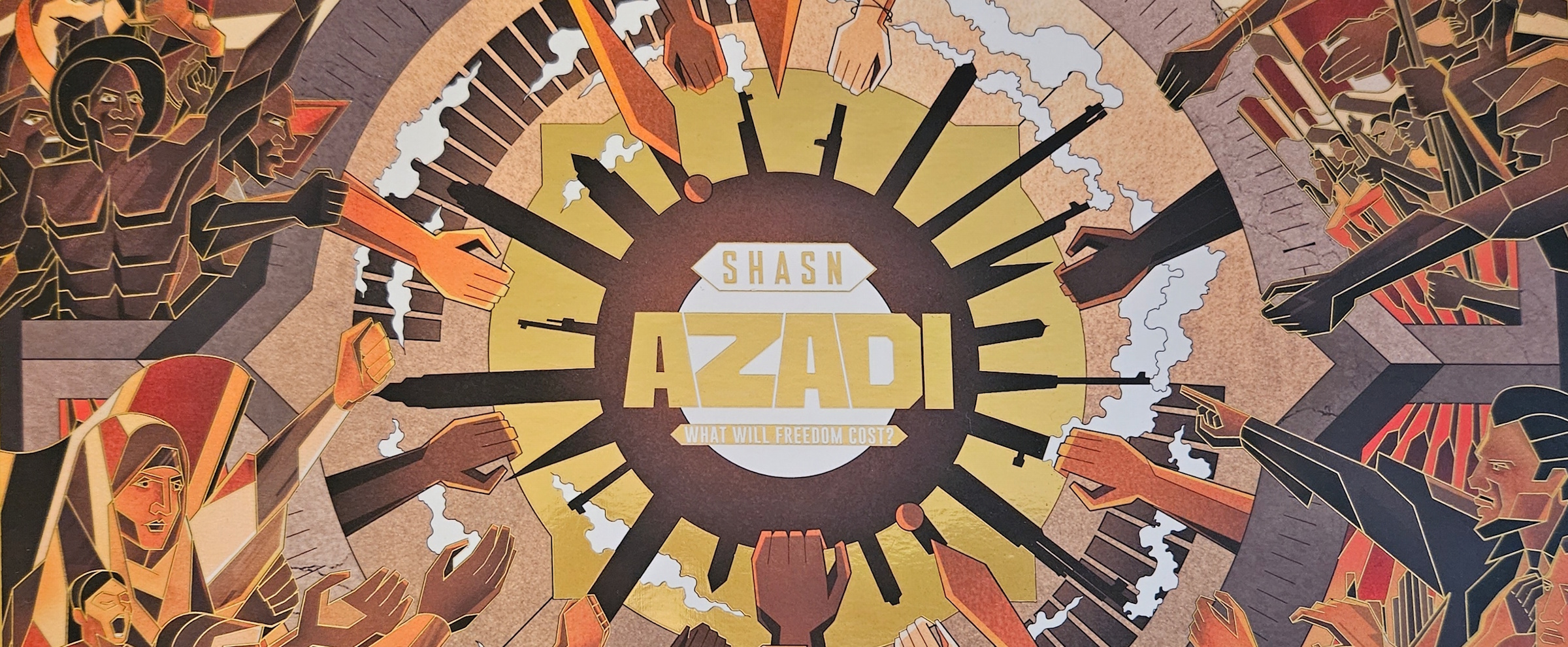
Shasn. Oh, Shasn. Zain Memon’s 2021 board game occupies a strange place in my memory as a vibrant, unsettling, funny, and tonally inconsistent game, and I mean that in the most complimentary sense. At the time, its message seemed to be that politicians are opportunists of the lowest order. And, hey, fair enough. My country is currently ruled by a conman who sells presidential pardons like they’re skincare products. But is that something we need a board game to tell us? I doubt those who haven’t gotten the memo are playing imported board games.

Here’s the thing. Shasn might not have imparted the most insightful message. But Memon has been plugging away at it in the background. Now, together with Abhishek Lamba, he’s released a sequel… expansion… thing. A standalone? Is that the right word? Who knows. Regardless of its proper assignation, Shasn: Azadi is twice as peculiar as the original game. Again, I mean that as a compliment. Mostly.

Settle in. This one’s going to take some doing.

In one session with my wife and sister-in-law, every single question posed to me had something to do with women's rights. And, of course, that was the session where I had been leaning into a Supremo strategy. I think my face was a permanent shade of pink.

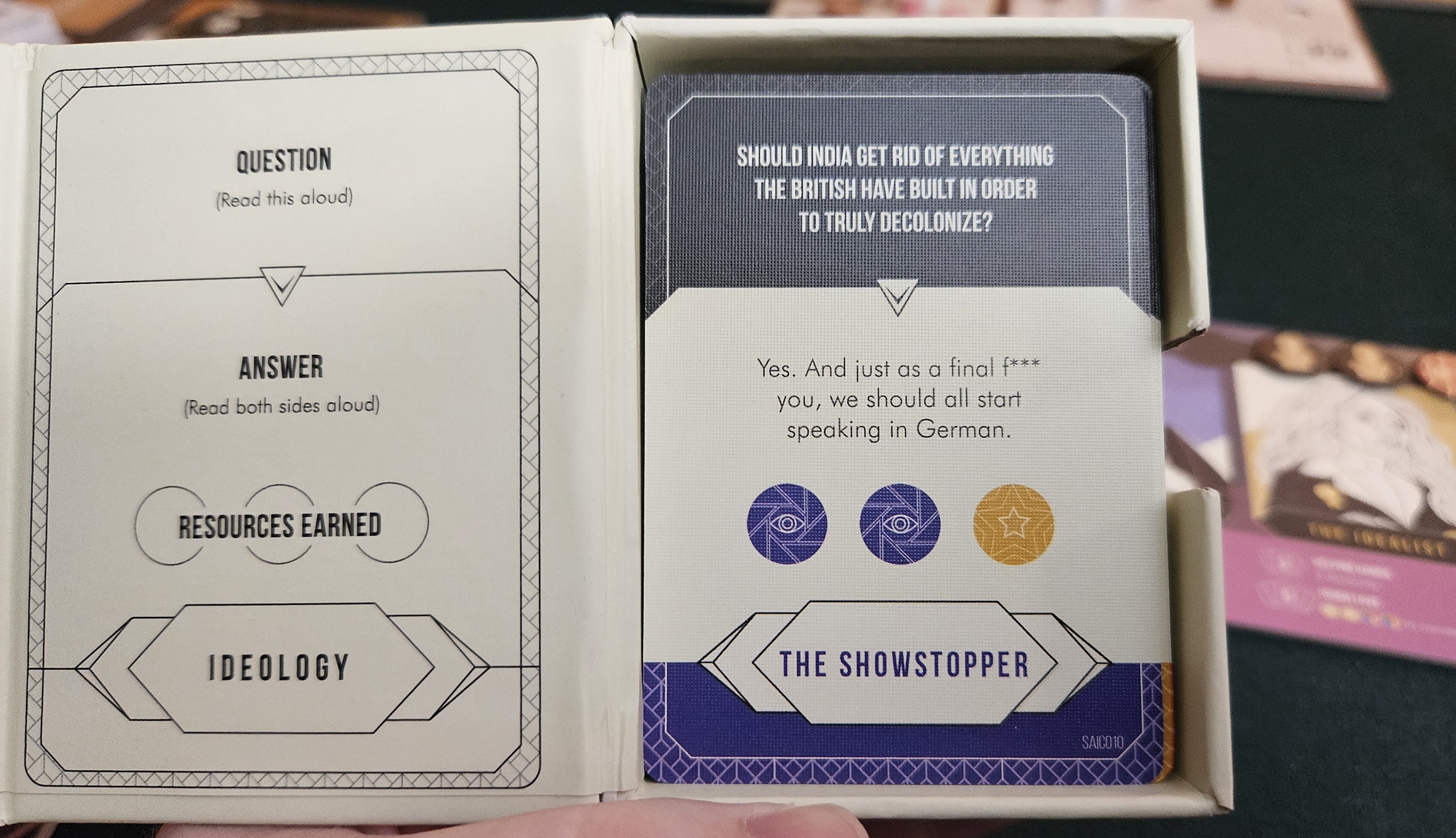
One of the many many many questions raised and irreverently answered by Azadi.

Part One: Call and Response

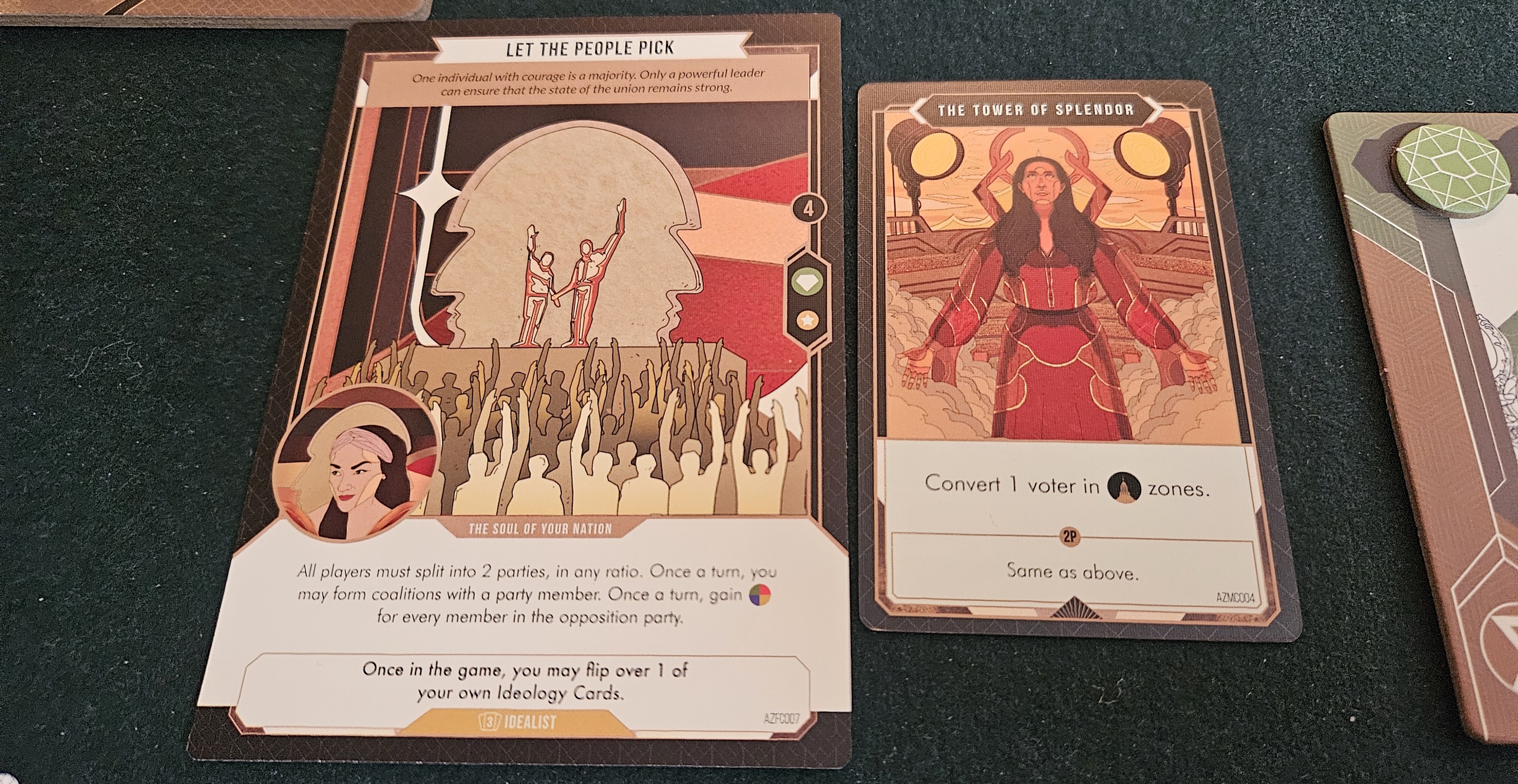
Every turn in Shasn opened with a question. As a general rule, these questions were hard-hitting, touching on topics as far-ranging as abortion, penal codes, human rights, ethnic cleansing, protected speech… anything and everything that might be posed to a prospective leader in an interview. The responses, meanwhile, were binary. Yes or No. Simple. Simplistic.

More than that, they were irreverent. Sometimes distressingly so. One by one, the game introduced serious topics only to lampoon them.

I plucked an example at random from the Egyptian Revolution set. Question: Should mothers be allowed financial custody of their children if the father passes away? (A) Yes. Women are fantastic spenders, they should be in charge of all money. (B) No. The Motherland can only flourish when the government takes care of its mothers’ finances.

Coming into Shasn cold, it would be easy to back away. What is this, one of those awful “offend everybody” party games?

Not quite. These Q&A sessions serviced the game’s intended message. Each answer fell into one of four categories. Broadly speaking, they represented archetypal positions adopted by politicians. Soundbites, basically. The Idealist might offer a platitude, something well-meaning but maybe not squarely positioned within the realm of the possible. The Capitalist would talk about the economy and the job market, how the children yearn for the mines, that sort of thing. Somewhat harder to peg were the last two personalities. Not because they aren’t recognizable, but because sometimes they blur into one another. The Supremo and the Showstopper. One for hard-line authoritarianism, the other for maximizing ratings. In my experience, those two tend to cohabitate.

Moreover, each answer provided a color-coded resource. Red for the Supremo, green for the Capitalist, and so forth. These currencies were all precious, necessary for purchasing the votes that would spread supporters across the game’s map. To win, then, one needed to play every side. It wasn’t long before even those with the soggiest of hearts started speaking out of both sides of their mouth, whether to access hard-fought resources or double down on a single category to unlock special powers.

To play Shasn was to become a politician. At least if you wanted to win. Was this a trite message? Sure. Worse, it was perhaps a self-reinforcing message. When we expect our politicians to say what they don’t mean, we begin to excuse them. Still, it provided an intriguing framework for a game about political animals, putting players on the spot and asking them to guess at the outcomes of any given soundbite.

Azadi begins with that exact same framework. When a turn opens, your neighbor asks you a question. Then you answer it blindly. You earn resources. You gain special powers. These are all identical to those from the base game. You can even use the same sets of ideology cards.

But Azadi takes those questions and reframes them in a crucial way. To explain how, though, we need to take a look at the ways Azadi differs from Shasn.

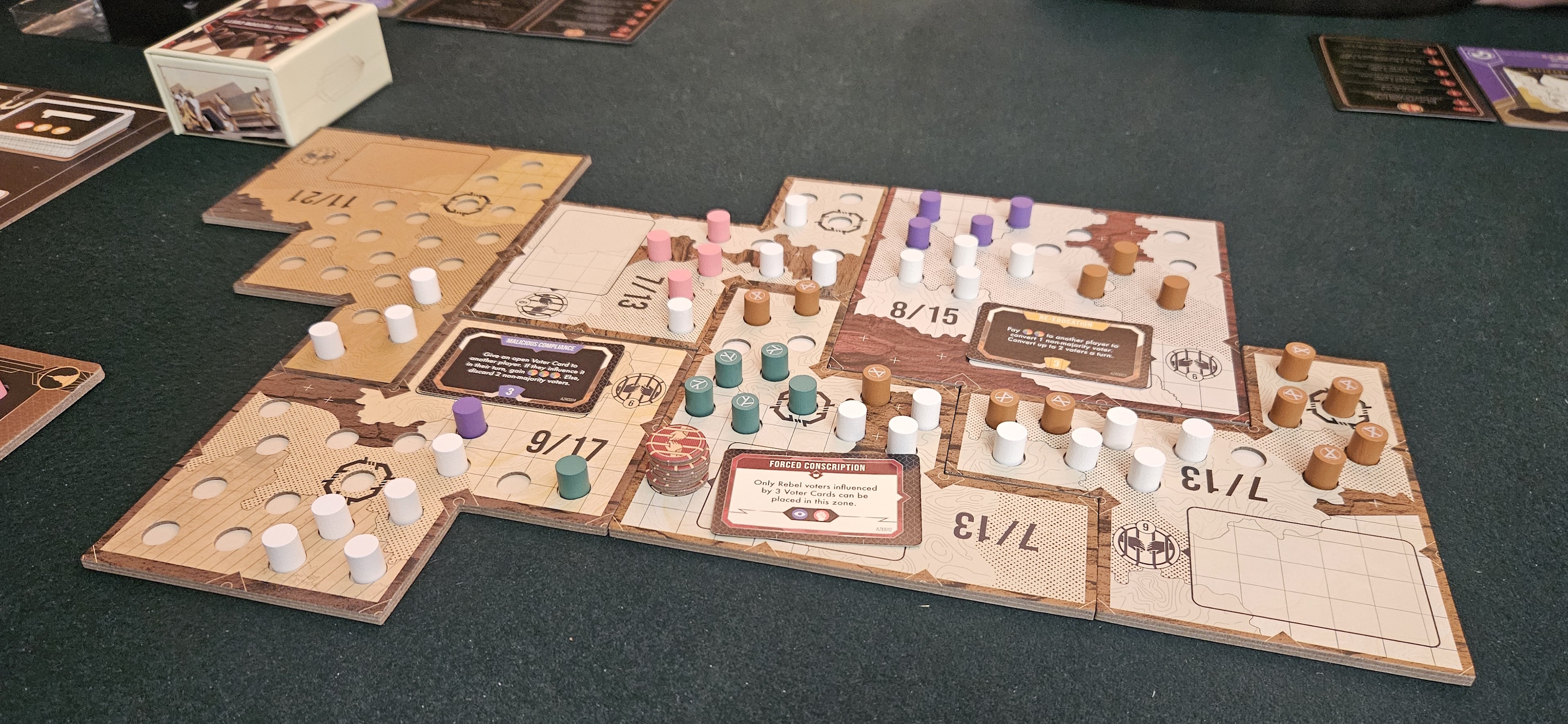
wait why are the imperial pawns white ooooohhhhhh

Those who have played Shasn will find this rather familiar.

Part Two: The Board Game

Sorry, but we aren’t quite ready for the differences yet. Don’t worry, I’ll pump the gas.

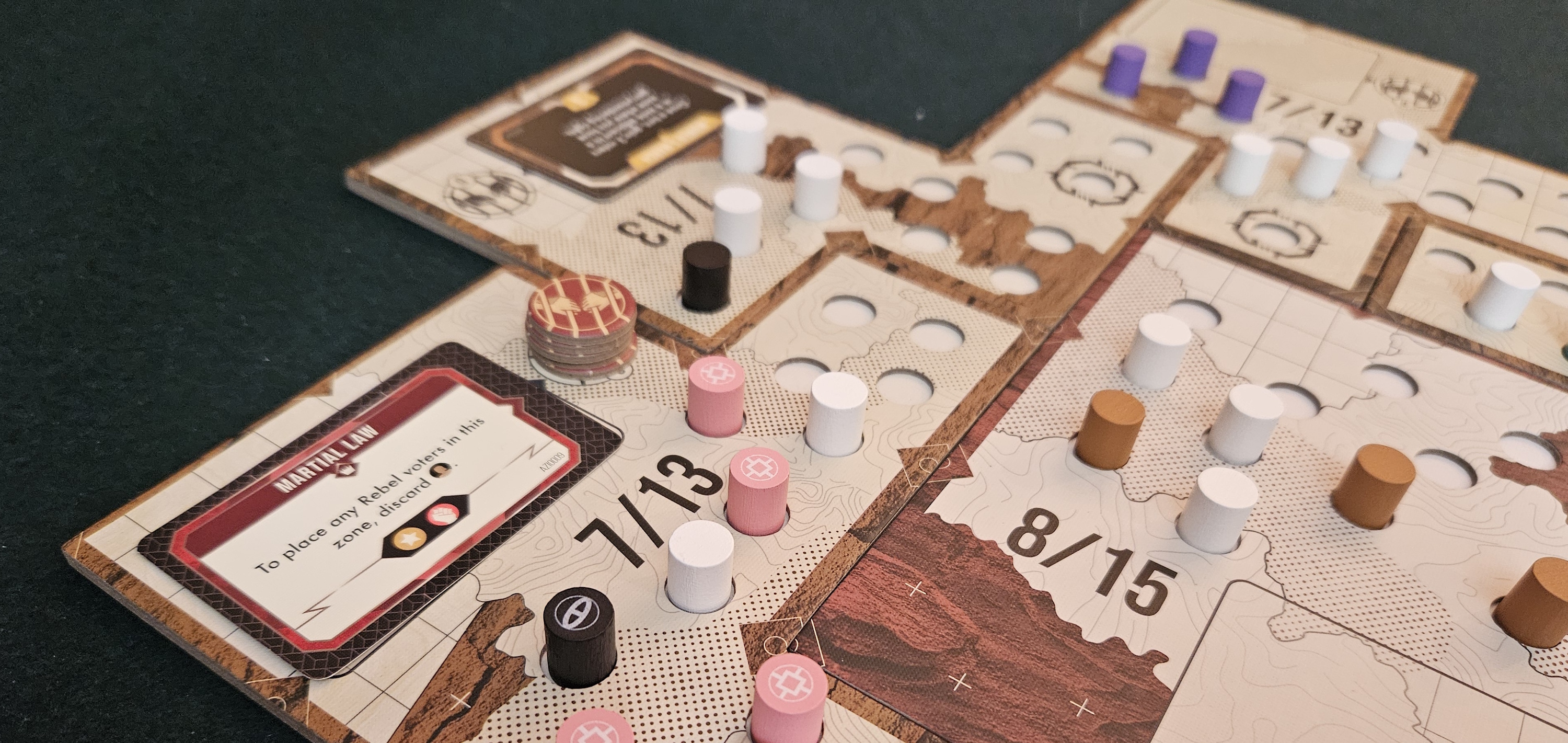
Like Shasn, Azadi is a game about building support. You take the resources you earned from your call-and-response soundbite, spend them on voters, and then distribute those voters across the game’s double-layered map. Each region can only host a certain number, with majorities clearly marked. As soon as you hit the requisite amount, you flip your voters to their other side, locking in the region’s support. These are victory points. And they can be rather tricky to dislodge once they’ve burrowed in.

Gerrymandering plays a huge role in Shasn, and by extension it plays a huge role in Azadi. Whenever you have the most voters in a region, you can push a rival’s voter into a neighboring area. It isn’t uncommon to see little zoning wars break out, certain voters ping-ponging between districts. It also isn’t uncommon for supporters to self-sort into ideological zones. Why place a voter into an area where they won’t ever do any good? As an observation about how different regions of the same country tend to polarize as people seek out those who think like themselves, this was always more insightful than the “politicians are scum” stuff.

Special powers also play a significant role. These are unlocked by gathering a certain number of soundbites in each category. With three Capitalist cards secured, it’s now possible to trade one resource for any two others. Only once per turn, of course. The game isn’t entirely broken. But it’s a little statement on how money can overcome a whole lot of shortcomings in other arenas. The same goes for the other spheres. At five cards, the Capitalist begins evicting voters from the board, sending them to other regions. That’s nicer than the Supremo, who bullies them out of existence altogether. The Showstopper turns gerrymandering into an art form. The Idealist tries to convert rival voters rather than removing them, although this is costly.

This was the core gameplay loop of Shasn, and it’s preserved more or less intact in Azadi. Actually, it’s a little simpler in Azadi. In addition to voters, Shasn allowed players to purchase conspiracy cards. Basically, conspiracies offered ways to manipulate the board outside the regular loop of buying and gerrymandering voters. Conspiracies are gone in Azadi. As we will see, to mixed effect.

So what’s changed? First, the board is modular. It’s a small thing, but the manner of its modularity is important. When the game opens, there are only a few regions. It’s only as the game continues that it expands outward. This forces players to cluster together, contesting those starting regions, rather than retreating to their own corners right from the beginning.

This also speaks to the larger structural change that undergirds Azadi. Namely, that this isn’t a game about domestic politics. It’s a game about revolution. Which means that there’s another faction at the table, one controlled by everybody and nobody. This is your imperial overlord. They are stern masters, their supporters are numerous, and you want them out.

Now we’re cooking with enough gasoline to make a whole crate of Molotov cocktails.

You wouldn't know it to look at me, but I like metal parts that fit into other metal parts.

Azadi versus imperial control.

Part Three: Azadi (or, Every Individual’s Fucking Birthright)

Azadi, like Shasn before it, isn’t some made-up fantasy word for a board game. Where “Shasn” was derived from the Sanskrit word for “governance,” Azadi, meanwhile, is Persian. It means freedom.

Or, to use the game’s definition: AZADI (noun), origin: Persian. 1. Freedom, Liberty, Independence. 2. Every individual’s fucking birthright.

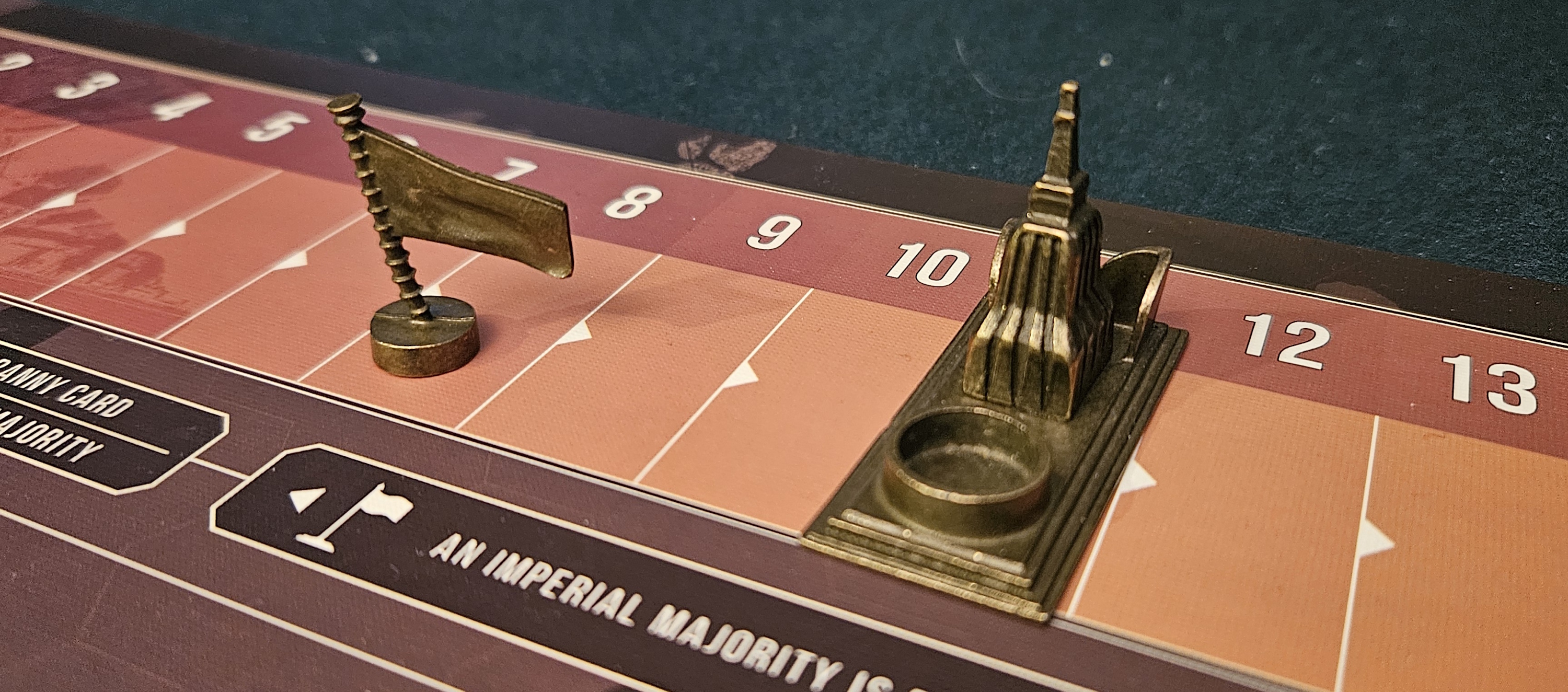
When Azadi begins, your country’s azadi is very limited indeed. On a track beside the board, you can see the overlord’s presence, way up near the top. Down at the bottom is your azadi, a revolutionary flag. This flag shifts upward when you gain control of a region through the regular rules of Shasn. Buying votes. Creating majorities. Grassroots action. There’s even a new rule that allows players to form coalitions, adding their voters together to achieve a majority together.

It won’t be enough.

There are three main problems facing the table. First, this isn’t a true cooperative game. In the same vein as revolutionary titles like Bloc by Bloc or Molly House, there’s a veneer of cooperation that proves tenuous when it comes to proclaiming an actual victor. Everybody represents their own distinct faction. And while you may agree that the overlord must be ousted, what precisely to do with any newfound freedom is hotly contested. Any coalitions, then, will be temporary, while your voters promise to stick around. This turns every placement into a double-edged sword, cutting against the overlord right now, but also against your current comrades in arms later.

Second, the temptation to collaborate with the overlord is ever-present. As the game progresses, your resources are steadily drained, not only by the demands of voters, but also by the overlord’s distant taxation. Those call-and-response cards always award three resource tokens. The overlord, on average, takes two. The leftovers aren’t much to live on, let alone build an independent nation.

Now, you could bide your time. Once you reach two matching ideology cards, you begin to earn a passive income. But the game is also played on a timer. Dither too long and the window will slam shut. At a certain point, action must be taken.

Hence, collaboration. By adding imperial voters to the board, you earn resources. Maybe even a tidy heap of resources, one for every region you add that imperial voter to. Sometimes this isn’t a big deal. If somebody already has a majority in a region, for example. At other times, it’s the act of a quisling, blocking an upstart comrade from claiming a zone. Either way, this is enough to kick the game into gear. Already on turn one, you’re making hard decisions. Whether to work with your overlords. Where to collaborate. Where to make concessions. How to ease the tensions with your peers at the table.

Still. It won’t be enough.

I'm currently fighting oppression by binging pistachio ice cream for lunch. It's a standoff between my mental health and my physical health.

Oppression naturally gives rise to problems that have multiple solutions.

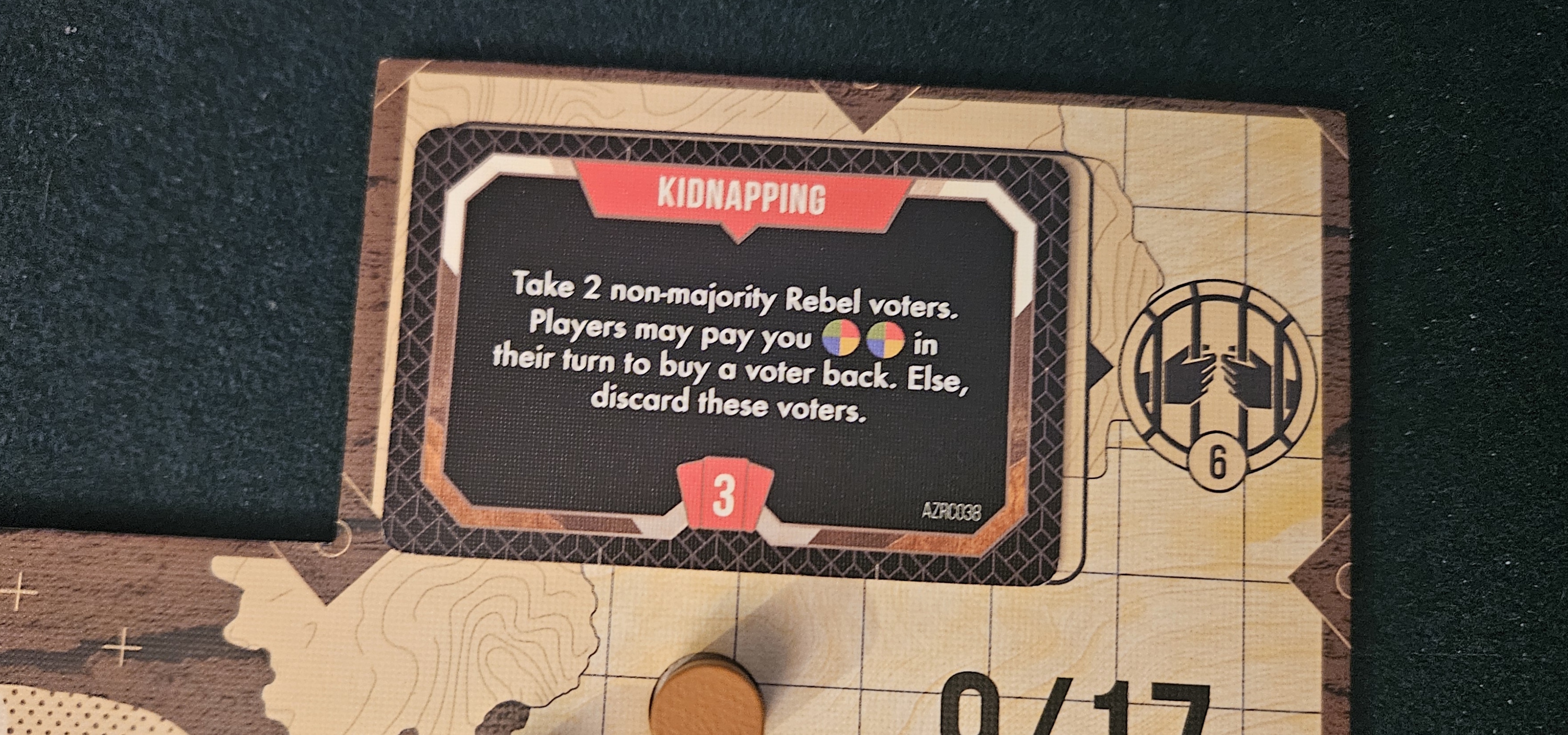
As in the original Shasn, every region in Azadi has one special space. Called “volatile zones,” these were originally used to draw event cards. Now, once occupied, they spark recriminations from the overlord.

This is perhaps the game’s flashiest addition to the original formula. As soon as a voter occupied a volatile zone, you draw a very special, very weird card. Really, they’re more like small folders. This presents a historical problem. Continuing with our example from the Egyptian Revolution of 2011, you might draw a card about the Port Said Massacre. “To punish the Ultras for their role in the revolution, the police trapped and killed countless football fans,” the card reads. “We can’t let them stamp us out.”

This card now pulls double duty. First, it adds an event to the region where the volatile zone was triggered. These represent government crackdowns, making it harder to add voters to that region. In the case of our stadium massacre, the corresponding card is a seizure. To add more voters, one of the voters already there must be converted into an imperial supporter. Other recriminations might include censorship, forced conscription, curfews, death penalties. The tools of the imperial trade, brought to bear on subaltern bodies, each complicating the ordinary task of gathering support in their own unique ways.

Now, these edicts can be opposed. By spending resources — always with the resources! — you earn another resource, infamy, that can be spent on revolutionary actions. More importantly, this gradually wears down the imperial control of that region. Oppose the edict enough and it will disappear altogether. On the track, your azadi ticks upward, bringing you one step closer to earning your freedom.

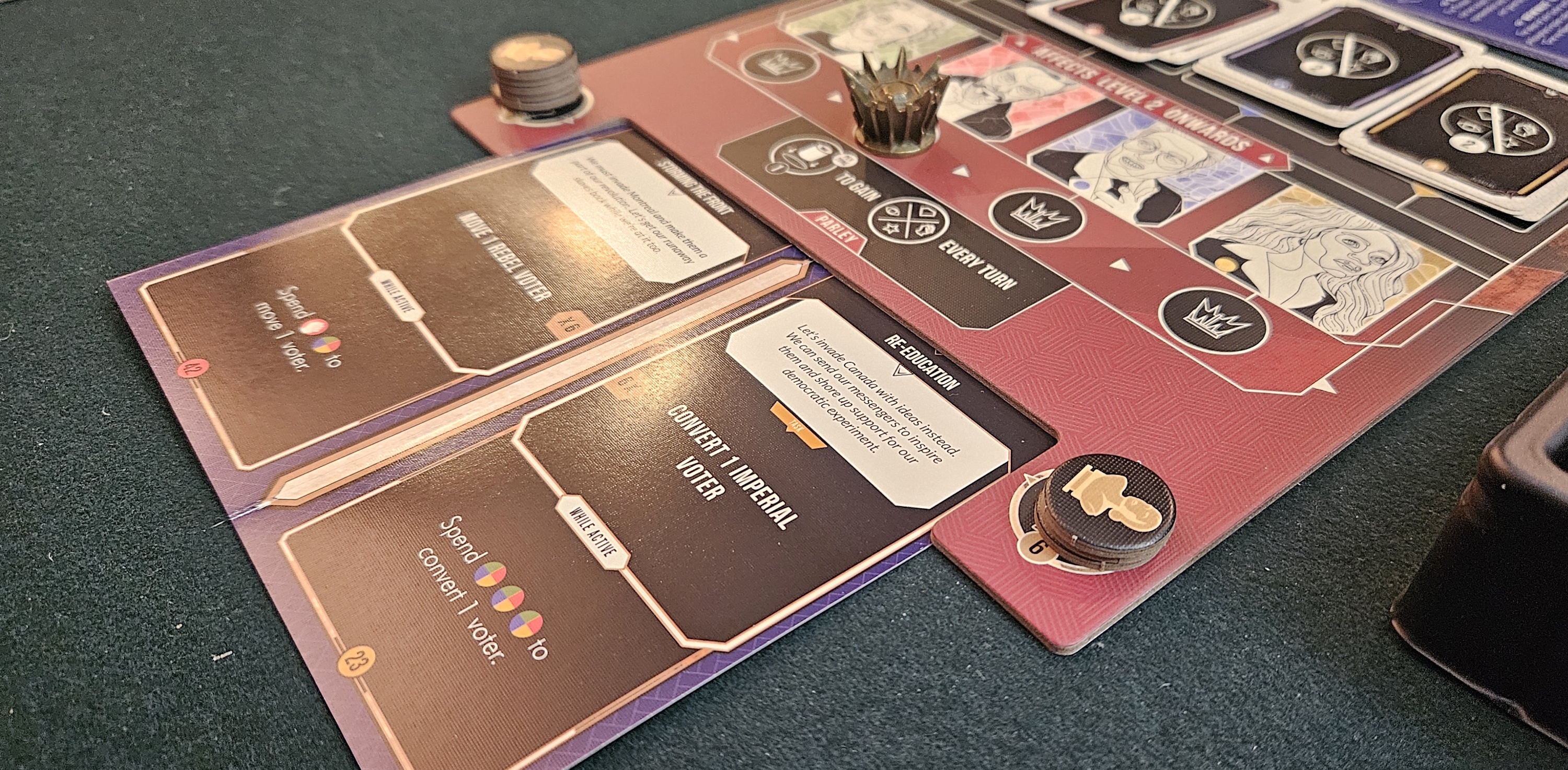
Even this won’t be enough. But that first imperial attack card, the little folder, isn’t gone. Instead, it has been spread open and placed to the side of the table. Now it sits there, offering different responses to the crisis. To return to the Port Said Massacre, you’re given two options. The first is riots. By discarding a voter — throwing your bodies against shields and batons — you can erode the overlord’s support. The other option is patronage. Memorials to the stadium martyrs. Vigils. Shrines. This option requires you to spend those precious infamy tokens, effectively trading away the prospect of violent revolution, but still showing strength.

Every crisis in Azadi is different. Not all of them demand violence, but they do speak to the need for direct action. At some point, organizing voters isn’t sufficient. In the case of the Port Said Massacre, it takes riots or vigils. Other crises present their own possible responses. Assassinations or lawsuits. Underground newspapers or hacked firewalls. As players, you’re free to pursue either option. These decisions present lingering consequences, represented as new action cards added to the map. Little legacies of how you chose to walk the walk.

No matter the precise response, however, the outcome is similar. Your azadi slowly swells upward. The map expands, bringing new regions and allies into the movement. And eventually, if you move quickly enough, if you’re clever with your collaborations and concessions, if you work with your comrades, freedom can be won. That little flag clinks into the little overlord token. In thematic terms, the oppressors are sent packing.

The game isn’t over. If anything, this is when Azadi reaches its inflection point.

ugh, why would we choose to reward idealism? yuck.

The birth of a new nation.

Part Four: Something Ends, Something Begins

The instant the overlord is ousted, Azadi offers some respite. Think of it as an interlude. A time-skip.

First, you see what manner of nation you’ve built. Everybody takes their answers to those call-and-response questions and adds them up. These are the contrasting visions of your country’s founders, whoever they might be. Revolutionaries and essayists and generals and artists and collaborators. Or, in Shasn’s terminology, Capitalists, Supremos, Showstoppers, and Idealists. These ideologies are tallied to become the basis for your new government.

Depending on the first- and second-place winners, a pair of distinct visions emerges. Now everybody gets to vote. The currency this time isn’t voter pieces; it’s the contributions everyone made to the revolution. The outcome is everything. Maybe you’ll choose to burn bridges with the outside world, retreating into isolationism. Or perhaps you’ll establish an oppressive theocracy. Or a libertarian paradise that excludes the filthy masses. Or a democratic beacon on a hill. Or a flawed democratic state with limited enfranchisement that likes to tell itself it’s a beacon on a hill. Whatever the outcome, this sets new rules for the game going forward. Special abilities. Single-use monuments. Whose ideology cards receive special affordances, and who gets included. The usual board game stuff, but developed in direct response to the actions you took across the preceding ninety minutes.

Honestly? It’s sublime.

One of my critiques of Shasn was that it examined how politics function, but ignored what politics are for. Azadi rectifies this omission. All those goofy call-and-response questions suddenly matter. And not only in game terms, but as reflections of ideology. They’re your Federalist Papers. Your Declaration of the Rights of Man of the Citizen. Also, unfortunately, your delegation on the preservation of slavery, whether at home or in the colonies. The result is a half-wrought constitution, some new mode of governance that’s better than what came before, but also profoundly imperfect.

Also, crucially, it’s still under construction. Because what comes next is closer to the original Shasn. All the old coalitions are broken. Imperial voters (usually) disappear. Now everybody is out for themselves. It’s back to the gerrymandering and voter suppression and all that. The revolution has slouched back around to eat its children.

It sounds cooler than it is.

insert some joke that will absolutely not be in terrible taste

The country still bears the scars of the oppressor’s actions — and your own.

I mentioned earlier that Azadi has done away with the conspiracy cards. It’s okay if you don’t remember. That was many words ago. But the point stands. The portion of Azadi that comes after its tense first act and that incredible intermission is something of a letdown.

At best, it’s a slog. An interesting slog, perhaps. You’re still gathering resources and buying voters and doing the gerrymandering thing, and the rules have been tweaked by the actions you took as a revolutionary. But it’s straightforward in a way that the game’s first half was not.

At its worst, the back half of Azadi is perfunctory. In such a case, it’s already clear who has secured the most majority votes, there’s really no stopping them, but there are still a few rounds to go before the map has been filled in enough to bring home the final tally. Sure, it’s possible to call it right then and there. But then you won’t get to see all those little consequences play out. After all that investment, it would be a shame to not finish.

Even so, it’s a disappointment all the same. Something to mix up the final few rounds wouldn’t have gone amiss. Like, say, some conspiracy cards to keep everybody on their toes. Too bad the deck from the original game is so ill-suited to the myriad possibilities coming out of the game’s revolutions.

But. Still.

Azadi is a remarkable achievement. I mean that. Even when it stumbles. Even when its merger of bad party game and serious revolutionary manifesto put themselves at odds. Especially then. Because this is what politics are for. Awkward coalitions, strange bedfellows, bills of rights that strive for universality but leave out the untouchables, or the women, or the slaves, or religious minorities, or whoever. Please don’t mistake this for watery centrism masquerading as realism. There are grand outcomes, too. It’s just that they’re as mired in the muck of contrasting opinions and methods and sometimes violence as any other possibility.

There are five revolutions in the game. South Asia 1947, American Revolution 1776, Russia 1917, Egypt 2011, and, um, Mars.

A strange, imperfect, wonderful game.

Which is to say that Azadi is messy the way people are messy. The way countries are messy.

But both people and countries, to invoke Hemingway, can be fine things, and worth the fighting for. That, I think, is the takeaway here. Azadi makes no bones about its position on its messiness. Not every outcome is the same. The troubled democracy is not the equivalent of the iron-handed tyranny. Azadi is every individual’s fucking birthright. For such a game, for such a vibrant, unsettling, funny, and tonally inconsistent game, I can take the slow denouement with the exemplary meditation on liberty and nation-building.

Just, you know, never again with five players. That took forever.


A complimentary copy of Shasn: Azadi was provided by the publisher.

(If what I’m doing at Space-Biff! is valuable to you in some way, please consider dropping by my Patreon campaign or Ko-fi. Right now, supporters can read about which films I watched in 2025, including some brief thoughts on each. That’s 44 movies! That’s a lot, unless you see, like, 45 or more movies in a year!)

5 Questions About the “Almighty” Kickstarter Project

12. Februar 2026 um 15:25

My journey to becoming a backer of the “Almighty” Kickstarter campaign began with an intriguing Space-Biff review, followed by a note to myself to write about the thematically whimsical-yet-informative project page, and finally a surprise message from creator Malachi Ray Rempen. I had a few questions for Mal that he graciously answered for today’s post.

1. I really like that the first image on the project page leads with the words, “Why we made Almighty” (with the reason focused on potential players: That they would “make a great god” and if they like a short list including ancient mythology, emergent narratives, and asymmetric area control). Can you talk a little about the decision to “lead with why” as the first image on the page?

It probably won’t surprise you to learn that this comes directly from Simon Sinek’s “Start with why” TED talk from back in the day. On my very first Kickstarter, Itchy Feet, I decided to take his advice literally; rather than start the campaign with the product or even the theme, the very valuable real estate at the top of the page is taken up almost entirely with a statement to answer “why” and a bit of art.

That campaign did WAY better than I ever dreamed, so in a way the why statement has become a good luck charm for me, and now I always do it. I can’t be sure that starting with why is what led to that campaign’s success, but I’m not about to test that by breaking with tradition now!

It is also a great way for me to focus the marketing message. If I can answer “why” in a single, bold, appealing statement, it’s like the center of gravity around which the rest of my messaging can turn. Without it, the marketing risks just becoming another flavor of “buy this thing now.”

[JAMEY] I really like the idea of starting with why in the messaging–it’s something I need to remember more often.

2. The game looks like Root and Oath had a baby…and you got a quote from the designer of those games, Cole Wehrle! How did you pull that off?

I credit Root with making it possible for serious strategy games to present as fun and cartoony, and for that I owe it a huge debt. With the exception of Itchy Feet, all my games are mechanically more serious than they first look, and thanks to Root nobody thinks twice about that. I took a lot of inspiration from Oath, both visually and mechanically, as it’s a highly strategic game that also revolves tightly around a shared central tableau.

Almighty is lighter than either of those games, but I do consider myself something of a student of Cole’s art direction and what you might call his sense of unified aesthetic, or how every single aspect of a board game contributes to its experience…even the parts that only exist in your mind!

As for the quote, that’s from a Bluesky post that he put up totally unprompted by me, it was a complete surprise! He’s the best though, he’s a model exception to the rule that you should never meet your heroes.

[JAMEY] I’ll add that I think it’s incredible that you are a designer, developer, publisher, and artist!

3. I must admit that when a game highlights that it can be played both competitively and cooperatively, it makes me wonder which is the “correct” or “best” way to play. In other words, to me it’s more of a marketing detriment than an asset. Of course, that’s a highly subjective take. Was Almighty designed from the beginning as either a competitive or cooperative game? What’s your instinct when you (as someone who plays games) sees a game advertised with multiple modes of play?

Almighty was built initially as a competitive game. There is certainly wisdom in the idea that a game should only present its best foot forward and not dabble in different modes of play, for the sake of clarity and elegance, and I am sympathetic to that view.

But for me personally, as a publisher of a kind of games that you are unlikely to find elsewhere, it’s a question of accessibility. I know there are people who prefer or only play solo or cooperatively, and if there is a chance that I can offer those people a way to play with the worlds, stories, art, components and puzzles in my games, then I want to try to do that for them. I also enjoy the design challenge, and looking at the amazing work by solo designers like Ricky Royal it’s getting harder and harder these days to argue that it’s not possible.

As for my own personal instinct, I don’t mind if a game has multiple modes of play, as long as they preserve what makes that game unique and interesting.

[JAMEY] I love the focus on accessibility, though I can see it working the other way too–if a game isn’t super clear about its intentions (should I play this competitively or cooperatively), that can impede accessibility. I’ve also seen rulebooks where the competitive and cooperative rules intermingle in a way that can be confusing. That said, I view solo play as a necessity; even though it’s technically a different mode, you’re still experiencing the core gameplay.

4. You have a really unique and fun take on stretch goals in the “God of Upgrades”. It’s much less rigid and far more thematic than most stretch goal systems I’ve seen, and I like the inclusion of “Backers that show kindness and support for one another” on the like list and both “Speaking to the creators of this game as though THEY were deities (we are but humble mortal vessels)” and “Backers that are rude and/or combative with each other” on the dislike list. How has the response been to this approach so far?

The result of this pretty last-minute idea is that I now have the funniest and most delightful comments section of any Kickstarter campaign I’ve ever seen. It’s full of jokes, board game themed psalms, comical appeals for forgiveness, and one person even posted a photo on BGG of their cats having “built a temple” to this “god of board game upgrades” that I created for the campaign.

It’s also practical, as it lets me gauge what backers actually want upgraded or added, which is a big downside to a traditional stretch goal system. It’s interactive, it’s thematic, it’s fun, it promotes good vibes, and maybe most importantly of all, it’s optional! So everyone who has been taking part has been making it that much more fun for everyone else. I’m delighted by the response so far.

[JAMEY] I hadn’t thought of the flexibility this method gives you to serve backers base on what they really want. You’ve basically provided the perfect method for them to express their highest hopes for the game, and you accomplish this by setting a fun (not demanding) tone for the backers.

5. Is there anything else you want to highlight in regards to the fun vibe exuded by the project page?

I’m glad you think there are fun vibes, that’s certainly the goal! It’s my belief that crowdfunding campaigns have a magic circle, too, not unlike the one we’re familiar with around the tabletop; for a limited window of time, you and other like-minded people gather together and participate in the creation of something that did not exist before and cannot exist without you. That is a wonderful, rare thing in this day and age, and worth protecting. I am a little saddened when I see campaigns that are not much more than a dolled up preorder system. To me it’s more like I’m lighting a bonfire, inviting you to join, and after our festivities you’ll get to take a burning log back home with you to light your own hearth. I dunno, maybe that’s a totally overwrought metaphor, but it’s how I feel!

[JAMEY] Thank you so much, Mal, and I’m excited to play Almighty around this time next year. If you (dear reader) have any thoughts on this conversation, feel free to share in the comments!

***

If you gain value from the 100 articles Jamey publishes on this blog each year, please consider championing this content! You can also listen to posts like this in the audio version of the blog.

Take A Number / X Nimmt

Take A Number is an advanced version of the classic game from Wolfgang Kramer, Take 5, also known as 6 Nimmt and Category 5. My copy is a gift from Allen, and it is a 2-in-1 version containing Take 5 too. It is recommended that you play Take 5 before Take A Number, which makes sense, because the game mechanism in Take 5 is a subset of Take A Number. 

BGI 406 The Between Places

11. Februar 2026 um 09:03

BGI 406 The One Between Places

Board Games InsiderJoin our Guild on Board Game Geek Guild | Like us on FB

Social media:

Ignacy Trzewiczek / Portal Games: website | FB | Twitter | Youtube

Corey Thompson / Above Board TV:  website | Youtube

Stephen Buonocore / “The Podfather Of Gaming”: website | FB | Twitter | Youtube

Intro Music: Happy Rock – Bensound.com

💾

boardgaming in photos: playtesting at Apollo

7 Feb 2026. We had a playtesting session at Nasi Kandar Apollo on a Saturday afternoon. I didn't manage to take photos of every game played, not even every game that I played. I did a rough playtest of one idea I came up with just the day before. I wanted to make a simple card game that can be played on a road trip, needing no table. Everyone has a stack of 5 cards. They are ordered. The highest

Halo: Flashpoint v2.1

10. Februar 2026 um 22:00

Now, there will be some shooting.

Remember the Reach with your Halo: Flashpoint rules & reference!

As mentioned in yesterday’s video, I’ve updated my Halo: Flashpoint rules & reference to encompass the two new expansions, Rise of the Banished and Feet First Into Hell! But if you were quick and immediately downloaded it, check again, because I discovered a keyword was missing and have updated it again to v2.1. Enjoy!

TWO New Halo: Flashpoint Expansions!

10. Februar 2026 um 09:04

Nobody asks to be a hero, it just sometimes turns out that way.

Peter unboxes two new expansions for Halo: Flashpoint by Mantic Games!

It’s great to see more stuff coming out for Mantic’s Halo: Flashpoint game, and I’m especially happy to see more aliens on the battlefield. Check out the new stuff – Rise of the Banished and Feet First Into Hell!

Making high quality tabletop gaming content at the EOG takes time and money. Please consider becoming a Patreon supporter or making a donation so I can continue this work! Thankyou!

Battlegroup Clash: Baltics - a professional wargame for a commercial audience

10. Februar 2026 um 08:00

by James Buckley


As the geopolitical environment becomes more tumultuous, the use of digital and analogue games by professionals to understand, model, and prepare for the future is coming to prominence. Professional wargaming is having its moment in the sun.

I moved into the world of professional game design having been the head of development at a hobby board game publisher. My first professional role was helping with the development and production of Battlegroup Wargame System (BGWS). The game was commissioned by the British Army to encourage the development of a wargaming mentality in the organisation.

While there are plenty of commercial wargames that cover tactical level combat, few are interested in capturing elements that precede a real life engagement: planning based on mission objectives, force capacity, tasking against specific time lines and geographic boundaries, and map work. That’s why they are not used for training by the army.

BGWS is interested in that. I believed that a commercial audience would be too. So I began work on transforming BGWS - an umpire led-game specifically designed for military professionals - into what was to become Battlegroup Clash: Baltics. A professional wargame, designed for a commercial audience. A game you can read about on BGG.

Step 1 - What To Keep
The two essential elements from BGWS I wanted to port to Battlegroup Clash: Baltics were the use of grid-based, real world maps, and the requirement to plan your operations before the game begins.

To my knowledge, no land-based tactical commercial wargame uses real world maps. Very few give much focus on operational planning, at least not how modern armed forces actually do it.

Step 2 - What To Drop
BGWS requires both an umpire and an understanding of military concepts and approaches that is beyond most civilians. It uses off-the-shelf 1:10,000 mapping, and off board cards to track lots of information on the units in play.


User playtest by British Army junior officers of Battlegroup Wargame System, the game that inspired Battlegroup Clash: Baltics.


To make it playable beyond the classroom, these features needed amending, and the game overall needed streamlining.

A first major decision was to move away from maps that require judgement to understand and parse. I commissioned the creation of bespoke maps, created by computer-aided design. These are real world, based on satellite imagery of Estonia, but with overlaid borders to identify key terrain types.


Map B from Battlegroup Clash: Baltics. The game uses 1:10,000 maps developed from satellite imagery from Estonia, with grid lines overlaid.


A second major decision was to move the stats for each unit onto its counter, rather than having them on a separate sheet. This significantly eases game play at a lower play count; everything is in front of the player on the map.


Battlegroup Clash: Baltics moves all the necessary information about the unit onto the counter (right). BGWS uses separate force cards for this instead of its counters (left).


A third major decision related to narrative. I wanted to move away from a generic ‘blue’ versus ‘red’ approach to the real world. The presence of a British Army Battlegroup in Estonia made that an obvious choice, and the game became NATO versus Russia in a hypothetical invasion by the latter of Estonia.

Step 3 - What To Add
Emphasising the present day narrative, and in keeping with my desire to create something that stood out from other tactical wargames, I decided to concentrate a lot of the design for Battlegroup Clash: Baltics on drones and electronic warfare.

The war in Ukraine has shown the degree to which drone warfare has changed the battlefield. Electronic warfare has been around for longer, but its intersection with drones and cyber attacks makes it now almost as important as kinetic effects on the battlefield.

In the game, every action that would generate some kind of radio or electronic transmission has the potential to be intercepted by the enemy. Intercepted transmissions can be used to target units for direct or indirect fires. Each side also gains access to Electronic Warfare Chits, that can be used on the battlefield for a variety of effects such as jamming your opponent’s recon drones.

This is important as reconnaissance drones, called UAS, completely transform the battlefield in the game, providing virtually unlimited line of sight for indirect fire. Another type of kamikaze drone, known as a first person video drone (FPV), can be used to directly attack enemy units, providing a more accurate, if less powerful, alternative to mortars and artillery.


UAS effect. In the game a UAS gives unlimited line of sight to the four adjacent grid squares.


Testing the Game
I wanted my playtesting team to combine folks with experience in both professional as well as commercial wargaming, and through a combination of persistence and good luck I was able to get both.


Prototype counters used in a play test.


While Tabletop Simulator played a crucial role in the development and testing process, I learnt from my time as a hobby game developer that digital is not a substitute for a physical prototype, so I had physical copies made and tested them both at home, at my local club and at conventions.


Testing the two-mapper scenario at PunchedCON in Coventry, UK.


Making the Game
Independent of the tariffs saga, I made a decision very early on that I wouldn’t get the game printed in China. China is funding Russia’s war in Ukraine, so it didn’t make sense to me to pay a Chinese company to make the game. Instead I chose EFKO in the Czech Republic. The price is higher than the Chinese alternative, but I can sleep easier with my choice.


The box cover

Selling the Game
Battlegroup Clash: Baltics is self-published, in the sense that I am releasing via my own company. I have sufficient experience of the board game industry to be able to do this, rather than having to use another publisher to release the game. This approach also allowed me to get the game to market very quickly.

I considered using crowdfunding as the vehicle for selling the game, but I was concerned that the concept might not fly with customers from a professional background. Furthermore, I didn’t need funding to develop the game, just to print it, and decided that a simple pre-order system via the Sapper Studio website, which I use for my game development consultancy business, would suffice.

I decided to make use of professional channels as well as traditional board game media to promote the game. This involved posting on LinkedIn and via the Fight Club Discord server, as well as hobby channels and events such as SD Histcon and Armchair Dragoons.

The success of the game in terms of generating pre-orders very much exceeded my expectations. I had several hundred pre-orders within the first few months, meaning I could opt for a larger print run than I had anticipated. Now the game is out for general release, and it’s time to see if my customers agree that I have been able to create a professional wargame for a commercial audience.

You can purchase a copy of Battlegroup Clash directly from Sapper Studio via this link https://www.sapperstudio.com/battlegr. Alternatively check your with FLGS in your country that you know stock a good wargame selection.

Popcorn

Popcorn is a game about running your own cineplex. You buy screening rights for movies, you attract cinema-goers and you upgrade your cinema halls to provide great movie experiences. You have to keep your list of movies fresh, taking down movies before customers completely dry up and showing new movies to attract customers. While scoring points (points are called popcorn here), you need to

10 Things to Do When You’re Completely Caught Up at Work

09. Februar 2026 um 21:39

I recently talked to a publisher friend about something they had never encountered before: They were completely caught up at work. In fact, they were well ahead of schedule but their coworkers were not, so they wanted to resist their instinct to simply create another game, at least for a while.

Being completely caught up at work is a luxury that some of us may never experience, but perhaps you can relate to brief times when you’ve completed all time-sensitive tasks. After filling every spare moment with Vantage for nearly 8 years, I had that feeling when it was complete. I suddenly went from feeling perpetually behind to having an ample amount of time.

So today I thought I’d brainstorm a few ways to spend extra hours or even days when you’re caught up on work, particularly in creative roles. I’d love to hear what you do in these rare situations.

  1. Serve customers: When in doubt, I ask myself, “What could I do right now to serve our customers?” This can be private or public. For example, I could email some of our most frequent customers to thank them for their support. I could hang out in any online community for our games, or search for our games on Instagram to comment on the posts instead of just liking them. Or I could make a video (recorded or live) to help people learn one of our games.
  2. Research and learn: There’s more knowledge in the world than I can ever possibly know. I can spend extra time studying game design (from books, podcasts, articles, YouTube, etc) or even playing games (tabletop and digital). In fact, I so rarely play digital games because I always feel like I should be working, but I learn something about game design every time I do.
  3. Support existing products: As fun as it is to release something new, most of the games we sell are reprints. Among many different ways of supporting existing products is to share special challenges or variants (like Vantage’s recent Valentine’s-themed custom cards). I can even revisit older rulebooks with a fresh, unrushed perspective. Also, even if I’m ahead of schedule, it never hurts to playtest a prototype again.
  4. Create content: If there’s a topic on my mind that might add value to people or start a conversation, I can write an article about it, record a podcast, or film a video. It doesn’t need to be a commitment to creating regular content–it’s perfectly fine to create a singular post on a topic.
  5. Attend an event: I rarely travel to conventions or even attend events at local game stores/cafes. Perhaps that’s just my introversion, but part of it is the other work I always feel I should be doing. But if I have extra time, there are plenty of places I could go–near and far–to play games and meet people outside of my social circle.
  6. Make something just for fun: Sometimes I give myself permission to brainstorm a game (and even prototype it) just for fun, and I’m almost always glad I did. The lack of pressure to create something publishable is incredibly freeing.
  7. Help someone else: I’ve heard that one of the best things for our mental health is to help someone else. Whether it’s a coworker, a friend in the industry, or a new creator, there’s always someone out there who might be looking for a little time, feedback, or words of encouragement.
  8. Connect with someone locally: I typically take a 30-minute lunch break at my home office, then it’s back to work! I hardly ever go out to lunch, but there are lots of people–friends and peers–in the area that I could be more intentional about sharing lunch with from time to time.
  9. Be good to yourself: There’s no rule saying that an absence of work needs to instantly be filled by more work. I can go for a walk, take care of a personal task I’ve delayed, treat myself to a movie, etc.
  10. Start the next project: I’m putting this last because despite my inclination to always be creating something new, we don’t always need to make more games. Especially when we already have plenty of games in the pipeline and when adding something new could put a burden on already-busy coworkers. That said, it’s nice to start on a new game without any time pressure.

What do you do when you have extra time at work?

***

If you gain value from the 100 articles Jamey publishes on this blog each year, please consider championing this content! You can also listen to posts like this in the audio version of the blog.

One Week Left to Vote on the BGA Awards!

by Steph Hodge

Hey Everyone! Thank you so much for the warm welcome on my first post last week. :meeple:

Today I wanted to bring attention to Board Game Arena. Many of us enjoy playing games online, and BGA is one of the key websites for doing that. I am still amazed at the number of games they are implementing each year. There are over 1200 games ready to be played at your fingertips.

Currently, there is 1 week left to vote for the 2025 BGA Awards. The BGA Awards were first introduced in January 2024 for games from 2023, and they have continued each year since.

[ImageID=9395798 medium rep]


You can view the whole article here, but below is a snip-it of how they select which games are nominated.

We have selected the most popular games released on BGA in 2025 and divided them into several categories to reflect the richness of games on the platform:

Best Casual Game: Perfect for quick, lighthearted fun and friendly competition.
Best Regular Game: Games that strike the perfect balance between strategic depth and satisfying complexity.
Best Expert Game: For those who thrive on challenging strategies and enjoy conquering intricate puzzles.
Best 2-player Game: Face-to-face duels that bring an extra level of intensity.
Best Brain Teaser: For those who love to give their brain a workout and solve challenges.


To participate, you will first have to play each of the nominated games in the category you want to vote for. Once you play each game from a category, you can cast your vote here.

Here are the nominations:

Best Casual Game:
Coffee Rush
Flip 7
Qwinto
Skull King

Best Regular Game
Castles of Mad King Ludwig
Dead Cells: The Rogue-Lite Board Game
Forest Shuffle: Dartmoor
The Guild of Merchant Explorers

Best Expert Game
Apiary
Concordia
Galactic Cruise
The White Castle

Best 2-Player Game
Azul Duel
King of Tokyo: Duel
Schotten Totten
Toy Battle

Best Brain Teaser
Digit Code
Logic
Orapa Mine
Ubongo

Happy Voting!

They will post the results on 2/16/2026 at 5:00 AM


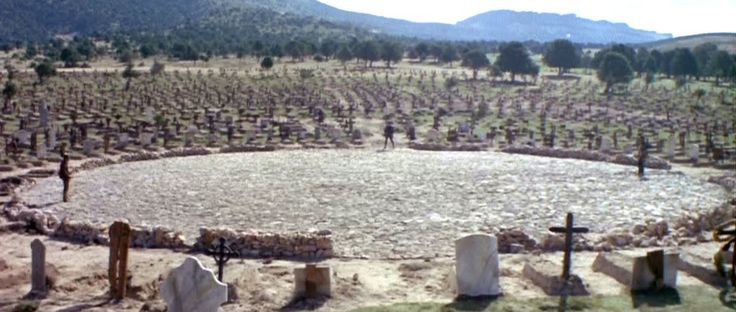
Cardboard Cinema – The Good, the Bad, and the Western Legends

09. Februar 2026 um 15:00
I remember the first time I saw The Good, the Bad, and the Ugly. I was a teen, sitting in front of a small CRT in a small living room. I was wholly unaware of what the next three hours of my life would entail. I hadn’t yet learned to trust my dad. And while…

Read more →

❌