❌

Lese-Ansicht

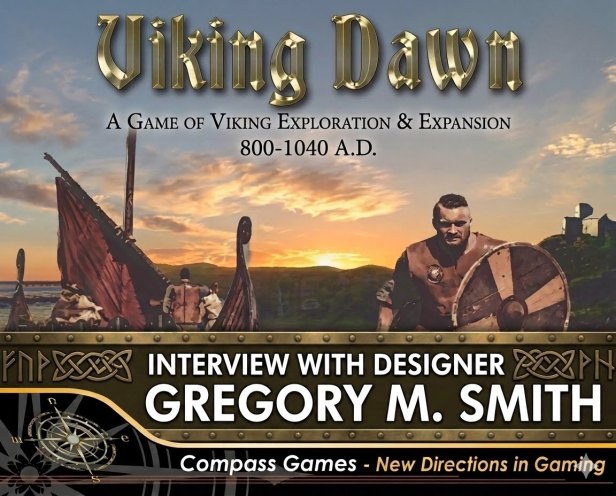
Interview with Gregory M. Smith Designer of Viking Dawn: A Game of Viking Exploration & Expansion 800-1040 A.D. from Compass Games

Our friend Gregory M. Smith is a solitaire game designing genius and has done many of these solo, narrative driven style wargames that we have all enjoyed for hours on end while we have been unable to find an opponent or just because we want to play a game on our timeline. We have interviewed him many times for his games such as Zeppelin Raider, Interceptor Ace, The Hunted, Western Front Ace, Amerika Bomber, Defending America, American Tank Ace, British Tank Ace, Rebel Tide, Sinking Yamato and most recently for a magazine wargame called B-52D Linebacker II. But Greg is a versatile designer and also has done many great 2-player games as well. He always has something cooking in his game design kitchen and recently we spoke with him about his new design with Kevin McPartland called Viking Dawn: A Game of Viking Exploration & Expansion 800-1040 A.D. from Compass Games. I was able to play this 1-4 player game while at the World Boardgaming Championships last month and you can read about my experience at the following link: https://theplayersaid.com/2026/07/27/world-boardgaming-championships-2026-daily-debrief-series-day-3/

I reached out to Greg recently to get a bit more information about the design to share with you and he was more than willing to talk with me about this new game.
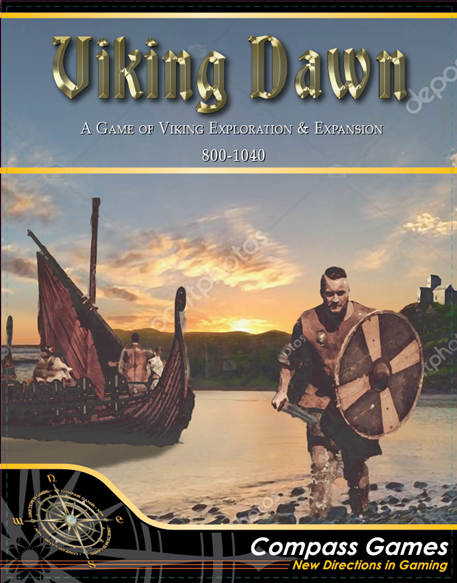
Grant: Greg welcome back to the blog. What is your new upcoming game Viking Dawn about?

Greg: Hey Grant, a pleasure as always. I still think back to the first few of these interviews we did many years ago and laugh. Good times! [Editor’s note: When I reach out to Greg about doing one of these interviews, he is always willing to respond but often adds “don’t get medieval on my ass!” meaning he hopes that my questions are reasonable in number. He has a separate life to game design evidently.]

But, to business – Viking Dawn is an operational/strategic level look at the Viking raids and explorations in Europe, the New World and even into the Mediterranean and North Africa from roughly 800 to 1,000 A.D. 1-4 players will attempt to build a legacy for their faction, including the Swedes, Danes, Norwegians or Geats, by amassing Victory Points through wealth acquisition, exploration, area control, founding and growth of colonies and elaborate Leader burials. The game is playable in 4-5 hours with each of its 8 turns spanning a period of 20-40 years.
Grant: Why did you feel inspired to make this game?

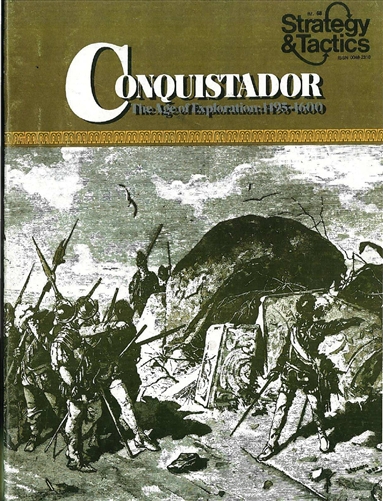
Greg: One of my favorite games in college was Conquistador: The Age of Exploration 1425-1600 from Strategy & Tactics Press and one evening I was watching Vikings (the recent series from the History Channel) and I thought, hey, I should make a Viking version of Conquistador. There’s nothing quite as dramatic as a game that covers 200+ years.

Grant: What sources did you consult to get the historical details correct?

Greg: As you might imagine, there was NO shortage of research materials, which is great on one hand, but on the other, can be daunting. I thought the most scholarly and overall excellent of the bunch was Johannes Brøndsted’s The Vikings. Another great overall look was Robert Ferguson’s The Vikings. Another similar book was Jonathan Clements’ The Vikings. (Nobody hesitates to use that name, you might notice.) The best resource with pictures of artifacts, drawings, and maps included was a book by Richard Hall titled The World of The Vikings.

Grant: I understand you have a design partner in Kevin McPartland. How did this partnership come about?

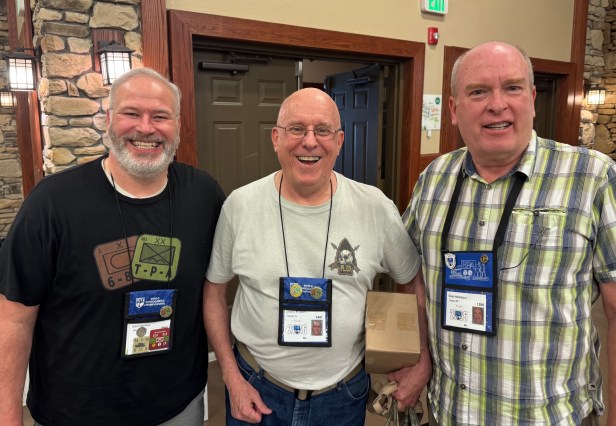
Greg: It was quite hilarious actually. Kevin is an accomplished designer in his own right, but a couple years back I brought the first prototype of Viking Dawn to the Compass Con and explained how the idea originated. The light bulbs went on in his head, because he ALSO loved Conquistador back in the day and was upset he hadn’t thought of this first! We laughed, then after playing the prototype, he was making nonstop suggestions (and historical corrections and additions). He so improved the prototype I felt I had to have him as co-designer, to which he graciously agreed.
Grant: What was the division of labor between you two?

Greg: Well, I did most of the initial design work, but every time we got together he had some fixes, tweaks, historical corrections, and additions. I’d say he almost acted more as a developer, but he came up with enough mechanics I think co-designer is probably more accurate.

Grant: What other games inspired your design approach?

Greg: As mentioned, Conquistador was the primary inspiration for the overall theme of raiding and exploration, with leaders that last a turn or two before dying (typically of old age, with 20 year turns).

Grant: What is the players goal in the game?

Greg: As with many games, the goal is to amass the most Victory Points, which will determine the winner. Unlike many games, this is achieved through exploration, pillaging, looting, building settlements, and my favorite element through lavish burials for your deceased Leaders. They may have accomplished great deeds in life but if you don’t bury them with gold they aren’t really truly memorable.

Grant: What does a victory look like in the game?

Greg: That is a bit hard to define, as there are many paths to victory, but the most likely path to victory involves settlement income, exploration Victory Points and burial income. If you don’t develop your network of settlements and establish your economy, you will not be able to generate the needed funds to pursue further exploration and settlement and will also not be able to afford to keep your empire going at the end of each turn as you have to pay upkeep on Warbands and Longships.

Grant; What was important to include or model about Vikings in the game?

Greg: Despite the operational/strategic nature of the game, we had to have pillaging and looting or it wouldn’t really be a game about Vikings as this was one of things they are best known for historically and the reason that they were greatly feared in Europe. Just as important (in my mind) was to model the exploration aspects of their seafaring, and this is encouraged by getting Victory Points by being the first to explore various far reaching corners of the map including Russia, Constantinople, Persia and the New World.

Grant: What was your greatest design challenge to overcome?

Greg: The game was too long in its initial versions, and it took some creative editing to chop it down to a more manageable eight turns. It was fun at 12 turns, but just took an inordinate amount of time (6+ hours). I really dislike games that take too long.

Grant: What is the time scale of the game? Why was this important?

Greg: Unlike games about more recent conflicts, the Viking heyday was several hundred years. This was a serious design challenge, but we finally decided on the first two turns being 40 years each <!> and the rest of the turns 20 years each. This sounds crazy, but it actually works, and allowed us to cover the main historical time frame in a playable system.

Grant: What are the different Viking factions in the game?  

Greg: You can have 1-4 players, with the Danes, Norse, Swedes and Geats, an offshoot of the Swedes. Think of the Geats as the Portuguese from Conquistador.

Grant: How do factions gain new Leaders? How historical are these Leaders represented?

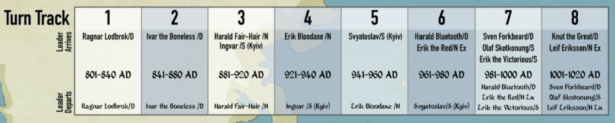
Greg: The Leaders in the game are mainly the more famous/notorious of the Viking faction they represent. They arrive on the Turn Track via their historical arrival dates, and depart via the same (most last only a single turn, some survive for two turns.) However, each player may spend silver and purchase temporary Leaders and Explorers if they don’t have one arriving for awhile. Leaders give a bonus in combat, and Explorers give a bonus in seafaring, so they can be significant. Part of the asymmetrical build of the game is map location, but also Leader arrival times. The Danes have early advantage, but the Swedes and Norse are stronger later in the game.
Grant: Can you share a few examples of these leaders with us?

Greg: For example, these are the Norse Leaders. They have arrival/departure turns (which is sometimes the same turn) and the specialized Explorers have the circular symbol denoting that status.

Grant: What is the general Sequence of Play?   

Greg: In general, you receive income, buy units, send out expeditions in turn order, pillage, establish settlements, return home with exploration VP’s, and bury your dead Leaders. There’s more to it than that, but that’s the basic gist of things.  

Grant: What different units types are available to each side?

Greg: The basic combat unit is the Warband. The basic transport is the Longship. The basic “civilian” unit is a Settler.

Grant: How does combat and raiding work? How is it Press Your Luck?

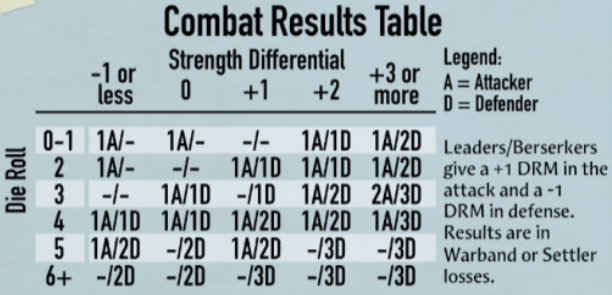
Greg: Combat is mainly a combination of how many Warbands you have, modified by Leaders and/or Berserker chits. There isn’t much of a Press Your Luck aspect to combat (exploration, yes, trading, yes, but combat, no.)  However, there is a CRT so you have to know your odds. Trying to pillage with only a 50/50 chance of success is risky and should be avoided.
Grant: What actions does each player have access to?

Greg: Players have almost complete freedom in what they want to do – but should obviously focus on doing things that earn Victory Points (making silver, or being the first to explore an area and return home to tell about it). Basically, the actions are external trade, exploration, creating settlements, pillaging, raiding, even demanding ransom. Players can send out multiple expeditions even, with the caveat they have to be able to afford it.

Grant: What is the layout of the board? Who is your artist?

Greg: Here’s the map, being basically most of the places the Vikings went (which was a challenge to show!) Nadir Elfarra, my favorite artist, did the work.
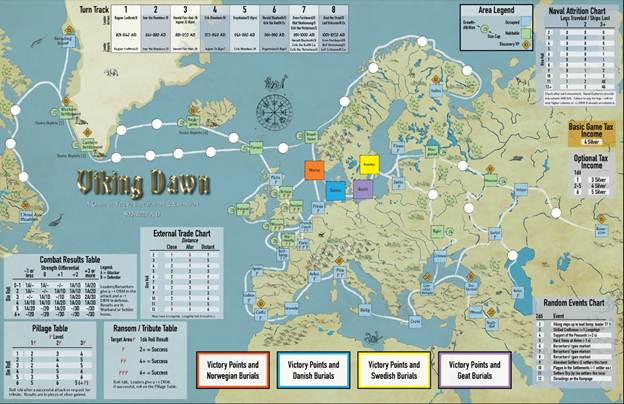
Fun story about the map, I showed an earlier version to my wife, Cindy, and the first thing out of her mouth was “Where are the Sea Monsters???” So we corrected that 😊

Grant: How does trade work? 

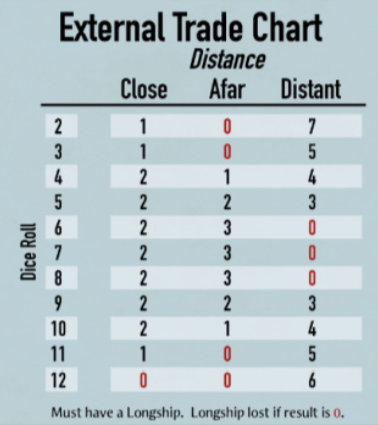
Greg: Internal trade happens automatically with your settlements, assuming you’ve paid for their upkeep.   External trade, on the other hand, is a decision the player makes via the External Trade Chart. It requires you to risk a silver and a Longship, and you decide which column to use.

Grant: How are colonies established and how do they grow?  

Greg: If you have successfully pillaged a green (habitable area suitable to be settled) you can drop off Settler(s) if you brought any. Each area has a Growth/Attrition number and also a Size Cap. At the end of each turn, you roll to see if the settlement grows (up to the size cap) or suffers attrition.   Obviously, England has less attrition and a larger size cap than, say, Greenland. One fun problem is that when areas reach their size cap, they roll to break away and become independent from the homeland.
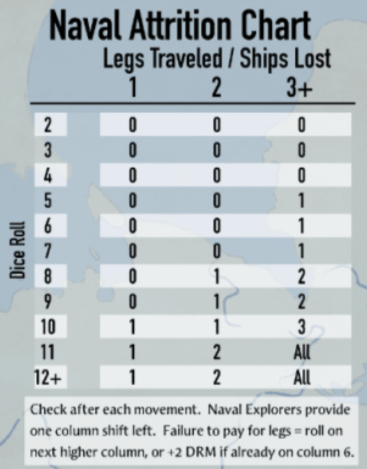
Grant: How does Longship travel work? What dangers are involved?

Greg: You may travel a maximum of three legs (each leg being six areas or fraction thereof). This makes the theoretical maximum 18 areas. However, the further you go, the more likely you are to lose Longships and/or your entire expedition. Explorers can mitigate these risks, but there are very few explorers in the game. So there is definitely risk in exploration.

Grant: What type of experience does the game create for players?

Greg; I would like to think of Viking Dawn as a “historical Euro” for lack of a better term. It’s certainly more of a game than an attempt at perfecting simulating all the historical events of the time. Kevin’s fantastic knowledge really helped to make it better historically, and I think it does a really good job of doing a “broad brush” rendering of the Viking age.

Grant: What are you most pleased about with the design?

Greg: I really thought the turn order mechanic made it very tense. Everybody secretly purchases Warbands and Longships, but turn order (a huge advantage to go first early in the game) is determined by who has the most silver remaining after purchases. If you buy a lot, you can do a lot, BUT you’re probably low on silver and going last in the turn. So determining turn order by remaining silver turned out to be a great mechanic.

Grant: What has been the feedback of your playtesters?

Greg: Anybody who knows me knows that I’m my own biggest cheerleader, BUT seriously, we had a great time playing this the last several years at Compass Con. It’s just fun multiplayer, especially when bad things happen. I am very happy with the design, and especially since Kevin McPartland made it ten times better with his involvement.

Grant: When can we expect to see the game released?

Greg: I refuse to answer this question on the grounds I’m never right 😊 but if pressed, I’d have to say early 2027. It’s done and at the printers.

Grant: What other designs are you currently working on?

Greg: I’ve got a few irons in the fire. Solo Banner (Burning Banners dungeon crawler), Western Desert Ace (North Africa WW2 version of Western Front Ace), Soviet Tank Ace, B-52D Linebacker II (magazine game), Gotha Raiders (magazine game), Project Z (Japanese hypothetical heavy bombers 1947), Ground Attack Ace (Stukas and Sturmoviks), Korean Tide (1950-53 Tide Series), Star-Spangled Tide (War of 1812 with Kevin McPartland again), a B-36 game, and a few others. Trust me I’m staying busy!

Thanks as always, enjoyed chatting.
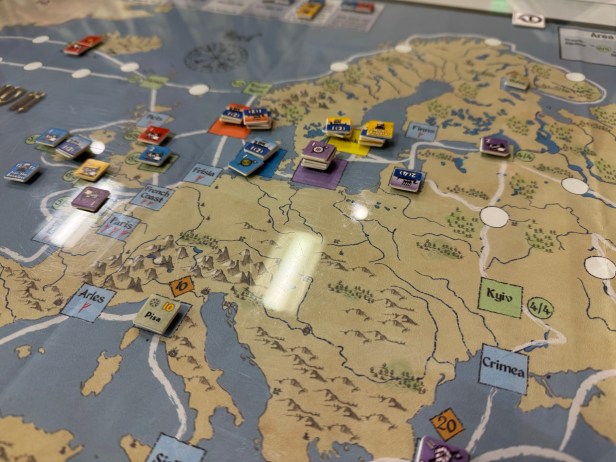
If you are interested in Viking Dawn: A Game of Viking Exploration & Expansion 800-1040 A.D., you can pre-order a copy for $54.00 from the Compass Games website at the following link: https://www.compassgames.com/product/viking-dawn-pay-later/

-Grant

  •  

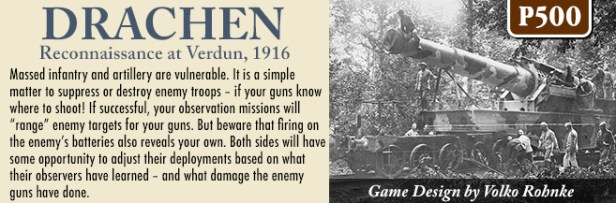
Interview with Volko Ruhnke Designer of Drachen: Reconnaissance at Verdun 1916 from GMT Games

I think that every single wargamer knows the name Volko Ruhnke. He has designed several great series in the COIN Series, that has now stretched to a full 15 volumes, and then more recently Levy & Campaign Series, which has an astounding 5 released volumes with several others that are announced and about a dozen more in design. He can make a good game for sure! One of our first experiences in wargaming and the first Volko design we played was Wilderness War. He is now at it again with a new design in a continuing newer series called the Recon Series that uses hide and seek elements and hidden blocks to tell the story of the Allied intelligence efforts during World War I during the campaigns around Verdun in 1916. The game is called Drachen: Reconnaissance at Verdun, 1916 and looks to be very interesting and we reached out to Volko to get a look into the design.

Grant: Volko welcome back to the blog. What is your new upcoming game Drachen about?

Volko: Hi Grant & Alex! Thank you for this opportunity. I love what you guys do.

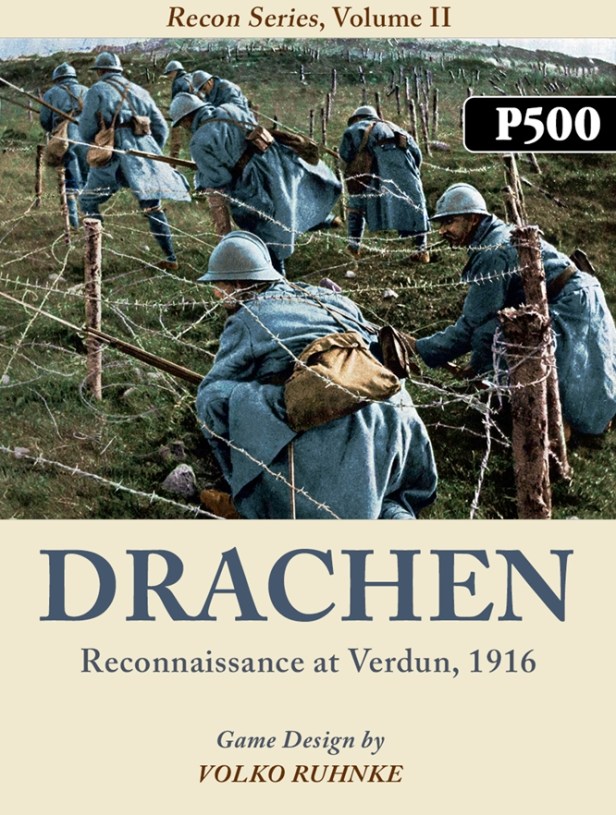
Drachen continues my new Recon Series, following on to the series’ recently released first volume, Coast Watchers. Volume II – Drachen – is about the struggle for reconnaissance information in a World War I trench battles, specifically, Verdun in 1916.

Grant: What does the title mean and why did you want to use it for this game?

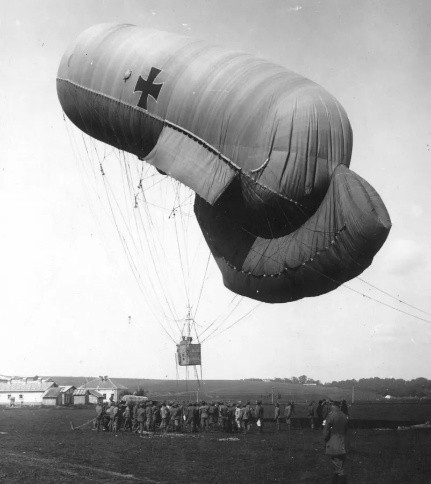
Volko: “Drachen” means “kite” in German and is simply short for “Drachenballon” – kite balloon. The tethered observation balloons famous as targets for balloon-busting fighter aeroplane missions were really the queens of the battlefield in their ability to see what the enemy was up to and guide artillery fire onto enemy targets. They were in effect hydrogen filled kites in that they faced into the wind for stability. On a clear day, even a windy one, a spotter with binoculars in a kite balloon could provide information on enemy movements and positions up to 15 miles away. Tethered to the ground, unlike observer aeroplanes with either no radio or early transmitters only, balloons had instant and secure communications with friendly headquarters or batteries to coordinate fire.

Grant: This is Volume II in the Recon Series. Why does this subject fit your vision for the series?

Volko: I’m looking for the Series to visit settings in which secrets and their discovery really mattered to the outcome of a conflict. The advent of trench warfare on the Western Front was a remarkable moment in land battle because the age-old means of reconnaissance – the horseman – could no longer roam. For the first time, you would know nothing of the enemy beyond the next ridge unless you got up in the air. We gamers have tended to focus on ace-versus-ace duels in the sky. I wanted to explore what all the dogfighting was really about: winning the right to peer down upon your enemy.

Grant: How has your experience with series games assisted you in the development of this Recon Series?

Volko: OK, that’s a big question! I do try to learn, and I have developed some principles for series design:

1) Openness – Make room for other designers to take the series where you never imagined.

2) Complexity – Bigger is not always better. I wrote about this in depth in C3i Nr29.

3) Variety – Make it familiar, not samey. I wrote about that in C3i Nr30.

Regarding variety within a series, it helps to articulate a focus to guide selection of topics, what you keep the same, and what you vary for each setting.

  • For the COIN Series, that was the premise that counterinsurgency and other popular conflicts were multifactional, that factional relations were key.
  • For Levy & Campaign, it was that medieval warfare was equally complex as modern but in distinct ways, especially regarding command and logistics.
  • For the Recon Series, then, it is that secret information – which side protects it or discovers it better – can decide the outcome, at least for certain conflicts.

That said, for me, principle 1) above trumps the other two. Other designers certainly have taken COIN and Levy & Campaign to places beyond my original intent. I hope the same for the Recon Series.

Regarding “bigger is not better” for Drachen in particular, that meant being sure that Volume II did not just add subsystems like more ornaments on a Christmas tree. Rather, I try to drop something unneeded out for every new thing added in. For example, Drachen gets much deeper into resolution of combat than does Coast Watchers, but then Drachen has a much simpler resolution of who won the struggle: just most of 3 Objective cards fulfilled, rather than Volume I’s “victory point salad”.

To keep Drachen “familiar but not samey”, we keep not only the location blocks and open versus secret spotting but also two chit cups for resolution, for example. Where Coast Watchers has Delivery and Patrol cups, Drachen features Air and Group cups to resolve clashes in…well, you can guess where for each.

Grant: What did you need to make sure to model from aerial reconnaissance in WWI?

Volko: The key historical dynamics that I was able to find and felt were important to incorporate in the game include:

  • The main purpose of fighter aeroplane engagements as clearing the way for friendly observers and countering enemy observers.
  • The difference between just spotting something and being able to loiter long enough to cooperate with guns or take photos.
  • Which observation activity would be known to the enemy and which would be secret.
  • The importance of attrition in aircraft to observation dominance.

Grant: What sources did you consult to get the historical details correct? What one must-read source would you recommend?

Volko: I scarfed up all I could about Great War trench warfare in general, including the nature and use of observation balloons, how aeroplanes cooperated with artillery, the purposes of trench raids, and so on. Naturally, I particularly dug into how things worked in the Battle of Verdun, which was a great learning laboratory for both sides.

My two key secondary sources were The First Air Campaign by Eric and Jane Lawson, which discusses the evolution of air power in World War I and the special juncture that Verdun was in its development, and Alistaire Horne’s The Price of Glory, still for me the best of the several English-language works on the iconic battle.

Grant: What is your overall design goal and thesis with Drachen?

Volko: The design goal is to take apart how reconnaissance worked in trench battles, with the premise that winning the reconnaissance struggle set up the possibility of winning the kinetic part, the fire and assault.

Grant: Why do you feel that blocks and chit pull are the best ways to tell this story?

Volko: Blocks are an age-old but powerful way to manage secret information on the tabletop, without writing or referees. The Recon Series uses blocks in a new way: not as units that the opponent can see massing and moving across the map but as location information about which you start out seeing nothing and have to act to gain any knowledge of.

Chit pull gives me as designer an ability unparalleled by dice to subtly manipulate probabilities – and to give the players abilities to influence those probabilities – in a relatively simple and inexpensively produced way.

Grant: What other mediums did you consider or explore?

Volko: One question was whether to use “record” markers for players to log what they find. The Japanese player in Coast Watchers has such markers on the board as reminders of what is known of Allied blocks that have stood up hidden again.

In Drachen, there is even more to keep track of: various sizes and types of units and fortifications. And some of what players spot they do so secretly. So Drachen provides a record sheet reproducing the battlefield in miniature, but with room to take notes, plus screens to hide that record, if players want to use them. I considered providing record markers to place on the sheet, but the variety of items to spot mean that it would have been a mess, a big pile of counters to sort through – not worth it when a pencil works fine!

Grant: What different units are available to the players?

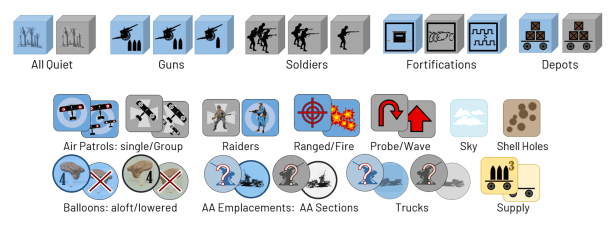
Volko: Here is a look at the blocks and counters, including the units represented. By the way, no real art exists yet – these are just my homemade prototypes.…

The standup blocks represent the guns, soldiers, fortifications, and depots that fight out the duels between gun batteries and the offensive’s barrage and assault. They build up hidden and are the targets for enemy observation missions. Positioning your hidden blocks will be critical both to make them harder to spot and to get the best use out of them in your plan for combat.

The counters represent those forces carrying out or supporting reconnaissance. They build up openly on the battlefield, except for anti-aircraft emplacements that may be AA sections or just harmless trucks. (Other counters here are markers that support various missions and actions.)

Grant: What is the role of Depots?

Volko: Depot blocks – if they survive unsuppressed – during the offensive resupply guns to fire again or fire at double strength. If the attacker exploits an advance, the depots refill and can again supply guns.

Grant: What are the All Quiet blocks and what do they represent from history?

Volko: “All Quiet” blocks (also nicknamed “trees”) represent just the usual presence of defenses at a side’s positions. So they do not mean empty, rather nothing special to see and shoot at. There are some troops garrisoning the line in what are probably battered trench works, perhaps some wire or field guns. If attacked, at least a few machineguns hidden there will answer.

Grant: What different air assets are available to players?

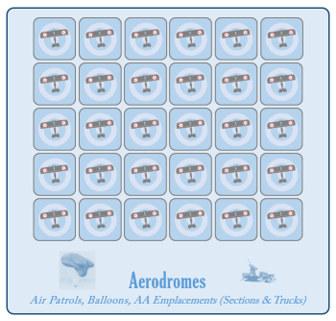
Volko: The workhouse in the air is the “Air Patrol” – either single or group, the latter more effective but uses up more airframes. Each player has a supply of Air Patrols at their aerodromes (on their mat) and sends them on specific fighter and observer missions or puts them into the Air Cup to add generally to the density of friendly aircraft prowling and protecting the skies over Verdun. Air Patrols suffer loss in action, so you can run out if you don’t manage the air battle carefully, potentially requiring you to recall counters from the cup or the map.

Of course we have balloons too, aloft over friendly positions behind the front line. Enemy balloon-busting fighter missions can destroy them or, more commonly, force them to lower. As noted above, these Drachen are highly effective observers, in the game reaching out to a distance of 4 positions, spotting secretly – you won’t know where your opponent’s balloons are looking unless they range guns in on your blocks – and unlike aeroplane observers automatically succeed in spotting their targets.

On the ground but protecting your balloons and blocks against enemy Air Patrols, you get antiaircraft emplacements – “AA Sections” or dummy “Trucks”. These will make any enemy air missions at or adjacent to them more dangerous. They also occasionally can cause a loss among your own nearby defensive air patrols, representing friendly fire.

The counters for Balloons and AA Emplacements are round to signify that these units can built up, adjusted, and used for free – whereas use of Air Patrols and trench raiders cost actions.

Grant: How are the serial assets used to perform recon? How does this work?

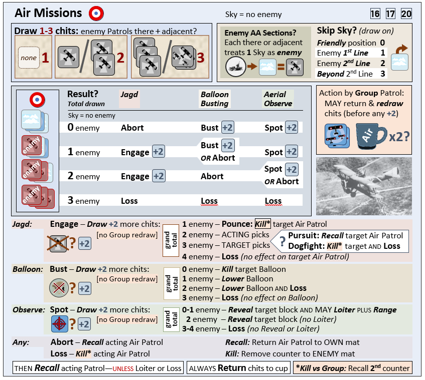
Volko: As reconnaissance and the efforts of fighters to stop it are the focus of the sim, most Air Missions as well as Trench Raids use an articulated chit-pull procedure accounting for a wide range of circumstances.

On the Air Missions table, you can see that we account for the presence of the enemy’s defensive Patrols and AA, how deep behind enemy lines you are flying, whether you are using an Air Group, and how many enemy chits you are likely to draw.

Various Asset cards, like “Boelke & Immelmann”, can further affect these results.

Grant: Why do you feel this is so important to the game?

Volko: Most trench warfare games either focus on the assault by infantry and perhaps tanks or cover the air duels going on overhead. But before those assaults and the barrages supporting them kick off, there would have been a critical period in which the sides were struggling to figure out what the enemy was up to and where they were massed. And that is when most of those aerial dogfights would be going on. Drachen pulls all that together to try to illuminate just HOW reconnaissance got done and would then set the course of a “big push”.

Grant: What is the layout of the game board and the purpose of the different shaped fortifications?

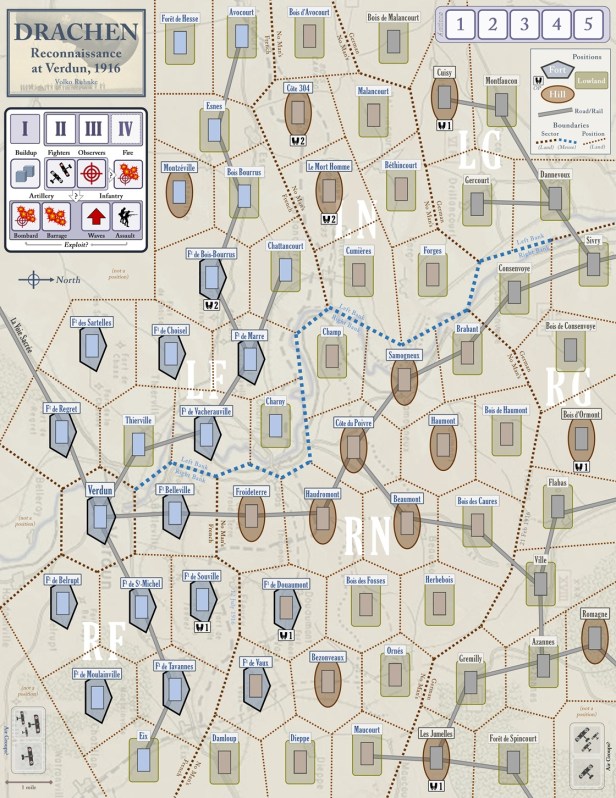
Volko: The game board shows the battlefield of Verdun. Area spaces, called “positions”, each hold a single block hiding the forces or fortifications there.

Terrain is either Lowland, Hill, or Fort – the latter effectively on hills too but tougher to crack. Hills and Forts enable guns on them to shoot a little farther, are harder to take by infantry assault, and often are the very targets that the attacker is assigned to seize.

A road and rail network spans the battlefield. Its effect is to limit where depots can be built up.

Land and Meuse River segments separate the positions. Little wooden stick pieces will mark the front along these segments. Positions group into sectors, such as “Left French”, to guide setup and solo play.

A final feature of the map positions is that some are observation posts. They function much like balloons but with far more limited reach, and they can be suppressed by artillery fire.

Grant: What is the general Sequence of Play?

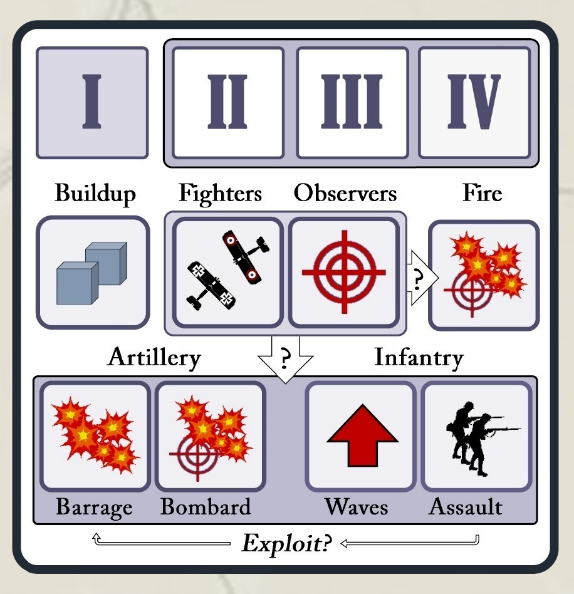
Volko: In each of between 2 and 4 turns total, each side first builds up forces (blocks and counters). Buildup limits are most lenient on Turn I, so players generally need to set a plan of attack or defense then and just adjust positioning on later turns. On Turn II and thereafter, revealed (face up) blocks hide again (stand back up) unless suppressed by enemy fire or under loitering air surveillance. On Turn III and IV – if the attacker has not yet launched an offensive – the defender receives reinforcement in the form of an added block.

The main part of the turn follows buildup, “Reconnaissance” activity by Fighters then Observers. That includes mounting defensive “Barrier Patrols” and offensive “Jagd” against enemy Air Patrols plus Balloon Busting, then Aerial Observation, Trench Raids, and spotting by Balloons and OPs.

After that, the sides will exchange “Directed Fire” by their guns onto previously “Ranged” targets. Or, on Turn II or later, the attacker can instead launch the offensive that will resolve the game.

Grant: How is victory achieved?

Volko: After the offensive, or after Turn IV in the rare case that the attacker never launches one, Victory depends on who has fulfilled more of their 3 drawn Objective Cards.

Grant: What are the purpose of the Attacker & Defender Objective Cards?

Volko: The simulation premise of the Objective Cards is that reconnaissance is trying not only to discover where the enemy is but what they are up to – what matters to them? Will the attack go for a breakthrough, or are they just trying to pin our forces in place and divert our attention from some other part of the front? Or even less, are they for now just trying to grind down our forces and soften up our fortifications? Is the defender set to hold everything at all cost? Or do they just want to bloody us as we advance?

A second set of questions concerns how big an enemy buildup we are dealing with. The Objective Cards give players more robust forces to carry out the more ambitious task. So that too is an essential element of information that reconnaissance is trying to gauge – what are we up against?

The Objective Cards provide a neat and easy way to set out that secret information. Through recon successes, such as finding out how your enemy’s fortifications or troops are deployed, you can discern what your opponent’s cards may be. And if you invest in trench raiding, your raiders might reveal one or more enemy Objectives for certain.

Grant: What are the various hidden objectives?

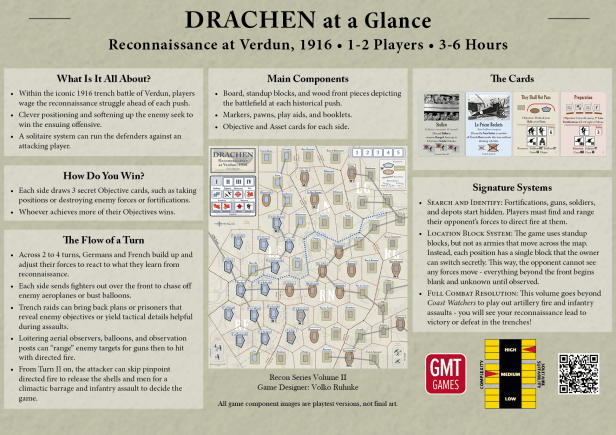
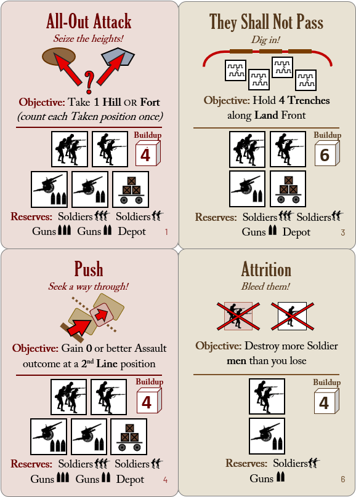
Volko: Attacker and Defender each draw 3 cards from up to 9 Objective Cards, most of which are unique tasks hidden from the opponent. Each card not only sets out a task to be achieved but also provides added blocks to that side’s “Reserves” and specifies a number of blocks that the player can build up on the map on Turn I.

One twist is that you don’t have to use a card’s specified forces for that task: the blocks just add to your total available.

A second twist is that particularly successful trench raids can obtain “Plans” that reveal your opponent’s Objective Cards to you: potentially highly useful, as you win not only by achieving your own Objectives but by impeding your enemy’s.

Grant: What different types of these cards are there?

Volko: There is a separate set each for Attacker and Defender. In sets of 3, they go from least to most ambitious/robust, for the Attacker, “Preparation”, “Push”, “All-Out Attack”; for the Defender, “Retrenchment”, “Attrition”, “They Shall Not Pass”. Different scenarios then might limit some of these sets for one or the other side to reflect that stage in the longer Battle of Verdun.

As you can see by the examples, the cards are specific as to their tasks and forces. Generally, the Attacker is either destroy certain defenses, mount strong attacks, or take key positions. The Defender generally is to hold key positions or destroy substantial attacking forces.

Grant: How do players go about accomplishing these?

Volko: A key premise of the game is that reconnaissance success unlocked success of an offensive push. So in the game, you won’t earn VP or whatever for how you run your reconnaissance effort. Rather, knowing what your enemy has where – and “Ranging” those targets for accurate fire by your gun – will set up the combat success that you will need to fulfill more of your own Objectives.

But you will need to add to that skillful positioning of your forces and fortifications to make use of the information that you gather, and then the right decisions when and where to uncover your guns to fire or send your infantry waves into assaults and counter-assaults.

So the game is about reconnaissance but also how that feeds into running trench war combat.

Grant: What challenges does each side face in their objectives?

Volko: Since fulfilling your Objectives flows from how you handle the entire Sequence of Play, they really distill all the game’s challenges. But specific challenges to do with the cards include that the easier tasks come with skinnier forces to fight with, and that you start out unaware of what your opponents Objectives are. That latter can be critical, as even decent performance against the goals in front of you may not be enough to win if your opponent does even better at their secret tasks.

Grant: How do offensives work?

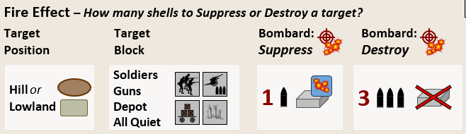
Volko: When the Attacker decides to launch the Offensive, both sides first get to recover some of their suppressed positions. Then each side’s guns, Attacker first, can “Barrage” to suppress enemy positions without needing Ranging by observers, just using more shells. Then each side can “Bombard” Ranged targets to Suppress them more efficiently or destroy them outright (as in the earlier “Directed Fire” phase).

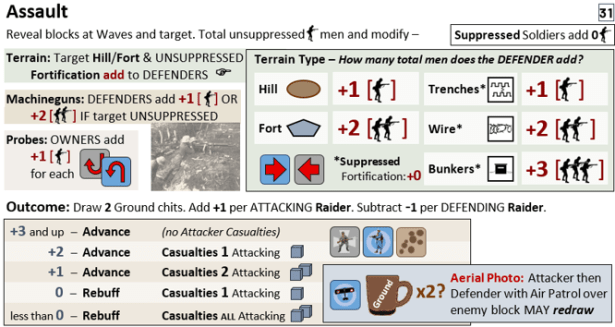
Then players place “Wave” markers to commit where infantry Assaults and counterattacks will occur. For the Attacker, these will attempt to take the defender’s frontline positions. Those get resolved rather simply, including a draw from the Ground cup to give at least some chance for a weaker attack or defense to succeed.

If any such Assault does succeed in taking ground, the attacker may “Exploit” – meaning one more round of Artillery and Infantry combat, usually to try to seize a 2nd-Line position.

Grant: How many players is the game designed for? Is there a solitaire mode?

Volko: Drachen is a 2-player game. A larger number of players, divided into 2 teams, has worked well at the many demos that I have done.

There is a solitaire mode that enables a solo player to take the Attacking side in all the scenarios, whether German or French. It uses instructions and scenario setups found in the Playbook, a “Defenses” display to guide hidden block buildup, and a deck of 18 “Army HQ” Cards to help run Defender actions.

Grant: What opportunities for deception and signaling are there?

Volko: Great question! A point of the Recon Series is to feature not only secret information but both open and secret collection of that information – in part to enhance such opportunities for deceptive signals.

In Drachen, you will have plenty of secret information about which to mislead your opponent. And, critically, you will have potentially or automatically open information that you can transit selectively in order to mislead. Some ideas…in the game, you can:

  • Put a few Soldiers to get spotted where you do not intend to assault, or fortifications that suggest Objectives that you did not draw.
  • Range targets that you cannot actually or do not intend to Bombard.
  • Deploy air defenses in areas that are unimportant to you.

And so on. Circumstances and your imaginings are the only limits!

Grant: What do you feel the game models well?

Volko: I am quite pleased with how the flow of the game models trench warfare’s set-piece buildups, the contest for control of the skies, the danger and importance of busting balloons and launching trench raids, the tit-for-tat artillery duels, including the danger of firing and exposing your batteries too soon, and more. In short, Drachen plays out on the table my mental model of WWI trench battles.

Grant: What are you most pleased about with the design?

Volko: The biggest thrill for me is that the design has held the interest of a talented corps of testers for many moons and many plays – and that it seems to get universally positive reactions at con demos. Ted Raicer has done wonders to bring out the fascinating aspects of the Great War, but even now trench battles don’t get the spotlight among us wargamers that I feel they warrant. And Verdun does not even have British or Americans (outside some volunteer fliers). So I’m proud that Drachen is adding to our hobby’s examination of WWI’s Western Front in between the famous mobile phases of 1914 and 1918.

Grant: What other designs are you contemplating or already working on in this series?

Volko: I already have a playable prototype for Volume III, and it even has seen some playtests. I call it Masher and it is set in Vietnam. Perhaps a topic for another visit here!

Thanks again for this opportunity to talk about the Recon Series!

I think that this new series, and this game particularly, look really interesting and I am all in on the subject matter and the approach. Also, the game offers 8 main scenarios and a solo learning situation spanning German and French offensives within the titanic 10-month Battle of Verdun. I did just receive my copy of Volume I in the Recon Series called Coast Watchers but have not had a change to get it to the table as of yet. I will rectify that sooner rather than later.

If you are interested in Drachen: Reconnaissance at Verdun, 1916, you can pre-order a copy for $79.00 from the GMT Games website at the following link: https://www.gmtgames.com/p-1162-drachen.aspx

-Grant

  •  
❌