Normale Ansicht

Sejm As It Ever Was

09. April 2026 um 23:20

How I feel when I turn in an article draft to my wife.

Here’s a situation for you. It’s the last decade of the 1700s. Far across the sea, a rebellion has ousted the British from thirteen of their prize colonies, leading to the adoption of a new constitution. Revolutionary fervor is sweeping the continent, throwing France into turmoil and the old regimes into paranoia. Your union, the Polish–Lithuanian Commonwealth, has seen its star faded by entrenched nobility and foreign partition.

And now there’s an opportunity to draft a constitution of your own.

That document — historically the Constitution of 3 May 1791, although you might instead draft any number of parallel constitutions in its place — is the topic of Rex Regnat, Edward Damon’s sharp-as-a-tack title about uncomfortable politics and doomed alliances. Part trick-taker, part parliamentary simulation, and part rumination on a union whose constitution would only last 19 months before it was divided out of existence until the First World War, Rex Regnat is one of the finest political games I’ve played all year.
Hm, where is the WHINING ON 'APOLITICAL' COMEDYBRO PODCASTS issue?

Some of the issues facing the Polish–Lithuanian Commonwealth in the late 1700s.

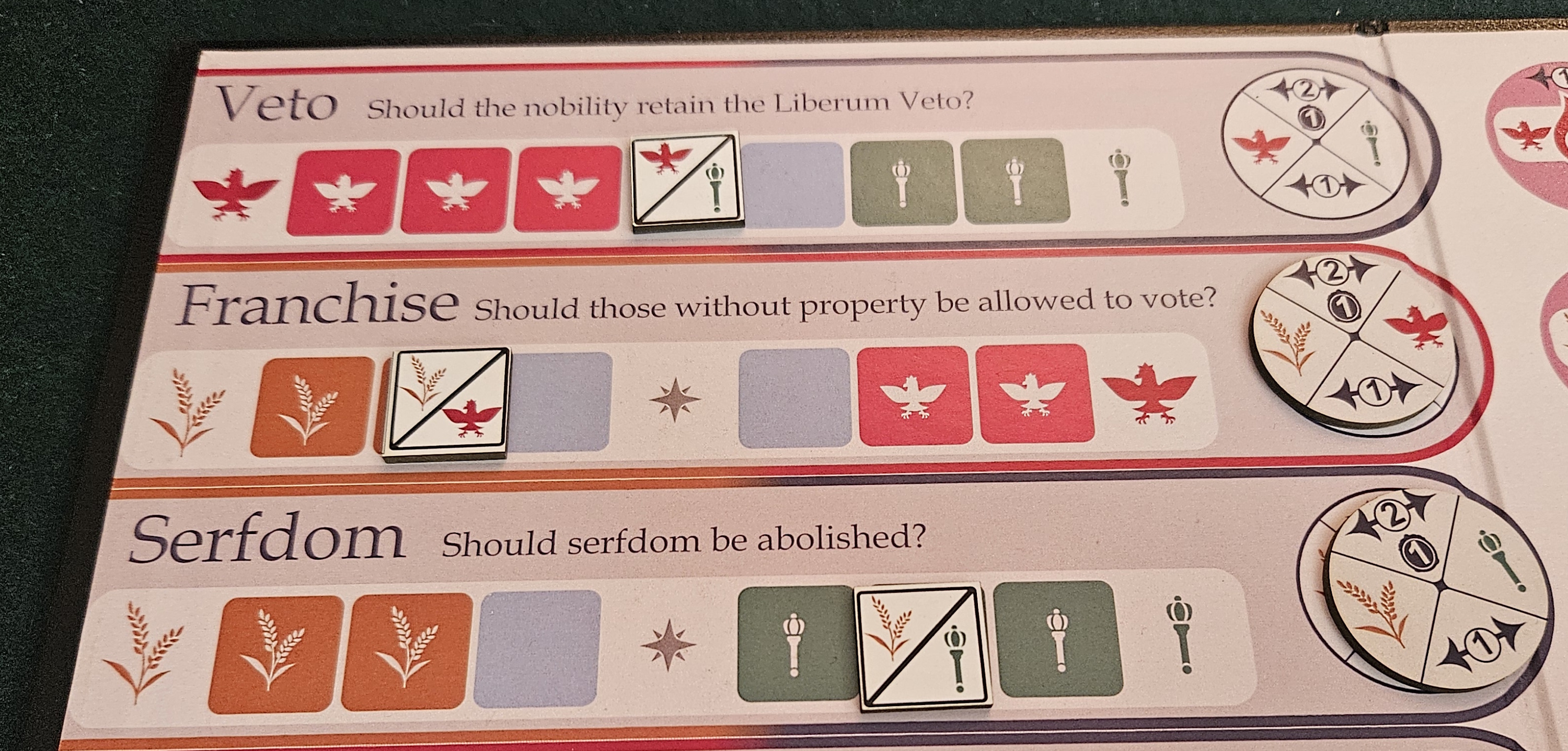
At first glance, Rex Regnat is a game about tracks. The board consists of ten of the things, six for various issues facing the assembled sejm — think “parliament” and you’ll be close enough — and another four for the agitation taking place across Polish–Lithuanian society during the drafting of its constitution.

For the most part, those issues should be familiar to passing students of history. They raise questions about who should be allowed to vote, the status of serfdom, Catholicism as a state religion, and whether the king should be subject to common law. Boilerplate stuff for the Age of Revolution. The two remaining issues are harder to peg without some understanding of this peculiar union’s context. First is the Liberum Veto. This bad boy allowed any deputy of the sejm to nullify the entire legislative proceedings, a terrible idea even in peacetime, but a downright suicidal one when neighboring titans like Russia and Brandenburg could bribe any old noble to veto any reform that might impede their foreign agenda. Next is the hereditary nature of the monarchy. That only makes sense when you realize that kings were elected — and, as a result, tended to function as a stump for their noble electors.

Okay, so the basics are easy enough to understand. You’re one of the factions hoping to mold the constitution to your liking. Handily, the tracks label your intentions. The Regime — which means the nobility and its sway over the monarchy more than the king himself — wants to further entrench their privileges, placing their icons on the right side of the three tracks they care most about. But this can prove slightly deceiving. As those currently hoarding the lion’s share of their country’s power, the Regime would also be content to allow affairs to remain as they already are. Thus they score points for securing their privileges, but also for keeping those tracks — all six of them this time — firmly seated in the middle. This marks them as right-wingers and centrists at the same time. Which is always the case, deep down, but the phenomenon is especially pronounced here.

Opposite the Regime is Reform. This faction wants a constitution that will bring the Commonwealth into the modern world. The Liberum Veto? Out. Serfdom? Out. Total enfranchisement? Hold on a minute. The Reformers aren’t insane. Incremental change, that’s the path forward. Maybe, and this is a maybe here, Reform could grant a few cities free status. Just to prevent the troubles in France from happening here, you understand. But beyond that? Let’s not lose our shirts.

If you’ve ever studied a revolution, you can probably already see the hairline fractures forming at the foundation. Rex Regnat can be played with two players. In such an event, Regime and Reform are the principal actors. But as an experience, Rex Regnat shines with four. That’s because there are two more factions to consider. As ideologies, their role was limited in the historical sejm that oversaw the declining years of the Commonwealth. But they existed, they agitated for their own alterations to Polish–Lithuanian governance, and they played a crucial role, as radicals always do, in popularizing which issues can be discussed in the first place.

I'm outraged that the chits are off-center. But that's my outrage for every game with chits.

Society’s many outraged sectors.

These factions, then, are even further to the right and left than the mainstays. First we have the Radicals, also known as Reform on steroids. Whatever Reform wants, the Radicals want double. Whatever Reform is hesitant to grant, the Radicals are ready to throw a Parisian Moveable Feast to take for themselves. But then there’s their opposite number, Reaction. Think of them as the incel podcasters of the 18th century. They want a stronger monarchy, an empowered military, maybe an alliance with those treaty-breaking Prussians next door. If this should spell annexation… well, reactionary movements have never been especially good at thinking long-term.

Now, you might be thinking that I’m spending a lot of time discussing tracks and factions. True enough. But these dynamics are at the heart of Rex Regnat. Reform and the Radicals, Regime and Reaction; these are the natural alliances, albeit uncomfortable and shoehorned alliances, that dominate the table. They’re Rex Regnat’s version of the Communists, Socialists, and Anarchists from Alex Knight’s Land and Freedom, or the awkward three-way race that defines Mark Herman’s Churchill, or the squabbling powers of Herman and Geoff Engelstein’s Versailles 1919. These comparisons are not ones I invoke lightly. Rex Regnat resembles those games not only because they’re all games with tracks, but also because it intends to put players in the same diplomatic headspace. It’s about trading favors, talking your friends into doing things that benefit you just a little bit more than they benefit them, and maybe, in the end, risking everything on a coup de grace that’s really just a literal coup.

Which is why the tracks are important, but not all-important. Each faction has other aims to consider. The Regime derives most of their points from the tracks, which makes sense, given how badly they want things to remain the same. But they also care about tamping down societal agitation and keeping control of the gavel, the marker that dictates who picks the issue up for debate. Reform, meanwhile, is happy to be included at all, so any issue they win becomes political currency, even those that have nothing to do with them.

The Radicals and Reaction go further, as befits their status as outsiders determined to get a foot in the door. If the Radicals don’t get their way, they can instead foment outrage, possibly leveraging the upset of the people to seize control outright. Reaction, meanwhile, alters its objectives ever so slightly between rounds. In the first half, Reaction wants as many cabinet positions as possible. They’re infiltrating offices. Securing funding. Finding their audience. In the second half, they want to push those outrage tracks up as far as possible. Suddenly, their interests are aligned with the Radicals, but only in the sense that they want a riled-up population. They’re here to co-opt everybody’s justified anger for their own purposes.
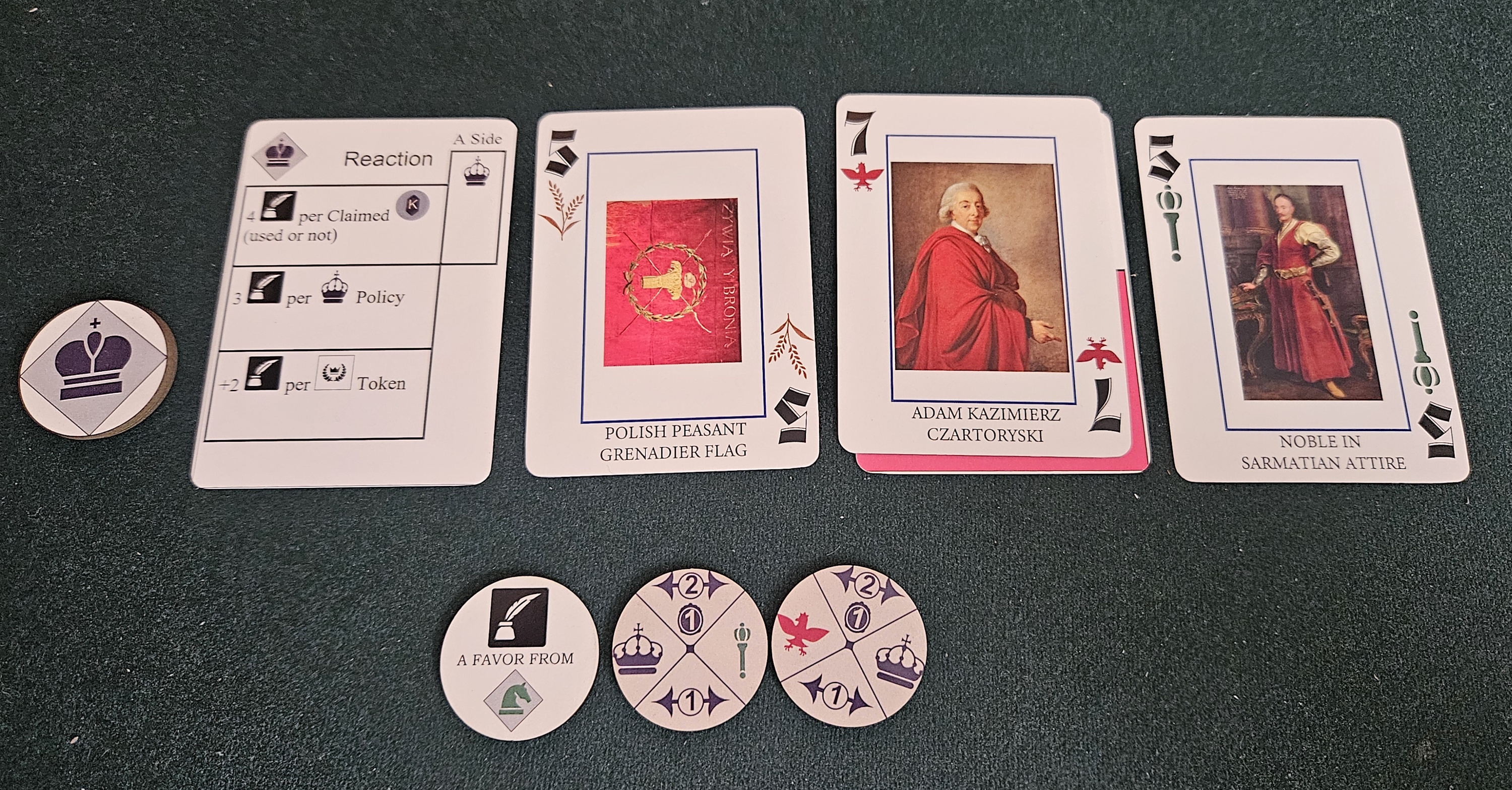
ah yeah, it's red robe guy

Only the cards on your bench can be played into a trick.

Just as those other political titles I mentioned had their own methods for resolving the debates and issues of the day, Rex Regnat finds its footing in the most expected of places… because, yes, this is a trick-taking game. Another trick-taking game. All I play anymore is trick-taking games.

But while Rex Regnat is a trick-taker, it’s quite unlike its peers. The first and most visible difference is that each player always has three face-up cards. This is their “bench,” and these are the only cards they can play into any given trick. Right away, this has a few consequences. The first is that there’s a great deal of manipulation to the proceedings. If I see that you have the highest-ranked card in a particular suit, I’m not likely to initiate a debate over an issue in that suit. Unless, that is, we can come to an agreement.

Or unless I want you to win that issue. First of all, it’s entirely possible to force an opponent to shed a powerful card on an issue that doesn’t really benefit them right now. If you’ve already secured Catholicism as our state religion, letting you expend your strongest card to thump the table about God and Country is a boon that keeps on giving. Go ahead. I don’t mind. Shout about our duty to Christendom. Tell it to the rafters.

But more than that, there are plenty of little overlaps in the scoring conditions, and not only between natural allies. Needling the Regime into stripping the Radicals of an outrage issue is valuable even if it doesn’t benefit me directly. All the better if I can force you to burn a potent card and deprive a leading opponent of their strongest source of points.

But even more than that, precise rankings matter in Rex Regnat. The winner takes and resolves the issue, the natural outcome of any debate. Last place earns the gavel, their backroom politicking letting them dictate the future issue under discussion. But second and third place also get their say, shifting the suit of their played card up on the outrage track. Depending on the sequence — which, again, is often manipulable thanks to the face-up cards on everyone’s bench — it’s possible to ensure that you shift such a track at the precise moment it will confer some advantage. Such as, say, an influence token, worth points to all factions. Or a token that will conceal one of my bench cards, making it all the harder to guess at my next move. Or a shift on an issue track that isn’t directly tied to a debate. No matter the precise debate being undertaken right now, there’s always some way to get ahead.

The result is a form of trick-taking that’s played openly (most of the time) and allows for an unusual degree of control (again, most of the time) and encourages the aforementioned horse-trading and wheedling. While many of the genre’s touchstones are present and accounted for, trump suits and sloughing and tactical tiebreakers, they tend to fade into the backdrop of the game’s politics. Your bench is a set of cards, but it’s also the dignitaries and arguments your faction has ready right now. Your hand becomes blackmail and backrooms deals and side hustles, almost ready for the oven but in need of a bit more leavening. Even smaller incentives, like the royal offices that transform ordinary cards into kings, become opportunities to flex your political clout.
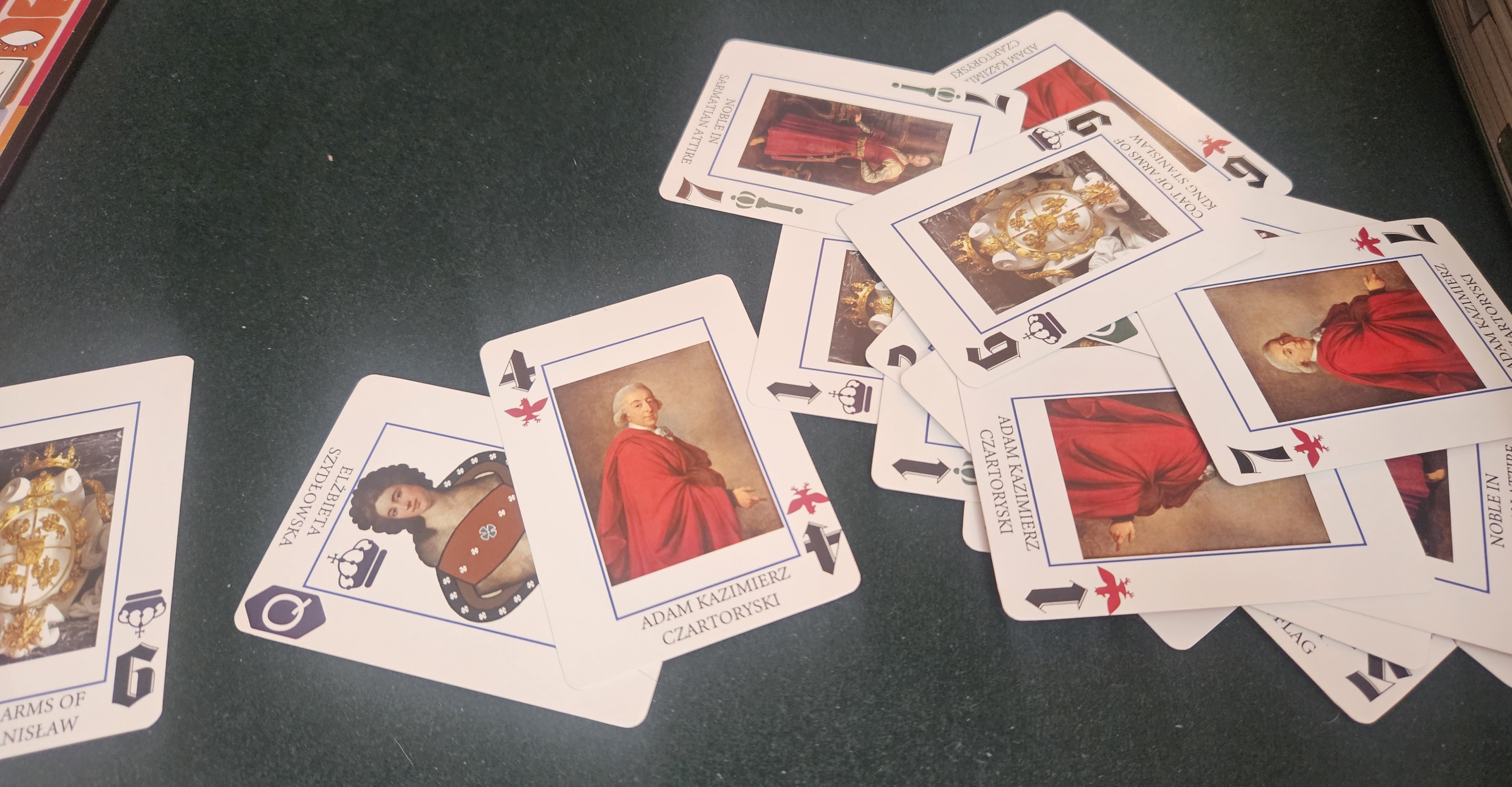
as you can see, red robe guy is a favorite around here

When discards go bad.

I have a great deal of affection for games that use abstraction to speak a deeper truth about the topic they present. I’ve already mentioned a few of them. In Land and Freedom, Alex Knight compressed a complex and drawn-out civil war to a few fronts, some negotiable values, and the squabbles and purges between three factions that couldn’t set aside their differences to save their lives. The result was a game about the shortcomings of revolution and democracy. Churchill’s military fronts were also tracks, linear near-inevitabilities that assume the Axis will collapse, but it’s anybody’s guess who will inherit the world; the outcome was an examination of the war-behind-the-war that produced the remainder of the 20th century. High Treason established its courtroom drama as a series of icons that might or might not be worthwhile, their relative value always slightly out of reach. Justice, Alex Berry argued, was a matter of guesswork and who was seated in the jury box.

With Rex Regnat, Damon pulls a similar trick. Rex Regnat reveals a political system in the throes of reform, but one that might have shambled along for too many decades to carve out a future for itself. Is it possible to pull back from the brink of a monied class that believes its only hope of holding onto its privileges is denying them to anyone else, from electoral power that excludes those it deems too ill-mannered, from foreign interests that incite violence rather than stability? God, I hope so.

That Damon does this without presenting a single map is nothing to sneeze at. Rex Regnat includes design notes, but fewer players will read them than the rules. In place of textual rhetoric, Damon instead has to leverage smaller touches: considered victory conditions, the placement of icons on tracks, an ideological impression rather than a dramatis personae or timeline of events.

I daresay it works, at least in the broad strokes. As a springboard to learning about the Polish–Lithuanian Commonwealth’s final decade, there are none better. Crud, half the people I’ve introduced the game to weren’t even aware that the Polish–Lithuanian Commonwealth existed, let alone that it attempted a series of radical reforms in its final months.
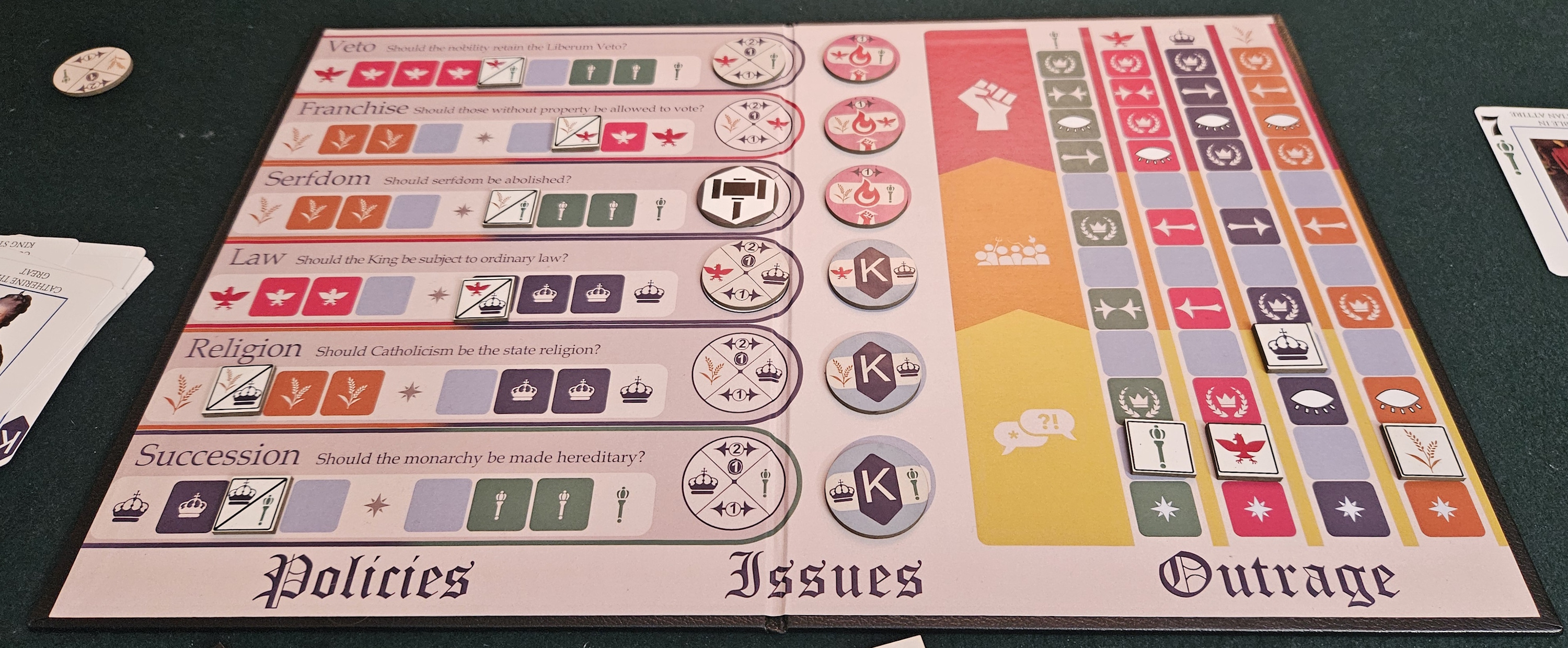
Outrageous! Ahem. Sorry, but I've just written 2000+ words about this game. You'll excuse me for not having another good alt-text.

Taking in the big picture.

But attempt it did, and succeed it did, at least for a time. The 1791 Constitution didn’t last, but it became a model. For the Poland that would recover its independence 123 years later, it became a model of their enduring identity; for the coming constitutions that weren’t throttled in their cradles, it became a model of possibility. In capturing the dynamics of its fraught composition, Rex Regnat offers one of the finest works of abstract ludic history I’ve played in a long while.


I’m adding a note here just in case somebody actually wants to buy this thing, because it’s hard to acquire: you need to go to the Damonic Designs website and email him, at which point he will offer to sell and ship you the game. Yes, this is convoluted.

A complimentary copy of Rex Regnat was provided by the designer.

(If what I’m doing at Space-Biff! is valuable to you in some way, please consider dropping by my Patreon campaign or Ko-fi. Right now, supporters can read my first-quarter update of 2026: the best board games, movies, books, and more!)

SETI Insert: Von Zippbeuteln zur Spieleschachtel-Ordnung

Von: ravn
09. April 2026 um 22:48

Ordnung hilft, zumindest um eine Menge an kostbarer Brettspieltreff-Zeit einzusparen. Weil wer mag vor der erwarteten Partie noch umständlich lange mit dem Spielmaterial zu hantieren, um das Brettspiel spielfertig aufzubauen. Besonders bei komplexeren Kennenerspielen mit vielen Komponenten kann das arg zeitintensiv und mühsam werden. Zeit, die wir uns sparen können – dank passgenauer Inserts aus dem 3D-Drucker.

Für mein aktuelles Lieblingsspiel im gehobenen Eurogame-Bereich habe ich mir die Investition in ein Insert gegönnt. Während das Grundspiel von SETI mit Erweiterung Raumfahrtorganisationen rund 82 Euro in der lokalisierten Version von Heidelbär Games kostet, schlägt das kommerzielle 3D-Drucker-Insert von 3D-Inset mit 42 Euro extra zu Buche. Versandkosten kommen da noch dazu. Damit wurde das Gesamtpaket Search for Extraterrestrial Intelligence für mich um 50 Prozent teurer.

Ganz klar eine Luxus-Aufwertung, auf die ich gut hätte verzichten können, aber eben nicht gerne. Denn die bisherige Aufbauzeit, um all das Spielmaterial aus seinen Kartenschachteln und Zipp-Beutel auf den Tisch zu bringen, hat schon seine Zeit gebraucht. Keine Ahnung, wie lange, denn gestoppt habe ich diese Zeit nicht. Aber im direkten Vergleich miterlebt, wie einfacher und schneller es mit einem passgenauen Insert geht. Das wollte ich auch und deshalb habe ich mir das Plastik-Insert von 3D-Inset gegönnt.

3D-Inset ist und da zitiere ich einfach mal, weil es so gut passt, deren Selbstdarstellung: „Wir sind leidenschaftliche Brettspiel-Fans und haben es uns zur Aufgabe gemacht, dein Spielerlebnis noch besser zu machen. Unsere 3D-gedruckten Inserts, Organizer und Zubehörteile helfen dir, deine Brettspiele schneller aufzubauen, ordentlich zu verstauen und mit noch mehr Freude zu spielen.“ In Deutschland entworfen, produziert und verschickt. In nur wenigen Tagen nach meiner Online-Bestellung hatte ich das offiziell lizenzierte Zubehör für SETI bei mir zu Hause. Das ist das Firmenversprechen, weshalb ich eine bevorzugte Behandlung ausschließe, weil komplett privat bezahlt ohne Bezug zur brettspieltag.de-Webseite.

Warum ausgerechnet das 3D gedruckte Insert von 3D-Inset? Weil ich es bei einem Brettspiel-Kumpel im Einsatz gesehen habe und ich fast vollständig damit zufrieden war. Denn ich wollte ein Plastik-Insert, um das komplette Spiel mit Erweiterung mitsamt Kartenhüllen und ohne Kompromisse und Schachtelhub unterzubringen. Bisher war das nur möglich, in dem ich das Solo-Material in die Erweiterungsschachtel aussortiert hatte. Trotzdem blieb der Aufbauaufwand, besonders mit dem ganzen Material für die verschiedenen Aliens und den dreifach zu sortierenden Technologieplättchen.

Das war immer eine kleine wie fehleranfällige Fleißaufgabe vor dem Spiel. Der Technologieplättchen-Halter für 10 Euro hätte eventuell auch schon ausgereicht, zumal ich sowieso kein Solo-Spieler bin. Aber wenn schon, dann bitte alles. Und wenn ich hier bisher unwissend von Plastik geschrieben habe, dann ist das eigentlich ein zweifarbiges PLA (Polylactid) und das ist ein biologisch abbaubares Filament für 3D-Drucker, das aus nachwachsenden Rohstoffen wie Maisstärke gewonnen wird. Wieder mal was gelernt.

Meine nur fast vollständige Zufriedenheit kommt daher, dass es leider jeweils nur einen Behälter für die Datenpakete sowie Credits und Energie-Plättchen gibt. Ich hätte gerne lieber zwei kleinere Schalen für beide Tischseiten gehabt, denn der Aufbau von SETI in Vollbesetzung ist schon arg raumgreifend und so hätte jeder die ständig benötigten Komponenten in Griffreichweite gehabt. So ganz ohne Extraschalen geht es dann leider doch nicht.

Da ich von der Stange gekauft habe, hätte ich stattdessen eventuell Sonderwünsche anbringen können. Habe ich aber nicht, weil war eine spontane Kaufentscheidung als ich die Rückmeldung vom Brettspiel-Kumpel bekam, dass das Insert nun auch für Kartenhüllen mit der Erweiterung passt. Das war zunächst ein Ausschlusskriterium für mich, wurde aber von 3D-Inset nachgebessert. Wer aktuell dort bestellt, bekommt die neueste Insert-Version, die auch mit Gamegenic gesleevte Karten in den Kartenhalter kompatibel ist. Ich selbst nutze noch meine Restposten von etwas dünneren Arcane Tinmen Kartenhüllen und habe somit noch etwas mehr Platz.

In Summe kann ich das SETI Insert nur empfehlen. Einzig fehlt mir noch ein ausgedrucktes Blatt, wie ich die kleinen Plastikschachtelchen alle wieder so zurück in die Spielepackung sortiere, sodass alles wieder passt. Stattdessen gibt es ein YouTube-Video, das Euch Schritt für Schritt dahin begleitet. Mit ein wenig Übung und Erinnerungsvermögen und notfalls ein Smartphone zur Hand geht es auch. Im Zweifel schaue ich einfach hier in meine eigene Auspack- und Aufbau-Bildergalerie. Passt dann schon und das bestens.

Timber Town Game Review

This is my first review for Meeple Mountain, so by way of introduction let me tell you that tile-placement games are my favorite. Carcassonne was my introduction to modern hobby games, and it's possible this created a soft spot in my heart for the genre. And if a tile-placement game also has a city-building aspect, as in Warsaw: City of Ruins, Neom, or Suburbia? That's a double win. Throw in a puzzle to be solved and wrap it all in a light- to medium-weight game, and you'll almost always have a hit with me, unless the game is mechanically flawed, bug-ugly, or offensive in some manner.

Enter Timber Town from Alley Cat Games. Timber Town is a two-player game where players are beaver architects competing to construct the best (i.e., highest scoring) town on opposite sides of the riverbank. Your eager beaver builders construct town components (in the form of tiles) upstream and then float them down the river for you to collect and place in your town. As the architect, it’s your job to place the tiles in legal and optimal scoring positions.

The trick is, the river is fast moving and components you (or your opponent) don't choose in a timely manner will fall over the waterfall, lost to you forever. This simulation is…

The post Timber Town Game Review appeared first on Meeple Mountain.

The Love/Hate Relationship: Card Driven Games

Von: Grant
09. April 2026 um 14:00

I very much enjoy Card Driven Games (CDGs’) and I think that many players also generally like them for many reasons including their strategic depth and replayability, as well as the tough choices players face each turn with the management of their hand of cards. However, this depth can come with some drawbacks and in this edition of The Love/Hate Relationship, I want to share what I love and hate about the CDG mechanic. Some of the first wargames that I experienced were Card Driven Games! Due to this fact, and because I really enjoy the mechanic, CDG’s hold a special place in my heart. So what is a Card Driven Game? It is more than just a game having cards or using cards. The CDG attempts to focus the players’ actions, and what they can ultimately do in the game, on the cards in their hand. Typically, performing some form of an action will use a single card and these cards will often be multi-purpose. This means they can be used for an action or to take the printed event on the card to do an action that typically either is more powerful but somewhat circumstantial. The medium also allows for historical events to be implemented in the game and allows various rules overhead or special instructions to be printed on the cards making the game a bit easier to play. Cards are simply fantastic and I have played many CDG’s. In fact, my first wargame was Twilight Struggle (yes I see it as a wargame!) followed by classics such as Wilderness WarEmpire of the SunWashington’s War and others.

Love

The main focus of the Card Driven Game mechanic, and probably the aspect that I most love about it, is the constant, agonizing choices about how best to use your hand of cards. Do I use a card for its powerful unique event or for its Operation Points? You simply never have enough resources to do everything you want, forcing you to prioritize the use of your cards and the actions you take but also to force a decision upon you about when or if to take calculated risks. This makes every turn feel like a high-stakes puzzle and each time I draw a new set of cards to start a round, and as I thumb through them, formulating my strategy, I get either a sinking feeling in my stomach or a sudden burst of excitement. CDG’s are generally praised for their strategic depth and replayability, which stems from the tough choices players are faced with each turn and that will change from game to game as the cards come out differently.

Also, unlike generic strategy games, CDG’s use cards to inject real-world flavor and historical events into the gameplay. Typically, in order to add these bits of chrome from history would require additional rules, exceptions or a whole new process being being added to the game. This tends to bog a game down and makes the almost unplayable. But, with CDG’s, each card represents a specific historical event that provides in-game benefits or difficulty for the players based on that history. These cards create a narrative as you play, where the sequence of cards can tell a unique or alternate version of history every time the game hits the table. This variety in outcomes and the way history in the game unfolds is one of my favorite parts!

There also is a real Fog of War aspect to CDG’s that I love as I just don’t know what type of hand my opponent has drawn. As players keep their hands hidden in the game, you and your opponent will be uncertain about the specific events and strategies available to the player based on their card draws. This really fosters a dynamic, back and forth, reactive gameplay that adds to the tense feeling of these games. I very much enjoy this aspect of the unknown and the process of trying to deduce what your opponent is trying to do based upon their card plays. When you are playing these CDG’s, you will have to think quickly and efficiently as a turn usually lasts 5-7 card plays and you will not have time to dawdle or you may find that you are in a real pickle.

But I think that my favorite part of CDG’s is the planning of a turn and how best to use your hand of cards. As you first start to examine your hand of newly drawn cards each round, you should first ask yourself “What do I need to accomplish this turn? and “What would I like to accomplish this turn?”. Then simply peruse your cards identifying those that can help you in both of those identified goals. I like to then look at the opponent Event cards in my hand and determine which ones don’t have their conditions to set off the Event met on the board at the moment. If the condition could possibly change, I prioritize that card to play first as I don’t want that Event to go off for my opponent. I also then make sure I don’t have any of my events that have conditions that could change as well and I will prioritize those to play next, after I have culled the negative opponent events. To hemp with this process, I literally line the cards up in my hand according to an approved play order, from right to left, so that I don’t get distracted or sidetracked.  If there is anything that can happen in this game, you will get distracted by what the other player is doing and sometimes quickly react without thinking, ruining your carefully laid plan. This approach has kept me organized, on task and most importantly in a position where I am able to minimize the negative damage from my opponent’s Events while simultaneously maximizing my own benefit.

Hate

Now that you see what I love about these CDG’s, let’s take a look at what I hate. Hate is such a strong word for me but there are many things that I don’t like about the mechanic. 

As with any new game or system, there is a learning curve with CDG’s. To play a CDG effectively, players often need to be familiar with and generally know all of the cards in the deck to be able to plan long-term strategies and mitigate potential risks and traps. This can be daunting for new or casual players of a CDG as the true strategy of the game will not be revealed for the first few plays but is something that needs to be developed through experience with the deck over several plays. An example of this is the Fidel Card found in Twilight Struggle. As I have played Twilight Struggle as the USA player, I have had to keep in the back of my mind the fact that this Fidel card is in the deck as it allows the Russian player to remove all US Influenced and directly place Influence into Cuba. Too much commitment in the early part of the game can be a waste of resources as it can all be removed with the play of this card and you must keep that in mind. Any card that allows for the placement of Influence into an area you cannot is worth its weight in gold.

Probably my most hated part with CDG’s is the “luck of the draw”. When you are dealing with a card based game where a deck is shuffled and randomized, you are bound to run into a bad hand now and again. While part of the fun with this mechanic is the concept of trying to do the best you can with the cards you are dealt, a bad opening hand or a streak of poor draws can sometimes feel game-breaking or frustrating, diminishing the sense of strategy and skill that the genre holds important. Nothing worse than looking at your hand and you have 2 – 1 OPs value cards, 2 – 2 Ops value cards and each event is that of your opponent. Just not a good way to start a turn.

The final thing that I dislike is that the mechanic does sometimes lead to a less realistic simulation and even a totally ahistorical outcome or timeline of events. To some wargamers, abstraction provided by cards lessens the game’s simulation value compared to more detailed and traditional systems, such as hex and counter games. The feeling of being unable to perform basic actions without a specific card can break immersion.

In summary, I personally love the CDG mechanic. It is a great method of design to ensure that you are injecting the history of the situation into the game while also creating a very stimulating and interesting play experience. What do you love and hate about CDG’s?

-Grant

Wagering Everything on Bronto

09. April 2026 um 02:36

These are civilized thunder lizards, they would never consume one another mid-race. But you can tell they're thinking about it.

Are wacky races the new zombies of board games? Probably not, but it strikes me as wild that I’ve played four distinct wacky race games within the span of a single year, yet nobody within my circle agrees on which one is the forerunner. Dino Racer, the third of those four, was designed by Marceline Leiman, who gave us the lovely High Tide and Nebular Colors (née Heavenly Bodies). This time, the racers aren’t hot dog mascots or magical athletes. I think you can guess what they are.

(They’re dinosaurs.)

STEGGY. STEGGY. STEGGY.

And down the stretch they come!

When we first played Dino Racer, the whole thing seemed broken. Thanks to a small rules error, the outcome of the races was all but foreordained, the wagers were obvious, and not even Eric Hibbeler’s charming dinosaur portraits could do much to make up the gap.

Okay, so maybe it wasn’t such a “small” error on my part. But the point stands. Even something as minute as reshuffling the deck in between matches, rather than letting it run its course and thus tweak the odds from race to race, was enough to scuttle this one. Fortunately, the right rules transform it into a zany good time — albeit one that might prove too light for some enthusiasts.

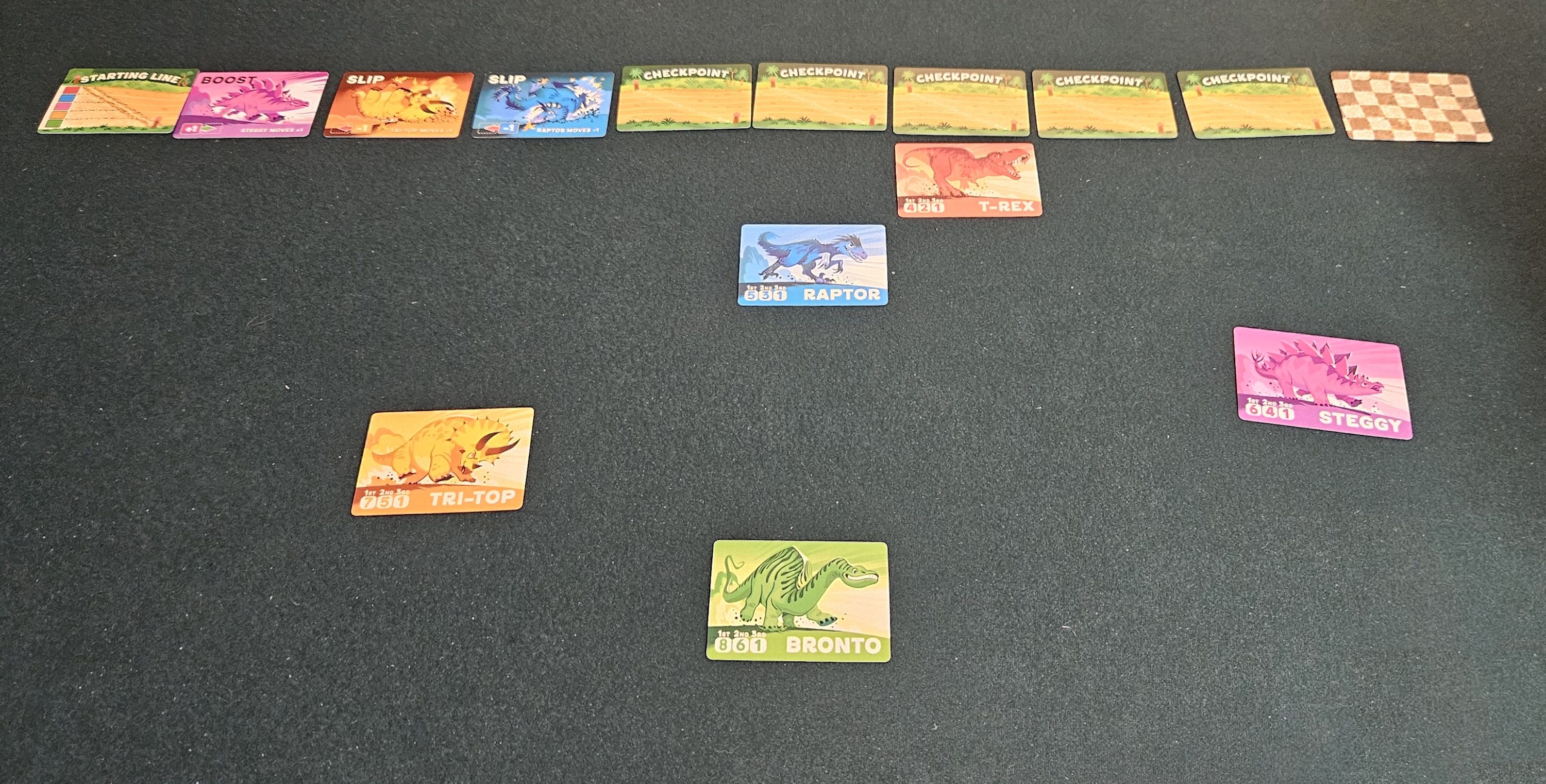
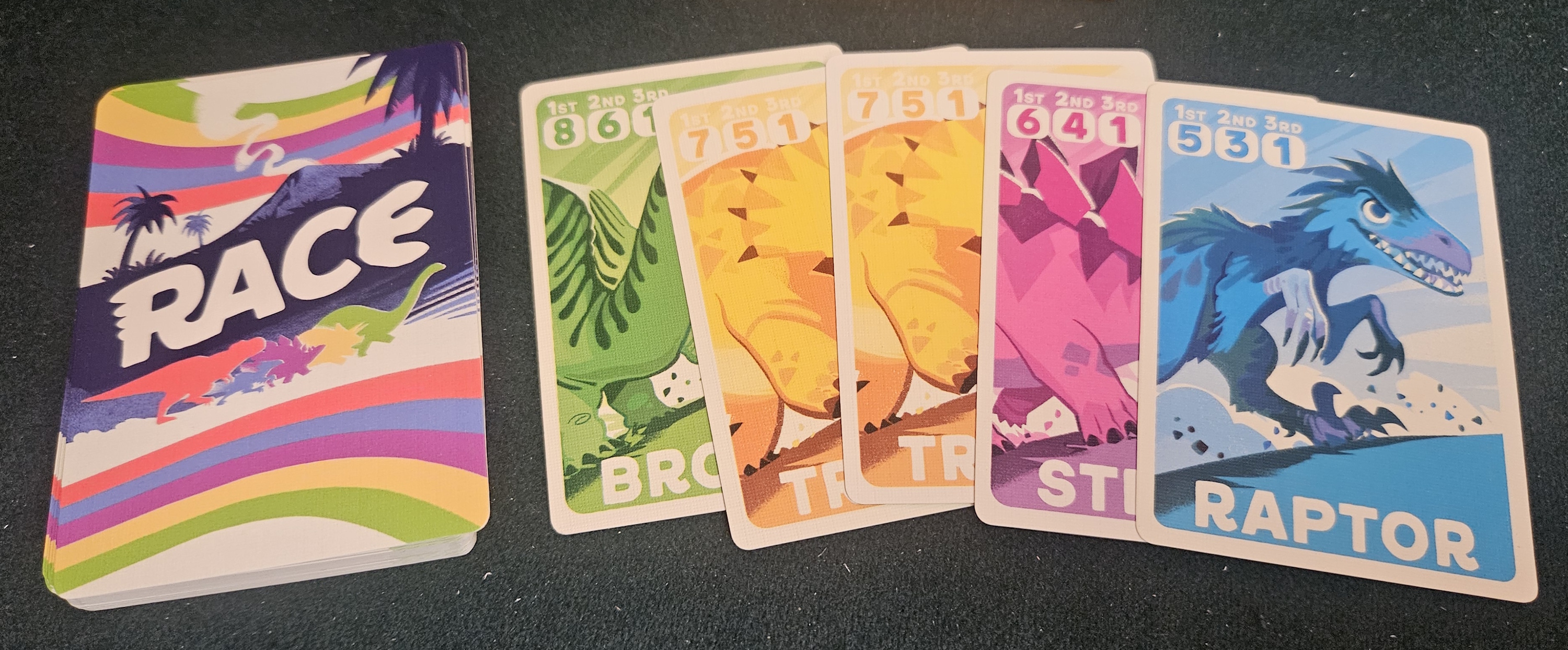
At the outset, Dino Racer seems like as much a spectator sport as its peers in the wacky race club. When the round begins, five dinosaurs stand hip to hip at the starting line. T-Rex has the best stamina, with diminishing probabilities of success for Raptor, Steggy, Tri-Top and Bronto. These odds are represented by each dino’s quantity of cards in the deck, not to mention their relative tiebreaker positions, but they’re close enough that the outcome isn’t wholly set in stone. T-Rex has one more card than Raptor; Raptor has one more than Steggy; and so on down the line. It’s enough to give some dinosaurs a statistical advantage, but such a slender one that upsets aren’t outside the realm of possibility.

The race itself is resolved in much the same manner as those in Jon Perry’s Hot Streak. Somebody picks up the deck, flips a card, and moves the corresponding dino one space closer to the finish line. Some of that game’s possibilities are left by the wayside; there are no trips or reversals, just a steady forward momentum.

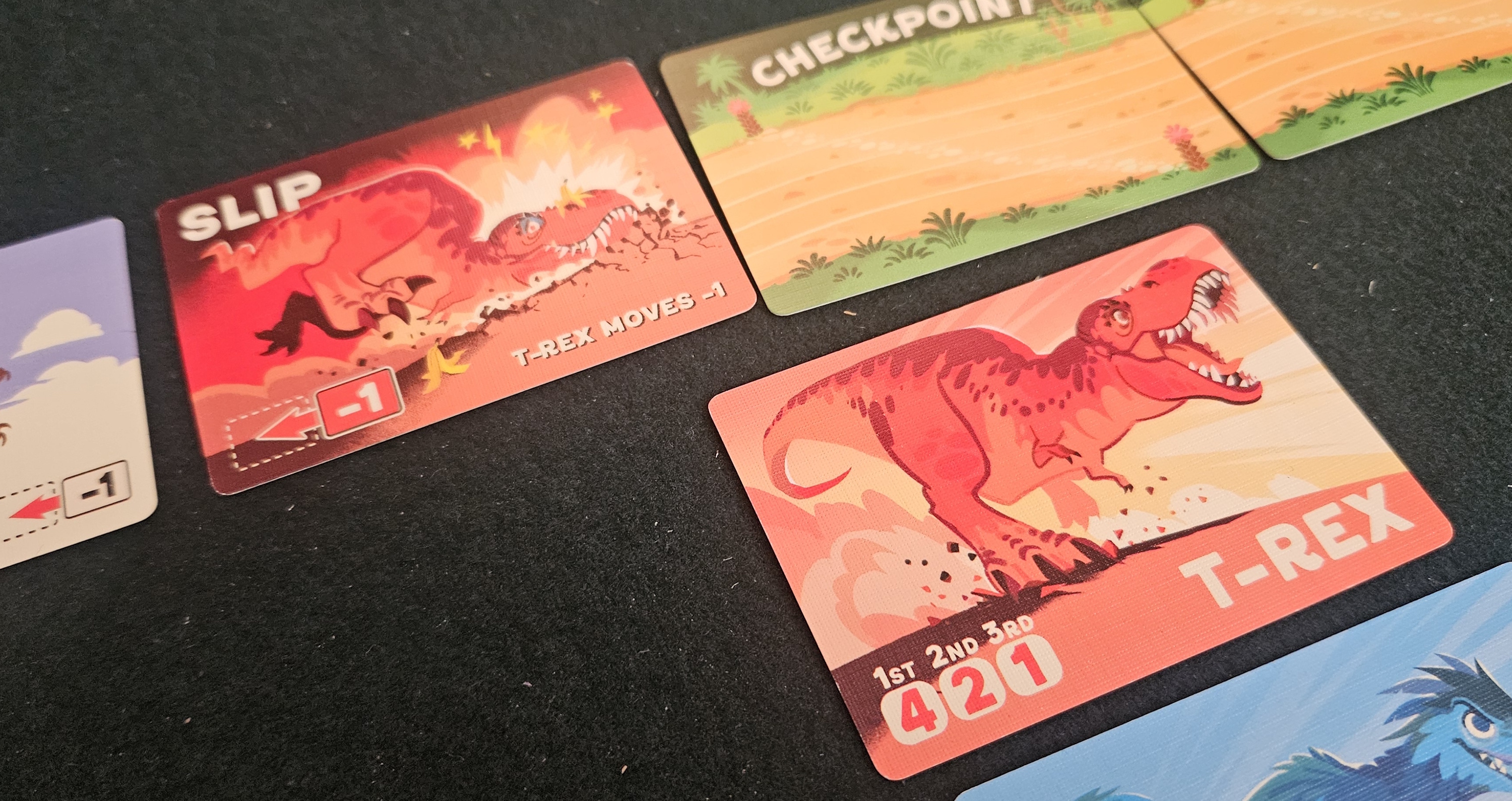
For the most part, anyway. As soon as every dino has reached a column, the checkpoint card at the top of the track gets flipped over. These might produce new opportunities, such as a burst of speed for Steggy, a sudden stumble for Raptor, or a swap between the racers in first and fifth place. What initially seemed like a straightforward foot-race becomes… well, still a straightforward foot race, but one in which the racers’ fortunes are much tightly corded than they previously appeared.

The game’s bigger revelation is that it isn’t a spectator sport at all. Unlike Magical Athlete and Hot Streak, where the bulk of the decision-making occurs before the firing shot, players in Dino Racer are active participants the entire way through. As soon as a certain number of cards have been flipped, the proceedings pause while players take turns selecting from those same cards.

I would call this system Knizian, but I think we've reached the point where that could get me burnt at the stake for blasphemy.

The cards govern both the race and its wagers.

These are the game’s wagers, and they’re informed enough to make smart decisions, but not so settled that you don’t run the risk of losing everything when a loser sprints to the head of the pack. Every detail becomes important. The relative standings between dinos. The cards they’ve burned in previous races. The stronger payouts for less-favored runners. Even the number of remaining checkpoints that are likely to throw the race into disarray. For all that, the way Leiman keeps these decisions constrained to only a few cards — one more than the number of players in the game — prevents anyone from fretting too hard over which dino to pick. It’s possible to play well, but we’re talking about play in aggregate more than turning players into Jurassic match-fixers.

It’s a real holler. Literally. I’ve watched crowds of staid players transform into screamers, bellowing at Steggy to pick up the pace or cheering as another Bronto card flips from the deck. My daughters complained that some of our guests were keeping them up at night; the game under consideration was Dino Racer. A week later, my kiddos gave it a try and screeched like banshees when their favored T-Rex cratered on his snout.

Is it a perfect game? Oh, I have no idea. I’m hesitant to do a compare-and-contrast to its peers. My wife has informed me in no uncertain terms that it’s better than Magical Athlete, which initially struck me as bananas, but I could see preferring it to Hot Streak, which sometimes I favor over Magical Athlete, so at this point it’s all one ouroboros biting precious calories from its own tail.

Because the thing is, these games aren’t actually all that similar. Hot Streak is about obsessive gambling and manipulating the odds. Magical Athlete is about the draft and rolling with the punches. Dino Racer, by contrast, is about placing smart bets, but not especially difficult bets. It’s the lightest of the trio, rules-wise. My kids, aged twelve and six, can play without worrying about special abilities, but there’s still enough for the adults to think about that nobody is getting bored.

It helps, too, that it’s so fast. There’s always something to be said for games that don’t overstay their welcome, and Dino Racer is downright skittish in that regard. Twenty minutes and it’s done. Even if I weren’t in the mood to watch a tableful of people scream at a Triceratops to pick up the pace, it would be over before the headache could form. I don’t even mean that as faint praise. Just, where a session of Magical Athlete means settling in for a while, possibly even a long while if the players settle into a feedback loop, I know what to expect from Dino Racer.

Screaming. That’s what I expect. Provided you get the rules right. Which shouldn’t be a problem, darn it, so I’m not sure why it was that one night. Done right, this game is worth every decibel. It’s cute, it’s fast, and it provides more meat than it might seem from a distance. That’s all good stuff.

UH OH IS THIS GAME POLITICAL (yes)

May it ever be thus to tyrants.

In the end, Dino Racer is about the highest volume one could pack into such a small box, plus a lovely addition to the expanding roster of wacky race games. It displays Leiman in yet another register, all shouts and immediacy, a far cry from the more intimate pleasures of High Tide or Nebular Colors, and even more finely tuned. Just writing about it makes me want to put it on the table all over again. I hope to do so with some regularity.


A complimentary copy of Dino Racer was provided by the designer.

(If what I’m doing at Space-Biff! is valuable to you in some way, please consider dropping by my Patreon campaign or Ko-fi. Right now, supporters can read my first-quarter update of 2026: the best board games, movies, books, and more!)
❌