Normale Ansicht

Revealing the Medium’s Secret

28. Juli 2026 um 22:37

I thought Houdini's last act was dying of appendicitis literally two years before the discovery of penicillin, but what do I know?

Houdini’s Last Act feels like a magic trick. And not only because designers Chris Zinsli and Suzanne Zinsli (no relation) (okay, maybe there’s some relation, but it’s rude to assume) provide an actual card-shuffling trick as an intermission.

Set during the final years of the escapist’s life, the game’s apprentices — of which there must always be precisely four — are here to assist Houdini in exposing various spirit mediums as frauds and hucksters. It’s a noble objective, protecting the bereaved from those who would take advantage of them. But it’s also a testy proposition, one liable to end in disaster. Thus the game’s core tension: Will you work toward the show’s success? Or look after your own self-interest?
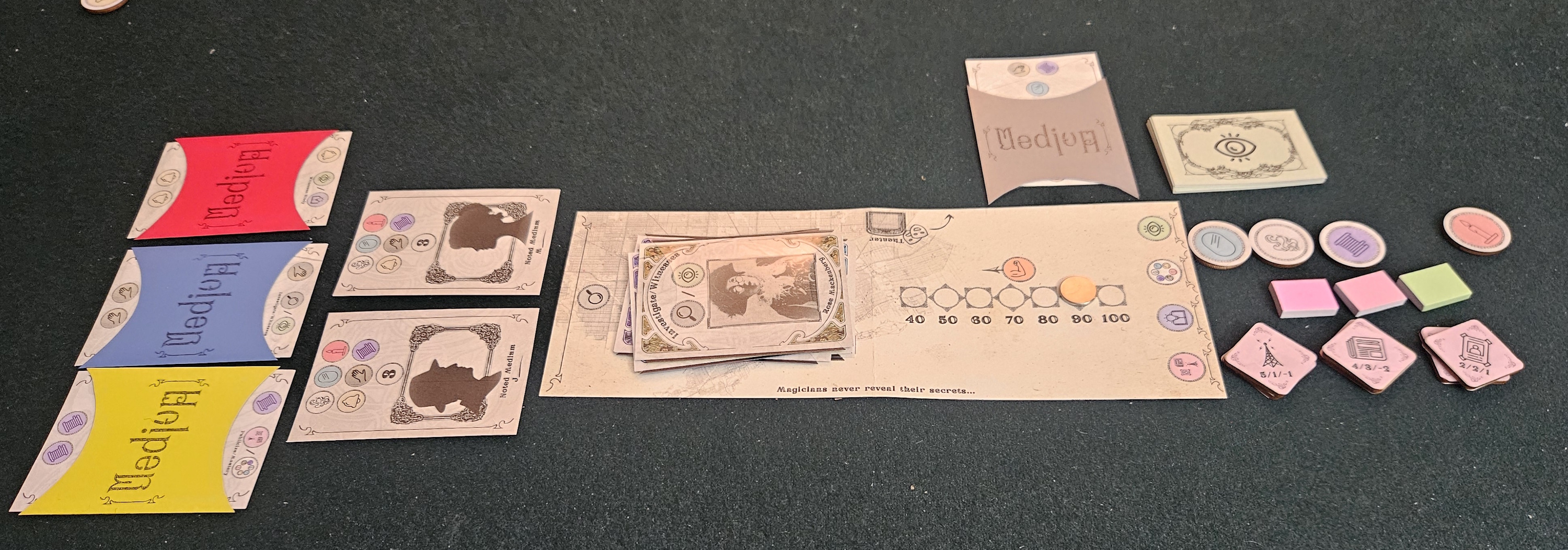
The components, despite being hand-cut, are lovely. The little books are my favorite. I want to put a flipbook cartoon into one of them as a surprise.

Preparing for the final show.

As a plaything, Houdini’s Last Act is tightly wound. There are two discrete acts, divided by the aforementioned magic trick, and it’s necessary to see them in motion to really understand what sleight of hand the Zinslis are getting up to. In other words, this is one magic act it pays to see twice. Which is no big thing, considering the entire game takes maybe half an hour to complete.

First come the preparations. Going around the table, everybody spends cards to get ready for the big show. There’s more to do than can all be handled at once, ranging from overseeing the show’s security and promoting it via pamphlets and airwaves to preparing yourself by mastering various magical techniques.

What’s interesting about the game is that each of these preparations is spring-loaded in its own way. Promoting the show, for instance, sees you claiming a private token that reveals whether the local public is on your side or feeling antagonistic. Positive numbers mean your show is more likely to succeed, while negative digits might mean… well, the other thing.
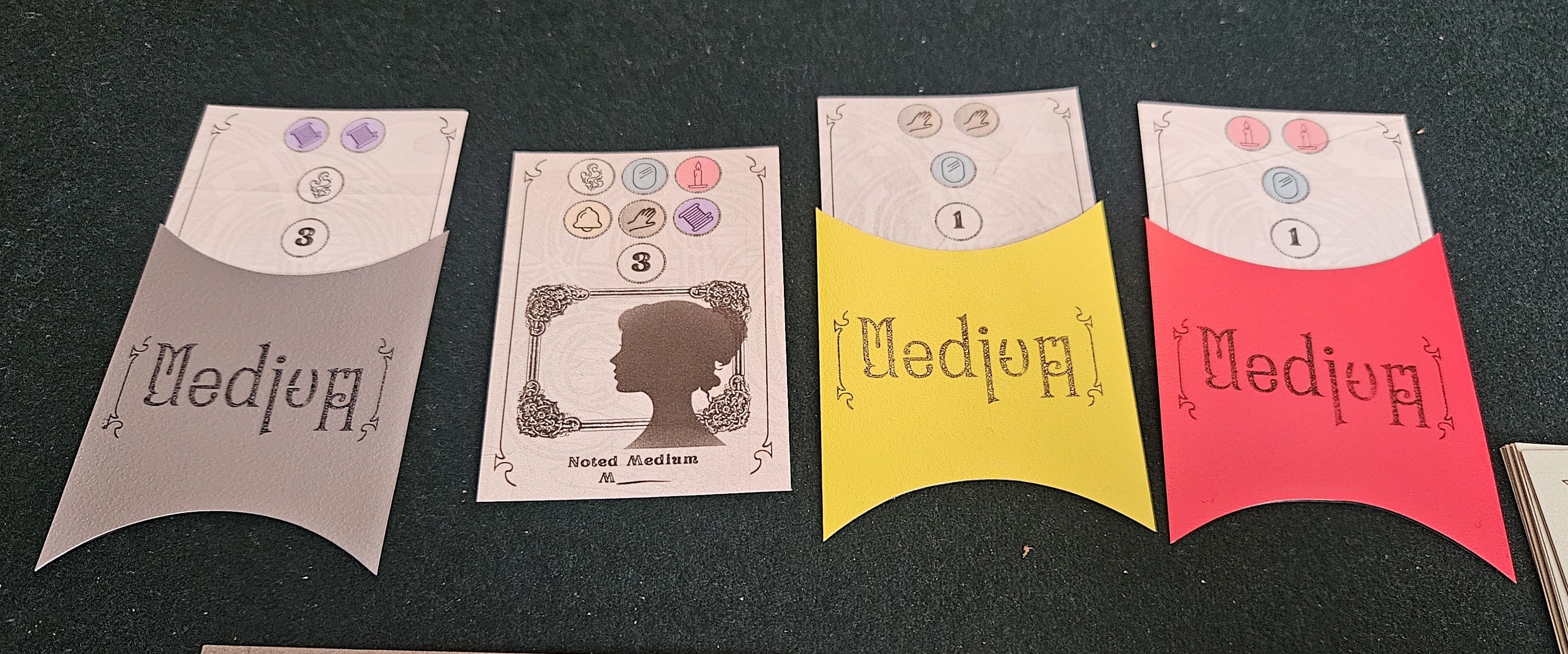
weird that they all have the same name

Just some of the frauds you might expose.

From there, the cards are (magically) shuffled and dealt back to the apprentices. Now it’s showtime. There’s still time for a few last-minute preparations, but for the most part this phase of the game is an icon-matching affair where you attempt to demonstrate the techniques the local mediums are using to defraud the public. It’s useful to cooperative tightly with your fellow apprentices. As with a death-defying escape act, any number of details might go wrong and spell disaster for the entire act.

It isn’t really until the final tally that the game’s legerdemain becomes apparent. Which is, incidentally, why I recommend any prospective players give it two tries back to back.

The first question is whether the show succeeds or fails. This is a mathematical question, the one portion of the game that feels more like bookkeeping than a careful balancing act. Provided all the mediums have been defrocked, there’s still the question of the event’s security — which sets the baseline score your team is required to beat — versus the product of those defeated mediums times the show’s publicity.

Look, the details don’t matter. The point is that you multiply one number against another, then check that result against a third number. If the show was a success, everybody wins. Otherwise, everyone reveals a personal goal card. And now the real chicanery is afoot.
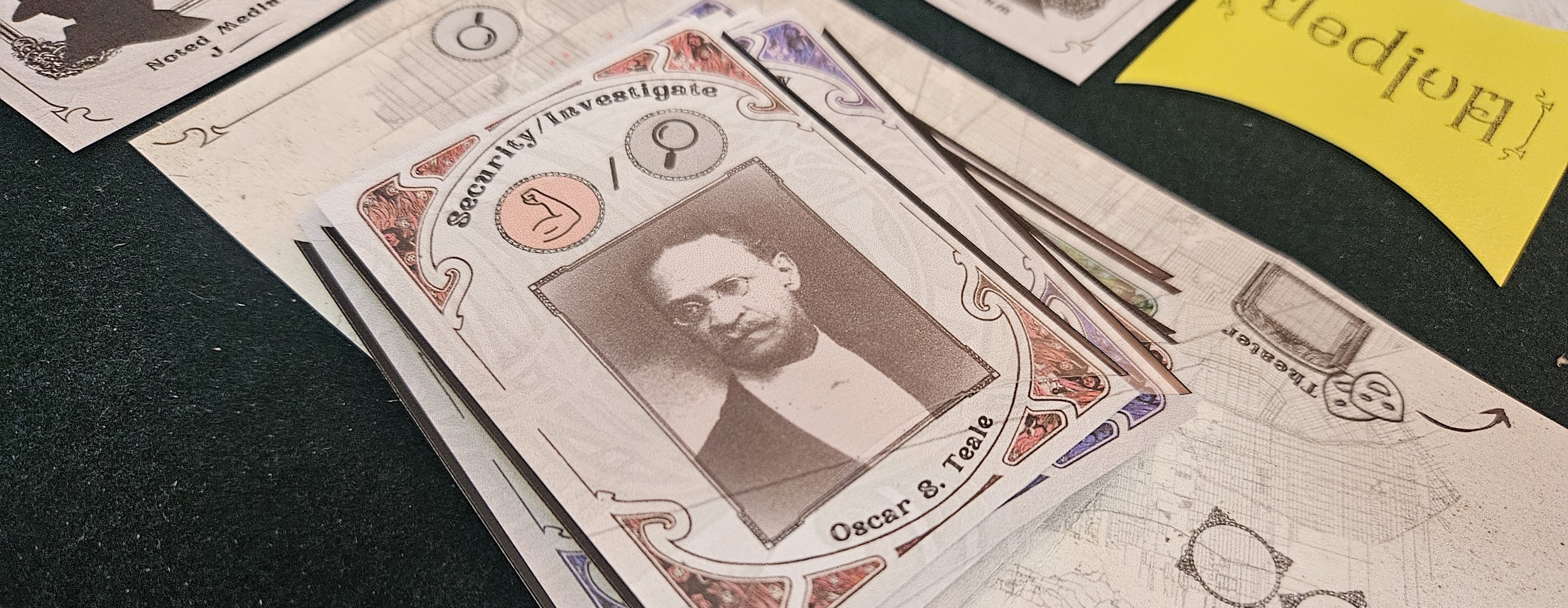
that's the thing with cards, really

Every card can be used in multiple ways.

At heart, Houdini’s Last Act is a game about confidence. The confidence of its masters and apprentices and mediums, but also the confidence of its players, in themselves and one another. Because all those actions, the earlier ones in the preparation phase as well as those taken during the show itself, are slow-motion bets that your work will pay off. And depending on what you saw earlier, if you happened to publicize the event and saw which way the winds were blowing, or even if you just don’t think your crew can handle quite so much debunking in one sitting, your confidence might not be overflowing.

That’s where your personal objectives come in. If the show fails, the game switches tracks and checks the goals you’ve been tending this whole time. Maybe you want to expose a particularly skilled medium personally, ensuring your own legacy on the stage. Or maybe you’re more cynical, angling for the show to fail spectacularly. Either way, apprentices who aren’t feeling especially good about the tour’s odds can claim additional goal cards. But this is a dangerous proposition, threatening to sow discord. Wait, why did you draw another goal? Do you know something I don’t? Are we a team or what?

Even small doubts can have a corrosive effect. All it takes is one draw at the wrong time and suddenly everyone is thinking twice about overseeing security or learning stage techniques. Instead, they’re checking their little green objective cards and making weird decisions. Like insisting that we debunk more mediums than we can strictly handle, or getting flustered when somebody else claims the wire-work mastery token, or drawing two new goals in a row.
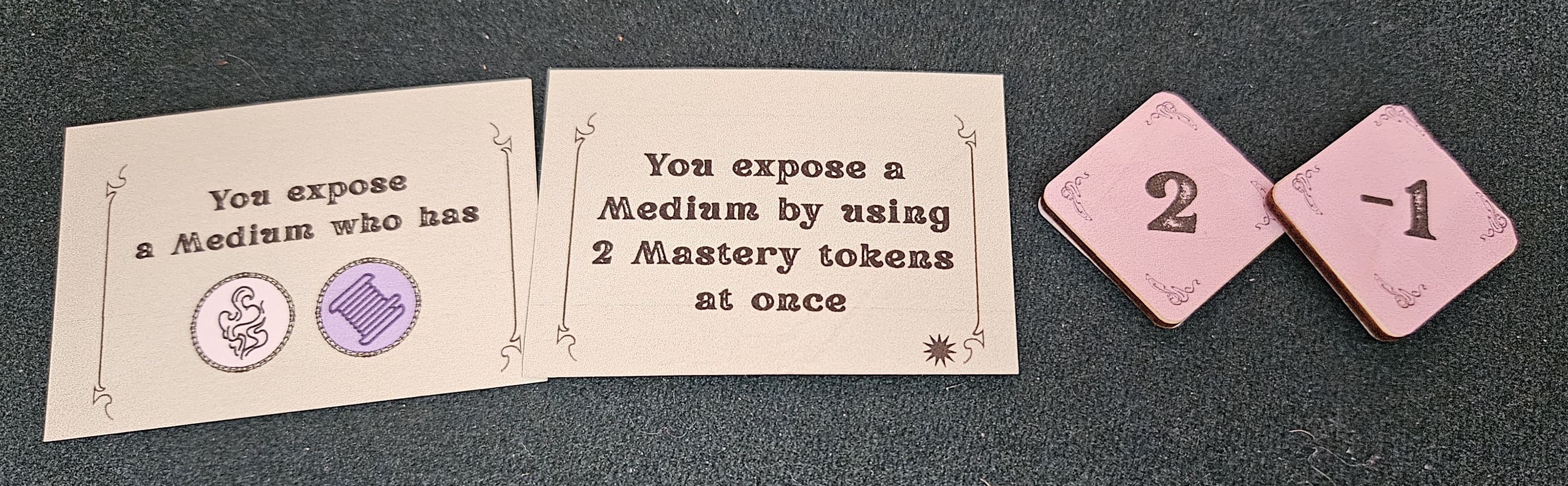
I check my hidden goal card: "Finish the Great American Novel." Uh, no problem, I think, and play my very first action to draw something else.

Some of the things you might know… and keep to yourself.

To be clear, Houdini’s Last Act never becomes more than a bite-sized experience. Even played twice in a row, it probably won’t consume a full hour. There are certain limitations to what can be accomplished in such a short span of time. Sometimes a longer duration is a boon. When it comes to ambiguous behaviors on the part of fellow players, a game this short doesn’t provide much room to observe whether people are acting squirrelly.

But the magic trick is that it doesn’t matter, at least not as much as it might have otherwise. Houdini’s Last Act works because it’s charming in all the right places. The way the sleeves are designed to let the cards slide one way or the other to reveal hidden information. The cardplay, which is simple but never shows even the slightest pound of extra weight. Putting on a successful show is genuinely challenging, enough so that pursuing a side hustle or two seems wise. Even the little magic trick in between acts is amusing, a ritual that takes so little time that you might as well go through the motions rather than dealing out the cards normally.

The result is a game that punches well above its weight. Not unlike the little escapist himself, come to think of it. For such a small thing, there’s some real verve here, a commentary on magic as showmanship and mystery versus hucksterism and superstition, about personal goals versus collaborative efforts, about we silly humans who love to be tricked so badly that we grow addicted to it.
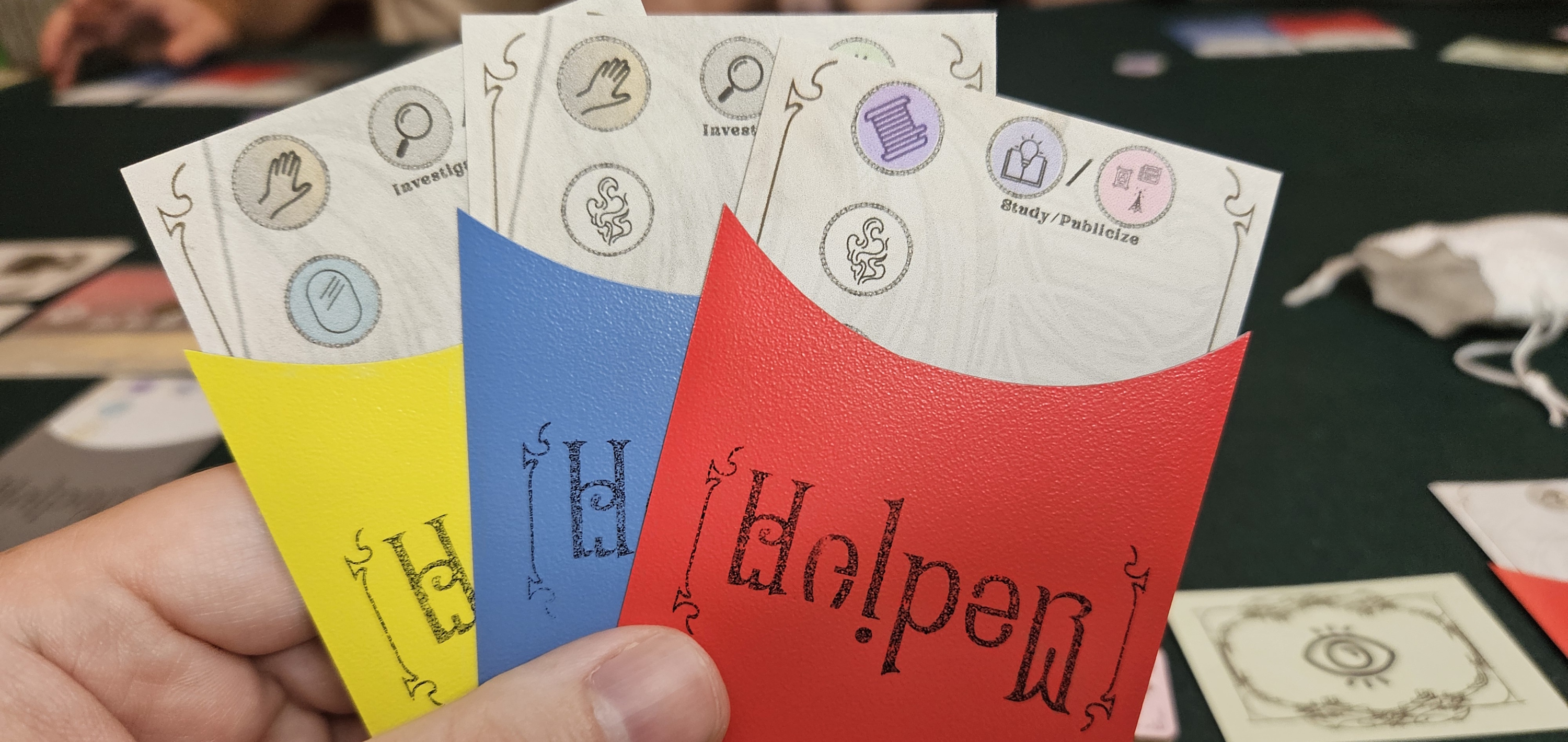
The double-perspective text is neat, but I think I can read it upside-down better than right-side-up.

Improving your skills means revealing extra icons on your cards.

Which is, perhaps, the final flourish of this particular offering. Like all figures from history, Harry Houdini had his textures. But he also stuck by his principles, especially where it came to debunking those who took advantage of the bereaved. He sacrificed friendships over it — most famously with Sir Arthur Conan Doyle, that faerie-believing dork. As an offbeat and enjoyable expression of history, Houdini’s Last Act is a suitable tribute indeed, a brief foray into a world where magic and reason brushed shoulders and left audiences entertained.


A complimentary copy of Houdini’s Last Act was provided by the designers.

(If what I’m doing at Space-Biff! is valuable to you in some way, please consider dropping by my Patreon campaign or Ko-fi. Right now, supporters can read the next installment in my series Talking About Games, this time tackling the topic of what makes a good list! Naturally, the piece includes a list.)

Worlds Upon the Wind

28. Juli 2026 um 22:19

I tried the demo for this somewhat cozy game a few days ago, and decided to buy it.

This is a deck builder where each card has 1 or more glyphs, and possibly a special ability. You are basically a god/explorer founding villages. When you pick a location it contains two regions (plains, swamps, buildings, etc) that determine what combination of glyphs are worth things, and you then draw a hand, use the abilities/glyphs to fill the puzzle, then get a second hand and that’s it.

(The puzzles are basically decision trees. You can unlock A or B or C, and A may have A1 or A2, etc. Taking A precludes B/C).

There’s just enough choice to be interesting … since you can use each card for one glyph (possibly of 2 or more) OR its special ability, and you don’t know all the cards you are going to draw (since you get one redraw, but must discard unused). Since starting one path precludes others, it’s a risk/reward.

But “cozy” … no time pressure, very low key.

Honestly, I didn’t really buy it for the gameplay, although its fine. The game also has classical Japanese Art (and descriptions, history lessons on the art, hi-res versions, etc) and some Japanese Language Practice (which is optional and probably not even very helpful compared to real lessons, but I liked that and I hate taking real lessons). Because of that, I figured I could pay $10 which — let’s be frank — isn’t much.

If I were paying attention I’d learn that “Oh, this terrain gives the same decision tree every time and my deck is good for that,” but I don’t really care enough to put that much effort into it. I’m just exploring it for the aesthetics, mostly.

Rating — A fine cozy game, but honestly indifferent. I suppose if I approached it as a real strategy game I’d probably move my rating one way or the other. I’ll likely play 10 hours, maybe more, but probably not 25+.

Designer Diary: The Story Behind Arnak’s Surprise Shipment

28. Juli 2026 um 16:00

by Mín

 
Hi everyone, it’s Mín here, and I would like to share a few things about the new addition to the Lost Ruins of Arnak!

 
The name says it all: the Surprise Shipment is an expansion even we didn’t really expect. It wasn’t planned originally, but when we were designing the Adventure Chest, there was this little bit of extra space in the card compartments that we ended up with, and we thought it would be cool to use it for some more cards. That is also the reason why Twisted Paths was advertised as the last major expansion–we were hoping to be able to fill that empty space in the Adventure Chest.

 
When we got back to actually designing the cards, it surprised us that there was actually still a lot more design space than we expected. When designing some of the previous expansions, it was easy to feel like we already exhausted all the interesting ideas for card effects. But as it turned out, there were many fun ideas still waiting for us, some actually changing the game in interesting ways.

New Card Effects
 
The base game comes with 75 items and artifacts, and the Surprise Shipment adds 50 more unique items and artifacts, which is actually a lot. We tried to aim for effects that are not overly complicated so that you can play with them even with beginners, but they still offer interesting effects that can change your playstyle and open the game to new strategies.

 
Adding new effects into an existing game can be both easier and harder than coming up with a new game. You already have some framework in place, but you need to fit into it and make sure you do not break anything.

 
Thankfully, we had the “CGO”–the CGE online testing platform–at our disposal. This expansion was tested there extensively, for which we’re very grateful to the community of testers there! We were pleasantly surprised by how big of an impact this seemingly small expansion had on the gameplay.

Let Us Introduce a Few of the Cards!

For example, the Thermometer card affects the timing–suddenly, you want to play a lot of cards in a turn. Even gaining a fear from an effect does not sound like such a bad idea, because that is also a card that goes to your play area 🙂.

The Golden Wing can also be a game-changer if you are fairly rich and manage to snatch it at the right time. It can be especially useful when you are short on cards and need to travel a lot.

 
Have you ever had a game where you were just drowning in Fear cards? These artifacts may make that a strategic choice!

 
And sometimes, especially towards the end of the game, you might be lacking travel symbols when all the cards in your hand are just too precious to use just for the travel icons. That's where these new cards shine, giving you just the extra push you need to reach your destination.

 
One of my personal favorites is definitely the Stew Pot–a card with great versatility! It allows you to get to the gold side effect of an assistant much faster, and even interact with your opponent's assistant. That can be especially useful in some situations, like when they snatch the one assistant you really need. It's definitely a card that creates some memorable moments and encourages friendly banter! Like:
   
“Why is my assistant eating at your camp again?”
   
“Well, if you fed your assistant properly, maybe they wouldn’t come over!”
and so on!


Art Progress
 
We had a lot of fun with the artwork. Milan Vavroň is a pleasure to work with–he comes up with interesting concepts for the cards easily, which was very useful here, especially for Artifact card illustrations. The Item cards are much easier in that regard, since it’s easy to find some inspiration in the everyday world, but Artifacts need to feel unique and mysterious. They represent the culture of the Arnakian past and need to fit into the rest of the world seamlessly, while also communicating the in-game effect visually. For example, we usually try to have the illustration carry the same color as the important resources you gain from the card effect.

 
Ondřej Hrdina once again worked on the beautiful illustration for the cover, the new sites, and also the Kitten and Puppy cards. The idea we had for this cover was to make it cute and playful.

 
One of the all-time favorite cards is the Dog, of course. We wanted to create cheaper and weaker versions of the Dog and Cat cards, and when I saw the new cards next to each other, the image you see on the cover just popped into my mind. It was hard to unsee it–I really liked the idea of these two being the first ones to find a lost shipment in the Jungle. So keep an eye out for two new cute and cuddly expedition members - if they're not too busy chasing butterflies, that is!


Sometimes the theme of a card is closely connected with the way we represent its effect, but the intention does not always “survive” thanks to limitations like readability or balancing issues.

 
The Calendar card is a nice example of the former–we really wanted the effect to slowly change into another bonus from round to round, just like the seasons change. But the icons were too small when placed on the card like that. Placing the icons in the zig-zag looked strange because the round and square icons in different places created a scattered feel. So in the end the idea may not be as obvious from the final effect, but at least those of you who read this Diary will know.


Oh, and the date in the calendar also changed - it’s the date of the day when we (shortly before midnight) sent the Arnak rulebook to print, and with that, all the work on the base game was finished, and all we could do was to anxiously await how the game would be received. We have a few more Easter eggs like that hidden in the game, but let’s not spoil you all the fun of looking for them.

New Sites
 
When designing new sites, we wanted to keep the balance among the different resources that you may gain while digging at sites. Since we only had room for two extra sites, we decided to go for a unique new effect that is more flexible in what resources it can offer. The effect allows you to take back one of the previously used idols, making both the idol and the slot available for use again. This creates some interesting new combo opportunities!

We hope Lost Ruins of Arnak: Surprise Shipment brings fresh energy to your games of Arnak, whether you’re exploring new strategies or just enjoying the unexpected twists these cards can create. The new expansion will be released July 30, 2026.

See you on the island, explorers!

The Sandcastles of Burgundy Review

28. Juli 2026 um 15:11
The Sandcastles of BurgundyIt is well known around Board Game Quest Headquarters that I am the resident Stefan Feld aficionado/fanboy/devotee/stalker. Naturally, then, when the BGQ Bulletin Board announced an assignment to review a new version of my favorite game of all time, I jumped at the chance. The next day at my desk—neatly nestled beside my daily BGQroissant […]

Source

Puzzle Dungeon Game Review

Dungeon Delve for One, Please

On lazy Sundays, I quite enjoy breaking out a solo game and throwing on some old records. No group bickering over game choice, no fear of another player’s analysis paralysis, just me, myself, and a deck of cards. There’s a particular joy in quieting down and figuring out a game by yourself, and Puzzle Dungeon is an ideal mix of dungeon delving and puzzle solving to keep those silent thoughts busy.

I was fortunate enough to experience the deluxe edition of the game, which comes with an overwhelming amount of heroes and baddies alike. It’s a smorgasbord of characters packed into this monster-hunting card game, so any characters mentioned here may not be present in the base game!

Puzzle Play

Puzzle Dungeon is a straightforward, solo-only hand management game that challenges players to defeat the required number and types of monsters listed on their hero’s card before their deck runs out. The monster deck is made up of five different monster types, randomly shuffled into four columns and laid out into ordered lines.

To defeat the frontmost monster in a column, players must discard cards with symbols matching that monster. These cards can be…

The post Puzzle Dungeon Game Review appeared first on Meeple Mountain.

Tabletop Democracy – what board games can teach us about democracy (Topic Discussion)

28. Juli 2026 um 12:43

At a time when many people feel democratic culture is under strain, it is worth looking at our own everyday behaviours that allow democracy to function. Elections, laws and political institutions are all important, but democracy also depends on how people treat one another every day. Listening to different opinions, accepting compromise, respecting agreed-upon rules and recognising opponents as people rather than enemies are all part of a healthy democracy. Maybe unsurprisingly, board games are a place to look for those values. I mean, the simple act of sitting down together to play a game, following the same rules and taking on a role, is an opportunity to act out democratic values.

The post Tabletop Democracy – what board games can teach us about democracy (Topic Discussion) appeared first on Tabletop Games Blog.

World Boardgaming Championships 2026 Daily Debrief Series – Day 3

Von: Grant
28. Juli 2026 um 04:09

The morning dawned early and I was up and ready to go by 8:30am. I had a muffin in my room and a trusty diet Mountain Dew for breakfast and we were on our way to the Winterberry Room to get going on our continued game of GTS.

We jumped right back into GTS Where Eagles Dare and The Devil’s Cauldron from MMP. I was assigned to command the area around Eindhoven/Best/Son and to eliminate the few pockets of German resistance remaining there and then move our armor north to cut off possible German reinforcements from the east. We jumped back in at the 1100 turn and played into the 1700 turn although I had to leave shortly after lunch to meet up with Gregory M. Smith. This system is just so solid and is really great fun.

And I also very much enjoy the deep historical immersion into the event and its incorporation of things like heroes and artillery parks as well as the gorgeous production values with amazing counters, a very detailed and beautiful board and the way it portrays company-level combat. I will say that there is a fairly steep learning curve and rules overhead and while I feel the combat system works it is very involved and bits can be forgotten. But it really is a solid operational level portrayal of WWII combat. I very much can’t wait to play it again in the future and we actually have the reprint of The Devil’s Cauldron on pre-order and I have heard it might be out by the end of the year. I need to find me a copy of Where Eagles Dare as well although I most likely will never get the full combined games together on the table at the same time.

After 14 hours of pushing counters, I am now a follower of this system and want to thank Joe and Matt, as well as my friend Mike Heckman, for teaching me.

After lunch I found my friend John Sy from the Philippines and said hello but he had a gift he had brought for me. It was Japanese occupation currency in the form of Philippine pesos from WWII. What a very cool and thoughtful gift and upon my return home I will be placing it in a frame and hanging it in my game room. Thanks John!

I then was able to meet up with my friend and fantastic designer Gregory M. Smith as well as Kevin McPartland to get a look at a few games that they are designing together, including Viking Dawn from Compass Games and Star Spangled Tide: The War of 1812 from Compass Games.

Me, Greg Smith and Kevin McPartland.

We first got a play in of Viking Dawn and had a great time with the game. It is a light, beer and pretzels style game based on the SPI Conquistadors designed by Richard Berg where players control 1 of 4 Viking clans and are trying to build longboats, train war bands, develop explorers and lead them to explore, settle, raid and conquer Europe from Russia in the east, to Iceland and Newfoundland in the west, the Mediterranean and parts of North Africa. When leaders die you must bury them with silver gaining VP’s or if you can’t afford it bury them with nothing and lose VP’s. The main mechanic is a press your luck exploration mechanic where you must roll for the destruction of your fleets based upon how far they have traveled that year. You might lose all of your ships or may get lucky and lose none, you can mitigate this be investing in the journeys with additional supplies and tech to ensure better offs but the dice are cruel and you might just lose not only your fleets but also the booty they have collected from raiding.

It’s a very fun and lite take on this chaotic time in history and I very much enjoyed it. The game is nearly complete and should be printing and ready for shipping in early 2027. I think that this one is a perfect convention game and is sure to see more plays on my table.

We then shot a video with both designers together and then broke off with just Greg to talk about 6 of his other in-design projects. These included the following Korean Tide (next entry in the Tide Series covering the Korean War 1940-1953), Rifle Platoon (tactical level squad based solitaire game using the American Tank Ace Series), Project Z (what if bombing game where Japan won at Midway and began to run bombing operations against the United States mainland and Australia similar to Amerika Bomber), Western Desert Ace (solitaire Ace Series game focused in North Africa), B-52D Linebacker II (solitaire Vietnam War bombing game in 1972) and then finally a scoop on a joint design from Kevin McPartland and Greg Smith called Star Spangled Tide. It was a great discussion and I’m very much looking forward to all of these games.

To end the video, Greg spoiled his upcoming Lone Banner game which is a 1-4 player dungeon crawler set in the fantasy world of Kalar from Burning Banners from Compass Games. This one is going to be fun and I got a look at the characters, spells and weapons and also saw the dungeon tiles that will be laid out as players move through the dungeon encountering traps, monsters and bosses to fight. This looks great but it is a ways off as Greg said he has only been designing it for a month or so.

I then got to play the new The Great Hunger from Compass Games with designer Kevin McPartland. In The Great Hunger players represent families of tenant farmers and field hands. At first, when the potatoes are plentiful your clan will grow, using the events on the top half of cards to help your family expand across the map moving into counties, working on estates and in factories. When the potatoes blight arrives, you’ll use the events on the bottom half to save as many as you can, finding them aid or employment in Ireland, or scrambling to ports to secure passage to America. 

The game is a very light Euro style game of survival and is well done as it’s rooted in history and teaches about the struggles of the Irish. I am glad to have played the final production copy as I got to play a prototype copy a few years ago at WBC. This one will catch some heat from people for it’s dark topic and will just not be for everyone but it has something to teach about history and I have Irish ancestry and am interested as to what happened to cause my ancestors to leave their home to come to America.

One final thing I want to show you is the lineup of games that GMT has staged in the main gaming area. These are all of their newest arrivals and they are just gorgeous. I’m most interested in Coast Watchers designed by Volko Ruhnke and The Weimar Republic designed by Gunnar Holmbäck.

That was it for Day 3 and I’m off to bed with an early start tomorrow with a few games on the docket including World Order from Hegemonic Games Project and Coalitions: Realpolitik from PHALANX.

See you tomorrow night!

-Grant

❌