
Normale Ansicht

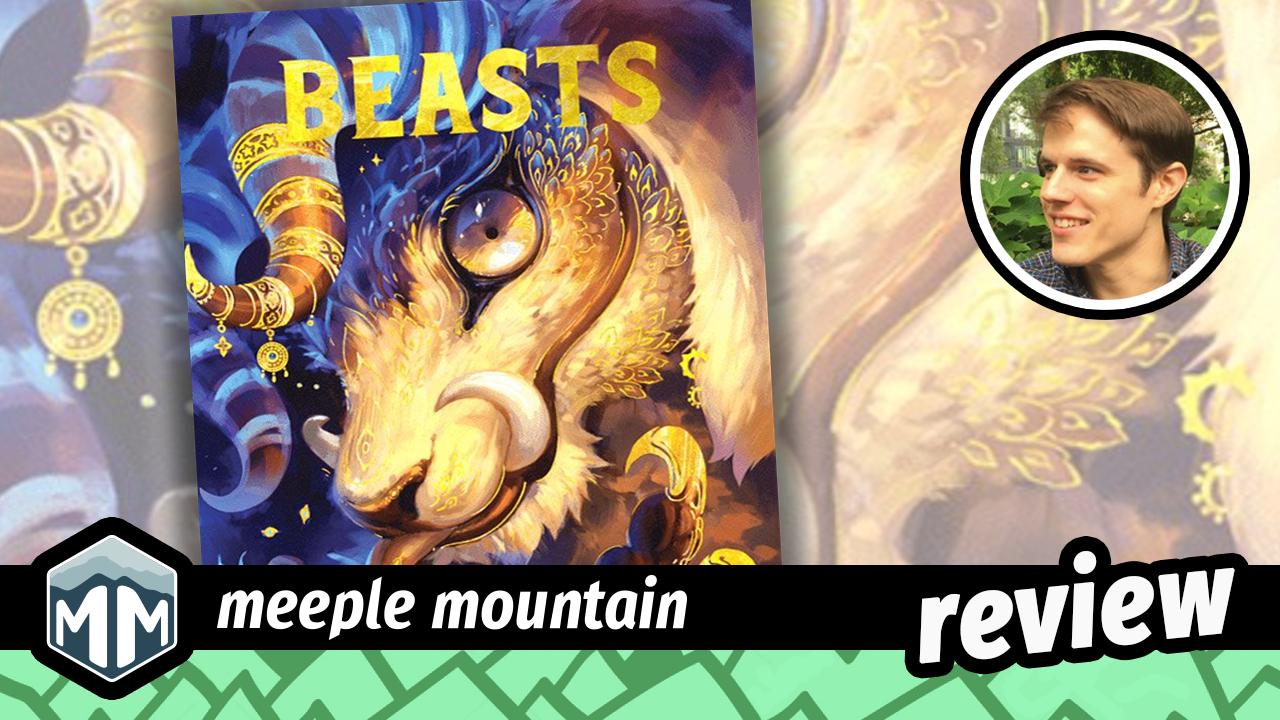
Beasts Game Review

I know how to sell a game. In my day job as an inventory manager for a board game café, I regularly pitch people on games they know nothing about, and I often succeed in making those games sound interesting. The approach is usually straightforward:

Catan is a game about gathering resources, building cities, and trading with other players. It’s also very, very rude.”

MicroMacro is a huge Where’s Waldo, but instead of looking for random people, you’re trying to follow their progress around the map to solve crimes and figure out what happened.”

Hive is just like chess, in that all the pieces have their own moves, but you’re not dealing with 600 years of scholarship and study, so it’s much more approachable.”
Every now and then, you get a game that requires a bit more qualification, like Wilmot’s Warehouse:

“It’s technically a memory game, but it isn’t really. It’s a game about telling stories that happens to be a memory game. You won’t even notice.”
Rare is the game that defies my ability to do a quick pitch. So rare is it, in fact, that until Beasts came along, I’m not sure I could have named one.

It’s not that Clarence Simpson’s card game is difficult to…

The post Beasts Game Review appeared first on Meeple Mountain.

Diver Go! Game Review

I realized long ago that publisher Itten has a library of games that balance precariously on a knife’s edge between Game and Novelty, often tipping towards the latter. They make fun, silly games that hinge on a hooky idea, games that often make a great first impression without offering anything for you to sink your teeth into, or even much of anything to gnaw on. Itten titles are often best as objects of appreciation, kooky displays of what creativity can lead to. My partner referred to them once as “coffee table board games,” a description so exact that I envy its creator.

The mileage you get out of any Itten game is by necessity directly proportional to how much mileage you get out of the hook, and how much you enjoy the presentation. The aesthetic of Crash Octopus, which looks as good on a table as any game ever has, has to be enough to hold your attention, because the game itself isn’t much. A game like Gravity 3 can only interest you if the very concept of a game made out of 15 small weights is enough to get you through the door. I am tempted to compare Itten to publisher Button Shy; they are each in their own way one of the hobby’s most consistently experimental…

The post Diver Go! Game Review appeared first on Meeple Mountain.
Ratzia Game Review

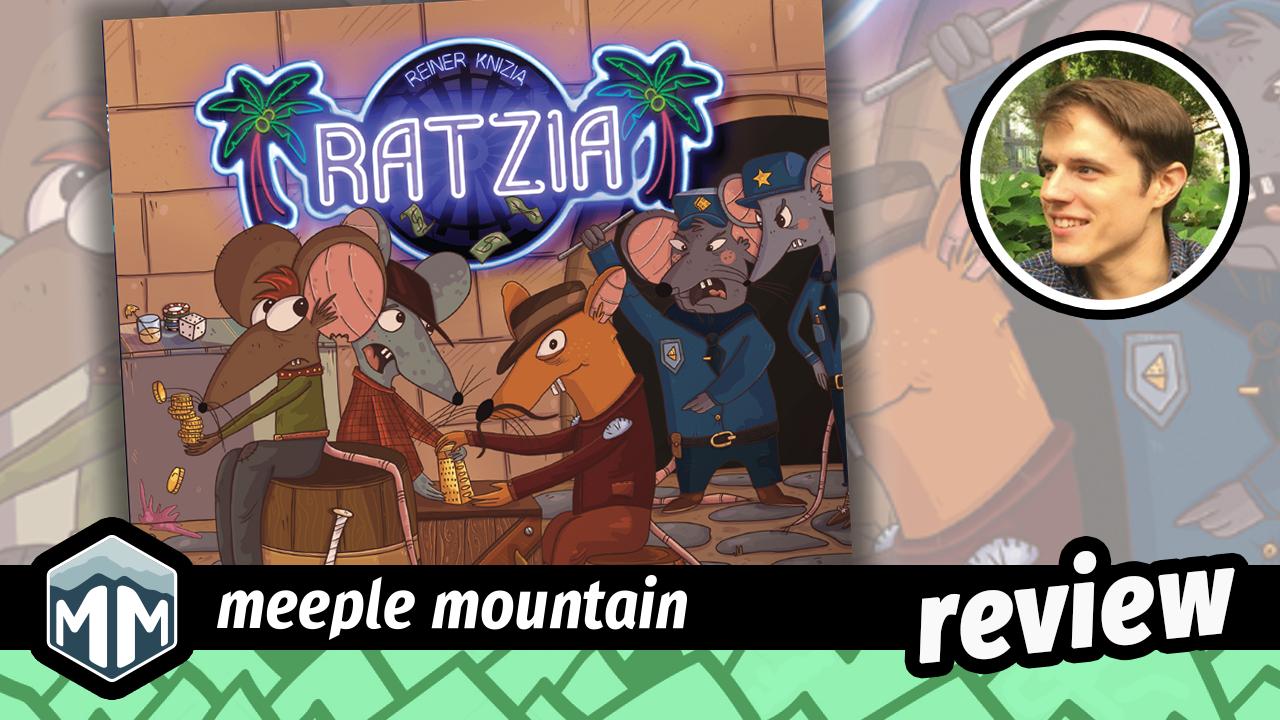
If you’re reading a review of Reiner Knizia deep cut Ratzia, I figure there’s a good chance you are already at least passingly familiar with the game Ra, the Egyptian-themed auction game with strong push-your-luck elements first published in 1999. Ra is regularly considered one of the greatest board games ever published. It has a hardy rating of 7.7/10 on Board Game Geek, and sits at #117 in their overall rankings. Not too shabby for a game that came out nearly 30 years ago, and that success is certainly deserved. Ra is a terrific game.

Neither Ratzia, nor its previous iteration Razzia!, are so fortunate. Both are held in comparatively slight esteem. Ratzia, a mafia–themed auction game with strong push-your-luck elements, is rated a 6.8 on BGG as of writing, and sits low enough in the rankings that the actual spot doesn’t warrant mentioning.

I find this curious, because Ratzia and Ra are effectively the same game. I do not mean to say that they are similar. No. They are, rule-for-rule, the exact same game. There are a few extra tile types in Ra, but that’s it. These two games are more closely related to one another than Hitchcock’s Psycho is to Gus Van Sandt’s shot-for-shot remake of Psycho, which at least had different actors. So why this discrepancy…

The post Ratzia Game Review appeared first on Meeple Mountain.
Emergency Exit Only Game Review

For some reason I thought fleeing an encroaching office fire would be less stressful than this.

Run for Your Lives!

Emergency Exit Only is a strange beast, a tile layer in which success or failure comes down to how good you are with spatial reasoning and memory. That will sound like a nightmare to some of you, and I get it. I can only assuage your concerns by emphasizing the degree to which this game is funny. Like That’s Not a Hat or the substantially more involved Galaxy Trucker before it, Emergency Exit Only is better when someone fails.

The goal is to get yourself to the end of an eternal, Severance-esque corridor, with a fire hot on your heels the entire time. You take turns adding a tile to the path, but the tiles are placed one atop the other. Only one is ever visible at any given time. Rather than seeing your path unfold before you, you are forced to picture it in your mind’s eye.

[caption id="attachment_327745" align="alignnone" width="1024"] Photo credited to @Olivier_Iello on BoardGameGeek.[/caption]

This means, rather inevitably, that mistakes will be made. If you think the path has hit a dead end, looped back onto itself, or that an otherwise invalid tile was played,…

The post Emergency Exit Only Game Review appeared first on Meeple Mountain.
Heat: Tunnel Vision Expansion Review

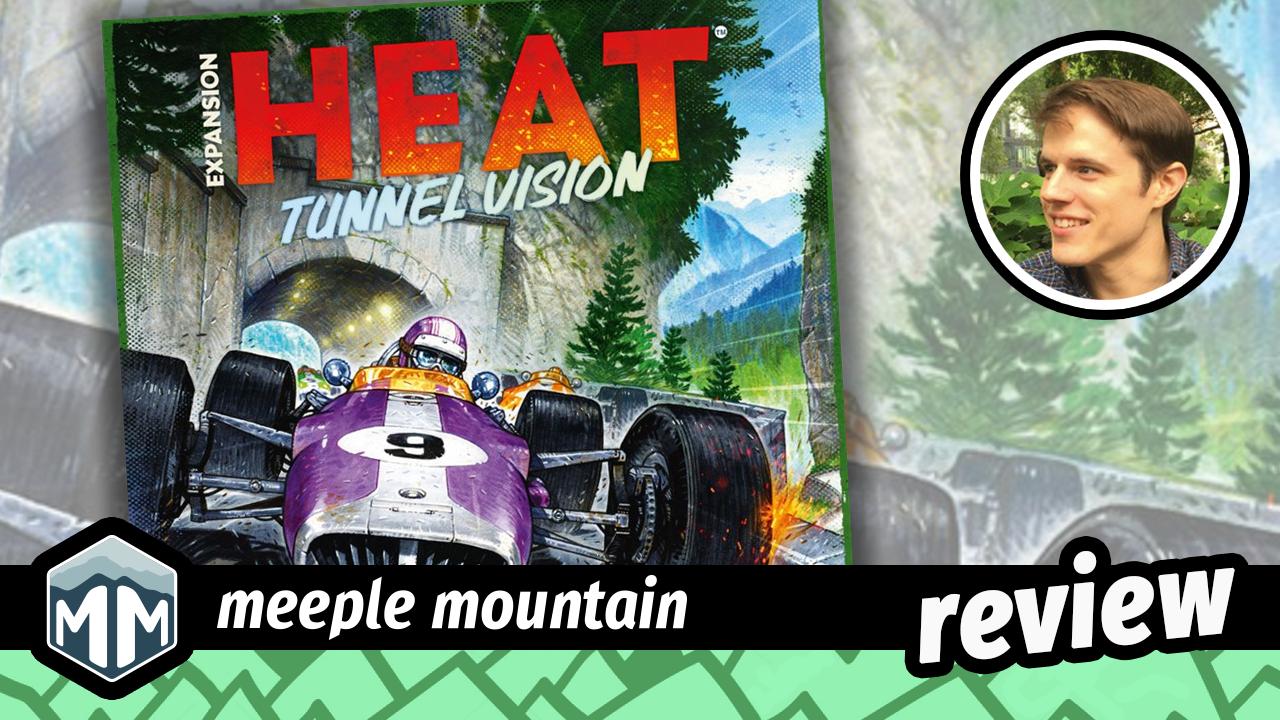
I’ve always enjoyed Heat: Pedal to the Metal, Asger Aleksandrov Granerud and Daniel Skjold Pedersen’s smash racing game. It is a smart system. Managing the ebb and flow of your cards to suit the layout of whatever track you’re barreling down comes as close as I imagine a board game can get to feeling like a race. Any time I think about Heat, I imagine tapping the clutch and recklessly shifting up a gear as I head into a monster corner.

If I’ve always enjoyed Heat, it wasn’t until recently, when I finally got to play with car upgrades, that I came to love it. I agree with Mark’s review, the base game is a little too easy, a little too canned. When everybody has the same cards, the figurative course of a race feels predetermined. With the upgrades, that’s no longer true.

Consider my last race in España, where my friend Boris had drafted upgrades for a car that could make massive gains on straightaways, and I had taken a gamble on aggressive turns. I was worried that I had over-leveraged my position, since España has two mid-race stretches that I would need time to get through and Boris could cruise through in a matter of seconds.

A board depicting a race…</p>
<p>The post <a href=Heat: Tunnel Vision Expansion Review appeared first on Meeple Mountain.
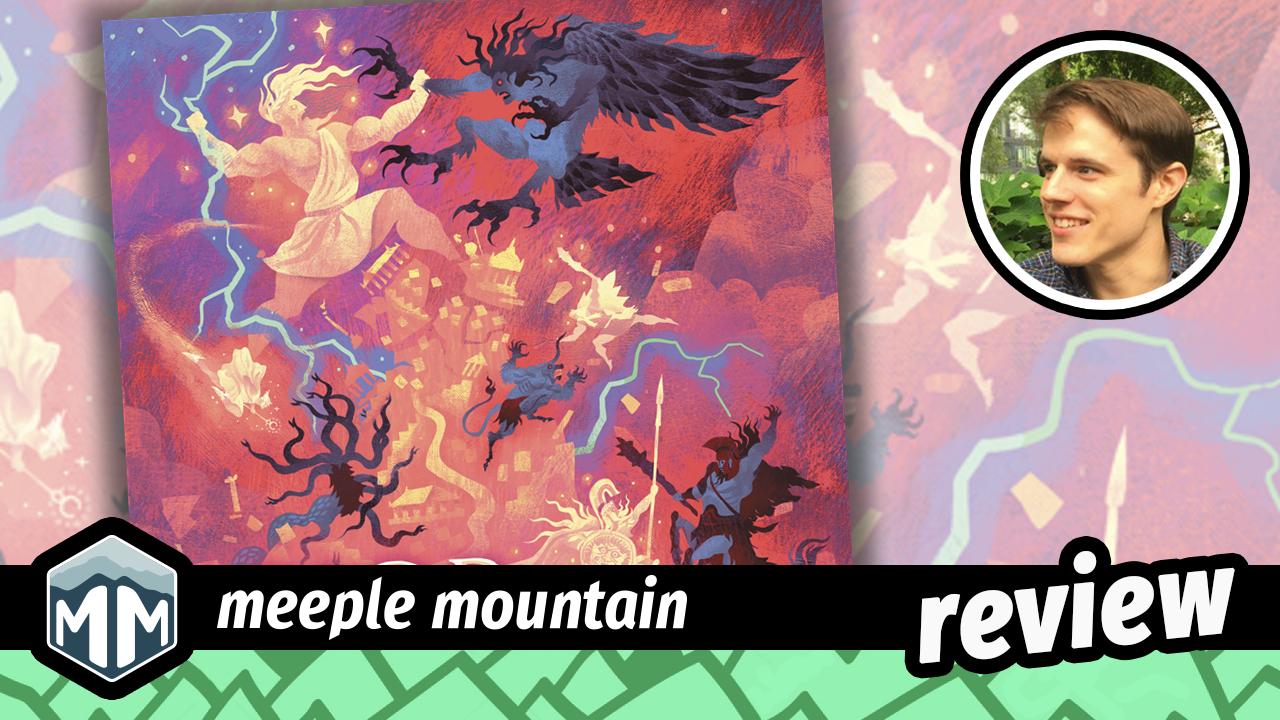
Ichor Game Review

I went on a bit of a journey as I considered the place of Ichor in designer Reiner Knizia’s oeuvre. My first thought, the one that came to me instinctively, was “Knizia doing an abstract game? Interesting.” My operating definition of an abstract game is relatively narrow. Rather than considering any game that does not have an explicitly implied—I’m not sure “explicitly implied” is possible, but I’ve said it, so here we are—story or setting “abstract,” I only refer to games in the wide family of things like chess, mancala, or Santorini as “abstract.” For my personal heuristic, there seems to have to be determinism, movement of pieces, and some heavy spatial reasoning.

My second thought was, “What a stupid thought. If anything, it’s surprising he hasn’t done more of them.” Knizia’s games are nearly always abstract, or at least abstracted. We could get lost in the weeds of “All board games are abstracted,” but I’m not interested. Application denied. Some games strive for a relatively representational approach to their setting. Terraforming Mars has you accrue resources to develop technology and build settlements on Mars. Other games don’t. Lost Cities is about playing cards in increasing order. It is also somehow about archaeological expeditions.

A red cloth board, divided into a 6 x…</p>
<p>The post <a href=Ichor Game Review appeared first on Meeple Mountain.
Iliad Game Review

Boy, what a game.

You’d think straightforward tile-layers would be tapped out by now, after thirty or forty years of design, but then you sit down and play something like Iliad, which feels as fresh as the day Carcassonne was born. It manages to be fresh and exciting while comfortable and familiar. That’s a hard combination to pull off.

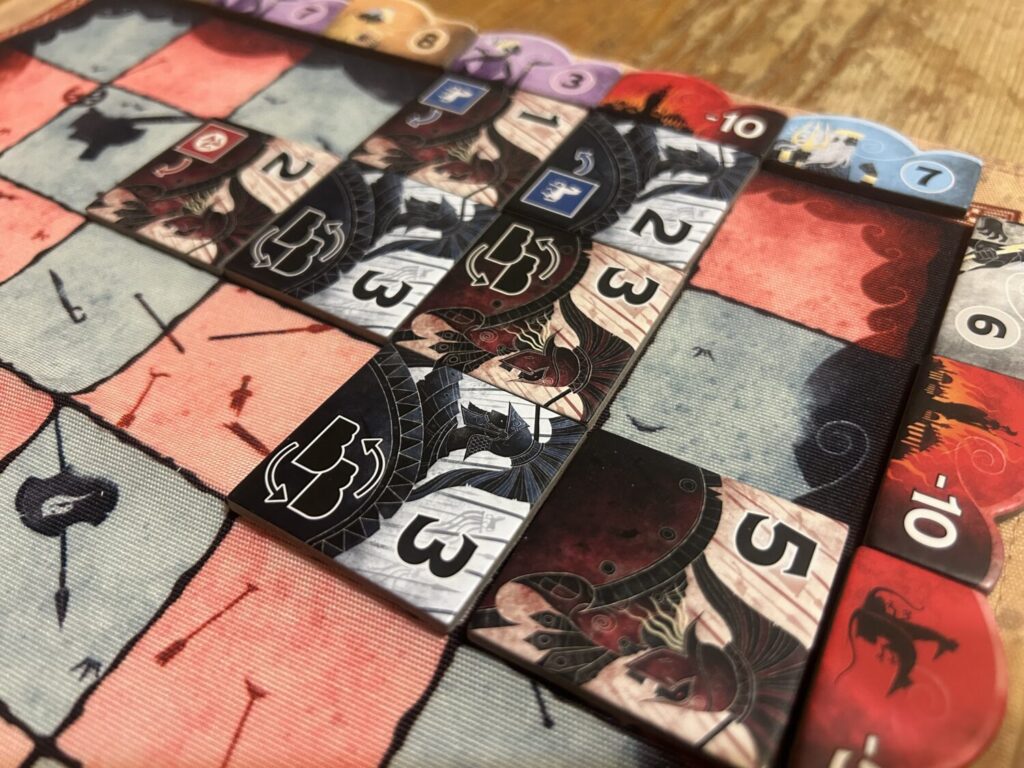
Each player starts with an identical deck of tiles, which vary in value from [input needed] to 5. You take turns choosing a tile from your hand of two and placing it on any contiguous space in your color on the 5 x 5 checkerboard playmat. Whenever a row or column is filled up, the values of each player’s tiles are added together, and the winner chooses from one of the two bonus tiles that sit on either edge of the relevant region. The other player takes whatever is left. The game ends the moment both players have played all of their tiles.

A selection of square titles in red and blue on a cloth mat. Each tile includes an illustration of a Bronze-age soldier and a number.

That, believe it or not, is that, as far as the broad strokes are concerned. With just a little more information, you’re ready…

The post Iliad Game Review appeared first on Meeple Mountain.
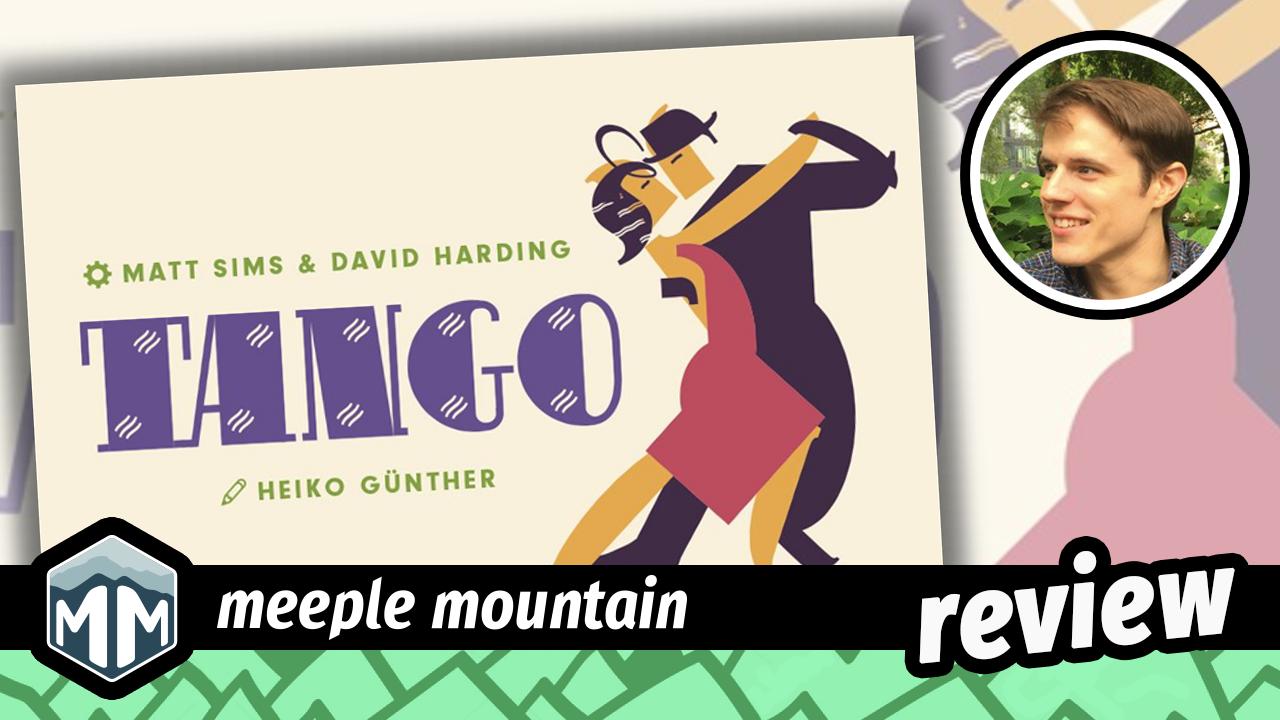
Tango Game Review

Tango.

What a great name for this trick-taking game. It is, of course, a cute name, given that Tango is exclusively for two players. It takes two to tango, and Tango takes two. But it takes more than a cute joke to make a title great. “Tango” is also apt. David Harding and Matt Sims have designed a game that is all about coordination. Also, frankly, there is something a little sexy about this game when you and your opponent are both locked in.

Let’s get into position. Both players are dealt two hands of cards. One hand is subject to the usual standards, by which I mean you hold it in your hand. This is the hand-hand if you will, the pie activo. The other hand, the pie soporto, is set out on the table in front of you in five stacks of two, with the top cards face-up and the bottom cards face-down. This we will call the table-hand.

Now we can begin the footwork. A Basic to the Cross isn’t so complicated, so let’s try that: I play a card from my hand-hand, you play a card from your hand-hand that follows suit if possible, I play a card from my table-hand that follows suit if possible, and finally you play a card from your table-hand…

The post Tango Game Review appeared first on Meeple Mountain.
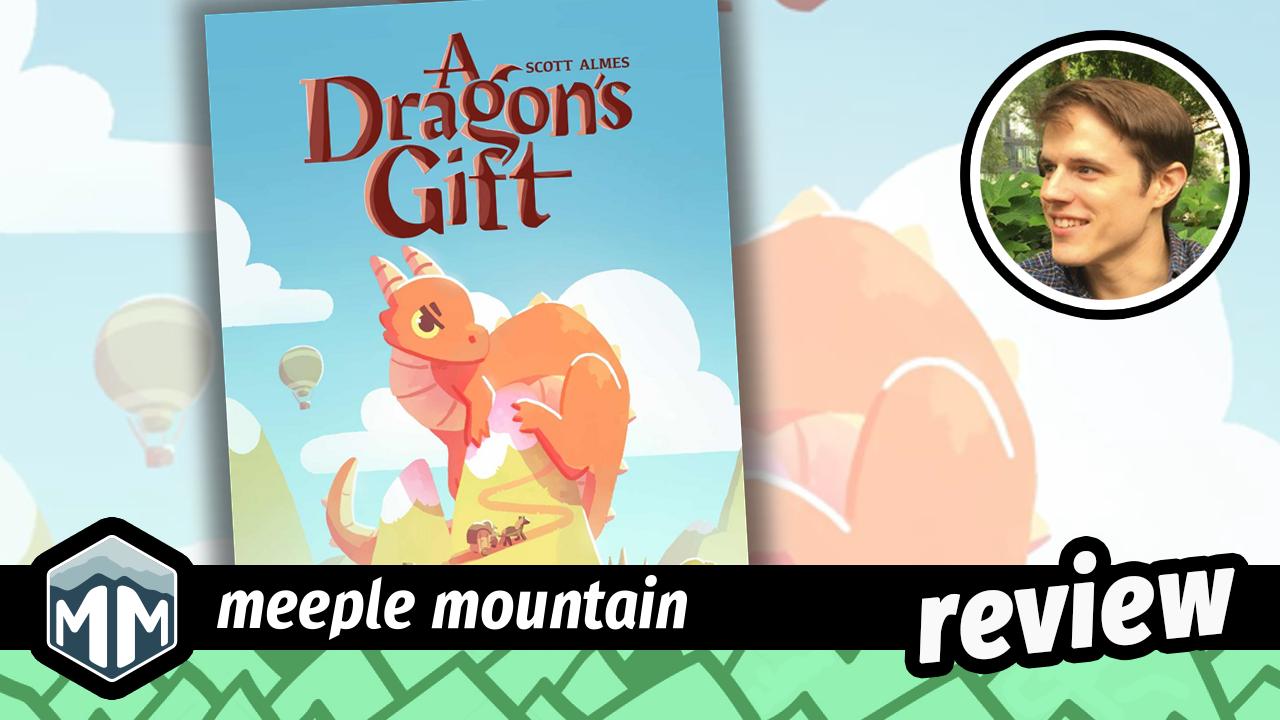
A Dragon’s Gift Game Review

There’s something about A Dragon’s Gift, Button Shy’s latest solo game from designer Scott Almes, that feels particularly pastoral. You can hear the opening strains of “Belle” from Beauty and the Beast as you open the Button Shy wallet and gaze upon these adorable illustrations. Then, just as the song explodes into hustle and bustle, the village's busybodies spring to life.

Every year, the citizens of Adragonsgiftopia (I assume) come together and honor the dragon who guards the town with a gift. Different citizens have different ideas. The baker suggests a treasure chest, which seems a safe bet. The bard wants to write a poem. Typical. The sorceress is in favor of a My First Chemistry set, presumably to encourage the dragon to pursue a career in STEM or to foster a general sense of curiosity and wonder about the world around it. You draw one of the six Gift Cards and set it aside faceup.

A bunch of cards laid out in a grid on a table.Once the gift is chosen, the town gets to work. The remaining 12 cards show the rest of the Village. Each card includes a winding set of roads around the periphery, a natural resource, and a business. The puzzle comes in lining up…

The post A Dragon’s Gift Game Review appeared first on Meeple Mountain.

❌