Anmelden


Brine & Origami

Sea Salt & Paper sure was hot a couple years back, huh? I didn’t think much of this thing the first time I encountered it, perhaps a symptom of having only played it with a single partner; in contrast to some, I find it needs room to stretch out. Perhaps it helps, too, that the expansions, More Salt and More Pepper, both give the game a small kick in its folded shorts.
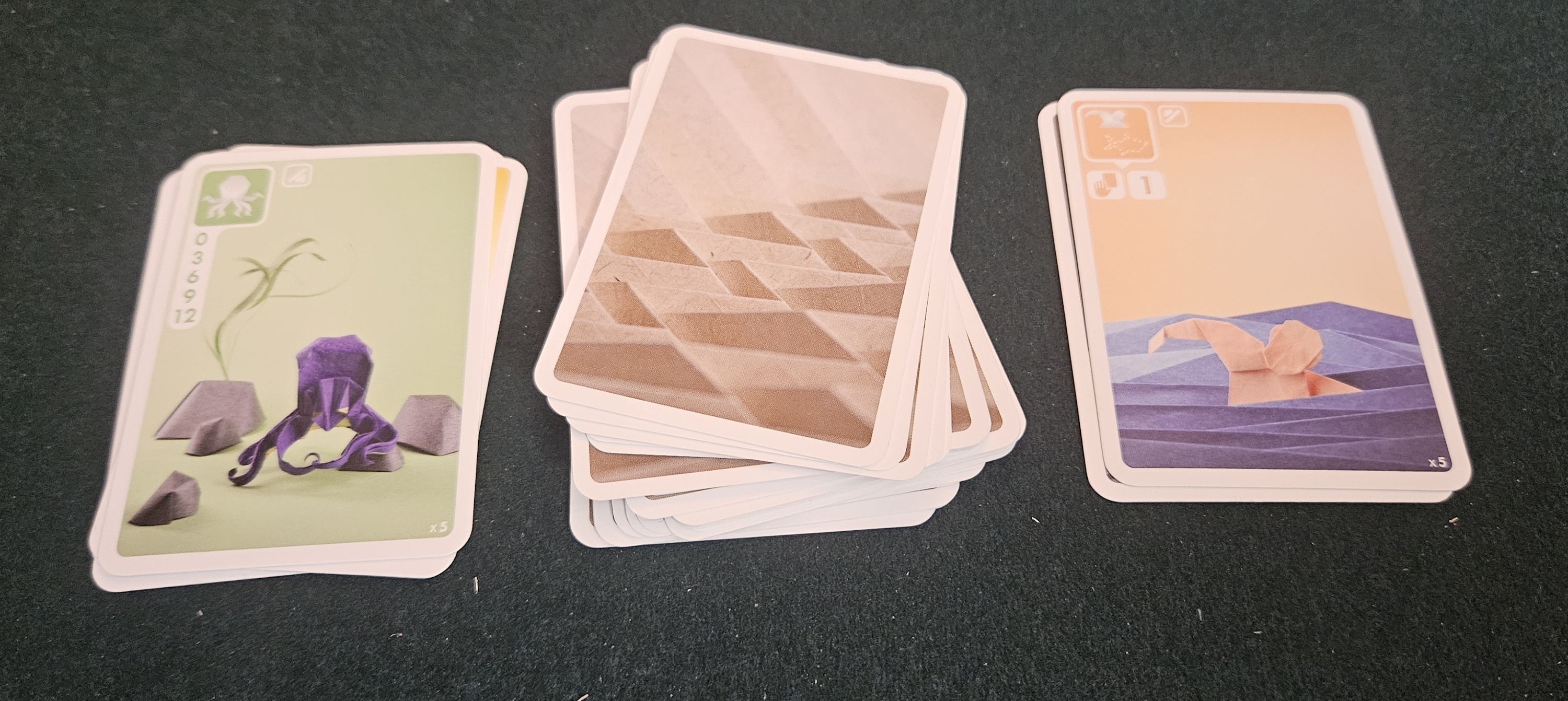
The basic choice: from where does one draw?
For those who haven’t played Bruno Cathala and Théo Rivière’s small-box card game, Sea Salt & Paper opens with the gentlest of all possible choices: from where to draw? Your options, in this case, are either the deck proper — in which case you’ll draw a pair, keep one, and toss the reminder into either of two discards — or the top offering from one of those castoff piles. Either way, you gain a single card.
Over the course of multiple turns and multiple sessions, however, this choice begins to take on some depth. First, there’s the possibility of playing a duo. Some cards, when paired with a mate, can be deployed to the table. The pair is worth a point either way, but their coming-out provides some small benefit: crabs that let you dig through a discard pile for something previously buried, boats that start your turn anew, a shark and swimmer that swipe something precious from a rival’s hand.
But while duos are potent, there’s more to your picks than pairing cards. There’s the color of the card, entirely separate from its icon, which can amass points as you gain more of a particular hue. Or there are offerings that pose a risk, like octopuses and penguins, worth nothing at first but gradually accumulating points as you build sets — while, of course, signaling to your opponents that you’re angling for something.
Or there’s the risk of throwing away something worthwhile to the others at the table. More than once, I’ve had to take a worthless shell because Adam, who tends to sit to my left, hoards shells by default. If I throw one out, he’ll nab it for certain. And fortune favoring him, he probably already has three in hand.
This is all to say that Sea Salt & Paper is an unassuming little thing. Its choices are diminutive, but no less crucial for their stature.
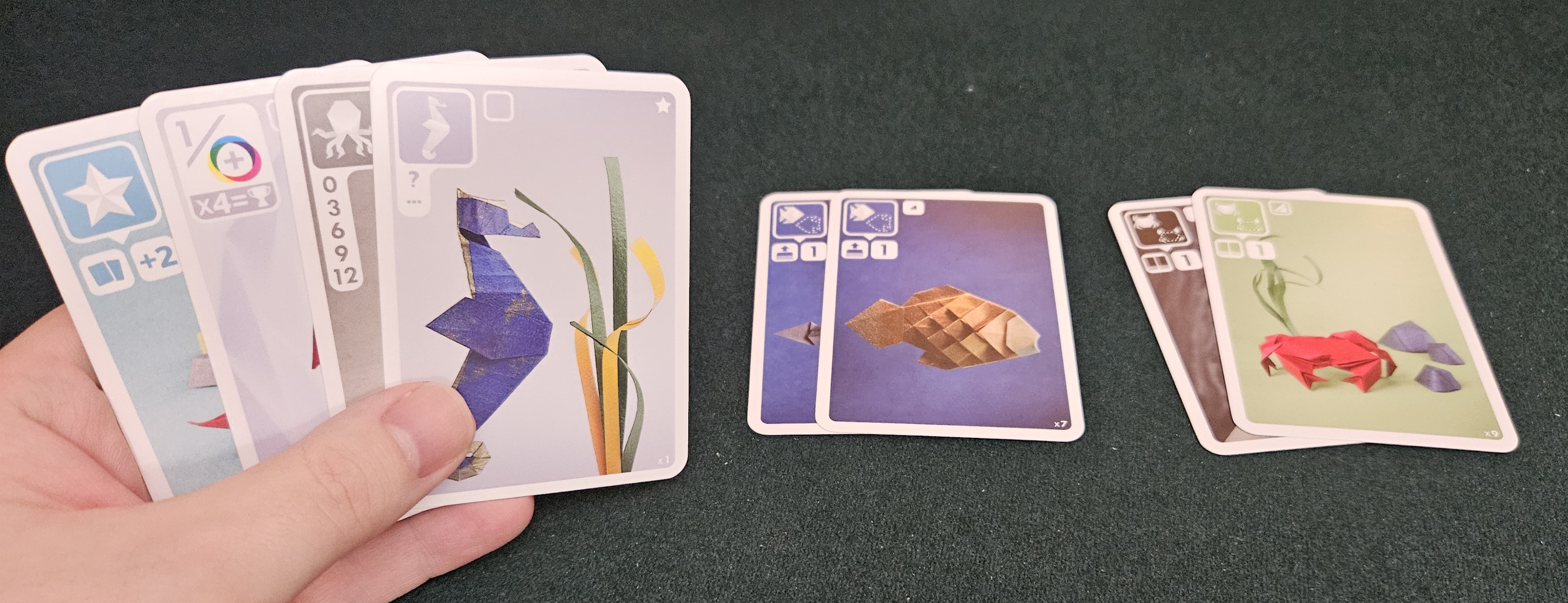
Cards in hand are hidden, but vulnerable.
Where the game gets interesting, though, is in its scoring. Played over multiple hands, the objective is to accumulate some number of points. Say, thirty points with four players. But rather than ending any given hand at a certain threshold, here players are allowed to keep playing until somebody elects to go out. And then they’re offered another little choice that bends the proceedings. They can declare the hand is over, at which point everybody scores according to what they’re holding and/or the duos they’ve revealed. Or the goer-outer can announce that they have the high score at the table and nobody can match them.
Aha! The contest is on. And the stakes are high. If the player who went out has the highest score, they earn all their points plus a color bonus, points worth the sum of their highest-held suit. That might be a lot or a little, depending on their priorities that round. Everyone else, meanwhile, earns only a color bonus. Again, that might be a tidy sum, but it will almost certainly be less than their normal score. But if the opposite holds true, the pendulum swings the other way. Everybody else scores their hand points, while the shouty player earns nothing but the color bonus.
Like everything else in Sea Salt & Paper, this decision is understated. But it represents a potentially major swing. I say “potentially” because, well, this is a game of subtle wagers and sudden swings, and it’s entirely possible for somebody to quietly amass a solid bar of colors and come out ahead either way.
This gives it a sleepy atmosphere. I might even call it boring, in a largely pleasant way, the sort of game you play with your grandmother while sharing some light chit-chat. In that regard, it reminds me of something like Mexican Train or countless trick-takers played with a regular deck. It doesn’t exactly knock me out of my socks, but it was never meant for sock-rocking. It’s there for quiet evenings on the seaside, the air heavy with the inrush of atmosphere, a storm coming but still out on the horizon. It’s a bedtime game.
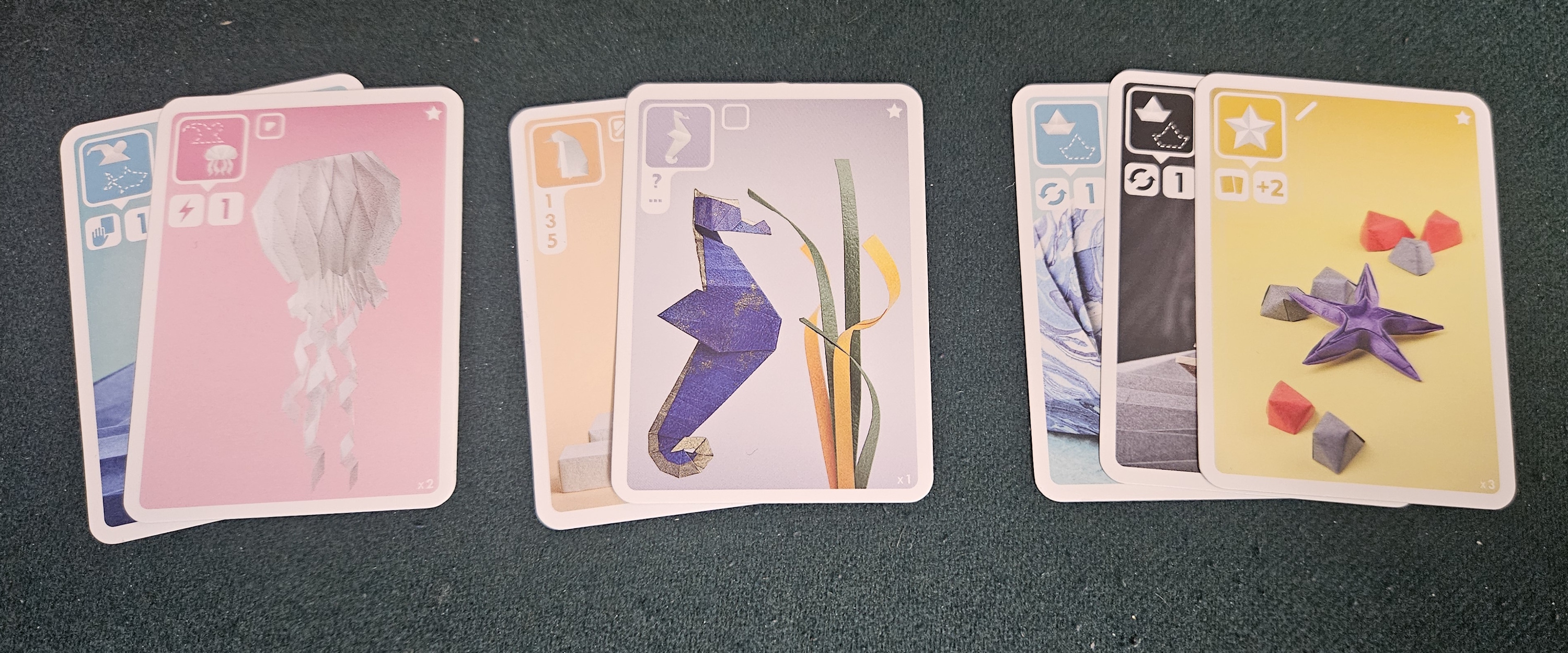
Extra Salt adds a few cards.
The expansions give it some much-needed kick. The first, Extra Salt, adds only a few cards, not enough to upset the delicate ecosystem of the original game, but sufficient to add at least a few decisions. Extras like a lobster or a jellyfish pair with previously-obvious offerings to produce new effects, while a seahorse makes certain sets more worthwhile and starfish can be added to a duo to drop their ability in exchange for some extra points. The game is still sleepy, but the decision-space is a little denser.
Next is Extra Pepper, the more interesting offering. Every round, an event card is drawn that alters the proceedings. A change to how a certain set is formed, a higher scoring threshold, only needing three mermaids to win outright rather than the usual four… that sort of thing. Everybody plays according to this altered rule, but then — and this is the smart bit — then the winning or losing player receives the event card as a permanent addition to their repertoire. This varies by card, with handicaps going to trailing players and hurdles to winners. Either way, the game receives a nudge that corrects toward the median ever so slightly. Or, better yet, allows somebody to manipulate the rules in their favor by tanking an early session to nab something ultra-potent.
In both cases, the expansions benefit the core game by adding a little more to the turn-by-turn proceedings. If I had to identify an issue with the game — which, again, I’m not sure this is the sort of game that bears a deep critique — it’s that the decision-making process is so muffled. There’s a gap between good and bad play, but good and great play? Eh. I’m not convinced. To their credit, the expansions offer a few more of those small decisions that make it such a pleasant, if still sleepy, game for late nights.
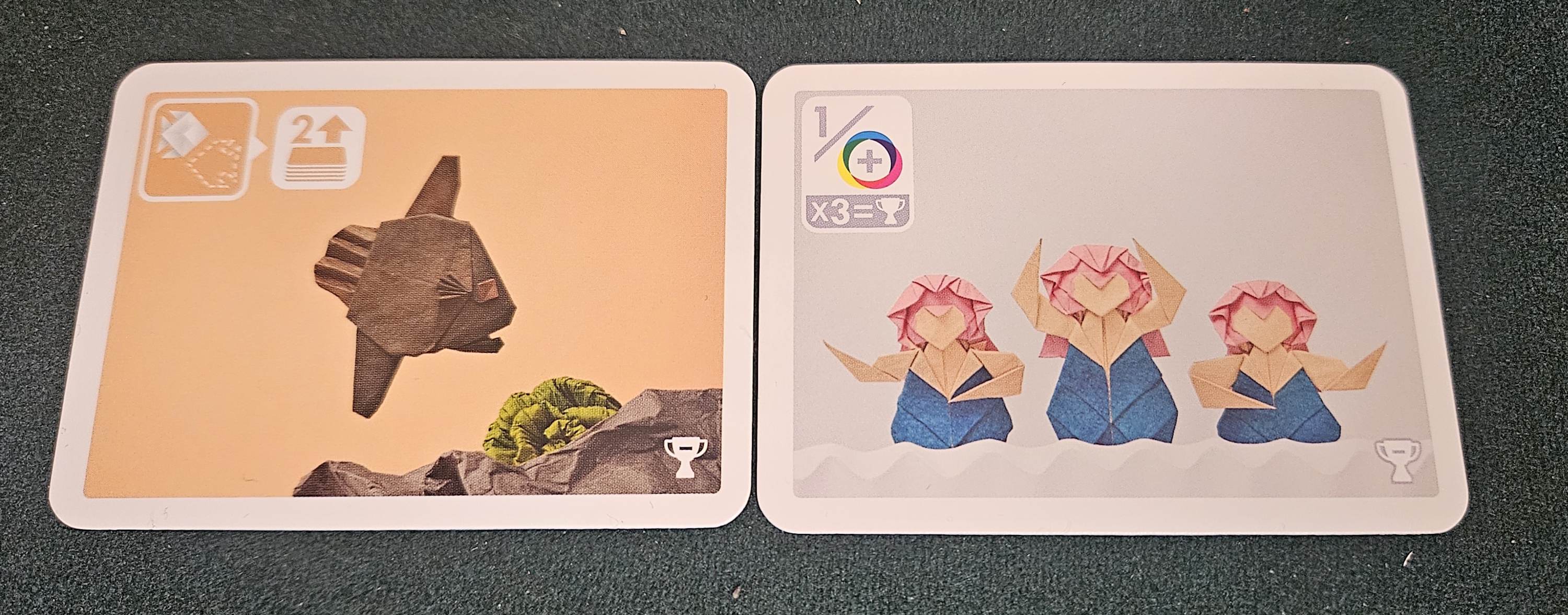
Extra Pepper is more interesting.
On the whole, Sea Salt & Paper is a game that’s nice to play with family, as a filler, or when everybody’s too tired for anything heavier. That’s a crowded field, but, well, this just so happens to be one of the games that’s succeeded in that arena. Call it the king of the sleepers. I doubt Sea Salt & Paper would even take it as an insult.
A complimentary copy of Sea Salt & Paper was provided by the publisher.
(If what I’m doing at Space-Biff! is valuable to you in some way, please consider dropping by my Patreon campaign or Ko-fi. Right now, supporters can read my first-quarter update of 2026: the best board games, movies, books, and more!)