Normale Ansicht

Interview with Javier Romero Designer of Battle of Pensacola 1781 in Strategy & Tactics Magazine #358 from Decision Games

Von: Grant
29. Juni 2026 um 14:00

We became familiar with the work of Javier Romero when we played his game Lion of Judah: The War for Ethiopia, 1935-1941 from Compass Games in 2017. Since that time, we have done 6 designer interviews with him for World War Africa: The Congo 1998-2001 in Modern War No. 52 from Strategy & Tactics PressSoviet Fallout: The Nagorno-Karabakh War: 1992-1994 in Modern War No. 54 from Strategy & Tactics PressSantander ’37 from SNAFU DesignThe Chaco War, 1932-1935 in World at War #86 from Decision Games, Caporetto: The Italian Front 1917–18 in Strategy & Tactics Magazine #337 from Decision Games and Partizan! The War in Yugoslavia, 1941-1944 (Walter’s War) from Kilovolt Studio. A few months ago, and in connection with the 250th anniversary of the Declaration of Independence and the establishment of the United States of America, I saw where Javier was designing a game on the American Revolutionary War in the Southeast titled Battle of Pensacola 1781 in Strategy & Tactics Magazine #358. We reached out to Javier and as always he was more than willing to share.

Grant: Javier welcome back to the blog. What is your new game Battle of Pensacola 1781?

Javier: Thanks for having me again. Pensacola 1781 is a simulation of the American Revolution in the southeast region, stretching from the Mississippi River basin to the Floridas, from the Spanish entry in the war in 1779 to 1782. I must say that the title is a bit deceptive in its scope and included battles.

Grant: What was your inspiration for this game? Why did you feel drawn to the subject?

Javier: The Spanish participation in the American Revolution has recently attracted much interest in Spain. It was, so to speak, the swansong of the empire in the Americas. There aren’t any games that cover the entire campaign. There is only a wargame on the siege of Pensacola from GMT Games which is a part of their Battles of the American Revolution Series, which is a detailed and interesting situation. But I wanted an operational level game showing the big picture, from New Orleans to Mobile, Pensacola and St. Augustine. The game highlights the operations of Bernardo de Gálvez, who led one of the most brilliant campaigns in that theatre, clearing the Mississippi basin of English outposts as well as taking Mobile and Pensacola fighting against all odds. Against the advice of his subordinates, who deemed impossible defending Louisiana without reinforcements from Cuba, Gálvez declared that he preferred “having to answer charges of recklessness, than other type of charges” and took the offensive against the British in the lower Mississippi.

Grant: What was your design goal with the game?

Javier: My goal was to show a “multi domain” 18th century campaign, including amphibious operations, sieges, Indian warfare and diplomacy. The design puts the focus on leadership quality, Indian warfare and chaos. The campaign in Louisiana, modern day Alabama and the Floridas was a bit of a sideshow in a worldwide conflict fought from Canada to the Mediterranean, the 13 colonies, the British channel, Gibraltar or India. The design reflects this in several ways. In this game, reinforcements arrive at the beginning of each year and their arrival depend upon a number of factors, such as victories in earlier turns (thus gaining the favor of their respective courts in London and Madrid) as well as events elsewhere. Fleet squadrons come and go because this is an oceanic war being fought out across the seven seas, and the Caribbean was just only one more front.

Grant: What type of research did you do to get the details correct? What one must-read source would you recommend?

Javier: There are plenty of Spanish sources on the campaigns of Bernardo de Gálvez in the Americas, many of them published in recent times. There are recent English language sources that recognize the major role of Spain in arming and supporting the American Revolution. For
instance, the book by Larrie D. Ferreiro Brothers at Arms: American Independence and the Men of France and Spain Who Saved It. Another interesting source in English is the work by Joshua Provan Every Hazard and Fatigue: the Siege of Pensacola, 1781 published by Helion Books. This book provides solid evidence of “the true military consequences of the siege [of Pensacola] on the War of American Independence.”

Grant: What from the American Revolution in the Southeast was most important to model?

Javier: It was important to model that the Mississippi-Floridas campaign was one more theatre in a global war spanning from the Americas to Europe and India. Keeping open the Mississippi River basin to the arms and supplies shipments coming from Spain, France and other nations was a decisive factor in keeping alive the American Revolution. Being just one more theatre, the arrival of reinforcements depends on a number of a factors and events elsewhere. After the first successes of Gálvez, the Spanish decided to reinforce success and provide him with more ships, troops and resources.

Grant: What is the scale of the game? Force structure of units?

Javier: Units are basically regiments and Indian warbands, rated for Indian and Linear warfare. Using one or the other depends on a number of factors, namely leadership quality.

Grant: What area of the Southeast does the map cover?

Javier: The map covers a large area, from the lower Mississippi to Eastern Florida, with off map boxes for outposts in the upper Mississippi and Georgia.

Grant: What off map areas are represented and why are they important?

Javier: There are three: St. Joseph and St. Louis, which are important to keep the Mississippi supply route open, and Georgia, from where the Spanish/Patriot player can launch attacks against East Florida. The 1778 Patriot invasion of East Florida was defeated, but there was the possibility of new offensives in the following years. After the conquest of Pensacola the Allied forces (Spanish, French and Patriots) planned a joint operation against British forces in the Carolinas, but the end of the war cancelled it.

Grant: What key strategic points are contested in the area and what is the geographic goal of the combatants?

Javier: For the Spanish, the first objective is to defend the Mississippi Basin, although Havana is also included in the map so that the Spanish has to keep a sizeable defense there. Historically, the Spanish commander in chief in Havana was extremely reluctant to spare ships and troops for the Floridas. In the words of the chief of the Spanish navy in the island, “This [Cuba] is worth 50 Mobiles or Pensacolas…if the King was here, he would do the same”. The British capture of Havana in 1762 still loomed large.

For the British, the objective is to reach the Mississippi Basin, and, if not possible, to defend West and East Florida. With the arrival of Rodney’s fleet, he can also chance a surprise attack on New Orleans, or even Havana if the Spanish player doesn’t keep there a sizeable force.

Grant: What different unit types does each side have access to?

Javier: There are line infantry, militias, artillery, siege trains, supply trains, Indian warbands, fleets, transport ships, and leaders.

Grant: What is the anatomy of the counters?

Javier: Land units are rated for linear warfare (representing “proper” 18th century warfare) and Indian warfare (irregular tactics, hit and run, pillage, ambushes). Linear infantry and field artillery are better for the first, while militias and Indian warbands are better for the latter. Militias and Indian warbands are also very useful for finding out the makeup and location of the enemy or avoiding interception/ambushes by the enemy force. Leaders are rated for their tactical and diplomatic skills that add modifiers to initiative, combat, diplomacy and other actions. Supply trains are spent to avoid attrition, which can be heavy in the hostile wilderness.

Grant: What is the general Sequence of Play?

Javier: The sequence of play begins with the stratagem markers phase (both players pick at random stratagem markers), followed by reinforcements die rolls at the beginning of the campaign season. Then comes the Indian diplomacy phase, where both players use diplomacy stratagem markers to break or establish alliances with the various Indian tribes. After that both sides can try to recruit Indian warbands among neutral or allied Indian nations. Then comes the recruiting phase, where both sides use accumulated Treasury Points to rebuild destroyed units. Finally, the Spanish operates his naval and land forces in any order he sees fit, followed by the British operations phase. At the end of the turn, both sides roll for attrition, and for the possible withdrawal of Indian bands.

Grant: What type of experience did you want the Sequence of Play to invoke?

Javier: Players can activate their forces in any order they want, so that they can use any combination of land, amphibious and naval operations. The experience I wanted to invoke is that of uncertainty- this is the 18th century warfare in a remote colony. As in many other wars, both sides make plans, but there are many factors that can disrupt them, from hurricanes to unexpected arrival of enemy forces to events elsewhere. There are no communications other than messengers and courier ships, so the possibility of an enemy expedition arriving out of nowhere should make players to be cautious.

Grant: How do the different nations troops coordinate their maneuvers and attacks? What difficulty of command will players experience trying to coordinate French, Spanish and Patriot forces as well as British, Hessian and Loyalist forces?

Javier: In general the troops of different nations can operate together without problem. The Indian forces are a double edged weapon-very useful for reconnaissance and ambush (or to avoid enemy ambushes) but they can leave a force if they decided that they have to return or that they have captured enough loot and captives. Forces can operate any number of units of different nations.

Grant: What role do the Indians of the region play in the game?

Javier: In this game I wanted to emphasize the role of the various Indian nations. Indian warbands are useful for raiding and reconnaissance although they tended to return to their villages after a successful campaign. Historically, the British had a well developed network of Indian agents which gave them advantage in their Indian diplomacy. This is reflected in the “Indian agent” markers, that provide die roll modifiers to the British diplomacy attempts. Historian Josh Provan pointed out in his book on the Pensacola campaign that the Spanish victory was achieved with the assistance of Native American nations, “whom have routinely been dismissed outright for over two hundred years”.

Grant: What are Stratagem markers?

Javier: The Stratagem Marker is a mechanism that I use in many of my designs. These are very useful to simulate things that are beyond the control of players. Represent anything from tropical diseases, campaigns elsewhere in the Americas and in the World, to tactical events such as lucky hit, ambushes or military advantage. The marker “Surprise move” is particularly useful to simulate the uncertainties of 18th century in a remote wilderness such as the old Southeast. Given the right conditions, a surprise move may make a fleet appear out of nowhere and destroy an enemy force. This is the 18th century…there are no communications other than messengers and courier ships. Historically, upon learning about the presence in the Caribbean basin of the squadron of Admiral Rodney, the Spaniards feared that they could catch by surprise the forces besieging Pensacola. Stratagem Markers also simulate the spy networks of both sides. Before the war, Gálvez setup an extensive spy network that was very useful. For instance, his spies got hold of a copy of the secret orders sent to General Campbell at Pensacola, ordering him to organize, if possible, an attack on New Orleans with armed vessels from Jamaica and “as many faithful Indians and the Superintendent could supply”. Gálvez took the initiative and took the British outposts along the lower Mississippi before Campbell could arrange his own offensive.

Grant: What are Treasury Points? How are they gained and lost?

Javier: TP’s represent resources received from their respective metropolis, as well as local contributions used to recruit units. Treasury Points are received from their respective countries during reinforcement turns. Unlike other games, there are no treasury generating regions or cities-everything comes from Havana, Madrid or Britain. Treasury Points are used to rebuild destroyed units.

Grant: What role do Leaders play? What historic personalities are represented?

Javier: Leaders play a key role in diplomacy and combat. The better the leadership, the better chances of gaining initiative in combat, recruiting Indian allies, and so on. Among the historic personalities, the most notable is perhaps Bernardo de Gálvez, the most noted commander in that theatre. After fighting in Europe, North Africa and the Americas (against the Apaches), he was named governor of Louisiana in 1777. In May 1779, a month before Spain declared war on Britain, and three years after the Declaration of Independence, Gálvez assembled a small army with which he attacked the defensive posts the British held along the Mississippi. With a contingent that included free African Americans, Choctaw Indians, Canadians, and American volunteers, Gálvez captured forts such as Manchac, Baton Rouge, and Mobile, and expelled the British from the region. His greatest victory was the conquest of the port city of Pensacola, in northwest Florida in 1781. Galvez’ adversary at Pensacola, Major General John Campbell, a veteran of Culloden in 1746 and the siege of Havana in 1762, is an interesting figure as well.

Grant: How does combat work?

Javier: There are two odds-based Combat Tables-Indian and Linear. Indian represents Indian Warfare-emphasizing mobility, with night attacks, ambushes. Local militias and, of course, Indian warbands are better at them. The other CRT is linear warfare, representing “proper” 18th century linear warfare. In this, Line infantry are artillery are most useful. The choice of CRT is determined by an initiative die roll, modified by the leadership rating of any leaders in the forces, plus the play of Stratagem Markers such as military advantage or ambush.

Grant: What are Military Advantage and Ambush Markers used for?

Javier: They represent tactical opportunities and junior leadership and can be used to modify initiative, interception or operations points die rolls.

Grant: What is the makeup of the CRT?

Javier: As mentioned above, it is odds based. Units add their linear or Indian warfare factors-Linear units add 2 combat factors on the linear CRT, 1 on the Indian CRT. Artillery adds 2 combat factors on the linear CRT, 0 on the Indian CRT. So, a force containing mostly militias and Indian warriors against a force containing line infantry and artillery will chose the Indian CRT. Of course, the system rewards combined arms-it is advisable to combine all types of units in a single force. The Linear CRT is bloodier (more chances of completely destroying an enemy
force) the Indian Warfare CRT is more indecisive.

Grant: How do Sieges work?

Javier: In the game there are Fortresses and forts. The first represent stone fortresses such as the ones in Mobile, St. Augustine and Pensacola, while forts represent minor positions made mostly of wood. Players can build siege works to approach the enemy defenses (representing parallel trenches, mining and so on). The force under siege may choose to launch a sortie to destroy the siege works. If the sortie fails, the siege works add a positive modifier to the assault operation against the fortress hex. The player then rolls on the siege table and apply results, which may include Bloody Repulse (Eliminate besieging units equivalent to the number of defending units), Honors of War (with Age of Enlightment chivalry), the defender is given the option to withdraw from the fort or fortress. The defenders are withdrawn and can enter as reinforcements during the next game turn) or Surrender: the fortress is conquered and all defenders are eliminated, including any naval units if it is a coastal fort or fortress.

Grant: How is victory achieved?

Javier: Victory is achieved by taking geographical objectives (Mobile, Pensacola, St. Augustine, New Orleans…) or by preventing the enemy from taking them. The British may win a sudden death victory if they manage to take Havana as in 1762.

Grant: What role do Naval Operations play? Why were they important to include?

Javier: Naval operations were very important because it was the only means to move sizeable forces in this theatre. Overland movement and supply was extremely slow, so the best way to move reinforcements, supplies and to take the fight to the enemy strongholds was by sea.

Grant: What optional rules are included?

Javier: There are four optional rules. In general, these add to the game narrative although it might make game turns somewhat longer. Optional rules are naval infantry. In this one, players can “land” marine infantry from naval ships, which can fight overland in a siege, for instance-if the naval ship is involved in naval combat, it has a negative modifier in combat, representing the missing crew and marines. The other optional rules are Indian supplies (players can purchase supplies to local Indian tribes, like Gálvez did, for instance, during the siege of Pensacola), destroyed forts (players have the option to burn forts, but not fortresses) and valley movement, where players follow river valleys to move faster across the wilderness territory.

Grant: What type of an experience does the game create?

Javier: It creates an experience of uncertainty, in particular with the unexpected arrival of enemy forces from out of nowhere. If this could happen at the tactical level, more so in a strategic game covering all of North America from the Mississippi river basin to Florida. Also, gamers must keep in mind the importance of the human geography-the Indian nations played key roles in the operations of the war, by supplying, providing information and combat troops to the empires at war. Elements such as the “Surprise move” markers, and the arrival of Rodney’s Fleet, provide the game with wild changes of initiative. The British, in particular in the early turns, can try to grab the initiative and attack towards the lower Mississippi or St. Louis.

Grant: What are you most pleased about with the design?

Javier: I think it makes a good work at simulating “multi domain” 18th warfare, covering many aspects, from conventional operations to irregular warfare to diplomacy with a relatively simple set of rules.

Grant: What other designs are you working on?

Javier: I am currently working on several games for SNAFU Design Team, Decision Games, VUCA, Bonsai Games and Compass Games/Paper Wars. S&T will publish in May-June 2026 another of my operational WW2 designs, Forgotten Front: Italy 1944-45. I just turned in to Decision Games the prototype for Ukraine Battles 2. This one covers the early, mobile campaign in Kharkiv in Eastern Ukraine in the spring and summer of 2022. It is an evolution of the system first used in Ukraine Battles 2014-15. Artillery plays a very important role in the system. It is precise and deadly, and can do a number of missions, from interdiction to destroying command posts to supply depots. Plus drones and long range fires, of course.

1942: Battle for the Mediterranean for VUCA Simulations, is, I hope, approaching completion. It is an old project that I first agreed to publish with the company of the late Jack Greene, Quarterdeck International, but later he suggested me to contact VUCA for publication since they did a great job with the new edition of his Bismarck design. 1942: Battle for the Mediterranean is what I would call an operational naval game, with turns representing one month of naval operations. Apart from supplying the war fronts and fighting the enemy at sea, players have to manage their assets and think in the long term. The campaign game covers 10 game turns, from January to October 1942. There are also shorter one turn scenarios simulating the major convoy battles of the 1942 campaign: Second Sirte, Harpoon/Vigorous (Battaglia di Mezzo Giugno, “Battle of Mid June” for the Italians), or Pedestal (Battaglia di Mezzo Agosto, “Battle of Mid August”).

Aragón 38 for SNAFU Team is also in development. Nils Johansson is working on the graphics aspect (map, counters, play aids and cover). It uses an evolution of the Santander ’37 System. While in the Santander campaign we have Brigade-sized units attacking across a mountain range, using speed, firepower and infiltration to overcome the Republican defenses, in Aragon we have a “push” of several Army Corps operating together, with front collapse followed by exploitation, consolidation and conquest of several bridgeheads as bases for future offensive operations. So we had to adapt the system to better simulate that campaign. Bonsai Games from Japan will publish my game Assault on Europe 1943, covering land operations in the Mediterranean Theatre in 1943, from Tunisia to Sicily and Southern Italy. The Allied player can decide whether to land in Corsica and Sardinia before Southern Italy. Rules simulate the painful US Army learning curve (from being called in Tunisia “our Italians” by the British, to a much better performance in Sicily and Southern Italy) and the surrender/collapse of the Italian army (operation Achse). After publishing Red Partisans for Paper Wars, I am working on a small unit game of the fight around Kyiv in February 2022. It is still in a very early design stage.

Thanks for your time Javier in answering our questions as I know you are a busy man and obviously have lots of interesting gaming subjects on your design table. I am very interested in this one, as the American Revolution is one of my favorite gaming topics.

If you are interested in Battle of Pensacola 1781 in Strategy & Tactics Magazine #358 from Decision Games, you can order a copy for $54.95 from the Strategy & Tactics Press website at the following link: https://shop.strategyandtacticspress.com/ProductDetails.asp?ProductCode=ST358

-Grant
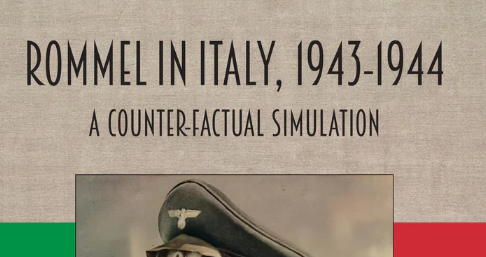
Interview with Ty Bomba Designer of Rommel in Italy, 1943-1944: A Counter-Factual Simulation from War Diary Publications

Von: Grant
22. Juni 2026 um 14:00

We have interviewed the venerable designer Ty Bomba on numerous occasions over the 10-year life of the blog. In fact, I counted up the interviews and to date we have done 18 total! Wow but the last one we did was in January 2023 and we have just not had him on since. No reason for that other than I have been busy with other games. But recently I saw from War Diary Publications that they were printing one of his What If? style alternative history games called Rommel in Italy, 1943-1944: A Counter-Factual Simulation, which supposes Field Marshal Erwin Rommel had taken command of German forces in Northern Italy rather than being sent to help with the defense of France against the expected Allied invasion. I reached out to Ty and he was more than glad to give me some more information.

If you are interested in Rommel in Italy, 1943-1944: A Counter Factual Simulation, you can pre-order a copy for $30.00 from the War Diary Publications website at the following link: https://wardiarymagazine.com/products/rommel-in-italy-1943-1944-a-counterfactual-simulation

Grant: What is your upcoming game Rommel in Italy about?

Ty: Rommel in Italy, 1943-1944: A Counter-Factual Simulation allows 2 players (or one playing 2-hand solitaire) to investigate the strategic and operational potentials that would have been in place across northern Italy from September 1943 through May 1944 if Hitler had left Field Marshal Erwin Rommel in charge there rather than Kesselring. Rommel advocated for immediately pulling back to a shorter, easier to defend, position at the south edge of the Po Valley rather than trying to fight it out farther south, with both the German’s flanks exposed to possible encirclement via Allied amphibious end runs. In effect, it put the Allies into a strategic position that historically they did not achieve until a year later. The question then becomes can they keep up that kind of advance into and across the Alps.

Grant: Why was this a subject that you wanted to design a game around? What assumptions about history did you take into account?

Ty: Historically, we had 2 of Germany’s best field commanders, Rommel and Kesselring at complete odds with each other over theater-level strategy. Kesselring felt confident the Allies would not achieve a level of operational efficiency that would allow them to effectively exploit the supremacy in the seas along both of Italy’s coasts. History showed that he was correct in that assessment, but Rommel’s transfer to France was not a sure thing. Hitler actually tried to send him back to Italy, to take full charge there, shortly after Rommel had gotten on a plane to fly to France. Radio communications temporarily failed, and by the time Hitler’s communications people got that all sorted out, the dictator had again changed his mind and kept Kesselring in place.

Further, the fact Kesselring was shown to have been correct does not mean Rommel was necessarily wrong – and there’s a fun-to-play wargame inherent in that iron.

Grant: What is important from the overall period and setting to model in the game?

Ty: The opening of the campaign, in September 1943, is filled with opportunity – but also fraught with peril –  for both sides. At the start of play, there are only a few German garrison units in the far north of Italy, while the 10 (mostly elite) divisions of their Tenth Army start off-map to the south, where they just received Rommel’s order to run north. There are no Allied units setup on the map at all. They enter on the south edge during the first turn, and both players operate using the sequence below.

5.3 Allied Reinforcement & Replacement Phases

During these phases, the Allied player may bring onto the map newly arriving units and reclaim into play units that had been previously eliminated in combat. This phase is skipped on Turn 1.

5.4 German Reinforcement Phases

During these phases, the German player may bring onto the map newly arriving units and reclaim into play units that had been previously eliminated in combat. This phase is skipped on Turn 1.

5.5 Movement & Combat Sequence Determination Phases

In each of these phases, excluding that of Turn 1, the Allied player openly declares whether that turn’s movement phase or combat phase will be taken first. On Turn 1 the sequence is always the movement phase followed by the combat phase.

5.6 Alternating Actions Movement or Combat Phases

Always starting with the Allied player, the two players alternate either launching one attack or moving one unit, depending on whether the present phase is movement or combat. Individual attacks may have more than one attacking unit in them, but moves are always made one unit at a time. The unit(s) committed to those “actions” are, upon their completion, flipped over to show their disrupted sides. If a player does not actually want to make an attack or a move when it is his time to do so, he must flip one unit to its disrupted side, just as if it had moved or launched an attack: no “passing” is allowed.

5.7 Movement or Combat Recovery Phases

A movement or combat phase continues as described above until both players are out of undisrupted units or both agree they want to end the phase. If one player runs out of undisrupted units before the other, the player with remaining undisrupted units may go ahead and complete whatever actions he wants to perform with them within normal strictures, but now uninterrupted by having to pause to allow the opposing player to take an action. When a combat or movement phase is ended, both players should cooperatively turn over all disrupted units on the map so their undisrupted sides are and showing.

5.8 German Supply Check Phases

In each of these phases, both players should cooperatively look over the map to find if there are any German units out of supply. Each such unit is immediately removed to the dead pile.

5.9 Allied Supply Check Phases

In each of these phases, both players should cooperatively look over the map to find if there are any Allied units out of supply. Each such unit is immediately removed to the dead pile.

5.10 Ending & Starting Turns

Each time a Allied Supply Check Phase has been completed, advance the Turn marker one box on the Turn Track printed on the mapsheet and start a new turn with Phase I. 

On the first turn, the Allied player has a relatively open front before him. If he can exploit that to get into the Po Valley quickly, he will move the strategic timetable significantly forward of the historic one. However, as he’s moving onto the map, so too it German Tenth Army. Depending on how bold both players are, it is not unusual to see pockets form inside other pockets. 

Grant: How has this design changed since its original publication in 2021 in Banzai Magazine under the title Rommel’s Last Stand: Italy 1943-44, What If?

Ty: The new publisher has fixed the (scant) errata from the first (bilingual) Japanese edition from Banzai Magazine. They have also taken all the Japanese off the map and out of the rules, presenting everything fully in English. Other than the removal of those irritants, it is the same game. 

Grant: What is the scale and force structure of units used for this design?

Ty: Each hex on the map equals 5 miles (8 km) from side to opposite side. Each full turn represents 2 weeks to 2 months, depending on the time of year. Every ground unit represents a regiment, brigade or division of about 2,500 to 12,000 men and/or 50 to 350 armored fighting vehicles.

Grant: How many maps are used in the game? 

Ty: There is 1 large-hex based 34×22” map showing Italy north of the line of the Arno River to Ancona.

Grant: What is the anatomy of the counters?

Ty: The units are standard-classical in their data presentations, except their movement factors are not printed on them. All Allied units have (supplied) MF’s of 16 throughout the game, while the German MF’s are as follows.

German Mechanized Units Turns 1-6 – 16 MF’s

German Non-Mechanized Units Turns 1-6 – 8 MF’s

German Mechanized Units On Turns 7-10 – 12 MF’s

German Non-Mechanized Units On Turns 7-10 – 6 MF’s

Grant: What sources did you consult for the Order of Battle?

Ty: The Armies of Rommel by George Forty was an excellent source for the subtleties in the initial German Order of Battle. Beyond that, I pulled the roughly half-dozen historical Italian campaign games off my shelves and pulled information out of them. This is one of the most thoroughly simulated campaigns in the hobby, going all the way back to Avalon Hill’s Anzio, so I was not looking to find any heretofore undiscovered anomalies in either sides’ OB. The uniqueness in this game’s treatment of it comes from the changed strategic context combined with the tension inherent in the turn sequence, which requires both players to remain alert for sudden danger or fortuitous opportunities all throughout its play

Grant: How does combat work?

Ty: Combat is always voluntary and, when viewed on a battle-by-battle basis, is standard/classical odds ratio using a six-sided die.

Grant: What are the victory conditions?

Ty: Operating in conjunction with the alternating-actions turn sequence, the victory conditions are a further element I used to keep both players on the edges of their seats at all times. See below.

4.1 In General. The Allied player is on the offensive, trying to win by advancing fast enough to cause a major disruption to the historic timeline. 

4.2 Allied Victory During 1943 Turns. If Phase 9 of Turn 1 or 2 or 3 or 4 ends with Venice or Milan or Trieste, or any one or more of the four German supply source hexes, occupied by an Allied unit or stack, that game ends at that time in an Allied victory.

4.3 Allied Victory During 1944 Turns. If Phase 9 of Turn 5 or 6 or 7 or 8 or 9 or 10 ends with any one or more of the four German supply source hexes occupied by an Allied unit or stack, that game ends at that time in an Allied victory.

4.4 German 1943 Sudden Death Victory. If any movement or combat phase of a 1943 turn ends with the German player having gained control of the containing the Allied Amphibious Invasion Beachhead marker, the games ends in a German victory at that time.

4.5 German 1944 Sudden Death Victory. If any movement or combat phase of a 1944 turn ends with one or more German units in any hex(es) on the south map edge, that game ends in a German victory at that time.

4.6 German End-Game Victory. If Phase 9 of Turn 10 ends without the Allied player having achieved a victory, the game ends at that time in a German victory. 

The “White Dragon Game Designer” dressed as a samurai.

Grant: What are you most pleased with about the design?

Ty: As I mentioned above, the Italian campaign has been one of our hobby’s most thoroughly plowed fields for decades. Despite that, I believe I have offered a new experience with it here. Players will get a new slant on it, one that operates within the broad parameters of the war’s historic decision-making, but that is also tense and entertaining for both commanders.

I also hope its appearance in an easily available all-English edition may lead this and other publishers to look into acquiring the rights to other of my designs that have so far appeared only in East Asia (where I am affectionately known as the “White Dragon Game Designer”). I have done several games that have been well-received there, but are barely known here in the West.

Grant: I know you are a busy man with game design projects as well as editing for various wargame magazines but what other games are you currently working on?

Ty: I am presently working on this alternative history design, which is scheduled to appear in World at War No. 130, called Stalin’s Missed Opportunity: What If He Invaded Romania in May 1940?.

If you are interested in Rommel in Italy, 1943-1944: A Counter Factual Simulation, you can pre-order a copy for $30.00 from the War Diary Publications website at the following link: https://wardiarymagazine.com/products/rommel-in-italy-1943-1944-a-counterfactual-simulation

-Grant

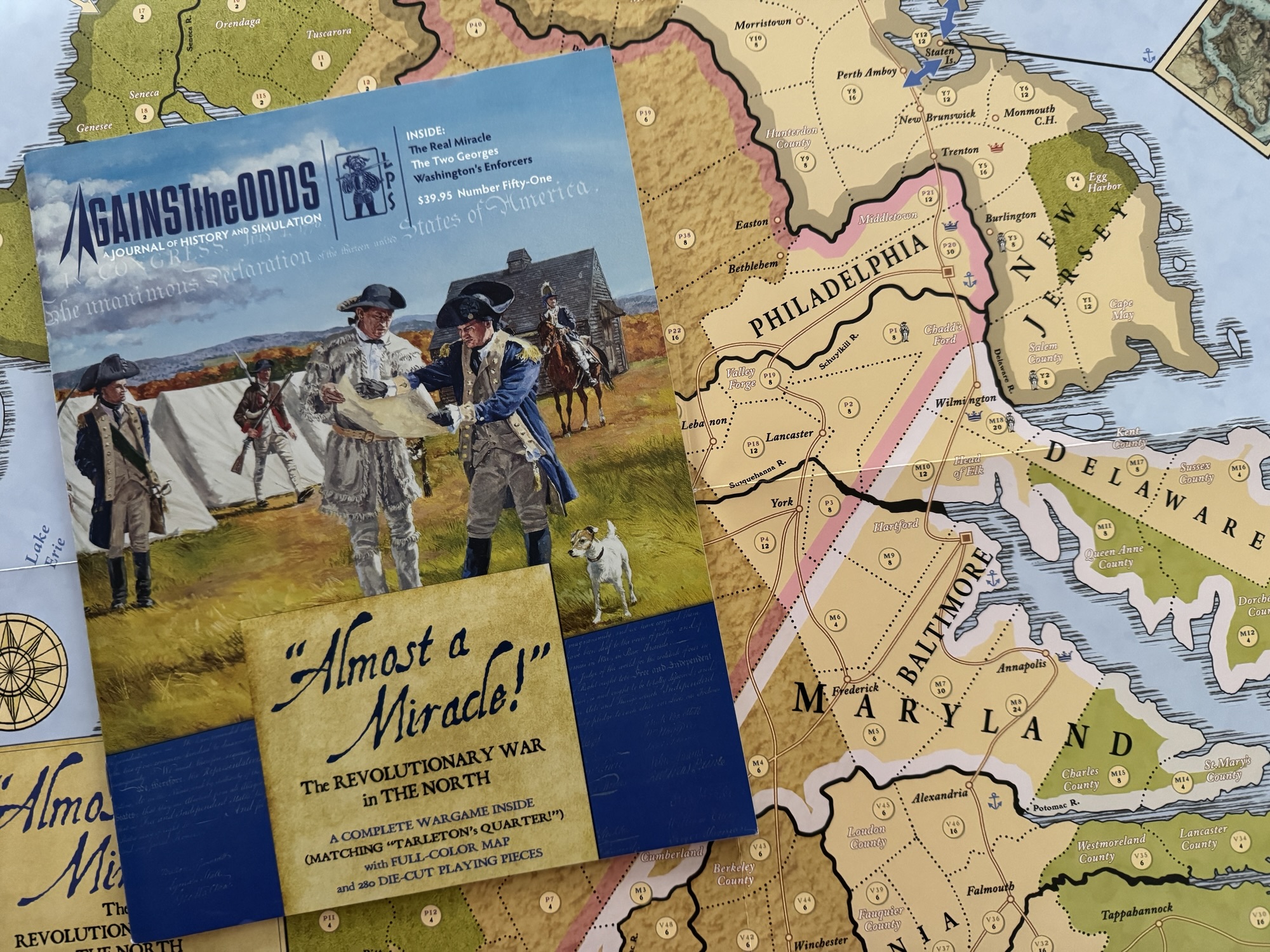
The Beautiful Boards of Wargaming! – Almost a Miracle!: The Revolutionary War in the North in Against the Odds Magazine #51 from LPS, Inc.

Von: Grant
20. Mai 2026 um 14:00

Continuing along in this series devoted to the best looking boards found in the wargaming world where I will highlight the art and layout of a different board in a wargame that we have played to show you the various talents of the artists and graphic designers involved. In my humble opinion, a well designed and attractive board can make all the difference in the world to me enjoying a wargame. Don’t get me wrong, the game has to be good, but if it’s also good looking it always is a better experience. A board can draw me in. Can make me feel that I’m there. Can set the stage for the thematic immersion that we all crave. And I have found many of these type of boards and I want to make sure that I share them with you.

In this entry in the series, we will be taking a look at the fantastic looking board for Almost a Miracle!: The Revolutionary War in the North found in Against the Odds Magazine #51 from LPS, Inc. The board is illustrated by the very talented Mark Mahaffey whose board from Stilicho: Last of the Romans we have already covered in this series. Now typically, Magazine Wargames are nothing special. Both in their game play but also in their component quality and in the area of art and graphic design. But LPS takes great pride in the games found in their flagship magazine Against the Odds. And Almost a Miracle is such a beautiful example of great graphic design and art but also the board is absolutely a piece of art worthy of being framed and hung on a wall.

The board is illustrated by Mark Mahaffey who is a very accomplished full time artist who has done art for nearly 200 games including Celles: The Ardennes, December 23-27, 1944 (2012) from Revolution Games, The Dark Valley (2013) from GMT Games and Stilicho: Last of the Romans (2020) from Hollandspiele to name just a few. I think that Mark has a real talent for making a board coherent, easy to reference upon first glance and pleasing to look at during play, but I would not say that a lot of his boards are over the top beautiful but that is definitely the case with his effort for Almost a Miracle!.

The board represents mostly the Northern Theater of the American Revolutionary War but also includes Virginia and Maryland in addition to Pennsylvania, New Jersey, Delaware, New York and an area identified as New England which encompasses Massachusetts, New Hampshire and Connecticut. Canada is also represented at the top of the board. The map comes in 2 separate parts that join together in New England and that measures 22″ x 51″ total when combined. The interesting thing about these 2 maps is that one is significantly smaller than the other one. I would say about 75% of the playable board is found on the larger of the 2 sections with the northern tier only covering 25%.

My only real issue with the 2 parts of the board is that they join together fine but the way the map was folded created a really defined white seam in the board that really stands out. You can see it located to the right of the words New England and it runs from Penobscot to the top of the board ending in Canada around the top of Acadia. Not a huge issue but more of a distraction from the beauty that the board offers.

But the board is really quite beautiful and really provides a fantastic backdrop for the game itself. As you can see, the color palette chosen focuses on various shades of green and brown and they really give the game a natural and wild feel to it. With these American Revolutionary War games, I always keep in mind that the majority of the area of each colony, outside of a few larger population centers such as New York City, Baltimore and Philadelphia, are farmland and wilderness timber. Not a lot of development and definitely a land rich in natural resources in the form of wild game, furs, fish, lumber and ore. This “natural” color scheme of greens and browns really sets the tone of the period and provides a ready conduit into the theme and setting of the war.

Let’s focus on the southern portion of the board that includes Virginia, Maryland, Delaware, Pennsylvania and New Jersey. First off, I very much love the inclusion of the title box in the bottom left hand corner of the board with the game title and the various contributors including the designer David Jones and Mike Joslyn (who designed Tarleton’s Quarter which covers the Southern Theater) and the graphic design and art teams. These additions are always nice as they feel period to me and almost as if I am looking at a map of the region created at the time.

One thing that I want to point out is the use of lines to mark the various counties in each of the colonies. These lighter dotted lines are not as prominent as the other more important colony boundaries, roads and rivers. You will also notice that each of the colony boundaries are a different color because they touch and are easier to differentiate with the use of colors. Pennsylvania’s boundary is pink as it comes into contact with New York, New Jersey, Maryland and Virginia. Then the boundary of New Jersey is gray and New York is brown as they both touch Pennsylvania. This was a very nice touch and is important to understand the colony boundaries for recruitment and reinforcement purposes. This visually aids in distinguishing the various locations and to assist in grounding you in the geography.

Foraging is also a major part of the game and when troops are out campaigning they rely on baggage trains and supply depots for food and ammunition but also can forage the countryside which is hit or miss. These foraging results are found on a table and are influenced by the terrain type that the troops are located in. So knowing what the terrain in any given area is important and these colors quickly identify the type.

The other very nice feature on the board is the use of lines to mark the shorelines of the various bodies of water including lakes, bays and oceans. In the picture below, we get a look at the shoreline of New Jersey, Delaware, Maryland and Virginia and you can see the deft use of these horizontal dark lines to mark the water as it comes in contact with the shoreline. I also really like the small islands that are sprinkled in the midst of these lines and they add some real depth to the feature. You can also see in this picture the names of each of the counties in each of the colonies. You may also notice the nice use of the silhouettes of soldiers on the boards in some of these counties. These are the starting positions for your forces and I very much like the way they did this.

You may also notice the blue crown icons found on the board near major cities. In this picture you can see the blue crown icon at several places including: Wilmington in Delaware and Annapolis in Maryland. These blue crown icons denote the capitals of each of the colonies and some of the larger ones have multiple capitals. This has to do with victory at the end of the game for the British as if they control the colony capitals and there are no Colonial Regulars or Militia present in the colony they can then place the Colonial Governor and declare “the King’s Peace” in at least 2 colonies to end the campaign game.

As we move to the north of the map, and enter the less populated and definitely more wild areas of the colonies, including northern Massachusetts and the wilderness of Canada, the board changes quite a lot as there are less roads, less markings and frankly more green on the board. It still looks really good and the use of lines for water features is continued particularly in several of the larger lakes in the area.

In the picture above, you can see a good example of the Holding Boxes for troops in the larger metropolitan areas. Here we get a look at the Montreal Holding Box and I very much like the way that they have drawn the outline of the city itself with some of the streets, buildings and homes. This is a very nice touch to the board itself and there are several of these Holding Boxes found on the board including those shown in the picture below such as the Newport Holding Box, New York Holding Box and Staten Island Holding Box. These are very nice additions to the board itself and they look really good and add a layer of depth as well as playability to the game.

The game aids and tracks that are printed directly onto the board are very useful and well done. These use calligraphy like cursive writing that really feels period and adds to the thematic immersion of the player into the American Revolutionary War period. These boxes include the Continental Baggage Train Box and the British Baggage Train Box and shows the game’s focus on Supply. In these boxes, there is an available and an expended section that are used. There also is a Prisoners of War Track that is very period as well as these pitched battles were never fights to the death but represented the fighting style of the period which lead to many different forms of losses including deaths, injuries and prisoners taken.

Finally, there are Captured Boxes for Continental and British Leaders that aid the players in playing the game. These administrative aids are very well done from a graphics standpoint but I love that this game included them on the very large board as it eases play and cuts down on the need to continually refer back to the rules.

Almost a Miracle! was a game chosen for our Shelf of Shame Dust-Off Event in 2024 and we very much enjoyed the game and the history. The game is focused on the American Revolutionary War in the North and is named Almost a Miracle! because when asked about it years after the war ended, George Washington said that the American victory was “little short of a standing miracle.” Almost a Miracle! uses the Tarleton’s Quarter! System as a game engine starting point to bring the Northern “half” of the American Revolution into play.

I think that the best part of this game though is the board. It is just gorgeous and is an odd shape to take into account the entire northern colonies. I think that one of the strengths of this game is that it truly shows the difficulty of maneuvering armies around the colonies and the terrain as well as having to search for forage to feed those armies.

If you are interested, here is a link to our video review:

The next board that we will take a look at in the series is Great Campaigns of the American Civil War: Thunder On the Mississippi: Grant’s Vicksburg Campaign, April-July, 1863 from Multi-Man Publishing.

Here are links to the previous entries in the series:

Kekionga!: A Dark and Bloody Battleground, 1790 from High Flying Dice Games

Campaigns of 1777 in Strategy & Tactics Magazine #316 from Decision Games

Battle Hymn Volume 1: Gettysburg and Pea Ridge from Compass Games

From Salerno to Rome: World War II – The Italian Campaign, 1943-1944 from Dissimula Edizioni

This War Without an Enemy: The English Civil War 1642-1646 from Nuts! Publishing

Holland ‘44: Operation Market-Garden, September 1944 from GMT Games

Maori Wars: The New Zealand Land Wars, 1845-1872 from Legion Wargames

Imperial Struggle: The Global Rivalry – Britain & France 1697-1789 from GMT Games

Stilicho: Last of the Romans from Hollandspiele

Nevsky: Teutons and Rus in Collision, 1240-1242 from GMT Games

A Most Fearful Sacrifice: The Three Days of Gettysburg from Flying Pig Games

Donnerschlag: Escape from Stalingrad from VUCA Simulations

Keep Up the Fire!: The Boxer Rebellion Deluxe Edition from Worthington Publishing

Liberty or Death: The American Insurrection from GMT Games

Lanzerath Ridge: Battle of the Bulge from Dan Verssen Games

Salerno ’43: The Allied Invasion of Italy, September 1943 from GMT Games

Bayonets & Tomahawks: The French and Indian War from GMT Games

Undaunted: Normandy from Osprey Games

Traces of War from VUCA Simulations

SCS Ardennes II from Multi-Man Publishing

Almoravid: Reconquista and Riposte in Spain, 1085-1086 from GMT Games

Walking a Bloody Path: The Battle of Fallen Timbers, August 20, 1794 from High Flying Dice Games

All Bridges Burning: Red Revolt and White Guard in Finland, 1917-1918 from GMT Games

Storm Over Jerusalem: The Roman Siege from Multi-Man Publishing

Barbarians at the Gates, The Decline and Fall of the Western Roman Empire 337 – 476 from Compass Games

Iron, Blood, Snow & Mud from PHALANX

North Africa ’41: The Western Desert, March to December, 1941 from GMT Games

Battles of the American Revolution Volume II: Brandywine from GMT Games

Ardennes ’44: The Battle of the Bulge from GMT Games

Gandhi: The Decolonization of British India, 1917-1947 from GMT Games

Battles of Napoleon: Volume I – Eylau 1807 from Sound of Drums

Tattered Flags No. 01 – Into the Whirlpool from Blue Panther

Alliance: Multiplayer Napoleonic Wargame from Columbia Games

Phantom Fury: Iraq, November 9, 2004 The Second Battle for Fallujah 2nd Edition from Nuts! Publishing

-Grant

Arcs named game of the year by Italian tabletop magazine ioGioco, Paolo Mori named best designer

Arcs, the hybrid trick-taking wargame from Root and Oath designer Cole Wehrle, has won game of the year in the ioGioco Awards, which were created in 2021 to celebrate Italian-language board games and their designers.

Paolo Mori

Paolo Mori was named game designer of the year after demonstrating his huge range through designs including Toy Battle, Altay: Dawn of Civilization, Battlefields of the Napoleonic Wars and the second edition of Blitzkreig.

Bryan Bornmueller’s The Fellowship of the Ring – Trick-Taking Game triumphed in the light and family games category, the new edition of Richard Borg’s Memoir ’44 won best wargame, while children’s game of the year went to Marc and Catherine André’s design Splendor Kids.

This year’s award for best aesthetic and production quality went to Michele Morosini’s The Breach, published by Ludus Magnus Studio, while best two-player game went to Paolo Mori and Alessandro Zucchini’s design Toy Battle.

Nominees are picked by the editorial staff at Italian tabletop gaming magazine ioGioco from all of the titles published in Italy in the previous year, with the winners decided by public vote via the magazine’s website.

The Breach, from designer Michele Morosini and Ludus Magnus Studios

ioGioco said the tabletop gaming sector continues to prove “particularly vibrant”, with the market in Italy seeing a 27% rise in value last year compared to 2024 according to data from research company Circana.

Trading card games were a huge driver of that figure, the research shows, with sales of tabletop games outside of that category growing 3% year-on-year. More than new 800 titles were released in the country last year, ioGioco added.

Last year’s ioGioco game of the year award was won by fantasy deckbuilding and strategy game Black Rose Wars: Rebirth, which was designed by Andrea Colletti, Diego Fonseca and Marco Montanaro.

ioGioco Awards 2025 – full results

BOARD GAME

Winner: Arcs, designed by Cole Wehrle – published in Italy by MS Edizioni
Ants, Renato Ciervo, Andrea Robbiani
Bomb Busters, Hisashi Hayashi
The Lord of the Rings: Fate of the Fellowship, Matt Leacock
Star Wars – Battle of Hoth, Richard Borg, Adrien Martinot

GAME DESIGNER

Winner: Paolo Mori
Gregory Grard
Hisashi Hayashi
Reiner Knizia
Matt Leacock

LIGHT & FAMILY GAME

Winner: The Lord of the Rings: The Fellowship of the Ring – Trick-Taking Game, Bryan Bornmueller – Asmodee Italia
Bomb Busters, Hisashi Hayashi
Castle Combo, Grégory Grard, Mathieu Roussel
Cities, Steve Finn, Phil Walker-Harding
Flip 7, Eric Olsen

WARGAME

Winner: Memoir’ 44 (New Edition), Richard Borg – Asmodee Italia
Battlefields of the Napoleonic Wars, Paolo Mori, Alessandro Zucchini
Pocket Air War: Definitive Edition, Carlo Amaddeo
An Impossible War: The First Carlist War in the North, 1834-1838, David Gómez Relloso
Wunderwaffen, Walter Obert)

CHILDREN’S GAME

Winner: Splendor Kids, Marc André, Catherine André – Asmodee Italia
Jurassic Valley, Davide Panizza
My Puzzle Adventure: Ochre Land, Antonin Boccara, Romaric Galonnier, Fabrice Lamouille, Mathilde Malburet
Redwoods, Gary Kim, Yohan Goh, Hope S Hwang
Opération Noisettes, Emilie Soleil, Jérôme Soleil

AESTHETIC AND PRODUCTION QUALITY

Winner: The Breach, Michele Morosini – Ludus Magnus Studio
Cyclades: Legendary Edition, Bruno Cathala, Ludovic Maublanc
Galactic Cruise, TK King, Dennis Northcott, Koltin Thompson
Koi, Rosaria Battiato, Massimo Borzì, Martino Chiacchiera
Runar, Diego Fonseca)

AESTHETIC AND PRODUCTION QUALITY – ROLE-PLAYING GAME

Winner: Mörk Borg, Pelle Nilsson, J Yamil – Need Games
Daggerheart
Elder Mythos, Laura Fontanella, Marta Palvarini
Magus et Oraculum – New Edition, Momatoes, Oscar Biffi
Pilgrims of the Murk Dome, Pelle Nilsson, J Yamil

SOLITAIRE GAME

Winner: Gloomhaven: Buttons & Bugs, Joe Klipfel, Nikki Valens – Asmodee Italia
Final Girl Season 2, Evan Derrick, AJ Porfirio
Hispania, Miguel Marqués
Too Many Bones, Josh J Carlson, Adam Carlson
Voidfall, Nigel Buckle, Dávid Turczi

TWO-PLAYER GAME

Winner: Toy Battle, Paolo Mori, Alessandro Zucchini – Asmodee Italia
Duel for Cardia, Faouzi Boughida, Mathieu Rivero
Agent Avenue, Christian Kudahl, Laura Kudahl
Memoir’ 44 – New Edition, Richard Borg
Zenith, Grégory Grard, Mathieu Roussel

BOARD GAME EXPANSION

Winner: The White Castle – Matcha, Sheila Santos, Israel Cendrero – Devir
Dune: Imperium – Bloodlines, Phil Amylon, Andy Clautice, Paul Dennen, Caleb Vance
Food Chain Magnate: The Ketchup Mechanism & Other Ideas, Jeroen Doumen, Joris Wiersinga
Talisman: Nemesis – Call of the Hunt, Craig Van Ness
Twilight Imperium: Fourth Edition – Thunder’s Edge, Dane Beltrami, James Kniffen

ROLE-PLAYING GAME

Winner: Daggerheart – Acheron Games
DIE: The Roleplaying Game, Kieron Gillen
Marvel Multiverse Roleplaying Game, Matt Forbeck, Marty Forbeck
Triangle Agency, Caleb Zane Huett, Sean Ireland
Wilderfeast, Federico Corbetta Caci, KC Shi

ROLE-PLAYING GAME SUPPLEMENT

Winner: The One Ring: Realms of the Three Rings, Michele Garbuggio, Marco Maggi, Francesco Nepitello, Gabriele Quaglia – Need Games
Dolmenwood Campaign Book
Dungeons & Dragons 5.5e: Dungeon Master’s Guide
Outgunned Adventure, Simone Formicola, Riccardo Sirignano
Tal’Dorei Reborn, James JHaeck, Matthew Mercer, Hannah Rose

GAMEBOOK

Winner: Un altro passo nella neve, Manuele Giuliano – Ingenioso Hidalgo
15 Mondi da Cana, Stefano Tartarotti
Chi è stato? 1 – La Casa degli Automi, Michele Buonanno
Fiabe Oscure 2 – Aurora, Valentina Ceciliato
The Freedom Finders – Beak Your Chains, Emily Conolan

The post Arcs named game of the year by Italian tabletop magazine ioGioco, Paolo Mori named best designer first appeared on .

Interview with Javier Romero Designer of Partizan! The War in Yugoslavia, 1941-1944 (Walter’s War) from Kilovolt Studio

Von: Grant
04. Mai 2026 um 14:00

We became familiar with the work of Javier Romero when we played his game Lion of Judah: The War for Ethiopia, 1935-1941 from Compass Games in 2017. Since that time, we have done 6 designer interviews with him for World War Africa: The Congo 1998-2001 in Modern War No. 52 from Strategy & Tactics PressSoviet Fallout: The Nagorno-Karabakh War: 1992-1994 in Modern War No. 54 from Strategy & Tactics PressSantander ’37 from SNAFU DesignThe Chaco War, 1932-1935 in World at War #86 from Decision Games, Caporetto: The Italian Front 1917–18 in Strategy & Tactics Magazine #337 from Decision Games and most recently Bosnian War 1992-1995 in Strategy & Tactics Magazine #351 from Decision Games. A few months ago, I saw where Javier was redesigning a formerly published game of his from World at War Magazine called Partizan! The War in Yugoslavia, 1941-1944 from a Chinese wargame publisher called Kilovolt Studio. I immediately reached out to him and he was more than willing to talk with us.

Grant: Javier welcome back to the blog. What historical period does your new game Partizan! cover?
What did you want the title to imply to the players?

Javier: Many thanks. Glad to be back.

Well, I wouldn’t call it a “new” design. A first version of Partizan! was published in World at War Magazine back in 2011. Partizan! is a simulation of the Guerrilla warfare in World War II, from the Axis invasion in the spring of 1941 to late 1944, when the Soviet forces entered the region and the guerrilla struggle ended in the south and east of the country, even though the war iWan Yugoslavia would go on until May 1945.

The title, of course, evokes the epic of the Partisan struggle, the foundational myth of the Communist Yugoslav regime of Josip Broz Tito, “Tito” is a prime example of “Sic Transit Glory Mundi” if there is one. Upon his death, in May 1980, Tito went from being idolized at home and hailed abroad as one of the most outstanding leaders of the 20th century, to being reviled in his own country and all but forgotten abroad.

Grant: Who is publishing this new edition of the game?

Javier: Chinese editor Kilovolt Studio did this new edition.

Grant: How has the game changed from its original publication in 2011 in World at War Magazine?

Javier: It is a boxed version complete with upgraded graphics, a sturdier map and pre-rounded counters. The editor added errata, rules and counters that were left behind from the original version and later published as add-ons online and in later issues of World at War Magazine. Apart from that, the game is basically the same.

Grant: What was your inspiration for this game? Why did you feel drawn to the subject?

Javier: Well, that region of the world (let’s call it Southeastern Europe – “Balkans” can be found offensive by the locals for a number of reasons) is one of my pet subjects, so to speak. So far I have designed several games on WWII in Yugoslavia (Partizan!, Balkans ’44) as well as on the Yugoslav Wars of Independence in the 1990s, including War Returns to Europe: Yugoslavia 1991 and Bosnian War for Strategy & Tactics. As mentioned in earlier interviews, I have travelled extensively across former Yugoslavia and the neighboring countries and always had a great time there.

Grant: What was your design goal with the new edition?

Javier: The game mechanics basically remain the same, although the editor added an important element that was left out from the first edition, namely the Chetniks or Yugoslav royalists that played a key role in the war.

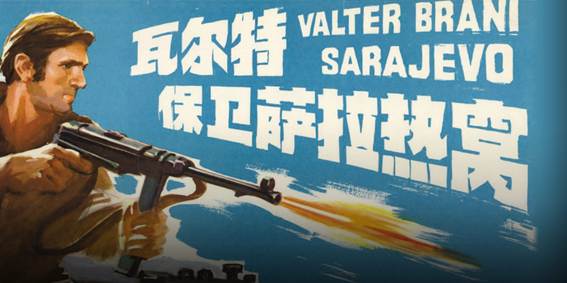
For the Chinese wargaming public, this subject has a particular interest as well because in the People’s Republic of China the Partisan epic (one of the ideological/propaganda foundations of Socialist Yugoslavia) was, and is, wildly popular so much so that the Chinese edition is called Walter’s War. “Walter’s War” refers to the 1972 Yugoslav film Walter Defends Sarajevo (Serb Croatian: Valter brani Sarajevo) based loosely on the military feats of Vladimir Peric, aka “Valter”, who defended Sarajevo during the German retreat from the southern Balkans in late 1944.

Walter’s War is one of the most famous examples of the “Partisan movies” subgenre, a series of films on the Partisan epic made in Yugoslavia between the 1960’s and the 1980’s. It was particularly popular in the Eastern bloc countries-on the year of its release, it was viewed by some 300 million people in the People’s Republic of China alone. Fifty years later, it is still something of a cult movie in China and other countries.

Chinese poster of Walter’s War.

Grant: What type of research did you do to get the details correct? What one must read source would you recommend?

Javier: Thankfully, over the last 20 years quite a few books have been written on the Yugoslav War. This interest in guerrilla warfare was partly due to the use of historical models to understand modern insurgencies such as Iraq in the GWOT years.

Another historical player that began to receive long overdue attention were the Yugoslav Royalists, or Chetniks, that until the early 21st century were almost forgotten or considered a footnote when compared with the Partisan epic of Tito and his guerrilla army. The military museum in Belgrade, Serbia reflects this perfectly. The first time I visited the military museum there were two floors, one dedicated to praise the feats of Tito and his partisan army, the other covering the rest, from Medieval times to the 1999 War against NATO. The second time I visited the museum, in the early years of the 21st century, I found out that the “Partisan” area was closed for reforms, and all Communist era exhibitions were being replaced with exhibitions dedicated to Col. Draza Mihailovic and his Chetniks.

Grant: What from World War II in Yugoslavia was most important to model?

Javier: Simulating what was de facto a three player game (Partisans, Chetniks, Axis and local Allies).

The third player – the Chetnik – presents a major problem. Basically, they didn’t fight the Axis- their policy was to wait for the Western Allies to arrive while preparing for the final showdown against the Communists. On the other hand, while the Partisans had a central command, the Chetniks were a loose coalition of local leaders that followed orders when it suit them to do so, and often reached temporary agreements with the occupying forces to fight the Communist Partisans. Tito had mobile troops which could operate everywhere and hit the enemy targets without concern about the inevitable and brutal enemy reprisals. In fact, the reprisals ended up being a source of recruits for his Partisan army. Mihailovic’s units, however, were strictly territorial, and he could not control them. Most of them (especially the Chetnik units in Bosnia) recognized him only as an honorary leader, but only followed their orders when, and if they matched with their own priorities. So, in practice, the Chetniks are not a “player” in the game, but they can be mobilized by the two players (Axis and Partisans) depending on a number of circumstances.

Grant: What is the scale of the game?

Javier: Turns are quarterly (three months per turn, covering from mid 1941 to late 1944). So to speak, each turn condenses several major operations and smaller actions.

Grant: What different unit types does each side have access to?

Javier: Being a guerrilla war in the Balkans, the standard unit is leg infantry, of course. There are a handful of motorized/armored and cavalry units, but almost all units are infantry. There are air support markers and a Special Forces unit or two.

Grant: What is the anatomy of the counters?

Javier: Units have two basic factors: conventional and guerrilla combat. Guerillas, of course, are better at guerrilla combat, regular units are better at conventional Combat. There are two Combat Tables, guerrilla and conventional-which that is used depends on leadership, initiative and terrain. A guerrilla force fighting in forest or mountain hexes for example has a better chance of using the Guerrilla Table. A conventional unit fighting in a railroad or clear hex has better chance of using the conventional table.

Grant: What is the general Sequence of Play? What type of experience did you want the Sequence of Play to invoke?

Javier: In general, the Guerrilla player has the initiative, while the Axis player has to react. The turn begins with the guerrilla phase were the Partisan player determines resources receives and recruits/upgrades units. This is followed by the objective placement phase, where players deploy a number of targets on map representing intelligence on possible targets provided by their network of spies and other intel sources. Then the Guerilla player moves and attacks targets, and/or enemy units. After that the Axis action phase begins. Upon receiving reinforcements, the Axis player may attack guerilla units. However, catching guerrillas can be difficult-they can easily avoid being forced to fight in particular in forest areas.

The Axis player begins the game with large forces (Germans, Croatians, Italians, Hungarians, Bulgarians) while the Partisan begins with a handful of odreds (detachments). However, as the play goes on, the Italians surrender and the Axis player is increasingly stretched thin. Besides, Bulgarians and Hungarians cannot move from their respective regions. The German and Croatian policies in Yugoslavia all but ensured that the population would join the Partisans.

Grant: What is the layout and area of Yugoslavia covered by the game map?

Javier: The map covers all of Yugoslavia and neighboring areas, from Slovenia to Macedonia and parts of Hungary, Albania and Bulgaria. The map contains all charts and tables needed to play.

Grant: What strategic pinch points does the terrain create?

Javier: Terrain is important, like in the systemic cousin Red Partisans (published by Paper Wars in 2025). Forest, mountains and swamps are the Partisan’s friend. Avoid flat terrain, and particularly railway hexes, that can be reinforced quickly. However, railroads are a major objective of the Partisans, so the Partisan player must strike a balance here.

Grant: What is your focus on Zones of Control in the game?

Javier: In general there are no Zones of Control. Zones of Control are exerted depending on the unit and terrain type. Regular units, for instance, do not exert ZOC on mountain or forest hexes for Partisan units.

Grant: What is the Guerrilla Political Phase? What does this represent from the history?

Javier: Basically, it represents the prestige of the Partisans among the local populace and abroad. If the guerilla player attacks at least one ground attack against an Axis ground unit, they roll for Tito’s Prestige. The higher the prestige, the more resources he can receive from the Western Allies. Tito’s prestige begins at box 1. When it reaches box 6, the Partisans can receive extra resources and the support of the Balkan Air Force (Allied bombers). When it reaches level 7, the Partisans can deploy and use a British Special Force unit, the 2nd SAS.

This simulates the increasing prestige of the Partisan guerrillas among the Western Allies, who initially opted to provide support to the Monarchist forces of Col. Mihailovic. After the reports by the Deakin mission came from Yugoslavia in 1943, and thanks also to ULTRA intercepts, Tito began to be regarded as the only effective guerrilla movement fighting the Germans, while Mihailovic did nothing, or, even worse, reached agreements with the enemy occupiers to fight the partisans.

Grant: What is the Allied Landing Scare roll? What does this represent?

Javier: Several of the major Axis anti-partisan drives in Yugoslavia (Operations Schwarz, Weiss…) were launched with the objective of clearing the coastal areas from hostile guerrillas and prepare the defense of the Balkans against an expected Allied landing. Beginning with 1943, there were several “landing scares” that had all sides (Partisans, Chetniks, Axis) scrambling to occupy the best coastal positions before the arrival of the Western Allies.

For instance, in January 1943, fearing Allied landings in the Balkans, the Axis launched Operation Weiss (White), the largest anti-partisan drive to date, involving 90,000 troops, aimed at destroying Tito’s stronghold at Bihac. Tito planned to move back to Serbia and Eastern Bosnia to destroy the Chetnik forces there before they could join forces with the Western Allies.

Grant: What is the purpose of the Weapons Cache markers? How are they concealed in combat?
How does combat work?

Javier: Weapon Cache markers represent weapons sent by the Western Allies along with arms captured to the enemy, used to improve Partisan detachments into Partisan brigades and divisions.

Grant: What is the makeup of the Combat Results Table? What unique odds are represented and why?

Javier: There are two Combat Tables, guerrilla and conventional-which one is used depends on leadership, initiative and terrain. A guerrilla force fighting in forest or mountain hexes for example has better chances of using the Guerrilla Table. A conventional unit fighting in a railroad or clear hex has better chances of using the conventional table.

Grant: How do Replacements and Withdrawals work?

Javier: The Guerilla player collects replacements-the more territories they control, the more replacements received. Control of towns greatly increases recruitment, but guerrilla units are much more vulnerable in urban terrain. Axis reprisals increased the number of recruits. They also receive “weapons caches” that can be used during the game. They represent clandestine weapon factories, and, as the game goes on and Tito gains popularity among the Western Allies, they represent weapons shipments from the West. Certain game results yield weapons caches as well. These can be used to upgrade partisan units into Brigades and Divisions.

The Axis reinforcements and replacements work differently-They receive a fixed number of replacements per turn, with the exception of “Allied landing scare” turns, when they received extra replacement with which to launch anti partisan drives and clear the coastal areas of Partisans.

Grant: How are Artillery, Air and Naval Support handled?

Javier: There are no artillery units in the game. It is modeled into the regular brigades and divisions. There are only two air support markers that add or decrease odds shifts in attack or defense.

The Partisan army, of course, had no air support units, although they can receive the support of the Allied “Balkan Air Force”. The Axis has only one marker -Yugoslavia was very low on the priority list of the Luftwaffe. Naval Support is handled by the “Partisan navy” counter that provides an odd shift in attack or defense in combats in coastal hexes. The Partisan navy counter enters play after the Italian surrender.

Grant: How do players win the game?

Javier: The Partisan player can add Victory Points by blocking railway lines from resource centers (there are five on map) to Germany. This represents the disruption of resource exploitation in the Balkans. Another way to score Victory Points is to destroy objectives such as fuel depots, train stations or bridges, or rescue downed Allied pilots, determined prior to the turn by the objective table. During the Victory check phase of each turn, the Partisan player rolls 1D6 for each objective marker under their control and adds the corresponding modifier for that objective. Destroying a Dam, for instance, adds +3 to the die roll. The final result is the number of VP’s scored for that objective. Control of towns and cities at the end of a turn gives extra VP’s to the Partisan player. (Control of towns and cities, even temporary, allow Partisans to recruit extra manpower and liquidate collaborationists).

Finally, “Landing scare” turns allows the Partisan player to earn VP’s for controlling port towns and cities, from Bar in Montenegro to Zara/Zadar in Croatia. This simulates the chaotic fight that followed the Italian armistice of September 1943. The Italians controlled large parts of former Yugoslavia, and their surrender ignited a race to arrive first to the huge caches of arms and supplies in the Italian zone, in a free for all between Partisans, Germans and Chetniks. Tito was furious at the Allies for not warning him of the upcoming Italian surrender. Some of the Italian forces joined the Partisans against their former Croat-German allies. This is included in the game as well.

The Axis player must try to deny VP’s to the Partisan player, and make him pay dearly for every VP gained: each guerrilla ground unit eliminated deducts 10 VP. The Axis can also kill Tito. If Tito is eliminated, the Partisan player loses 2 VP’s at the start of each subsequent turn, and their prestige is reduced to 1, so they receive no more extra resources from the Western Allies. The Axis player can try an assassination attempt with the 500 SS Parachute Battalion that historically tried to kill or capture Tito in May 1944, in operation “Knight’s Move”.  

Grant: What type of an experience does the game create?

Javier: The game creates a cat-and-mouse experience, quite similar to the history, where the Axis launched constant anti-partisan drives but Tito and his Partisan army always escaped to fight another day, despite of suffering huge casualties. By the mid to late game, after the Italian surrender, the Partisans are too powerful and the Axis player lacks enough resources to launch mass offensives, thus remaining mostly on the defensive. It is now time for the Partisans to gain as much terrain as possible before the arrival of the Soviet forces in the Fall of 1944.

Grant: What are you most pleased about with the design?

Javier: I think that the game gives a fair idea of what happened in Yugoslavia in 1941-44. It was an extremely complex situation, with many different national and political loyalties at play. The Axis conduct of the Balkan counterinsurgency was a case study of how not to wage a guerrilla war. Their policies, and in particular that of the Croat state, created the perfect conditions for the Communist movement to thrive and take over: they destroyed the existing authority, set the different nationalities against each other, but lacked sufficient strength and brute force to impose a different system. The final result was anarchy and an ideal situation for the triumph of a revolutionary war, which Tito exploited to the fullest.

Grant: What has been the response of playtesters?

Javier: As far as I know, many players really enjoy the Partisan hidden movement rules in Partizan! and found the cat-and-mouse game play quite engaging. They appreciate the combination of simple rules, short playtime, and asymmetrical game play, with a full game often completed in just one day. The scoring mechanism, which rewards destroying objectives, forces Partisan players to carefully consider their strategy—whether to focus on scoring points or increasing their forces. Axis players get a true feeling of frustration of counterinsurgency operations.

Facing an Axis player with a good memory can sometimes be challenging for the Partisan side. Partisans can counter this by swapping the positions of units within the same hex. Overall, the game offers a simple yet enjoyable take on Partisan warfare. Although some players find it a bit troublesome to place markers every turn, the Chinese edition includes tables and numbered markers to help the setup. Most players find the experience enjoyable.

Grant: What other designs are you working on?

Burmese tribal irregulars in Burma ’45 (World at War #109)
“Black Brigades”. Fascist counterguerrilla forces in Forgotten Front: Italy 1944-45 (S&T 359)

Javier: Strategy & Tactics just published Pensacola 1779-82, and soon will be publishing Forgotten Front: Italy 1944-45. Curiously enough, in these games are featured both irregular and conventional forces. In Forgotten Front, for instance, guerrilla and counter guerilla operations play a key role as the ORBAT includes not only regular Axis and Allied divisions and brigades, but also Italian partisans and Fascist Italian counter guerrilla forces, such as the infamous Black Brigades. Pensacola 1779-82 includes irregulars, militias and Indian levies that are highly useful for recon, foraging and to harass enemy regular forces.

World at War will publish my design on the 1945 Burma campaign, where (again) guerrillas played a decisive but little known role.

I am currently working on a number of designs for Decision Games, Paper Wars and Banzai Magazine. I am currently working on the playtest and development of Aragón ’38 for SNAFU Design and Battle for the Mediterranean for VUCA. You can see here some spectacular previews of Battle for the Mediterranean by Pablo Bazerque here.

A look at the board for the upcoming Battle for the Mediterranean from VUCA Simulations.

As always, thanks for your time Javier in answering our questions as I know you are a busy man and always have lots of interesting gaming subjects on your design table.

-Grant

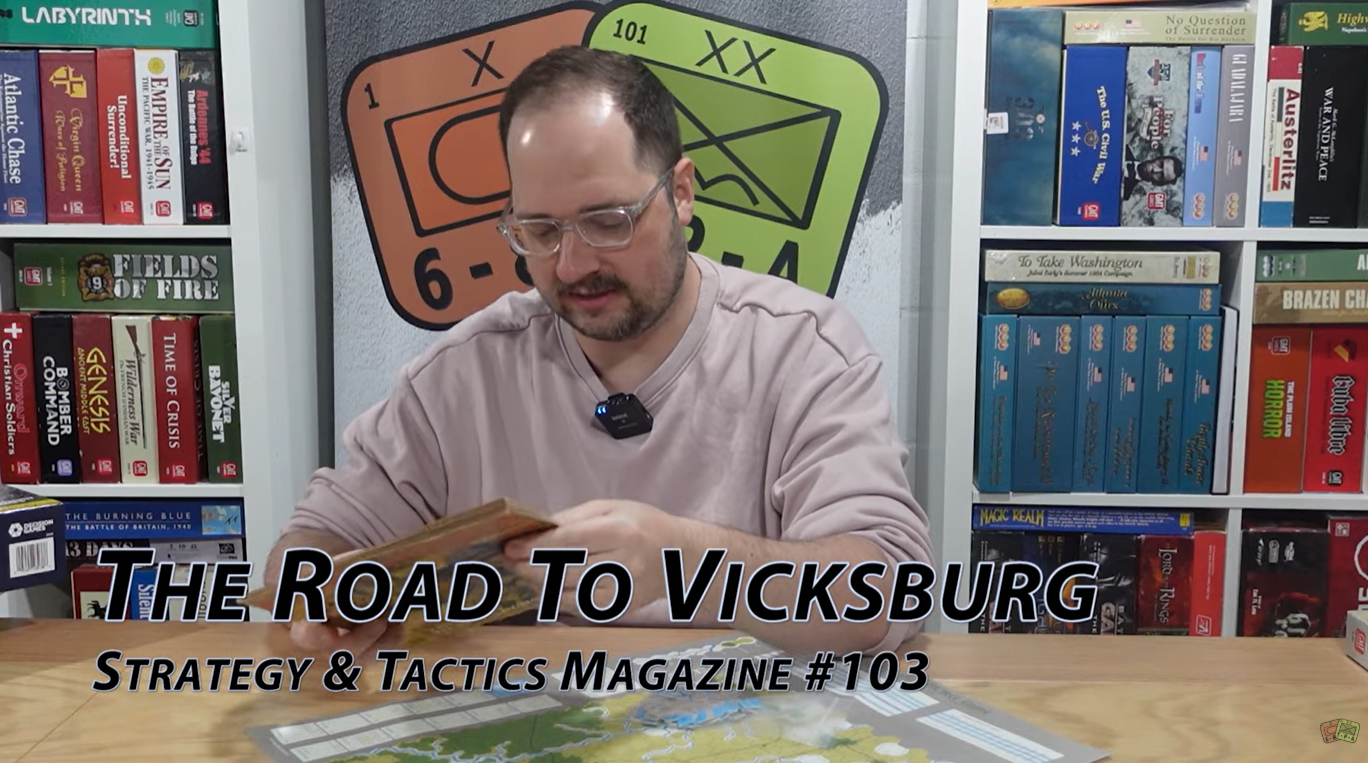
Video Review: The Road to Vicksburg from Strategy & Tactics Magazine #103 from Strategy & Tactics Press

Von: Grant
12. April 2026 um 14:00

The Battle of Champion Hill game is called The Road to Vicksburg and uses the Blue & Gray System. It was included in Strategy & Tactics Magazine Issue #103.

The May 16, 1863 Battle of Champion Hill was the largest, bloodiest, and most significant action of Grant’s Vicksburg Campaign. 32,000 advancing Union soldiers met 23,000 Confederates in a fierce struggle for a vital crossroads roughly halfway between Vicksburg and Jackson, Mississippi. The field was dominated by bald Champion Hill, from which Confederate artillery opened fire on the Union army at 9:45 A.M. The first Federal assault on the hill drove the Southerners back with bayonets and clubbed muskets. As the Union soldiers tried to reform and consolidate their gains, they were swept away by a counterattack led by John Bowen’s Missourians and Arkansans. Ulysses S. Grant ordered more men towards the hill and Bowen’s Confederates were themselves driven off, compelling a general retreat. Southern Brig. Gen. Lloyd Tilghman was killed while directing a desperate rearguard action that enabled most of the Confederate army to escape towards Vicksburg. The decisive Union victory at Champion Hill was instrumental in forcing the Confederates out of the open field and into a doomed position inside the walls of Vicksburg.

-Grant

326 Brettspielradio – Redebedarf der mit dem Weihnachtswunsch

14. Dezember 2025 um 10:40
RedebedarfShownotes Redebedarf. Das Podcastformat ohne Format. Manchmal gibt es einfach Anlässe, Erfahrungen und Beobachtungen zur Spielszene die nur in einem kurzen Podcast untergebracht werden können. Das tun Georgios Panagiotidis und Peer Sylvester mit Redebedarf.
❌