❌

Lese-Ansicht

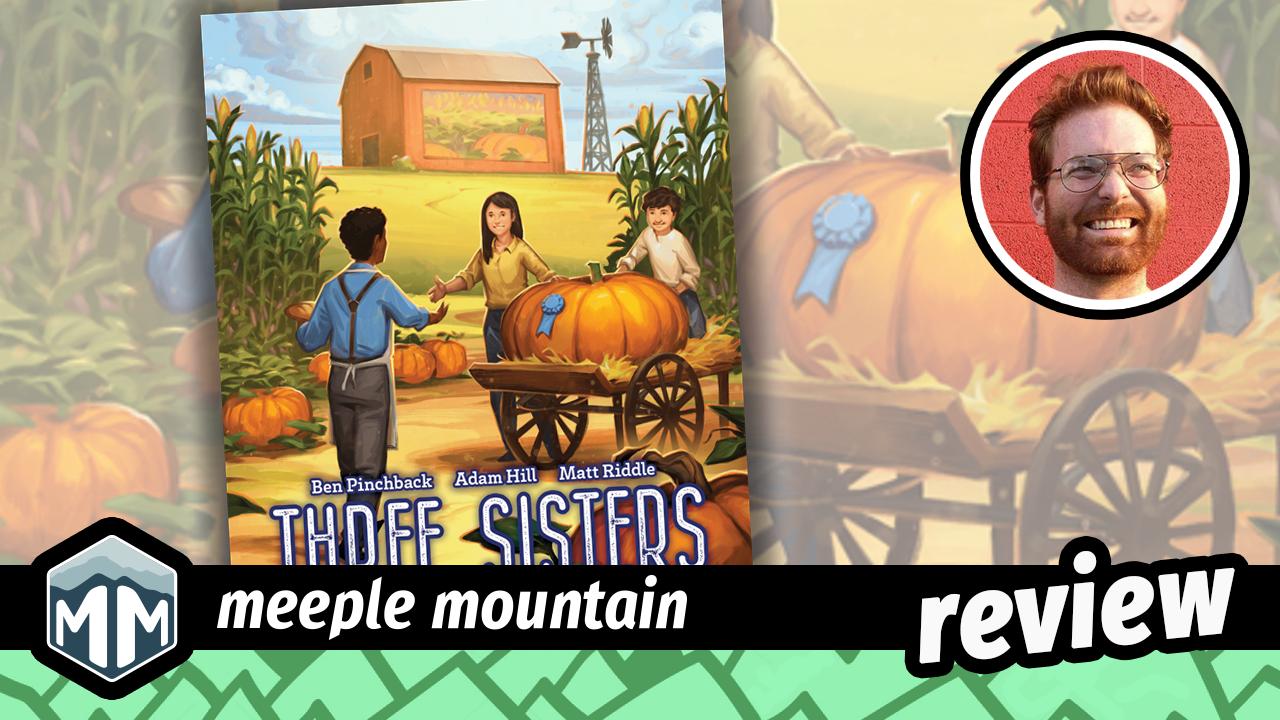
Three Sisters Harvest Edition Review

I love farming games. I grew up working on farms, and there is a special kind of bucolic pleasure that comes from tilling the earth without actually having to till the earth. Farming and gardening are actually very difficult, and as my graveyard of houseplants can attest, it’s best if this aspect of my life is kept in the realm of fantasy.

Three Sisters: Harvest Edition is a re-release of the roll-and-write game Three Sisters, where you manage a little farm and grow various vegetables and fruits. It’s charming and well-executed, though it is still essentially a game where you check things off on a pad of paper, so if that’s not your jam, it’s not going to blow your hair back.

Checkboxes: this time, with plants

Three Sisters comes out the gate strong. This isn’t a roll-and-write for the weak-wristed. There are two notepads for you to scribble on. One features a large garden area with a whole bunch of boxes, while the other has your orchard/shed area, which houses upgrades and special powerups (AKA berries and trees).

Each round, all of the dice are rolled and placed in same-numbered groups, starting from a wooden pawn and going around the spaces of a circular track that I won’t call a rondel because it’s just a circular track…

The post Three Sisters Harvest Edition Review appeared first on Meeple Mountain.
  •  

Garden Club Game Review

As activities go, I love the direction Chris Couch Games is taking with its initial batch of releases. The production looks exceptional and the bright, vivid colors of nearly every game I picked up from this publisher at Gen Con has the shelf appeal a game needs to stand out.

Garden Club (2026, designed by Kristen Mott and Andrew Stiles) is much better as a production than a game. Solid player boards that serve as a handsome storage area and turn tracker for each round. A rulebook that feels luxurious in the hands, from the linen finish to the easy read and the helpful game summary on the back cover. Carve-outs in the box for certain tokens and cards, and a decent amount of mini expansion content for players who want to dive deep.

As a game, Garden Club came back to Earth for my solo plays and my two-player game with my nine-year-old. Players plant and harvest on their turns, placing flower tiles on one of the 16 spaces of a shared centralized board, while making patterns that can be scored on project cards or manipulated using tool cards.

All of it feels very “Sunday afternoon.” By that, I mean that you should play Garden Club with a…

The post Garden Club Game Review appeared first on Meeple Mountain.

  •  

Hacienda Game Review

I don’t want to belabor the point here, but I have real questions, like this: does the new game Hacienda (based on the 2004 version of Hacienda by Wolfgang Kramer) want the leopard-looking creatures on offer here to be pumas, or jaguars?

I ask because the rulebook interchangeably uses the terms for both (they are pumas on the manual’s cover description, but jaguars on page four), and technology tells me that the two breeds of cool-looking cats are definitely different. Another theme note: Hacienda’s new theme is tied to building an eco-friendly tourist destination in the hills of Argentina. For the life of me, though, Hacienda feels like a game where I am simply placing clumps of animal tokens on a map to score adjacency bonuses and piles of cute-looking capybara packs.

Hacienda isn’t nearly as complicated as I’m making it out to be. In fact, like other Kramer games—the German legend has, as a lead or co-designer, gifted the world with titles ranging from El Grande to Tikal to Wandering Towers to my all-time favorite Kramer co-design, The Princes of Florence—Hacienda is extraordinarily simple to teach, and his work here with Daryl Andrews (Sagrada) is sleek, with a playtime that might last 30 minutes or less with lower player counts, 45 minutes with the…

The post Hacienda Game Review appeared first on Meeple Mountain.

  •  
❌