Normale Ansicht

Fentasy Games looks to help complex game publishers avoid ‘strangulation’ of trad distribution with P500-style platform launch

07. April 2026 um 13:26

French board game publisher Fentasy Games has launched a new platform aimed at providing publishers with a more affordable way to get their higher complexity titles into the hands of retailers and gamers.

Company founder and CEO Florian Gigot told BoardGameWire Fentasy had scored several successes since launching towards the end of 2024, including localisations of complex titles El Burro and Stephens – but said its major challenge in that time had been “the structural reality of the traditional distribution model”.

He said, “We realised that for a small publisher, a ‘critical success’ doesn’t always translate to a ‘financial success’ once the middlemen take their cut. The same applies to many of my partners around the world.

“…between squeezed margins, production costs, and trade discounts, even a popular game can become a financial failure. For an independent publisher, this means increasing difficulty in funding subsequent projects – and ultimately, a real risk of going out of business.

“In this context, profitability is no longer a secondary objective, but a condition for survival.”

He added, “This might seem counterintuitive, especially at a time when a game like [Brass: Pittsburgh] is thriving on Gamefound. But that is the exception. So many other expert ‘hidden gems’ deserve a chance to exist.”

Gigot hopes newly launched platform BoardGameCommerce will give publishers of higher complexity games with smaller print runs – of between 500 and 1,000 units – a more sustainable financial option than the traditional board game industry distribution model.

Fentasy Games founder and CEO Florian Gigot

He described BGC as an ‘evolution’ of the P500 scheme successfully employed by wargame and strategy game specialist GMT for more than 20 years, which allows gamers to pre-order still-in-development titles, which then begin final art and development once they reach 500 orders.

Gigot said BGC differs, however, in that Fentasy commits to producing the game the moment it goes onto the platform, saying, “We don’t ask the community to carry the industrial risk – we carry it ourselves because we believe in the project.”

He said that model helps Fentasy and other publishers measure real demand for their titles, as well as giving visibility to game makers that might not be possible amid the plethora of new games battling it out through traditional distribution.

Gigot added that BGC also offers retailers “a professional interface to secure limited stock with high margins of up to 55%”, with no payment required until the game is ready to ship.

He told BoardGameWire, “I absolutely see this growing. In fact, BGC is designed to be an agnostic platform. We are already in talks with other small publishers who face the same ‘strangulation’ within traditional distribution.

“We want to offer them the same resilience we built for ourselves – bringing everyone together on a single, global platform. It makes it much easier for gamers and retailers to find exactly what they are looking for in one place.

“The icing on the cake is that all publishers using the BGC platform have access to a shared licensing ecosystem. For example, if Publisher A adds a game to BGC and is looking for a partner to localise it, Publisher B can check the available licenses for their country and initiate a business discussion immediately.

“BGC takes 0% commission on these deals – the goal is simply to be stronger together.”

Gigot said Fentasy aims to release between three and five titles each year, with about half going through BGC and half, such as its localisation of Animal Rescue Team and upcoming strategy title Microlonies, through traditional distribution.

The BoardGameCommerce platform

The publisher’s first release through BGC is Iron Games’ Mesopotamia-themed territory builder Papyria, with future titles set to arrive on the platform before the end of next year including Martin Wallace space exploration design Casus Belli and Masaki Suga’s chocolate industry strategy title Bean to Bar.

Other Iron Games releases available through BGC include Discordia and its Magna expansion, Pandoria and Ploc, while Fentasy’s French localisation of Uwe Rosenberg design Kanal – previously Oranienburger Kanal – is also present on the platform.

But Gigot added, “Titles like Animal Rescue Team and Microlonies will still follow the traditional distribution model. We aren’t abandoning big distribution – we are simply choosing the right tool for the right game.

“There is no ‘hostility’ toward the traditional model – it just isn’t built to sustain niche titles effectively.”

Gigot said Fentasy’s biggest successes since its late 2024 launch have included Kikai – Bricolage Heads, which he said moved more than 4,000 copies “in a short window for a game of its complexity”.

He added that 2026 release Microlonies “is following the same successful path. It proved that a hungry audience exists for deep, high-production-value games”.

Fentasy’s success to date has persuaded Gigot – who runs the company as “a small, agile core team of one person” – to expand its scope internationally, with him telling BoardGameWire the business is moving towards a 60% international / 40% France split.

He said, “We are always looking for new partners to localize our games in their countries and to localise their games into French.

“Our goal for 2027 is to achieve a synchronized BGC launch for our expert line across Europe (Germany, Poland, Italy, Spain) and Canada, China, allowing local publishers / retailers to bypass the heavy costs of international imports.”

The post Fentasy Games looks to help complex game publishers avoid ‘strangulation’ of trad distribution with P500-style platform launch first appeared on .


Business Bazongas

07. April 2026 um 00:56

bring on the Puritans, I say

I like weird games (derogatory) almost as much as I like weird games (complimentary).

Belinda’s Big Bonus is a weird game (weird).

Having your game designed by Amabel Holland sets certain expectations, despite any difficulties in pinning her down to a single genre or register. Similarly, basing a game on an erotic novel series, in this case Belinda Blinked by Rocky Flintstone, also sets certain expectations. Yet Belinda’s Big Bonus isn’t especially erotic. I wouldn’t call it funny, either, although it’s possible I’m just not in on the joke. Neither does it strike me as “so bad it’s good.” Mostly, it’s twice as complicated as one would expect from a licensed game. It reminds me of nothing so much as one of those business guys whose entire life is conducted through Google Calendar invites.

Trekking the World, Third Edition

There is travel, but this is not a travel game.

First of all, we should open with a disclaimer. I know very little about Belinda Blinked. I considered reading the first one as research for this review — “research,” I say — but decided against it. Sometimes knowing less is knowing more. That’s our motto here in the United States. It’s written on our dollars and everything. While scant few people are going to play this thing sans foreknowledge, I happen to be one of them, and if there’s any one quality a critic requires, it’s the resolute belief that one’s experiences are valid no matter how uninformed. Here I stand.

Which is to say, perhaps Belinda Blinked is about managing one’s schedule, suffering from jet-lag, and mixing up which actions cost which payment. Maybe. In which case, may I offer my deepest apologies to Holland, Flintstone, and Belinda herself. Forgive this prude, for he knows not what he do.

At the game’s outset, players step into the not-yet-broken-in business shoes of interns at Steele’s Pots and Pans. Their task is to earn some millions of pounds for the company. They do this by…

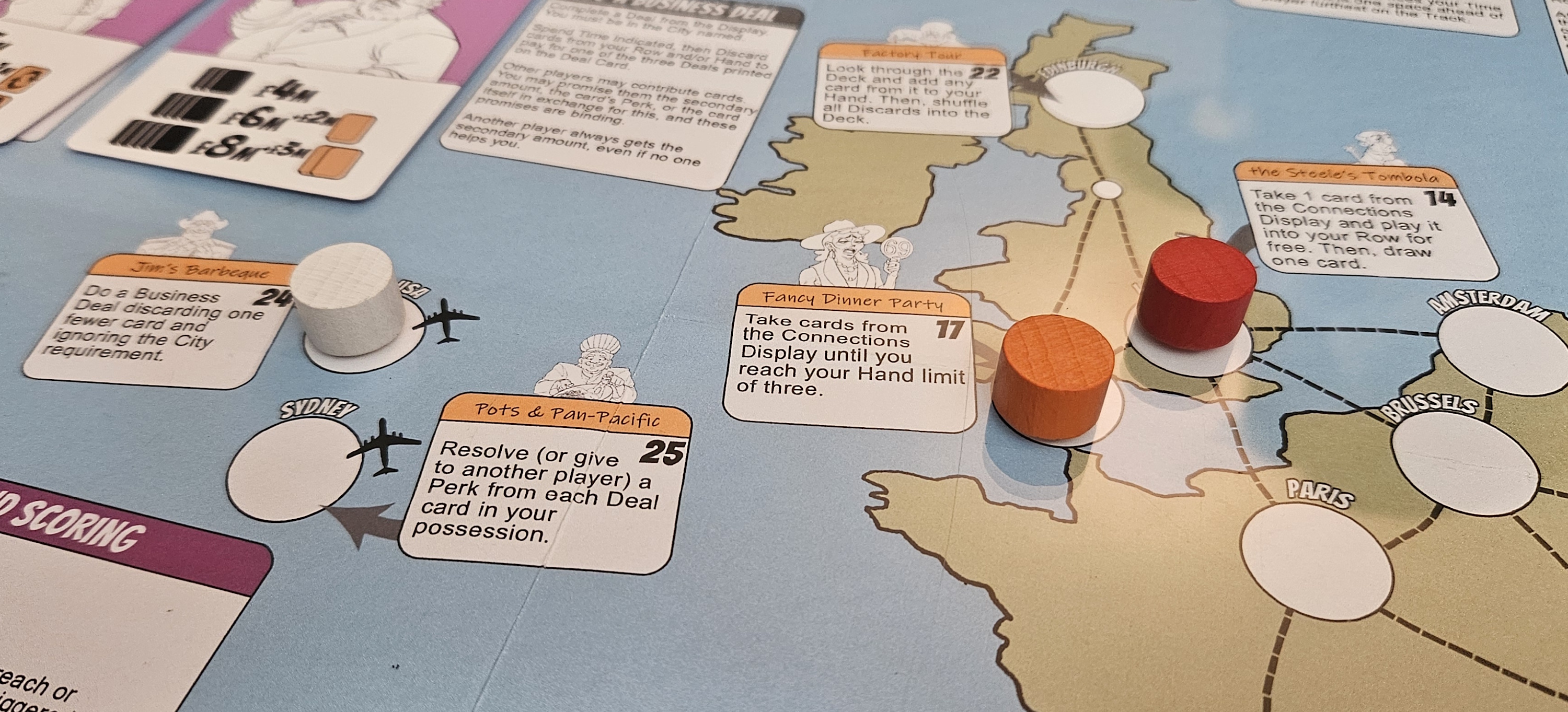
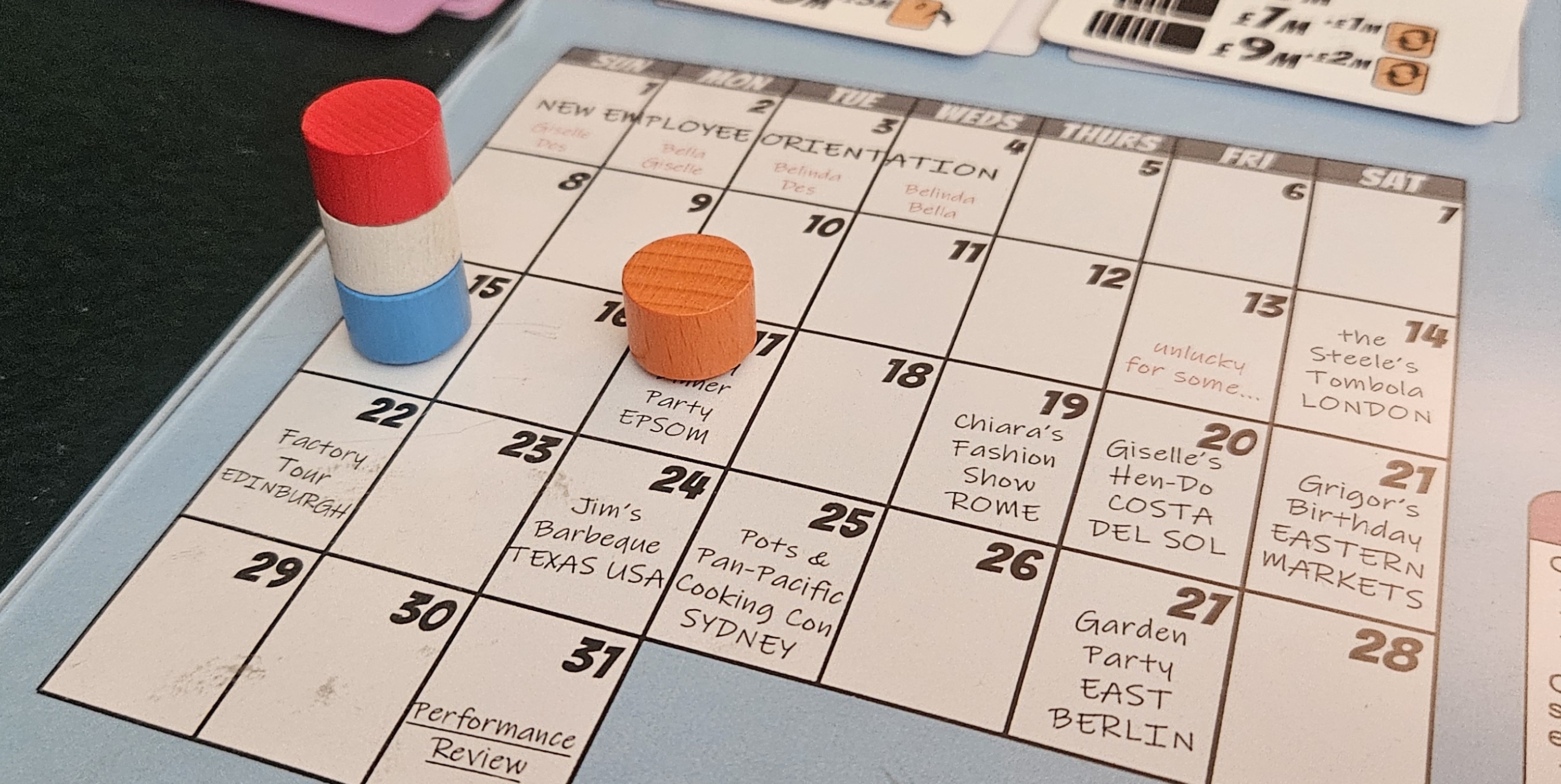
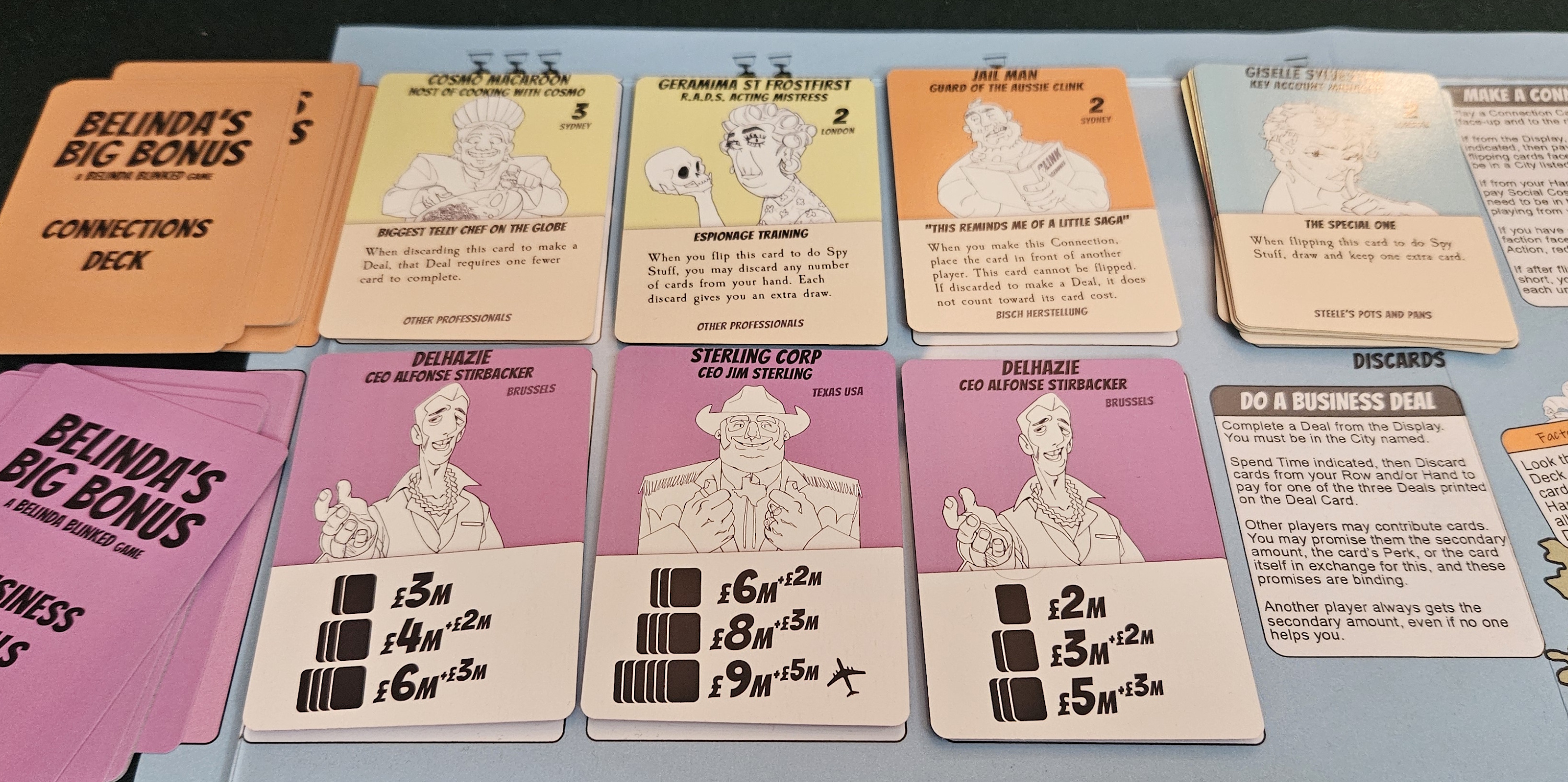
Look, this is the first problem with Belinda’s Big Bonus, and it’s a doozy. As any gaming evangelical knows, it’s hard enough describing a board game to newcomers, and Belinda’s Big Bonus is no board game for newcomers. There are mechanisms aplenty in this trunk, packed together like someone mixed the first-aid kit with the snack bag. There’s a calendar timekeeping system, the kind popularized by Martin Wallace titles, and cards that may exist either in a market, your hand, or a tableau, with interactions dependent on their current source — except sometimes they can be spent from two of those places, and the rulebook is conversational and, although it’s amusing, this doesn’t lend itself to learning the damn thing.

In a dim room somewhere, Martin Wallace nods thoughtfully. He saw this coming. He wanted this to come. Even now, he is thinking about the double entendre of "wanting this to come."

Scheduling, but this is not a scheduling game.

Here’s the short version. Turns are variable, conducted by whomever is farthest back on the calendar. On those turns, you spend some amount of time to make connections — which is to say, put cards into your tableau from either the market or your hand — do spy stuff — gain cards into your hand, from the deck this time — rest to refresh the cards in your tableau, make a business deal by throwing away the cards you painstakingly contacted or spied upon — and, in the process, try to persuade your fellow players to spend some of their cards instead, because these business deals are often collaborative and dole out benefits to multiple players — or perhaps visit a calendar event on the appointed date to gain some advantage.

If that sounds confusing, try teaching it. I’m no stranger to Holland’s more tangled designs, but this one found the most uncomfortable spot on the seesaw between complexity and anticipation: the fulcrum. Belinda’s Big Bonus feels like it should be a light game, looks like a light game, has that licensed light-game air to it, and then, kapow, but a kapow more like a punch to the schnoz than something erotic, it smacks you with a clutter of ideas.

For all that, there is an interesting game in here. The gist is that you need to build out your tableau and hand in order to spend those same cards to make business deals. Along the way, your characters provide something like an engine.

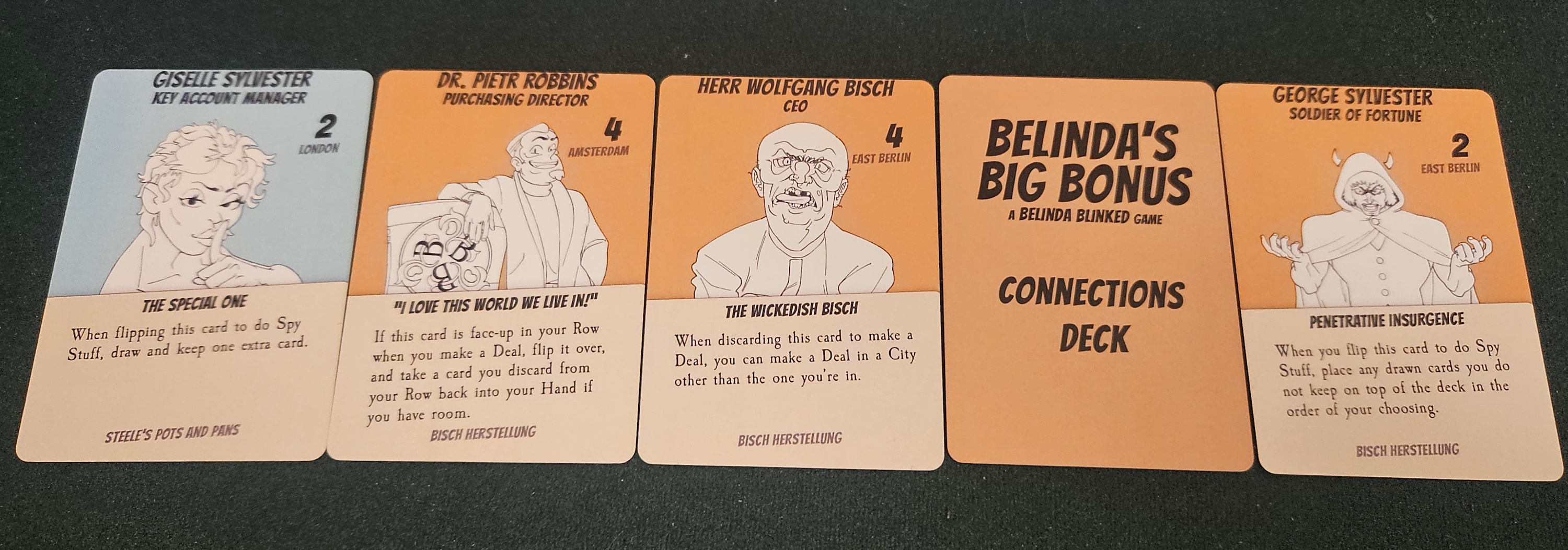
There’s even a narrative to the whole thing. Sir James Godwin makes it easier to attract Bella Ridley to your work group. Meanwhile, James Spooner, the Laird of Gretna Green, brings Cosmo Macaroon into the fold through some act of espionage. Later, your connections to Bella and Cosmo will help you make a deal in Texas, USA for nine million pounds sterling. Unfortunately, that same deal enriches a rival intern by five million pounds, so you try to squeeze some contribution from so-and-so at the table rather than merely handing the commission to whichever competitor is sitting in last place.

I'm friends with ole snarltooth, as you can see

Odd people, but this is not an odd people game… well, scratch that. It’s an odd people game.

Those are genuine dramatic and narrative beats! Along the way, though, Belinda’s Big Bonus is burdened by bloated bits. It’s easy to paint oneself into a corner, for instance, by spending too many cards on an eager deal. This can leave one player sitting around with very little to do but play catch-up. And, hey, that’s their fault, right? If we were playing one of Holland’s cube-rail games, such a possibility would act as evidence of the game’s forthrightness. But here, the possibility comes across less like an honest appraisal of the perils of betting everything on some bad stock tips, and more like an unexpected heel-turn on the game’s part.

Here’s another example. Belinda’s Big Bonus includes the possibility of a traitor moment. When the game concludes, the player in last place might reveal that they now hold the majority of connections to Steele’s rival firm, Bisch Herstellung. This turns them into “the special one” and wins the game in a sudden coup. Cool!

Except, like everything else in Belinda’s Big Bonus, the rules governing the reveal are so text-heavy that it doesn’t feel like an amusing capstone. It’s closer to checking a technical manual to see if you’ve successfully told a joke. It isn’t hard, exactly. Nothing in the game is hard. But it’s less fluid than it ought to be, keeping everybody’s attention on these mismatched processes rather than on the parade of characters and situations strutting across the table.

(derogatory)

Buncha great hangs.

Then again, maybe I’m not in on the joke. Maybe a Belinda Blinked game should be more complicated than most licensed titles. Maybe it should buck common sense by being an erotic game with no eroticism, a business game with no head for business, a whimsy with lots of rules printed on the board. Maybe it should be a big meta-joke at my expense. Maybe this game doesn’t exist for anyone but me, and it was sent to me solely so that everybody could point and laugh and say, ha ha, you took our prank earnestly, you big stupid fool, you moron, you lame-o.

That would be okay. I don’t mind. In the game’s cast of characters, I feel most like the guy anxiously cleaning a stain from his tie. I don’t need to get everything. Sometimes, I even revel in how little I understand. For example, I’ve had a lovely time not understanding Belinda’s Big Bonus. Maybe you’ll have a lovely time not understanding it as well. Just don’t say I didn’t warn you.


A complimentary copy of Belinda’s Big Bonus was provided by the publisher.

(If what I’m doing at Space-Biff! is valuable to you in some way, please consider dropping by my Patreon campaign or Ko-fi. Right now, supporters can read about which films I watched in 2025, including some brief thoughts on each. That’s 44 movies! That’s a lot, unless you see, like, 45 or more movies in a year!)

❌