
Normale Ansicht

Kilauea Game Review

The publisher Combo Games—the same publisher that gave us 2024’s underrated sushi-smuggling tableau builder Neko Syndicate, designed by Dani Garcia—is officially on my radar. Although I thought their light puzzler Keyframes was a miss, it was a miss designed by two of my favorite designers, the folks known as Llama Dice (The White Castle, The Red Cathedral, Flatiron).

That means Combo is working with the right people. So, I took a flyer on their new abstract game Kilauea, designed by David Bernal and Ferran Renalias. Bernal is the man behind 2024’s Salton Sea, a Devir game that had my single favorite mechanic in a game that year. Renalias is a co-designer of games I’m intrigued by, including The Battle of Versailles and Lacrimosa.

So, designers? Check. The game in the box is gorgeous, too, with beautiful, chunky tiki pieces in four different colors and a rondel with a cute little canoe token. Before my second play, I set up Kilauea on my dining room table, and my wife and two kids both called out their adoration for the look of it on the table. “I don’t know what’s going on there, but that looks fun!” said my wife.

Kilauea has a lot going for it. As a game, however, it…

The post Kilauea Game Review appeared first on Meeple Mountain.
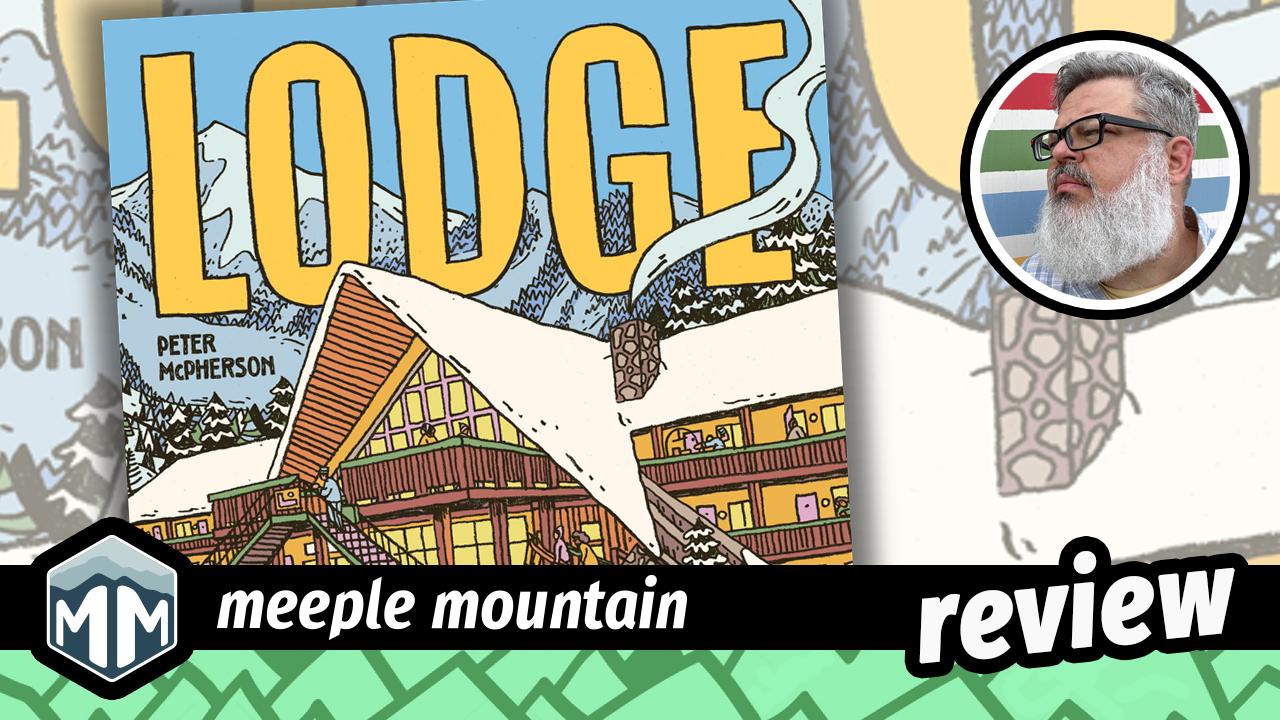
Lodge Game Review

I was first introduced to the design sensibilities of Pete McPherson after playing Tiny Towns, a pattern-matching game about building structures for woodland creatures. Because I enjoyed Tiny Towns so much I also reviewed his game Wormholes (a route building and resource collection game set in outer space), and Fit to Print (a realtime tile laying game in which you’re building the front page of a small town newspaper). We’ve also interviewed Pete twice (Feb 2019 and Jan 2022).

So when Pickpocket Games told me about an upcoming Pete McPherson title called Lodge, I reached out and requested a review copy without any knowledge of the game other than the cover (which is gorgeous). And now that I’ve played it several times, I realize that it fits right into Pete’s catalog like it was born there.

Take a walk in the snow with me to the front door of Lodge.

“With luck, it might even snow for us.”

In Lodge, players run competing ski lodges, set high in the mountains. Over the course of the game, players add rooms and amenities to their lodges, then entice guests to stay in those rooms. Ah, but the guests are picky, and as guests do, have their…

The post Lodge Game Review appeared first on Meeple Mountain.

Ichor Game Review

I went on a bit of a journey as I considered the place of Ichor in designer Reiner Knizia’s oeuvre. My first thought, the one that came to me instinctively, was “Knizia doing an abstract game? Interesting.” My operating definition of an abstract game is relatively narrow. Rather than considering any game that does not have an explicitly implied—I’m not sure “explicitly implied” is possible, but I’ve said it, so here we are—story or setting “abstract,” I only refer to games in the wide family of things like chess, mancala, or Santorini as “abstract.” For my personal heuristic, there seems to have to be determinism, movement of pieces, and some heavy spatial reasoning.

My second thought was, “What a stupid thought. If anything, it’s surprising he hasn’t done more of them.” Knizia’s games are nearly always abstract, or at least abstracted. We could get lost in the weeds of “All board games are abstracted,” but I’m not interested. Application denied. Some games strive for a relatively representational approach to their setting. Terraforming Mars has you accrue resources to develop technology and build settlements on Mars. Other games don’t. Lost Cities is about playing cards in increasing order. It is also somehow about archaeological expeditions.

A red cloth board, divided into a 6 x…</p>
<p>The post <a href=Ichor Game Review appeared first on Meeple Mountain.

Iliad Game Review

Boy, what a game.

You’d think straightforward tile-layers would be tapped out by now, after thirty or forty years of design, but then you sit down and play something like Iliad, which feels as fresh as the day Carcassonne was born. It manages to be fresh and exciting while comfortable and familiar. That’s a hard combination to pull off.

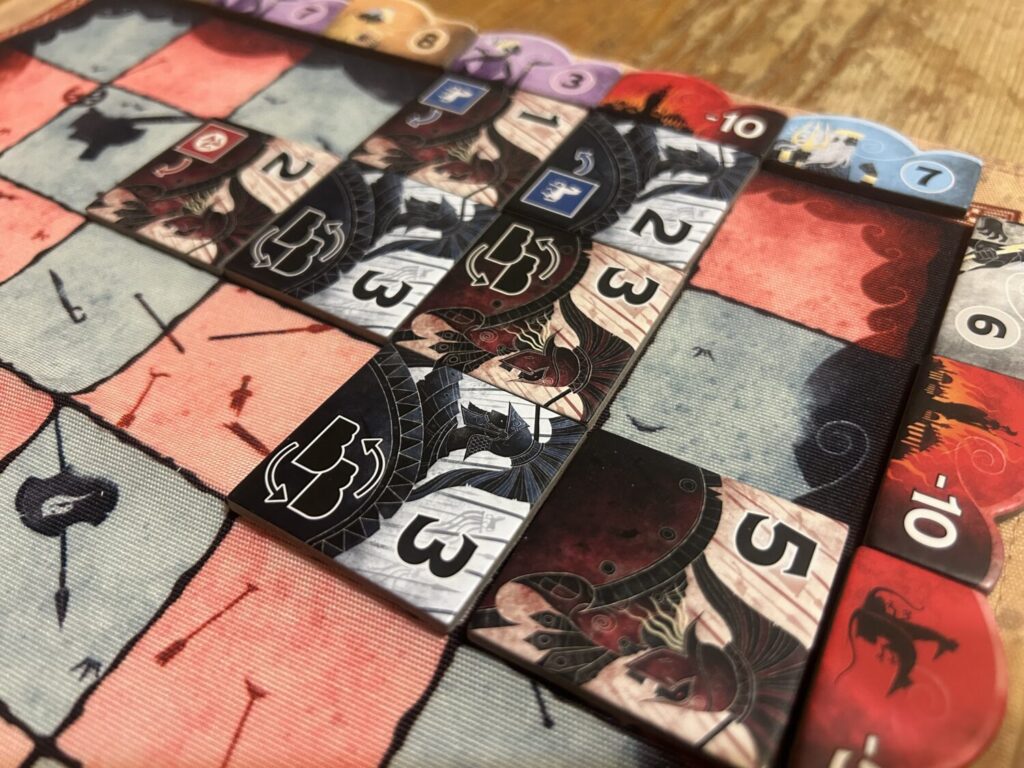
Each player starts with an identical deck of tiles, which vary in value from [input needed] to 5. You take turns choosing a tile from your hand of two and placing it on any contiguous space in your color on the 5 x 5 checkerboard playmat. Whenever a row or column is filled up, the values of each player’s tiles are added together, and the winner chooses from one of the two bonus tiles that sit on either edge of the relevant region. The other player takes whatever is left. The game ends the moment both players have played all of their tiles.

A selection of square titles in red and blue on a cloth mat. Each tile includes an illustration of a Bronze-age soldier and a number.

That, believe it or not, is that, as far as the broad strokes are concerned. With just a little more information, you’re ready…

The post Iliad Game Review appeared first on Meeple Mountain.
❌