Normale Ansicht

Interview with José Manuel Neva Designer of Peking: 55 Days of Fury from Neva Game Press

Von: Grant
23. März 2026 um 13:00

Neva Game Press (originally called Neva Wargames) is a new publisher who appeared on the scene in the past few years. When I started seeing their posts on Twitter and Facebook, I was immediately impressed with their interesting topic choices for their upcoming games as well as the fact that they are trying to make small footprint wargames that pack a punch. And the art is also very appealing and brings an aesthetically pleasing and attractive look to their games! Recently, they placed their next few games up for pre-order through their Incoming! Pre-Order System including Peking: 55 Days of Fury and I reached out to the owner of the company and design José to see if he could share some information about the design.

If you are interested in Peking: 55 Days of Fury, you can pre-order through the Incoming! Pre-Order System on the Neva Game Press website at the following link: https://nevagamepress.com/product/peking-55-days-of-fury/

Grant: José welcome back to our blog. What is your new upcoming game Peking: 55 Days of Fury about?

José: Thanks, Grant, it’s a pleasure to be here! I’d like to start by mentioning that we’ve recently rebranded from Neva Wargames to Neva Game Press. This change reflects our evolving catalog, as we’re excited to include more thematic games moving forward.

Today, I’m presenting one of my latest designs: Peking: 55 Days of Fury. It’s a 1-2 player game where one side commands the Chinese forces and the other leads the International Legations (an alliance of 8 nations). The game spans 6 turns—representing roughly 9 days each—where players fight to secure the most victory points by the end of the siege.

A full game typically lasts between 2 and 2 1/2 hours, making it perfect for a single session. Please keep in mind that we are still finalizing the artwork and graphic design, so the images shown here are not final.
Also, our second pre-order campaign, featuring both Reformation: Fire and Faith and Peking: 55 Days of Fury launched on March 15th. Don’t miss out on the Early Bird discount!

Grant: What does the subtitle “55 Days of Fury” mean and reference?

José: I imagine many of you have seen the classic film 55 Days at Peking—if not, I highly recommend it! It’s a fantastic movie and a core inspiration for this project. With the subtitle “55 Days of Fury”, I wanted to pay tribute to the original title while carving out its own identity. It reflects the sheer intensity of those 55 days of siege, and I wanted the name to capture that raw energy.

Grant: Why was this a subject you wanted to focus on?

José: I’ve always been fascinated by sieges throughout history, from ancient times to the modern era. Because of this, it’s very likely you’ll see more siege-themed titles from me in the future. I already have several compelling projects in mind, such as the 1453 Siege of Constantinople or the Siege of the Alcázar during the Spanish Civil War. There is so much tactical and human drama in a siege that I’m eager to explore the subject and see how to model the differences in each of the sieges and eras represented.

Grant: What are the unique features with the system used for the game?

José: Sieges are often associated with static gameplay—that’s just the nature of the conflict. However, I wanted to design a system that keeps the action fluid and engaging. To achieve this, the entire besieged area is streamlined into four main zones, allowing for a more dynamic experience.

Each side faces unique strategies and challenges, and that asymmetric touch gives the game immense replayability. At its heart, the cards are the engine of the game. It’s important to note how much depth they offer; your success depends entirely on how you plan and optimize your strategy based on card management.
I’ve also implemented a unique twist on Fog of War. Instead of these being ‘dead’ or useless cards, you’ll have to make tough tactical decisions about how to use the Fog of War cards you draw at the end of each turn. They could be a resource, not a penalty.

Grant: What must you model regarding the history in the design?

José: There is a wealth of historical detail in this design. From the unit stats to the card events and specialized mechanics, my goal was to represent the siege as authentically as possible without sacrificing a manageable playtime.

For example, the Boxer units have much lower Firepower than other factions, but they boast the highest Manpower values. This reflects their limited weaponry while highlighting their superior numbers—they have the strength to build and repair barricades quickly. In contrast, the Imperial Chinese Army units have better Firepower but generally lower Manpower.

On the other side, the International units are better armed but severely outnumbered. To represent this attrition, when a Chinese unit is defeated, it returns to the unit pool to potentially reappear later. However, injured International units are sent to the Infirmary instead.

The Infirmary is a critical mechanic; it honors the men and women who worked tirelessly to save lives during the siege. The International player must manage this correctly, or risk losing their limited forces for good.
Finally, I’ve included Diplomatic Relationships. Based on historical accounts, the International player will face diplomatic tensions between the allied nations. These tensions carry various penalties, forcing the player to balance military action with the need to restore diplomatic stability to avoid major setbacks.

Grant: What is your design goal with the game?

José: My main objective with this design was to prove that sieges don’t have to be limited to solitaire play. I wanted to turn them into a compelling, dynamic head-to-head experience where two players can truly feel the historical pressure and the weight of their consequences.

I want players to experience the unique hardships each side faced during the siege while navigating a system full of fresh ideas and meaningful choices. By providing so many strategic layers and branching paths, I’ve ensured that the game offers deep replayability every time it hits the table.

Grant: What other games did you use as inspiration?

José: While there are other games on the Boxer Rebellion, Peking: 55 Days of Fury offers a completely different perspective. I’ve taken a fresh approach to this fascinating siege, focusing on dynamics and mechanics that haven’t been explored this way before. That’s exactly what makes it so attractive—it fills a gap in the market by providing a unique experience that feels unlike anything else currently available on the subject.

Grant: What sources did you consult about the history?

José: In terms of research, my design was primarily informed by three key works:

The Boxer Rebellion by Diana Preston: This was my main reference—an incredibly comprehensive account full of the historical nuances that allowed me to build the game’s framework.
Peking 1900: The Boxer Rebellion by Peter Harrington (Osprey Publishing).
The Boxer Rebellion by Lynn E. Bodin.

While Preston’s book provided the narrative and thematic depth, the works by Harrington and Bodin were essential for the technical details. They helped me accurately determine the troop sizes for each nation and provided the visual references needed to correctly represent the uniforms and equipment of every soldier type.

Grant: What is the scale of the game? Force structure of units?

José: I’d classify this as a tactical-scale game. Each International military unit represents approximately 8 to 10 soldiers, highlighting the small, elite nature of the legation guards. In contrast, the Chinese units represent much larger groups of combatants. This difference in scale on the board really emphasizes the ‘few against many’ tension that defined the historical siege.

Grant: What are the differences between the playable factions of the Eight Nation Alliance and the Qing army and Boxers?

José: The asymmetry between both sides is woven into every aspect of the game. As a general overview, while the International forces possess superior weaponry, they are heavily outnumbered by the Chinese. Their logistics also differ significantly: the International player must struggle to manage dwindling supplies within the besieged legations, whereas the Chinese side operates under a completely different set of pressures. Key thematic elements like Diplomacy, the construction of Siege lines, repairing Barricades, the looming arrival of the Relief Column, and the management of the Infirmary all work together to ensure that playing each side requires a totally different mindset and strategy.

Grant: How did you differentiate them in their mechanics?

José: To give you a better idea of how this asymmetry translates to the table, here are some key differences in how each side operates:

• Unit Quality vs. Quantity: While International units are superior in combat, the Chinese player must compensate for this by effectively using artillery pieces, surveillance markers, and sheer numbers.
• The Detachment Display: The International player can have a larger detachment of up to 6 units ready for combat, whereas the Chinese side is limited to a smaller detachment of 3, requiring more frequent rotations or reinforcements.
• The Infirmary & Attrition: When International units are injured, they are moved to the Infirmary. If it becomes overcrowded, units will die, awarding Victory Points (VP’s) to the Chinese. Managing this by “installing beds” and healing soldiers is a vital survival sub-game.
• The Relief Column Mini-Map: The Chinese player manages a specific mini-map tracking the progress of the two Relief Columns marching toward Peking. Their goal is to stall this advance; the further they keep the rescuers at bay, the more VP’s they secure.
• Supply Lines: Logistics are a constant struggle for the besieged International side, whereas the Chinese side enjoys much more reliable access to supplies.
• Diplomacy & Defenses: The International player starts with fully built defenses but must navigate precarious diplomatic tensions. Conversely, the Chinese side must actively build and maintain their own barricades throughout the game to score VP’s.
• Unique Action Phases: Both sides have access to a distinct set of special actions and historical Fog of War cards, ensuring that no two turns feel the same.

Grant: How does the game use cards?

José: Cards are the primary engine of the game, and I designed them to be highly versatile. You don’t just ‘play’ a card; you have to decide how to use it across different phases:

• Initiative & Events: Cards can be used during the Initiative phase or played for their Main Event.
• Boosting Mechanics: You can even activate Secondary Events by ‘boosting’ a card with another from your hand, creating powerful combinations.
• Action Points: During the Action phase, cards can be spent for Action Points (AP) to perform essential maneuvers.
• Deck-Building Elements: As the game progresses, you can incorporate common cards into your hand to improve your deck—often depending on how you manage your Fog of War cards.

I deliberately split the card-driven mechanics into two distinct phases. I wanted to ensure that even if you draw a ‘difficult’ hand, you still have the Action Point phase to fall back on. This gives you the flexibility to spend those cards as AP, ensuring you always have agency over the situation. It’s all about hand optimization and adapting your strategy to the shifting tides of the siege.

Grant: Can you show us a few examples of these different type of cards?

José: In the cards you will find Faction cards, Common cards and Fog of War cards:

Faction Cards
Each side has nine Faction cards.

    1) Descriptive image of the event.
    2) AP value.
    3) Support icon – used to execute a Secondary Event during the Event Phase. A card can have a maximum of two different Support icons. Icons can be of the Lion, Heron, or Dragon type.).
    4) Initiative value.
    5) Event title. The color of the title indicates which side the card belongs to (blue = International, red = Chinese).
    6) Description of the Primary Event.
    7) Secondary Event Support icon requirement.
    8) Description of the Secondary Event.
    9) Card number (for identification purposes only; has no effect on the game).

    After a Faction Card is played, it is placed in the playing side’s discard pile. The discard pile is reshuffled to form a new draw deck if the existing deck is exhausted when drawing a new hand at the end of the Turn.

    Common Cards

    1. Side colors: red and blue. 2. Reminder to remove the card when its events are used.

    Fog of War Cards

    1. Fog of War Icon.
    2. Side color (red or blue).
    3. Reminder to remove the card when its events are used.

    Grant: What is the layout of the Board? Who is the artist?

    José: The central part of the board is where the heart of the action takes place. It features a detailed map of the International Legations and their surroundings, strategically divided into four key sectors. Surrounding this central battlefield, you’ll find various common and individual tracks, along with dedicated display areas for each player to manage their resources and units.

    As for the visuals, we are currently in the middle of the creative process. I’m thrilled to be working with a very talented team: David Prieto is handling the Graphic Design, while Germán Pasti and Moreno Paissan are the illustrators bringing the 1900s to life. Although the artwork is still a work-in-progress, we are striving for an immersive and historically evocative look.

    Grant: What is the purpose of the various Outer Zones?

    José: The board is designed for maximum clarity, with dedicated zones for each player. On the International side, the player manages their Morale and Supply tracks, along with the Detachment, Diplomacy, and Infirmary displays.

    The Chinese side also tracks their Morale and Supplies, but their side of the board features the unique Relief Expedition mini-map. This is where the tension builds as the International forces attempt to advance from Taku to Peking, and the Chinese player must do everything in their power to stall them.

    Grant: How is diplomacy and diplomatic relations used in the game? What benefits and detriments does it bring?

    José: After the Supply check, the International side performs a Diplomatic Status check. The International side rolls one die for each Diplomacy marker (in the Diplomacy area of the International section) on its Parchment side. On a roll of 1, the marker is flipped to its Tension side to indicate tensions between nations.

    When Tension occurs, the International side must apply the revealed effect in any Zone where MU of the nation(s) who’s flag is shown are present. If the first Diplomacy box is affected (with flags of Britain and Russia), only Map Zones with both British and Russian MU present are affected.

    Tension effects can be cumulative if multiple effects apply to the same Zone. There are several types of effects such as: Tactical dispute (reduces combat strength), Communication Breakdown (it is not possible to use modifiers), Conflicting Priorities (reduces manpower), Water hoarding (it makes it more difficult to extinguish a fire).

    Grant: What is the anatomy of the counters?

    José: Here is a look at a few of the counters.


    Military Units (MU)
    Each MU marker represents a group of soldiers.

      1) Illustration of the nation’s soldier.
      2) Flag of the nation.
      3) Combat Strength – Ranging from 1 to 3. During combat, the Combat Strength of all MU on each side are added together.
      4) Manpower Factor – Ranging from 0 to 3. Used by the International side to Repair Barricades, and by the Chinese side to Lay or Repair Siege Lines.

      Grant: How are units activated and chosen?

      José: Units are activated through specific actions, and I’ve designed a system that balances tactical planning with the Fog of War. While units are often drawn randomly from a bag, both sides have a dedicated Detachment Area. This acts as a pool of visible, ‘ready-to-deploy’ units that you can plan around. This means you have the flexibility to deploy known forces from your detachment in addition to the tension of drawing new reinforcements directly from the pool.

      Grant: What is the general Sequence of Play?

      José: The sequence of play is the following:

      Initiative
      • Both sides reveal one card from their hand, simultaneously.
      • Tie – the player who had the Initiative in the previous turn wins.
      • Tie on Turn 1 – the Chinese side wins.
      • The Initiative cannot be given away.
      • If Fog of War cards were played, execute the Events (Initiative side first).
      • Played cards are discarded (or removed if a Fog of War Card of the playing side).

      Initial Engagement
      • The Initiative side places their Engagement marker in any Zone. The non-Initiative side then does the same in another Zone.
      • The Initiative side resolves the Engagement in their chosen Zone, acting as the attacker.
      • The non-Initiative side then resolves the Engagement in their chosen Zone, acting as the attacker.
      • Note: If there are no MU present in the Zone, or only MU from one side, the Engagement does not occur.

      Events
      • The Initiative side plays two cards from their hand for their Events. They may play a third Support card to execute Secondary Events.
      • The non-Initiative side repeats the process.

      Maintenance
      • Both sides, starting with the Initiative side, perform two types of Maintenance checks.
      • International:
       Supply Status check (1 die).
       Roll of 1 to 4 – Lose two Supply levels.
       Roll of 5 to 6 – Lose one Supply level.
       Update the Supply Track.
       Any Supply Track effects are applied: MU are moved to the Infirmary.
       Diplomacy Status check (1 die per Diplomacy marker on its Parchment side).
       A result of 1 flips the Diplomacy marker to its Tension side.
       The revealed effect applies unless the marker is flipped back to its Parchment side via a Diplomacy Special

      Action.
      • Chinese:
      • Supply Status check (1 die).
       Roll of 1 to 2 – Lose two Supply levels.
       Roll of 3 to 4 – Lose one Supply level.
       Roll of 5 to 6 – No Supply loss.
       Update the Supply Track.
       Any Supply Track effects are applied: Morale level reduction.
       Relief Expedition roll: 1 die:
       Number of spaces Relief Expedition marker advances on the Relief Map: (1) = 1, (2-4) = 2, (5-6) = 3.

      Action
      • The Initiative side performs Actions with the APs on the remaining card in their hand.
      • The non-Initiative side repeats the process.
      • Two types of Actions:
       Basic: Common to both sides. Cost 1 AP. Can be repeated once per side per Turn.
       Special: Different for each side. Cost 2 action points. Cannot be repeated.

      Command
      • 6.1. Scoring & Victory Check:
       (Turns 3 & 6 only): Chinese side gains or loses VPs based on the position of the Relief Expedition marker on the Relief Map.
       (Turn 6 only): Both sides gain VPs based on their Intact Barricades (International) and Intact Siege Lines (Chinese).
      o Check for Automatic Victory (one side has 15+ VP advantage). If Turn 6, determine the winner of the game.

      Grant: What actions are available to players?

      José: Both players have access to a core set of Basic Actions to manage the conflict:

      • Combat: Including Engagements, Raids, and Artillery Fire.
      • Maneuver: Movement and Surveillance to gain the upper hand.
      • Logistics: Supplying forces and Repairing vital defenses.

      However, the true flavor of the game comes from the Specific Special Actions available to each side, reflecting their unique historical roles:

      • The International Player focuses on survival and rescue: Expanding the Infirmary, healing wounded units, advancing the Relief Expedition, managing Diplomacy, and increasing political Commitment or Morale.
      • The Chinese Player focuses on pressure and persistence: Laying Siege Lines, coordinating Artillery Support, increasing Commitment, and rallying their forces to Raise Morale.

      This structure ensures that while the basic rules are easy to learn, the strategy for each side is completely distinct.

      Grant: How is supply used in the game?

      José: Supply management is a cornerstone of the experience, especially for the International side. During the Maintenance Phase, both players must check their supply status. The consequences of failing to maintain logistics are severe and thematic:

      • The International Side: For the besieged, a lack of resources is devastating. Failing to meet supply requirements can force healthy units directly into the Infirmary due to exhaustion or starvation.
      • The Chinese Side: For the attackers, supply issues represent a loss of momentum and logistical strain, resulting in a direct hit to their Morale.

      This ensures that players cannot just focus on combat; they must spend precious actions and cards on the Supply action to keep their war machine running.

      Grant: How is victory achieved?

        José: To win a game of Peking: 55 Days of Fury you must get more victory points (VP’s) than your opponent. Each side has different ways of doing this:

        International Side

        • For each Chinese MU KIA +1 VP.
        • For each Chinese Artillery Unit Sabotaged: +1 VP.
        • For each Intact Barricade at the end of the game: +1 VP.

        Chinese Side

        • For each International MU KIA +1 VP.
        • For each Destroyed Barricade: +1 VP.
        • For every two (rounded down) Intact Siege Lines at the end of the game: +1 VP.

        If the Relief Expedition marker is held in a +1/+2 VP space on the Relief Map at the end of Turn 3, and again at the end of Turn 6 (it can be scored twice). If the marker is on a –1/-2 VP space, the Chinese sides lose that many VP’s at the end of Turn 3 and Turn 6.

        There is a case when the game can end automatically in the following cases:

        • If any side scores 30 VP’s, they are immediately declared the winner.
        • If at the end of any Turn a side has a 15 VP advantage or more over their opponent, they are declared the winner.

        Grant: What type of experience does the game create for players?

        José: The experience is defined by a shifting sense of pressure that is unique to each side. Since it is an asymmetrical game, the tension evolves differently for each player as the siege progresses. In the first half of the game, the International player often feels they have the situation under control, but as the turns pass, the weight of the siege begins to take its toll, and maintaining their position becomes increasingly desperate. Conversely, the Chinese player starts by testing the defenses, and their momentum builds as they tighten the noose around the legations.

        This ‘cross-fade’ of emotions—from early confidence to late-game survival for one, and from persistence to a final push for the other—ensures that the tension remains high from the very first turn until the final victory point is counted.

        Grant: What are you most pleased about with the design?

        José: I am truly proud of the system I’ve built for this game. My goal was to prove that a siege doesn’t have to feel static or repetitive, and I believe we’ve achieved a dynamic flow that will surprise players.

          If the community enjoys this system (Siege & Storm Series)—which I’m confident they will—I would love to adapt and implement it for other historical sieges in the future. I am always open to feedback and suggestions! Which historic siege would you like to see next? Let me know in the comments.

          Grant: What other games are you working on?

          José: Beyond Peking, I have several other exciting projects in the pipeline. I am currently putting the finishing touches on Spartacus: Rome Under Threat, a 1-2 player game focusing on the Third Servile War. I am also mid-way through the development of Cid Campeador: Warlord, a 1-4 player game. It spans the dramatic 15-year period from 1085 to 1099—a time defined by El Cid’s exile, the expansion of the Christian kingdoms, and the rising shadow of the Almoravids.

          Looking further ahead, I have plenty of ideas in the works, including a new thematic game centered on the Roman Empire and Volume II of our Blind Valor Series, which will utilize the system from Iwo Jima: Hell on Earth. There’s much more to come from Neva Game Press!

            José, thank you so much for your time and effort in responding to our request for this interview and for the great detail that you have given us about this game. I am very much interested in Peking: 55 Days of Fury and cannot wait for it to be available to play!

            If you are interested in Peking: 55 Days of Fury, you can pre-order through the Incoming! Pre-Order System on the Neva Game Press website at the following link: https://nevagamepress.com/product/peking-55-days-of-fury/

            -Grant
            Interview with Clint Warren-Davey Designer of Reformation: Fire and Faith from Neva Game Press

            Von: Grant
            16. März 2026 um 13:00

            Neva Game Press is really exploring the space of wargame publishing and have games that are being worked on spanning all of history including modern and ancient. They also are looking at non-traditional topics to cover such as the Reformation. Their newest pre-order offering is called Reformation: Fire and Faith and is designed by Clint Warren-Davey. I am keenly interested in this one and have been working with Clint on this interview and maybe a series of other articles on strategies.

            Grant: Welcome back to the blog Clint. With 4 published games to your credit what lessons have you learned about the design process and been able to put into practice?

            Clint: Thanks for having me back guys! Yes I have learned a lot. Mainly, my iterative loop has become faster. I use mainly digital prototypes on PowerPoint and can get a prototype up and running pretty fast. This means I don’t need to print components and then reprint when things change. I also have a larger “toolbox” of ideas to draw from as I’ve played a wider variety of games. I still have a core design philosophy though – I want games that give players lots of meaningful decisions and a minimum of busywork, plus I generally prefer a high level of player interaction and interdependence.

            Grant: How do you pitch games to publishers? What is your approach?

            Clint: First I make sure the game is ready. I play-test the game myself a minimum of 20 times. Then I give it to external play-testers (basically my followers on Twitter/X). I keep refining it and make sure all the rules are nailed down. Once I have a fully functional and viable digital prototype, I send an email to a lot of different publishers to see who wants the game. So far, I’ve usually found at least one publisher who will accept each game. 

            Grant: What is your new game upcoming game Reformation: Fire and Faith about?

            Clint: It’s about the wars and religious struggles that tore Europe apart during the Reformation, from 1517 (Martin Luther nailing the 95 Theses to the door of Wittenberg cathedral) to 1555 (the Peace of Augsburg). This is during the “pike and shot” era, which I love. It also includes a lot of political, religious and military conflict that is fascinating on multiple levels. It’s the perfect setting for an asymmetric wargame.

            Grant: What image and feeling did you want to convey to players with the subtitle “Fire and Faith”?

            Clint: Well this subtitle was decided by my publisher, Jose Neva of Neva Game Press. He wanted to convey both religious and military struggle in the title of the game, hence fire and faith. Before that the game title was undecided – it was either going to be just “Reformation” or “One Hour Reformation”  – though upon further development it was clear this game doesn’t really fit with my other “One Hour” games.

            Grant: Why was this a game you were inspired to design?

            Clint: I am fascinated by the Reformation – both from a religious and a historical perspective. When I converted to Christianity about 10 years ago I had to choose which church to join, which forced me to read more on this time period, and read the arguments put forward by Protestant and Catholic apologists, then and now. I should state here that although I decided upon Catholicism, I hold no ill-feeling towards Protestantism and I understand the impetus behind it.

            I was also drawn in by the fascinating geopolitics and tactical level military transformations of the time. The struggles between the French, Habsburgs, English, Ottomans, Venice, Scotland, Hungary, the Papacy and many other much smaller states were kaleidoscopic in their complexity but endlessly entertaining. To take one example of the political maneuvering of the time – the French lost the battle of Pavia to the Habsburgs, partially because 5,000 of their Swiss mercenaries just left and went home to defend their own cantons from rampaging German Landsknechts. Losing Pavia meant that King Francis I was captured. This in turn meant the English sensed weakness and struck in north-eastern France.

            Seeking allies against this double threat, the French turned to the one great power that might help them – the Islamic Ottoman Empire! This outraged the Habsburg Emperor Charles V, who had his hands full containing the spread of Protestantism in Germany. The Saxons, Hessians and Brandenburgers following Luther’s lead would be much better used to help defend Vienna from the Turks, but instead both the Pope and the Emperor found themselves facing a full-scale religious revolt at the same time as renewed Ottoman offensives in the Balkans and the Mediterranean. This was all taking place against the backdrop of a military revolution in which pike and shot, and artillery, were replacing feudal levies of armoured knights.

            Grant: What other Reformation games did you study for inspiration?

            Clint: The complexity of this time period, and the sensitivity of religion as a topic, has meant that few game designers have been willing to tackle it. The exception is Here I Stand, the classic 6-player card-driven game by Ed Beach. This game is a well-renowned and even genre-defining title that managed to cram tons of inter-faction dynamics and historical chrome into the CDG system invented by Mark Herman (who made the first such CDG – We the People). It is absolutely brilliant in so many ways. Baroque, intricate, full of theme. It is almost like a historical equivalent of Twilight Imperium – one of my other favorite games.

            The problem? It takes way too long to play for most gamers. Ever since playing Here I Stand many years ago, I had kept the idea of a simplified version at the back of my mind. Then, when I started teaching religious history at a Catholic school, I found myself teaching the Reformation. A classroom game on the topic would sure come in handy. So, in 2024 I made one. The images below give an idea of this, including my very basic graphics made in PowerPoint and Word. In 2025, I revisited the idea and thought it might be worth making into a serious game, still using the basic concepts and inter-faction dynamics borrowed from Here I Stand.

            Early prototype version of the board.

            Grant: What is your design goal with the game?

            Clint: To make a game with 6 asymmetric factions that shows the inter-factional dynamics and key decisions of the period, all with mechanics that are simple enough to be used in a high school classroom AND simple enough for non-wargamers to pick up. Also, a game that players of Here I Stand would enjoy – especially when they are pressed for time. I believe I have succeeded in this goal but time will tell.

            Grant: What main mechanics are used in the design?

            Clint: The core gameplay loop is very simple. Each faction has a list of actions to choose from. Each turn, each faction will choose two actions. That’s it. But these vary greatly. They include everything from exploring the New World to translating the Bible to raising armies to piracy and everything in between.

            All the factions have some actions in common – like Recruit (placing military units) and Campaign (moving and fighting). The two religious factions – the Protestants and the Papacy – are set apart from the others by having most of their actions focus on non-military functions.

            Early prototype version of the Papacy Player Board.

            The Protestants are trying to convert people to their new faith (or rather, in their terms, restore an older and more purified form of the Christian religion). As such, their overriding focus is placing Followers on the map. As a rough approximation, each Follower piece represents 5-10% of the population converting to Protestantism. What the Protestant faction is aiming for is gaining a majority, or a near-majority, in the countries of Europe. So, their main way of earning Victory Points is by having 5 or more Followers in as many spaces as possible. Now, the Reformation did not initially take hold everywhere. Geographically it was concentrated in Germany above all, then England, then in scattered pockets throughout France. In the game this is basically where the Protestants will be focusing all of their efforts. They start with only 1 Follower on the map in Germany – this represents Martin Luther and the nascent reform movement that started to gather around him in 1517. From this humble beginning, I wanted the Protestants to build up and expand, sometimes rapidly, across the map.  

            To speed up their placement of Followers, the Protestants can translate the Bible into local languages – German, English and French. This is an idea I took directly from Here I Stand and of course from the actual history of the Reformation. Having the Bible in the vernacular language, and spread by the printing press, was key to the spread of Luther’s ideas. Bible translation is a simple, two-step process in the game. First you need to accumulate “Knowledge” through the Study action and then use the Translate action to place Knowledge markers on the three Bible language spots on the Protestant faction sheet. Initially, this was the only purpose of Knowledge. But then I expanded it to other uses – especially the Debate action, which is a competitive bid against the Papacy that can score a valuable “Issue” token worth a precious VP. These Issue tokens represent the points of dispute in the Reformation, like the role of Scripture, Tradition and authority of the Magisterium. I liked the idea of carefully studying to build up knowledge in preparation for a debate – it’s a case of the game language matching the theme.  

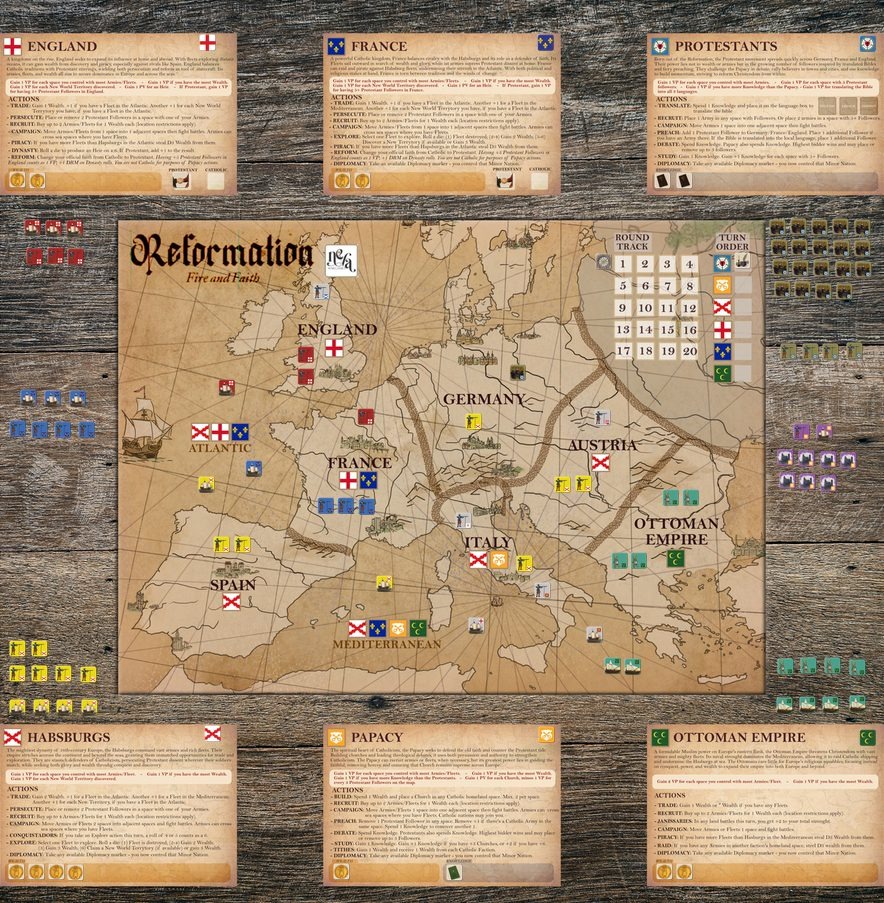
            Near final look at the board and player boards.

            The Papacy works in a similar way to the Protestants – but in reverse. The Pope is trying to remove Protestant Followers, through Preach and Debate actions. Every 3 Protestant Followers is minus 1 Victory Point for the Papacy, so they are incentivized to contain the spread of the Reformation. The Papacy also has ways of building up their own points, through Churches. This general term refers to all the infrastructure of the Catholic religion – not just beautiful cathedrals (like St. Peter’s, which was being built during the Reformation) but also schools, Jesuit universities, seminaries, monasteries, trained clergymen and church councils. I was originally going to have a track or chart on the Papacy faction sheet to measure this but later decided to have it as pieces on the map – the Churches you see in the game.

            This was because I wanted the Papacy to have some of physical presence on the map like the other factions. This was loosely inspired by the building tokens in games like Root or the resources placed on the map in Scythe. It has the advantage of opening up the Papacy’s primary victory metric to attacks from the other factions. Just like Protestant Follower pieces, papal Church pieces can be attacked and removed. This represents iconoclasm and persecution of Catholic clergy, as well as periodic waves of destruction like the Sack of Rome in 1527. Unlike Protestant Followers, I had the Papacy’s Churches cost Wealth. This Wealth is gained entirely through the Tithe action – which takes money from any nations that are still Catholic. Early in the game this includes three out of the six factions: Habsburgs, England and France. But England and France might convert to Protestantism, and a greedy Pope constantly demanding their money might hasten this on! 

            Grant: What are the playable factions? How did you differentiate them?

            Clint: There are 6 factions in the game: Protestants, Papacy, Habsburgs, England, France and Ottoman Empire. Each one has a faction sheet, like the one below, which summarizes their victory conditions and available actions.

            The Protestants and Papacy are religious-focused factions. They do have military forces, but they are relatively few in number and are not the main priority. The Protestants are trying to build up their knowledge of the Bible and translate it into vernacular languages, preach to the masses and debate the Catholics to spread their ideas. Their main goal is getting their Followers on the map. The Papacy is trying to contain the spread of Protestant Followers and remove them from the map as much as possible, plus place their own Churches. Both Churches and Followers are immobile and do not count as military units. But they can be attacked and persecuted off the map.

            The other factions – the Habsburgs, England, France and the Ottomans – function more like the nations in a wargame. Amassing armies and fleets, fighting battles, aiming for control of spaces on the map. There are plenty of differences though. The English, French and Habsburgs have the option of Explore action – sending their Atlantic Fleets to explore the New World, gaining varying amounts of Wealth or a valuable New World colony (at the risk of losing the Fleet). This provides a great way for factions to gamble early on in the game in a high-stakes race for colonies. Two tweaks were made to the Explore action during the design process. First, my co-designer Ed Farren suggested that New World colonies should provide extra income during the Trade action if the owner has a Fleet in the Atlantic.

            I loved this idea and implemented it immediately. I later thought that the Habsburgs should have a distinct advantage in exploring the New World, what with Hernan Cortez and Francisco Pizarro active during this time. I gave the Habsburgs a way to boost their Explore action with “Conquistadors” – effectively tripling their chance of finding a colony at the cost of an additional action. This means the Habsburgs will be raking in more money. But there are a lot of ways for the other factions to steal it! The English, French and Ottomans can all use the Piracy action to get that Spanish silver, and the Ottomans can also Raid on land if their Armies make it through to Austria.   

            The relationship between the military/political factions and the religious factions is also fascinating. I kept the Habsburgs as a staunchly Catholic faction – they can’t change their allegiance and will act as the strong right arm of the Holy See throughout the game. But England and France are a different story. England needed a historically-rooted incentive to convert to Protestantism, and this was solved in two ways. First, if England officially converts, they will earn 1 VP if England itself contains at least 5 Protestant Followers. This also gives 1 VP to the Protestant player, so there would be strong reasons for both players to work together in the conversion for England. I also wanted some of the high drama of Henry VIII and his wives without an entire sub-system and chart like Here I Stand. This became the “Dynasty” action – a simple die roll to gain a VP by producing a viable heir to the throne.

            If England is Catholic, they need a 6 for this. But converting to Protestantism offers success on a 5 or a 6, as Henry can start divorcing his infertile wives. England can therefore grab 2 VP quite easily by ushering in the Anglican faith, which is handy because their opportunities for expansion on the continent are quite limited. France can also earn VP by converting to Protestantism and having at least 5 Protestant Followers in France. For both England and France, converting to the new faith costs an action – which Ed quite appropriately labelled “Reform”. This could be a wasted action if Protestantism doesn’t end up spreading in that nation or if the Dynasty action still fails. But it’s a live issue. Among experienced players, I expect that the Papacy player and the Protestant player will spend a lot of their table talk trying to convince England and France to side with them in religious terms.  

            Grant: What is the layout of the board?

            Clint: I made the map as simple as possible. There are 7 land spaces: Spain, France, Germany, England, Austria, Italy and the Ottoman Empire. There are 2 sea spaces: the Atlantic and the Mediterranean. And that’s it! But you will find that this still provides plenty of interesting strategic choices, as there are 6 factions crammed into these 9 spaces. So, like the proverbial “knife fight in a telephone booth,” players are stuck in fierce competition from the very beginning. For example, the Papacy, France and Habsburgs all have some presence in Italy in the game’s set up. Plus, there are pieces from neutral nations there – like Venice and Florence. So inevitably there be some conflict there!

            Grant: Why did you feel area movement was the best approach? What strategic decisions are forced upon the players by the layout?

            Clint: Honestly, I didn’t want this to be game about operational level maneuver, more about strategic level decisions and inter-faction dynamics. The map is very heavily abstracted. But you can see it this way. Every faction has a “homeland” space. The Habsburgs, being the hegemon of Europe, have two (Spain and Austria). Each faction will usually be aiming to keep its homeland secure while pushing into 1 or 2 other spaces. Taking control of a space is a big deal and will involve good timing, negotiation and applying just enough force. Some spaces – like Germany and Italy – will usually become battleground spaces with multiple factions vying for control.

            Grant: What is the counter anatomy? What different units are included?

            Clint: Like the map, the counter anatomy is as simple as possible. There is really no information on the counters other than their type. There are Armies and Fleets – which are the only military units in the game. There are also two religious “units” – Churches for the Papacy and Followers for the Protestants. These don’t fight and can’t move, but they are essential for the two religious factions to build up their influence and victory points. There are also counters for many other things – New World Territories, the Royal Heir for England, the Issues that can be won in a Debate, Knowledge, Wealth and a few other things.

            Grant: What is the scale of the game?

            Clint: There’s no specific ground or time scale as many things have been heavily abstracted. But very roughly you could say that each turn represents about 2-3 years and each army piece represents 5,000-10,000 men.

            Grant: What actions do players have each turn? 

            Clint: Players can choose two actions per turn. As explained above, they are different for each faction. But there are some similarities. I will give a list of the actions for each faction.

            Protestants: Recruit, Campaign, Diplomacy, Preach, Study, Translate, Debate.

            Papacy: Recruit, Campaign, Diplomacy, Preach, Study, Debate, Tithe, Build.

            Habsburgs: Recruit, Campaign, Diplomacy, Conquistadors, Explore, Trade, Persecute.

            England: Recruit, Campaign, Diplomacy, Explore, Trade, Dynasty, Reform, Persecute, Piracy.

            France: Recruit, Campaign, Diplomacy, Explore, Trade, Reform, Persecute, Piracy.

            Ottomans: Recruit, Campaign, Diplomacy, Janissaries, Piracy, Trade.

            Many of these are self-explanatory but I will explain some of my favourite ones. Diplomacy means getting a Minor Nation on your side, or pulling one away from an enemy. These Minor Nations include Venice, Florence, Genoa, Hungary and Scotland and they have their own Armies or Fleets or both.

            Piracy means using your Fleets to steal money from the enemy. Explore means trying to find a valuable New World Territory – worth VP and more income during Trade actions if you have a Fleet in the Atlantic.

            The Persecute action means placing or removing Protestant Followers. The Reform action – available only to England and France – means officially converting your nation to Protestantism.

            Dynasty is unique to England and represents Henry VIII trying to get an Heir (worth a VP). It’s a dice roll, but it’s easier when you’re Protestant to represent Henry being able to divorce and try with a different woman.

            Janissaries is unique to the Ottomans and gives them a valuable +2 bonus in battle that turn. Conquistadors is unique to the Habsburgs and gives them a bonus on their Explore rolls – making it more likely that they will grab a New World Territory.

            Grant: How does combat work in the design?

            Clint: Very simple – add up your Armies/Fleets, add a D3 roll, the highest score wins. If there were a total of 7 or more units in the battle, the winner suffers 1 loss and the loser suffers 2 losses. Otherwise, the loser suffers 1 loss.

            Clint: How do players obtain victory?

            Clint: Every faction can score Victory Points (VP) in multiple ways. The margins here are very tight – typically the winning faction will score 5 or 6 VP while second and third place will have 4-5. So, a single point really matters. Every faction can score VP for control of spaces – this is hard to pull off as you need more Armies or Fleets in the space than all other factions combined. So, you might retain control of your own homeland, but taking control of another space is hard. Aside from control, each faction has other ways of getting VP:

            The Protestants earn 1 VP for translating the Bible into all 3 languages (French, English and German), 1 VP for each space on the map with 5 or more Followers, 1 VP for each Issue you win in a Debate and 1 VP for having more Knowledge than the Papacy. So the Protestants need to focus on their religious actions – studying, translating and preaching.

            The Papacy earns 1 VP for each Church they have on the map MINUS 1 for every 3 Protestant Followers on the map. They also earn 1 VP for having more Knowledge than the Protestants, 1 VP for each Issue they win in a Debate and 1 VP for having more Wealth than any other faction. So, the Pope also needs to focus more on his religious goals – but can also use the Tithe action to build up Wealth (for building Churches) and maybe get a point for rolling in cash.

            The Habsburgs earn VP for each New World Territory they discover – and they are better at it than other factions because of their Conquistadors. They also earn VP for having 2 or more Churches in their homelands (Spain and Austria) and can earn VP for having the most Wealth.

            The English earn VP for New World Territories and for having the most Wealth. They can also earn 1 VP for producing an Heir with their Dynasty action. The Dynasty action represents Henry VIII’s efforts to produce a legitimate male heir for his throne, and is easier if England becomes Protestant. England earns 1 VP if it converts to Protestantism and has 5 or more Protestant Followers in England. If it stays Catholic, it earns 1 VP for having 2 Churches in England.

            France is basically like England but doesn’t have the Dynasty action. They will focus on military action, exploration and building up Wealth. If they stay Catholic they will want the Pope to build up Churches in France, if they go Protestant they earn VP for having 5+ Protestant Followers in France.

            The Ottomans are the most straightforward – they can earn 1 VP for having the most Wealth but mostly they just get VP for control of spaces – they earn 2 per space instead of 1. They are an expansionist juggernaut and don’t care about the religious squabbles in Europe.

            Grant: What type of an experience does the game create?

            Clint: I think it gives you an understanding of the key inter-factional dynamics of the Reformation era using mechanics that are simple to understand and easy to enact.

            Grant: What are you most pleased about with the design?

            Clint: The asymmetry, the simplicity and the interaction between the players. I’m also really happy with the “bot” rules which allow you to play at anything from 1 to 6 players, with non-player-controlled factions run by a simple dice-based action sheet.

            Grant: What has been the response of playtesters?

            Clint: Very positive. Every play-tester has said the game is really fun and easy to learn, their only suggestions have been refinements to improve the balance between the 6 factions. For example, one play-tester noticed that the Debate action was under-powered and that the Protestants and Papacy were scoring fewer VP than the other factions on average. Changing the Debate action to winning “Issue” markers (worth 1 VP each) solved both problems. This is why play-testers are so valuable!

            Grant: What other designs are you working on?

            Clint: A lot! I will share a few of them with you.

            First, there is One Hour Napoleon and One Hour WW1, sequels to my game One Hour WW2. Napoleon should be out this year, WW1 next year.

            Then there is Messiah – my “Jesus COIN game” which is set in 1st century Roman-occupied Israel and lets you play as the Christians, Zealots, Pharisees or Romans. Similarly, there is “Testament” – my card drafting game on the entire Old Testament, inspired by 7 Wonders. These are still in development but they have a publisher and will certainly be made.

            Anyone interested in my designs should follow me on X at @Clint_Davey1 to keep up to date with all the new releases. Thanks for having me on again!

            If you have followed us for a while now, you know how we feel about Here I Stand: Wars of the Reformation from GMT Games. And, you know that we enjoy multi-player wargames. So, this one really seems to b simple and take in the concepts of negotiation and the asymmetry of each of the factions. I think that this game will be a good quick playing substitute for the longer and more involved Here I Stand experience. I cannot wait to get this one hopefully this year.

            If you are interested in Reformation: Fire and Faith, you can pre-order a copy for $49.00 from the Neva Game Press website at the following link: https://nevagamepress.com/product/reformation-fire-and-faith/

            -Grant

            ❌