It’s been thirteen years since the original release of Jamey Stegmaier’s Euphoria: Build a Better Dystopia. I would say it doesn’t feel like thirteen years, but I’d be lying. Between the pandemic and five or six successive generations of board game iteration, it’s been an eternity. Long enough for a retrospective, certainly.
Speak of the devil. Euphoria: Essential Edition is a remake of the original game, plus some of the stuff from the expansions, minus a few love handles and splotchy moles. Let’s see how the old dystopia has held up after all these years.
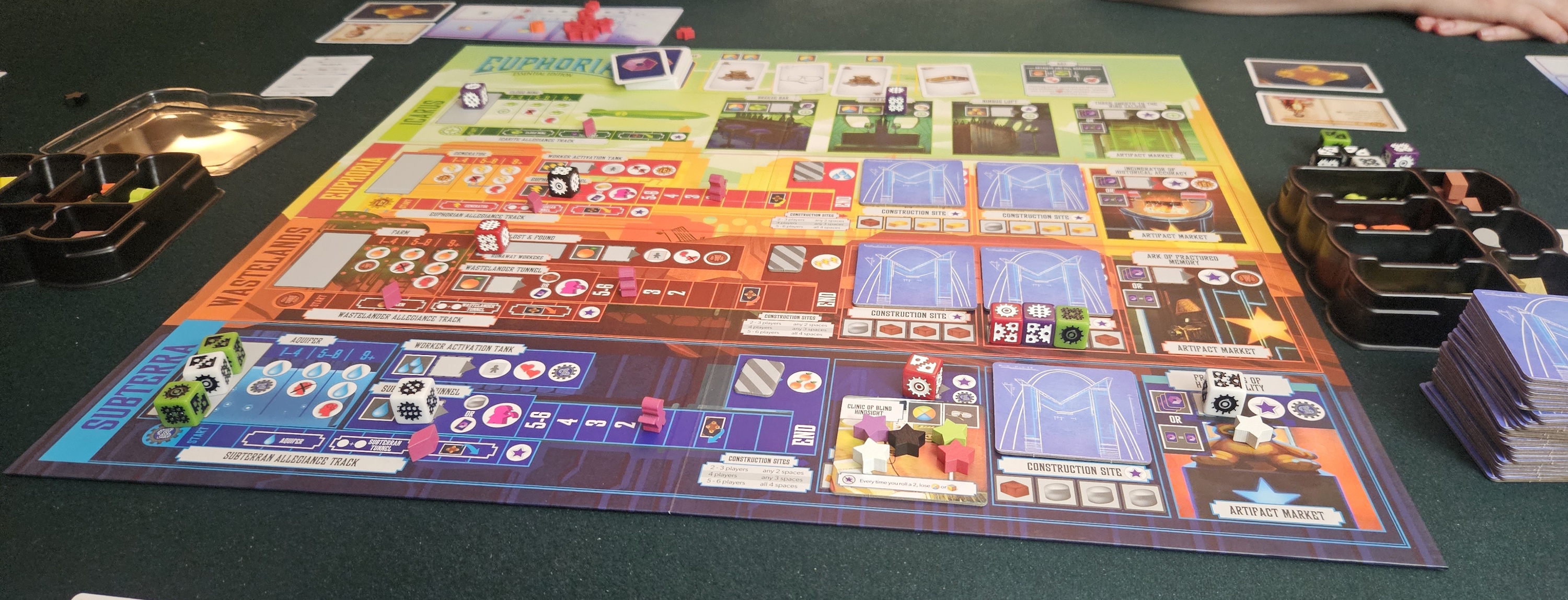
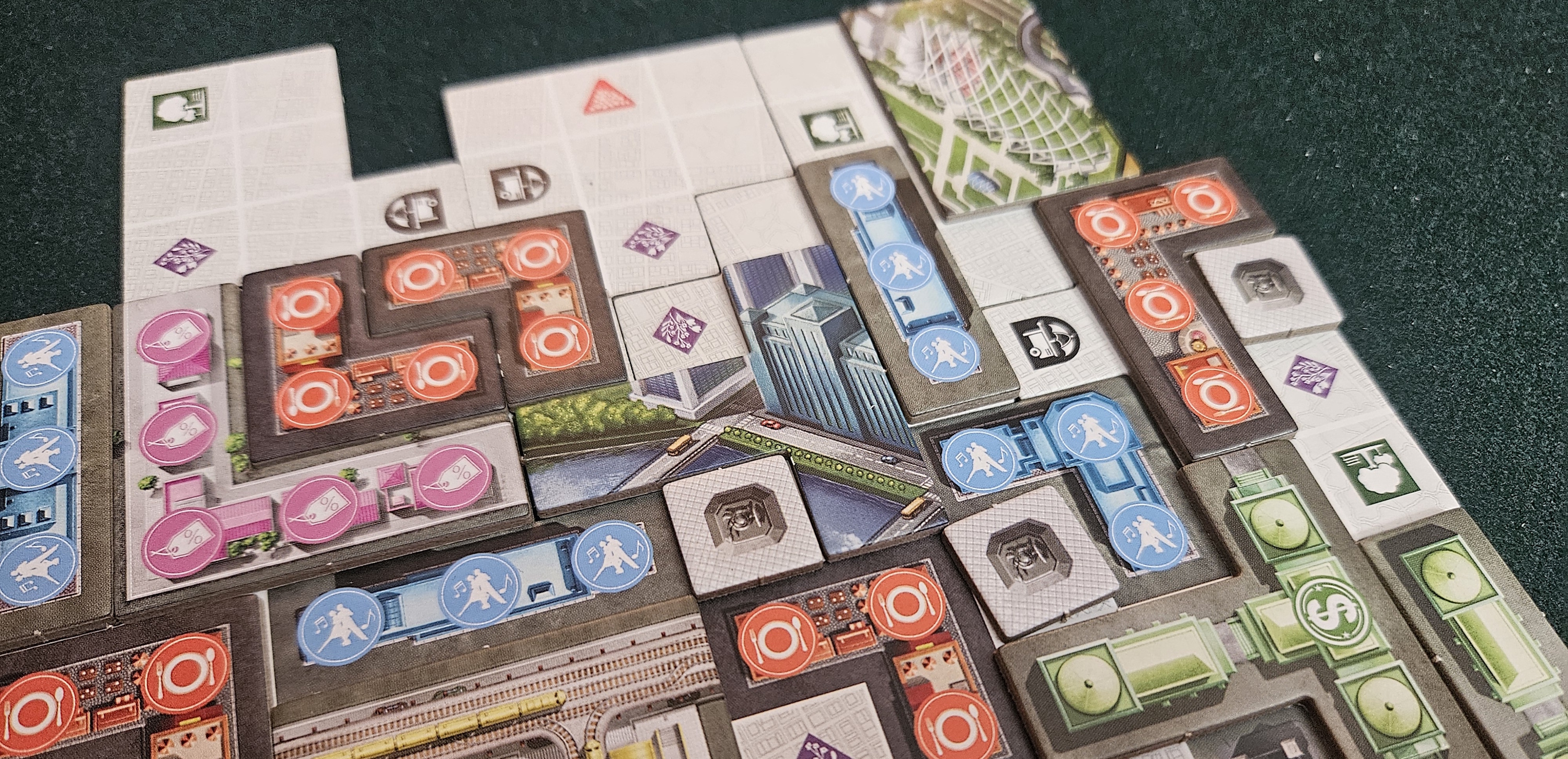
The new board, not quite the same as the old board.
Short version, there’s rebar showing through the concrete.
As before, Euphoria is about your efforts to thrive in a dystopian society. Relatable. Maybe that’s why the intervening decade hasn’t flown by. But I digress. In Euphoria’s case, that dystopian society is divided into four strata, each offering different spaces for your workers to run errands. There are the Euphorians, folks who generate electricity by marching on hamster wheels, Wastlanders who labor in orange groves, Subterrans who pump water through the cracked bedrock, and Icarans… Icarids? Icaruses? Whatever. These guys cook future-meth for keeping everyone’s workers drowsy and compliant.
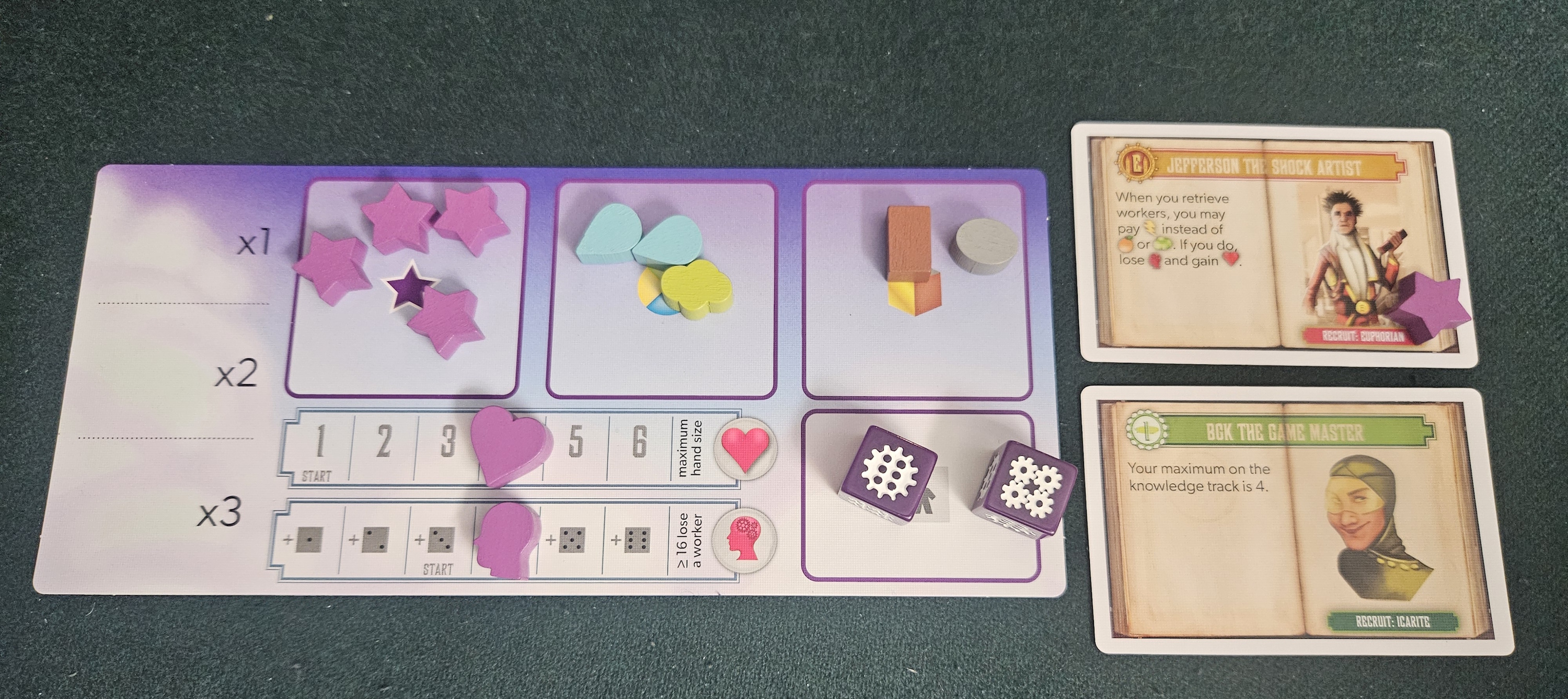
The status of those workers is never far from mind. At the time of the original game’s release, rolling dice to determine the relative knowledge of one’s workers was a clever touch. If nothing else, it functioned as one of the hobby’s earliest meta-commentaries on the blank slate that was the worker-placement worker. Roll too high, and one of your workers gets wise to the situation and flees from your grasp. Roll too low, and…
… and there’s no penalty for rolling too low. What you really want is to roll doubles. That way, you can spend some morale to place an extra worker, earning two turns in a single go.
Euphoria: meek in the streets, freak in the spreadsheets.
At the time of the original game’s release — there’s a phrase I’ll probably say more than twice — it was easier to overlook the chanciness of the whole thing. Sure, rolling high means losing a worker, and rolling doubles means earning a twofer. But rolling low, I suppose, means you can send a worker to one of the game’s resource production zones without worrying about them learning the shape of their culture. Except, wait, that’s another benefit for rolling low. Darn it.
Okay, so Euphoria is full of luck. Always was, still is. The problem isn’t so much that luck is the sole determiner of whether you succeed, but rather that it’s just enough to prove frustrating. As a genre, Eurogames included more chance in 2013 than they do today. Personally, I miss a bit of chance. But in general, those earlier forms of chance were about mitigation. Even placing towns in Settlers of Catan was about spreading around the odds so that you’d always earn something. In Euphoria, the system feels out of place, and not only among the determinists of 2020s nu-euros.
But let’s set that aside. How has the rest of the game borne the timelapse?
Again, the short version is that it works perfectly well, but never quite eases its grandfatherly creaks and groans. Most actions are tit-for-tat resource conversions. First you send a worker to a resource generator to earn one or two commodities. Then you send them to a tunnel to spend a commodity for a building block. Maybe you spend a wad of commodities for an extra worker. Then you build special markets, which let you exchange commodities, blocks, and artifacts for stars, the game’s victory condition. Repeat. Repeat. Repeat.
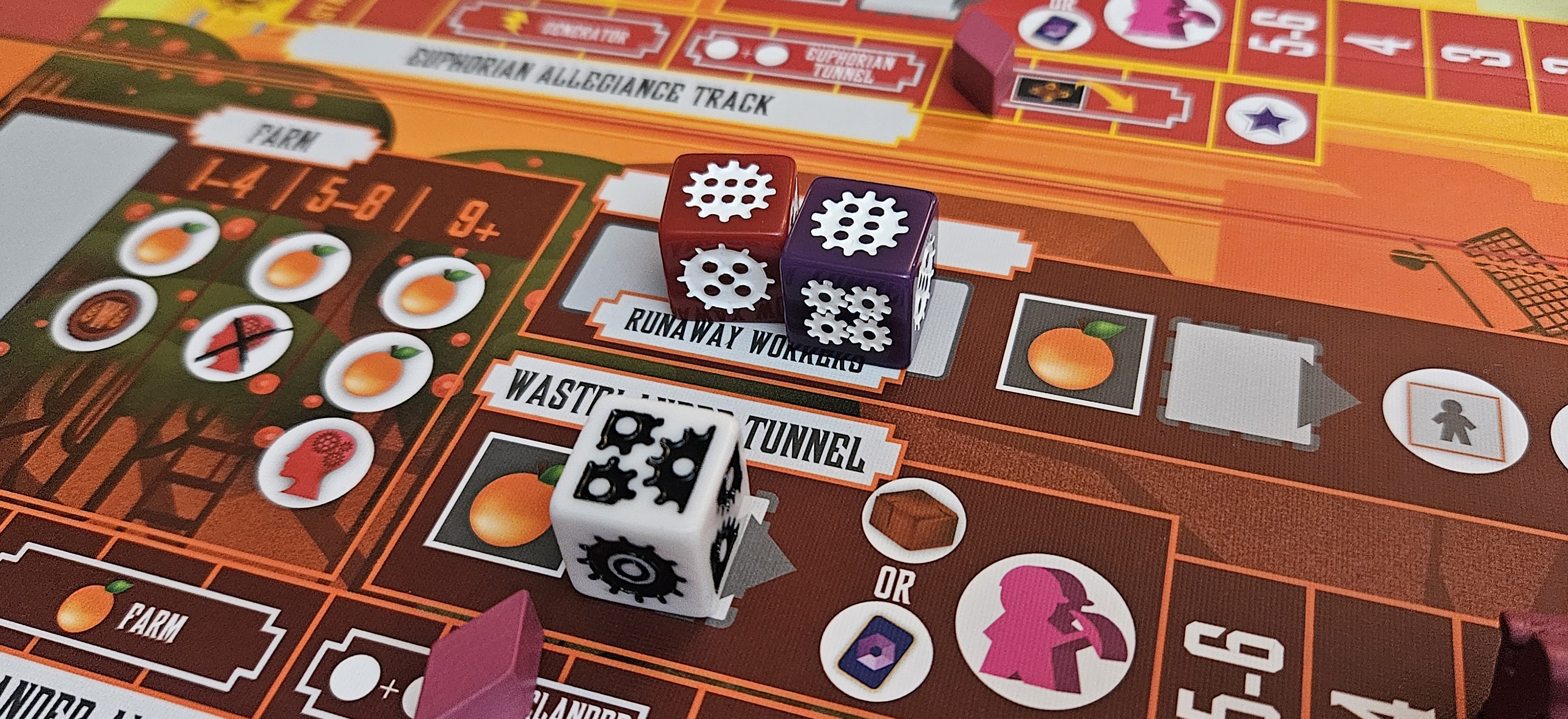
“Runaway workers” sure is a loaded term.
It doesn’t help that the Essential Edition sometimes comes across as more of a Pruned Edition. The board is more legible, but has shed the original map’s sense of place. Just look at that perfect goofball illustration. The new map feels like a spreadsheet setup for a spreadsheet game. Which is fine, as those things go. This is a resource-conversion worker-placement game, after all. You could even make the argument that this new edition has shed the original game’s pretense, including the ethical dilemma cards that, let’s face it, didn’t always add much to the game systems-wise. But, again, they mattered to Euphoria’s sense of place, the notion that players were being forced to compromise their values in order to get ahead. Thanks to the intervening years, a few subtractions, and this updated visual design, it’s easier than ever to see the wires and mirrors behind the illusion.
The remaining good parts are still as good as ever. For example, those markets. As before, building a market means spending a bunch of building blocks, not to mention putting your laborers in a holding pattern until other players join in. This created a certain degree of cooperation, one that could be turned against you at a moment’s notice. Having even a single worker hanging around at a job site is a real sacrifice, fostering opportunities for players to bicker and cajole. That’s great.
Furthermore, the markets themselves are nasty little things. When built, every player who didn’t contribute to its construction is forced to suffer a penalty until they pay a penalty at the new market. Sometimes these are negligible; other times they pose biting impositions that must be rectified as soon as possible. Or even both at once. The Theatre of Endless Monotony reduces how many commodities you earn, but only to a minimum of one. The Institute of Orwellian Optimism treats all your 1s and 2s as 3s when it comes to checking your dice for thoughtcrime. The Courthouse of Hasty Judgment makes it harder to spend artifacts for stars. That sort of thing.
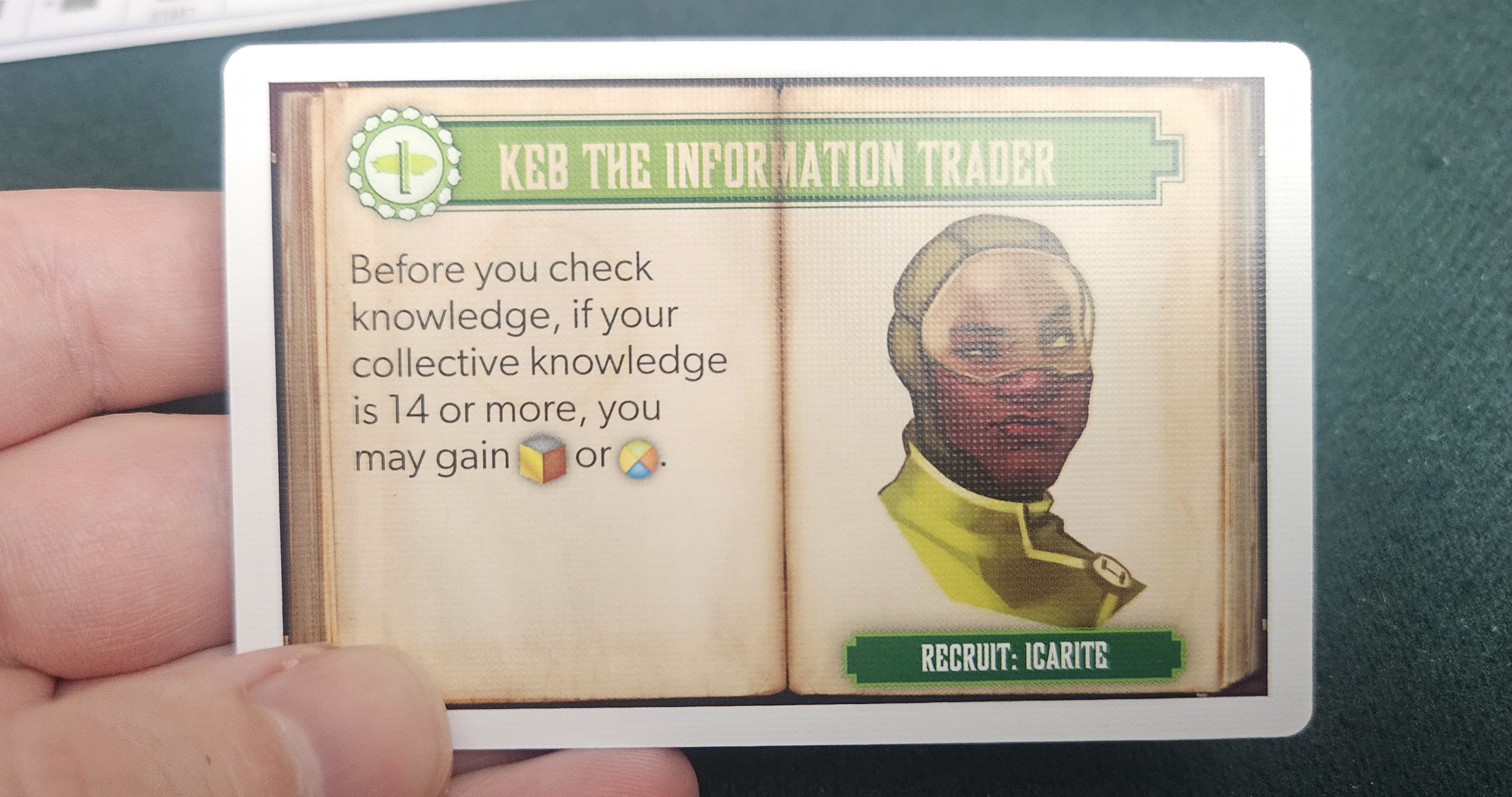
This guy is a cool dude.
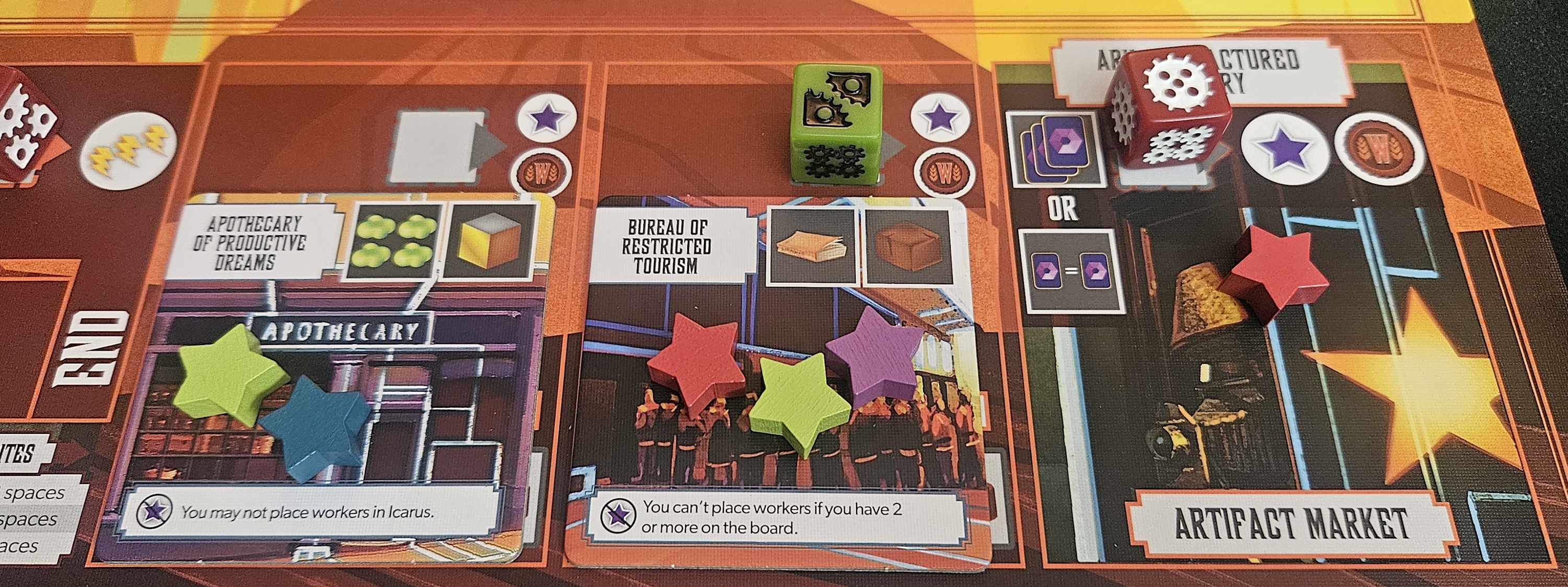
There are some real whoppers in there, too. In one case, we revealed the Apothecary of Productive Dreams. This market prevents some players from sending workers to Icarus. At all. Which effectively locks them out of a full quarter of the board’s spaces. Worse, buying into an already-built Apothecary requires bliss, the very same drug peddled by the Icaroopsies. Not only were some players locked out of Icarus territory, this locking-out was effectively permanent. Was this a fair turn of events? Hardly. But it was interesting. Textured, we might call it. Abrasively textured, sure, but it was refreshing to play a game that would offer such overt penalties rather than ensuring everything ran smoothly all the time.
Between these and the heaps of recruit cards, there’s always something happening on the board. Some market being constructed (or ruining your day), some recruit tweaking the rules to your benefit, some haggling over at the construction site. That’s all great.
The downside is that it never quite breaks free of its shackles. Board games have largely moved on from worker placement, at least in such a straightforward cube-pushing sense. And Euphoria always feels like cube-pushing. Every segment of its dystopia is more or less identical to its peers. The same resources exchange rates. The same methods for hampering one another. The same costs at the artifact markets. And now those four segments are placed side by side so you can see just how closely they align.
In a sense, the Essential Edition is a worthwhile experiment because it highlights just how far game design has come over the past decade. But it’s only a worthwhile experiment for me, a total sicko for how board games change and develop over time. For somebody looking to spend their hard-earned cash, there are better options out there. If I’m going to place dice-shaped workers and suffer random consequences, I’d much rather play Connie Vogelmann’s Apiary, and that’s limiting our selection to titles from the same publisher.
E:EE is full of little textures. Some of them are abrasive.
Because Euphoria has been left behind. By board games as an iterative artform. By our hobby’s collective taste in the role of chance. By an Essential Edition that leaves some of its most interesting ideas in the dustbin. By a culture that’s grown weary of dystopias.
Speaking only for myself, I think it’s time to tunnel through to the other side.
A complimentary copy of Euphoria: Essential Edition was provided by the publisher/designer.
(If what I’m doing at Space-Biff! is valuable to you in some way, please consider dropping by my Patreon campaign or Ko-fi. Right now, supporters can read my first-quarter update of 2026: the best board games, movies, books, and more!)
Battle Card is as apt as descriptions get. Designed by David Thompson and Nils Johansson, this is the fourth project in the Postmark Games lineup. Like its earlier peers — Voyages, Aquamarine, and Waypoints — this is a print-and-play title that can be produced with functionally zero budget. Unlike those projects, however, Battle Card is billed as a wargame on a single postcard-sized sheet.
That’s true enough. With a few dice and a smidgen of experience to help interpret the rules, Battle Card covers six engagements from the Second World War. And their format is indeed very small, highlighting some real resourcefulness on their designers’ part in compressing battles and even campaigns into ten-minute experiences.
But unlike those other titles, Battle Card is a mixed bag. I’ll give an example.
Rock on, Canada.
The second of Battle Card’s six scenarios sees Commonwealth forces waging a fighting retreat against Imperial Japanese troops shortly after the attack on Pearl Harbor. Over the course of two months, these forces staggered their positions along the Malay Peninsula, gradually ceding ground in an attempt to withdraw a portion of their forces. Historically, the campaign was catastrophic for the Allies, revealing Japanese air superiority and rapid infantry. (Mounted on bicycles!)
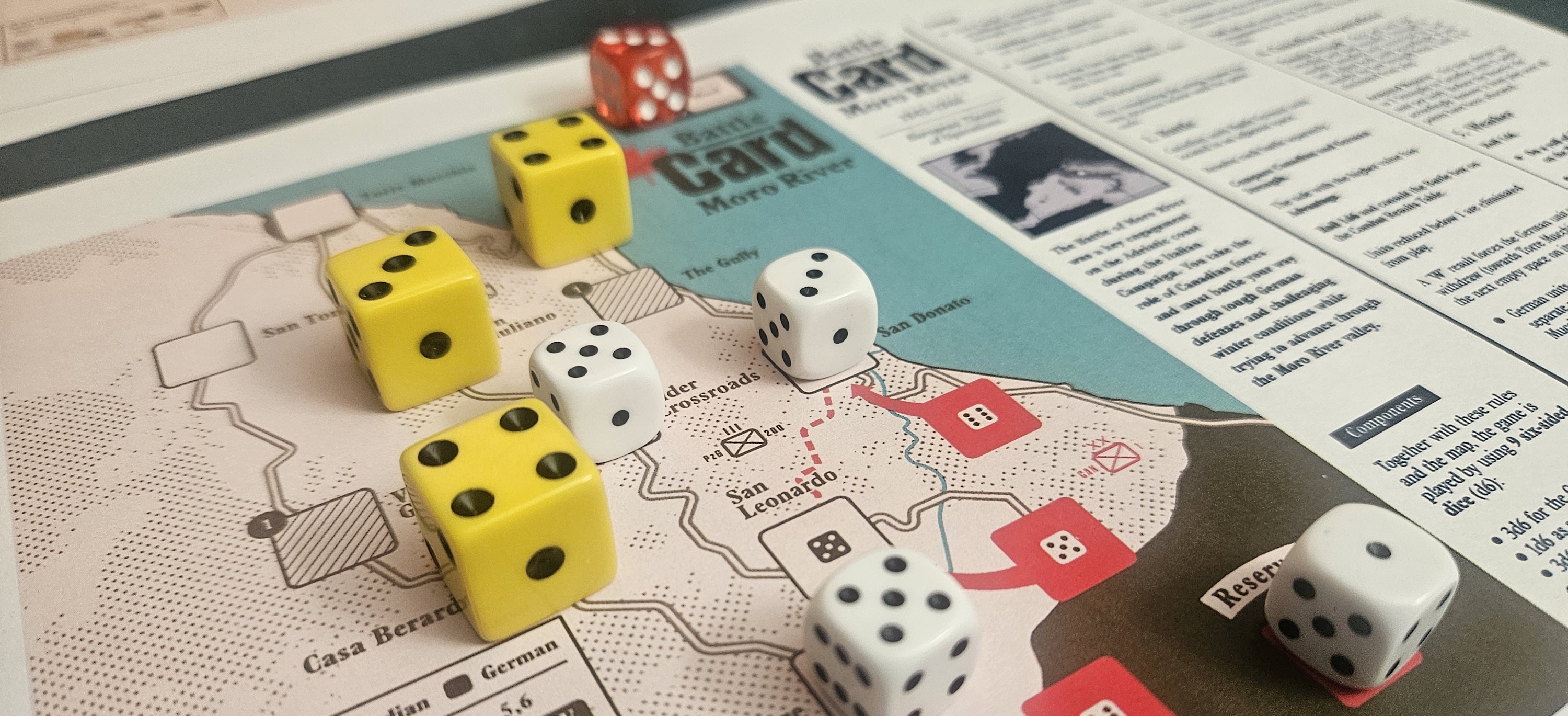
In Battle Card, the situation isn’t much better. Dice represent the armies on both sides, with their pips indicating their current strength. These armies engage in battle — determined by the roll of another die — and shift positions along the twin roads along the peninsula.
Here, the situation is relatively static. As the leader of the Commonwealth forces, your options mostly revolve around when to retreat, whether to defend your position or mount a counterattack, and which units to gradually pull back toward Singapore. No matter the outcome of any individual roll, the game has been fixed, much as it was historically. It isn’t a question of whether the Japanese will overtake your position, but how swiftly.
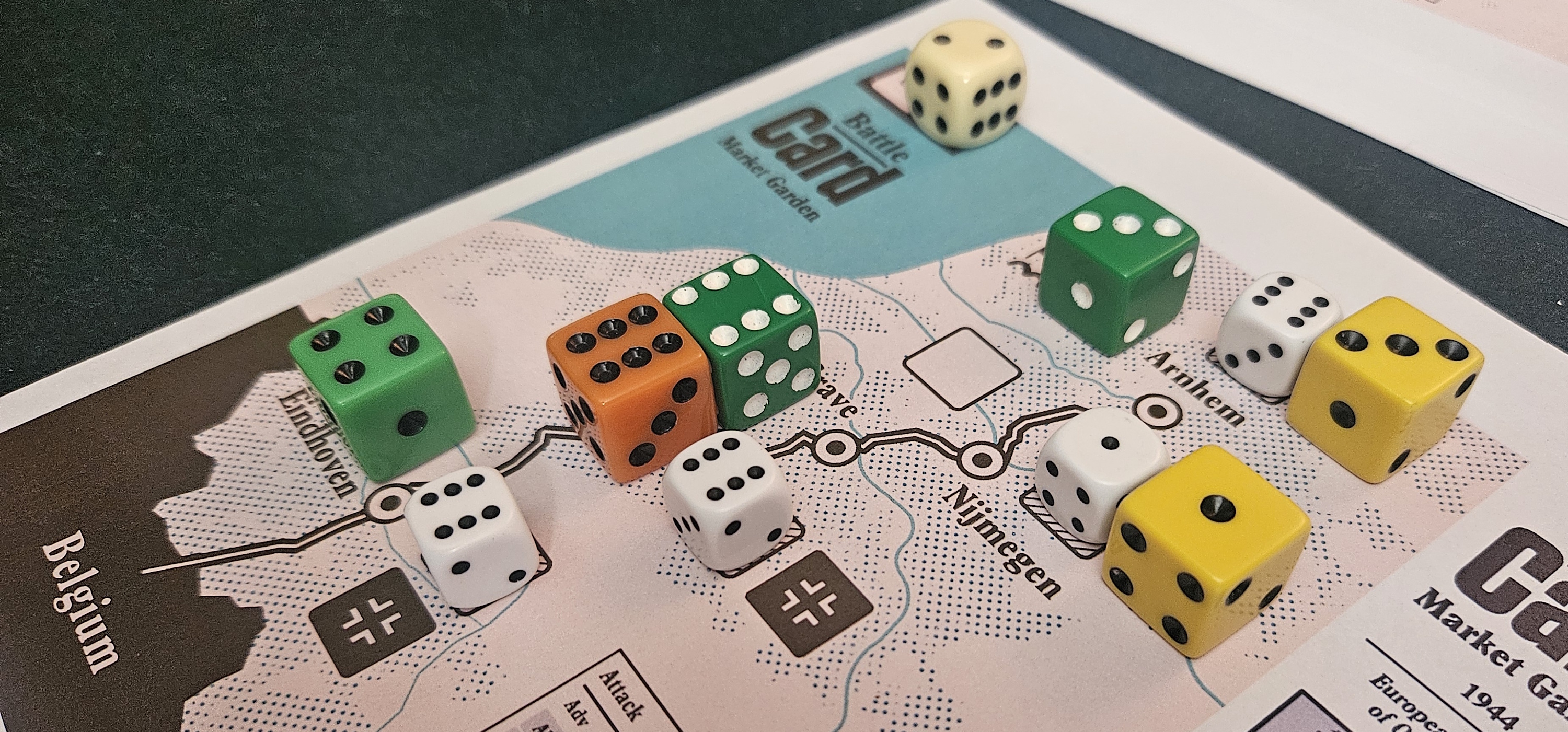
The Market Garden scenario is ostensibly a demo, but it’s fiddlier than those that come afterward.
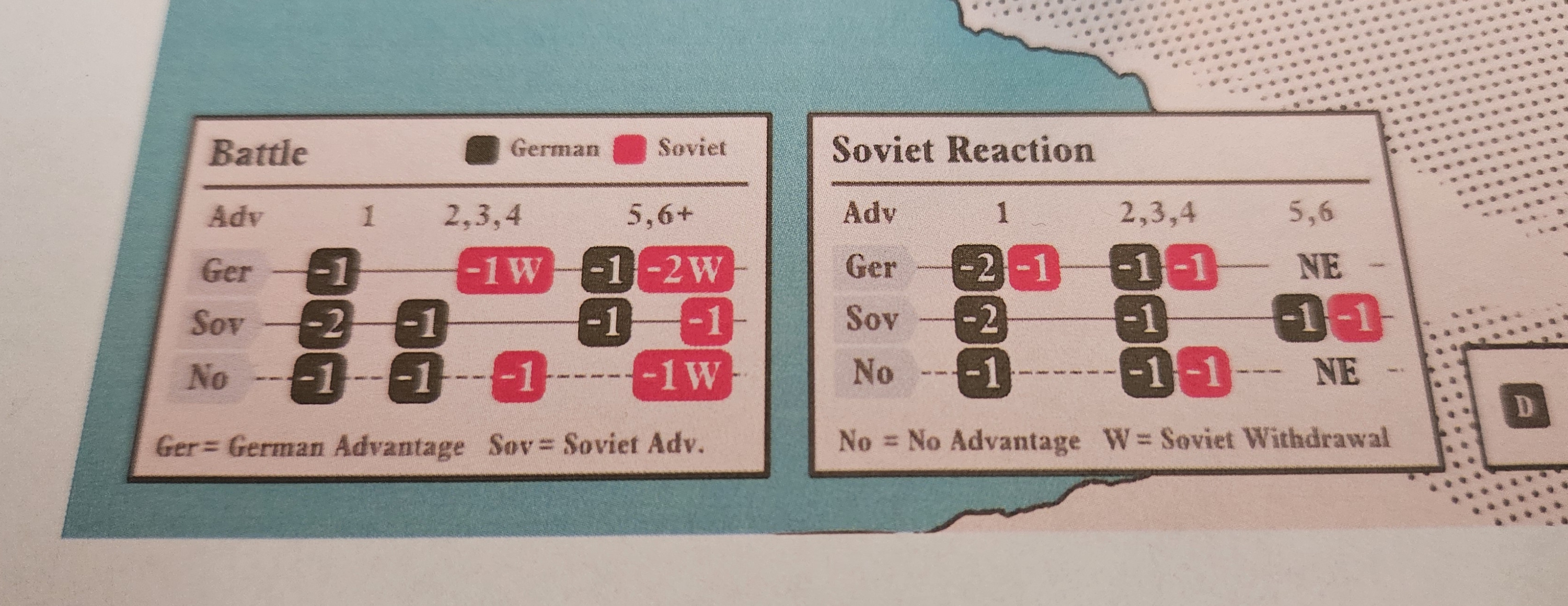
What follows is a strong indication of both the system’s strengths and weaknesses. Your choices, such as they are, are as bite-sized as the game’s footprint. Retreat or hold; defend or attack; withdraw a die along a road. The roll-offs are governed by small combat results tables that factor in whether one side has an advantage — meaning one side’s die has more pips than that of their enemy. As advertised, it’s fast. And, to its credit, the minimalist design does lend some sense of the geography and the central conundrums of the conflict.
In this case, your objective is to withdraw three pips to Singapore, and the way to accomplish this goal is closer to a puzzle than anything offering operational flexibility. Either you stick your troops behind the right line in the sand or you don’t. Either you withdraw in time or you don’t. Either you make high enough rolls or you don’t. No matter the scenario, this is more or less how Battle Card functions. There’s a solution here. That solution still requires the bulk of the rolls to go your way, but that’s the solution, and there’s no deviating from it. Perhaps most damningly, once you’ve uncovered that solution, there’s really nothing else to see.
Yes, yes, I’m the guy who wrote that replayability is overrated. But there are slender games and then there are slender games. Battle Card is the latter. Each play lasts between five and ten minutes. Scenarios are also compact, as befits a game called Battle Card, meaning there aren’t many subtleties to any given fight. If you don’t figure out the trick on your first play, you’re bound to have a strong suspicion heading into your second. After that, it’s really a matter of getting the right rolls.
Combat results tables! We got ’em!
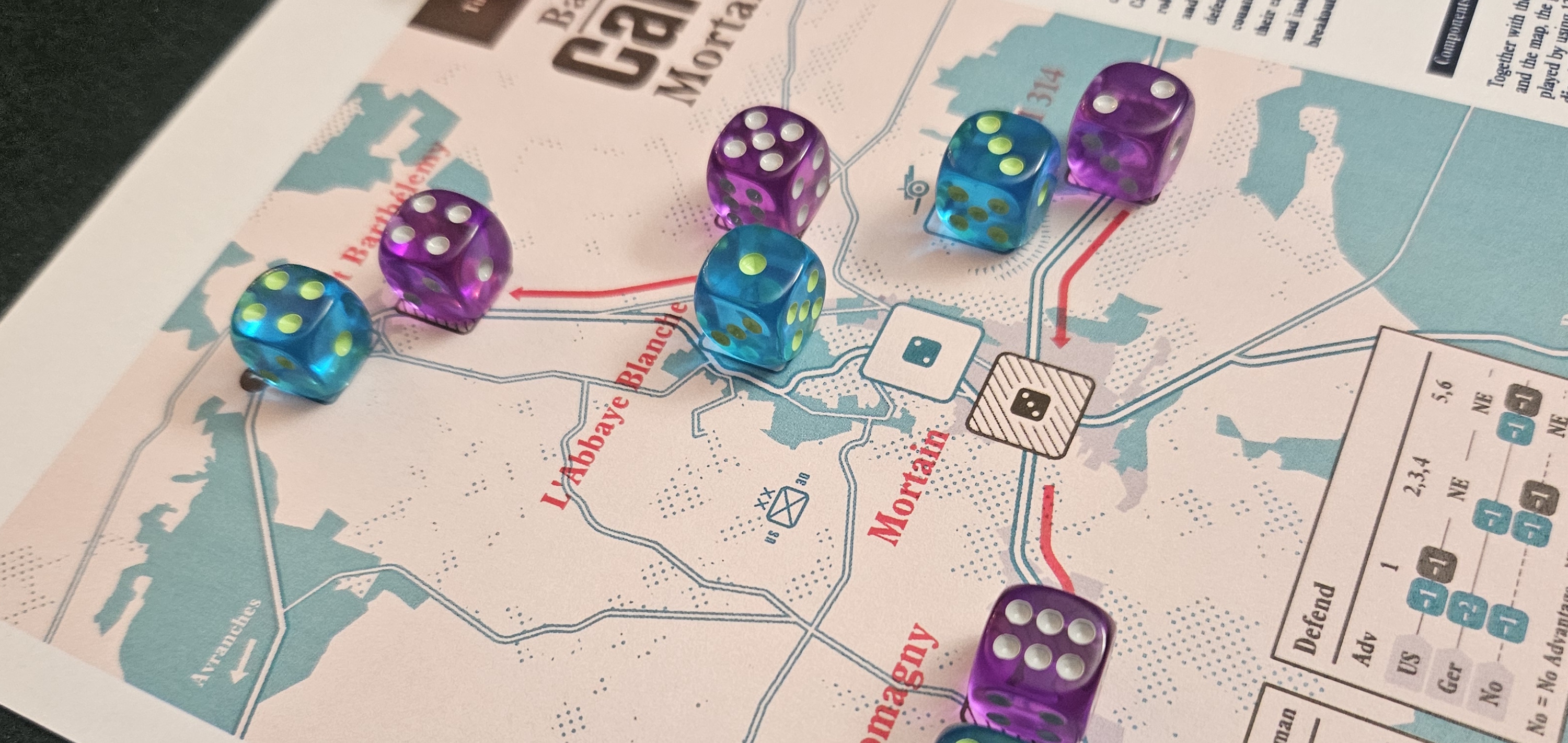
This isn’t to say the whole enterprise is doomed. The best scenarios offer some wiggle room between maneuver and chance. As the Canadians make a three-pronged drive up the Italian boot in the Moro River scenario, they must pause to reinforce any divisions that took a beating. As the Germans plunge toward the Caucasus oil fields, they need to decide when to split their forces into smaller but more vulnerable columns. Choosing where to fire your artillery at Mortain is… well, it isn’t the most complicated decision, but it would also be inaccurate to call it straightforward.
Again, though, that’s about as much mileage as anyone will get out of these print-and-plays. I’ve run through the entire series twice now, and the second time I found myself growing weary. This stands in strong contrast to those other Postmark titles. As score-chasers, there was always a reason to return for another attempt. Here, the entire format feels too compressed, like a States of Siege game without the chrome-laden considerations that made that series so interesting. Mostly, it was a nice way to organize my dice by color and size.
Firing the arty.
In a way, Battle Card isn’t that far off from looking at an animated battle map. All those little arrows and company designators. The towns changing hands. The roads, the weather. The relative strength of any given column. Battle Card is that with some marginal interactivity. As a middle-aged white guy, that’s my ken. But the joke’s on Battle Card. I already own a book of WWII battle maps. This is one instance where pushing the pieces across the board — sorry, the card — isn’t enough of an improvement.
Access to the files to print Battle Card was provided by the publisher.
(If what I’m doing at Space-Biff! is valuable to you in some way, please consider dropping by my Patreon campaign or Ko-fi. Right now, supporters can read my first-quarter update of 2026: the best board games, movies, books, and more!)
Ever wanted to play a game that would make you feel strange feelings about your childhood religion? Heyo, Greg Loring-Albright’s Keep the Faith is the title for you! In this conversation, Greg joins us to discuss whether board games or role-playing games are better, our respective religious traumas and hopes, and how a board game might prove illuminating of historical forces. You know, light chit-chat!
Honestly, there are no timestamps for this one. The conversation was rather stream-of-consciousness on my part, and I’d rather not break it into discrete portions. I’m sorry. =(
(If what I’m doing at Space-Biff! is valuable to you in some way, please consider dropping by my Patreon campaign or Ko-fi. Right now, supporters can read my first-quarter update of 2026: the best board games, movies, books, and more!)
I live in the shadow of the Wasatch Mountains. Have for nearly my whole life. Out-of-towners sometimes voice their apprehension when they first visit our cordillera, when they see the way our cities and suburbs are hemmed in by walls. The mountains, they say, seem precarious, like they could topple onto our heads at any moment, burying us under a thousand tons of limestone and quartz monzonite. Jokingly, I inform them that the real danger of the coming tectonic collapse — not the little shakes we sometimes get, but the Big One, the one we’re a millennium overdue for — is that it will kill us from below. The ground will liquefy and carry us downward, the ancient tidal basin finally sweeping us out to an inland sea that died with the mammoths.
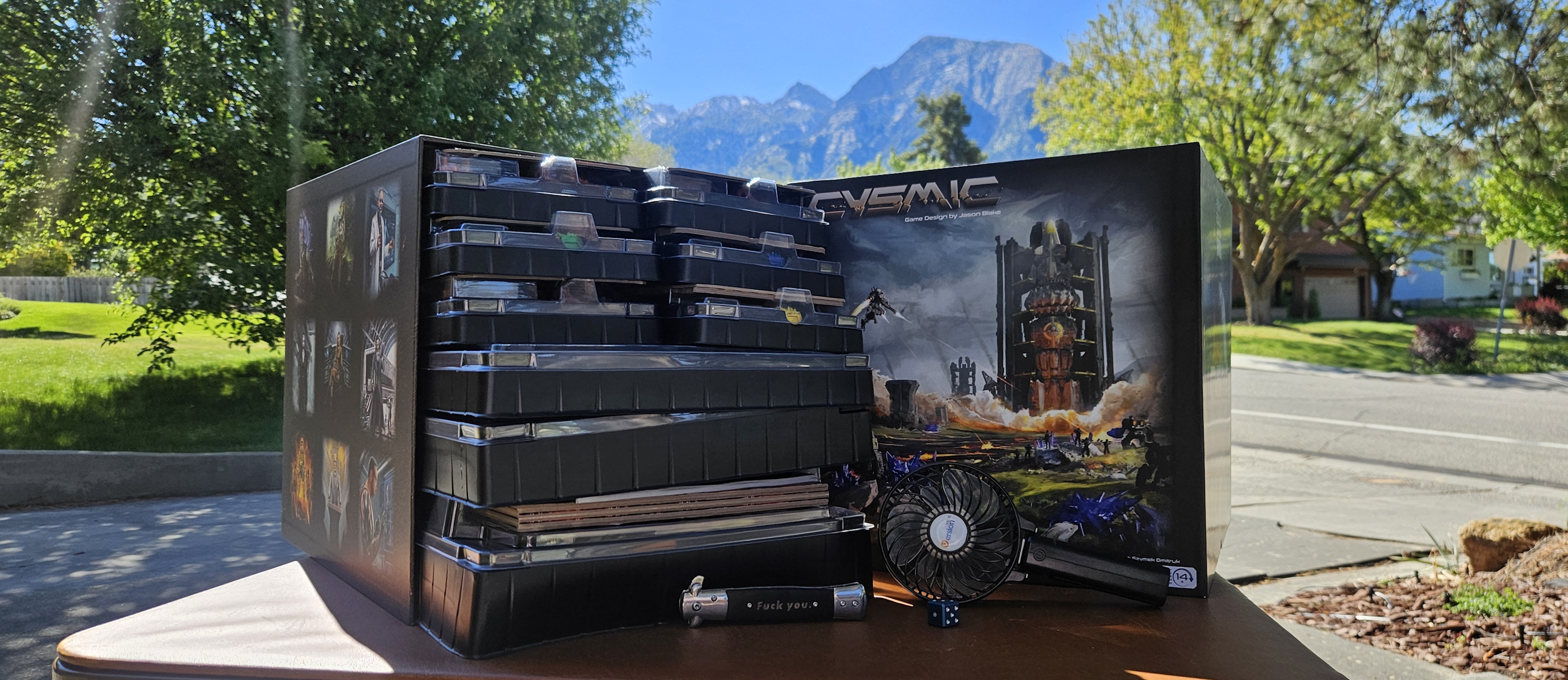
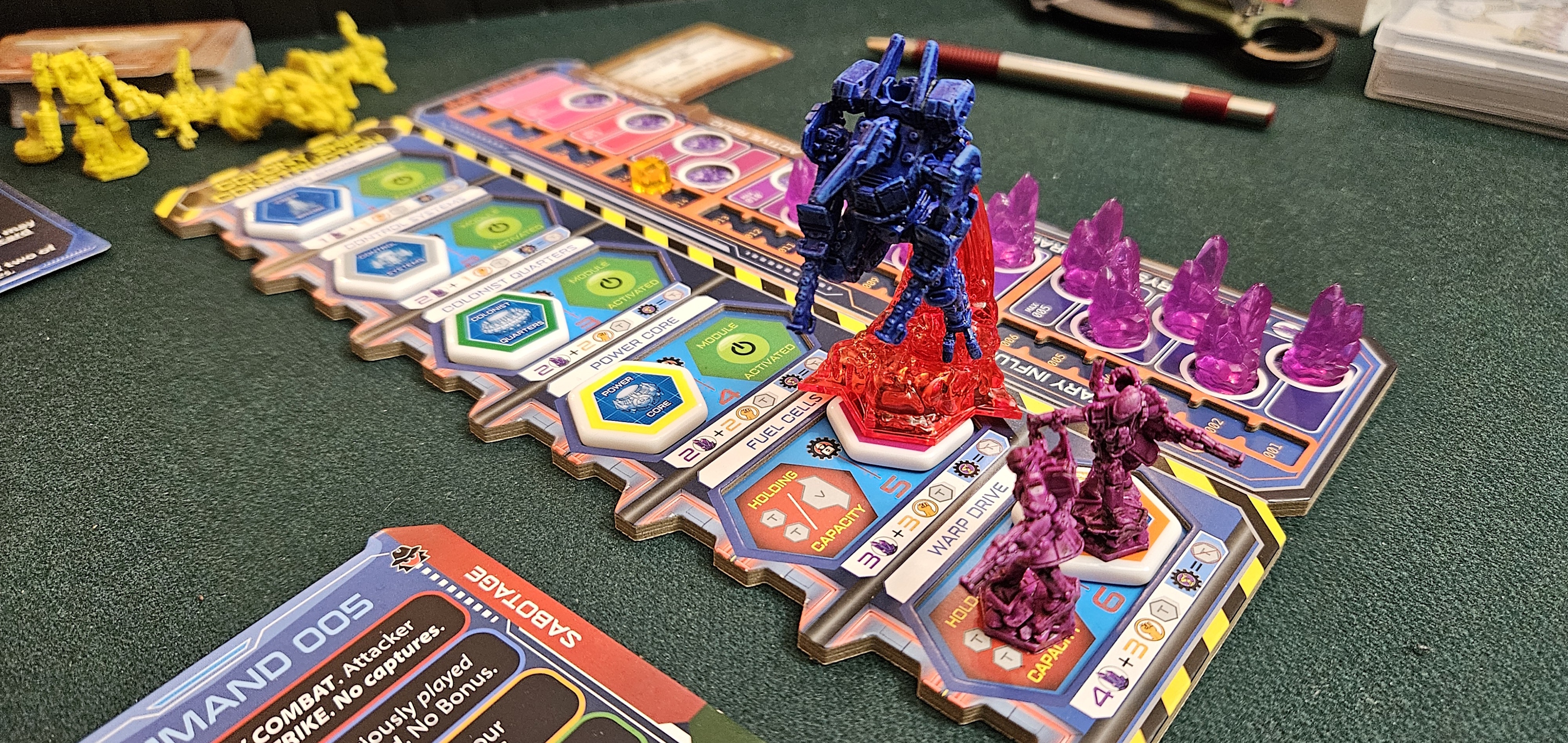
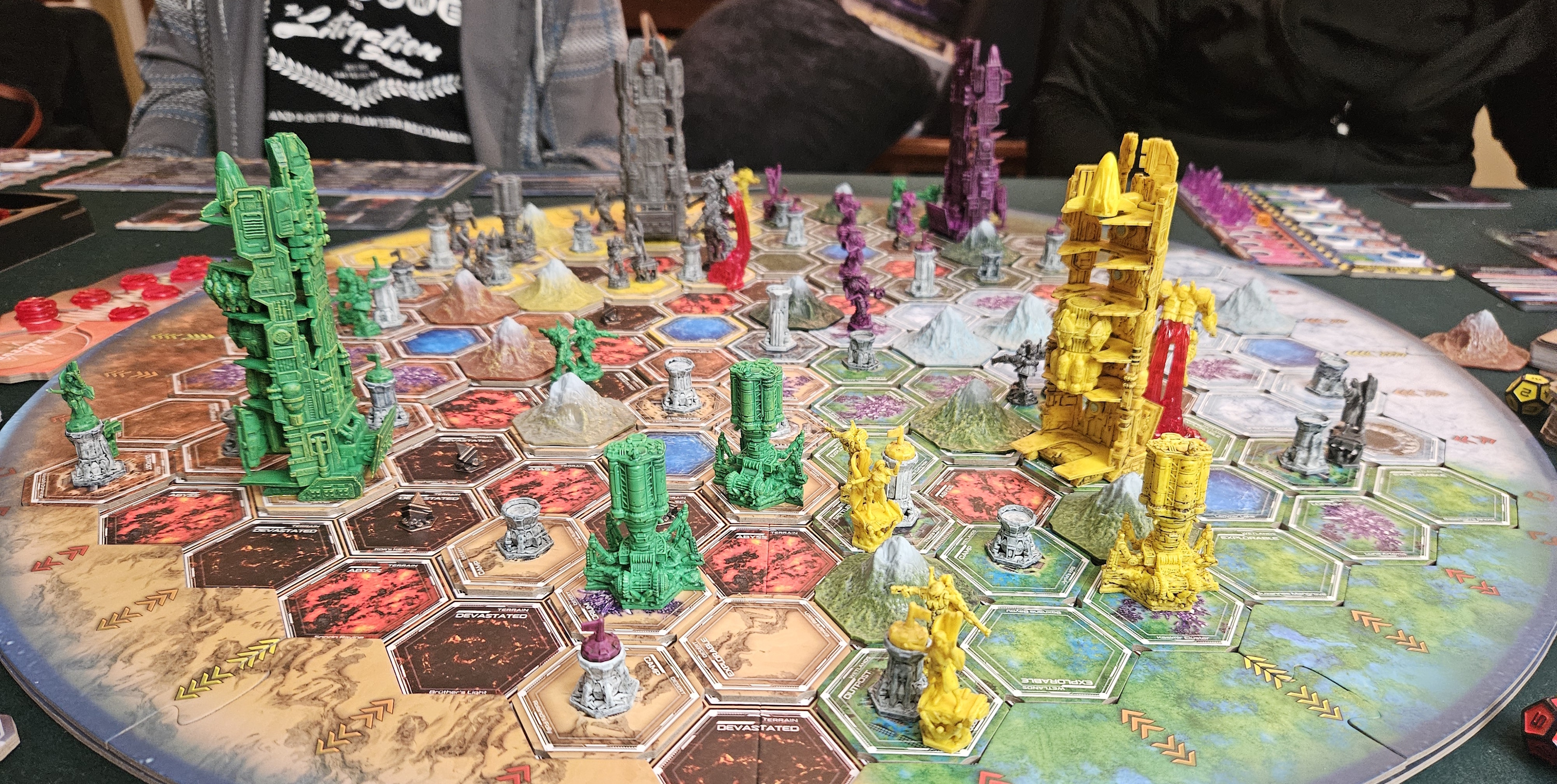
Cysmic, the board game by Jason Blake, gives me that feeling. When I hefted it onto the review stack next to my computer desk, my wife wondered aloud if it would topple and crush me. It isn’t the largest board game I’ve ever owned; that would be the 22-pound Ogre, the one with the team lift warning printed prominently on its side. But it’s the one that feels most like an Ozymandian temple to excess. Its map is sprawling. The frame that holds the hexes comes with hidden magnets to lock everything into place. The plastic constructs are so phallic that they make me uncomfortable. Among its many dice, there’s one for gauging your character’s crisis of conscience. It’s so gargantuan that it’s become a game-night joke. Nothing could justify this sprawl.
I kinda dig it.
Cysmic next to a few everyday items.
I want to set the scene. Both of the scenes.
In the distant future, humanity has settled an exoplanet. Pretty cool. Only it turns out that we repeated our past mistakes, squatting on territory that means us harm. This planet, you see, is tectonically unsound. Seismic. Cysmic. (Ohhhhh.) At some point in the near future, the crust of this world will flake away like the film coating an uncleaned oven. When that happens, the eruption of magma and steam will render anything above unlivable.
Not unlike the Salt Lake Valley, come to think of it. Mostly, I just don’t. Think about it.
Which is precisely the problem. Cysmic is unexpectedly redolent of Sol: Last Days of a Star, Ryan Spangler’s parable about climate collapse hastened by its victims, and Meltwater, Erin Escobedo’s cautionary tale about how nations set themselves aflame for the sake of spiting people whose existence has little bearing on their own. Of course, these titles could not be further apart, production- or intention-wise, but the parallels are there for the taking.
All, for instance, are about a looming crisis that their games’ factions are urgent to hasten. Because that’s the crux of the matter. Our goal on this planet is to escape by reconstructing one of the old colony ships that bore us here. But rather than cooperate to ensure everybody gets a seat on the ark, we now usher in our own destruction. We crack the mantle to get at the minerals that will shape the colony ship’s hull; we shatter the crust with our ordnance; we erect tracked megastructures that unfasten fault lines like zippers. Every action we undertake in service of survival steals a pinch from the hourglass.
Where Sol’s telling of this parable was poetic and Meltwater’s was bitter, Cysmic settles for frickin’ awesome. If those games offer the somber foretellings of the Book of Revelation, Cysmic is the Doof Warrior rendition. Let’s get this party staaaaarted, it hollers, jets of flame washing over the audience.
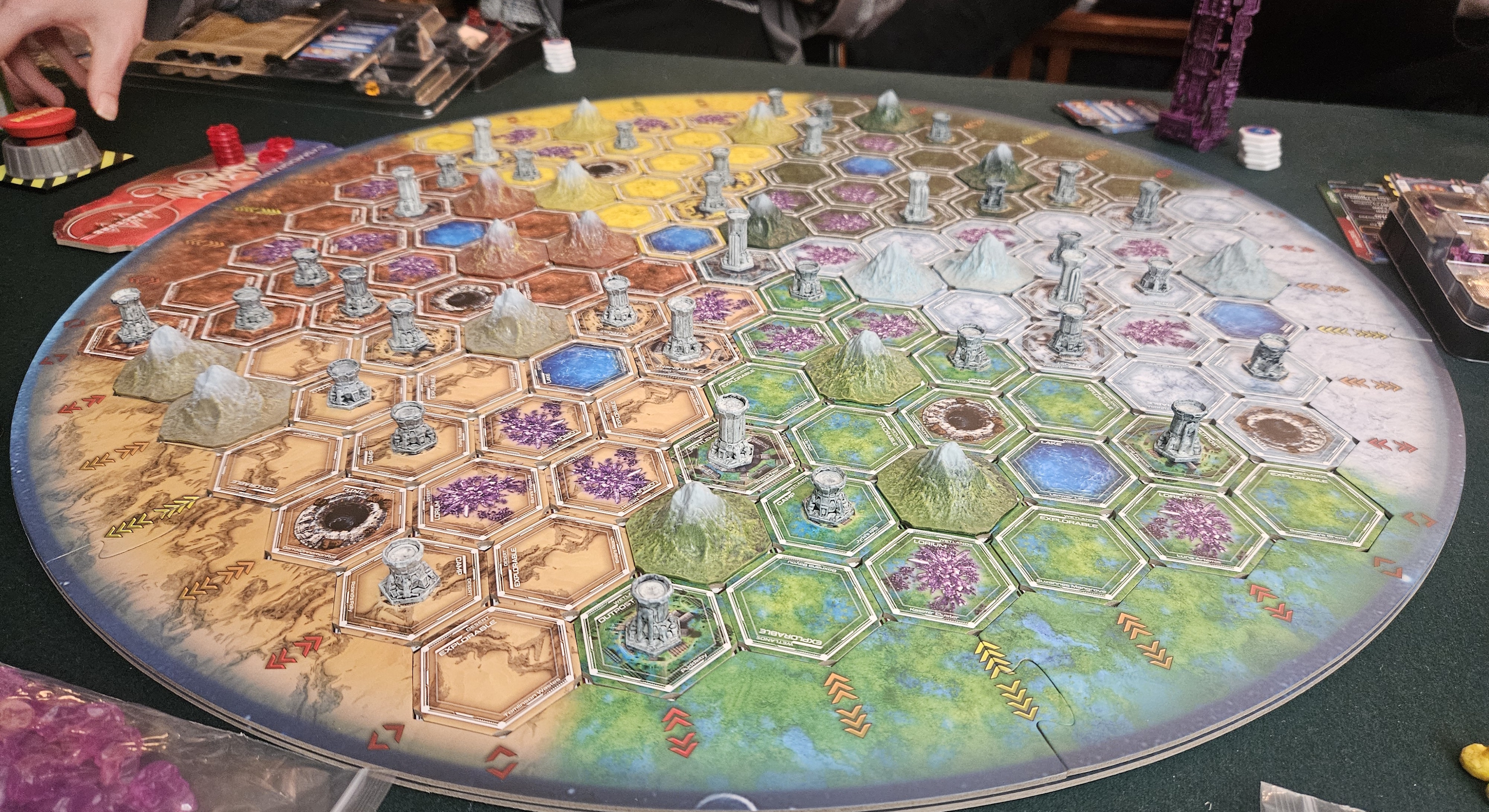
The map is ridiculous.
That’s the narrative scene. The second scene begins on the physical tabletop.
I worry about waste. Not as often as I ought to, probably. Compared to junk mailers and Happy Meal toys and oil wells set alight by incautious tyrants, board games are a drop in an ocean of muck. At least, I tell myself, they’re preservable. I donate some of them, and sell others, and buy secondhand when I can, and try to ensure that they go to homes where they will be appreciated and not wind up in some landfill after only one or two plays.
Cysmic defies that self-soothing rubric. The map is so massive that my group laughed uncontrollably the first time we set it up. Again, it isn’t the largest board game to ever take up real estate on my table, but it’s perhaps the most of everything else. Those frames, with their little magnets underneath the cardboard. The tiles, crafted with fingernail-thick nubs at their corners to make them easier to pry up. The plastic mountains, which called to mind the earliest printings of Runewars, back before Fantasy Flight decided to use cardboard overlays in place of three-dimensional topography.
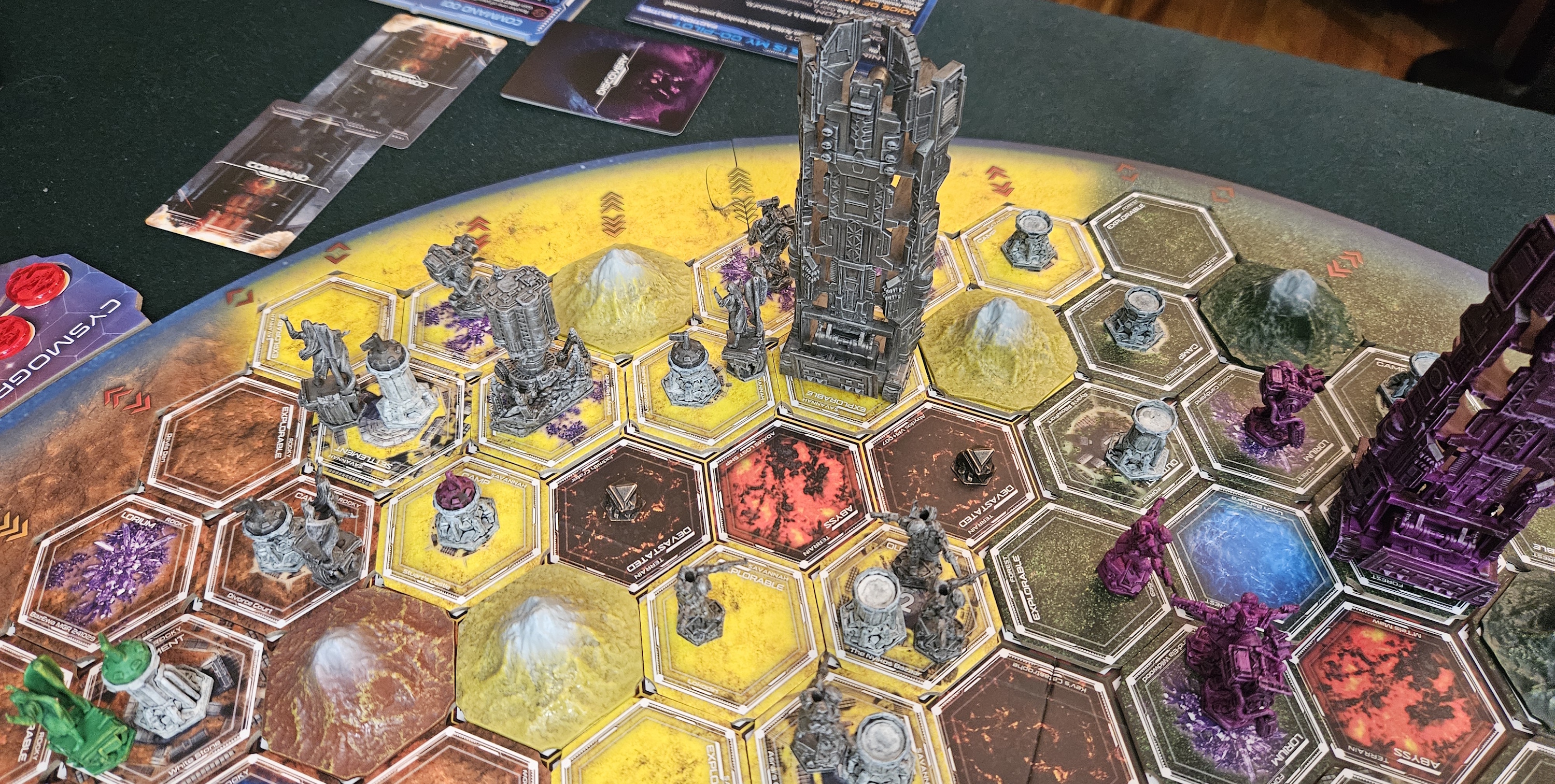
The miniatures. Goodness, the miniatures. Some of them are actually mini. Others, like the spires that hold the components inside your colony ships, an affectation that’s a nice bit of visual design on the one hand but also a physical obstruction of the battlefield on the other, are so large that they veer into self-parody. If you saw this thing on a sketch show, you would swear this wasn’t a real game. Ha ha, we would say, look at the silly nerds, with their jokes about Windows 11 and their board games that defy common sense. Those towers are not merely phallic; they are penises, swollen like Cormac McCarthy’s sunset, like Daniel Plainview’s erupting pumpjack, almost rhapsodic in the baldness of their representation.
To some degree, this clutter is extraneous to the tale Blake wants to tell. It’s so big, for one thing, that many of its rumblings hardly matter. The first time the mantle collapses to reveal the planet’s glowing lifeblood, odds are that the catastrophe won’t come anywhere near you. A settlement falls in, countless lives are lost, but only in theory. There are other settlements to claim, other veins to mine. The scars are mere obstructions, easily bypassed or flown over. Might as well fire up some extra rockets. Charge some lasers. Drill baby drill.
Battle lines begin to form. Soon they’ll fall apart.
Then again, this is also the point. Because Cysmic, in addition to head-banging through the apocalypse, does have something to say about how the proverbial frog gets boiled. One collapse is nothing. Two is nothing. Five is nothing. But a dozen? Now we’re cooking. Like the frog in the pot. Like the settlements that have just fallen into mile-wide sinkholes. Like our troops, those without early warning detection systems, who have gone hurtling into the abyss.
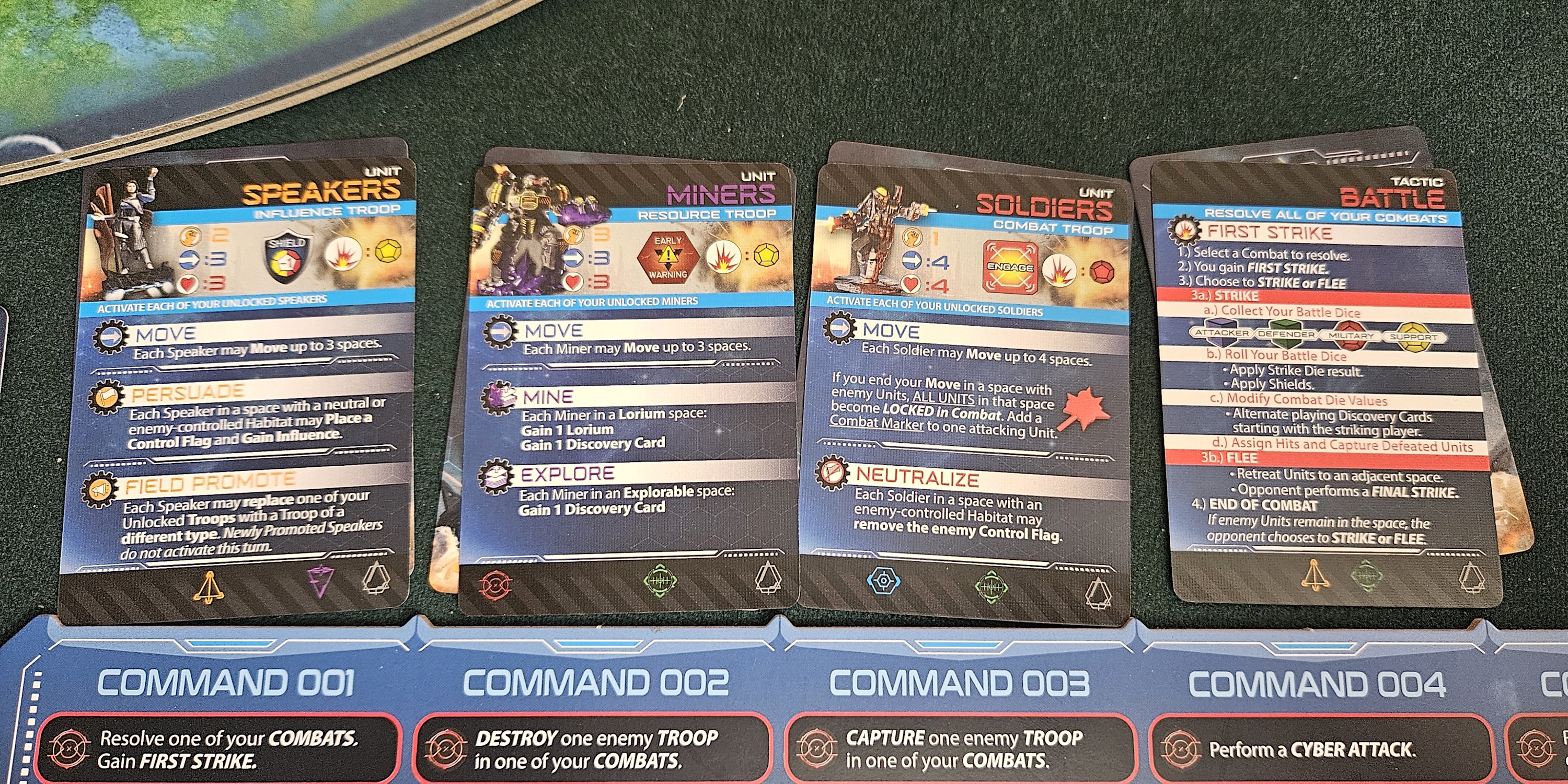
Let’s back up. For a game of such sprawling proportions, Cysmic is surprisingly smooth to play. Each turn sees you selecting a card that activates some segment of your apocalypse-realizing faction. Often, this means triggering a type of unit. There are diplomatic Speakers that are indispensable in the early days and more vestigial once the oven reaches temperature, Soldiers for shooting things, Miners and plus-sized Harvesters for mining minerals, and big jump-jet equipped Powermechs for blasting enemy columns. Other cards resolve all the battles you’ve set up over the previous turns, launch negotiations and cyber warfare, recruit or upgrade troops, the works.
The most transformative card is the one that activates your colony ship. This inevitably collapses at least one hex as your giant launchpad shifts position, squishing troops and cities under its treads and leaving fiery destruction in its wake. This is also an opportunity to attach modules to your ship, provided you have the resources and blueprints to do so.
Despite this clarity, turns aren’t as straightforward as choosing one card among many. In addition to selecting which card to activate, you also choose one that will disappear beneath it. This card is out of the rotation for the time being, depriving you of an entire class of unit or some crucial activity. Sure, there are ways to cycle spent cards back into your hand before the end-of-round refresher, but it speaks well of Cysmic that you’re asked to make tough decisions early and often. These choices aren’t as profound as, say, the hand drafting in Inis or Blood Rage, but they tend to be more significant than the eldritch upgrade paths of Cthulhu Wars.
This positions Cysmic squarely in the middle of the Ameritrash spectrum, somewhere between the poles of “cerebral/political” and “beautifully stupid.” Before long, it touches on both extremes. And while its performance in either arena is accomplished to greater or lesser effect, it always returns to those core tradeoffs between cards. This does wonders for the game. At a glance, you can tell how likely it is that a rival will respond to an incursion with a counter-attack, whether a target can shift a particular unit out of your reach, when the next tectonic collapse will take place. None of this information is foolproof. There are too many special abilities and action cards and faction perks for that. But it’s enough to communicate some sense of possibility, a probability waveform that can be surfed to your advantage.
The command system asks hard questions about your priorities.
So let’s look at those poles.
At heart, Cysmic is a contest of equal-opportunity aggression. Your goal is to complete your colony ship before anybody else, an objective made significantly harder by the absence of blueprints for all six of the necessary modules. Each player has sole ownership of one such module, meaning the only way to complete your ark is by prying the blueprints from their possession.
Fortunately, the blueprints of the far future apaprently come as shareable zip files. There’s no need to be too possessive; your possession of a blueprint does not preclude my ownership. The rub is that nobody is going to hand out their propriety information willingly. There are therefore two ways to gain access to a faction’s data. One, you can steal it via cyber crime, a finicky action that’s one of the game’s many underdeveloped appendages, but a noteworthy one all the same. Or two, engage in battle to kidnap some of their troops for use in a blueprint-for-prisoners exchange.
The implications are far-reaching. The good part is that everybody needs to attack everybody else, at least a little bit, in order to capture enough units to swap for those blueprints. If anything, a few early attacks might render a particular neighbor more or less negligible, which can be a huge relief when you share a border. Once you hold my blueprint, there’s no reason to attack me anymore, barring some late-game stalling for time.
On the other hand, this diminishes some of the game’s other elements. The map, for example, isn’t especially interesting, which is saying a lot when it depicts an entire planet crumbling under the strain of mech battles and mountain-cracking mineral extraction. There’s no reason to hold any territory in particular. One settlement is as good as another, resource veins are interchangeable, troops come and go, and entire flanks might collapse thanks to a random pull from a bag. With no sense of permanence, there’s nothing like a battle line, and the inviolability of your colony ship means there’s nothing to protect.
The closest dudes-on-a-map analogue would probably be Kemet, but one cleared of cities or temples. There’s plenty of territory out there, even a few choke points, but all that landscape provides very little reason to care about one tract over another. As the planet falls apart, it’s possible that some areas will become more valuable, but our sessions tended to conclude before such an eventuality was realized. The result is round-robin aggression, everybody targeting whomever they haven’t yet stolen blueprints from, with very little concern for anyone else.
Prisoners can be exchanged for blueprints.
The good news is that these aggressions are enjoyable enough in their own right that it isn’t as though Cysmic is going through the motions. Battles are punchy, if a little too concerned with different dice types and attack modifiers, and it’s always possible that a gunfight will accidentally split the world at the seams. There’s a little bit of everything in there. Dice, of course, with varying shades for combat and noncombat units; cards, for modifying rolls and maybe springing a nasty surprise; unit and faction abilities, just in case you thought you were getting off easy. Despite this abundance, resolution is reasonable, never reaching Forbidden Stars duration, which is great for the game’s play length if not for any prospective bathroom breaks.
Maybe the biggest highlight is the faction system. Like everything else in Cysmic, there are heaps to choose from, and in place of the expected mealy-mouthed plus-one perks, each team offers something transformative and meaty. One of them adds adjacency to every single space next to a mountain or lake, effectively letting you teleport anywhere at will. Another seizes control of any settlement anywhere on the map at the start of each turn. A third takes their turn at any point in the round — and I mean any point, treating the usual turn order to forced obsolescence.
What’s wild is that these are only the first of those factions’ abilities. Each offering has three or four whoppers. And there are more than twenty-five factions in all, each with their own distinct advantages and playstyles. The only real downside is that they all have dork-ass meme names like Path of the Wrighteous, Moving Mao Tons, or Kriss of Death. Receiving a diplomatic missive from uplifted psychic housecats is one thing; that the kittens have named their faction Cat-Aclysm gives off a real cringe vibe.
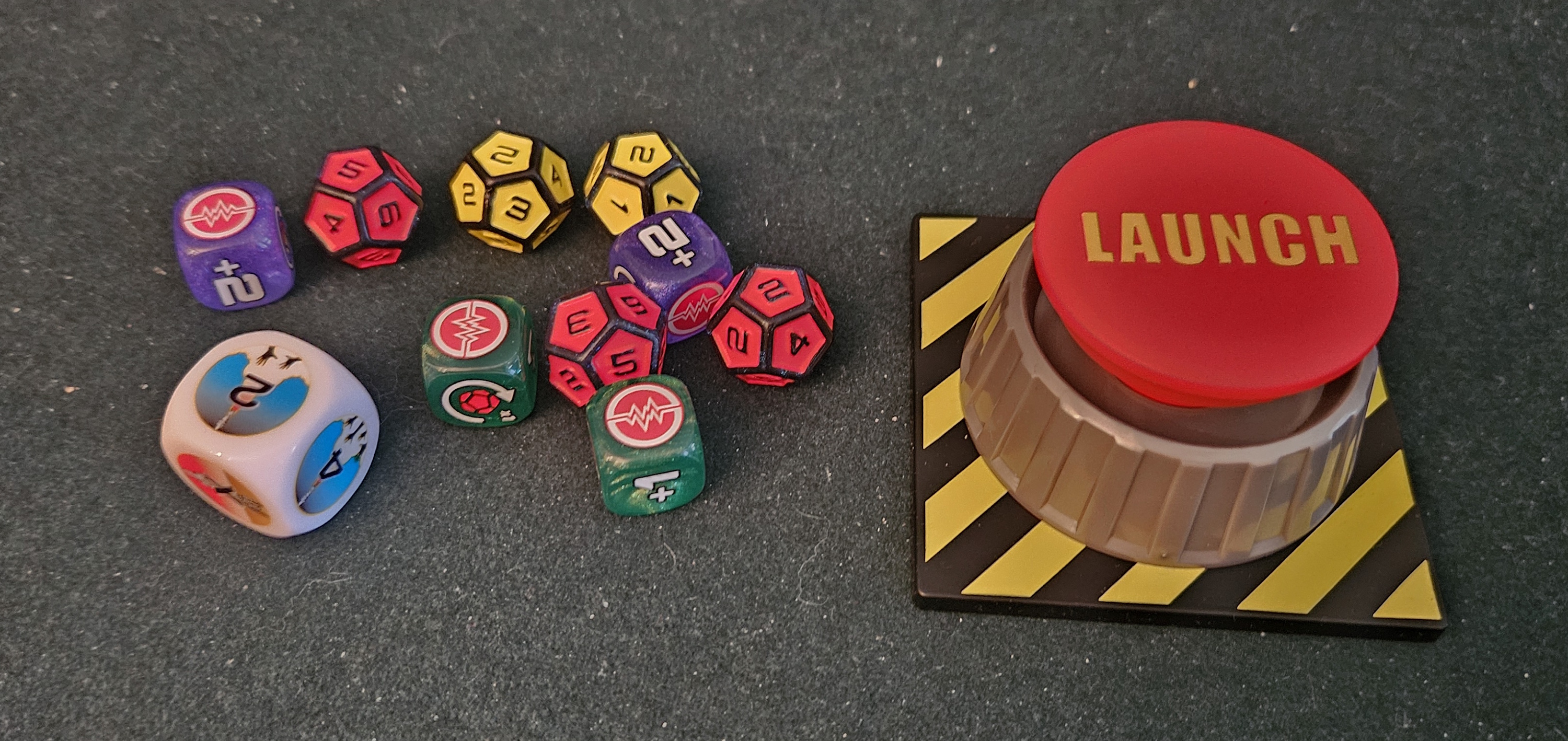
But, look, restraint is not Cysmic’s watchword, so why would Blake rein in the puns? Everything here is the board game equivalent of an extra order of mozzarella sticks. The handfuls of dice. The units you probably won’t field. The sheer variety on display. There’s even a clacky launch button that serves precisely zero in-game function, but which I very much intend to keep when I pass the game along to somebody else.
And, of course, there’s that most emblematic of all components: the conscience die.
Roll the dice. Smash the button. Search your conscience.
To my utter tickling, this final hexahedron serves an indispensable purpose. When at last the planet has been strip-mined, when the blueprints have been assembled, when the modules have been stuffed into your colony tower, the game is still not complete. Now it’s time to blast off for the stars and leave the rest of these suckers behind.
Except you might not be ready to hit the red button. It all depends on the conscience die. When the time comes, you roll and compare its result against the troops you still have on-planet. All the miners and troops stationed in the dust, all the diplomats persuading those neutral settlements that you have their best interests at heart, all the prisoners still waiting for freedom. The conscience die reveals how many you’re willing to leave behind. If there are fewer out there than the roll, you leave. Kaboom.
But if not, you stick around and attempt to evacuate more bodies, more lives. With the right resources, you can try the roll again next turn. Without them, you’ll have to wait for the end of the round when your cards return to your hand.
Either way, Cysmic has done the unexpected. It has grounded the moral cost of its conflict. In incredibly shaky terms, yes. In a way that rewards losing units to cave-ins and enemy assaults. In a way that makes the anthropogenic horrors visited on its planet and peoples seem all the sillier. But in terms that, imperfect as they are, most historical wargames don’t even attempt, and which — and I say this in all seriousness — we would laud in a game with a more solemn setting. Because even here, as the world collapses toward its molten core, sometimes the cost is too high. Sometimes you can’t bring yourself to make the hard choice. Even if you happen to be a battle-hardened jerk named Minnesota Killjoy.
(Yes. That is one of the game’s factions. Save me.)
Ah. Ludicrous.
This, I think, is what sets Cysmic apart. It’s too big. It could have been pruned down. It doesn’t need quite so many alternative modes. The mountains could have been cutouts. The launch towers could have been a little less, ah, engorged. There didn’t need to be magnets all over the place.
But it’s also a huge cry from the crowdfunding trash that gives miniatures-heavy games such a bad name. Unlike some of those titles, maybe even unlike the majority of them, Cysmic is a game one would actually opt to play. And more than that, it’s an earnest experience, one packed with exciting battles, a landscape undergoing disaster, a race to survive at all costs.
It even has shades of meaning in its human-hastened collapse, one that feels all too timely. Here in the desert of Utah, a billionaire has announced a 40,000 acre data center that will triple the state’s power consumption. The stated reason is national security, a digital arms race against China. This despite the professionals at the local universities pointing out that we don’t have the water, don’t have the heat allowance, don’t even have much of a Great Salt Lake anymore. Will our elected officials make a saving throw on the conscience die before they bake us to death? I hope so.
For a board game, that’s the sort of thing that makes us say it’s punching above its weight. When it comes to Cysmic, the aphorism feels wrong. Let’s instead say it’s punching at precisely its weight. Fine: maybe a little under.
A complimentary copy of Cysmic was provided by the publisher/designer.
(If what I’m doing at Space-Biff! is valuable to you in some way, please consider dropping by my Patreon campaign or Ko-fi. Right now, supporters can read my first-quarter update of 2026: the best board games, movies, books, and more!)
Voyages, the first of Matthew Dunstan and Rory Muldoon’s single-sheet print-and-play roll-and-write games, used three dice. Aquamarine used two. Waypoints continues the trend by using a single die.
That’s cool in its own right. But that isn’t what makes Waypoints special. What makes Waypoints special is the way it handles the movements generated by its rolls. Where those other titles — and let’s face it, most board games — featured straight movements, point to point, A to B, nearly every move in Waypoints is the sort of move you might actually make while traversing an open space.
Here, I’ll show you.
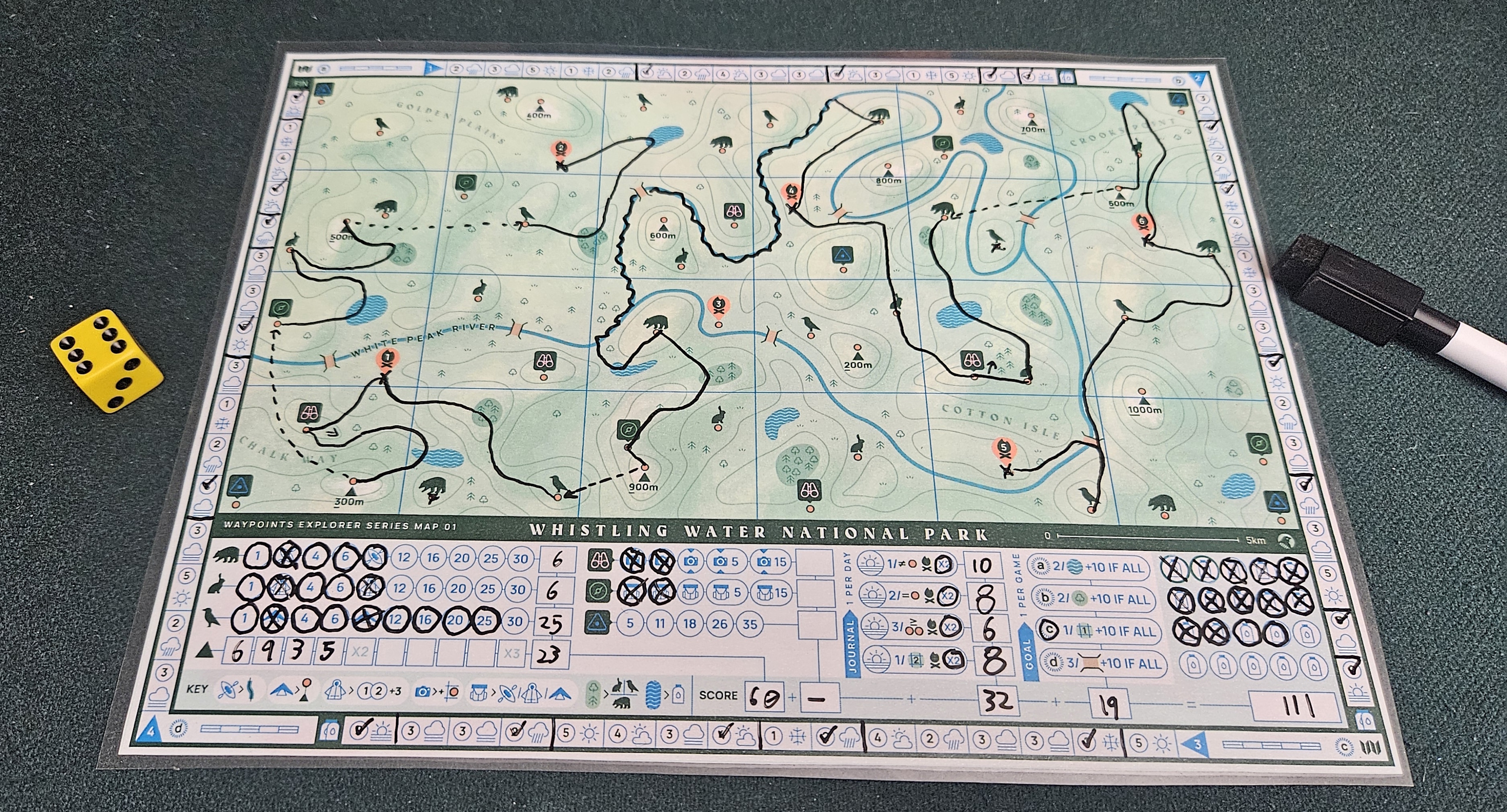
A glimpse of the first map and the many places it might take you.
You’ve taken the Internet’s advice to touch grass. And with gusto, because rather than go to the park or something, you’re opting for a four-day wilderness expedition. Hopefully you aren’t prone to hay fever.
The gist behind Waypoints is that every turn you’re allotted some number of movement points. The number itself depends on the weather, and isn’t as simple as rolling the die and moving as far as it indicates. Instead, your roll shifts you forward along a track and reveals the current turn’s weather for everybody at the table. Inclement showers or storms might confer only a single pip of movement, while sunny afternoons offer a full five points. You also have a limited supply of water, which can be spent to stretch yourself to greater distances.
Every move begins and ends at a waypoint. When the game opens, that’s a campsite. Turn by turn, that might mean a wildlife site, a peak, a hot spring, a scenic overlook, or any number of other destinations. There are plenty to discover, and across the game’s five scenarios there’s a fair bit of variety. Along the way, you might swing by special features, like water sources or forests, but these aren’t waypoints, just side destinations on your way to the main thing. If you can’t reach another waypoint, that’s fine, but it means you’ll be stuck at your starting point pumping some extra water instead of moving anywhere at all.
As for those movement points, they’re spent by crossing lines. Latitude and longitude? That’s a point. Elevation? Another point. A long-distance trek involving multiple map segments and lots of hiking up and down ravines? That’s possible, but you’ll probably need a decent stretch of good weather. That or guzzle tons of water.
Each map prioritizes a different skill.
Very quickly, these inbuilt limitations give your movements a certain naturalistic beauty. Rather than dealing in straight lines, as the crow flies, Waypoints challenges you to think like a gravity-bound creature. You’ll scurry along ridges, stick to gullies between rises, find open stretches of flat ground for traveling long distances, march up inclines in short spurts.
Of course, saving energy is only half the game. You’re here to see things. And the things most worth seeing outdoors are liable to be hard to reach. There’s a balance to be struck, then, between conserving your strength and pushing yourself to see the best sights.
But the result is a creativity of space, energy, and distance that’s rarely expressed in a medium as literalistic and rules-bound as board games. Often, the best route will be circuitous, the one that loops the long way around a peak. Or one that swings down a hill to collect some water, across a meadow to investigate a forest, and then around and up an incline where you’ll deploy a hang glider to soar to your next destination.
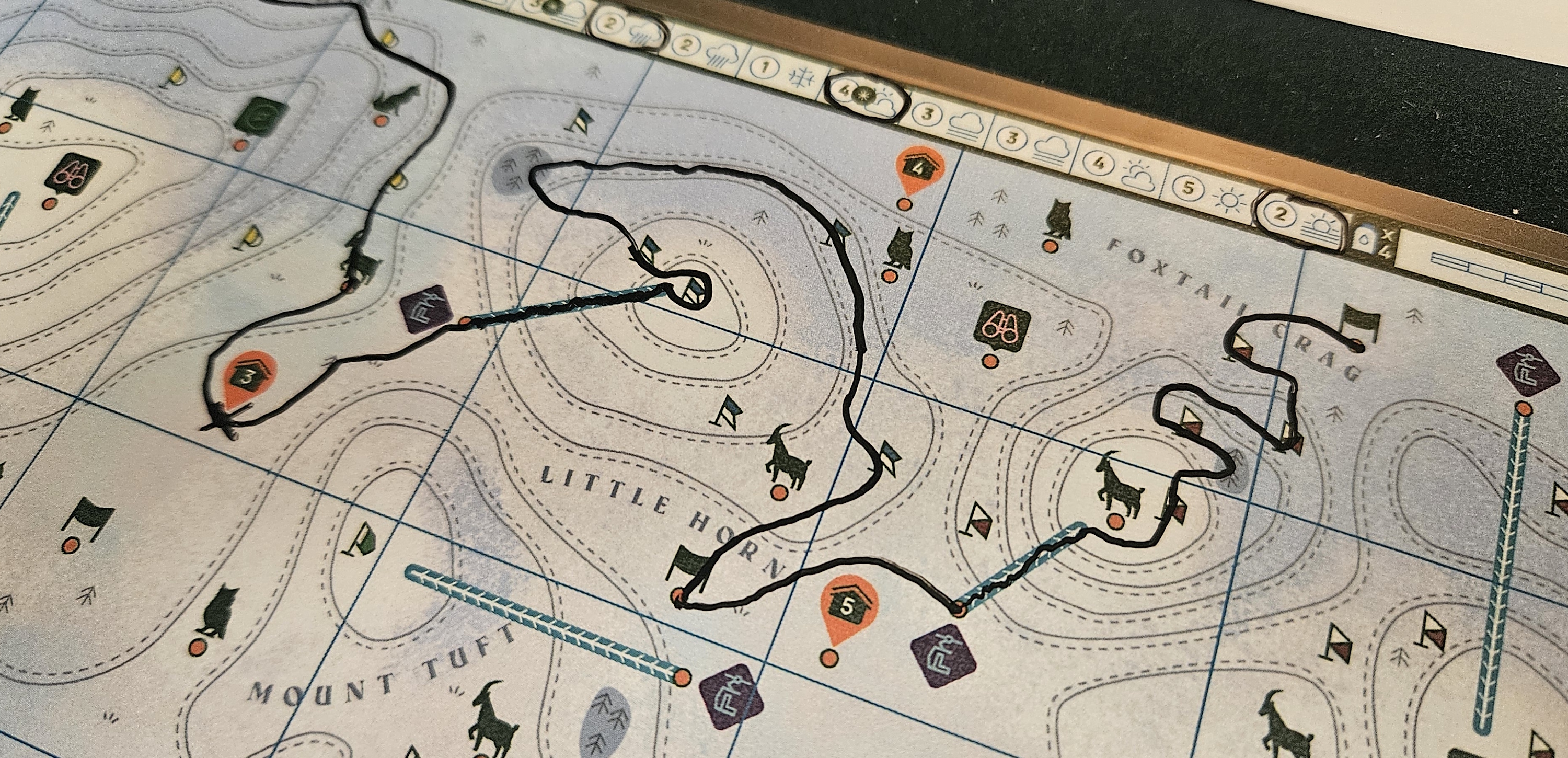
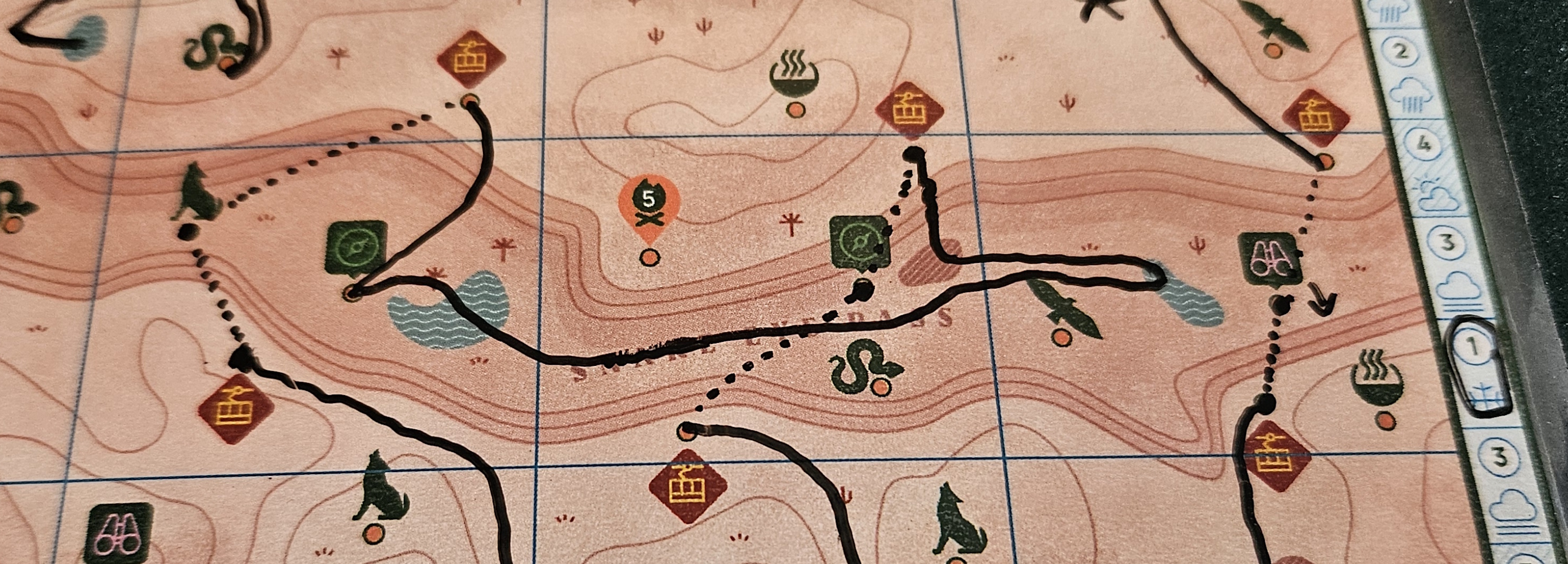
Because of course there are special abilities. In the first map, you quickly avail yourself of hang gliders and kayaks for covering great stretches of the outdoors. On other maps, your tools might include climbing ropes, cable cars, bicycles, snorkel gear, dinghies, ski lifts, or ferries. This produces fresh conundrums for each scenario. More impressively, these differences are also visible in the lines you draw on the map. In the desert, you tend to travel in spurts, sticking to shade or rationing your movement around the great canyon bisecting the map. On the ski slopes, shuffling upward is more difficult than gliding downhill, resulting in sharp rises followed by sweeping, switchbacked movements that visit feature after feature before arriving at the turn-concluding waypoint. In Waypoints, your mode of transportation is written directly onto the page, visible in the sweep of each route.
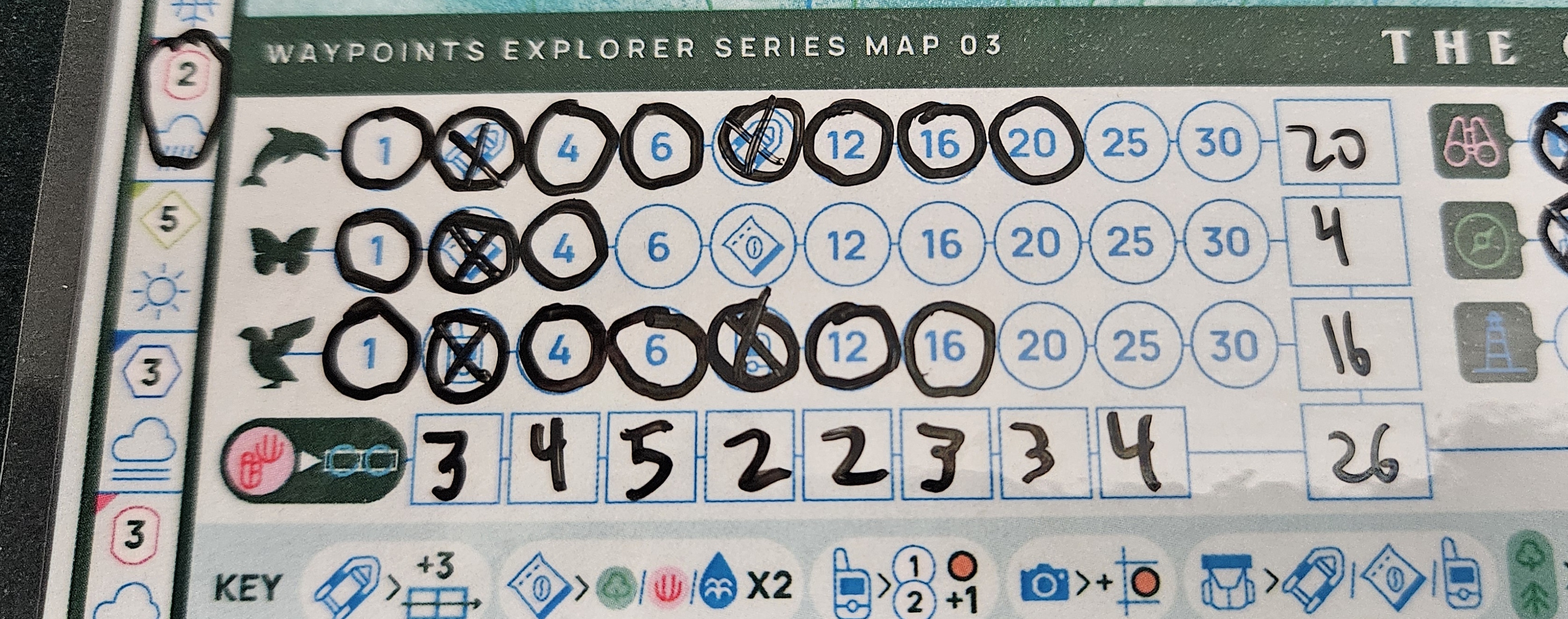
Meeting wild animals confers a wide range of benefits.
Like the previous entries in Dunstan and Muldoon’s movement trilogy, Waypoints is heavy with scoring opportunities. Fortunately, also like Voyages and Aquamarine, the scoring is interesting at all points.
The main commonality between maps is wildlife. There are always three types to see, and apart from occasional oddities — on the coastal map, the majority of my dolphin sightings occur in forests — it’s rewarding to watch your appreciation tick upward, earning not only points but also additional tools to make traversal easier. Beyond that, maps grow more playful. In one, reefs earn additional points later in the day, creating a situation where you’re incentivized to visit them late, but not so late that you get stranded when the day unexpectedly comes to its end. In another, you parcel out slugs of whisky between visiting local breweries or slogging through lochs in search of monsters.
Perhaps the one sour note is yet another repeat: the solitaire mode is a letdown. As with Voyages and Aquamarine, this is one roll-and-write that’s far more interesting to experience with other human minds. The problem is that the solo objective is incredibly easy in a vacuum, asking you to ensure that you conclude each day at a campsite. When that’s your primary objective, it’s a thing easily accomplished.
With fellow trekkers, the real goal is to wring every last point out of an imperfect day. Some hikes will be cut short, the caprice of the dice only offering a small handful of turns before the sunset brings your trek to a close. Others might even go long, your hiker hovering around a natural concluding point, only to find themselves distracted by extra sights. Regardless, there’s something satisfying about facing challenge after challenge, feeling like everything is going wrong, only to look at a rival’s sheet to discover that, you know what, your journey was rather remarkable in the end.
That time I scaled the Grand Canyon eight times in a day.
That’s the last great thing about Waypoints. In the minute between scoring and erasure, you get to look back on this thing, this little journey, and behold what you’ve accomplished. The strange loops, the reversals, that time you got stranded at a lighthouse for the night. The stories this game tells are small and gentle, but that’s also what makes them worth tracing one last time. This is no battle. There are no foes to vanquish. Only you, a fellow player or ten, and the routes you penned onto a map.
It’s a rare game that lets its players be so expressive. That Waypoints does so much with a sheet, a pen, and a die is nothing short of wonderful. I liked both Voyages and Aquamarine; against all odds, this one outdoes both of them at their best.
Access to the files to print Waypoints was provided by the publisher/designer.
(If what I’m doing at Space-Biff! is valuable to you in some way, please consider dropping by my Patreon campaign or Ko-fi. Right now, supporters can read my first-quarter update of 2026: the best board games, movies, books, and more!)
The original Fallout — the original original, the video game, the one from so long ago that they refused to sell it to me at the media section of my local grocery store because it was rated M for mature and as a twelve-year-old they suspected I didn’t qualify — it had a time limit. After a certain number of in-game weeks, the quest failed. Sayonara, Vault 13. Sorry about the terminal dehydration.
You know what else has a time limit? My life. Your life. All of our lives. I was once advertised a wall calendar that would count down the weeks in the average lifespan. It was perhaps the grimmest thing I’ve ever seen, one’s life scratched off week by week. Fallout: Power Play is that ghoulish product in board game form. It is a waste, the subtraction of every minute in its presence keenly felt. If the function of art, as Tarkovsky noted, is to harrow the soul and prepare it for death, then Fallout: Power Play is anti-art. It is a game that makes me unready for the beyond, incurious to receive the answer to the great mystery that awaits us all. It makes me resentful and crabby. It makes me want to claw those minutes back from the felt and stuff them red-nailed into the craw of whichever anonymous designer retched forth this slouching antichrist.
I do not recommend it. Not ironically, not for a sake of a lookie, not to release its carbon back into the atmosphere through combustion. Stay away. The radioactive skeleton has been thus mounted atop the dump, its meaning undeniable. If you enter here, you will leave poorer.
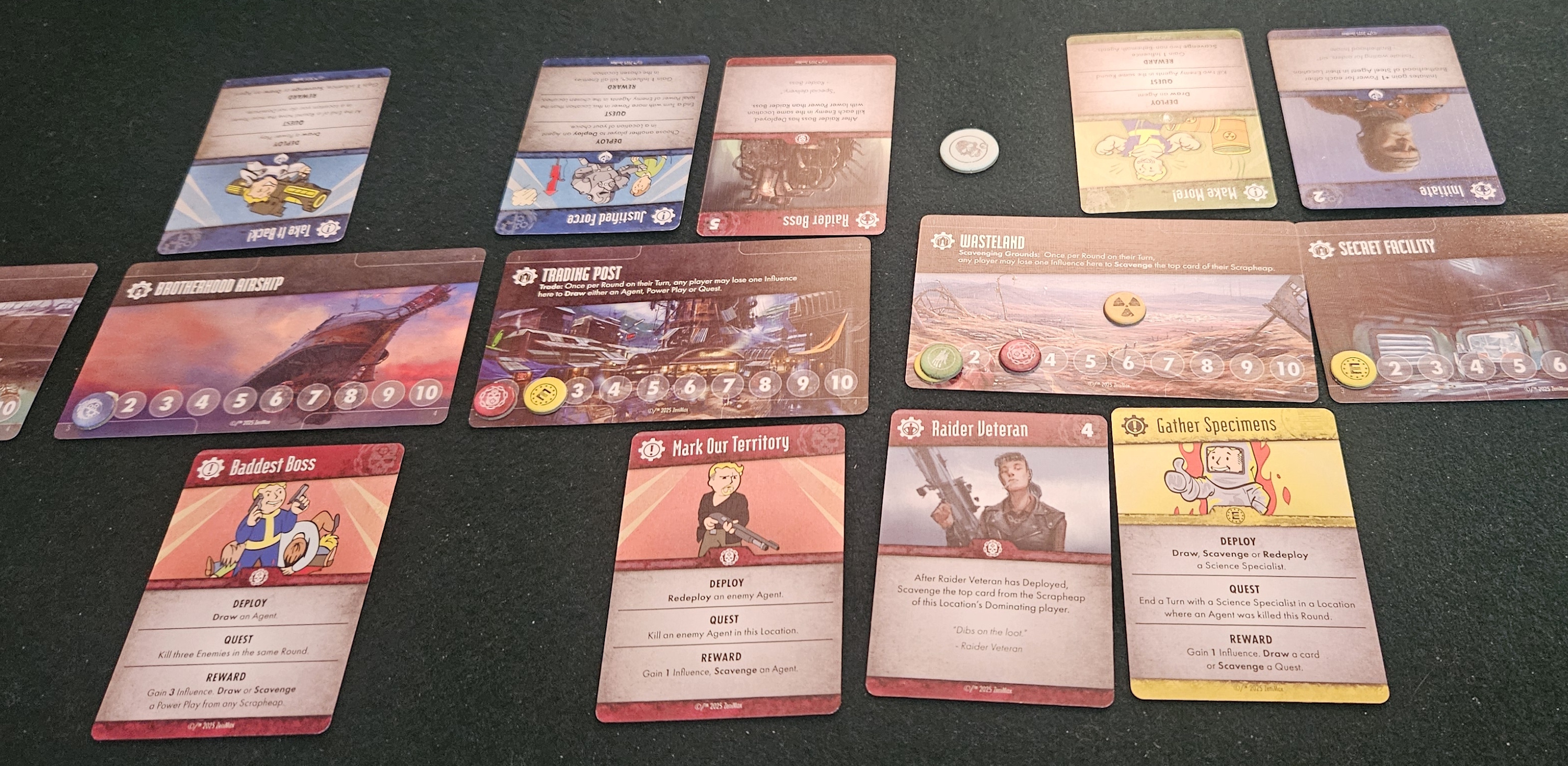
The distant appearance of a lane-battler.
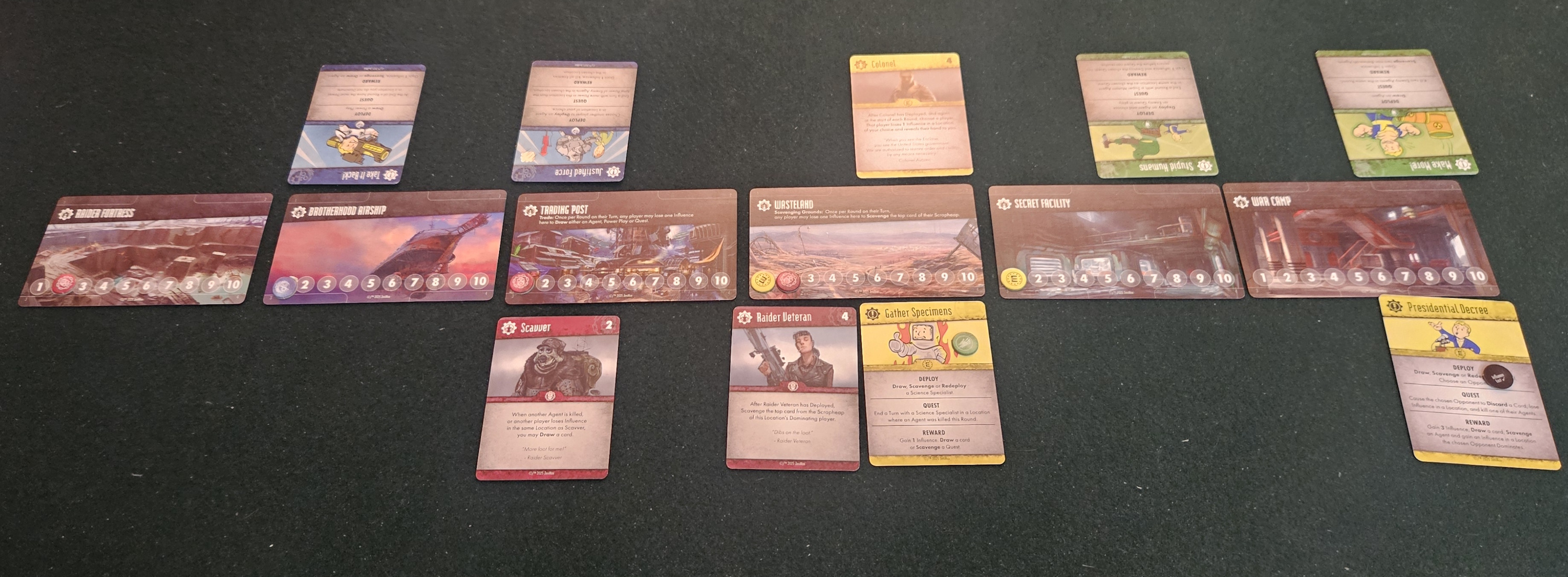
Ostensibly, Fallout: Power Play has the outward appearance of a lane-battler. The wasteland is presented as a series of locales, theme-park destinations like the Brotherhood Airship, the War Camp, the Trading Post. Generic and safe, like every Fallout after the first two and New Vegas, strip-mined for maximum return on investment.
Into these locales you will deploy — you will maybe deploy, but we’ll circle back to that — the populace of your faction. There are four in all. Most familiar even to outsiders is the Brotherhood of Steel, those much-fetishized techno-cultists, in their iron suits that smell of piss and incense. They are matched by the Enclave, the baddies of the series, although only in the sense that they are slightly less nostalgically laden; the Super Mutants, greenskin crazies shorn of the cognitive internality that marked their earliest incarnations in the video games; and the Raiders, who one suspects were included because the designer was running out of ideas but had been tasked with shoehorning in loony-bin scavengers for the sake of marketability.
Ostensibly — there’s that word again — these factions go about the business of deploying their scientists and tin-can warriors and yellow-toothed scavvers and greenskin mooks into these locales, with the aim of securing influence and therefore victory points one pip at a time.
Only, as you might have guessed, this is not what happens. No sir. No ma’am. Not even close. Balance isn’t something I usually fret over. It’s a coward’s concern, the birthright of those mewled into comfort from infancy. Balance? I might as well bellyache about fairness!
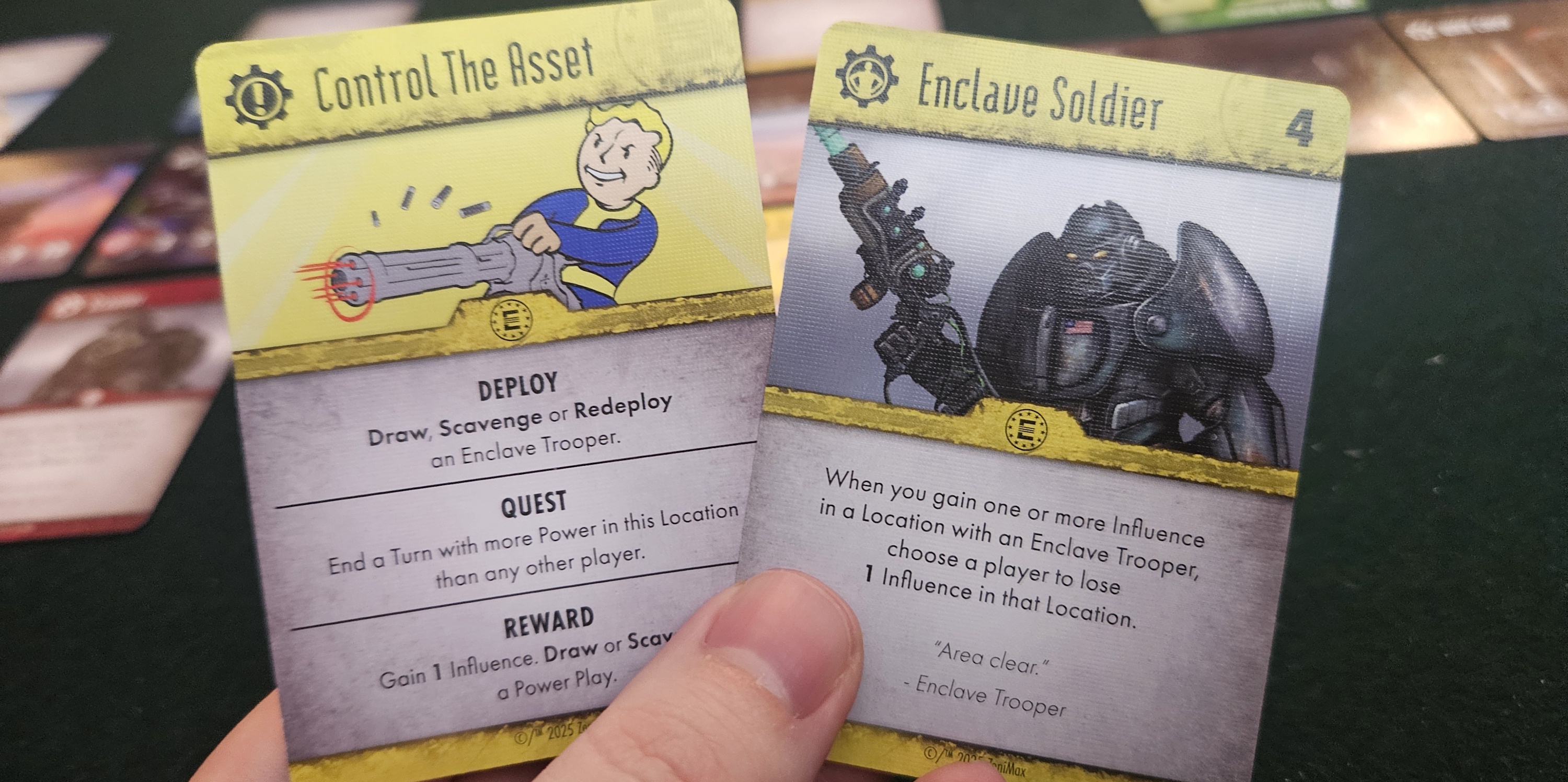
But in Fallout: Power Play, we are reminded of just how good board games have gotten over the past decade. I speak not of the balance between decks, between factions, because it’s impossible to get that far. Rather, the issue is wholly internal. These decks are so lopsided that there are hardly any troops to deploy. Those boots that must be placed on the ground, which indeed are required in order for the game to function, are the exception rather than the norm. In place of manpower, all four decks are top-heavy with everything else. Missions, which seed little objectives that, surprise surprise, require the troops that you only occasionally have access to. Powers, which, what do you know, also riff on the troops you may or may not have deployed to the wasteland’s many sunny destinations.
Signs and signifiers, devoid of the soul.
As a result of this crooked state of affairs, most turns are spent waiting around. Passing. As in, literally telling the table “I pass,” like a kid who forgot their homework, only in this case the teacher neglected to hand it out yesterday, but has, in their cruelty, still insisted that their pupils collectively pass their papers to the front. “I pass,” you say. “Pass,” says the next player. Someone else dumps three troops into a location. Luck of the draw. “I think I will pass,” says the next player, and then, in an attempt to interject some levity into this torment, they add, “But I am choosing to pass. I am not passing because I don’t have any cards to play.”
They are lying. Lying to themselves that this experience could be buoyed. Lying to themselves that they might reclaim these misspent minutes.
Is this a commentary on the unfairness of war? Of how war never changes, parroting the catchphrase that has become self-parody? If only. I might stomach a game that wanted to teach me something, even if it were as badly done as this.
But Fallout: Power Play cannot keep its own story straight. The cards urge their players to trigger activities that are impossible. Bold keywords that go unexplained, their meanings only guessed at, peer back from the cardstock like the unblinking eyes of the abyss. Other cards sport instructions that the game declines to enable or explain, the equivalent of an apocalyptic warlord who amuses himself by playing games with his prey. When the player is told to “choose a quest,” how are we intended to denote such a thing? Memory? A nonexistent token? A tapped card? Do we announce the choosing, or leave it secret? Can we cheat? Can we change our minds? What if the quest is removed? What if upon its removal it reappears? Is there bluffing in this game? Is there a soul, some form-space version only accessible within the sulci of the designer’s mind? If so, how might we access it? Would a surgical drill suffice?
I adore games. Bad games, too. Like bad art — bad films, bad books, bad paintings — there is an earnestness that makes all of human endeavor worthy of investigation, even if only as a means to understand its impulse and methodology. I can play a bad game. I often do such, and have a wonderful time examining what makes the bad game bad, what makes it fall short of what-could-have-been. Even bad games are worth my time.
What I cannot play is a tossed-up wad of cardboard that has been struck before me with the intent to waste my time. I say “intent” because at least then Fallout: Power Play would have been produced with something like intention, something like deliberation, rather than this generated slopmess, this uneager unthinking unplay. I have been pranked by a trickster; that would be better than to have suffered so unwittingly. To unwit, then, the only object of curiosity in the entire package is the absence of the designer’s name. It is there. It can be found. But it is hidden, neither on the box nor attested on BGG. At least that speaks to some measure of dignity. A dignity denied to me, by the way, in the moments Fallout: Power Play has stolen, irrevocable and irretrievable, from the precious span of my life.
1 1000 51 6 500.
I want those minutes back. I am resentful, like the firefighters sent into Chernobyl, the authorities insistent that we are safe, this was a mere accident, the graphite on the ground has only charred our flesh because our lying senses are mistaken, now will we please whittle the oaken heartwood of our limited days on this bounteous Earth down to a flinty toothpick for the sake of somebody else’s error, somebody else’s neglect, and while the shavings pile up at our feet, minutes that will not be reclaimed, but will be stricken from those that might be shared with our children, their faces upturned to adore the parents whose lovemaking gave them life and who bounced them in their exhaustion until they could at last close their eyes and sleep, while those shavings mound to our knees, will this game forget that these objects are meant to be joyous reflections of our birthright as creatures who learn from our frolicking, who test gravity with leaps and who learn songs through atonal screeches that set our hearts afloat despite their assault on our eardrums, and this is life and what it could be, what it was meant to be, and this ungame, this hideous thing, should not be experienced by man nor beast, but consigned to the mulch of the soil until it enriches something for the first time since it was atomically the lignin of a great tree, now whittled to shavings, its compressed heartwood all in fragments on the floor, and there is no gluing together what was carved apart with sharpened iron and thoughtless conception.
Do not play Fallout: Power Play. I challenge you to never play it. I dare you to stay away. I beseech you, I beg thee. There are better ways to exhaust this one life you have been given by god or the universe. Write a poem. Draw a stick-figure. Design a game. But make it yours. Show me what you have made. It will be better than this, and I will receive it with eyes of joy.
A complimentary copy of Fallout: Power Play was provided by the publisher.
(If what I’m doing at Space-Biff! is valuable to you in some way, please consider dropping by my Patreon campaign or Ko-fi. Right now, supporters can read my first-quarter update of 2026: the best board games, movies, books, and more!)
Quinn Brander’s Rebuilding Chicago is one of the best polyomino-placement games I’ve ever played. That’s the lede, and I will not bury it. Even moreso than its predecessor, Rebuilding Seattle — not to be confused with Raising Chicago, which I do pretty much every time I say the game’s title aloud — this is a tight, smart, and addictive approach to city-building and competitive brinkmanship. The more I play it, the more I want to keep coming back.
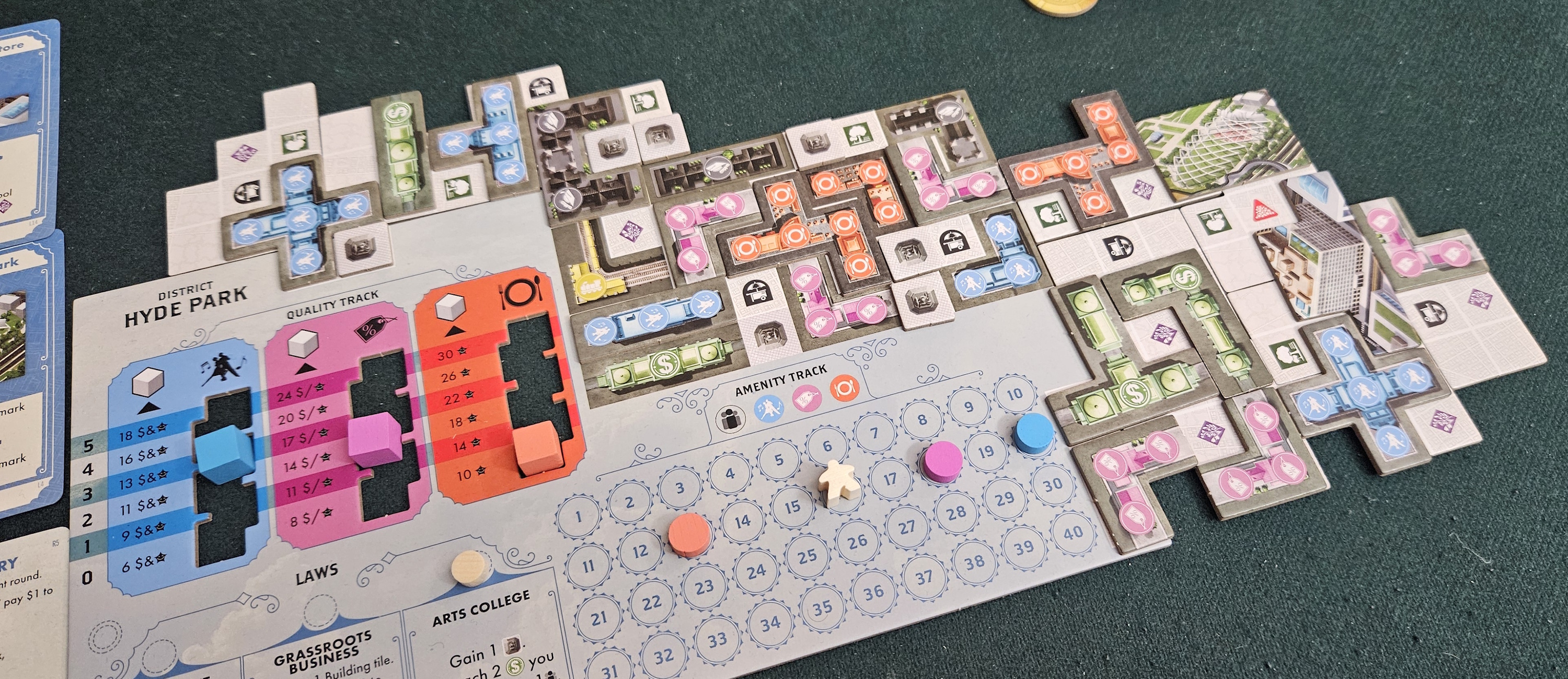
The player boards are also where you build your district.
Lest this become a comparison piece with Rebuilding Seattle, let’s nudge the parallels out of the way. Yes, this is more or less the same system. But where Seattle had some baggy Ozempic skin wrapped around its bones, Rebuilding Chicago sees Brander screwing down every edge and flap until all that remains is a taut cable that bears so much more weight than its predecessor.
We begin with the usual tale. Chicago has burned down. Cow in the shed, fire fire fire, a hot time in the old town tonight. Now it’s up to you to transform the rubble into not only into a place people can inhabit, but one they might visit from afar. A World’s Fair city. A city that stands for a thousand years. Or at least a little over a century, barring any further catastrophe.
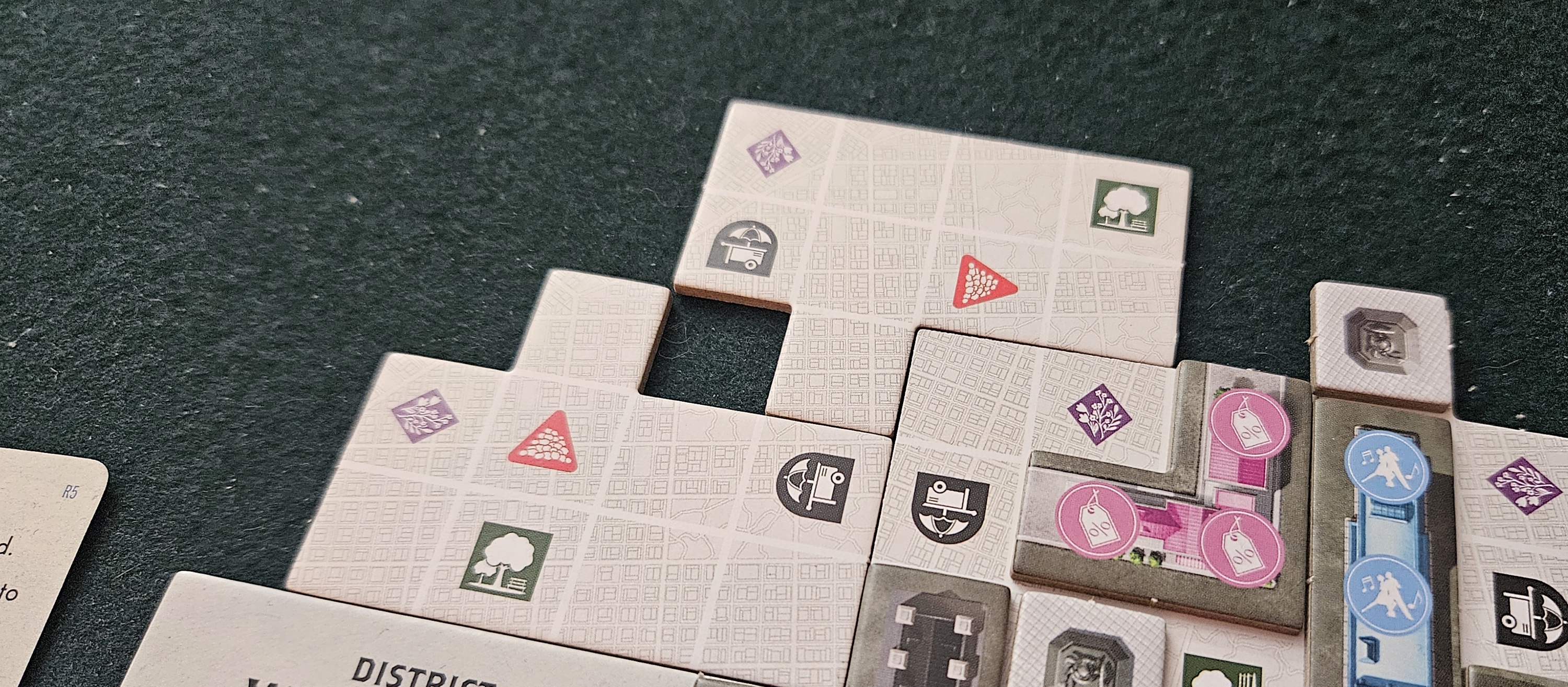
Right away, there’s a confidence to the whole thing. Your player board, festooned with trackers and laws only you can pass, also shows the first portions of your city district. Cleverly, this district is fragmented. There’s the main area, filled with food carts and gardens and public parks — a lot of rubble, too — where you will place the structures that govern your city’s progress. But there are also two smaller areas, way off to the left and right. You’ll bridge to these areas eventually, but until you do so they’re unavailable, just collections of spun-off decay that must be reached eventually lest they produce an eyesore from afar.
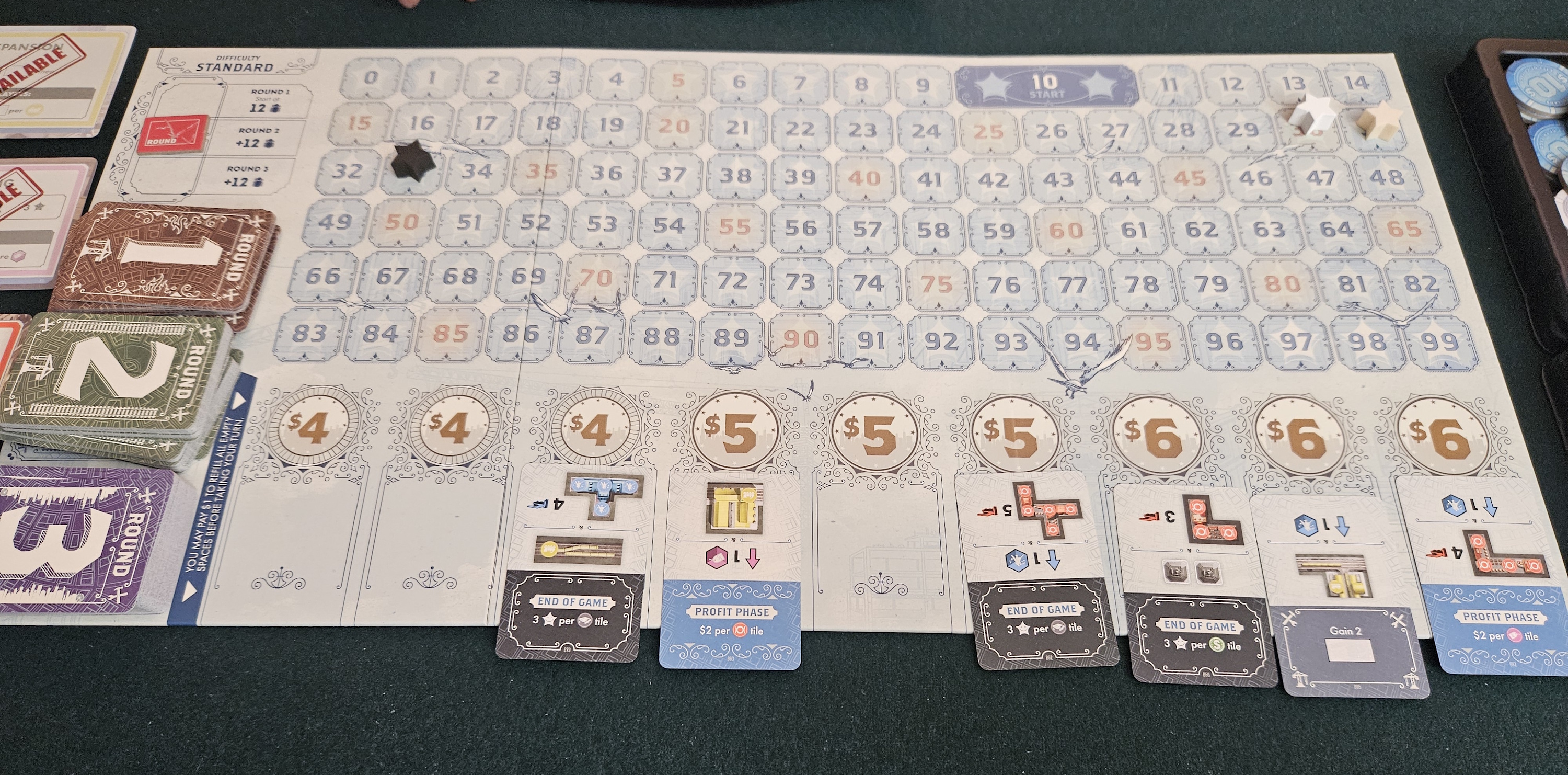
The card offer and scoring board is printed in base 17 for some reason.
Rebuilding Chicago, then, is a polyomino game in two layers. Underneath it all are suburbs, oddly shaped pieces that don’t always fit together easily, each providing the same icons that dominate your main board. Once adjoined to the rest of your city, these then provide the foundation for everything else.
It’s a little bit like building one jigsaw atop a different, mismatched jigsaw, with certain pieces you’d rather not cover because all those hot dog stands will provide income at regular intervals. But given how tight the game’s geography tends to be, sacrifices will have to be made. It isn’t uncommon, for instance, for your pitiless district councilperson to glean the benefit of those local hotspots, only to then immediately eminent domain them into new shopping centers.
There are seven types of structure in all, but three of them are given outsized attention: shopping, nightlife, and dining. These are your amenities, and unlike the banks and train stations and everything else, they’re given special trackers for both their quantity and quality. This is crucial, because at certain points someone, whether yourself or one of your rival district bosses, will trigger these amenities to score. When that happens, you check their position on your trackers against how many dissatisfied citizens are living in your district, subtract any shortfalls, and then earn victory points and hard-earned cash on the result.
Those gaps in your city are entirely legal.
In addition to your ongoing construction projects, Rebuilding Chicago contains a whole series of interlocking systems, but never so many that the game becomes complicated to cluttered.
To start, there’s the drafting. You select buildings, bonuses, amenity perks, and everything else via a market draft. Each card offers both structures and some other bonus, forcing players to make hard decisions almost every turn. Meanwhile, the market doesn’t refresh unless you pay some cash to do it. This can feel restrictive at times, especially when you’re scraping the till for every last nickel, but also prevents the table from churning through the decks — of which there are three, one per era of the city — until they get precisely what they want.
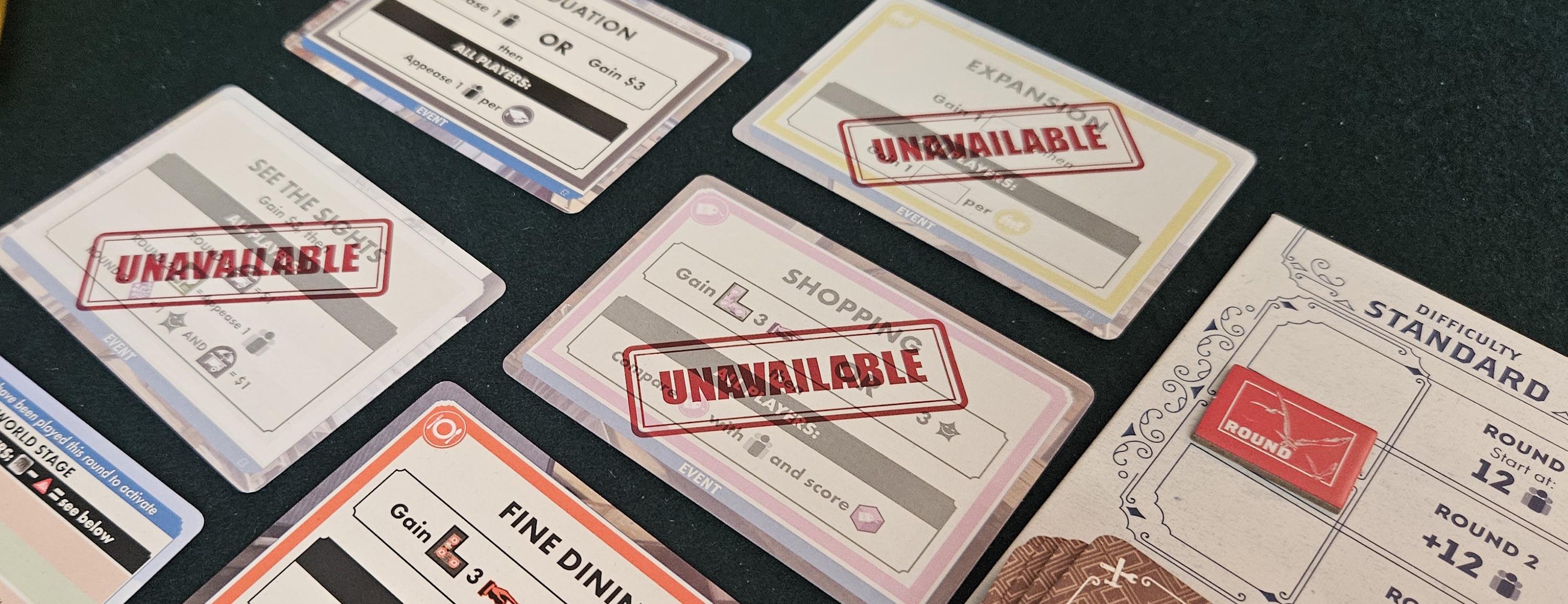
Overlaid atop everything else is an event system that’s purposely frustrating in all the right ways. Claiming an event awards some minor bonus to the triggering player, while also applying a broader effect to everyone at the table. In many cases, though, the best outcome is to let some other rube trigger them so you can benefit without having to spend the turn.
These events run the gamut: new suburbs, cash for hot dog stands, scoring checks, even occasional bids to ensure your city is visible on the world stage. There are subtleties aplenty to consider, especially since events tend to be scattered among the usual card-drafting and city-building, producing little windfalls that punctuate the action. The result is a circadian rhythm that propels the game through both ups and downs. Sometimes players are flush with cash, other times events provide necessary infusions. It’s significantly more organic than the systems found in some tableau-builders, where everyone has resources until they don’t. Here, everybody is involved until the last event has been claimed. Then it’s time for the next round.
Events are powerful, and dictate the duration of the round.
Perhaps best of all, Brander’s vision of a city on the rise is pleasantly nuanced. The amenities are the clear show-stealers, with their periodic checks and windfalls. But every project receives its due in some manner. Trains allow access to distant suburbs, making expansion all the easier, although at times the additional responsibility can prove overwhelming, especially in the game’s early stages. Schools reduce the number of grumpy citizens, making it easier to appease your population via amenities. Financial institutions make money, special landmarks trigger sweeping bonuses that can alter your approach to scoring, and even single-square monuments serve to beautify your urban landscape and pave over unsightly messes.
It helps, too, that each player is given control over their own district, complete with its own starting benefits and unique laws, the game’s term for special abilities you can trigger once per round. The Loop, with its easy access to transportation, tends to expand rapidly, while River North feels a little more scrappy and Lincoln Park is thick with cash potential. There are six districts in all, and rather than settling for my usual three plays I couldn’t help but give them all a try, observing how Brander invests his system with distinct puzzles despite making only the barest of tweaks. My personal favorite, Hyde Park, leans into the education strategy to quell its citizen-grousers, but there are other approaches, all valid, with their own advantages and drawbacks.
Which is to say, it’s a stunningly rich system for so few rules. Perhaps that’s to do with how it always returns to its core considerations: the draft and how your rivals can steal precisely what you were looking for, the events that might occur one turn shy of their maximal benefit, and above all those wonderful skylines, all Tetris pieces and larger landmarks and monuments spackled into the cracks. This is one of those rare games that asks to be looked at for a moment, to be beheld, before everything gets sorted back into the box.
Hey, I’ve been to there.
In the end, Rebuilding Chicago realizes the promise of Rebuilding Seattle and then some. Where that game played it loose with every detail, this one cinches up its suspenders. The result is a mighty fine game in every regard. As a drafter, as a race, as a series of accidental or snitty thefts between players, as a positional puzzle to use every last acre of a city in metamorphosis. Here’s to a second round with each of those half-dozen districts.
A complimentary copy of Rebuilding Chicago was provided by the publisher.
(If what I’m doing at Space-Biff! is valuable to you in some way, please consider dropping by my Patreon campaign or Ko-fi. Right now, supporters can read my first-quarter update of 2026: the best board games, movies, books, and more!)

 Anmelden