Normale Ansicht

I’d Like to Lodge a Complaint

23. Januar 2026 um 01:44

I think I've been there...

Ahh… do you smell that in the air? That winter nip? That hint of woodsmoke? It’s the tangy scent of preview season, baby!

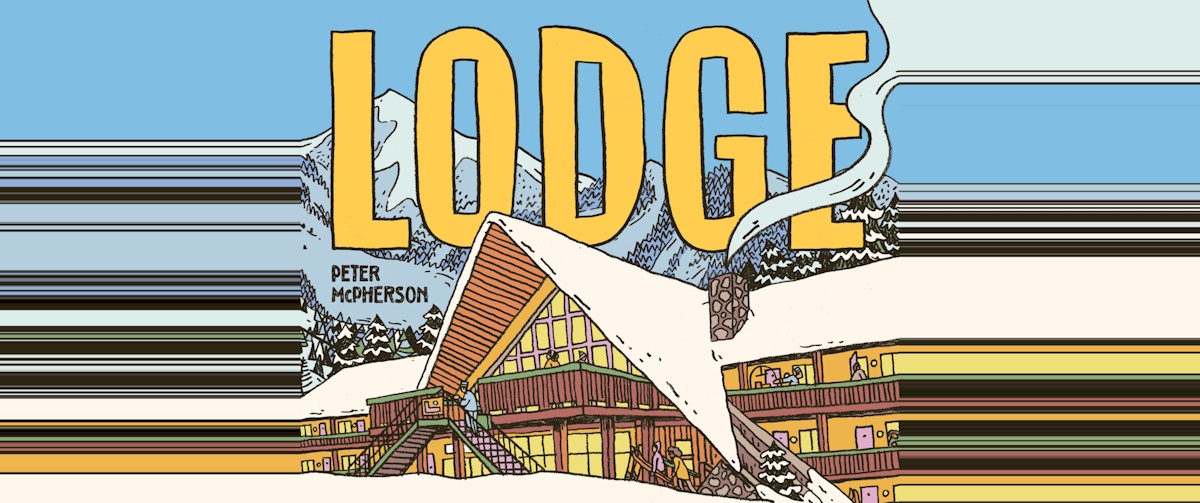
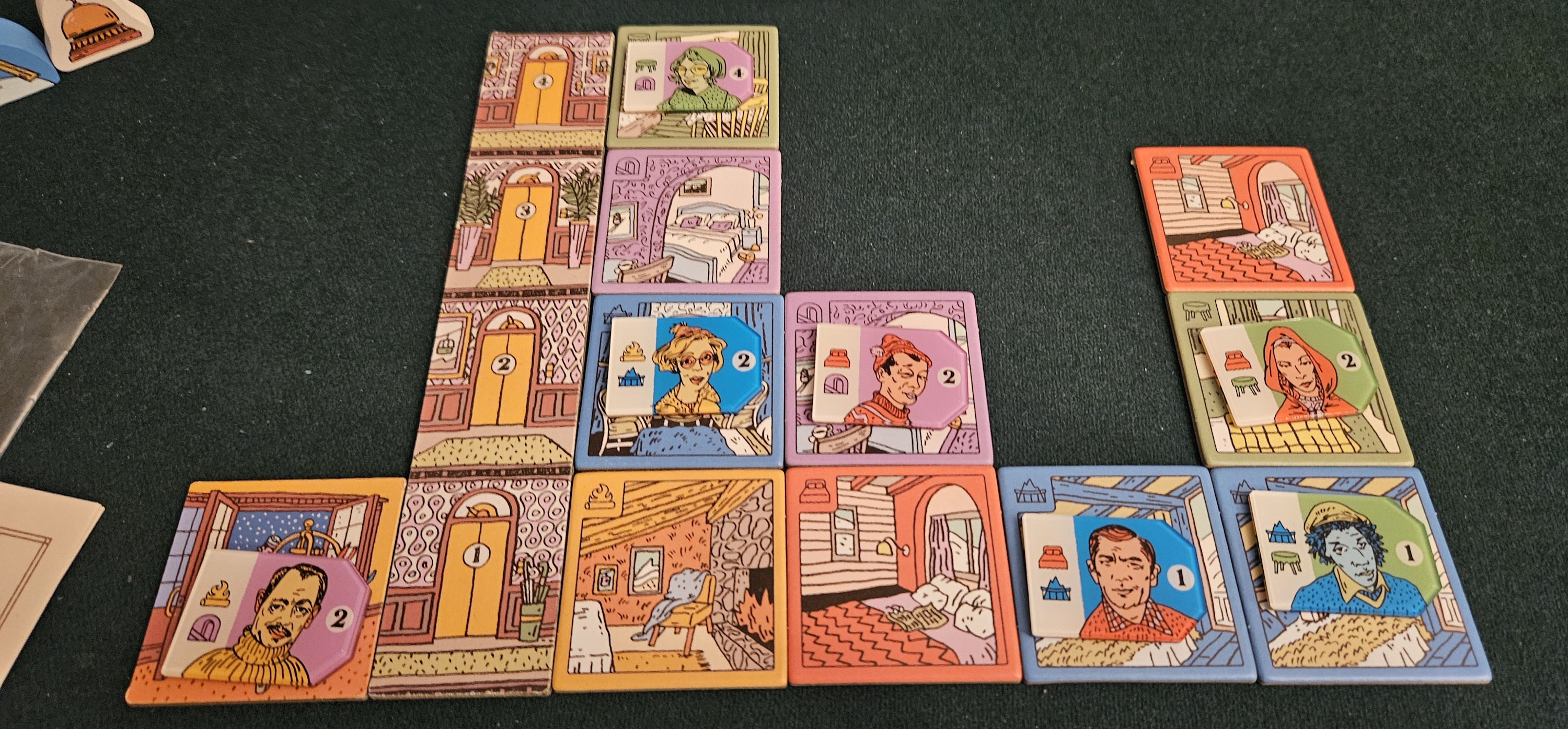
First on the list is Peter McPherson’s Lodge. Ever wanted to design a lodge? Now you can. Sorta.
Oh. Nope. Never mind.

It is a universal law that the best lodges are those that look weird.

We’ve looked at a few of McPherson’s games over the years — Wormholes, Tiny Towns, and by far my favorite, Fit to Print — and Lodge fits right in as a cozy game about building an alpine retreat for winter sportists. Although if you know anything about my reception to two of those three titles, you might recognize that as a slightly barbed compliment.

First, the basics. Your lodge, as befits all things built or assembled on a table, is presented as a tableau of distinct tiles. The way these are selected is downright clever, featuring a sliding board that shows sixteen offerings at first, only to gradually thin out as rooms are claimed and added to players’ chateaux. Only once an entire row of rooms has been claimed do you refill the thing, and rather than manually sliding each and every tile downward, you tip the entire tray onto its edge, transferring the admittedly minor labor over to our old master gravity. Snick, go the tiles as they reach the bottom of the tray. Satisfying.

The placement of those tiles is all-important, as you might imagine, but their location within the tray is more important than as a mere selection system. They’re also bound to a particular floor in your lodge. Any room on the bottom belongs to the ground floor, the next level goes on the second story, and so on until we reach the fourth and final level.

Furthermore, gravity plays a role in the construction process as well. As tempting as it might be to place a dangling room without anything underneath, sorry, but those aren’t the physical constants of the universe we currently inhabit. There goes my fantasy of building a lodge suspended by cables, Bond villain style, but the constraint works wonders for the actual gameplay. There’s real tension between expanding your lodge outward or upward, especially as the available rooms grow more limited.
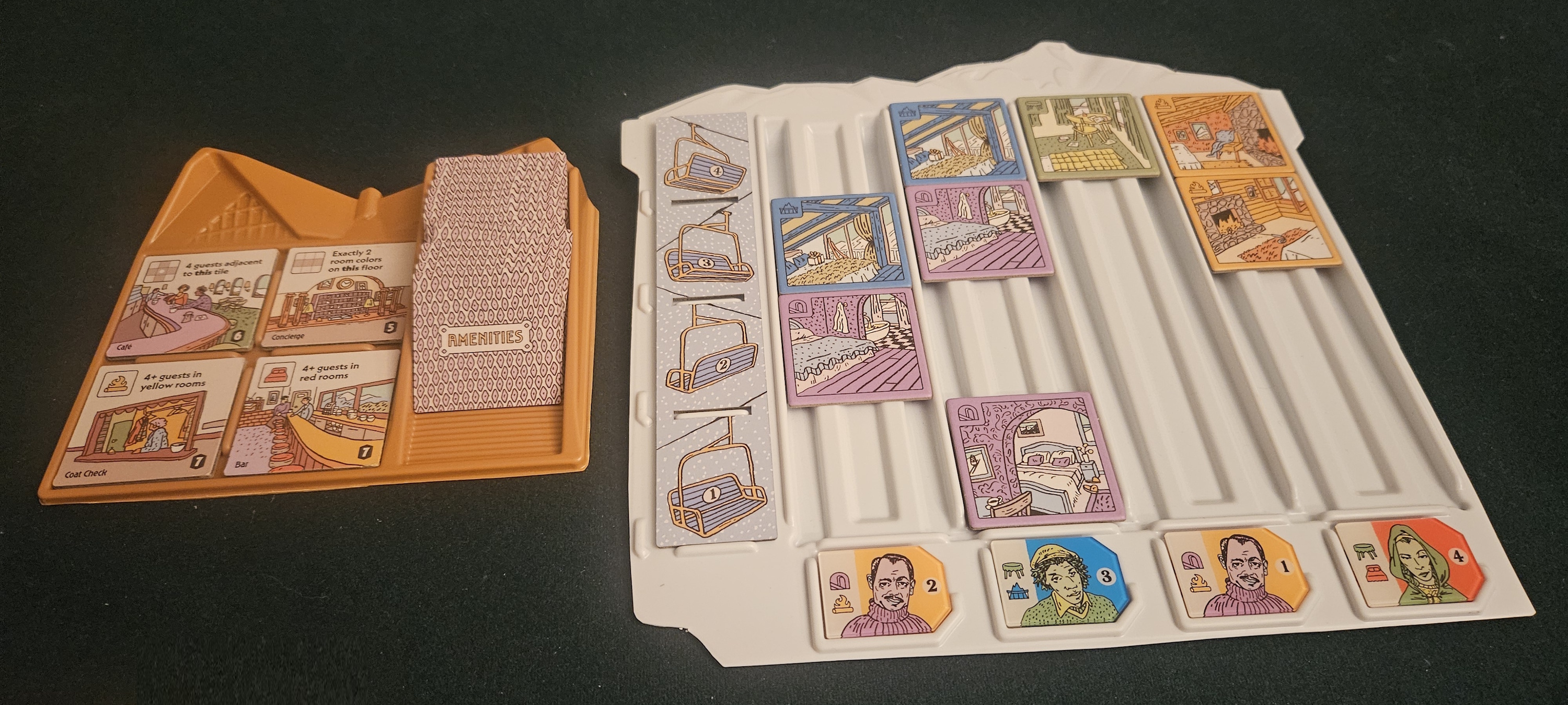
WHOA YEAH DID YOU GET MY PUN? BIG DRAW? HEYYYOOO.

The tile-selection system is a big draw.

Meanwhile, there are two additional objects to claim and place in your lodge, amenities and guests. Unfortunately, this is where Lodge begins to stumble.

Let’s start with amenities. In a nutshell, these are special rooms. Perhaps you’ll place a bar that awards extra points for housing guests in red rooms, or a gym that does the same but for purple-room people, or a concierge that only scores if its floor only includes two colors. First of all: Huh. I’m not sure what’s going on here. There’s a strong disconnect between an amenity’s real-world purpose and its gameplay effect, and Lodge doesn’t seem interested in bridging the gap. Second: Amenities don’t inhabit the usual sliding tray, instead occupying their own separate offer to the side. This sets them apart not only physically but also within the play-space. They exist in isolation, as long-shot bonuses rather than real considerations in their own right. The result is pretty much always a lodge that’s all housing and one laundry, or perhaps a lodge where the coat check is located three flights of stairs above the entryway, or a lodge with a hidden conference room right under the honeymoon suite. That’ll be fun for the annual carpet-steaming conference.

That same sense of disconnection extends to the guests. These are more important than amenities, functioning as both the game’s timer and its principal scoring method. Guests earn bonus points if they’re placed on the appropriate floor, which is fine. But they also demand to be housed in a specific color of room… that’s also adjacent to another specific color of room… which they will not occupy, but leave open for other guests to stay in, or even use as their own next-door-but-empty chamber.

On one level, this presents a perfectly interesting placement puzzle. Guests don’t care whether their adjoining rooms are adjacent on the same floor or located above/below their own, just so long as they share some timber between them. This forces players to think long-term, selecting rooms and guests opportunistically and always keeping an eye on the sliding room offer. It helps, too, that guests in higher floors earn more bonus points, but it’s tougher to quickly assemble the right rooms at elevation. That’s good stuff.
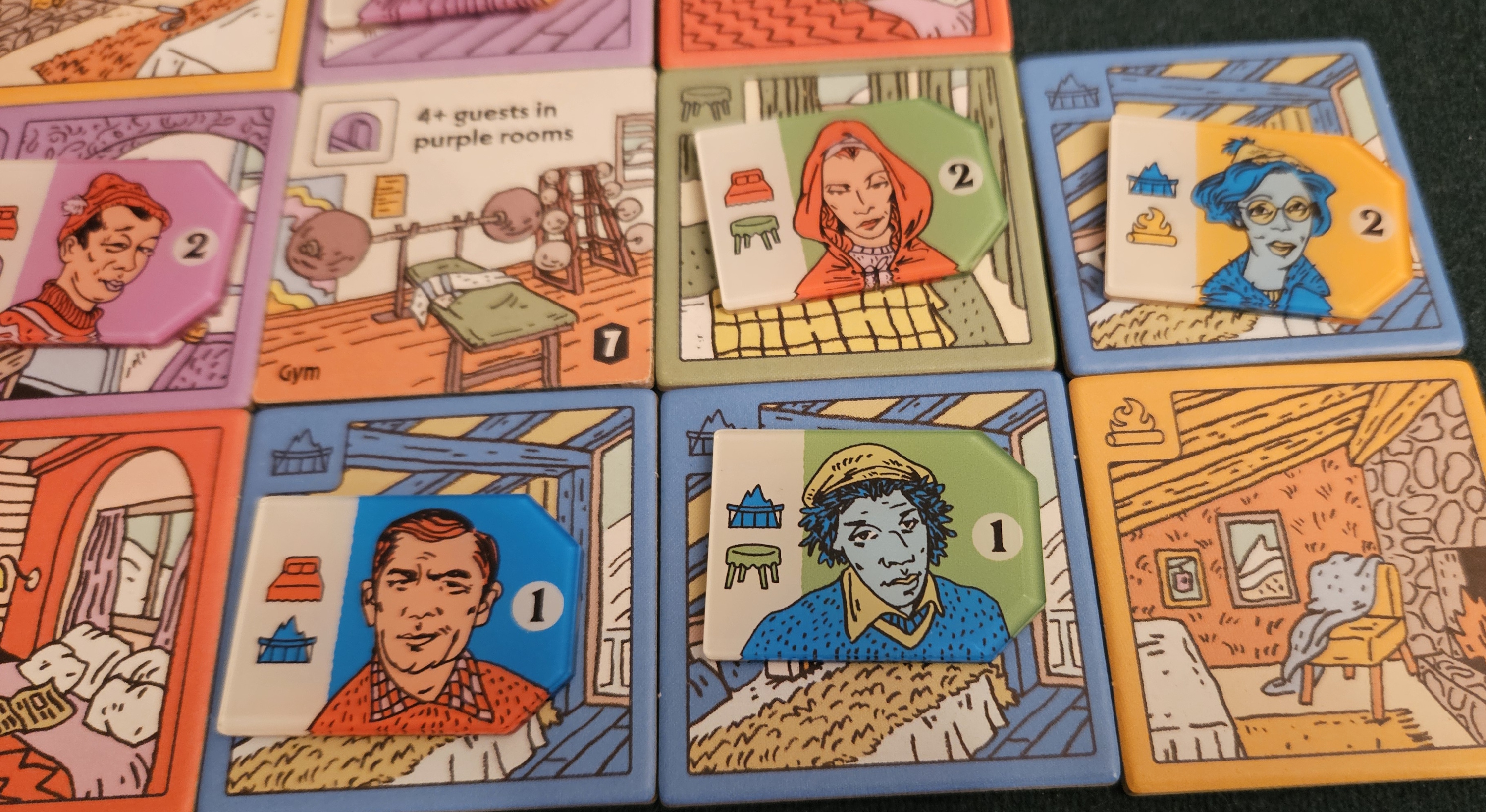
I do everything in my power to pay no mind to my hotel neighbors, and shiver at the notion that somebody has selected a room because of anything that might be happening in mine.

These guests just won’t mind their own business.

At the same time, these preferences make about as much sense as the amenities. Which is to say, none at all. Despite the warm illustrations by Leslie Herman, this quickly turns Lodge colder than it might have been otherwise. There’s just not that much personality behind any of your choices. Very quickly, a winning lodge becomes a mishmash of rooms, with no reason to prioritize one color over another, one type of guest over their peers, or the broader layout of the tableau before you.

It’s a shame in particular because the illustrations are lovely and the idea of assembling a prize-winning lodge is a tremendous one. But a lodge isn’t just an assemblage of rooms with maybe a single café in the middle. Is this a lodge for skiers that require laundromats and dryers? Or is it a lodge with day activities for bored spouses and cranky children? Or perhaps a lodge for glampers, all glammed-up tents with heaters sticking out the back, or a space for people who like the idea of winter sports but actually want to lounge around in the spa, or an all-inclusive hotel that happens to have snow around it? In Lodge, your lodge is none of those things. It’s really just a lot of color-coded boxes.

Which is to say, Lodge’s mechanical half lacks the sense of place it otherwise tries to evoke through imagery alone. It’s a far cry from the beachfronts of Santa Monica or the haunted houses of Scream Park. Where those games labored to connect the actions players undertook at the table with the way those spaces function in real life — complete with empty space, mismatched elements, and inhabitants — Lodge doesn’t come across as a lodge. Nothing speaks to its lodge-ness. The game could be a stack of Starbursts, with the guests a pack of children who prefer two particular flavors in proximity but will settle for one if they really must.
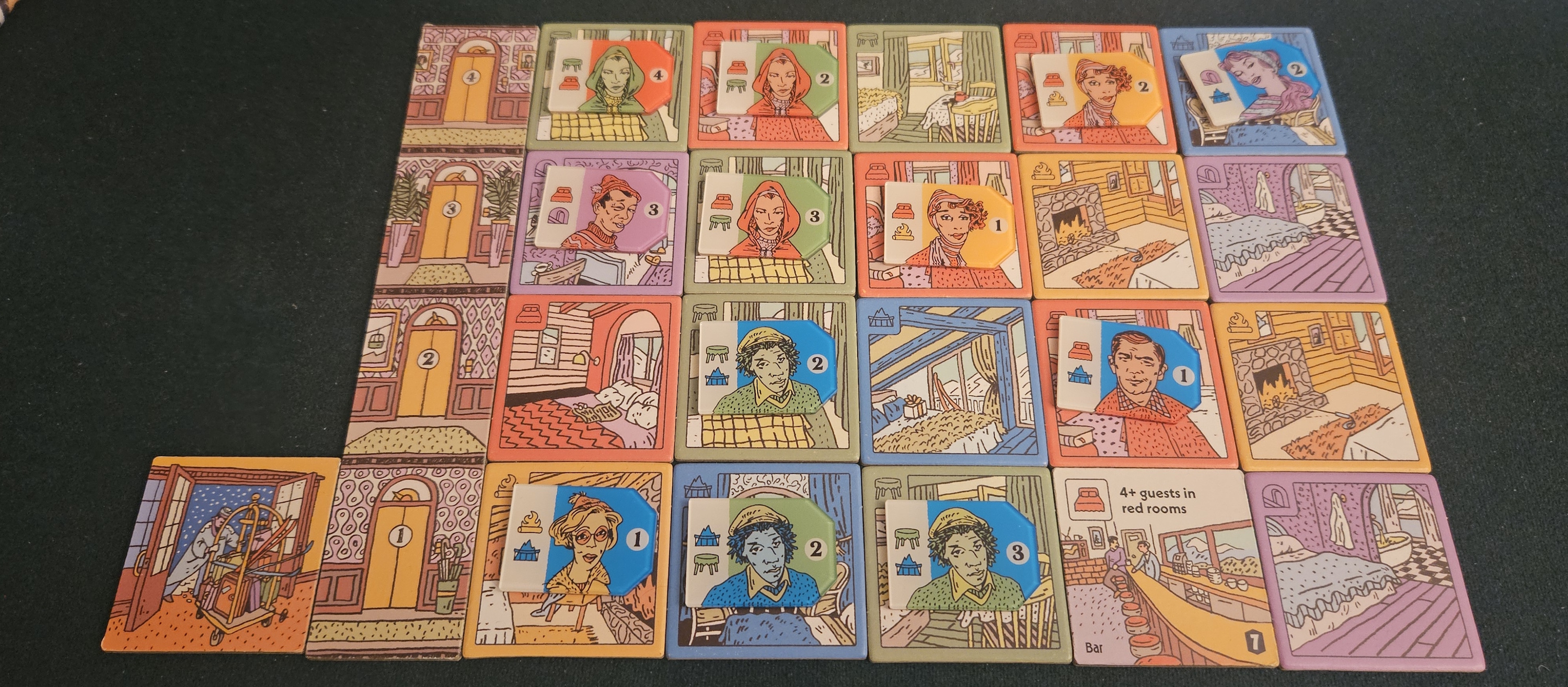
My sister-in-law proposed that the game might be more interesting if the elevator opened up to a tidal wave of blood. No idea why such a macabre notion would occur to her.

Ah. Now my lodge is boring.

Again, the puzzle itself is good. It holds one’s attention. The tile selection system in particular is pleasant on the fingertips and asks the right questions about player priorities. Leslie Herman’s art is sumptuous.

But it isn’t so interesting that it couldn’t have striven to be more. For such gorgeous wallpaper, Lodge’s hallways are peeling at the edges. The result is a game that’s perfectly enjoyable, but lacks the ambition to stand out in a crowded field.


Lodge will be launching in crowdfunding next week. A prototype copy of Lodge was temporarily provided by the publisher.

(If what I’m doing at Space-Biff! is valuable to you in some way, please consider dropping by my Patreon campaign or Ko-fi. Right now, supporters can read about which films I watched in 2025, including some brief thoughts on each. That’s 44 movies! That’s a lot, unless you see, like, 45 or more movies in a year!)

Scratch & Sniffle

21. Januar 2026 um 02:15

I ain't writing all that, but thank you.

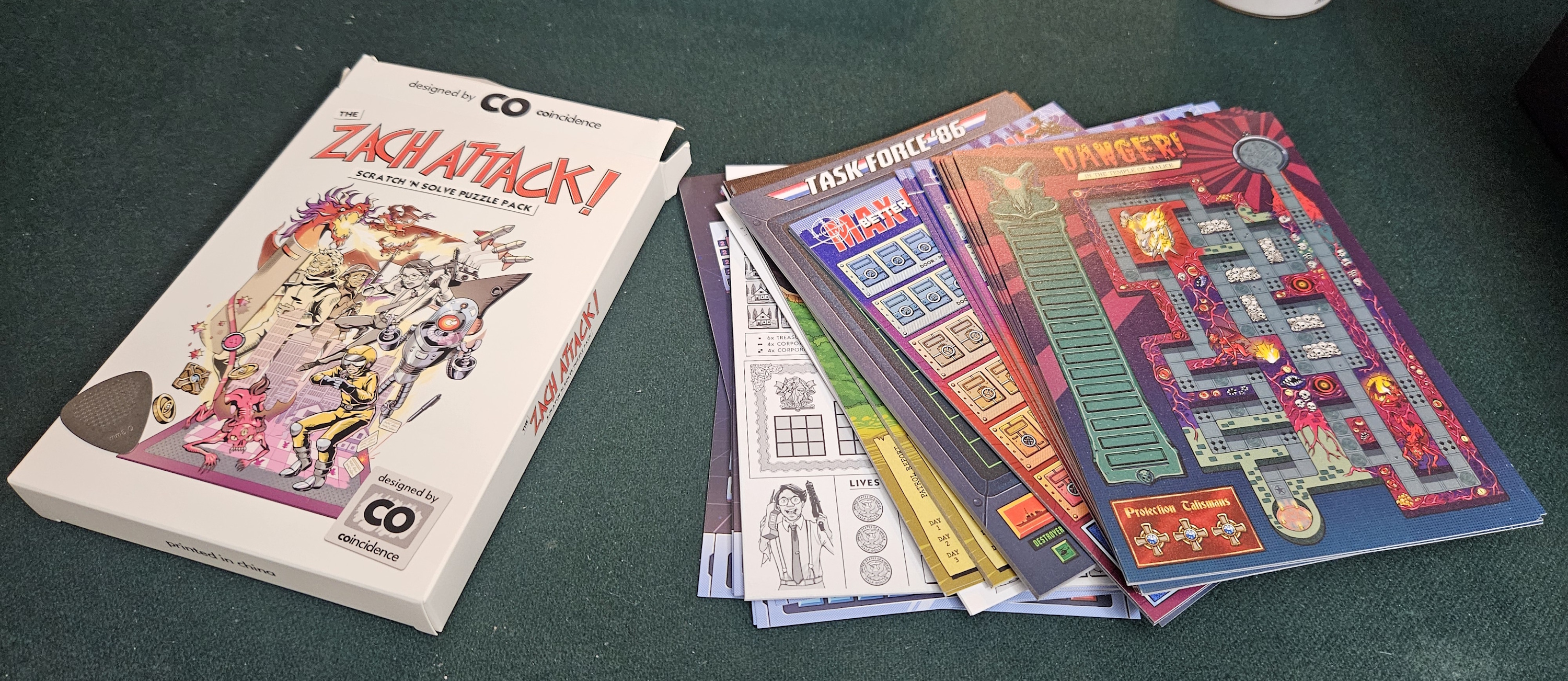
Now here’s something I haven’t seen before: a collection of six scratch-off board games designed by puzzle master Zach Barth. That’s a sentence that keeps getting more intriguing as it goes, especially after The Lucky Seven proved one of the most reliable single-deck solitaire games on my shelf.

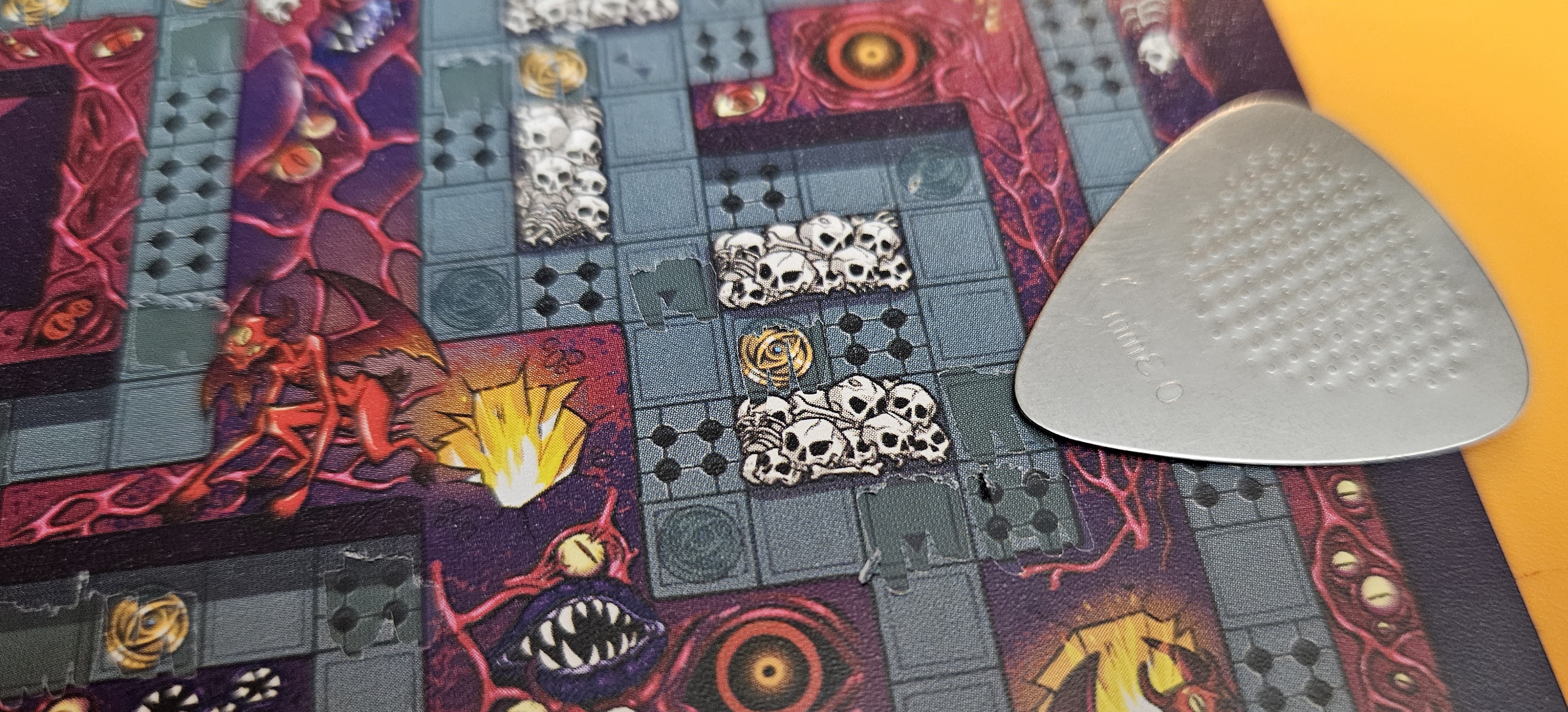
What I didn’t expect was the smell. I don’t know how scratch-offs are made, especially scratch-offs as nice as the ones in this pack. These are hardly the state fair scratch-offs from my childhood. They still produce a royal mess — I’ve had to play with a little rubbish can next to the table — but that metallic scent has proven strangely addictive. Is this why people gamble away their life savings? Maybe I’d be tempted to do so as well, were the minigames in the state lottery this compelling. Let’s run through all six.

like me

Avoiding spike traps… or praying they’re old and broken.

Danger! In the Temple of Malice

The first title is a nifty press-your-luck ditty that keeps the rules light, marking it as a perfect entry point to the collection. It’s basically a roll-and-move, except in place of rolls there are scratch-off boxes. You reveal the three numbers in a box, take those moves in any order — while potentially skipping any digits that strike you as unwise — and hopefully reach the end with as many medallions as possible.

That’s more or less the entire thing, although of course there are a few dueling considerations to keep in mind. The first is your own mortality. Stepping on three traps will spell an early end for your delve, and of course they’re everywhere. Some are duds, which is always a relief, especially near the end of the temple where it isn’t uncommon to see them clustered together. Meanwhile, you also need to reach the end of the track, navigate the occasional branching path, and take calculated risks to secure as much loot as possible.

Danger! is a simple thing, but it sets the tone for the entire collection. On the positive side, these are bite-sized puzzles that use familiar systems in fresh ways, often putting the limitations of their medium — laminated scratch-off pads — to work in interesting ways. It’s impressive to see how far afield Barth is able to wander within these constraints.

But there are more frustrating points as well. Danger! sets a precedent that will crop up more than once throughout the collection. Namely, the possibility of concluding a pad before it’s been exhausted. The box contains ten sheets per puzzle. That’s more generous than I expected, but it still turns them into a precious commodity. While the sheets’ limited quantity provides some additional motivation to consider each step before committing dime to ink, it can still prove deflating when an early misstep threatens to waste the entire puzzle.

Fortunately, that possibility is fairly remote in Danger! thanks to some eminently clear stakes. The ability to decline a move ensures you’re never cornered, even as it threatens to leave you a few steps short of the exit. On the whole, a solid opening gambit for the collection.

like me... wait I'm not sure that applies this time

My recon missions are very good at running into missiles immediately.

Task Force ’86

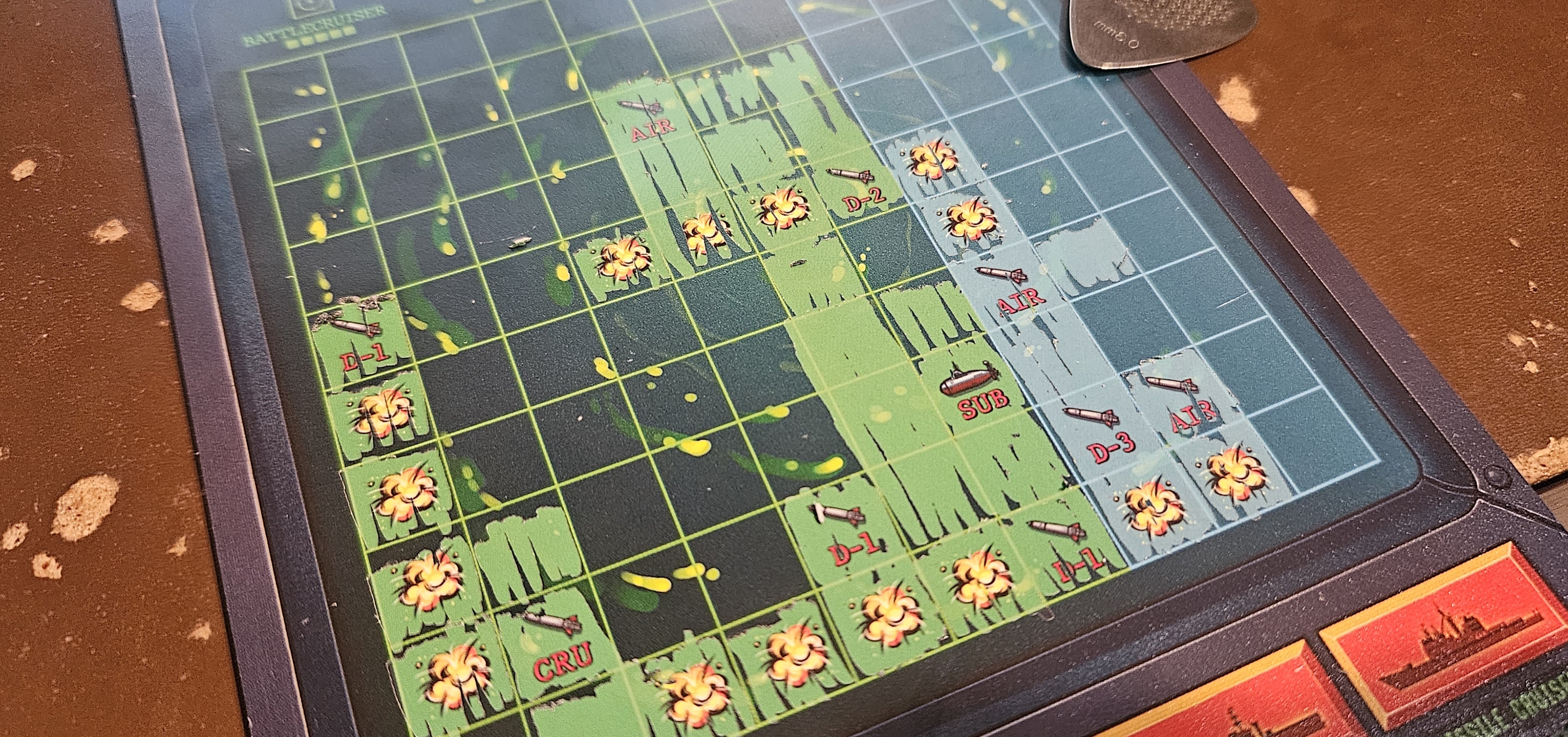
And then there’s the deep end of the pool. Also known as the ocean. Task Force ’86 is an homage to Battleship, but it understands that having too many empty spaces is boring, so instead it fills the sea with not only enemy ships to pick apart with long-range strikes but also a very good chance that every move will result in total disaster.

Your goal is to hit every segment of every enemy ship. There’s a rubric for these things: the enemy fleet contains one battlecruiser, which must be situated entirely in deep water, four shallow-water frigates, and a handful of cruisers and destroyers that might be scattered between the sheet’s halves. Missiles appear around these vessels’ edges, both hinting at their position and threatening to strike your fleet.

Speaking of your fleet, Task Force ’86 introduces a concept that will be present in nearly every other entry in the collection: a small number of bonus resources that can be spent at watershed moments to turn the tables in your favor. While you’re free to scour the ocean for enemy vessels however you see fit, this objective is made easier by your fleet of five friendlies. Your destroyers provide helicopter sorties, which reveal a bunch of cells in a line but stop as soon as they encounter a missile or submarine, while your aircraft carrier holds strike fighters that blow up an entire 3×3 square, and your missile cruiser packs a pair of counter-missiles. This last option is crucial. When revealed on the map, enemy missiles sink your ships, by extension stripping away your bonus powers. That is, unless you knock down the incoming attack.

The inclusion of these limited resources is what makes Task Force ’86 one of the collection’s most gripping puzzles. It’s a big leap from Danger!, complexity-wise, but the tradeoffs are significant. Every space feels dangerous, and it takes real contemplation to choose between launching an air strike or another reconnaissance mission. As puzzles go, this might even be my favorite entry in the whole package, a perfect blend of Minesweeper and the tension that comes from having to physically reveal each cell. This is the good stuff.

One of my grandpas had a bunker. It... did not have a minibar.

I’ve visited that underground bunker before.

Max Midnight: Better Dead Than Never

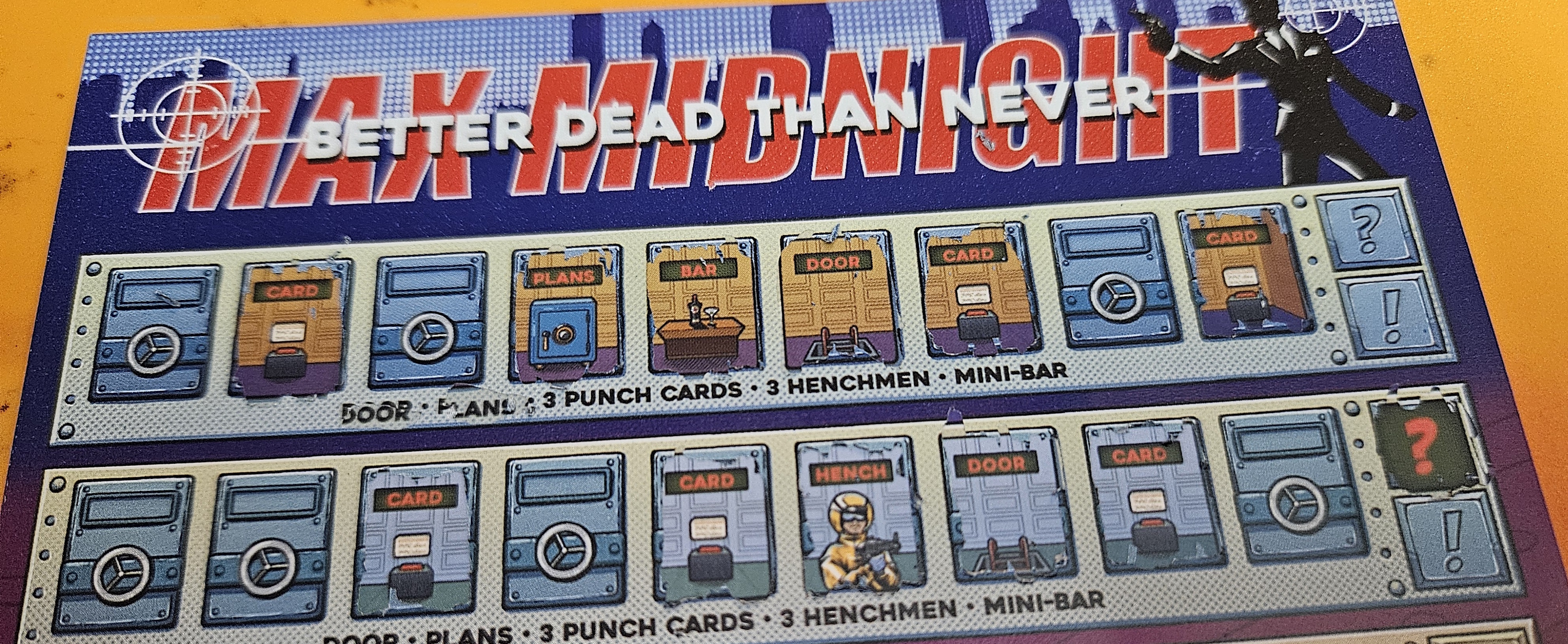
Blending bad puns, Roger Moore-era James Bond, and aesthetics that remind me of nothing more than Apogee’s Secret Agent, Max Midnight is all about diving into an evil mastermind’s evil lair to undo their evil plot before a bunch of people are killed, evilly. He’s the hero we need in this day and age, that Max Midnight.

On the surface, Max Midnight is one of the collection’s chancier titles. You progress through the lair one floor at a time, scratching off doors to reveal what lies inside. The mission is to find enough punchcards to deactivate the control panel on the bottom floor, although this is complicated by henchmen and robots that first raise the floor’s suspicion and then shoot you dead. Early fails are a real possibility.

Except the inclusion of a few critical tools makes Max Midnight a fairly easy puzzle overall. Your agent has a limited number of bullets for shooting henchmen, plus a laser pen that can tunnel deeper into the base. Oh, and some X-ray glasses. This latter tool is my favorite, and it’s complemented by secret plans that can be stumbled upon as you search the base. Their effect is identical: you scratch off a door’s “window,” revealing what’s hidden inside without actually popping the hatch. This allows Max to perform some light surveillance before committing to any given door.

Meanwhile, there’s another rubric to consider. No two adjacent rooms contain the same feature. While an early misstep might see you bumbling into a henchman, this also proves a learning experience, since the doors up and down the hall are guaranteed to be secure. Until you reach the floors with the killer robots, anyway.

On the whole, Max Midnight is one of the more throwaway titles in the collection. It’s cute and whimsical, but lacks the dense thinkiness of its peers. Then again, it gets serious bonus points for the whole “look through the window” feature, which Barth will repeat in a later entry. I appreciate any game that leans into its inherent strengths, and letting players peek at a space without revealing it entirely is a very cool way to use the scratch-off concept.

I like the way you scrape out the wires to show when you've made a connection. That's fun.

Time for some guesswork.

Signal to Noise

Ah, more Minesweeper. Fortunately, I like Minsweeper (and nonograms). Also, it helps that Barth knows how to tinker with the formula to produce a puzzle that invokes the familiar while also feeling entirely new.

Signal to Noise is a digital heist. Most spaces contain cash; the rest represent ICE that threaten to trace your location. In Minesweeper terms, these are the bombs. But in a total inversion, only bombs reveal the adjacency of other bombs. Cash itself is only useful for scoring. When it comes to data-mining, they’re effectively blank.

The solution lies in the game’s limited resources. Here these are Data Miner and ICE Breaker programs, both of which allow the player to string together many reveals of either cash or ICE spaces, but only until they hit the other type. To once again use Minesweeper terms, it’s as though you could switch into “bomb mode” to click as many bombs as you want, but only until you accidentally hit an open cell again.

At the same time, you’re provided hints as to how many bombs are located in each row and column. Often, this is scant information. Most of the sheet’s grids are wide-open spaces, forcing some exploratory scrapes before the process of deduction can begin in earnest. This poses some interesting questions about how to manage risk and your programs, but it also reminded me of a crummy version of Minesweeper on an old TI-86+ where the first click wasn’t a freebie, often resulting in more frustration than anything.

Still, Signal to Noise is a strong option thanks largely to its final data vault. This is where Barth cuts loose with the odds, presenting a box that’s stacked with ICE on one side and cash on the other. This allows for some truly devious deduction, especially if you’ve preserved enough ICE Breakers to pick through the static. It’s a strong crescendo, although I was left wishing the entire sheet had leaned into that format rather than saving it for the very end.

and this random firefighter we pressed into service

Sending in the boys.

Dragons Over Dunkirk

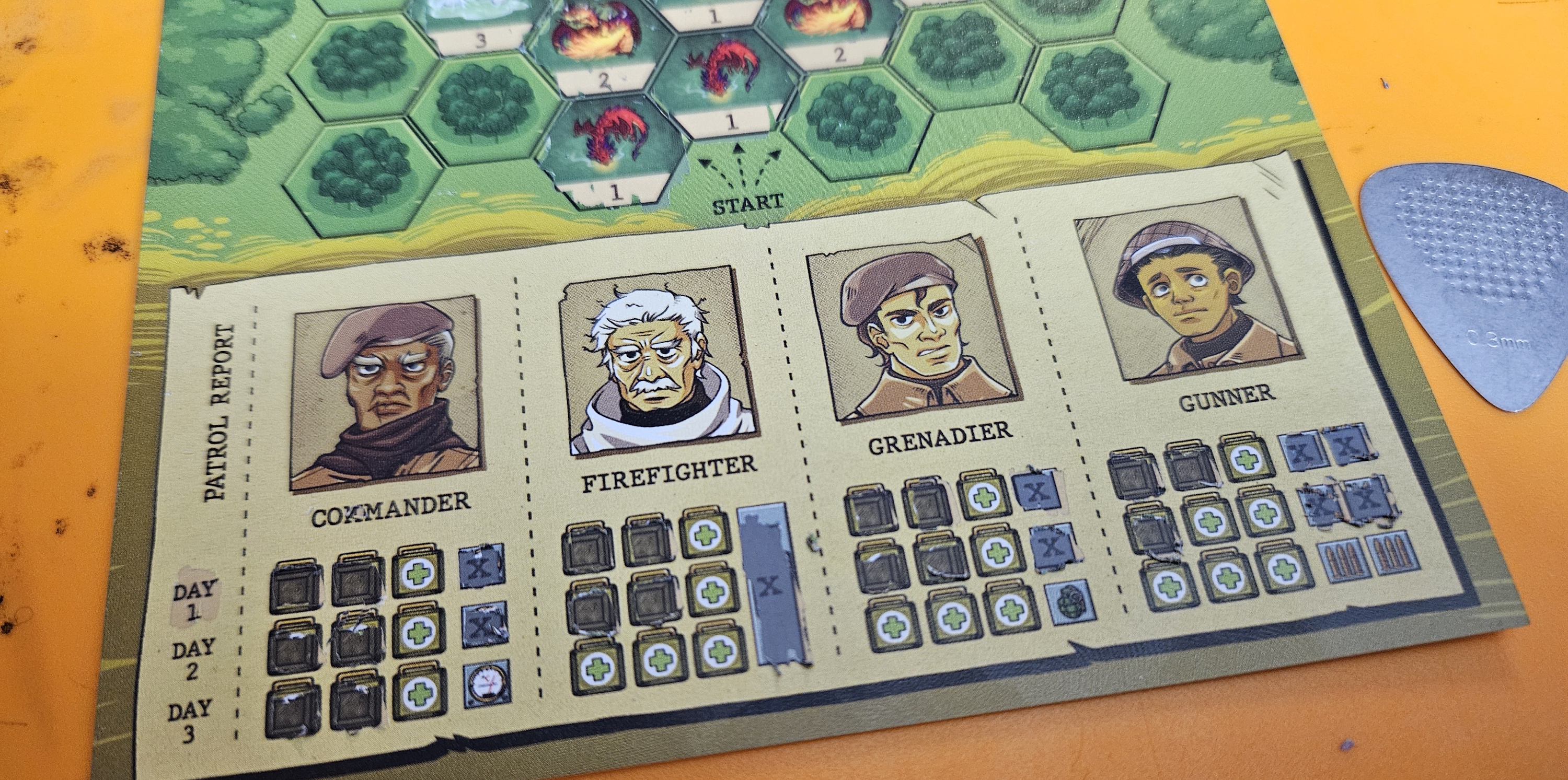
In a very nerdy collection, Dragons Over Dunkirk is the sheet that feels most like a thirteen-year-old boy’s mashup of two different sets of toys. It’s commandos versus dragons. Oh, and the commando squad includes a Playmobil firefighter.

This time, Barth adds some time pressure to great effect. Your squad has three days to wipe out six dragon nests, at least half of which are concealed in a cave system, using, you guessed it, some Minesweeper/Hexcells adjacency deduction. That three-day limit is the real highlight, refreshing each squaddie’s health and kit, but not their mortal coil if they happen to have shuffled off it.

And your tools are essential. The Commander carries an infrared scope that peeks at tiles — shades of Max Midnight! — while the Grenadier and Gunner decrease how many injuries the squad takes from a dragon attack. The firefighter, meanwhile, lets you skip over a space, useful for when you don’t want to weather an obvious ambush in between you and a target.

This time around, the cell-scratching is complicated by the fact that your squad absorbs the damage from any dragons they reveal. At the same time, only the most dangerous dragons will lead you to their nests. So the game quickly becomes about measuring how much punishment you can take before you start losing men.

It’s clever stuff, but this is also where the scratch-off gimmick starts to show its seams. There’s more clutter than in previous titles, and the logic puzzle isn’t quite as clean as its peers. In theory there’s an interesting tension between resting or pressing on, except it’s pretty obvious when your squad has taken enough of a beating. Still, it’s an honest-to-goodness squad management game on a scratch-off sheet. I’m less inclined to revisit this one in the future, but there’s still something impressive about how many systems Barth has folded together.

That's a smoke dangling from his lip, but it works better if you pretend it's a sucker.

Monnneeeyyy.

Capital Offense

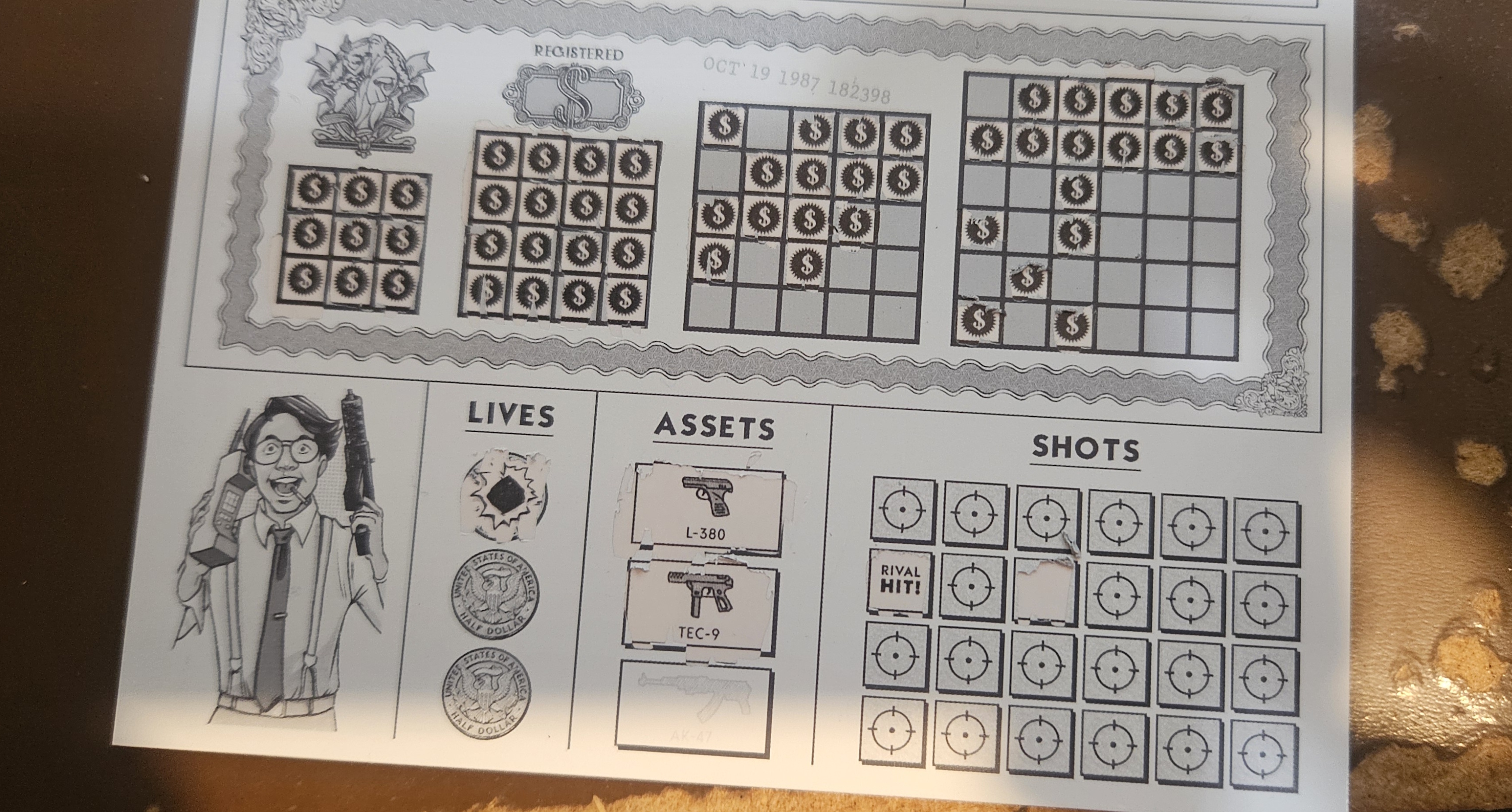
Finally, there’s Capital Offense. Like everything else in Zach Attack!, this one contains fifty shades of press-your-luck, but its more notable inclusion is shape-building. As a corrupt stockbroker, you’re here to uncover various stocks and then scratch their shapes into four grids. Fill them in to get rich quick. It’s the American Dream as a scratch-off, which is as close as the collection gets to commentary.

Along the way, you might stumble across a baggie of coke or a rival broker. Those rivals turn the game over to a shootout minigame, where you reveal cells on a shot grid based on how many weapons you’ve purchased with your ill-gotten gains. This ups the pressure to fill in one of those scoring boxes early rather than spacing out your stock-shapes in a more sensical manner. As for the coke, it exists to let you fill in a box without worrying about the consequences. Because it’s coke.

My problem with Capital Offense has entirely to do with how its shapes are arranged. Rather than using polyominoes or other common shapes, these ones are all over the place. It feels like I should chart out their possible arrangements before playing, or as if there’s a prescribed optimal solution. I recognize how the sheet wants you to accidentally preclude the possibility of not filling in every square, but it winds up feeling overly restrictive and finicky. It’s also the tonal opposite of the coke-snorting rival-shooting madhouse that marks the rest of the puzzle.

Whatever the reason, Capital Offense is the entry I liked least. It probably doesn’t help that its drab white aesthetic doesn’t capture the sheer vibrancy that’s on display elsewhere. Every time I’ve completed it, I’ve immediately wanted to circle back to one of the other sheets for a refresher.

Lucky Seven scratch-off when?

What a strange and intriguing collection.

All told, Zach Attack! is a worthwhile experiment. Half of the puzzles are excellent, only one of them left me cold, and there’s no denying that they’re inventive and clever. Barth has a long history of crafting solid solitaire games, and this collection demonstrates why he’s a master of the field. Operating under the strangest of self-imposed limitations, he’s created six distinct puzzles that each leverage the concept of scratch-offs-as-board-games to their utter extreme. I would love to see another set in the future. For now, I’ll be merrily scratching away at Task Force ’86.


A complimentary copy of Zach Attack! was provided by the publisher.

(If what I’m doing at Space-Biff! is valuable to you in some way, please consider dropping by my Patreon campaign or Ko-fi. Right now, supporters can read about which films I watched in 2025, including some brief thoughts on each. That’s 44 movies! That’s a lot, unless you see, like, 45 or more movies in a year!)
Cate’s Favorite Games of 2025

20. Januar 2026 um 00:59

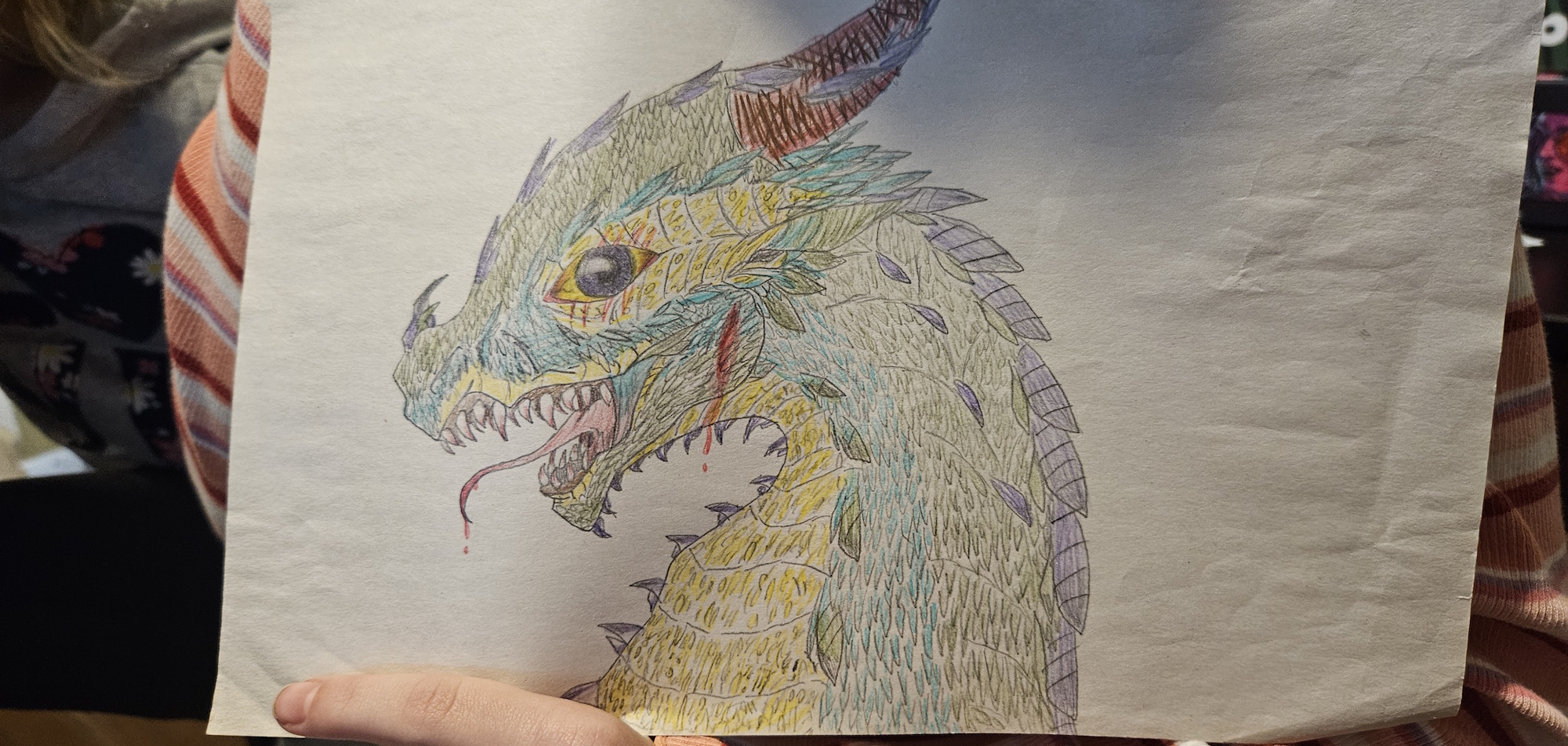
Hi! My name is Cate. This is my selection of my favorite ten games from last year.

#10. Katmai: The Bears of Brooks River

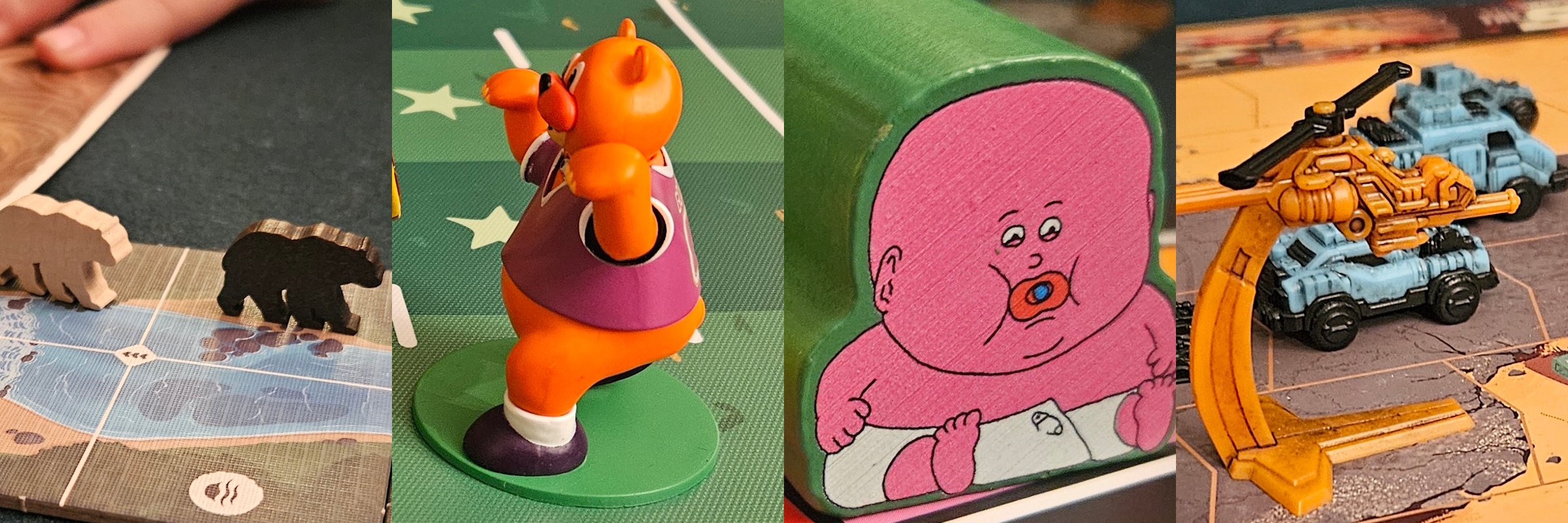
Katmai is about these bears that you get to put in different places, and they have to survive and catch fish. The bears can compete for territory and food. With the bears your goal is to put them in places to make a pattern to score points. And all the bears have these fun little names that I like, and they’re all real bears from Alaska. I think it is a good game for all nature lovers.

#9. Hot Streak

Hot Streak is a good funny game that kids can play. It’s really funny because the characters fall down while they’re racing. The game is about these silly characters that are mascots for different restaurants or stores, and they’re racing to compete to see which mascot is best. You don’t exactly control the characters. Instead, you have cards you draw to see which one falls, which one is ahead, and which one travels the farthest. You win by voting which mascot you think will win and if that mascot wins you will earn money. There are three main races in Hot Streak and whoever has the most money from voting on their favorite mascot wins the game.

#8. Magical Athlete

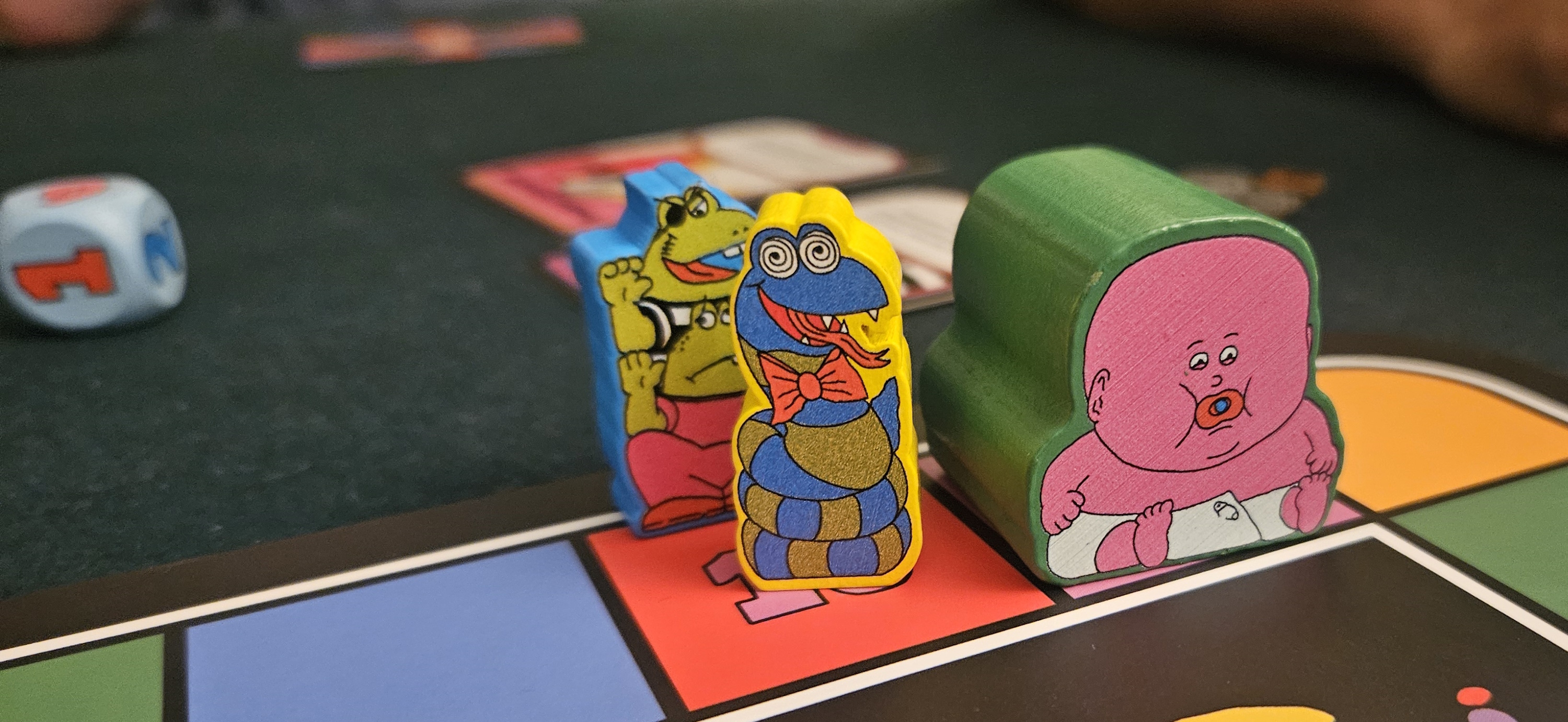
Like Hot Streak, Magical Athlete is a racing game. But instead of moves played by cards, the characters walk by rolling a die. We do a big snake draft to see which characters we’re going to get. There’s a very big variety of characters. A normal round is four races. There are also these things on the racing track that can move you up a space, give you a point, or move you backward. There are some characters that have good abilities like an extra roll or moving an extra space, but there are some who are not as good, with defaults such as not being able to land on the finish space unless you get the right roll. It is a good game to play with a big group and see how this silly race turns out.

#7. Thunder Road Vendetta

Thunder Road is about these racing cars. Sometimes they run into difficulties on the road that slow them down or crash them. You play as the cars themselves, and the racetrack is different almost every time. Some racetracks are hard and some are easy; there’s one racer that is a helicopter that flies over the cars and drops bombs on them to slow them down, and there’s a car that’s so long, and that’s both an advantage and a disadvantage. There’s a lot of action and excitement, and cars that have a bad course on the tracks won’t make it through.

#6. Tic Tac Trek

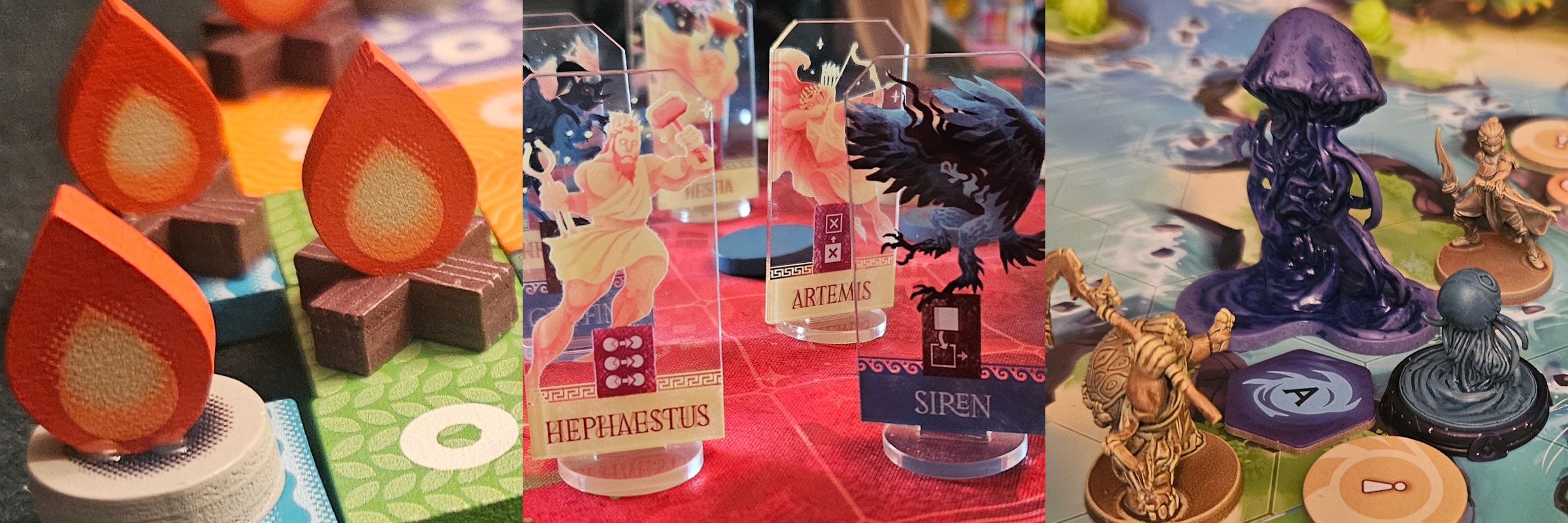
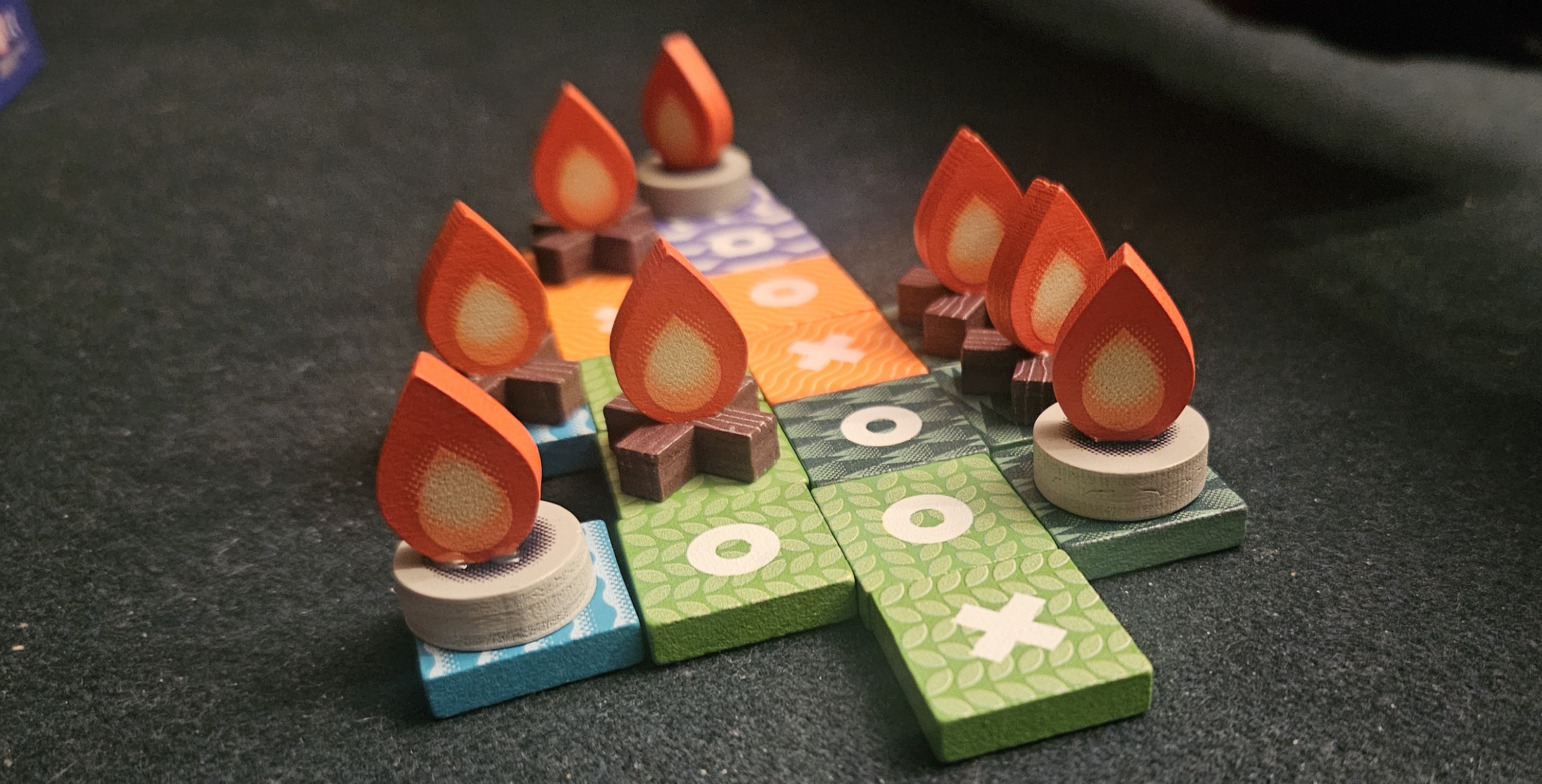
Tic Tac Trek is like Tic Tac Toe, but once you score the game isn’t over. Instead you place a campfire. Oh, and instead of a board that’s just normal Tic Tac Toe, there are tiles you put out. Tiles can be stuff like forests or mountains. It has to touch another of its kind, and it can’t go diagonal. Rivers are rare and can touch anything. They don’t even have to touch other rivers, they can touch anything and anything can touch them. But if a token cannot touch one of its own kind, you can place it anywhere, but if it’s possible to touch a river, then you have to make it touch a river. Scoring isn’t about how many lines you make with the tokens, it’s how many free spaces are around your campfires. That makes it kind of tricky because you might be good at scoring points in Tic Tac Toe, but you might not see your opponent coming to block your free spaces. I like the little campfires and the cool little nature spaces.

#5. Ichor

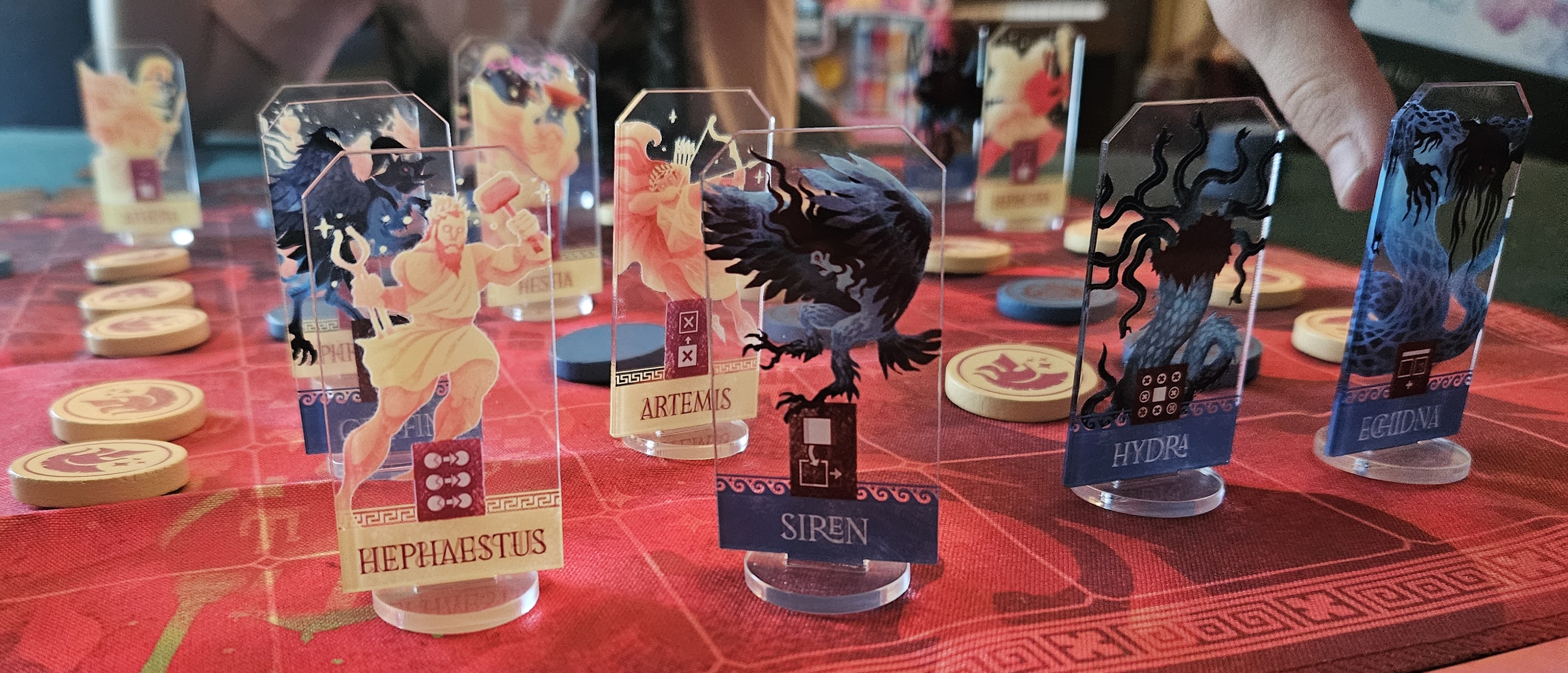
Ichor is about these battling Greek Gods and Greek Monsters, like a minotaur or Aphrodite. They each have special powers that make them unique, and the goal is to go really far on the board. Whenever you move on a space, you place a token to show that the space is yours. But whenever someone else goes over your tokens, they replace them with one of their own tokens. Whoever places all of their tokens first wins. A lot of special powers can mean jumping over opponents, or blocking them, or mimicking them, so you can place the most tokens. I really like Greek myths so it’s fun to play to see the monsters and gods fighting like that. The game doesn’t end with death or execution, but is just a quick little game about their rivalry.

#4. Tidal Blades 2: Rise of the Unfolders

Tidal Blades is this fun game about these characters that are half-people half-animal. They live on floating islands on the ocean. The game is based on what might happen in the future. It has different dimensions, a big world, and monsters to beat, many missions, and portals to different worlds. And it is a really fun game for people who like imaginative things. There is this one big monster at the very end [minor spoiler] that you fight with everybody, whether you are them or not. It just has a lot of character and fun in it. It isn’t only about the heroes’ adventures, it’s also about them relaxing in their hometown and stuff. I really like that it’s this big adventure that people can go on.

#3. Agent Avenue

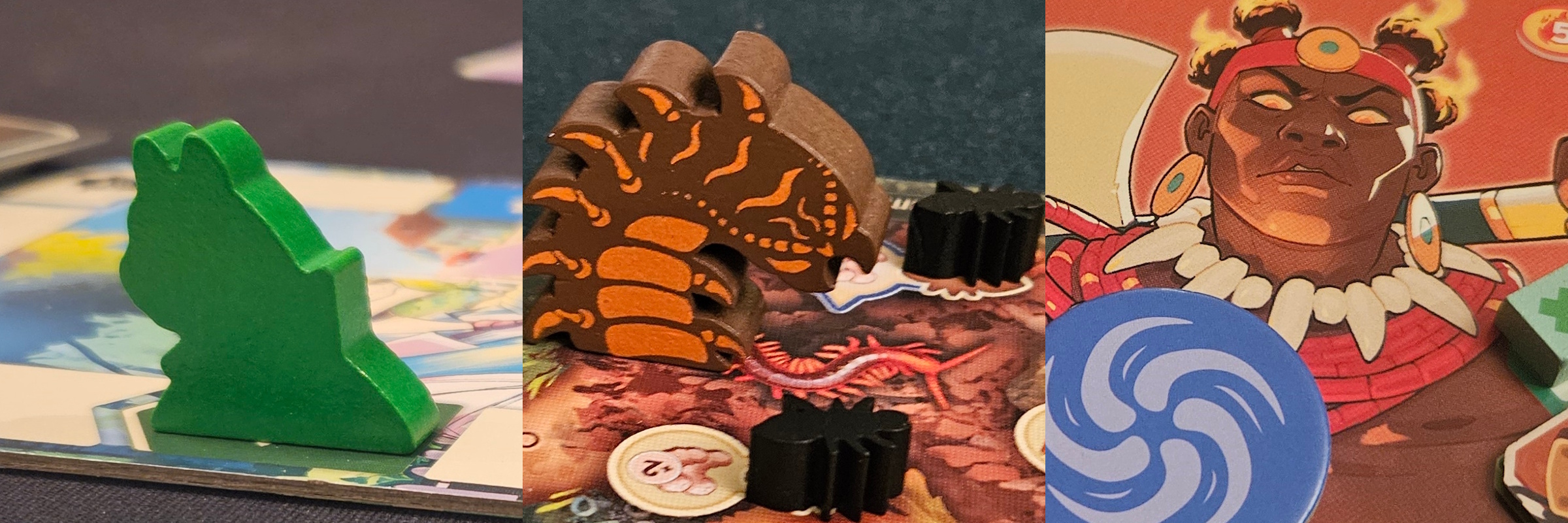
Agent Avenue is basically this small little board with these small little spaces that the characters go on. Whoever catches the other person’s character wins. There are little cards that show how much you move by. There are even these little mice [in the expansion] that can go either way to catch your rival for you. It has very many tricks and a lot of things that you might not see coming. For your turn, you will put out two cards, one face up and one face down; your rival takes one card and then you take the other. It’s hard because you don’t know which one your rival will take, and some cards can be things that make you win or lose the third time you get it. So whatever cards you pick out for yourself or your rival, they can either defeat you themselves or make it really easy for you to win. I like the little animals that we play as in Agent Avenue and all the twists and turns.

#2. March of the Ants

March of the Ants is about these little ants and you can create your own type of ant with these different cards to see what will be best for you. It is all about taking over territory and finding different dens, finding worm holes, and beating centipedes. The ants in the game must spread popularity, find food, and keep pressing forward and laying eggs to survive. There is a winter in this game and it’s all about how the ants have to survive through it, and how they prepare for it. Whoever has the most points through all the winters in the game wins. I like the different species of ants you can make up, and I just like the game, because that’s normal nature, to learn to survive.

#1. Tag Team

Tag Team is about these different sides that are fighting. You pick two characters and they have these different powers and abilities they can use against your rival. They have hit points, and you have these planned attacks in your deck. New cards have to slide into your deck; you can’t swap your deck’s order. It is hard because you kind of know what attacks are coming, but not exactly, and we each do our attacks at the exact same time, so you can block them or defend yourself, which makes it really tricky but really fun. It makes me feel smart because I always beat my daddy.

Those are my favorite games from last year! Daddy said I couldn’t pick Compile because he didn’t write about it last year, but I have the new Compile, too. It’s my favorite game.


(If what I’m doing at Space-Biff! is valuable to you in some way, please consider dropping by my Patreon campaign or Ko-fi. Right now, supporters can read about which films I watched in 2025, including some brief thoughts on each. That’s 44 movies! That’s a lot, unless you see, like, 45 or more movies in a year!)
Faith in Crisis/Transition/Expansion

14. Januar 2026 um 03:57

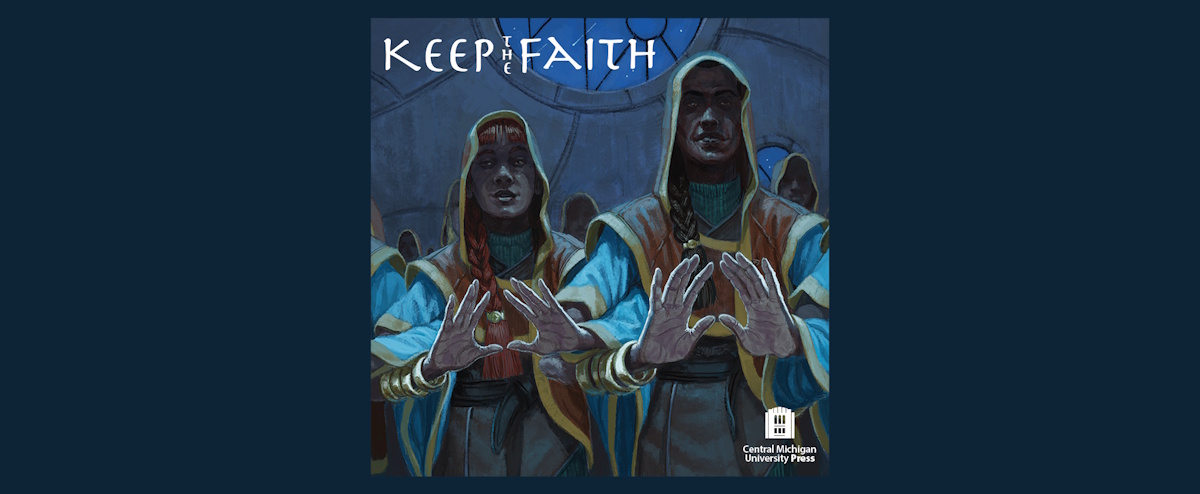
It’s hard, maybe impossible, to not put yourself into Keep the Faith, the latest board game by Greg Loring-Albright. Going in, I always tell myself the same thing. This time, I say, the religion I create is going to be something different from the one I grew up in, the one I’ve spent a lifetime studying, the one that got me to learn a bunch of old languages in order to prove its connection to a millennia-gone church only to accidentally disavow itself in the process. And then, like this opening paragraph, somehow I find myself circling back, like a star trapped in a slow orbit around a black hole, hydrogen distending into that event horizon.

Okay, so perhaps I have feelings. Surely that’s a sign that Keep the Faith is a success. But if that’s so, then why is it so difficult to write about? Why has it taken me seven hours to get this far?

The wagon wheel theory of religious politics.

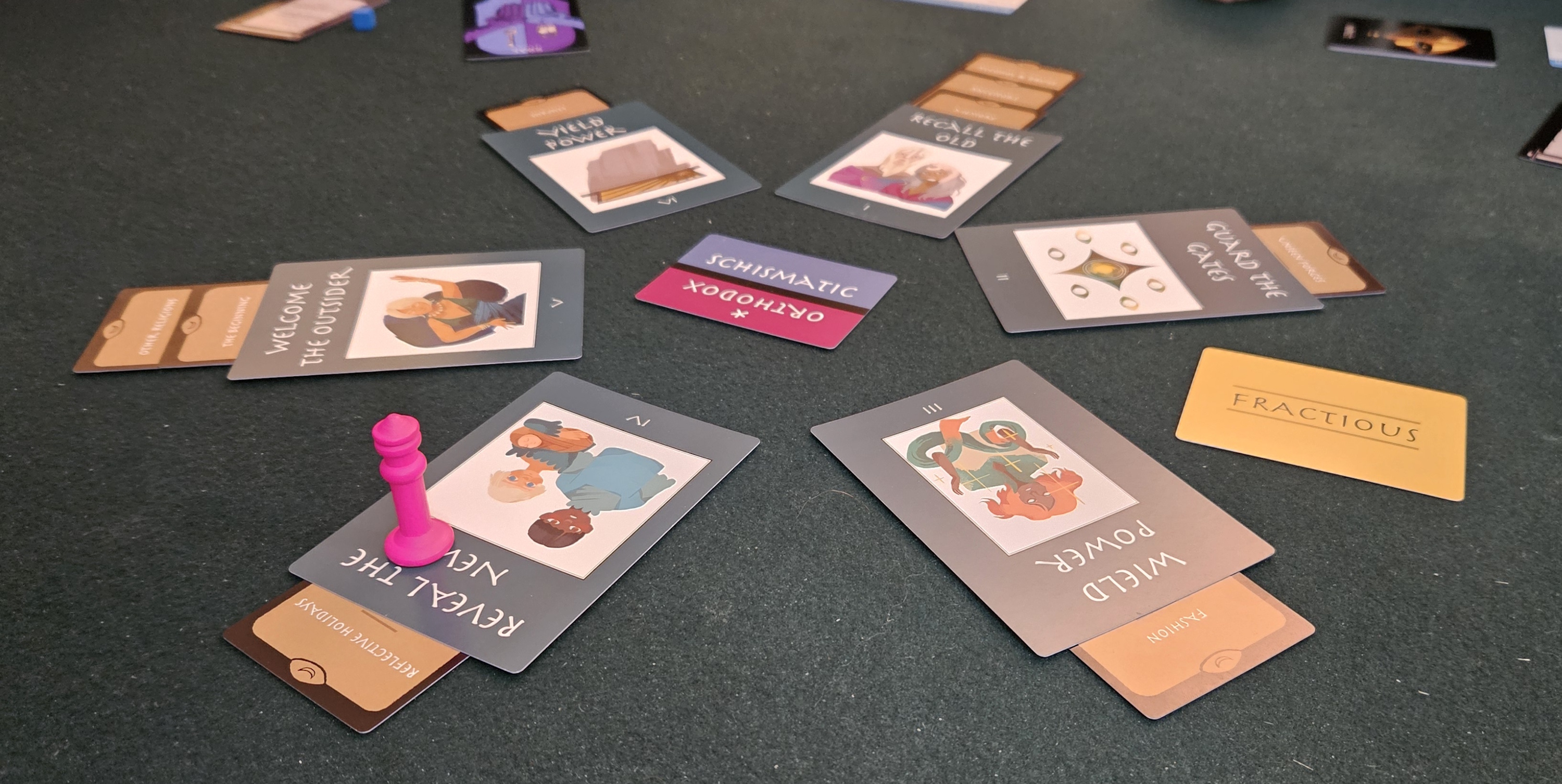
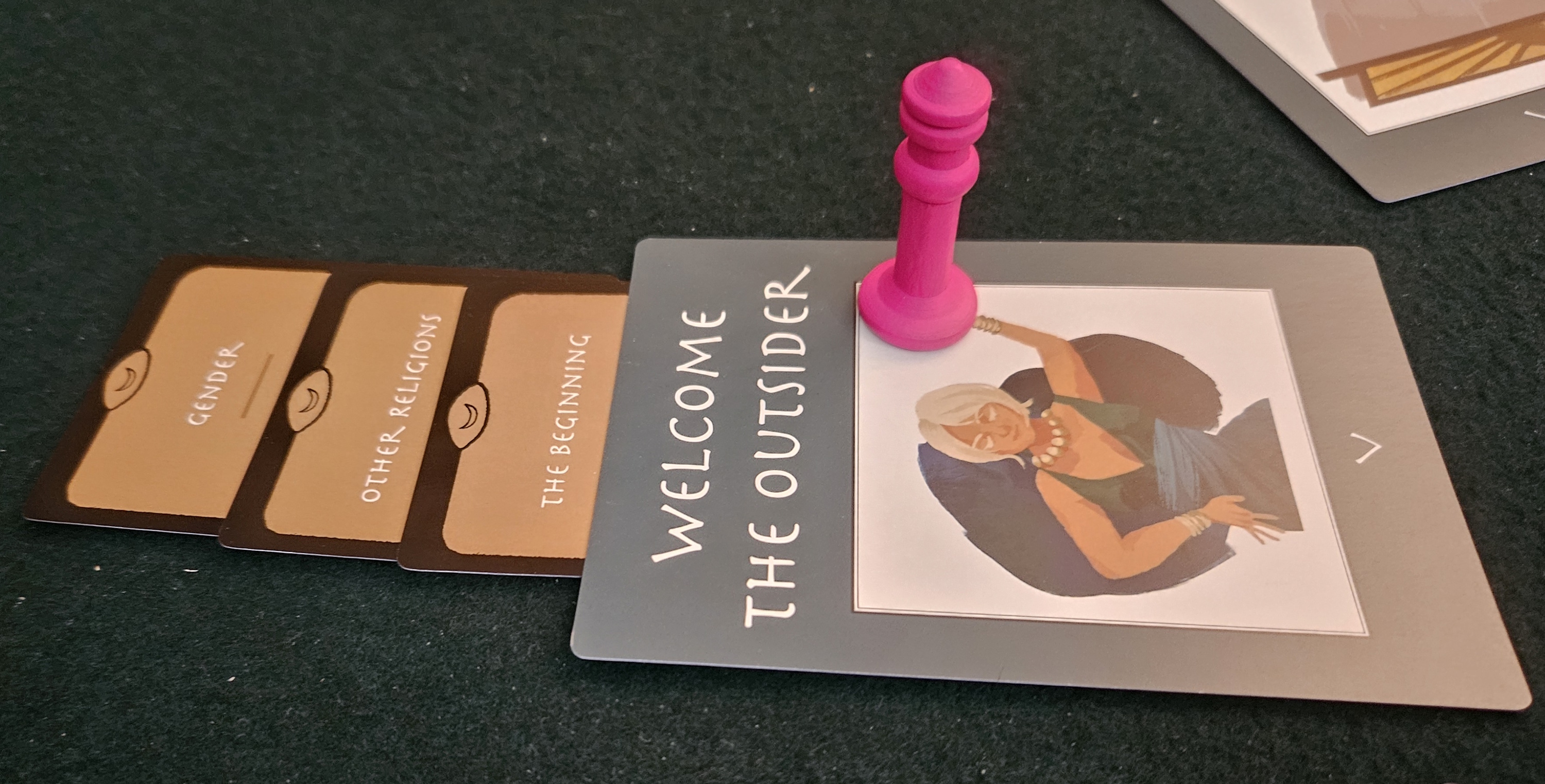
Keep the Faith opens with a new religion. (Already I want to quibble. Religions never begin at a concrete moment. Especially when they claim they do.) It begins with a series of values, six in all, arrayed like the spokes of a wagon wheel so that opposing traits are clearly delineated. Perhaps one of those values will be “Guard the Gates,” in which case its opposite value will be “Welcome the Outsider.” Or perhaps the dichotomy will be “Spread the Word” versus “Protect the Secrets.” Or “Be Set Apart” and “Be in the World.” “Recall the Old” and “Reveal the New.”

These aren’t contradictions, to my understanding, although someday this timeline’s New Atheists will insist that they are, probably with Power Point slides festooned with scary red arrows drawing attention to every self-rebutting verse. But that isn’t how I think about them, at least not necessarily, not always. They’re the creases and folds that occur whenever a human institution examines itself, points that aren’t in conflict, not even two sides of the same coin or two expressions of the same face, but varying applications of friction and heat and pressure.

Take Christianity. (Uh oh. Here we go. The black hole latches in its hooks.) Early in the religion’s life, after some emperor or another had declared a period of persecution that led many believers to lapse out of despair or convenience or terror, only for that same emperor to die a few years later and leave his dictates in the dustbin, believers were faced with an existential question. Should they welcome the lapsed back into the congregation or extract some display of contrition? And if so, what was that contrition’s proper severity? The lapsed had, after all, betrayed their faith and might pose a danger to the community. But forgiveness and long-suffering and turning the other cheek were essential traits of the faith. For one to deny a penitent their relief was to become oneself unfaithful. It was a pickle. But a contradiction? Eh. Ask the faithful. Ask the penitent. You might receive two very different answers.

To these contrasting values, everyone at the table populates their nascent faith with a handful of aspects, always narrating the meaning behind each pairing. If I play the card that invites me to think about “Food,” I choose one of our values and explain how it’s reflected by this aspect. Recall the Old? That’s easy: our food is flatbread and bitter herbs, a reminder of our time in bondage. Accept Our Fate? That requires a little more thought. Perhaps we aren’t meant to think too hard about preparing our meals, instead taking what we can get as our religion expands to new continents and cultures. Shape Our Destiny? Food becomes an act of defiance, as prepared and dressed-up as possible. Eventually, we restrict ourselves to only the most enriched flours and mummifying preservatives, all the better to stave off the entropy that claims us all. Ironically, these highly processed meals shorten our lives. Is this a contradiction? I’m sure somebody has a Power Point for that.

This is the setup. But it’s also the play. Much of the time, Keep the Faith is about pairing aspects and values and then explaining their relevance. It’s also about shifting those aspects between values. At some point, maybe Food will be severed from Shape Our Destiny and move over to Wielding Power. We narrate the change: somebody has persuaded their coreligionists that the former use of food was a contradiction; now it’s a sign of dominance. The wealthy eat everything while everybody else fights over the scraps.

We welcome the outsider… but what does “welcome” mean? Who is an “outsider”? Who is “we”?

(Again, the black hole pulls at me. We’ve reinvented trickle-down economics and the fabled Needle Gate of Jerusalem and every other false justification of the wealthy that they deserve not only to eat well, but also the untouched extras as well. Is my brain the trap here, or is humanity bound to a turning wheel from which it will never quite wriggle free?)

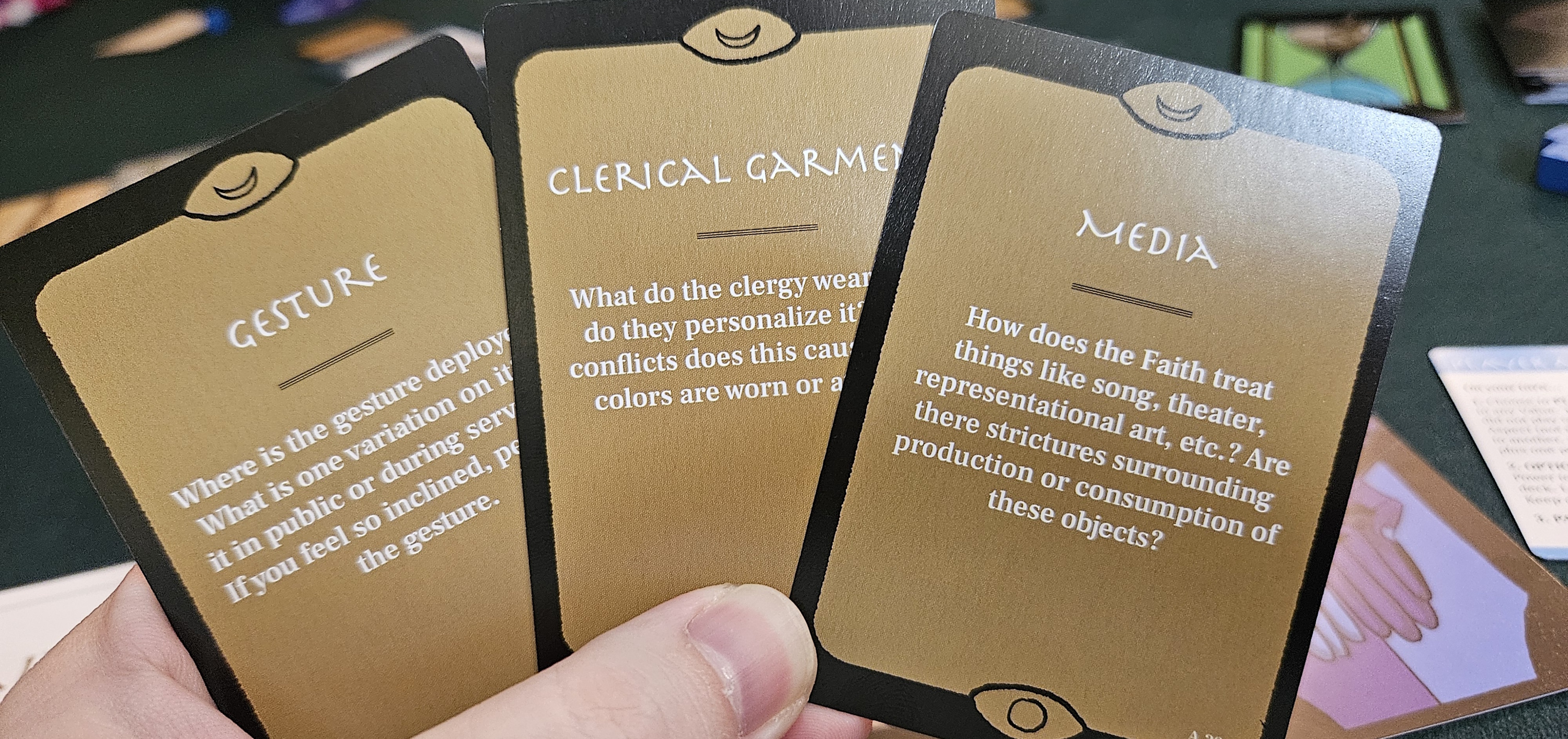
These aspects are presented without oversight from Loring-Albright. Like the ecclesiastical positions of Amabel Holland’s Nicaea, there are no icons stating that one aspect is more valuable than another, or even valuable in a distinct way, or that there are resources tied to these concepts of Media and Social Conformity and Hierarchy and Esotericism and everything else. They are offered as blank slates. (No. Not quite blank. Because, again, there’s no escaping the black hole, no breaking free of the wheel. It’s just that their value isn’t encoded within the game’s rules. Instead, it’s encoded within us, the players.)

At multiple junctures, every time I play Keep the Faith, I balk at this blankness just as I balk at my incapacity to frame the game’s nouns in a novel way. I have my own hangups with role-playing games, and I grow frustrated when board games are presented as imaginatively inferior to their more improvisational cousins. In one sense, the absence of a stance — that “Animals” and “Gender” and “Ancestors” are presented as equivalents within the game’s ludic rhetoric — strikes me as a dereliction of duty on Loring-Albright’s part. It’s a thought I always shake off, but before long it sneaks back in again. If we, the players, aren’t willing to share some part of ourselves whenever we pair an aspect to a value, the cards might as well be blank. Physically blank, not only blank of icons.

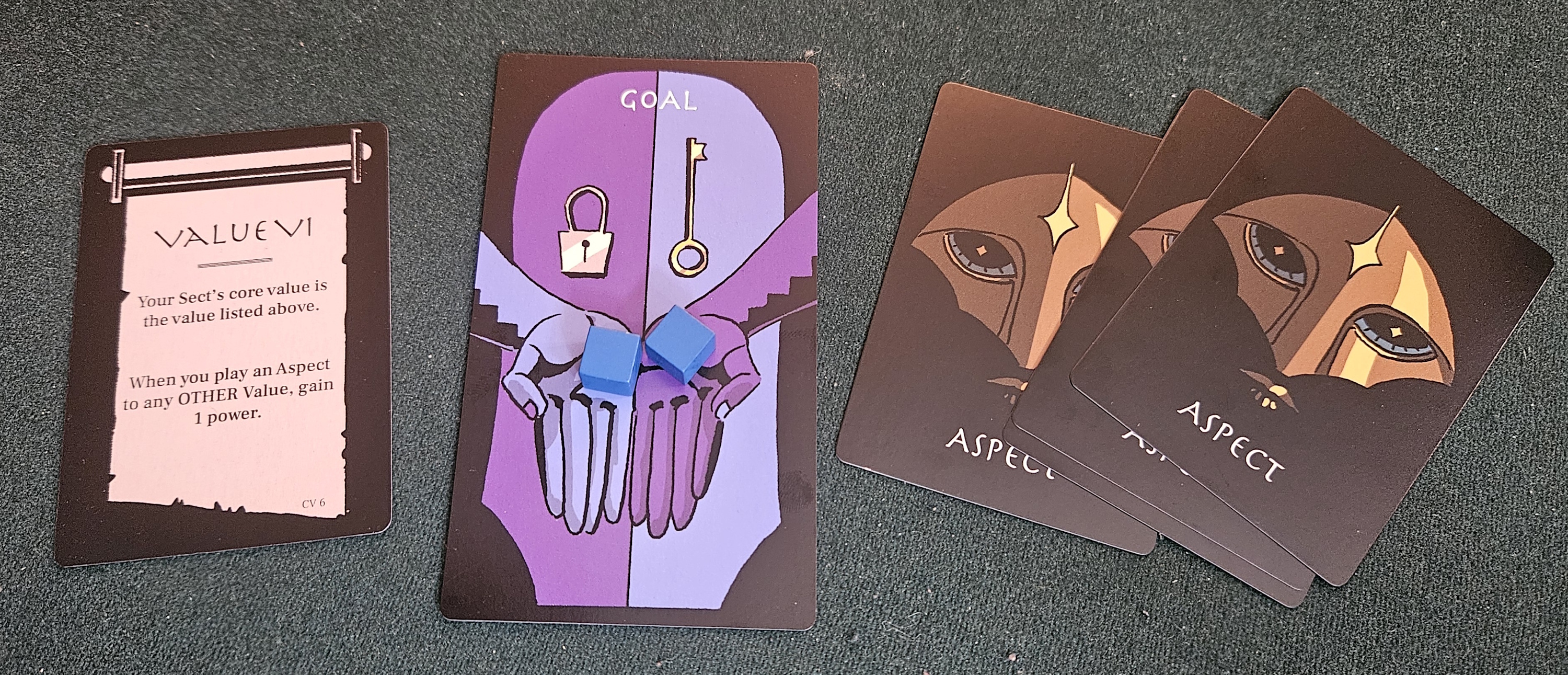
However, there is a governing logic behind these assignations. While the moment-to-moment gameplay depends entirely on the players’ willingness to narrate their choices, there is an underlying drive. When the game begins, we receive a core value that our particular sect holds dear. Maybe I care most about Recalling the Old, while you’re all about Welcoming the Outsider.

But we also each receive a hidden goal. Perhaps I’m Righteous, in which case I want to protect my core value at all costs. We will Recall the Old, forging a religion of calendars and feasts and constant observances. In game terms, this translates to me keeping as many aspect cards tucked under my core value as possible. But in that same session, you might be Steadfast. Even if it means abandoning your core value, you intend to achieve stability in our faith, ensuring that one half of the wheel is filled with as many aspects as possible.

What’s interesting is that these objectives can be entirely complementary. There’s a world where my single-minded zeal and your spineless centrism go hand in hand. But what if one of our co-players is Rebellious? Their goal is to slap as many aspects onto non-dominant values as possible, driving our faith into a period of schism. These objectives push Keep the Faith into more familiar territory, games-wise, but make no mistake, they function foremost as narrative devices. Every round, the clock shifts forward. A century passes, some new question or crisis arises, and the landscape of our faith shifts out from under our feet. Our overall goal remains firm — unless we opt to alter it, a possibility provided by the game — but our sect’s relationship to its core beliefs is always in flux. (Of course, there’s no such thing as a community that maintains exactly the same values over centuries. Today’s rebellion becomes tomorrow’s centrists, as they say. But like every other parenthetical in this review, this isn’t a critique as such, just a note.)

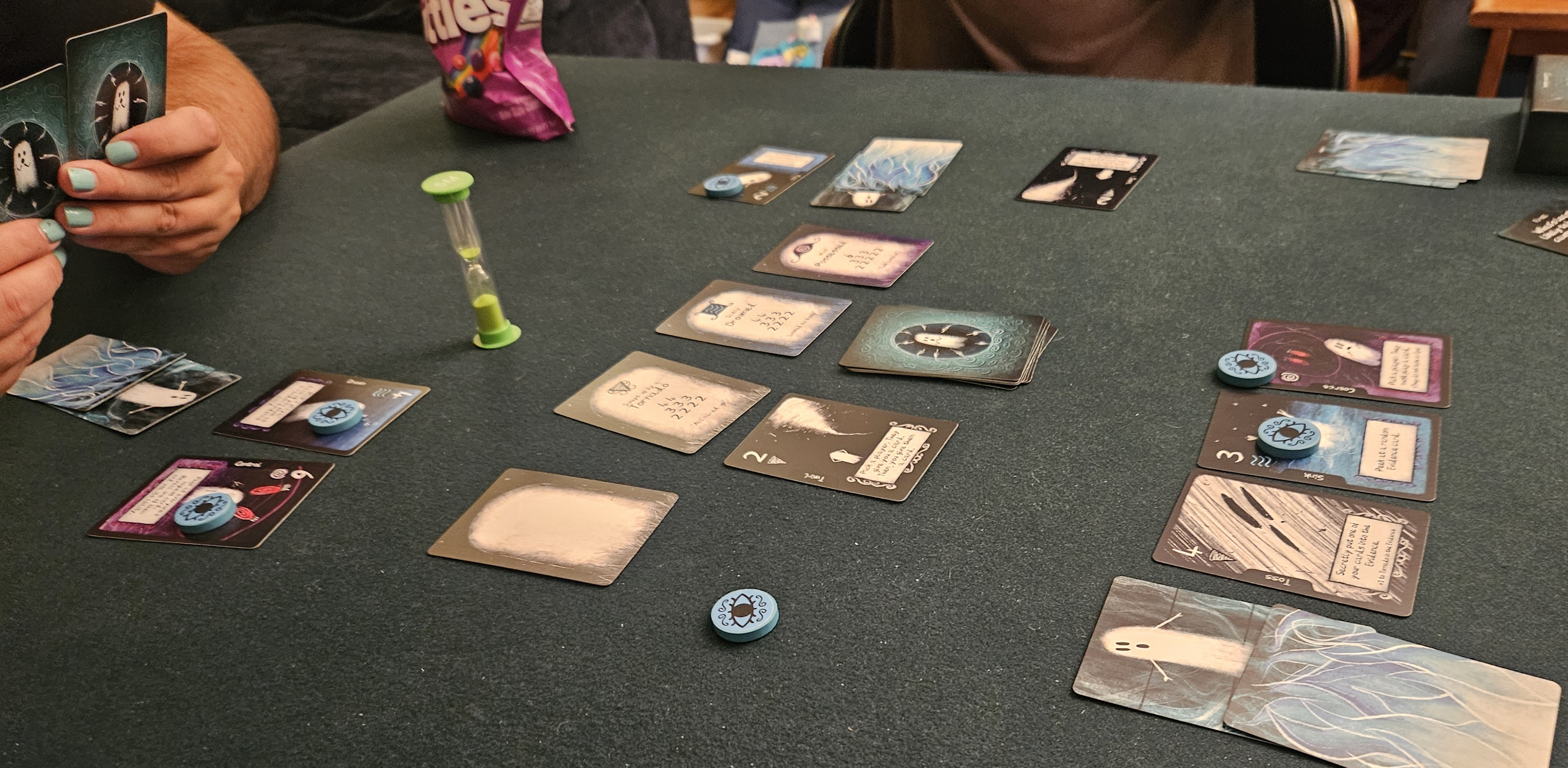
My religion treats Skittles as our eighth sacrament.

If you couldn’t tell, I’ve had a complicated response to Keep the Faith.

As a board game, it’s rather plain. The entire thing lasts maybe an hour and a half, give or take a few minutes depending how stridently people decide to chase their individual objectives. I mentally sort it into the same box as Jenna Felli’s deduction games, especially Bemused, where the incentives are opaque enough that newcomers are often left unsure of what they’re actually meant to do here. One can attempt deduction, trying to suss out what their fellow players hope to accomplish, but those energies are better spent elsewhere. At root, it’s about shifting stacks of cards from one place to another; beyond that, there simply isn’t enough scaffolding to produce much in the way of classic gameplay.

As a role-playing experience, it suffers from the same problems that harry other RPGs with heavy topics on their mind — namely, that everybody brings their own expectations to the table and must navigate the collaborative process to the best of their abilities, and even one awkward or uncomfortable moment can turn the whole thing to rubble. This is also, naturally, the game’s strength, provided everyone agrees on some ground rules. It can be funny, sad, traumatic, cringey, or dramatic. Sometimes it is all of those things within the same few minutes. Because the tale it tells is more institutional than personal, it also encourages a certain distance from its subject matter. Given its closeness to so many lived experiences, this is a huge relief.

As a historiographical toolkit, it’s without parallel. Just flipping through the cards is a useful exercise, demonstrating how faith and religion can intersect with things both large and benign. One card is titled “Prophets & Gadflies,” emphasizing the highest and lowest reaches of its cultural landscape. But that’s an obvious example. One is invited to consider symbolism, clothing, gestures, plants, sacrifices, figures of speech, weather and seasons, music, language, beverages, gifts, and so much more. Where modern study tends to put religion in a box, Keep the Faith breaks it out again. I would recommend it to students of religion in a heartbeat.

As a personal experience, it splits some raw nerves. I expect I won’t be alone in that. My own faith tradition, Mormonism, argues that it is a direct descendant of Christianity as it appeared in the first and second centuries, before the Catholics and Romans came in to mess it up. It’s an argument that’s made by pretty much every Christian sect. We are the original. Our values are Jesus’s values. These practices are pure and untainted by the world. Never mind that our own practices and values have changed within lived memory, let alone the centuries.

Not showing.

Keep the Faith puts such a sadness in me. Because it’s hard, maybe impossible, to not bring myself into this thing. It’s impossible to not see the kid who fled into religion because of abuse, even when that religion was also the cause of the abuse. It’s impossible to not see the idealist missionary who was let down by the institution. It’s impossible to not see the young scholar, learning that everything he had been taught was an excuse rather than good information.

That’s healthy, in its own way. (Yes, it is.) But it hurts, too. (Yes, it does.) If I had to stamp my own thesis on the experience, I would say that Keep the Faith is about how religion is every bit as contingent and changeable as every other human creation, but that, paradoxically, it displays one true constant in its overriding need to always pretend it has always been this way, to chart its roots to the beginning even as it’s constantly born anew, to insist that it honors its heritage even as it spills buckets of whiteout and ink across its own pages. The result is a complicated, textured experience, one I intend to use in the classroom but will probably avoid for personal consumption. Along the way, the wheel keeps turning, the black hole keeps pulling me inward, and the faith keeps being kept. Here is the note of hope and the note of despair, hand in hand: It will change. And then it will pretend it never did.


A complimentary copy of Keep the Faith was provided by the publisher.

(If what I’m doing at Space-Biff! is valuable to you in some way, please consider dropping by my Patreon campaign or Ko-fi. Right now, supporters can read about which films I watched in 2025, including some brief thoughts on each. That’s 44 movies! That’s a lot, unless you see, like, 45 or more movies in a year!)
Technically, It’s a Rigid Airship

13. Januar 2026 um 01:03

THE CELESTIA KINGDOM, I did not entitle this review

Aaron Weissblum’s Celestia is one of those games I’ve wanted to play again, if only out of curiosity. Cloud 9, the title it reimplements, originally hit shelves way back in 1999, the toddler era for modern board games, and although I prefer more recent expressions of press-your-luck like Deep Sea Adventure or MLEM: Space Agency, there’s no denying that Celestia manages to feel distinct from its peers despite some significant similarities.

this is a very old reference

One staticky sweater and it’s BOOM, oh the humanity!

Let’s start with the big parallel: like those other titles I mentioned, Celestia takes place on a perilous track filled with increasingly tasty rewards but also greater odds that your vessel — in this case a wooden airship that looks great on the table but shouldn’t be considered airworthy — will plummet to the ground in a shower of fire and splinters. There’s an even greater proximity to MLEM in that players take turns as the ship’s captain. Everybody is invited to gaze into their eyes and ask that most crucial of questions: “You got this?”

Yeah. I got this.

Or so the captain pro tem will reply, because Celestia is something of a bluffing game. Where most press-your-luck games are all about playing the odds, Weissblum’s is… well, also about playing the odds, but there’s some Boy Scout’s motto mixed in for good measure. To put it another way, players best come ready to lie their butts off and pray to the aleatory gods that their rolls will tumble aright, but it helps to bring the right cards along for the voyage.

Round by round, Celestia looks like this. On each leg of the journey, you check the odds of making it to the next port. Early on, this means two dice; by the end of the line, you’ll be chucking four. These dice present a number of threats: bad weather, different bad weather, carnivorous birds, or sky-pirates. There are blanks as well, which could transform even early hops into deadly charybdes or the last leg into little more than a summery jaunt.

At this point, everybody makes a choice. Either they stick with the current captain, believing them capable of facing whatever dangers appear along the journey, or they jump ship then and there. In most cases — a strong 90% of the time, if not more often — you’ll want to ditch the voyage well short of its final destination. This will earn a treasure from the current island. Naturally, these become more valuable with each passing landmass, tempting everyone to stick it out for just a little longer.

Unfortunately, very small distinctions in card timing make the special effects irritating to play properly.

Some of the cards. Yeah. There they are.

Anyway, the dice are cast and everyone chooses their fate. The captain then spends cards to face the current challenge or the blimp goes down. Either way, this process continues with a new captain, everyone rotating around and around until the voyage is finished one way or another. Then you go again. Eventually somebody obtains enough prizes to bring the session to its conclusion.

As I noted a moment ago, what makes Celestia interesting is that it’s strictly more than a press-your-luck game. It’s also about discussion, and assessing the odds that the captain is holding cards that can rise to the moment, and sometimes tricking people into staying in the boat so they can share your fate. Or maybe wincing a little. Just enough to persuade people that you can’t really sail past all those murderbirds, but not so much that they know you’re fibbing. Your goal, after all, is to earn more points than your fellow passengers.

Of course, there are special abilities, like jetpacks for ditching the ship at the last moment, acts of sabotage that reroll any blank dice, or jeweled spyglasses that are worth points but can be broken to usher the ship to its next port without incident. In some cases, these items can prove as frustrating as they are worthwhile, especially when some people keep drawing all the good stuff. Knizia balanced MLEM around the idea that everybody at the table had every special ability, but they were presented as astronaut abilities that had to be committed to a mission in advance. Here luck plays a double role, affecting both the results of its dice and what everyone pulls from the deck.

Still, it’s notable how much of a role deception plays in Celestia. Because players see the results of the roll before making their decision, it’s necessary to test the captain a bit. And because the role swaps so quickly, it isn’t long before everybody starts to take the measure of one another’s hand. In our last session, my wife was quick to remind the table that I’d failed my last outing as the captain because I wasn’t holding any storm cards. Fortunately, I’d drawn one in the interim, letting me race forward after leaving everybody marooned at the last port.

less making out with one's cousin, presumably

Like a hayride but for blimps.

Which is to say, Celestia may feel undirected early on, but as the game develops those decisions become more and more informed. It’s never quite as focused as I would like; the bluffing and the chancier elements hover in tension with one another rather than fully blending together. But it still stands apart from other games of its ilk by trying to have it both ways. If anything, it could have afforded to lean into its two-faced nature even further. As it stands, I don’t foresee myself returning to it, but it is an interesting example of how a system can feel different with even a few small adjustments.


A complimentary copy of Celestia was provided by the publisher.

(If what I’m doing at Space-Biff! is valuable to you in some way, please consider dropping by my Patreon campaign or Ko-fi. Right now, supporters can read about which films I watched in 2025, including some brief thoughts on each. That’s 44 movies! That’s a lot, unless you see, like, 45 or more movies in a year!)

A Rather Whistful War

10. Januar 2026 um 02:48

this guy does not approve of "whist" being a different color! he will whack it with his sword! take that, blue!

Fred Serval, one of wargaming’s great rabble-rousers, has a new game out. It might not sound like a new game, since I covered it a year and a halfish ago, but that was a convention freebie that required scissors and some buttons from your bottom drawer to play. A Very Civil Whist is now an actual game you can buy and play and push around, or maybe even press into service as a doorstop if that’s your thing.

I like it even more now than I did the first time.

check out these adorable lil dorks

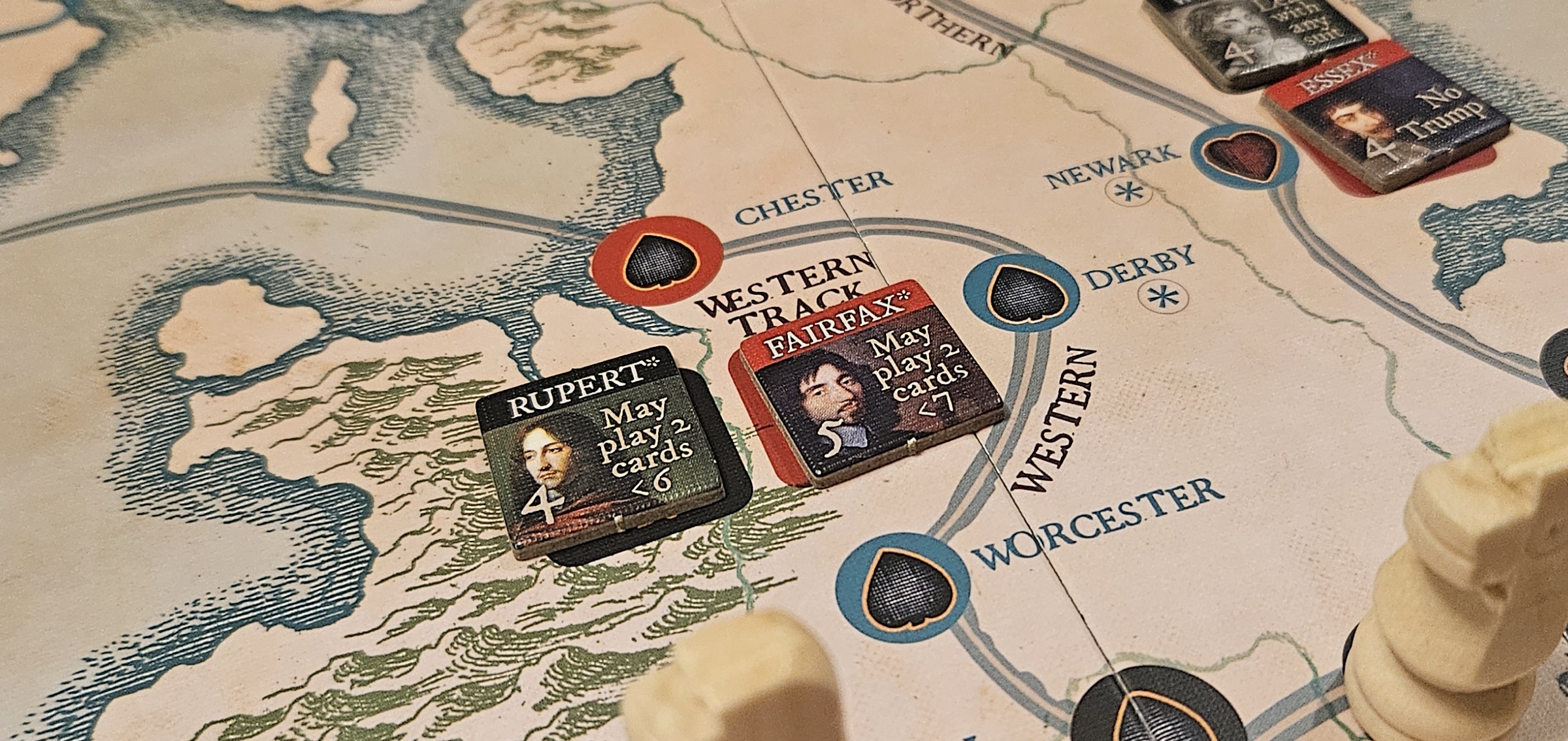
Chess knights indicate the position of the various fronts.

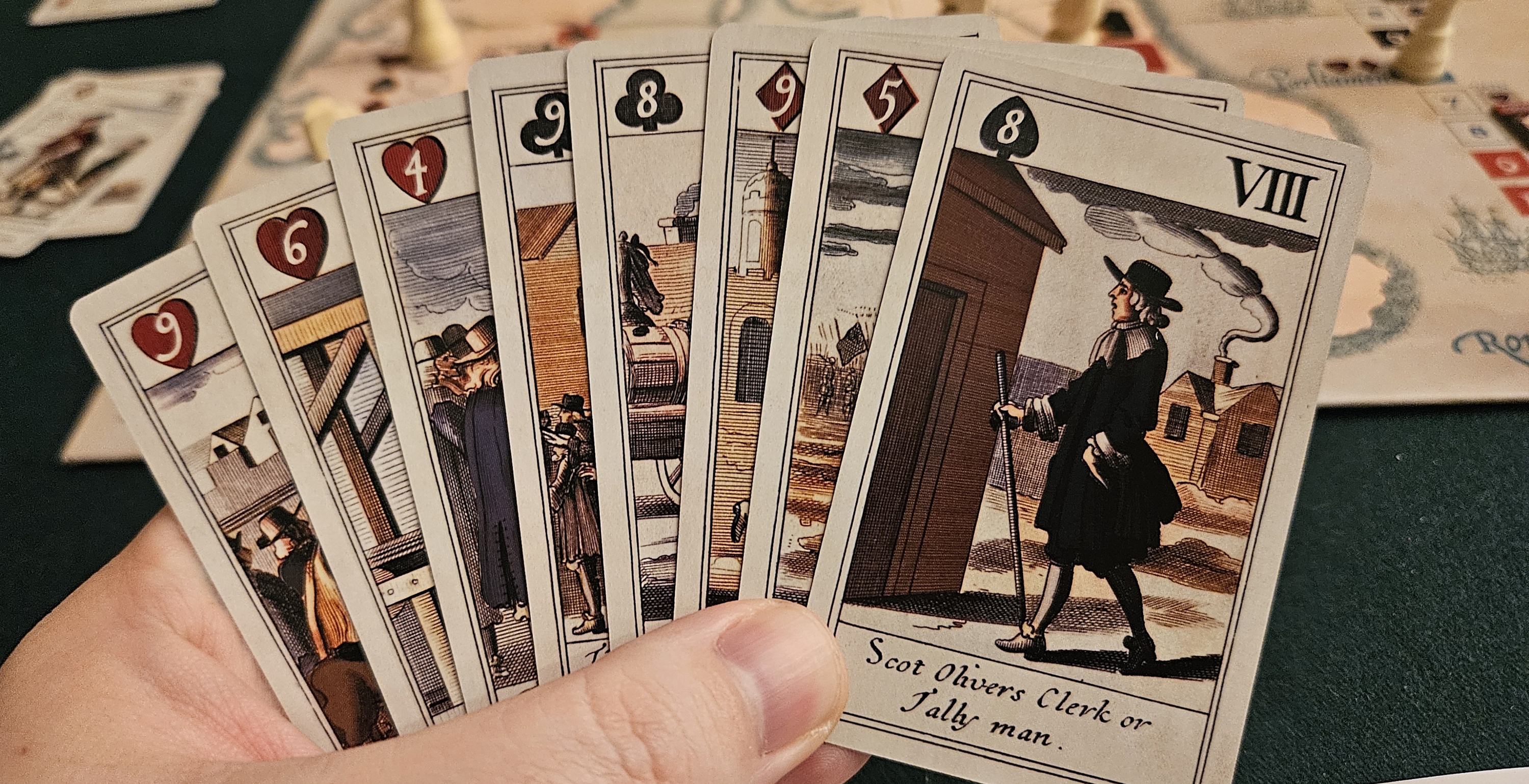
Even as an exercise in minimalism and design limitation, A Very Civil Whist is quite the thing to behold. Like the original one-sheet version, the game is largely playable with a single deck of cards that fulfills four different purposes at the same time. There’s an actual map board now, plus chunky cardboard counters for everything, and some chess pieces for tracking the fronts and foreign support in its ongoing English Civil War, but the highlight is still that deck of cards.

As you can probably tell from the game’s title, this is a trick-taker, although there are some wrinkles that prevent it from feeling too much like anything else out there. Like German Whist, there’s a drafting phase, in which both players deploy a small hand of cards in order to secure other cards, and some combination of your original hand and those later additions then serve as your tools for the battles, domestic and foreign support, and reactions to come.

The deck is really something, both visually, thanks to the old woodblock prints that are their illustrations, and as a mechanical showcase. Most of the time, only the 4-9s get used in the trick-taking, tightening the scope in a way that’s even easier on card-counting, or at least card-vibing, than the form usually permits. The 10s serve as power-ups that unlock when your faction reaches a certain threshold: securing enough foreign support as the Royalists, say, or seizing some good ground in the northern war as Parliament. This basically confers an insta-win in that particular suit, although of course one should be suspicious of anything that seems like a sure strategy.

This will be my fashion sense when I'm old.

The woodblock-style cards are lovely.

The remainder of the cards still matter. The lower suits, those 1s through 3s, function as a casualty check. When an attack fails, you draw a pair from this deck and see whether they sum to a higher number than your commander’s resilience; if so, he atones for his dishonor by falling on the field of battle. This is, to put it lightly, a bummer, especially when one of your better leaders bites it early. In one of my more bruising sessions, I managed to bring out Oliver Cromwell only to watch as he tripped onto his own sword in his very first fight. Let’s call that a good outcome for the Irish Catholics.

Meanwhile, the face cards become events. A Very Civil Whist is a brisk game, only four hands long at maximum, which requires two events per round. But they’re high-impact things, not to mention load-bearing tendons in the game’s connective tissue. Queen Henrietta might appear to call upon a burst of foreign support from her home country, or new counters might enter play to provide a one-time boost to your odds in battle. My least-favorite event — and I mean that in the complimentary sense — is the one that allows Parliament to examine every pair of that round’s drafted cards in advance before hiding one of them face-down, turning the draft into a nasty bluffing minigame.

With the cards pulling so many duties, it may not seem like there’s enough to keep players engaged. Nothing could be further from the truth. A Very Civil Whist is nasty, brutish, and short, all qualities Serval leverages to the game’s benefit. The military fronts are seesaws, their tracks kin to States of Siege’s lanes, always under threat. Shoring up your domestic support is necessary to declare victory, but requires players to discard their most precious cards. Unlike some trick-takers, there is never a moment that feels foreordained; there’s always something to do, some weaselly advantage to be clawed over on your rival.

"Clubmen" could imply either that they wield clubs or belong to a club. Unless they're clubclubmen.

Events keep both sides of the war on their toes.

Which brings us to a larger question: is A Very Civil Whist worthwhile as more than a plaything? As a trick-taker, it’s very good. As a visual production, it look fantastic. But what about as an expression of its historical conflict? We are, presumably, interested in these games as portrayals of their conflicts, not merely as vague nods in their direction.

There will be some variance here. Between its approach to events and the way its verbs relate to its card-play, there’s no denying that this occupies the far end of the CDG wargaming spectrum. In other words, it’s profoundly abstract. With some imagination, one may imagine the cards as stand-ins for broader considerations: some diplomatic tact here, the New Model Army there. But I doubt anybody would argue it doesn’t require the aforementioned imagining.

Where A Very Civil Whist excels, I think, has less to do with the invocation of specific occurrences, and more to do with the closeness and acrimony of its conflict. One doesn’t gain a sense for the progression of the English Civil War so much as for its unprecedented and brutal nature. Like the term “civil war,” the game’s title is a bitter irony. There is nothing civil about it. The war’s actors may speak the same tongue, may wear the clothes of noblemen, may speak in lofty dialogue. But here they are, grubbing in the mud for advantage over their closest peers. Nobody will emerge from the game any closer to having memorized the war’s important dates or understood its underlying causes. But they may grasp some of its proximity, some flicker of the reverberations it will send down the centuries. This is the true starting point for the Age of Revolution. Some may mark its date later, up to a full century after these events. But, no, it is here, in these very English debates over the ultimate source of sovereignty, over which taxes are justly imposed and which are unfairly extorted, over questions of which kingdoms should be accepted to rule over others, over the framework of constitutions and who deserves to benefit from them, that the great upheavals mark their beginning.

Just like that, the war turns a corner. Now there can only be one.

That awkward moment when both men wear the same thing to the war.

In any case, it’s hard not to be drawn to A Very Civil Whist’s sheer audacity. It’s a single-deck game that prizes playing cards for their versatility as much as for their ubiquity, and deploys both traits to great effect. It’s a hybrid of trick-taking and wargame that manages to emphasize the strength of both forms even as it forges its own identity. It’s even another investigation of revolutionary history, making it the rightful partner of A Gest of Robin Hood and Red Flag Over Paris — and, in many ways, their superior.


A complimentary copy of A Very Civil Whist was provided by the publisher.

(If what I’m doing at Space-Biff! is valuable to you in some way, please consider dropping by my Patreon campaign or Ko-fi. Right now, supporters can read about which films I watched in 2025, including some brief thoughts on each. That’s 44 movies! That’s a lot, unless you see, like, 45 or more movies in a year!)
No More Mr. Mice Guy

08. Januar 2026 um 21:49

That fox is the horniest board game character I've ever seen, and I don't have even one ounce of furry in me.

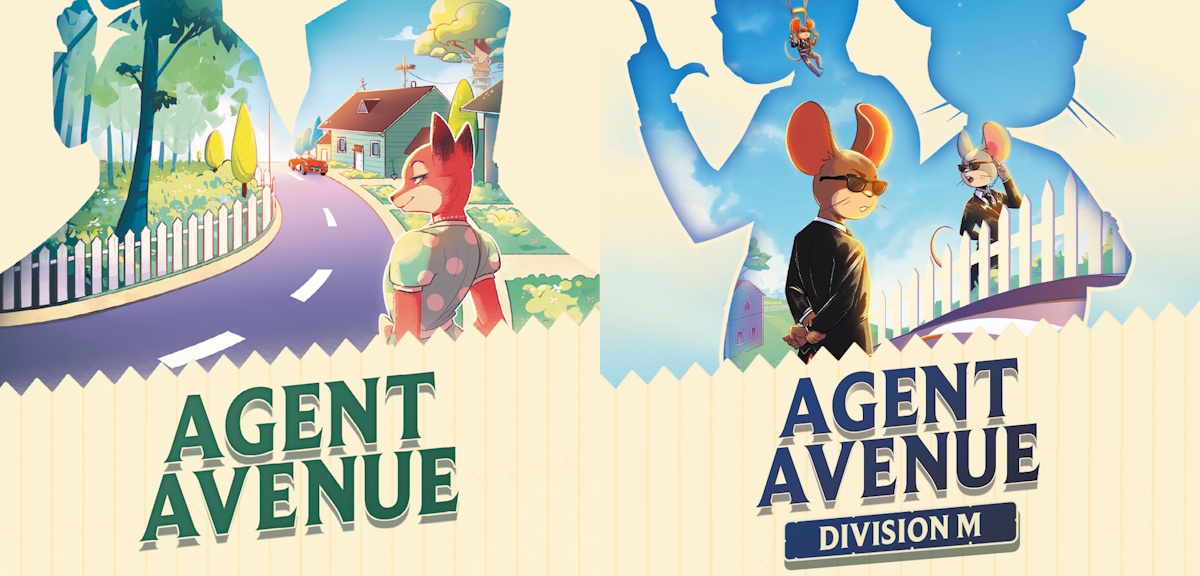
Sometimes one card makes all the difference. When I played Agent Avenue last year, I found it sharp but perhaps a millimeter thinner than I would like, resulting in an affinity for the four-player mode over the usual two-player duel. Now that I’ve added Division M to the mix, I can safely say the expansion functions like a shim under a chair’s mismatched leg.

Do you think their ears ever give away their position? Like sharks that are too dumb to know we can see their fins?

There they are. The MIBs. (Mice in Black.)

I say “one card,” but rest assured that Division M includes more than a single card. This is no depot expansion to The Lucky Seven. Which isn’t to say it’s exactly sprawling. There are six copies of the new card, plus fifteen black market cards for the advanced mode. Still a slender expansion, then, but it’s not like it ships in one of those singlet baseball card sleeves.

As before, players take on the role of rival secret agents who have moved into the same suburban community and are now enlisting their neighbors in a race to corner their opponent, a conceit that speaks to high drama without requiring more than a sentence of introduction and a few furry illustrations. The stakes are immediately clear: the board is a clockwise circuit, and whichever agent catches up to their rival delivers a presumable double-tap that concludes the session.

Similarly, the poison-pill gameplay returns wholly intact. Turns are simple: one side presents two cards, one visible and the other face-down, then their opponent picks which card both sides will receive. It isn’t quite as involved as the antics of my preferred divide-and-choose title Pacts, but that’s also the point. With only a handful of options in circulation, the possibility space is constrained, which only makes the decision space all the more deadly.

But where the base game’s cards fell into two broad categories — those that moved pawns and those that could, once enough copies were gathered, win or lose the game outright — Division M’s addition makes everything else more fraught. It’s an assassin. A mouse assassin. When first played, this adds an extra pawn to the board. As further copies are acquired, that assassin shifts its position like a shadow version of your main agent. If ever your rival shares a space with the great mouse assassin, it’s lights out for them. And vice versa, of course. Because there are six copies of Division M in the deck, it’s entirely possible for both sides to chase their rival while also dodging pint-sized bullets.

assassino rodenta

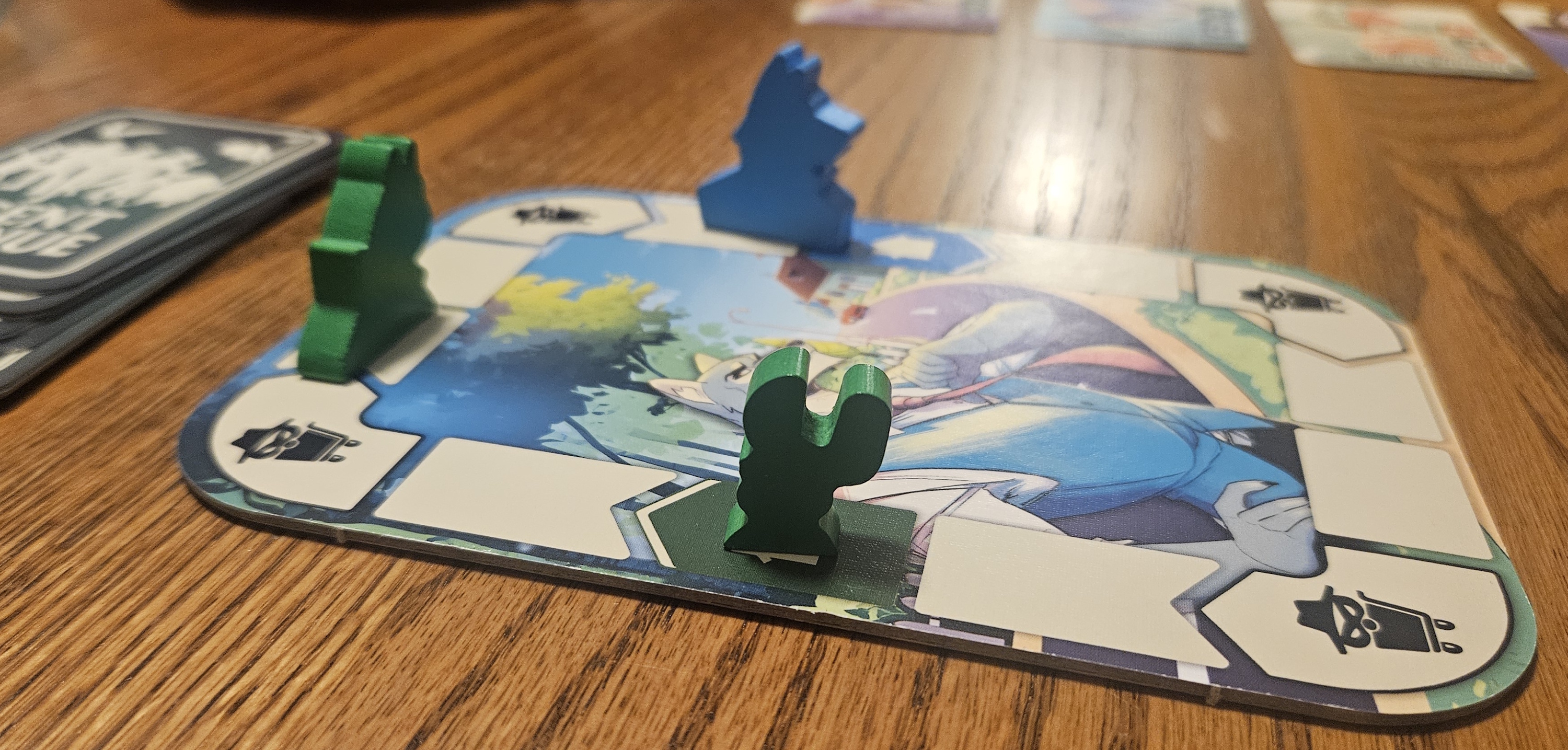
Mouse assassins add some extra danger to the roundabout.

What this adds to Agent Avenue is an essential landmine. It has always been possible to “checkmate” one’s opponent, offering a pair of cards that will both cause them to lose, or, barring that, to weaken their position. With Division M in the mix, that’s a little more likely, but in both directions. It isn’t uncommon, for instance, to see a Division M card put up for offer right as you approach your rival’s side of the board. By claiming the concealed card, you might move right into the freshly-spawned rodent killer. Or is that what your opponent wants you to think? And so forth.

This makes matches punchier, which is exactly what I wanted. Despite my affection for the base game, I’ve suffered through the occasional match that ran a little too long for its own good, both agents circling again and again until one of them lost out of exhaustion more than maneuvering. Those days are over.

It helps, too, that the new black market cards are stellar. Nothing has changed in the advanced mode, rules-wise. Landing on a corner space still lets you select one of three offerings, and those cards are still nasty little things. It’s just that they’re a little more barbed than before. There’s the Turncoat, which lets you recruit a card from your opponent’s hand at random. Will you get something they’ve been hoarding for the right moment? Or maybe an ill-timed saboteur? Some of the new options even manipulate your new pawn, like Call Backup, which lets you move your mouse up to three spaces. That one’s counterpart is Secret Passage, which gives you a one-time dodge when your diminutive killer would put you on ice. Those fifteen extra cards double the size of the black market deck, ensuring that each session now has its own set of considerations.

In less interesting news, Double Agent is still OP.

Just that one extra card adds a lot to consider.

Still, the real draw is the Division M card. The short version — short, geddit? — is that I already liked Agent Avenue, but Division M shapes it into an all-timer. It’s a perfect game for filling ten minutes, which includes when the kiddos want to play something quick before bed or we’d like to cap off an evening with something that’s still pleasantly thinky. I can’t foresee a time when I won’t want it on my forever shelf.


A complimentary copy of Agent Avenue: Division M was provided by the publisher.

(If what I’m doing at Space-Biff! is valuable to you in some way, please consider dropping by my Patreon campaign or Ko-fi.)

Yub Nub

07. Januar 2026 um 20:22

YUI3II3O is my bank password

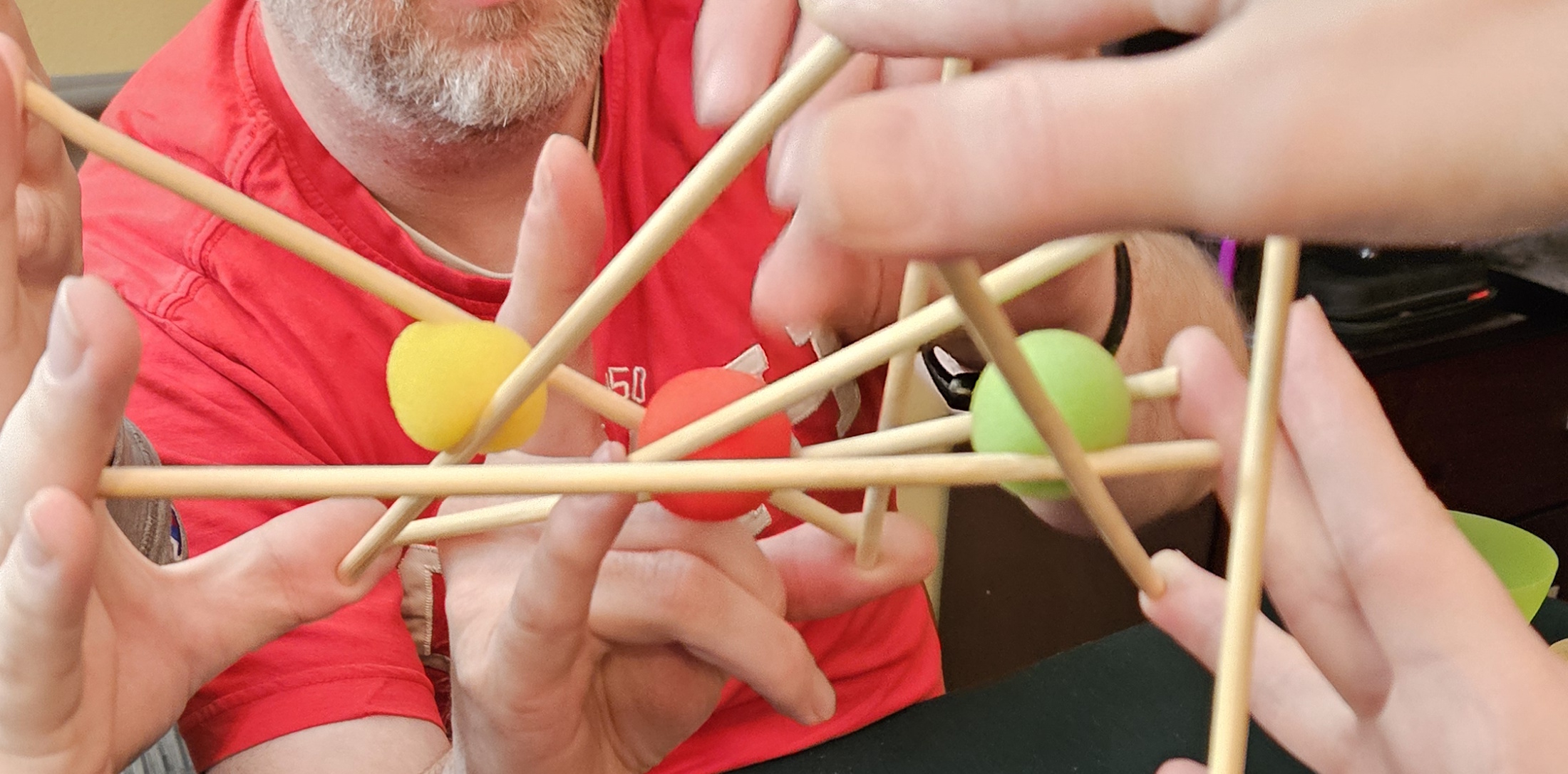
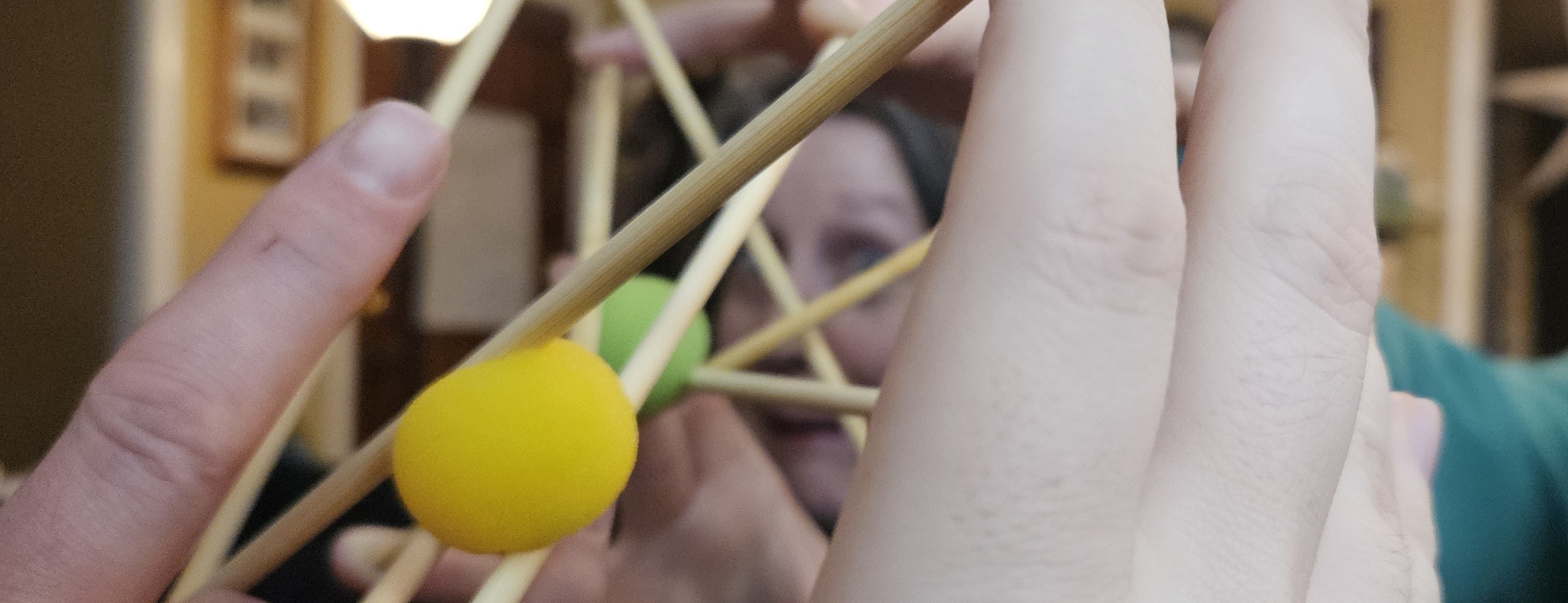
Yubibo exists to reveal which member of your group has selfish proprioception, a sentence I never could have conceptualized until I experienced a friend, with a dozen sticks poised between his fingers and those of four peers, suddenly rotating his wrist all the way around to arrive at a more comfortable position. Six other players were sent lurching in response, doing everything in their power to maintain the pressure on those sticks. It didn’t work. Foam balls and wooden sticks clattered to the table. Everyone laughed.

growing the beard while doing it? insane mode

Balancing the balls is technically the advanced mode. Usually the sticks are hard enough.

Yubibo feels like a game invented, playtested, and marketed in a dumpling restaurant. The gist couldn’t be simpler. You draw a card — very quickly itself a feat of balance — to reveal which player you must balance a stick with. Which player and which finger. Your brother-in-law’s ring finger. Your daughter’s thumb. Your own birdie finger, which means anybody’s birdie finger of your choosing.

Early on, this is a simple ask. Two people can hold a stick between them. No problemo. Kein problem. Mondainai. Another stick? Sure. How about a third. What is this, a game for children?

I’ve tried Yubibo with children, and let me tell you, it takes some willpower to keep more than a couple sticks above the table. My older daughter can manage alright, although her wrist gets tired after a while. My six-year-old? Forget it. She has the greediest proprioception I’ve ever seen. This isn’t something I could have known about her until she tossed an entire handful of sticks onto the table, noping out of the game after three minutes. Was her hand hurting? “I just don’t like this game,” she insisted.

Even with adults, it only takes one go around the table, maybe two with a smaller group, before you start to feel it. Not only the burn, although Yubibo excels at finding the muscle groups that have atrophied from disuse. No, it’s the sheer jittery tension that comes from coordinating with other human beings, but not quite touching them. The sticks become power cables. Tension bridges. Bonsai wires. When someone in the group shifts — even when it isn’t someone you’re holding a stick with — you feel every movement, transmitted like a message through multiple intermediaries. Someone rolls their finger to accommodate a second stick and the entire collective vibrates.

"my hand isn't meant to bend like this!"

Terror.

At its easiest, Yubibo is just about balancing sticks. In case you’d like to try out for your country’s gymnastics team, you can also try to stuff foam balls in between the sticks. Why would you do this? Because it transforms you into Mr. Miyagi trying to honk a clown nose. A hivemind Mr. Miyagi who, if you’re anything like us, lacks basic coordination and couldn’t beat up a gang of skeletons if his life depended on it.

I think strange thoughts while playing Yubibo, which is undoubtedly bad practice when it comes to focusing on all those sticks. I look at that shifting forest and wonder if this is what the connections in our brain are like, tensing and flexing as they produce consciousness. I see human society, this magnificent construct barely held aloft through faith and determination. I see a family. Then I lock eyes with someone across the table and the spell breaks, and more often than not I feel the tremor in my knuckles and the whole thing begins to come apart.

Yubibo is a quick game. It’s an easy game to teach. Unlike some balancing games, I have my doubts that it’s quite winnable. Oh, the rules provide a metric. A certain number of sticks. In my experience, those are best ignored. The game shines when you play it with all the stuff. When there’s no purpose but the cascade at the end. Not every game needs to end in victory. Sometimes, just holding it together for one more go-round the table is enough.

basically the Ring girl

The most cursed image ever featured on Space-Biff!

There isn’t much more to say about Yubibo. This once, that strikes me as a good thing. Ten minutes, lots of laughter, lots of failure. The sticks clatter, the foam balls bounce away. So, too, goes whatever was cluttering my headspace only a few moments ago.


A complimentary copy of Yubibo was provided by the publisher.

(If what I’m doing at Space-Biff! is valuable to you in some way, please consider dropping by my Patreon campaign or Ko-fi.)

Movin’ Up an’ Down Again

07. Januar 2026 um 04:43

Oaf?

For all that board games thrive on taking us to new places, exploration is surprisingly hard to do well. Explorers of Navoria, designed by Meng Chunlin, is a prime example. Set in a colorful world redolent of Root’s woodland or Oath’s turbulent empire, and populated by critters who wouldn’t draw much side-eye in either setting, Explorers of Navoria is nominally about pushing the frontier ever outward, but more accurately about shifting one’s position on a number of slightly differentiated tracks. In the proper mode — a persnickety combination of player count, expansion, and headspace — it’s a tasty and visually appealing course that feels good going down even as it leaves the stomach rumbling minutes later.

Just maybe not here on this particular board.

There’s lots to explore out there.

To describe Explorers of Navoria is to divvy it into two halves. Think of them as expansion and contraction. In the first phase, players are asked to push outward, assigning discs to various decks to acquire cards in the market; later, they will reassign those discs back into the heartland that birthed them, earning resources and other sundries.

Each of these phases has its own appeal. The exploration phase is immediately rewarding. Either you draw a pair of those discs from a bag and select one, or else claim one of the previous discards. Either way, your… troupe? guild? I’m not sure, but whatever their role, they’ll nab a card from the market and put it into practice.

These cards, in addition to being easy on the eyes, are simple little things. Some move your explorers along tracks, one for each of the desert, jungle, and mountain, in order to plant flags and earn farthest-place bonuses. Others build outposts along those same tracks, pushing your starting space outward for future rounds. Those are the most dynamic; others are more straight-laced, earning resources that can be distributed across your player board’s three spaces to be cashed in for bonuses and points later, or perhaps building combos for later. There are suits to consider for end-game scoring, various species to monopolize for the same function, and the not-occasional coin or three. Coins are victory points, by the way, so don’t go expecting something more engaging.

And then, once the exploration is complete, Explorers of Navoria transforms into an ultra-light worker-placement shindig. Those same tokens return home, only this time the earnings are less tableau-ish. You earn a few more resources, a few more coins, and maybe turn in some of those resources for an extra few bonuses.

In between the cards and the player board, you can see the drafted faction powers that are only included in the expansion. If you must play this game, I recommend the extras.

I do appreciate a vibrant tableau.

The secret to the game’s success isn’t really much of a secret. Everything is rewarding. Everything feels good. It’s like a casino where every slot machine is guaranteed to dump cherries and coins and colorful bits of ribbon in your lap. Never mind that the cherries are plastic and the coins hold no value. Explorers of Navoria is a masterwork at saying something loudly and often, but with very little meaning.

To be fair, that isn’t such a bad thing. At its best, Explorers of Navoria could hardly be described as a poor hang. It feels good to move up those tracks. It feels great to build an outpost and start a little farther out than last time. It feels nice to bring home a wagon full of crystals and swords, and even better to trade them in for some extra coins-slash-VPs.

Little by little, though, the sameness of the linoleum starts to show through. There’s the way every card sticks more or less to the same formula, maybe plus or minus a point, but never coughing up anything all that exciting. Or the way every combo looks like every other combo; there are those that reward coins for particular races, or those that trigger only at the end of the game for outposts, with very little room in between. This isn’t exactly a game that allows the player to discover something new, let alone forge their own way in the world. At least there’s some frisson of randomness there, courtesy of the draw-bag and the way the market populates with cards. It isn’t much. It isn’t enough. I’d call it a gesture in the right direction. But two plays is enough to realize you’ve already seen what Explorers of Navoria has to offer.

This isn't even the correct metaphor. Explorers of Navoria could afford to be MORE tipsy. Instead, it's a little too stable. Still, the fact that the turn markers can't stay standing for more than a moment is an interesting detail.

The turn markers are a microcosm of the game at large: pretty but tipsy.

It doesn’t help that some of the game’s best ideas are hidden away behind the expansion. Like actual rewards for moving along those tracks. Actual rewards apart from coins, I mean, such as bonuses for collecting the previously underwhelming warfare cards. Or like the faction draft that sees each player building their own opening combo, with starting cards and little abilities, complete with an extra resource that can be gathered on the map and churned into a new approach to the gameplay. Or like the addition of a sixth deck of cards in the market. This makes it possible to play with five players, but more importantly it allows the game to actually function at four.

Okay, I’ll back up. With the base game, each round sees players gathering four cards. Unless you have four people at the table. Then you only gather three. That’s the difference between nine and twelve cards at the end of the game. Playing with four means everybody is too pinched. It’s hard to move along any of those exploration tracks, let alone build a functional combo. With the expansion, however, now there’s enough to go around. Unless you bump the count to five players. Then you’re stuck gathering those three cards per round again.

It’s a weird way to gate a package’s content. Urp. Content. I hate thinking about board games like that. But in this case, it’s hard not to default to that way of thinking. The base game works well enough, but it works less well without the expansion. Despite all the color and the fanciful characters and the moment-to-moment lizard-brained pleasure of accumulation, it feels thin, like the precise number of cards were doled out to make the game playable but also a bit lean, just enough to leave everyone hungry for more.

Which leaves Explorers of Navoria in an odd space. Like I said earlier, it feels good to play. It’s tight. Players will likely wind up with comparable scores, borne of fifty trickles that sometimes contained a drop more or less than the others. But it’s still the equivalent of licking a damp cave wall for nourishment. It’s just that there are pretty pictures to look at and some technically serviceable levers to pull while your tongue laps at that smoothness.

I was originally going to sneak a card from Oath in there just to see if anyone would notice, but their title banners gave them away too readily. Oh well.

The lion guy is a good hang.

What’s left is a board game that looks nice and feels nice, but never really does anything more. Which, look, is sometimes precisely what I want. This is an easy game to converse over, even if the variable turn order makes it a little more hostile to beer-and-pretzels than it might have otherwise been. But there are other options out there. Some of them feel less like hamster wheels. You’ve got better things to do with your time than march up and down the same featureless tracks.


A complimentary copy of Explorers of Navoria was provided by the publisher.

(If what I’m doing at Space-Biff! is valuable to you in some way, please consider dropping by my Patreon campaign or Ko-fi.)

Best Week 2025! The Index!

31. Dezember 2025 um 17:42

Another turn of the Wheel. 2025 was a banner year for board games, which by extension means it was a banner year for Best Week. Down below, you’ll find an index of the year’s picks. Click on any of the images to be whisked to the corresponding article. To the old year! To the new year!

Day One! Picture Perfect!

Day Two! Heart of Darkness!

Day Three! Beatrixmania!

Day Four! The D.T.R.!

Day Five! All My Children!


(If what I’m doing at Space-Biff! is valuable to you in some way, please consider dropping by my Patreon campaign or Ko-fi.)

Best Week 2025! All My Children!

30. Dezember 2025 um 17:04

In those now-unreachable years before my daughters came along, I remember balking at certain statements. “Some things you simply can’t understand until you have children,” someone would say. Now that I’ve had kids, I’m adult enough to admit they were right… but still juvenile enough to believe they were drafting their offspring into props to prove a point.

And what, exactly, have my daughters taught me? The unnamed emotion of putting an infant to sleep on my stomach. The mind-blanking terror of sitting beside a hospital bed. The way even the simplest of board games can become profound shared experiences. What follows is a list I never thought I would write: the games that transformed my year not because they were innovative or philosophical, but rather because they let me pass a few meaningful minutes with my girls.

#6. Tic Tac Trek

Designed by Trevor Benjamin and Brett J. Gilbert. Published by Alley Cat Games.

The third in Alley Cat’s line of mint-tin games, Tic Tac Trek initially seemed like the afterthought of the group. For one thing, unlike its predecessors Tinderblox and Barbecubes, it isn’t a stacking game. For another, it’s a riff on Tic Tac Toe, the worst way to pass time in church. (Besides actually listening to the sermon, obviously.)

I should have known better than to doubt Trevor Benjamin and Brett J. Gilbert. Tic Tac Trek is as smart as they come. Your goal is indeed to make three in a row, but here your marks are tiles drawn from a bag, injecting tension and doubt into every move. What’s more, you hope to ignite your campfires on the edges of the play space, earning points for every uncharted territory around them, but risking subtractions as the game progresses. It’s a masterclass in shared incentives and painstaking blocking — but on a more relevant level, you should have seen me beam when my elder daughter absolutely swept my dad with a series of clever placements.

Review: Fire Hazards

#5. Ichor

Designed by Reiner Knizia. Published by Bitewing Games.

Look, I agree that Iliad, Ichor’s companion title, is the stronger of these Knizias. But Ichor is the one my elder daughter fell in love with, and by extension the one we played time and time again, her monsters sweeping across the foothills of Mount Olympus. As a game, Ichor feels tailor-made to appeal to chess-loving children. It’s basically the answer to the question, “What if every piece could move like a rook?” The answer is silly at times, especially when somebody leaves a lane unattended.

Of course, Reiner Knizia knows better than to let one of his games fall apart just for the sake of some silliness. Ichor stands apart because its objective isn’t to capture opposing pieces. Indeed, most pieces can’t capture at all. Instead, you’re here to scatter all your tokens across the board, a task made all the harder because your opponent also has a stable of their own rooks for replacing your tokens with their own. It’s only through careful play, including cautious use of your team’s special abilities, that you can get ahead. My daughter can beat me over half the time now. I couldn’t be prouder.

Review: She’s a Grisly Monster, I Assure You

#4. Magical Athlete

Designed by Takashi Ishida and Richard Garfield. Published by CMYK.

The surest sign of a board game’s success comes when my parents, relative agnostics for the form, ask excitedly if I brought it to Christmas brunch. Magical Athlete is one of the best board games ever designed, and I say that without reservation. Low player agency? Fart noiseWho cares. This is one of those rare games that can be played by four-year-olds and octogenarians with equal delight.

And the recent CMYK edition is more or less the game’s platonic ideal. Everything has been touched up: the character abilities, the extra racing circuit, the way racers are drafted, even the wooden miniatures. Ever seen a giant baby take up an entire space? The game is packed with little jokes, some ludic and others visual. I have yet to encounter a bad play of this thing. Or, crud, even an average play. My kids now insist we pack this thing to any sufficiently large family gathering. It’s that good.

Review: Chariots of Frickin’ Fire

#3. A Gentle Rain

Designed by Kevin Wilson. Published by Incredible Dream Studios.

Designed during the doldrums of a global plague, A Gentle Rain technically released in 2021. But in a testament to the format’s timelessness, it emerged as a household regular only this year. As a game, I was initially reluctant. The play consists of matching tile edges to create blossoms. Not much to it. There’s a win condition, but it’s squishy. To be frank, the entire project initially struck me as indulgent and patronizing.

I was wrong. Oh, so wrong. My younger daughter has always struggled with the largeness of her emotions. Being able to sit and undertake simple, soothing, repetitive actions has been a blessing. She cheats at the game; since it’s cooperative, nobody cares, and she also insists I cheat as well. It’s short enough that we can squeeze it in before school. And it’s calming enough that it has been become a reliable staple for helping her gain some space from an overwhelming task. As an exercise in mindfulness, A Gentle Rain exemplifies the strengths of tabletop games.

Review: A Mindful Rain

#2. Tidal Blades 2: Rise of the Unfolders

Designed by Tim and Ben Eisner. Published by Druid City Games.

Over the past year, we’ve tackled a number of campaign games. Most of them have quickly proved tiring. I won’t list examples; Best Week isn’t for downers. But the one title that consistently brought us back to the table, charmed us with its bright palette and upbeat characters, and kept us turning pages despite some rather, ah, expressive writing, was Tidal Blades 2: Rise of the Unfolders.

What are Unfolders? I could tell you, but it wouldn’t make any sense. Like most board game adventures, Tidal Blades 2 is a bit of a mush. But it’s a lovely mush. Even the monsters are worth seeing. We spent many nights poring over the game’s scenarios, my older kid tinkering with her character while my younger one perched on my lap for a side battle between her own hero and some spare creatures. This is the first board game that my kids could tell you about the lore. It helps, too, that I was also invested, not only because of the kiddos, but because the game’s world is so vibrant that even this weathered sack of bones found something worth defending.

Review: Wet Behind the Gills

#1. Hot Streak

Designed by Jon Perry. Published by CMYK.

It’s unthinkable that two goofball racing games came out this year, both with limited player agency, wacky characters, and broad appeal, and that the best of them wasn’t Magical Athlete. In our house, we were already Jon Perry fans. Between Spots for the kids and Scape Goat for the bigguns, there’s no denying his range and talent. Hot Streak bridges the gap with a Golden Gate of remarkable craftsmanship. Also, it’s a useful inroad to the topic of gambling. Look at what DraftKings did to these poor addicts, now reduced to wagering on the outcome of underground mascot races. Is this the future you want for yourselves, kids? Betting your life savings that a hot dog will eat asphalt?

Maaaybe. Above all else, Hot Streak is a scream. It captures the thrill of spectation, breaking down the barrier between play and passive observance. But, look, that’s grown-up talk. The real takeaway is that this is a perfect game because you can bet big on an angler fish running backwards across the finish line. We love it.

Review: Ready Set Brat

There you have it! Don’t hesitate to go all mushy on me. What were your favorite family/kid/dog games of the year? Share them below.


(If what I’m doing at Space-Biff! is valuable to you in some way, please consider dropping by my Patreon campaign or Ko-fi.)

Best Week 2025! The D.T.R.!

29. Dezember 2025 um 16:12

Do people still D.T.R.? When I was a youngling, the acronym stood for Define The Relationship, that belly-clenching moment when two people would sit across from one another, lock eyes, and hold a serious discussion about whether to go steady. Nowadays it probably stands for Do The Rhombus. What is the Rhombus? I couldn’t tell you. Too old, me.

Something was in the air this year. Love, sex, breakups, and awkward situationships, to be specific. Weird, I know! For whatever reason, 2025 was the year we decided to actually get squishy for once. What follows are the year’s strongest exemplars.

#6. Conviction

Designed by Xoe Allred. Published by Lunarpunk Games.

It was deeply tempting to feature Xoe Allred’s Persuasion, as it remains one of the finest board games about relationships ever designed, and moreover now has a shiny new release from Hollandspiele. But I featured its print-and-play version back in 2022 — the topic of the day was “trauma,” take from that what you will — so instead this seemed like a good chance to talk about Conviction, the spiritual sequel to that game.

Conviction is the morning after of relationship games. The dream couple has been sealed in holy matrimony. Hooray! Only now it seems they didn’t discuss something important during the trial period. Oh no! Blending role-play, card counting, and all of ten minutes, Conviction is Allred’s portrayal of what happens when a couple quarrels, thus beginning either their reconciliation or the end of their mutual journey. With some investment from both players, it’s a striking meditation on… well, pretty much every adult relationship, to be honest. Mine, anyway.

Review: Lovers’ Quarrels

#5. We Need to Talk

Designed by Brendon Fong. Published by Skeptical Otter Games.

Trick-taking and shedding represent two sides of the same coin, a statement that surely won’t get in me trouble with the purists. We Need to Talk bends that coin into a möbius strip, tasking its duo with both winning tricks and pruning uncomfortable memories. That’s because they’re going through a bad breakup and are now trauma-dumping their shared reminiscences, good times along with the bad, awkward, and in-between.

We’ve all been there. Most of us. Not the dream couples, I guess. They’re stuck in the entry above this one. What makes We Need to Talk shine is the way it merges its conceptual framework with its gameplay. The illustrations capture the moments that make up many relationships, only to fade into the background or linger intrusively in the back of your character’s mind. Will you press onward to something new, or remain trapped in a memory prison? That’s up to you.

Review: Eternal Sunshine of the Trick-Taking Mind

#4. That’s the Spirit!

Designed by Connor Wake. Published by Always Awake Games.

“So, which of our friends killed us?” has got to rank up there as one of the most awkward questions one spirit can ask another while awaiting reincarnation. Especially when it’s the fourth time your group has been killed by an embarrassing shared accident. Did we explode this time? Get poisoned? Were we swept away by a tornado while watching Twisters, despite ample warnings that a storm was bearing down on our location and that we might be trading our lives to view a cinematic catastrophe?

Whatever the reason, whoever the culprit, it’s our job to figure them out. Or conceal them, if you were the one responsible for our fellowship’s untimely demise. That’s the Spirit! is as peculiar a social deduction game as they come, chock-full of strange abilities and uncomfortable social circumstances, both on the table and above it. It’s an extended conversation about who screwed up this time. Don’t expect anybody to take responsibility for free.

Review: Afterlives

#3. Adulting

Designed by Eric Dittmore. Self-published.

Not many board games are as charming as Adulting, a title about surviving a hectic weekend full of chores, anxious screen time, and maybe, just maybe, some self-improvement. The core concept is deck-building, but in the most fluid fashion imaginable, cards bouncing in and out of your hand with nearly every action.

But Adulting is also a relationship game almost entirely thanks to its multi-tiered objectives. Everyone at the table must work together to avoid burnout, caused by the pileup of too many chores. At the same time, everybody has a different idea for what they hope to get out of their weekend, and is given free rein over how to pursue that goal. While some players work together to tackle the chores, others are free to irritate their housemates by pursuing their objectives at all costs — or even mark themself as the self-sacrificing parent willing to absorb the group’s stress. The result is an affectionate portrayal of cooped-up group dynamics.

Review: Joy in the Burnout

#2. The Hedgehog’s Dilemma

Designed by Scott King. Self-published.

I’m not actually sure how to describe The Hedgehog’s Dilemma in a snippet. Part fable, part exposition on a philosophical metaphor by Arthur Schopenhauer, and part marriage proposal, this trick-taker covers quite a lot of ground. As in Adulting, the victory conditions provide much of the context. If everyone’s pieces occupy the same space, everybody wins together. If they’re all apart, everybody loses. More likely, if some are together and others are apart, the game kicks over to a scoring phase that grows increasingly desperate and/or thrilling with each successive tally.

There are other wrinkles, but that’s enough to set the stage. Often, all it takes to flip the switch between magnanimous and petty is the reveal of a single card. It feels like a parable in game form, drawing out social behaviors through simple rules and clear incentives. I can safely say I haven’t played anything quite like it.

Review: A Prickle of Trickers

#1. Molly House

Designed by Jo Kelly and Cole Wehrle. Published by Wehrlegig Games.

There’s a warm heart at the center of Molly House; a warm heart that beats in spite of moralizing cruelty, and which might be stilled by fellow hearts that have succumbed to panic. As a “molly” — a queer person in Georgian England, one whose identity likely strikes most of us today as foreign — your task is to find joy among the arcades and drinking-houses of London. This is a fraught business. Almost assuredly a doomed business. But a business worth pursuing nonetheless.

Over the past year, I’ve had the privilege of introducing Molly House to a wide range of players. Some have been like myself. Others have been queer in varying shades. In nearly every case, the response has been a surprising wellspring of empathy. Molly House is, among other things, full of parties both riotous and sad, fidelities and betrayals, and surprises both great and small. Every so often a board game comes along to succeed where every other medium has failed, investing us in a time and place that would otherwise go overlooked. Molly House is that game.

Review: Love and Heartbreak in Georgian London

Whew! That’s a lot of board games about relationships. Did you play any such titles this year? And if so, what were your favorites. Come along now. D.T.R. for me. (Define The Recreation.)


(If what I’m doing at Space-Biff! is valuable to you in some way, please consider dropping by my Patreon campaign or Ko-fi.)

Best Week 2025! Beatrixmania!

28. Dezember 2025 um 18:32

I don’t believe I’ve ever seen a publisher have more of a bottle rocket year than DVC Games. Home to the design collective Jasper Beatrix — which thankfully avoids the pitfalls of the now-defunct Prospero Hall by offering actual attribution — DVC Games has established itself as a cradle of innovation. Even when their individual titles riff on the familiar, they’re undoubtedly riffs, jazzy little grace notes that bring their own interpretation to the genre.

Which is to say, this is the tightest focus ever featured in Best Week. These folks deserve the plaudits. Just take a look.

#6. Karnak

Designed by Jasper Beatrix. Published by DVC Games.

Like a lot of the titles on today’s list, Karnak is sorta many things. Sorta a stacking game. Sorta an area control game. Sorta a cutthroat contract game. It’s all of those things and none of those things. It’s what you get when a child-pharaoh demands a cool plinth with a rockin’ statue, then changes his mind and instead wants a bunch of sideways pillars over a river. Why? Because the brat is nine years old, that’s why.

In practice, Karnak is a little uneven, although its unevenness is also no small part of its charm. What, you expected the god-king to be consistent? Pshaw. Stacking together strange monuments, only to repurpose some of them into new edifices while others are ossified thanks to obnoxious priests, that’s just how it goes when you’re an ancient architect. No aliens required.

Review: Most Select of Board Games

#5. Medusa’s Garden

Designed by Phil Gross and Jono Naito-Tetro. Self-published.

The only title on this list not strictly published by DVC, Medusa’s Garden was nevertheless crafted and developed by the Jasper Beatrix crew. I suspect the form factor — a deck of cards and a hand mirror — prevented its inclusion as a boxed release. Picture this: a social deduction game, but with none of the pressures that accompany most social deduction games. Instead, it’s presented as a duel between two players: Perseus, who wants to deliver a swift chop to Medusa’s neck, and the famous gorgon herself, lurking among a garden of stone statues, determined to crumble them before Perseus can ruin the party.

A perfect convention game, then, one that sits halfway between performance art and logic puzzle while never once failing to be hilarious. And all that when over half of its participants have the simplest goal of all: stay very, very still.

Review: Nebulae, Medusae… Crownae?

#4. Scream Park

Designed by Jasper Beatrix. Published by DVC Games.

I’m a bit of a snob when it comes to tableau builders, but I contend that ninety percent of the things have no idea why players want to build these spaces in the first place. It isn’t only the brain-tickling pleasure of arranging icons in proximity; it’s the possibility of exploring that space.

Scream Park is a love letter to seasonal haunted houses, and what it understands is that we don’t only want to build the things — we want to get scared silly along with their visitors. That’s why each round concludes with a VIP guest, somebody we as curators must fear in our own right: a fire marshal, a gang of birthday brats, an internet influencer looking to dunk on our subpar effects. We build the space for maximal fright, rejiggering the components from last year’s leftovers, and try to sell this season’s guests on the illusion. It’s silly and satisfying as only a perfect tableau-builder can be.

Review: Fear Factory

#3. Pacts

Designed by Ben Brin. Published by DVC Games.

Pacts is emblematic of this publisher’s whole deal. Designer Ben Brin takes a concept, in this case “I divide, you choose,” jettisons what makes the mechanism tired in every other setting, and gives it new life. There’s nothing here we haven’t seen before, strictly speaking, but every edge has been polished to its finest shine. Or sharpened into a stake, perfect for driving through your opponent’s skull.

Set in Ireland of legend, Pacts has it all. Strange creatures, devil’s bargains, and a surprising number of ways to get ahead. With all the cruft subtracted from the design, what remains is a pared-down but rich experience, a fantastical conflict that occupies less than half an hour but contains enough drama for a game five times its size and duration.

Review: Cutting the Cottage Pie

#2. Signal

Designed by Jasper Beatrix. Published by DVC Games.

If you’d asked me back in March, I would have insisted that Signal would be one of Best Week’s #1 games. Based on first contact fiction — squint a little and you can see the grainy target-cam footage of Arrival — Signal is a cooperative effort between one alien and a crew of translators. Between those two groups and a whole lot of failed experiments, the rules of the alien’s language emerge one line at a time. It’s translatorpunk, to fall back on the trope of slapping -punk onto the back end of an otherwise ill-suited descriptor.

What makes Signal work so well, though, is the sheer variety on display. There are dozens of aliens in the game, each with their own rules. Some want pieces placed in relation to one another; others stack pieces, or use pieces that shove other pieces, or deploy pieces that transmogrify into different colors. The rules are myriad and ever-changing. And it’s up to you to deduce their meaning.

Review: A Desire for More Cows

#1. Here Lies

Designed by Jasper Beatrix, Jakob Maier, and Bobby West. Published by DVC Games.

At a glance, Here Lies is perilously close to Signal. One player takes the role of an aging detective recounting decades-old cold cases. (In one scenario, a millennia-old cold case!) Everybody else gathers round to try and figure out the solution. It’s a blend of locked room mystery, Encyclopedia Brown short stories, and Sherlock Holmes serials.

But what sets it apart from every other detective game is that Here Lies refuses to present one more logic puzzle. Instead, it’s a chance to get creative. You’ll play hangman, draw a picture, summon a snippet of dialogue, or test your vocabulary with some word association. As new evidence trickles onto the table, you’ll draw unexpected conclusions that bring the group inexorably closer to the truth. It’s perhaps the most striking of the Beatrix collective’s titles, a brilliant summation of a design ethos that evokes the game’s literary inspirations while sidestepping the tropes of every board game that came before it. When I first sat down to dig into the box’s contents, I had no idea I was holding a quiet revolution in my hands.

Review: Here Lies Every Other Detective Game

Okay, so there’s a real problem on our hands, because I want you, the reader, to give me your own recommendations. But this is the narrowest topic ever featured in Best Week. So perhaps share your own top publisher of the year, complete with examples? Who opened your eyes to new possibilities over the past twelve months? Go wild.


(If what I’m doing at Space-Biff! is valuable to you in some way, please consider dropping by my Patreon campaign or Ko-fi.)

Best Week 2025! Heart of Darkness!

27. Dezember 2025 um 17:18

This will surprise absolutely nobody, but I am sometimes accused of being a big old bummer. A downer. A morose feel-bad baby. Nietzsche said that if you stare into the abyss it’ll gaze back, and I’ve found that to be true, but in locking eyes with the abyss I also find we come to an understanding. We’re poorer in spirit if we don’t lock eyes with the void now and again.

There were a number of void-locking titles this year. Today is a celebration of the best of them. Take my hand, abyss. It’ll be all right.

#6. Night Soil

Designed by Jon Moffat. Published by Grail Games

Poop! Night Soil begins with a joke, keeps on giving that joke, and then sneaks up on you with a point about the hidden work that keeps civilization chugging along while everybody sleeps. Set in a Tudor London that’s packed to the gills with human filth, players adopt the role of gong farmers and mudlarks, the dirty workers who muck out the gutters and cart it to the river. It’s grimy, greasy work, made all the grimier and greasier for Jesse Gillespie’s rancid card illustrations.

But what a game. Most human lives have gone overlooked, but not all of them have gone quite this overlooked. Which makes Night Soil not only a rollicking title about the dawn of sanitation, but also a work of social history that ought to be taught in science-starved classrooms. How do we keep civilization running? By carting the poop to the sea. Oh, and by the way: Poop!

Review: I Don’t Wanna Do Your Dirty Work

#5. Chicago ’68

Designed by Yoni Goldstein. Published by The Dietz Foundation.

If you have no right to protest, you have no rights. This truism is at the heart of Chicago ’68, a game that feels all too timely five decades and change after the events portrayed, when right-wing violence has been so normalized that masked thugs kidnap citizens and non-citizens alike in the streets without repercussion while every act of disagreement gets labeled the end of civilization by a complicit corporate media.

But that makes Chicago ’68 necessary. It’s a reminder that conscientious people have always struggled to craft a better world, have always marched uphill through teargas, have always founded awkward coalitions, have always, sometimes, suffered setbacks and loss. There’s more to say about the game — for instance, that it’s a good game — but for now, its potency as a reminder is enough.

Review: The Whole World Is Watching

#4. Fate of the Fellowship

Designed by Matt Leacock. Published by Z-Man Games.

The Lord of the Rings has long been the modern world’s parable of resilience, a detail that sometimes gets overlooked in our hurry to strip-mine it for monsters and elves and general aesthetic. That it still retains its power is a testament to Tolkien’s skill as a writer.

Fate of the Fellowship understands that legacy. It’s a game about hope: its loss, its tenuousness, the way it stands firm or crumbles in an instant. Every time I play it, there’s at least one moment where I’m not sure we’ll pull through. The wraiths have backed Frodo and Sam into a corner. The hordes are descending on a beleaguered haven. Gondor can’t get its poop in a group. But then, a miracle. Reinforcements. A lucky roll. The horde blundering along the wrong path. When that happens, those prickles run up my legs, just like they did all those years ago when I read the trilogy for the first time. I’m a kid all over again, learning that I can slay dragons.

Review: Legend Became Tabletop

#3. Corps of Discovery

Designed by Jay Cormier and Sen-Foong Lim. Published by Off the Page Games.

Corps of Discovery is a strange game, in no small part thanks to the strangeness of its source material. One part critique of the American colonial project, another part distasteful male gaze for Sacajawea, the comic series is an unsettling portrayal that sometimes doesn’t know where its head is at. The board game adaptation lingers in that headspace. Are we here to kill monsters? Yes. But also, we’re here to bend this land to our will. To remake it in our image.

Okay, some of this stuff is basement-level subtext. I don’t think the game fires on all cylinders without first reading the material it’s adapting. But in its proper context it hits many of the right notes, providing plenty of grisly work for its alt-history Lewis and Clark expedition. It’s grimy in a way that most board games never manage, with a wilderness that feels appropriately hostile and enemies that would rather eat us than become us. Heart of Darkness, indeed.

Review: Manifest Sudoku

#2. Purple Haze

Designed by Bernard Grzybowski. Published by PHALANX.

There’s a mode Purple Haze excels at, one where the player is invited to do terrible things and have terrible things done to them, one which leaves a sick feeling in the stomach, but does so without moralizing or offering an easy escape. As a squad of U.S. Marines, your troops are a tough match for their opposition. They’re well equipped, well trained, and have the advantage of artillery. But they’re also expendable to the machine that has sent them here. That expendability, both of body and spirit, is never far from mind. As the injuries accumulate, as hidden hurts become all too real, as the inability to tell friend from foe becomes uncomfortably present.

Like the rest of the titles on this list, the result is an imperfect game that still has a lot to say about our imperfect natures. Call it synchronicity, because I’m not sure a perfect game would fit in this company. Whatever the reason, Purple Haze is one of the most gripping and personal portrayals of infantry warfare ever put to cardboard.

Review: Don’t Know If It’s Day or Night

#1. Onoda

Designed by Francisco Gradaille. Published by Salt & Pepper Games.

Board games don’t often truck in obscurity. In a media ecosystem where ambiguity is already an imperiled species, this simply isn’t the strongest medium for muddy waters. Under normal circumstances, anyway. Francisco Gradaille’s Onoda asks us to inhabit the shabby boots of Hiroo Onoda, the second-longest holdout of WWII. Along the way, Onoda commits regular war crimes, steals and bullies and kills, and steadfastly refuses to face the reality that his empire has been shattered and his cause is futile.

Is this denial? Insanity? A last-ditch attempt to avoid prosecution? Gradaille doesn’t offer an answer. Instead, he walks us through Onoda’s daily life and the passing decades. Unlike many of the titles on this list, the landscape is bright and cheerful rather than overcast. It’s you, the protagonist of this tale, who falls like a dark cloud to steal a radio or hold villagers at gunpoint. As an examination of a man who insists he embodies manliness while fleeing from his responsibilities, Onoda provides a clear-eyed portrayal of a real-world horror story.

Review: On Banditry

Whew! What a big bummer we were today. What were your annual bummers, dear reader? Share all the bummers below. Let us become bummers together, and in being bummed, dispel the bumminess.


(If what I’m doing at Space-Biff! is valuable to you in some way, please consider dropping by my Patreon campaign or Ko-fi.)

Best Week 2025! Picture Perfect!

26. Dezember 2025 um 16:44

What a year. Best of times, worst of times, that’s what we’re supposed to say. For board games, though, 2025 was a banner year, full of tremendous titles both big and small.

As ever, Best Week is a celebration of the board games that struck me the most roundly, and today I’d like to cover the games that won me over thanks to their beauty, at least in part. These are the games that transported me to new places, that showed me wondrous sights, or that used their visual design in such a way that I found an old topic illuminated in a manner I hadn’t considered before.

#6. Skara Brae

Designed by Shem Phillips. Published by Garphill Games.

I have a thing for the Neolithic. Mesolithic, too. Chalcolithic, Paleolithic, Bronze, Iron, you name it, if it’s about humans I’m probably at least a little bit interested in what we were getting up to. Skara Brae is the tale of a human settlement that was old long before the period it covers. That’s the point. Its homes are dug into the midden left by centuries of human activity, that sediment of shells and bones becoming the foundations and walls of something new.

And it’s a looker. Not only for Sam Phillips’ illustrations, although they’re lovely. But also for the layout. Skara Brae is an inventory management game, your stockpile filling with tools and food but also waste. Everything has a use, if you bother to search for it. The result is a particular interpretation of human settlement that’s optimistic and vibrant, a counterpoint to more hard-pressed titles about human survival under harsh circumstances.

Review: Stuck in the Midden with You

#5. Nature

Designed by Dominic Crapuchettes. Published by North Star Games.

There’s a hint of sadness to Nature, at least in my reading of it. As the natural world retreats mile by mile, as microplastics crowd into raindrops and highways enclose the wilderness, the biomes and food chains that are the domain of Crapuchettes’ masterpiece recede like my hairline until all that remains are the fringes.

I’m being morose. Nature isn’t about such things. This is a card game, one descended from the competitive scene of Magic: The Gathering and a hundred other titles, worked and reworked until every card interaction is perfect, gorgeously illustrated to evoke a realm most of us will never get to encounter. Calories and population are the objective, evolution is the method. As your creatures develop more traits, hopefully they emerge better suited to tackle the challenges arrayed before them. Not often does a game leave me in awe of both its mechanical and visual purity; this is one such design.

Review: Apex Card Shark

#4. Vantage

Designed by Jamey Stegmaier. Published by Stonemaier Games.

Have we exited the phase of Vantage’s discourse where it’s cool to rag on this thing? Vantage is a shocking accomplishment, arguable weaknesses included, offering a multilayered world that unfolds like a map only to unspool like a ball of yarn only to peel apart like a sticker book. Every nook and cranny has something new to see, to touch, to taste. Sometimes to kiss. If those wonders should prove a little… undirected… well, that’s how actual adventures turn out sometimes. Even the principal criticism of Vantage reveals something wonderful about it.

And what a place. Part science fiction, part fantasy, all colorful dimensions, Vantage is both an illustration and a solution to the “map problem” that hounds pretty much every other adventure game. By offering a space you can actually get lost in, Stegmaier pulls the best trick of all: letting you find yourself.

Review: Life in First-Person

#3. Battlefields of the Napoleonic Wars

Designed by Paolo Mori and Alessandro Zucchini. Published by Ingenioso Hidalgo.

Somebody’s going to insist this is the mismatch of the list, but hear me out. Battlefields of the Napoleonic Wars is a revelation. Not so much of individual illustration, but of what a hex-and-counter wargame can accomplish. Rather than stacking its chits to the heavens, Mori and Zucchini limit each space to two pieces, their arrangement providing a visual shorthand for the unit’s capabilities. Two chits beside one another make a firing line; arranged in a square means a column; splayed apart communicates a broken unit in need of a good smashing.

It isn’t long before the battlefield, in all its complexity, lays itself as bare as a color-coded chart. By making its space legible, the game gives the player command of its shifting lines and flanking horses; in turn, it isn’t long before clever maneuvers and risky feints become possible. This isn’t how Napoleon saw the battlefield — it’s far too vertical for that — but in its own gamey way, it feels like it.

Review: Hex-and-Counter Meets Its Little Boney

#2. Harmonies

Designed by Johan Benvenuto. Published by Libellud.

In abstraction, clarity. Harmonies is another title about the natural world, albeit one where humans have some limited presence, their red houses sharing space with mountains, rivers, and forests. More than that, it’s a game about topography and elevation. Trees soon pile atop trunks, mountains crane upward, and rivers and prairies settle into their basins where they belong.

And into these niches wander creatures. Even represented as cards and cubes, Harmonies evokes a particular impression of nature, like seeing a model of the surrounding area at a natural park. Carving a river in between mountains in order to place otters in their proper habitat is its own sensory delight. Or maybe I just like stacking those wooden discs. They feel so good.

Review: Two Minds in the Wild

#1. The Old King’s Crown

Designed by Pablo Clark. Published by Eerie Idol Games.

I have a jealousy in me for The Old King’s Crown. It isn’t right that a single person be this talented. Pablo Clark designed, illustrated, world-built, balanced, you name it, and seems to have emerged on the other side with his sanity intact. Maybe he would say “relatively” intact. So now he’s humble and charming, too? What a world. What an unfair world.

More seriously, The Old King’s Crown is perhaps the densest lane-battler ever made, which makes it all the stranger that it was never intended as a lane-battler. Two to four factions jostle to rule a kingdom that’s coming apart in the absence of its ruler, and each of them presents its own culture in miniature. Whether you’re playing as the old guard, the barbarians at the gates, the revolution, or another completely distinct revolution, everyone brings their own story to the table. It’s a game of bitter reversals and successes that are very hard to not whoop about. If I didn’t have to write about other games on occasion, I would try to play it one hundred times. For starters.

Review: All for Freedom and for Pleasure

There you have it: my top six beauties of the year. What were yours? Feed me that engagement. Drip it right into my veins by commenting below.


(If what I’m doing at Space-Biff! is valuable to you in some way, please consider dropping by my Patreon campaign or Ko-fi.)

Space-Cast! #52. Fellowship of the Trick

23. Dezember 2025 um 05:13

If you were to ask Wee Aquinas, Wee Aquinas would say that this is the stuff he is about.

Transforming a work of literature into a trick-taking game is no mean feat, especially when that work is as influential as The Lord of the Rings. Today, we’re joined by Bryan Bornmueller, creator of the trick-taking versions of both The Fellowship of the Ring and The Two Towers. Listen in as we discuss our background with both Tolkien and trick-taking, the difficulties of adaptation, and what’s coming next.

Listen here or download here. Timestamps can be found after the jump.

TIMESTAMPS

2:44 — Bryan Bornmueller, Tolkien and trick-taking
15:11 — bridging those tangents
23:30 — the inevitable comparison to The Crew
32:06 — adaptation into trick-taking
48:45 — leaning into the genre’s strengths
54:21 — solitaire modes
58:14 — release and reception


(If what I’m doing at Space-Biff! is valuable to you in some way, please consider dropping by my Patreon campaign or Ko-fi. Right now, you can read my third-quarter update on all things Biff!)

💾

❌