There’s undoubted utility to a bag of holding, but I always imagine everything jumbling together like loose chicken parts. Magical tomes next to tavern dinners next to razor implements, sloshing around to produce a pulpy slurry.
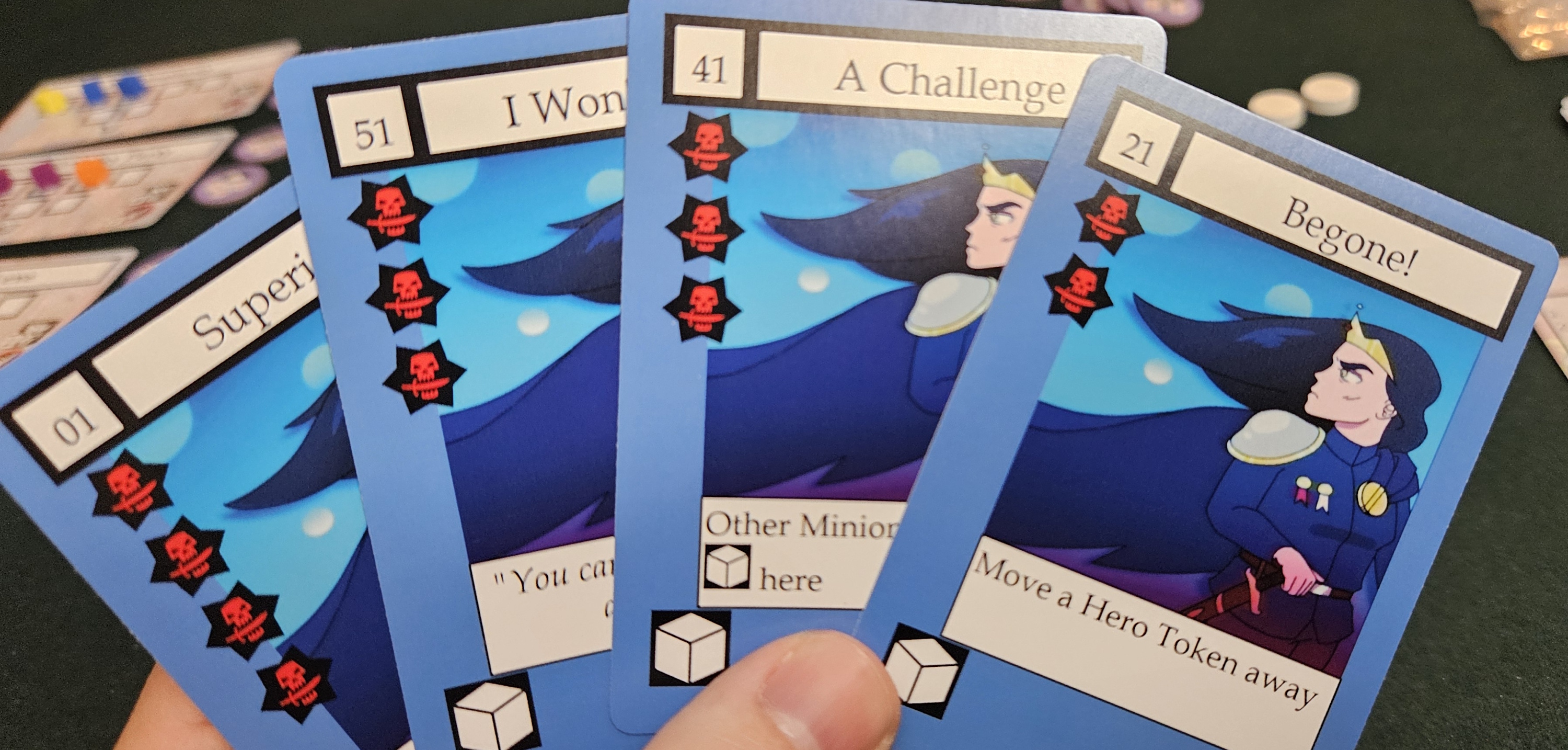
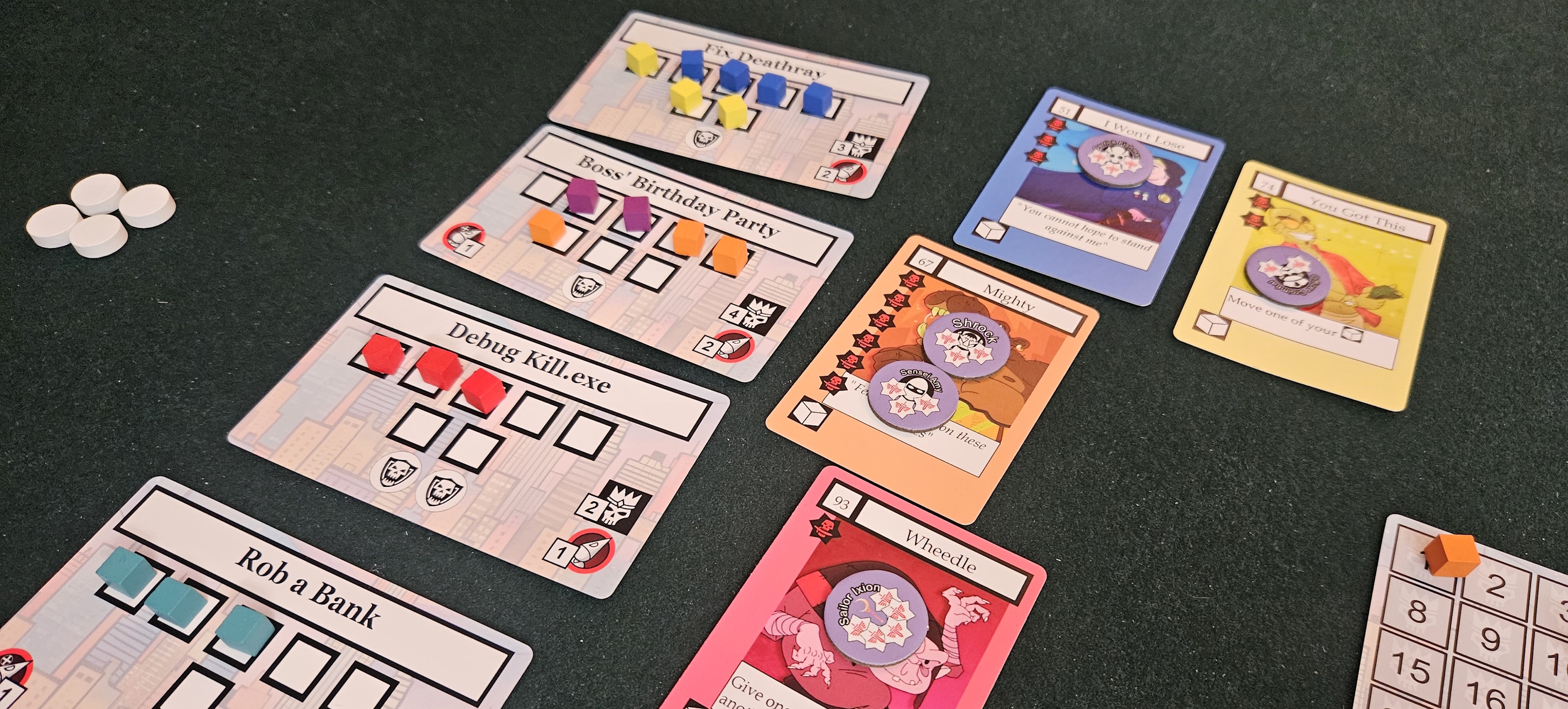
Designed by Molly Johnson, Robert Melvin, and Shawn Stankewich — best known for Point Salad and Verdant, although my course of choice would be the excellent TEN — Satchel Quest might be the first game to really understand the problem. This is a bag-builder only slightly in the vein of The Quacks of Quedlinburg, featuring hints of that title’s press-your-luck gameplay, but really emphasizing the disorderly nature of a magical burlap sack where one’s potatoes are stored beside mana crystals and radioactive artifacts. For example, you’ve decided to hold not only an entire arsenal in your satchel, but also a whole bunch of monsters.
If that sounds like a bad packing decision — and I’m saying this as someone who grew up schlepping a half-dozen hardbacks on any given weekend trip — then rest assured there’s a reason for all those odds and ends.
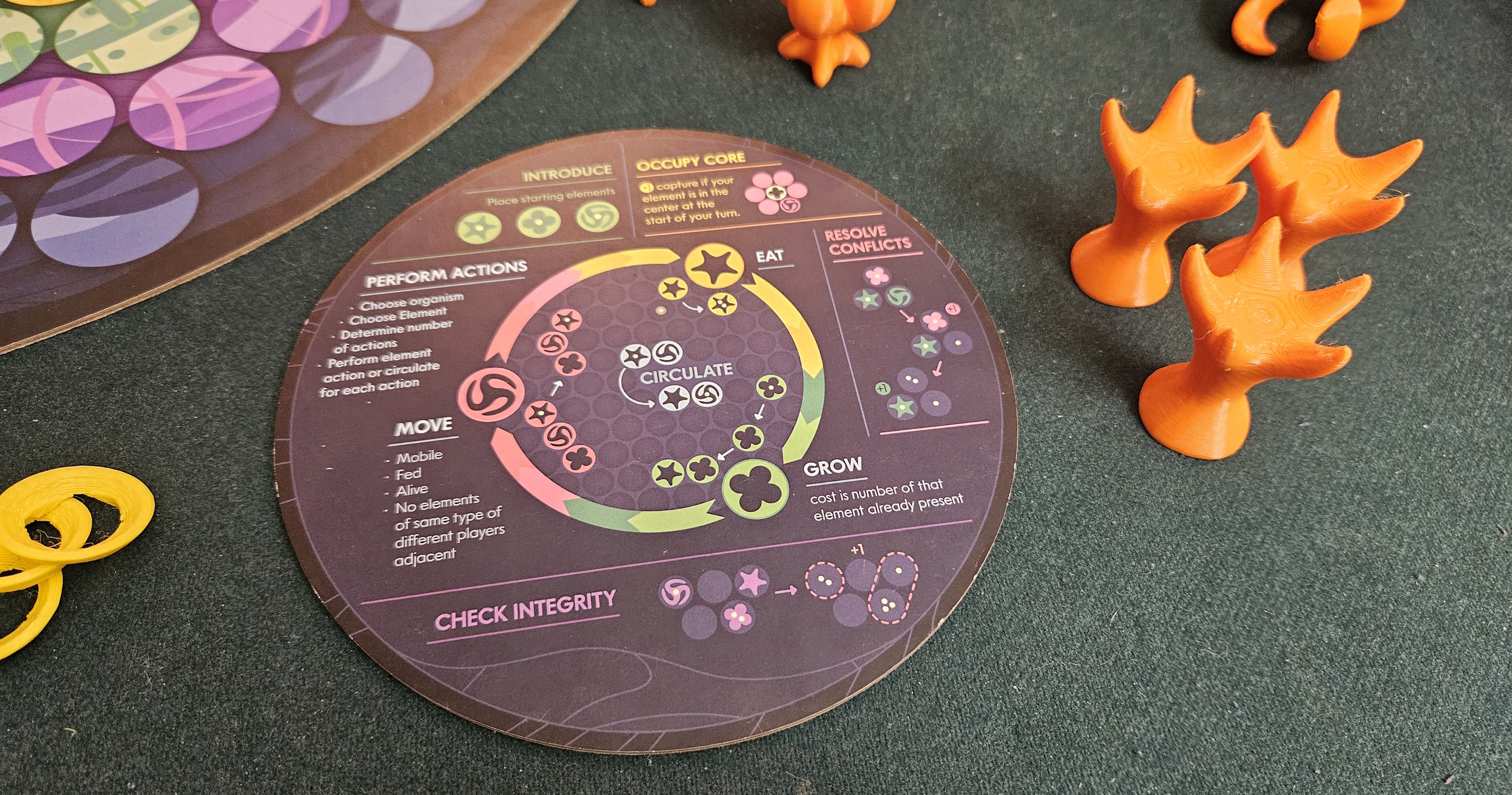
Exploring a dungeon, one chip at a time.
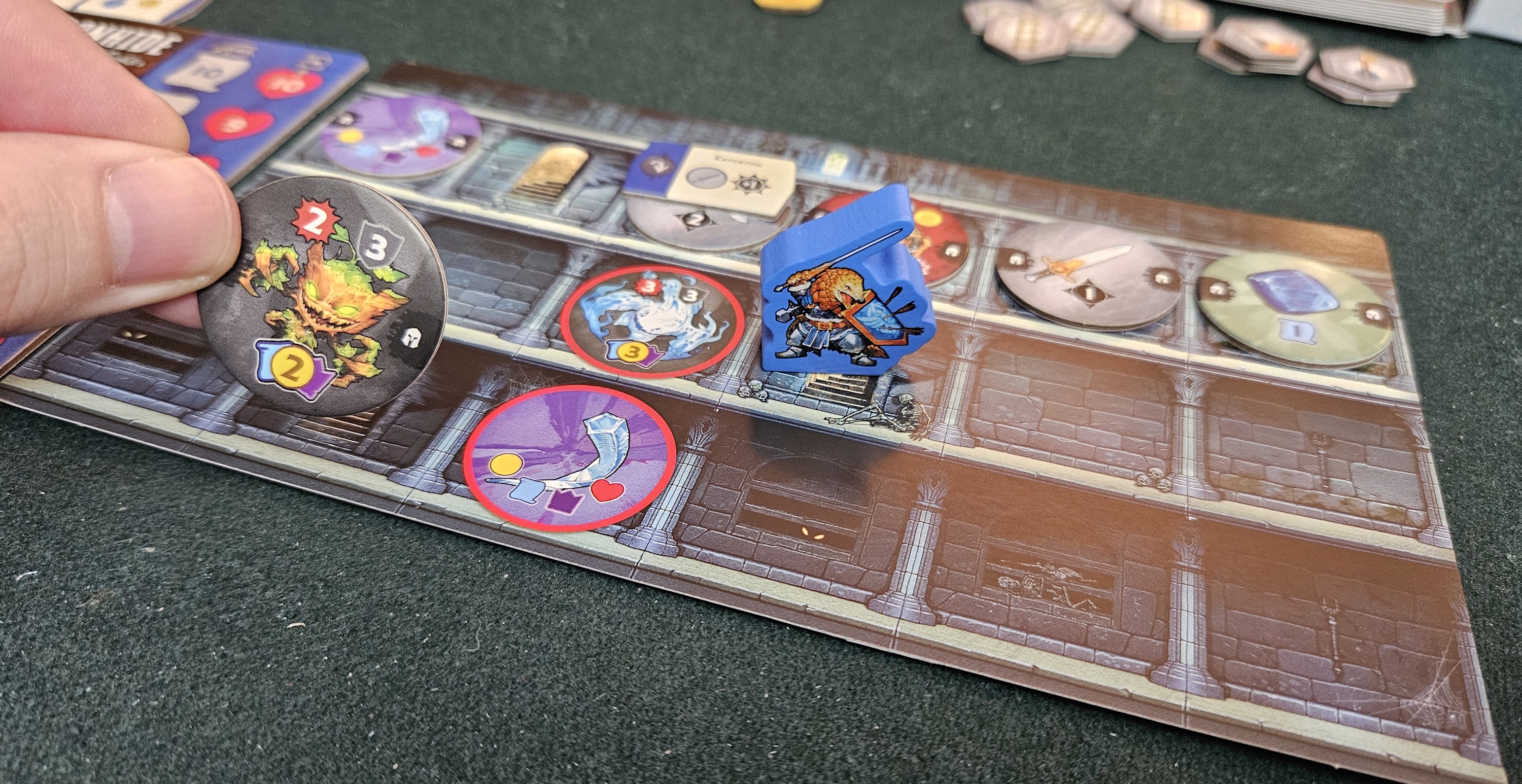
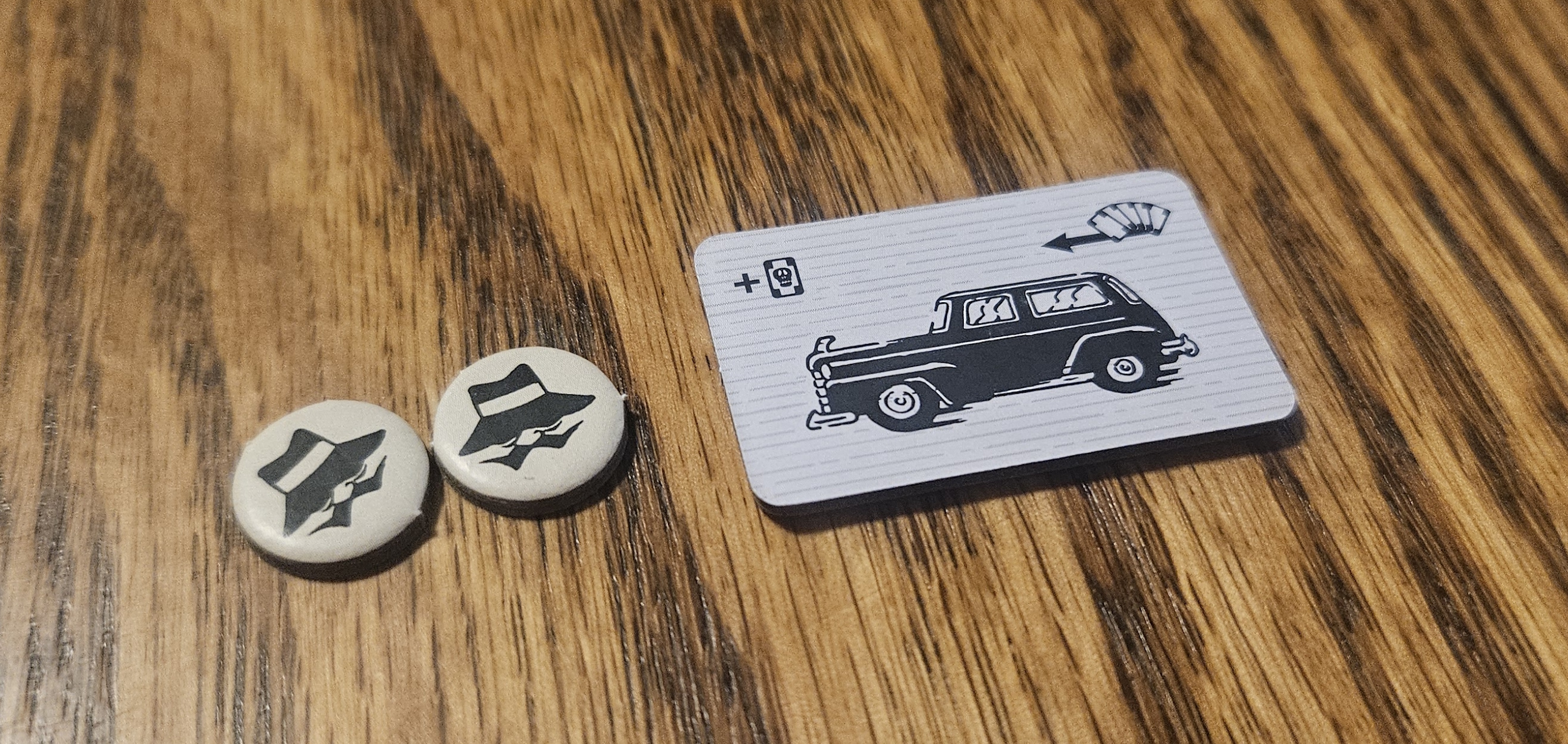
The centerpiece of Satchel Quest is an extended puzzle. Provided a dungeon mat, complete with a few enforced spaces like stairwells and maybe a monster or artifact, you draw chips from a bag and place them somewhere on your current floor. Often, these chips give you opportunities. Gold! Gems! Artifacts! Weapons! Whole suits of armor!
However, chips often present dangers as well. Or, if we’re in a sunny mood, opportunities. Chests double as traps, while monsters whittle away as much of your health as possible. It behooves any adventurer to tread carefully. While death doesn’t end the game outright, the penalties for bottoming out your health track are severe. This is excellent design, by the way. While there’s some rubber-banding in Satchel Quest to prevent errant players from falling too far behind, it’s hard to recover from a botched dungeon.
What soon becomes apparent is that Satchel Quest is as much about placement and foresight as stretching your luck to its absolute limit. Every type of chip presents its own conundrum. Gems only unlock their potential when placed next to as much gold as possible. Artifacts like to be clumped together for maximum returns. Chests are a whole mini-puzzle. When bordered by exactly the right chips, you crack them open without harm. Too few and you take damage; too many and you break them open through sheer brute force… but still take injuries from their protective trap.
Of course, the most impactful type of chip is the monster. You can dull their attacks by positioning shields and armor nearby, while slaying them requires careful arrangement of your own swords, bows, and staves. This isn’t as easy as it sounds. Swords only hit adjacent monsters. Bows and staves smack entire lanes, but only along diagonal or orthogonal lines respectively. In general, this requires you to produce little defensive clusters around shields, while weapons produce fields of damage.
Hopefully this one won’t go extinct.
But this is where your satchel comes into play. Only rarely will things go according to plan. It isn’t uncommon to place a shield exactly where it needs to go, ready to block damage from three monsters at once, alongside an empowered staff for blasting the beasties. Only then you’ll draw a bunch of gold tokens, a sword that isn’t needed at the moment, and a gem that would pair nicely with the gold, if only that’s what you were trying to do right now.
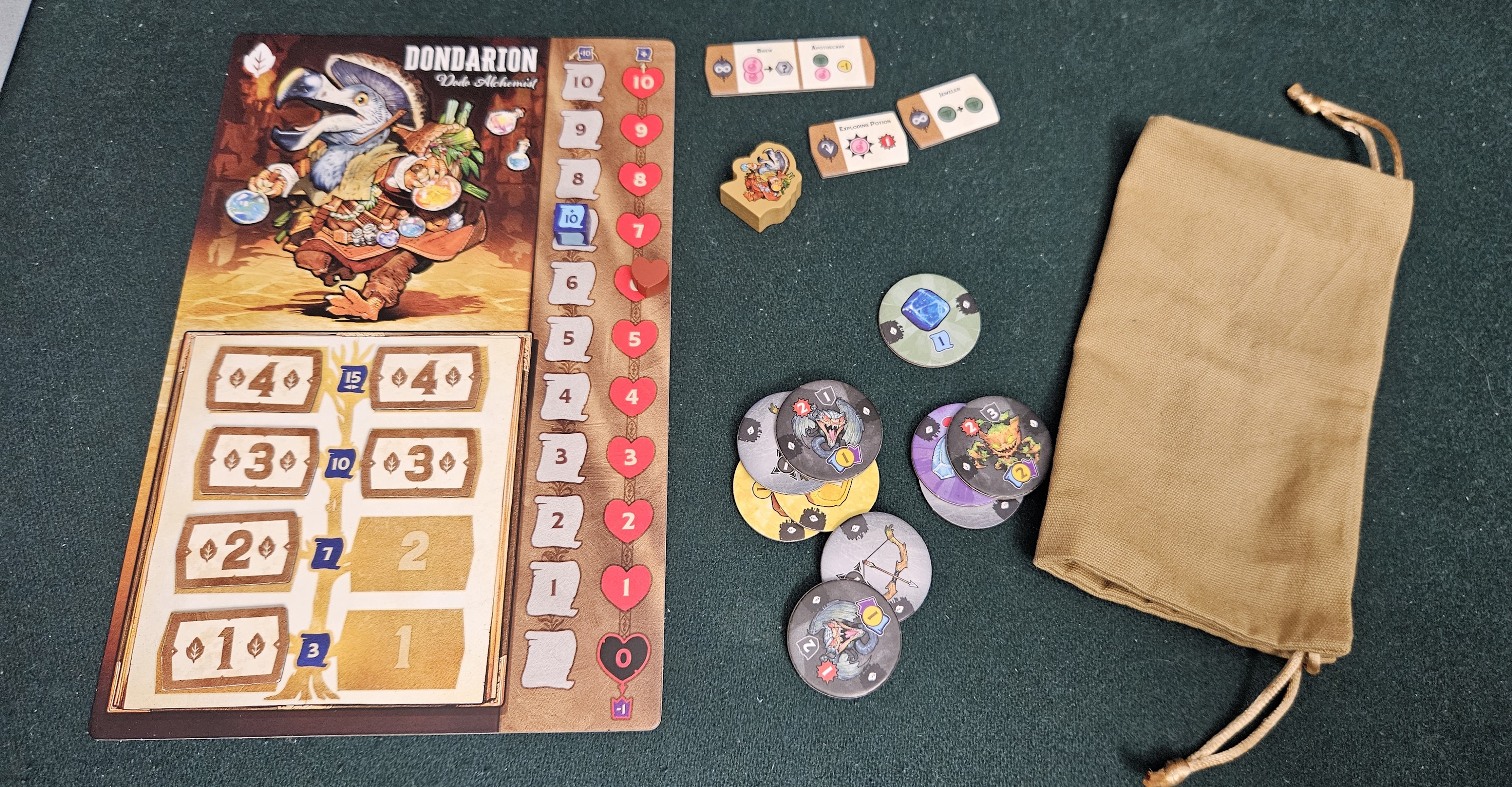
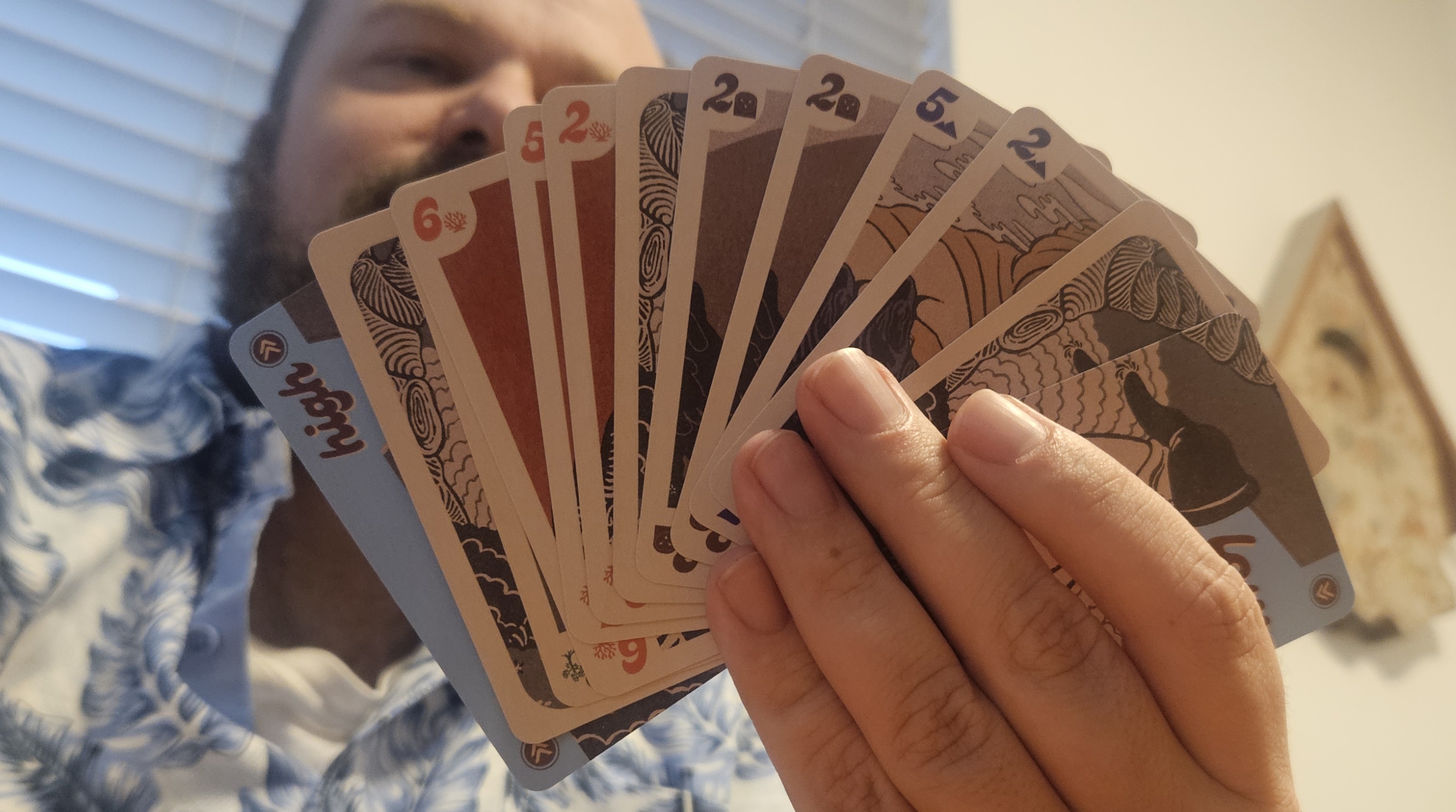
It pays to pivot. It also pays to learn the tools of your trade. There are items, tools like keys for breaking past a sticky chest or torches that serve as extra draws from your satchel. Each hero also gets their own set of abilities, like the Dodo Alchemist’s taste for potions or the Pangolin Fighter’s layers of armor. It helps, too, that chips are double-sided. If you can’t possibly tackle that monster right now, there’s usually something helpful, or at least benign, on its reverse face.
This puzzle phase is Satchel Quest at its best and brightest. Everybody plays simultaneously, a barbed blessing if one player happens to be slower than everyone else, but considerably pacier than taking turns. And while most players will usually use every last chip in each dungeon, somewhat undercutting the game’s press-your-luck ethos, this puzzle is always engrossing. That goes double when things are going wrong. Johnson and company have done a solid job of ensuring that their game is at its most interesting when nothing is quite going your way, forcing you to use every tool at your disposal to come out of the dungeon alive.
Shopping for new chips.
If you detect a Ginormous But lurking around the corner, you’re only half-right. For the most part, the remainder of Satchel Quest is similarly polished.
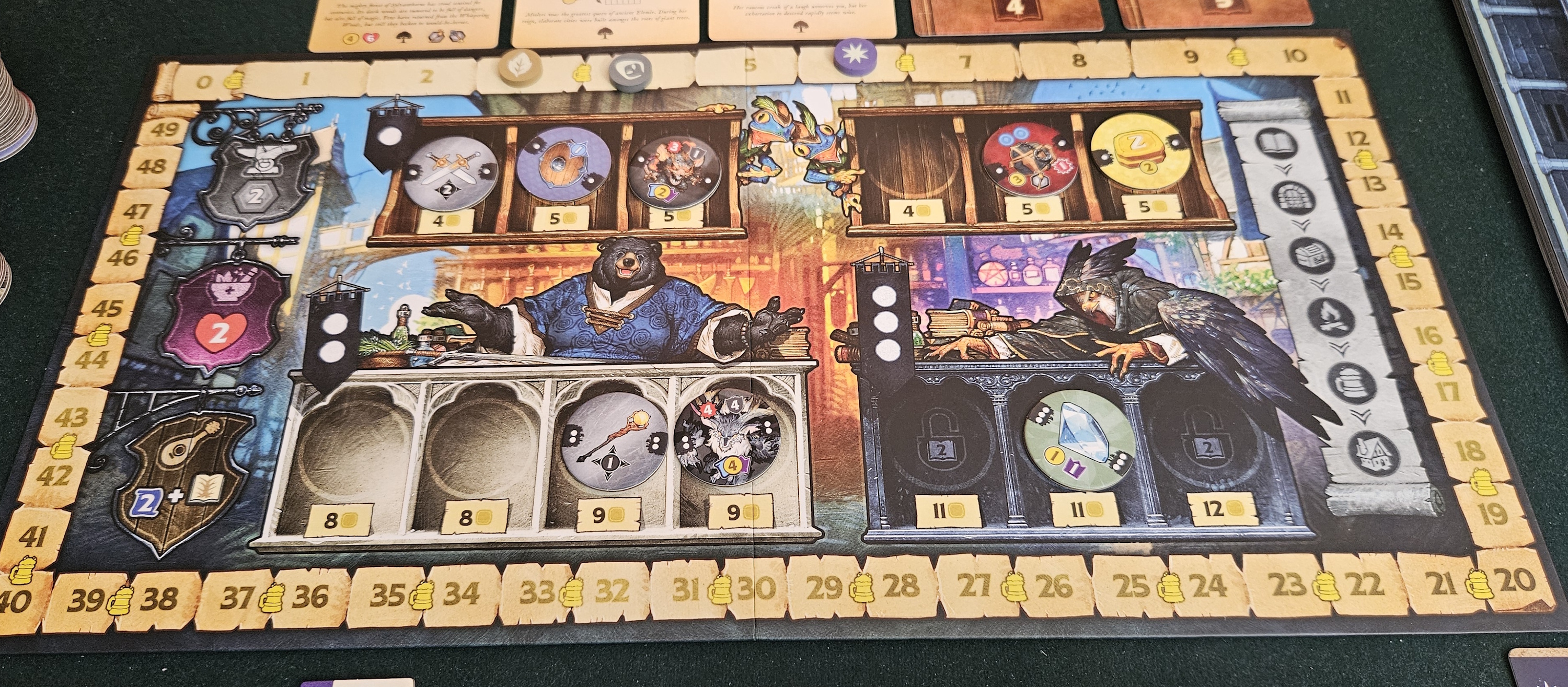
Consider the shopping phase, which uses the game’s double-sided chips to its advantage. Letting everybody check the reverse face of each chip would have been a horrible time-sink. Instead, everybody is allowed to “browse” one chip per turn, peeking at its reverse side before buying something — and that purchase might be a different chip entirely. This ensures there’s still an element of surprise, but also lets players wield some control over their destiny. No endless token-checking required.
Or there’s the way new adventure cards vary the puzzle from round to round. One dungeon might be rotated ninety degrees, requiring you to venture down a shaft with little room to maneuver, while the next is filled with placeholder gold that makes gems more valuable but combat unusually claustrophobic.
If anything, the Lesser But is that Satchel Quest overstays its welcome. Five dungeons is a lot to tackle, especially when you’re only adding one to three chips per round. This isn’t enough to mix up your bag’s composition, at least not quickly. While your bag will hold a different mishmash of weapons and monsters between the first and fifth dungeon, its changes are incremental, and therefore the puzzle feels samey from one delve to the next. This gives the game a fatiguing sensation, especially with additional players necessitating pauses while adventuring or shopping. Unsurprisingly, the solitaire mode sees the problem evaporating.
Every round has its own wrinkles.
On the whole, then, Satchel Quest is an admirable effort. It isn’t as varied or as punchy as it could have been, but its central puzzle is well crafted, with plenty of smart touches that ensure every draw presents its own attack of anxiety. I would file this under the “play a few times and pass it along” category — much like this bag of holding. Curse my stars for thinking I could store my good adventuring boots next to these vials of beholder pollen.
A complimentary copy of Satchel Quest was provided by the publisher.
(If what I’m doing at Space-Biff! is valuable to you in some way, please consider dropping by my Patreon campaign or Ko-fi. Right now, supporters can read the next installment in my series Talking About Games, this time tackling the topic of what makes a good list! Naturally, the piece includes a list.)
CMYK is on a hot streak. Get it? Hot streak? Fine, I’ll just tell you about this other board game. Grabble is a remake of Naoki Fukuda’s Nuts a GoGo!, which probably doesn’t tell you much. Imagine a bunch of people scrambling around a box for mismatched components. Shortly thereafter, they wage a sudden-death competition with their foraged traffic cones, dice, and metal pigs. In and out, five minutes.
That’s Grabble. It’s fast, it’s silly, and then it’s over. Unless you play more than once, which is more or less mandatory. Unlike a few other recent CMYK releases, I suspect this one will prove too trifling for some. I think I’ve played it something like forty times in the past month alone.
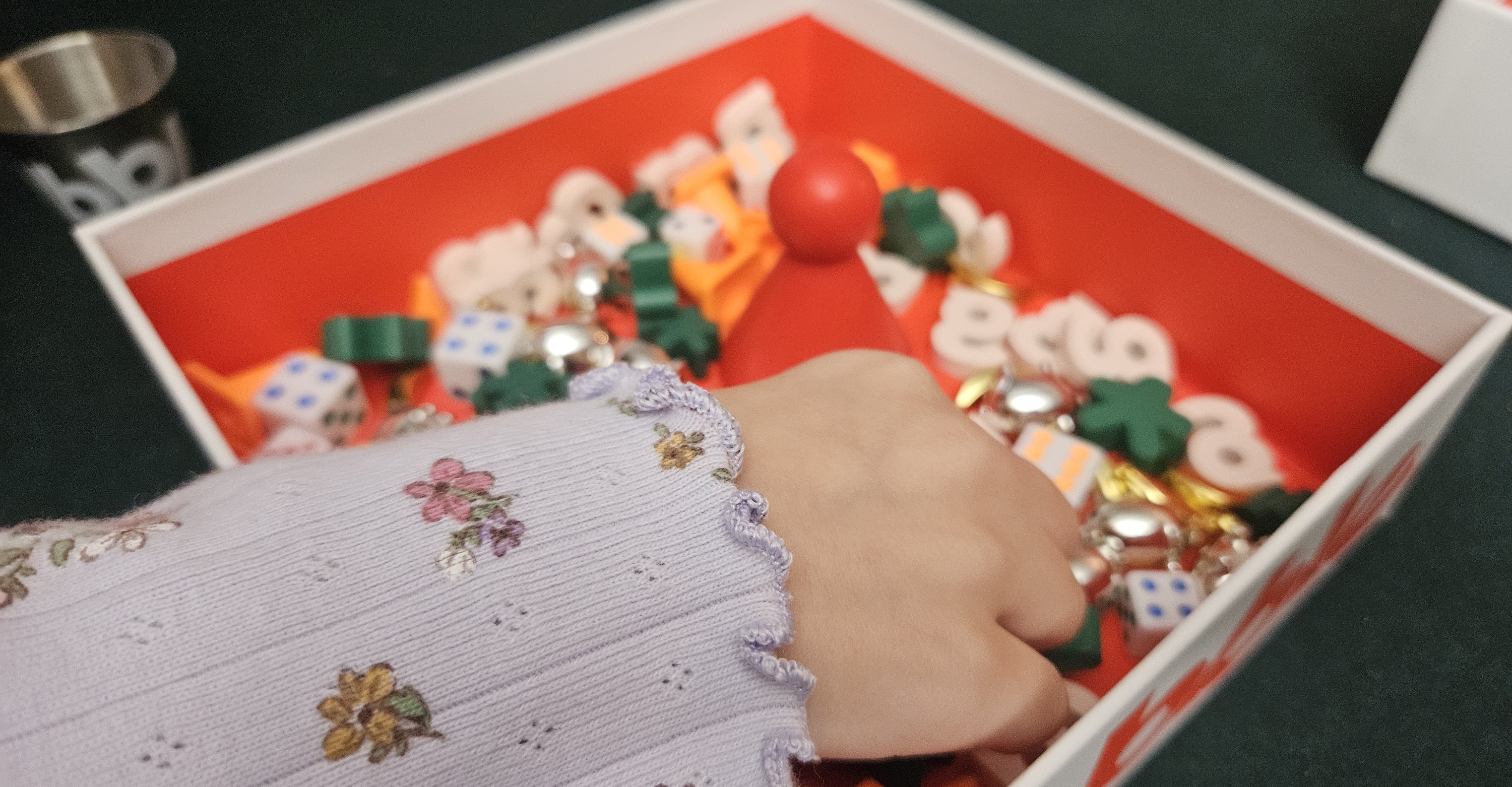
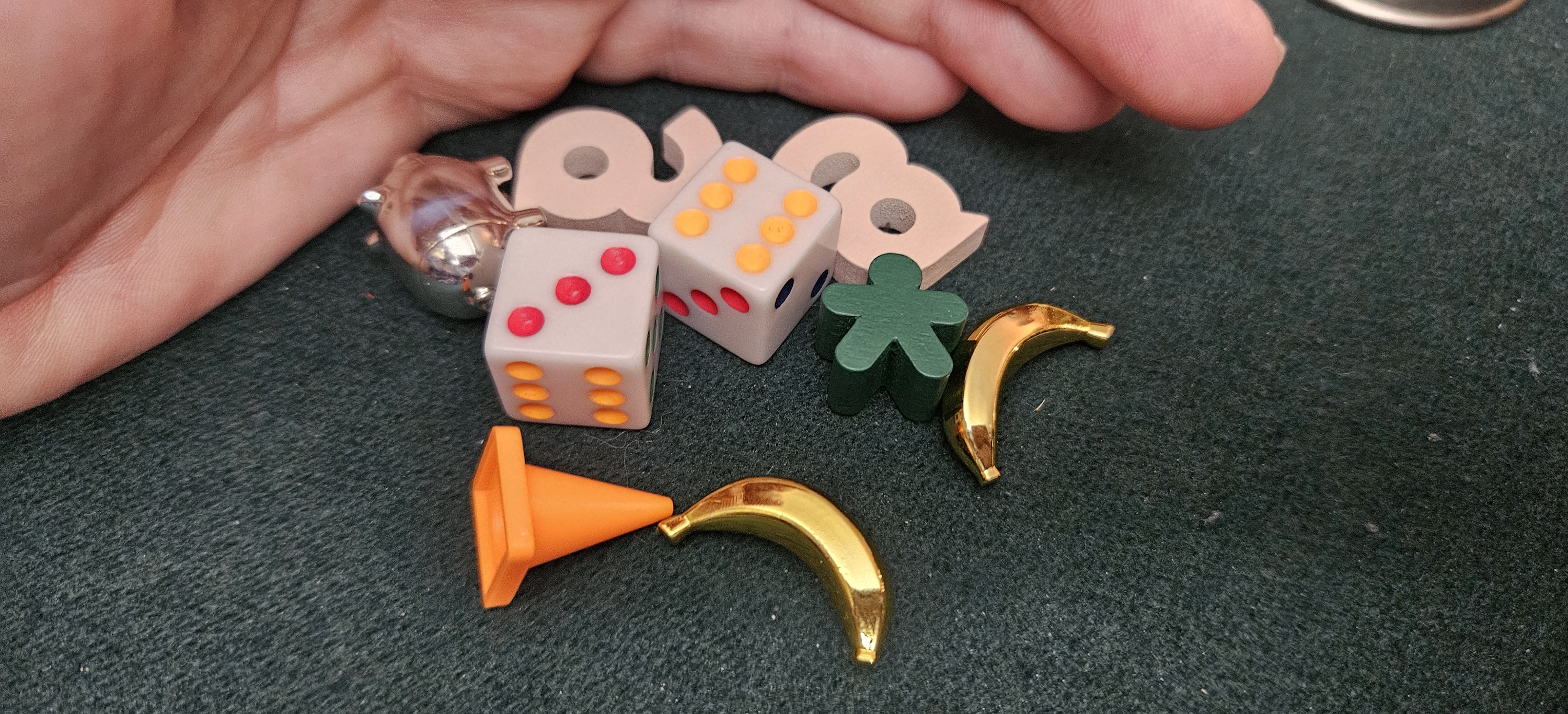
The grabbing portion of Grabble.
As noted, the rules for Grabble are compact. So compact that they fit inside the box lid. How’s that for a throwback? It’s the sort of game that can be taught inside of thirty seconds. Which isn’t to say there aren’t… not subtleties, exactly. Not even nuances. But there’s more than one might expect to Grabble.
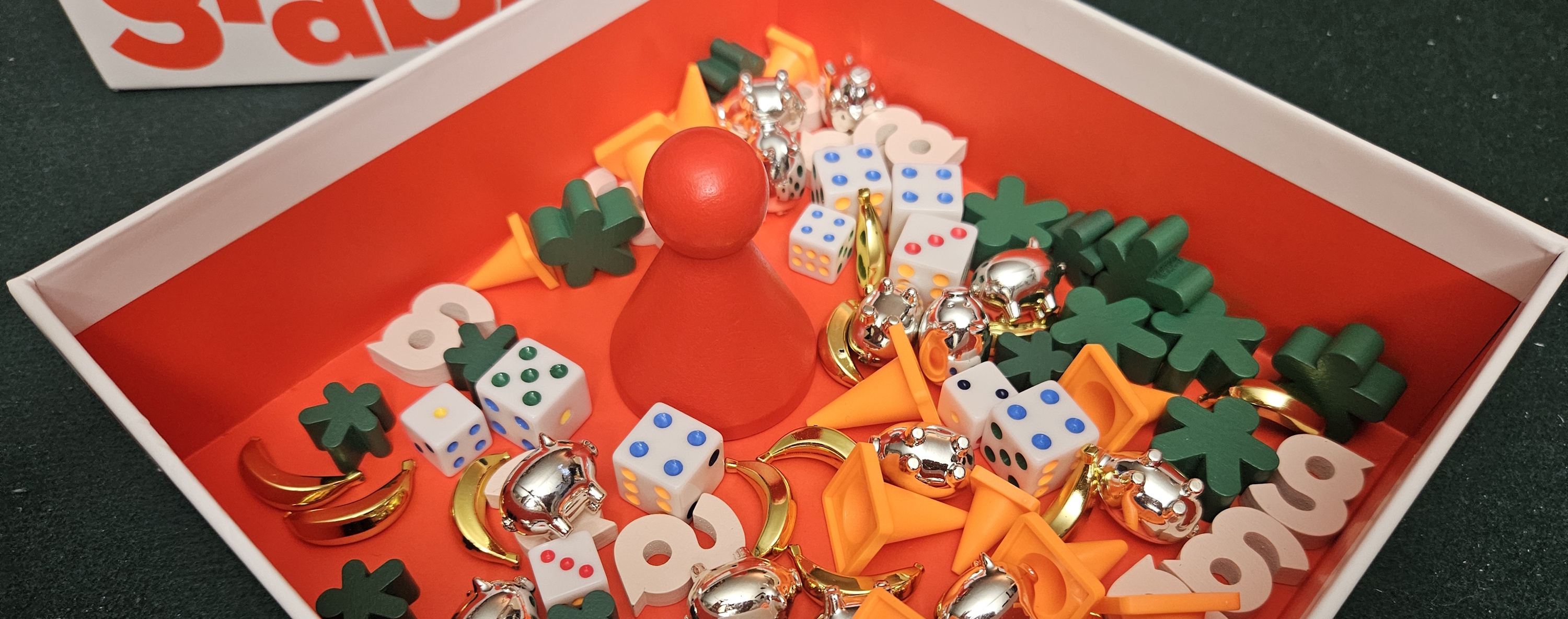
Take, for example, the pieces. In the original Nuts a GoGo!, the pieces were all wood. They had different shapes: pegs, rings, pyramids, cubes. But they all had that lacquered brown shade, which made them hard to select in a lineup, let alone when five hands were groping around in the box. Here, the shapes are more distinct. Dice, both large and small. Traffic cones, also in two sizes. Wooden meeples, colored green so my seven-year-old calls them leprechauns. Metal pigs and bananas. A lower-case g. Not for Grabble, actually. For gumption.
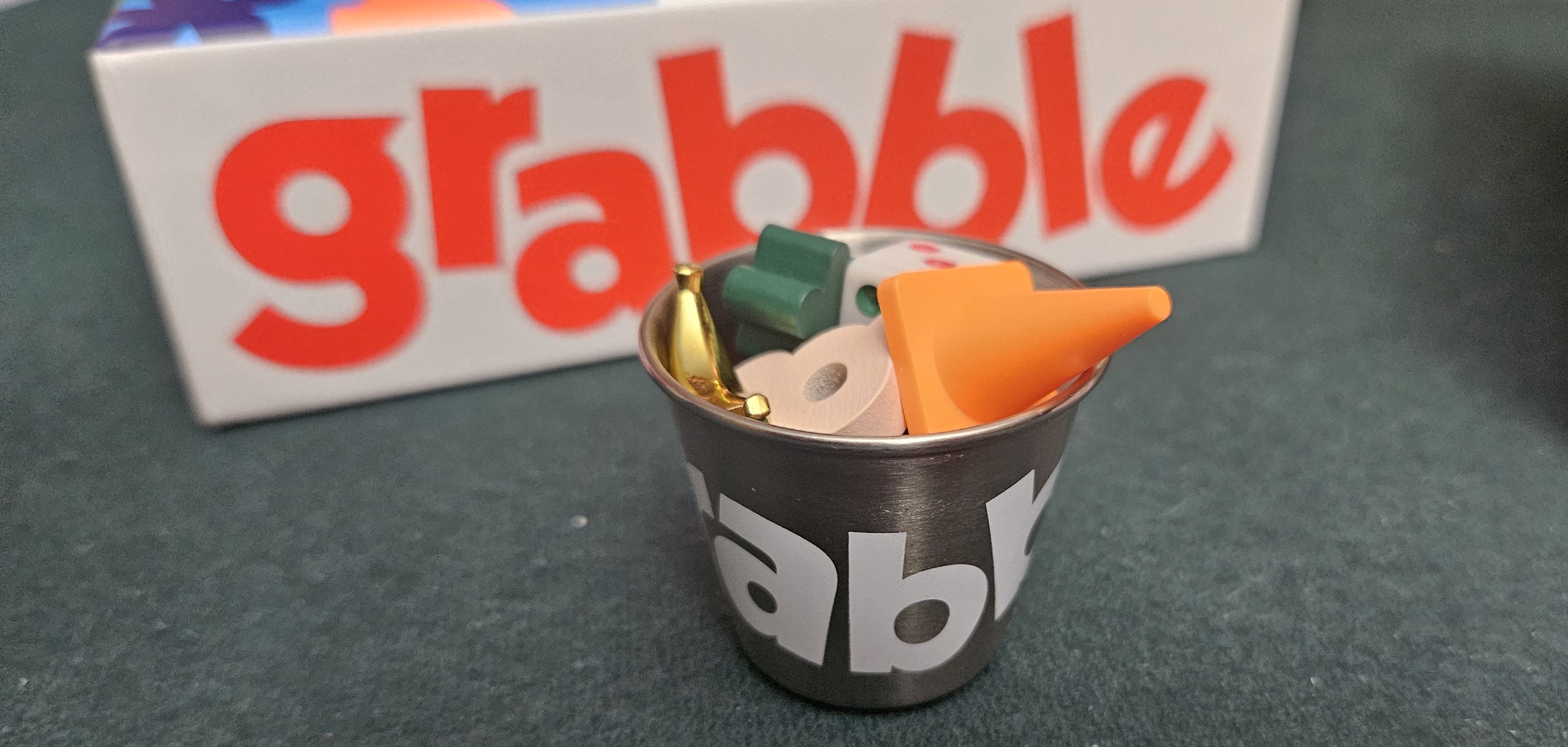
The distinctiveness of these pieces is part of the game. When Grabble starts, everybody reaches into the box and starts grabbing stuff. The usual restrictions apply: one piece at a time, only one hand. Everybody deposits these pieces into their very own metal cup. If they fall out, they must be replaced before you can continue grubbing around in the box.
Cup o’ grabbins.
Already, there’s something here. Strategy. Tactics. Maybe not. But dexterity, at least. You’re targeting specific pieces. Don’t have a traffic cone? You’d better find one. Somebody seems to be moving too quickly? Shove your fingers under theirs, play a little defense. Thinking too hard? Don’t do that.
As soon as your cup overfloweth, you’re allowed to halt the festivities. You grab the big pawn — it’s huge, you can’t miss it — and shout stop. Everybody slaps the table. The last person to slap owes you a present from their cup.
This is where Grabble switches gears. Everybody pours out their cup, making sure to keep everything hidden. Then, starting with whomever ended the grabbling phase, you go around the table. On your turn, you declare a piece to throw back into the box. Pig! Everybody complies. Then the next person throws something back. Leprechaun! Then the next. Letter!
Here’s the rub. When somebody can’t throw something back, they’re out. It doesn’t matter how much they’re holding. The goal, naturally, is to be the last person standing. So you play… again, not quite strategically. But there is some sense in which you’re making informed decisions. The colorful and shapely nature of the components matters. Because, yeah, you noticed when such-and-such seemed to keep grabbing endless orange cones, or that somebody was taking pieces too quickly and maybe overlooked the tiny bananas that accrue beneath everything else.
And now the ble portion of Grabble.
The funny thing about Grabble is that it doesn’t need these words. I’ve spent double or triple the wordcount describing Grabble than Grabble spends on itself. Any subtleties arise organically during play. All at once, it’s a dexterity game and a guessing game and a deduction game. It’s a player elimination game, too. But it doesn’t need descriptors. It’s Grabble. It’s itself.
It’s so wholly itself that it resembles some ideal form given shape and volume. When a half-dozen players are glazed over from some overwrought nu-euro, Grabble is there to shake off the mental cobwebs. When my seven-year-old wants to play something before school but she’s taken too long picking out an outfit, we can get in a session of Grabble, no problem. When my twelve-year-old wants to host a game night for her friends but isn’t confident she can teach something complicated, Grabble breaks the ice.
Even compared to some of CMYK’s recent catalog, it’s short, giddy, and not especially long on player agency. Then again, there’s a thinkpiece about what “player agency” actually means in there. Everything passes at lightning speed in Grabble. But it never really feels like it’s out of control. Only that its control is always at risk of slipping away, a finger’s length from being firmly grasped.
Grabbed.
Or maybe control doesn’t matter. Not always. Not all the time. Maybe player agency is overrated, at least in some cases. I worry that some people will think themselves too mature to appreciate what it gets right.
But I hope not. Maybe with titles like Magical Athlete and Hot Streak and Dino Racer in favor again, people will see Grabble for what it is: the purest, most perfect way to laugh for five minutes while out-slapping, out-grabbing, and out-guessing one’s family members.
A complimentary copy of Grabble was provided by the publisher.
(If what I’m doing at Space-Biff! is valuable to you in some way, please consider dropping by my Patreon campaign or Ko-fi. Right now, supporters can read the next installment in my series Talking About Games, this time tackling the topic of what makes a good list! Naturally, the piece includes a list.)
At times, that feels like an invitation to make me regret what little time I have left on this Earth.
Shards of Creation is the latest unfortunate example. Designed by Hayden Dillard, it fails to utilize the past decade of sound tabletop design principles, let alone the trick-taking revolution that has produced so many wonderful trifles. It is the anti-trick-taker, the title I would place before someone I was hoping to dissuade from getting into the hobby.
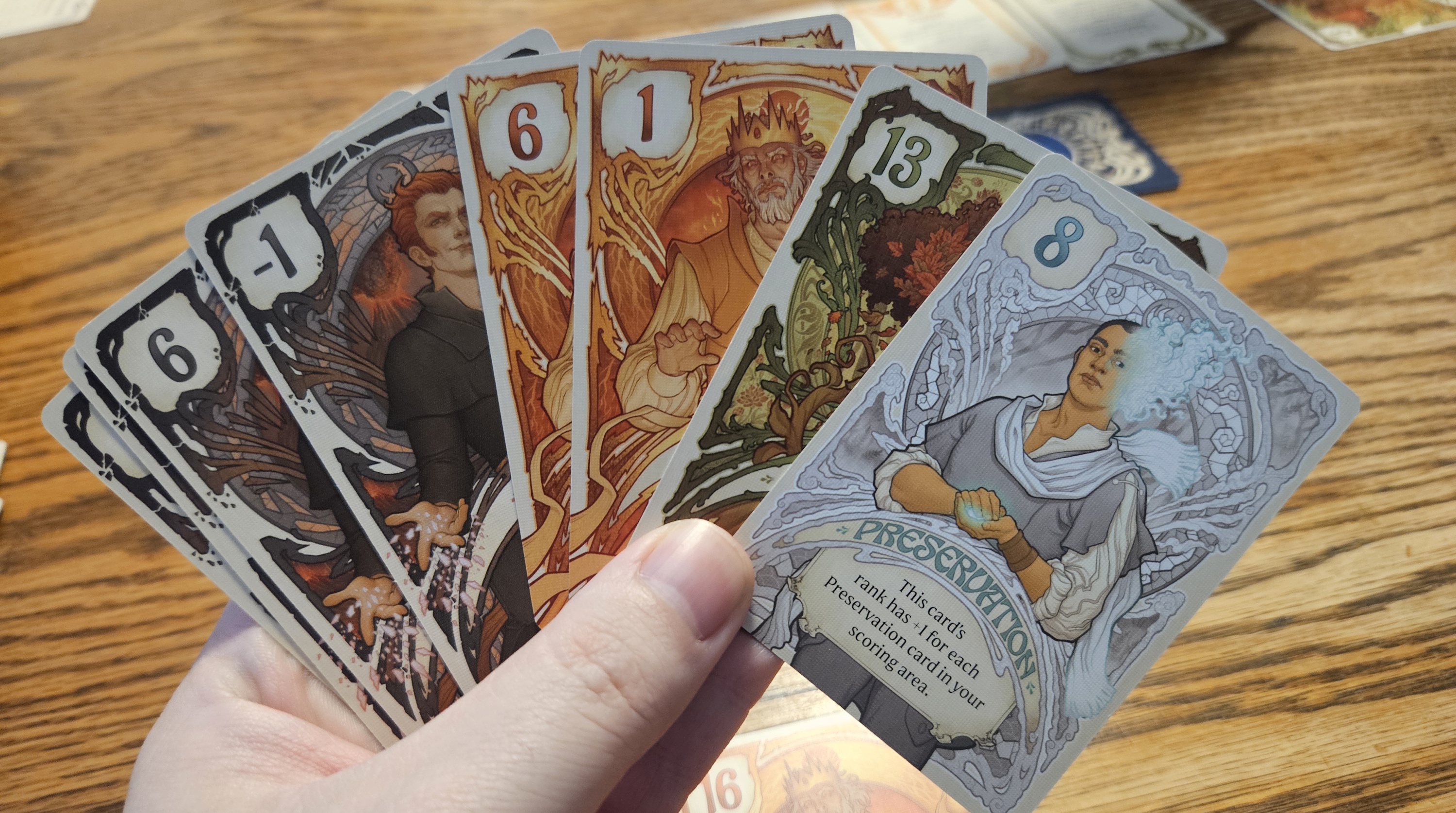
Playing some cards. Grudgingly.
Before we discuss Shards of Creation, there’s something I need to get out of the way. This thing is nominally based on Brandon Sanderson’s fantasy novels. Now, I’ve read a few Sandersons in my time, and even enjoyed one or two, although I wouldn’t label myself a fan. When it comes to the Cosmere, the shared setting for most of his novels, I know very little. Perhaps the Shattering of the Adonalsium is meant to be represented as a capricious slog, a lanced blister in the form of a creation myth. If that’s the case, then Shards of Creation is an accurate and lore-appropriate depiction.
I have my doubts.
As a trick-taker, Shards of Creation is relatively boilerplate. Somebody plays a card. Everybody else follows that card’s suit. The high card wins.
Of course, there’s a trump suit. Depending on player count, each session uses either four or five suits from a selection of eight. Three of these, drawn at random, will function as trump suits over the game’s three rounds.
Except right away, there are some big problems. The first is the rulebook, which doesn’t bother to state who leads most tricks, at least not in the actual rules. Without diving into the examples of play, it’s impossible to discern the designer’s intentions without making some big assumptions that may or may not be true.
That’s a nitpick, albeit one that demonstrates a lack of care that extends to everything else in Shards of Creation. The bigger issue dwarfs the first: everything depends on the luck of the draw. And I mean everything.
Choosing which suits we’ll use this session.
The first time I tried a trick-taker, as an adult who’d been kept safely away from playing cards for all of my nineteen years, the pursuit struck me as pointless. Wouldn’t the contest naturally be won by whomever had drawn the most hearts? Modern trick-taking design goes to great lengths to ensure this isn’t the case. Heck, ancient trick-taking design did the same. It isn’t often that trick-takers, whether new or old, are won by sheer quantity of tricks won.
Shards of Creation goes the other direction. Winning tricks is everything. That’s because the winner of each trick gets to select a card to add to their scoring pile. This pile produces the points that will matter when the game concludes after three rounds. The more cards you’ve claimed, the more scoring opportunities you have, whether by collecting as many cards within a suit as possible or collecting sets.
Of course, this is already obnoxious. Drawing a bunch of trumps means you’ll take significantly more cards. And since there aren’t many opportunities to poison the well — only one suit subtracts points — this is almost always an unvarnished positive.
At the same time, a whole bunch of card effects ask players to draw new cards during the round. On the one hand, this churns the hand a little bit, perhaps dulling the sting of a bad draw. (Provided your bad draw included cards that would let you churn your hand, hardly a guarantee.) Except this also turns Shards of Creation into a slog, players regularly pausing mid-trick to draw and discard, steal and draw and discard, draw and sum ranks… basically, Shards of Creation pulls out every method for slowing itself to a crawl.
Put together, this makes Shards of Creation straightforwardly dull but chancy but slow. It’s a trifecta of bad trick-taking.
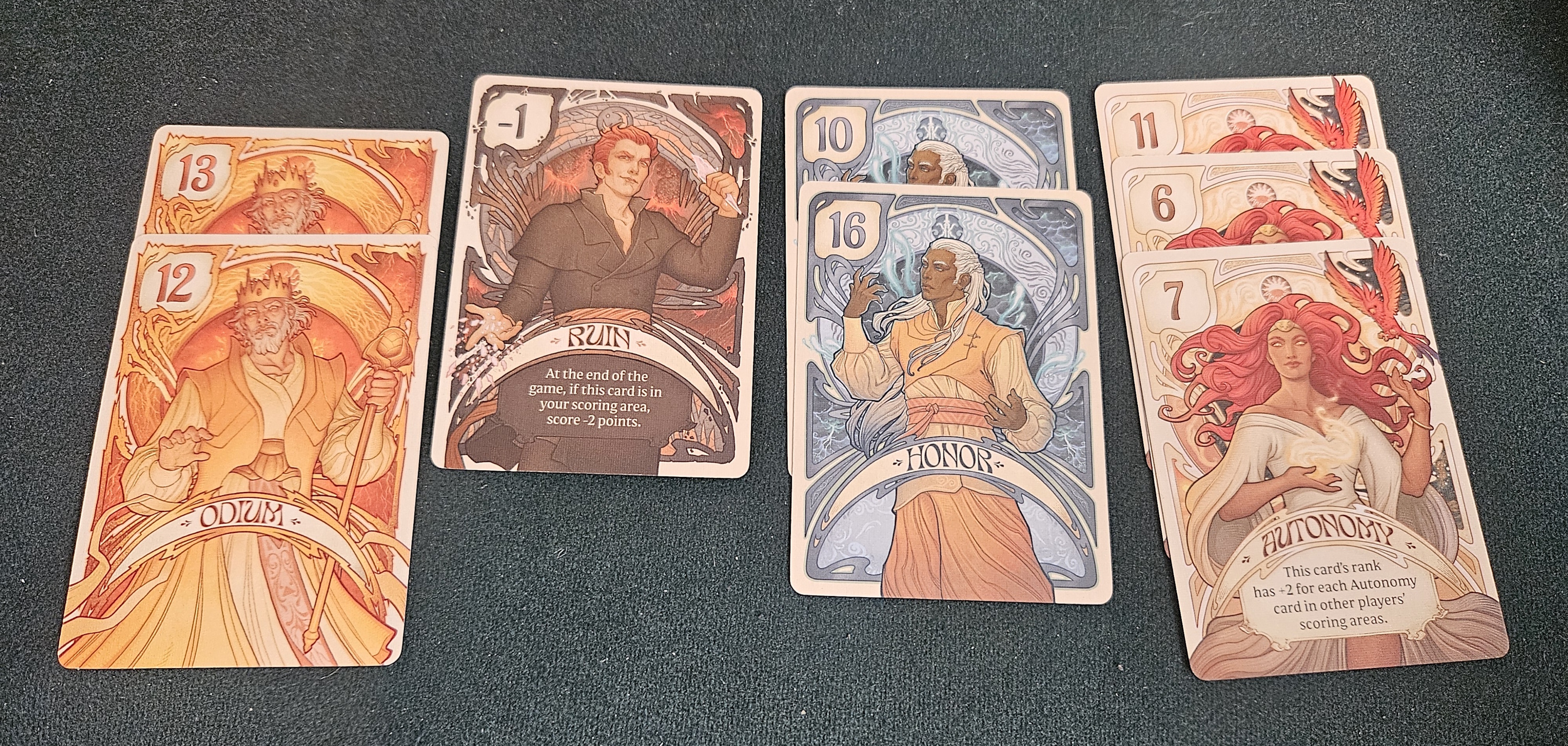
Accumulating a win pile.
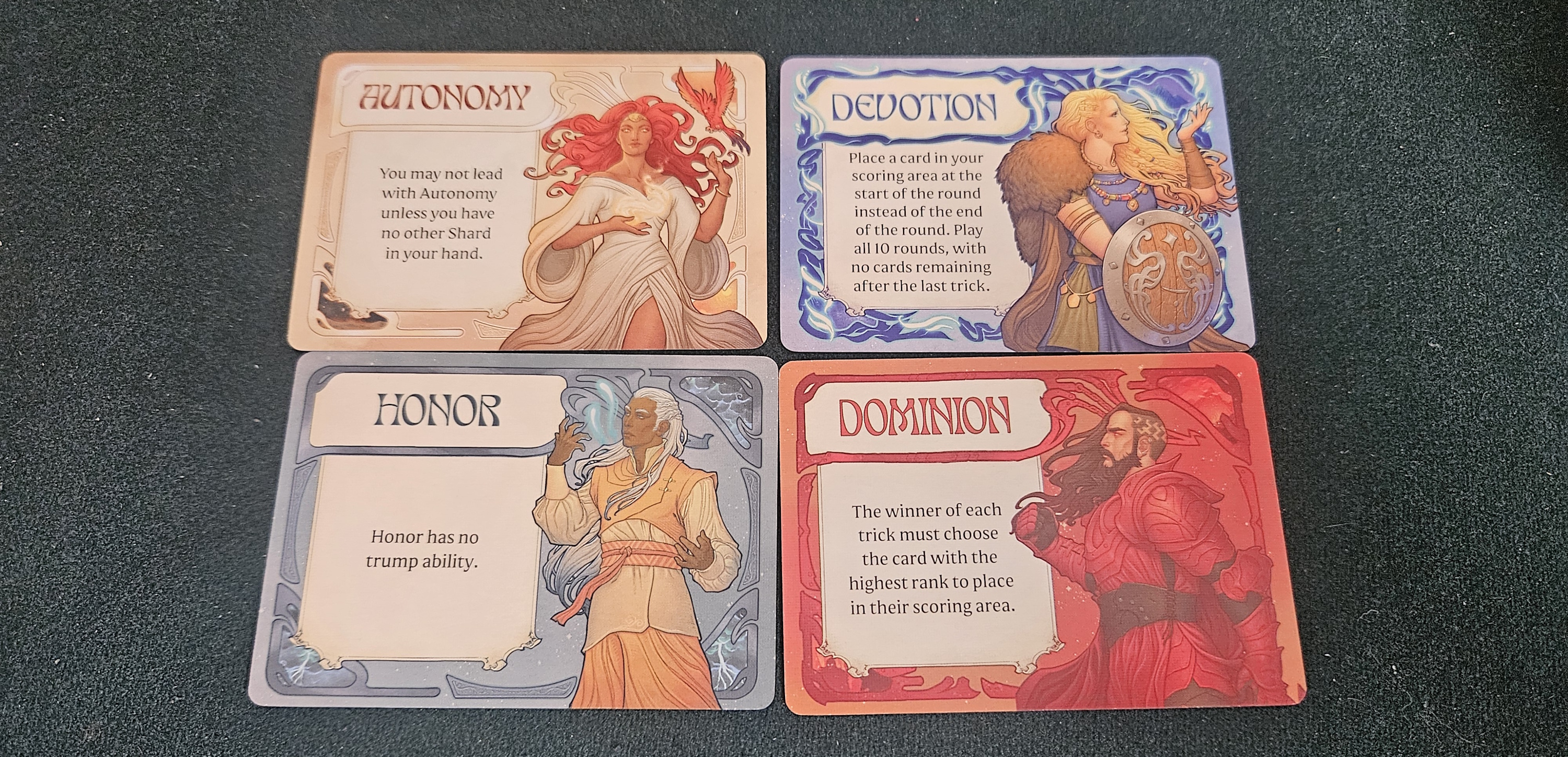
Again, I know next to nothing about the Cosmere. I don’t know why Honor is so ineffectual. I don’t know who shaved the evil runic lettering into the evil Dominion guy’s haircut. I don’t know why Ruin is presided over by an angry Irishman.
But I do know that this is one of the worst trick-takers I’ve ever played. Take it from someone who only plays trick-takers anymore: there are countless better options out there.
A complimentary copy of Shards of Creation was provided by the publisher.
(If what I’m doing at Space-Biff! is valuable to you in some way, please consider dropping by my Patreon campaign or Ko-fi. Right now, supporters can read the next installment in my series Talking About Games, this time tackling the topic of what makes a good list! Naturally, the piece includes a list.)
Upland & Prairie is troublesome. Designed by the peerless Peer Sylvester, gorgeously illustrated and produced, and conceptually adjacent to certain Knizian disc- and tile-laying games, it has the makings of something wonderful.
The problem is that it doesn’t work. With some squinting, I believe I can see what Sylvester was going for. But it’s like looking directly at the sun: uncomfortable, fumbling, all its majesty blinded by sheer directness. I have worked to appreciate what is here. But the more I try, the more irritated I become.
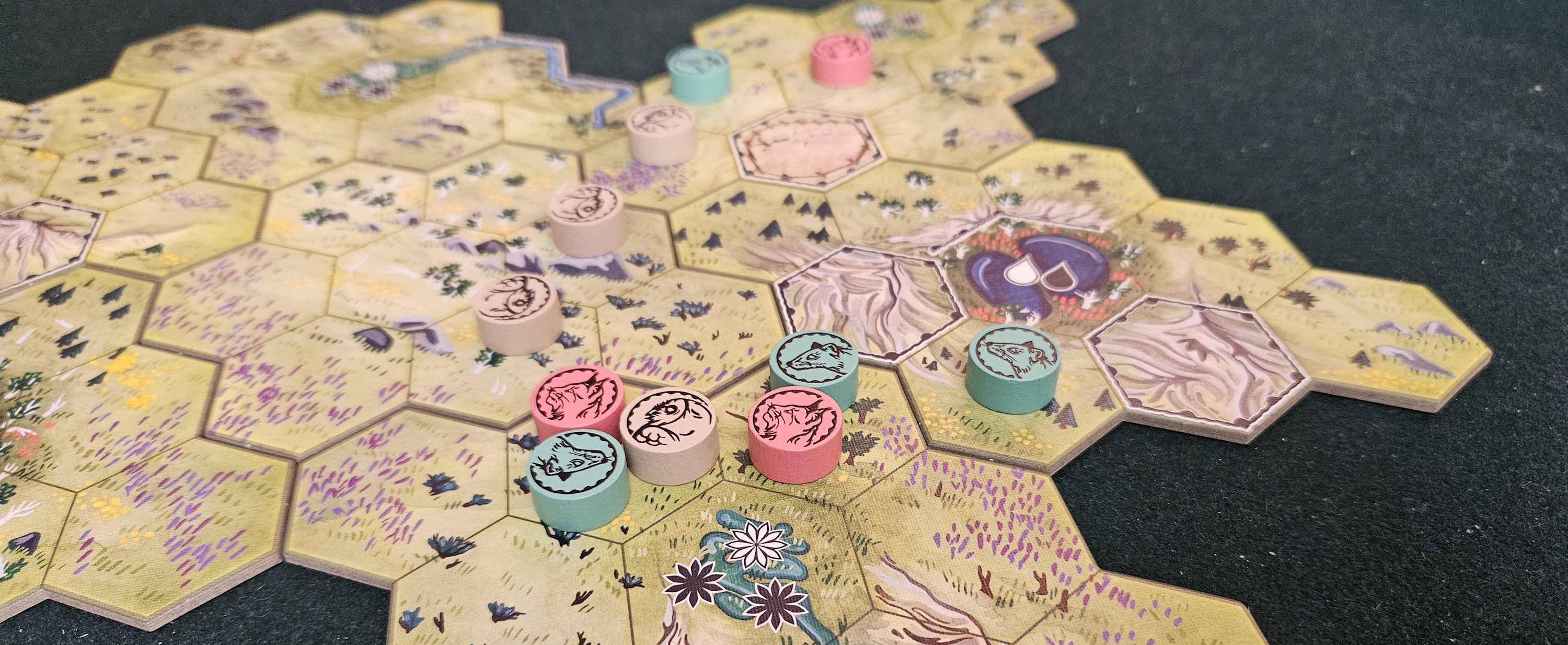
Early moves. Also maybe mid-moves.
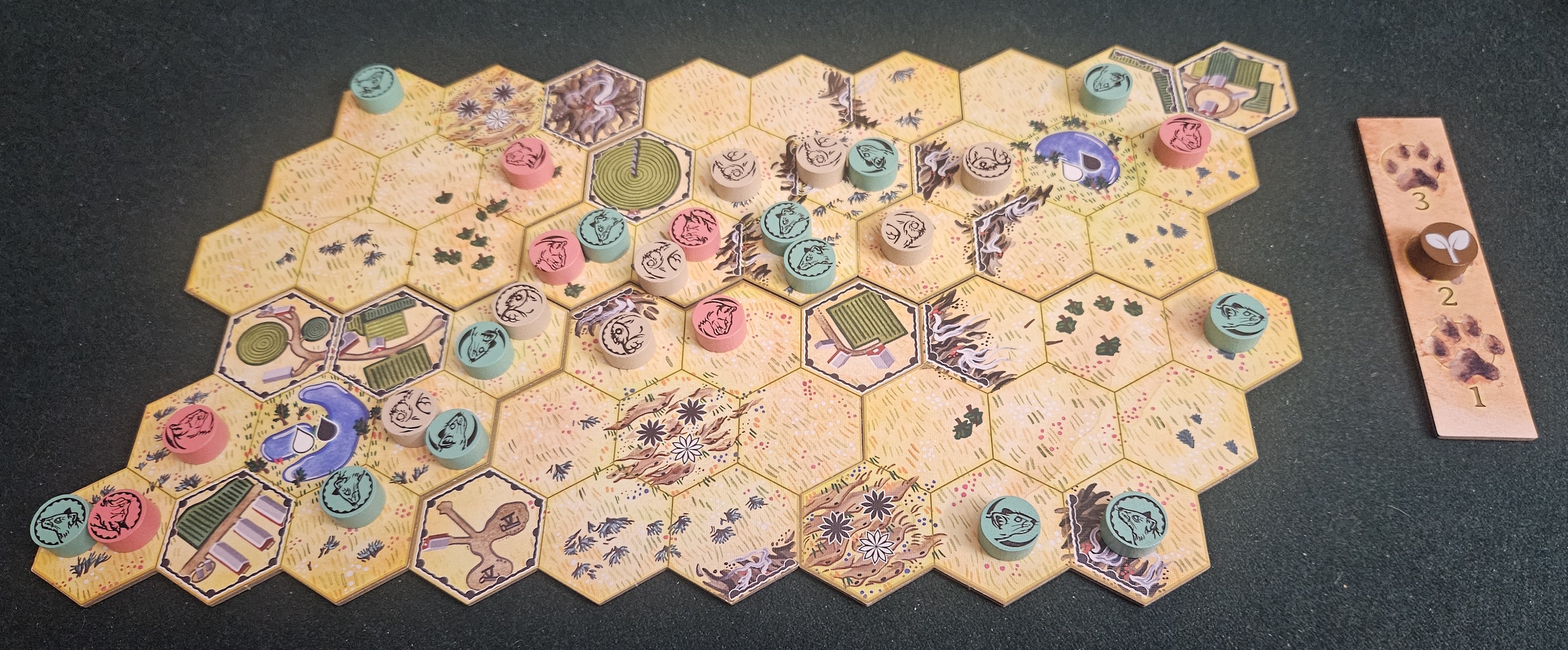
At a soil level, Upland & Prairie is about placing discs in three colors to link together either two or three objective spaces. When this happens — if it happens — the color of that space-linking chain determines which type of token becomes the game’s victory condition. Thus, linking rodents means rodent tokens become the game’s means of success. If the chain is composed of owls, you’re hopefully holding the most brown tokens. Predatory cats… you get the idea.
The game’s sole action is dead simple. On your turn, you draw three tokens from the bag. One of these gets placed on the map. Another gets hidden behind your player shield. The third gets tossed back into the bag. Even at its slowest, it’s snappy.
In theory, this exiles players to donkeyspace. If you’re holding the most red tokens, you want the final chain to be red. But placing red tokens means you’re not hoarding red tokens; hoarding red tokens means you’re not placing red tokens. Meanwhile, if an opponent sees you moving to complete the red chain, there’s nothing preventing them from hoarding their own red tokens. It’s a pickle.
Conversely, the game might end with the bag running dry. When that happens, now players are looking to build sets of red, green, and brown tokens. In such on occurrence, hoarding was exactly the wrong thing to do. Now it’s variety you’re after. Choices, choices.
And there certainly are choices. Constrained choices, to be sure. Choices dictated largely by the draw. That’s no problem. They’re still informed choices, and theoretically interesting choices at that. Every little tidbit, every placement, becomes a trickle of water on an arid prairie. When an opponent tucks a ferret (?) into a corner, is that because they’re trying to run out the bag? Or are they just trying to deplete those green tokens because they aren’t holding enough of them? Could this be an opening? Or is it so much static, not a coherent signal?
Now that’s one generous bag!
The foremost issue with Upland & Prairie is one of limitation. Not in the sense that it’s too limited. Rather, that it isn’t limited enough.
There are only three colors. Most of the time, this makes blocking a real problem. Now, in the game’s early stages, blocking is simple enough. If owls are threatening to end the session prematurely — a real possibility, given the tiny size of the map — then I might cut off your parliamentary incursion by placing a mountain lion. Easy enough.
But as the game progresses, other tokens might appear from the bag. These push up a tracker that increases how many tokens a space can hold. Where the game begins with each hex limited to a single disc, eventually it becomes possible to hold a second disc, and then a third. These moments, regulated as they are only by the draw-bag, are significantly harder to manage than ordinary token draws. It’s possible, as in a few of our sessions, that the game will open up its geography very early, in which case you might as well beeline toward the finish line with the color you’re holding the most of. If instead the game lingers a while, then the sudden appearance of a population-expanding token tends to favor the player upon whose turn it appeared. Now any bottlenecks can be pried open, and usually with ease.
Meanwhile, because the map is so small, these swings arrive with such suddenness that there isn’t much one can do to preempt them. Even if I’ve successfully walled off a particular species, a shift on my opponent’s turn — whether that’s one opponent or two, or perhaps two opponents and a partner, all depending on play count — can spell a very swift crumbling to that bulwark.
Hidden discs function as your score.
And then, when the game ends, there’s the very real possibility that it will end in a tie. There are tiebreakers, of course, and as in some of Sylvester’s better titles, The King Is Dead foremost among them, knowledge of the tiebreaker might be all-important.
Here, though, the tiebreakers feel more like concessions than objectives that can be shrewdly managed. In the case of a chain, tied players break their stalemate by who would go next in turn order. For an empty bag, it’s all about who holds the most animals of a single type. That might sound functional enough, but I’ve also seen that tally result in a tie. And the rulebook declines to address this possibility with either a second tiebreaker or a desultory “in this case, players share the win.”
This relates to my earlier issue. Upland & Prairie tends to end in a tie for the same reason that blocking is hard: the whole thing is simply too small. The map, the duration, the limits on placement, all of it. Sessions tend to end either swiftly or slightly less swiftly. There just isn’t enough time to build up a sizeable lead in any particular category. Nor is there room to suss out what an opponent is likely holding. The result is a game that presents pleasantly bite-sized decisions, but never enough of them to amount to a meal.
Big Sky. Tiny board.
It’s a shame, because I understand the desire to build a shorter tile-laying game. The famous Knizias — Tigris & Euphrates, Samurai, Qin, Babylonia — weren’t horrible time-hogs. But, sure, they could take a while to develop their board states.
Unfortunately, Upland & Prairie goes too far in the other direction. It prunes down not just the scope, but also the ability to stretch out, to take an opponent’s measure, to switch gears. Instead of coming across as a compact tile-layer, it feels like a novelty, like a mint-tin version of something more robust. And one that doesn’t succeed at compressing its subject matter, at that. This is no highland, no prairie. It’s a strip of lawn in a cookie-cutter suburb.
A complimentary copy of Upland & Prairie was provided by the designer/publisher.
(If what I’m doing at Space-Biff! is valuable to you in some way, please consider dropping by my Patreon campaign or Ko-fi. Right now, supporters can read the next installment in my series Talking About Games, this time tackling the topic of what makes a good list! Naturally, the piece includes a list.)
BABA IS YOU is one of the most mind-bending puzzle video games of recent memory. Now, thanks to Peter C. Hayward, it’s also a board game. On today’s Space-Cast!, we discuss the peculiar adaptation of Arvi Teikari’s video game, from its inception in That Time You Killed Me and sickbed time-wasting to its gradual development and Hayward’s long-term plans to become a screenwriter.
Listen here or download here. Timestamps can be found after the jump.
TIMESTAMPS
00:15 — obligatory compliments
17:11 — Peter’s artistic journey
40:40 — from That Time You Killed Me to Baba Is You
45:54 — Baba Is You (the video game)
54:00 — making the board game
1:04:50 — the shape of Baba Is You (the board game)
(If what I’m doing at Space-Biff! is valuable to you in some way, please consider dropping by my Patreon campaign or Ko-fi. Right now, supporters can read the next installment in my series Talking About Games, this time tackling the topic of what makes a good list! Naturally, the piece includes a list.)
For its size, I would classify Brute Fort as maximalist. Which perhaps sounds contradictory, given it’s a microgame that runs on only 18 cards and comes in a plastic cassette case. But each of those details unfurls into something more. The cassette case is double-wide, necessary for holding the synth soundtrack alongside the cards. And the included dice, concealed under the tuckbox, can be used to generate the rooms of a haunted fort in a TTRPG.
What’s more, the microgame within is hand-drawn in garish inkstrokes that wouldn’t be out of place in a game like Cave Evil or The Restless. This is my first attempt at a game by Alfred Vale, but it’s solid enough to make me sit at attention and consider the other entries in his catalog. Maybe, for instance, the solitaire zine that requires you to spin a coin while you complete drawing minigames.
But for now, I’m contenting myself with Brute Fort. This thing doesn’t quite fit the Button Shy model. It’s way too metal.
You stand at the foot of a shrouded fort…
Brute Fort is about sacrifice.
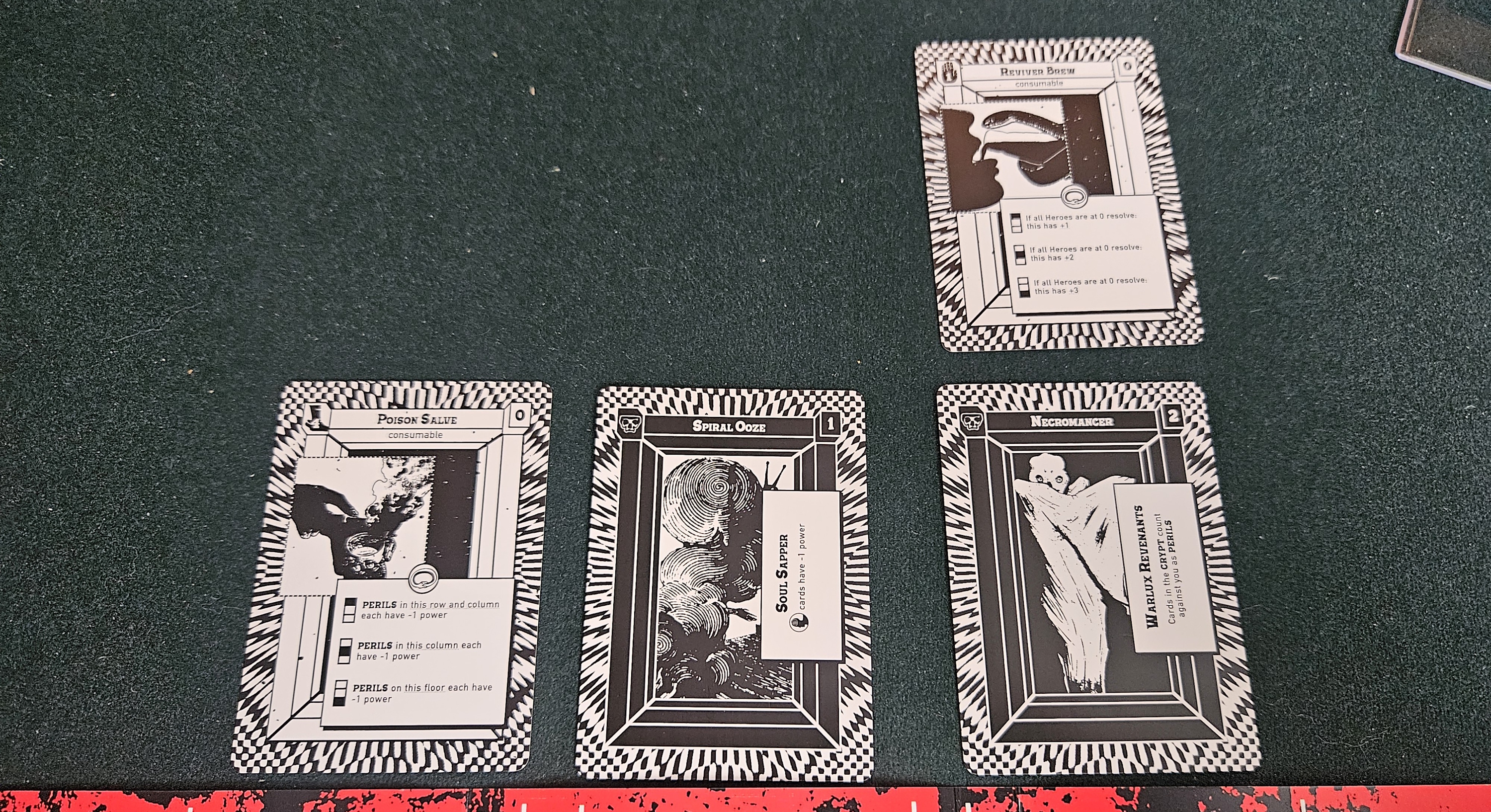
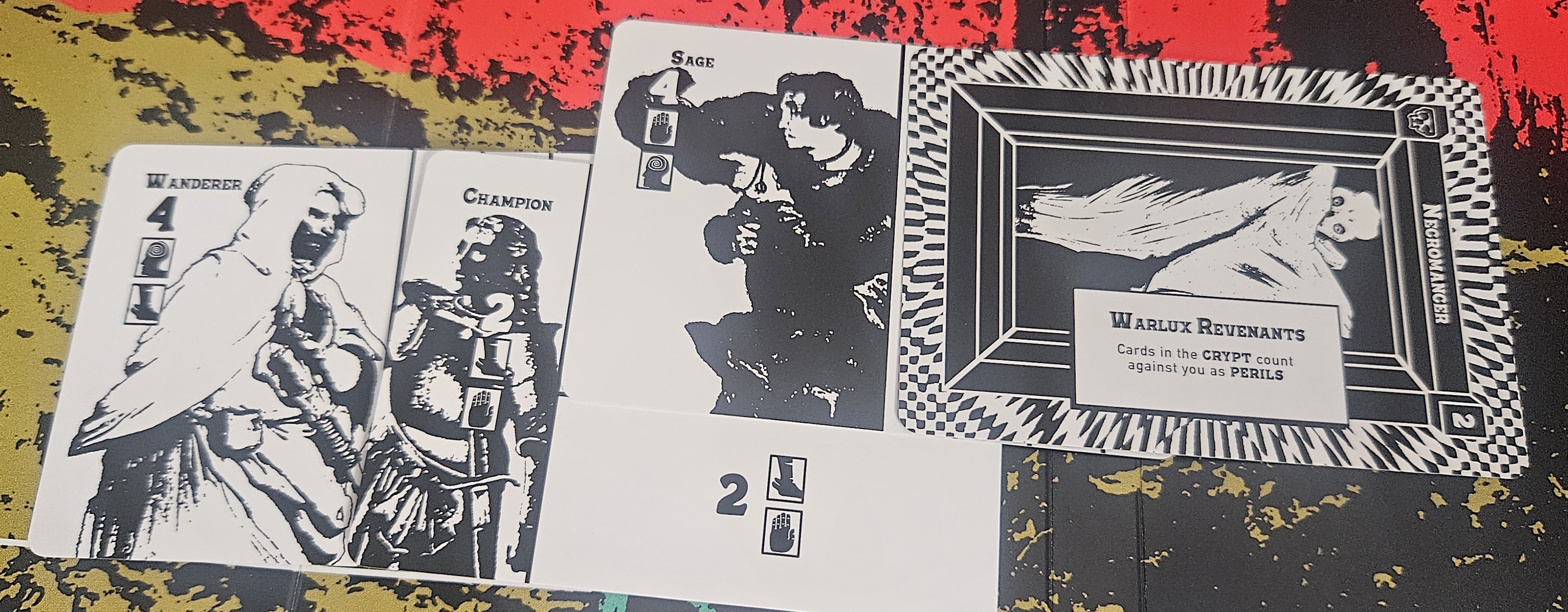
When the game begins, you have three heroes: the Wanderer, the Champion, and the Sage. Each hero is arranged so that it partially covers the one next to it. A fourth card, drawn at random from the main deck, covers the last hero, and in the process also imposes some penalty on your session. The Gloomswiller destroys artifacts the instant they’re played. The Demon Imp threatens to flip more cards against you. The Warlux Revenant transforms any dead cards in the crypt into your enemies.
But it’s the heroes who are the important part, at least right at first. Each hero begins fresh with four points ready to be spent. You draw a trio of cards from the deck. Each one costs some amount of those points. You might, for example, be holding a Poison Salve (poisons enemies — not quite a salve, but fine), a Harbinger’s Mask (grows stronger near specific other items), and a Cursed Banner (also makes you stronger when placed near certain items). All useful in their own way.
Except most of these items don’t cost four points. In fact, only one of them does. The Poison Salve, in case you were wondering. But the Harbinger’s Mask costs two and the Cursed Banner costs one.
Now, normally this wouldn’t be a problem. But in Brute Fort, your heroes don’t give change. If you spend any of the Sage’s four points, the remainder is gone. All that effort, spent to place a single card. What’s an adventuring party to do?
Heroes can be spent for resources, or divided to stretch those resources a little further.
In this case, you divide your attention. By adding one of the cards from your hand to the fort, but doing so in the fort’s favor — flipping it over to its evil side — you’re allowed to divide a hero’s resources in half. Now instead of your Sage having four points, he has two bundles of two points. Only, uh oh, the Harbinger’s Mask has transformed into an Infernal Seer. Now it will be even harder to overcome the fort.
Later, you might make another sacrifice. More time, another baddie, to divide your points yet again. Now your Sage’s two and two becomes two and one and one, the latter half halved again. Now you can play that Cursed Banner without losing out on any points. The only problem is that between the Infernal Seer and the Iron Talon Raptor you just added, the fort is starting to look rather tough indeed.
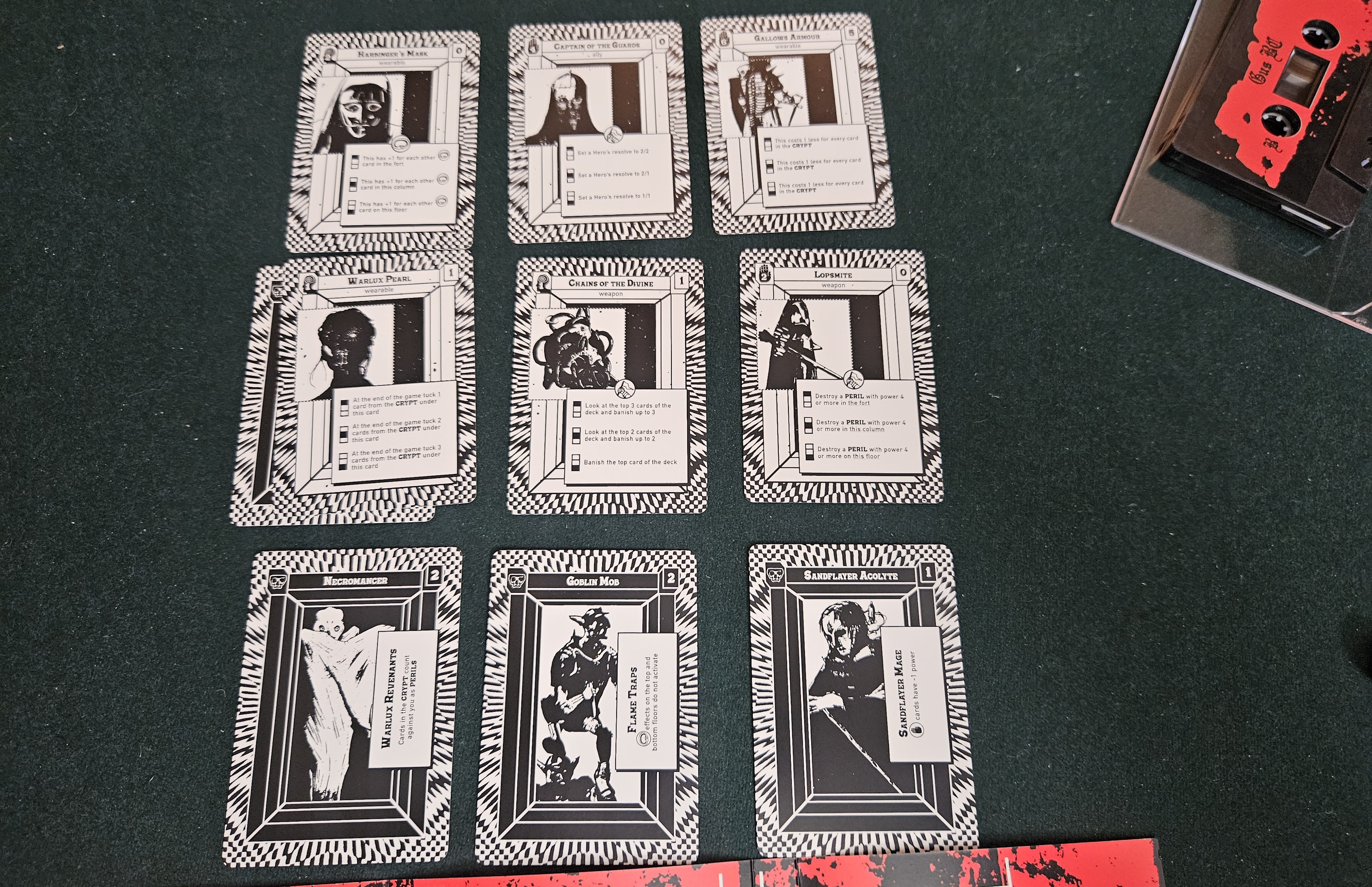
Brute Fort continues like this. One sacrifice after another. Cards transforming into monsters. Resources rationed and dwindling. At the right moments, your own cards — items and allies and artifacts, all that stuff — coming into play to slowly raise your own score to hopefully trounce that of the fort. In the end, it’s a simple tally. Your strength versus the fort’s strength. Only nine cards in the fort itself, plus some tucked cards maybe for a bonus here or there.
The sacrifices I make to review board games.
It’s all very microgame-like, although it doesn’t feel anything like the fare you’d get from Button Shy. I don’t mean that as an insult. It’s just that Brute Fort is a little darker than the titles in that catalog. There’s the art, obviously, which is a far cry from the cartoonier style that usually fills those wallets. But also in the sense that Brute Fort feels a little wilder, a little less ultra-tuned. Some cards offer obvious combos. Others require more massaging. There are some I’m not sure can be made to work, not for any shortage of trying.
As for the feel of the game, it’s tradeoffs all the way down. Every card feels like a tangible sacrifice to the dark gods that inhabit this place. Even the ones you actually purchase might wind up in the wrong spot, with each one offering slightly different abilities depending on where in the fort they get placed. This is the remedy to the danger of Brute Fort growing rote: since cards are more powerful lower in the fort, you’re encouraged to make at least one or two purchases at suboptimal exchange rates, sacrificing a hero’s strength before parceling it all the way down to its constituent fragments.
And then there’s that soundtrack. I even had my mother scrounge a cassette player from some undusted corner of her castle so I could listen while I played. I’ll confess I don’t understand the return to tape, despite being a fervent advocate for physical media in this age of rented art. But as the deck scraped to life, some part of me was taken back to an earlier time. To listening to books on tape on long car trips, only to abscond with the rest of the set when our time on the road didn’t quite conclude the latest Tony Hillerman or Michael Crichton novel. Listening to them in my bedroom, in the dark, on the boom box I owned mostly for Green Day CDs, but which included a tape deck because there were still a fair few cassettes floating around in those days. The scratch and whine complemented the narrator’s voice the way the rotating spindles complemented John Darnielle’s early albums, and I’ll be damned if the crackle didn’t evoke a sputtering torch here.
A completed tableau full of both good and evil cards.
It isn’t often that I play a game that feels quite this complete. Brute Fort works, and it works because it has such a zine sensibility, merging art and media and even disparate types of play without seeming like it’s even thinking about how it’s crossing boundaries. I have a little corner of my collection for microgames. Most of them inhabit plastic wallets. I’m delighted to now have a double-wide cassette case misfitted among them.
A complimentary copy of Brute Fort was provided by the designer/publisher.
(If what I’m doing at Space-Biff! is valuable to you in some way, please consider dropping by my Patreon campaign or Ko-fi. Right now, supporters can read the next installment in my series Talking About Games, this time tackling the topic of what makes a good list! Naturally, the piece includes a list.)
Board games aren’t always very good at themes. Actual themes, as in underlying messages, not “themes,” the settings that appear in a game’s artwork. One of the hobby’s essential exceptions was Sol: Last Days of a Star. Set in some distant future, players were asked to harvest their dying star’s last embers to propel an ark into the great beyond, only to realize that their efforts were hastening the same solar death they were striving to outrun. Part climate change parable, part meditation on thermodynamics, Sol was not only playable, it was a genuine effort at using gameplay to tell a worthwhile story.
Now Ryan Spangler, one of Sol’s three creators, is back with Organism. Where Sol propelled itself outward, Organism utilizes the smallest possible lens to zoom all the way down. In a way, its diminutive subject matter is even more meaningful than Sol’s space opera. I’m speaking, of course, about the building blocks of life.
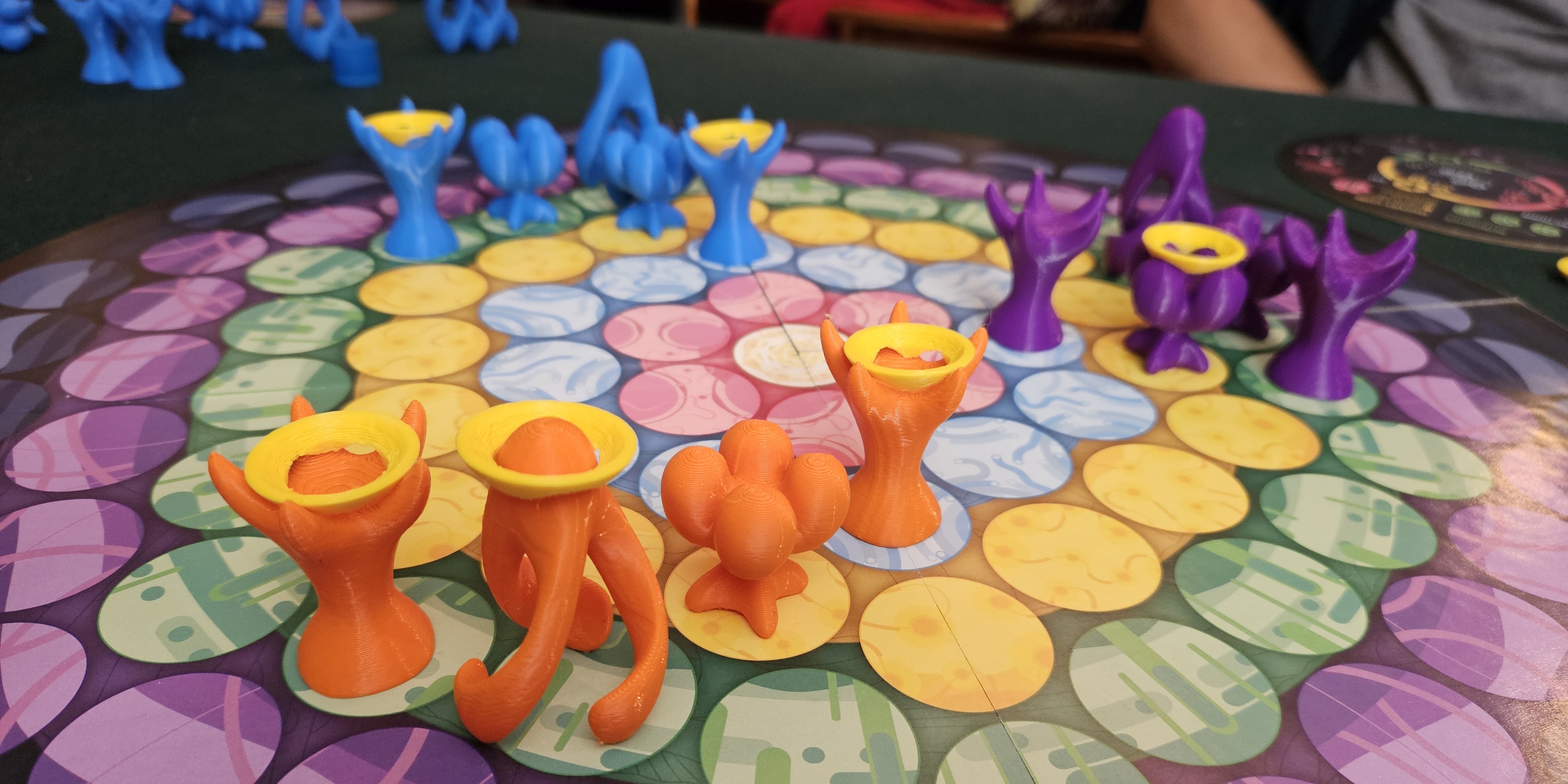
My goopy guys versus your goopy gals.
What are the smallest components that are necessary for something to constitute “life”? When I interviewed Spangler for Senet Magazine, that’s the question that led to Organism. Here players become… not even cells, really. Cells and their constituent components. Organelles. Nuclei and ribosomes and flagella. Grasping, uh, mouth-parts. Can you tell I was never very good at biology?
Fortunately, Organism drills down onto some simple terminology. To constitute an organism, there are three parts. These are your cellular building blocks. Without any one of them, the organism will die. With many of them, it becomes a lurching thing capable of doing more work. Maybe more importantly, it might split into two separate bodies altogether.
Those three building blocks are as follows. There’s the Eater, which is how your organism takes in nutrients; the Grower, which allows your organism to sprout new components; and the Mover, which allows it to shuffle around the petri dish or hydrothermal vent that is the game’s playground. At the game’s beginning, everybody begins with one of each. That’s your organism: Eater, Grower, Mover.
The life cycle of life.
Turns consist of selecting a single action for your organism. (Actually, you could select a different action for each organism, but now I’m putting the flagellum before the pili.) Those actions correspond with your organelles, with the crucial detail that you get to take as many actions as you have cellular bits. Want to absorb food? Choose Eat. Now every Eater in your organism gets to chow down on ambient soup, pulling food discs into your body. Want to expand your cell? Growers spend food to add new structures in adjacent spaces. Move? Look, you know what Move does.
Except you probably don’t! Organism, it turns out, is about grappling with your own lumbering body as much as it is about the smallest possible components of life. It isn’t all elegance and skater-like gliding down there. Sometimes your body is a malformed, asymmetrical blob, only capable of pushing around its parts on one side, or maybe wedged into a corner because your limbs are tucked against the edge of the board rather than putting their best foot forward. As someone who recently had both legs fall dead asleep because I was sitting too hard on my bum — normal sitting posture, just sorta wedged into a cushion — I’m in this picture and I don’t like it.
What I’m trying to say is that turns are two things at once. There’s raw potential here. Provided you have a solid handful of Movers in your body, you can rearrange yourself quite quickly, scooting your little organs all over the place. But when those Movers are in the wrong spot or few in number, movement becomes a chore. The same goes for Eating and Growing. With enough mouths and, ahem, reproducing bits, your organism gains the advantage of scale. Without them, you might soon find yourself dead in the water.
Even the scoring track is cool.
Literally dead, in fact. Organism is cutthroat. When two rival organisms move into contact with another, there’s a quick-and-dirty rock-paper-scissors check where Eaters destroy Growers, Growers smoosh Movers, and Movers circle around to strangle Eaters. This destroys the organelle on the receiving end of the circle of life and deposits an extra morsel of food in its wake. What’s more, if the recipient of this microscopic violence no longer has all the necessary components to sustain life, the whole thing is reduced to a pile of mushy calories.
And this is tied directly to how victory functions. There are two ways to win. Either you rack up five points by occupying the nutrient-dense space at the center of the board and destroying body parts — which can be done surprisingly swiftly if a surgical strike eliminates an entire hostile organism — or you outrun your rivals by dividing into three separate bodies.
These are roughly analogous to aggressive versus turtle playstyles, although the game’s open-ended nature means it’s an imperfect comparison. More often, Organism allows both approaches simultaneously. Having two bodies is better than one in terms of diversification, since now you can take two separate actions per turn. But mitosis is not a decision to undertake lightly, leaving your newly separated organisms open to attack and liable to grouse at each other for lack of sleep. [Note: Insert parenting joke.]
What this really does for Organism is make every decision matter, both in the micro sense and the larger conflict. It isn’t uncommon to look at your bloated cell and realize you optimized it poorly a half-dozen turns ago and the bill is only coming due now that you can’t figure out how to move it into battle with a rival organism without sacrificing two appendages.
Mutations introduce all sorts of complications.
Speaking purely mechanically, Organism is an abstract game — obviously — but one with its own internal coherence. After that awkward learning phase, which has as much to do with the game’s novelty as anything else, one can look at the board and read the slow-motion topography of its microcosmic battleground, like skilled eyes reading tectonic plates or a football match.
And as an abstract game, it’s entirely distinct from anything else out there. Like Chess, it’s sometimes elegant and sometimes ungainly; like Go, it’s possible to read the state many turns into the future only to find oneself blindsided by a clever turn. But it’s also wholly unlike either of those benchmarks.
One of its biggest departures is that it’s also only a starting point. I’ve been exploring a handful of the game’s mutations, discs that introduce special rules. It’s a similar approach to what Spangler did with Sol, letting these little powers alter the progression of the game without undermining the rules wholesale. Except, well, sometimes the rules do get undermined wholesale. Such as when a mutation introduces “fields,” little discs that function as sub-systems within a cell. Some foster aggression, others lean into the optimization puzzle, and still more transform the game into something else entirely.
Under a microscope.
No matter how it transforms, though, Organism remains truly exciting. There have been some excellent games about evolution over the years, in particular the North Star titles Evolution, Oceans, and Nature. Organism takes an entirely different tack from those games’ recombinant traits. In a sense, it recalls those games but with only three cards and a whole lot of careful positioning. But there’s a certain thematic overlap, an arms race that never lets up. That it works not only with two players, but as many as six, is nothing short of astonishing. I’ve played with four, and while the session took longer than lower counts, it was a wonderful experience, full of little feints and flankings.
Anyway. That’s Organism. As a parable, its ambitions are narrower than Sol, but also given the focus of an electron microscope. I can’t wait to push around its tendrils, mouth-parts, and weird jiggling udders for years to come. It’s on Kickstarter right now.
A prototype of Organism was provided by the publisher.
(If what I’m doing at Space-Biff! is valuable to you in some way, please consider dropping by my Patreon campaign or Ko-fi. Right now, supporters can read the next installment in my series Talking About Games, this time tackling the topic of what makes a good list! Naturally, the piece includes a list.)
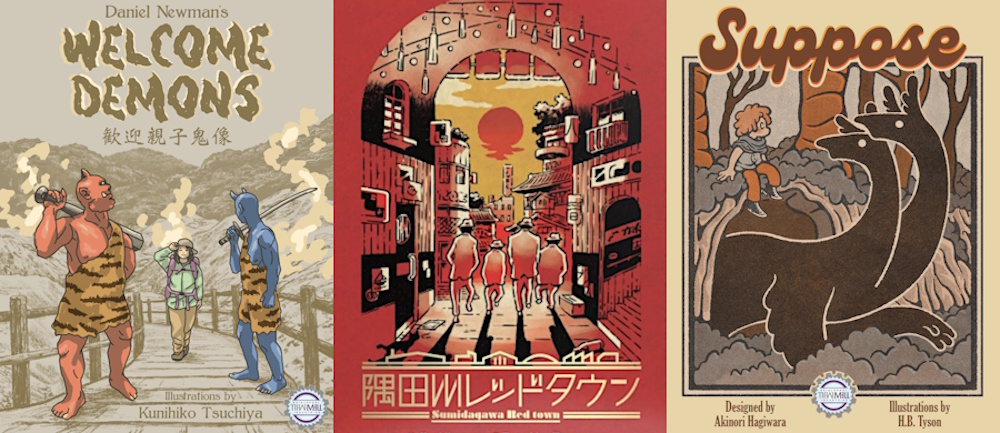
All I play anymore is trick-takers. And climber/shedders. Are those the same thing? Some say so. Others disagree. I don’t take a strong stance on it. Which is why I’m lumping these three titles together. For this quarter’s roundup, we’ve got friendly oni, unfriendly gangsters, and some super cute monsters that might be friendly or unfriendly depending on whether you correctly guess their identity.
Boo! We’re here to help!
Welcome Demons
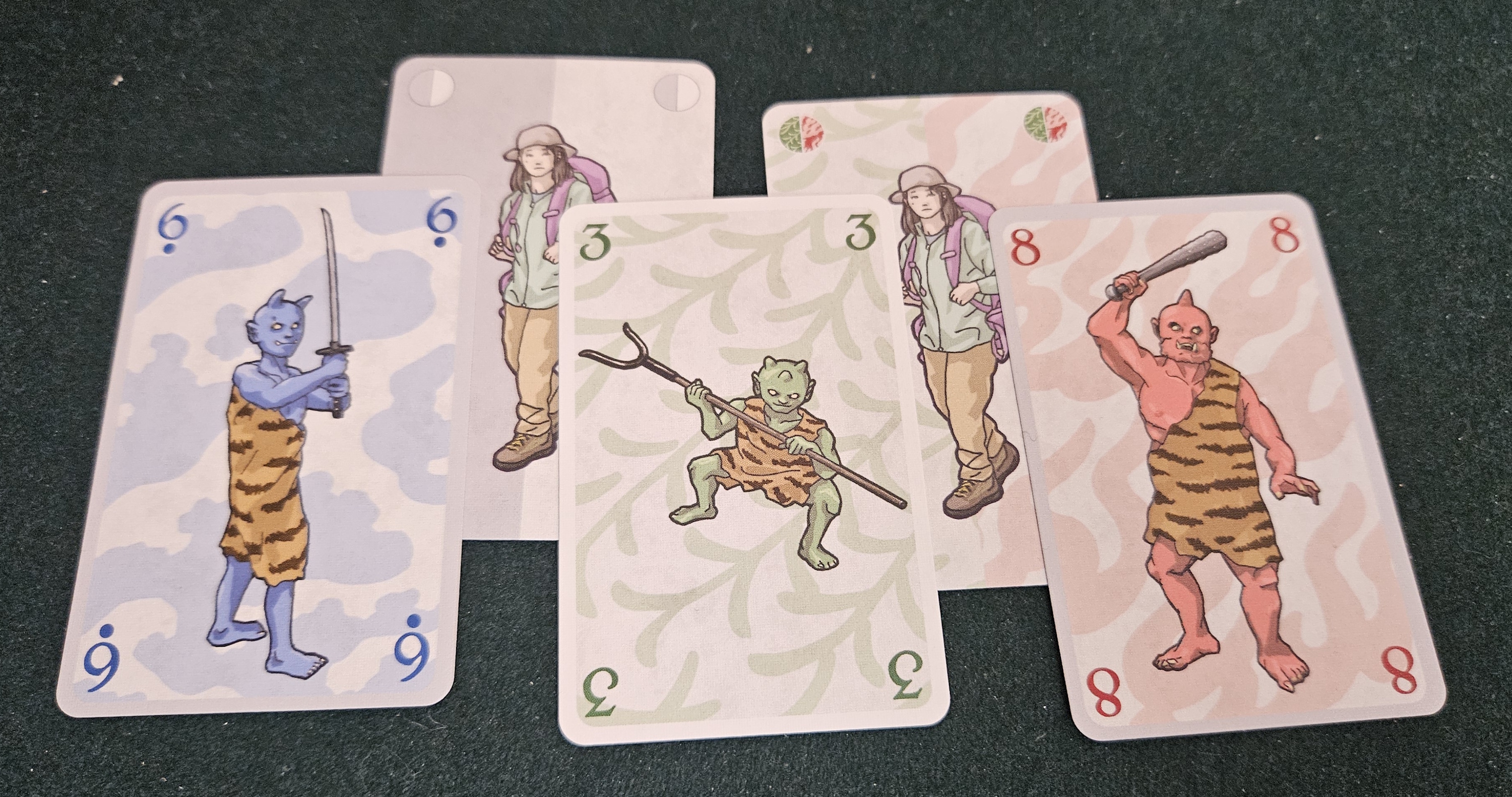
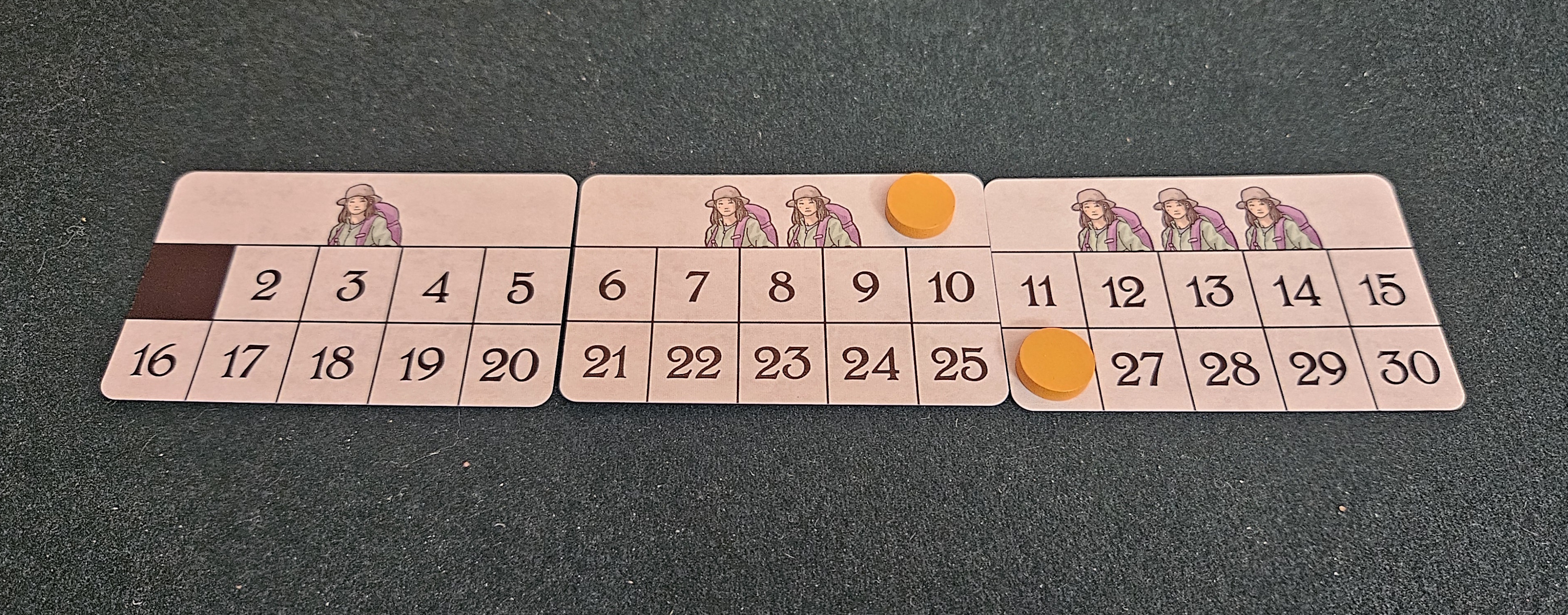
If I were a Japanese demon, I’d be like the oni from Welcome Demons — a menacing li’l guy with a sword, but really just here to make sure you get home safe. Designed by Daniel Newman, this is a shedder about using the cards from your hand to guide lost hikers out of the mountains.
It’s also as atypical as it gets, seating exactly three players and, rather than building melds in the usual fashion, having you match your cards to your hikers. Each hiker has their own needs, whether odd/even ranks or various suits of oni. What’s more, players are required to format these melds using at least one card from the previous player’s set. This forces everyone to pay some attention to what their rivals are putting on the table. More than some attention, really. Because your meld must contain the same number of hikers (one, two, or three) but a higher sum of ranks, or more hikers but a lower overall rank. Which makes things tricky indeed, especially if you’re holding a bunch of mid-rank cards.
And then, if it becomes impossible to follow, everyone passes and the last demon to shepherd their lost hikers begins the process all over again with one lonely hiker. This continues until somebody most definitely can’t save any more hikers, at which point they lose and the other two players are crowned… I don’t know, the most helpful oni of the month.
How many hikers can you aid?
It’s a clever little thing, emphasis on both “clever” and “little.” Newman pulls a trick we’ve seen before, where you aren’t playing to win so much as playing to avoid losing. Oni are spiteful that way. Especially near the end of the hand — and the hand is the game, this isn’t some multi-round affair — it isn’t uncommon for players to struggle to build the right melds, sometimes resulting in an early quit for the session. Like many shedders, this makes the game’s back half less interesting than its opening salvo.
Fortunately for Welcome Demons, its approach to meld-building is novel enough that it’s worth witnessing, even if only as a filler. I would put this one in the midnight nugget box: a tasty snack with a crunchy exterior, but not the most filling meal out there.
Take ’em out back and gun ’em down.
Sumidagawa Red Town
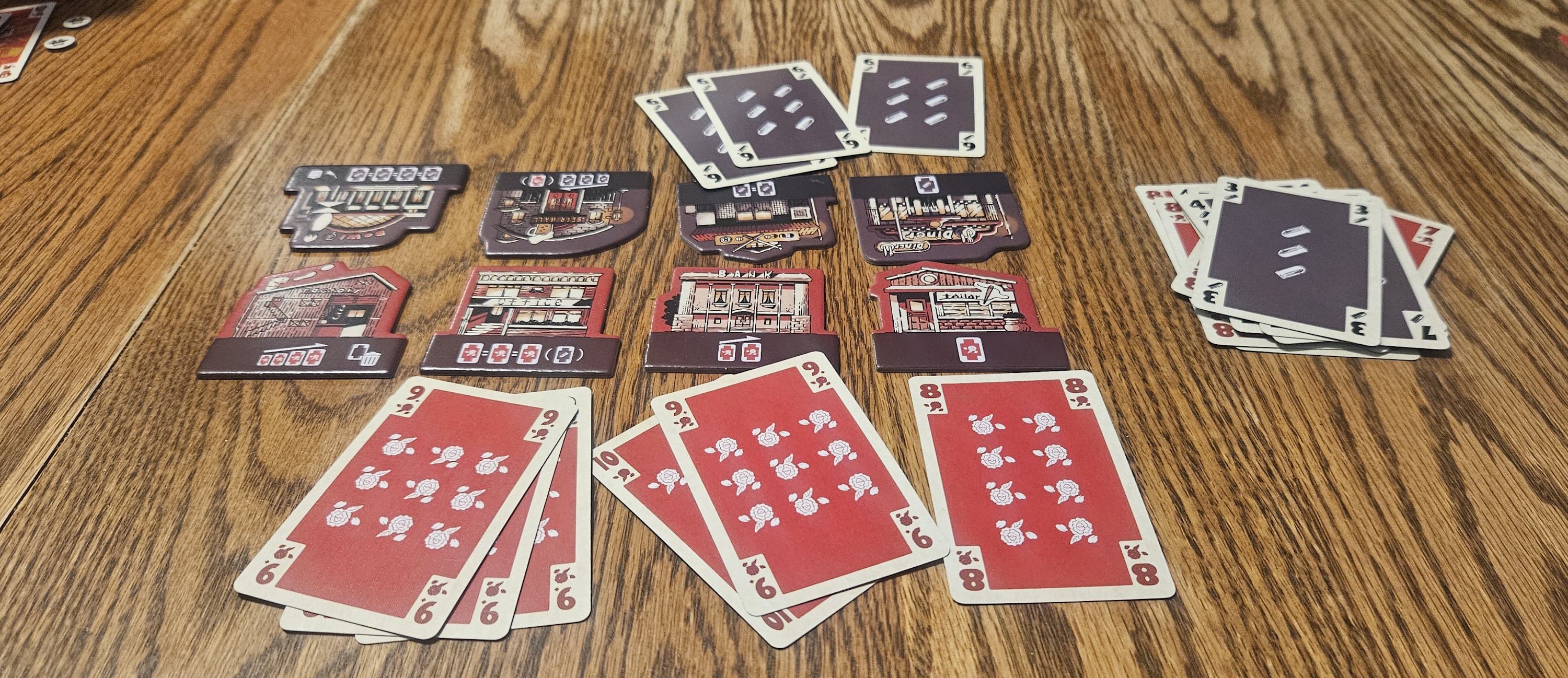
Like our previous entry, Sumidagawa Red Town is a shedding game about sinking slowest. Players, of which there are between two and five, step into the rain-slicked trenchcoats of small-town gangsters who need to subtract a column from the organization’s payroll. By which I mean they need to murder one of their companions. With the oni doing emergency response, it raises the question of who the real monsters are. Sobering, etc.
The main twist is that players aren’t one-upping each other’s melds, at least not in the traditional sense. Instead, the titular red town is presented as eight sections, each of which holds its own unique meld. There’s a space for a sequence of three brown cards, another for a triplet of red cards, two for singles of either suit, and so forth. Into these spaces you play a meld. This must start at a higher rank than whatever the previous player deployed, but otherwise you’re free to choose whether to play one card or four.
Assuming the proper space remains open, that is. And that’s the rub. After even one round, it becomes very tricky indeed to find a good fit. This marks Sumidagawa Red Town as one of those titles absolutely riddled with tactical passes. While dropping four cards on the town’s biggest space is certainly a power move, it might be better to pass and let the town clear out for the next round. Especially if you’re likely to go second.
First to lose. Might as well get some help.
It’s thrilling to follow a four-card bomb with a single, and for that reason alone Sumidagawa Red Town establishes itself as one of my favorite shedders.
But Mashikamaru doesn’t stop there. In between rounds, players get to decide if they want to summon hitmen — in game terms, suit-coded wild cards — to beef up their hand. If only one player elects to do so, they receive broad latitude to add as many hitmen from their private pool as they like. But if multiple players choose this option, they only add one hitman, then swap hands with everyone else who made the same decision. It’s a brilliant piece of brinkmanship, potentially making or breaking your entire hand, plus offering the chance to drop a real stinker of a hand onto somebody else.
And really, that’s what this one is all about. Choosing your battles, knowing when to go all-in, and then slipping your rival a mickey rather than facing them directly. The main downside is that it’s hard to find outside of Japan and requires a translated rules sheet. Personally, I’ve found it well worth the effort. Forget it, Jake. It’s Sumidagawa Red Town.
Check out that handsome devil.
Suppose
On the more traditional end of things — although only marginally — is another New Mill import in the form of Hagizou’s Suppose. This is a trick-taker, and for once there’s an actual winner, but the game’s may-follow nature marks it as rather distinct from most of its peers.
Scratch that, everything is distinct. There’s the way your hand is arranged: sorted by your neighbor and splayed so that ranks increase within suits, but with only a few cards facing you while the others peek outward to show everyone else at the table what you’re holding. In fact, much of the game revolves around your hand’s concealment. Whenever you play a card you can’t see, you’re permitted to guess its identity. There’s no penalty for guessing wrong, while a correct guess awards a “suppose” token. These translate into points at the end of the hand. Which is a good thing, given the relative scarcity of points elsewhere.
How, then, does one score? Tricks, first of all, although at one point per, these aren’t much to write home about. Your larger tally comes from another guess. When the round begins and you sort your neighbor’s hand, you wager how many tricks you think they’ll take. Contract bids are always testy, but here they’re especially tough. Since you’re never forced to follow suit, sabotaging a neighbor’s bid is especially easy. It’s possible to split your bid for fewer points, but, well, that only makes it marginally easier to hypothesize what your opponent is going to do during the round.
Making good guesses, I guess.
The outcome, then, is an extended guessing game, but one that strikes out along multiple avenues of conjecture. What you’re holding, what everybody else is holding, how your target neighbor is faring, whether this is a good time to nab another trick or yield it to someone else… it’s a lot to take in.
That said, Suppose is something special. It might even be my favorite New Mill release all year. The deck is tight enough that correct guesses are possible, but the inclusion of two copies of each card makes card-counting, while not impossible, at least not such an advantage that it changes the nature of the game entirely. The result is a game that’s as much about sabotage and the careful sniping of unexpected tricks as it is about reading everyone’s hand. Truly, this one is a gem.
You know. I suppose.
A complimentary of Suppose and Welcome Demons was provided by the publisher.
(If what I’m doing at Space-Biff! is valuable to you in some way, please consider dropping by my Patreon campaign or Ko-fi. Right now, supporters can read the next installment in my series Talking About Games, this time tackling the topic of what makes a good list! Naturally, the piece includes a list.)
UFO 50 was one of the coolest gaming artifacts of the past few years, a collection of fifty unique video games by Derek Yu, Jon Perry, and a handful of other developers that pitched itself as a digital excavation of a long-lost 8-bit console. The collection was special for many reasons, but my favorite trick was the way its creators employed modern design principles that contrasted the system’s hardware and input limitations.
For example, Party House. Designed by Jon Perry, this was a full-fledged solitaire deck-building game that fictively predated Dominion by over two decades. Now, in a design ouroboros, Perry is shifting Party House to tabletop.
Check out my sick group of friends. (UFO 50 version)
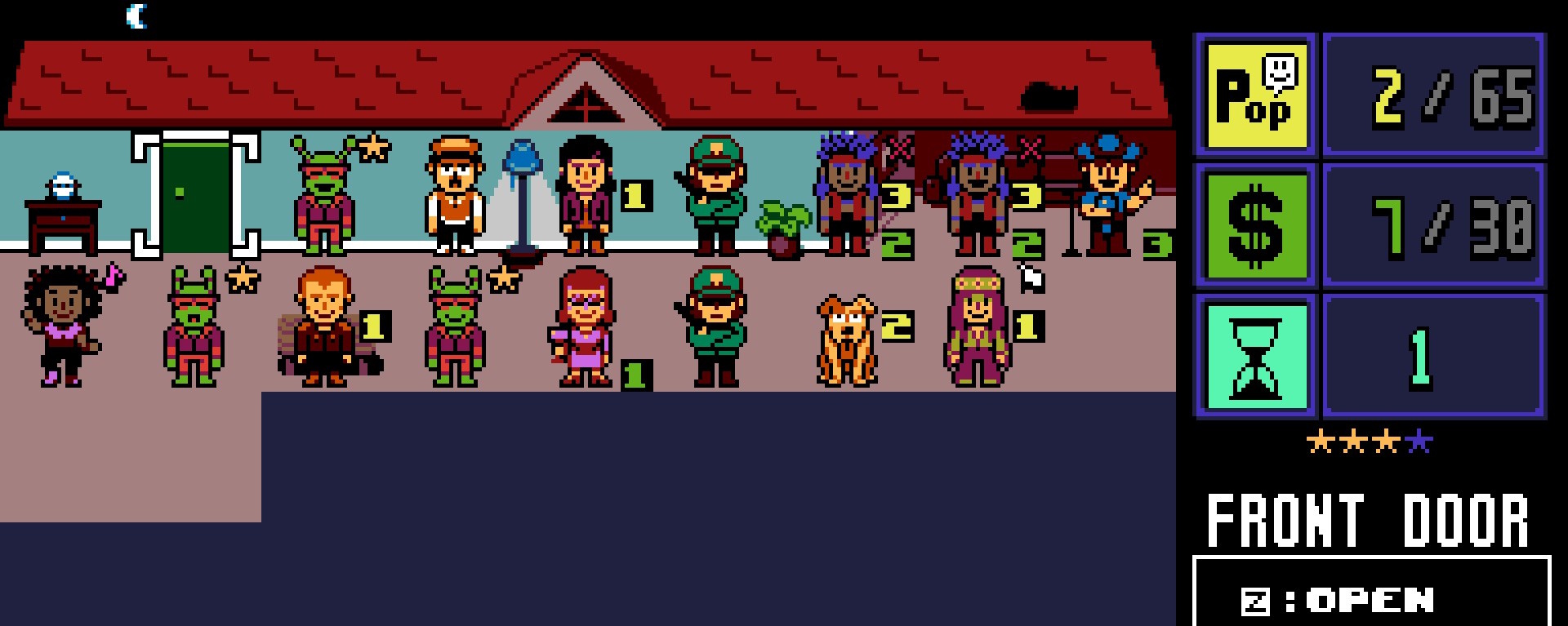
If nothing else, Party House is more relatable than most gamified topics. You want to throw a party. A big party. But you also don’t want the cops and/or the fire marshal to bust up the festivities. In the UFO 50 original, that meant building out your Rolodex, expanding your apartment to accommodate more bodies, and then randomly drawing guests until you decided you’d had enough. Or until the door got kicked in.
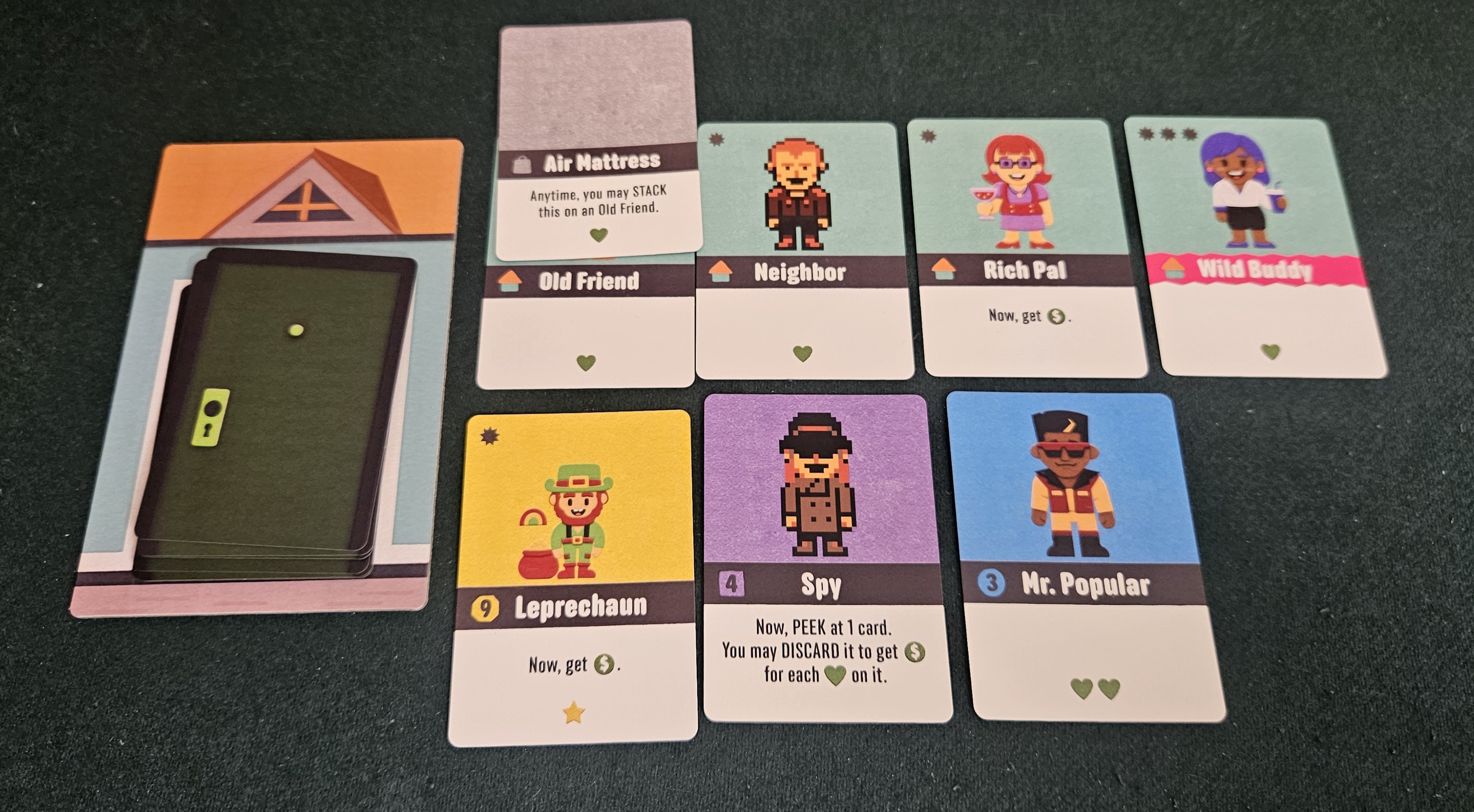
Basically, the whole thing was a merger of Dominion-style deck-building and press-your-luck gameplay. Good guests awarded popularity and cash, while rowdy guests egged your neighbors into taking matters into their own hands. Others served as utilities: bouncers for tossing out troublemakers, private investigators who could drag the right people to the party, college mascots for nostalgic gatherings of old friends. Special guests like aliens and mermaids, meanwhile, served as objectives, awarding the stars that proved you had mastered a particular set.
That’s the gist of the physical version as well, although Perry has made a number of changes, some delicate and others structural.
The biggest alteration is Party House’s format. Because the UFO 50 version was a solitaire game, it presented a series of challenges, each offering a pre-built selection of guests and objectives. Tackling these levels required some luck, but the game’s core concern was more with finding the right build order for your Rolodex than responding to dynamic problems. The result wasn’t quite a puzzle with a set solution, but it was closer to that side of things than one might expect.
For the physical edition, Perry has tossed all the digital game’s goodies into a single box. Gone is the set marketplace. Instead, players are presented with three rows of guests that are constantly refreshing as they’re befriended with popularity and cash. Gone are the puzzle-style levels. In their stead is a race to earn a certain number of stars before anybody else at the table. Gone is the apartment limit. Now your place can hold as many guests as possible. Provided the party doesn’t end prematurely, that is.
Parties are better in person.
On the topic of premature ejection, troublemakers have received a significant facelift. Previously, the police would crash the party as soon as three troublemakers were clomping around the living room. Now every guest — or nearly all of them — produces some amount of noise. As soon as you hit eight points of ruckus, the party’s over. Worse, you skip the Rolodex phase entirely. And unlike in the original game, popularity fades each round. Only money can be hoarded. Fortunately, these twin currencies are interchangeable. What one lacks in charisma they can make up for with Benjamins.
As a side note, there’s a nice balancing mechanism where a crashed party puts an accessory card in your deck. Accessories are always positive, just not as positive as a good guest. Still, a charcuterie board or karaoke machine is handy in a pinch. It’s a nice concession for the occasional stroke of rotten luck. Failing players stay in the game, but with less control over how they assemble their guest list.
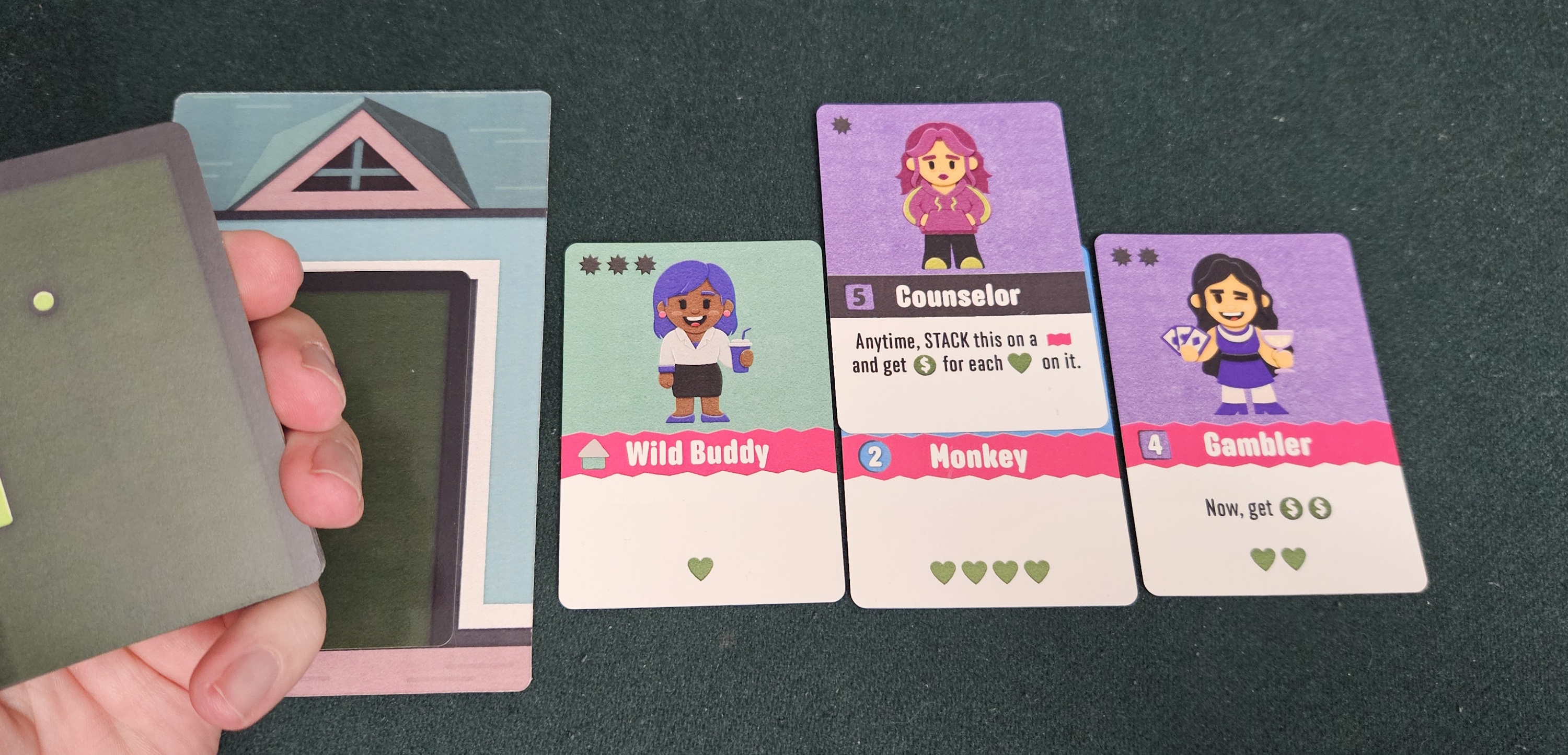
Perhaps most importantly, the whole thing is fast. You hold your deck in your hand the entire round. A turn takes maybe twenty seconds at most. And cards flip at a rate comparable to the typewriter clatter of FlipToons, but with the occasional mid-turn decision to prevent it from feeling quite so rote. Actually, the comparisons don’t end there. Party House feels like FlipToons with considerably more direct control. Whether it’s the ability to peek at cards mid-party via spies and superheroes, cover your loudest offenders with cute dogs and counselors, or deploy occasional cards that directly confront your opponents, your Rolodex is a bespoke assemblage that can be bent to your will.
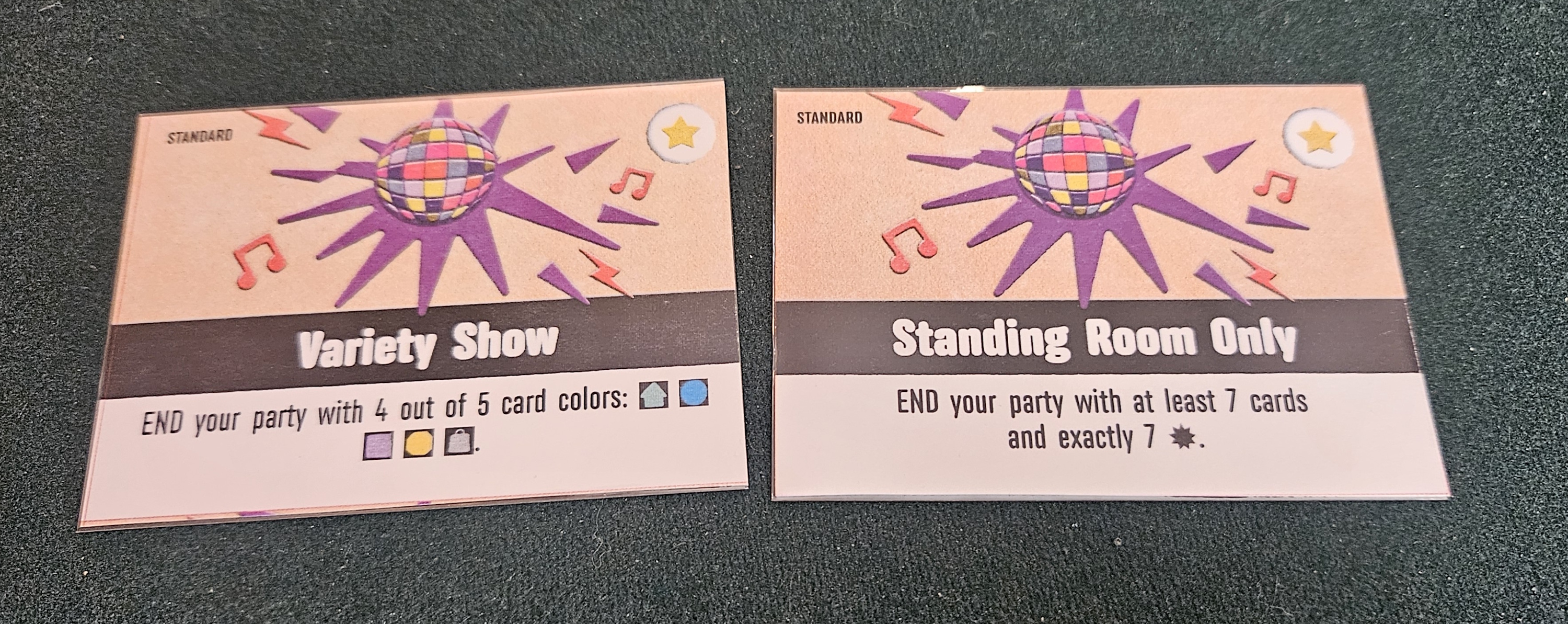
The other big point of inter-player friction arrives in the form of party cards. Each game puts two of these on display, then asks players to jostle for control by fulfilling their stated objectives. This allows for some distinction between sessions. Hosting a Class Reunion feels different from a Legendary Rager, with the former favoring gatherings of old friends while the latter requires you to ride the line with plenty of troublemakers. Importantly, these cards can be stolen, encouraging players to one-up each other over the course of the game.
Different party types can also award stars.
On the whole, Party House does an admirable job of translating the version that existed in UFO 50. It captures the spirit of the original, incorporates more players, and expands the decision space, while also keeping the play punchy and pacey. There are even little touches that speak to Perry’s deep mastery of how a hand of cards can and should be handled, such as the single guest that must be peeled from your deck to become the “door” (read: discard pile) of your apartment, a trick he pulled in Hot Streak to prevent players from developing too robust of a predictive mental model of their deck.
I’d also be remiss to forget Daniel Profiri’s illustrations, which resemble felt board cutouts and are a perfect way to depict the guests’ retro appearance without defaulting to pixels.
At the same time — and keeping in mind that I’ve only played the prototype — Party House comes across as a minor title in Perry’s ludography. It isn’t as subversive as some of his other hits, lacking the emotional range of Scape Goat, the genre-redefining nature of Air, Land, & Sea, or the family breadth of Spots. To be sure, this isn’t to say that Party House has to be revolutionary, and there’s a tyranny to expectations that can prevent us from appreciating what’s right in front of us. But by and large, my experience with Party House has been a gentle one, a pleasurable process of revealing and shifting cards that still feels largely automatic. Where the version found in UFO 50 fit that collection’s 8-bit limitations, here it lands somewhat more thinly.
Then again, there’s a lot to be said for pleasurable physical processes, and that’s where Party House succeeds best. With the right group, it’s the sort of game that gets people chanting “Hit, hit, hit!” And the game upsets genre formulas in subtler ways. For instance, this is one of the few deck-builders to shrug off the absolutism of the five-card hand. Here a party might consist of three guests or ten, all depending on chance and how well you’ve assembled your Rolodex. It’s a smart little thing. Just be aware that it’s littler than you might expect.
The bigger the party, the more likely the cop roll-by.
Where does that leave Party House? On the threshold, I suppose. Playing prototypes is always a risk. Sometimes you get Baba Is You, which feels poised to become an instant cult classic. Other times you get a game that’s still finding its identity. That’s where I would put Party House. Class Reunion or Legendary Rager — we’ll see next year which party this shindig shapes up to be.
A prototype copy of Party House was temporarily provided by the publisher.
(If what I’m doing at Space-Biff! is valuable to you in some way, please consider dropping by my Patreon campaign or Ko-fi. Right now, supporters can read the next installment in my series Talking About Games, this time tackling the topic of what makes a good list! Naturally, the piece includes a list.)
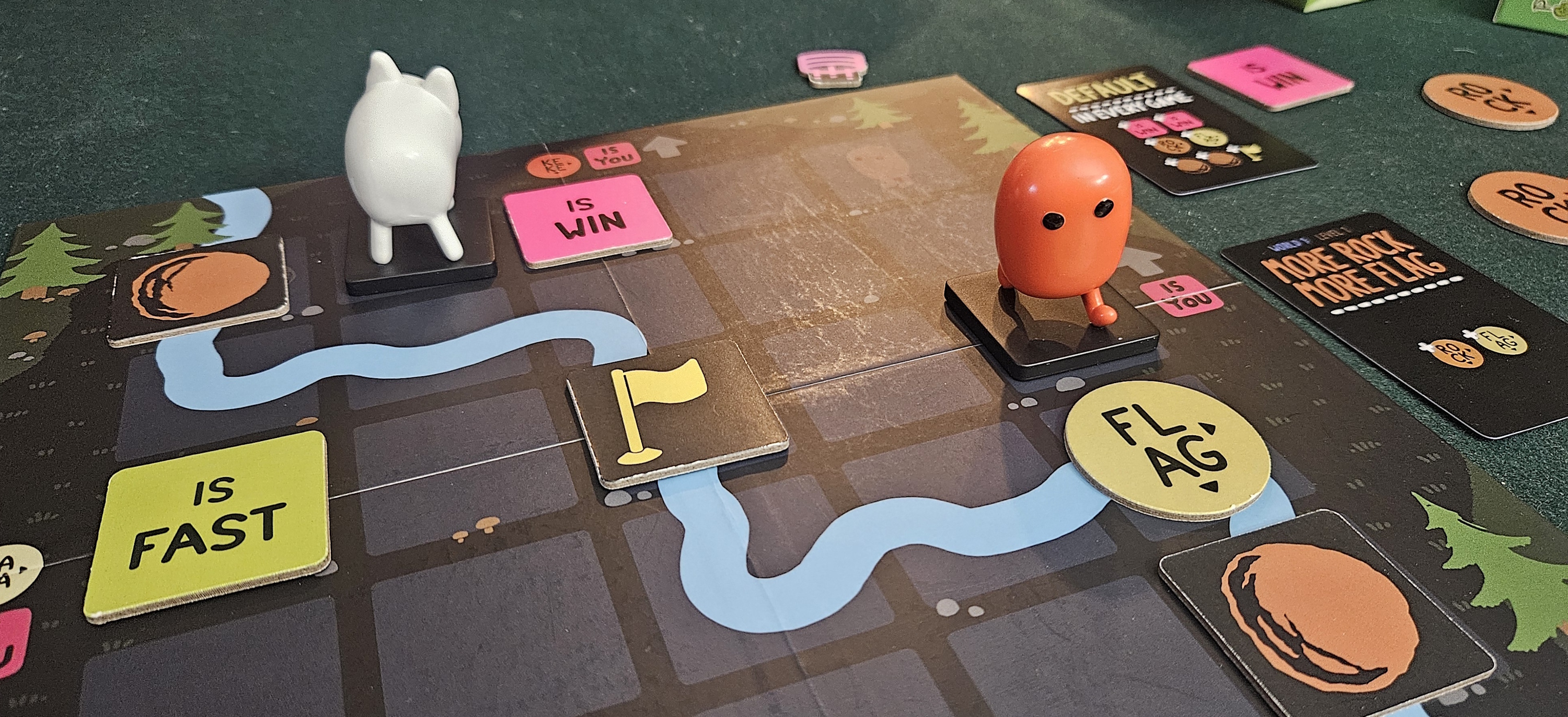
If you haven’t heard of Baba Is You, grab hold of the nearest guardrail, because you’re about to be hit by a wrecking ball of descriptors. Here goes: released in 2019, Baba Is You was a mind-bending box-pushing syntax-making meta-puzzle video game by Arvi Teikari. It was hard. Famously so. Especially if you’re anything like me and not really into Sokoban-style box-pushers.
Baba Is You is now also a board game, albeit one whose pedigree doesn’t only belong to Teikari. The analog adaptation was done by Peter C. Hayward, and in many ways it feels like a riff on his abstract comedy game That Time You Killed Me. Although somehow, improbably, it’s even better — provided you have the right mind for it.
Baba Is Sometimes Confounding. In a good way.
You are Baba. Baba is a dog… sheep… cat thing. Baba likes to push boxes around a ten-by-ten grid. Baba can also pull boxes, one of the board game’s main concessions to its non-digital format. Mostly, this is to prevent everything from piling up on the edges and corners until the board has screwed inward like an ingrown toenail. Boxes can also be placed next to Baba, brought from off-map to alter the game’s progress.
You are also Keke. Or, well, your opponent is Keke. Because unlike the video game, Baba Is You: The Board Game is not a solitaire affair. This is a duel, alternating players and pairs of actions. I take two actions, split as I choose between moving Baba and placing boxes. Then you take two actions, moving Keke this time and maybe also placing boxes.
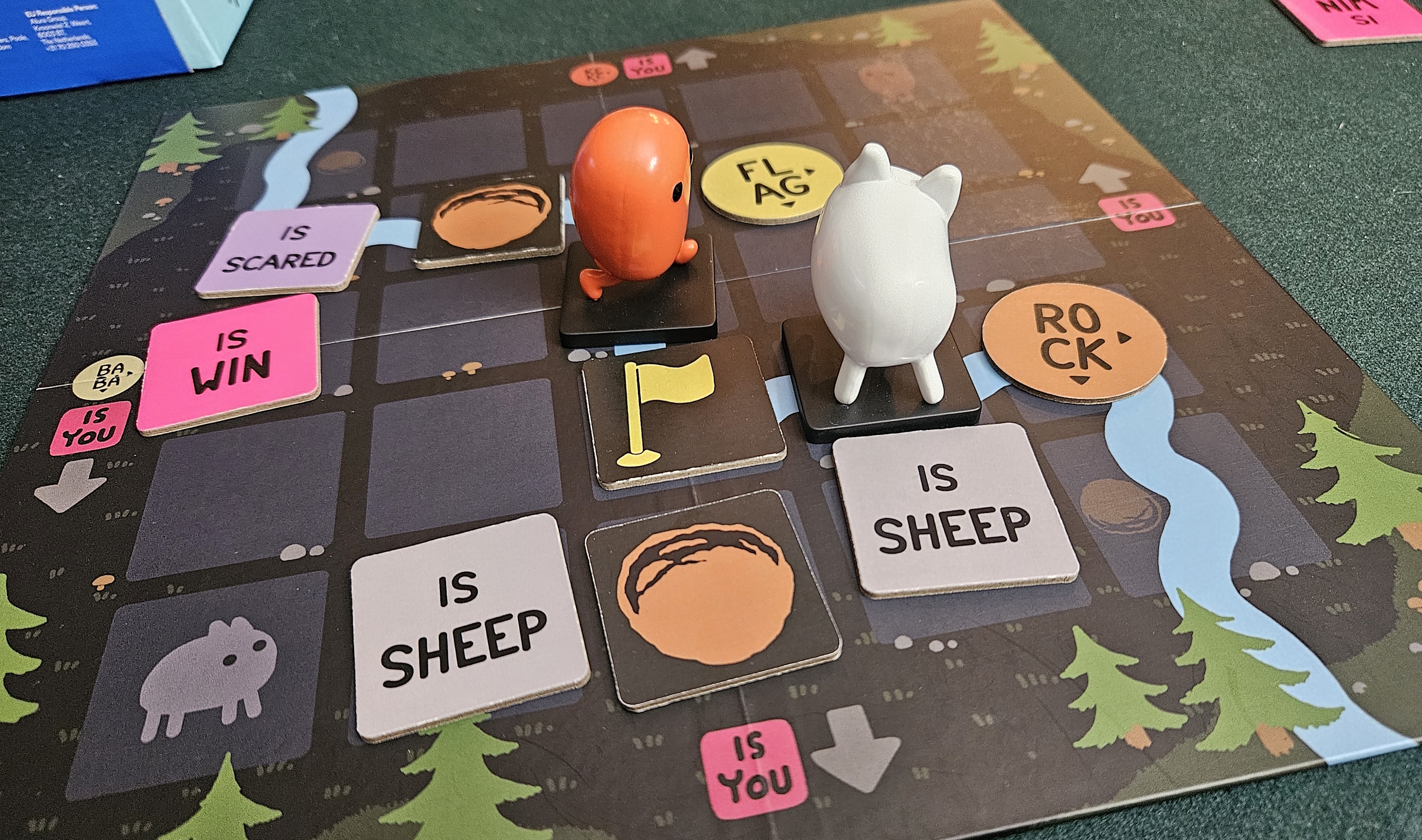
What sets this apart from any number of other games is that there is no win condition. Not right away. Your goal is “to win.” I mean, obviously. That’s why we’re playing games, isn’t it? To win? But in order to win, you must construct a way for that win to occur. For example, by placing and pushing boxes. “Rock.” That’s one such box you can place on the map. “Is Win.” That’s another. Put them next to one another and you spell out the phrase “Rock Is Win.” Now if somebody steps onto a rock, they win.
Baba Has Lots of Options. But not too many at any given time.
It doesn’t take long for this rubric to turn pretzels and loop-de-loops and barrel rolls on itself.
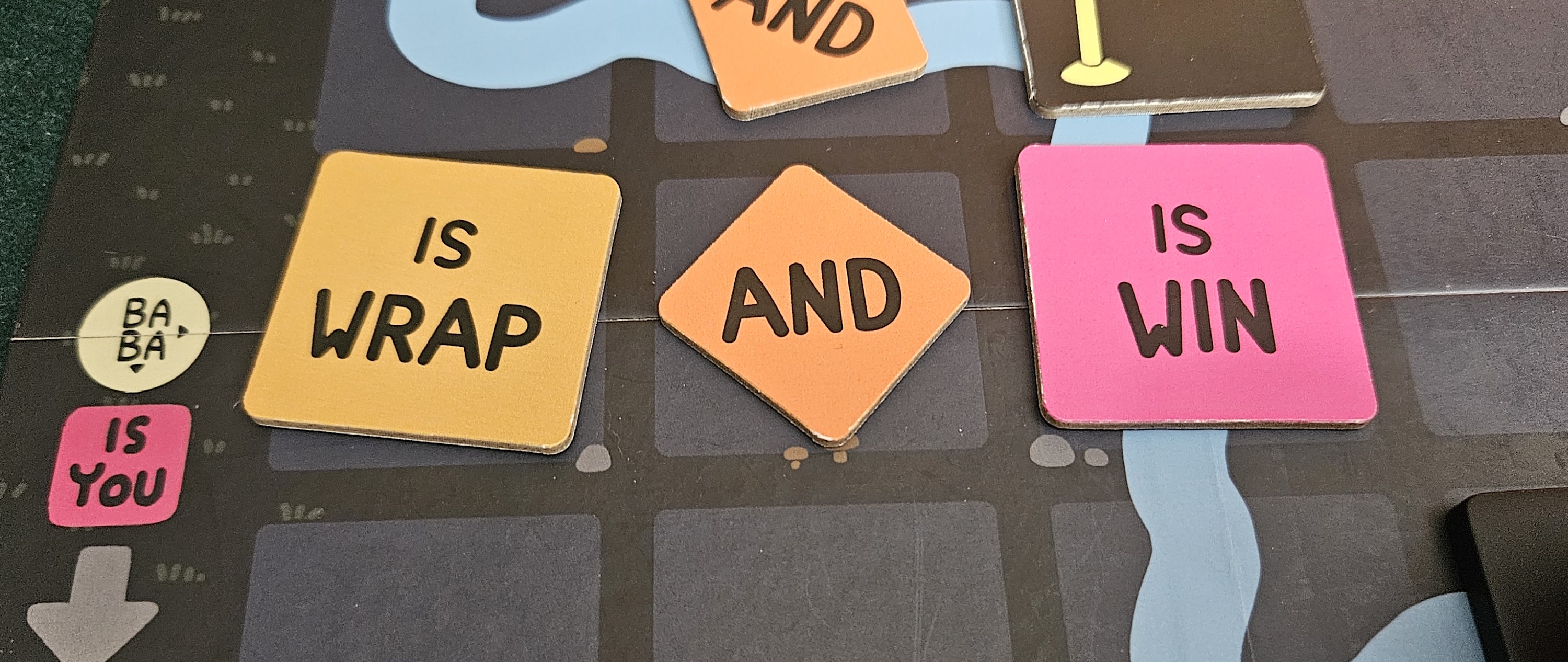
For one thing, there’s a lot you can do with a few basic phrases. Put “Rock” next to “Is You” and suddenly “Rock Is You.” Now instead of only moving Keke, you can also move any rock as though you were the rock. Spell out “Rock Is You” and “Rock Is Win” at the same time and you might be able to win by stepping one rock onto another rock — because you’re a rock and also rock is win. Or you could do things more simply by just spelling “Rock Is Win” and having Keke, who is you, step onto the rock. Fewer steps that way.
At the same time, fewer steps isn’t always better, because both you and your opponent are messing with the integrity of these phrases. Usually by pushing and pulling, but other tricks eventually reveal themselves as well. As a rock, maybe you push apart the phrase “Flag Is Win.” Now the flag isn’t win, so your opponent, Baba, who was one turn away from stepping on the flag, cannot win. At least not without somehow putting that phrase back together or creating another. Or by layering the game’s syntax and box-pushing puzzles over the top of each other so that your rival is checkmated into permitting your win.
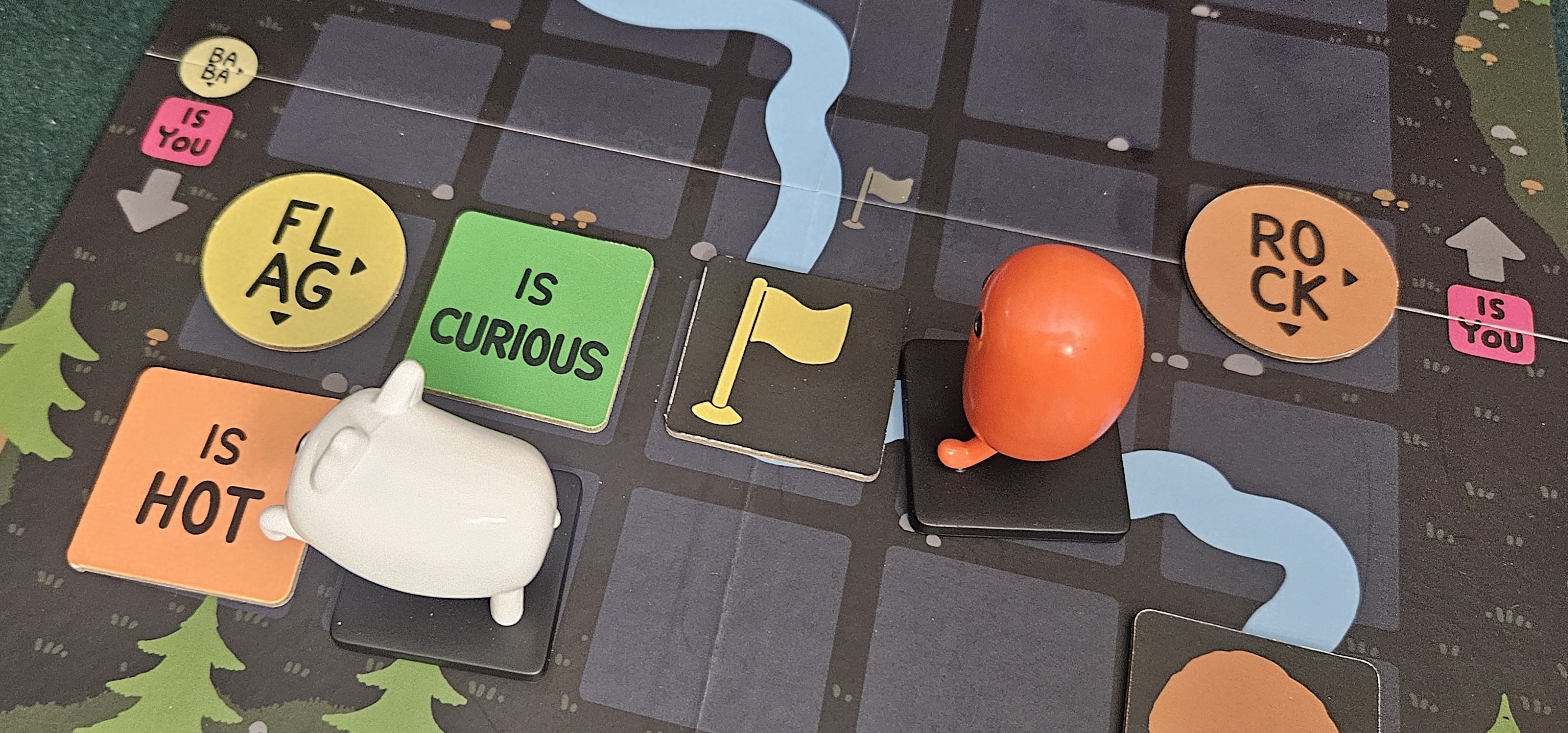
Also, there are heaps of these phrases, all capable of jumbling together to create dynamic new rulesets. For example, maybe something on the board becomes “Curious.” This means that anything that moves into its row or column will cause that thing to come wandering over to see what’s snuffling about. Or perhaps Baba becomes “Thirsty,” inclined to scoot over to the river spaces at the end of each turn. Or the river decides to begin to flow downhill, potentially whisking items off the board altogether.
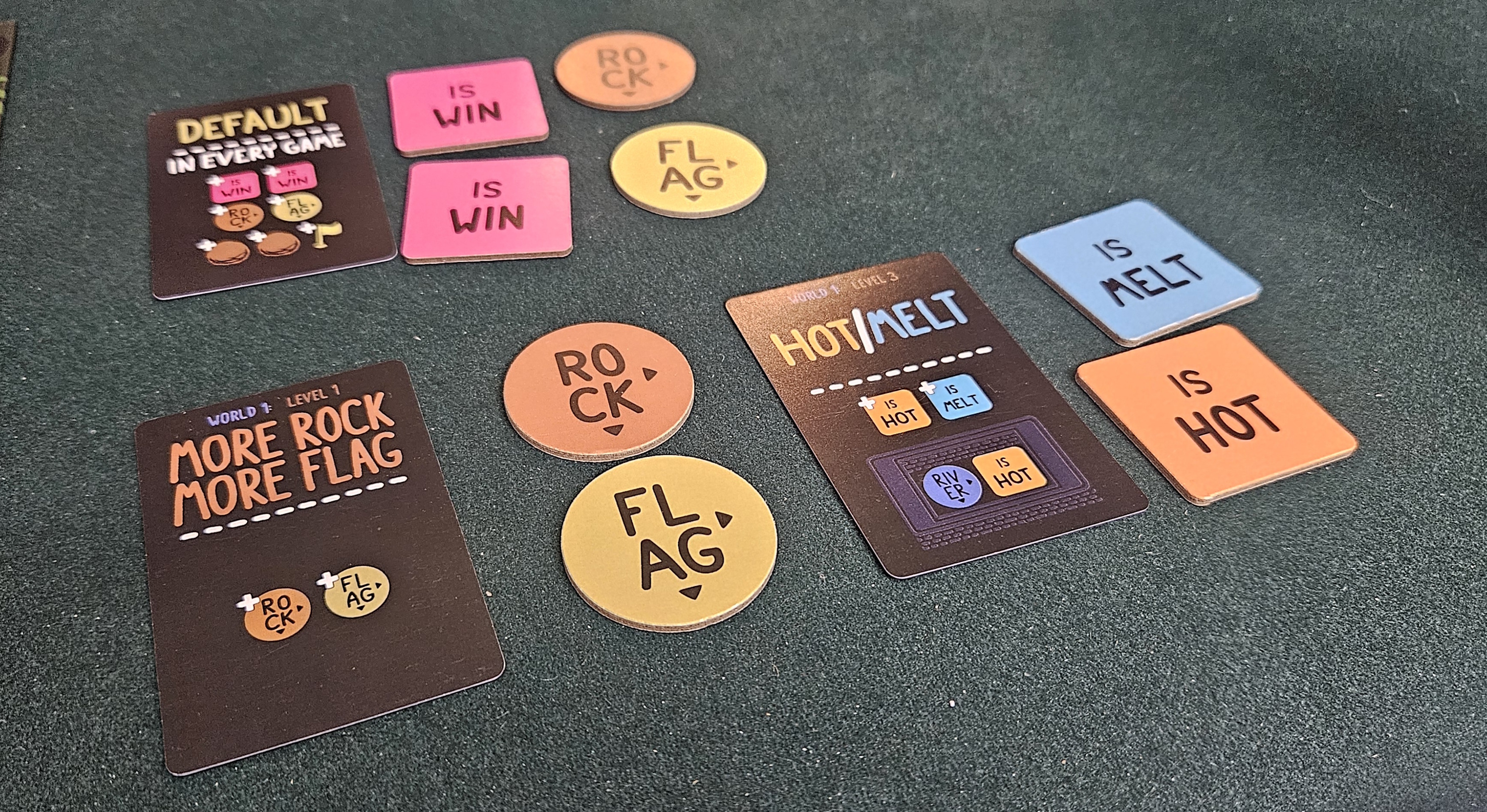
Sometimes these rules can have unintended consequences. Such as when a “Hot” item comes in contact with a “Melt” item, which destroys the latter. It’s possible that you will even be destroyed. You as in Baba, or you as in Keke, depending on which side you’re playing as right now. If you are something else on the board — a rock, a flag, an errant piece of syntax uplifted to temporary sentience — then you can continue to function, maybe even calling your destroyed body back onto the board, until such time as the rule is broken into pieces.
Baba Took A Wide Angle Shot.
There are three main things I would impress upon you about Baba Is You: The Board Game.
The first is that it’s incredibly funny. I mentioned that Baba recalls Hayward’s earlier effort, That Time You Killed Me, another notably funny game. Their commonalities are many. Both are short abstract games with ever-shifting rules. Both are tight two-player duels on claustrophobic boards. Both allow precisely two actions per turn, which is just enough to get something done but not enough to accomplish everything you need. Also, if played in an obnoxious manner, both can result in little I-step, you-step conundrums that aren’t especially interesting to resolve.
But where Baba Is You differs from That Time You Killed Me is crucial. These are dramatically different games in scope and process. Moves are harder to undo than those in That Time You Killed Me, with boxes usually sticking around for the duration of the match. Also, the comedy doesn’t arise from the prose. There’s none to speak of anyway. Here, Baba and Keke’s misadventures are pure slapstick. It’s the joy of assembling a mousetrap only to trigger it in your own face.
Which is also to say, the game is hard. At least it’s hard for me and the people I’ve played it with. I came into the game forearmed, having played Teikari’s original video game. But when introduced to newcomers, I found it often perplexed them. Four different opponents bounced off its systems. The combination of box-arranging and word-making is no easy thing to get a handle on.
Baba Wishes To Understand Grammar.
Then my seven-year-old requested a try. She’d watched me try it with her older sister and Summer. I figured there was no harm. She plays all sorts of games that are beyond her level, so she’s a good sport whenever something doesn’t match her expectations.
Except she took to it immediately. To her, the syntax puzzles were a joy, a constant wellspring of experimentation. The box-pushing was tougher, especially when she developed some creative interpretations of which boxes could be pulled. But making innovative new phrases became her favorite thing. She began to request it every day before school, insisting on new chapters with their punch-boards of nouns and adjectives. When we would walk to class afterward, she would bounce along, singing about the different combinations of words she had made. “Daddy, I’m floating, like Baba! Daddy, watch out, I’m gonna melt you! Daddy, the hole in the grass over there is win!” Sharing the various ways she had discovered to upset reality.
Which is another way of saying that Baba Is You doesn’t fit every brain. But when it fits, it fits with a satisfying click.
To the designer’s credit, there’s some secret sauce in the recipe… and it’s basically mayonnaise. As in, not the most exciting to talk about, but an essential splash of flavor nevertheless. The way it works is that you play a match with only a couple of keywords. Then, when that’s over, you add a new keyword and the loser gets to decide which older word is removed. This keeps the game lively and defangs the threat of losing. Rather than wagering everything on a single session, Baba Is You is played as a flight of five, seven, or possibly more matches, each building on what came before. Little metagames develop, instances where both parties want to see a keyword used to greater effect, or perhaps someone gets fed up with a Fast Baba zipping around the board and deletes the “Fast” keyword from existence altogether. It’s a dang smart way to approach the game as a whole, encouraging experimentation and risk-taking instead of putting all that weight on a single bundle of moves.
Baba Is a Perfect Outro.
Put together, Baba Is You: The Board Game becomes more than the sum of its parts. It’s a comedy game that’s genuinely thinky, a thinky game that bounces off some brains but burrows into others, and a technical achievement that always feels one step ahead of both players. When it works — and for some, that won’t happen — it’s one of the funniest, most generous titles of the year, a constant reinvention of what it means to be Baba.
A prototype copy of Baba Is You was temporarily provided by the publisher.
(If what I’m doing at Space-Biff! is valuable to you in some way, please consider dropping by my Patreon campaign or Ko-fi. Right now, supporters can read the next installment in my series Talking About Games, this time tackling the topic of what makes a good list! Naturally, the piece includes a list.)
I owe Abroad an apology. When it first landed on my doorstep, I set it aside for a solid month. My assumption was that it was another ultra-light globe-trotter, absent serious tension and disconnected from the locales it was asking me to explore. A game about travel, but not really about travel, if you take my meaning. Not to throw any specific shade here, but I figured it for a Trekking the World clone.
Designed by Rodrigo Rego and Danilo Valente, Abroad is anything but a clone, and it certainly doesn’t feel disconnected from its geography. If anything, it hews closer to the Let’s Go! series by Josh Wood, which invited us on vacations to Japan and France. Those titles drew us in with both tourist traps and local color, the unique contours of their cities, even the way these places’ infrastructure might require transit, downtime, or some extra effort to uncover something off the beaten path. The main distinction, of course, is that Abroad covers a continent rather than a single country. The remarkable thing is that it still manages to feel like a real place — and a highly competitive one at that.
Trekking Europe (not that one)
Unlike the abstractions found in some titles, Abroad opens with quite the hook: you’re in the running for a position as a travel journalist. It’s a dream job for people who don’t mind trains, planes, and automobiles — that’s me precluded — and as such you have one month to visit as many regions of Europe as possible, cultivate local connections, write articles, and sometimes pass out from exhaustion.
Also, engage in a cutthroat area control minigame. But that comes later.
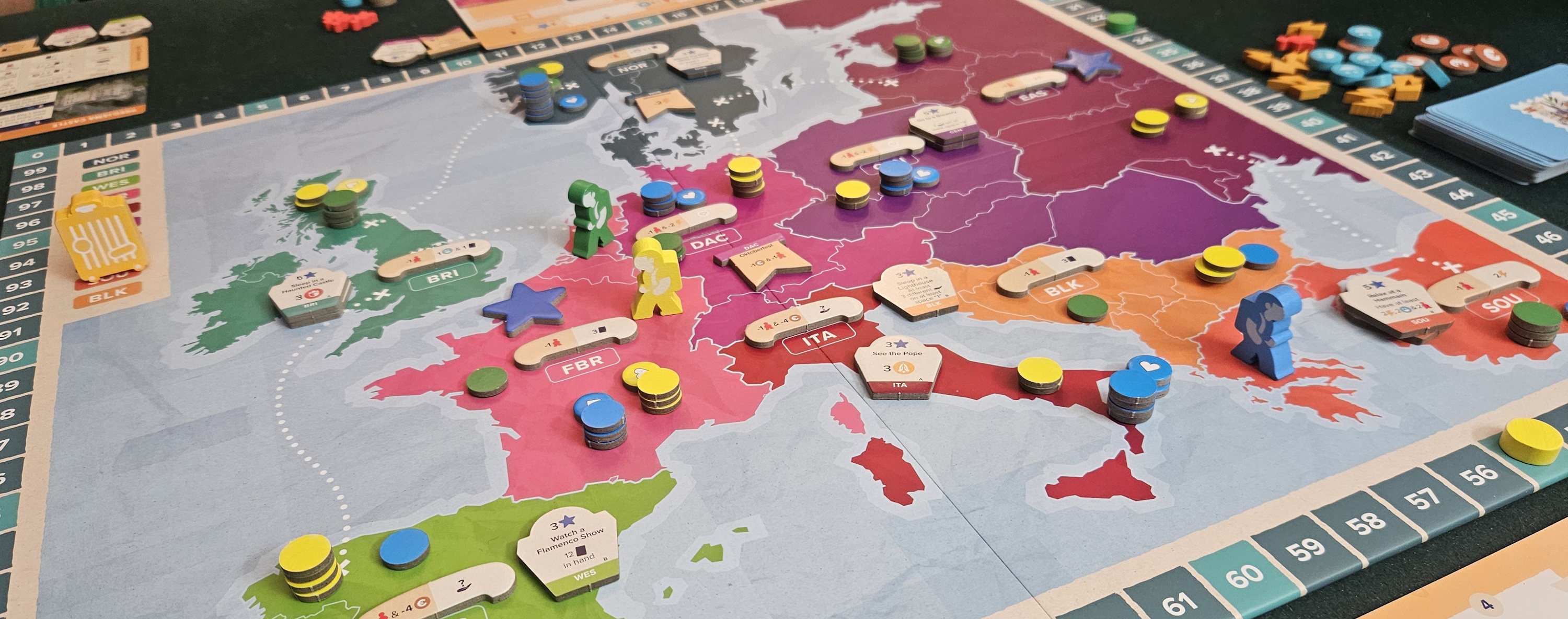
In a near mirror image of something like Trekking the World, it begins with a selection of cards that represent a whole range of possible destinations. Here those cards begin in your hand, subdivided by region rather than individual country. You might, for instance, consider swinging by the Alhambra Palace in Spain, the Isola Bella on Lake Maggiore in Northern Italy, and the Tsarevets Fortress in Bulgaria. Broadly speaking, your objective is to visit these destinations, necessitating some logistics as you balance flights against available funds and train rides against a steadily declining supply of physical energy.
So it’s a movement game! True. Getting around is one of Abroad’s central questions, especially when you get stranded in Greece because you hopped one too many trains. But it very quickly reveals other dimensions as well.
As any seasoned traveler can tell you, schedule is king.
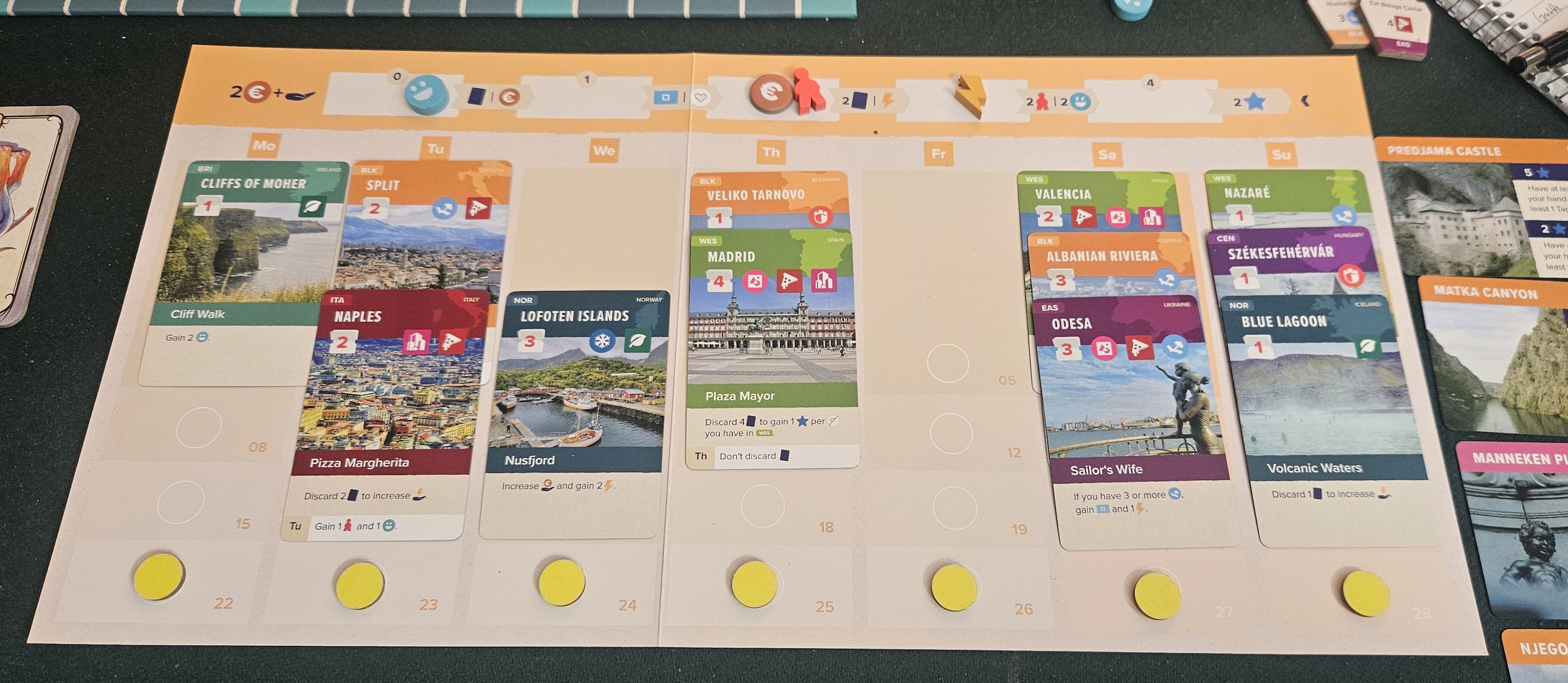
The calendar, for instance. When you visit a location, you don’t just play the card and earn a bonus. Sure, you do both of those things. Playing cards and earning bonuses are both major components of the game. But the card is also added to an ongoing schedule that shows your four-week tour of Europe.
What’s more, the duration of that card matters. A small attraction, like an ancient amphitheater in Greece, might only require one day to visit, while something grander, such as the Fjords of Norway, takes four. To place such a card into your schedule, then, you must count that many spaces forward on your calendar. One, two, three, four. That’s most of a week. Maybe it would be better to see a bunch of smaller locales?
Except it isn’t that simple. First, there’s an entire resource system under the hood. You can spend motivation — which for those who are counting is a fourth resource to manage, in addition to cards, money, and energy — to subtract from a destination’s time requirement. Want to see the Fjords in two days? You can do that. It will cost you, but it’s possible.
Second, the slots on your calendar don’t only serve to mark time. They also demonstrate how much you’ve mastered the region you’re currently exploring. Visiting that day-trip amphitheater means you’ll only move one token from your calendar to the map. You now know something about Greece. Well done! But spending four days in Norway means placing four tokens. Sure, you could use motivation to shorten the trip. But that also decreases the number of tokens you’re placing on the map.
And tokens matter. Oh, how they matter. At the end of each week, there’s some quick upkeep. You earn income, which is nice. You discard and draw cards, which is even better. But the real headliner is that each region awards points to the journo who’s mastered it best.
Even then, this isn’t as simple as “most tokens wins.” Sometimes tokens can be flipped to their more powerful heart side. Then they function as trump cards, winning against any number of ordinary tokens. The result is a series of little bids across the map. My knowledge of the German-speaking countries gets one-upped by your heart token, so I counter by writing a great piece about hot spring destinations in Britain, eroding your base by way of revenge. It’s smart, emphasizing both time and mastery over our subject matter.
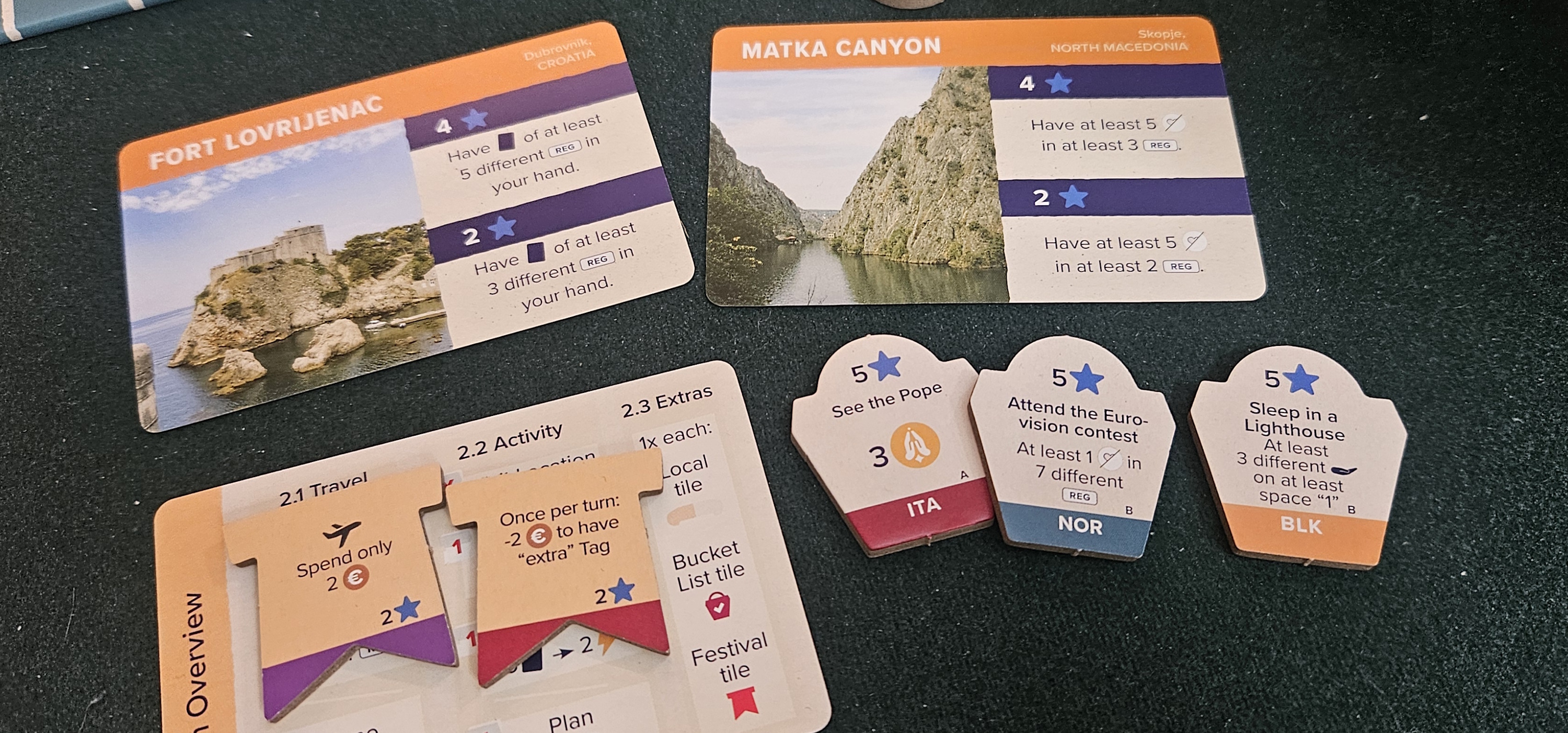
Postcards, festivals, bucket list items.
It’s also super, super mean. Just downright jerky. Snitty all the way through. Supernal area control, with all the little bid-sweeps and point-swipes one has come to expect from the mechanism.
Which is also, naturally, the best thing about Abroad. Generally, these travel games serve as comfort fantasies. If you could go anywhere, could take the time off work and afford any destination, what would you do? We play it out, and then we tally our scores to see who had the best trip. Which can be a great deal of fun, but isn’t exactly doing any heavy lifting with inter-player dynamics.
Abroad, on the other hand, never lets you sleep on its audition. Took a nap in France to recoup your energy? That’s a defeat. Paused to write a few articles for pocket money? That’s a chance for your peers to step ahead of you. Spent two whole weeks in Central Europe because you were holding a dozen purple cards? Sorry, you’ve overspecialized. You think Rick Steves only knows Poland? Baby, there isn’t a roadhouse or castle or war memorial between Portugal and Moscow that he hasn’t photographed or humped.
Along the way, you get to know these spaces. Not as intimately as the spaces in some games, it’s true. These are big attractions, not the gachapon shops and hidden gardens of the Let’s Go! titles. But one still develops a sense for Europe, its many sights, the festivals, the benefit of local knowledge. It’s only an impression, and barely an impression at that. But it’s more of an impression than most games of this stripe bother to make. It feels like it loves these places, wants them to be more widely appreciated, understands why people keep returning to them. They’re destinations, not points on a checklist. You’re only visiting, but you’re visiting something.
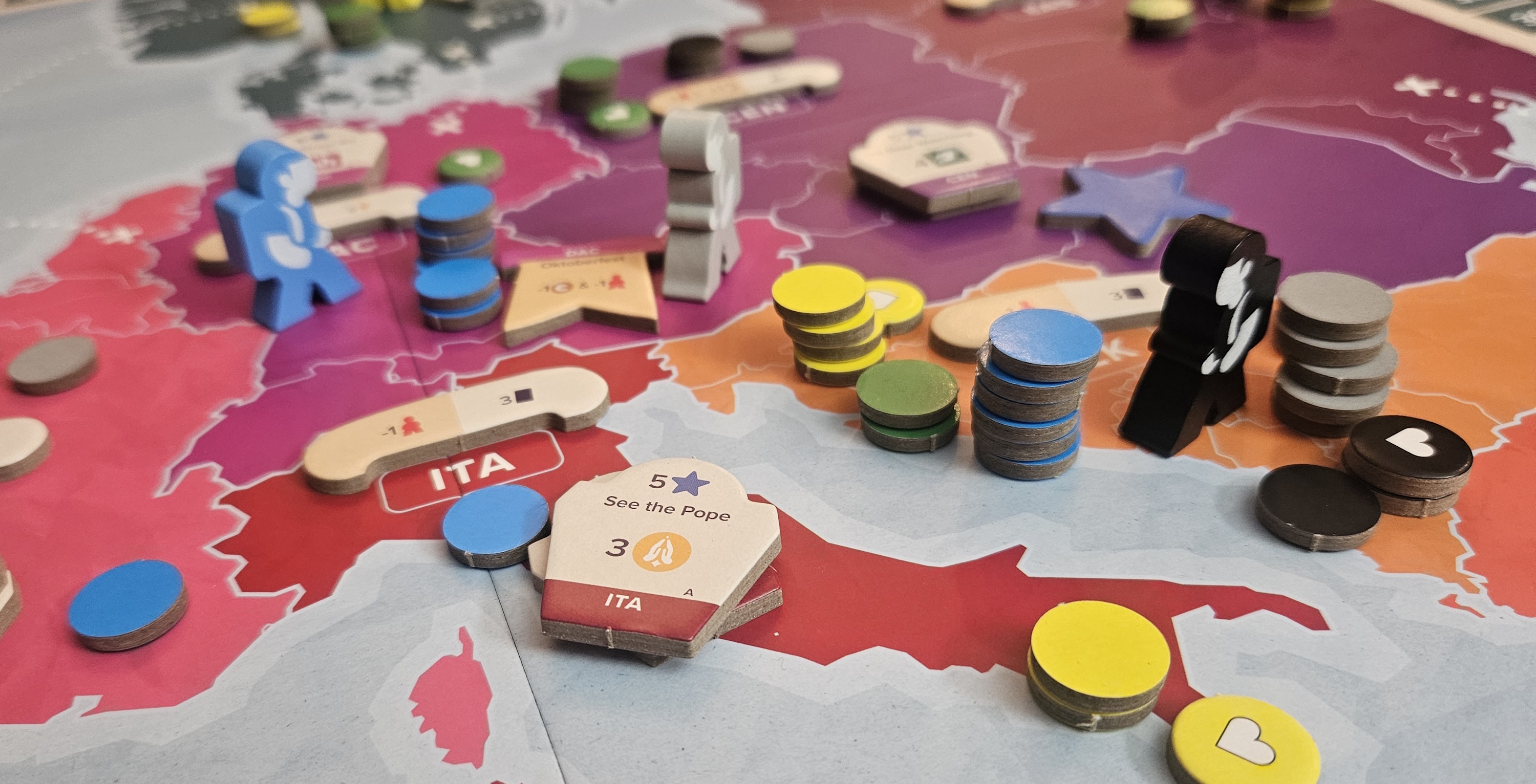
I will see the Pope today, dammit.
This marks Abroad as a success in myriad ways. Its sense of place, of course, but also its willingness to let players knock heads, to steal scoops from one another, to become the Prime Understander of Spain when nobody expects it. The result is wonderful to handle, from its calendar to its board, raising questions of timing and control and resource management and comprehension and more besides. I went in expecting a staycation; what I found is one of the finer travel games out there.
A complimentary copy of Abroad was provided by the publisher.
(If what I’m doing at Space-Biff! is valuable to you in some way, please consider dropping by my Patreon campaign or Ko-fi. Right now, supporters can read the next installment in my series Talking About Games, this time tackling the topic of what makes a good list! Naturally, the piece includes a list.)
I don’t know what to make of Pond. Not as a board game — it isn’t that hard to get a handle on — but rather as an artifact of hyperreality, a signifier that has sprung into Pinocchio-like boyhood, a cardboard link to another game entirely.
Which, yeah, is to say that it calls to mind Root. It isn’t even that close, gameplay-wise. But when you put something on the table and three people blurt out “Is this that new Root expansion?” / “Wait, those aren’t the Root frogs” / “Huh, it even has four letters in the title,” just one part shy of a Barbershop quartet, reality begins to feel negotiable.
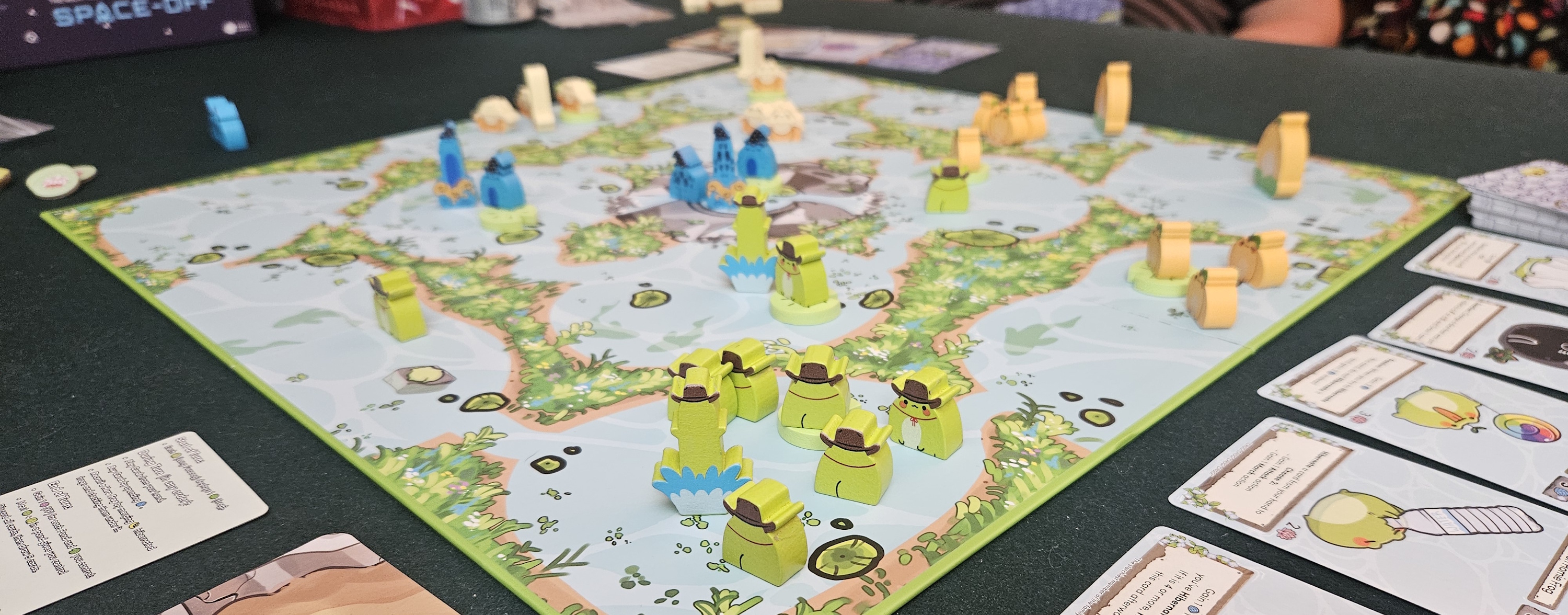
Frogs in their natural habitat.
Picture this. Up to four factions of adorable wetland creatures have decided to duke it out for control of their local pond network. Each faction is asymmetric, with its own adorable superpower to attend to its adorable visual motif. For the most part, they are staffed with frogs. Just frogs: the infantry for this final war, the grist for this cuisses de grenouille.
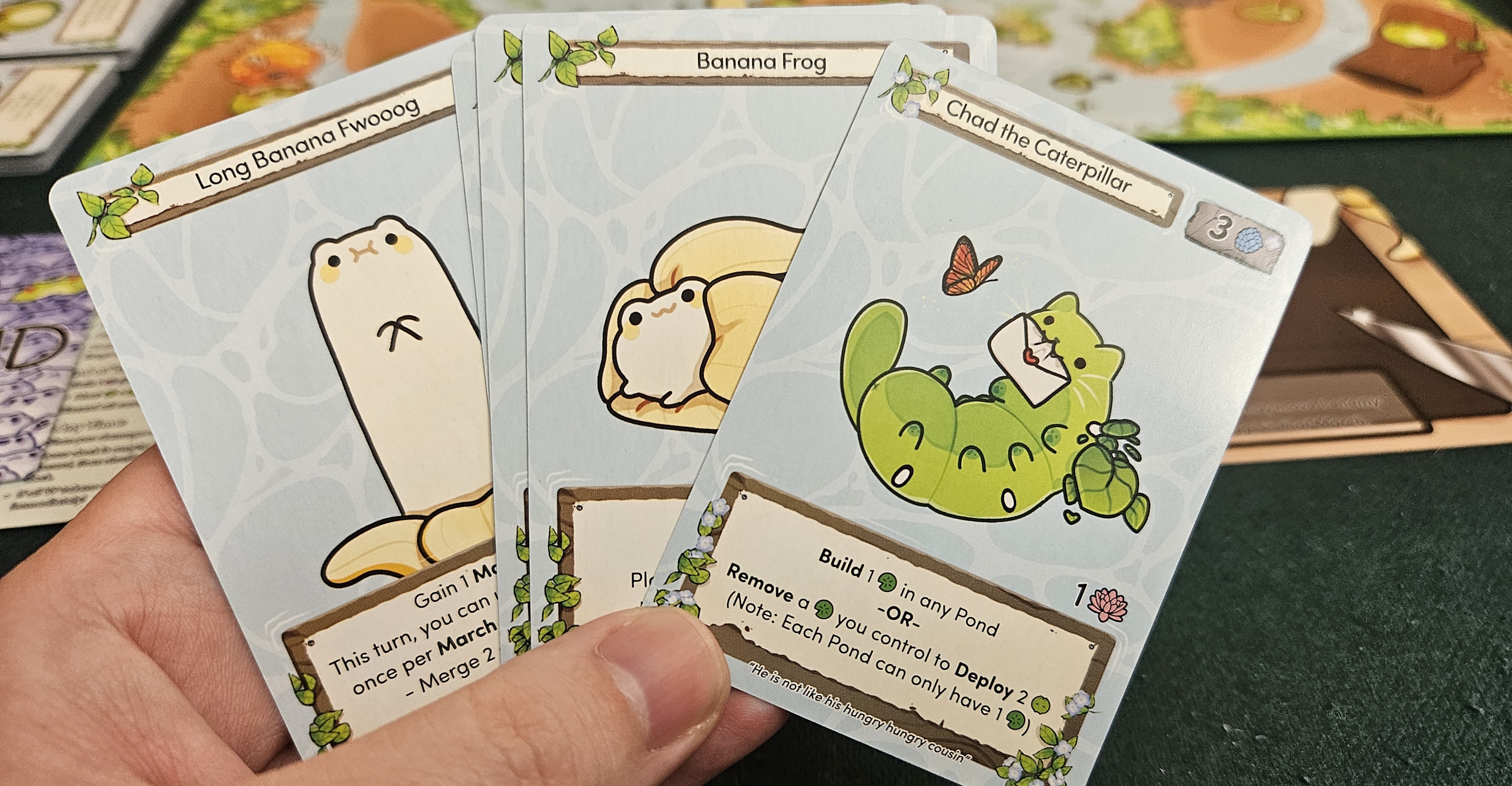
There are also long frogs. Pardon me. Long fwooogs. That should tell you something about Pond’s sense of humor. If “long fwooog” strikes you as substantially cuter than “long frog,” this might be the game for you. At any rate, long fwooogs are the battlefield commanders who send their fellow frog-kind hopping into battle. They can be injured, in the sense that sustaining damage will result in points for your rivals, but never killed the way a lesser frog might be removed from the board. One imagines them the gentlemen officers of this particular campaign. Stiff upper lips when asked to call upon others to make the final sacrifice, quavering backs and sickbed sweats when it’s time to charge over the top. Which is perhaps why long fwooogs do not take part in battle directly.
As for the map, it’s arranged as concentric ponds that radiate from the center. Each pond is identical, but lily pads may be built to increase one’s scoring value. Movement tends to be rapid. In part because the map is rather compact, but also because factions can accomplish quite a bit on a turn. The art, as you might expect, is downright adorable. I don’t mean that in a belittling sense; some of the cards made me laugh out loud, in particular the “Biblically Accurate Frog,” with its seraph’s spokes of eyes and wings.
A pocketful of frogs.
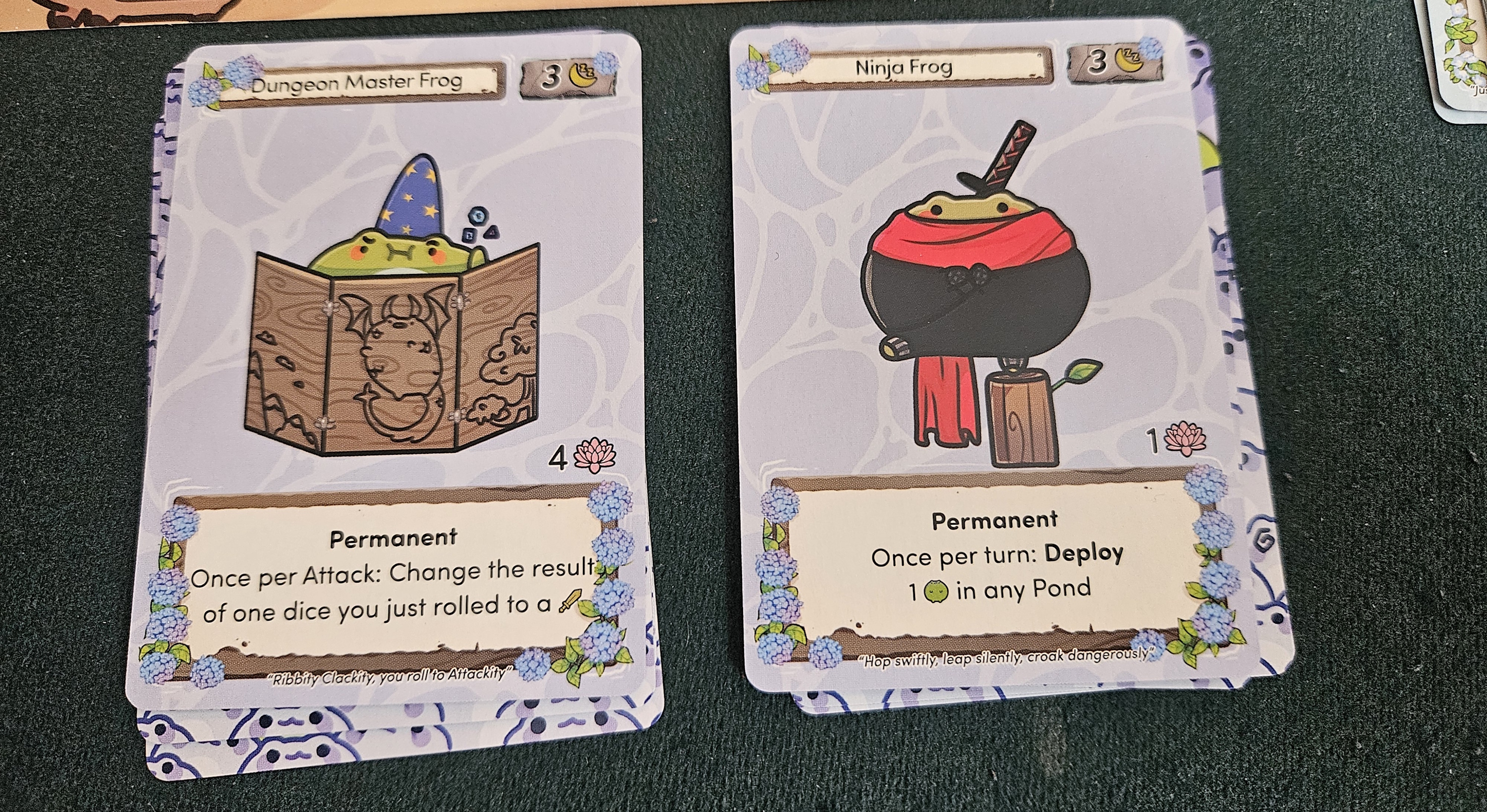
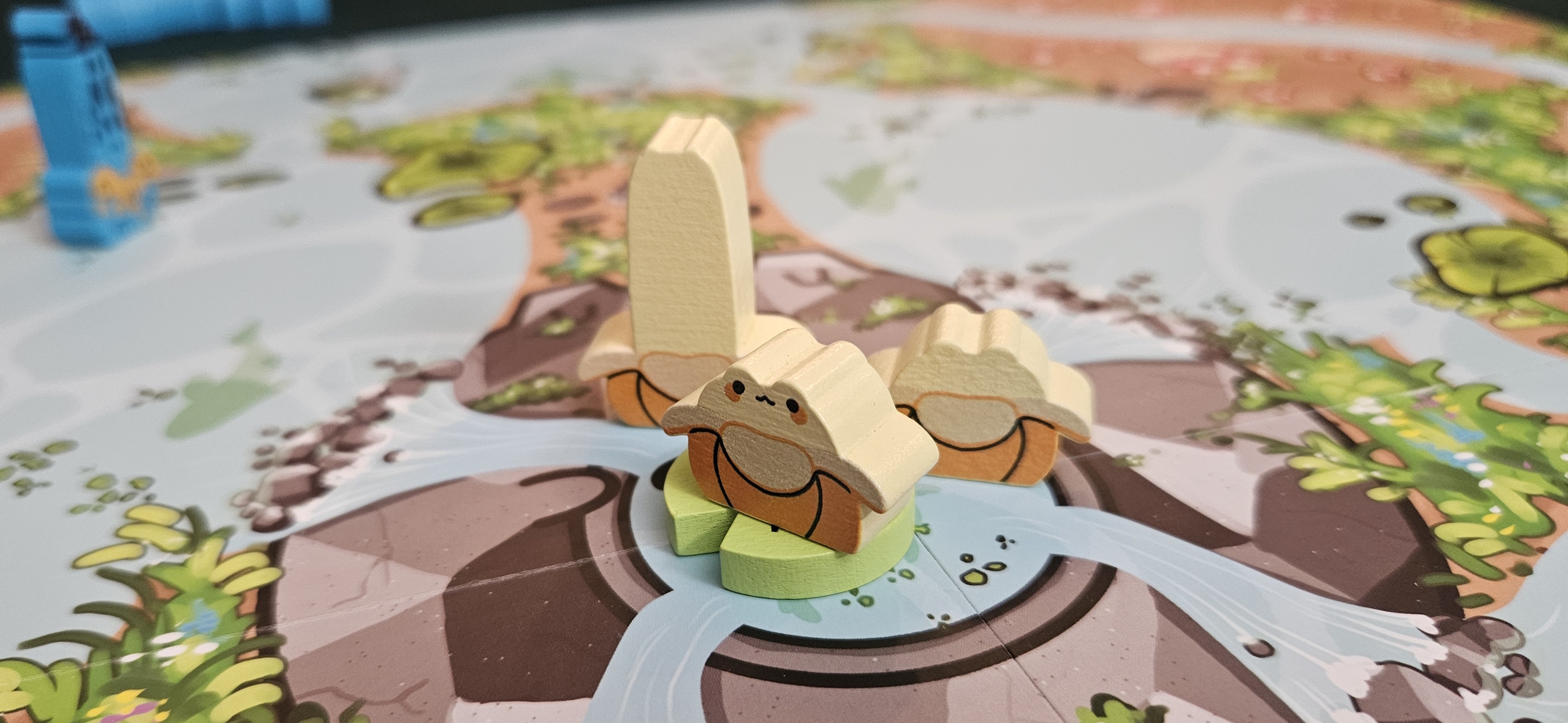
As for cards, there are heaps of the things. In a thankful departure from Root, Pond presents itself as a deck-building game. Everyone begins with a deck of ten cards, built from a combination of generic offerings (“Frog with a Knife” and “Frog with a Net”) and faction-specific troops that give each player their own dose of asymmetry without front-loading too many rules. Banana Frogs are slippery — they generate movement but also return to the top of your deck — while Wizard Frogs teleport around, Pumpkin Frogs produce lots of food, and Cowboy Frogs like to wrassle.
This is probably where Pond shines the brightest, not least because its card effects are all over the place. You might draft Jimmy the Bee into your deck to draw a card for every single lily pad under your control — potentially doubling the total action economy of your turn but also planting a target on all those lily pads. Or the Anarchy Frog, perfect for dumping all your stagnant frogs into a single pond and then lighting them on fire for a bunch of points. Swole Frog turns self-damaging battle results into offense-only attacks; Sneaky Frog deploys into any pond, even those you can’t normally reach; Cactus Frog pops a couple of attackers at the instant of their aggression. The whole thing feels wild and untamed. One might even say it doesn’t feel properly developed. All the better.
Of course, there aren’t infinite effects to tinker with. Indeed, one of the main limitations of the underlying system is that everything seems to revolve around four or five verbs — deploy, move, attack, build, hibernate — but within that rubric, there’s an impressive range of expression here. Some cards feel like outright showstoppers. As far as I’m concerned, that’s a great way to get the table to actually pay attention to the card market.
Hibernation leads to metamorphosis.
It helps, too, that card-winnowing is built right into the foundation. Whenever you shuffle your deck, you’re required to “hibernate” a frog, removing it from circulation while still preserving its point value. There are other ways to hibernate cards, too. They’re almost always desirable thanks to hero frogs.
What are hero frogs? Glad you asked. These are permanent upgrades that sit atop one, two, or three hibernated cards. That’s where the Biblically Accurate Frog comes in. Also the Unicorn Frog, the Leprechaun Frog, the Investor Frog, and so many more. To a one, these guys are valuable. First of all, you don’t need to shuffle them into your deck. Their ability is always there, ready to teleport a dead frog into your opponent’s swamp cooler.
At a more fundamental level, hibernation and heroes are a wonderful method for further defining all that factional asymmetry. Once again, almost no overhead required. This is probably where Pond deposits itself furthest from Root’s woodland. Where that game put all its chips on front-end asymmetry, requiring a tremendous initial investment before anybody could play — or at least play well — here the asymmetry is gentle at first, then slightly less gentle. It never becomes not gentle. Just more differentiated, with little perks that spring from the cards you’ve chosen to hibernate, draft, and deputize to hero status.
Frog battles are dangerous affairs.
Which brings us, inadvertently, back to Root.
I’ve seen some people call Pond a starter Root. My Little Root. Root for Babies. (Okay, not that one.) That isn’t too far off in the sense that its adorable artwork belies a confrontational race to score a certain number of points. But the games are surprisingly distinct in their underlying approach. They’re both volume-measuring tools with froggy eyes sharpied onto the side. But one is a funnel that runs from wide to narrow while the other is a bit more of a graduated cylinder. Despite some superficial resemblance, they move their liquids toward different purposes. A gulp versus a sip.
Those purposes, meanwhile, reach different conclusions. Root has been around for eight years. That’s a long time in this hyper-speed hobby of ours. Long enough to spawn imitators, some more flattering than others. Pond, in some senses, feels like a game that can only exist because Root existed first. But it carves out an identity that feels… still similar to Root, but not overly so. Not so close that it starts to feel like a ripoff. Just another perspective on similar themes. Root but easier to learn. Root with a first teach that doesn’t feel like reading a syllabus. Root that ends with a bang rather than a last little trickle of crafting points. Root without the near-infinite imaginary space.
(Root without Foucault? Yes. But Root as Baudrillard, as the signifier and signified getting mixed together until we can’t tell the difference. Root as the meme that has escaped containment. If it could ever be contained to begin with.)
Sometimes a frog is only a frog.
This leaves Pond in an interesting place. There’s a spot for a lighter adorable woodland creature kingmaking asymmetrical game. Maybe not the biggest spot or the most lasting one. But it would be false to pretend that Pond hasn’t exerted some charm. I’ve enjoyed spending a few sessions with its Biblically Accurate Frogs and Frogs with Two Knives and, sure, even the Long Fwooogs, cloying as they seem. I don’t imagine I’ll keep coming back, but my romps through these wetlands have been enjoyable all the same.
A complimentary copy of Pond was provided by the designer/publisher.
(If what I’m doing at Space-Biff! is valuable to you in some way, please consider dropping by my Patreon campaign or Ko-fi. Right now, supporters can read the next installment in my series Talking About Games, this time tackling the topic of what makes a good list! Naturally, the piece includes a list.)
Circle of Conflict is a really bad title. Just terrible. You know what would have been better? Anything. Ring of Conflict, maybe, seeing as how this is a Lord of the Rings shindig. Crud, just call it Circlet. That has an elegant chime, doesn’t it? Circlet.
I imagine the thinking behind the title, which was designed by Geoff Engelstein and Stephen Buonocore, was that it’s descriptive. Because the game actually plops you right into the middle of a circle, you see, and that circle happens to be not a circle of harmony, but a circle of conflict. You’re reenacting the War of the Third Age from both perspectives, commanding the Free Peoples against the player to your left and Sauron & Friends against the player to your right. Thus the Circle. The Circle of Conflict.
The other rancid thing about the title is that… oh, what’s that? You want to hear about the game? Very well. It’s quite good. Not perfect, but good.
More board games should be in folders. For the lazy.
As gimmicks go, one could do a lot worse than Circle of Conflict. It’s like the inverse of its title: just a great idea from top to bottom. As the Free Peoples, you’re trying to safeguard the One Ring on its trip to Mount Doom, muster armies to defend Rohan and Gondor, and generally vouchsafe the hearts of men so they don’t falter. As the Shadow, you’re doing all that but exactly the opposite. Find the Ring, burn Rohan, burn Gondor, indulge every impulse.
And it works. Works well, in fact. Works too well, perhaps, in the sense that the system very quickly scurries out of the way and opens up the holistic design to any number of nitpicks.
The baseline mechanism is roll-and-write, landing this in the long and not-often-successful lineage of titles that have tried to fashion a roll-and-write-but-bigger game. Every round — which is a mess of phases, just be warned — opens with a big handful of chunky dice getting rolled onto the table. When the game begins, only two of these dice are actually usable, and you’re required to divide them between the halves of your demesne. One for the Free Peoples, one for the Shadow.
I do love some nice dice. And a nice Sméagol, too.
It’s a simple enough decision, although of course there’s more to it than first meets the eye. It isn’t long before players begin to hear rumors from their neighbors. Perhaps the player to your left announces that they’ve rallied Isengard. This means they also gain the icons from the gray die, and may soon begin deploying troops to assault your version of Rohan. Meanwhile your Nazgul are hunting for the Ring somewhere around Weathertop; this initiates a call-and-response phase where you check your investigation against the player to your right, who reveals whether you’ve managed to corrupt their Ringbearer.
Point is, while you aren’t given total control over whether to go all-in on one side or the other, you’re afforded just enough authority to lather up some nice apprehension. At times, it can feel like both sides are pressing in on you while ignoring their neighbors on the opposite side. It’s a smart way of divvying up the action on Engelstein and Buonocore’s part. Some activities are concealed, others reveal essential breadcrumbs of military intelligence. Along the way, you hope you aren’t playing with cheaters. Or people who don’t really understand the rules and might interpret them in their favor.
At all times, this puts you in twin headspaces: hunter and hunted, army on the march and defenders under siege, Gollum and Sméagol. Actually, you’re only ever Gollum or Sméagol. There’s a special phase for that. Everyone chooses whether they’re the li’l guy’s good side or bad side, then reveals their decision and handles the fallout. If anything, Gollum’s madness seems like the one thing to collapse the game’s cosmological superposition. But that’s neither here nor there.
The battle board is, ahem, functional.
If anything, there are a few points where Circle of Conflict (ugh) seems to throw up its hands, as though Engelstein and Buonocore knew they were onto something great and realized they had to bring it back down lest they invent something too mind-expanding. There are a lot of the customary roll-and-write combos, for example, where you’ll be filling in one bubble that then awards another icon that lets you mark another bubble, and then that bubble lets you mark something else, and on and on until an ordinary turn has transformed into two or three turns’ worth of dry-erase daubs. In a game this distinct, these moments always feel like a throwback to the format’s puzzle-going past, more of a conundrum to solve than a dynamic contest between players.
And, yes, at times Circle of Conflict (hurk) feels like too much of a puzzle. After one or two sessions, you get a good sense for which combos will really let you whip along its tracks. Some early Boromir and Galadriel to secure the loyalty of Rohan toot suite, Wormtongue to tank the loyalty of whichever nation your right-ward neighbor embraces first, just enough Legolas Gimli to max out your battle value but no more. I don’t want to say it can be “solved”… but one of my opponents in our most recent session sure believed so.
Which isn’t to say this ruins the game. Not by a long shot. It’s just that Circle of Conflict (uruk-hai) is at its best when it leans into the suspense between neighboring players, but not every portion of the design is pitched toward maximizing that. The slow buildup of armies, with both sides growing stronger, closer, and more likely to win a bunch of points from the coming battle: incredible. The gradual chase and evasion of the Ring on both sides: wonderful. The occasional game-disturbing abilities from the heroes: appropriately enraging. Waiting around while somebody completes their tenth mark on a turn when you earned two or three: a bit of a downer.
Conducting the grand tour.
On the whole, I dig it. It calls to mind other experimental titles like Captain Sonar and The Anarchy in its willingness to tinker with the usual formula, even as it doesn’t quite reach their heights. Even so, there are little touches that make it especially considerable, like how the hobbits are tiny until suddenly they matter quite a lot, the occasional ability to move or hunt with greater efficacy, or, my favorite detail, the fact that the whole thing is presented as a single folder so you can lean back in your chair while you jot down your moves. One could do a lot worse.
A complimentary copy of The Lord of the Rings: Circle of Conflict was provided by the publisher.
(If what I’m doing at Space-Biff! is valuable to you in some way, please consider dropping by my Patreon campaign or Ko-fi. Right now, supporters can read the next installment in my series Talking About Games, this time tackling the topic of what makes a good list! Naturally, the piece includes a list.)
What recourse is there for the public when their leaders will not listen, their employers have broken the compacts that bind society, and their bellies gnaw with hunger?
If two examples are sufficient to draw a motif, that seems to be the recurring question at the center of Yoni Goldstein’s work. Last year’s Chicago ’68 was a refreshing look at civil disobedience in the streets; now Goldstein and the Dietz Foundation are publishing The Nights of King Ludd, which raises similar questions about resistance and state repression despite being translocated across an ocean and 150 years.
Gettim, lads!
I’ve been twice called a Luddite. The second time was not that long ago, after publishing an article explaining why I wouldn’t be reviewing any board game that used non-human artwork. A few years before that, it was because I mentioned to a friend that I thought it was wrong for corporations to use programmed obsolescence to spur consumers to purchase replacement cell phones.
In both cases, the response felt similar. “Get with the times. You can’t fight progress. This technology is inevitable. Go with the tide or get washed away by it.”
At the turn of the 18th to 19th century, English stockingers and woolworkers were hearing similar sentiments. Their trade, which had been conducted by domestic labor for over a century, was facing upheaval. The stocking frame was not a new technology — it had been invented in Nottingham way back in 1589 — but gradual improvements, such as rotary-, water-, and steam-powered frames and Jebediah Strutt’s derby rib, made it possible to turn out greater quantities than ever before.
Now, I know what you’re thinking. Isn’t easier work better than harder work? In theory, absolutely. I’m as lazy as they come, so you won’t hear a peep out of me on that count.
But the people who made their living knitting stockings weren’t the ones who benefited from these improvements. Over the course of a few short decades, mill owners used one dirty trick after another to dispossess an entire class of laborer. They violated price-collaboration laws. They used enclosure acts to drive commoners from the lands they had occupied for centuries, producing hordes of desperate workers who would work for almost nothing. They used their superior access to parliament to lobby for frame-breaking protections and outlaw collective bargaining. They churned out cheaper but less durable products. They employed children with no care for the blood their amputated limbs left in the machines. They used war as a pretext to declare their industries essential and therefore in need of military protection.
With every peaceful recourse blocked off, some textile workers took matters in a different direction. They took up their hammers not to work the machine, but to break it. And they did so under the fictional name of Ned Ludd.
Roles are dynamic, with self-interested goals and unique abilities.
This is where The Nights of King Ludd deposits us. The mills are roaring. Thousands have already been displaced. It’s going to get a lot worse before it gets better.
Goldstein presents the Luddite movement from two vantages. There’s the sky-high perspective, showing the three epicenters of Luddite activity in Nottinghamshire, Yorkshire, and Lancashire. This portion has the look of a traditional historical simulation game: there are enclosures for unemployed laborers, mills where workers or mobs can congregate, and a chess knight making the rounds to crack down on anyone threatening the supply of cheap stockings and lace.
But there’s another, more intimate perspective, and it’s here that Goldstein’s approach to the Luddite movement becomes clearer. Rather than embodying the Luddites as a faceless mass, as they’ve customarily been represented by the intervening two centuries of Oxford tut-tutting, here they’re given names and faces — and, above even those signifiers, personal aspirations and fears.
It works like this. When the game opens, everybody adopts an identity. You might become George Mellor, King Ludd’s “right-hand man” who infamously assassinated the wealthiest mill owner of Yorkshire and hanged for it. Everybody at the table loses the game together if they don’t burn the map’s three mills, but Mellor must also assassinate the manufacturer, a nasty piece of work who sits at the side of the board and hoovers up cards from the deck with each passing round. This is a dangerous proposition, liable to bring the military down on the movement’s head sooner than later, ensuring that Mellor’s appearance lends the session a riotous edge.
That’s the extreme end of things. The remaining identities provide other objectives, like sisters Mary and Lydia Molyneux’s desire to hold onto their family’s position in society and John Baines’ fear that the price of goods will collapse. These characters necessitate a more cautious approach, one that strives to keep as many weavers employed as possible rather than whipping everyone into a frenzy. These figures have been brought together by a manufactured crisis, but they have stark differences of opinion on the movement’s operation.
Crucially, these identities are more than clusters of special abilities and personal objectives. Each character seeds a woe into the deck, representing a personal problem that might rear its head at any moment. They also have personal lines they refuse to cross. Elizabeth Studham has joined the Luddites to save her home and community. Will she eventually become so impassioned — some would say radicalized — by the cause that she risks exile to the colonies? The celebrity parliamentarian Lord Byron is another option, his distance from the movement reflected by a weaker pool of conspirators. Will he throw away his standing in polite society to champion laborers who hold so little in common with him? These are the questions The Nights of King Ludd asks early and often, presenting the movement as a tangle of competing interests and concerns.
The Regency gets up to no good in response to the Luddites’ no good.
The Luddite movement has always eluded easy classification. Given the revolutionary fervor on the Continent, some historians portray it as a similar moment of English class consciousness. Others interpret it as the earliest stirrings of what would become later labor reform and even Marxism.
Perhaps it’s appropriate, then, that Goldstein presents the movement in such contradictory terms. Just as the game tells its story via two vastly different scopes, and just as its characters squabble over the appropriate course of action, the game itself is suspended between identities.
On the one hand, there are familiar elements of both card-driven wargames and paxgames. There’s the river-style market, which recalls Pax Porfiriana and its many successors, while the cards themselves are multitools that hew closer to the system found in Mark Herman’s We the People and popularized by Twilight Struggle. Much of the game revolves around figuring out which cards to purchase and when to deploy them, familiar fare for anyone who’s been involved in the historical gaming scene at any point over the past three decades.
But the cards play second fiddle to the game’s real core: its dice. At heart, The Nights of King Ludd is about building a pool of dice and then rolling them to determine whether your frame-breakers have successfully broken enough frames to put a mill out of commission. This is a multi-step process. First your conspirators must organize unemployed weavers, bringing them into the movement and assembling them at the sites where their agitation will do the most good. Then they must be persuaded to take up arms and occupy the mills — both of which are testy affairs, drawing ire from the Regency and the patrolling militia. All the while, you must assemble a pool of dice that can be spent for those workers, now suitably organized and positioned, to assault the mill.
If everything goes right, a mob of weavers will enter a mill, burn it down, and disappear back into the moonlight. No need for anybody to get hurt. No trials, no hangings, no masses of deportations to Australia. Some property will be ruined, but like the historical Luddite movement these attacks will shock authorities with their targeted precision.
The hitch, as you can probably discern for yourself, it that it is exceedingly rare for everything to go right.
Hm. I knew those Aussies were up to something.
In practice, The Nights of King Ludd plays out like a jigsaw puzzle whose pieces keep getting hidden beneath the tablecloth, squirreled away by cranky uncles, and sometimes fed to the family dog.
Consider this. To wreck a mill, you must organize those unemployed weavers. But the passing militia will lock down entire counties at a time, sometimes for extended durations. This makes it near-impossible to organize with any precision, especially if your character is currently in hiding in the affected portion of the board. It may become necessary to wait out the occupation. Or even to bait the militia into removing itself to another region. Just be careful you don’t draw them toward a mill where your workers are on the verge of an uprising; that will exile the entire lot to Australia, severely limiting the movement’s access to manpower.
Okay, so you’re keeping an eye on the local garrison. But what about the Regency in London? Certain actions force you to draw a card from the Regency deck, and these cards are, to use the terminology of the day, a right burr in the arse. Their effects are far-ranging. Government spies tip off the authorities before a mob can act. Preemptive hangings permanently lower the ceiling on your dice pool. The cavalry show up to move the militia token two spaces instead of the usual one. Child labor and sixteen-hour workdays and workplace accidents ensure that laborers are too exhausted to resist their plight.
There are other, more transformative consequences as well. Somewhere in the game’s midsection, the card row shifts from a common pool to a laissez-faire market that’s open to those with capital — hint hint: Lord Byron still does okay — but not so much to those who actually produce its goods. This alters how players access cards. No longer is every card the same price. Now their values are tiered, requiring greater expenditures to purchase until they slide leftward in the market. It’s a remarkable flourish, illustrating the radical changes this industrializing generation underwent as food prices soared, their livelihoods were stripped, and their legal representatives were bought out by moneyed interests.
Swear me an oath!
Put together, these elements give the game the sensation of trying to keep a sinking ship afloat even as you commit mutiny. There are occasional refreshing breezes: an ambush that delays the militia’s approach, such a mass of unemployed workers that their grievances become impossible to ignore, even early attempts at establishing labor cooperatives. But make no mistake, what initially seems like a straightforward task will soon be stymied from all directions. Even when the movement’s success is secured, it often comes at the expense of a conspirator’s personal goal.
At times, it’s also an uneven task, and not only because the Regency is scrambling to protect the people with the most from having slightly less. Thanks to Goldstein’s hybrid system, The Nights of King Ludd can be tricky to operate. At any given moment, you’re operating along multiple vectors. There’s the strategic layer, with its emphasis on timing and positioning. The personal level, with its diverse objectives and abilities. The card market, always in flux, plus the gradual attentions of the Regency. Keeping in mind that I’ve only played a prototype, it’s a lot to unpick.
And then, of course, there are the dice. Goldstein provides opportunities to mitigate a flubbed roll, not to mention a few alternate tricks for damaging mills, but these options are few and far between. Most of the time, the only path forward is a healthy dice pool, a well-armed mob, and a prayer in one’s heart. There’s nothing as uniquely irksome as showing up to a mill-burning with torches and hammers, only to somehow roll all misses. Those who balked at John Company’s retirement rolls will likely find themselves similarly disappointed here.
It takes a village to burn a mill.
For my part, The Nights of King Ludd is a strange, evocative thing, as much a machine as those it seeks to break. It’s a more radical experiment than Chicago ’68, but Goldstein leverages it to similar ends, asking hard questions about who societies prioritize. Put somebody in a sack and don’t be surprised when they choose to fight their way out.
Were the Luddites doomed? Maybe. The textiles industry was transforming with or without powered mills and innovative knitting frames. Trousers were soon to supplant hosiery in popularity. Cotton and silk were growing more affordable. The United States was starting to throw their economic weight around. And, pardon my French, Napoleon was being a real butthole.
But some men chose to oil their machinery with blood. The response was fire and fury. And, yes, sometimes blood for blood. A few droplets pattered into an ocean. Once again, Goldstein has crafted a challenging, thought-provoking rumination on an oft-misplaced history, collective anger, and the depths power and capital will plumb to protect their interests. Stark, sobering, and sometimes hopeful, The Nights of King Ludd is an essential work for students of labor history and new-wave historical simulation.
A prototype of The Nights of King Ludd was temporarily provided by the designer. It is on Kickstarter right now.
(If what I’m doing at Space-Biff! is valuable to you in some way, please consider dropping by my Patreon campaign or Ko-fi. Right now, supporters can read the next installment in my series Talking About Games, this time tackling the topic of what makes a good list! Naturally, the piece includes a list.)
The smallest but most persistent indignity of our current digital age is the way we have all, every one of us, been press-ganged into service as human CAPTCHAs. You know, the Completely Automated Public Turing test to tell Computers and Humans Apart, as tortured an acronym as ever there was. How many bicycles are there in this image? Is that a stop sign or merely a reflection of a stop sign? Is this story real or fake? The computer can’t tell the difference. Which means you can’t ping your lost iPhone without decoding the golem’s underlying logic.
Kasper Lapp, it seems, fashions games with my discomfort as their first design principle. First it was That’s Not a Hat. Now it’s Totally Human.
I dislike Totally Human. But at least I dislike it for reasons that mark it as a very interesting game indeed.
Uh oh. I’m an alien. No worries. I’ll just have you for dinner.
Imagine this. Your society, previously flawed but functional enough in principle, has been overrun by aliens. Aliens who eat humans. These aliens look like us, talk like us, even make art like us. But these things made by aliens are not human in nature. Oh no. They are the regurgitated mass of all that is human. Always backward, never forward. Remixed, never created. Always the tiniest scooch off.
That’s because the aliens are ChatGPT, hahahaaaaaaaaa
Calm down, Dan. Sometimes an alien is an alien.
You draw three numbered cards. If the whole trio shows the outline of an ordinary human, congratulations, you are an ensouled being fashioned through millions of years of evolution and perhaps the consciousness of the universe itself. If, on the other hand, even a single one of these cards shows an alien, sorry, you’re an alien. Your sole purpose in life is to snack on humans.
Because of the alien invasion, the humans are boarding shuttles to start new colonies somewhere far from Earth. But first, they need to sort through who’s who, lest the colonists get eaten en route like the crew in that one movie (spoiler). How will they accomplish this — DNA scans? Deep behavioral analyses? Having the applicants draw a picture of a person that doesn’t look like a bizarre homunculus?
No. By answering three abstract questions that set the hairs on the back of our neck prickling. The world’s ending, and we’re gonna Voight-Kampff our way through to the other side.
So. What’s the answer? Punk.
These questions are procedurally generated — not unlike a CAPTCHA. There are three components. First, the question. Second, a bunch of adjectives. Third, some nouns. This produces a five-fold multiple-choice test.
For example, you might be asked about the best name for a punk band. Is it (1) Slimy Cloud (2) Slow River (3) Unreliable Volcano (4) Well-Oiled Tree (5) Noisy Flower. Everybody simultaneously plays a card that reveals their chosen answer.
Here’s the catch that might force an alien to tip its tentacle. Humans can answer the questions however they like. But the aliens among us, they’re more limited. When they drew those three cards at the beginning, they received three numbers. Those are the digits they must use to answer the three questions posed by the game. They can choose the order they use the numbers, spending them like, I dunno, digital tokens or whatever, but they’re required to use those exact numbers.
In the case of the above question, the table’s answers will hopefully prove revealing. You’ll discover which of your friends listen to punk, those whose entire conception of punk is Green Day, and perhaps, if you aren’t so snobby that you airlock anyone who can sing all nine minutes of “Jesus of Suburbia,” which of your buddies is actually a stochastic nightmare that repeatedly consumes, vomits, and re-consumes humanity’s efforts at culture.
Once all three questions have been asked and answered, it’s time to climb aboard the rocket ships. Humans win by securing a spot on the most-populous colony ship. For genetic diversity in reproduction, obviously. Also, they would prefer to not be torn limb from limb. Aliens, meanwhile, win by eating a human. Usually this results in a spectrum of success, with a few humans blasting off into the cosmos while one or two aliens secure the necessary calories to survive for one more day.
Three questions. That’s all you get.
Conceptually, Totally Human is intriguing. It taps into that wonky space of our brains that’s more intuitive than logical, especially when it comes to in- and out-grouping. While some questions are more obvious than others, plenty are full of gray spaces for players to squabble over and, sometimes, to get lost in. Is it harder to break a rusty hippopotamus (because hippopotamuses are the sturdiest animal on land) or a metal giraffe (because it’s metal)? Is there really a “best” thing to put into a hundred-year time capsule? Is Green Day punk?
And then, when it comes time to load the rockets, the ensuing debates are also vibe-based, reaching into a rucksack of mammalian instincts. On Bluesky, there was recently some discussion about the value of small talk beyond allaying boredom at a social event, such as establishing to fellow apes that you’re a friend rather than an aggressor — and, as an extension of that, the way neurodivergent folks might feel alienated by such a state of affairs. Totally Human could function as a ludic expression of that entire conversation. When there are aliens in our ranks, it’s often better to move with the crowd than to have a good reason for why you stand slightly apart from baseline. When one is perhaps a little alien, the consequences can be severe no matter how benign the distinction.
This makes Totally Human interesting to talk about, but not always enjoyable to experience. And I don’t mean in the usual way for social deduction games, where deception sometimes rankles those who prefer forthrightness. Totally Human wrings the concealment angle of the genre into a sort of social deduction distillate. It’s about hiding in plain sight and little else. You’re given the option to discuss and defend the team’s Q&A sessions, but either the questions are so binary that folks either fit the metric or they don’t, or else they’re so vague that very little can be gleaned from them. In either case, either you hide with at least one of your fellows or you wind up on the outside looking in, human or no.
Blastoff! Hope you aren’t hobnobbing with a flesh-eating alien.
As a get-to-know-you game, there’s some value to be had here. Not only because you get to ask and answer silly questions, which provides an avenue for further insight into the socially anxious apes seated at your kitchen table, but also because those questions often lead down more interesting avenues. Provided you don’t shy away from all forms of small talk. In which case, you really should avoid this particular campfire.
For everyone else, Totally Human is totally fine. Personally, I wish its gameplay lived up to its premise. Beyond illustrating our tendency to cluster more closely with those who say the right words in the right sequences, there’s very little to see here. Maybe it’s a question of fatigue. In a world where every feed has become an extended CAPTCHA, it turns out I would rather not role-play as one, even for a mere quarter hour. My verdict: interesting but unsatisfying.
A complimentary copy of Totally Human was provided by the publisher.
(If what I’m doing at Space-Biff! is valuable to you in some way, please consider dropping by my Patreon campaign or Ko-fi. Right now, supporters can read the next installment in my series Talking About Games, this time tackling the topic of what makes a good list! Naturally, the piece includes a list.)
At long last, we’re nearing the end. After Uruguay, Peru, and Nicaragua, El Salvador is the fourth and final scenario in Stephen Rangazas’s The Guerrilla Generation. We’ve seen urban resistance movements that neglected to reach the people they were bent on liberating, a cult-of-personality communist party who went to any lengths to maintain their doctrines, and far-right death squads whose activities were so vicious that they became invaders of their own country. Now, in El Salvador, we’re going to see a little bit of everything as the FMLN launches its first offensive against the government in January 1981.
But the story doesn’t begin there. It never does. History is a story, and stories need beginnings. But reality is not a story. There are any number of root causes to this particular insurrection. We might begin with Farabundo Martí, from whom the FMLN drew its name. He was executed by firing squad in 1938 after his uprising of peasants was massacred by the government. Or we could start with that regime’s formation in 1931 through coup d’état and its repressive rule for more than four decades.
This time, however, the most suitable starting point is a priest: Óscar Romero.
One of the many murals of Óscar Romero.
Óscar Romero was appointed the fourth archbishop of San Salvador in 1977. A native Salvadoran, Romero was a social conservative, and indeed this was one of the reasons his appointment had been considered. The priesthood of El Salvador had long been divided along social lines, with some priests supporting stability while others favored “liberation theology.” This was a relatively new strain of Catholic thought, born out of the Latin American revolutions and foreign interventions of the ’60s. As with any issue of dogma, there were contrasting definitions of liberation theology, but the gist was that the poor and downtrodden were being deliberately kept in place by both individuals and systems, and that good Christians were therefore called upon to reflect the living ministry of Jesus Christ by rectifying their suffering. Priests who supported liberation theology, then, tended to be sympathetic toward Marxist thought and communist guerrillas, while those critical of it fell into the opposite camp. Romero’s appointment was accepted with relief by the regime. Unsurprisingly, the liberationists were bitterly disappointed.
(Sidenote: North American and European readers might note a similarity between liberation theology and the concept of “woke” as it originated among African-Americans in the Jim Crow-era United States. These strands of thought arose from different sources, but as a quick and dirty analog one could do a lot worse. Short version: you are being kept poor on purpose, the jackboots have it in for you, and it behooves young people to get woke to reality so they can survive this hostile state of affairs.)
Only a month after Romero’s appointment to San Salvador, one of his personal friends, the Jesuit priest Rutilio Grande, was assassinated. This came as a shock to Romero. After all, Grande had been one of the good ones. Despite speaking out against the government on certain issues, he had also argued for a pastoral ministry that was disconnected from Marxism. After every effort to walk a middle path, he had still been gunned down by state security forces only a few miles from where he had been born. Romero requested an investigation. He was met with silence.
Another mural.
In his own words, Romero became devoted to following Grande’s path. He spoke to the people via weekly radio broadcasts, his diocese newspaper, and his sermons, repeatedly listing the government’s killings, tortures, and disappearances. When the joint military-civilian Revolutionary Government Junta proved as brutal as the military dictatorship it had replaced, he appealed to President Jimmy Carter to halt the flow of U.S. military aid and Pope John Paul II to condemn the regime. Again, silence. Even as his popularity among the people grew, it seemed everybody with access to real power was content to ignore his pleas.
Despite his inability to effect change, somebody was listening. Because that’s always how it goes with those who live by the gun. One must not only be victimized. One must be grateful for their place in life. One must submit.
In March 1980, Archbishop Romero called upon Salvadoran soldiers to reject the government’s crimes against humanity. The next day, he was shot through the heart by a gunman as he delivered a sermon at a small chapel attached to Hospital de la Divina Providencia. His funeral was attended by a massacre in the streets. The shooters fired from rooftops with rifles and threw smoke bombs into the crowds of mourners. At least thirty were killed. In response, José Napoleón Duarte, four years in advance of his presidency, blamed both sides of the political spectrum for the violence, and used it as pretext to decline an official inquiry into Romero’s murder. The meddlesome Archbishop, whom the regime had welcomed only three years earlier, had been silenced for good.
The FMLN launches one of their offensives.
Nine months later, the FMLN launched its first offensive against the government.
This is where the fourth scenario of The Guerrilla Generation begins. The FMLN, fed up with the government’s constant human rights abuses, rolls from the highlands into the coastal and urban portions of the country. Potentially, large numbers of blue government cubes will be removed in an instant and the guerrillas will possess large swaths of territory. For a system that usually portrays insurgent forces as incapable of such a concerted assault, it’s a shocking opening gambit.
To accomplish this, Rangazas takes cues from a handful of earlier titles, most notably the “pivotal event” cards that made their first appearance in Mark Herman’s Fire in the Lake. At the time, these were a profound departure for the series. For those who don’t know the COIN System very well, events are normally seeded at random throughout the deck. Thanks to their chaotic appearance, they represent occurrences that fall beyond the factions’ ability to set into motion, but which one of them might leverage to their advantage. When Volko Ruhnke designed Andean Abyss, the first volume in the series, it represented a change in the way card-driven wargames presented player agency. Rather than putting every event into players’ hands — both literally and figuratively — factions were now presented as reactive. Something would happen: a massacre, the death of a politician, an influx of war materiel from an interested third-party nation. And then you, the player, would decide whether that event was worth acting upon.
Fire in the Lake presented another option. Some events, Herman’s system argued, represented moments of clear player agency. It wouldn’t make any sense for the Tet Offensive to blindside the Viet Cong, for example. So each player was given a single pivotal event. One card in their hand, which could be used at the player’s discretion to cancel an ordinary event and launch a special action.
The El Salvador scenario begins with one such event. Only in this case, the event has already been played. “FMLN Offensive Rocks Country” starts on the table. All at once, the FMLN, which the game presumes is largely in its historical situation as of January 1981, undertakes a country-spanning sweep. It won’t be enough to topple the regime, as FMLN leaders had hoped historically. But it sets the tone for what’s to come. This is a knock-down drag-out fight. The FMLN is significantly tougher than most of the series’ insurgencies; the Government, significantly weaker. But the Government has a prize trainer in its corner. The United States. Duh. And the U.S. is currently packing the Government’s gloves with enough silver eagles for a knockout punch.
Uncovering the regime’s war crimes.
From there, the scenario settles back into the system’s usual rhythm of events and faction activities. It isn’t long before both sides begin to have money trouble. The FMLN isn’t as willing to extort the local populace as some of its peers in other volumes. Managing its finances is a slow process, requiring careful spending and hard tradeoffs between building local support or using local resources to maintain their momentum.
The Government, meanwhile, is similarly pressed. There simply isn’t enough in the coffers to resist the FMLN’s offensive. This is where the United States rears its head. As in many previous volumes, the Government’s resources are bolstered by an Aid marker. Rather than releasing a trickle of resources at pre-appointed intervals, however, here Aid functions as a secondary cash reserve, with the niggling problem that the Government can only avail themselves of this pool for certain operations. Basically, while the U.S. is happy to send endless bundles of cash to resupply Government forces in urban centers, Congress balks when a massacre shows up on the evening news. It’s a testy relationship, one that encourages the appearance of stability even as the FMLN claims additional territory outside the cities.
It’s also the COIN System at its most ideological. In the past, I’ve critiqued the series as being frustratingly “blind” when it comes to ideology — and by extension, of defaulting to a conservative position that elides the nuances that underpin these conflicts. Basically, COIN’s emphasis on procedure excels at “what” and “how,” but usually flubs the “why.” We see the outcomes of ideology — the tanks and planes, the massacres and coverups, the boots on the ground — but not so much the reason those tanks were delivered to faraway places, the regime’s need to conceal those massacres, or the half-truths that were sold to the public to convince them to sacrifice their young men and women to fight a war that has nothing to do with them. It’s not especially far-fetched to see in titles like Land and Freedom, Versailles 1919, and Revolutions an ideological intervention into a system that was, itself, a procedural intervention on the card-driven wargames that came before it.
“Reform” can be misleading.
I don’t know if Stephen Rangazas is the strongest designer to handle the COIN System to date, but he makes a good case for being the most clear-eyed. Both of El Salvador’s factions are uniquely hemmed in by ideological concerns. In addition to their desire to govern the populace, the FMLN must uncover and promulgate the reason for their offensive. The why to the what. They do this by revealing cards from a personal deck to demonstrate the Government’s crimes against its citizens. Crimes that would continue over the twelve-year course of the Civil War, with the post-war commission stating that security forces were responsible for eighty-five percent of civilian casualties. By revealing these crimes, the FMLN doesn’t bolster their position immediately, and even risks the occasional backfire when the wrong card is revealed. They are, in effect, building a case during wartime for how the peace will be conducted.
For the Government’s part, they’re asked to walk a tightrope between taking a hard rightist stance toward the insurgency or introducing reforms to rein in their troops. (And secure greater U.S. Aid, but surely that isn’t the prime motivator. Right?) As these reforms are embraced, it becomes harder to conduct reprisals. And the Government is positively horny to conduct reprisals. It’s the easiest way to batter the population into… well, not supporting the Government, but at least they won’t be supporting the FMLN either.
It isn’t long before El Salvador becomes a zombie state, completely bankrupted and in thrall to foreign funding. It’s a stark ludic representation of a regime that has bought its continued right to abuse its citizenry by indebting itself to a hemispheric hegemony whose interests shift with the wind. Or, in game terms, with a whole bunch of event cards.
In some ways, the scenario pulls up short. There is no card for Óscar Romero. Perhaps his assassination came too early for the game to model. Robert D’Aubuisson, the death squad commander who ordered Romero’s death, he has a card. It isn’t flattering, reflecting his antagonistic nature and inability to avoid controversy. That’s as close to the Archbishop as the game gets. His absence is a reminder that no simulation reaches every corner, no matter how long the broom’s handle.
I’m in there somewhere. Don’t look, though. Please don’t.
The one time I visited El Salvador, as a member of an ophthalmic surgical mission in early 2019, Óscar Romero was everywhere. We were hosted in Juayúa by a Catholic retreat, so the imagery of St. Romero was unsurprising, especially given his canonization only a few months earlier. But his visage appeared everywhere beyond the compound walls as well. On the streets of San Salvador, beside the walls of coffee plantations, inside coffee shops. A plaque marked where bullets had penetrated the wall during his funeral massacre.
Growing up, my Father was deeply conservative, but with a compassionate streak that suited his status as a medical doctor. When he began visiting Latin America to perform cataract surgeries — one eye per patient so the surgical team could double how many people they treated — he underwent a transformation. His nature grew more thoughtful; his veneration of Ronald Reagan and Teddy Roosevelt melted away. He began reading books about saints. Little by little, he started talking with more frustration and less condemnation about the state of the poor.
We also started getting along a bit better. But that’s neither here nor there.
I went with him in 2019 because he sensed this might be one of the last trips he had in him. The pandemic hadn’t been declared in our hemisphere yet, but the medical community could see the writing on the wall, and political changes were threatening to make El Salvador even harder to visit. So I accepted his invitation, renewed my expired passport in a panic, and off we went.
There’s no need to bore you with the details. The indigence was extreme, but all poverty has the same leanness. The defining moment came a few months after the trip, when I related how one of our fellow volunteers had called the people “lazy.” Dad, who all my life had complained about panhandlers and freeloaders and takers, suddenly roared, with such force that I think it surprised him as much as me, “They’re not lazy. They’re poor.”
I’ve always been proud of my Father. For his work ethic. For how much he reads. For putting up with a son who’s totally unlike him. But in that moment, I became proud of his ability to change.
It’s possible for the government to find their footing. But at what cost?
When it comes to the COIN Series, El Salvador and The Guerrilla Generation more broadly also represent a change. As a system, COIN has sometimes been insightful and sometimes been blinkered. Often it has been both things in the same volume. With Rangazas’s work in this multipack and The British Way, it becomes something else. It tells a slightly different story, one less about counterinsurgent procedures and more about the systems that brought about these insurgencies in the first place.
Or, as Óscar Romero put it in his second pastoral letter, delivered at the Feast of the Transfiguration shortly after his appointment to San Salvador and the murder of his friend Rutilio Grande: “The Church has, quite rightly, denounced sin. Certainly she has denounced personal sins, and she has also denounced the sin that perverts relationships between persons, especially at the family level. But she has begun to recall now something that, at the Church’s beginning, was fundamental: social sin — the crystallization of individual sins into permanent structures that keep sin in being, and make its force to be felt by the majority of the people.”
Next time, we’ll examine those systems from afar via The Guerrilla Generation’s meta-campaign, which combines Nicaragua and El Salvador in Resisting Reagan.
A complimentary copy of The Guerrilla Generation was provided by the publisher.
(If what I’m doing at Space-Biff! is valuable to you in some way, please consider dropping by my Patreon campaign or Ko-fi. Right now, supporters can read the next installment in my series Talking About Games, this time tackling the topic of what makes a good list! Naturally, the piece includes a list.)
Ask my twelve-year-old about her favorite games and she’ll list a bunch of titles she consistently beats me at. Case in point: Six-Sided Seas. Inspired by the laminated game boards Chris Solis witnessed in Thailand board game cafes, this is a design by Kroze Kresky that limits itself to a single roll-up mat and a bunch of dice.
Forget inspirations. I keep losing to a child. A literal child. Twelve years of age, and already acquainted with an eyepatch and peg leg. She yearns for the galleon.
(sound: the distant thunder of a broadside)
As befits Six-Sided Seas’ simple format, the gameplay is a rapid-fire exchange of cannon fire, island-hopping conquest, and desperate carpentry. The whole thing takes between ten and twenty minutes, depending on how poorly one fares. If my experience is anything to go by, it’s one of those games that demands two or even three sessions in sequence. If I wanted to be reductive, I’d call it Pirate Yahtzee. You roll dice and assign them to your ship’s various stations. Once a station is full, you can remove all the dice banked there to activate its ability. The whole thing is dead simple.
But there are unexpected complexities beneath the surface. The first has to do with the way dice operate. Your crew has a certain amount of plunder, which sets the ceiling for your rolls. You can throw as many dice as you like, but busting that number means assigning a few of them to your evasion pool and tossing the rest, a paltry pity prize indeed. Hitting your plunder number, on the other hand, lets you either bump it up a space or earn an extra roll for free, effectively stretching how much you can accomplish either this turn or in the future. So you’re always playing the odds, pushing your crew a little further, and then enjoying or suffering the consequences when they rise to the occasion — or snap under the pressure.
To roll or not to roll? ‘Tis the question.
Meanwhile, the actions themselves are nicely varied. There’s the usual cannon fire, of course, and a few disruptive abilities like one that sends a barrel of grog to the enemy ship to disable the first rolled die on their next turn or another that wipes out your defensive pool of evasion dice to ram the enemy ship for beaucoup damage. Three contrasting win conditions give these pursuits some edge. Sinking the enemy is the honest option, but even a limping vessel might earn enough plunder or secure four of the contested (and bonus-bestowing) islands in the middle to win without splintering an enemy timber.
It’s minor, but it was also designed to be minor, and its minorness is one of its greatest strengths. For example, I’m compelled to lament the ram action, which I believe is horribly overpowered, especially when doubled, but it’s a maneuver that requires multiple turns to set up, strips away your protection, and may be a reflection of my daughter’s favorite strategy more than an actual imbalance. Anyway, what’s an imbalance in a game that I’ve set a world record for by losing in four minutes? As soon as I’ve been scuttled, we’re halfway positioned for the next duel. This time I’ll ram her ship. (Spoiler: She rammed my ship twice and sent it to the bottom of the ocean.)
It takes fifteen, twenty minutes to sink one of these ships.
I don’t want to damn Six-Sided Seas with faint praise; its brevity belies a real understanding of what makes dice so joyous to handle. The decisions are micro-sized, but they matter. Should I seize the island that gives me an all-important reroll — one that might prevent an untimely bust — or double the impact of my cannons? If I’m falling behind, should I play it safe with my dice or push my crew as hard as possible? There are no easy answers.
So, yes, the format matters. Six-Sided Seas is small, brief, and in some respects limited, especially with its two-player count. But I’m impressed with what Kresky and Solis have done with said format. This one would feel right at home in a game cafe, on a picnic table, or beneath the dim light of a cramped starboard cabin.
A complimentary copy of Six-Sided Seas was provided by the publisher.
(If what I’m doing at Space-Biff! is valuable to you in some way, please consider dropping by my Patreon campaign or Ko-fi. Right now, supporters can read the next installment in my series Talking About Games, this time tackling the topic of what makes a good list! Naturally, the piece includes a list.)
For today’s Space-Cast!, we’re revisiting some jerk’s nasty review from five years ago, investigating some excellent indie games, and discussing the ups and downs (but mostly ups) of self-publishing. Our guide for this journey is none other than Connor Wake, creator of Umbra Via, Out of Sorts, That’s the Spirit!, and many others.
Listen here or download here. Timestamps can be found after the jump.
TIMESTAMPS
1:05 — a reckoning with Umbra Via
28:49 — persisting through Hedged In and Hedge Mage
37:09 — Out of Sorts
58:16 — That’s the Spirit!
1:10:20 — self-publishing
(If what I’m doing at Space-Biff! is valuable to you in some way, please consider dropping by my Patreon campaign or Ko-fi. Right now, supporters can read the next installment in my series Talking About Games, this time tackling the topic of what makes a good list! Naturally, the piece includes a list.)
Every so often — although not as often as I’d like — a publisher will release a more affordable version of a beloved game, and it’s always interesting to see where they’re able to shave a buck off the original production. Cardboard becomes cardstock. Plastic miniatures lose detail or transform into standees. In the absolute worst cases, the game is streamlined. “Streamlined.” The doubt-quotes are important. Pared down, more like. Cut short. Decapitated.
Thunder Road: Ignition trails the lavish Thunder Road: Vendetta. In some ways, this is what you would expect from a product that’s more of the same but costs a third as much as the original box. Cardstock and single-injection molds. The usual.
What’s surprising about Ignition, though, is where it departs from the save-a-buck formula. It isn’t that I expected the folks at Restoration Games to churn out garbage. Far from it. But Ignition isn’t just Thunder Road Done Cheap. After only a handful of plays, my daughters, who had previously declared Vendetta one of their all-time faves, insisted Ignition was superior. To my own surprise, in many ways I agree with them.
Another day on the road.
Not that you’d know it right away. Thunder Road was a maximalist design. You could see it in every detail, even if you didn’t have access to the multi-tiered Maximum Chrome edition. The cars were assembled from multiple pieces. The helicopters had a spinning rotor. The boards and dice were chunky. And that’s before the expansions added trucks and motorcycles and super-weapons and a deathmatch arena.
By contrast, Ignition is smaller. Suitably so, but still smaller. As before, players command three vehicles as they race across the wasteland, dodging potholes and taking potshots at one another. The accoutrements are gone, none more fundamental than the original game’s whirlybirds, the toy helicopters that served to pursue anyone who broke away from the pack.
Honestly… I don’t miss all that stuff. At least not as much as I thought I would. Ignition is a return to basics. Which might present a problem if those basics weren’t superheated and accelerated to 2400 feet per second.
These are paper mats rather than heavy cardboard. There isn’t much difference.
First, the dice. The foundations are the same as before. Each round, everyone rolls four dice, then takes turns placing them one at a time on those various rigs to hurtle them down the highway. That last die could be used once per round to activate a special bonus, like weaving through traffic or sending your helicopter to bomb someone.
Very little has changed. For the most part, the dice-play is identical. Roll four. Spend three on movement. The last one goes toward a bonus action. It’s every bit as smooth and chancy as ever.
The first little differences only rear their heads once you look closer at those bonus actions. The helicopters are gone, replaced by an action that serves more or less the same purpose. This time it’s a missile, presumably launched from one of your cars, and capable of targeting anyone on the road. The only difference is that the missile doesn’t take up space on the road the way Vendetta’s helicopters did.
Or there’s the way nitro no longer moves a car by the value of the die placed on it. Instead, you get to roll the trick die and move that far. It’s a subtle but smart alteration, reducing the effect of a strong opening roll and making breakaway vehicles less likely to speed across a dozen spaces in a turn.
Or there’s the absence of the repair action. Now, if you know Thunder Road, that might sound as cracked as a wasteland warrior’s sense of self after their warlord has imparted some considerable brainwashing. No repairs? How will you keep your cars from being wrecked?
About that…
Checkpoints allow demolished vehicles to return to the race.
In Ignition, cars don’t get wrecked.
Oh, they can still crash. Or get machine-gunned to bits. Or have a missile turn them into a crater. Or speed across too much gravel after their transmission has been shredded by a landmine. Two hits and a car is out of commission.
But only for a while. Only until the next time you activate it with a die.
The answer is checkpoints. When a car is destroyed, it goes to the most recent checkpoint. From there, it reenters the race, albeit probably a little farther back then before. Also, it will be slower. It takes the car’s entire turn just to reappear on the road.
That is, unless you spend your bonus action on the option that stands in for the old repair action. Now, when you roll your car back onto the road, the jump-start action will allow it to make its full move. In most cases, this is enough to get back into the thick of things. And if not… well, maybe in those cases it’s smarter to save your bonus dice on heat-seeking missiles.
The curved roads look great and add a few new considerations.
The ramifications of this change from permanent destruction to temporary setback are far-reaching. First, I won’t pretend there aren’t any negatives. There are no more car wrecks. These were one of the original game’s coolest sights, the burnt-out husks of defeated racers turned into serious obstacles for the drivers behind them.
That said, this completely removes one of the system’s larger problems: that the back half of Vendetta’s races were considerably less interesting than their opening moments. As players lost their vehicles, turns grew shorter and more perfunctory. Fewer decisions were present. Usually the last third of the track felt like a foregone conclusion.
Now the victory condition has changed. This is a race, pure and simple, and whomever crosses the finish line with two cars is declared the winner. There’s no longer a situation — and a common situation at that — where you’ve lost so any cars that you no longer have anything to do with those remaining dice. Now you just wheel them back onto the track and keep going.
This eases some of the game’s chancier elements. Thunder Road has never been a serious game, but dulling the consequences helps to emphasize its better portions. Namely, that this is also a rather funny game. Smashing a tank into a dune buggy, only for the tank to get thrown into a wall of trash, is now wholly amusing rather than frustrating. By the same token, getting slapped with a missile right before you reach the next checkpoint offers a shadow of the finish-line blues, but its easier recovery means you haven’t lost the race. If anything, this adds some strategy to the game. Rather than investing every one of your best rolls into your fastest car, it’s often worthwhile to spread them around to ensure a damaged vehicle reaches the next checkpoint rather than getting booted back to the start of the track.
Which is all very clever. Because Ignition is definitely the smaller of these siblings, but it doesn’t feel short so much as lean and muscular. Its matches are focused and mean and hilarious. An improbable emotional blend, but one that works thanks to some ruthless development work.
Smoosh!
Everything else survives intact, at least if we’re starting from the baseline rather than the expansion stuff. The special dice, which oversee ramming and damage and shooting, are still a joy to contemplate and handle. The cars still feel distinct without needing any additional rules. The race… well, it’s still Thunder Road. Just better, in most ways.
As my seven-year-old put it, “It was so crazy when my car hit your car into the garbage!” Like the best of the recent resplendence of comedy racing games — Hot Streak, Magical Athlete, and Dino Racer — Thunder Road: Ignition feels like it was custom-built to appeal to everyone in my family, adult and child alike. Vroom vroom, sucka.
A complimentary copy of Thunder Road: Ignition was provided by the publisher.
(If what I’m doing at Space-Biff! is valuable to you in some way, please consider dropping by my Patreon campaign or Ko-fi. Right now, supporters can read the next installment in my series Talking About Games, this time tackling the topic of what makes a good list! Naturally, the piece includes a list.)
Hench is a strange, lovely beast. It’s as far as it gets from Edward Damon’s previous title, Rex Regnat, and not only because its Saturday morning cartoon vibe is a sharp contrast with that game’s public domain portraiture. They operate in distinct modes. Where Rex Regnat functioned best when everybody was attentive, Hench is a little sloppier. It’s raucous. It doesn’t mind getting grease on its shirt. It wants to throw stuff against the wall.
Players are, rather obviously, a supervillain’s henchmen. Henchpeople, according to union guidelines. It’s a role that rewards those who steal recognition for the most basic of tasks.
Observe my nefarious deeds.
When you get down to it, Hench is about a single question. Really, it’s the same question that undergirds much of modern society. On the one side, there are tangled and mutually beneficial incentives that allow us to have raspberries in winter and mass transit and airplanes that don’t fall immediately out of the sky. On the other, there’s the need to “get that bag,” as the kids say. To benefit yourself. To stay afloat at everybody else’s expense.
Perhaps Lord Nefarious, your supervillain overboss, is the stand-in for capitalism in this particular arrangement. Because in Hench, it’s necessary to work as a team to succeed. But in order to succeed succeed, you also need to stab that team in the back as often as possible.
Picture this: multiple missions, ranging from the banal (dry-clean the boss’s outfit, bully a child) to the labyrinthine (build a volcano lair, file the evil org’s taxes). Even the most trivial of these tasks requires investment from multiple henchpeople. Especially because those do-gooder heroes are always out foiling your plans, requiring regular confrontations that may well end with your face purpled and swollen, but at least you’ve kept Dr. Hero away from Evilcon East for the week.
But then, the problem. The real problem, because heroes are but the first hurdle on this particular marathon. (Marathons have hurdles now??) Everyone who contributes to a mission will earn Lord Nefarious’s esteem. But whomever contributes last to the task, the mook who’s putting the finishing touches on the job when the overboss slouches around — well, they get more credit than everybody else.
This social conundrum informs everything. Whether you bother to help a fellow henchperson fix the deathray. Whether you intercept a hero on the verge of tanking an objective. How obnoxious — how loud — you become at the table.
Everything, from the henchpeople to the heroes to the missions, are done in good humor.
For the most part, Damon leaves the answer to this question — really the answers, plural, because there’s no singular way to respond — up to the players. Hench is a restrained design in that regard. Turns, which are simultaneous, consist of picking cards and then, according to their initiative number, playing them to those various jobs. Within that rubric, there’s room to collaborate or to be as snide as possible. Even to sabotage a rival’s mission on the brink of its success. Hench isn’t proscriptive about it.
I will say, the center of this cake is a little doughy, and not only because we baked a saw into its midsection. Whether we’re talking about the missions, the heroes, or the limited henchperson powers, the tuning never feels entirely right. Hench feels like a game that would have benefited from wackier occurrences, the occasional landmine or salt-water taffy, to keep events lively.
The biggest example is the minions. Each character receives a passive ability and a couple of cards with special abilities. For a game with so much potential, it’s a limited approach. Not even the game’s cooldown system, which prevents any henchperson from playing the same one or two cards over and over again, can break its hold. Instead, players tend to play their best three cards over and over again. Some additional tinkering wouldn’t have gone amiss.
Still, I appreciate a design that keeps the focus where it’s due. Hench might not be the best imaginable version of itself, but there’s no denying that its attention never strays. The whole thing takes maybe half an hour, just long enough to let a few interoffice rivalries develop, but not so long that they grow stale. It’s a thought experiment written… not large, but big enough to illustrate its point. There’s no such thing as ethical collaboration under a dark lord. That’s my takeaway.
Nefarious deeds on cooldown.
Or maybe I just like hanging out with these weirdos. To be sure, the cast is colorful, and while their abilities are limited, they each gesture toward a more robust personality. There’s the Worm, who thrives on punishment and thus seeks out minor failures. The Brain, always out-thinking everybody around him. (Or at least imagining he is.) The Brute is a gigantic hippo. I don’t remember its abilities. But being a giant hippo’s got to count for something.
All in all, Hench is a minor but still appealing second act from an exciting up-and-comer. It isn’t as dense or piercing as Damon’s previous title, but still offers a tight half-hour experience that understands the virtue of getting out of its own way. Very much unlike a dark lord, come to think of it.
A complimentary copy of Hench was provided by the designer. It will be available at Pax West next week.
(If what I’m doing at Space-Biff! is valuable to you in some way, please consider dropping by my Patreon campaign or Ko-fi. Right now, supporters can read the next installment in my series Talking About Games, this time tackling the topic of what makes a good list! Naturally, the piece includes a list.)

 Anmelden